Epstein Files Full PDF

CLICK HERE
Technopedia Center
PMB University Brochure
Faculty of Engineering and Computer Science
S1 Informatics S1 Information Systems S1 Information Technology S1 Computer Engineering S1 Electrical Engineering S1 Civil Engineering

faculty of Economics and Business
S1 Management S1 Accountancy

Faculty of Letters and Educational Sciences
S1 English literature S1 English language education S1 Mathematics education S1 Sports Education
teknopedia

  • Registerasi
  • Brosur UTI
  • Kip Scholarship Information
  • Performance
Flag Counter
  1. World Encyclopedia
  2. Badami - Wikipedia
Badami - Wikipedia
Coordinates: 15°55′12″N 75°40′49″E / 15.92000°N 75.68028°E / 15.92000; 75.68028
From Wikipedia, the free encyclopedia
Town in Karnataka, India
This article is about the town in India. For other things named Badami, see Badami (disambiguation). For the Hindu mythological character, see Ilvala and Vatapi.

Town in Karnataka, India
Badami
Vatapi
Town
Badami Cave Temples
Badami Cave Temples
Badami is located in Karnataka
Badami
Badami
Show map of Karnataka
Badami is located in India
Badami
Badami
Show map of India
Coordinates: 15°55′12″N 75°40′49″E / 15.92000°N 75.68028°E / 15.92000; 75.68028
CountryIndia
StateKarnataka
DistrictBagalkot
Area
 • Total
10.9 km2 (4.2 sq mi)
Elevation
586 m (1,923 ft)
Population
 (2011)[1]
 • Total
30,943
 • Density2,840/km2 (7,350/sq mi)
Languages
 • OfficialKannada[2]
Time zoneUTC+5:30 (IST)
PIN
587 201
Telephone code08357
Websitehttp://www.badamitown.mrc.gov.in/

Badami (Kannada: [baːd̪aːmi]), formerly known as Vātāpi (Sanskrit: from āpi, ‘friend, ally’; ‘having the wind (vāta) as an ally’), is a town and headquarters of a taluk by the same name, in the Bagalkot district of Karnataka, India. It was the regal capital of the Badami Chalukyas from 540 to 757. It is famous for its rock cut monuments such as the Badami cave temples, as well as the structural temples such as the Bhutanatha temples, Badami Shivalaya and Jambulingesvara Temple. It is located in a ravine at the foot of a rugged, red sandstone outcrop that surrounds Agastya lake.

Badami has been selected as one of the heritage cities for HRIDAY - Heritage City Development and Augmentation Yojana scheme of Government of India.

History

[edit]
Main articles: Chalukya dynasty and Badami Chalukya Architecture

History

[edit]
Extent of Badami Chalukyas Empire, 636 CE, 740 CE

Pulakeshin I an early ruler of the Chalukyas, is generally regarded as having founded the Badami Chalukya dynasty in 540. An inscription record of this king engraved on a boulder in Badami records the fortification of the hill above 'Vatapi' in 544. Pulakeshin's choice of this location for his capital was likely due to strategic considerations, as Badami is protected on three sides by rugged sandstone cliffs. His son Kirtivarman I and his brother Mangalesha constructed the cave temples located there. The Agastya lake (formerly Vatapi lake) is a man-made lake, a water infrastructure project completed in the 7th century, likely as a strategic source of water for the capital and around which many Hindu temples were constructed.[3][4]

Kirtivarman I strengthened Vatapi and had three sons, Pulakeshin II, Vishnuvardhana and Buddhavarasa, who were minors at the time of his death. Kirtivarman I's brother Mangalesha ruled the kingdom, as is mentioned in the Mahakuta Pillar inscription. In 610, the famous Pulakeshin II came to power and ruled between up to 642. Vatapi was the capital of the Early Chalukyas, who ruled much of Karnataka, Maharashtra, parts of Tamil Nadu and Andhra Pradesh between the 6th and 8th centuries.

Old Kannada inscription of Chalukya King Mangalesha dated 578 CE at Badami cave temple no.3

Under the Badami Chalukyas, Badami emerged as one of the regional centres of art in the Malprabha valley – a cradle of Hindu and Jain temple architecture schools. Both Dravida and Nagara styles of temples are found in Badami, along with those in Aihole, Pattadakal and Mahakuta.[5] Many of the temples in Badami, such as the Eastern Bhutanatha group and the Jambulingesvara temple, were built between the 6th and 8th century. They are key to understanding the development of temple architecture and arts, as well as the Karnata tradition of arts around the mid 1st-millennium CE.[5]

When Pulakeshin II was defeated by Narasimhavarman of Pallavas in 642CE, the Pallava army descended upon the city of Vatapi, indulging in the riches accumulated over generations by the Chalukyas. The royal palace was ransacked, men were slain, women taken captive, and temples stripped of their treasures. A later oral tradition claims that among the spoils was the revered ‘Vatapi Ganapati’ idol, now celebrated in Carnatic music. This idol was allegedly transported to the Uthrapathiswaraswamy temple near present-day Nagapattinam in Pallava territory. As the city burned, its survivors—immigrant preachers, architects, traders, officials, and laborers—gathered whatever they could and fled, not to return for many years. Narasimhavarman Mahamalla seized the victory pillar that Pulakeshin II had once erected in the city after he had defeated Harsha and Vengi, and brought it to Kanchi. A Pallava inscription, written in their script and still found in Badami, proclaims the attack as a fierce retaliation for Pulakeshin's past conquests.[6]

These sites also contain many increasingly sophisticated temples and arts from the Rashtrakutas and Later Chalukyas, such as the Northern Bhutanatha group of temples and the Yellamma Temple, completed through the early 13th century. Thereafter, states George Michell, this region was ravaged and temples ruined by invading armies of the Turko-Persian Delhi Sultanate.

Badami and other sites in the Malprabha region were fought over by the Hindu monarchs of the Vijayanagara Empire and the Turko-Persian Sultans of Deccan. The Vijayanagara emperors commissioned expanded fort walls in Badami and elsewhere. Many ruins, the fort and some well preserved temples in high hillocks survive and attest to the rich heritage of Badami and nearby sites from these centuries.[7] The Turko-Persian sultanate rule that followed the Vijayanagara period forcefully and aggressively islamized the site. This is attested by two monuments here. One is the Markaj Jumma near the entrance of the cave temples and structural temples. It has the 18th-century tomb of Abdul Malik Aziz. The other Islamic monument is also of modern era – the dargah of Sayyid Hazrat Badshah near the Upper Shivalaya.[8]

Inscriptions

[edit]
Main article: Kappe Arabhatta

Badami has eighteen inscriptions, with important historical information. The first Sanskrit inscription in old Kannada script, on a hillock dates back to 543 CE, from the period of Pulakeshin I (Vallabheswara), the second is the 578 CE cave inscription of Mangalesha in Kannada language and script and the third is the Kappe Arabhatta records, the earliest available Kannada poetry in tripadi (three line) metre.[9][10][11] one inscription near the Bhuthanatha temple also has inscriptions dating back to the 12th century in Jain rock-cut temple dedicated to the Tirtankara Adinatha.

Paintings

[edit]
Main article: Chitra (art)

The Badami cave temples were likely fully painted inside by the late 6th century. Most of these paintings are now lost, except for the mural fragments, bands and faded sections found in Cave 3 (Vaishnava, Hindu) and Cave 4 (Jain). The original murals are most clearly evidenced in Cave 3, where inside the Vishnu temple, there are paintings of secular art as well as murals that depict legends of Shiva and Parvati on the ceiling and in parts less exposed to the natural elements. These are among the earliest known paintings of Hindu legends in India that can be dated.[12][13]

In literature

[edit]

Badami is predominantly featured in the Tamil language historical fiction novel series Sivagamiyin Sapatham, written by Kalki Krishnamurthy. Hindi Film Guru featuring Abisek Bachan was shot in Badami. A part of the Tamil film Taj Mahal was shot in Badami, with a part of the song 'Adi Manja Kilange' shot at Agastya Teertha.

Gallery

[edit]
Main articles: Badami cave temples and Bhutanatha group
Historic sites in Badami, Karnataka
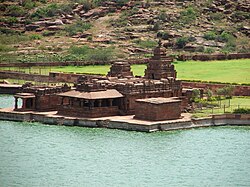
  • Agastya lake
    Agastya lake
  • Yellamma temple at Badami, early phase construction, 11th century
    Yellamma temple at Badami, early phase construction, 11th century
  • Bhutanatha group of temples facing the Agasythya Tank
    Bhutanatha group of temples facing the Agasythya Tank
  • Mallikarjuna group of temples
    Mallikarjuna group of temples
  • Markaj Jumma in Badami
    Markaj Jumma in Badami
  • Northern Fort Temple
    Northern Fort Temple
  • Floor plans of the 8th-century Bhutanatha temple near the lake
    Floor plans of the 8th-century Bhutanatha temple near the lake
  • Mallegitti Shivalaya on the top of a rock, best preserved Dravida architecture in Badami
    Mallegitti Shivalaya on the top of a rock, best preserved Dravida architecture in Badami
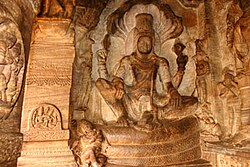
  • Vishnu seated on Adishesha
    Vishnu seated on Adishesha
  • Brahma on Hamsa in Cave 3 ceiling
    Brahma on Hamsa in Cave 3 ceiling
  • Bahubali in cave 4
    Bahubali in cave 4
  • Jain Parshvanatha in cave 4
    Jain Parshvanatha in cave 4
  • Vishnu, Shiva and Brahma in a small rock carving monument
    Vishnu, Shiva and Brahma in a small rock carving monument
  • Hindu reliefs on a Badami boulder
    Hindu reliefs on a Badami boulder
  • Some Badami cave monuments show evidence of paintings
    Some Badami cave monuments show evidence of paintings

Administration

[edit]

Taluks

[edit]

The Badami Taluka has thirty-four panchayat villages:[14]

  • Adagal
  • Anawal
  • Belur
  • Cholachagudda
  • Fakirbhudihal
  • Haldur
  • Halkurki
  • Hansanur
  • Hebbali
  • Hosur
  • Huligeri
  • Hullikeri
  • Jalihal
  • Jamankatti
  • Kaknur
  • Katageri
  • Kataraki
  • Kelavadi
  • Khanapur S.K.
  • Kittali
  • Kotikal
  • Layadgundi
  • Mamtageri
  • Mangalore
  • Mustigeri
  • Mutalgeri
  • Nagaral S.P.
  • Nandikeshwar
  • Neelgund
  • Neeralkeri
  • Neerbhudihal
  • Parvati
  • Pattadkal
  • Sulikeri

Geography

[edit]
Badami Taluk Map before creation of Guledgud Taluk
Badami Taluk ZP Constituency Map before creation of Guledgud Taluk

Badami is located at 15°55′N 75°41′E / 15.92°N 75.68°E / 15.92; 75.68.[15] It has an average elevation of 586 metres (1922 ft). It is located at the mouth of a ravine between two rocky hills and surrounds Agastya tirtha water reservoir on the three other sides. The total area of the town is 10.3 square kilometers.

It is located 30 kilometers from Bagalkot, 128 kilometers from Bijapur, 132 kilometers from Hubli, 46 kilometers from Aihole, another ancient town, and 589 kilometers from Bangalore,[16] the state capital.

Climate

[edit]
  • Summer – March to June
  • Spring – Jan to March
  • Monsoons – July to October that contributes to rainfall
  • Winter – November to February

The temperature ranges from a minimum 22 degrees to a maximum 40 degrees in summer and from 14 to 29 degrees in winter. The average rainfall is around 68 cm (680 mm). The best time to visit Badami is considered to be between the low-humid season from November to March.

The climate of Badami has made it a safe haven for the monkeys of southern India. Tourists often flock to Badami for the opportunity to see monkeys interact in a natural environment.

Demographics

[edit]

As of the 2011 Indian Census, Badami had a total population of 30,943, of which 15,539 were males and 15,404 were females. The population within the age group of 0 to 6 years was 3,877. The total number of literates in Badami was 22,093, which constituted 71.4% of the population with male literacy of 78.1% and female literacy of 64.7%. The effective literacy rate of 7+ population of Badami was 81.6%, of which male literacy rate was 89.7% and female literacy rate was 73.6%. The Scheduled Castes and Scheduled Tribes population was 4,562 and 1,833 respectively. Badami had 6214 households in 2011.[1]

As of the 2001 Indian census[update],[17] Badami had a population of 25,851. Males constituted 51% of the population and females 49%. Badami had an average literacy rate of 64.8%, comparable to the national average of 65%; with 59% of the males and 41% of females literate. 14% of the population was under 6 years of age.

The main language spoken is Kannada.

Panoramic view of Agastya Teertha, Badami.

Climbing

[edit]

Badami's red sandstone cliffs are popular amongst local and international climbers. This is popular location for free sport climbing and bouldering. The cliffs have a horizontal crack systems, similar to Gunks. There are over 150 bolted routes and multiple routes for free climbing. Gerhard Schaar,[18] a German Climber and Pranesh Manchaiah, a local climber from Bangalore, were instrumental in setting up the sport routes by driving a project called 'Bolts for Bangalore'.[19]

See also

[edit]
  • Aihole
  • Badami Cave Temples
  • Badami Chalukya Architecture
  • Banashankari Amma Temple at Cholachagudd
  • Chalukya
  • Climbing locations in India
  • Gadag
  • Indian rock-cut architecture
  • List of State Protected Monuments in Karnataka
  • Lakkundi
  • Mahakuta
  • Sidlaphadi
  • North Karnataka
  • Pattadakal
  • Pulakeshin II
  • Siege of Badami
  • Sivagamiyin sabadham
  • Sudi
  • Tourism in Karnataka
  • Dravidian architecture - Badami Chalukyas
  • Hindu temple architecture - Badami Chalukya architecture
  • Political history of medieval Karnataka - Badami Chalukyas
  • Architecture of Karnataka - Badami Chalukya architecture
  • Chalukyas of Badami[broken anchor]

References

[edit]
  1. ^ a b "Census of India: Badami". www.censusindia.gov.in. Retrieved 14 December 2019.
  2. ^ "52nd REPORT OF THE COMMISSIONER FOR LINGUISTIC MINORITIES IN INDIA" (PDF). nclm.nic.in. Ministry of Minority Affairs. p. 18. Archived from the original (PDF) on 25 May 2017. Retrieved 24 December 2018.
  3. ^ M. A. Dhaky; Michael W. Meister (1983). Encyclopaedia of Indian Temple Architecture: Volume 1 Part 2 South India Text & Plates. University of Pennsylvania Press. pp. 3–8 and 57, ISBN 978-0-8122-7992-4
  4. ^ Julia Hegewald (2001), Water Architecture in South Asia: A Study of Types, Developments and Meanings, Brill Academic, ISBN 978-90-04-12352-6, pp. 85–91
  5. ^ a b Michell, George (2014). Temple Architecture and Art of the Early Chalukyas. India : Niyogi Books. pp. 12–17. ISBN 978-93-83098-33-0.
  6. ^ Kanisetti, Anirudh (2022). Lords of the Deccan. New Delhi: Juggernaut Books. ISBN 9789391165055.
  7. ^ Michell, George (2014). Temple Architecture and Art of the Early Chalukyas. India : Niyogi Books. pp. 15–17, 32–39. ISBN 978-93-83098-33-0.
  8. ^ Michell, George (2014). Temple Architecture and Art of the Early Chalukyas. India : Niyogi Books. pp. 64–65. ISBN 978-93-83098-33-0.
  9. ^ Dr. Suryanath U. Kamath (2001), A Concise History of Karnataka from pre-historic times to the present, Jupiter books, MCC (Reprinted 2002), p9, p10, 57, p59 OCLC: 7796041
  10. ^ K.V. Ramesh, Chalukyas of Vatapi, 1984, Agam Kala Prakashan, p34, p46, p50
  11. ^ Azmathulla Shariff. "Badami Chalukyans' magical transformation". Deccan Herald, Spectrum, July 26, 2005. Archived from the original on 7 October 2006. Retrieved 10 November 2006.
  12. ^ Stella Kramrisch (1932), Paintings at Badami, Journal of Indian Society for Oriental Art, Volume IV, Number 1, pp. 57–61
  13. ^ KV Soundara Rajan (1981), Cave Temples of the Deccan: Number 3, Archaeological Survey of India, pp. 64–65 with Plate XV that presents a part of the Badami mural
  14. ^ "Reports of National Panchayat Directory: Village Panchayat Names of Badami, Bagalkot, Karnataka". Registrar General & Census Commissioner, India. Archived from the original on 13 November 2011. Retrieved 10 April 2013.
  15. ^ "Falling Rain Genomics, Inc. - Badami". Fallingrain.com. Retrieved 12 February 2013.
  16. ^ Railway ticket (Bijapur express) from Bangalore to Badami
  17. ^ "Census of India 2001: Data from the 2001 Census, including cities, villages and towns (Provisional)". Census Commission of India. Archived from the original on 16 June 2004. Retrieved 1 November 2008.
  18. ^ "Gerhard Schaar Official". gerhardschaar.com. Archived from the original on 28 September 2015. Retrieved 15 October 2015.
  19. ^ "Bolts for Bangalore". Climbing.com. Archived from the original on 12 March 2012. Retrieved 15 January 2012.

External links

[edit]
Wikiquote has quotations related to Badami.
Wikimedia Commons has media related to Badami.
Wikivoyage has a travel guide for Badami.
  • Museum at Badami, ASI Dharwad
  • Malegitti Shivalaya, ASI Dharwad
  • Agastya Lake and walls, ASI Dharwad
  • North Fort, Badami, ASI Dharwad
  • Lakulisa temple, Badami, ASI Dharwad
  • The Jain and Vaishnava Caves of Badami, ASI Dharwad
  • Bhutanath group of temples, Badami, ASI Dharwad
  • Bagalkot district info about Badami
  • v
  • t
  • e
Hindu inscriptions and arts
  • Hindu architecture and art glossary
Beginnings
(before
400 CE)
Arts, sculpture
  • Didarganj Yakshi
  • Pompeii Lakshmi
Archaeological sites
  • Mathura
  • Bet Dwarka
  • Dihar
  • Kumhrar
  • Pandu Rajar Dhibi
Inscriptions
  • Ayodhya
  • Hathibada Ghosundi
  • Heliodorus pillar
  • Lakulisa Mathura
  • Mora Well
  • Mountain Temple
  • Naneghat
  • Reh
  • Yavanarajya
  • Vasu Doorjamb
Hindu "Om" symbol
Maturity
(400-899 CE)
Arts, sculpture
  • Nataraja
Archaeological sites
  • Aihole
  • Badami
  • Besnagar
  • Chandraketugarh
  • Sirpur
  • Ujjain
Inscriptions
  • Gadhwa Stone
  • Gopika Cave
  • Vadathika Cave
  • Mandasor Stone
  • Mandasor Pillar
Temples
400-599 CE
  • Udayagiri Caves
  • Bhumara Shiva
  • Dashavatara
  • Eran Vishnu
  • Nachna Parvati
  • Tigawa Devi
  • Gop Surya
  • Mandasor Shiva
  • Aihole Group
  • Badami Caves
  • Elephanta Caves
600-899 CE
  • Pattadakal Group
  • Bateshwar Madhya Pradesh
  • Teli ka Mandir
  • Chaturbhuj Gwalior
  • Masrur Himachal
  • Lakshana Devi
  • Alampur Telangana
    • Navabrahma
    • Papanasi
  • Ellora Caves
  • Somnath Gujarat
  • Dwarka Gujarat
  • Mahabalipuram Group
  • Sirpur Chhattisgarh
  • Srirangam
  • Meenakshi
Advanced
(900-1299 CE)
Archaeological sites
  • Belur
  • Halebidu
  • Madan Kamdev
  • Somanathapura
Temples
  • Brihadisvara Thanjavur
  • Brihadisvara Gangaikondacholapuram
  • Airavatesvara Darasuram
  • Chennakeshava Belur
  • Chennakesava Somanathapura
  • Hoysaleswara Halebidu
  • Udupi Krishna
  • Nataraja Chidambaram
  • Tirupati
  • Modhera Gujarat
  • Dewark Sun Temple
  • Khajuraho
  • Jageshwar Uttarakhand
  • Sasbahu Gwalior
  • Konark Sun
  • Jagannath Puri
Revival
(1400-1799 CE)
Archaeological sites
  • Hampi
Related
  • Hindu
  • Denominations
  • Iconography
  • Pilgrimage sites
  • Hinduism by country
Note:
  • The above list of archaeological sites, inscriptions and temples is grossly incomplete.
  • Category
  • Portal
  • v
  • t
  • e
Tourism in India
By state
  • Andhra Pradesh
  • Andaman and Nicobar Islands
  • Assam
  • Bihar
  • Delhi
  • Chhattisgarh
  • Goa
  • Gujarat
  • Himachal Pradesh
  • Jammu and Kashmir
  • Jharkhand
  • Haryana
  • Karnataka
  • Kerala
  • Ladakh
  • Madhya Pradesh
  • Maharashtra
  • Mizoram
  • Northeast India
  • Odisha
  • Puducherry
  • Punjab
  • Rajasthan
  • Telangana
  • Tamil Nadu
  • Uttar Pradesh
  • Uttarakhand
  • West Bengal
By city
  • Agra
  • Ahmedabad
  • Aurangabad
  • Bangalore
  • Bhopal
  • Chandigarh
  • Chennai
  • Coimbatore
  • Dehradun
  • Delhi
  • Gwalior
  • Hyderabad
  • Jabalpur
  • Jaipur
  • Kochi
  • Kolkata
  • Kozhikode
  • Lucknow
  • Madurai
  • Mumbai
  • Mysore
  • Patna
  • Prayagraj
  • Pune
  • Surat
  • Thiruvananthapuram
  • Tiruchirappalli
  • Udaipur
  • Vadodara
  • Varanasi
  • Vellore
  • Vijayawada
  • Visakhapatnam
Types
  • Atomic
  • Ayurvedic
  • Medical
  • Sport
  • Yoga
Sites
Archaeological
  • Archaeoastronomical Sites
  • Buildings
  • Cave Paintings
  • Dolmens
  • Forts
  • Fossil Parks
  • Geological Monuments
  • Ghats
  • Menhirs
  • Monuments
  • Museums
  • National Heritage Sites
  • Pilgrimage sites
  • Rock-cut Temples
  • Sculptures
  • Statues
  • Stepwells
  • Structures
  • World Heritage Sites
Nature
  • Beaches
  • Caves
  • Coral Reefs
  • Hill stations
  • Islands
  • Lakes
  • Mountains
  • Rivers
  • Waterfalls
Wildlife
  • National Parks
  • Protected Areas
  • Sacred Groves
  • Tiger Reserves
Culture
  • Atithi Devo Bhava
  • Cinema
  • Cuisine
  • Festivals
  • Indian diaspora
  • Indianisation
  • Indosphere
  • Languages
  • Namaste
  • Religion
  • Sarva Dharma Sama Bhava
Transport
  • Aerial Tramways
  • Airports
  • Borders
  • Bridges
  • Ghat Roads
  • Railway
    • Luxury Trains
    • Mountain Railways
Agencies
  • India Tourism Development Corporation
  • Andhra Pradesh Tourism Development Corporation
  • Assam Tourism Development Corporation
  • Bihar State Tourism Development Corporation
  • Delhi Tourism and Transportation Development Corporation
  • Gujarat Tourism
  • Haryana Tourism Corporation
  • Jammu and Kashmir Tourism Development Corporation
  • Kerala Tourism Development Corporation
  • Madhya Pradesh Tourism Development Corporation
  • Maharashtra Tourism Development Corporation
  • Odisha Tourism Development Corporation
  • Rajasthan Tourism Development Corporation
  • Tamil Nadu Tourism Development Corporation
  • Telangana State Tourism Development Corporation
  • Uttar Pradesh Tourism
  • West Bengal Tourism Development Corporation
Related
  • History
  • Incredible India
  • Visa policy
  • Category
  • Commons
  • v
  • t
  • e
Historical Places in Karnataka
  • Aihole
  • Amruthapura
  • Aralaguppe
  • Avani
  • Badami
  • Balligavi
  • Banavasi
  • Basaralu
  • Belavadi
  • Belur
  • Bidar
  • Bijapur
  • Chaudayyadanapura
  • Chitradurga
  • Dambal
  • Dharmasthala
  • Gadag
  • Galaganatha
  • Gokarna
  • Halasi
  • Halebidu
  • Hampi
  • Hangal
  • Ikkeri
  • Kanakagiri
  • Karkala
  • Keladi
  • Kittur
  • Kolar
  • Kollur
  • Kukke Subramanya
  • Kuknur
  • Lakkundi
  • Lakshmeshwara
  • Itagi
  • Mahakuta
  • Melkote
  • Moodabidri
  • Mudgal
  • Murudeshwara
  • Mysore
  • Pattadakal
  • Raichur
  • Shivamogga
  • Shravanabelagola
  • Shringeri
  • Somanathapura
  • Sudi
  • Talakad
  • Udupi
  • v
  • t
  • e
Historical places of Chalukyas
Karnataka
  • Badami
  • Aihole
  • Pattadakal
  • Mahakuta
  • Sudi
  • Banashankari
  • Lakkundi
  • Dambal
  • Gadag
  • Mahadeva Temple, Itagi
  • Lakshmeshwara
  • Annigeri
  • Kundgol
  • Chaudayyadanapura
  • Galaganatha
  • Hangal
  • Hooli
  • Jalasangvi
  • Basavakalyan
  • Manyakheta
  • Chandramouleshwara Temple Unkal Hubli-Dharwad
  • Haveri
  • Kuruvatti
Maharashtra
  • Elephanta Caves
  • Ajanta cave #1 paintings
  • Sangli
  • Sangli State
  • Hottal near Deglur
  • Kolhapur
  • Latur
  • Dhule
  • Solapur
  • Manapura
  • Mumbai
  • Akola
  • Nanded
  • Hottal in Nanded District
  • Naldurg
  • Aurad
  • Omerga
  • Daitya Sudan temple
  • Shiva temples at Pen
  • Naldurg
Telangana
  • Bhadrakali Temple in Warangal
  • Someshwara temple in Warangal
  • Thousand Pillar Temple in Hanamakonda
  • Ramappa Temple near Warangal
  • Alampur, Mahbubnagar
  • Panagal
  • Bhongir Fort
  • Kulpakji and Jangaon, Warangal
Andhra Pradesh
  • Chebrolu, Guntur district
  • Eluru
  • Kolletikota
  • Nidumolu
  • Rajahmundry
  • Vengi
  • Terela village in Durgi mandal in Guntur district
Authority control databases Edit this at Wikidata
International
  • VIAF
  • GND
National
  • United States
  • Israel
Other
  • Yale LUX
  • v
  • t
  • e
Seal of Karnataka State of Karnataka
Capital: Bengaluru
Overview
  • Emblem of Karnataka
  • Architecture
    • Kadamba
    • Dravidian
    • Badami Chalukya
    • Western Chalukya
    • Hoysala
    • Vijayanagara
    • Inscriptions
      • Kannada
      • Halmidi
      • Shravanabelagola
      • Atakur
      • Doddahundi nishidhi
  • Cuisine
    • Udupi
  • Economy
  • Education
  • Geography
  • Religion
    • Hinduism
      • Lingayats
    • Buddhism in North Karnataka
  • Jainism
    • In North Karnataka
  • Sports
  • Transportation
  • Wildlife
  • Karnataka Rajyotsava
History
  • Etymology
  • Political history of medieval Karnataka
  • Historical sites of North Karnataka
  • Ahmadnagar
  • Aihole
  • Alupa dynasty
  • Amoghavarsha
  • Badami
  • Banavasi
  • Balligavi
  • Berar
  • Belur
  • Bidar
  • Bijapur
  • Chalukya dynasty
  • Nayakas of Chitradurga
  • Deva Raya II
  • Durvinita
  • Halebidu
  • Halmidi
  • Hampi
  • Hoysala Empire
    • Hoysala Kingdom
  • Kadamba dynasty
  • Western Chalukya Empire
  • Nayakas of Keladi
  • Shivappa Nayaka
  • Kadamba dynasty
  • Kittur Chennamma
  • Kingdom of Mysore
  • Mayurasharma
  • Pattadakal
  • Pulakeshin II
  • Rashtrakuta Empire
  • Sringeri
  • Srirangapatna
  • Golconda
  • Tipu Sultan
  • Unification of Karnataka
  • Vijayanagara
    • Empire
      • Origin
    • Musicological nonet
    • Medieval city
    • Military
    • Haridasa
    • Battle of Raichur
    • Battle of Talikota
  • Vishnuvardhana
  • Veera Ballala II
  • Vikramaditya II
  • Vikramaditya VI
  • Western Ganga dynasty
  • History of Kodagu
    • Kodavas captivity
    • Kingdom of Coorg
    • Coorg State
    • Coorg War
  • Belagavi border dispute
Government
  • Governors
  • Chief Minister
  • Assembly
  • Council
  • Vidhana Soudha
  • Karnataka Public Works Department
Districts and divisions
Bangalore division
  • Bengaluru Urban
  • Bengaluru Rural
  • Chitradurga
  • Davanagere
  • Kolar
  • Shimoga
  • Tumakuru
  • Ramanagara
  • Chikkaballapura
Belagavi division
  • Bagalkot
  • Belagavi
  • Bijapur
  • Dharwad
  • Haveri
  • Gadag
  • Uttara Kannada
Kalaburagi division
  • Ballari
  • Bidar
  • Kalaburagi
  • Koppal
  • Raichur
  • Vijayanagara
  • Yadgir
Mysore division
  • Chamarajanagar
  • Chikmagalur
  • Dakshina Kannada
  • Hassan
  • Kodagu
  • Mandya
  • Mysore
  • Udupi
Geography
  • Districts
  • Dams and reservoirs
  • Taluks
  • Highest point
  • Bayalu Seeme
  • Malenadu
  • Kanara
  • Western Ghats
Culture
  • Museums
    • Janapada Loka
  • Bharatanatyam
  • Buta Kola
  • Bidriware
  • Channapatna toys
  • Chitrakala Parishat
  • Dollu Kunitha
  • Gaarudi Gombe
  • Ilkal sari
  • Kamsale
  • Kannada
  • Karnatik music
  • Kasuti
  • Khedda
  • Mysore Dasara
  • Togalu gombeyaata
  • Veeragase
  • Yakshagana
    • Yakshagana plays
    • Raga
    • Tala
    • Poetry
    • Bayalaata
    • Bells
    • Maddale
    • Chande
  • Kingdom of Mysore musicians
  • Bangalore
  • Mysore
  • Folk arts
    • Kamsale
  • Jaanapada
  • Haridasas and Carnatic music
  • Vasanta Habba
  • Aati kalenja
  • Buta Kola
  • Veeragase
  • Togalu Gombeyaata
  • Gaarudi Gombe
  • Tala-Maddale
  • Languages
    • Kannada
      • Grammar
      • Prosody
      • Old Kannada
    • Dialects
      • Arebhashe
      • Havigannada
      • Kundagannada
      • Bangalore Kannada
      • Mangalore Kannada
    • Byari
    • Kodava
    • Konkani
    • Kurumba
    • Sholaga
    • Tulu
    • Urali
Literature
  • Milestones
  • Epics
  • Medieval
  • Rashtrakuta
  • Western Ganga
  • Western Chalukya
  • Hoysala
  • Vijayanagara
  • Vachana
  • Haridasa
  • Modern Kannada
  • Mysore
  • Modern
  • Poetry
  • Dasa sahitya
  • Rashtrakuta
  • Extinct Kannada literature
  • Kannada Sahitya Parishat
  • Kannada Sahitya Sammelana
Demographics
  • Ethnic groups
  • Kannadigas
  • Tuluvas
  • Kodavas
  • Konkani
  • Veerashaiva
  • Kota Brahmins
  • Komarpant
  • Vokkaliga/Gowda
  • Kodagu Gowda
  • Tulu Gowda
  • Kunchitiga
  • List
Tourism
  • Beaches
  • Bangalore
  • Mangalore
  • Mysore
  • Main list
    • Bangalore circle
    • Belgaum
    • Bidar
    • Bijapur
    • Dharwad
    • Gulbarga
    • North Kanara
    • Raichur
  • State protected monuments
  • Forts
Media
  • Cinema
  • Newspapers
  • Magazines
  • Television
  • Radio
Retrieved from "https://teknopedia.ac.id/w/index.php?title=Badami&oldid=1334023230"
Categories:
  • Cities and towns in Bagalkot district
  • Former capital cities in India
  • Tourism in Karnataka
  • Climbing areas of India
Hidden categories:
  • Pages using gadget WikiMiniAtlas
  • Articles with short description
  • Short description is different from Wikidata
  • Use dmy dates from September 2019
  • Coordinates on Wikidata
  • Pages with Kannada IPA
  • Articles containing potentially dated statements from 2001
  • All articles containing potentially dated statements
  • Pages with broken anchors
  • Commons category link is on Wikidata

  • indonesia
  • Polski
  • العربية
  • Deutsch
  • English
  • Español
  • Français
  • Italiano
  • مصرى
  • Nederlands
  • 日本語
  • Português
  • Sinugboanong Binisaya
  • Svenska
  • Українська
  • Tiếng Việt
  • Winaray
  • 中文
  • Русский
Sunting pranala
url url url url url url url url url url url url url url url url url url url url url url url url url url url url url url url url url url url url url url url url url url url url url url url url url url url url url url url url url url url url url url url url url url url url url url url url url url url url url url url url url url url url url url url url url url url url url url url url url url url url url url url url url url url url url url url url url url url url url url url url url url url url url url url url url url url url url url url url url url url url url url url url url url url url url url url url url url url url url url url url url url url url url url url url url url url url url url url url url url url url url url url url url url url url url url url url url url url url url url url url url url url url url url url url url url url url url url url url url url url url url url url url url url url url url url url url url url url url url url url url url url url url url url url url url url url url url url url url url url url url url url url url url url url url url url url url url url url url url url url url url url url url url url url url url url url url url url url url url url url url url url url url url url url url url url url url url url url url url url url url url url url url url url url url url url url url url url url url url url url url url url url url url url url url url url url url url url url url url url url url url url url url url url url url url url url url url url url url url url url url url url url url url url url url url url url url url url url url url url url url url url url url url url url url url url url url url url url url url url url url url url url url url url url url url url url url url url url url url url url url url url url url url url url url url url url url url url url url url url url url url url url url url url url url url url url url url url url url url url url url url url url url url url url url url url url url url url url url url url url url url url url url url url url url url url url url url url url url url url url url url url url url url url url url url url url url url url url url url url url url url url url url url url url url url url url url url url url url url url url url url url url url url url url url url url url url url url url url url url url url url url url url url url url url url url url url url url url url url url url url url url url url url url url url url url url url url url url url url url url url url url url url url url url url url url url url url url url url url url url url url url url url url url url url url url url url url url url url url url url url url url url url url url url url url url url url url url url url url url url url url url url url url url url url url url url url url url url url url url url url url url url url url url url url url url url url url url url url url url url url url url url url url url url url url url url url url url url url url url url url url url url url url url url url url url url url url url url url url url url url url url url url url url url url url url url url url url url url url url url url url url url url url url url url url url url url url url url url url url url url url url url url url url url url url url url url url url url url url url url url url url url url url url url url url url url url url url url url url url url url url url url url url url url url url url url url url url url url url url url url url url url url url url url url url url url url url url url url url url url url url url url url url url url url url url url url url url url url url url url url url url url url url url url url url url url url url url url url url url url url url url url url url url url url url url url url url url url url url url url url url url url url url url url url url url url url url url url url url url url url url url url url url url url url url url url url url url url url url url url url url url url url url url url url url url url url url url url url url url url url url url url url url url url url url url url url url url url url url url url url url url url url url url url url url url url url url url url url url url url url url url url url url url url url url url url url url url url url url url url url url url url url url url url url url url url url url url url url url url url url url url url url url url url url url url url url url url url url url url url url url url url url url url url url url url url url url url url url url url url url url url url url url url url url url url url url url url url url url url url url url url url url url url url url url url url url url url url url url url url url url url url url url url url url url url url url url url url url url url url url url url url url url url url url url url url url url url url url url url url url url url url url url url url url url url url url url url url url url url url url url url url url url url url url url url url url url url url url url url url url url url url url url url url url url url url url url url url url url url url url url url url url url url url url url url url url url url url url url url url url url url url url url url url url url url url url url url url url url url url url url url url url url url url url url url url url url url url url url url url url url url url url url url url url url url url url url url url url url url url url url url url url url url url url url url url url url url url url url url url url url url url url url url url url url url url url url url url url url url url url url url url url url url url url url url url url url url url url url url url url url url url url url url url url url url url url url url url url url url url url url url url url url url url url url url url url url url url url url url url url url url url url url url url url url url url url url url url url url url url url url url url url url url url url url url url url url url url url url url url url url url url url url url url url url url url url url url url url url url url url url url url url url url url url url url url url url url url url url url url url url url url url url url url url url url url url url url url url url url url url url url url url url url url url url url url url url url url url url url url url url url url url url url url url url url url url url url url url url url url url url url url url url url url url url url url url url url url url url url url url url url url url url url url url url url url url url url url url url url url url url url url url url url url url url url url url url url url url url url url url url url url url url url url url url url url url url url url url url url url url url url url url url url url url url url url url url url url url url url url url url url url url url url url url url url url url url url url url url url url url url url url url url url url url url url url url url url url url url url url url url url url url url url url url url url url url url url url url url url url url url url url url url url url url url url url url url url url url url url url url url url url url url url url url url url url url url url url url url url url url url url url url url url url url url url url url url url url url url url url url url url url url url url url url url url url url url url url url url url url url url url url url url url url url url url url url url url url url url url url url url url url url url url url url url url url url url url url url url url url url url url url url url url url url url url url url url url url url url url url url url url url url url url url url url url url url url url url url url url url url url url url url url url url url url url url url url url url url url url url url url url url url url url url url url url url url url url url url url url url url url url url url url url url url url url url url url url url url url url url url url url url url url url url url url url url url url url url url url url url url url url url url url url url url url url url url url url url url url url url url url url url url url url url url url url url url url url url url url url url url url url url url url url url url url url url url url url url url url url url url url url url url url url url url url url url url url url url url url url url url url url url url url url url url url url url url url url url url url url url url url url url url url url url url url url url url url url url url url url url url url url url url url url url url url url url url url url url url url url url url url url url url url url url url url url url url url url url url url url url url url url url url url url url url url url url url url url url url url url url url url url url url url url url url url url url url url url url url url url url url url url url url url url url url url url url url url url url url url url url url url url url url url url url url url url url url url url url url url url url url url url url url url url url url url url url url url url url url url url url url url url url url url url url url url url url url url url url url url url url url url url url url url url url url url url url url url url url url url url url url url url url url url url url url url url url url url url url url url url url url url url url url url url url url url url url url url url url url url url url url url url url url url url url url url url url url url url url url url url url url url url url url url url url url url url url url url url url url url url url url url url url url url url url url url url url url url url url url url url url url url url url url url url url url url url url url url url url url url url url url url url url url url url url url url url url url url url url url url url url url url url url url
Pusat Layanan

UNIVERSITAS TEKNOKRAT INDONESIA | ASEAN's Best Private University
Jl. ZA. Pagar Alam No.9 -11, Labuhan Ratu, Kec. Kedaton, Kota Bandar Lampung, Lampung 35132
Phone: (0721) 702022
Email: pmb@teknokrat.ac.id