Epstein Files Full PDF

CLICK HERE
Technopedia Center
PMB University Brochure
Faculty of Engineering and Computer Science
S1 Informatics S1 Information Systems S1 Information Technology S1 Computer Engineering S1 Electrical Engineering S1 Civil Engineering

faculty of Economics and Business
S1 Management S1 Accountancy

Faculty of Letters and Educational Sciences
S1 English literature S1 English language education S1 Mathematics education S1 Sports Education
teknopedia

  • Registerasi
  • Brosur UTI
  • Kip Scholarship Information
  • Performance
Flag Counter
  1. World Encyclopedia
  2. Calorimetry - Wikipedia
Calorimetry - Wikipedia
From Wikipedia, the free encyclopedia
Determining heat transfer in a system by measuring its other properties
Not to be confused with Colorimetry or Colometry.
The world's first ice-calorimeter, used in the winter of 1782–83, by Antoine Lavoisier and Pierre-Simon Laplace, to determine the heat involved in various chemical changes; calculations which were based on Joseph Black's prior discovery of latent heat. These experiments mark the foundation of thermochemistry.
Snellen direct calorimetry chamber, University of Ottawa[1]
Indirect calorimetry metabolic cart measuring oxygen uptake and CO2 production of a spontaneously breathing subject (dilution method with canopy hood).

In chemistry and thermodynamics, calorimetry (from Latin calor 'heat' and Greek μέτρον (metron) 'measure') is the science or act of measuring changes in state variables of a body for the purpose of deriving the heat transfer associated with changes of its state due, for example, to chemical reactions, physical changes, or phase transitions under specified constraints. Calorimetry is performed with a calorimeter. Scottish physician and scientist Joseph Black, who was the first to recognize the distinction between heat and temperature, is said to be the founder of the science of calorimetry.[2]

Indirect calorimetry calculates heat that living organisms produce by measuring either their production of carbon dioxide and nitrogen waste (frequently ammonia in aquatic organisms, or urea in terrestrial ones), or from their consumption of oxygen. Lavoisier noted in 1780 that heat production can be predicted from oxygen consumption this way, using multiple regression. The dynamic energy budget theory explains why this procedure is correct. Heat generated by living organisms may also be measured by direct calorimetry, in which the entire organism is placed inside the calorimeter for the measurement.

A widely used modern instrument is the differential scanning calorimeter, a device which allows thermal data to be obtained on small amounts of material. It involves heating the sample at a controlled rate and recording the heat flow either into or from the specimen.

History

[edit]

The concept of heat has intrigued scientists for more than 2500 years. In the Graeco-Roman era, Plato and Aristotle regarded heat as a manifestation of fire. Newton proposed that it was transmitted by vibrations of the particles of aether, while Descartes described it as an accelerated motion of air particles induced by light. Robert Hooke viewed heat as a property of matter arising from the motion of its parts. For centuries, the prevailing theory imagined heat as a self-repelling, weightless fluid called "caloric".[3]

The measurement of heat began to take shape about three centuries ago. In 1750, Georg Wilhelm Richmann formulated the first general calorimetric equation, later known as Richmann's law, allowing calculation of the equilibrium temperature of mixed substances of the same kind. A decade later, Joseph Black made a decisive contribution: in 1761, he discovered that adding heat to ice at its melting point or to boiling water did not change their temperature. His identification of latent and specific heat marked the birth of thermodynamics and introduced the distinction between heat and temperature.[3]

In 1789, Antoine Lavoisier and Pierre-Simon Laplace constructed the first calorimeter, launching quantitative calorimetry. The next major advance came from Sir Benjamin Thompson in the 1790s. Observing heat generated during cannon boring under water, he concluded that heat must be a form of energy, not a material substance.[3]

This idea was quantified by James Prescott Joule, who in the 1840s determined the mechanical equivalent of heat. Using falling weights to drive a paddle in an insulated liquid, Joule demonstrated that 4.184 joules of work produce the same heating effect as one calorie, establishing a numerical link between mechanical work and thermal energy.[3]

Around the same time, in 1840, the chemist Germain Henri Hess formulated Hess's law, showing that the total enthalpy change of a chemical reaction is independent of the reaction path. This principle remains fundamental to modern thermochemistry and calorimetry.[3]

Finally, in the 1870s, Pierre Eugène Berthelot developed the first modern bomb calorimeter and introduced the concepts of endothermic and exothermic reactions.[3]

Classical calorimetric calculation of heat

[edit]

Cases with differentiable equation of state for a one-component body

[edit]

Basic classical calculation with respect to volume

[edit]

Calorimetry requires that a reference material that changes temperature have known definite thermal constitutive properties. The classical rule, recognized by Clausius and Kelvin, is that the pressure exerted by the calorimetric material is fully and rapidly determined solely by its temperature and volume; this rule is for changes that do not involve phase change, such as melting of ice. There are many materials that do not comply with this rule, and for them, the present formula of classical calorimetry does not provide an adequate account. Here the classical rule is assumed to hold for the calorimetric material being used, and the propositions are mathematically written:

The thermal response of the calorimetric material is fully described by its pressure p   {\displaystyle p\ } {\displaystyle p\ } as the value of its constitutive function p ( V , T )   {\displaystyle p(V,T)\ } {\displaystyle p(V,T)\ } of just the volume V   {\displaystyle V\ } {\displaystyle V\ } and the temperature T   {\displaystyle T\ } {\displaystyle T\ }. All increments are here required to be very small. This calculation refers to a domain of volume and temperature of the body in which no phase change occurs, and there is only one phase present. An important assumption here is continuity of property relations. A different analysis is needed for phase change

When a small increment of heat is gained by a calorimetric body, with small increments, δ V   {\displaystyle \delta V\ } {\displaystyle \delta V\ } of its volume, and δ T   {\displaystyle \delta T\ } {\displaystyle \delta T\ } of its temperature, the increment of heat, δ Q   {\displaystyle \delta Q\ } {\displaystyle \delta Q\ }, gained by the body of calorimetric material, is given by

δ Q   = C T ( V ) ( V , T ) δ V + C V ( T ) ( V , T ) δ T {\displaystyle \delta Q\ =C_{T}^{(V)}(V,T)\,\delta V\,+\,C_{V}^{(T)}(V,T)\,\delta T} {\displaystyle \delta Q\ =C_{T}^{(V)}(V,T)\,\delta V\,+\,C_{V}^{(T)}(V,T)\,\delta T}

where

C T ( V ) ( V , T )   {\displaystyle C_{T}^{(V)}(V,T)\ } {\displaystyle C_{T}^{(V)}(V,T)\ } denotes the latent heat with respect to volume, of the calorimetric material at constant controlled temperature T {\displaystyle T} {\displaystyle T}. The surroundings' pressure on the material is instrumentally adjusted to impose a chosen volume change, with initial volume V   {\displaystyle V\ } {\displaystyle V\ }. To determine this latent heat, the volume change is effectively the independently instrumentally varied quantity. This latent heat is not one of the widely used ones, but is of theoretical or conceptual interest.
C V ( T ) ( V , T )   {\displaystyle C_{V}^{(T)}(V,T)\ } {\displaystyle C_{V}^{(T)}(V,T)\ } denotes the heat capacity, of the calorimetric material at fixed constant volume V   {\displaystyle V\ } {\displaystyle V\ }, while the pressure of the material is allowed to vary freely, with initial temperature T   {\displaystyle T\ } {\displaystyle T\ }. The temperature is forced to change by exposure to a suitable heat bath. It is customary to write C V ( T ) ( V , T )   {\displaystyle C_{V}^{(T)}(V,T)\ } {\displaystyle C_{V}^{(T)}(V,T)\ } simply as C V ( V , T )   {\displaystyle C_{V}(V,T)\ } {\displaystyle C_{V}(V,T)\ }, or even more briefly as C V   {\displaystyle C_{V}\ } {\displaystyle C_{V}\ }. This latent heat is one of the two widely used ones.[4][5][6][7][8][9][10]

The latent heat with respect to volume is the heat required for unit increment in volume at constant temperature. It can be said to be 'measured along an isotherm', and the pressure the material exerts is allowed to vary freely, according to its constitutive law p = p ( V , T )   {\displaystyle p=p(V,T)\ } {\displaystyle p=p(V,T)\ }. For a given material, it can have a positive or negative sign or exceptionally it can be zero, and this can depend on the temperature, as it does for water about 4 C.[11][12][13][14] The concept of latent heat with respect to volume was perhaps first recognized by Joseph Black in 1762.[15] The term 'latent heat of expansion' is also used.[16] The latent heat with respect to volume can also be called the 'latent energy with respect to volume'. For all of these usages of 'latent heat', a more systematic terminology uses 'latent heat capacity'.

The heat capacity at constant volume is the heat required for unit increment in temperature at constant volume. It can be said to be 'measured along an isochor', and again, the pressure the material exerts is allowed to vary freely. It always has a positive sign. This means that for an increase in the temperature of a body without change of its volume, heat must be supplied to it. This is consistent with common experience.

Quantities like δ Q   {\displaystyle \delta Q\ } {\displaystyle \delta Q\ } are sometimes called 'curve differentials', because they are measured along curves in the ( V , T )   {\displaystyle (V,T)\ } {\displaystyle (V,T)\ } surface.

Classical theory for constant-volume (isochoric) calorimetry

[edit]

Constant-volume calorimetry is calorimetry performed at a constant volume. This involves the use of a constant-volume calorimeter. Heat is still measured by the above-stated principle of calorimetry.

This means that in a suitably constructed calorimeter, called a bomb calorimeter, the increment of volume δ V   {\displaystyle \delta V\ } {\displaystyle \delta V\ } can be made to vanish, δ V = 0   {\displaystyle \delta V=0\ } {\displaystyle \delta V=0\ }. For constant-volume calorimetry:

δ Q = C V δ T   {\displaystyle \delta Q=C_{V}\delta T\ } {\displaystyle \delta Q=C_{V}\delta T\ }

where

δ T   {\displaystyle \delta T\ } {\displaystyle \delta T\ } denotes the increment in temperature and
C V   {\displaystyle C_{V}\ } {\displaystyle C_{V}\ } denotes the heat capacity at constant volume.

Classical heat calculation with respect to pressure

[edit]

From the above rule of calculation of heat with respect to volume, there follows one with respect to pressure.[4][8][17][18]

In a process of small increments, δ p   {\displaystyle \delta p\ } {\displaystyle \delta p\ } of its pressure, and δ T   {\displaystyle \delta T\ } {\displaystyle \delta T\ } of its temperature, the increment of heat, δ Q   {\displaystyle \delta Q\ } {\displaystyle \delta Q\ }, gained by the body of calorimetric material, is given by

δ Q   = C T ( p ) ( p , T ) δ p + C p ( T ) ( p , T ) δ T {\displaystyle \delta Q\ =C_{T}^{(p)}(p,T)\,\delta p\,+\,C_{p}^{(T)}(p,T)\,\delta T} {\displaystyle \delta Q\ =C_{T}^{(p)}(p,T)\,\delta p\,+\,C_{p}^{(T)}(p,T)\,\delta T}

where

C T ( p ) ( p , T )   {\displaystyle C_{T}^{(p)}(p,T)\ } {\displaystyle C_{T}^{(p)}(p,T)\ } denotes the latent heat with respect to pressure, of the calorimetric material at constant temperature, while the volume and pressure of the body are allowed to vary freely, at pressure p   {\displaystyle p\ } {\displaystyle p\ } and temperature T   {\displaystyle T\ } {\displaystyle T\ };
C p ( T ) ( p , T )   {\displaystyle C_{p}^{(T)}(p,T)\ } {\displaystyle C_{p}^{(T)}(p,T)\ } denotes the heat capacity, of the calorimetric material at constant pressure, while the temperature and volume of the body are allowed to vary freely, at pressure p   {\displaystyle p\ } {\displaystyle p\ } and temperature T   {\displaystyle T\ } {\displaystyle T\ }. It is customary to write C p ( T ) ( p , T )   {\displaystyle C_{p}^{(T)}(p,T)\ } {\displaystyle C_{p}^{(T)}(p,T)\ } simply as C p ( p , T )   {\displaystyle C_{p}(p,T)\ } {\displaystyle C_{p}(p,T)\ }, or even more briefly as C p   {\displaystyle C_{p}\ } {\displaystyle C_{p}\ }.

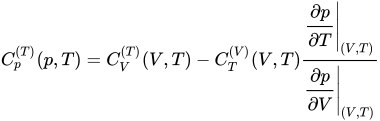
The new quantities here are related to the previous ones:[4][8][18][19]
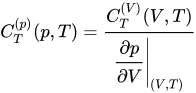
C T ( p ) ( p , T ) = C T ( V ) ( V , T ) ∂ p ∂ V | ( V , T ) {\displaystyle C_{T}^{(p)}(p,T)={\frac {C_{T}^{(V)}(V,T)}{\left.{\cfrac {\partial p}{\partial V}}\right|_{(V,T)}}}} {\displaystyle C_{T}^{(p)}(p,T)={\frac {C_{T}^{(V)}(V,T)}{\left.{\cfrac {\partial p}{\partial V}}\right|_{(V,T)}}}}
C p ( T ) ( p , T ) = C V ( T ) ( V , T ) − C T ( V ) ( V , T ) ∂ p ∂ T | ( V , T ) ∂ p ∂ V | ( V , T ) {\displaystyle C_{p}^{(T)}(p,T)=C_{V}^{(T)}(V,T)-C_{T}^{(V)}(V,T){\frac {\left.{\cfrac {\partial p}{\partial T}}\right|_{(V,T)}}{\left.{\cfrac {\partial p}{\partial V}}\right|_{(V,T)}}}} {\displaystyle C_{p}^{(T)}(p,T)=C_{V}^{(T)}(V,T)-C_{T}^{(V)}(V,T){\frac {\left.{\cfrac {\partial p}{\partial T}}\right|_{(V,T)}}{\left.{\cfrac {\partial p}{\partial V}}\right|_{(V,T)}}}}

where

∂ p ∂ V | ( V , T ) {\displaystyle \left.{\frac {\partial p}{\partial V}}\right|_{(V,T)}} {\displaystyle \left.{\frac {\partial p}{\partial V}}\right|_{(V,T)}} denotes the partial derivative of p ( V , T )   {\displaystyle p(V,T)\ } {\displaystyle p(V,T)\ } with respect to V   {\displaystyle V\ } {\displaystyle V\ } evaluated for ( V , T )   {\displaystyle (V,T)\ } {\displaystyle (V,T)\ }

and

∂ p ∂ T | ( V , T ) {\displaystyle \left.{\frac {\partial p}{\partial T}}\right|_{(V,T)}} {\displaystyle \left.{\frac {\partial p}{\partial T}}\right|_{(V,T)}} denotes the partial derivative of p ( V , T )   {\displaystyle p(V,T)\ } {\displaystyle p(V,T)\ } with respect to T   {\displaystyle T\ } {\displaystyle T\ } evaluated for ( V , T )   {\displaystyle (V,T)\ } {\displaystyle (V,T)\ }.

The latent heats C T ( V ) ( V , T )   {\displaystyle C_{T}^{(V)}(V,T)\ } {\displaystyle C_{T}^{(V)}(V,T)\ } and C T ( p ) ( p , T )   {\displaystyle C_{T}^{(p)}(p,T)\ } {\displaystyle C_{T}^{(p)}(p,T)\ } are always of opposite sign.[20]

It is common to refer to the ratio of specific heats as
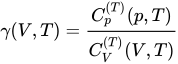
γ ( V , T ) = C p ( T ) ( p , T ) C V ( T ) ( V , T ) {\displaystyle \gamma (V,T)={\frac {C_{p}^{(T)}(p,T)}{C_{V}^{(T)}(V,T)}}} {\displaystyle \gamma (V,T)={\frac {C_{p}^{(T)}(p,T)}{C_{V}^{(T)}(V,T)}}} often just written as γ = C p C V {\displaystyle \gamma ={\frac {C_{p}}{C_{V}}}} {\displaystyle \gamma ={\frac {C_{p}}{C_{V}}}}.[21][22]

Calorimetry through phase change, equation of state shows one jump discontinuity

[edit]

An early calorimeter was that used by Laplace and Lavoisier, as shown in the figure above. It worked at constant temperature, and at atmospheric pressure. The latent heat involved was then not a latent heat with respect to volume or with respect to pressure, as in the above account for calorimetry without phase change. The latent heat involved in this calorimeter was with respect to phase change, naturally occurring at constant temperature. This kind of calorimeter worked by measurement of mass of water produced by the melting of ice, which is a phase change.

Cumulation of heating

[edit]

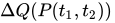
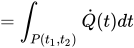
For a time-dependent process of heating of the calorimetric material, defined by a continuous joint progression P ( t 1 , t 2 )   {\displaystyle P(t_{1},t_{2})\ } {\displaystyle P(t_{1},t_{2})\ } of V ( t )   {\displaystyle V(t)\ } {\displaystyle V(t)\ } and T ( t )   {\displaystyle T(t)\ } {\displaystyle T(t)\ }, starting at time t 1   {\displaystyle t_{1}\ } {\displaystyle t_{1}\ } and ending at time t 2   {\displaystyle t_{2}\ } {\displaystyle t_{2}\ }, there can be calculated an accumulated quantity of heat delivered, Δ Q ( P ( t 1 , t 2 ) ) {\displaystyle \Delta Q(P(t_{1},t_{2}))\,} {\displaystyle \Delta Q(P(t_{1},t_{2}))\,} . This calculation is done by mathematical integration along the progression with respect to time. This is because increments of heat are 'additive'; but this does not mean that heat is a conservative quantity. The idea that heat was a conservative quantity was invented by Lavoisier, and is called the 'caloric theory'; by the middle of the nineteenth century it was recognized as mistaken. Written with the symbol Δ   {\displaystyle \Delta \ } {\displaystyle \Delta \ }, the quantity Δ Q ( P ( t 1 , t 2 ) ) {\displaystyle \Delta Q(P(t_{1},t_{2}))\,} {\displaystyle \Delta Q(P(t_{1},t_{2}))\,} is not at all restricted to be an increment with very small values; this is in contrast with δ Q   {\displaystyle \delta Q\ } {\displaystyle \delta Q\ }.

One can write

Δ Q ( P ( t 1 , t 2 ) )   {\displaystyle \Delta Q(P(t_{1},t_{2}))\ } {\displaystyle \Delta Q(P(t_{1},t_{2}))\ }
= ∫ P ( t 1 , t 2 ) Q ˙ ( t ) d t {\displaystyle =\int _{P(t_{1},t_{2})}{\dot {Q}}(t)dt} {\displaystyle =\int _{P(t_{1},t_{2})}{\dot {Q}}(t)dt}
= ∫ P ( t 1 , t 2 ) C T ( V ) ( V , T ) V ˙ ( t ) d t + ∫ P ( t 1 , t 2 ) C V ( T ) ( V , T ) T ˙ ( t ) d t {\displaystyle =\int _{P(t_{1},t_{2})}C_{T}^{(V)}(V,T)\,{\dot {V}}(t)\,dt\,+\,\int _{P(t_{1},t_{2})}C_{V}^{(T)}(V,T)\,{\dot {T}}(t)\,dt} {\displaystyle =\int _{P(t_{1},t_{2})}C_{T}^{(V)}(V,T)\,{\dot {V}}(t)\,dt\,+\,\int _{P(t_{1},t_{2})}C_{V}^{(T)}(V,T)\,{\dot {T}}(t)\,dt}.

This expression uses quantities such as Q ˙ ( t )   {\displaystyle {\dot {Q}}(t)\ } {\displaystyle {\dot {Q}}(t)\ } which are defined in the section below headed 'Mathematical aspects of the above rules'.

Mathematical aspects of the above rules

[edit]

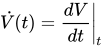
The use of 'very small' quantities such as δ Q   {\displaystyle \delta Q\ } {\displaystyle \delta Q\ } is related to the physical requirement for the quantity p ( V , T )   {\displaystyle p(V,T)\ } {\displaystyle p(V,T)\ } to be 'rapidly determined' by V   {\displaystyle V\ } {\displaystyle V\ } and T   {\displaystyle T\ } {\displaystyle T\ }; such 'rapid determination' refers to a physical process. These 'very small' quantities are used in the Leibniz approach to the infinitesimal calculus. The Newton approach uses instead 'fluxions' such as V ˙ ( t ) = d V d t | t {\displaystyle {\dot {V}}(t)=\left.{\frac {dV}{dt}}\right|_{t}} {\displaystyle {\dot {V}}(t)=\left.{\frac {dV}{dt}}\right|_{t}}, which makes it more obvious that p ( V , T )   {\displaystyle p(V,T)\ } {\displaystyle p(V,T)\ } must be 'rapidly determined'.

In terms of fluxions, the above first rule of calculation can be written[23]

Q ˙ ( t )   = C T ( V ) ( V , T ) V ˙ ( t ) + C V ( T ) ( V , T ) T ˙ ( t ) {\displaystyle {\dot {Q}}(t)\ =C_{T}^{(V)}(V,T)\,{\dot {V}}(t)\,+\,C_{V}^{(T)}(V,T)\,{\dot {T}}(t)} {\displaystyle {\dot {Q}}(t)\ =C_{T}^{(V)}(V,T)\,{\dot {V}}(t)\,+\,C_{V}^{(T)}(V,T)\,{\dot {T}}(t)}

where

t   {\displaystyle t\ } {\displaystyle t\ } denotes the time
Q ˙ ( t )   {\displaystyle {\dot {Q}}(t)\ } {\displaystyle {\dot {Q}}(t)\ } denotes the time rate of heating of the calorimetric material at time t   {\displaystyle t\ } {\displaystyle t\ }
V ˙ ( t )   {\displaystyle {\dot {V}}(t)\ } {\displaystyle {\dot {V}}(t)\ } denotes the time rate of change of volume of the calorimetric material at time t   {\displaystyle t\ } {\displaystyle t\ }
T ˙ ( t )   {\displaystyle {\dot {T}}(t)\ } {\displaystyle {\dot {T}}(t)\ } denotes the time rate of change of temperature of the calorimetric material.

The increment δ Q   {\displaystyle \delta Q\ } {\displaystyle \delta Q\ } and the fluxion Q ˙ ( t )   {\displaystyle {\dot {Q}}(t)\ } {\displaystyle {\dot {Q}}(t)\ } are obtained for a particular time t   {\displaystyle t\ } {\displaystyle t\ } that determines the values of the quantities on the righthand sides of the above rules. But this is not a reason to expect that there should exist a mathematical function Q ( V , T )   {\displaystyle Q(V,T)\ } {\displaystyle Q(V,T)\ }. For this reason, the increment δ Q   {\displaystyle \delta Q\ } {\displaystyle \delta Q\ } is said to be an 'imperfect differential' or an 'inexact differential'.[24][25][26] Some books indicate this by writing q   {\displaystyle q\ } {\displaystyle q\ } instead of δ Q   {\displaystyle \delta Q\ } {\displaystyle \delta Q\ }.[27][28] Also, the notation đQ is used in some books.[24][29] Carelessness about this can lead to error.[30]

The quantity Δ Q ( P ( t 1 , t 2 ) )   {\displaystyle \Delta Q(P(t_{1},t_{2}))\ } {\displaystyle \Delta Q(P(t_{1},t_{2}))\ } is properly said to be a functional of the continuous joint progression P ( t 1 , t 2 )   {\displaystyle P(t_{1},t_{2})\ } {\displaystyle P(t_{1},t_{2})\ } of V ( t )   {\displaystyle V(t)\ } {\displaystyle V(t)\ } and T ( t )   {\displaystyle T(t)\ } {\displaystyle T(t)\ }, but, in the mathematical definition of a function, Δ Q ( P ( t 1 , t 2 ) )   {\displaystyle \Delta Q(P(t_{1},t_{2}))\ } {\displaystyle \Delta Q(P(t_{1},t_{2}))\ } is not a function of ( V , T )   {\displaystyle (V,T)\ } {\displaystyle (V,T)\ }. Although the fluxion Q ˙ ( t )   {\displaystyle {\dot {Q}}(t)\ } {\displaystyle {\dot {Q}}(t)\ } is defined here as a function of time t   {\displaystyle t\ } {\displaystyle t\ }, the symbols Q   {\displaystyle Q\ } {\displaystyle Q\ } and Q ( V , T )   {\displaystyle Q(V,T)\ } {\displaystyle Q(V,T)\ } respectively standing alone are not defined here.

Physical scope of the above rules of calorimetry

[edit]

The above rules refer only to suitable calorimetric materials. The terms 'rapidly' and 'very small' call for empirical physical checking of the domain of validity of the above rules.

The above rules for the calculation of heat belong to pure calorimetry. They make no reference to thermodynamics, and were mostly understood before the advent of thermodynamics. They are the basis of the 'thermo' contribution to thermodynamics. The 'dynamics' contribution is based on the idea of work, which is not used in the above rules of calculation.

Experimentally conveniently measured coefficients

[edit]

Empirically, it is convenient to measure properties of calorimetric materials under experimentally controlled conditions.

Pressure increase at constant volume

[edit]

For measurements at experimentally controlled volume, one can use the assumption, stated above, that the pressure of the body of calorimetric material is can be expressed as a function of its volume and temperature.

For measurement at constant experimentally controlled volume, the isochoric coefficient of pressure rise with temperature, is defined by [31]
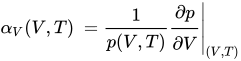
α V ( V , T )   = 1 p ( V , T ) ∂ p ∂ V | ( V , T ) {\displaystyle \alpha _{V}(V,T)\ ={\frac {1}{p(V,T)}}{\left.{\cfrac {\partial p}{\partial V}}\right|_{(V,T)}}} {\displaystyle \alpha _{V}(V,T)\ ={\frac {1}{p(V,T)}}{\left.{\cfrac {\partial p}{\partial V}}\right|_{(V,T)}}}

Expansion at constant pressure

[edit]

For measurements at experimentally controlled pressure, it is assumed that the volume V   {\displaystyle V\ } {\displaystyle V\ } of the body of calorimetric material can be expressed as a function V ( T , p )   {\displaystyle V(T,p)\ } {\displaystyle V(T,p)\ } of its temperature T   {\displaystyle T\ } {\displaystyle T\ } and pressure p   {\displaystyle p\ } {\displaystyle p\ }. This assumption is related to, but is not the same as, the above used assumption that the pressure of the body of calorimetric material is known as a function of its volume and temperature; anomalous behaviour of materials can affect this relation.

The quantity that is conveniently measured at constant experimentally controlled pressure, the isobar volume expansion coefficient, is defined by [31][32][33][34][35][36][37]
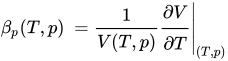
β p ( T , p )   = 1 V ( T , p ) ∂ V ∂ T | ( T , p ) {\displaystyle \beta _{p}(T,p)\ ={\frac {1}{V(T,p)}}{\left.{\cfrac {\partial V}{\partial T}}\right|_{(T,p)}}} {\displaystyle \beta _{p}(T,p)\ ={\frac {1}{V(T,p)}}{\left.{\cfrac {\partial V}{\partial T}}\right|_{(T,p)}}}

Compressibility at constant temperature

[edit]

For measurements at experimentally controlled temperature, it is again assumed that the volume V   {\displaystyle V\ } {\displaystyle V\ } of the body of calorimetric material can be expressed as a function V ( T , p )   {\displaystyle V(T,p)\ } {\displaystyle V(T,p)\ } of its temperature T   {\displaystyle T\ } {\displaystyle T\ } and pressure p   {\displaystyle p\ } {\displaystyle p\ }, with the same provisos as mentioned just above.

The quantity that is conveniently measured at constant experimentally controlled temperature, the isothermal compressibility, is defined by [32][33][34][35][36][37]
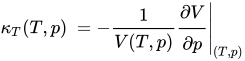
κ T ( T , p )   = − 1 V ( T , p ) ∂ V ∂ p | ( T , p ) {\displaystyle \kappa _{T}(T,p)\ =-{\frac {1}{V(T,p)}}{\left.{\cfrac {\partial V}{\partial p}}\right|_{(T,p)}}} {\displaystyle \kappa _{T}(T,p)\ =-{\frac {1}{V(T,p)}}{\left.{\cfrac {\partial V}{\partial p}}\right|_{(T,p)}}}

Relation between classical calorimetric quantities

[edit]

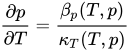
Assuming that the rule p = p ( V , T )   {\displaystyle p=p(V,T)\ } {\displaystyle p=p(V,T)\ } is known, one can derive the function of ∂ p ∂ T   {\displaystyle {\frac {\partial p}{\partial T}}\ } {\displaystyle {\frac {\partial p}{\partial T}}\ } that is used above in the classical heat calculation with respect to pressure. This function can be found experimentally from the coefficients β p ( T , p )   {\displaystyle \beta _{p}(T,p)\ } {\displaystyle \beta _{p}(T,p)\ } and κ T ( T , p )   {\displaystyle \kappa _{T}(T,p)\ } {\displaystyle \kappa _{T}(T,p)\ } through the mathematically deducible relation

∂ p ∂ T = β p ( T , p ) κ T ( T , p ) {\displaystyle {\frac {\partial p}{\partial T}}={\frac {\beta _{p}(T,p)}{\kappa _{T}(T,p)}}} {\displaystyle {\frac {\partial p}{\partial T}}={\frac {\beta _{p}(T,p)}{\kappa _{T}(T,p)}}}.[38]

Connection between calorimetry and thermodynamics

[edit]

Thermodynamics developed gradually over the first half of the nineteenth century, building on the above theory of calorimetry which had been worked out before it, and on other discoveries. According to Gislason and Craig (2005): "Most thermodynamic data come from calorimetry..."[39] According to Kondepudi (2008): "Calorimetry is widely used in present day laboratories."[40]

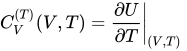
In terms of thermodynamics, the internal energy U   {\displaystyle U\ } {\displaystyle U\ } of the calorimetric material can be considered as the value of a function U ( V , T )   {\displaystyle U(V,T)\ } {\displaystyle U(V,T)\ } of ( V , T )   {\displaystyle (V,T)\ } {\displaystyle (V,T)\ }, with partial derivatives ∂ U ∂ V   {\displaystyle {\frac {\partial U}{\partial V}}\ } {\displaystyle {\frac {\partial U}{\partial V}}\ } and ∂ U ∂ T   {\displaystyle {\frac {\partial U}{\partial T}}\ } {\displaystyle {\frac {\partial U}{\partial T}}\ }.

Then it can be shown that one can write a thermodynamic version of the above calorimetric rules:

δ Q   = [ p ( V , T ) + ∂ U ∂ V | ( V , T ) ] δ V + ∂ U ∂ T | ( V , T ) δ T {\displaystyle \delta Q\ =\left[p(V,T)\,+\,\left.{\frac {\partial U}{\partial V}}\right|_{(V,T)}\right]\,\delta V\,+\,\left.{\frac {\partial U}{\partial T}}\right|_{(V,T)}\,\delta T} {\displaystyle \delta Q\ =\left[p(V,T)\,+\,\left.{\frac {\partial U}{\partial V}}\right|_{(V,T)}\right]\,\delta V\,+\,\left.{\frac {\partial U}{\partial T}}\right|_{(V,T)}\,\delta T}

with

C T ( V ) ( V , T ) = p ( V , T ) + ∂ U ∂ V | ( V , T )   {\displaystyle C_{T}^{(V)}(V,T)=p(V,T)\,+\,\left.{\frac {\partial U}{\partial V}}\right|_{(V,T)}\ } {\displaystyle C_{T}^{(V)}(V,T)=p(V,T)\,+\,\left.{\frac {\partial U}{\partial V}}\right|_{(V,T)}\ }

and

C V ( T ) ( V , T ) = ∂ U ∂ T | ( V , T )   {\displaystyle C_{V}^{(T)}(V,T)=\left.{\frac {\partial U}{\partial T}}\right|_{(V,T)}\ } {\displaystyle C_{V}^{(T)}(V,T)=\left.{\frac {\partial U}{\partial T}}\right|_{(V,T)}\ } .[30][41][42][43][44]

Again, further in terms of thermodynamics, the internal energy U   {\displaystyle U\ } {\displaystyle U\ } of the calorimetric material can sometimes, depending on the calorimetric material, be considered as the value of a function U ( p , T )   {\displaystyle U(p,T)\ } {\displaystyle U(p,T)\ } of ( p , T )   {\displaystyle (p,T)\ } {\displaystyle (p,T)\ }, with partial derivatives ∂ U ∂ p   {\displaystyle {\frac {\partial U}{\partial p}}\ } {\displaystyle {\frac {\partial U}{\partial p}}\ } and ∂ U ∂ T   {\displaystyle {\frac {\partial U}{\partial T}}\ } {\displaystyle {\frac {\partial U}{\partial T}}\ }, and with V   {\displaystyle V\ } {\displaystyle V\ } being expressible as the value of a function V ( p , T )   {\displaystyle V(p,T)\ } {\displaystyle V(p,T)\ } of ( p , T )   {\displaystyle (p,T)\ } {\displaystyle (p,T)\ }, with partial derivatives ∂ V ∂ p   {\displaystyle {\frac {\partial V}{\partial p}}\ } {\displaystyle {\frac {\partial V}{\partial p}}\ } and ∂ V ∂ T   {\displaystyle {\frac {\partial V}{\partial T}}\ } {\displaystyle {\frac {\partial V}{\partial T}}\ } .

Then, according to Adkins (1975),[45] it can be shown that one can write a further thermodynamic version of the above calorimetric rules:

δ Q   = [ ∂ U ∂ p | ( p , T ) + p ∂ V ∂ p | ( p , T ) ] δ p + [ ∂ U ∂ T | ( p , T ) + p ∂ V ∂ T | ( p , T ) ] δ T {\displaystyle \delta Q\ =\left[\left.{\frac {\partial U}{\partial p}}\right|_{(p,T)}\,+\,p\left.{\frac {\partial V}{\partial p}}\right|_{(p,T)}\right]\delta p\,+\,\left[\left.{\frac {\partial U}{\partial T}}\right|_{(p,T)}\,+\,p\left.{\frac {\partial V}{\partial T}}\right|_{(p,T)}\right]\delta T} {\displaystyle \delta Q\ =\left[\left.{\frac {\partial U}{\partial p}}\right|_{(p,T)}\,+\,p\left.{\frac {\partial V}{\partial p}}\right|_{(p,T)}\right]\delta p\,+\,\left[\left.{\frac {\partial U}{\partial T}}\right|_{(p,T)}\,+\,p\left.{\frac {\partial V}{\partial T}}\right|_{(p,T)}\right]\delta T}

with

C T ( p ) ( p , T ) = ∂ U ∂ p | ( p , T ) + p ∂ V ∂ p | ( p , T )   {\displaystyle C_{T}^{(p)}(p,T)=\left.{\frac {\partial U}{\partial p}}\right|_{(p,T)}\,+\,p\left.{\frac {\partial V}{\partial p}}\right|_{(p,T)}\ } {\displaystyle C_{T}^{(p)}(p,T)=\left.{\frac {\partial U}{\partial p}}\right|_{(p,T)}\,+\,p\left.{\frac {\partial V}{\partial p}}\right|_{(p,T)}\ }

and

C p ( T ) ( p , T ) = ∂ U ∂ T | ( p , T ) + p ∂ V ∂ T | ( p , T )   {\displaystyle C_{p}^{(T)}(p,T)=\left.{\frac {\partial U}{\partial T}}\right|_{(p,T)}\,+\,p\left.{\frac {\partial V}{\partial T}}\right|_{(p,T)}\ } {\displaystyle C_{p}^{(T)}(p,T)=\left.{\frac {\partial U}{\partial T}}\right|_{(p,T)}\,+\,p\left.{\frac {\partial V}{\partial T}}\right|_{(p,T)}\ } .[45]

Beyond the calorimetric fact noted above that the latent heats C T ( V ) ( V , T )   {\displaystyle C_{T}^{(V)}(V,T)\ } {\displaystyle C_{T}^{(V)}(V,T)\ } and C T ( p ) ( p , T )   {\displaystyle C_{T}^{(p)}(p,T)\ } {\displaystyle C_{T}^{(p)}(p,T)\ } are always of opposite sign, it may be shown, using the thermodynamic concept of work, that also
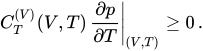
C T ( V ) ( V , T ) ∂ p ∂ T | ( V , T ) ≥ 0 . {\displaystyle C_{T}^{(V)}(V,T)\,\left.{\frac {\partial p}{\partial T}}\right|_{(V,T)}\geq 0\,.} {\displaystyle C_{T}^{(V)}(V,T)\,\left.{\frac {\partial p}{\partial T}}\right|_{(V,T)}\geq 0\,.}[46]

Special interest of thermodynamics in calorimetry: the isothermal segments of a Carnot cycle

[edit]

Calorimetry has a special benefit for thermodynamics. It tells about the heat absorbed or emitted in the isothermal segment of a Carnot cycle.

A Carnot cycle is a special kind of cyclic process affecting a body composed of material suitable for use in a heat engine. Such a material is of the kind considered in calorimetry, as noted above, that exerts a pressure that is very rapidly determined just by temperature and volume. Such a body is said to change reversibly. A Carnot cycle consists of four successive stages or segments:

(1) a change in volume from a volume V a   {\displaystyle V_{a}\ } {\displaystyle V_{a}\ } to a volume V b   {\displaystyle V_{b}\ } {\displaystyle V_{b}\ } at constant temperature T +   {\displaystyle T^{+}\ } {\displaystyle T^{+}\ } so as to incur a flow of heat into the body (known as an isothermal change)

(2) a change in volume from V b   {\displaystyle V_{b}\ } {\displaystyle V_{b}\ } to a volume V c   {\displaystyle V_{c}\ } {\displaystyle V_{c}\ } at a variable temperature just such as to incur no flow of heat (known as an adiabatic change)

(3) another isothermal change in volume from V c   {\displaystyle V_{c}\ } {\displaystyle V_{c}\ } to a volume V d   {\displaystyle V_{d}\ } {\displaystyle V_{d}\ } at constant temperature T −   {\displaystyle T^{-}\ } {\displaystyle T^{-}\ } such as to incur a flow or heat out of the body and just such as to precisely prepare for the following change

(4) another adiabatic change of volume from V d   {\displaystyle V_{d}\ } {\displaystyle V_{d}\ } back to V a   {\displaystyle V_{a}\ } {\displaystyle V_{a}\ } just such as to return the body to its starting temperature T +   {\displaystyle T^{+}\ } {\displaystyle T^{+}\ }.

In isothermal segment (1), the heat that flows into the body is given by

    Δ Q ( V a , V b ; T + ) = ∫ V a V b C T ( V ) ( V , T + ) d V   {\displaystyle \Delta Q(V_{a},V_{b};T^{+})\,=\,\,\,\,\,\,\,\,\int _{V_{a}}^{V_{b}}C_{T}^{(V)}(V,T^{+})\,dV\ } {\displaystyle \Delta Q(V_{a},V_{b};T^{+})\,=\,\,\,\,\,\,\,\,\int _{V_{a}}^{V_{b}}C_{T}^{(V)}(V,T^{+})\,dV\ }

and in isothermal segment (3) the heat that flows out of the body is given by

− Δ Q ( V c , V d ; T − ) = − ∫ V c V d C T ( V ) ( V , T − ) d V   {\displaystyle -\Delta Q(V_{c},V_{d};T^{-})\,=\,-\int _{V_{c}}^{V_{d}}C_{T}^{(V)}(V,T^{-})\,dV\ } {\displaystyle -\Delta Q(V_{c},V_{d};T^{-})\,=\,-\int _{V_{c}}^{V_{d}}C_{T}^{(V)}(V,T^{-})\,dV\ }.[47]

Because the segments (2) and (4) are adiabats, no heat flows into or out of the body during them, and consequently the net heat supplied to the body during the cycle is given by

Δ Q ( V a , V b ; T + ; V c , V d ; T − ) = Δ Q ( V a , V b ; T + ) + Δ Q ( V c , V d ; T − ) = ∫ V a V b C T ( V ) ( V , T + ) d V + ∫ V c V d C T ( V ) ( V , T − ) d V   {\displaystyle \Delta Q(V_{a},V_{b};T^{+};V_{c},V_{d};T^{-})\,=\,\Delta Q(V_{a},V_{b};T^{+})\,+\,\Delta Q(V_{c},V_{d};T^{-})\,=\,\int _{V_{a}}^{V_{b}}C_{T}^{(V)}(V,T^{+})\,dV\,+\,\int _{V_{c}}^{V_{d}}C_{T}^{(V)}(V,T^{-})\,dV\ } {\displaystyle \Delta Q(V_{a},V_{b};T^{+};V_{c},V_{d};T^{-})\,=\,\Delta Q(V_{a},V_{b};T^{+})\,+\,\Delta Q(V_{c},V_{d};T^{-})\,=\,\int _{V_{a}}^{V_{b}}C_{T}^{(V)}(V,T^{+})\,dV\,+\,\int _{V_{c}}^{V_{d}}C_{T}^{(V)}(V,T^{-})\,dV\ }.

This quantity is used by thermodynamics and is related in a special way to the net work done by the body during the Carnot cycle. The net change of the body's internal energy during the Carnot cycle, Δ U ( V a , V b ; T + ; V c , V d ; T − )   {\displaystyle \Delta U(V_{a},V_{b};T^{+};V_{c},V_{d};T^{-})\ } {\displaystyle \Delta U(V_{a},V_{b};T^{+};V_{c},V_{d};T^{-})\ }, is equal to zero, because the material of the working body has the special properties noted above.

Special interest of calorimetry in thermodynamics: relations between classical calorimetric quantities

[edit]

Relation of latent heat with respect to volume, and the equation of state

[edit]

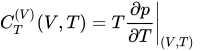
The quantity C T ( V ) ( V , T )   {\displaystyle C_{T}^{(V)}(V,T)\ } {\displaystyle C_{T}^{(V)}(V,T)\ }, the latent heat with respect to volume, belongs to classical calorimetry. It accounts for the occurrence of energy transfer by work in a process in which heat is also transferred; the quantity, however, was considered before the relation between heat and work transfers was clarified by the invention of thermodynamics. In the light of thermodynamics, the classical calorimetric quantity is revealed as being tightly linked to the calorimetric material's equation of state p = p ( V , T )   {\displaystyle p=p(V,T)\ } {\displaystyle p=p(V,T)\ }. Provided that the temperature T {\displaystyle T\,} {\displaystyle T\,} is measured in the thermodynamic absolute scale, the relation is expressed in the formula

C T ( V ) ( V , T ) = T ∂ p ∂ T | ( V , T )   {\displaystyle C_{T}^{(V)}(V,T)=T\left.{\frac {\partial p}{\partial T}}\right|_{(V,T)}\ } {\displaystyle C_{T}^{(V)}(V,T)=T\left.{\frac {\partial p}{\partial T}}\right|_{(V,T)}\ }.[48]

Difference of specific heats

[edit]

Advanced thermodynamics provides the relation

C p ( p , T ) − C V ( V , T ) = [ p ( V , T ) + ∂ U ∂ V | ( V , T ) ] ∂ V ∂ T | ( p , T ) {\displaystyle C_{p}(p,T)-C_{V}(V,T)=\left[p(V,T)\,+\,\left.{\frac {\partial U}{\partial V}}\right|_{(V,T)}\right]\,\left.{\frac {\partial V}{\partial T}}\right|_{(p,T)}} {\displaystyle C_{p}(p,T)-C_{V}(V,T)=\left[p(V,T)\,+\,\left.{\frac {\partial U}{\partial V}}\right|_{(V,T)}\right]\,\left.{\frac {\partial V}{\partial T}}\right|_{(p,T)}}.

From this, further mathematical and thermodynamic reasoning leads to another relation between classical calorimetric quantities. The difference of specific heats is given by

C p ( p , T ) − C V ( V , T ) = T V β p 2 ( T , p ) κ T ( T , p ) {\displaystyle C_{p}(p,T)-C_{V}(V,T)={\frac {TV\,\beta _{p}^{2}(T,p)}{\kappa _{T}(T,p)}}} {\displaystyle C_{p}(p,T)-C_{V}(V,T)={\frac {TV\,\beta _{p}^{2}(T,p)}{\kappa _{T}(T,p)}}}.[32][38][49]

Practical constant-volume calorimetry (bomb calorimetry) for thermodynamic studies

[edit]

Constant-volume calorimetry is calorimetry performed at a constant volume. This involves the use of a constant-volume calorimeter.

No work is performed in constant-volume calorimetry, so the heat measured equals the change in internal energy of the system. The heat capacity at constant volume is assumed to be independent of temperature.

Heat is measured by the principle of calorimetry.

q = C V Δ T = Δ U , {\displaystyle q=C_{V}\Delta T=\Delta U\,,} {\displaystyle q=C_{V}\Delta T=\Delta U\,,}

where

ΔU is change in internal energy,
ΔT is change in temperature and
CV is the heat capacity at constant volume.

In constant-volume calorimetry the pressure is not held constant. If there is a pressure difference between initial and final states, the heat measured needs adjustment to provide the enthalpy change. One then has

Δ H = Δ U + Δ ( P V ) = Δ U + V Δ P , {\displaystyle \Delta H=\Delta U+\Delta (PV)=\Delta U+V\Delta P\,,} {\displaystyle \Delta H=\Delta U+\Delta (PV)=\Delta U+V\Delta P\,,}

where

ΔH is change in enthalpy and
V is the unchanging volume of the sample chamber.

See also

[edit]
  • Isothermal microcalorimetry (IMC)
  • Isothermal titration calorimetry
  • Sorption calorimetry
  • Reaction calorimeter

References

[edit]
  1. ^ Reardon FD, Leppik KE, Wegmann R, Webb P, Ducharme MB, Kenny GP (August 2006). "The Snellen human calorimeter revisited, re-engineered and upgraded: design and performance characteristics". Med Biol Eng Comput. 44 (8): 721–8. doi:10.1007/s11517-006-0086-5. PMID 16937214.
  2. ^ Laidler, K.J. (1993). The World of Physical Chemistry. Oxford University Press. ISBN 0-19-855919-4. OCLC 27034547.
  3. ^ a b c d e f Meschel, S.V. (2019). "A brief history of heat measurements by calorimetry with emphasis on the thermochemistry of metallic and metal-nonmetal compounds". Calphad. 68 101714. doi:10.1016/j.calphad.2019.101714.
  4. ^ a b c Bryan 1907, pp. 21–22
  5. ^ Partington 1949, pp. 155–7
  6. ^ Prigogine, I.; Defay, R. (1954). Chemical Thermodynamics. London: Longmans, Green & Co. pp. 22–23. OCLC 8502081.
  7. ^ Crawford 1963, § 5.9, pp. 120–121
  8. ^ a b c Adkins 1975, § 3.6, pp. 43–46
  9. ^ Truesdell & Bharatha 1977, pp. 20–21
  10. ^ Landsberg 1978, p. 11
  11. ^ Maxwell 1871, pp. 232–3
  12. ^ Lewis & Randall 1961, pp. 378–9
  13. ^ Truesdell & Bharatha 1977, pp. 9–10, 15–18, 36–37
  14. ^ Truesdell, C.A. (1980). The Tragicomical History of Thermodynamics, 1822–1854. Springer. ISBN 0-387-90403-4.
  15. ^ Lewis & Randall 1961, p. 29
  16. ^ Callen 1985, p. 73
  17. ^ Crawford 1963, § 5.10, pp. 121–122
  18. ^ a b Truesdell & Bharatha 1977, p. 23
  19. ^ Crawford 1963, § 5.11, pp. 123–124
  20. ^ Truesdell & Bharatha 1977, p. 24
  21. ^ Truesdell & Bharatha 1977, pp. 25
  22. ^ Kondepudi 2008, pp. 66–67
  23. ^ Truesdell & Bharatha 1977, p. 20
  24. ^ a b Adkins 1975, § 1.9.3, p. 16
  25. ^ Landsberg 1978, pp. 8–9
  26. ^ An account of this is given by Landsberg 1978, Ch. 4, pp 26–33
  27. ^ Fowler, R.; Guggenheim, E.A. (1965). Statistical Thermodynamics. A version of Statistical Mechanics for Students of Physics and Chemistry. Cambridge University Press. p. 57. OCLC 123179003.
  28. ^ Guggenheim 1967, § 1.10, pp. 9–11
  29. ^ Lebon, G.; Jou, D.; Casas-Vázquez, J. (2008). Understanding Non-equilibrium Thermodynamics: Foundations, Applications, Frontiers. Springer. p. 7. doi:10.1007/978-3-540-74251-7 (inactive 1 July 2025). ISBN 978-3-540-74252-4.{{cite book}}: CS1 maint: DOI inactive as of July 2025 (link)
  30. ^ a b Planck, M. (1923/1926), page 57.
  31. ^ a b Iribarne & Godson 1981, p. 46
  32. ^ a b c Lewis & Randall 1961, p. 54
  33. ^ a b Guggenheim 1967, p. 38
  34. ^ a b Callen 1985, p. 84
  35. ^ a b Adkins 1975, p. 38
  36. ^ a b Bailyn 1994, p. 49
  37. ^ a b Kondepudi 2008, p. 180
  38. ^ a b Kondepudi 2008, p. 181
  39. ^ Gislason, E.A.; Craig, N.C. (2005). "Cementing the foundations of thermodynamics:comparison of system-based and surroundings-based definitions of work and heat". J. Chem. Thermodynamics. 37 (9): 954–966. Bibcode:2005JChTh..37..954G. doi:10.1016/j.jct.2004.12.012.
  40. ^ Kondepudi 2008, p. 63
  41. ^ Preston, T. (1904). Cotter, J.R. (ed.). The Theory of Heat (2nd ed.). London: Macmillan. pp. 700–701. OCLC 681492070.
  42. ^ Adkins 1975, p. 45
  43. ^ Truesdell & Bharatha 1977, pp. 134
  44. ^ Kondepudi 2008, p. 64
  45. ^ a b Adkins 1975, p. 46
  46. ^ Truesdell & Bharatha 1977, p. 59
  47. ^ Truesdell & Bharatha 1977, pp. 52–53
  48. ^ Truesdell & Bharatha 1977, p. 150
  49. ^ Callen 1985, p. 86

Books

[edit]
  • Adkins, C.J. (1975). Equilibrium Thermodynamics (2nd ed.). McGraw-Hill. ISBN 0-07-084057-1. OCLC 1174680.
  • Bailyn, M. (1994). A Survey of Thermodynamics. American Institute of Physics. ISBN 0-88318-797-3. OCLC 28587332.
  • Bryan, G.H. (1907). Thermodynamics. An Introductory Treatise dealing mainly with First Principles and their Direct Applications. Leipzig: B.G. Tuebner. OCLC 1843575.
  • Callen, H.B. (1985). Thermodynamics and an Introduction to Thermostatistics (2nd ed.). Wiley. ISBN 0-471-86256-8. OCLC 11916089.
  • Crawford, F.H. (1963). Heat, Thermodynamics, and Statistical Physics. London: Harcourt, Brace, & World. OCLC 1170987551.
  • Guggenheim, E.A. (1967). Thermodynamics. An Advanced Treatment for Chemists and Physicists. Amsterdam: North-Holland. OCLC 324553..
  • Iribarne, J.V.; Godson, W.L. (1981). Atmospheric Thermodynamics (2nd ed.). Kluwer Academic. doi:10.1007/978-94-017-0815-9. ISBN 90-277-1296-4. OCLC 7573676.
  • Kondepudi, D. (2008). Introduction to Modern Thermodynamics. Wiley. ISBN 978-0-470-01598-8. OCLC 180204969.
  • Landsberg, P.T. (1978). Thermodynamics and Statistical Mechanics. Oxford University Press. ISBN 0-19-851142-6. OCLC 5257434.
  • Lewis, G.N.; Randall, M. (1961). Thermodynamics. McGraw-Hill series in advanced chemistry. McGraw-Hill. OCLC 271687278.
  • Maxwell, J.C. (2011) [1871]. Theory of Heat. Cambridge University Press. doi:10.1017/CBO9781139057943. ISBN 978-1-139-05794-3.
  • Partington, J.R. (1949). Fundamental Principles. The Properties of Gases. An Advanced Treatise on Physical Chemistry. Vol. 1. London: Longmans, Green, & Co. OCLC 544118.
  • Planck, M. (1990) [1926]. Treatise on Thermodynamics (3rd English ed.). Dover. ISBN 0-486-31928-8. OCLC 841526209.
  • Truesdell, C.; Bharatha, S. (1977). The Concepts and Logic of Classical Thermodynamics as a Theory of Heat Engines, Rigorously Constructed upon the Foundation Laid by S. Carnot and F. Reech. Texts and monographs in physics. Springer. doi:10.1007/978-3-642-81077-0. ISBN 0-387-07971-8. OCLC 2542716.

External links

[edit]
Wikisource has the text of the 1911 Encyclopædia Britannica article "Calorimetry".
  • "Differential scanning calorimetry protocol: MOST". Appropedia.
  • v
  • t
  • e
Analytical chemistry
Instrumentation
  • Atomic absorption spectrometer
  • Flame emission spectrometer
  • Gas chromatograph
  • High-performance liquid chromatograph
  • Infrared spectrometer
  • Mass spectrometer
  • Melting point apparatus
  • Microscope
  • Optical spectrometer
  • Spectrophotometer
Techniques
  • Calorimetry
  • Chromatography
  • Electroanalytical methods
  • Gravimetric analysis
  • Ion mobility spectrometry
  • Mass spectrometry
  • Spectroscopy
  • Titration
Sampling
  • Coning and quartering
  • Dilution
  • Dissolution
  • Filtration
  • Masking
  • Pulverization
  • Sample preparation
  • Separation process
  • Sub-sampling
Calibration
  • Chemometrics
  • Calibration curve
  • Matrix effect
  • Internal standard
  • Standard addition
  • Isotope dilution
Prominent publications
  • Analyst
  • Analytica Chimica Acta
  • Analytical and Bioanalytical Chemistry
  • Analytical Chemistry
  • Analytical Biochemistry
  • Category
  • Commons
  • Portal
  • WikiProject
  • v
  • t
  • e
Branches of chemistry
  • Glossary of chemical formulae
  • List of biomolecules
  • List of inorganic compounds
  • Periodic table
Analytical
  • Calorimetry
  • Characterization
  • Chromatography
    • GC
    • HPLC
  • Crystallography
  • Electroanalytical methods
  • Elemental analysis
  • Instrumental chemistry
  • Mass spectrometry
    • EI
    • ICP
    • MALDI
  • Separation process
  • Spectroscopy
    • IR
    • Raman
    • UV-Vis
    • NMR
  • Titration
  • Wet chemistry
Theoretical
  • Computational chemistry
    • Mathematical chemistry
  • Molecular modelling
  • Molecular mechanics
  • Molecular dynamics
  • Molecular geometry
    • VSEPR theory
  • Quantum chemistry
Physical
  • Chemical kinetics
  • Chemical physics
    • Molecular physics
  • Chemical thermodynamics
  • Cryochemistry
  • Electrochemistry
    • Spectroelectrochemistry
    • Photoelectrochemistry
  • Equilibrium chemistry
  • Femtochemistry
  • Interface and colloid science
    • Micromeritics
  • Mechanochemistry
  • Microwave chemistry
  • Photochemistry
  • Sonochemistry
  • Spectroscopy
  • Spin chemistry
  • Structural chemistry
  • Surface science
  • Thermochemistry
Inorganic
  • Ceramic chemistry
  • Cluster chemistry
  • Coordination chemistry
  • Magnetochemistry
  • Organometallic chemistry
    • Organolanthanide chemistry
  • Solid-state chemistry
Organic
  • Dynamic covalent chemistry
  • Enantioselective synthesis
  • Fullerene chemistry
  • Organic reactions
  • Organic synthesis
  • Petrochemistry
  • Physical organic chemistry
  • Polymer chemistry
  • Retrosynthetic analysis
  • Stereochemistry
    • Alkane stereochemistry
  • Total synthesis / Semisynthesis
Biological
  • Biochemistry
    • Molecular biology
    • Cell biology
  • Bioinorganic chemistry
  • Bioorganic chemistry
  • Bioorganometallic chemistry
  • Biophysical chemistry
  • Chemical biology
    • Bioorthogonal chemistry
  • Clinical chemistry
  • Medicinal chemistry
    • Pharmacology
  • Neurochemistry
Interdisciplinarity
  • Nuclear chemistry
    • Radiochemistry
    • Radiation chemistry
    • Actinide chemistry
  • Cosmochemistry / Astrochemistry / Stellar chemistry
  • Geochemistry
    • Biogeochemistry
    • Photogeochemistry
  • Environmental chemistry
    • Atmospheric chemistry
    • Ocean chemistry
  • Clay chemistry
  • Carbochemistry
  • Food chemistry
    • Carbohydrate chemistry
    • Food physical chemistry
  • Agricultural chemistry
    • Soil chemistry
  • Chemistry education
    • Amateur chemistry
    • General chemistry
  • Clandestine chemistry
  • Forensic chemistry
    • Forensic toxicology
    • Post-mortem chemistry
  • Nanochemistry
    • Supramolecular chemistry
  • Chemical synthesis
    • Green chemistry
    • Click chemistry
    • Combinatorial chemistry
    • Biosynthesis
  • Chemical engineering
    • Stoichiometry
  • Materials science
    • Metallurgy
    • Ceramic engineering
    • Polymer science
See also
  • History of chemistry
  • Nobel Prize in Chemistry
  • Timeline of chemistry
    • of element discoveries
  • "The central science"
  • Chemical reaction
    • Catalysis
  • Chemical element
  • Chemical compound
  • Atom
  • Molecule
  • Ion
  • Chemical substance
  • Chemical bond
  • Alchemy
  • Quantum mechanics
  • Category
  • Commons
  • Portal
  • WikiProject
Authority control databases Edit this at Wikidata
International
  • GND
  • FAST
National
  • United States
  • France
  • BnF data
  • Czech Republic
  • Israel
Other
  • Yale LUX
Retrieved from "https://teknopedia.ac.id/w/index.php?title=Calorimetry&oldid=1338943517"
Categories:
  • Calorimetry
  • Heat transfer
Hidden categories:
  • CS1 maint: DOI inactive as of July 2025
  • Articles with short description
  • Short description is different from Wikidata

  • indonesia
  • Polski
  • العربية
  • Deutsch
  • English
  • Español
  • Français
  • Italiano
  • مصرى
  • Nederlands
  • 日本語
  • Português
  • Sinugboanong Binisaya
  • Svenska
  • Українська
  • Tiếng Việt
  • Winaray
  • 中文
  • Русский
Sunting pranala
url url url url url url url url url url url url url url url url url url url url url url url url url url url url url url url url url url url url url url url url url url url url url url url url url url url url url url url url url url url url url url url url url url url url url url url url url url url url url url url url url url url url url url url url url url url url url url url url url url url url url url url url url url url url url url url url url url url url url url url url url url url url url url url url url url url url url url url url url url url url url url url url url url url url url url url url url url url url url url url url url url url url url url url url url url url url url url url url url url url url url url url url url url url url url url url url url url url url url url url url url url url url url url url url url url url url url url url url url url url url url url url url url url url url url url url url url url url url url url url url url url url url url url url url url url url url url url url url url url url url url url url url url url url url url url url url url url url url url url url url url url url url url url url url url url url url url url url url url url url url url url url url url url url url url url url url url url url url url url url url url url url url url url url url url url url url url url url url url url url url url url url url url url url url url url url url url url url url url url url url url url url url url url url url url url url url url url url url url url url url url url url url url url url url url url url url url url url url url url url url url url url url url url url url url url url url url url url url url url url url url url url url url url url url url url url url url url url url url url url url url url url url url url url url url url url url url url url url url url url url url url url url url url url url url url url url url url url url url url url url url url url url url url url url url url url url url url url url url url url url url url url url url url url url url url url url url url url url url url url url url url url url url url url url url url url url url url url url url url url url url url url url url url url url url url url url url url url url url url url url url url url url url url url url url url url url url url url url url url url url url url url url url url url url url url url url url url url url url url url url url url url url url url url url url url url url url url url url url url url url url url url url url url url url url url url url url url url url url url url url url url url url url url url url url url url url url url url url url url url url url url url url url url url url url url url url url url url url url url url url url url url url url url url url url url url url url url url url url url url url url url url url url url url url url url url url url url url url url url url url url url url url url url url url url url url url url url url url url url url url url url url url url url url url url url url url url url url url url url url url url url url url url url url url url url url url url url url url url url url url url url url url url url url url url url url url url url url url url url url url url url url url url url url url url url url url url url url url url url url url url url url url url url url url url url url url url url url url url url url url url url url url url url url url url url url url url url url url url url url url url url url url url url url url url url url url url url url url url url url url url url url url url url url url url url url url url url url url url url url url url url url url url url url url url url url url url url url url url url url url url url url url url url url url url url url url url url url url url url url url url url url url url url url url url url url url url url url url url url url url url url url url url url url url url url url url url url url url url url url url url url url url url url url url url url url url url url url url url url url url url url url url url url url url url url url url url url url url url url url url url url url url url url url url url url url url url url url url url url url url url url url url url url url url url url url url url url url url url url url url url url url url url url url url url url url url url url url url url url url url url url url url url url url url url url url url url url url url url url url url url url url url url url url url url url url url url url url url url url url url url url url url url url url url url url url url url url url url url url url url url url url url url url url url url url url url url url url url url url url url url url url url url url url url url url url url url url url url url url url url url url url url url url url url url url url url url url url url url url url url url url url url url url url url url url url url url url url url url url url url url url url url url url url url url url url url url url url url url url url url url url url url url url url url url url url url url url url url url url url url url url url url url url url url url url url url url url url url url url url url url url url url url url url url url url url url url url url url url url url url url url url url url url url url url url url url url url url url url url url url url url url url url url url url url url url url url url url url url url url url url url url url url url url url url url url url url url url url url url url url url url url url url url url url url url url url url url url url url url url url url url url url url url url url url url url url url url url url url url url url url url url url url url url url url url url url url url url url url url url url url url url url url url url url url url url url url url url url url url url url url url url url url url url url url url url url url url url url url url url url url url url url url url url url url url url url url url url url url url url url url url url url url url url url url url url url url url url url url url url url url url url url url url url url url url url url url url url url url url url url url url url url url url url url url url url url url url url url url url url url url url url url url url url url url url url url url url url url url url url url url url url url url url url url url url url url url url url url url url url url url url url url url url url url url url url url url url url url url url url url url url url url url url url url url url url url url url url url url url url url url url url url url url url url url url url url url url url url url url url url url url url url url url url url url url url url url url url url url url url url url url url url url url url url url url url url url url url url url url url url url url url url url url url url url url url url url url url url url url url url url url url url url url url url url url url url url url url url url url url url url url url url url url url url url url url url url url url url url url url url url url url url url url url url url url url url url url url url url url url url url url url url url url url url url url url url url url url url url url url url url url url url url url url url url url url url url url url url url url url url url url url url url url url url url url url url url url url url url url url url url url url url url url url url url url url url url url url url url url url url url url url url url url url url url url url url url url url url url url url url url url url url url url url url url url url url url url url url url url url url url url url url url url url url url url url url url url url url url url url url url url url url url url url url url url url url url url url url url url url url url url url url url url url url url url url url url url url url url url url url url url url url url url url url url url url url url url url url url url url url url url url url url url url url url url url url url url url url url url url url url url url url url url url url url url url url url url url url url url url url url url url url url url url url url url url url url url url url url url url url url url url url url url url url url url url url url url url url url url url url url url url url url url url url url url url url url url url url url url url url url url url url url url url url url url url url url url url url url url url url url url url url url url url url url url url url url url url url url url url url url url url url url url url url url url url url url url url url url url url url url url url url url url url url url url url url url url url url url url url url url url url url url url url url url url url url url url url url url url url url url url url url url url url url url url url url url url url url url url url url url url url url url url url url url url url url url url url url url url url url url url url url url url url url url url url url url url url url url url url url url url url url url url url url url url url url url url url url url url url url url url url url url url url url url url url url url url url url url url url url url url url url url url url url url url url url url url url url url url url url url url url url url url url url url url url url url url url url url url url url url url url url url url url url url url url url url url url url url url url url url url url url url url url url url url url url url url url url url url url url url url url url url url url url url url url url url url url url url url url url url url url url url url url url url url url url url url url url url url url url url url url url url url url url url url url url url url url url url url url url url url url url url url url url url url url url url url url url url url url url url url url url
Pusat Layanan

UNIVERSITAS TEKNOKRAT INDONESIA | ASEAN's Best Private University
Jl. ZA. Pagar Alam No.9 -11, Labuhan Ratu, Kec. Kedaton, Kota Bandar Lampung, Lampung 35132
Phone: (0721) 702022
Email: pmb@teknokrat.ac.id