Epstein Files Full PDF

CLICK HERE
Technopedia Center
PMB University Brochure
Faculty of Engineering and Computer Science
S1 Informatics S1 Information Systems S1 Information Technology S1 Computer Engineering S1 Electrical Engineering S1 Civil Engineering

faculty of Economics and Business
S1 Management S1 Accountancy

Faculty of Letters and Educational Sciences
S1 English literature S1 English language education S1 Mathematics education S1 Sports Education
teknopedia

  • Registerasi
  • Brosur UTI
  • Kip Scholarship Information
  • Performance
Flag Counter
  1. World Encyclopedia
  2. Densely defined operator - Wikipedia
Densely defined operator - Wikipedia
From Wikipedia, the free encyclopedia
Linear operator on dense subset of its apparent domain
This article includes a list of references, related reading, or external links, but its sources remain unclear because it lacks inline citations. Please help improve this article by introducing more precise citations. (October 2025) (Learn how and when to remove this message)

In mathematics – specifically, in operator theory – a densely defined operator or partially defined operator is a type of partially defined function. In a topological sense, it is a linear operator that is defined "almost everywhere". Densely defined operators often arise in functional analysis as operations that one would like to apply to a larger class of objects than those for which they a priori "make sense".[clarification needed]

A closed operator that is used in practice is often densely defined.

Definition

[edit]

Let X , Y {\displaystyle X,Y} {\displaystyle X,Y} be topological vector spaces.

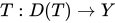
A densely defined linear operator T {\displaystyle T} {\displaystyle T} from X {\displaystyle X} {\displaystyle X} to Y {\displaystyle Y} {\displaystyle Y} is a linear operator of type T : D ( T ) → Y {\displaystyle T:D(T)\to Y} {\displaystyle T:D(T)\to Y}, such that D ( T ) {\displaystyle D(T)} {\displaystyle D(T)} is a dense subset of X {\displaystyle X} {\displaystyle X}. In other words, T {\displaystyle T} {\displaystyle T} is a partial function whose domain is dense in X {\displaystyle X} {\displaystyle X}.

Sometimes this is abbreviated as T : X → Y {\displaystyle T:X\to Y} {\displaystyle T:X\to Y} when the context makes it clear that T {\displaystyle T} {\displaystyle T} might not be defined for all of X {\displaystyle X} {\displaystyle X}.

Properties

[edit]

Closed Graph Theorem—If X , Y {\displaystyle X,Y} {\displaystyle X,Y} are Hausdorff and metrizable, T : D ( T ) → Y {\displaystyle T:D(T)\to Y} {\displaystyle T:D(T)\to Y} is densely defined, with continuous inverse S : Y → D ( T ) {\displaystyle S:Y\to D(T)} {\displaystyle S:Y\to D(T)}, then T {\displaystyle T} {\displaystyle T} is closed. That is, the set { ( x , T ( x ) ) : x ∈ D ( T ) } {\displaystyle \{(x,T(x)):x\in D(T)\}} {\displaystyle \{(x,T(x)):x\in D(T)\}} is closed in the product topology of X × Y {\displaystyle X\times Y} {\displaystyle X\times Y}.

Proof

Take any net ( x α ) {\displaystyle (x_{\alpha })} {\displaystyle (x_{\alpha })} in D ( T ) {\displaystyle D(T)} {\displaystyle D(T)} with T x α → y {\displaystyle Tx_{\alpha }\to y} {\displaystyle Tx_{\alpha }\to y} in Y {\displaystyle Y} {\displaystyle Y}. By continuity of S {\displaystyle S} {\displaystyle S}, x α = S ( T x α ) →   S ( y ) {\displaystyle x_{\alpha }=S(Tx_{\alpha })\to \ S(y)} {\displaystyle x_{\alpha }=S(Tx_{\alpha })\to \ S(y)}. Hence there exists some x ∈ D ( T ) {\displaystyle x\in D(T)} {\displaystyle x\in D(T)} such that x α → x {\displaystyle x_{\alpha }\to x} {\displaystyle x_{\alpha }\to x}, and T x = T ( S ( y ) ) = y {\displaystyle Tx=T(S(y))=y} {\displaystyle Tx=T(S(y))=y}.

The Hausdorff property ensures sequential convergence is unique. The metrizability property ensures that sequentially closed sets are closed. In functional analysis, these conditions typically hold, as most spaces under consideration are Fréchet space, or stronger than Fréchet. In particular, Banach spaces are Fréchet.

Examples

[edit]

Sequence

[edit]

Let X = ℓ 2 ( N ) {\displaystyle X=\ell ^{2}(\mathbb {N} )} {\displaystyle X=\ell ^{2}(\mathbb {N} )} be the Hilbert space of square-summable sequences, with orthonormal basis ( e n ) n ≥ 1 {\displaystyle (e_{n})_{n\geq 1}} {\displaystyle (e_{n})_{n\geq 1}}. Define the diagonal operator A : D ( A ) → ℓ 2 , ( A x ) n := n x n , {\displaystyle A:D(A)\to \ell ^{2},\qquad (Ax)_{n}:=n\,x_{n},} {\displaystyle A:D(A)\to \ell ^{2},\qquad (Ax)_{n}:=n\,x_{n},}with domain D ( A ) := { x = ( x n ) n ≥ 1 ∈ ℓ 2 : ∑ n = 1 ∞ n 2 | x n | 2 < ∞ } . {\displaystyle D(A):=\left\{x=(x_{n})_{n\geq 1}\in \ell ^{2}:\sum _{n=1}^{\infty }n^{2}|x_{n}|^{2}<\infty \right\}.} {\displaystyle D(A):=\left\{x=(x_{n})_{n\geq 1}\in \ell ^{2}:\sum _{n=1}^{\infty }n^{2}|x_{n}|^{2}<\infty \right\}.}Then D ( A ) {\displaystyle D(A)} {\displaystyle D(A)} is dense in ℓ 2 {\displaystyle \ell ^{2}} {\displaystyle \ell ^{2}} because the finitely supported sequences c 00 ⊂ D ( A ) {\displaystyle c_{00}\subset D(A)} {\displaystyle c_{00}\subset D(A)}, and c 00 {\displaystyle c_{00}} {\displaystyle c_{00}} is dense in ℓ 2 {\displaystyle \ell ^{2}} {\displaystyle \ell ^{2}}. The operator A {\displaystyle A} {\displaystyle A} is closed and unbounded, since ‖ A e n ‖ 2 = n {\displaystyle \|Ae_{n}\|_{2}=n} {\displaystyle \|Ae_{n}\|_{2}=n}.

There exists a bounded inverse: A − 1 : ℓ 2 → D ( A ) , ( A − 1 y ) n := y n n , ‖ A − 1 ‖ = sup n ≥ 1 1 n = 1. {\displaystyle A^{-1}:\ell ^{2}\to D(A),\qquad (A^{-1}y)_{n}:={\frac {y_{n}}{n}},\qquad \|A^{-1}\|=\sup _{n\geq 1}{\frac {1}{n}}=1.} {\displaystyle A^{-1}:\ell ^{2}\to D(A),\qquad (A^{-1}y)_{n}:={\frac {y_{n}}{n}},\qquad \|A^{-1}\|=\sup _{n\geq 1}{\frac {1}{n}}=1.}Hence A : D ( A ) → ℓ 2 {\displaystyle A:D(A)\to \ell ^{2}} {\displaystyle A:D(A)\to \ell ^{2}} is bijective with bounded inverse, so 0 ∈ ρ ( A ) {\displaystyle 0\in \rho (A)} {\displaystyle 0\in \rho (A)} and, by the Neumann series argument, the resolvent set of A {\displaystyle A} {\displaystyle A} contains the open unit disk { λ ∈ C :   | λ | < 1 } {\displaystyle \{\,\lambda \in \mathbb {C} :\ |\lambda |<1\,\}} {\displaystyle \{\,\lambda \in \mathbb {C} :\ |\lambda |<1\,\}}.

In fact, the spectrum of A {\displaystyle A} {\displaystyle A} (that is, the complement of its resolvent set) is precisely the set of positive integers, since for any λ ∉ { 1 , 2 , … } {\displaystyle \lambda \not \in \{1,2,\dots \}} {\displaystyle \lambda \not \in \{1,2,\dots \}}, the diagonal formula ( A − λ I ) − 1 y = ( y n n − λ ) n ≥ 1 {\displaystyle (A-\lambda I)^{-1}y={\bigl (}{\tfrac {y_{n}}{n-\lambda }}{\bigr )}_{n\geq 1}} {\displaystyle (A-\lambda I)^{-1}y={\bigl (}{\tfrac {y_{n}}{n-\lambda }}{\bigr )}_{n\geq 1}}defines a bounded operator ℓ 2 → D ( A ) {\displaystyle \ell ^{2}\to D(A)} {\displaystyle \ell ^{2}\to D(A)}.

Thus, A {\displaystyle A} {\displaystyle A} is a densely defined, closed, unbounded operator with bounded inverse and nontrivial, unbounded spectrum.

Differentiation

[edit]

Consider the space C 0 ( [ 0 , 1 ] ; R ) {\displaystyle C^{0}([0,1];\mathbb {R} )} {\displaystyle C^{0}([0,1];\mathbb {R} )} of all real-valued, continuous functions defined on the unit interval; let C 1 ( [ 0 , 1 ] ; R ) {\displaystyle C^{1}([0,1];\mathbb {R} )} {\displaystyle C^{1}([0,1];\mathbb {R} )} denote the subspace consisting of all continuously differentiable functions. Equip C 0 ( [ 0 , 1 ] ; R ) {\displaystyle C^{0}([0,1];\mathbb {R} )} {\displaystyle C^{0}([0,1];\mathbb {R} )} with the supremum norm ‖ ⋅ ‖ ∞ {\displaystyle \|\,\cdot \,\|_{\infty }} {\displaystyle \|\,\cdot \,\|_{\infty }}; this makes C 0 ( [ 0 , 1 ] ; R ) {\displaystyle C^{0}([0,1];\mathbb {R} )} {\displaystyle C^{0}([0,1];\mathbb {R} )} into a real Banach space. The differentiation operator D {\displaystyle D} {\displaystyle D} given by ( D u ) ( x ) = u ′ ( x ) {\displaystyle (\mathrm {D} u)(x)=u'(x)} {\displaystyle (\mathrm {D} u)(x)=u'(x)} is a linear operator defined on the dense linear subspace C 1 ( [ 0 , 1 ] ; R ) ⊂ C 0 ( [ 0 , 1 ] ; R ) {\displaystyle C^{1}([0,1];\mathbb {R} )\subset C^{0}([0,1];\mathbb {R} )} {\displaystyle C^{1}([0,1];\mathbb {R} )\subset C^{0}([0,1];\mathbb {R} )}, therefore it is a operator densely defined on C 0 ( [ 0 , 1 ] ; R ) {\displaystyle C^{0}([0,1];\mathbb {R} )} {\displaystyle C^{0}([0,1];\mathbb {R} )}.

The operator D {\displaystyle \mathrm {D} } {\displaystyle \mathrm {D} } is an example of an unbounded linear operator, since u n ( x ) = e − n x  has  ‖ D u n ‖ ∞ ‖ u n ‖ ∞ = n . {\displaystyle u_{n}(x)=e^{-nx}\quad {\text{ has }}\quad {\frac {\left\|\mathrm {D} u_{n}\right\|_{\infty }}{\left\|u_{n}\right\|_{\infty }}}=n.} {\displaystyle u_{n}(x)=e^{-nx}\quad {\text{ has }}\quad {\frac {\left\|\mathrm {D} u_{n}\right\|_{\infty }}{\left\|u_{n}\right\|_{\infty }}}=n.} This unboundedness causes problems if one wishes to somehow continuously extend the differentiation operator D {\displaystyle D} {\displaystyle D} to the whole of C 0 ( [ 0 , 1 ] ; R ) . {\displaystyle C^{0}([0,1];\mathbb {R} ).} {\displaystyle C^{0}([0,1];\mathbb {R} ).}

Paley–Wiener

[edit]

The Paley–Wiener integral is a standard example of a continuous extension of a densely defined operator.

In any abstract Wiener space i : H → E {\displaystyle i:H\to E} {\displaystyle i:H\to E} with adjoint j := i ∗ : E ∗ → H , {\displaystyle j:=i^{*}:E^{*}\to H,} {\displaystyle j:=i^{*}:E^{*}\to H,} there is a natural continuous linear operator (in fact it is the inclusion, and is an isometry) from j ( E ∗ ) {\displaystyle j\left(E^{*}\right)} {\displaystyle j\left(E^{*}\right)} to L 2 ( E , γ ; R ) , {\displaystyle L^{2}(E,\gamma ;\mathbb {R} ),} {\displaystyle L^{2}(E,\gamma ;\mathbb {R} ),} under which j ( f ) ∈ j ( E ∗ ) ⊆ H {\displaystyle j(f)\in j\left(E^{*}\right)\subseteq H} {\displaystyle j(f)\in j\left(E^{*}\right)\subseteq H} goes to the equivalence class [ f ] {\displaystyle [f]} {\displaystyle [f]} of f {\displaystyle f} {\displaystyle f} in L 2 ( E , γ ; R ) . {\displaystyle L^{2}(E,\gamma ;\mathbb {R} ).} {\displaystyle L^{2}(E,\gamma ;\mathbb {R} ).} It can be shown that j ( E ∗ ) {\displaystyle j\left(E^{*}\right)} {\displaystyle j\left(E^{*}\right)} is dense in H . {\displaystyle H.} {\displaystyle H.} Since the above inclusion is continuous, there is a unique continuous linear extension I : H → L 2 ( E , γ ; R ) {\displaystyle I:H\to L^{2}(E,\gamma ;\mathbb {R} )} {\displaystyle I:H\to L^{2}(E,\gamma ;\mathbb {R} )} of the inclusion j ( E ∗ ) → L 2 ( E , γ ; R ) {\displaystyle j\left(E^{*}\right)\to L^{2}(E,\gamma ;\mathbb {R} )} {\displaystyle j\left(E^{*}\right)\to L^{2}(E,\gamma ;\mathbb {R} )} to the whole of H . {\displaystyle H.} {\displaystyle H.} This extension is the Paley–Wiener map.

See also

[edit]
  • Blumberg theorem – Any real function on R admits a continuous restriction on a dense subset of R
  • Closed graph theorem (functional analysis) – Theorems connecting continuity to closure of graphs
  • Linear extension (linear algebra) – Mathematical function, in linear algebraPages displaying short descriptions of redirect targets
  • Partial function – Function whose actual domain of definition may be smaller than its apparent domain

References

[edit]
  • Renardy, Michael; Rogers, Robert C. (2004). An introduction to partial differential equations. Texts in Applied Mathematics 13 (Second ed.). New York: Springer-Verlag. pp. xiv+434. ISBN 0-387-00444-0. MR 2028503.
  • v
  • t
  • e
Hilbert spaces
Basic concepts
  • Adjoint
  • Inner product and L-semi-inner product
  • Hilbert space and Prehilbert space
  • Orthogonal complement
  • Orthonormal basis
Main results
  • Bessel's inequality
  • Cauchy–Schwarz inequality
  • Riesz representation
Other results
  • Hilbert projection theorem
  • Parseval's identity
  • Polarization identity (Parallelogram law)
Maps
  • Compact operator on Hilbert space
  • Densely defined
  • Hermitian form
  • Hilbert–Schmidt
  • Normal
  • Self-adjoint
  • Sesquilinear form
  • Trace class
  • Unitary
Examples
  • Cn(K) with K compact & n<∞
  • Segal–Bargmann F
  • v
  • t
  • e
Banach space topics
Types of Banach spaces
  • Asplund
  • Banach
    • list
  • Banach lattice
  • Grothendieck
  • Hilbert
    • Inner product space
    • Polarization identity
  • (Polynomially) Reflexive
  • Riesz
  • L-semi-inner product
  • (B
  • Strictly
  • Uniformly) convex
  • Uniformly smooth
  • (Injective
  • Projective) Tensor product (of Hilbert spaces)
Banach spaces are:
  • Barrelled
  • Complete
  • F-space
  • Fréchet
    • tame
  • Locally convex
    • Seminorms/Minkowski functionals
  • Mackey
  • Metrizable
  • Normed
    • norm
  • Quasinormed
  • Stereotype
Function space Topologies
  • Banach–Mazur compactum
  • Dual
  • Dual space
    • Dual norm
  • Operator
  • Ultraweak
  • Weak
    • polar
    • operator
  • Strong
    • polar
    • operator
  • Ultrastrong
  • Uniform convergence
Linear operators
  • Adjoint
  • Bilinear
    • form
    • operator
    • sesquilinear
  • (Un)Bounded
  • Closed
  • Compact
    • on Hilbert spaces
  • (Dis)Continuous
  • Densely defined
  • Fredholm
    • kernel
    • operator
  • Hilbert–Schmidt
  • Functionals
    • positive
  • Pseudo-monotone
  • Normal
  • Nuclear
  • Self-adjoint
  • Strictly singular
  • Trace class
  • Transpose
  • Unitary
Operator theory
  • Banach algebras
  • C*-algebras
  • Operator space
  • Spectrum
    • C*-algebra
    • radius
  • Spectral theory
    • of ODEs
    • Spectral theorem
  • Polar decomposition
  • Singular value decomposition
Theorems
  • Anderson–Kadec
  • Banach–Alaoglu
  • Banach–Mazur
  • Banach–Saks
  • Banach–Schauder (open mapping)
  • Banach–Steinhaus (Uniform boundedness)
  • Bessel's inequality
  • Cauchy–Schwarz inequality
  • Closed graph
  • Closed range
  • Eberlein–Šmulian
  • Freudenthal spectral
  • Gelfand–Mazur
  • Gelfand–Naimark
  • Goldstine
  • Hahn–Banach
    • hyperplane separation
  • Kakutani fixed-point
  • Krein–Milman
  • Lomonosov's invariant subspace
  • Mackey–Arens
  • Mazur's lemma
  • M. Riesz extension
  • Parseval's identity
  • Riesz's lemma
  • Riesz representation
  • Robinson-Ursescu
  • Schauder fixed-point
  • Sobczyk's theorem
Analysis
  • Abstract Wiener space
  • Banach manifold
    • bundle
  • Bochner space
  • Convex series
  • Differentiation in Fréchet spaces
  • Derivatives
    • Fréchet
    • Gateaux
    • functional
    • holomorphic
    • quasi
  • Integrals
    • Bochner
    • Dunford
    • Gelfand–Pettis
    • regulated
    • Paley–Wiener
    • weak
  • Functional calculus
    • Borel
    • continuous
    • holomorphic
  • Measures
    • Lebesgue
    • Projection-valued
    • Vector
  • Weakly / Strongly measurable function
Types of sets
  • Absolutely convex
  • Absorbing
  • Affine
  • Balanced/Circled
  • Bounded
  • Convex
  • Convex cone (subset)
  • Convex series related ((cs, lcs)-closed, (cs, bcs)-complete, (lower) ideally convex, (Hx), and (Hwx))
  • Linear cone (subset)
  • Radial
  • Radially convex/Star-shaped
  • Symmetric
  • Zonotope
Subsets / set operations
  • Affine hull
  • (Relative) Algebraic interior (core)
  • Bounding points
  • Convex hull
  • Extreme point
  • Interior
  • Linear span
  • Minkowski addition
  • Polar
  • (Quasi) Relative interior
Examples
  • Absolute continuity AC
  • b a ( Σ ) {\displaystyle ba(\Sigma )} {\displaystyle ba(\Sigma )}
  • c space
  • Banach coordinate BK
  • Besov B p , q s ( R ) {\displaystyle B_{p,q}^{s}(\mathbb {R} )} {\displaystyle B_{p,q}^{s}(\mathbb {R} )}
  • Birnbaum–Orlicz
  • Bounded variation BV
  • Bs space
  • Continuous C(K) with K compact Hausdorff
  • Hardy Hp
  • Hilbert H
  • Morrey–Campanato L λ , p ( Ω ) {\displaystyle L^{\lambda ,p}(\Omega )} {\displaystyle L^{\lambda ,p}(\Omega )}
  • ℓp
    • ℓ ∞ {\displaystyle \ell ^{\infty }} {\displaystyle \ell ^{\infty }}
  • Lp
    • L ∞ {\displaystyle L^{\infty }} {\displaystyle L^{\infty }}
    • weighted
  • Schwartz S ( R n ) {\displaystyle S\left(\mathbb {R} ^{n}\right)} {\displaystyle S\left(\mathbb {R} ^{n}\right)}
  • Segal–Bargmann F
  • Sequence space
  • Sobolev Wk,p
    • Sobolev inequality
  • Triebel–Lizorkin
  • Wiener amalgam W ( X , L p ) {\displaystyle W(X,L^{p})} {\displaystyle W(X,L^{p})}
Applications
  • Differential operator
  • Finite element method
  • Mathematical formulation of quantum mechanics
  • Ordinary Differential Equations (ODEs)
  • Validated numerics
  • v
  • t
  • e
Functional analysis (topics – glossary)
Spaces
  • Banach
  • Besov
  • Fréchet
  • Hilbert
  • Hölder
  • Nuclear
  • Orlicz
  • Schwartz
  • Sobolev
  • Topological vector
Properties
  • Barrelled
  • Complete
  • Dual (Algebraic / Topological)
  • Locally convex
  • Reflexive
  • Separable
Theorems
  • Hahn–Banach
  • Riesz representation
  • Closed graph
  • Uniform boundedness principle
  • Kakutani fixed-point
  • Krein–Milman
  • Min–max
  • Gelfand–Naimark
  • Banach–Alaoglu
Operators
  • Adjoint
  • Bounded
  • Compact
  • Hilbert–Schmidt
  • Normal
  • Nuclear
  • Trace class
  • Transpose
  • Unbounded
  • Unitary
Algebras
  • Banach algebra
  • C*-algebra
  • Spectrum of a C*-algebra
  • Operator algebra
  • Group algebra of a locally compact group
  • Von Neumann algebra
Open problems
  • Invariant subspace problem
  • Mahler's conjecture
Applications
  • Hardy space
  • Spectral theory of ordinary differential equations
  • Heat kernel
  • Index theorem
  • Calculus of variations
  • Functional calculus
  • Integral linear operator
  • Jones polynomial
  • Topological quantum field theory
  • Noncommutative geometry
  • Riemann hypothesis
  • Distribution (or Generalized functions)
Advanced topics
  • Approximation property
  • Balanced set
  • Choquet theory
  • Weak topology
  • Banach–Mazur distance
  • Tomita–Takesaki theory
  • Category
Retrieved from "https://teknopedia.ac.id/w/index.php?title=Densely_defined_operator&oldid=1317650638"
Categories:
  • Functional analysis
  • Hilbert spaces
  • Linear operators
  • Operator theory
Hidden categories:
  • Articles with short description
  • Short description is different from Wikidata
  • Articles lacking in-text citations from October 2025
  • All articles lacking in-text citations
  • Wikipedia articles needing clarification from August 2024
  • Pages displaying short descriptions of redirect targets via Module:Annotated link

  • indonesia
  • Polski
  • العربية
  • Deutsch
  • English
  • Español
  • Français
  • Italiano
  • مصرى
  • Nederlands
  • 日本語
  • Português
  • Sinugboanong Binisaya
  • Svenska
  • Українська
  • Tiếng Việt
  • Winaray
  • 中文
  • Русский
Sunting pranala
url url url url url url url url url url url url url url url url url url url url url url url url url url url url url url url url url url url url url url url url url url url url url url url url url url url url url url url url url url url url url url url url url url url url url url url url url url url url url url url url url url url url url url url url url url url url url url url url url url url url url url url url url url url url url url url url url url url url url url url url url url url url url url url url url url url url url url url url url url url url url url url url url url url url url url url url url url url url url url url url url url url url url url url url url url url url url url url url url url url url url url url url url url url url url url url url url url url url url url url url url url url url url url url url url url url url url url url url url url url url url url url url url url url url url url url url url url url url url url url url url url url url url url url url url url url url url url url url url url url url url url url url url url url url url url url url url url url url url url url url url url url url url url url url url url url url url url url url url url url url url url url url url url url url url url url url url url url url url url url url url url url url url url url url url url url url url url url url url url url url url url url url url url url url url url url url url url url url url url url url url url url url url url url url url url url url url url url url url url url url url url url url url url url url url url url url url url url url url url url url url url url url url url url url url url url url url url url url url url url url url url url url url url url url url url url url url url url url url url url url url url url url url url url url url url url url url url url url url url url url url url url url url url url url url url url url url url url url url url url url url url url url url url url url url url url url url url url url url url url url url url url url url url url url url url url url url url url url url url url url url url url url url url url url url url url url url url url url url url url url url url url url url url url url url url url url url url url url url url url url url url url url url url url url url url url url url url url url url url url url url url url url url url url url url url url url url url url url url url url url url url url url url url url url url url url url url url url url url url url url url url url url url url url url url url url url url url url url url url url url url url url url url url url url url url url url url url url url url url url url url url url url url url url url url url url url url url url url url url url url url url url url url url url url url url url url url url url url url url url url url url url url url url url url url url url url url url url url url url url url url url url url url url url url url url url url url url url url url url url url url url url url url url url url url url url url url url url url url url url url url url url url url url url url url url url url url url url url url url url url url url url url url url url url url url url url url url url url url url url url url url url url url url url url url url url url url url url url url url url url url url url url url url url url url url url url url url url url url url url url url url url url url url url url url url url url url url url url url url url url url url url url url url url url url url url url url url url url url url url url url url url url url url url url url url url url url url url url url url url url url url url url url url url url url url url url url url url url url url url url url url url url url url url url url url url url url url url url url url url url url url url url url url url url url url url url url url url url url url url url url url url url url url url url url url url url url url url url url url url url url url url url url url url url url url url url url url url url url url url url url url url url url url url url url url url url url url url url url url url url url url url url url url url url url url url url url url url url url url url url url url url url url url url url url url url url url url url url url url url url url url url url url url url url url url url url url url url url url url url url url url url url url url url url url url url url url url url url url url url url url url url url url url url url url url url url url url url url url url url url url url url url url url url url url url url url url url url url url url url url url url url url url url url url url url url url url url url url url url url url url url url url url url url url url url url url url url url url url url url url url url url url url url url url url url url url url url url url url url url url url url url url url url url url url url url url url url url url url url url url url url url url url url url url url url url url url url url url url url url url url url url url url url url url url url url url url url url url url url url url url url url url url url url url url url url url url url url url url url url url url url url url url url url url url url url url url url url url url url url url url url url url url url url url url url url url url url url url url url url url url url url url url url url url url url url url url url url url url url url url url url url url url url url url url url url url url url url url url url url url url url url url url url url url url url url url url url url url url url url url url url url url url url url url url url url url url url url url url url url url url url url url url url url url url url url url url url url url url url url url url url url url url url url url url url url url url url url url url url url url url url url url url url url url url url url url url url url url url url url url url url url url url url url url url url url url url url url url url url url url url url url url url url url url url url url url url url url url url url url url url url url url url url url url url url url url url url url url url url url url url url url url url url url url url url url url url url url url url url url url url url url url url url url url url url url url url url url url url url url url url url url url url url url url url url url url url url url url url url url url url url url url url url url url url url url url url url url url url url url url url url url url url url url url url url url url url url url url url url url url url url url url url url url url url url url url url url url url url url url url url url url url url url url url url url url url url url url url url url url url url url url url url url url url url url url url url url url url url url url url url url url url url url url url url url url url url url url url url url url url url url url url url url url url url url url url url url url url url url url url url url url url url url url url url url url url url url url url url url url url url url url url url url url url url url url url url url url url url url url url url url url url url url url url url url url url url url url url url url url url url url url url url url url url url url url url url url url url url url url url url url url url url url url url url url url url url url url url url url url url url url url url url url url url url url url url url url url url url url url url url url url url url url url url url url url url url url url url url url url url url url url url url url url url url url url url url url url url url url url url url url url url url url url url url url url url url url url url url url url url url url url url url url url url url url url url url url url url url url url url url url url url url url url url url url url url url url url url url url url url url url url url url url url url url url url url url url url url url url url url url url url url url url url url url url url url url url url url url url url url url url url url url url url url url url url url url url url url url url url url url url url url url url url url url url url url url url url url url url url url url url url url url url url url url url url url url url url url url url url url url url url url url url url url url url url url url url url url url url url url url url url url url url url url url url url url url url url url url url url url url url url url url url url url url url url url url url url url url url url url url url url url url url url url url url url url url url url url url url url url url url url url url url url url url url url url url url url url url url url url url url url url url url url url url url url url url url url url url url url url url url url url url url url url url url url url url url url url url url url url url url url url url url url url url url url url url url url url url url url url url url url url url url url url url url url url url url url url url url url url url url url url url url url url url url url url url url url url url url url url url url url url url url url url url url url url url url url url url url url url url url url url url url url url url url url url url url url url url url url url url url url url url url url url url url url url url url url url url url url url url url url url url url url url url url url url url url url url url url url url url url url url url url url url url url url url url url url url url url url url url url url url url url url url url url url url url url url url url url url url url url url url url url url url url url url url url url url url url url url url url url url url url url url url url url url url url url url url url url url url url url url url url url url url url url url url url url url url url url url url url url url url
Pusat Layanan

UNIVERSITAS TEKNOKRAT INDONESIA | ASEAN's Best Private University
Jl. ZA. Pagar Alam No.9 -11, Labuhan Ratu, Kec. Kedaton, Kota Bandar Lampung, Lampung 35132
Phone: (0721) 702022
Email: pmb@teknokrat.ac.id