

Drochia | |
|---|---|
.jpg)   Drochia | |
 Flag  Coat of arms | |
  Drochia Location in Moldova | |
| Coordinates: 48°2′N 27°45′E / 48.033°N 27.750°E | |
| Country | Moldova |
| District | Drochia District |
| Established | 1777 |
| Government | |
| • Mayor | Cereteu Nina (PN), since 2015 |
| Elevation | 741 ft (226 m) |
| Population | |
• Total | 13,150 |
| Time zone | UTC+2 (EET) |
| • Summer (DST) | UTC+3 (EEST) |
| Postal code | MD-52xx |
| Area code | +373 252 xx x xx |
| Climate | Dfb |
 | You can help expand this article with text translated from the corresponding article in Romanian. (August 2025) Click [show] for important translation instructions.
|
Drochia (Romanian pronunciation: [ˈdroki.ja]) is a city in the northern part of Moldova. It is the administrative center of the eponymous district. The city is located 174.4 km (108.4 mi) north of the national capital, Chișinău, and 67 km (42 mi) north-east of the Romanian city of Iași. The average elevation of Drochia is 226 meters. The population at the 2004 census was 16,606.
The name of the city comes from a local type of bird, called dropie (English: great bustard).
History
Drochia is first mentioned by chroniclers in 1777. By 1830 it was a small settlement encompassing 25 families. A document dating from 1847 notes that a small grape-processing plant, the town's first industrial enterprise, had been built. Two mills situated on a local stream were built in 1875.
More intensive industrial development emerged after the railway first came through at the end of the 19th century. At the 1930 census, the locality (then a village) was known as Drochia-Gară (literally Drochia Station), and had a population of only 595. It was part of Plasa Bădiceni of the Soroca County.
Drochia received the status of a city in 1973.
Demographics
According to the 2024 census, 12,939 inhabitants lived in Drochia, a decrease compared to the previous census in 2014, when 13,150 inhabitants were registered.[2][3]
- Moldovans[a] (85.6%)
- Romanians (4.70%)
- Ukrainians (6.70%)
- Russians (2.30%)
- Others (0.70%)
| Year | Pop. | ±% |
|---|---|---|
| 1930 | 595 | — |
| 1959 | 6,638 | +1015.6% |
| 1970 | 11,161 | +68.1% |
| 1979 | 15,280 | +36.9% |
| 1989 | 21,298 | +39.4% |
| 2004 | 16,606 | −22.0% |
| 2014 | 13,150 | −20.8% |
| 2024 | 12,939 | −1.6% |
- ^ There is an ongoing controversy regarding the ethnic identification of Moldovans and Romanians.
- ^ In March 2023, the Parliament of Moldova passed a law updating all legislative texts and the constitution to refer to the national language as Romanian, effectively rendering the term "Moldovan" obsolete.[4][5]
Historical demographics
| Ethnic composition (1930 Census) | |||
| Romanians | 181 | ||
| Ruthenians and Ukrainians | 77 | ||
| Russians | 209 | ||
| Jews | 112 | ||
| Poles | 5 | ||
| Armenians | 7 | ||
| Serbians, Croatians, Slovenes | 1 | ||
| others | 3 | ||
| Total | 595 | ||
| Linguistic composition (1930 Census) | ||
| Romanian | 198 | |
| Russian | 210 | |
| Yiddish | 102 | |
| Ukrainian | 80 | |
| Polish | 4 | |
| other | 1 | |
| Total | 595 | |
Media
.jpg)
- Radio Chișinău 93.8 FM
- Vocea Basarabiei 101,0
- Radio Studentus www.studentus.md/listen.html
Mayors of Drochia
- Anatol Pleșca 1991–1999
- Valeriu Ceban 1999–2007
- Grigore Melnic 2007 – 2011
- Igor Grozavu 2011 – 2015
- Nina Cereteu 2015 - 2023
- Nina Cereteu 2023 - present
International relations
Twin towns – Sister cities
Drochia is twinned with:


Notable people
- Romeo V. Turcan, professor
- Victor Pînzaru, athlete
Photo gallery
-
 Cathedral of the "Adormirea Maicii Domnului"
 -
 Monument of Mihai Eminescu
 -
 City Hall
 -
 Bogdan Petriceicu Hasdeu High School
 -
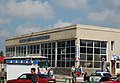 Drochia Bus Terminal
 -
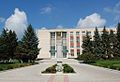 Drochia District Council and the monument of Stephen III of Moldavia
 -
 Office building
 -
 Monument of Mihai Eminescu


References

- ^ Results of Population and Housing Census in the Republic of Moldova in 2014: "Characteristics – Population (population by communes, religion, citizenship)" (XLS). National Bureau of Statistics of the Republic of Moldova. 2017. Retrieved 1 May 2017.
- ^ "Rezultatele finale ale Recensământului Populației și Locuințelor 2024: Caracteristici etnoculturale ale populației". National Bureau of Statistics of the Republic of Moldova. (in Romanian)
- ^ "2014 Moldova Census of Population and Housing". National Bureau of Statistics of the Republic of Moldova. (in Romanian, Russian, and English)
- ^ "Chisinau Recognizes Romanian As Official Language". Radio Free Europe/Radio Liberty. 5 December 2013. Archived from the original on 23 September 2016. Retrieved 11 March 2014.
- ^ "Moldovan parliament approves law on Romanian language". Reuters. 16 March 2023. Retrieved 11 July 2024.
External links
- Drochia Stadium on divizianationala.com
- Weather in Drochia
- Bogdan Petriceicu Hasdeu High School Webpage Archived 12 August 2011 at the Wayback Machine
- Drochia in Photos
- Meteo Moldova
- Drochia.md
| Municipalities |  | |
|---|---|---|
| Capitals of autonomous units | ||
| District seats4 | ||
| Other towns | ||
1 In Transnistria. 2 Controlled by the Transnistrian authorities. 3 Also a municipality. 4 The seat of Dubăsari District is the commune of Cocieri (not a city). | ||


