Epstein Files Full PDF

CLICK HERE
Technopedia Center
PMB University Brochure
Faculty of Engineering and Computer Science
S1 Informatics S1 Information Systems S1 Information Technology S1 Computer Engineering S1 Electrical Engineering S1 Civil Engineering

faculty of Economics and Business
S1 Management S1 Accountancy

Faculty of Letters and Educational Sciences
S1 English literature S1 English language education S1 Mathematics education S1 Sports Education
teknopedia

  • Registerasi
  • Brosur UTI
  • Kip Scholarship Information
  • Performance
Flag Counter
  1. World Encyclopedia
  2. Epidaurus - Wikipedia
Epidaurus - Wikipedia
Coordinates: 37°35′52″N 23°04′28″E / 37.59778°N 23.07444°E / 37.59778; 23.07444
From Wikipedia, the free encyclopedia
"Epidauria" redirects here. For the genus of moth, see Epidauria (moth).
For other places with the same name, see Epidaurus (disambiguation).
Municipality in Greece
Epidaurus
Ἐπίδαυρος
Municipality
Location of Epidaurus
Epidaurus is located in Greece
Epidaurus
Epidaurus
Coordinates: 37°35′52″N 23°04′28″E / 37.59778°N 23.07444°E / 37.59778; 23.07444
CountryGreece
Administrative regionPeloponnese
Regional unitArgolis
SeatLygourio
UNESCO World Heritage Site
Official nameSanctuary of Asklepios at Epidaurus
CriteriaCultural: i, ii, iii, iv, vi
Reference491
Inscription1988 (12th Session)
Area1,393.8 ha
Buffer zone3,386.4 ha
Area
 • Municipality
340.4 km2 (131.4 sq mi)
 • Municipal unit160.6 km2 (62.0 sq mi)
Population
 (2021)[1]
 • Municipality
7,030
 • Density20.7/km2 (53.5/sq mi)
 • Municipal unit
3,418
 • Municipal unit density21.28/km2 (55.12/sq mi)
Time zoneUTC+2 (EET)
 • Summer (DST)UTC+3 (EEST)
Postal code
210 59
Vehicle registrationAP

Epidaurus (Greek: Ἐπίδαυρος) was a small city (polis) in ancient Greece, on the Argolid Peninsula at the Saronic Gulf. Two modern towns bear the name Epidavros: Palaia Epidavros and Nea Epidavros. Since 2010 they belong to the new municipality of Epidaurus, part of the regional unit of Argolis. The seat of the municipality is the town Lygourio.[2] The nearby sanctuary of Asclepius and ancient theatre were inscribed on the UNESCO World Heritage List in 1988 because of their exemplary architecture and importance in the development and spread of healing sanctuaries and cults across the ancient Greek and Roman worlds.[3]

Name and etymology

[edit]

The name "Epidaurus" is of Greek origin. It was named after the hero Epidauros, son of Apollo.[4] According to Strabo, the city was originally named Ἐπίκαρος (Epíkaros) under the Carians, (Aristotle claimed that Caria, as a naval empire, occupied Epidaurus and Hermione)[5] before taking the name Ἐπίταυρος (Epítauros) when the city was taken by the Ionians and finally becoming Ἐπίδαυρος (Epídauros) after the Dorians conquered the city. Compare the individual elements ἐπί (epí, "upon"), Καρία (Karía, "Carian"), ταῦρος (taûros, "bull") and Δωριεύς (Dōrieús "Dorian")/Δωριεῖς (Dōrieîs, "Dorians").[6]

History

[edit]

Epidaurus was independent of Argos and not included in Argolis until the time of the Romans. With its supporting territory, it formed the small territory called Epidauria. It was reputed to be founded by or named for the hero Epidaurus, and to be the birthplace of Apollo's son Asclepius the healer.

Buildings

[edit]

Sanctuary of Asclepius

[edit]
Main article: Sanctuary of Asclepius, Epidaurus

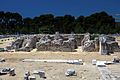
Epidaurus is best known for its healing sanctuary (asclepieion) and the Sanctuary of Asclepius, situated about five miles (8 km) from the town, with its theatre, which is still in use today. The cult of Asclepius at Epidaurus is attested in the 6th century BC, when the older hill-top sanctuary of Apollo Maleatas was no longer spacious enough. It was the most celebrated healing centre of the Classical world, the place where ill people went in the hope of being cured. To find out the right cure for their ailments, they spent a night in the enkoimeteria, a big sleeping hall. In their dreams, the god himself would advise them what they had to do to regain their health. Within the sanctuary there was a guest house (katagogion) with 160 guest rooms. There are also mineral springs in the vicinity, which may have been used in healing.

Asclepius, the most important healer god of antiquity, brought prosperity to the sanctuary, which flourished until the first half of the first century BC, when it suffered extensive damage when it was sacked by Sulla during the First Mithridatic War. It was revived after a visit by Hadrian in AD 124 and enjoyed renewed prosperity in the following centuries.[7]

In AD 395 the Goths raided the sanctuary. Even after the introduction of Christianity and the silencing of the oracles, the sanctuary at Epidaurus was still known as late as the mid 5th century as a Christian healing centre.

Theatre

[edit]
Main article: Ancient Theatre of Epidaurus
The Ancient Theatre of Epidaurus

The prosperity brought by the asclepeion enabled Epidaurus to construct civic monuments, including the huge theatre that delighted Pausanias for its symmetry and beauty, used again today for dramatic performances, the ceremonial hestiatoreion (banqueting hall), and a palaestra. The ancient theatre of Epidaurus was designed by Polykleitos the Younger in the 4th century BC. The original 34 rows were extended in Roman times by another 21 rows. As is usual for Greek theatres (and as opposed to Roman ones), the view on a lush landscape behind the skênê is an integral part of the theatre itself and is not to be obscured. It seats up to 14,000 people.

The theatre has long had a reputation for its exceptional acoustics, which reportedly allowed almost perfect intelligibility of unamplified spoken words from the proscenium or skēnē to all 14,000 spectators, regardless of their seating, a tale often recounted by tour guides.[8] In-situ measurements, however, somewhat moderate these claims: although most sounds can indeed be noticed throughout, intelligibility is not guaranteed, particularly for voice, which requires good projection,[9] which might not have been a problem for Greek actors, who were reputed experts in this aspect.[8] The acoustic properties are caused both by the physical shape, but also the construction material: the rows of limestone seats filter out low-frequency sounds, such as the murmur of the crowd, and also amplify the high-frequency sounds of the stage.[10]

Other buildings

[edit]

The town of Epidaurus had its own theatre which has been excavated since 1990 and found to be well-preserved. Dating from the 4th c. BC it had about 2000 seats. It has been renovated and is open to the public, as part of a scheme to conserve and enhance ancient theatres which has mapped 140 ancient arenas across Greece.[11]

Municipality

[edit]

The municipality Epidavros was formed at the 2011 local government reform by the merger of the following two former municipalities, that became municipal units:[2]

  • Asklipieio
  • Epidavros

The municipality has an area of 340.442 km2, the municipal unit 160.604 km2.[12]

Gallery

[edit]
  • Stadion
    Stadion
  • Gymnasion
    Gymnasion
  • Abaton
    Abaton
  • Odeon
    Odeon
  • Roman baths
    Roman baths
  • Statuette of Asclepius
    Statuette of Asclepius

See also

[edit]
  • List of ancient Greek cities
  • Callon of Epidaurus

References

[edit]
  1. ^ "Αποτελέσματα Απογραφής Πληθυσμού - Κατοικιών 2021, Μόνιμος Πληθυσμός κατά οικισμό" [Results of the 2021 Population - Housing Census, Permanent population by settlement] (in Greek). Hellenic Statistical Authority. 29 March 2024.
  2. ^ a b "ΦΕΚ A 87/2010, Kallikratis reform law text" (in Greek). Government Gazette.
  3. ^ "Sanctuary of Asklepios at Epidaurus". UNESCO World Heritage Convention. United Nations Educational Scientific and Cultural Organization. Retrieved 12 November 2022.
  4. ^ Cartwright, Mark (2012). "Epidaurus". World History Encyclopedia.
  5. ^ Ridgeway, William (2014). The early age of Greece. Volume 1. Cambridge. p. 269. ISBN 978-1-107-43458-5. OCLC 890937713.{{cite book}}: CS1 maint: location missing publisher (link)
  6. ^ "Ἐπίδαυρος (Epidaurus)". Wiktionary. Retrieved 2021-09-15.
  7. ^ *Melfi, Milena (2010). "Rebuilding the Myth of Asklepios at the Sanctuary of Epidauros in the Roman Period". In Rizakēs, A. D.; Lepenioti, Cl. E. (eds.). Roman Peloponnese III: Society, Economy and Culture under the Roman Empire: Continuity and Innovation. Athēna: Kentron Hellēnikēs kai Rōmaikēs Archaiotētos. pp. 329–340. ISBN 9789607905543.
  8. ^ a b "Whisper it – Greek theatre's legendary acoustics are a myth". The Guardian. 16 October 2017.
  9. ^ Hoekstra N, Nicolai B, Peeters BP, Hak CC, Wenmaekers RH (July 2016). "Project Ancient Acoustics Part 2 of 4 : large-scale acoustical measurements in the Odeon of Herodes Atticus and the theatres of Epidaurus and Argos" (PDF). 23rd International Congress on Sound & Vibration. Athens: 1–8.
  10. ^ Declercq, Nico F.; Dekeyser, Cindy S. A. (April 2007). "Acoustic diffraction effects at the Hellenistic amphitheater of Epidaurus: Seat rows responsible for the marvelous acoustics". The Journal of the Acoustical Society of America. 121 (4): 2011–2022. Bibcode:2007ASAJ..121.2011D. doi:10.1121/1.2709842. PMID 17471718.
  11. ^ Resurrecting the ancient little theater of Epidaurus https://www.ekathimerini.com/culture/1177098/resurrecting-the-ancient-little-theater-of-epidaurus/
  12. ^ "Population & housing census 2001 (incl. area and average elevation)" (PDF) (in Greek). National Statistical Service of Greece. Archived from the original (PDF) on 2015-09-21.

Further reading

[edit]
  • Tomlinson, R. A. (1983). Epidauros. London: Granada. ISBN 0246113987.

External links

[edit]
Wikimedia Commons has media related to Epidaurus.
Library resources about
Epidaurus
  • Online books
  • Resources in your library
  • Resources in other libraries
  • Epidaurus UNESCO Listing
  • Epidaurus photos and info Archived 2025-07-10 at the Wayback Machine
  • How the sanctuary was built -the building inscriptions
  • v
  • t
  • e
Ancient Greece
  • Timeline
  • History
  • Geography
Periods
  • Cycladic civilization
  • Minoan civilization
  • Mycenaean Greece
  • Greek Dark Ages
  • Archaic Greece
  • Classical Greece
  • Hellenistic Greece
  • Roman Greece
Geography
  • Aegean Sea
  • Aeolis
  • Crete
  • Cyrenaica
  • Cyprus
  • Doris
  • Epirus
  • Hellespont
  • Ionia
  • Ionian Sea
  • Macedonia
  • Magna Graecia
  • Peloponnesus
  • Pontus
  • Taurica
  • Ancient Greek colonies
  • City states
  • Politics
  • Military
City states
  • Argos
  • Athens
  • Byzantion
  • Chalcis
  • Corinth
  • Ephesus
  • Miletus
  • Pergamon
  • Eretria
  • Kerkyra
  • Larissa
  • Megalopolis
  • Thebes
  • Megara
  • Rhodes
  • Samos
  • Sparta
  • Lissus (Crete)
Kingdoms
  • Bithynia
  • Cappadocia
  • Epirus
  • Greco-Bactrian Kingdom
  • Indo-Greek Kingdom
  • Macedonia
  • Pergamon
  • Pontus
  • Ptolemaic Kingdom
  • Seleucid Empire
Federations/
Confederations
  • Doric Hexapolis (c. 1100 – c. 560 BC)
  • Italiote League (c. 800–389 BC)
  • Ionian League (c. 650–404 BC)
  • Peloponnesian League (c. 550–366 BC)
  • Amphictyonic League (c. 595–279 BC)
  • Acarnanian League (c. 500–31 BC)
  • Hellenic League (499–449 BC)
  • Delian League (478–404 BC)
  • Chalcidian League (430–348 BC)
  • Boeotian League (c. 424–c. 395 BC)
  • Aetolian League (c. 400–188 BC)
  • Second Athenian League (378–355 BC)
  • Thessalian League (374–196 BC)
  • Arcadian League (370–c. 230 BC)
  • Epirote League (370–168 BC)
  • League of Corinth (338–322 BC)
  • Euboean League (c. 300 BC–c. 300 AD)
  • Achaean League (280–146 BC)
Politics
  • Boule
  • Free city
  • Koinon
  • Proxeny
  • Stasis
  • Tagus
  • Tyrant
Athenian
  • Agora
  • Areopagus
  • Dikasterion
  • Ecclesia
  • Graphe paranomon
  • Heliaia
  • Ostracism
Spartan
  • Ekklesia
  • Ephor
  • Gerousia
Macedon
  • Synedrion
  • Koinon
Military
  • Wars
  • Athenian military
    • Scythian archers
  • Antigonid Macedonian army
  • Army of Macedon
  • Ballista
  • Cretan archers
  • Hellenistic armies
  • Hippeis
  • Hoplite
  • Hetairoi
  • Macedonian phalanx
  • Military of Mycenaean Greece
  • Phalanx
  • Peltast
  • Pezhetairos
  • Sarissa
  • Sacred Band of Thebes
  • Sciritae
  • Seleucid army
  • Spartan army
  • Strategos
  • Toxotai
  • Xiphos
  • Xyston
People
List of ancient Greeks
Rulers
  • Kings of Argos
  • Archons of Athens
  • Kings of Athens
  • Kings of Commagene
  • Diadochi
  • Kings of Macedonia
  • Kings of Paionia
  • Attalid kings of Pergamon
  • Kings of Pontus
  • Ptolemaic dynasty
  • Seleucid dynasty
  • Kings of Sparta
  • Tyrants of Syracuse
Artists & scholars
  • Astronomers
  • Geographers
  • Historians
  • Mathematicians
  • Philosophers
  • Playwrights
  • Poets
  • Seven Sages
  • Writers
Philosophers
  • Anaxagoras
  • Anaximander
  • Anaximenes
  • Antisthenes
  • Aristippus
  • Aristotle
  • Democritus
  • Diogenes of Sinope
  • Empedocles
  • Epicurus
  • Gorgias
  • Heraclitus
  • Hypatia
  • Leucippus
  • Parmenides
  • Plato
  • Protagoras
  • Pythagoras
  • Socrates
  • Thales
  • Zeno
Authors
  • Aeschylus
  • Aesop
  • Alcaeus
  • Archilochus
  • Aristophanes
  • Bacchylides
  • Diodorus Siculus
  • Euripides
  • Herodotus
  • Hesiod
  • Hipponax
  • Homer
  • Ibycus
  • Lucian
  • Menander
  • Mimnermus
  • Panyassis
  • Philocles
  • Pindar
  • Plutarch
  • Polybius
  • Sappho
  • Simonides
  • Sophocles
  • Stesichorus
  • Theognis
  • Thucydides
  • Timocreon
  • Tyrtaeus
  • Xenophon
Others
  • Athenian statesmen
  • Lawgivers
  • Olympic victors
  • Tyrants
By culture
  • Ancient Greek tribes
  • Thracian Greeks
  • Ancient Macedonians
  • Society
  • Culture
Society
  • Agriculture
  • Calendar
  • Clothing
  • Coinage
  • Cuisine
  • Economy
  • Education
  • Emporium
  • Euergetism
  • Festivals
  • Folklore
  • Homosexuality
  • Law
  • Olympic Games
  • Pederasty
  • Philosophy
  • Prostitution
  • Religion
  • Slavery
  • Warfare
  • Wedding customs
  • Wine
Arts and science
  • Architecture
    • Greek Revival architecture
  • Astronomy
  • Literature
  • Mathematics
  • Medicine
  • Music
    • Musical system
  • Pottery
  • Sculpture
  • Technology
  • Theatre
Religion
  • Funeral and burial practices
  • Mythology
    • Deities
  • Temple
  • Twelve Olympians
  • Underworld
Sacred places
  • Eleusis
  • Delphi
  • Delos
  • Dion
  • Dodona
  • Mount Olympus
  • Olympia
Structures
  • Athenian Treasury
  • Lion Gate
  • Long Walls
  • Philippeion
  • Theatre of Dionysus
  • Tunnel of Eupalinos
Temples
  • Aphaea
  • Artemis
  • Athena Nike
  • Erechtheion
  • Hephaestus
  • Hera, Olympia
  • Parthenon
  • Samothrace
  • Zeus, Olympia
Language
  • Proto-Greek
  • Mycenaean
  • Homeric
  • Dialects
    • Aeolic
    • Arcadocypriot
    • Attic
    • Doric
    • Epirote
    • Ionic
    • Locrian
    • Macedonian
    • Pamphylian
  • Koine
Writing
  • Linear A
  • Linear B
  • Cypriot syllabary
  • Greek alphabet
  • Greek numerals
  • Attic numerals
  • Greek colonisation
Magna Graecia
Mainland
Italy
  • Alision
  • Ankṓn
  • Brentesion
  • Caulonia
  • Chone
  • Croton
  • Cumae
  • Elea
  • Heraclea Lucania
  • Hipponion
  • Hydrus
  • Krimisa
  • Laüs
  • Locri
  • Medma
  • Metauros
  • Metapontion
  • Neápolis
  • Pandosia (Lucania)
  • Poseidonia
  • Pixous
  • Rhegion
  • Scylletium
  • Siris
  • Sybaris
  • Sybaris on the Traeis
  • Taras
  • Terina
  • Thurii
Sicily
  • Akragas
  • Akrai
  • Akrillai
  • Apollonia
  • Calacte
  • Casmenae
  • Catana
  • Gela
  • Helorus
  • Henna
  • Heraclea Minoa
  • Himera
  • Hybla Gereatis
  • Hybla Heraea
  • Kamarina
  • Leontinoi
  • Megara Hyblaea
  • Messana
  • Naxos
  • Segesta
  • Selinous
  • Syracuse
  • Tauromenion
  • Thermae
  • Tyndaris
Aeolian Islands
  • Didyme
  • Euonymos
  • Ereikousa
  • Hycesia
  • Lipara/Meligounis
  • Phoenicusa
  • Strongyle
  • Therassía
Cyrenaica
  • Balagrae
  • Barca
  • Berenice
  • Cyrene (Apollonia)
  • Ptolemais
Iberian Peninsula
  • Akra Leuke
  • Alonis
  • Emporion
  • Helike
  • Hemeroscopion
  • Kalathousa
  • Kypsela
  • Mainake
  • Menestheus's Limin
  • Illicitanus Limin/Portus Illicitanus
  • Rhode
  • Salauris
  • Zacynthos
Illyria
  • Aspalathos
  • Apollonia
  • Aulon
  • Epidamnos
  • Epidauros
  • Issa
  • Melaina Korkyra
  • Nymphaion
  • Orikon
  • Pharos
  • Tragurion
  • Thronion
Black Sea
basin
North
coast
  • Akra
  • Borysthenes
  • Charax
  • Chersonesus
  • Dioscurias
  • Gorgippia
  • Hermonassa
  • Kalos Limen
  • Kepoi
  • Kerkinitis
  • Kimmerikon
  • Myrmekion
  • Nikonion
  • Nymphaion
  • Olbia
  • Pantikapaion
  • Phanagoria
  • Pityus
  • Tanais
  • Theodosia
  • Tyras
  • Tyritake
South
coast
  • Abonoteichos
  • Amisos
  • Anchialos
  • Apollonia
  • Athina
  • Bathus
  • Dionysopolis
  • Cotyora
  • Cytorus
  • Eupatoria
  • Heraclea
  • Kerasous
  • Mesambria
  • Odessos
  • Oinòe
  • Phasis
  • Polemonion
  • Rhizos
  • Salmydessus
  • Sesamus
  • Sinope
  • Thèrmae
  • Tium
  • Trapezous
  • Tripolis
  • Zaliche
Lists
  • Cities
    • in Epirus
  • People
  • Place names
  • Stoae
  • Temples
  • Theatres
  • Category
  • Portal
  • Outline
  • v
  • t
  • e
World Heritage Sites in Greece
North
  • Aigai
  • Mount Athos
  • Paleochristian and Byzantine monuments of Thessaloniki
    • City Walls
    • Rotunda
    • Church of the Acheiropoietos
    • Church of Saint Demetrios
    • Latomou Monastery
    • Church of Hagia Sophia
    • Church of Panagia Chalkeon
    • Church of Saint Panteleimon
    • Church of the Holy Apostles
    • Church of Saint Nicholas Orphanos
    • Church of Saint Catherine
    • Church of the Saviour
    • Vlatades Monastery
    • Church of Prophet Elijah
    • Byzantine Bath
  • Philippi
  • Zagori


Central
  • Delphi
    • Temple of Athena Pronaia
    • Tholos
    • Athenian Treasury
    • Gymnasium
    • Stoa of the Athenians
    • Temple of Apollo
  • Hosios Loukas
  • Meteora
  • Old Town of Corfu
Attica
  • Acropolis of Athens
  • Daphni Monastery
South
  • Epidaurus
  • Mycenae and Tiryns
    • Lion Gate
    • Tomb of Aegisthus
    • Treasury of Atreus
    • Tomb of Clytemnestra
    • Grave Circle A
    • Grave Circle B
  • Mystras
  • Olympia
  • Temple of Apollo Epicurius at Bassae
Aegean Islands
  • Delos
  • Medieval City of Rhodes
    • Grand Master's Palace
    • Fortifications
  • Minoan Palatial Centres
    • Knossos
    • Kydonia
    • Malia
    • Phaistos
    • Zakros
    • Zominthos
  • Monastery of Saint John the Theologian and the Cave of the Apocalypse
  • Nea Moni of Chios
  • Pythagoreion and Heraion of Samos
  • v
  • t
  • e
Administrative division of the Peloponnese Region
Area
15,490 km2 (5,980 sq mi)
Population
577,903 (as of 2011)
Municipalities
26 (since 2011)
Capital
Tripoli
Regional unit of Arcadia
  • Gortynia
  • Megalopoli
  • North Kynouria
  • South Kynouria
  • Tripoli
Regional unit of Argolis
  • Argos-Mykines
  • Epidaurus
  • Ermionida
  • Nafplio
Regional unit of Corinthia
  • Corinth
  • Loutraki-Perachora-Agioi Theodoroi
  • Nemea
  • Sikyona
  • Velo-Vocha
  • Xylokastro-Evrostina
Regional unit of Laconia
  • East Mani
  • Elafonisos
  • Evrotas
  • Monemvasia
  • Sparta
Regional unit of Messenia
  • Kalamata
  • Messini
  • Oichalia
  • Pylos-Nestor
  • Trifylia
  • West Mani
Regional governor
Panagiotis Nikas [el] (elected 2019)
Decentralized Administration
Peloponnese, Western Greece and the Ionian
  • v
  • t
  • e
Subdivisions of the municipality of Epidaurus
Municipal unit of Asklipieio
  • Adami
  • Agios Dimitrios
  • Arkadiko
  • Lygourio
Municipal unit of Epidaurus
  • Archaia Epidavros
  • Dimaina
  • Nea Epidavros
  • Tracheia
Authority control databases Edit this at Wikidata
International
  • VIAF
  • GND
National
  • United States
  • France
  • BnF data
  • Israel
Geographic
  • Pleiades
Other
  • Kulturenvanteri monument
  • Yale LUX
Retrieved from "https://teknopedia.ac.id/w/index.php?title=Epidaurus&oldid=1334867529"
Categories:
  • Epidaurus
  • World Heritage Sites in Greece
  • Cities in ancient Peloponnese
  • Ancient Greek sanctuaries in Greece
  • Former populated places in Greece
  • Populated places in ancient Argolis
  • Asclepius
  • Municipalities of Peloponnese (region)
  • Populated places in Argolis
  • Tourist attractions in Peloponnese (region)
Hidden categories:
  • Pages using gadget WikiMiniAtlas
  • CS1 Greek-language sources (el)
  • CS1 maint: location missing publisher
  • Articles with short description
  • Short description is different from Wikidata
  • Coordinates on Wikidata
  • Articles containing Greek-language text
  • Commons category link is defined as the pagename
  • Webarchive template wayback links

  • indonesia
  • Polski
  • العربية
  • Deutsch
  • English
  • Español
  • Français
  • Italiano
  • مصرى
  • Nederlands
  • 日本語
  • Português
  • Sinugboanong Binisaya
  • Svenska
  • Українська
  • Tiếng Việt
  • Winaray
  • 中文
  • Русский
Sunting pranala
url url url url url url url url url url url url url url url url url url url url url url url url url url url url url url url url url url url url url url url url url url url url url url url url url url url url url url url url url url url url url url url url url url url url url url url url url url url url url url url url url url url url url url url url url url url url url url url url url url url url url url url url url url url url url url url url url url url url url url url url url url url url url url url url url url url url url url url url url url url url url url url url url url url url url url url url url url url url url url url url url url url url url url url url url url url url url url url url url url url url url url url url url url url url url url url url url url url url url url url url url url url url url url url url url url url url url url url url url url url url url url url url url url url url url url url url url url url url url url url url url url url url url url url url url url url url url url url url url url url url url url url url url url url url url url url url url url url url url url url url url url url url url url url url url url url url url url url url url url url url url url url url url url url url url url url url url url url url url url url url url url url url url url url url url url url url url url url url url url url url url url url url url url url url url url url url url url url url url url url url url url url url url url url url url url url url url url url url url url url url url url url url url url url url url url url url url url url url url url url url url url url url url url url url url url url url url url url url url url url url url url url url url url url url url url url url url url url url url url url url url url url url url url url url url url url url url url url url url url url url url url url url url url url url url url url url url url url url url url url url url url url url url url url url url url url url url url url url url url url url url url url url url url url url url url url url url url url url url url url url url url url url url url url url url url url url url url url url url url url url url url url url url url url url url url url url url url url url url url url url url url url url url url url url url url url url url url url url url url url url url url url url url url url url url url url url url url url url url url url url url url url url url url url url url url url url url url url url url url url url url url url url url url url url url url url url url url url url url url url url url url url url url url url url url url url url url url url url url url url url url url url url url url url url url url url url url url url url url url url url url url url url url url url url url url url url url url url url url url url url url url url url url url url url url url url url url url url url url url url url url url url url url url url url url url url url url url url url url url url url url url url url url url url url url url url url url url url url url url url url url url url url url url url url url url url url url url url url url url url url url url url url url url url url url url url url url url url url url url url url url url url url url url url url url url url url url url url url url url url url url url url url url url url url url url url url url url url url url url url url url url url url url url url url url url url url url url url url url url url url url url url url url url url url url url url url url url url url url url url url url url url url url url url url url url url url url url url url url url url url url url url url url url url url url url url url url url url url url url url url url url url url url url url url url url url url url url url url url url url url url url url url url url url url url url url url url url url url url url url url url url url url url url url url url url url url url url url url url url url url url url url url url url url url url url url url url url url url url url url url url url url url url url url url url url url url url url url url url url url url url url url url url url url url url url url url url url url url url url url url url url url url url url url url url url url url url url url url url url url url url url url url url url url url url url url url url url url url url url url url url url url url url url url url url url url url url url url url url url url url url url url url url url url url url url url url url url url url url url url url url url url url url url url url url url url url url url url url url url url url url url url url url url url url url url url url url url url url url url url url url url url url url url url url url url url url url url url url url url url url url url url url url url url url url url url url url url url url url url url url url url url url url url url url url url url url url url url url url url url url url url url url url url url url url url url url url url url url url url url url url url url url url url url url url url url url url url url url url url url url url url url url url url url url url url url url url url url url url url url url url url url url url url url url url url url url url url url url url url url url url url url url url url url url url url url url url url url url url url url url url url url url url url url url url url url url url url url url url url url url url url url url url url url url url url url url url url url url url url url url url url url url url url url url url url url url url url url url url url url url url url url url url url url url url url url url url url url url url url url url url url url url url url url url url url url url url url url url url url url url url url url url url url url url url url url url url url url url url url url url url url url url url url url url url url url url url url url url url url url url url url url url url url url url url url url url url url url url url url url url url url url url url url url url url url url url url url url url url url url url url url url url url url url url url url url url url url url url url url url url url url url url url url url url url url url url url url url url url url url url url url url url url url url url url url url url url url url url url url url url url url url url url url url url url url url url url url url url url url url url url url url url url url url url url url url url url url url url url url url url url url url url url url url url url url url url url url url url url url url url url url url url url url url url url url url url url url url url url url url url url url url url url url url url url url url url url url url url url url url url url url url url url url url url url url url url url url url url url url url url url url url url url url url url url url url url url url url url url url url url url url url url url url url url url url url url url url url url url url url url url url url url url url url url url url url url url url url url url url url url url url url url url url url url url url url url url url url url url url url url url url url url url url url url url url url url url url url url url url url url url url url url url url url url url url url url url url url url url url url url url url url url url url url url url url url url url url url url url url url url url url url url url url url url url url url url url url url url url url url url url url url url url url url url url url url url url url url url url url url url url url url url url url url url url url url url url url url url url url url url url url url url url url url url url url url url url url url url url url url url url url url url url url url url url url url url url url url url url url url url url url url url url url url url url url url url url url url url url url url url url url url url url url url url url url url url url url url url url url url url url url url url url url url url url url url url url url url url url url url url url url url url url url url url url url url url url url url url url url url url url url url url url url url url url url url url url url url url url url url url url url url url url url url url url url url url url url url url url url url url url url url url url url url url url url url url url url url url url url url url url url url url url url url url url url url url url url url url url url url url url url url url url url url url url url url url url url url url url url url url url url url url url url url url url url url url url url url url url url url url url url url url url url url url url url url url url url url url url url url url url url url url url url url url url url url url url url url url url url url url url url url url url url url url url url url url url url url url url url url url url url url url url url url url url url url url url url url url url url url url url url url url url url url url url url url url url url url url url url url url url url url url url url url url url url url url url url url url url url url url url url url url url url url url url url url url url url url url url url url url url url url url url url url url url url url url url url url url url url url url url url url url url url url url url url url url url url url url url url url url url url url url url url url url url url url url url url url url url url url url url url url url url url url url url url url url url url url url url url url url url url url url url url url url url url url url url url url url url url url url url url url url url url url url url url url url url url url url url url url url url url url url url url url url url url url url url url url url url url url url url url url url url url url url url url url url url url url url url url url url url url url url
Pusat Layanan

UNIVERSITAS TEKNOKRAT INDONESIA | ASEAN's Best Private University
Jl. ZA. Pagar Alam No.9 -11, Labuhan Ratu, Kec. Kedaton, Kota Bandar Lampung, Lampung 35132
Phone: (0721) 702022
Email: pmb@teknokrat.ac.id