Epstein Files Full PDF

CLICK HERE
Technopedia Center
PMB University Brochure
Faculty of Engineering and Computer Science
S1 Informatics S1 Information Systems S1 Information Technology S1 Computer Engineering S1 Electrical Engineering S1 Civil Engineering

faculty of Economics and Business
S1 Management S1 Accountancy

Faculty of Letters and Educational Sciences
S1 English literature S1 English language education S1 Mathematics education S1 Sports Education
teknopedia

  • Registerasi
  • Brosur UTI
  • Kip Scholarship Information
  • Performance
Flag Counter
  1. World Encyclopedia
  2. General linear group - Wikipedia
General linear group - Wikipedia
From Wikipedia, the free encyclopedia
Group of n × n invertible matrices
Algebraic structure → Group theory
Group theory
Basic notions
  • Subgroup
  • Normal subgroup
  • Group action
  • Quotient group
  • (Semi-)direct product
  • Direct sum
  • Free product
  • Wreath product
Group homomorphisms
  • kernel
  • image
  • simple
  • finite
  • infinite
  • continuous
  • multiplicative
  • additive
  • cyclic
  • abelian
  • dihedral
  • nilpotent
  • solvable
  • Glossary of group theory
  • List of group theory topics
Finite groups
  • Cyclic group Zn
  • Symmetric group Sn
  • Alternating group An
  • Dihedral group Dn
  • Quaternion group Q
  • Cauchy's theorem
  • Lagrange's theorem
  • Sylow theorems
  • Hall's theorem
  • p-group
  • Elementary abelian group
  • Frobenius group
  • Schur multiplier
Classification of finite simple groups
  • cyclic
  • alternating
  • Lie type
  • sporadic
  • Discrete groups
  • Lattices
  • Integers ( Z {\displaystyle \mathbb {Z} } {\displaystyle \mathbb {Z} })
  • Free group
Modular groups
  • PSL(2, Z {\displaystyle \mathbb {Z} } {\displaystyle \mathbb {Z} })
  • SL(2, Z {\displaystyle \mathbb {Z} } {\displaystyle \mathbb {Z} })
  • Arithmetic group
  • Lattice
  • Hyperbolic group
Topological and Lie groups
  • Solenoid
  • Circle
  • General linear GL(n)
  • Special linear SL(n)
  • Orthogonal O(n)
  • Euclidean E(n)
  • Special orthogonal SO(n)
  • Unitary U(n)
  • Special unitary SU(n)
  • Symplectic Sp(n)
  • G2
  • F4
  • E6
  • E7
  • E8
  • Lorentz
  • Poincaré
  • Conformal
  • Diffeomorphism
  • Loop
Infinite dimensional Lie group
  • O(∞)
  • SU(∞)
  • Sp(∞)
Algebraic groups
  • Linear algebraic group
  • Reductive group
  • Abelian variety
  • Elliptic curve
  • v
  • t
  • e

Lie groups and Lie algebras
Classical groups
  • General linear GL(n)
  • Special linear SL(n)
  • Orthogonal O(n)
  • Special orthogonal SO(n)
  • Unitary U(n)
  • Special unitary SU(n)
  • Symplectic Sp(n)
Simple Lie groups
Classical
  • An
  • Bn
  • Cn
  • Dn
Exceptional
  • G2
  • F4
  • E6
  • E7
  • E8
Other Lie groups
  • Circle
  • Lorentz
  • Poincaré
  • Conformal group
  • Diffeomorphism
  • Loop
  • Euclidean
Lie algebras
  • Lie group–Lie algebra correspondence
  • Exponential map
  • Adjoint representation
    • Killing form
    • Index
  • Simple Lie algebra
  • Loop algebra
  • Affine Lie algebra
Semisimple Lie algebra
  • Dynkin diagrams
  • Cartan subalgebra
    • Root system
    • Weyl group
    • Real form
    • Complexification
  • Split Lie algebra
  • Compact Lie algebra
Representation theory
  • Lie group representation
  • Lie algebra representation
  • Representation theory of semisimple Lie algebras
  • Representations of classical Lie groups
  • Theorem of the highest weight
  • Borel–Weil–Bott theorem
Lie groups in physics
  • Particle physics and representation theory
  • Lorentz group representations
  • Poincaré group representations
  • Galilean group representations
Scientists
  • Sophus Lie
  • Henri Poincaré
  • Wilhelm Killing
  • Élie Cartan
  • Hermann Weyl
  • Claude Chevalley
  • Harish-Chandra
  • Armand Borel
  • Glossary
  • Table of Lie groups
  • v
  • t
  • e

In mathematics, the general linear group of degree n {\displaystyle n} {\displaystyle n} is the set of n × n {\displaystyle n\times n} {\displaystyle n\times n} invertible matrices, together with the operation of ordinary matrix multiplication. This forms a group, because the product of two invertible matrices is again invertible, and the inverse of an invertible matrix is invertible, with the identity matrix as the identity element of the group. The group is so named because the columns (and also the rows) of an invertible matrix are linearly independent, hence the vectors/points they define are in general linear position, and matrices in the general linear group take points in general linear position to points in general linear position.

To be more precise, it is necessary to specify what kind of objects may appear in the entries of the matrix. For example, the general linear group over R {\displaystyle \mathbb {R} } {\displaystyle \mathbb {R} } (the set of real numbers) is the group of n × n {\displaystyle n\times n} {\displaystyle n\times n} invertible matrices of real numbers, and is denoted by GL n ⁡ ( R ) {\displaystyle \operatorname {GL} _{n}(\mathbb {R} )} {\displaystyle \operatorname {GL} _{n}(\mathbb {R} )} or GL ⁡ ( n , R ) {\displaystyle \operatorname {GL} (n,\mathbb {R} )} {\displaystyle \operatorname {GL} (n,\mathbb {R} )}.

More generally, the general linear group of degree n {\displaystyle n} {\displaystyle n} over any field F {\displaystyle F} {\displaystyle F} (such as the complex numbers), or a ring R {\displaystyle R} {\displaystyle R} (such as the ring of integers), is the set of n × n {\displaystyle n\times n} {\displaystyle n\times n} invertible matrices with entries from F {\displaystyle F} {\displaystyle F} (or R {\displaystyle R} {\displaystyle R}), again with matrix multiplication as the group operation.[1] Typical notation is GL ⁡ ( n , F ) {\displaystyle \operatorname {GL} (n,F)} {\displaystyle \operatorname {GL} (n,F)} or GL n ⁡ ( F ) {\displaystyle \operatorname {GL} _{n}(F)} {\displaystyle \operatorname {GL} _{n}(F)}, or simply GL ⁡ ( n ) {\displaystyle \operatorname {GL} (n)} {\displaystyle \operatorname {GL} (n)} if the field is understood.

More generally still, the general linear group of a vector space GL ⁡ ( V ) {\displaystyle \operatorname {GL} (V)} {\displaystyle \operatorname {GL} (V)} is the automorphism group, not necessarily written as matrices.

The special linear group, written SL ⁡ ( n , F ) {\displaystyle \operatorname {SL} (n,F)} {\displaystyle \operatorname {SL} (n,F)} or SL n ⁡ ( F ) {\displaystyle \operatorname {SL} _{n}(F)} {\displaystyle \operatorname {SL} _{n}(F)}, is the subgroup of GL ⁡ ( n , F ) {\displaystyle \operatorname {GL} (n,F)} {\displaystyle \operatorname {GL} (n,F)} consisting of matrices with a determinant of 1.

The group GL ⁡ ( n , F ) {\displaystyle \operatorname {GL} (n,F)} {\displaystyle \operatorname {GL} (n,F)} and its subgroups are often called linear groups or matrix groups (the automorphism group GL ⁡ ( V ) {\displaystyle \operatorname {GL} (V)} {\displaystyle \operatorname {GL} (V)} is a linear group but not a matrix group). These groups are important in the theory of group representations, and also arise in the study of spatial symmetries and symmetries of vector spaces in general, as well as the study of polynomials. The modular group may be realised as a quotient of the special linear group SL ⁡ ( 2 , Z ) {\displaystyle \operatorname {SL} (2,\mathbb {Z} )} {\displaystyle \operatorname {SL} (2,\mathbb {Z} )}.

If n ≥ 2 {\displaystyle n\geq 2} {\displaystyle n\geq 2}, then the group GL ⁡ ( n , F ) {\displaystyle \operatorname {GL} (n,F)} {\displaystyle \operatorname {GL} (n,F)} is not abelian.

General linear group of a vector space

[edit]

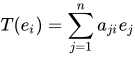
If V {\displaystyle V} {\displaystyle V} is a vector space over the field F {\displaystyle F} {\displaystyle F}, the general linear group of V {\displaystyle V} {\displaystyle V}, written GL ⁡ ( V ) {\displaystyle \operatorname {GL} (V)} {\displaystyle \operatorname {GL} (V)} or Aut ⁡ ( V ) {\displaystyle \operatorname {Aut} (V)} {\displaystyle \operatorname {Aut} (V)}, is the group of all automorphisms of V {\displaystyle V} {\displaystyle V}, i.e. the set of all bijective linear transformations V → V {\displaystyle V\to V} {\displaystyle V\to V}, together with functional composition as group operation. If V {\displaystyle V} {\displaystyle V} has finite dimension n {\displaystyle n} {\displaystyle n}, then GL ⁡ ( V ) {\displaystyle \operatorname {GL} (V)} {\displaystyle \operatorname {GL} (V)} and GL ⁡ ( n , F ) {\displaystyle \operatorname {GL} (n,F)} {\displaystyle \operatorname {GL} (n,F)} are isomorphic. The isomorphism is not canonical; it depends on a choice of basis in V {\displaystyle V} {\displaystyle V}. Given a basis { e 1 , … , e n } {\displaystyle \{e_{1},\dots ,e_{n}\}} {\displaystyle \{e_{1},\dots ,e_{n}\}} of V {\displaystyle V} {\displaystyle V} and an automorphism T {\displaystyle T} {\displaystyle T} in GL ⁡ ( V ) {\displaystyle \operatorname {GL} (V)} {\displaystyle \operatorname {GL} (V)}, we have then for every basis vector ei that

T ( e i ) = ∑ j = 1 n a j i e j {\displaystyle T(e_{i})=\sum _{j=1}^{n}a_{ji}e_{j}} {\displaystyle T(e_{i})=\sum _{j=1}^{n}a_{ji}e_{j}}

for some constants a i j {\displaystyle a_{ij}} {\displaystyle a_{ij}} in F {\displaystyle F} {\displaystyle F}; the matrix corresponding to T {\displaystyle T} {\displaystyle T} is then just the matrix with entries given by the a j i {\displaystyle a_{ji}} {\displaystyle a_{ji}}.

In a similar way, for a commutative ring R {\displaystyle R} {\displaystyle R} the group GL ⁡ ( n , R ) {\displaystyle \operatorname {GL} (n,R)} {\displaystyle \operatorname {GL} (n,R)} may be interpreted as the group of automorphisms of a free R {\displaystyle R} {\displaystyle R}-module M {\displaystyle M} {\displaystyle M} of rank n {\displaystyle n} {\displaystyle n}. One can also define GL(M) for any R {\displaystyle R} {\displaystyle R}-module, but in general this is not isomorphic to GL ⁡ ( n , R ) {\displaystyle \operatorname {GL} (n,R)} {\displaystyle \operatorname {GL} (n,R)} (for any n {\displaystyle n} {\displaystyle n}).

In terms of determinants

[edit]

Over a field F {\displaystyle F} {\displaystyle F}, a matrix is invertible if and only if its determinant is nonzero. Therefore, an alternative definition of GL ⁡ ( n , F ) {\displaystyle \operatorname {GL} (n,F)} {\displaystyle \operatorname {GL} (n,F)} is as the group of matrices with nonzero determinant.

Over a commutative ring R {\displaystyle R} {\displaystyle R}, more care is needed: a matrix over R {\displaystyle R} {\displaystyle R} is invertible if and only if its determinant is a unit in R {\displaystyle R} {\displaystyle R}, that is, if its determinant is invertible in R {\displaystyle R} {\displaystyle R}. Therefore, GL ⁡ ( n , R ) {\displaystyle \operatorname {GL} (n,R)} {\displaystyle \operatorname {GL} (n,R)} may be defined as the group of matrices whose determinants are units.

Over a non-commutative ring R {\displaystyle R} {\displaystyle R}, determinants are not at all well behaved. In this case, GL ⁡ ( n , R ) {\displaystyle \operatorname {GL} (n,R)} {\displaystyle \operatorname {GL} (n,R)} may be defined as the unit group of the matrix ring M ( n , R ) {\displaystyle M(n,R)} {\displaystyle M(n,R)}.

As a Lie group/algebra

[edit]

Real case

[edit]

The general linear group GL ⁡ ( n , R ) {\displaystyle \operatorname {GL} (n,\mathbb {R} )} {\displaystyle \operatorname {GL} (n,\mathbb {R} )} over the field of real numbers is a real Lie group of dimension n 2 {\displaystyle n^{2}} {\displaystyle n^{2}}. To see this, note that the set of all n × n {\displaystyle n\times n} {\displaystyle n\times n} real matrices, M n ( R ) {\displaystyle M_{n}(\mathbb {R} )} {\displaystyle M_{n}(\mathbb {R} )}, forms a real vector space of dimension n 2 {\displaystyle n^{2}} {\displaystyle n^{2}}. The subset GL ⁡ ( n , R ) {\displaystyle \operatorname {GL} (n,\mathbb {R} )} {\displaystyle \operatorname {GL} (n,\mathbb {R} )} consists of those matrices whose determinant is non-zero. The determinant is a polynomial map, and hence GL ⁡ ( n , R ) {\displaystyle \operatorname {GL} (n,\mathbb {R} )} {\displaystyle \operatorname {GL} (n,\mathbb {R} )} is an open affine subvariety of M n ( R ) {\displaystyle M_{n}(\mathbb {R} )} {\displaystyle M_{n}(\mathbb {R} )} (a non-empty open subset of M n ( R ) {\displaystyle M_{n}(\mathbb {R} )} {\displaystyle M_{n}(\mathbb {R} )} in the Zariski topology), and therefore[2] a smooth manifold of the same dimension.

The Lie algebra of GL ⁡ ( n , R ) {\displaystyle \operatorname {GL} (n,\mathbb {R} )} {\displaystyle \operatorname {GL} (n,\mathbb {R} )}, denoted g l n , {\displaystyle {\mathfrak {gl}}_{n},} {\displaystyle {\mathfrak {gl}}_{n},} consists of all n × n {\displaystyle n\times n} {\displaystyle n\times n} real matrices with the commutator serving as the Lie bracket.

As a manifold, GL ⁡ ( n , R ) {\displaystyle \operatorname {GL} (n,\mathbb {R} )} {\displaystyle \operatorname {GL} (n,\mathbb {R} )} is not connected but rather has two connected components: the matrices with positive determinant and the ones with negative determinant. The identity component, denoted by GL + ⁡ ( n , R ) {\displaystyle \operatorname {GL} ^{+}(n,\mathbb {R} )} {\displaystyle \operatorname {GL} ^{+}(n,\mathbb {R} )}, consists of the real n × n {\displaystyle n\times n} {\displaystyle n\times n} matrices with positive determinant. This is also a Lie group of dimension n 2 {\displaystyle n^{2}} {\displaystyle n^{2}}; it has the same Lie algebra as GL ⁡ ( n , R ) {\displaystyle \operatorname {GL} (n,\mathbb {R} )} {\displaystyle \operatorname {GL} (n,\mathbb {R} )}.

The polar decomposition, which is unique for invertible matrices, shows that there is a homeomorphism between GL ⁡ ( n , R ) {\displaystyle \operatorname {GL} (n,\mathbb {R} )} {\displaystyle \operatorname {GL} (n,\mathbb {R} )} and the Cartesian product of O ⁡ ( n ) {\displaystyle \operatorname {O} (n)} {\displaystyle \operatorname {O} (n)} with the set of positive-definite symmetric matrices. Similarly, it shows that there is a homeomorphism between GL + ⁡ ( n , R ) {\displaystyle \operatorname {GL} ^{+}(n,\mathbb {R} )} {\displaystyle \operatorname {GL} ^{+}(n,\mathbb {R} )} and the Cartesian product of SO ⁡ ( n ) {\displaystyle \operatorname {SO} (n)} {\displaystyle \operatorname {SO} (n)} with the set of positive-definite symmetric matrices. Because the latter is contractible, the fundamental group of GL + ⁡ ( n , R ) {\displaystyle \operatorname {GL} ^{+}(n,\mathbb {R} )} {\displaystyle \operatorname {GL} ^{+}(n,\mathbb {R} )} is isomorphic to that of SO ⁡ ( n ) {\displaystyle \operatorname {SO} (n)} {\displaystyle \operatorname {SO} (n)}.

The homeomorphism also shows that the group GL ⁡ ( n , R ) {\displaystyle \operatorname {GL} (n,\mathbb {R} )} {\displaystyle \operatorname {GL} (n,\mathbb {R} )} is noncompact. “The” [3] maximal compact subgroup of GL ⁡ ( n , R ) {\displaystyle \operatorname {GL} (n,\mathbb {R} )} {\displaystyle \operatorname {GL} (n,\mathbb {R} )} is the orthogonal group O ⁡ ( n ) {\displaystyle \operatorname {O} (n)} {\displaystyle \operatorname {O} (n)}, while "the" maximal compact subgroup of GL + ⁡ ( n , R ) {\displaystyle \operatorname {GL} ^{+}(n,\mathbb {R} )} {\displaystyle \operatorname {GL} ^{+}(n,\mathbb {R} )} is the special orthogonal group SO ⁡ ( n ) {\displaystyle \operatorname {SO} (n)} {\displaystyle \operatorname {SO} (n)}. As for SO ⁡ ( n ) {\displaystyle \operatorname {SO} (n)} {\displaystyle \operatorname {SO} (n)}, the group GL + ⁡ ( n , R ) {\displaystyle \operatorname {GL} ^{+}(n,\mathbb {R} )} {\displaystyle \operatorname {GL} ^{+}(n,\mathbb {R} )} is not simply connected (except when n = 1 {\displaystyle n=1} {\displaystyle n=1}, but rather has a fundamental group isomorphic to Z {\displaystyle \mathbb {Z} } {\displaystyle \mathbb {Z} } for n = 2 {\displaystyle n=2} {\displaystyle n=2} or Z 2 {\displaystyle \mathbb {Z} _{2}} {\displaystyle \mathbb {Z} _{2}} for n > 2 {\displaystyle n>2} {\displaystyle n>2}.

Complex case

[edit]

The general linear group over the field of complex numbers, GL ⁡ ( n , C ) {\displaystyle \operatorname {GL} (n,\mathbb {C} )} {\displaystyle \operatorname {GL} (n,\mathbb {C} )}, is a complex Lie group of complex dimension n 2 {\displaystyle n^{2}} {\displaystyle n^{2}}. As a real Lie group (through realification) it has dimension 2 n 2 {\displaystyle 2n^{2}} {\displaystyle 2n^{2}}. The set of all real matrices forms a real Lie subgroup. These correspond to the inclusions

GL ⁡ ( n , R ) < GL ⁡ ( n , C ) < GL ⁡ ( 2 n , R ) {\displaystyle \operatorname {GL} (n,\mathbb {R} )<\operatorname {GL} (n,\mathbb {C} )<\operatorname {GL} (2n,\mathbb {R} )} {\displaystyle \operatorname {GL} (n,\mathbb {R} )<\operatorname {GL} (n,\mathbb {C} )<\operatorname {GL} (2n,\mathbb {R} )},

which have real dimensions n 2 {\displaystyle n^{2}} {\displaystyle n^{2}}, 2 n 2 {\displaystyle 2n^{2}} {\displaystyle 2n^{2}}, and ( 2 n ) 2 = 4 n 2 {\displaystyle (2n)^{2}=4n^{2}} {\displaystyle (2n)^{2}=4n^{2}}. Complex n {\displaystyle n} {\displaystyle n}-dimensional matrices can be characterized as real 2 n {\displaystyle 2n} {\displaystyle 2n}-dimensional matrices that preserve a linear complex structure; that is, matrices that commute with a matrix J {\displaystyle J} {\displaystyle J} such that J 2 = − I {\displaystyle J^{2}=-I} {\displaystyle J^{2}=-I}, where J {\displaystyle J} {\displaystyle J} corresponds to multiplying by the imaginary unit i {\displaystyle i} {\displaystyle i}.

The Lie algebra corresponding to GL ⁡ ( n , C ) {\displaystyle \operatorname {GL} (n,\mathbb {C} )} {\displaystyle \operatorname {GL} (n,\mathbb {C} )} consists of all n × n {\displaystyle n\times n} {\displaystyle n\times n} complex matrices with the commutator serving as the Lie bracket.

Unlike the real case, GL ⁡ ( n , C ) {\displaystyle \operatorname {GL} (n,\mathbb {C} )} {\displaystyle \operatorname {GL} (n,\mathbb {C} )} is connected. This follows, in part, since the multiplicative group of complex numbers C × {\displaystyle \mathbb {C} ^{\times }} {\displaystyle \mathbb {C} ^{\times }} is connected. The group manifold GL ⁡ ( n , C ) {\displaystyle \operatorname {GL} (n,\mathbb {C} )} {\displaystyle \operatorname {GL} (n,\mathbb {C} )} is not compact; rather its maximal compact subgroup is the unitary group U ⁡ ( n ) {\displaystyle \operatorname {U} (n)} {\displaystyle \operatorname {U} (n)}. As for U ⁡ ( n ) {\displaystyle \operatorname {U} (n)} {\displaystyle \operatorname {U} (n)}, the group manifold GL ⁡ ( n , C ) {\displaystyle \operatorname {GL} (n,\mathbb {C} )} {\displaystyle \operatorname {GL} (n,\mathbb {C} )} is not simply connected but has a fundamental group isomorphic to Z {\displaystyle \mathbb {Z} } {\displaystyle \mathbb {Z} }.

Over finite fields

[edit]
Cayley table of GL(2, 2), which is isomorphic to S3.

If F {\displaystyle F} {\displaystyle F} is a finite field with q {\displaystyle q} {\displaystyle q} elements, then we sometimes write GL ⁡ ( n , q ) {\displaystyle \operatorname {GL} (n,q)} {\displaystyle \operatorname {GL} (n,q)} instead of GL ⁡ ( n , F ) {\displaystyle \operatorname {GL} (n,F)} {\displaystyle \operatorname {GL} (n,F)}. When p is prime, GL ⁡ ( n , p ) {\displaystyle \operatorname {GL} (n,p)} {\displaystyle \operatorname {GL} (n,p)} is the outer automorphism group of the group Z p n {\displaystyle \mathbb {Z} _{p}^{n}} {\displaystyle \mathbb {Z} _{p}^{n}}, and also the automorphism group, because Z p n {\displaystyle \mathbb {Z} _{p}^{n}} {\displaystyle \mathbb {Z} _{p}^{n}} is abelian, so the inner automorphism group is trivial.

The order of GL ⁡ ( n , q ) {\displaystyle \operatorname {GL} (n,q)} {\displaystyle \operatorname {GL} (n,q)} is:

∏ k = 0 n − 1 ( q n − q k ) = ( q n − 1 ) ( q n − q ) ( q n − q 2 )   ⋯   ( q n − q n − 1 ) . {\displaystyle \prod _{k=0}^{n-1}(q^{n}-q^{k})=(q^{n}-1)(q^{n}-q)(q^{n}-q^{2})\ \cdots \ (q^{n}-q^{n-1}).} {\displaystyle \prod _{k=0}^{n-1}(q^{n}-q^{k})=(q^{n}-1)(q^{n}-q)(q^{n}-q^{2})\ \cdots \ (q^{n}-q^{n-1}).}

This can be shown by counting the possible columns of the matrix: the first column can be anything but the zero vector; the second column can be anything but the multiples of the first column; and in general, the k {\displaystyle k} {\displaystyle k}th column can be any vector not in the linear span of the first k − 1 {\displaystyle k-1} {\displaystyle k-1} columns. In q-analog notation, this is [ n ] q ! ( q − 1 ) n q ( n 2 ) {\displaystyle [n]_{q}!(q-1)^{n}q^{n \choose 2}} {\displaystyle [n]_{q}!(q-1)^{n}q^{n \choose 2}}.

For example, GL(3, 2) has order (8 − 1)(8 − 2)(8 − 4) = 168. It is the automorphism group of the Fano plane and of the group Z 2 3 {\displaystyle \mathbb {Z} _{2}^{3}} {\displaystyle \mathbb {Z} _{2}^{3}}. This group is also isomorphic to PSL(2, 7).

More generally, one can count points of Grassmannian over F {\displaystyle F} {\displaystyle F}: in other words the number of subspaces of a given dimension k {\displaystyle k} {\displaystyle k}. This requires only finding the order of the stabilizer subgroup of one such subspace and dividing into the formula just given, by the orbit-stabilizer theorem.

These formulas are connected to the Schubert decomposition of the Grassmannian, and are q-analogs of the Betti numbers of complex Grassmannians. This was one of the clues leading to the Weil conjectures.

Note that in the limit q → 1 {\displaystyle q\to 1} {\displaystyle q\to 1} the order of GL ⁡ ( n , q ) {\displaystyle \operatorname {GL} (n,q)} {\displaystyle \operatorname {GL} (n,q)} goes to 0! – but under the correct procedure (dividing by ( q − 1 ) n {\displaystyle (q-1)^{n}} {\displaystyle (q-1)^{n}}) we see that it is the order of the symmetric group (see Lorscheid's article). In the philosophy of the field with one element, one thus interprets the symmetric group as the general linear group over the field with one element: S n ≅ GL ⁡ ( n , 1 ) {\displaystyle S_{n}\cong \operatorname {GL} (n,1)} {\displaystyle S_{n}\cong \operatorname {GL} (n,1)}.

History

[edit]

The general linear group over a prime field, GL ⁡ ( ν , p ) {\displaystyle \operatorname {GL} (\nu ,p)} {\displaystyle \operatorname {GL} (\nu ,p)}, was constructed and its order computed by Évariste Galois in 1832, in his last letter (to Chevalier) and second (of three) attached manuscripts, which he used in the context of studying the Galois group of the general equation of order p ν {\displaystyle p^{\nu }} {\displaystyle p^{\nu }}.[4]

Special linear group

[edit]
Main article: Special linear group

The special linear group, SL ⁡ ( n , F ) {\displaystyle \operatorname {SL} (n,F)} {\displaystyle \operatorname {SL} (n,F)}, is the group of all matrices with determinant 1. These matrices are special in that they lie on a subvariety: they satisfy a polynomial equation (as the determinant is a polynomial in the entries). Matrices of this type form a group as the determinant of the product of two matrices is the product of the determinants of each matrix.

If we write F × {\displaystyle F^{\times }} {\displaystyle F^{\times }} for the multiplicative group of F {\displaystyle F} {\displaystyle F} (that is, F {\displaystyle F} {\displaystyle F} excluding 0), then the determinant is a group homomorphism

det : GL ⁡ ( n , F ) → F × {\displaystyle \det :\operatorname {GL} (n,F)\to F^{\times }} {\displaystyle \det :\operatorname {GL} (n,F)\to F^{\times }}

that is surjective and its kernel is the special linear group. Thus, SL ⁡ ( n , F ) {\displaystyle \operatorname {SL} (n,F)} {\displaystyle \operatorname {SL} (n,F)} is a normal subgroup of GL ⁡ ( n , F ) {\displaystyle \operatorname {GL} (n,F)} {\displaystyle \operatorname {GL} (n,F)}, and by the first isomorphism theorem, GL ⁡ ( n , F ) / SL ⁡ ( n , F ) {\displaystyle \operatorname {GL} (n,F)/\operatorname {SL} (n,F)} {\displaystyle \operatorname {GL} (n,F)/\operatorname {SL} (n,F)} is isomorphic to F × {\displaystyle F^{\times }} {\displaystyle F^{\times }}. In fact, GL ⁡ ( n , F ) {\displaystyle \operatorname {GL} (n,F)} {\displaystyle \operatorname {GL} (n,F)} can be written as a semidirect product:

GL ⁡ ( n , F ) = SL ⁡ ( n , F ) ⋊ F × {\displaystyle \operatorname {GL} (n,F)=\operatorname {SL} (n,F)\rtimes F^{\times }} {\displaystyle \operatorname {GL} (n,F)=\operatorname {SL} (n,F)\rtimes F^{\times }}.

The special linear group is also the derived group (also known as commutator subgroup) of GL ⁡ ( n , F ) {\displaystyle \operatorname {GL} (n,F)} {\displaystyle \operatorname {GL} (n,F)} (for a field or a division ring F {\displaystyle F} {\displaystyle F}), provided that n ≠ 2 {\displaystyle n\neq 2} {\displaystyle n\neq 2} or F {\displaystyle F} {\displaystyle F} is not the field with two elements.[5]

When F {\displaystyle F} {\displaystyle F} is R {\displaystyle \mathbb {R} } {\displaystyle \mathbb {R} } or C {\displaystyle \mathbb {C} } {\displaystyle \mathbb {C} }, SL ⁡ ( n , F ) {\displaystyle \operatorname {SL} (n,F)} {\displaystyle \operatorname {SL} (n,F)} is a Lie subgroup of GL ⁡ ( n , F ) {\displaystyle \operatorname {GL} (n,F)} {\displaystyle \operatorname {GL} (n,F)} of dimension n 2 − 1 {\displaystyle n^{2}-1} {\displaystyle n^{2}-1}. The Lie algebra of SL ⁡ ( n , F ) {\displaystyle \operatorname {SL} (n,F)} {\displaystyle \operatorname {SL} (n,F)} consists of all n × n {\displaystyle n\times n} {\displaystyle n\times n} matrices over F {\displaystyle F} {\displaystyle F} with vanishing trace. The Lie bracket is given by the commutator.

The special linear group SL ⁡ ( n , R ) {\displaystyle \operatorname {SL} (n,\mathbb {R} )} {\displaystyle \operatorname {SL} (n,\mathbb {R} )} can be characterized as the group of volume and orientation-preserving linear transformations of R n {\displaystyle \mathbb {R} ^{n}} {\displaystyle \mathbb {R} ^{n}}.

The group SL ⁡ ( n , C ) {\displaystyle \operatorname {SL} (n,\mathbb {C} )} {\displaystyle \operatorname {SL} (n,\mathbb {C} )} is simply connected, while SL ⁡ ( n , R ) {\displaystyle \operatorname {SL} (n,\mathbb {R} )} {\displaystyle \operatorname {SL} (n,\mathbb {R} )} is not. SL ⁡ ( n , R ) {\displaystyle \operatorname {SL} (n,\mathbb {R} )} {\displaystyle \operatorname {SL} (n,\mathbb {R} )} has the same fundamental group as GL + ⁡ ( n , R ) {\displaystyle \operatorname {GL} ^{+}(n,\mathbb {R} )} {\displaystyle \operatorname {GL} ^{+}(n,\mathbb {R} )}, that is, Z {\displaystyle \mathbb {Z} } {\displaystyle \mathbb {Z} } for n = 2 {\displaystyle n=2} {\displaystyle n=2} and Z 2 {\displaystyle \mathbb {Z} _{2}} {\displaystyle \mathbb {Z} _{2}} for n > 2 {\displaystyle n>2} {\displaystyle n>2}.

Other subgroups

[edit]

Diagonal subgroups

[edit]

The set of all invertible diagonal matrices forms a subgroup of GL ⁡ ( n , F ) {\displaystyle \operatorname {GL} (n,F)} {\displaystyle \operatorname {GL} (n,F)} isomorphic to ( F × ) n {\displaystyle (F^{\times })^{n}} {\displaystyle (F^{\times })^{n}}. In fields like R {\displaystyle \mathbb {R} } {\displaystyle \mathbb {R} } and C {\displaystyle \mathbb {C} } {\displaystyle \mathbb {C} }, these correspond to rescaling the space; the so-called dilations and contractions.

A scalar matrix is a diagonal matrix which is a constant times the identity matrix. The set of all nonzero scalar matrices forms a subgroup of GL ⁡ ( n , F ) {\displaystyle \operatorname {GL} (n,F)} {\displaystyle \operatorname {GL} (n,F)} isomorphic to F × {\displaystyle F^{\times }} {\displaystyle F^{\times }}. This group is the center of GL ⁡ ( n , F ) {\displaystyle \operatorname {GL} (n,F)} {\displaystyle \operatorname {GL} (n,F)}. In particular, it is a normal, abelian subgroup.

The center of SL ⁡ ( n , F ) {\displaystyle \operatorname {SL} (n,F)} {\displaystyle \operatorname {SL} (n,F)} is simply the set of all scalar matrices with unit determinant, and is isomorphic to the group of n {\displaystyle n} {\displaystyle n}th roots of unity in the field F {\displaystyle F} {\displaystyle F}.

Classical groups

[edit]

The so-called classical groups are subgroups of GL ⁡ ( V ) {\displaystyle \operatorname {GL} (V)} {\displaystyle \operatorname {GL} (V)} which preserve some sort of bilinear form on a vector space V {\displaystyle V} {\displaystyle V}. These include the

  • orthogonal group, O ⁡ ( V ) {\displaystyle \operatorname {O} (V)} {\displaystyle \operatorname {O} (V)}, which preserves a non-degenerate quadratic form on V {\displaystyle V} {\displaystyle V},
  • symplectic group, Sp ⁡ ( V ) {\displaystyle \operatorname {Sp} (V)} {\displaystyle \operatorname {Sp} (V)}, which preserves a symplectic form on V {\displaystyle V} {\displaystyle V} (a non-degenerate alternating form),
  • unitary group, U ⁡ ( V ) {\displaystyle \operatorname {U} (V)} {\displaystyle \operatorname {U} (V)}, which, when F = C {\displaystyle F=\mathbb {C} } {\displaystyle F=\mathbb {C} }, preserves a non-degenerate hermitian form on V {\displaystyle V} {\displaystyle V}.

These groups provide important examples of Lie groups.

Related groups and monoids

[edit]

Projective linear group

[edit]
Main article: Projective linear group

The projective linear group PGL ⁡ ( n , F ) {\displaystyle \operatorname {PGL} (n,F)} {\displaystyle \operatorname {PGL} (n,F)} and the projective special linear group PSL ⁡ ( n , F ) {\displaystyle \operatorname {PSL} (n,F)} {\displaystyle \operatorname {PSL} (n,F)} are the quotients of GL ⁡ ( n , F ) {\displaystyle \operatorname {GL} (n,F)} {\displaystyle \operatorname {GL} (n,F)} and SL ⁡ ( n , F ) {\displaystyle \operatorname {SL} (n,F)} {\displaystyle \operatorname {SL} (n,F)} by their centers (which consist of the multiples of the identity matrix therein); they are the induced action on the associated projective space.

Affine group

[edit]
Main article: Affine group

The affine group Aff ⁡ ( n , F ) {\displaystyle \operatorname {Aff} (n,F)} {\displaystyle \operatorname {Aff} (n,F)} is an extension of GL ⁡ ( n , F ) {\displaystyle \operatorname {GL} (n,F)} {\displaystyle \operatorname {GL} (n,F)} by the group of translations in F n {\displaystyle F^{n}} {\displaystyle F^{n}}. It can be written as a semidirect product:

Aff ⁡ ( n , F ) = GL ⁡ ( n , F ) ⋉ F n {\displaystyle \operatorname {Aff} (n,F)=\operatorname {GL} (n,F)\ltimes F^{n}} {\displaystyle \operatorname {Aff} (n,F)=\operatorname {GL} (n,F)\ltimes F^{n}}

where GL ⁡ ( n , F ) {\displaystyle \operatorname {GL} (n,F)} {\displaystyle \operatorname {GL} (n,F)} acts on F n {\displaystyle F^{n}} {\displaystyle F^{n}} in the natural manner. The affine group can be viewed as the group of all affine transformations of the affine space underlying the vector space F n {\displaystyle F^{n}} {\displaystyle F^{n}}.

One has analogous constructions for other subgroups of the general linear group: for instance, the special affine group is the subgroup defined by the semidirect product, SL ⁡ ( n , F ) ⋉ F n {\displaystyle \operatorname {SL} (n,F)\ltimes F^{n}} {\displaystyle \operatorname {SL} (n,F)\ltimes F^{n}}, and the Poincaré group is the affine group associated to the Lorentz group, O ⁡ ( 1 , 3 , F ) ⋉ F n {\displaystyle \operatorname {O} (1,3,F)\ltimes F^{n}} {\displaystyle \operatorname {O} (1,3,F)\ltimes F^{n}}.

General semilinear group

[edit]
Main article: General semilinear group

The general semilinear group Γ L ⁡ ( n , F ) {\displaystyle \operatorname {\Gamma L} (n,F)} {\displaystyle \operatorname {\Gamma L} (n,F)} is the group of all invertible semilinear transformations, and contains GL ⁡ ( n , F ) {\displaystyle \operatorname {GL} (n,F)} {\displaystyle \operatorname {GL} (n,F)}. A semilinear transformation is a transformation which is linear “up to a twist”, meaning “up to a field automorphism under scalar multiplication”. It can be written as a semidirect product:

Γ L ⁡ ( n , F ) = Gal ⁡ ( F ) ⋉ GL ⁡ ( n , F ) {\displaystyle \operatorname {\Gamma L} (n,F)=\operatorname {Gal} (F)\ltimes \operatorname {GL} (n,F)} {\displaystyle \operatorname {\Gamma L} (n,F)=\operatorname {Gal} (F)\ltimes \operatorname {GL} (n,F)}

where Gal ⁡ ( F ) {\displaystyle \operatorname {Gal} (F)} {\displaystyle \operatorname {Gal} (F)} is the Galois group of F {\displaystyle F} {\displaystyle F} (over its prime field), which acts on GL ⁡ ( n , F ) {\displaystyle \operatorname {GL} (n,F)} {\displaystyle \operatorname {GL} (n,F)} by the Galois action on the entries.

The main interest of Γ L ⁡ ( n , F ) {\displaystyle \operatorname {\Gamma L} (n,F)} {\displaystyle \operatorname {\Gamma L} (n,F)} is that the associated projective semilinear group P Γ L ⁡ ( n , F ) {\displaystyle \operatorname {P\Gamma L} (n,F)} {\displaystyle \operatorname {P\Gamma L} (n,F)}, which contains PGL ⁡ ( n , F ) {\displaystyle \operatorname {PGL} (n,F)} {\displaystyle \operatorname {PGL} (n,F)}, is the collineation group of projective space, for n > 2 {\displaystyle n>2} {\displaystyle n>2}, and thus semilinear maps are of interest in projective geometry.

Full linear monoid

[edit]
[icon]
This section needs expansion with: basic properties. You can help by adding missing information. (April 2015)

If one removes the restriction of the determinant being non-zero, the resulting algebraic structure is a monoid, usually called the full linear monoid,[6][7][8] but occasionally also full linear semigroup,[9] general linear monoid[10][11] etc. It is actually a regular semigroup.[7]

Infinite general linear group

[edit]

The infinite general linear group or stable general linear group is the direct limit of the inclusions GL ⁡ ( n , F ) → GL ⁡ ( n + 1 , F ) {\displaystyle \operatorname {GL} (n,F)\to \operatorname {GL} (n+1,F)} {\displaystyle \operatorname {GL} (n,F)\to \operatorname {GL} (n+1,F)} as the upper left block matrix. It is denoted by either GL ⁡ ( F ) {\displaystyle \operatorname {GL} (F)} {\displaystyle \operatorname {GL} (F)} or GL ⁡ ( ∞ , F ) {\displaystyle \operatorname {GL} (\infty ,F)} {\displaystyle \operatorname {GL} (\infty ,F)}, and can also be interpreted as invertible infinite matrices which differ from the identity matrix in only finitely many places.[12]

It is used in algebraic K-theory to define K1, and over the reals has a well-understood topology, thanks to Bott periodicity.

It should not be confused with the space of (bounded) invertible operators on a Hilbert space, which is a larger group, and topologically much simpler, namely contractible – see Kuiper's theorem.

See also

[edit]
  • List of finite simple groups
  • SL2(R)
  • Representation theory of SL2(R)
  • Representations of classical Lie groups

Notes

[edit]
  1. ^ Here rings are assumed to be associative and unital.
  2. ^ Since the Zariski topology is coarser than the metric topology; equivalently, polynomial maps are continuous.
  3. ^ A maximal compact subgroup is not unique, but is essentially unique, hence one often refers to “the” maximal compact subgroup.
  4. ^ Galois, Évariste (1846). "Lettre de Galois à M. Auguste Chevalier". Journal de Mathématiques Pures et Appliquées. XI: 408–415. Archived from the original on 2021-04-26. Retrieved 2009-02-04, GL(ν,p) discussed on p. 410.{{cite journal}}: CS1 maint: postscript (link)
  5. ^ Suprunenko, D.A. (1976), Matrix groups, Translations of Mathematical Monographs, American Mathematical Society, Theorem II.9.4
  6. ^ Jan Okniński (1998). Semigroups of Matrices. World Scientific. Chapter 2: Full linear monoid. ISBN 978-981-02-3445-4.
  7. ^ a b Meakin (2007). "Groups and Semigroups: Connections and contrast". In C. M. Campbell (ed.). Groups St Andrews 2005. Cambridge University Press. p. 471. ISBN 978-0-521-69470-4.
  8. ^ John Rhodes; Benjamin Steinberg (2009). The q-theory of Finite Semigroups. Springer Science & Business Media. p. 306. ISBN 978-0-387-09781-7.
  9. ^ Eric Jespers; Jan Okniski (2007). Noetherian Semigroup Algebras. Springer Science & Business Media. 2.3: Full linear semigroup. ISBN 978-1-4020-5810-3.
  10. ^ Meinolf Geck (2013). An Introduction to Algebraic Geometry and Algebraic Groups. Oxford University Press. p. 132. ISBN 978-0-19-967616-3.
  11. ^ Mahir Bilen Can; Zhenheng Li; Benjamin Steinberg; Qiang Wang (2014). Algebraic Monoids, Group Embeddings, and Algebraic Combinatorics. Springer. p. 142. ISBN 978-1-4939-0938-4.
  12. ^ Milnor, John Willard (1971). Introduction to algebraic K-theory. Annals of Mathematics Studies. Vol. 72. Princeton, NJ: Princeton University Press. p. 25. MR 0349811. Zbl 0237.18005.

References

[edit]
  • Springer, Tonny Albert (1998). Linear Algebraic Groups (2nd ed.). Birkhäuser. ISBN 978-0-8176-4839-8.

External links

[edit]
  • "General linear group", Encyclopedia of Mathematics, EMS Press, 2001 [1994]
  • "GL(2, p) and GL(3, 3) Acting on Points" by Ed Pegg, Jr., Wolfram Demonstrations Project, 2007.
Retrieved from "https://teknopedia.ac.id/w/index.php?title=General_linear_group&oldid=1340753300"
Categories:
  • Abstract algebra
  • Linear algebra
  • Lie groups
  • Linear algebraic groups
Hidden categories:
  • CS1 maint: postscript
  • Articles with short description
  • Short description is different from Wikidata
  • Use American English from January 2019
  • All Wikipedia articles written in American English
  • Articles to be expanded from April 2015
  • All articles to be expanded
  • Pages that use a deprecated format of the math tags

  • indonesia
  • Polski
  • العربية
  • Deutsch
  • English
  • Español
  • Français
  • Italiano
  • مصرى
  • Nederlands
  • 日本語
  • Português
  • Sinugboanong Binisaya
  • Svenska
  • Українська
  • Tiếng Việt
  • Winaray
  • 中文
  • Русский
Sunting pranala
url url url url url url url url url url url url url url url url url url url url url url url url url url url url url url url url url url url url url url url url url url url url url url url url url url url url url url url url url url url url url url url url url url url url url url url url url url url url url url url url url url url url url url url url url url url url url url url url url url url url url url url url url url url url url url url url url url url url url url url url url url url url url url url url url url url url url url url url url url url url url url url url url url url url url url url url url url url url url url url url url url url url url url url url url url url url url url url url url url url url url url url url url url url url url url url url url url url url url url url url url url url url url url url url url url url url url url url url url url url url url url url url url url url url url url url url url url url url url url url url url url url url url url url url url url url url url url url url url url url url url url url url url url url url url url url url url url url url url url url url url url url url url url url url url url url url url url url url url url url url url url url url url url url url url url url url url url url url url url url url url url url url url url url url url url url url url url url url url url url url url url url url url url url url url url url url url url url url url url url url url url url url url url url url url url url url url url url url url url url url url url url url url url url url url url url url url url url url url url url url url url url url url url url url url url url url url url url url url url url url url url url url url url url url url url url url url url url url url url url url url url url url url url url url url url url url url url url url url url url url url url url url url url url url url url url url url url url url url url url url url url url url url url url url url url url url url url url url url url url url url url url url url url url url url url url url url url url url url url url url url url url url url url url url url url url url url url url url url url url url url url url url url url url url url url url url url url url url url url url url url url url url url url url url url url url url url url url url url url url url url url url url url url url url url url url url url url url url url url url url url url url url url url url url url url url url url url url url url url url url url url url url url url url url url url url url url url url url url url url url url url url url url url url url url url url url url url url url url url url url url url url url url url url url url url url url url url url url url url url url url url url url url url url url url url url url url url url url url url url url url url url url url url url url url url url url url url url url url url url url url url url url url url url url url url url url url url url url url url url url url url url url url url url url url url url url url url url url url url url url url url url url url url url url url url url url url url url url url url url url url url url url url url url url url url url url url url url url url url url url url url url url url url url url url url url url url url url url url url url url url url url url url url url url url url url url url url url url url url url url url url url url url url url url url url url url url url url url url url url url url url url url url url url url url url url url url url url url url url url url url url url url url url url url url url url url url url url url url url url url url url url url url url url url url url url url url url url url url url url url url url url url url url url url url url url url url url url url url url url url url url url url url url url url url url url url url url url url url url url url url url url url url url url url url url url url url url url url url url url url url url url url url url url url url url url url url url url url url url url url url url url url url url url url url url url url url url url url url url url url url url url url url url url url url url url url url url url url url url url url url url url url url url url url url url url url url url url url url url url url url url url url url url url url url url url url url url url url url url url url url url url url url url url url url url url url url url url url url url url url url url url url url url url url url url url url url url url url url url url url url url url url url url url url url url url url url url url url url url url url url url url url url url url url url url url url url url url url url url url url url url url url url url url url url url url url url url url url url url url url url url url url url url url url url url url url url url url url url url url url url url url url url url url url url url url url url url url url url url url url url url url url url url url url url url url url url url url url url url url url url url url url url url url url url url url url url url url url url url url url url url url url url url url url url url url url url url url url url url url url url url url url url url url url url url url url url url url url url url url url url url url url url url url url url url url url url url url url url url url url url url url url url url url url url url url url url url url url url url url url url url url url url url url url url url url url url url url url url url url url url url url url url url url url url url url url url url url url url url url url url url url url url url url url url url url url url url url url url url url url url url url url url url url url url url url url url url url url url url url url url url url url url url url url url url url url url url url url url url url url url url url url url url url url url url url url url url url url url url url url url url url url url url url url url url url url url url url url url url url url url url url url url url url url url url url url url url url url url url url url url url url url url url url url url url url url url url url url url url url url url url url url url url url url url url url url url url url url url url url url url url url url url url url url url url url url url url url url url url url url url url url url url url url url url url url url url url url url url url url url url url url url url url url url url url url url url url url url url url url url url url url url url url url url url url url url url url url url url url url url url url url url url url url url url url url url url url url url url url url url url url url url url url url url url url url url url url url url url url url url url url url url url url url url url url url url url url url url url url url url url url url url url url url url url url url url url url url url url url url url url url url url url url url url url url url url url url url url url url url url url url url url url url url url url url url url url url url url url url url url url url url url url url url url url url url url url url url url url url url url url url url url url url url url url url url url url url url url url url url url url url url url url url url url url url url url url url url url url url url url url url url url url url url url url url url url url url url url url url url url url url url url url url url url url url url url url url url url url url url url url url url url url url url url url url url url url url url url url url url url url url url url url url url url url url url url url url url url url url url url url url url url url url url url url url url url url url url url url url url url url url url url url url url url url url url url url url url url url url url url url url url url url url url url url url url url url url url url url url url url url url url url url url url url url url url url url url url url url url url url url url url url url url url url url url url url url url url url url url url url url url url url url url url url url url url url url url url url url url url url url url url url url url url url url url url url url url url url url url url url url url url url url url url url url url url url url url url url url url url url url url url url url url url url url url url url url url url url url url url url url url url url url url url url url url url url url url url url url url url url url url url url url url url url url url url url url url url url url url url url url url url url url url url url url url url url url url url url url url url url url url url url url url url url url url url url url url url url url url url url url url url url url url url url url url url url url url url url url url url url url url url url url url url url url url url url url url url url url url url url url url url url url url url url url url url url url url url url url url url url url url url url url url url url url url url url url url url url url url url url url url url url url url url url url url url url url url url url url url url url url url url url url url url url url url url url url url url url url url url url url url url url url url url url url url url url url url url url url url url url url url url url url url url url url url url url url url url url url url url url url url url url url url url url url url url url url url url url url url url url url url url url url url url url url url url url url url url url url url url url url url url url url url url url url url url url url url url url url url url url url url url url url url url url url url url url url url url url url url url url url url url url url url url url url url url url url url url url url url url url url url url url url url url url url url url url url url url url url url url url url url url url
Pusat Layanan

UNIVERSITAS TEKNOKRAT INDONESIA | ASEAN's Best Private University
Jl. ZA. Pagar Alam No.9 -11, Labuhan Ratu, Kec. Kedaton, Kota Bandar Lampung, Lampung 35132
Phone: (0721) 702022
Email: pmb@teknokrat.ac.id