Epstein Files Full PDF

CLICK HERE
Technopedia Center
PMB University Brochure
Faculty of Engineering and Computer Science
S1 Informatics S1 Information Systems S1 Information Technology S1 Computer Engineering S1 Electrical Engineering S1 Civil Engineering

faculty of Economics and Business
S1 Management S1 Accountancy

Faculty of Letters and Educational Sciences
S1 English literature S1 English language education S1 Mathematics education S1 Sports Education
teknopedia

  • Registerasi
  • Brosur UTI
  • Kip Scholarship Information
  • Performance
Flag Counter
  1. World Encyclopedia
  2. Help:Score - Wikipedia
Help:Score - Wikipedia
From Wikipedia, the free encyclopedia
This help page is a how-to guide.
It explains concepts or processes used by the Wikipedia community. It is not one of Wikipedia's policies or guidelines, and may reflect varying levels of consensus.
Shortcut
  • H:SCOREH:SCORE
"WP:SCORE" redirects here. For information about how to format the score results of competitions, see Wikipedia:Manual of Style/Dates and numbers § Numbers as figures or words.

The <score>...</score> element in wikitext displays a musical score out of GNU LilyPond (the default) or ABC markup syntax. It also produces a MIDI file of the music and optionally displays an audio player that plays the music. It is implemented by the Score extension for MediaWiki, available across Wikipedia languages.

For LilyPond resources, see § External links. As of August 2021[update], the extension on Wikipedia is using LilyPond v2.22.0 (check Special:Version for the current version). Changes to LilyPond since version 2.18 are documented here. Note that LilyPond's full syntax is available when the extension is invoked with the wikitext <score raw="1">. A plain <score> invokes a simplified implementation that is not fully consistent with the LilyPond documentation.

Element attributes

[edit]
Attribute Description
lang="ABC" use ABC notation (see standard documentation; many parts newer than 1.6 are unsupported, so preview often)
lang="lilypond" use LilyPond notation (default, see #Syntax)
sound="1" add an audio player beneath the score image to play an automatically-generated Ogg Vorbis audio file
raw="1" interpret the markup within the score tag as a complete LilyPond file, allowing more complex scores
midi="1" obsolete This used to control whether the score image links to an automatically-generated MIDI file; clicking the score now always shows a JavaScript pop-up with a link to the MIDI file.
override_midi="…" deprecated replace the automatically-generated MIDI file by the given one
override_audio="…" deprecated replace the automatically-generated audio file by the given one
override_ogg="…" deprecated alias for override_audio
vorbis="1" deprecated alias for sound

If there is a MIDI file or audio file of superior quality to the MIDI or audio generated by the Score extension, you can provide a [[File::]] wikilink to it after the closing </score> tag.

Examples

[edit]

Simple

[edit]
<score>
{c' d' e' f' g' fis' es' cis' c'2}
</score>

gives


{c' d' e' f' g' fis' es' cis' c'2}

Equivalent in ABC notation:

<score lang="ABC">
L:1/4
CDEF | G^F_E^C | C2
</score>

More elaborate

[edit]
<score sound="1">
  \transpose c g \relative c' { % display G for C, A for D, etc. and one octave higher
  \key c \minor
  \time 4/4
    c4 e8 e g4 g          % (text after the % is just a comment)
    <c es g>2 <c es g>    % angle brackets create chords
    es4 d( c b)         % parentheses create slurs
    a4. r8 r8 a8 ~ a4     % r creates rests; ~ creates ties
    e-- e-> e-. g\fermata % accents and other signs
    \bar "|."
  }
</score>

gives


  \transpose c g \relative c'{
  \key c \minor
  \time 4/4
    c4 e8 e g4 g          % (text after the % is just a comment)
    <c es g>2 <c es g>    % angle brackets create chords
    es4 d( c b)           % parentheses create slurs
    a4. r8 r8 a8 ~ a4     % r creates rests; ~ creates ties
    e-- e-> e-. g\fermata % accents and other signs
    \bar "|."
  }
% This is just a comment line.
Audio playback is not supported in your browser. You can download the audio file.

Equivalent in ABC (pre-transposed due to differing semantics):

<score lang="ABC">
K: Gm 
M: 4/4
L: 1/4
G =B/2B/2 dd |      % a comment
[gbd']2 [gbd']2 |   % square brackets create chords (not supported by abc2ly)
b (ag^e) |          % parentheses create slurs
=e3/2 z/2 z/2 c/2-c % z creates rests; – creates ties
!tenuto!=B LB .B HB % see standard section "Decorations" (not supported by abc2ly)
|]
</score>

Syntax

[edit]

The score section must be surrounded by <score>...</score>. The notes must be within a set of curly braces {...}.

Comments in the markup start with a percentage sign % and end at the end of the line.

Pitch

[edit]

To display a note, type the letter (a b c etc.) Separate each letter with a space. The bare note name refers to the natural note irrespective of key signature (see "setting the key" below). These letters are as in English and Dutch, not as in German and many other continental languages (FYI: continental b means b flat and continental h means b – if you find that confusing, forget it).

Sharps and flats are formed by using the Dutch and German suffixes "is" and "es" respectively. To avoid "ees", the note E♭ is simply written as es. The simple accidentals are thus ais bis cis dis eis fis gis for the sharps and aes bes ces des es fes ges for the flats. English language editors may prefer to include the line \language "english" in the script, after which s for sharp and f for flat can be used: as bs cs ds es fs gs and af bf cf df ef ff gf. Double sharps are formed with the suffix isis and double flats with eses, or in English notation with ss or x and ff. Semi-sharps, -flats and sesqui-sharps and -flats are also supported in both English and German. See: #Accidentals.

By default, each note name refers to the note below middle C. For example, a would be displayed as

\new Staff \with { \remove "Time_signature_engraver" }{a}

or

\new Staff \with { \remove "Time_signature_engraver" }{\clef bass a}

. Use the apostrophe (') to go up an octave and a comma (,) to go an octave down. Middle C would be c'

\new Staff \with { \remove "Time_signature_engraver" }{ c'}

.

 <score lang="lilypond" sound="1">
  {
    a,, c, e, a, c e a c' % Middle C
    e' a' c'' e'' a'' c''' e''' g''' \bar "||"
    aes'' bes'' gis'' dis'' aeses'' beses'' gisis'' disis'' \bar "||"
    aeh'' beseh'' gih'' disih''  \bar "||"
    \language "english"
    af'' bf'' gs'' ds'' aff'' bff'' gss'' bx'' \bar "||"
    aqf'' btqf'' gqs'' dtqs''
  }
 </score>

  {
    a,, c, e, a, c e a c' %Middle C
    e' a' c'' e'' a'' c''' e''' g''' \bar "||"
    aes'' bes'' gis'' dis'' aeses'' beses'' gisis'' disis'' \bar "||"
    aeh'' beseh'' gih'' disih''  \bar "||"
    \language "english"
    af'' bf'' gs'' ds'' aff'' bff'' gss'' bx'' \bar "||"
    aqf'' btqf'' gqs'' dtqs''
  }
Audio playback is not supported in your browser. You can download the audio file.

A much easier way is to use relative coding. If you include \relative before the braces, each note will refer to the note closest to the previous one, and the first one will refer to the note closest to the one mentioned after the \relative tag. ("Closest" ignores sharps and flats.) Use ' to go up an extra octave and , to go down.

 <score lang="lilypond" sound="1">
 \relative c' {
  e f <c e g>2
  a'4( b c) c,
  d8 e f16 g a b
  c4. a8 e' f g, f r \autoBeamOff e d c
  b4 a g b-> c2.-> r4
  \bar "|."
  }
 </score>

 \relative c' {
  e f <c e g>2
  a'4( b c) c,
  d8 e f16 g a b
  c4. a8 e' f g, f r \autoBeamOff e d c
  b4 a g b-> c2.-> r4
  \bar "|."
  }
Audio playback is not supported in your browser. You can download the audio file.

Setting the key

[edit]

By default there is no key signature (no sharps or flats). You can indicate the key with \key g \major, \key c \minor, or even a mode such as \key c \dorian or \key c \mixolydian. The key can be changed at any point.

Keep in mind that even with a key signature, you must still include sharps (-is) and flats (-es) for each individual note name. If you omit one, it will be considered a natural. For example, this is the key of Gb major:

<score lang="lilypond" sound="1">
 \relative c' {
   \key ges \major
   \time 6/8

% Notes with -es suffixes indicating flats
   des8 es ges aes bes ces

% Notes without accidentals (naturals)
   b c d e g a
  }
</score>

 \relative c' {
   \key ges \major
   \time 6/8

% Notes with -es suffixes indicating flats
   des8 es ges aes bes ces

% Notes without accidentals (naturals)
   b c d e g a
  }
Audio playback is not supported in your browser. You can download the audio file.

Accidentals

[edit]

Accidentals may be indicated by following the note name with the appropriate text:

double flat three quarter flat ♭ half flat ♮ half sharp ♯ three quarter sharp double sharp
De eses eseh es eh ! ih is isih isis
En ff tqf f qf qs s tqs ss or x

Note that E♭ is "es" alone, rather than "ees". "q" and "tq" refer to "quarter" and "three-quarter" (rather than "hf" for "half flat" and "thf" for "three-half flat"), as in "quarter tone". However, the "quarter flat/sharp" is not a quarter of a flat/sharp, but instead half of a flat/sharp, and the "three-quarter flat/sharp" is 1.5 flats not 0.75 flats. Notes outside of the quarter-tone scale are not supported.

German:

<score lang="lilypond" sound="1"> {

\omit Score.TimeSignature
    \relative c'' {
        \time 4/4
        aeses1 aeseh aes aeh a! aih ais aisih aisis
    }  }
</score>

English:

<score lang="lilypond" sound="1"> {

\omit Score.TimeSignature
    \relative c'' {
        \time 4/4
\language "english"
        aff1 atqf af aqf a! aqs as atqs ass
    }  }
</score>

Both result in:

 {

\omit Score.TimeSignature
    \relative c'' {
        \time 4/4
\language "english"
        aff1 atqf af aqf a! aqs as atqs ass
    }  }
Audio playback is not supported in your browser. You can download the audio file.

Transpose and transposition

[edit]

If, for some reason, a piece needs to be transposed to a different key, it is possible to do so without having to transcribe it manually. This also affects the key signature. The syntax for this is:

\transpose frompitch topitch musicexpr

For example:

<score lang="lilypond" sound="1">\transpose c es {
    \relative c' {
        \key c \major \time 4/4
        c4 d e f g a b c
    }  
}
</score>

Results in:

\transpose c es {
    \relative c' {
        \key c \major \time 4/4
        c4 d e f g a b c
    }  
}
Audio playback is not supported in your browser. You can download the audio file.

MIDI output can be transpositioned with the \transposition <pitch> command. The French horn (in C) motif from the opening of Schubert's last symphony, transpositioned one octave down:

<score sound="1">
\relative c' { \set Staff.midiInstrument = #"french horn"
  \set Staff.midiMinimumVolume = #0.7
  \set Staff.midiMaximumVolume = #1.0
  \tempo "Andante"
  \tempo 4 = 80
  \transposition c
  \key c \major
  \time 2/2
  c'2->\p d4 e4 | a,4.-> b8 c2 | f4.-> d8 e2 | g-> d4 e | a,4.-> b8 c2 | d4.-> e8 c2 | d2.\pp e4 | c1
}
</score>

\relative c' { \set Staff.midiInstrument = #"french horn"
  \set Staff.midiMinimumVolume = #0.7
  \set Staff.midiMaximumVolume = #1.0
  \tempo "Andante"
  \tempo 4 = 80
  \transposition c
  \key c \major
  \time 2/2
  c'2->\p d4 e4 | a,4.-> b8 c2 | f4.-> d8 e2 | g-> d4 e | a,4.-> b8 c2 | d4.-> e8 c2 | d2.\pp e4 | c1
}
Audio playback is not supported in your browser. You can download the audio file.

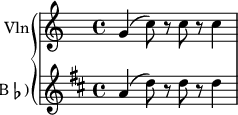
The \transposition command is mainly intended for scores that involve transposing instruments not set in concert pitch.

<score sound="1">
\new GrandStaff <<
  \new Staff = "violin" \with {
    instrumentName = "Vln"
    midiInstrument = "violin"
  }
  \relative c'' {
    % not strictly necessary, but a good reminder
    \transposition c'
    \key c \major
    g4( c8) r c r c4
  }
  \new Staff = "clarinet" \with {
    instrumentName = \markup { Cl (B\flat) }
    midiInstrument = "clarinet"
  }
  \relative c'' {
    \transposition bes
    \key d \major
    a4( d8) r d r d4
  }
>>
</score>
\new GrandStaff <<
  \new Staff = "violin" \with {
    instrumentName = "Vln"
    midiInstrument = "violin"
  }
  \relative c'' {
    % not strictly necessary, but a good reminder
    \transposition c'
    \key c \major
    g4( c8) r c r c4
  }
  \new Staff = "clarinet" \with {
    instrumentName = \markup { Cl (B\flat) }
    midiInstrument = "clarinet"
  }
  \relative c'' {
    \transposition bes
    \key d \major
    a4( d8) r d r d4
  }
>>
Audio playback is not supported in your browser. You can download the audio file.

Rhythm

[edit]

Note duration is indicated by a number following the pitch with no space between (a4 b8). Use the number 1 for a whole note (semibreve), 2 for a half note (minim), 4 for a quarter note (crotchet), 8 for an eighth note (quaver), and so on. If a note does not have an explicit duration, it will either default to a quarter note or use the duration of the note preceding it.

Rests are indicated by using the letter r instead of a pitch. Dotted notes are formed simply by following the duration number with a period (c4.).

Tuplets are indicated using the \times command, for example \times 2/3 {c8 c c} gives a triplet of three eight-notes (quavers).

 <score lang="lilypond" sound="1">
   \relative c''{b1 b2 b4 b8 c r4 b4. r8 \times 2/3 {a8 g f}}
 </score>

\relative c''{b1 b2 b4 b8 c r4 b4. r8 \times 2/3 {a8 g f}}
Audio playback is not supported in your browser. You can download the audio file.

Setting the time signature

[edit]

The default time signature is 4/4. To set another time signature, one may use the \time command. For example to set the time signature to cut-time one would use \time 2/2 and waltz time would be \time 3/4. The time signature may be changed at almost any point.

Removing the time signature

[edit]

For some music examples, removing the time signature may be desirable; the code \remove "Time_signature_engraver" can be used in that case:

<score>
{
  \new Staff \with { \remove "Time_signature_engraver" }
  <d' fis' a'>2
}
</score>
{ \new Staff \with { \remove "Time_signature_engraver" } <d' fis' a'>2 }

Pick up measure

[edit]

The code \partial 4 will create a pickup measure (anacrusis) of one quarter note, \partial 4*2 would create a pickup measure of two quarter notes, etc. See an example in the Adding Lyrics section of this article.

Customizing beams

[edit]

\relative c'' {
   \time 3/4
   r4. g8 a8 b8
}

The software occasionally combines beamed notes in places that are not desired or look awkward. To override the automatic beams, use \noBeam between the notes that would otherwise be beamed: g a b \noBeam g. To turn off beaming for many notes, use \autoBeamOff and then \autoBeamOn.

<score>
  \relative c'' {
     \time 3/4
     r4. g8 \noBeam a8 b8
  }
</score>

\relative c'' {
   \time 3/4
   r4. g8 \noBeam a8 b8
}

To manually beam notes, use square brackets inserting the first one after the first note to be beamed: a8 b[ c d e] f. This would beam the notes b, c, d, and e, but leave the first and last notes without beams.

 \relative c''{a8 b[ c d e] f}

Adding lyrics

[edit]

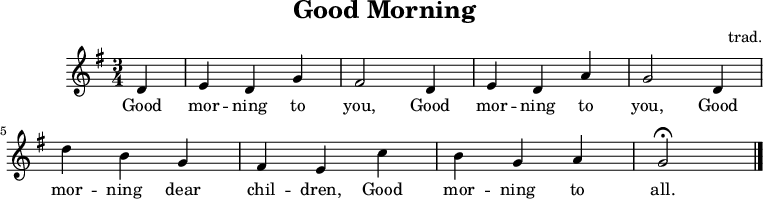
You can add lyrics to the score using \addlyrics. See the LilyPond Manual for more information about how to align the lyrics to the score.

<score raw="1" lang="lilypond">
  \header {
    tagline = "" % no footer
    title = "Good Morning"
    composer = "trad."
  }
  \relative g' {
    \key g \major \time 3/4
    \partial 4 d
     e d g
     fis2 d4
     e d a'
     g2 d4
     d' b g
     fis e c'
     b g a
     g2 \fermata
     \bar "|."
   }
   \addlyrics {
     Good mor -- ning to you,
     Good mor -- ning to you,
     Good mor -- ning dear chil -- dren,
     Good mor -- ning to all.
   }
  </score>
  \header {
    tagline = "" % no footer
    title = "Good Morning"
    composer = "trad."
  }
  \relative g' {
    \key g \major \time 3/4
    \partial 4 d
     e d g
     fis2 d4
     e d a'
     g2 d4
     d' b g
     fis e c'
     b g a
     g2 \fermata
     \bar "|."
   }
   \addlyrics {
     Good mor -- ning to you,
     Good mor -- ning to you,
     Good mor -- ning dear chil -- dren,
     Good mor -- ning to all.
   }

Adding chord names

[edit]

Chord names can be added as a separate ChordNames staff as follows:

<score lang="lilypond" sound="1">
<<
  \new ChordNames \chordmode {
    \set chordChanges = ##t % Only display chord when there is a change (e.g., don't repeat the Am here)
    a4:m a4:m         |% measure 1 – A7 would be a:7
    g2                |% measure 2
  }
  \new Staff \relative c''{
    \key a \minor
    \time 2/4
    a8 a16 a a8 a16 a |% measure 1
    b8 a g4           |% measure 2
  }
>>
</score>

<<
\new ChordNames \chordmode {
  \set chordChanges = ##t
  a4:m a4:m         |% measure 1
  g2                |% measure 2
}
\new Staff \relative c''{
  \key a \minor
  \time 2/4
  a8 a16 a a8 a16 a |% measure 1
  b8 a g4           |% measure 2
}
>>
Audio playback is not supported in your browser. You can download the audio file.

The letter s can be used in the ChordNames staff in place of r (the code for a rest) when there is no chord.

An r will result in an explicit "No Chord" notation

<<\new ChordNames \chordmode {r2} \new Staff \with { \remove "Time_signature_engraver" } \relative c''{c}>>

whereas the s will result in correct spacing, but no chord name notation will appear.

Adding whitespace

[edit]

The letter s followed by a note duration adds an appropriate amount of whitespace:

With s4 and s1   Without whitespace

\new GrandStaff <<
 \time 5/4
 \new Staff \with { \remove "Time_signature_engraver" \magnifyStaff 1.5 } { s4 c'1 }
 \new Staff \with { \remove "Time_signature_engraver" \magnifyStaff 1.5 \clef bass } { s4 s1 } >>

\new GrandStaff <<
 \new Staff \with { \remove "Time_signature_engraver" \magnifyStaff 1.5 } { c'1 }
 \new Staff \with { \remove "Time_signature_engraver" \magnifyStaff 1.5 \clef bass } { } >>
Middle C centrally placed on a grand staff

Accents and other symbols

[edit]

There are a number of symbols to attach to notes, such as -^. There are also {e-> f-- g-+ a-. b\fermata c-_ d-!}

<score>
  \relative c' {
  e-> f-- g-+ a-.
  b\fermata c-_ d-! e-^
  }
</score>

producing


  \relative c' {
  e-> f-- g-+ a-.
  b\fermata c-_ d-! e-^
  }

Color

[edit]
<score lang="lilypond" sound="1">
{
\omit Score.TimeSignature
\relative c' { 
  \clef treble 
  \time 7/4 \once \override NoteHead.color = #red c4 d \once \override NoteHead.color = #red e f \once \override NoteHead.color = #red g a b  \time 2/4 c2 \bar "||"
  \time 4/4 <c, e g>1 \bar "||"
} }
</score>

produces


{
\omit Score.TimeSignature
\relative c' { 
  \clef treble 
  \time 7/4 \once \override NoteHead.color = #red c4 d \once \override NoteHead.color = #red e f \once \override NoteHead.color = #red g a b  \time 2/4 c2 \bar "||"
  \time 4/4 <c, e g>1 \bar "||"
} }
Audio playback is not supported in your browser. You can download the audio file.

MIDI instruments

[edit]

MIDI instrument sounds can be assigned with \set Staff.midiInstrument = #"instrument" as documented in section A6 of LilyPond's Notation Reference. Trial and error may be necessary: some instruments may not work unless the # is omitted, and some may not work with or without the #.

  • The sound of each midi-instrument supported by LilyPond can be heard at v:Music/Software/Lilypond/MIDI
From The Rite of Spring
Markup
<score sound="1">
\relative c'' { \set Staff.midiInstrument = #"bassoon" \clef treble \numericTimeSignature \time 4/4 \tempo "Lento" 4 = 50 \stemDown c4\fermata(_"solo ad lib." \grace { b16[( c] } b g e b' \times 2/3 { a8)\fermata } }
</score>
Renders as
 \relative c'' { \set Staff.midiInstrument = #"bassoon" \clef treble \numericTimeSignature \time 4/4 \tempo "Lento" 4 = 50 \stemDown c4\fermata(_"solo ad lib." \grace { b16[( c] } b g e b' \times 2/3 { a8)\fermata } }
Audio playback is not supported in your browser. You can download the audio file.
Markup
<score sound="1">
{ \new PianoStaff << \new Staff \relative c'' { \set Staff.midiInstrument = #"violin" \clef treble \tempo 8 = 126 \time 3/16 r16 <d c a fis d>\f-! r16\fermata | \time 2/16 r <d c a fis d>-! \time 3/16 r <d c a fis d>8-! | r16 <d c a fis d>8-! | \time 2/8 <d c a fis>16-! <e c bes g>->-![ <cis b aes f>-! <c a fis ees>-!] } \new Staff \relative c { \set Staff.midiInstrument = #"violin" \clef bass \time 3/16 d,16-! <bes'' ees,>-! r\fermata | \time 2/16 <d,, d,>-! <bes'' ees,>-! | \time 3/16 d16-! <ees cis>8-! | r16 <ees cis>8-! | \time 2/8 d16\sf-! <ees cis>-!->[ <d c>-! <d c>-!] } >> }
</score>
Renders as
 \new PianoStaff<< \new Staff \relative{ \tempo 8 = 126 \time 3/16 r16 <d'' c a fis d>-! \omit Score.MetronomeMark \tempo 8=40 r\fermata | \tempo 8=126 \time 2/16 r q-! \time 3/16 r q8-! | r16 q8~-! | \time 2/8 q16-! <e c bes g>->-![ <cis b aes f>-! <c a fis ees>-!] } \new Staff \relative{ \clef bass \time 3/16 d,16-! <bes'' ees,>^\f-! r\fermata | \time 2/16 <d,, d,>-! <bes'' ees,>-! | \time 3/16 d,-! <ees' cis>8-! | r16 q8~-! | \time 2/8 q16^\sf-! q-!->[ <d c>-! q-!] } >> \midi{\set Staff.midiInstrument = #"string ensemble 1"}
Audio playback is not supported in your browser. You can download the audio file.

Repeated sections and MIDI

[edit]

To indicate a repeated section, prefix it with \repeat volta 2. The MIDI and audio will only play once unless you add \unfoldRepeats, which will also "unfold" the score. To avoid this you must duplicate the score, once for layout and once for MIDI, for example:

Markup
<score raw="1" sound="1">
\header { tagline = "" }
\score {
  \relative c' \repeat volta 2 {c d e f}
  \layout { }
}
\score { % "unfold" this score copy so MIDI plays the repeated section twice
  \unfoldRepeats {
    \relative c' \repeat volta 2 {c d e f}
  }
  \midi { }
}
</score>
Renders as

\header { tagline = "" }
\score {
  \relative c' \repeat volta 2 {c d e f}
  \layout { }
}
\score { % "unfold" this score copy so MIDI plays the repeated section twice
  \unfoldRepeats {
    \relative c' \repeat volta 2 {c d e f}
  }
  \midi { }
}
Audio playback is not supported in your browser. You can download the audio file.

MIDI only

[edit]

It is possible to use LilyPond to omit the sheet music output and produce only MIDI output:

<score sound raw>
\header { tagline = ##f }
triad = \relative c' { c4 e g <c e g>2 }
empty = r1
\score { \empty \layout { \context { \Staff \RemoveAllEmptyStaves } } }
\score { \midi { } \triad }
</score>

\header { tagline = ##f }
triad = \relative c' { c4 e g <c e g>2 }
empty = r1
\score { \empty \layout { \context { \Staff \RemoveAllEmptyStaves } } }
\score { \midi { } \triad }
Audio playback is not supported in your browser. You can download the audio file.

Hiding tempo

[edit]

Metronome marks, as shown above, may be hidden with \set Score.tempoHideNote = ##t.

From St Matthew Passion
Markup
<score sound="1">
{ \new ChoirStaff <<
  \new Staff << 
    \new Voice \relative c'' { \set Score.tempoHideNote = ##t \tempo 8 = 120 \stemUp \clef treble \key fis \minor \time 3/8 s4. | <gis' dis>8^.^( <gis dis>^. <gis dis>^.) | s4. | <fis cis>8^.^( <fis cis>^. <fis cis>^.) | s4. | fis16^( eis dis cis) <b' gis>8^. | <a fis>^. r r | s4 } 
    \new Voice \relative c'' { \stemDown cis8[ d] cis | bis4. | b!32_([ cis d16 cis8)] b | ais4. | b8 a![_( gis)] | a fis[_( eis)] | fis \grace { e(} d4) | cis } \addlyrics { Buß - und Reu,– Buß4 und8 Reu– knirscht das Sün- den- herz ent- zwei }
  \new Staff \relative c { \clef bass \key fis \minor \time 3/8 fis4.~_"Bar 13" | fis8 gis16( fis eis dis) | eis4. | e!8 fis16( e d cis) | d8( cis b) | cis4.~ | cis8 b16( a gis fis) | eis ^"173 bars"}
   >> >> }
</score>
Renders as

{ \new ChoirStaff <<
  \new Staff << 
    \new Voice \relative c'' { \set Score.tempoHideNote = ##t \tempo 8 = 120 \stemUp \clef treble \key fis \minor \time 3/8 s4. | <gis' dis>8^.^( <gis dis>^. <gis dis>^.) | s4. | <fis cis>8^.^( <fis cis>^. <fis cis>^.) | s4. | fis16^( eis dis cis) <b' gis>8^. | <a fis>^. r r | s4 } 
    \new Voice \relative c'' { \stemDown cis8[ d] cis | bis4. | b!32_([ cis d16 cis8)] b | ais4. | b8 a![_( gis)] | a fis[_( eis)] | fis \grace { e(} d4) | cis } \addlyrics { Buß - und Reu,– Buß4 und8 Reu– knirscht das Sün- den- herz ent- zwei }
  \new Staff \relative c { \clef bass \key fis \minor \time 3/8 fis4.~_"Bar 13" | fis8 gis16( fis eis dis) | eis4. | e!8 fis16( e d cis) | d8( cis b) | cis4.~ | cis8 b16( a gis fis) | eis ^"173 bars"}
   >> >> }
Audio playback is not supported in your browser. You can download the audio file.

Individual staff sizes

[edit]

Individual staff sizes can be changed with \with{ \magnifyStaff #nn } . Using \with{ \magnifyStaff #2/3 } after each instance of \new Staff, the example above renders as:


{\new ChoirStaff <<
  \new Staff \with{ \magnifyStaff #2/3 } << 
    \new Voice \relative c'' { \set Score.tempoHideNote = ##t \tempo 8 = 120 \stemUp \clef treble \key fis \minor \time 3/8 s4. | <gis' dis>8^.^( <gis dis>^. <gis dis>^.) | s4. | <fis cis>8^.^( <fis cis>^. <fis cis>^.) | s4. | fis16^( eis dis cis) <b' gis>8^. | <a fis>^. r r | s4 } 
    \new Voice \relative c'' { \stemDown cis8[ d] cis | bis4. | b!32_([ cis d16 cis8)] b | ais4. | b8 a![_( gis)] | a fis[_( eis)] | fis \grace { e(} d4) | cis } \addlyrics { Buß - und Reu,– Buß4 und8 Reu– knirscht das Sün- den- herz ent- zwei }
  \new Staff \with{ \magnifyStaff #2/3 } \relative c { \clef bass \key fis \minor \time 3/8 fis4.~_"Bar 13" | fis8 gis16( fis eis dis) | eis4. | e!8 fis16( e d cis) | d8( cis b) | cis4.~ | cis8 b16( a gis fis) | eis ^"173 bars"}
   >> >> }
Audio playback is not supported in your browser. You can download the audio file.

For more intricate details, see "Setting the staff size" in the LilyPond manual.

Overall size

[edit]

A simpler method to change the overall size of a score is to use the CSS property zoom. Using <div style="zoom: 70%;">, the above example renders as:


{ \new ChoirStaff <<
  \new Staff << 
    \new Voice \relative c'' { \set Score.tempoHideNote = ##t \tempo 8 = 120 \stemUp \clef treble \key fis \minor \time 3/8 s4. | <gis' dis>8^.^( <gis dis>^. <gis dis>^.) | s4. | <fis cis>8^.^( <fis cis>^. <fis cis>^.) | s4. | fis16^( eis dis cis) <b' gis>8^. | <a fis>^. r r | s4 } 
    \new Voice \relative c'' { \stemDown cis8[ d] cis | bis4. | b!32_([ cis d16 cis8)] b | ais4. | b8 a![_( gis)] | a fis[_( eis)] | fis \grace { e(} d4) | cis } \addlyrics { Buß - und Reu,– Buß4 und8 Reu– knirscht das Sün- den- herz ent- zwei }
  \new Staff \relative c { \clef bass \key fis \minor \time 3/8 fis4.~_"Bar 13" | fis8 gis16( fis eis dis) | eis4. | e!8 fis16( e d cis) | d8( cis b) | cis4.~ | cis8 b16( a gis fis) | eis ^"173 bars"}
   >> >> }
Audio playback is not supported in your browser. You can download the audio file.

Image frame

[edit]

Alignment

[edit]

    \relative c' {
        \clef treble \time 7/4 \hide Staff.TimeSignature
        c4 d e f g a b c2
    }
Diatonic scale on C, a "white note" scale

Use {{Image frame}} to align scores to the left, center, or right.

For example:

{{Image frame
|content = <score>
    \relative c' {
        \clef treble \time 7/4 \hide Staff.TimeSignature
        c4 d e f g a b c2
    }
</score>
|width=|caption = Diatonic scale on C, a "white note" scale
}}

results in the image to the right.

Grouping

[edit]

{
\omit Score.TimeSignature
\relative c' { 
  \clef treble \time 4/4
  e4^\markup { Enharmonic genus } feh geses a b ceh deses e

} }

{
\omit Score.TimeSignature
\relative c' { 
  \clef treble \time 4/4
  e4^\markup { Chromatic genus } f ges a b c des e

} }

{
\omit Score.TimeSignature
\relative c' { 
  \clef treble \time 4/4
  e4^\markup { Diatonic genus } f g a b c d e
} }
The three genera of the Dorian octave species on E

{{Image frame}} may also be used to group score images together. The text below creates the group of images to the right:

{{Image frame|content=<score>
{
\omit Score.TimeSignature
\relative c' { 
  \clef treble \time 4/4
  e4^\markup { Enharmonic genus } feh geses a b ceh deses e

} }
</score>

<score>
{
\omit Score.TimeSignature
\relative c' { 
  \clef treble \time 4/4
  e4^\markup { Chromatic genus } f ges a b c des e

} }
</score>

<score>
{
\omit Score.TimeSignature
\relative c' { 
  \clef treble \time 4/4
  e4^\markup { Diatonic genus } f g a b c d e
} }
</score>|width=300|caption=The three genera of the Dorian [[octave species]] on E}}

See also

[edit]
Wikisource logo
Wikisource has complementary help pages at
Help:Sheet music
Help:LilyPond
  • Wikipedia:Lyrics and poetry
  • Special:PagesWithProp/score, pages where <score>...</score> is used, or Category:Pages using the Score extension
  • Pages with errors are shown in Category:Pages with score rendering errors
  • For some of the history of attempts to add LilyPond support, see Wikipedia:GNU LilyPond support/historical proposal
  • Help:Music
  • Template {{Music}} that displays a number of music symbols, mainly intended for inline use.
  • Sinuhe20/Spielwiese presents dozens of helpful examples, even for those who cannot read the German headings.
  • A collection demonstrating some advanced features of LilyPond are at User:Michael Bednarek/LilyPond.
  • The German Tutorial Wikiversity:de:Kurs:Lilypond für Wikis waiting to be translated into English.
    • Translated by Google

External links

[edit]
  • LilyPond notation documentation
  • Complete LilyPond v2.22.0 manual – (in PDF).
  • LilyPond code snippets

References

[edit]
  • v
  • t
  • e
Wikipedia technical help
Get personal technical help at the Teahouse, help desk, village pump (technical), talk pages, or IRC.
General
technical help
  • Bypass cache
  • Keyboard shortcuts
  • Editing
    • CharInsert
    • Edit conflict
    • Edit toolbar
    • Reverting
  • How to create a page
  • IRC
    • Tutorial
  • Mobile access
  • Multilingual support
  • Page history
  • Page information
  • Page name
    • Help
  • Printing
  • Software notices
    • Editnotice
  • Special characters
    • Entering
  • User access levels
  • VisualEditor
    • Help
Special
page
-related
  • Special page help
  • AllPages
  • Edit filter
  • Emailing users
  • Logging in
    • Reset passwords
  • Logs
  • Moving a page
    • History merging
    • Non-admin and admin-only page moves
  • Notifications/Echo
    • FAQ
  • Page Curation
  • Page import
  • Pending changes
  • Random pages
  • Recent changes
  • Related changes
  • Searching
    • Linksearch
  • Tags
  • User contributions
  • Watchlist
  • What links here
Wikitext
  • Wikitext
    • Cheatsheet
  • Columns
  • Line-break handling
  • Lists
  • Magic words
    • For beginners
    • Conditional expressions
    • Switch parser function
    • Time function
  • Redirects
  • Sections and TOCs
  • Tables
    • Introduction
    • Basics
    • Advanced table formatting
    • Collapsing
    • Conditional tables
    • Sortable tables
  • Using colours
Links and diffs
  • Links
    • Interlanguage
    • Interwiki
    • Permanent
  • Diffs
    • Simplest diff guide
    • Simple diff and link guide
    • Complete diff and link guide
  • Colon trick
  • Link color
  • Pipe trick
  • URLs
Media files: images,
videos and sounds
  • Media help
  • Files
    • Creation and usage
    • Moving files to Commons
  • Images
    • Introduction to images
    • Picture tutorial
    • Preparing images for upload
    • Uploading images
    • Options to hide an image
    • Extended image syntax
    • SVG help
  • Gallery tag
  • Graphics tutorials
    • Basic bitmap image editing
    • How to improve image quality
    • Graphics Lab resources
  • Sound file markup
  • Visual file markup
Other graphics
  • Family trees
  • Graphs and charts
    • How to create
    • Barcharts
    • To scale charts
  • Math formulas
    • Math symbols
  • Musical scores
    • Musical symbols
  • Timeline
    • EasyTimeline syntax
  • WikiHiero syntax
Templates and
Lua modules
  • Templates
  • Advanced template coding
  • Template documentation
  • Template index
  • Template limits
  • Template sandbox and test cases
  • Citation templates
  • Lua help
  • Lua project
    • Resources
    • To do
  • Substitution
  • Purge
    • Job queue
  • Transclusion
    • Labeled section
    • Costs and benefits
  • Guide to Scribbling
Data structure
  • Namespaces
  • Main/Article
  • Category
  • Draft
  • File
    • File description page
  • Help
  • Portal
  • Project/Wikipedia
  • Talk
    • Archiving
      • Simple
  • Template
  • User
    • User page design
  • MediaWiki
    • Bug reports and feature requests
    • TimedMediaHandler extension
  • Module
  • Special
HTML and CSS
  • Cascading Style Sheets
  • HTML in wikitext
  • Catalogue of CSS classes
  • Common.js and common.css
  • Classes in microformats
  • Markup validation
  • Span tags
  • Useful styles
Customisation
and tools
  • Preferences
  • Gadgets
  • Skins
  • Citation tools
  • Cleaning up vandalism tools
  • Customizing watchlists
    • Hide pages
  • IRC Scripts
  • User scripts
    • Guide
    • List
    • Techniques
    • Safe mode
  • User style
  • Tools
    • Alternative browsing
    • Browser tools
    • Editing tools
    • Navigation shortcuts
    • Optimum tool set
  • Wikimedia Cloud Services
  • Beta Features at MediaWiki
Automated editing
  • AfC helper script
  • AntiVandal
  • AutoWikiBrowser
  • Bots
    • Creating
    • history
  • HotCat
  • Huggle
  • Navigation popups
  • RedWarn
  • Twinkle
  • Ultraviolet
  • WPCleaner
  • Inactive
    • igloo
    • STiki
  • See also: Category:Wikipedia how-to
  • Category:Wikipedia information pages
    Further navigation at: Help pages
    • Administrators
  • Accessibility
  • Accounts
  • Bots
  • Referencing
    • Citation metadata
  • Templates
  • User scripts
Retrieved from "https://teknopedia.ac.id/w/index.php?title=Help:Score&oldid=1336109645"
Categories:
  • Wikipedia how-to
  • Wikipedia editor help
  • Wikipedia text help
Hidden category:
  • Pages using the Score extension

  • indonesia
  • Polski
  • العربية
  • Deutsch
  • English
  • Español
  • Français
  • Italiano
  • مصرى
  • Nederlands
  • 日本語
  • Português
  • Sinugboanong Binisaya
  • Svenska
  • Українська
  • Tiếng Việt
  • Winaray
  • 中文
  • Русский
Sunting pranala
url url url url url url url url url url url url url url url url url url url url url url url url url url url url url url url url url url url url url url url url url url url url url url url url url url url url url url url url url url url url url url url url url url url url url url url url url url url url url url url url url url url url url url url url url url url url url url url url url url url url url url url url url url url url url url url url url url url url url url url url url url url url url url url url url url url url url url url url url url url url url url url url url url url url url url url url url url url url url url url url url url url url url url url url url url url url url url url url url url url url url url url url url url url url url url url url url url url url url url url url url url url url url url url url url url url url url url url url url url url url url url url url url url url url url url url url url url url url url url url url url url url url url url url url url url url url url url url url url url url url url url url url url url url url url url url url url url url url url url url url url url url url url url url url url url url url url url url url url url url url url url url url url url url url url url url url url url url url url url url url url url url url url url url url url url url url url url url url url url url url url url url url url url url url url url url url url url url url url url url url url url url url url url url url url url url url url url url url url url url url url url url url url url url url url url url url url url url url url url url url url url url url url url url url url url url url url url url url url url url url url url url url url url url url url url url url url url url url url url url url url url url url url url url url url url url url url url url url url url url url url url url url url url url url url url url url url url url url url url url url url url url url url url url url url url url url url url url url url url url url url url url url url url url url url url url url url url url url url url url url url url url url url url url url url url url url url url url url url url url url url url url url url url url url url url url url url url url url url url url url url url url url url url url url url url url url url url url url url url url url url url url url url url url url url url url url url url url url url url url url url url url url url url url url url url url url url url url url url url url url url url url url url url url url url url url url url url url url url url url url url url url url url url url url url url url url url url url url url url url url url url url url url url url url url url url url url url url url url url url url url url url url url url url url url url url url url url url url url url url url url url url url url url url url url url url url url url url url url url url url url url url url url url url url url url url url url url url url url url url url url url url url url url url url url url url url url url url url url url url url url url url url url url url url url url url url url url url url url url url url url url url url url url url url url url url url url url url url url url url url url url url url url url url url url url url url url url url url url url url url url url url url url url url url url url url url url url url url url url url url url url url url url url url url url url url url url url url url url url url url url url url url url url url url url url url url url url url url url url url url url url url url url url url url url url url url url url url url url url url url url url url url url url url url url url url url url url url url url url url url url url url url url url url url url url url url url url url url url url url url url url url url url url url url url url url url url url url url url url url url url url url url url url url url url url url url url url url url url url url url url url url url url url url url url url url url url url url url url url url url url url url url url url url url url url url url url url url url url url url url url url url url url url url url url url url url url url url url url url url url url url url url url url url url url url url url url url url url url url url url url url url url url url url url url url url url url url url url url url url url url url url url url url url url url url url url url url url url url url url url url url url url url url url url url url url url url url url url url url url url url url url url url url url url url url url url url url url url url url url url url url url url url url url url url url url url url url url url url url url url url url url url url url url url url url url url url url url url url url url url url url url url url url url url url url url url url url url url url url url url url url url url url url url url url url url url url url url url url url url url url url url url url url url url url url url url url url url url url url url url url url url url url url url url url url url url url url url url url url url url url url url url url url url url url url url url url url url url url url url url url url url url url url url url url url url url url url url url url url url url url url url url url url url url url url url url url url url url url url url url url url url url url url url url url url url url url url url url url url url url url url url url url url url url url url url url url url url url url url url url url url url url url url url url url url url url url url url url url url url url url url url url url url url url url url url url url url url url url url url url url url url url url url url url url url url url url url url url url url url url url url url url url url url url url url url url url url url url url url url url url url url url url url url url url url url url url url url url url url url url url url url url url url url url url url url url url url url url url url url url url url url url url url url url url url url url url url url url url url url url url url url url url url url url url url url url url url url url url url url url url url url url url url url url url url url url url url url url url url url url url url url url url url url url url url url url url url url url url url url url url url url url url url url url url url url url url url url url url url url url url url url url url url url url url url url url url url url url url url url url url url url url url url url url url url url url url url url url url url url url url url url url url url url url url url url url url url url url url url url url url url url url url url url url url url url url url url url url url url url url url url url url url url url url url url url url url url url url url url url url url url url url url url url url url url url url url url url url url url url url url url url url url url url url url url url url url url url url url url url url url url url url url url url url url url url url url url url url url url url url url url url url url url url url url url url url url url url url url url url url url url url url url url url url url url url url url url url url url url url url url url url url url url url url url url url url url url url url url url url url url url url url url url url url url url url url url url url url url url url url url url url url url url url url url url url url url url url url url url url url url url url url url url url url url url url url url url url url url url url url url url url url url url url url url url url url url url url url url url url url url url url url url url url url url url url url url url url url url url url url url url url url url url url url url url url url url url url url url url url url url url url url url url url url url url url url url url url url url url url url url url url url url url url url url url url url url url url url url url url url url url url url url url url url url url url url url url url url url url url url url url url url url url url url url url url url url url url url url url url url url url url url url url url url url url url url url url url url url url url url url url url url url url url url url url url url url url url url url url url url url url url url url url url url url url url url url url url url url url url url url url url url url url url url url url url url url url url url url url url url url url url url url url url url url url url url url url url url url url url url url url url url url url url url url url url url url url url url url url url url url url url url url url url url url url url url url url url url url url url url url url url url url url url url url url url url url url url url url url url url url url url url url url url url url url url url url url url url url url url url url url url url url url url url url url url url url url url url url url url url url url url url url url url url url url url url url url url url url url url url url url url url url url url url url url url url url url url url url url url url url url url url url url url url url url url url url url url url url url url url url url url url url url url url url url url url url url url url url url url url url url url url url url url url url url url url url url url url url url url url url url url url url url url url url url url url url url url url url url url url url url url url url url url url url url url url url url url url url url url url url url url url url url url url url url url url url url url url url url url url url url url url url url url url url url url url url url url url url url url url url url url url url url url url url url url url url url url url url url url url url url url url url url url url url url url url url url url url url url url url url url url url
Pusat Layanan

UNIVERSITAS TEKNOKRAT INDONESIA | ASEAN's Best Private University
Jl. ZA. Pagar Alam No.9 -11, Labuhan Ratu, Kec. Kedaton, Kota Bandar Lampung, Lampung 35132
Phone: (0721) 702022
Email: pmb@teknokrat.ac.id