


The Koch snowflake (also known as the Koch curve, Koch star, or Koch island[1][2]) is a fractal curve and one of the earliest fractals to have been described. It is based on the Koch curve, which appeared in a 1904 paper titled "On a Continuous Curve Without Tangents, Constructible from Elementary Geometry"[3] by the Swedish mathematician Helge von Koch.
The Koch snowflake can be built up iteratively, in a sequence of stages. The first stage is an equilateral triangle, and each successive stage is formed by adding outward bends to each side of the previous stage, making smaller equilateral triangles. The areas enclosed by the successive stages in the construction of the snowflake converge to times the area of the original triangle, while the perimeters of the successive stages increase without bound. Consequently, the snowflake encloses a finite area, but has an infinite perimeter.

The Koch snowflake has been constructed as an example of a continuous curve where drawing a tangent line to any point is impossible. Unlike the earlier Weierstrass function where the proof was purely analytical, the Koch snowflake was created to be possible to geometrically represent at the time, so that this property could also be seen through "naive intuition".[3]
Origin and history
In his 1904 article, von Koch applies this recursive construction to a line segment, obtaining the curve that forms 1/3 of the boundary of the Koch snowflake. However, the complete snowflake does not appear in the original article published in 1904,[3] nor in the extended 1906 memoir.[4] The Koch snowflake as a closed curve may instead be due to the American mathematician Edward Kasner.[5][6]
Construction
The Koch snowflake can be constructed by starting with an equilateral triangle, then recursively altering each line segment as follows:
- divide the line segment into three segments of equal length.
- draw an equilateral triangle that has the middle segment from step 1 as its base and points outward.
- remove the line segment that is the base of the triangle from step 2.
The first iteration of this process produces the outline of a hexagram.
The Koch snowflake is the limit approached as the above steps are followed indefinitely. The Koch curve originally described by Helge von Koch is constructed using only one of the three sides of the original triangle. In other words, three Koch curves make a Koch snowflake.
A Koch curve–based representation of a nominally flat surface can similarly be created by repeatedly segmenting each line in a sawtooth pattern of segments with a given angle.[7]
Properties
Perimeter of the Koch snowflake
The arc length of the Koch snowflake is infinite. To show this, we note that each iteration of the construction is a polygonal approximation of the curve. Thus, it suffices to show that the perimeters of the iterates is unbounded.
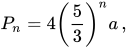
The perimeter of the snowflake after iterations, in terms of the side length of the original triangle, is


which diverges to infinity.
Area of the Koch snowflake
The total area of the snowflake after iterations is, in terms of the original area of the original triangle, is the geometric series


Taking the limit as approaches infinity, the area of the Koch snowflake is of the area of the original triangle. Expressed in terms of the side length of the original triangle, this is:[8]

Solid of revolution
The volume of the solid of revolution of the Koch snowflake about an axis of symmetry of the initiating equilateral triangle of unit side is [9]

Other properties
The Koch snowflake is self-replicating with six smaller copies surrounding one larger copy at the center. Hence, it is an irrep-7 irrep-tile (see Rep-tile for discussion).
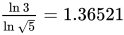
The Hausdorff dimension of the Koch curve is . This is greater than that of a line () but less than that of Peano's space-filling curve ().


The Hausdorff measure of the Koch curve satisfies , but its exact value is unknown. It is conjectured that . [10]


It is impossible to draw a tangent line to any point of the curve.
Representation as a de Rham curve
The Koch curve arises as a special case of a de Rham curve. The de Rham curves are mappings of Cantor space into the plane, usually arranged so as to form a continuous curve. Every point on a continuous de Rham curve corresponds to a real number in the unit interval. For the Koch curve, the tips of the snowflake correspond to the dyadic rationals: each tip can be uniquely labeled with a distinct dyadic rational.
Tessellation of the plane
Koch's siamese and antisiamese

To obtain the siamese, an elongated variant of the snowflake, start with two equilateral triangles with a common side, which is eliminated to obtain a rhombus. Then replace the sides of the rhombus with the Koch curve turned outwards. If, on the other hand, the replaced curve is turned inwards, we obtain the anti-siamese. If siamese and snowflake integrate with their anti-figures, they break down into an infinite number of siamese figures of various sizes. The siamese thus becomes a replicante, a rep- figure because it can break down into infinite copies of itself. The siamese has remarkable properties, comparable to those of the moth [11]

Koch's snowmen
To obtain Koch's snowmen, start with a rhombus with an acute angle of 60 degrees and an obtuse angle of 120 degrees. Each side of the rhombus is divided into two halves. The eight parts are replaced by Koch curves, facing outwards when adjacent to the acute angle, facing inwards otherwise. The figure obtained is the snowman, which has the same area as the generating rhombus. In fact, the four external curve add the same area removed by inside ones. Snowmen cover the plane with identical figures in a manner similar to tessellation with rhombuses. Koch's snowmen can be broken down into three snowflakes, two small ones and one large one. This is because the rhombus can be broken down into a regular hexagon with two equilateral triangles adjacent to two opposite parallel sides. By cutting the triangles externally, the two small snowflakes are obtained; by cutting the hexagon internally, the large snowflake is obtained.[12]
-
 Koch's snowman
 -
 broken down into three snowflakes
 -
 broken down into nine snowflakes
 -
 Broken down into infinite siamese


Tessellation of the plane with Koch snowmen and snowflakes
Starting from a regular tessellation of the plane with snowmen, replacing them with the three snowflakes leads to a tessellation of the plane with snowflakes of two sizes. It is possible to tessellate the plane by copies of Koch snowflakes in two different sizes. However, such a tessellation is not possible using only snowflakes of one size. Since each Koch snowflake in the tessellation can be subdivided into seven smaller snowflakes of two different sizes, it is also possible to find tessellations that use more than two sizes at once.[13]
-
 tassellation with snowmen
 -
![from snowmen to Koch's snowflakes[12]](//upload.wikimedia.org/wikipedia/commons/thumb/c/c5/Koch_snowmen_tiles_2.jpg/250px-Koch_snowmen_tiles_2.jpg) from snowmen to Koch's snowflakes[12]
from snowmen to Koch's snowflakes[12] -
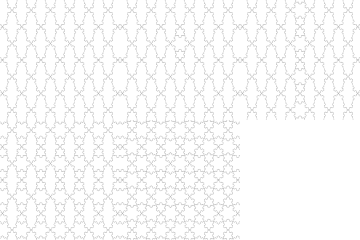 Koch flakes in two sizes
 -
 Tessellation by two sizes of Koch snowflake

![from snowmen to Koch's snowflakes[12]](/wiki/File:Koch_snowmen_tiles_2.jpg)


Tassellation with siamese
It is possible to tile the plane with various sizes of siamese in extraordinarily varied ways.[14]
-
 MSWLogo programme
 -
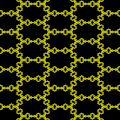 tassellation with siamese
 -
 tassellation with antisiamese
 -
 tassellation with antisnowflakes


Thue–Morse sequence and turtle graphics
A turtle graphic is the curve that is generated if an automaton is programmed with a sequence. If the Thue–Morse sequence members are used in order to select program states:
- If , move ahead by one unit,
- If , rotate counterclockwise by an angle of radians or 60 degrees,


the resulting curve converges to the Koch snowflake.
Representation as Lindenmayer system
The Koch curve can be expressed by the following rewrite system (Lindenmayer system):
- Alphabet : F
- Constants : +, −
- Axiom : F
- Production rules : F → F+F--F+F
Here, F means "draw forward", - means "turn right 60°", and + means "turn left 60°".
To create the Koch snowflake, one would use F--F--F (an equilateral triangle) as the axiom.
Variants of the Koch curve
Following von Koch's concept, several variants of the Koch curve were designed, considering right angles (quadratic), other angles (Cesàro), circles and polyhedra and their extensions to higher dimensions (Sphereflake and Kochcube, respectively)
| Variant (dimension, angle) | Illustration | Construction |
|---|---|---|
| ≤1D, 60-90° angle |  Cesàro fractal (85°) |
The Cesàro fractal is a variant of the Koch curve with an angle between 60° and 90°.[citation needed]  First four iterations of a Cesàro antisnowflake (four 60° curves arranged in a 90° square) |
| ≈1.46D, 90° angle |  Quadratic type 1 curve |
 First two iterations |
| 1.5D, 90° angle |  Quadratic type 2 curve |
Minkowski Sausage[15]  First two iterations. Its fractal dimension equals and is exactly half-way between dimension 1 and 2. It is therefore often chosen when studying the physical properties of non-integer fractal objects. |
| ≤2D, 90° angle |  Third iteration |
Minkowski Island  Four quadratic type 2 curves arranged in a square |
| ≈1.37D, 90° angle |  Quadratic flake |
 4 quadratic type 1 curves arranged in a polygon: First two iterations. Known as the "Minkowski Sausage",[16][17][18] its fractal dimension equals .[19] |
| ≤2D, 90° angle |  Quadratic antiflake |
Anticross-stitch curve, the quadratic flake type 1, with the curves facing inwards instead of outwards (Vicsek fractal) |
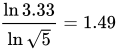
| ≈1.49D, 90° angle |  Quadratic Cross |
Another variation. Its fractal dimension equals . |
| ≤2D, 90° angle |  Quadratic island[20] |
 Quadratic curve, iterations 0, 1, and 2; dimension of |
| ≤2D, 60° angle |  von Koch surface |
 First three iterations of a natural extension of the Koch curve in two dimensions. |
| ≤2D, 90° angle |  First (blue block), second (plus green blocks), third (plus yellow blocks) and fourth (plus transparent blocks) iterations of the type 1 3D Koch quadratic fractal |
Extension of the quadratic type 1 curve. The illustration at left shows the fractal after the second iteration  Animation quadratic surface |
| ≤3D, any | .jpg) Koch curve in 3D |
A three-dimensional fractal constructed from Koch curves. The shape can be considered a three-dimensional extension of the curve in the same sense that the Sierpiński pyramid and Menger sponge can be considered extensions of the Sierpinski triangle and Sierpinski carpet. The version of the curve used for this shape uses 85° angles. |


Squares can be used to generate similar fractal curves. Starting with a unit square and adding to each side at each iteration a square with dimension one third of the squares in the previous iteration, it can be shown that both the length of the perimeter and the total area are determined by geometric progressions. The progression for the area converges to while the progression for the perimeter diverges to infinity, so as in the case of the Koch snowflake, we have a finite area bounded by an infinite fractal curve.[21] The resulting area fills a square with the same center as the original, but twice the area, and rotated by radians, the perimeter touching but never overlapping itself.


The total area covered at the th iteration is:

while the total length of the perimeter is: which approaches infinity as increases.
Functionalisation

In addition to the curve, the paper by Helge von Koch that has established the Koch curve shows a variation of the curve as an example of a continuous everywhere yet nowhere differentiable function that was possible to represent geometrically at the time. From the base straight line, represented as AB, the graph can be drawn by recursively applying the following on each line segment:
- Divide the line segment (XY) into three parts of equal length, divided by dots C and E.
- Draw a line DM, where M is the middle point of CE, and DM is perpendicular to the initial base of AB, having the length of .
- Draw the lines CD and DE and erase the lines CE and DM.

Each point of AB can be shown to converge to a single height. If is defined as the distance of that point to the initial base, then as a function is continuous everywhere and differentiable nowhere.[3]


Applications
Because the Koch snowflake has a finite area but an infinitely long boundary, it serves as a model for designs that require maximized perimeter or surface length within limited space. In antenna engineering, incorporating a Koch-type fractal design increases the perimeter of the material that transmits or receives electromagnetic radiation, allowing the construction of compact antennas suited to confined or complex circuit layouts.[22][23][24] In acoustic engineering, a Koch snowflake-inspired acoustic metasurface has been tested for broadband sound diffusion in automotive cabins.[25] The Koch snowflake geometry has also been applied to enhance heat transfer performance in double-pipe heat exchangers.[26]
See also
- List of fractals by Hausdorff dimension
- Gabriel's Horn (infinite surface area but encloses a finite volume)
- Gosper curve (also known as the Peano–Gosper curve or flowsnake)
- Osgood curve
- Self-similarity
- Teragon
- Weierstrass function
- Coastline paradox
References
- ^ Addison, Paul S. (1997). Fractals and Chaos: An Illustrated Course. Institute of Physics. p. 19. ISBN 0-7503-0400-6.
- ^ Lauwerier, Hans (1991). Fractals: Endlessly Repeated Geometrical Figures. Translated by Gill-Hoffstädt, Sophia. Princeton University Press. p. 36. ISBN 0-691-02445-6.
Mandelbrot called this a Koch island.
- ^ a b c d von Koch, Helge (1904). "Sur une courbe continue sans tangente, obtenue par une construction géométrique élémentaire". Arkiv för matematik, astronomi och fysik (in French). 1: 681–704. JFM 35.0387.02.
- ^ von Koch, Helge (1906). "Une méthode géométrique élémentaire pour l'étude de certaines questions de la théorie des courbes planes". Acta Mathematica (in French). 30: 145–174. doi:10.1007/BF02418570. ISSN 0001-5962.
- ^ Demichel, Yann (2024-09-13). "Who Invented von Koch's Snowflake Curve?". The American Mathematical Monthly. 131 (8): 662–668. arXiv:2308.15093. doi:10.1080/00029890.2024.2363737. ISSN 0002-9890.
- ^ Kasner, Edward; Newman, James R. (2001). Mathematics and the imagination. Mineola, N.Y: Dover Publications. ISBN 978-0-486-41703-5.
- ^ Alonso-Marroquin, F.; Huang, P.; Hanaor, D.; Flores-Johnson, E.; Proust, G.; Gan, Y.; Shen, L. (2015). "Static friction between rigid fractal surfaces" (PDF). Physical Review E. 92 (3) 032405. Bibcode:2015PhRvE..92c2405A. doi:10.1103/PhysRevE.92.032405. hdl:2123/13835. PMID 26465480. — Study of fractal surfaces using Koch curves.
- ^ "Koch Snowflake". ecademy.agnesscott.edu.
- ^ McCartney, Mark (2020-04-16). "The area, centroid and volume of revolution of the Koch curve". International Journal of Mathematical Education in Science and Technology. 52 (5): 782–786. doi:10.1080/0020739X.2020.1747649. ISSN 0020-739X. S2CID 218810213.
- ^ Jia, Baoguo (1 June 2007). "Bounds of the Hausdorff measure of the Koch curve". Applied Mathematics and Computation. 190 (1): 559–565. doi:10.1016/j.amc.2007.01.046.
- ^ Pietrocola, Giorgio (2024). "Il siamese e la falena, due frattali per l'arte di Escher". Archimede (in Italian). Vol. 3, no. 3. Le Monnier. doi:10.1400/300129. ISSN 0390-5543.
- ^ a b Giorgio Pietrocola (2023). "Il siamese di Koch. Un frattale straordinariamente vario nel tassellare il piano" (PDF). Periodico di Matematica (in Italian). Vol. (IV) Vol. V(2). Accademia di Filosofia delle Scienze Umane. pp. 109–124. ISSN 2612-6745.
- ^ Burns, Aidan (1994). "Fractal tilings". Mathematical Gazette. 78 (482): 193–6. doi:10.2307/3618577. JSTOR 3618577. S2CID 126185324..
- ^ Pietrocola, Giorgio (2024). "Affinity between fractal figures Combinatorial algorithms to discover two pairs: dragon, butterfly and moth, siamese". Academia.edu.
- ^ Paul S. Addison, Fractals and Chaos: An illustrated course, p. 19, CRC Press, 1997 ISBN 0849384435.
- ^ Weisstein, Eric W. (1999). "Minkowski Sausage", archive.lib.msu.edu. Accessed: 21 September 2019.
- ^ Pamfilos, Paris. "Minkowski Sausage", user.math.uoc.gr/~pamfilos/. Accessed: 21 September 2019.
- ^ Weisstein, Eric W. "Minkowski Sausage". MathWorld. Retrieved 22 September 2019.
- ^ Mandelbrot, B. B. (1983). The Fractal Geometry of Nature, p.48. New York: W. H. Freeman. ISBN 9780716711865. Cited in Weisstein, Eric W. "Minkowski Sausage". MathWorld. Retrieved 22 September 2019..
- ^ Appignanesi, Richard; ed. (2006). Introducing Fractal Geometry. Icon. ISBN 978-1840467-13-0.
- ^ Demonstrated by James McDonald in a public lecture at KAUST University on January 27, 2013. "KAUST | Academics | Winter Enrichment Program". Archived from the original on 2013-01-12. Retrieved 2013-01-29. retrieved 29 January 2013.
- ^ Choukiker, Yogesh Kumar; Behera, Santanu Kumar (2017). "Wideband frequency reconfigurable Koch snowflake fractal antenna". IET Microwaves, Antennas & Propagation. 11 (2): 203–208. doi:10.1049/iet-map.2016.0238. ISSN 1751-8725.
- ^ Saharsh, S. B.; Viswasom, Sanoj; Kumar, Santhosh K. (2020). Design and Analysis of Koch Snowflake Fractal Antenna Array. Fourth International Conference on I-SMAC (IoT in Social, Mobile, Analytics and Cloud) (I-SMAC). pp. 194–197. doi:10.1109/I-SMAC49090.2020.9243518.
- ^ Palacios, Orlando F. G.; Diaz Vargas, Ricardo E.; Perez, Jorge A. H.; Erazo, Segundo B. C. (2016). S-band Koch snowflake fractal antenna for CubeSats. 2016 IEEE ANDESCON. Arequipa, Peru. pp. 1–4. doi:10.1109/ANDESCON.2016.7836227.
- ^ Li, Zhi-Han; Xie, Long-Xiang; Gao, Xinhua; Huang, Weichun; Xu, Youzhong; Yang, Jin; Lu, Ming-Hui; Zhong, Xu (2025-11-14). "Koch snowflake-inspired acoustic metasurface for broadband sound diffusion in automotive loudspeaker systems". Journal of Applied Physics. 138 (18). doi:10.1063/5.0277003. ISSN 0021-8979.
- ^ Gomez, Anton (2017). Thermal Performance of a Double-Pipe Heat Exchanger with a Koch Snowflake Fractal Design (Master’s thesis). Statesboro, GA, United States: Georgia Southern University. Retrieved 18 November 2025.
External links

| External videos | |
|---|---|
 Koch Snowflake Fractal Koch Snowflake Fractal
|
- (2000) "von Koch Curve", efg's Computer Lab at the Wayback Machine (archived 20 July 2017)
- Koch Snowflake by Edward Bole (Lazarus src)
- The Koch Curve poem by Bernt Wahl, Wahl.org. Retrieved 23 September 2019.
- Weisstein, Eric W. "Koch Snowflake". MathWorld. Retrieved 23 September 2019.
- "7 iterations of the Koch curve". Wolfram Alpha Site. Retrieved 23 September 2019.
- "Square Koch Fractal Curves". Wolfram Demonstrations Project. Retrieved 23 September 2019.
- "Square Koch Fractal Surface". Wolfram Demonstrations Project. Retrieved 23 September 2019.
- A WebGL animation showing the construction of the Koch surface Archived 2020-09-16 at the Wayback Machine, tchaumeny.github.io. Retrieved 23 September 2019.
- "A mathematical analysis of the Koch curve and quadratic Koch curve" (PDF). Archived from the original (pdf) on 26 April 2012. Retrieved 22 November 2011.


