Epstein Files Full PDF

CLICK HERE
Technopedia Center
PMB University Brochure
Faculty of Engineering and Computer Science
S1 Informatics S1 Information Systems S1 Information Technology S1 Computer Engineering S1 Electrical Engineering S1 Civil Engineering

faculty of Economics and Business
S1 Management S1 Accountancy

Faculty of Letters and Educational Sciences
S1 English literature S1 English language education S1 Mathematics education S1 Sports Education
teknopedia

  • Registerasi
  • Brosur UTI
  • Kip Scholarship Information
  • Performance
Flag Counter
  1. World Encyclopedia
  2. Leadscrew - Wikipedia
Leadscrew - Wikipedia
From Wikipedia, the free encyclopedia
Screw used as a linkage in a mechanism
For worm gear used with circular gear for rotary reduction, see worm drive.
Three types of screw thread used in leadscrews:
3 & 4: buttress thread
5: round thread
6: square thread
DVD drive with leadscrew and stepper motor
Floppy disc drive with leadscrew and stepper motor

A leadscrew (or lead screw), pronounced /liːd skruː/, also known as a power screw[1] or translation screw,[2] is a screw used as a linkage in a machine, to translate turning motion into linear motion. Because of the large area of sliding contact between their male and female members, screw threads have larger frictional energy losses compared to other linkages. They are not typically used to carry high power, but more for intermittent use in low power actuator and positioner mechanisms. Leadscrews are commonly used in linear actuators, machine slides (such as in machine tools), vises, presses, and jacks.[3] The word "lead" – pronounced /liːd/, from the verb "to lead"[4] – refers to the amount of distance travelled per rotation, not the metal.[citation needed]

Leadscrews are manufactured in the same way as other thread forms: they may be rolled, cut, or ground.

A lead screw is sometimes used with a split nut (also called a half nut) which allows the nut to be disengaged from the threads and moved axially, independently of the screw's rotation, when needed (such as in single-point threading on a manual lathe). A split nut can also be used to compensate for wear by compressing the parts of the nut.

A hydrostatic leadscrew overcomes many of the disadvantages of a normal leadscrew, having high positional accuracy, very low friction, and very low wear, but requires continuous supply of high-pressure fluid and high-precision manufacture, leading to significantly greater cost than most other linear motion linkages.[5]

Types

[edit]

Power screws are classified by the geometry of their thread.

V-thread

[edit]

V-threads are less suitable for leadscrews than others such as Acme because they have more friction between the threads. Their threads are designed to induce this friction to keep the fastener from loosening. Leadscrews, on the other hand, are designed to minimize friction.[6] Therefore, in most commercial and industrial use, V-threads are avoided for leadscrew use. Nevertheless, V-threads are sometimes successfully used as leadscrews, for example on microlathes and micromills.[7]

Square thread

[edit]
Main article: Square thread form

Square threads are named after their square geometry. They are the most efficient, having the least friction, so they are often used for screws that carry high power; however, they are also the most difficult to machine, and are thus the most expensive.

Acme thread / Trapezoidal thread

[edit]
An Acme screw
Main article: Acme thread form

Acme threads have a 29° thread angle, which is easier to machine than square threads. They are not as efficient as square threads, due to the increased friction induced by the thread angle.[3] Acme threads are generally also stronger than square threads due to their trapezoidal thread profile, which provides greater load-bearing capabilities.

Buttress thread

[edit]
Main article: Buttress thread

Buttress threads are of a triangular shape. These are used where the load force on the screw is only applied in one direction.[8] They are as efficient as square threads in these applications, but are easier to manufacture.

Advantages and disadvantages

[edit]
Leadscrews are used to raise and lower the front door of the Boeing 747-8F Freighter aircraft.

The advantages of a leadscrew are:[2]

  • Large load carrying capability
  • Compactness
  • Simplicity of design
  • Ease of manufacture
  • Large mechanical advantage
  • Precise and accurate linear motion
  • Smooth and quiet operation
  • Low maintenance
  • Minimal number of parts
  • Most are self-locking (cannot be back-driven)

The disadvantages are that most are not very efficient. Due to this low efficiency, they cannot be used in continuous power transmission applications. They also have a high degree of friction on the threads, which can wear the threads out quickly. For square threads, the nut must be replaced; for trapezoidal threads, a split nut may be used to compensate for the wear.[6]

Alternatives

[edit]

Alternatives to actuation by leadscrew include:

  • Ball screws and roller screws (sometimes categorized as types of leadscrew rather than in contradistinction)
  • Fluid power (i.e., hydraulics and pneumatics)
  • Gear trains (e.g., worm drives, rack-and-pinion drives)
  • Electromagnetic actuation (e.g., solenoids)
  • Piezoelectric actuation

Mechanics

[edit]
Diagram of an "unwrapped" screw thread

The torque required to lift or lower a load can be calculated by "unwrapping" one revolution of a thread. This is most easily described for a square or buttress thread as the thread angle is 0 and has no bearing on the calculations. The unwrapped thread forms a right angle triangle where the base is π d m {\displaystyle \pi d_{\text{m}}} {\displaystyle \pi d_{\text{m}}} long and the height is the lead (pictured to the right). The force of the load is directed downward, the normal force is perpendicular to the hypotenuse of the triangle, the frictional force is directed in the opposite direction of the direction of motion (perpendicular to the normal force or along the hypotenuse), and an imaginary "effort" force is acting horizontally in the direction opposite the direction of the frictional force. Using this free-body diagram the torque required to lift or lower a load can be calculated:[9][10]


T raise = F d m 2 ( l + π μ d m π d m − μ l ) = F d m 2 tan ⁡ ( ϕ + λ ) {\displaystyle T_{\text{raise}}={\frac {Fd_{\text{m}}}{2}}\left({\frac {l+\pi \mu d_{\text{m}}}{\pi d_{\text{m}}-\mu l}}\right)={\frac {Fd_{\text{m}}}{2}}\tan {\left(\phi +\lambda \right)}} {\displaystyle T_{\text{raise}}={\frac {Fd_{\text{m}}}{2}}\left({\frac {l+\pi \mu d_{\text{m}}}{\pi d_{\text{m}}-\mu l}}\right)={\frac {Fd_{\text{m}}}{2}}\tan {\left(\phi +\lambda \right)}}
T lower = F d m 2 ( π μ d m − l π d m + μ l ) = F d m 2 tan ⁡ ( ϕ − λ ) {\displaystyle T_{\text{lower}}={\frac {Fd_{\text{m}}}{2}}\left({\frac {\pi \mu d_{\text{m}}-l}{\pi d_{\text{m}}+\mu l}}\right)={\frac {Fd_{\text{m}}}{2}}\tan {\left(\phi -\lambda \right)}} {\displaystyle T_{\text{lower}}={\frac {Fd_{\text{m}}}{2}}\left({\frac {\pi \mu d_{\text{m}}-l}{\pi d_{\text{m}}+\mu l}}\right)={\frac {Fd_{\text{m}}}{2}}\tan {\left(\phi -\lambda \right)}}
Coefficient of friction for leadscrew threads[11][12]
Screw material Nut material
Steel Bronze Brass Cast iron
Steel, dry 0.15–0.25 0.15–0.23 0.15–0.19 0.15–0.25
Steel, machine oil 0.11–0.17 0.10–0.16 0.10–0.15 0.11–0.17
Bronze 0.08–0.12 0.04–0.06 - 0.06–0.09

where

  • T {\displaystyle T} {\displaystyle T} = torque
  • F {\displaystyle F} {\displaystyle F} = load on the screw
  • d m {\displaystyle d_{\text{m}}} {\displaystyle d_{\text{m}}} = mean diameter
  • μ {\displaystyle \mu \,} {\displaystyle \mu \,} = coefficient of friction (common values are found in the adjacent table)
  • l {\displaystyle l} {\displaystyle l} = lead
  • ϕ {\displaystyle \phi \,} {\displaystyle \phi \,} = angle of friction
  • λ {\displaystyle \lambda \,} {\displaystyle \lambda \,} = lead angle

Based on the T lower {\displaystyle T_{\text{lower}}} {\displaystyle T_{\text{lower}}} equation, it can be found that the screw is self-locking when the coefficient of friction is greater than the tangent of the lead angle. An equivalent comparison is when the friction angle is greater than the lead angle ( ϕ > λ {\displaystyle \phi >\lambda } {\displaystyle \phi >\lambda }).[13] However, this self-locking property is not absolute. Under dynamic conditions—particularly in the presence of vibration or shock loading—the effective coefficient of friction may drop to dynamic levels (which are typically lower than static), allowing the screw to back-drive unexpectedly. For this reason, safety-critical applications often require a secondary holding brake rather than relying solely on the lead screw geometry.[9]

Efficiency

[edit]

The efficiency, calculated using the torque equations above, is:[14][15]

efficiency = T 0 T raise = F l 2 π T raise = tan ⁡ λ tan ⁡ ( ϕ + λ ) {\displaystyle {\mbox{efficiency}}={\frac {T_{0}}{T_{\text{raise}}}}={\frac {Fl}{2\pi T_{\text{raise}}}}={\frac {\tan {\lambda }}{\tan {\left(\phi +\lambda \right)}}}} {\displaystyle {\mbox{efficiency}}={\frac {T_{0}}{T_{\text{raise}}}}={\frac {Fl}{2\pi T_{\text{raise}}}}={\frac {\tan {\lambda }}{\tan {\left(\phi +\lambda \right)}}}}

Non-zero thread angle

[edit]

For screws that have a thread angle other than zero, such as a trapezoidal thread, this must be compensated as it increases the frictional forces. The equations below take this into account:[14][16]


T raise = F d m 2 ( l + π μ d m sec ⁡ α π d m − μ l sec ⁡ α ) = F d m 2 ( μ sec ⁡ α + tan ⁡ λ 1 − μ sec ⁡ α tan ⁡ λ ) {\displaystyle T_{\text{raise}}={\frac {Fd_{\text{m}}}{2}}\left({\frac {l+\pi \mu d_{\text{m}}\sec {\alpha }}{\pi d_{\text{m}}-\mu l\sec {\alpha }}}\right)={\frac {Fd_{\text{m}}}{2}}\left({\frac {\mu \sec {\alpha }+\tan {\lambda }}{1-\mu \sec {\alpha }\tan {\lambda }}}\right)} {\displaystyle T_{\text{raise}}={\frac {Fd_{\text{m}}}{2}}\left({\frac {l+\pi \mu d_{\text{m}}\sec {\alpha }}{\pi d_{\text{m}}-\mu l\sec {\alpha }}}\right)={\frac {Fd_{\text{m}}}{2}}\left({\frac {\mu \sec {\alpha }+\tan {\lambda }}{1-\mu \sec {\alpha }\tan {\lambda }}}\right)}
T lower = F d m 2 ( π μ d m sec ⁡ α − l π d m + μ l sec ⁡ α ) = F d m 2 ( μ sec ⁡ α − tan ⁡ λ 1 + μ sec ⁡ α tan ⁡ λ ) {\displaystyle T_{\text{lower}}={\frac {Fd_{\text{m}}}{2}}\left({\frac {\pi \mu d_{\text{m}}\sec {\alpha }-l}{\pi d_{\text{m}}+\mu l\sec {\alpha }}}\right)={\frac {Fd_{\text{m}}}{2}}\left({\frac {\mu \sec {\alpha }-\tan {\lambda }}{1+\mu \sec {\alpha }\tan {\lambda }}}\right)} {\displaystyle T_{\text{lower}}={\frac {Fd_{\text{m}}}{2}}\left({\frac {\pi \mu d_{\text{m}}\sec {\alpha }-l}{\pi d_{\text{m}}+\mu l\sec {\alpha }}}\right)={\frac {Fd_{\text{m}}}{2}}\left({\frac {\mu \sec {\alpha }-\tan {\lambda }}{1+\mu \sec {\alpha }\tan {\lambda }}}\right)}

where α {\displaystyle \alpha \,} {\displaystyle \alpha \,} is one half the thread angle.

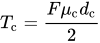
If the leadscrew has a collar which the load rides on, then the frictional forces between the interface must be accounted for in the torque calculations as well. For the following equation the load is assumed to be concentrated at the mean collar diameter ( d c {\displaystyle d_{\text{c}}} {\displaystyle d_{\text{c}}}):[14]

Plot of square lead screw efficiency against lead angle for different coefficients of friction
T c = F μ c d c 2 {\displaystyle T_{\text{c}}={\frac {F\mu _{\text{c}}d_{\text{c}}}{2}}} {\displaystyle T_{\text{c}}={\frac {F\mu _{\text{c}}d_{\text{c}}}{2}}}

where μ c {\displaystyle \mu _{\text{c}}} {\displaystyle \mu _{\text{c}}} is the coefficient of friction between the collar on the load and d c {\displaystyle d_{\text{c}}} {\displaystyle d_{\text{c}}} is the mean collar diameter. For collars that use thrust bearings, the frictional loss is negligible and the above equation can be ignored.[17]

Efficiency for non-zero thread angles can be written as follows:[18]

η = cos ⁡ α   −   μ tan ⁡ λ cos ⁡ α   +   μ cot ⁡ λ {\displaystyle \eta ={\frac {\cos \alpha \ -\ \mu \tan \lambda }{\cos \alpha \ +\ \mu \cot \lambda }}} {\displaystyle \eta ={\frac {\cos \alpha \ -\ \mu \tan \lambda }{\cos \alpha \ +\ \mu \cot \lambda }}}

Coefficient of friction for thrust collars[17]
Material combination Starting μ c {\displaystyle \mu _{\text{c}}} {\displaystyle \mu _{\text{c}}} Running μ c {\displaystyle \mu _{\text{c}}} {\displaystyle \mu _{\text{c}}}
Soft steel / cast iron 0.17 0.12
Hardened steel / cast iron 0.15 0.09
Soft steel / bronze 0.10 0.08
Hardened steel / bronze 0.08 0.06

Running speed

[edit]
Safe running speeds for various nut materials and loads on a steel screw[19]
Nut material Safe loads (psi) Safe loads (bar) Speed (fpm) Speed (m/s)
Bronze 2,500–3,500 psi 170–240 bar Low speed
Bronze 1,600–2,500 psi 110–170 bar 10 fpm 0.05 m/s
Cast iron 1,800–2,500 psi 120–170 bar 8 fpm 0.04 m/s
Bronze 800–1,400 psi 55–97 bar 20–40 fpm 0.10–0.20 m/s
Cast iron 600–1,000 psi 41–69 bar 20–40 fpm 0.10–0.20 m/s
Bronze 150–240 psi 10–17 bar 50 fpm 0.25 m/s

The running speed for a leadscrew (or ball screw) is typically limited to, at most, 80% of the calculated critical speed. The critical speed is the speed that excites the natural frequency of the screw. For a steel leadscrew or steel ballscrew, the critical speed is approximately[20]
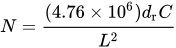
N = ( 4.76 × 10 6 ) d r C L 2 {\displaystyle N={(4.76\times 10^{6})d_{\text{r}}C \over L^{2}}} {\displaystyle N={(4.76\times 10^{6})d_{\text{r}}C \over L^{2}}}

where

  • N {\displaystyle N} {\displaystyle N} = critical speed in RPM
  • d r {\displaystyle d_{\text{r}}} {\displaystyle d_{\text{r}}} = smallest (root) diameter of the leadscrew in inches
  • L {\displaystyle L} {\displaystyle L} = length between bearing supports in inches
  • C {\displaystyle C} {\displaystyle C} = .36 for one end fixed, one end free
  • C {\displaystyle C} {\displaystyle C} = 1.00 for both ends simple
  • C {\displaystyle C} {\displaystyle C} = 1.47 for one end fixed, one end simple
  • C {\displaystyle C} {\displaystyle C} = 2.23 for both ends fixed

Alternatively using metric units:[21]
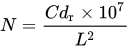
N = C d r × 10 7 L 2 {\displaystyle N={\frac {Cd_{\text{r}}\times 10^{7}}{L^{2}}}} {\displaystyle N={\frac {Cd_{\text{r}}\times 10^{7}}{L^{2}}}}

where the variables are identical to above, but the values are in millimetres and C {\displaystyle C} {\displaystyle C} is as follows:

  • C {\displaystyle C} {\displaystyle C} = 3.9 for fixed-free supports [22]
  • C {\displaystyle C} {\displaystyle C} = 12.1 for both ends supported
  • C {\displaystyle C} {\displaystyle C} = 18.7 for fixed-supported structure
  • C {\displaystyle C} {\displaystyle C} = 27.2 for both ends fixed

See also

[edit]
  • Ball screw
  • Roller screw
  • Fine adjustment screw
  • Jackscrew

References

[edit]
  1. ^ Ball Screws & Lead screws, retrieved 2008-12-16.
  2. ^ a b Bhandari, p. 202.
  3. ^ a b Shigley, p. 400.
  4. ^ "Definition of LEADSCREW". www.merriam-webster.com. Retrieved 2025-09-20.
  5. ^ US 5499942, Pflager, William W., "Hydrostatic nut and lead screw assembly, and method of forming said nut", published 1996-03-19, assigned to Western Atlas Inc. 
  6. ^ a b Bhandari, p. 203.
  7. ^ Martin 2004, p. 266.
  8. ^ Bhandari, p. 204.
  9. ^ a b Shigley, p. 402.
  10. ^ Bhandari, pp. 207–208.
  11. ^ Shigley, p. 408.
  12. ^ Machinery's Handbook (30th ed.). Industrial Press. 2016. pp. 1800–1805. ISBN 978-0831130916.
  13. ^ Bhandari, p. 208.
  14. ^ a b c Shigley, p. 403.
  15. ^ Bhandari, p. 209.
  16. ^ Bhandari, pp. 211–212.
  17. ^ a b Bhandari, p. 213.
  18. ^ Childs, Peter R. N. (24 November 2018). Mechanical design engineering handbook (Second ed.). Oxford, United Kingdom. p. 803. ISBN 978-0-08-102368-6. OCLC 1076269063.{{cite book}}: CS1 maint: location missing publisher (link)
  19. ^ Shigley, p. 407.
  20. ^ Nook Industries, Inc. "Acme & lead screw assembly glossary and technical data" Archived 2008-07-05 at the Wayback Machine
  21. ^ Moritz, Frederick G. F. (2014). Electromechanical motion systems : design and simulation. Chichester, England: Wiley. p. 121. ISBN 978-1-118-35967-9. OCLC 873995457.
  22. ^ "Critical Speed - August Steinmeyer GmbH & Co. KG". www.steinmeyer.com. Retrieved 2020-08-26.

Bibliography

[edit]
  • Bhandari, V B (2007), Design of Machine Elements, Tata McGraw-Hill, ISBN 978-0-07-061141-2.
  • Martin, Joe (2004), Tabletop Machining: A Basic Approach to Making Small Parts on Miniature Machine Tools, Vista, California, USA: Sherline, Inc., ISBN 978-0-9665433-0-8. Originally published in 1998; content updated with each print run, similar to a "revised edition". Currently in the fourth print run.
  • Shigley, Joseph E.; Mischke, Charles R.; Budynas, Richard Gordon (2003), Mechanical Engineering Design (7th ed.), McGraw Hill, ISBN 978-0-07-252036-1.

External links

[edit]
  • v
  • t
  • e
Gears
Systems
  • Spur gear systems
  • Worm drive
  • Rack and pinion
  • Epicyclic (planetary) gearing
  • Sun and planet gear
  • Harmonic drive
  • Cycloidal drive
  • Non-circular gear
Shapes
  • Spur
  • Bevel
  • Crown
  • Spiral bevel
  • Helical
  • Herringbone
Geartooth profiles
  • Involute
  • Cycloid
Mechanics
  • Transmission
  • Differential
  • Coupling
  • Train
  • Bicycle gearing
  • Continuously variable transmission
  • Offset
Examples
Bicycles
  • Cogset
  • Derailleur
  • Hub gear
  • Shaft-driven bicycle
  • Sprocket
Horology
  • Wheel train
See also
  • Ball screw
  • Leadscrew
  • Jackscrew
  • Belt drive
  • Chain drive
  • Gear manufacturing
  • Freewheel
  • Spur gear corrected tooth
Authority control databases Edit this at Wikidata
International
  • GND
National
  • United States
  • Israel
Other
  • Yale LUX
Retrieved from "https://teknopedia.ac.id/w/index.php?title=Leadscrew&oldid=1336796697"
Category:
  • Screws
Hidden categories:
  • CS1 maint: location missing publisher
  • Webarchive template wayback links
  • Articles with short description
  • Short description is different from Wikidata
  • Pages with plain IPA
  • All articles with unsourced statements
  • Articles with unsourced statements from September 2025

  • indonesia
  • Polski
  • العربية
  • Deutsch
  • English
  • Español
  • Français
  • Italiano
  • مصرى
  • Nederlands
  • 日本語
  • Português
  • Sinugboanong Binisaya
  • Svenska
  • Українська
  • Tiếng Việt
  • Winaray
  • 中文
  • Русский
Sunting pranala
url url url url url url url url url url url url url url url url url url url url url url url url url url url url url url url url url url url url url url url url url url url url url url url url url url url url url url url url url url url url url url url url url url url url url url url url url url url url url url url url url url url url url url url url url url url url url url url url url url url url url url url url url url url url url url url url url url url url url url url url url url url url url url url url url url url url url url url url url url url url url url url url url url url url url url url url url url url url url url url url url url url url url url url url url url url url url url url url url url url url url url url url url url url url url url url url url url url url url url url url url url url url url url url url url url url url url url url url url url url url url url url url url url url url url url url url url url url url url url url url url url url url url url url url url url url url url url url url url url url url url url url url url url url url url url url url url url url url url url url url url url url url url url url url url url url url url url url url url url url url url url url url url url url url url url url url url url url url url url url url url url url url url url url url url url url url url url url url url url url url url url url url url url url url url url url url url url url url url url url url url url url url url url url url url url url url url url url url url url url url url url url url url url url url url url url url url url url url url url url url url url url url url url url url url url url url url url url url url url url url url url url url url url url url url url url url url url url url url url url url url url url url url url url url url url url url url url url url url url url url url url url url url url url url url url url url url url url url url url url url url url url url url url url url url url url url url url url url url url url url url url url url url url url url url url url url url url url url url url url url url url url url url url url url url url url url url url url url url url url url url url url url url url url url url url url url url url url url url url url url url url url url url url url url url url url url url url url url url url url url url url url url url url url url url url url url url url url url url url url url url url url url url url url url url url url url url url url url url url url url url url url url url url url url url url url url url url url url url url url url url url url url url url url url url url url url url url url url url url url url url url url url url url url url url url url url url url url url url url url url url url url url url url url url url url url url url url url url url url url url url url url url url url url url url url url url url url url url url url url url url url url url url url url url url url url url url url url url url url url url url url url url url url url url url url url url url url url url url url url url url url url url url url url url url url url url url url url url url url url url url url url url url url url url url url url url url url url url url url url url url url url url url url url url url url url url url url url url url url url url url url url url url url url url url url url url url url url url url url url url url url url url url url url url url url url url url url url url url url url url url url url url url url url url url url url url url url url url url url url url url url url url url url url url url url url url url url url url url url url url url url url url url url url url url url url url url url url url url url url url url url url url url url url url url url url url url url url url url url url url url url url url url url url url url url url url url url url url url url url url url url url url url url url url url url url url url url url url url url url url url url url url url url url url url url url url url url url url url url url url url url url url url url url url url url url url url url url url url url url url url url url url url url url url url url url url url url url url url url url url url url url url url url url url url url url url url url url url url url url url url url url url url url url url url url url url url url url url url url url url url url url url url url url url url url url url url url url url url url url url url url url url url url url url url url url url url url url url url url url url url url url url url url url url url url url url url url url url url url url url url url url url url url url url url url url url url url url url url url url url url url url url url url url url url url url url url url url url url url url url url url url url url url url url url url url url url url url url url url url url url url url url url url url url url url url url url url url url url url url url url url url url url url url url url url url url url url url url url url url url url url url url url url url url url url url url url url url url url url url url url url url url url url url url url url url url url url url url url url url url url url url url url url url url url url url url url url url url url url url url url url url url url url url url url url url url url url url url url url url url url url url url url url url url url url url url url url url url url url url url url url url url url url url url url url url url url url url url url url url url url url url url url url url url url url url url url url url url url url url url url url url url url url url url url url url url url url url url url url url url url url url url url url url url url url url url url url url url url url url url url url url url url url url url url url url url url url url url url url url url url url url url url url url url url url url url url url url url url url url url url url url url url url url url url url url url url url url url url url url url url url url url url url url url url url url url url url url url url url url url url url url url url url url url url url url url url url url url url url url url url url url url url url url url url url url url url url url url url url url url url url url url url url url url url url url url url url url url url url url url url url url url url url url url url url url url url url url url url url url url url url url url url url url url url url url url url url url url url url url url url url url url url url url url url url url url url url url url url url url url url url url url url url url url url url url url url url url url url url url url url url url url url url url url url url url url url url url url url url url url url url url url url url url url url url url url url url url url url url url url url url url url url url url url url url url url url url url url url url url url url url url url url url url url url url url url url url url url url url url url url url url url url url url url url url url url url url url url url url url url url url url url url url url url url url url url url url url url url url url url url url url url url url url url url url url url url url url url url url url url url url url url url url url url url url url url url url url url url url url url url url url url url url url url url url url url url url url url url url url url url url url url url url url url url url url url url url url url url url url url url url url url url url url url url url url url url url url url url url url url url url url url url url url url url url url url url url url url url url url url url url url url url url url url url url url url url url url url url url url url url url url url url url url url url url url url url url url url url url url url url url url url url url url url url url url url url url url url url url url url url url url url url url url url url url url url url url url url url url url url url url url url url url url url url url url url url url url url url url url url url url url url url url url url url url url url url url url url url url url url url url url url url url url url url url url url url url url url url url url url url url url url url url url url url url url url url url url url url url url url url url url url url url url url url url url url url url url url url url url url url url url url url url url url url url url url url url url url url url url url url url url url url url url url url url url url url url url url url url url url url url url url url url url url url url url url url url url url url url url url url url url url url url url url url url url url url url url url url url url url url url url url url url url url url url url url url url url url url url url url url url url url url url url url url url url url url url url url url url url url url url url url url url url url url url url url url url url url url url url url url url url url url url url url url url url url url url url url url url url url url url url url url url url url url url url url url url url url url url url url url url url url url url url url url url url url url url url url url url url url url url url url url url url url url url url url url url url url url url url url url url url url url url url url url url url url url url url url url url url url url url url url url url url url url url url url url url url url url url url url url url url url url url url url url url url url url url url url url url url url url url url url url url url url url url url url url url url url url url url url url url url url url url url url url url url url url url url url url url url url url url url url url url url url url url url url url url url url url url url url url url url url url url url url url url url url url url url url url url url url url url url url
Pusat Layanan

UNIVERSITAS TEKNOKRAT INDONESIA | ASEAN's Best Private University
Jl. ZA. Pagar Alam No.9 -11, Labuhan Ratu, Kec. Kedaton, Kota Bandar Lampung, Lampung 35132
Phone: (0721) 702022
Email: pmb@teknokrat.ac.id