Epstein Files Full PDF

CLICK HERE
Technopedia Center
PMB University Brochure
Faculty of Engineering and Computer Science
S1 Informatics S1 Information Systems S1 Information Technology S1 Computer Engineering S1 Electrical Engineering S1 Civil Engineering

faculty of Economics and Business
S1 Management S1 Accountancy

Faculty of Letters and Educational Sciences
S1 English literature S1 English language education S1 Mathematics education S1 Sports Education
teknopedia

  • Registerasi
  • Brosur UTI
  • Kip Scholarship Information
  • Performance
Flag Counter
  1. World Encyclopedia
  2. Linear relation - Wikipedia
Linear relation - Wikipedia
From Wikipedia, the free encyclopedia
Type of mathematical equation
Not to be confused with Linear function.

In linear algebra, a linear relation, or simply relation, between elements of a vector space or a module is a linear equation that has these elements as a solution.

More precisely, if e 1 , … , e n {\displaystyle e_{1},\dots ,e_{n}} {\displaystyle e_{1},\dots ,e_{n}} are elements of a (left) module M over a ring R (the case of a vector space over a field is a special case), a relation between e 1 , … , e n {\displaystyle e_{1},\dots ,e_{n}} {\displaystyle e_{1},\dots ,e_{n}} is a sequence ( f 1 , … , f n ) {\displaystyle (f_{1},\dots ,f_{n})} {\displaystyle (f_{1},\dots ,f_{n})} of elements of R such that

f 1 e 1 + ⋯ + f n e n = 0. {\displaystyle f_{1}e_{1}+\dots +f_{n}e_{n}=0.} {\displaystyle f_{1}e_{1}+\dots +f_{n}e_{n}=0.}

The relations between e 1 , … , e n {\displaystyle e_{1},\dots ,e_{n}} {\displaystyle e_{1},\dots ,e_{n}} form a module. One is generally interested in the case where e 1 , … , e n {\displaystyle e_{1},\dots ,e_{n}} {\displaystyle e_{1},\dots ,e_{n}} is a generating set of a finitely generated module M, in which case the module of the relations is often called a syzygy module of M. The syzygy module depends on the choice of a generating set, but it is unique up to the direct sum with a free module. That is, if S 1 {\displaystyle S_{1}} {\displaystyle S_{1}} and S 2 {\displaystyle S_{2}} {\displaystyle S_{2}} are syzygy modules corresponding to two generating sets of the same module, then they are stably isomorphic, which means that there exist two free modules L 1 {\displaystyle L_{1}} {\displaystyle L_{1}} and L 2 {\displaystyle L_{2}} {\displaystyle L_{2}} such that S 1 ⊕ L 1 {\displaystyle S_{1}\oplus L_{1}} {\displaystyle S_{1}\oplus L_{1}} and S 2 ⊕ L 2 {\displaystyle S_{2}\oplus L_{2}} {\displaystyle S_{2}\oplus L_{2}} are isomorphic.

Higher order syzygy modules are defined recursively: a first syzygy module of a module M is simply its syzygy module. For k > 1, a kth syzygy module of M is a syzygy module of a (k – 1)-th syzygy module. Hilbert's syzygy theorem states that, if R = K [ x 1 , … , x n ] {\displaystyle R=K[x_{1},\dots ,x_{n}]} {\displaystyle R=K[x_{1},\dots ,x_{n}]} is a polynomial ring in n indeterminates over a field, then every nth syzygy module is free. The case n = 0 is the fact that every finite dimensional vector space has a basis, and the case n = 1 is the fact that K[x] is a principal ideal domain and that every submodule of a finitely generated free K[x] module is also free.

The construction of higher order syzygy modules is generalized as the definition of free resolutions, which allows restating Hilbert's syzygy theorem as a polynomial ring in n indeterminates over a field has global homological dimension n.

If a and b are two elements of the commutative ring R, then (b, –a) is a relation that is said trivial. The module of trivial relations of an ideal is the submodule of the first syzygy module of the ideal that is generated by the trivial relations between the elements of a generating set of an ideal. The concept of trivial relations can be generalized to higher order syzygy modules, and this leads to the concept of the Koszul complex of an ideal, which provides information on the non-trivial relations between the generators of an ideal.

Basic definitions

[edit]

Let R be a ring, and M be a left R-module. A linear relation, or simply a relation between k elements x 1 , … , x k {\displaystyle x_{1},\dots ,x_{k}} {\displaystyle x_{1},\dots ,x_{k}} of M is a sequence ( a 1 , … , a k ) {\displaystyle (a_{1},\dots ,a_{k})} {\displaystyle (a_{1},\dots ,a_{k})} of elements of R such that

a 1 x 1 + ⋯ + a k x k = 0. {\displaystyle a_{1}x_{1}+\dots +a_{k}x_{k}=0.} {\displaystyle a_{1}x_{1}+\dots +a_{k}x_{k}=0.}

If x 1 , … , x k {\displaystyle x_{1},\dots ,x_{k}} {\displaystyle x_{1},\dots ,x_{k}} is a generating set of M, the relation is often called a syzygy of M. It makes sense to call it a syzygy of M {\displaystyle M} {\displaystyle M} without regard to x 1 , . . , x k {\displaystyle x_{1},..,x_{k}} {\displaystyle x_{1},..,x_{k}} because, although the syzygy module depends on the chosen generating set, most of its properties are independent; see § Stable properties, below.

If the ring R is Noetherian, or, at least coherent, and if M is finitely generated, then the syzygy module is also finitely generated. A syzygy module of this syzygy module is a second syzygy module of M. Continuing this way one can define a kth syzygy module for every positive integer k.

Hilbert's syzygy theorem asserts that, if M is a finitely generated module over a polynomial ring K [ x 1 , … , x n ] {\displaystyle K[x_{1},\dots ,x_{n}]} {\displaystyle K[x_{1},\dots ,x_{n}]} over a field, then any nth syzygy module is a free module.

Stable properties

[edit]
In this section, all modules are supposed to be finitely generated. That is the ring R is supposed Noetherian, or, at least, coherent.

Generally speaking, in the language of K-theory, a property is stable if it becomes true by making a direct sum with a sufficiently large free module. A fundamental property of syzygies modules is that there are "stably independent" of choices of generating sets for involved modules. The following result is the basis of these stable properties.

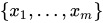
Proposition—Let { x 1 , … , x m } {\displaystyle \{x_{1},\dots ,x_{m}\}} {\displaystyle \{x_{1},\dots ,x_{m}\}} be a generating set of an R-module M, and y 1 , … , y n {\displaystyle y_{1},\dots ,y_{n}} {\displaystyle y_{1},\dots ,y_{n}} be other elements of M. The module of the relations between x 1 , … , x m , y 1 , … , y n {\displaystyle x_{1},\dots ,x_{m},y_{1},\dots ,y_{n}} {\displaystyle x_{1},\dots ,x_{m},y_{1},\dots ,y_{n}} is the direct sum of the module of the relations between x 1 , … , x m , {\displaystyle x_{1},\dots ,x_{m},} {\displaystyle x_{1},\dots ,x_{m},} and a free module of rank n.

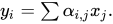
Proof. As { x 1 , … , x m } {\displaystyle \{x_{1},\dots ,x_{m}\}} {\displaystyle \{x_{1},\dots ,x_{m}\}} is a generating set, each y i {\displaystyle y_{i}} {\displaystyle y_{i}} can be written y i = ∑ α i , j x j . {\displaystyle \textstyle y_{i}=\sum \alpha _{i,j}x_{j}.} {\displaystyle \textstyle y_{i}=\sum \alpha _{i,j}x_{j}.} This provides a relation r i {\displaystyle r_{i}} {\displaystyle r_{i}} between x 1 , … , x m , y 1 , … , y n . {\displaystyle x_{1},\dots ,x_{m},y_{1},\dots ,y_{n}.} {\displaystyle x_{1},\dots ,x_{m},y_{1},\dots ,y_{n}.} Now, if r = ( a 1 , … , a m , b 1 , … , b n ) {\displaystyle r=(a_{1},\dots ,a_{m},b_{1},\dots ,b_{n})} {\displaystyle r=(a_{1},\dots ,a_{m},b_{1},\dots ,b_{n})} is any relation, then r − ∑ b i r i {\displaystyle \textstyle r-\sum b_{i}r_{i}} {\displaystyle \textstyle r-\sum b_{i}r_{i}} is a relation between the x 1 , … , x m {\displaystyle x_{1},\dots ,x_{m}} {\displaystyle x_{1},\dots ,x_{m}} only. In other words, every relation between x 1 , … , x m , y 1 , … , y n {\displaystyle x_{1},\dots ,x_{m},y_{1},\dots ,y_{n}} {\displaystyle x_{1},\dots ,x_{m},y_{1},\dots ,y_{n}} is a sum of a relation between x 1 , … , x m , {\displaystyle x_{1},\dots ,x_{m},} {\displaystyle x_{1},\dots ,x_{m},} and a linear combination of the r i {\displaystyle r_{i}} {\displaystyle r_{i}}s. It is straightforward to prove that this decomposition is unique, and this proves the result. ◼ {\displaystyle \blacksquare } {\displaystyle \blacksquare }

This proves that the first syzygy module is "stably unique". More precisely, given two generating sets S 1 {\displaystyle S_{1}} {\displaystyle S_{1}} and S 2 {\displaystyle S_{2}} {\displaystyle S_{2}} of a module M, if S 1 {\displaystyle S_{1}} {\displaystyle S_{1}} and S 2 {\displaystyle S_{2}} {\displaystyle S_{2}} are the corresponding modules of relations, then there exist two free modules L 1 {\displaystyle L_{1}} {\displaystyle L_{1}} and L 2 {\displaystyle L_{2}} {\displaystyle L_{2}} such that S 1 ⊕ L 1 {\displaystyle S_{1}\oplus L_{1}} {\displaystyle S_{1}\oplus L_{1}} and S 2 ⊕ L 2 {\displaystyle S_{2}\oplus L_{2}} {\displaystyle S_{2}\oplus L_{2}} are isomorphic. For proving this, it suffices to apply twice the preceding proposition for getting two decompositions of the module of the relations between the union of the two generating sets.

For obtaining a similar result for higher syzygy modules, it remains to prove that, if M is any module, and L is a free module, then M and M ⊕ L have isomorphic syzygy modules. It suffices to consider a generating set of M ⊕ L that consists of a generating set of M and a basis of L. For every relation between the elements of this generating set, the coefficients of the basis elements of L are all zero, and the syzygies of M ⊕ L are exactly the syzygies of M extended with zero coefficients. This completes the proof to the following theorem.

Theorem—For every positive integer k, the kth syzygy module of a given module depends on choices of generating sets, but is unique up to the direct sum with a free module. More precisely, if S 1 {\displaystyle S_{1}} {\displaystyle S_{1}} and S 2 {\displaystyle S_{2}} {\displaystyle S_{2}} are kth syzygy modules that are obtained by different choices of generating sets, then there are free modules L 1 {\displaystyle L_{1}} {\displaystyle L_{1}} and L 2 {\displaystyle L_{2}} {\displaystyle L_{2}} such that S 1 ⊕ L 1 {\displaystyle S_{1}\oplus L_{1}} {\displaystyle S_{1}\oplus L_{1}} and S 2 ⊕ L 2 {\displaystyle S_{2}\oplus L_{2}} {\displaystyle S_{2}\oplus L_{2}} are isomorphic.

Relationship with free resolutions

[edit]

Given a generating set g 1 , … , g n {\displaystyle g_{1},\dots ,g_{n}} {\displaystyle g_{1},\dots ,g_{n}} of an R-module, one can consider a free module L of basis G 1 , … , G n , {\displaystyle G_{1},\dots ,G_{n},} {\displaystyle G_{1},\dots ,G_{n},} where G 1 , … , G n {\displaystyle G_{1},\dots ,G_{n}} {\displaystyle G_{1},\dots ,G_{n}} are new indeterminates. This defines an exact sequence

L ⟶ M ⟶ 0 , {\displaystyle L\longrightarrow M\longrightarrow 0,} {\displaystyle L\longrightarrow M\longrightarrow 0,}

where the left arrow is the linear map that maps each G i {\displaystyle G_{i}} {\displaystyle G_{i}} to the corresponding g i . {\displaystyle g_{i}.} {\displaystyle g_{i}.} The kernel of this left arrow is a first syzygy module of M.

One can repeat this construction with this kernel in place of M. Repeating again and again this construction, one gets a long exact sequence

⋯ ⟶ L k ⟶ L k − 1 ⟶ ⋯ ⟶ L 0 ⟶ M ⟶ 0 , {\displaystyle \cdots \longrightarrow L_{k}\longrightarrow L_{k-1}\longrightarrow \cdots \longrightarrow L_{0}\longrightarrow M\longrightarrow 0,} {\displaystyle \cdots \longrightarrow L_{k}\longrightarrow L_{k-1}\longrightarrow \cdots \longrightarrow L_{0}\longrightarrow M\longrightarrow 0,}

where all L i {\displaystyle L_{i}} {\displaystyle L_{i}} are free modules. By definition, such a long exact sequence is a free resolution of M.

For every k ≥ 1, the kernel S k {\displaystyle S_{k}} {\displaystyle S_{k}} of the arrow starting from L k − 1 {\displaystyle L_{k-1}} {\displaystyle L_{k-1}} is a kth syzygy module of M. It follows that the study of free resolutions is the same as the study of syzygy modules.

A free resolution is finite of length ≤ n if S n {\displaystyle S_{n}} {\displaystyle S_{n}} is free. In this case, one can take L n = S n , {\displaystyle L_{n}=S_{n},} {\displaystyle L_{n}=S_{n},} and L k = 0 {\displaystyle L_{k}=0} {\displaystyle L_{k}=0} (the zero module) for every k > n.

This allows restating Hilbert's syzygy theorem: If R = K [ x 1 , … , x n ] {\displaystyle R=K[x_{1},\dots ,x_{n}]} {\displaystyle R=K[x_{1},\dots ,x_{n}]} is a polynomial ring in n indeterminates over a field K, then every free resolution is finite of length at most n.

The global dimension of a commutative Noetherian ring is either infinite, or the minimal n such that every free resolution is finite of length at most n. A commutative Noetherian ring is regular if its global dimension is finite. In this case, the global dimension equals its Krull dimension. So, Hilbert's syzygy theorem may be restated in a very short sentence that hides much mathematics: A polynomial ring over a field is a regular ring.

Trivial relations

[edit]

In a commutative ring R, one has always ab – ba = 0. This implies trivially that (b, –a) is a linear relation between a and b. Therefore, given a generating set g 1 , … , g k {\displaystyle g_{1},\dots ,g_{k}} {\displaystyle g_{1},\dots ,g_{k}} of an ideal I, one calls trivial relation or trivial syzygy every element of the submodule the syzygy module that is generated by these trivial relations between two generating elements. More precisely, the module of trivial syzygies is generated by the relations


r i , j = ( x 1 , … , x r ) {\displaystyle r_{i,j}=(x_{1},\dots ,x_{r})} {\displaystyle r_{i,j}=(x_{1},\dots ,x_{r})}

such that x i = g j , {\displaystyle x_{i}=g_{j},} {\displaystyle x_{i}=g_{j},} x j = − g i , {\displaystyle x_{j}=-g_{i},} {\displaystyle x_{j}=-g_{i},} and x h = 0 {\displaystyle x_{h}=0} {\displaystyle x_{h}=0} otherwise.

History

[edit]

The word syzygy came into mathematics with the work of Arthur Cayley.[1] In that paper, Cayley used it in the theory of resultants and discriminants.[2] As the word syzygy was used in astronomy to denote a linear relation between planets, Cayley used it to denote linear relations between minors of a matrix, such as, in the case of a 2×3 matrix:

a | b c e f | − b | a c d f | + c | a b d e | = 0. {\displaystyle a\,{\begin{vmatrix}b&c\\e&f\end{vmatrix}}-b\,{\begin{vmatrix}a&c\\d&f\end{vmatrix}}+c\,{\begin{vmatrix}a&b\\d&e\end{vmatrix}}=0.} {\displaystyle a\,{\begin{vmatrix}b&c\\e&f\end{vmatrix}}-b\,{\begin{vmatrix}a&c\\d&f\end{vmatrix}}+c\,{\begin{vmatrix}a&b\\d&e\end{vmatrix}}=0.}

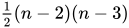
A particular question he studied concerns a set of equations that arise in Plücker embedding, which is an embedding of the (Grassmannian) space of planes G ( 2 , R n ) {\displaystyle G(2,\mathbb {R} ^{n})} {\displaystyle G(2,\mathbb {R} ^{n})} into the projective space P ( ∧ 2 V ) {\displaystyle \mathbb {P} (\wedge ^{2}V)} {\displaystyle \mathbb {P} (\wedge ^{2}V)}. Using Plücker coordinates, the space P ( ∧ 2 V ) {\displaystyle \mathbb {P} (\wedge ^{2}V)} {\displaystyle \mathbb {P} (\wedge ^{2}V)} can be written as { [ p 1 , 2 , p 1 , 3 , … , p n − 1 , n ] } {\displaystyle \{[p_{1,2},p_{1,3},\dots ,p_{n-1,n}]\}} {\displaystyle \{[p_{1,2},p_{1,3},\dots ,p_{n-1,n}]\}}, which has 1 2 n ( n − 1 ) − 1 {\displaystyle {\tfrac {1}{2}}n(n-1)-1} {\displaystyle {\tfrac {1}{2}}n(n-1)-1} dimensions. Now, since G ( 2 , R n ) {\displaystyle G(2,\mathbb {R} ^{n})} {\displaystyle G(2,\mathbb {R} ^{n})} has 2 ( n − 2 ) {\displaystyle 2(n-2)} {\displaystyle 2(n-2)} dimensions, it should be possible to write it as the intersection of 1 2 ( n − 2 ) ( n − 3 ) {\displaystyle {\tfrac {1}{2}}(n-2)(n-3)} {\displaystyle {\tfrac {1}{2}}(n-2)(n-3)} hypersurfaces. However, they found that G ( 2 , R n ) {\displaystyle G(2,\mathbb {R} ^{n})} {\displaystyle G(2,\mathbb {R} ^{n})} is the intersection of the 1 4 n ( n − 1 ) ( n − 2 ) ( n − 3 ) {\displaystyle {\tfrac {1}{4}}n(n-1)(n-2)(n-3)} {\displaystyle {\tfrac {1}{4}}n(n-1)(n-2)(n-3)} equations: Q i j k l := p i j p k l − p i k p j l + p i l p j k = 0 ( 1 ≤ i < j < k < l ≤ n ) {\displaystyle Q_{ijkl}:=p_{ij}p_{kl}-p_{ik}p_{jl}+p_{il}p_{jk}=0\quad (1\leq i<j<k<l\leq n)} {\displaystyle Q_{ijkl}:=p_{ij}p_{kl}-p_{ik}p_{jl}+p_{il}p_{jk}=0\quad (1\leq i<j<k<l\leq n)}Thus, these equations must be dependent on each other when n ≥ 5 {\displaystyle n\geq 5} {\displaystyle n\geq 5}. For example, when n = 5 {\displaystyle n=5} {\displaystyle n=5}, the space G ( 2 , R 5 ) {\displaystyle G(2,\mathbb {R} ^{5})} {\displaystyle G(2,\mathbb {R} ^{5})} is a codimension-3 subspace of P ( ∧ 2 R 5 ) {\displaystyle \mathbb {P} (\wedge ^{2}\mathbb {R} ^{5})} {\displaystyle \mathbb {P} (\wedge ^{2}\mathbb {R} ^{5})} defined as the intersection of 5 equations, so there are 2 redundancies, which can be exhibited by the matrix equation: ( 0 p 12 p 13 p 14 p 15 − p 12 0 p 23 p 24 p 25 − p 13 − p 23 0 p 34 p 35 − p 14 − p 24 − p 34 0 p 45 − p 15 − p 25 − p 35 − p 45 0 ) ( Q 1 Q 2 Q 3 Q 4 Q 5 ) = 0 , Q 1 = p 23 p 45 − p 24 p 35 + p 25 p 34 Q 2 = p 13 p 45 − p 14 p 35 + p 15 p 34 Q 3 = p 12 p 45 − p 14 p 25 + p 15 p 24 Q 4 = p 12 p 35 − p 13 p 25 + p 15 p 23 Q 5 = p 12 p 34 − p 13 p 24 + p 14 p 23 . {\displaystyle {\begin{pmatrix}0&p_{12}&p_{13}&p_{14}&p_{15}\\-p_{12}&0&p_{23}&p_{24}&p_{25}\\-p_{13}&-p_{23}&0&p_{34}&p_{35}\\-p_{14}&-p_{24}&-p_{34}&0&p_{45}\\-p_{15}&-p_{25}&-p_{35}&-p_{45}&0\end{pmatrix}}{\begin{pmatrix}Q_{1}\\Q_{2}\\Q_{3}\\Q_{4}\\Q_{5}\end{pmatrix}}=0,\quad {\begin{aligned}Q_{1}&=p_{23}p_{45}-p_{24}p_{35}+p_{25}p_{34}\\Q_{2}&=p_{13}p_{45}-p_{14}p_{35}+p_{15}p_{34}\\Q_{3}&=p_{12}p_{45}-p_{14}p_{25}+p_{15}p_{24}\\Q_{4}&=p_{12}p_{35}-p_{13}p_{25}+p_{15}p_{23}\\Q_{5}&=p_{12}p_{34}-p_{13}p_{24}+p_{14}p_{23}.\end{aligned}}} {\displaystyle {\begin{pmatrix}0&p_{12}&p_{13}&p_{14}&p_{15}\\-p_{12}&0&p_{23}&p_{24}&p_{25}\\-p_{13}&-p_{23}&0&p_{34}&p_{35}\\-p_{14}&-p_{24}&-p_{34}&0&p_{45}\\-p_{15}&-p_{25}&-p_{35}&-p_{45}&0\end{pmatrix}}{\begin{pmatrix}Q_{1}\\Q_{2}\\Q_{3}\\Q_{4}\\Q_{5}\end{pmatrix}}=0,\quad {\begin{aligned}Q_{1}&=p_{23}p_{45}-p_{24}p_{35}+p_{25}p_{34}\\Q_{2}&=p_{13}p_{45}-p_{14}p_{35}+p_{15}p_{34}\\Q_{3}&=p_{12}p_{45}-p_{14}p_{25}+p_{15}p_{24}\\Q_{4}&=p_{12}p_{35}-p_{13}p_{25}+p_{15}p_{23}\\Q_{5}&=p_{12}p_{34}-p_{13}p_{24}+p_{14}p_{23}.\end{aligned}}}In the subspace of A 9 ⊂ P ( ∧ 2 R 5 ) {\displaystyle \mathbb {A} ^{9}\subset \mathbb {P} (\wedge ^{2}\mathbb {R} ^{5})} {\displaystyle \mathbb {A} ^{9}\subset \mathbb {P} (\wedge ^{2}\mathbb {R} ^{5})} where p 12 = 1 {\displaystyle p_{12}=1} {\displaystyle p_{12}=1}, the two linear syzygies Q 1 = p 23 Q 3 + p 24 Q 4 + p 25 Q 5 , Q 2 = − p 13 Q 3 − p 14 Q 4 − p 15 Q 5 {\displaystyle Q_{1}=p_{23}Q_{3}+p_{24}Q_{4}+p_{25}Q_{5},\quad Q_{2}=-p_{13}Q_{3}-p_{14}Q_{4}-p_{15}Q_{5}} {\displaystyle Q_{1}=p_{23}Q_{3}+p_{24}Q_{4}+p_{25}Q_{5},\quad Q_{2}=-p_{13}Q_{3}-p_{14}Q_{4}-p_{15}Q_{5}}show that if Q 3 , Q 4 , Q 5 = 0 {\displaystyle Q_{3},Q_{4},Q_{5}=0} {\displaystyle Q_{3},Q_{4},Q_{5}=0}, then the other two conditions are automatically satisfied. This is the redundancy.

Then, the word syzygy was popularized (among mathematicians) by David Hilbert in his 1890 article, which contains three fundamental theorems on polynomials, Hilbert's syzygy theorem, Hilbert's basis theorem and Hilbert's Nullstellensatz.

In his article, Cayley makes use, in a special case, of what was later[3] called the Koszul complex, after a similar construction in differential geometry by the mathematician Jean-Louis Koszul.

Notes

[edit]
  1. ^ 1847[Cayley 1847] A. Cayley, “On the theory of involution in geometry”, Cambridge Math. J. 11 (1847), 52–61. See also Collected Papers, Vol. 1 (1889), 80–94, Cambridge Univ. Press, Cambridge.
  2. ^ [Gel’fand et al. 1994] I. M. Gel’fand, M. M. Kapranov, and A. V. Zelevinsky, Discriminants, resultants, and multidimensional determinants, Mathematics: Theory & Applications, Birkhäuser, Boston, 1994.
  3. ^ Serre, Jean-Pierre Algèbre locale. Multiplicités. (French) Cours au Collège de France, 1957–1958, rédigé par Pierre Gabriel. Seconde édition, 1965. Lecture Notes in Mathematics, 11 Springer-Verlag, Berlin-New York 1965 vii+188 pp.; this is the published form of mimeographed notes from Serre's lectures at the College de France in 1958.

References

[edit]
  • Cox, David; Little, John; O’Shea, Donal (2007). "Ideals, Varieties, and Algorithms". Undergraduate Texts in Mathematics. New York, NY: Springer New York. doi:10.1007/978-0-387-35651-8. ISBN 978-0-387-35650-1. ISSN 0172-6056.
  • Cox, David; Little, John; O’Shea, Donal (2005). "Using Algebraic Geometry". Graduate Texts in Mathematics. New York: Springer-Verlag. doi:10.1007/b138611. ISBN 0-387-20706-6.
  • Eisenbud, David (1995). Commutative Algebra with a View Toward Algebraic Geometry. Graduate Texts in Mathematics. Vol. 150. Springer-Verlag. doi:10.1007/978-1-4612-5350-1. ISBN 0-387-94268-8.
  • David Eisenbud, The Geometry of Syzygies, Graduate Texts in Mathematics, vol. 229, Springer, 2005.
Retrieved from "https://teknopedia.ac.id/w/index.php?title=Linear_relation&oldid=1339906984"
Categories:
  • Commutative algebra
  • Homological algebra
  • Linear algebra
  • Polynomials
Hidden categories:
  • Articles with short description
  • Short description is different from Wikidata

  • indonesia
  • Polski
  • العربية
  • Deutsch
  • English
  • Español
  • Français
  • Italiano
  • مصرى
  • Nederlands
  • 日本語
  • Português
  • Sinugboanong Binisaya
  • Svenska
  • Українська
  • Tiếng Việt
  • Winaray
  • 中文
  • Русский
Sunting pranala
url url url url url url url url url url url url url url url url url url url url url url url url url url url url url url url url url url url url url url url url url url url url url url url url url url url url url url url url url url url url url url url url url url url url url url url url url url url url url url url url url url url url url url url url url url url url url url url url url url url url url url url url url url url url url url url url url url url url url url url url url url url url url url url url url url url url url url url url url url url url url url url url url url url url url url url url url url url url url url url url url url url url url url url url url url url url url url url url url url url url url url url url url url url url url url url url url url url url url url url url url url url url url url url url url url url url url url url url url url url url url url url url url url url url url url url url url url url url url url url url url url url url url url url url url url url url url url url url url url url url url url url url url url url url url url url url url url url url url url url url url url url url url url url url url url url url url url url url url url url url url url url url url url url url url url url url url url url url url url url url url url url url url url url url url url url url url url url url url url url url url url url url url url url url url url url url url url url url url url url url url url url url url url url url url url url url url url url url url url url url url url url url url url url url url url url url url url url url url url url url url url url url url url url url url url url url url url url url url url url url url url url url url url url url url url url url url url url url url url url url url url url url url url url url url url url url url url url url url url url url url url url url url url url url url url url url url url url url url url url url url url url url url url url url url url url url url url url url url url url url url url url url url url url url url url url url url url url url url url url url url url url url url url url url url url url url url url url url url url url url url url url url url url url url url url url url url url url url url url url url url url url url url url url url url url url url url url url url url url url url url url url url url url url url url url url url url url url url url url url url url url url url url url url url url url url url url url url url url url url url url url url url url url url url url url url url url url url url url url url url url url url url url url url url url url url url url url url url url url url url url url url url url url url url url url url url url url url url url url url url url url url url url url url url url url url url url url url url url url url url url url url url url url url url url url url url url url url url url url url url url url url url url url url url url url url url url url url url url url url url url url url url url url url url url url url url url url url url url url url url url url url url url url url url url url url url url url url url url url url url url url url url url url url url url url url url url url url url url url url url url url url url url url url url url url url url url url url url url url url url url url url url url url url url url url url url url url url url url url url url url url url url url url url url url url url url url url url url url url url url url url url url url url url url url url url url url url url url url url url url url url url url url url url url url url url url url url url url url url url url url url url url url url url url url url url url url url url url url url url url url url url url url url url url url url url url url url url url url url url url url url url url url url url url url url url url url url url url url url url url url url url url url url url url url url url url url url url url url url url url url url url url url url url url url url url url url url url url url url url url url url url url url url url url url url url url url url url url url url url url url url url url url url url url url url url url url url url url url url url url url url url url url url url url url url url url url url url url url url url url url url url url url url url url url url url url url url url url url url url url url url url url url url url url url url url url url url url url url url url url url url url url url url url url url url url url url url url url url url url url url url url url url url url url url url url url url url url url url url url url url url url url url url url url url url url url url url url url url url url url url url url url url url url url url url url url url url url url url url url url url url url url url url url url url url url url url url url url url url url url url url url url url url url url url url url url url url url url url url url url url url url url url url url url url url url url url url url url url url url url url url url url url url url url url url url url url url url url url url url url url url url url url url url url url url url url url url url url url url url url url url url url url url url url url url url url url url url url url url url url url url url url url url url url url url url url url url url url url url url url url url url url url url url url url url url url url url url url url url url url url url url url url url url url url url url url url url url url url url url url url url url url url url url url url url url url url url url url url url url url url url url url url url url url url url url url url url url url url url url url url url url url url url url url url url url url url url url url url url url url url url url url url url url url url url url url url url url url url url url url url url url url url url url url url url url url url url url url url url url url url url url url url url url url url url url url url url url url url url url url url url url url url url url url url url url url url url url url url url url url url url url url url url url url url url url url url url url url url url url url url url url url url url url url url url url url url url url url url url url url url url url url url url url url url url url url url url url url url url url url url url url url url url url url url url url url url url url url url url url url url url url url url url url url url url url url url url url url url url url url url url url url url url url url url url url url url url url url url url url url url url url url url url url url url url url url url url url url url url url url url url url url url url url url url url url url url url url url url url url url url url url url url url url url url url url url url url url url url url url url url url url url url url url url url url url url url url url url url url url url url url url url url url url url url url url url url url url url url url url url url url url url url url url url url url url url url url url url url url url url url url url url url url url url url url url url url url url url url url url url url url url url url url url url url url url url url url url url url url url url url url url url url url url url url url url url url url url url url url url url url url url url url url url url url url url url url url url url url url url url url url url url url url url url url url url url url url url url url url url url url url url url url url url url url url url url url url url url url url url url url url url url url url url url url url url url url url url url url url url url url url url url url url url url url url url url url url url url url url url url url url url url url url url url url url url url url url url url url url url url url url url url url url url url url url url url url url url url url url url url url url url url url url url url url url url url url url url url url url url url url url url url url url url url url url url url url url url url url url url url url url url url url url url url url url url url url url url url url url url url url url url url url url url url url url url url url url url url url url url url url url url url url url url url url url url url url url url url url url url url url url url url url url url url url url url url url url url url url url url url url url url url url url url url url url url url url url url url url url url url url url url url url url url url url url url url url url url url url url url url url url url url url url url url url url url url url url url url url url url url url url url url url url url url url url url url url url url url url url url url url url url url url url url url url url url url url url url url url url url url url url url url url url url url url url url url url url url url url url url url url url url url url url url url url url url url url url url url url url url url url url url url url url url url url url url url url url url url url url url url url url url url url url url url url url url url url url url url url url url url url url url url url url url url url url url url url url url url url url url url url url url url url url url url url url url url url url url url url url url url url url url url url url url url url url url url url url url url url url url url url url url url url url url url url url url url url url url url url url url url url url url url url url url url url url url url url url url url url url url url url url url url url url url url url url url url url url url url url url url url url url url url url url url url url url url url url url url url url url url url url url url url url url url url url url url url url url url url url url url url url url url url url url url url url url url url url url url url url url url url url url url url
Pusat Layanan

UNIVERSITAS TEKNOKRAT INDONESIA | ASEAN's Best Private University
Jl. ZA. Pagar Alam No.9 -11, Labuhan Ratu, Kec. Kedaton, Kota Bandar Lampung, Lampung 35132
Phone: (0721) 702022
Email: pmb@teknokrat.ac.id