

In linear algebra, a matrix pencil is a matrix-valued function defined on a field , usually the real or complex numbers.

Definition
Let be a field (typically, ; the definition can be generalized to rngs), and let be a positive integer. Then any matrix-valued function


(where denotes the -algebra of matrices over ) is called a matrix pencil.


Polynomial matrix pencils
An important special case arises when is polynomial: let be a non-negative integer, and let be matrices (i. e. for all ). Then the polynomial matrix pencil (often simply a matrix pencil) defined by is the matrix-valued function defined by





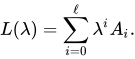
The degree of this matrix pencil is defined as the largest integer such that , the zero matrix over .


Linear matrix pencils
A particular case is a linear matrix pencil (where ).[1] We denote it briefly with the notation , and note that using the more general notation, and (not ).


Generalized eigenvalues of matrix pencils
For a matrix pencil , any such that is called a generalized eigenvalue (often simply eigenvalue) of , and the set of generalized eigenvalues of is called its spectrum and is denoted by


For a polynomial matrix pencil, we write ; for the linear pencil , we write as (not ).


The generalized eigenvalues of the linear matrix pencil are precisely the matrix eigenvalues of . The general linear pencil is said to have one or more eigenvalues at infinity if has one or more 0 eigenvalues.


A pencil is called regular if there is at least one such that , i. e. if ; otherwise it is called singular.


Applications
Matrix pencils play an important role in numerical linear algebra. The problem of finding the generalized eigenvalues of a pencil is called the generalized eigenvalue problem. The most popular algorithm for this task is the QZ algorithm, an implicit version of the QR algorithm for solving the eigenvalue problem without inverting the matrix (which is impossible when is singular, or numerically unstable when it is ill-conditioned).

Pencils generated by commuting matrices
If , then the pencil generated by and :[2]

- consists only of matrices similar to a diagonal matrix, or
- has no matrices in it similar to a diagonal matrix, or
- has exactly one matrix in it similar to a diagonal matrix.
See also
- Generalized eigenvalue problem
- Generalized pencil-of-function method
- Nonlinear eigenproblem
- Quadratic eigenvalue problem
- Generalized Rayleigh quotient
Notes
- ^ Golub & Van Loan (1996, p. 375)
- ^ Marcus & Minc (1969, p. 79)
References
- Golub, Gene H.; Van Loan, Charles F. (1996), Matrix Computations (3rd ed.), Baltimore: Johns Hopkins University Press, ISBN 0-8018-5414-8
- Marcus & Minc (1969), A survey of matrix theory and matrix inequalities, Courier Dover Publications
- Peter Lancaster & Qian Ye (1991) "Variational and numerical methods for symmetric matrix pencils", Bulletin of the Australian Mathematical Society 43: 1 to 17
 | This linear algebra-related article is a stub. You can help Wikipedia by adding missing information. |


