Epstein Files Full PDF

CLICK HERE
Technopedia Center
PMB University Brochure
Faculty of Engineering and Computer Science
S1 Informatics S1 Information Systems S1 Information Technology S1 Computer Engineering S1 Electrical Engineering S1 Civil Engineering

faculty of Economics and Business
S1 Management S1 Accountancy

Faculty of Letters and Educational Sciences
S1 English literature S1 English language education S1 Mathematics education S1 Sports Education
teknopedia

  • Registerasi
  • Brosur UTI
  • Kip Scholarship Information
  • Performance
Flag Counter
  1. World Encyclopedia
  2. Peridot - Wikipedia
Peridot - Wikipedia
From Wikipedia, the free encyclopedia
Green gem-quality mineral
For other uses, see Peridot (disambiguation).
Peridot
General
CategorySilicate minerals
Formula(Mg,Fe)2SiO4
Crystal systemOrthorhombic
Identification
ColorYellow, to yellow-green, olive-green, to brownish, sometimes a lime green, to emerald hue
TwinningUncommon, simple twinning can occur on {100}, {011},{012}, cyclic twinning on {031}
CleavagePoor on {010} and {110}, {010} cleavage improves with increasing iron content
FractureConchoidal
Mohs scale hardness6.5–7
LusterVitreous to oily
StreakColorless
DiaphaneityTranslucent to transparent
Specific gravity3.2–4.3
Refractive index1.64–1.70
Birefringence+0.036
PleochroismWeak pale yellow-green to yellow, yellow to yellow orange
Melting pointbetween 1,200 and 1,900°C
FusibilityInfusible avoid thermal shock
SolubilitySlowly forms gelatinous silica in H Cl

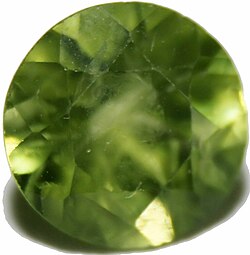
Peridot (/ˈpɛrɪˌdɒt/ PERR-ih-dot), sometimes called chrysolite, is a yellow-green transparent variety of olivine. Peridot is one of the few gemstones that occur in only one color.

Peridot can be found in mafic and ultramafic rocks occurring in lava and peridotite xenoliths of the mantle. The gem occurs in silica-deficient rocks such as volcanic basalt and pallasitic meteorites. Along with diamonds, peridot is one of only two gems observed to be formed not in Earth's crust, but in the molten rock of the upper mantle.[1] Gem-quality peridot is rare on Earth's surface due to its susceptibility to alteration during its movement from deep within the mantle and weathering at the surface.[2] Peridot has a chemical formula of (Mg,Fe)2SiO4.

Peridot is one of the birthstones for the month of August.[3]

Etymology

[edit]

The origin of the name peridot is uncertain. The Oxford English Dictionary suggests an alteration of Anglo–Norman pedoretés (classical Latin pæderot-), a kind of opal, rather than the Arabic word faridat, meaning "gemstone".

The Middle English Dictionary's entry on peridot includes several variations: peridod, peritot, pelidod and pilidod — other variants substitute y for letter i used here.[4]

The earliest use of the word in English is possibly in the 1705 register of the St. Albans Abbey: The dual entry is in Latin with the translation to English listed as peridot. It records that on his death in 1245, Bishop John bequeathed various items, including peridot gems, to the Abbey.[5]

Appearance

[edit]

Peridot is one of the few gemstones that occur in only one color: an olive-green. The intensity and tint of the green, however, depends on the percentage of iron in the crystal structure, so the color of individual peridot gems can vary from yellow, to olive, to brownish-green. In rare cases, peridot may have a medium-dark toned, pure green with no secondary yellow hue or brown mask. Lighter-colored gems are due to lower iron concentrations.[6]

Mineral properties

[edit]

Crystal structure

[edit]
The atomic scale structure of olivine looking along the a axis. Oxygen is shown in red, silicon in pink, and magnesium/iron in blue. A projection of the unit cell is shown by the black rectangle.

The molecular structure of peridot consists of isomorphic olivine, silicate, magnesium and iron in an orthorhombic crystal system. In an alternative view, the atomic structure can be described as a hexagonal, close-packed array of oxygen ions with half of the octahedral sites occupied by magnesium or iron ions and one-eighth of the tetrahedral sites occupied by silicon ions.

Surface property

[edit]

Oxidation of peridot does not occur at natural surface temperature and pressure but begins to occur slowly at 600 °C (870 K) with rates increasing with temperature.[7] The oxidation of the olivine occurs by an initial breakdown of the fayalite component, and subsequent reaction with the forsterite component, to give magnetite and orthopyroxene.

Occurrence

[edit]

Geologically

[edit]

Olivine, of which peridot is a type, is a common mineral in mafic and ultramafic rocks, often found in lava and in peridotite xenoliths of the mantle, which lava carries to the surface; however, gem-quality peridot occurs in only a fraction of these settings. Peridots can also be found in meteorites.

Peridots can be differentiated by size and composition. A peridot formed as a result of volcanic activity tends to contain higher concentrations of lithium, nickel and zinc than those found in meteorites.[8][full citation needed]

Olivine is an abundant mineral, but gem-quality peridot is rather rare due to its chemical instability on Earth's surface. Olivine is usually found as small grains and tends to exist in a heavily weathered state, unsuitable for decorative use. Large crystals of forsterite, the variety most often used to cut peridot gems, are rare; as a result, peridot is considered to be precious.

In the ancient world, the mining of peridot was called topazios then, on St. John's Island, in the Red Sea began about 300 BCE.[9]

The principal source of peridot olivine today is the San Carlos Apache Indian Reservation in Arizona, US.[a] It is also mined at another location in Arizona, and in Arkansas, Hawaii, Nevada, and New Mexico at Kilbourne Hole, in the US; and in Australia, Brazil, China, Egypt, Kenya, Mexico, Myanmar (Burma), Norway, Pakistan, Saudi Arabia, South Africa, Sri Lanka, and Tanzania.[citation needed]

In meteorites

[edit]
Pallasite meteorite with olive-green peridot crystals, found in Fukang, China.

Peridot crystals have been collected from some pallasite meteorites. The most commonly studied pallasitic peridot belongs to the Indonesian Jeppara meteorite, but others exist such as the Brenham, Esquel, Fukang, and Imilac meteorites.[11] Pallasitic (extraterrestrial) peridot differs chemically from its earthbound counterpart, in that pallasitic peridot lacks nickel.[12]

Gemology

[edit]
Due to its high birefringence, doubling of facet junctions is commonly seen when viewing peridot under magnification.

Orthorhombic minerals, like peridot, have biaxial birefringence defined by three principal axes: α, β, and γ. Refractive index readings of faceted gems can range around α = 1.651, β = 1.668, and γ = 1.689, with a biaxial positive birefringence of 0.037–0.038. With decreasing magnesium and increasing iron concentration, the specific gravity, color darkness and refractive indices increase, and the β index shifts toward the γ index. Increasing iron concentration ultimately forms the iron-rich end-member of the olivine solid solution series fayalite.[13]

A study of Chinese peridot gem samples determined the hydro-static specific gravity to be 3.36 . The visible-light spectroscopy of the same Chinese peridot samples showed light bands between 493.0–481.0 nm, the strongest absorption at 492.0 nm.[14]

The largest cut peridot olivine is a 310-carat (62-gram) specimen in the gem collection of the Smithsonian Museum in Washington, D.C.

Inclusions are common in peridot crystals but their presence depends on the location where it was found and the geological conditions that led to its crystallization.

  • Primary negative crystals – rounded gas bubbles – form in situ with peridot, and are common in Hawaiian peridots.
  • Secondary negative crystals form in peridot fractures.
  • "Lily pad" cleavages are often seen in San Carlos peridots, and are a type of secondary negative crystal. They can easily be seen under reflected light as circular discs surrounding a negative crystal.
  • Silky and rod-like inclusions are common in Pakistani peridots.[15]
  • The most common mineral inclusion in peridot is the chromium-rich mineral chromite.
  • Magnesium-rich minerals also can exist in the form of pyrope and magnesiochromite. These two types of mineral inclusions are typically surrounded "lily-pad" cleavages.
  • Biotite flakes appear flat, brown, translucent, and tabular.[16]

Cultural history

[edit]

Peridot has been prized since the earliest civilizations for its claimed protective powers to drive away fears and nightmares, according to superstitions. There is a superstition that it carries the gift of "inner radiance", sharpening the mind and opening it to new levels of awareness and growth, helping one to recognize and realize one's destiny and spiritual purpose.[citation needed]

Peridot olivine is the birthstone for the month of August.[17]

Peridot has often been mistaken for emerald beryl and other green gems.[18] Noted gemologist G.F. Kunz discussed the confusion between beryl and peridot in many church treasures, most notably the "Three Magi treasure" in the Dom of Cologne, Germany.[19][1]

Gallery

[edit]
  • Peridot olivine with minor pyroxene, on vesicular basalt. (field of view = 35 mm)
    Peridot olivine with minor pyroxene, on vesicular basalt. (field of view = 35 mm)
  • Peridot from the San Carlos Apache Reservation in Arizona.
    Peridot from the San Carlos Apache Reservation in Arizona.
  • Olive green peridot
    Olive green peridot
  • Peridot with milky inclusions
    Peridot with milky inclusions

Footnotes

[edit]
  1. ^ "Although some good olive-colored crystals are found in a few other places, like Burma, China, Zambia, and Pakistan, ninety percent of all known peridots are found in just one place. It is a Native American reservation, and it is located in a little-visited corner of the United States: San Carlos." — V. Finlay[10]

References

[edit]
  1. ^ a b "Peridot crystals: Formation & locations". Rock & Gem Magazine. 10 July 2023. Retrieved 21 January 2024 – via rockngem.com. Get to know this August birthstone
  2. ^ "Peridot". Gem notes. geo.utexas.edu. Geology Department. Austin, TX: The University of Texas. course 347k. Retrieved 2024-01-21.
  3. ^ "Color, meanings, and symbolism [of] August birthstone peridot". Old Farmer's Almanac – via almanac.com.
  4. ^ Kuhn, Sherman M. (1982). "peridot". Middle English Dictionary. University of Michigan Press. p. 818 ff. ISBN 0-472-01163-4 – via Google books.
  5. ^ Ware, James, Sir (1705). The Antiquities and History of Ireland. A. Crook. p. 628 ff – via Google books.{{cite book}}: CS1 maint: multiple names: authors list (link)
  6. ^ Wise, Richard W. (2016). Secrets of the Gem Trade: The connoisseur's guide to precious gemstones (2nd ed.). Lenox, MA: Brunswick House Press. p. 220. ISBN 9780972822329.
  7. ^ Knafelc, Joseph; Filiberto, Justin; Ferré, Eric C.; Conder, James A.; Costello, Lacey; Crandall, Jake R.; et al. (May 2019). "The effect of oxidation on the mineralogy and magnetic properties of olivine". American Mineralogist. 104 (5): 694–702. Bibcode:2019AmMin.104..694K. doi:10.2138/am-2019-6829. ISSN 0003-004X. S2CID 155508562 – via geoscienceworld.org.
  8. ^ Shen, A.; et al. (2011). "Identification of extraterrestrial peridot by trace elements". Gems & Gemology. 47 (3): 208–213. doi:10.5741/GEMS.47.3.208.
  9. ^ "St. John's Island peridot information and history". Mindat.org.
  10. ^ Finlay, Victoria (August 15, 2006). Jewels: A secret history (Kindle ed.). Ballantine Books. Kindle locations 543–546. ISBN 978-0345493354.
  11. ^ Leelawatanasuk, Thanong; Atichat, Wilawan; Thye Sun, Tay; Sriprasert, Boontawee; Jakkawanvibul, Jirapit (2014). "Some characteristics of taaffeite from Myanmar". The Journal of Gemmology. 34 (2): 144–148. doi:10.15506/jog.2014.34.2.144. ISSN 1355-4565.
  12. ^ "Alien sightings: Pallasite" (PDF). stonegrouplabs.com.
  13. ^ Koivula, John I. (1981). "San Carlos peridot" (PDF). Gems & Gemology. 17 (4): 205–214. doi:10.5741/gems.17.4.205. Retrieved 14 February 2023 – via gia.edu.
  14. ^ Koivula, John I.; Fryer, C.W. (1 April 1986). "The gemological characteristics of Chinese peridot". Gems & Gemology. 22 (1): 38–40. doi:10.5741/GEMS.22.1.38. ISSN 0016-626X.
  15. ^ "Sapat Gali, Naran, Kaghan Valley, Mansehra District, Khyber Pakhtunkhwa Province, Pakistan". mindat.org.
  16. ^ "Biotite as inclusions". Dictionary of Gems and Gemology. Springer. 2009. p. 87. doi:10.1007/978-3-540-72816-0_2288. ISBN 978-3-540-72795-8.
  17. ^ "Birthstones for each month". gia.edu. Gemological Institute of America. Retrieved 5 February 2021.
  18. ^ "Peridot gem guide and properties chart". Gemstones.com. Retrieved 2022-09-14.
  19. ^ Kunz, G.F. (June 1971). The Curious Lore of Precious Stones. New York, NY: Dover Publications. p. 66. ISBN 0-486-22227-6.

External links

[edit]
Wikimedia Commons has media related to Peridot.
  • Ganoksin
  • Mineralminers
  • USGS peridot data Archived 2018-12-21 at the Wayback Machine
  • Emporia Edu
  • Florida State University – Peridot
  • v
  • t
  • e
Gemstones
Gemmological classifications by E. Ya. Kievlenko (1980), updated
Jewelry stones
1st order
  • Diamond
  • Ruby
  • Emerald
  • Blue Sapphire
  • Alexandrite
  • Natural marine pearls
2nd order
  • Pink sapphire
  • Demantoid
  • Tsavorite
  • Spinel
  • Precious Black Opal
  • Tanzanite
3rd order
  • Yellow, Green, Violet Sapphires
  • Aquamarine
  • Orange topaz (Imperial)
  • Elbaite
  • Precious White and Fire Opal
4th order
  • Tourmaline – Verdelite
  • Indicolite, polychromous
  • Beryl – Heliodor, pink, yellow-green
  • Topaz yellow, blue, pink
  • Peridot
  • Garnets – Spessartine (malaya), Rhodolite, Almandine, Pyrope
  • Amethyst
  • Citrine
  • Blue Turquoise
Jewelry-Industrial
stones
1st order
  • Lazurite
  • Jadeite
  • Nephrite
  • Malachite
  • Amber (Baltic amber)
  • Chrysoprase
  • Charoite
2nd order
  • Agate
  • Amazonite
  • Rhodonite
  • Colorless, smoky and pink quartz
  • Hematite
  • Common opal
  • Opaque iridescent feldspars
Industrial stones
  • Jasper
  • Graphic granite
  • Petrified wood
  • Cacholong (Porouse opal)
  • Marble onyx
  • Obsidian
  • Listwanite (green mica)
  • Jet
  • Selenite
  • Fluorite
  • Serpentinite
  • Aventurine quartzite
  • Ophicalcite (Serpentine/Calcite)
  • Pagodite (Pyrophyllite/Talc)
Related
  • List of individual gemstones
  • List of diamonds
  • List of emeralds by size
  • List of sapphires by size
List of gemstones by species
  • photo Minerals portal
  • v
  • t
  • e
Jewellery
Forms
  • Anklet
  • Barrette
  • Belly chain
  • Belt buckle
  • Bindi
  • Bolo tie
  • Bracelet
  • Brooch
  • Chain
  • Chatelaine
  • Collar pin
  • Crown
  • Cufflink
  • Earring
  • Ferronnière
  • Lapel pin
  • Necklace
  • Neck ring
  • Pectoral
  • Pendant
  • Permanent jewellery
  • Ring
  • Tiara
  • Tie chain
  • Tie clip
  • Tie pin
  • Toe ring
  • Watch
    • pocket
    • strap
Making
People
  • Bench jeweler
  • Clockmaker
  • Goldsmith
  • Jewellery designer
  • Lapidarist
  • Silversmith
  • Watchmaker
Processes
  • Carving
  • Casting
    • centrifugal
    • lost-wax
    • vacuum
  • Enameling
  • Engraving
  • Filigree
  • Foldforming
  • Jewelry model
  • Metal clay
  • Plating
  • Polishing
  • Repoussé and chasing
  • Soldering
  • Stonesetting
  • Wire sculpture
  • Wire wrapped jewelry
Tools
  • Draw plate
  • File
  • Hammer
  • Mandrel
  • Pliers
Materials
Precious metals
  • Gold
  • Palladium
  • Platinum
  • Rhodium
  • Silver
Precious metal alloys
  • Britannia silver
  • Colored gold
  • Crown gold
  • Electrum
  • Shakudō
  • Shibuichi
  • Sterling silver
    • Argentium
  • Tumbaga
Base metals
  • Brass
  • Bronze
  • Copper
  • Mokume-gane
  • Nickel silver (alpacca):
  • Niobium
  • Pewter
  • Pinchbeck
  • Stainless steel
  • Titanium
  • Tungsten
Mineral gemstones
  • Agate
  • Amazonite
  • Amethyst
  • Aventurine
  • Beryl (red)
  • Carnelian
  • Chrysoberyl
  • Chrysocolla
  • Citrine
  • Diamond
  • Diopside
  • Emerald
  • Fluorite
  • Garnet
  • Howlite
  • Jade
  • Jasper
  • Kyanite
  • Labradorite
  • Lapis lazuli
  • Larimar
  • Malachite
  • Marcasite
  • Moonstone
  • Obsidian
  • Onyx
  • Opal
  • Peridot
  • Prasiolite
  • Quartz (smoky)
  • Ruby
  • Sapphire
  • Sodalite
  • Spinel
  • Sunstone
  • Tanzanite
  • Tiger's eye
  • Topaz
  • Tourmaline
  • Turquoise
  • Variscite
  • Zircon
Organic gemstones
  • Abalone
  • Amber
  • Ammolite
  • Copal
  • Coral
    • Black
    • Precious
  • Ivory
  • Jet
  • Nacre
  • Operculum
  • Pearl
  • Tortoiseshell
Other natural objects
  • Bezoar
  • Bog-wood
  • Ebonite (vulcanite)
  • Gutta-percha
  • Hair
  • Shell
    • Spondylus shell
  • Toadstone
Terms
  • Art jewelry
  • Carat (mass)
  • Carat (purity)
  • Finding
  • Fineness
Related topics
Body piercing
Fashion
Gemology
Metalworking
Phaleristics
Wearable art
Portals:
  • photo Minerals
  • icon Geology
  • Earth sciences
Retrieved from "https://teknopedia.ac.id/w/index.php?title=Peridot&oldid=1323114855"
Categories:
  • Gemstones
  • Silicate minerals
Hidden categories:
  • CS1 maint: multiple names: authors list
  • Articles with short description
  • Short description is different from Wikidata
  • Articles containing Anglo-Norman-language text
  • Articles containing Latin-language text
  • Articles containing Arabic-language text
  • Articles containing Middle English (1100-1500)-language text
  • All articles with incomplete citations
  • Articles with incomplete citations from August 2024
  • All articles with unsourced statements
  • Articles with unsourced statements from November 2021
  • Articles with unsourced statements from July 2025
  • Commons category link is on Wikidata
  • Webarchive template wayback links

  • indonesia
  • Polski
  • العربية
  • Deutsch
  • English
  • Español
  • Français
  • Italiano
  • مصرى
  • Nederlands
  • 日本語
  • Português
  • Sinugboanong Binisaya
  • Svenska
  • Українська
  • Tiếng Việt
  • Winaray
  • 中文
  • Русский
Sunting pranala
url url url url url url url url url url url url url url url url url url url url url url url url url url url url url url url url url url url url url url url url url url url url url url url url url url url url url url url url url url url url url url url url url url url url url url url url url url url url url url url url url url url url url url url url url url url url url url url url url url url url url url url url url url url url url url url url url url url url url url url url url url url url url url url url url url url url url url url url url url url url url url url url url url url url url url url url url url url url url url url url url url url url url url url url url url url url url url url url url url url url url url url url url url url url url url url url url url url url url url url url url url url url url url url url url url url url url url url url url url url url url url url url url url url url url url url url url url url url url url url url url url url url url url url url url url url url url url url url url url url url url url url url url url url url url url url url url url url url url url url url url url url url url url url url url url url url url url url url url url url url url url url url url url url url url url url url url url url url url url url url url url url url url url url url url url url url url url url url url url url url url url url url url url url url url url url url url url url url url url url url url url url url url url url url url url url url url url url url url url url url url url url url url url url url url url url url url url url url url url url url url url url url url url url url url url url url url url url url url url url url url url url url url url url url url url url url url url url url url url url url url url url url url url url url url url url url url url url url url url url url url url url url url url url url url url url url url url url url url url url url url url url url url url url url url url url url url url url url url url url url url url url url url url url url url url url url url url url url url url url url url url url url url url url url url url url url url url url url url url url url url url url url url url url url url url url url url url url url url url url url url url url url url url url url url url url url url url url url url url url url url url url url url url url url url url url url url url url url url url url url url url url url url url url url url url url url url url url url url url url url url url url url url url url url url url url url url url url url url url url url url url url url url url url url url url url url url url url url url url url url url url url url url url url url url url url url url url url url url url url url url url url url url url url url url url url url url url url url url url url url url url url url url url url url url url url url url url url url url url url url url url url url url url url url url url url url url url url url url url url url url url url url url url url url url url url url url url url url url url url url url url url url url url url url url url url url url url url url url url url url url url url url url url url url url url url url url url url url url url url url url url url url url url url url url url url url url url url url url url url url url url url url url url url url url url url url url url url url url url url url url url url url url url url url url url url url url url url url url url url url url url url url url url url url url url url url url url url url url url url url url url url url url url url url url url url url url url url url url url url url url url url url url url url url url url url url url url url url url url url url url url url url url url url url url url url url url url url url url url url url url url url url url url url url url url url url url url url url url url url url url url url url url url url url url url url url url url url url url url url url url url url url url url url url url url url url url url url url url url url url url url url url url url url url url url url url url url url url url url url url url url url url url url url url url url url url url url url url url url url url url url url url url url url url url url url url url url url url url url url url url url url url url url url url url url url url url url url url url url url url url url url url url url url url url url url url url url url url url url url url url url url url url url url url url url url url url url url url url url url url url url url url url url url url url url url url url url url url url url url url url url url url url url url url url url url url url url url url url url url url url url url url url url url url url url url url url url url url url url url url url url url url url url url url url url url url url url url url url url url url url url url url url url url url url url url url url url url url url url url url url url url url url url url url url url url url url url url url url url url url url url url url url url url url url url url url url url url url url url url url url url url url url url url url url url url url url url url url url url url url url url url url url url url url url url url url url url url url url url url url url url url url url url url url url url url url url url url url url url url url url url url url url url url url url url url url url url url url url url url url url url url url url url url url url url url url url url url url url url url url url url url url url url url url url url url url url url url url url url url url url url url url url url url url url url url url url url url url url url url url url url url url url url url url url url url url url url url url url url url url url url url url url url url url url url url url url url url url url url url url url url url url url url url url url url url url url url url url url url url url url url url url url url url url url url url url url url url url url url url url url url url url url url url url url url url url url url url url url url url url url url url url url url url url url url url url url url url url url url url url url url url url url url url url url url url url url url url url url url url url url url url url url url url url url url url url url url url url url url url url url url url url url url url url url url url url url url url url url url url url url url url url url url url url url url url url url url url url url url url url url url url url url url url url url url url url url url url url url url url url url url url url url url url url url url url url url url url url url url url url url url url url url url url url url url url url url url url url url url url url url url url url url url url url url url url url url url url url url url url url url url url url url url url url url url url url url url url url url url url url url url url url url url url url url url url url url url url url url url url url url url url url url url url url url url url url url url url url url url url url url url url url url url url url url url url url url url url url url url url url url url url url url url url url url url url url url url url url url url url url url url url url url url url url url url url url url url url url url url url url url url url url url url url url url url url url url url url url url url url url url url url url url url url url url url url url url url url url url url url url url url url url url url url url url url url url url url url url url url url url url url url url url url url url url url url url url url url url url url url url url url url url url url url url url url url url url url url url url url url url url url url url url url url url url url url url url url url url url url url url url url url url url url url url url url url url url url url url url url url url url url url url url url url url url url url url url url url url url url url url url url url url url url url url url url url url url url url url url url url url url url url url url url url url url url url url url url url url url url url url url url url url url url url url url url url url url url url url url url url url url url url url url url url url url url url url url url url url url url url url url url url url url url url url url url url url url url url url url url url url url url url url url url url url url url url url url url url url url url url url url url url url url url url url url url url url url url url url url url url url url url url url url url url url url url url url url url url url url url url url url url url url url url url url url url url url url url url url url url url url url url url url url url url url url url url url url url url url url url url url url url url url url url url url url url url url url url url url url url url url url url url url url url url url url url url url url url url url url url url url url url url url url url url url url url url url url url url url url url url url url url url url url url url url url url url url url url url url url url url url url url url url url url url url url url url url url url url url url url url url url url url url url url url url url url url url url url url url url url url url url url url url url url url url url url url url url url url url url url url url url url url url url url url url url url url url url url url url url url url url url url url url url url url url url url url url url url url url url url url url url url url url url url url url url url url url url url url url url url url url url url url url url url url url url url url url url url url url url url url url url url url url url url url url url url url url url url url url url url url url url url url url url url url url url url url url url url url url url url url url url url url url
Pusat Layanan

UNIVERSITAS TEKNOKRAT INDONESIA | ASEAN's Best Private University
Jl. ZA. Pagar Alam No.9 -11, Labuhan Ratu, Kec. Kedaton, Kota Bandar Lampung, Lampung 35132
Phone: (0721) 702022
Email: pmb@teknokrat.ac.id