Epstein Files Full PDF

CLICK HERE
Technopedia Center
PMB University Brochure
Faculty of Engineering and Computer Science
S1 Informatics S1 Information Systems S1 Information Technology S1 Computer Engineering S1 Electrical Engineering S1 Civil Engineering

faculty of Economics and Business
S1 Management S1 Accountancy

Faculty of Letters and Educational Sciences
S1 English literature S1 English language education S1 Mathematics education S1 Sports Education
teknopedia

  • Registerasi
  • Brosur UTI
  • Kip Scholarship Information
  • Performance
Flag Counter
  1. World Encyclopedia
  2. Price equation
Price equation
From Wikipedia, the free encyclopedia
Description of how a trait or gene changes in frequency over time
"Price's theorem" redirects here. For the theorem in general relativity, see Richard H. Price.

In the theory of evolution and natural selection, the Price equation (also known as Price's equation or Price's theorem) describes how a "characteristic" of a population changes in frequency over time as the result of reproduction and natural selection. A characteristic may be a physical or behavioral trait (phenotype) or a particular genetic makeup (allele).

The equation uses a covariance between a characteristic and fitness, to give a mathematical description of evolution and natural selection. It provides a way to understand the effects that gene transmission and natural selection have on the frequency of alleles and/or phenotypes within each new generation of a population. The Price equation was derived by George R. Price, working in London to re-derive W.D. Hamilton's work on kin selection.

Examples of the Price equation have been constructed for various evolutionary cases. For example Collins and Gardner [1] use the Price equation to partition the total change in toxin resistance in microbial communities into evolutionary change, ecological change and physiological change. Ellner et al. [2] use the Price equation to disentangle "ecological impacts of evolution vs. non-heritable trait change", using examples from data on birds, fish and zooplankton. The Price equation also has applications in economics.[3]


Statement

[edit]
Example for a characteristic under positive selection

The Price equation shows that a change in the average amount z {\displaystyle z} {\displaystyle z} of a characteristic in a population from one generation to the next ( Δ z {\displaystyle \Delta z} {\displaystyle \Delta z}) is determined by the covariance between the amounts z i {\displaystyle z_{i}} {\displaystyle z_{i}} of the characteristic for subpopulation i {\displaystyle i} {\displaystyle i} and the fitnesses w i {\displaystyle w_{i}} {\displaystyle w_{i}} of the subpopulations, together with the expected change in the characteristic due to fitness, namely E ( w i Δ z i ) {\displaystyle \mathrm {E} (w_{i}\Delta z_{i})} {\displaystyle \mathrm {E} (w_{i}\Delta z_{i})}:

Δ z = 1 w cov ⁡ ( w i , z i ) + 1 w E ⁡ ( w i Δ z i ) . {\displaystyle \Delta {z}={\frac {1}{w}}\operatorname {cov} (w_{i},z_{i})+{\frac {1}{w}}\operatorname {E} (w_{i}\,\Delta z_{i}).} {\displaystyle \Delta {z}={\frac {1}{w}}\operatorname {cov} (w_{i},z_{i})+{\frac {1}{w}}\operatorname {E} (w_{i}\,\Delta z_{i}).}

Here w {\displaystyle w} {\displaystyle w} is the average fitness over the population, and E {\displaystyle \operatorname {E} } {\displaystyle \operatorname {E} } and cov {\displaystyle \operatorname {cov} } {\displaystyle \operatorname {cov} } represent the population mean and covariance respectively. 'Fitness' w {\displaystyle w} {\displaystyle w} is the ratio of the average number of offspring for the whole population per the number of adult individuals in the population, and w i {\displaystyle w_{i}} {\displaystyle w_{i}} is that same ratio only for subpopulation i {\displaystyle i} {\displaystyle i}.

If the covariance between fitness ( w i {\displaystyle w_{i}} {\displaystyle w_{i}}) and the characteristic ( z i {\displaystyle z_{i}} {\displaystyle z_{i}}) is positive, the characteristic is expected to rise on average across population i {\displaystyle i} {\displaystyle i}. If the covariance is negative, the characteristic is harmful, and its frequency is expected to drop.

By noting that the covariance is the standard deviation multiplied by the correlation ( cov ⁡ ( X , Y ) = r X , Y σ X σ Y {\displaystyle \operatorname {cov} (X,Y)=r_{X,Y}\sigma _{X}\sigma _{Y}} {\displaystyle \operatorname {cov} (X,Y)=r_{X,Y}\sigma _{X}\sigma _{Y}}) we can rewrite this as

Δ z σ z = r w , z w / σ w + 1 w / σ w E ⁡ ( w i σ w Δ z i σ z ) {\displaystyle {\frac {\Delta {z}}{\sigma _{z}}}={\frac {r_{w,z}}{w/\sigma _{w}}}+{\frac {1}{w/\sigma _{w}}}\operatorname {E} \left({\frac {w_{i}}{\sigma _{w}}}{\frac {\Delta z_{i}}{\sigma _{z}}}\right)} {\displaystyle {\frac {\Delta {z}}{\sigma _{z}}}={\frac {r_{w,z}}{w/\sigma _{w}}}+{\frac {1}{w/\sigma _{w}}}\operatorname {E} \left({\frac {w_{i}}{\sigma _{w}}}{\frac {\Delta z_{i}}{\sigma _{z}}}\right)}
Δ z σ z = C V w r w , z + C V w E ⁡ ( w i σ w Δ z i σ z ) {\displaystyle {\frac {\Delta {z}}{\sigma _{z}}}=CV_{w}r_{w,z}+CV_{w}\operatorname {E} \left({\frac {w_{i}}{\sigma _{w}}}{\frac {\Delta z_{i}}{\sigma _{z}}}\right)} {\displaystyle {\frac {\Delta {z}}{\sigma _{z}}}=CV_{w}r_{w,z}+CV_{w}\operatorname {E} \left({\frac {w_{i}}{\sigma _{w}}}{\frac {\Delta z_{i}}{\sigma _{z}}}\right)}

where C V w = σ w w {\displaystyle CV_{w}={\frac {\sigma _{w}}{w}}} {\displaystyle CV_{w}={\frac {\sigma _{w}}{w}}} is the coefficient of variation of the fitness. That is, we can rewrite the quantities in standardized form.

We see that if the correlation between the characteristic and fitness is held constant, more variance increases the magnitude of selection.

The second term, E ( w i Δ z i ) {\displaystyle \mathrm {E} (w_{i}\Delta z_{i})} {\displaystyle \mathrm {E} (w_{i}\Delta z_{i})}, represents the portion of Δ z {\displaystyle \Delta z} {\displaystyle \Delta z} due to all factors other than direct selection which can affect the evolution of the characteristic. This term can encompass genetic drift, mutation bias, or meiotic drive. Additionally, this term can encompass the effects of multi-level selection or group selection.

Proof

[edit]

As with any concept, the more general its application, the more difficult it usually is to understand. The Price equation is no exception, and its proof is rather extended and detailed. There are a number of equations in evolutionary biology which are special cases of the Price equation and are more easily understood, such as the Robertson-Price identity, the breeder's equation, and Fisher's fundamental theorem of natural selection.

The Price equation relies on a simplified description of the properties of evolutionary systems [4]. These can be summarized as 1) Individuals in a population have characteristic that can be quantified. 2) The average characteristic of the population changes over time (such as between a past observation and a present observation). 3) Individuals in the past (i.e. ancestors) are associated with some individuals in the present (descendants) [5][6]. All these properties can be sumarized in a diagram representing two generations, in which the ancestors are parents and the children are the descendants. [7] .

This diagram illustrates the basic properties of evolutionary systems used in some derivations of the Price equation. In this example, the characteristic of interest is leaf length (measured in cm). This characteristic changes over time. One source of change is that the parent with larger leaves produces more children than the parent with smaller leaves.

This simplified description of evolution can be formalized by studying four equal-length lists of real numbers[8], the abundance of individuals of type i {\displaystyle i} {\displaystyle i} in the past, n i {\displaystyle n_{i}} {\displaystyle n_{i}}, the characteristic of individuals of type i {\displaystyle i} {\displaystyle i} in the past z i {\displaystyle z_{i}} {\displaystyle z_{i}}, the abundance of individuals of type i {\displaystyle i} {\displaystyle i} in the present n i ′ {\displaystyle n_{i}'} {\displaystyle n_{i}'}, and the characteristic of individuals of type i {\displaystyle i} {\displaystyle i} in the present z i ′ {\displaystyle z_{i}'} {\displaystyle z_{i}'}. From this from we may define w i = n i ′ / n i {\displaystyle w_{i}=n_{i}'/n_{i}} {\displaystyle w_{i}=n_{i}'/n_{i}}. n i {\displaystyle n_{i}} {\displaystyle n_{i}} and z i {\displaystyle z_{i}} {\displaystyle z_{i}} will be called the parent population numbers and characteristics associated with each index i. Likewise n i ′ {\displaystyle n_{i}'} {\displaystyle n_{i}'} and z i ′ {\displaystyle z_{i}'} {\displaystyle z_{i}'} will be called the child population numbers and characteristics, and w i ′ {\displaystyle w_{i}'} {\displaystyle w_{i}'} will be called the fitness associated with index i. (Equivalently, we could have been given n i {\displaystyle n_{i}} {\displaystyle n_{i}}, z i {\displaystyle z_{i}} {\displaystyle z_{i}}, w i {\displaystyle w_{i}} {\displaystyle w_{i}}, z i ′ {\displaystyle z_{i}'} {\displaystyle z_{i}'} with n i ′ = w i n i {\displaystyle n_{i}'=w_{i}n_{i}} {\displaystyle n_{i}'=w_{i}n_{i}}.) Define the parent and child population totals:

n = d e f ∑ i n i {\displaystyle n\;{\stackrel {\mathrm {def} }{=}}\;\sum _{i}n_{i}} {\displaystyle n\;{\stackrel {\mathrm {def} }{=}}\;\sum _{i}n_{i}} n ′ = d e f ∑ i n i ′ {\displaystyle n'\;{\stackrel {\mathrm {def} }{=}}\;\sum _{i}n_{i}'} {\displaystyle n'\;{\stackrel {\mathrm {def} }{=}}\;\sum _{i}n_{i}'}

and the probabilities (or frequencies):[9]

q i = d e f n i / n {\displaystyle q_{i}\;{\stackrel {\mathrm {def} }{=}}\;n_{i}/n} {\displaystyle q_{i}\;{\stackrel {\mathrm {def} }{=}}\;n_{i}/n} q i ′ = d e f n i ′ / n ′ {\displaystyle q_{i}'\;{\stackrel {\mathrm {def} }{=}}\;n_{i}'/n'} {\displaystyle q_{i}'\;{\stackrel {\mathrm {def} }{=}}\;n_{i}'/n'}

Note that these are of the form of probability mass functions in that ∑ i q i = ∑ i q i ′ = 1 {\displaystyle \sum _{i}q_{i}=\sum _{i}q_{i}'=1} {\displaystyle \sum _{i}q_{i}=\sum _{i}q_{i}'=1} and are in fact the probabilities that a random individual drawn from the parent or child population has a characteristic z i {\displaystyle z_{i}} {\displaystyle z_{i}}. Define the fitnesses:

w i = d e f n i ′ / n i {\displaystyle w_{i}\;{\stackrel {\mathrm {def} }{=}}\;n_{i}'/n_{i}} {\displaystyle w_{i}\;{\stackrel {\mathrm {def} }{=}}\;n_{i}'/n_{i}}

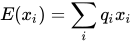
The average of any list x i {\displaystyle x_{i}} {\displaystyle x_{i}} is given by:

E ( x i ) = ∑ i q i x i {\displaystyle E(x_{i})=\sum _{i}q_{i}x_{i}} {\displaystyle E(x_{i})=\sum _{i}q_{i}x_{i}}

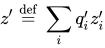
so the average characteristics are defined as:
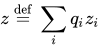
z = d e f ∑ i q i z i {\displaystyle z\;{\stackrel {\mathrm {def} }{=}}\;\sum _{i}q_{i}z_{i}} {\displaystyle z\;{\stackrel {\mathrm {def} }{=}}\;\sum _{i}q_{i}z_{i}} z ′ = d e f ∑ i q i ′ z i ′ {\displaystyle z'\;{\stackrel {\mathrm {def} }{=}}\;\sum _{i}q_{i}'z_{i}'} {\displaystyle z'\;{\stackrel {\mathrm {def} }{=}}\;\sum _{i}q_{i}'z_{i}'}

and the average fitness is:

w = d e f ∑ i q i w i {\displaystyle w\;{\stackrel {\mathrm {def} }{=}}\;\sum _{i}q_{i}w_{i}} {\displaystyle w\;{\stackrel {\mathrm {def} }{=}}\;\sum _{i}q_{i}w_{i}}

A simple theorem can be proved: q i w i = ( n i n ) ( n i ′ n i ) = ( n i ′ n ′ ) ( n ′ n ) = q i ′ ( n ′ n ) {\displaystyle q_{i}w_{i}=\left({\frac {n_{i}}{n}}\right)\left({\frac {n_{i}'}{n_{i}}}\right)=\left({\frac {n_{i}'}{n'}}\right)\left({\frac {n'}{n}}\right)=q_{i}'\left({\frac {n'}{n}}\right)} {\displaystyle q_{i}w_{i}=\left({\frac {n_{i}}{n}}\right)\left({\frac {n_{i}'}{n_{i}}}\right)=\left({\frac {n_{i}'}{n'}}\right)\left({\frac {n'}{n}}\right)=q_{i}'\left({\frac {n'}{n}}\right)} so that:

w = n ′ n ∑ i q i ′ = n ′ n {\displaystyle w={\frac {n'}{n}}\sum _{i}q_{i}'={\frac {n'}{n}}} {\displaystyle w={\frac {n'}{n}}\sum _{i}q_{i}'={\frac {n'}{n}}}

and

q i w i = w q i ′ {\displaystyle q_{i}w_{i}=w\,q_{i}'} {\displaystyle q_{i}w_{i}=w\,q_{i}'}

The covariance of w i {\displaystyle w_{i}} {\displaystyle w_{i}} and z i {\displaystyle z_{i}} {\displaystyle z_{i}} is defined by:

cov ⁡ ( w i , z i ) = d e f E ( w i z i ) − E ( w i ) E ( z i ) = ∑ i q i w i z i − w z {\displaystyle \operatorname {cov} (w_{i},z_{i})\;{\stackrel {\mathrm {def} }{=}}\;E(w_{i}z_{i})-E(w_{i})E(z_{i})=\sum _{i}q_{i}w_{i}z_{i}-wz} {\displaystyle \operatorname {cov} (w_{i},z_{i})\;{\stackrel {\mathrm {def} }{=}}\;E(w_{i}z_{i})-E(w_{i})E(z_{i})=\sum _{i}q_{i}w_{i}z_{i}-wz}

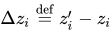
Defining Δ z i = d e f z i ′ − z i {\displaystyle \Delta z_{i}\;{\stackrel {\mathrm {def} }{=}}\;z_{i}'-z_{i}} {\displaystyle \Delta z_{i}\;{\stackrel {\mathrm {def} }{=}}\;z_{i}'-z_{i}}, the expectation value of w i Δ z i {\displaystyle w_{i}\Delta z_{i}} {\displaystyle w_{i}\Delta z_{i}} is

E ( w i Δ z i ) = ∑ i q i w i ( z i ′ − z i ) = ∑ i q i w i z i ′ − ∑ i q i w i z i {\displaystyle E(w_{i}\Delta z_{i})=\sum _{i}q_{i}w_{i}(z_{i}'-z_{i})=\sum _{i}q_{i}w_{i}z_{i}'-\sum _{i}q_{i}w_{i}z_{i}} {\displaystyle E(w_{i}\Delta z_{i})=\sum _{i}q_{i}w_{i}(z_{i}'-z_{i})=\sum _{i}q_{i}w_{i}z_{i}'-\sum _{i}q_{i}w_{i}z_{i}}

The sum of the two terms is:

cov ⁡ ( w i , z i ) + E ( w i Δ z i ) = ∑ i q i w i z i − w z + ∑ i q i w i z i ′ − ∑ i q i w i z i = ∑ i q i w i z i ′ − w z {\displaystyle \operatorname {cov} (w_{i},z_{i})+E(w_{i}\Delta z_{i})=\sum _{i}q_{i}w_{i}z_{i}-wz+\sum _{i}q_{i}w_{i}z_{i}'-\sum _{i}q_{i}w_{i}z_{i}=\sum _{i}q_{i}w_{i}z_{i}'-wz} {\displaystyle \operatorname {cov} (w_{i},z_{i})+E(w_{i}\Delta z_{i})=\sum _{i}q_{i}w_{i}z_{i}-wz+\sum _{i}q_{i}w_{i}z_{i}'-\sum _{i}q_{i}w_{i}z_{i}=\sum _{i}q_{i}w_{i}z_{i}'-wz}

Using the above mentioned simple theorem, the sum becomes

cov ⁡ ( w i , z i ) + E ( w i Δ z i ) = w ∑ i q i ′ z i ′ − w z = w z ′ − w z = w Δ z {\displaystyle \operatorname {cov} (w_{i},z_{i})+E(w_{i}\Delta z_{i})=w\sum _{i}q_{i}'z_{i}'-wz=wz'-wz=w\Delta z} {\displaystyle \operatorname {cov} (w_{i},z_{i})+E(w_{i}\Delta z_{i})=w\sum _{i}q_{i}'z_{i}'-wz=wz'-wz=w\Delta z}

where Δ z = d e f z ′ − z {\displaystyle \Delta z\;{\stackrel {\mathrm {def} }{=}}\;z'-z} {\displaystyle \Delta z\;{\stackrel {\mathrm {def} }{=}}\;z'-z}.

Derivation of the continuous-time Price equation

[edit]

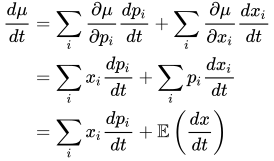
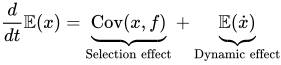
Consider a set of groups with i = 1 , . . . , n {\displaystyle i=1,...,n} {\displaystyle i=1,...,n} that have the same characteristic, denoted by x i {\displaystyle x_{i}} {\displaystyle x_{i}}. The number n i {\displaystyle n_{i}} {\displaystyle n_{i}} of individuals belonging to group i {\displaystyle i} {\displaystyle i} experiences exponential growth: d n i d t = f i n i {\displaystyle {dn_{i} \over {dt}}=f_{i}n_{i}} {\displaystyle {dn_{i} \over {dt}}=f_{i}n_{i}}where f i {\displaystyle f_{i}} {\displaystyle f_{i}} corresponds to the fitness of the group. We want to derive an equation describing the time-evolution of the expected value of the characteristic: E ( x ) = ∑ i p i x i ≡ μ , p i = n i ∑ i n i {\displaystyle \mathbb {E} (x)=\sum _{i}p_{i}x_{i}\equiv \mu ,\quad p_{i}={n_{i} \over {\sum _{i}n_{i}}}} {\displaystyle \mathbb {E} (x)=\sum _{i}p_{i}x_{i}\equiv \mu ,\quad p_{i}={n_{i} \over {\sum _{i}n_{i}}}}Based on the chain rule, we may derive an ordinary differential equation: d μ d t = ∑ i ∂ μ ∂ p i d p i d t + ∑ i ∂ μ ∂ x i d x i d t = ∑ i x i d p i d t + ∑ i p i d x i d t = ∑ i x i d p i d t + E ( d x d t ) {\displaystyle {\begin{aligned}{d\mu \over {dt}}&=\sum _{i}{\partial \mu \over {\partial p_{i}}}{dp_{i} \over {dt}}+\sum _{i}{\partial \mu \over {\partial x_{i}}}{dx_{i} \over {dt}}\\&=\sum _{i}x_{i}{dp_{i} \over {dt}}+\sum _{i}p_{i}{dx_{i} \over {dt}}\\&=\sum _{i}x_{i}{dp_{i} \over {dt}}+\mathbb {E} \left({dx \over {dt}}\right)\end{aligned}}} {\displaystyle {\begin{aligned}{d\mu  \over {dt}}&=\sum _{i}{\partial \mu  \over {\partial p_{i}}}{dp_{i} \over {dt}}+\sum _{i}{\partial \mu  \over {\partial x_{i}}}{dx_{i} \over {dt}}\\&=\sum _{i}x_{i}{dp_{i} \over {dt}}+\sum _{i}p_{i}{dx_{i} \over {dt}}\\&=\sum _{i}x_{i}{dp_{i} \over {dt}}+\mathbb {E} \left({dx \over {dt}}\right)\end{aligned}}}A further application of the chain rule for d p i / d t {\displaystyle dp_{i}/dt} {\displaystyle dp_{i}/dt} gives us: d p i d t = ∑ j ∂ p i ∂ n j d n j d t , ∂ p i ∂ n j = { − p i / N , i ≠ j ( 1 − p i ) / N , i = j {\displaystyle {dp_{i} \over {dt}}=\sum _{j}{\partial p_{i} \over {\partial n_{j}}}{dn_{j} \over {dt}},\quad {\partial p_{i} \over {\partial n_{j}}}={\begin{cases}-p_{i}/N,\quad &i\neq j\\(1-p_{i})/N,\quad &i=j\end{cases}}} {\displaystyle {dp_{i} \over {dt}}=\sum _{j}{\partial p_{i} \over {\partial n_{j}}}{dn_{j} \over {dt}},\quad {\partial p_{i} \over {\partial n_{j}}}={\begin{cases}-p_{i}/N,\quad &i\neq j\\(1-p_{i})/N,\quad &i=j\end{cases}}}Summing up the components gives us that: d p i d t = p i ( f i − ∑ j p j f j ) = p i [ f i − E ( f ) ] {\displaystyle {\begin{aligned}{dp_{i} \over {dt}}&=p_{i}\left(f_{i}-\sum _{j}p_{j}f_{j}\right)\\&=p_{i}\left[f_{i}-\mathbb {E} (f)\right]\end{aligned}}} {\displaystyle {\begin{aligned}{dp_{i} \over {dt}}&=p_{i}\left(f_{i}-\sum _{j}p_{j}f_{j}\right)\\&=p_{i}\left[f_{i}-\mathbb {E} (f)\right]\end{aligned}}}

which is also known as the replicator equation. Now, note that: ∑ i x i d p i d t = ∑ i p i x i [ f i − E ( f ) ] = E { x i [ f i − E ( f ) ] } = Cov ( x , f ) {\displaystyle {\begin{aligned}\sum _{i}x_{i}{dp_{i} \over {dt}}&=\sum _{i}p_{i}x_{i}\left[f_{i}-\mathbb {E} (f)\right]\\&=\mathbb {E} \left\{x_{i}\left[f_{i}-\mathbb {E} (f)\right]\right\}\\&={\text{Cov}}(x,f)\end{aligned}}} {\displaystyle {\begin{aligned}\sum _{i}x_{i}{dp_{i} \over {dt}}&=\sum _{i}p_{i}x_{i}\left[f_{i}-\mathbb {E} (f)\right]\\&=\mathbb {E} \left\{x_{i}\left[f_{i}-\mathbb {E} (f)\right]\right\}\\&={\text{Cov}}(x,f)\end{aligned}}}Therefore, putting all of these components together, we arrive at the continuous-time Price equation: d d t E ( x ) = Cov ( x , f ) ⏟ Selection effect + E ( x ˙ ) ⏟ Dynamic effect {\displaystyle {d \over {dt}}\mathbb {E} (x)=\underbrace {{\text{Cov}}(x,f)} _{\text{Selection effect}}+\underbrace {\mathbb {E} ({\dot {x}})} _{\text{Dynamic effect}}} {\displaystyle {d \over {dt}}\mathbb {E} (x)=\underbrace {{\text{Cov}}(x,f)} _{\text{Selection effect}}+\underbrace {\mathbb {E} ({\dot {x}})} _{\text{Dynamic effect}}}

Simple Price equation (Robertson-Price identity)

[edit]

When the characteristic values z i {\displaystyle z_{i}} {\displaystyle z_{i}} do not change from the parent to the child generation, the second term in the Price equation becomes zero resulting in a simplified version of the Price equation:

w Δ z = cov ⁡ ( w i , z i ) {\displaystyle w\,\Delta z=\operatorname {cov} \left(w_{i},z_{i}\right)} {\displaystyle w\,\Delta z=\operatorname {cov} \left(w_{i},z_{i}\right)}

which can be restated as:

Δ z = cov ⁡ ( v i , z i ) {\displaystyle \Delta z=\operatorname {cov} \left(v_{i},z_{i}\right)} {\displaystyle \Delta z=\operatorname {cov} \left(v_{i},z_{i}\right)}

where v i {\displaystyle v_{i}} {\displaystyle v_{i}} is the fractional fitness: v i = w i / w {\displaystyle v_{i}=w_{i}/w} {\displaystyle v_{i}=w_{i}/w}.

This simple Price equation can be proven using the definition in Equation (2) above. It makes this fundamental statement about evolution: "If a certain inheritable characteristic is correlated with an increase in fractional fitness, the average value of that characteristic in the child population will be increased over that in the parent population."

Applications

[edit]

The Price equation can describe any system that changes over time, but is most often applied in evolutionary biology. The evolution of sight provides an example of simple directional selection. The evolution of sickle cell anemia shows how a heterozygote advantage can affect characteristic evolution. The Price equation can also be applied to population context dependent characteristics such as the evolution of sex ratios. Additionally, the Price equation is flexible enough to model second order characteristics such as the evolution of mutability. The Price equation also provides an extension to Founder effect which shows change in population characteristics in different settlements

Dynamical sufficiency and the simple Price equation

[edit]

Sometimes the genetic model being used encodes enough information into the parameters used by the Price equation to allow the calculation of the parameters for all subsequent generations. This property is referred to as dynamical sufficiency. For simplicity, the following looks at dynamical sufficiency for the simple Price equation, but is also valid for the full Price equation.

Referring to the definition in Equation (2), the simple Price equation for the character z {\displaystyle z} {\displaystyle z} can be written:

w ( z ′ − z ) = ⟨ w i z i ⟩ − w z {\displaystyle w(z'-z)=\langle w_{i}z_{i}\rangle -wz} {\displaystyle w(z'-z)=\langle w_{i}z_{i}\rangle -wz}

For the second generation:

w ′ ( z ″ − z ′ ) = ⟨ w i ′ z i ′ ⟩ − w ′ z ′ {\displaystyle w'(z''-z')=\langle w'_{i}z'_{i}\rangle -w'z'} {\displaystyle w'(z''-z')=\langle w'_{i}z'_{i}\rangle -w'z'}

The simple Price equation for z {\displaystyle z} {\displaystyle z} only gives us the value of z ′ {\displaystyle z'} {\displaystyle z'} for the first generation, but does not give us the value of w ′ {\displaystyle w'} {\displaystyle w'} and ⟨ w i z i ⟩ {\displaystyle \langle w_{i}z_{i}\rangle } {\displaystyle \langle w_{i}z_{i}\rangle }, which are needed to calculate z ″ {\displaystyle z''} {\displaystyle z''} for the second generation. The variables w i {\displaystyle w_{i}} {\displaystyle w_{i}} and ⟨ w i z i ⟩ {\displaystyle \langle w_{i}z_{i}\rangle } {\displaystyle \langle w_{i}z_{i}\rangle } can both be thought of as characteristics of the first generation, so the Price equation can be used to calculate them as well:

w ( w ′ − w ) = ⟨ w i 2 ⟩ − w 2 w ( ⟨ w i ′ z i ′ ⟩ − ⟨ w i z i ⟩ ) = ⟨ w i 2 z i ⟩ − w ⟨ w i z i ⟩ {\displaystyle {\begin{aligned}w(w'-w)&=\langle w_{i}^{2}\rangle -w^{2}\\w\left(\langle w'_{i}z'_{i}\rangle -\langle w_{i}z_{i}\rangle \right)&=\langle w_{i}^{2}z_{i}\rangle -w\langle w_{i}z_{i}\rangle \end{aligned}}} {\displaystyle {\begin{aligned}w(w'-w)&=\langle w_{i}^{2}\rangle -w^{2}\\w\left(\langle w'_{i}z'_{i}\rangle -\langle w_{i}z_{i}\rangle \right)&=\langle w_{i}^{2}z_{i}\rangle -w\langle w_{i}z_{i}\rangle \end{aligned}}}

The five 0-generation variables w {\displaystyle w} {\displaystyle w}, z {\displaystyle z} {\displaystyle z}, ⟨ w i z i ⟩ {\displaystyle \langle w_{i}z_{i}\rangle } {\displaystyle \langle w_{i}z_{i}\rangle }, ⟨ w i 2 ⟩ {\displaystyle \langle w_{i}^{2}\rangle } {\displaystyle \langle w_{i}^{2}\rangle }, and ⟨ w i 2 z i {\displaystyle \langle w_{i}^{2}z_{i}} {\displaystyle \langle w_{i}^{2}z_{i}} must be known before proceeding to calculate the three first generation variables w ′ {\displaystyle w'} {\displaystyle w'}, z ′ {\displaystyle z'} {\displaystyle z'}, and ⟨ w i ′ z i ′ ⟩ {\displaystyle \langle w'_{i}z'_{i}\rangle } {\displaystyle \langle w'_{i}z'_{i}\rangle }, which are needed to calculate z ″ {\displaystyle z''} {\displaystyle z''} for the second generation. It can be seen that in general the Price equation cannot be used to propagate forward in time unless there is a way of calculating the higher moments ⟨ w i n ⟩ {\displaystyle \langle w_{i}^{n}\rangle } {\displaystyle \langle w_{i}^{n}\rangle } and ⟨ w i n z i ⟩ {\displaystyle \langle w_{i}^{n}z_{i}\rangle } {\displaystyle \langle w_{i}^{n}z_{i}\rangle } from the lower moments in a way that is independent of the generation. Dynamical sufficiency means that such equations can be found in the genetic model, allowing the Price equation to be used alone as a propagator of the dynamics of the model forward in time.

Full Price equation

[edit]

The simple Price equation was based on the assumption that the characters z i {\displaystyle z_{i}} {\displaystyle z_{i}} do not change over one generation. If it is assumed that they do change, with z i {\displaystyle z_{i}} {\displaystyle z_{i}} being the value of the character in the child population, then the full Price equation must be used. A change in character can come about in a number of ways. The following two examples illustrate two such possibilities, each of which introduces new insight into the Price equation.

Genotype fitness

[edit]

We focus on the idea of the fitness of the genotype. The index i {\displaystyle i} {\displaystyle i} indicates the genotype and the number of type i {\displaystyle i} {\displaystyle i} genotypes in the child population is:

n i ′ = ∑ j w j i n j {\displaystyle n'_{i}=\sum _{j}w_{ji}n_{j}\,} {\displaystyle n'_{i}=\sum _{j}w_{ji}n_{j}\,}

which gives fitness:

w i = n i ′ n i {\displaystyle w_{i}={\frac {n'_{i}}{n_{i}}}} {\displaystyle w_{i}={\frac {n'_{i}}{n_{i}}}}

Since the individual mutability z i {\displaystyle z_{i}} {\displaystyle z_{i}} does not change, the average mutabilities will be:
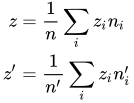
z = 1 n ∑ i z i n i z ′ = 1 n ′ ∑ i z i n i ′ {\displaystyle {\begin{aligned}z&={\frac {1}{n}}\sum _{i}z_{i}n_{i}\\z'&={\frac {1}{n'}}\sum _{i}z_{i}n'_{i}\end{aligned}}} {\displaystyle {\begin{aligned}z&={\frac {1}{n}}\sum _{i}z_{i}n_{i}\\z'&={\frac {1}{n'}}\sum _{i}z_{i}n'_{i}\end{aligned}}}

with these definitions, the simple Price equation now applies.

Lineage fitness

[edit]

In this case we want to look at the idea that fitness is measured by the number of children an organism has, regardless of their genotype. Note that we now have two methods of grouping, by lineage, and by genotype. It is this complication that will introduce the need for the full Price equation. The number of children an i {\displaystyle i} {\displaystyle i}-type organism has is:

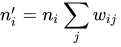
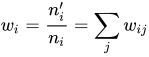
n i ′ = n i ∑ j w i j {\displaystyle n'_{i}=n_{i}\sum _{j}w_{ij}\,} {\displaystyle n'_{i}=n_{i}\sum _{j}w_{ij}\,}

which gives fitness:

w i = n i ′ n i = ∑ j w i j {\displaystyle w_{i}={\frac {n'_{i}}{n_{i}}}=\sum _{j}w_{ij}} {\displaystyle w_{i}={\frac {n'_{i}}{n_{i}}}=\sum _{j}w_{ij}}

We now have characters in the child population which are the average character of the i {\displaystyle i} {\displaystyle i}-th parent.

z j ′ = ∑ i n i z i w i j ∑ i n i w i j {\displaystyle z'_{j}={\frac {\sum _{i}n_{i}z_{i}w_{ij}}{\sum _{i}n_{i}w_{ij}}}} {\displaystyle z'_{j}={\frac {\sum _{i}n_{i}z_{i}w_{ij}}{\sum _{i}n_{i}w_{ij}}}}

with global characters:

z = 1 n ∑ i z i n i z ′ = 1 n ′ ∑ i z i n i ′ {\displaystyle {\begin{aligned}z&={\frac {1}{n}}\sum _{i}z_{i}n_{i}\\z'&={\frac {1}{n'}}\sum _{i}z_{i}n'_{i}\end{aligned}}} {\displaystyle {\begin{aligned}z&={\frac {1}{n}}\sum _{i}z_{i}n_{i}\\z'&={\frac {1}{n'}}\sum _{i}z_{i}n'_{i}\end{aligned}}}

with these definitions, the full Price equation now applies.

Criticism

[edit]

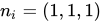
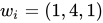
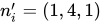
The use of the change in average characteristic ( z ′ − z {\displaystyle z'-z} {\displaystyle z'-z}) per generation as a measure of evolutionary progress is not always appropriate. There may be cases where the average remains unchanged (and the covariance between fitness and characteristic is zero) while evolution is nevertheless in progress. For example, if we have z i = ( 1 , 2 , 3 ) {\displaystyle z_{i}=(1,2,3)} {\displaystyle z_{i}=(1,2,3)}, n i = ( 1 , 1 , 1 ) {\displaystyle n_{i}=(1,1,1)} {\displaystyle n_{i}=(1,1,1)}, and w i = ( 1 , 4 , 1 ) {\displaystyle w_{i}=(1,4,1)} {\displaystyle w_{i}=(1,4,1)}, then for the child population, n i ′ = ( 1 , 4 , 1 ) {\displaystyle n_{i}'=(1,4,1)} {\displaystyle n_{i}'=(1,4,1)} showing that the peak fitness at w 2 = 4 {\displaystyle w_{2}=4} {\displaystyle w_{2}=4} is in fact fractionally increasing the population of individuals with z i = 2 {\displaystyle z_{i}=2} {\displaystyle z_{i}=2}. However, the average characteristics are z=2 and z'=2 so that Δ z = 0 {\displaystyle \Delta z=0} {\displaystyle \Delta z=0}. The covariance c o v ( z i , w i ) {\displaystyle \mathrm {cov} (z_{i},w_{i})} {\displaystyle \mathrm {cov} (z_{i},w_{i})} is also zero. The simple Price equation is required here, and it yields 0=0. In other words, it yields no information regarding the progress of evolution in this system.

A critical discussion of the use of the Price equation can be found in van Veelen (2005),[10] van Veelen et al. (2012),[11] and van Veelen (2020).[12] Frank (2012) discusses the criticism in van Veelen et al. (2012).[4]

Cultural references

[edit]

Price's equation features in the plot and title of the 2008 thriller film WΔZ.

The Price equation also features in posters in the computer game BioShock 2, in which a consumer of a "Brain Boost" tonic is seen deriving the Price equation while simultaneously reading a book. The game is set in the 1950s, substantially before Price's work.

See also

[edit]
  • The breeder's equation, which is a special case of the Price equation.
  • Fisher's fundamental theorem of natural selection, which is a special case of the Price equation.[4]

References

[edit]
  1. ^ Collins, Sinéad; Gardner, Andy (2009). "Integrating physiological, ecological and evolutionary change: a Price equation approach". Ecology Letters. 12 (8): 744–757. doi:10.1111/j.1461-0248.2009.01340.x. ISSN 1461-0248. PMID 19580586.
  2. ^ Ellner, Stephen P.; Geber, Monica A.; Hairston, Nelson G. (2011). "Does rapid evolution matter? Measuring the rate of contemporary evolution and its impacts on ecological dynamics". Ecology Letters. 28 (12): 603–614. doi:10.1111/j.1461-0248.2011.01616.x. ISSN 1461-0248. PMID 21518209.
  3. ^ Knudsen, Thorbjørn (2004). "General selection theory and economic evolution: The Price equation and the replicator/interactor distinction". Journal of Economic Methodology. 11 (2): 147–173. doi:10.1080/13501780410001694109. S2CID 154197796. Retrieved 2011-10-22.
  4. ^ a b c Frank, S.A. (2012). "Natural Selection IV: The Price equation". Journal of Evolutionary Biology. 25 (6): 1002–1019. arXiv:1204.1515. doi:10.1111/j.1420-9101.2012.02498.x. PMC 3354028. PMID 22487312.
  5. ^ Luque, Victor J.; Baravalle, Lorenzo (2021-12-01). "The mirror of physics: on how the Price equation can unify evolutionary biology". Synthese. 199 (5): 12439–12462. doi:10.1007/s11229-021-03339-6. ISSN 1573-0964.
  6. ^ Rice, Sean (2004). Evolutionary theory: mathematical and conceptual foundations. Sunderland, Massachusetts U.S.A.: Sinauer Associates, Inc. ISBN 0-87893-702-1.
  7. ^ Kerr, Benjamin; Godfrey-Smith, Peter (2009). "Generalization of the Price Equation for Evolutionary Change". Evolution. 63 (2): 531–536. doi:10.1111/j.1558-5646.2008.00570.x.
  8. ^ The lists may in fact be members of any field (i.e. a set on which addition, subtraction, multiplication, and division are defined and behave as the corresponding operations on rational and real numbers do
  9. ^ Frank, Steven A. (1995). "George Price's Contributions to Evolutionary Genetics". J. Theor. Biol. 175 (3): 373–388. Bibcode:1995JThBi.175..373F. doi:10.1006/jtbi.1995.0148. PMID 7475081. Retrieved Mar 19, 2023.
  10. ^ van Veelen, M. (December 2005). "On the use of the Price equation". Journal of Theoretical Biology. 237 (4): 412–426. Bibcode:2005JThBi.237..412V. doi:10.1016/j.jtbi.2005.04.026. PMID 15953618.
  11. ^ van Veelen, M.; García, J.; Sabelis, M.W.; Egas, M. (April 2012). "Group selection and inclusive fitness are not equivalent; the Price equation vs. models and statistics". Journal of Theoretical Biology. 299: 64–80. Bibcode:2012JThBi.299...64V. doi:10.1016/j.jtbi.2011.07.025. PMID 21839750.
  12. ^ van Veelen, M. (March 2020). "The problem with the Price equation". Philosophical Transactions of the Royal Society B. 375 (1797): 1–13. doi:10.1098/rstb.2019.0355. PMC 7133513. PMID 32146887.

Further reading

[edit]
  • Frank, S.A. (1995). "George Price's contributions to Evolutionary Genetics" (PDF). Journal of Theoretical Biology. 175 (3): 373–388. Bibcode:1995JThBi.175..373F. CiteSeerX 10.1.1.136.7803. doi:10.1006/jtbi.1995.0148. PMID 7475081.
  • Frank, S.A. (1997). "The Price equation, Fisher's fundamental theorem, kin selection, and causal analysis" (PDF). Evolution. 51 (6): 1712–1729. doi:10.2307/2410995. JSTOR 2410995. PMID 28565119.
  • Gardner, A. (2008). "The Price equation". Curr. Biol. 18 (5): R198–R202. Bibcode:2008CBio...18.R198G. doi:10.1016/j.cub.2008.01.005. PMID 18334191. S2CID 1169263.
  • Grafen, A. (2000). "Developments of the Price equation and natural selection under uncertainty" (PDF). Proceedings of the Royal Society B. 267 (1449): 1223–1227. doi:10.1098/rspb.2000.1131. PMC 1690660. PMID 10902688.
  • Harman, Oren (2010). The Price of Altruism: George Price and the search for the origins of kindness. Bodley Head. ISBN 978-1-84792-062-1.
  • Langdon, W.B. (1998). "8.1 Evolution of GP populations: Price's selection and covariance theorem". Genetic Programming and Data Structures. Springer. pp. 167–208. ISBN 9780792381358.
  • Price, G.R. (1970). "Selection and covariance" (PDF). Nature. 227 (5257): 520–521. Bibcode:1970Natur.227..520P. doi:10.1038/227520a0. PMID 5428476. S2CID 4264723.
  • Price, G.R. (1972). "Extension of covariance selection mathematics". Annals of Human Genetics. 35 (4): 485–490. doi:10.1111/j.1469-1809.1957.tb01874.x. PMID 5073694. S2CID 37828617.
  • van Veelen, Matthijs; García, Julián; Sabelis, Maurice W. & Egas, Martijn (2010). "Call for a return to rigour in models". Correspondence. Nature. 467 (7316): 661. Bibcode:2010Natur.467..661V. doi:10.1038/467661d. PMID 20930826.
  • Day, T. (2006). "Insights from Price's equation into evolutionary epidemiology". Disease Evolution. DIMACS Series in Discrete Mathematics and Theoretical Computer Science. Vol. 71. pp. 23–43. doi:10.1090/dimacs/071/02. ISBN 9780821837535.
  • "How to quit the Price equation: An online self-help tutorial".
  • "The Good Show". Radiolab. Season 9. Episode 1. New York. 14 December 2011. WNYC.
  • Markovitch; Witkowski; Virgo (2018). "Chemical Heredity as Group Selection at the Molecular Level". arXiv:1802.08024 [q-bio.PE].
  • v
  • t
  • e
Population genetics
Key concepts
  • Hardy–Weinberg principle
  • Genetic linkage
  • Identity by descent
  • Linkage disequilibrium
  • Fisher's fundamental theorem
  • Neutral theory
  • Shifting balance theory
  • Price equation
  • Coefficient of inbreeding
  • Coefficient of relationship
  • Selection coefficient
  • Fitness
  • Heritability
  • Population structure
  • Constructive neutral evolution
Selection
  • Natural
  • Artificial
  • Sexual
  • Ecological
Effects of selection
on genomic variation
  • Genetic hitchhiking
  • Background selection
Genetic drift
  • Small population size
  • Population bottleneck
  • Founder effect
  • Coalescence
  • Balding–Nichols model
Founders
  • R. A. Fisher
  • J. B. S. Haldane
  • Sewall Wright
Related topics
  • Biogeography
  • Evolution
  • Evolutionary game theory
  • Fitness landscape
  • Genetic genealogy
  • Landscape genetics and genomics
  • Microevolution
  • Population genomics
  • Phylogeography
  • Quantitative genetics
  • Index of evolutionary biology articles
Retrieved from "https://en.wikipedia.org/w/index.php?title=Price_equation&oldid=1339973994"
Categories:
  • Equations
  • Evolutionary dynamics
  • Evolutionary biology
  • Population genetics
Hidden categories:
  • Articles with short description
  • Short description matches Wikidata

  • indonesia
  • Polski
  • العربية
  • Deutsch
  • English
  • Español
  • Français
  • Italiano
  • مصرى
  • Nederlands
  • 日本語
  • Português
  • Sinugboanong Binisaya
  • Svenska
  • Українська
  • Tiếng Việt
  • Winaray
  • 中文
  • Русский
Sunting pranala
url url url url url url url url url url url url url url url url url url url url url url url url url url url url url url url url url url url url url url url url url url url url url url url url url url url url url url url url url url url url url url url url url url url url url url url url url url url url url url url url url url url url url url url url url url url url url url url url url url url url url url url url url url url url url url url url url url url url url url url url url url url url url url url url url url url url url url url url url url url url url url url url url url url url url url url url url url url url url url url url url url url url url url url url url url url url url url url url url url url url url url url url url url url url url url url url url url url url url url url url url url url url url url url url url url url url url url url url url url url url url url url url url url url url url url url url url url url url url url url url url url url url url url url url url url url url url url url url url url url url url url url url url url url url url url url url url url url url url url url url url url url url url url url url url url url url url url url url url url url url url url url url url url url url url url url url url url url url url url url url url url url url url url url url url url url url url url url url url url url url url url url url url url url url url url url url url url url url url url url url url url url url url url url url url url url url url url url url url url url url url url url url url url url url url url url url url url url url url url url url url url url url url url url url url url url url url url url url url url url url url url url url url url url url url url url url url url url url url url url url url url url url url url url url url url url url url url url url url url url url url url url url url url url url url url url url url url url url url url url url url url url url url url url url url url url url url url url url url url url url url url url url url url url url url url url url url url url url url url url url url url url url url url url url url url url url url url url url url url url url url url url url url url url url url url url url url url url url url url url url url url url url url url url url url url url url url url url url url url url url url url url url url url url url url url url url url url url url url url url url url url url url url url url url url url url url url url url url url url url url url url url url url url url url url url url url url url url url url url url url url url url url url url url url url url url url url url url url url url url url url url url url url url url url url url url url url url url url url url url url url url url url url url url url url url url url url url url url url url url url url url url url url url url url url url url url url url url url url url url url url url url url url url url url url url url url url url url url url url url url url url url url url url url url url url url url url url url url url url url url url url url url url url url url url url url url url url url url url url url url url url url url url url url url url url url url url url url url url url url url url url url url url url url url url url url url url url url url url url url url url url url url url url url url url url url url url url url url url url url url url url url url url url url url url url url url url url url url url url url url url url url url url url url url url url url url url url url url url url url url url url url url url url url url url url url url url url url url url url url url url url url url url url url url url url url url url url url url url url url url url url url url url url url url url url url url url url url url url url url url url url url url url url url url url url url url url url url url url url url url url url url url url url url url url url url url url url url url url url url url url url url url url url url url url url url url url url url url url url url url url url url url url url url url url url url url url url url url url url url url url url url url url url url url url url url url url url url url url url url url url url url url url url url url url url url url url url url url url url url url url url url url url url url url url url url url url url url url url url url url url url url url url url url url url url url url url url url url url url url url url url url url url url url url url url url url url url url url url url url url url url url url url url url url url url url url url url url url url url url url url url url url url url url url url url url url url url url url url url url url url url url url url url url url url url url url url url url url url url url url url url url url url url url url url url url url url url url url url url url url url url url url url url url url url url url url url url url url url url url url url url url url url url url url url url url url url url url url url url url url url url url url url url url url url url url url url url url url url url url url url url url url url url url url url url url url url url url url url url url url url url url url url url url url url url url url url url url url url url url url url url url url url url url url url url url url url url url url url url url url url url url url url url url url url url url url url url url url url url url url url url url url url url url url url url url url url url url url url url url url url url url url url url url url url url url url url url url url url url url url url url url url url url url url url url url url url url url url url url url url url url url url url url url url url url url url url url url url url url url url url url url url url url url url url url url url url url url url url url url url url url url url url url url url url url url url url url url url url url url url url url url url url url url url url url url url url url url url url url url url url url url url url url url url url url url url url url url url url url url url url url url url url url url url url url url url url url url url url url url url url url url url url url url url url url url url url url url url url url url url url url url url url url url url url url url url url url url url url url url url url url url url url url url url url url url url url url url url url url url url url url url url url url url url url url url url url url url url url url url url url url url url url url url url url url url url url url url url url url url url url url url url url url url url url url url url url url url url url url url url url url url url url url url url url url url url url url url url url url url url url url url url url url url url url url url url url url url url url url url url url url url url url url url url url url url url url url url url url url url url url url url url url url url url url url url url url url url url url url url url url url url url url url url url url url url url url url url url url url url url url url url url url url url url url url url url url url url url url url url url url url url url url url url url url url url url url url url url url url url url url url url url url url url url url url url url url url url url url url url url url url url url url url url url url url url url url url url url url url url url url url url url url url url url url url url url url url url url url url url url url url url url url url url url url url url url url url url url url url url url url url url url url url url url url url url url url url url url url url url url url url url url url url url url url url url url url url url url url url url url url url url url url url url url url url url url url url url url url url url url url url url url url url url url url url url url url url url url url url url url url url url url url url url url url url url url url url url url url url url url url url url url url url url url url url url url url url url url url url url url url url url url url url url url url url url url url url url url url url url url url url url url url url url url url url url url url url url url url url url url url url url url url url url url url url url url url url url url url url url url url url url url url url url url url url url url url url url url url url url url url url url url url url url url url url url url url url url url url url url url url url url url url url url url url url url url url url url url url url url url url url url url url url url url url url url url url url url url url url url url url url url url url url url url url url url url url url url url url url url url url url url url url url url url url url url url url url url url url url url url url url url url url url url url url url url url url url url url url url url url url url url url url url url url url url url url url url url url url url url url url url url url url url url url url url url url url url url url url url url url url url url url url url url url url url url url url url url url url url url url url url url url url url url url url url url url url url url url url url url url url url url url url url url url url url url url url url url url url url url url url url url url url url url url url url url url url url url url url url url url url url url url url url url url url url url url url url url url url url url url url url url url url url url url url url url url url url url url url url url url url url url url url url url url url url url url url url url url url url url url url url url url url url url url url url url url url url url url url url url url url url url url url url url url url url url url url url url url url url url url url url url url url url url url url url url url url url url url url url url url url url url url
Pusat Layanan

UNIVERSITAS TEKNOKRAT INDONESIA | ASEAN's Best Private University
Jl. ZA. Pagar Alam No.9 -11, Labuhan Ratu, Kec. Kedaton, Kota Bandar Lampung, Lampung 35132
Phone: (0721) 702022
Email: pmb@teknokrat.ac.id