Epstein Files Full PDF

CLICK HERE
Technopedia Center
PMB University Brochure
Faculty of Engineering and Computer Science
S1 Informatics S1 Information Systems S1 Information Technology S1 Computer Engineering S1 Electrical Engineering S1 Civil Engineering

faculty of Economics and Business
S1 Management S1 Accountancy

Faculty of Letters and Educational Sciences
S1 English literature S1 English language education S1 Mathematics education S1 Sports Education
teknopedia

  • Registerasi
  • Brosur UTI
  • Kip Scholarship Information
  • Performance
Flag Counter
  1. World Encyclopedia
  2. Sentinel-1 - Wikipedia
Sentinel-1 - Wikipedia
From Wikipedia, the free encyclopedia
Earth observation satellite
Not to be confused with SentinelOne.
Sentinel-1
Model of a Sentinel-1 (radar antenna missing)
Manufacturer
  • Thales Alenia Space
  • Astrium Satellites
  • DLR
  • Jena-Optronik[1]
Country of origin European Union
OperatorEuropean Space Agency
ApplicationsLand and sea monitoring, natural disasters mapping, sea ice observations, ships detection
Specifications
Spacecraft typeSatellite
ConstellationActive: 2
Launch mass2,300 kg (5,100 lb)
Dry mass2,170 kg (4,780 lb)
Dimensions3.9 m × 2.6 m × 2.5 m (13 ft × 8.5 ft × 8.2 ft)
Power5.9 kilowatts (5,900 W)[2]
Batteries324 Ah
Design life7 years (12 years of consumables)
Production
StatusActive
On order0
Built4
Launched4
Operational3
Retired1
Maiden launchSentinel-1A (3 April 2014)[3]
Last launchSentinel-1D (4 November 2025)
Related spacecraft
Subsatellite ofCopernicus Programme
Sentinel-2 →

Sentinel-1 is the first of the Copernicus Programme satellite constellations for Earth observation operated by the European Space Agency (ESA). Data collected via the satellites are used e.g. for marine and land monitoring, emergency response to environmental disasters, and economic applications.[4]

Overview

[edit]

The mission was originally composed of a constellation of two satellites, Sentinel-1A and Sentinel-1B, which shared the same orbital plane. Sentinel-1B was retired following a power supply issue on 23 December 2021, which left Sentinel-1A the only satellite of the constellation to be operating,[5] until Sentinel-1C was successfully launched on 5 December 2024.[6][7] Sentinel-1D launched in November 2025.[8][9][10]

The first satellite, Sentinel-1A, launched on 3 April 2014, and Sentinel-1B was launched on 25 April 2016. Both satellites lifted off from the Guiana Space Centre in Kourou, French Guiana on a Soyuz rocket.[11] Sentinel-1D is in development.[12] An equipment failure on Sentinel-1B in December 2021 accelerated work on Sentinel-1C,[13] which has been successfully launched in December 2024.[14]

The satellites have a Sun-synchronous, near-polar (98.18° inclination) orbit.[15] Their orbits have a 12-day repeat cycle and complete 175 orbits per cycle (having a 98.6 minute orbital period). The satellites operate at 693 km (431 mi) altitude, with 3-axis altitude stabilization.

The European Space Agency and European Commission's policies makes Sentinel-1's data easily accessible. Various users can acquire the data and use it for public, scientific, or commercial purposes for free.

Spacecraft

[edit]

Sentinel-1A

[edit]
Main article: Sentinel-1A

Sentinel-1A was launched on 3 April 2014.[3]

Sentinel-1B

[edit]
Main article: Sentinel-1B

Sentinel-1B was launched on 25 April 2016.[3] Unavailable due to a power issue since 23 December 2021. Mission end declared on 3 August 2022.[16]

Sentinel-1C

[edit]
Main article: Sentinel-1C

Development contract signed with Thales Alenia Space of Italy in December 2015.[17] It was launched on 5 December 2024.[18]

Sentinel-1D

[edit]
Main article: Sentinel-1D

Development contract signed with Thales Alenia Space of Italy in December 2015.[17] It was launched on 4 November 2025.[8][19][20]

Background

[edit]

The prime contractor of the mission is Thales Alenia Space Italy, with whole system integration and also with production of platform Spacecraft Management Unit (SMU) and payload Data Storage and Handling Assembly (DSHA). Other technologies such as the T/R modules, the C-band synthetic-aperture radar antenna, the advanced data management and transmission subsystems, and the on-board computer, were developed in L'Aquila and Milan.[21] The C-SAR instrument is the responsibility of Astrium Gmbh. Sentinel-1A was constructed in Rome, Italy. The ground segment prime contractor is Astrium with subcontractors Telespazio, WERUM, Advanced Computer Systems, and Aresys. Final test verification of the satellite was completed at Thales Alenia Space's clean rooms in Rome and Cannes.[21]

Instruments

[edit]
This section may be too technical for most readers to understand. Please help improve it to make it understandable to non-experts, without removing the technical details. (May 2024) (Learn how and when to remove this message)

Sentinel-1 spacecraft are designed to carry a C-band synthetic-aperture radar (C-SAR) instrument which provides a collection of data in all-weather, day or night, as well as an SDRAM-based Data Storage and Handling Assembly (DSHA).[22]

The single C-SAR instrument with its electronics provides 1 dB radiometric accuracy with a central frequency at 5.405 GHz.[15] This instrument has a spatial resolution down to 5 m (16 ft) and a swath of up to 410 km (250 mi).[23] The data collected in C-SAR was made to be continuous after the termination of a previous mission (Envisat mission).[24]

The DSHA has an active data storage capacity of about 1,443 Gbit (168 GiB), receiving data streams from SAR-SES over two independent links gathering SAR_H and SAR_V polarization, with a variable data rate up to 640 Mbit/s on each link, and providing 520 Mbit/s X-band fixed-user data-downlink capability over two independent channels towards ground.

Operational modes

[edit]

Sentinel-1 has four operational modes and four types of data products available. All data levels are publicly available for free online within 24 hours of observation.[25] The four operational modes offered by Sentinel-1 are:[15][26][27]

  • Strip Map (SM) Mode, which features 5-by-5-metre (16 by 16 ft)spatial resolution and an 80 km (50 mi) swath. The sole uses of SM are to monitor small islands as well as emergency management for extraordinary events upon request. Data products are offered in single (HH or VV) or double (HH + HV or VV + VH) polarization.
  • Interferometric Wide Swath (IW) Mode, featuring 5-by-20-metre (16 by 66 ft) spatial resolution and a 250 km (160 mi) swath. IW is the main operational mode over land and accomplishes interferometry through burst synchronization. Data products are offered in single (HH or VV) or double (HH + HV or VV + VH) polarization.
  • Extra Wide Swath (EW) Mode, featuring 20-by-40-metre (66 by 131 ft) spatial resolution and a 400 km (250 mi) swath. EW is used mainly to monitor wide coastal areas for phenomena such as shipping traffic and potential environmental hazards like oil spills or changes in sea ice. Data products are available in single (HH or VV) or double (HH + HV or VV + VH) polarization.
  • Wave (WV) Mode, which features 5-by-5-metre (16 by 16 ft) resolution and a low data rate. It produces 20 by 20 km (12 by 12 mi) sample images along the orbit at intervals of 100 km (62 mi).[15] This is the main operational mode over open ocean, with data offered only in single (HH or VV) polarization.

Data products

[edit]

The four types of data products offered by Sentinel-1 are:[26]

  • Raw Level 0 data
  • Processed Level 1 Single Look Complex (SLC) data, which consists of complex images with phase and amplitude of specified areas
  • Ground Range Detected (GRD) Level 1 data, which is only systematically distributed multi-looked intensity
  • Level 2 Ocean (OCN) data, consisting of systematically distributed data of the ocean's geophysical parameters

Applications

[edit]

A major goal of the mission was to provide C-Band SAR data.[24] Sentinel-1 provides continuity of data from the ERS and Envisat missions, with further enhancements in terms of revisit, coverage, timeliness and reliability of service. Recently, Sentinel-1 has worked in conjunction with SMAP to help achieve a more accurate measure of soil moisture estimates.[28] Observations from both instruments show them to be complementary of each other as they combine data of soil moisture contents.

A summary of the main applications of Sentinel-1 include:[29]

  • Marine monitoring: Sea-ice levels and conditions, oil spills, ship activity, and information about marine winds
  • Land monitoring: Agriculture, forestry, and land subsidence
  • Emergency response: Flooding, landslides, volcanoes and earthquakes

Measuring land subsidence

[edit]

The C-SAR instrument is capable of measuring land subsidence through the creation of interferometric synthetic-aperture radar (InSAR) images. The analysis of phase changes between two or more synthetic aperture radar images taken at different times is able to create maps of the digital elevation and measure the land surface deformation of an area. High spatial (20m) and temporal (6 days) resolutions allow Sentinel-1 to improve on current InSAR techniques and provide systematic continuity to the data.[30]

Earthquake monitoring

[edit]

Shortly after the August 2014 South Napa earthquake, data collected by Sentinel-1A was used to develop an interferometric synthetic-aperture radar, or InSAR, image of the affected region. The Sentinel-1 satellites are expected to make analysis of earthquakes using InSAR techniques quicker and simpler.[31]

Gallery

[edit]

Examples of images produced from Sentinel-1 data.

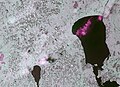
  • Thunderstorms over Estonia. False colour RGB image of VV-, VH- and VV+VH-polarisation backscatter.
    Thunderstorms over Estonia. False colour RGB image of VV-, VH- and VV+VH-polarisation backscatter.
  • Lake Success region, California. False colour RGB image of scans from two different dates.
    Lake Success region, California. False colour RGB image of scans from two different dates.
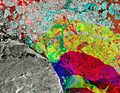
  • Ice movement in Alert, Canada. False colour RGB image of scans from three different months.
    Ice movement in Alert, Canada. False colour RGB image of scans from three different months.
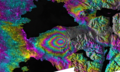
  • InSAR image displaying the ground deformation after the eruption of Calbuco volcano in Chile.
    InSAR image displaying the ground deformation after the eruption of Calbuco volcano in Chile.
  • Interferometry reveals a crack in the Larsen Ice Shelf, Antarctica.
    Interferometry reveals a crack in the Larsen Ice Shelf, Antarctica.
  • Sentinel-1 captured this radar image over French Guiana – home to Europe’s Spaceport in Kourou, where ESA's Biomass mission was being prepared for liftoff onboard a Vega-C rocket in 2025.
    Sentinel-1 captured this radar image over French Guiana – home to Europe’s Spaceport in Kourou, where ESA's Biomass mission was being prepared for liftoff onboard a Vega-C rocket in 2025.
  • A map showing ice flow speed on the Antarctic Peninsula created from Sentinel-1A data.
    A map showing ice flow speed on the Antarctic Peninsula created from Sentinel-1A data.
  • A composite of Ireland's land cover derived from Sentinel-1A data.
    A composite of Ireland's land cover derived from Sentinel-1A data.
  • The first data strip acquired by Sentinel-1B over the Barents Sea. The Svalbard archipelago is visible on the left side.
    The first data strip acquired by Sentinel-1B over the Barents Sea. The Svalbard archipelago is visible on the left side.

References

[edit]
  1. ^ "Sentinel 1". Earth Online. European Space Agency. Archived from the original on 2 March 2014. Retrieved 17 August 2014.
  2. ^ "Sentinel 1 Datasheet" (PDF). ESA. August 2013. Retrieved 17 August 2014.
  3. ^ a b c "Earth Online – Sentinel 1". European Space Agency. Archived from the original on 2 March 2014. Retrieved 3 April 2014.
  4. ^ "Sentinel-1". Sentinel Online. European Space Agency. Archived from the original on 22 March 2021. Retrieved 21 March 2018.
  5. ^ "Mission ends for Copernicus Sentinel-1B satellite". The European Space Agency.
  6. ^ "Sentinel-1C". University of Twente.
  7. ^ "Sentinel-1C demonstrates power to map land deformation". www.esa.int. Retrieved 2025-04-06.
  8. ^ a b Parsonson, Andrew (2025-11-04). "Arianespace Launches Sentinel-1D Aboard Ariane 6 Rocket". European Spaceflight. Retrieved 2025-11-04.
  9. ^ "Sentinel-1 D Satellite Mission Summary". CEOS Database. Retrieved 17 August 2025.
  10. ^ We wish you well, fellow Sentinel!
  11. ^ "Soyuz overview". Arianespace. Retrieved 21 March 2018.
  12. ^ Foust, Jeff (18 January 2022). "ESA considering moving up radar satellite launch after Sentinel-1B malfunction". SpaceNews. Retrieved 19 January 2022.
  13. ^ "Oppdraget over for radarsatellitten Sentinel-1B" [Mission over for the Sentinel-1B radar satellite]. Norwegian Space Agency (in Norwegian). 12 August 2022. Archived from the original on 13 August 2022. Retrieved 14 September 2022.
  14. ^ Sentinel-1C
  15. ^ a b c d Attema, Evert; et al. (August 2007). "Sentinel-1: The Radar Mission for GMES Operational Land and Sea Services" (PDF). Bulletin. 131: 10–17. Bibcode:2007ESABu.131...10A.
  16. ^ "Sentinel-1B successfully passivated". Sentinel Online. 2024-09-27. Retrieved 2025-09-04.
  17. ^ a b "Thales Alenia Inks Deal To Build 2 More Sentinel Satellites for ESA".
  18. ^ Foust, Jeff (12 January 2024). "Europe considers launching Copernicus satellite on Falcon 9". SpaceNews. Retrieved 19 June 2024.
  19. ^ We wish you well, fellow Sentinel!
  20. ^ JOSEPH-GABRIEL, Daphné (2025-10-06). "Arianespace to launch EU's Copernicus Sentinel-1D satellite on November 4, 2025, with Ariane 6". Newsroom Arianespace. Retrieved 2025-10-06.
  21. ^ a b "Sentinel-1A Arrives at Launch Site in French Guiana". Thales Group. 24 February 2014. Retrieved 15 March 2018.
  22. ^ "Sentinel-1: Instrument Payload". Sentinel Online. European Space Agency. Retrieved 7 March 2017.
  23. ^ "User Guides - Sentinel-1 SAR - Extra Wide Swath - Sentinel Online". Sentinel Online. Retrieved 2023-04-26.[permanent dead link]
  24. ^ a b "Sentinel-1 - ESA EO Missions - Earth Online - ESA". earth.esa.int. Retrieved 2020-03-05.
  25. ^ "Sentinel-1 - Data Distribution Schedule - Missions - Sentinel Online". sentinel.esa.int. Retrieved 2020-03-05.
  26. ^ a b "User Guides - Sentinel-1 SAR - Acquisition Modes". Sentinel Online. European Space Agency. Retrieved 12 March 2018.
  27. ^ "Sentinel 1 Data Access and Products". European Space Agency. March 2015. Retrieved 11 March 2018.
  28. ^ Lievens, H.; Reichle, R. H.; Liu, Q.; De Lannoy, G. J. M.; Dunbar, R. S.; Kim, S. B.; Das, N. N.; Cosh, M.; Walker, J. P. (2017-06-27). "Joint Sentinel-1 and SMAP data assimilation to improve soil moisture estimates". Geophysical Research Letters. 44 (12): 6145–6153. Bibcode:2017GeoRL..44.6145L. doi:10.1002/2017gl073904. ISSN 0094-8276. PMC 5896568. PMID 29657343.
  29. ^ "User Guides - Sentinel-1 SAR - Applications". Sentinel Online. European Space Agency. Retrieved 22 March 2018.
  30. ^ Cian, Fabio; Blasco, José Manuel Delgado; Carrera, Lorenzo (March 2019). "Sentinel-1 for Monitoring Land Subsidence of Coastal Cities in Africa Using PSInSAR: A Methodology Based on the Integration of SNAP and StaMPS". Geosciences. 9 (3): 124. Bibcode:2019Geosc...9..124C. doi:10.3390/geosciences9030124.
  31. ^ Amos, Jonathan (2 September 2014). "Sentinel system pictures Napa quake". BBC News. Retrieved 2 September 2014.

External links

[edit]
Wikimedia Commons has media related to Sentinel-1.
  • Sentinel-1 Archived 2021-03-22 at the Wayback Machine at ESA's Sentinel Online
  • Sentinel-1 at ESA's Earth Online
  • Sentinel-1 at ESA's Observing the Earth
  • Sentinel-1 Scientific Data Hub by ESA
  • Sentinel-1 fact sheet Archived 2018-04-13 at the Wayback Machine by the European Union
  • Copernicus Programme
  • Copernicus Dataspace: visualize and download data from Sentinel-1 and other ESA satellites.
  • v
  • t
  • e
Copernicus Programme
Sentinel
satellites
Classes
  • Sentinel-1
  • Sentinel-2
  • Sentinel-3
  • Sentinel-4
  • Sentinel-5
  • Sentinel-6
  • CO2M (Sentinel-7)
Launches
  • Sentinel-1A (Apr 2014)
  • Sentinel-2A (Jun 2015)
  • Sentinel-3A (Feb 2016)
  • Sentinel-1B (Apr 2016)
  • Sentinel-2B (Mar 2017)
  • Sentinel-5P (Oct 2017)
  • Sentinel-3B (Apr 2018)
  • Sentinel-6A (Nov 2020)
  • Sentinel-2C (Sep 2024)
  • Sentinel-1C (Dec 2024)
  • Sentinel-4A (Jul 2025)
  • Sentinel-5A (Aug 2025)
  • Sentinel-1D (Nov 2025)
  • Sentinel-6B (Nov 2025)
Contributing
missions
SAR
  • ERS-2
  • Envisat
  • COSMO-SkyMed
  • Radarsat-2
  • TerraSAR-X
  • TanDEM-X
  • Paz
Optical
  • ERS-2
  • Envisat
  • Deimos-2
  • Disaster Monitoring Constellation
  • EnMAP
  • HiROS
  • HiVE
  • Hyperfield
  • Pléiades
  • Prisma
  • Proba-V
  • RapidEye
  • Ingenio
  • SPOT
  • VENµS
Altimetry
  • Envisat
  • CryoSat
  • Ocean Surface Topography Mission
  • SARAL
Atmospheric
  • CALIPSO
  • Envisat
  • Merlin
  • Meteosat Second Generation
  • MetOp
  • v
  • t
  • e
European Space Agency
Space Centres
  • Guiana
  • Esrange
Launch vehicles
  • Ariane 6
  • Vega C
Facilities
  • Space Operations Centre
  • Space Research and Technology Centre
  • Centre for Earth Observation
  • European Astronaut Centre
  • Space Astronomy Centre
  • Space Applications and Telecommunications Centre
  • Concurrent Design Facility
  • Space Telescope European Coordinating Facility
  • Optical Ground Station
  • Flyeye
  • Phi Lab
  • Near-Earth Object Coordination Centre
Communications
  • ESTRACK
  • European Data Relay System
Programmes
  • Science Programme
    • Cosmic Vision
  • Terrae Novae
    • ExoMars
  • FutureEO
  • FLPP
    • PRIDE
  • Space Safety Programme
  • Copernicus
Predecessors
  • European Launcher Development Organisation
  • European Space Research Organisation
Related topics
  • Arianespace
  • Avio
  • ESA TV
  • EUMETSAT
  • EUSPA
  • EU Space Programme
Projects and missions
Science
Astronomy
& cosmology
  • Cos-B (1975–1982)
  • IUE (1978–1996)
  • EXOSAT (1983–1986)
  • Hipparcos (1989–1993)
  • HST (1990–present)
  • Eureca (1992–1993)
  • ISO (1995–1998)
  • XMM-Newton (1999–present)
  • INTEGRAL (2002–2025)
  • CoRoT (2006–2013)
  • Planck (2009–2013)
  • Herschel (2009–2013)
  • Gaia (2013–2025)
  • CHEOPS (2019–present)
  • JWST (2021–present)
  • Euclid (2023–present)
  • PLATO (2026)
  • ARIEL (2031)
  • ARRAKIHS (2030s)
  • Athena (2035)
  • LISA (2035)
Earth
observation
  • Meteosat First Generation (1977–1997)
  • ERS-1 (1991–2000)
  • ERS-2 (1995–2011)
  • Meteosat Second Generation (2002–present)
  • Envisat (2002–2012)
  • Double Star (2003–2007)
  • MetOp (2006–present)
  • GOCE (2009–2013)
  • SMOS (2009–present)
  • CryoSat-2 (2010–present)
  • Swarm (2013–present)
  • Copernicus (2014–present)
  • Sentinel-1 (2014–present)
    • 1A
    • 1B
    • 1C
    • 1D
  • Sentinel-2 (2015–present)
    • 2A
    • 2B
    • 2C
  • Sentinel-3 (2016–present)
    • 3A
    • 3B
  • Sentinel-5 Precursor (2017–present)
  • ADM-Aeolus (2018–2023)
  • Phi-Sat-1 (2020–present)
  • Sentinel-6 Michael Freilich (2020–present)
  • Meteosat Third Generation (2022–present)
    • MTG-I1 (2022–present)
    • MTG-S1/Sentinel-4A (2025–present)
    • MTG-I2 (2026)
  • Phi-Sat-2 (2024–present)
  • Hyperfield (2024–present)
  • EarthCARE (2024–present)
  • HiVE (2025–present)
  • IRIDE (2025–present)
  • Biomass (2025–present)
  • MetOp-SG (2025–present)
    • MetOp-SG A1/Sentinel-5A (2025–present)
    • MetOp-SG B1 (2026)
  • Sentinel-6B (2025–present)
  • HydroGNSS (2025–present)
  • SMILE (2026)
  • Atlantic Constellation (2026)
  • ALTIUS (2026)
  • FLEX (2026)
  • FORUM (2027)
  • SWING (2027)
  • CO2M (Sentinel-7) (2027)
  • NanoMagSat (2027)
  • Arctic Ocean Surveillance (2028)
  • Tango (2028)
  • EPS-Sterna (2029)
  • TRUTHS (2030)
  • Wivern (2032)
Planetary
science
  • Giotto (1985–1992)
  • Huygens (1997–2005)
  • SMART-1 (2003–2006)
  • Mars Express (2003–present)
  • Rosetta / Philae (2004–2016)
  • Venus Express (2005–2014)
  • Trace Gas Orbiter (2016–present)
  • BepiColombo (2018–present)
  • Jupiter Icy Moons Explorer (2023–present)
  • Hera (2024–present)
  • MoonLIGHT (2026)
  • M-Argo (2027)
  • LUMIO (2027)
  • Ramses (2028)
  • Rosalind Franklin rover (2028)
  • Comet Interceptor (2028)
  • Máni (2029)
  • Argonaut (2030)
  • EnVision (2031)
Solar
physics
  • ISEE-2 (1977–1987)
  • Ulysses (1990–2009)
  • SOHO (1995–present)
  • Cluster II (2000–2024)
  • Solar Orbiter (2020–present)
  • Vigil (2031)
Human
spaceflight
  • European Astronaut Corps (1983–present)
  • Spacelab (1983–1998)
  • Euromir (1994–1995)
  • ISS contributions
    • ELIPS (2001–present)
    • Columbus (2008–present)
    • Columbus External Payload Facility (2008–present)
    • Automated Transfer Vehicle (2008–2015)
    • Cupola (2010-present)
    • Bartolomeo (2020-present)
    • European Robotic Arm (2021-present)
  • Artemis program
    • European Service Module (2022-present)
    • Lunar I-Hab (2028)
    • ESPRIT (2030)
  • LEO Cargo Return Service (2028)
Telecommunications
and navigation
  • GEOS 2 (1978)
  • Olympus-1 (1989–1993)
  • Artemis (2001–2017)
  • EGNOS (2005–present)
  • GIOVE-A (2005–present)
  • GIOVE-B (2008–present)
  • HYLAS-1 (2010–present)
  • Galileo IOV (2011–present)
  • Galileo FOC (2014–present)
  • European Data Relay System (2016–present)
  • ESAIL (2020–2025)
  • Spainsat NG (2025–present)
  • Celeste (LEO-PNT) (2026)
  • Lunar Pathfinder (2026)
  • IRIS² (2027)
  • Moonlight Programme (2028)
  • Electra (future)
Technology
demonstration
and education
  • CAT-1 (1979)
  • PROBA-1 (2001–present)
  • YES2 (2007)
  • PROBA-2 (2009–present)
  • PROBA-V (2013–present)
  • ESTCube-1 (2013–2015)
  • TechDemoSat-1 (2014–2019)
  • GOMX-3 (2015–2016)
  • LISA Pathfinder (2015–2017)
  • e-st@r-II (2016–2024)
  • GOMX-4B (2018–2024)
  • OPS-SAT (2019–2024)
  • SIMBA (2020–2024)
  • PICASSO (2020–2024)
  • RadCube (2021–2024)
  • Sunstorm (2021–2024)
  • PRETTY (2023–2024)
  • MANTIS (2023–2025)
  • EIRSAT-1 (2023–present)
  • MicroHETsat (2023–present)
  • PROBA-V CubeSat Companion (2023–present)
  • JoeySat (2023–present)
  • Intuition-1 (2023–present)
  • YPSat-1 (2024)
  • PROBA-3 (2024–present)
  • ISTSat-1 (2024–present)
  • AIX (2025–present)
  • FOREST-3 (2025–present)
  • DUTHSat-2 (2025–present)
  • GENA-OT (2025–present)
  • MICE-1 (2025–present)
  • PHASMA (2025–present)
  • CubeSpec (2026)
  • GOMX-5 (2026)
  • HENON (2026)
  • ΣYNDEO‑3 (2026)
  • Eagle-1 (2026)
  • e.Inspector (2027)
  • VULCAIN (2027)
  • Draco (2027)
  • ClearSpace-1 (2028)
  • SROC (2028)
Launch
and reentry
  • Ariane rocket family (1979–present)
  • ARD (1998)
  • Vega (2012–2024)
  • IXV (2015)
  • European Launcher Challenge (2025–present)
  • Themis (2026)
  • Space Rider (2028)
Proposed
  • L4
  • Ariane Next
  • LightShip
  • MAGPIE
  • Moonraker
  • NEOMIR
  • NGGM
  • Solaris
  • Satis
  • THESEUS
  • VMMO
Cancelled
  • AIDA
  • Ariane 5 ME
  • Aurora programme
  • Calathus Mission
  • Ceres Polar Lander
  • Columbus Man-Tended Free Flyer
  • CSTS
  • Darwin Mission
  • Don Quijote
  • e.Deorbit
  • EChO
  • Eddington
  • EXPERT
  • HERACLES
  • Hermes
  • Hopper
  • LOFT
  • Lunar Lander
  • Marco Polo
  • MarcoPolo-R
  • NASA-ESA Mars Sample Return
  • ODINUS
  • Phootprint
  • SKIM
  • SPICA
  • STE-QUEST
Failed
  • Cluster
  • CryoSat-1
  • GEOS 1
  • QARMAN
  • Schiaparelli EDM
Future missions in italics
  • Category
  • Commons
  • Wikinews
  • WikiProject
Retrieved from "https://teknopedia.ac.id/w/index.php?title=Sentinel-1&oldid=1336303895"
Categories:
  • Copernicus Programme
  • Earth observation satellites of the European Space Agency
  • Space synthetic aperture radar
  • Earth imaging satellites
Hidden categories:
  • CS1 Norwegian-language sources (no)
  • All articles with dead external links
  • Articles with dead external links from December 2024
  • Articles with permanently dead external links
  • Articles with short description
  • Short description is different from Wikidata
  • Wikipedia articles that are too technical from May 2024
  • All articles that are too technical
  • Commons category link from Wikidata
  • Webarchive template wayback links

  • indonesia
  • Polski
  • العربية
  • Deutsch
  • English
  • Español
  • Français
  • Italiano
  • مصرى
  • Nederlands
  • 日本語
  • Português
  • Sinugboanong Binisaya
  • Svenska
  • Українська
  • Tiếng Việt
  • Winaray
  • 中文
  • Русский
Sunting pranala
url url url url url url url url url url url url url url url url url url url url url url url url url url url url url url url url url url url url url url url url url url url url url url url url url url url url url url url url url url url url url url url url url url url url url url url url url url url url url url url url url url url url url url url url url url url url url url url url url url url url url url url url url url url url url url url url url url url url url url url url url url url url url url url url url url url url url url url url url url url url url url url url url url url url url url url url url url url url url url url url url url url url url url url url url url url url url url url url url url url url url url url url url url url url url url url url url url url url url url url url url url url url url url url url url url url url url url url url url url url url url url url url url url url url url url url url url url url url url url url url url url url url url url url url url url url url url url url url url url url url url url url url url url url url url url url url url url url url url url url url url url url url url url url url url url url url url url url url url url url url url url url url url url url url url url url url url url url url url url url url url url url url url url url url url url url url url url url url url url url url url url url url url url url url url url url url url url url url url url url url url url url url url url url url url url url url url url url url url url url url url url url url url url url url url url url url url url url url url url url url url url url url url url url url url url url url url url url url url url url url url url url url url url url url url url url url url url url url url url url url url url url url url url url url url url url url url url url url url url url url url url url url url url url url url url url url url url url url url url url url url url url url url url url url url url url url url url url url url url url url url url url url url url url url url url url url url url url url url url url url url url url url url url url url url url url url url url url url url url url url url url url url url url url url url url url url url url url url url url url url url url url url url url url url url url url url url url url url url url url url url url url url url url url url url url url url url url url url url url url url url url url url url url url url url url url url url url url url url url url url url url url url url url url url url url url url url url url url url url url url url url url url url url url url url url url url url url url url url url url url url url url url url url url url url url url url url url url url url url url url url url url url url url url url url url url url url url url url url url url url url url url url url url url url url url url url url url url url url url url url url url url url url url url url url url url url url url url url url url url url url url url url url url url url url url url url url url url url url url url url url url url url url url url url url url url url url url url url url url url url url url url url url url url url url url url url url url url url url url url url url url url url url url url url url url url url url url url url url url url url url url url url url url url url url url url url url url url url url url url url url url url url url url url url url url url url url url url url url url url url url url url url url url url url url url url url url url url url url url url url url url url url url url url url url url url url url url url url url url url url url url url url url url url url url url url url url url url url url url url url url url url url url url url url url url url url url url url url url url url url url url url url url url url url url url url url url url url url url url url url url url url url url url url url url url url url url url url url url url url url url url url url url url url url url url url url url url url url url url url url url url url url url url url url url url url url url url url url url url url url url url url url url url url url url url url url url url url url url url url url url url url url url url url url url url url url url url url url url url url url url url url url url url url url url url url url url url url url url url url url url url url url url url url url url url url url url url url url url url url url url url url url url url url url url url url url url url url url url url url url url url url url url url url url url url url url url url url url url url url url url url url url url url url url url url url url url url url url url url url url url url url url url url url url url url url url url url url url url url url url url url url url url url url url url url url url url url url url url url url url url url url url url url url url url url url url url url url url url url url url url url url url url url url url url url url url url url url url url url url url url url url url url url url url url url url url url url url url url url url url url url url url url url url url url url url url url url url url url url url url url url url url url url url url url url url url url url url url url url url url url url url url url url url url url url url url url url url url url url url url url url url url url url url url url url url url url url url url url url url url url url url url url url url url url url url url url url url url url url url url url url url url url url url url url url url url url url url url url url url url url url url url url url url url url url url url url url url url url url url url url url url url url url url url url url url url url url url url url url url url url url url url url url url url url url url url url url url url url url url url url url url url url url url url url url url url url url url url url url url url url url url url url url url url url url url url url url url url url url url url url url url url url url url url url url url url url url url url url url url url url url url url url url url url url url url url url url url url url url url url url url url url url url url url url url url url url url url url url url url url url url url url url url url url url url url url url url url url url url url url url url url url url url url url url url url url url url url url url url url url url url url url url url url url url url url url url url url url url url url url url url url url url url url url url url url url url url url url url url url url url url url url url url url url url url url url url url url url url url url url url url url url url url url url url url url url url url url url url url url url url url url url url url url url url url url url url url url url url url url url url url url url url url url url url url url url url url url url url url url url url url url url url url url url url url url url url url url url url url url url url url url url url url url url url url url url url url url url url url url url url url url url url url url url url url url url url url url url url url url url url url url url url url url url url url url url url url url url url url url url url url url url url url url url url url url url url url url url url url url url url url url url url url url url url url url url url url url url url url url url url url url url url url url url url url url url url url url url url url url url url url url url url url url url url url url url url url url url url url url url url url url url url url url url url url url url url url url url url url url url url url url url url url url url url url url url url url url url url url url url url url url url url url url url url url url url url url url url url url url url url url url url url url url url url url url url url url url url url url url url url url url url url url url url url url url url url url url url url url url url url url url url url url url url url url url url url url url url url url url url url url url url url url url url url url url url url url url url url url url url url url url url url url url url url url url url url url url url url url url url url url url url url url url url url url url url url url url url url url url url url url url url url url url url url url url url url url url url url url url url url url url url url url url url url url url url url url url url url url url url url url url url url url url url url url url url url url url url url url url url url url url url url url url url url url url url url url url url url url url url url url url url url url url url url url url url url url url url url url url url url url url url url url url url url url url url url url url url url url url url url url url url url url url url url url url url url url url url url url url url url url url url url url url url url url url url url url url url url url url url url url url url url url url url url url url url url url url url url url url url url url url url url url url url url url url url url url url url url url url url url url url url url url url url url url url url url url url url url url url url url url url url url url url url url url url url url url url url url url url url url url url url url url url url url url url url url url url url url url url url url url url url url url url url url url url url url url url url url url url url url url url url url url url url url url url url url url url url url url url url url url url url url url url url url url url url url url url url url url url url url url url url url url url url url url url url url url url url url url url url url url url url url url url url url url url url url url url url url url url url url url url url url url url url url url url url url url url url url url url url url url url url
Pusat Layanan

UNIVERSITAS TEKNOKRAT INDONESIA | ASEAN's Best Private University
Jl. ZA. Pagar Alam No.9 -11, Labuhan Ratu, Kec. Kedaton, Kota Bandar Lampung, Lampung 35132
Phone: (0721) 702022
Email: pmb@teknokrat.ac.id