

| The Shami Statue | |
|---|---|
,_Parthian_School_(250_BC-226_AD)_National_Museum_of_Iran,_Tehran,_Iran.jpg) | |
| Material | Bronze |
| Size | 1.94 m high |
| Created | 50 BC-150 AD |
| Discovered | Shami village, Khūzestān province, Iran, 1935 |
| Present location | National Museum of Iran |
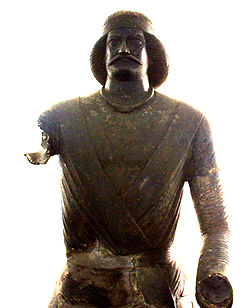
The Shami Statue is the most important and iconic surviving work from the Parthian Empire,[1] housed at the National Museum of Iran. The statue is almost completely preserved and depicts a Parthian Prince or nobleman.[2] It was found by local peasants in Shami village, Khūzestān Province, when workers encountered the bronze statue while digging foundations for construction in 1935.[3]
There is a long-standing hypothesis that the statue depicts the Parthian general Surena, but scholars have not reached consensus, and this identification remains speculative.[4][5][6] Some scholars believe that the statue was originally made in Palmyra and later transferred to Susa,[7][8] while others suggest that it was made in Susa.[9]
Details and clothing
The character is dressed in Parthian elite clothing, with a commanding posture — appropriate for a high-ranking figure. The hairstyle and clothing resemble those of Parthian horsemen. He is dressed in a long-sleeved coat with a V-shaped collar, and wide, long trousers with a narrow waistband — garments characteristic of Parthian attire. He is wearing a belt with metal plaques, and carrying a dagger at the hip.
The statue is 1.94 m high. The man depicted is shown frontally. He bears a short beard and a heavy moustache, while his hair is long and covers the ears. Around the head he wears a wide ribbon.
The left hand and the entire right arm are missing. However, a bronze arm was later found in Shami, which might belong to the statue. It is possible that the head and the body of the statue were crafted separately and put together in Shami, as the head is too small and made from a different type of bronze as to the rest of the statue.
Gallery
-
 Then President Ali Khamenei reopening the National Museum of Iran in 1996, and visiting the statue.
 -
![The Statue's replica on display at an exhibition by the National Museum of Iran in Spain.[10]](//upload.wikimedia.org/wikipedia/commons/thumb/c/cc/Estatua_de_un_pr%C3%ADncipe_parto_-_Museo_Nacional_de_Ir%C3%A1n_inv._n%C2%B02401_02.jpg/250px-Estatua_de_un_pr%C3%ADncipe_parto_-_Museo_Nacional_de_Ir%C3%A1n_inv._n%C2%B02401_02.jpg)
-

-

-

-

-

-

-

-

-
-


![The Statue's replica on display at an exhibition by the National Museum of Iran in Spain.[10]](/wiki/File:Estatua_de_un_pr%C3%ADncipe_parto_-_Museo_Nacional_de_Ir%C3%A1n_inv._n%C2%B02401_02.jpg)


.jpg)
.jpg)
_Statue_in_Iran-e_Bastan_Museum.jpg)
.JPG)


.JPG)
References
- ^ "Wayback Machine" (PDF). jinm.irannationalmuseum.ir. Archived (PDF) from the original on 2023-12-22. Retrieved 2025-12-02.
{{cite web}}: Cite uses generic title (help) - ^ Mathiesen: Sculpture in the Parthian Empire, p. 167, n. 11 (list of various datings)
- ^ Messina, Vito; Foietta, Enrico (2025-01-01). Shami, Kal-e Chendar. Research of the Iranian-Italian Joint Expedition in Khuzestan.
- ^ "معمای مرد باستانی ایران/ سورنا یا پادشاه؟". ایمنا (in Persian). 2021-09-04. Retrieved 2025-12-02.
- ^ "مجسمه سورنا متعلق به سردارد بزرگ ایرانی نیست!" (in Persian). 2024-03-10. Retrieved 2025-12-02.
- ^ "داستان «سورنا» یا «سورن پَهلَو» | پایگاه خبری تحلیلی انصاف نیوز". انصاف نیوز (in Persian). 2022-04-03. Retrieved 2025-12-02.
- ^ Hans Erik Mathiesen: Stylistic Trends in Late Parthian Sculpture, A Survey, In: Analecta Romana Institut Danici, 17–18 (1989), p. 120
- ^ R.R.R. Smith: Hellenistic Royal Portraits, Oxford, 1988, p. 102
- ^ D. Schlumberger: L'Orient Hellenise, Paris 1970, p. 156-157
- ^ "Major exhibit to stage Iran's history, civilization in Spain". Tehran Times. 2019-01-26. Retrieved 2025-12-02.
Literature
- Vogelsang-Eastwood, Gillian (2000). "The Clothing of the 'Shami Prince'". Persica. 16 (31–47): 31–47. doi:10.2143/PERS.16.0.510.
- Hans Erik Mathiesen 1992,Sculpture in the Parthian Empire, Aarhus 1992 ISBN 87-7288-311-1, p. 165-167
- Curtis, Vesta Sarkhosh., 1993, "A Parthian statuette from Susa and the bronze statue from Shami." Iran 31, no. 1: 63-69.
- Lindstroem, G., 2021, The Portrait of a Hellenistic Ruler and Other Bronze Sculptures from Kal-e Chendar/Shami. Results of the 2015 and 2016 studies in the National Museum of Iran, Journal of Iran National Museum 2(1): 177-196, doi:10.22034/JINM.2021.252917
External links

- Trudy S. Kawami, “SHAMI STATUE,” Encyclopædia Iranica, online edition, 2016, available at http://www.iranicaonline.org/articles/shami-statue (accessed on 20 October 2016).


