Epstein Files Full PDF

CLICK HERE
Technopedia Center
PMB University Brochure
Faculty of Engineering and Computer Science
S1 Informatics S1 Information Systems S1 Information Technology S1 Computer Engineering S1 Electrical Engineering S1 Civil Engineering

faculty of Economics and Business
S1 Management S1 Accountancy

Faculty of Letters and Educational Sciences
S1 English literature S1 English language education S1 Mathematics education S1 Sports Education
teknopedia

  • Registerasi
  • Brosur UTI
  • Kip Scholarship Information
  • Performance
Flag Counter
  1. World Encyclopedia
  2. Absolute continuity - Wikipedia
Absolute continuity - Wikipedia
From Wikipedia, the free encyclopedia
(Redirected from Absolutely continuous function)
Form of continuity for functions

In calculus and real analysis, absolute continuity is a smoothness property of functions that is stronger than continuity and uniform continuity. The notion of absolute continuity allows one to obtain generalizations of the relationship between the two central operations of calculus—differentiation and integration. This relationship is commonly characterized (by the fundamental theorem of calculus) in the framework of Riemann integration, but with absolute continuity it may be formulated in terms of Lebesgue integration. For real-valued functions on the real line, two interrelated notions appear: absolute continuity of functions and absolute continuity of measures. These two notions are generalized in different directions. The usual derivative of a function is related to the Radon–Nikodym derivative, or density, of a measure. We have the following chains of inclusions for functions over a compact subset of the real line:

absolutely continuous ⊆ uniformly continuous = {\displaystyle =} {\displaystyle =} continuous

and, for a compact interval,

continuously differentiable ⊆ Lipschitz continuous ⊆ absolutely continuous ⊆ bounded variation ⊆ differentiable almost everywhere.

Absolute continuity of functions

[edit]

A continuous function fails to be absolutely continuous if it fails to be uniformly continuous, which can happen if the domain of the function is not compact – examples are tan(x) over [0, π/2), x2 over the entire real line, and sin(1/x) over (0, 1]. But a continuous function f can fail to be absolutely continuous even on a compact interval. It may not be "differentiable almost everywhere" (like the Weierstrass function, which is not differentiable anywhere). Or it may be differentiable almost everywhere and its derivative f ′ may be Lebesgue integrable, but the integral of f ′ differs from the increment of f (how much f changes over an interval). This happens for example with the Cantor function.

Definition

[edit]

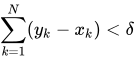
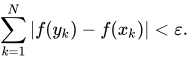
Let I {\displaystyle I} {\displaystyle I} be an interval in the real line R {\displaystyle \mathbb {R} } {\displaystyle \mathbb {R} }. A function f : I → R {\displaystyle f\colon I\to \mathbb {R} } {\displaystyle f\colon I\to \mathbb {R} } is absolutely continuous on I {\displaystyle I} {\displaystyle I} if for every positive number ε {\displaystyle \varepsilon } {\displaystyle \varepsilon }, there is a positive number δ {\displaystyle \delta } {\displaystyle \delta } such that whenever a finite sequence of pairwise disjoint sub-intervals ( x k , y k ) {\displaystyle (x_{k},y_{k})} {\displaystyle (x_{k},y_{k})} of I {\displaystyle I} {\displaystyle I} with x k < y k {\displaystyle x_{k}<y_{k}} {\displaystyle x_{k}<y_{k}} satisfies[1]

∑ k = 1 N ( y k − x k ) < δ {\displaystyle \sum _{k=1}^{N}(y_{k}-x_{k})<\delta } {\displaystyle \sum _{k=1}^{N}(y_{k}-x_{k})<\delta }

then

∑ k = 1 N | f ( y k ) − f ( x k ) | < ε . {\displaystyle \sum _{k=1}^{N}|f(y_{k})-f(x_{k})|<\varepsilon .} {\displaystyle \sum _{k=1}^{N}|f(y_{k})-f(x_{k})|<\varepsilon .}

The collection of all absolutely continuous functions on I {\displaystyle I} {\displaystyle I} is denoted AC ⁡ ( I ) {\displaystyle \operatorname {AC} (I)} {\displaystyle \operatorname {AC} (I)}.

Equivalent definitions

[edit]

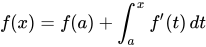
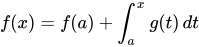
The following conditions on a real-valued function f on a compact interval [a,b] are equivalent:[2]

  1. f is absolutely continuous;
  2. f has a derivative f′ almost everywhere, the derivative is Lebesgue integrable, and f ( x ) = f ( a ) + ∫ a x f ′ ( t ) d t {\displaystyle f(x)=f(a)+\int _{a}^{x}f'(t)\,dt} {\displaystyle f(x)=f(a)+\int _{a}^{x}f'(t)\,dt} for all x on [a,b];
  3. there exists a Lebesgue integrable function g on [a,b] such that f ( x ) = f ( a ) + ∫ a x g ( t ) d t {\displaystyle f(x)=f(a)+\int _{a}^{x}g(t)\,dt} {\displaystyle f(x)=f(a)+\int _{a}^{x}g(t)\,dt} for all x in [a,b].

If these equivalent conditions are satisfied, then necessarily any function g as in condition 3. satisfies g = f′ almost everywhere.

Equivalence between (1) and (3) is known as the fundamental theorem of Lebesgue integral calculus, due to Lebesgue.[3]

For an equivalent definition in terms of measures see the section Relation between the two notions of absolute continuity.

Properties

[edit]
  • The sum and difference of two absolutely continuous functions are also absolutely continuous. If the two functions are defined on a bounded closed interval, then their product is also absolutely continuous.[4]
  • If an absolutely continuous function f is defined on a bounded closed interval and is nowhere zero then 1/f is absolutely continuous.[5]
  • Every absolutely continuous function (over a compact interval) is uniformly continuous and, therefore, continuous. Every (globally) Lipschitz-continuous function is absolutely continuous.[6]
  • If f: [a,b] → R is absolutely continuous, then it is weakly differentiable; conversely if f: [a,b] → R is weakly differentiable, then it coincides almost everywhere with an absolutely continuous function [7]; this provides a characterization of Sobolev spaces on intervals of the real line.
  • If f: [a,b] → R is absolutely continuous, then it is of bounded variation on [a,b].[8]
  • If f: [a,b] → R is absolutely continuous, then it can be written as the difference of two monotonic nondecreasing absolutely continuous functions on [a,b].
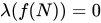
  • If f: [a,b] → R is absolutely continuous, then it has the Luzin N property (that is, for any N ⊆ [ a , b ] {\displaystyle N\subseteq [a,b]} {\displaystyle N\subseteq [a,b]} such that λ ( N ) = 0 {\displaystyle \lambda (N)=0} {\displaystyle \lambda (N)=0}, it holds that λ ( f ( N ) ) = 0 {\displaystyle \lambda (f(N))=0} {\displaystyle \lambda (f(N))=0}, where λ {\displaystyle \lambda } {\displaystyle \lambda } stands for the Lebesgue measure on R).
  • f: I → R is absolutely continuous if and only if it is continuous, is of bounded variation and has the Luzin N property. This statement is also known as the Banach-Zareckiǐ theorem.[9]
  • If f: I → R is absolutely continuous and g: R → R is globally Lipschitz-continuous, then the composition g ∘ {\displaystyle \circ } {\displaystyle \circ } f is absolutely continuous. Conversely, for every function g that is not globally Lipschitz continuous there exists an absolutely continuous function f such that g ∘ {\displaystyle \circ } {\displaystyle \circ } f is not absolutely continuous.[10]

Examples

[edit]

The following functions are uniformly continuous but not absolutely continuous:

  • The Cantor function on [0, 1] (it is of bounded variation but not absolutely continuous);
  • The function: f ( x ) = { 0 , if  x = 0 x sin ⁡ ( 1 / x ) , if  x ≠ 0 {\displaystyle f(x)={\begin{cases}0,&{\text{if }}x=0\\x\sin(1/x),&{\text{if }}x\neq 0\end{cases}}} {\displaystyle f(x)={\begin{cases}0,&{\text{if }}x=0\\x\sin(1/x),&{\text{if }}x\neq 0\end{cases}}} on a finite interval containing the origin.
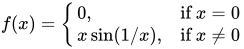
The following functions are absolutely continuous but not α-Hölder continuous:

  • The function f(x) = xβ on [0, c], for any 0 < β < α < 1

The following functions are absolutely continuous and α-Hölder continuous but not Lipschitz continuous:

  • The function f(x) = √x on [0, c], for α ≤ 1/2.

Generalizations

[edit]

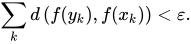
Let (X, d) be a metric space and let I be an interval in the real line R. A function f: I → X is absolutely continuous on I if for every positive number ε {\displaystyle \varepsilon } {\displaystyle \varepsilon }, there is a positive number δ {\displaystyle \delta } {\displaystyle \delta } such that whenever a finite sequence of pairwise disjoint sub-intervals [xk, yk] of I satisfies:
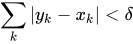
∑ k | y k − x k | < δ {\displaystyle \sum _{k}\left|y_{k}-x_{k}\right|<\delta } {\displaystyle \sum _{k}\left|y_{k}-x_{k}\right|<\delta }

then:

∑ k d ( f ( y k ) , f ( x k ) ) < ε . {\displaystyle \sum _{k}d\left(f(y_{k}),f(x_{k})\right)<\varepsilon .} {\displaystyle \sum _{k}d\left(f(y_{k}),f(x_{k})\right)<\varepsilon .}

The collection of all absolutely continuous functions from I into X is denoted AC(I; X).

A further generalization is the space ACp(I; X) of curves f: I → X such that:[11]

d ( f ( s ) , f ( t ) ) ≤ ∫ s t m ( τ ) d τ  for all  [ s , t ] ⊆ I {\displaystyle d\left(f(s),f(t)\right)\leq \int _{s}^{t}m(\tau )\,d\tau {\text{ for all }}[s,t]\subseteq I} {\displaystyle d\left(f(s),f(t)\right)\leq \int _{s}^{t}m(\tau )\,d\tau {\text{ for all }}[s,t]\subseteq I}

for some m in the Lp space Lp(I).

Properties of these generalizations

[edit]
  • Every absolutely continuous function (over a compact interval) is uniformly continuous and, therefore, continuous. Every Lipschitz-continuous function is absolutely continuous.
  • If f: [a,b] → X is absolutely continuous, then it is of bounded variation on [a,b].
  • For f ∈ ACp(I; X), the metric derivative of f exists for λ-almost all times in I, and the metric derivative is the smallest m ∈ Lp(I; R) such that:[12] d ( f ( s ) , f ( t ) ) ≤ ∫ s t m ( τ ) d τ  for all  [ s , t ] ⊆ I . {\displaystyle d\left(f(s),f(t)\right)\leq \int _{s}^{t}m(\tau )\,d\tau {\text{ for all }}[s,t]\subseteq I.} {\displaystyle d\left(f(s),f(t)\right)\leq \int _{s}^{t}m(\tau )\,d\tau {\text{ for all }}[s,t]\subseteq I.}

Absolute continuity of measures

[edit]

Definition

[edit]

A measure μ {\displaystyle \mu } {\displaystyle \mu } on Borel subsets of the real line is absolutely continuous with respect to the Lebesgue measure λ {\displaystyle \lambda } {\displaystyle \lambda } if for every λ {\displaystyle \lambda } {\displaystyle \lambda }-measurable set A , {\displaystyle A,} {\displaystyle A,} λ ( A ) = 0 {\displaystyle \lambda (A)=0} {\displaystyle \lambda (A)=0} implies μ ( A ) = 0 {\displaystyle \mu (A)=0} {\displaystyle \mu (A)=0}. Equivalently, μ ( A ) > 0 {\displaystyle \mu (A)>0} {\displaystyle \mu (A)>0} implies λ ( A ) > 0 {\displaystyle \lambda (A)>0} {\displaystyle \lambda (A)>0}. This condition is written as μ ≪ λ . {\displaystyle \mu \ll \lambda .} {\displaystyle \mu \ll \lambda .} We say μ {\displaystyle \mu } {\displaystyle \mu } is dominated by λ . {\displaystyle \lambda .} {\displaystyle \lambda .}

In most applications, if a measure on the real line is simply said to be absolutely continuous — without specifying with respect to which other measure it is absolutely continuous — then absolute continuity with respect to the Lebesgue measure is meant.

The same principle holds for measures on Borel subsets of R n , n ≥ 2. {\displaystyle \mathbb {R} ^{n},n\geq 2.} {\displaystyle \mathbb {R} ^{n},n\geq 2.}

Equivalent definitions

[edit]

The following conditions on a finite measure μ {\displaystyle \mu } {\displaystyle \mu } on Borel subsets of the real line are equivalent:[13]

  1. μ {\displaystyle \mu } {\displaystyle \mu } is absolutely continuous;
  2. For every positive number ε {\displaystyle \varepsilon } {\displaystyle \varepsilon } there is a positive number δ > 0 {\displaystyle \delta >0} {\displaystyle \delta >0} such that μ ( A ) < ε {\displaystyle \mu (A)<\varepsilon } {\displaystyle \mu (A)<\varepsilon } for all Borel sets A {\displaystyle A} {\displaystyle A} of Lebesgue measure less than δ ; {\displaystyle \delta ;} {\displaystyle \delta ;}
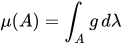
  3. There exists a Lebesgue integrable function g {\displaystyle g} {\displaystyle g} on the real line such that: μ ( A ) = ∫ A g d λ {\displaystyle \mu (A)=\int _{A}g\,d\lambda } {\displaystyle \mu (A)=\int _{A}g\,d\lambda } for all Borel subsets A {\displaystyle A} {\displaystyle A} of the real line.

For an equivalent definition in terms of functions see the section Relation between the two notions of absolute continuity.

Any other function satisfying (3) is equal to g {\displaystyle g} {\displaystyle g} almost everywhere. Such a function is called Radon–Nikodym derivative, or density, of the absolutely continuous measure μ . {\displaystyle \mu .} {\displaystyle \mu .}

Equivalence between (1), (2) and (3) holds also in R n {\displaystyle \mathbb {R} ^{n}} {\displaystyle \mathbb {R} ^{n}} for all n = 1 , 2 , 3 , … . {\displaystyle n=1,2,3,\ldots .} {\displaystyle n=1,2,3,\ldots .}

Thus, the absolutely continuous measures on R n {\displaystyle \mathbb {R} ^{n}} {\displaystyle \mathbb {R} ^{n}} are precisely those that have densities; as a special case, the absolutely continuous probability measures are precisely the ones that have probability density functions.

Generalizations

[edit]

If μ {\displaystyle \mu } {\displaystyle \mu } and ν {\displaystyle \nu } {\displaystyle \nu } are two measures on the same measurable space ( X , A ) , {\displaystyle (X,{\mathcal {A}}),} {\displaystyle (X,{\mathcal {A}}),} μ {\displaystyle \mu } {\displaystyle \mu } is said to be absolutely continuous with respect to ν {\displaystyle \nu } {\displaystyle \nu } if μ ( A ) = 0 {\displaystyle \mu (A)=0} {\displaystyle \mu (A)=0} for every set A {\displaystyle A} {\displaystyle A} for which ν ( A ) = 0. {\displaystyle \nu (A)=0.} {\displaystyle \nu (A)=0.}[14] This is written as " μ ≪ ν {\displaystyle \mu \ll \nu } {\displaystyle \mu \ll \nu }". That is: μ ≪ ν  if and only if   for all  A ∈ A , ( ν ( A ) = 0    implies    μ ( A ) = 0 ) . {\displaystyle \mu \ll \nu \qquad {\text{ if and only if }}\qquad {\text{ for all }}A\in {\mathcal {A}},\quad (\nu (A)=0\ {\text{ implies }}\ \mu (A)=0).} {\displaystyle \mu \ll \nu \qquad {\text{ if and only if }}\qquad {\text{ for all }}A\in {\mathcal {A}},\quad (\nu (A)=0\ {\text{ implies }}\ \mu (A)=0).}

When μ ≪ ν , {\displaystyle \mu \ll \nu ,} {\displaystyle \mu \ll \nu ,} then ν {\displaystyle \nu } {\displaystyle \nu } is said to be dominating μ . {\displaystyle \mu .} {\displaystyle \mu .}

Absolute continuity of measures is reflexive and transitive, but is not antisymmetric, so it is a preorder rather than a partial order. Instead, if μ ≪ ν {\displaystyle \mu \ll \nu } {\displaystyle \mu \ll \nu } and ν ≪ μ , {\displaystyle \nu \ll \mu ,} {\displaystyle \nu \ll \mu ,} the measures μ {\displaystyle \mu } {\displaystyle \mu } and ν {\displaystyle \nu } {\displaystyle \nu } are said to be equivalent. Thus absolute continuity induces a partial ordering of such equivalence classes.

If μ {\displaystyle \mu } {\displaystyle \mu } is a signed or complex measure, it is said that μ {\displaystyle \mu } {\displaystyle \mu } is absolutely continuous with respect to ν {\displaystyle \nu } {\displaystyle \nu } if its variation | μ | {\displaystyle |\mu |} {\displaystyle |\mu |} satisfies | μ | ≪ ν ; {\displaystyle |\mu |\ll \nu ;} {\displaystyle |\mu |\ll \nu ;} equivalently, if every set A {\displaystyle A} {\displaystyle A} for which ν ( A ) = 0 {\displaystyle \nu (A)=0} {\displaystyle \nu (A)=0} is μ {\displaystyle \mu } {\displaystyle \mu }-null.

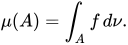
The Radon–Nikodym theorem[15] states that if μ {\displaystyle \mu } {\displaystyle \mu } is absolutely continuous with respect to ν , {\displaystyle \nu ,} {\displaystyle \nu ,} and both measures are σ-finite, then μ {\displaystyle \mu } {\displaystyle \mu } has a density, or "Radon-Nikodym derivative", with respect to ν , {\displaystyle \nu ,} {\displaystyle \nu ,} which means that there exists a ν {\displaystyle \nu } {\displaystyle \nu }-measurable function f {\displaystyle f} {\displaystyle f} taking values in [ 0 , + ∞ ) , {\displaystyle [0,+\infty ),} {\displaystyle [0,+\infty ),} denoted by f = d μ / d ν , {\displaystyle f=d\mu /d\nu ,} {\displaystyle f=d\mu /d\nu ,} such that for any ν {\displaystyle \nu } {\displaystyle \nu }-measurable set A {\displaystyle A} {\displaystyle A} we have: μ ( A ) = ∫ A f d ν . {\displaystyle \mu (A)=\int _{A}f\,d\nu .} {\displaystyle \mu (A)=\int _{A}f\,d\nu .}

Singular measures

[edit]

Via Lebesgue's decomposition theorem,[16] every σ-finite measure can be decomposed into the sum of an absolutely continuous measure and a singular measure with respect to another σ-finite measure. See singular measure for examples of measures that are not absolutely continuous.

Relation between the two notions of absolute continuity

[edit]

A finite measure μ on Borel subsets of the real line is absolutely continuous with respect to Lebesgue measure if and only if the point function:

F ( x ) = μ ( ( − ∞ , x ] ) {\displaystyle F(x)=\mu ((-\infty ,x])} {\displaystyle F(x)=\mu ((-\infty ,x])}

is an absolutely continuous real function. More generally, a function is locally (meaning on every bounded interval) absolutely continuous if and only if its distributional derivative is a measure that is absolutely continuous with respect to the Lebesgue measure.

If absolute continuity holds then the Radon–Nikodym derivative of μ is equal almost everywhere to the derivative of F.[17]

More generally, the measure μ is assumed to be locally finite (rather than finite) and F(x) is defined as μ((0,x]) for x > 0, 0 for x = 0, and −μ((x,0]) for x < 0. In this case μ is the Lebesgue–Stieltjes measure generated by F.[18] The relation between the two notions of absolute continuity still holds.[19]

Notes

[edit]
  1. ^ Royden 1988, Sect. 5.4, page 108; Nielsen 1997, Definition 15.6 on page 251; Athreya & Lahiri 2006, Definitions 4.4.1, 4.4.2 on pages 128,129. The interval I {\displaystyle I} {\displaystyle I} is assumed to be bounded and closed in the former two books but not the latter book.
  2. ^ Nielsen 1997, Theorem 20.8 on page 354; also Royden 1988, Sect. 5.4, page 110 and Athreya & Lahiri 2006, Theorems 4.4.1, 4.4.2 on pages 129,130.
  3. ^ Athreya & Lahiri 2006, before Theorem 4.4.1 on page 129.
  4. ^ Royden 1988, Problem 5.14(a,b) on page 111.
  5. ^ Royden 1988, Problem 5.14(c) on page 111.
  6. ^ Royden 1988, Problem 5.20(a) on page 112.
  7. ^ Royden 1988, Theorem 6.10
  8. ^ Royden 1988, Lemma 5.11 on page 108.
  9. ^ Bruckner, Bruckner & Thomson 1997, Theorem 7.11.
  10. ^ Fichtenholz 1923.
  11. ^ Ambrosio, Gigli & Savaré 2005, Definition 1.1.1 on page 23
  12. ^ Ambrosio, Gigli & Savaré 2005, Theorem 1.1.2 on page 24
  13. ^ Equivalence between (1) and (2) is a special case of Nielsen 1997, Proposition 15.5 on page 251 (fails for σ-finite measures); equivalence between (1) and (3) is a special case of the Radon–Nikodym theorem, see Nielsen 1997, Theorem 15.4 on page 251 or Athreya & Lahiri 2006, Item (ii) of Theorem 4.1.1 on page 115 (still holds for σ-finite measures).
  14. ^ Nielsen 1997, Definition 15.3 on page 250; Royden 1988, Sect. 11.6, page 276; Athreya & Lahiri 2006, Definition 4.1.1 on page 113.
  15. ^ Royden 1988, Theorem 11.23 on page 276; Nielsen 1997, Theorem 15.4 on page 251; Athreya & Lahiri 2006, Item (ii) of Theorem 4.1.1 on page 115.
  16. ^ Royden 1988, Proposition 11.24 on page 278; Nielsen 1997, Theorem 15.14 on page 262; Athreya & Lahiri 2006, Item (i) of Theorem 4.1.1 on page 115.
  17. ^ Royden 1988, Problem 12.17(b) on page 303.
  18. ^ Athreya & Lahiri 2006, Sect. 1.3.2, page 26.
  19. ^ Nielsen 1997, Proposition 15.7 on page 252; Athreya & Lahiri 2006, Theorem 4.4.3 on page 131; Royden 1988, Problem 12.17(a) on page 303.

References

[edit]
  • Ambrosio, Luigi; Gigli, Nicola; Savaré, Giuseppe (2005), Gradient Flows in Metric Spaces and in the Space of Probability Measures, ETH Zürich, Birkhäuser Verlag, Basel, ISBN 3-7643-2428-7
  • Athreya, Krishna B.; Lahiri, Soumendra N. (2006), Measure theory and probability theory, Springer, ISBN 0-387-32903-X
  • Bruckner, A. M.; Bruckner, J. B.; Thomson, B. S. (1997), Real Analysis, Prentice Hall, ISBN 0-134-58886-X
  • Fichtenholz, Grigorii (1923). "Note sur les fonctions absolument continues". Matematicheskii Sbornik. 31 (2): 286–295.
  • Leoni, Giovanni (2009), A First Course in Sobolev Spaces, Graduate Studies in Mathematics, American Mathematical Society, pp. xvi+607 ISBN 978-0-8218-4768-8, MR 2527916, Zbl 1180.46001, MAA
  • Nielsen, Ole A. (1997), An introduction to integration and measure theory, Wiley-Interscience, ISBN 0-471-59518-7
  • Royden, H.L. (1988), Real Analysis (third ed.), Collier Macmillan, ISBN 0-02-404151-3

External links

[edit]
  • Absolute continuity at Encyclopedia of Mathematics
  • Topics in Real Analysis by Gerald Teschl
  • v
  • t
  • e
Measure theory
Basic concepts
  • Absolute continuity of measures
  • Lebesgue integration
  • Lp spaces
  • Measure
  • Measure space
    • Probability space
  • Measurable space/function
Sets
  • Almost everywhere
  • Atom
  • Baire set
  • Borel set
    • equivalence relation
  • Borel space
  • Carathéodory's criterion
  • Cylindrical σ-algebra
    • Cylinder set
  • 𝜆-system
  • Essential range
    • infimum/supremum
  • Locally measurable
  • π-system
  • σ-algebra
  • Non-measurable set
    • Vitali set
  • Null set
  • Support
  • Transverse measure
  • Universally measurable
Types of measures
  • Atomic
  • Baire
  • Banach
  • Besov
  • Borel
  • Brown
  • Complex
  • Complete
  • Content
  • (Logarithmically) Convex
  • Decomposable
  • Discrete
  • Equivalent
  • Finite
  • Inner
  • (Quasi-) Invariant
  • Locally finite
  • Maximising
  • Metric outer
  • Outer
  • Perfect
  • Pre-measure
  • (Sub-) Probability
  • Projection-valued
  • Radon
  • Random
  • Regular
    • Borel regular
    • Inner regular
    • Outer regular
  • Saturated
  • Set function
  • σ-finite
  • s-finite
  • Signed
  • Singular
  • Spectral
  • Strictly positive
  • Tight
  • Vector
Particular measures
  • Counting
  • Dirac
  • Euler
  • Gaussian
  • Haar
  • Harmonic
  • Hausdorff
  • Intensity
  • Lebesgue
    • Infinite-dimensional
  • Logarithmic
  • Product
    • Projections
  • Pushforward
  • Spherical measure
  • Tangent
  • Trivial
  • Young
Maps
  • Measurable function
    • Bochner
    • Strongly
    • Weakly
  • Convergence: almost everywhere
  • of measures
  • in measure
  • of random variables
    • in distribution
    • in probability
  • Cylinder set measure
  • Random: compact set
  • element
  • measure
  • process
  • variable
  • vector
  • Projection-valued measure
Main results
  • Carathéodory's extension theorem
  • Convergence theorems
    • Dominated
    • Monotone
    • Vitali
  • Decomposition theorems
    • Hahn
    • Jordan
    • Maharam's
  • Egorov's
  • Fatou's lemma
  • Fubini's
    • Fubini–Tonelli
  • Hölder's inequality
  • Minkowski inequality
  • Radon–Nikodym
  • Riesz–Markov–Kakutani representation theorem
Other results
  • Disintegration theorem
    • Lifting theory
  • Lebesgue's density theorem
  • Lebesgue differentiation theorem
  • Sard's theorem
  • Vitali–Hahn–Saks theorem
For Lebesgue measure
  • Isoperimetric inequality
  • Brunn–Minkowski theorem
    • Milman's reverse
  • Minkowski–Steiner formula
  • Prékopa–Leindler inequality
  • Vitale's random Brunn–Minkowski inequality
Applications & related
  • Convex analysis
  • Descriptive set theory
  • Probability theory
  • Real analysis
  • Spectral theory
  • v
  • t
  • e
Functional analysis (topics – glossary)
Spaces
  • Banach
  • Besov
  • Fréchet
  • Hilbert
  • Hölder
  • Nuclear
  • Orlicz
  • Schwartz
  • Sobolev
  • Topological vector
Properties
  • Barrelled
  • Complete
  • Dual (Algebraic / Topological)
  • Locally convex
  • Reflexive
  • Separable
Theorems
  • Hahn–Banach
  • Riesz representation
  • Closed graph
  • Uniform boundedness principle
  • Kakutani fixed-point
  • Krein–Milman
  • Min–max
  • Gelfand–Naimark
  • Banach–Alaoglu
Operators
  • Adjoint
  • Bounded
  • Compact
  • Hilbert–Schmidt
  • Normal
  • Nuclear
  • Trace class
  • Transpose
  • Unbounded
  • Unitary
Algebras
  • Banach algebra
  • C*-algebra
  • Spectrum of a C*-algebra
  • Operator algebra
  • Group algebra of a locally compact group
  • Von Neumann algebra
Open problems
  • Invariant subspace problem
  • Mahler's conjecture
Applications
  • Hardy space
  • Spectral theory of ordinary differential equations
  • Heat kernel
  • Index theorem
  • Calculus of variations
  • Functional calculus
  • Integral linear operator
  • Jones polynomial
  • Topological quantum field theory
  • Noncommutative geometry
  • Riemann hypothesis
  • Distribution (or Generalized functions)
Advanced topics
  • Approximation property
  • Balanced set
  • Choquet theory
  • Weak topology
  • Banach–Mazur distance
  • Tomita–Takesaki theory
  • Category
Retrieved from "https://teknopedia.ac.id/w/index.php?title=Absolute_continuity&oldid=1334771745"
Categories:
  • Theory of continuous functions
  • Real analysis
  • Measure theory
Hidden categories:
  • Articles with short description
  • Short description matches Wikidata

  • indonesia
  • Polski
  • العربية
  • Deutsch
  • English
  • Español
  • Français
  • Italiano
  • مصرى
  • Nederlands
  • 日本語
  • Português
  • Sinugboanong Binisaya
  • Svenska
  • Українська
  • Tiếng Việt
  • Winaray
  • 中文
  • Русский
Sunting pranala
url url url url url url url url url url url url url url url url url url url url url url url url url url url url url url url url url url url url url url url url url url url url url url url url url url url url url url url url url url url url url url url url url url url url url url url url url url url url url url url url url url url url url url url url url url url url url url url url url url url url url url url url url url url url url url url url url url url url url url url url url url url url url url url url url url url url url url url url url url url url url url url url url url url url url url url url url url url url url url url url url url url url url url url url url url url url url url url url url url url url url url url url url url url url url url url url url url url url url url url url url url url url url url url url url url url url url url url url url url url url url url url url url url url url url url url url url url url url url url url url url url url url url url url url url url url url url url url url url url url url url url url url url url url url url url url url url url url url url url url url url url url url url url url url url url url url url url url url url url url url url url url url url url url url url url url url url url url url url url url url url url url url url url url url url url url url url url url url url url url url url url url url url url url url url url url url url url url url url url url url url url url url url url url url url url url url url url url url url url url url url url url url url url url url url url url url url url url url url url url url url url url url url url url url url url url url url url url url url url url url url url url url url url url url url url url url url url url url url url url url url url url url url url url url url url url url url url url url url url url url url url url url url url url url url url url url url url url url url url url url url url url url url url url url url url url url url url url url url url url url url url url url url url url url url url url url url url url url url url url url url url url url url url url url url url url url url url url url url url url url url url url url url url url url url url url url url url url url url url url url url url url url url url url url url url url url url url url url url url url url url url url url url url url url url url url url url url url url url url url url url url url url url url url url url url url url url url url url url url url url url url url url url url url url url url url url url url url url url url url url url url url url url url url url url url url url url url url url url url url url url url url url url url url url url url url url url url url url url url url url url url url url url url url url url url url url url url url url url url url url url url url url url url url url url url url url url url url url url url url url url url url url url url url url url url url url url url url url url url url url url url url url url url url url url url url url url url url url url url url url url url url url url url url url url url url url url url url url url url url url url url url url url url url url url url url url url url url url url url url url url url url url url url url url url url url url url url url url url url url url url url url url url url url url url url url url url url url url url url url url url url url url url url url url url url url url url url url url url url url url url url url url url url url url url url url url url url url url url url url url url url url url url url url url url url url url url url url url url url url url url url url url url url url url url url url url url url url url url url url url url url url url url url url url url url url url url url url url url url url url url url url url url url url url url url url url url url url url url url url url url url url url url url url url url url url url url url url url url url url url url url url url url url url url url url url url url url url url url url url url url url url url url url url url url url url url url url url url url url url url url url url url url url url url url url url url url url url url url url url url url url url url url url url url url url url url url url url url url url url url url url url url url url url url url url url url url url url url url url url url url url url url url url url url url url url url url url url url url url url url url url url url url url url url url url url url url url url url url url url url url url url url url url url url url url url url url url url url url url url url url url url url url url url url url url url url url url url url url url url url url url url url url url url url url url url url url url url url url url url url url url url url url url url url url url url url url url url url url url url url url url url url url url url url url url url url url url url url url url url url url url url url url url url url url url url url url url url url url url url url url url url url url url url url url url url url url url url url url url url url url url url url url url url url url url url url url url url url url url url url url url url url url url url url url url url url url url url url url url url url url url url url url url url url url url url url url url url url url url url url url url url url url url url url url url url url url url url url url url url url url url url url url url url url url url url url url url url url url url url url url url url url url url url url url url url url url url url url url url url url url url url url url url url url url url url url url url url url url url url url url url url url url url url url url url url url url url url url url url url url url url url url url url url url url url url url url url url url url url url url url url url url url url url url url url url url url url url url url url url url url url url url url url url url url url url url url url url url url url url url url url url url url url url url url url url url url url url url url url url url url url url url url url url url url url url url url url url url url url url url url url url url url url url url url url url url url url url url url url url url url url url url url url url url url url url url url url url url url url url url url url url url url url url url url url url url url url url url url url url url url url url url url url url url url url url url url url url url url url url url url url url url url url url url url url url url url url url url url url url url url url url url url url url url url url url url url url url url url url url url url url url url url url url url url url url url url url url url url url url url url url url url url url url url url url url url url url url url url url url url url url url url url url url url url url url url url url url url url url url url url url url url url url url url url url url url url url url url url url url url url url url url url url url url url url url url url url url url url url url url url url url url url url url url url url url url url url url url url url url url url url url url url url url url url url url url url url url url url url url url url url url url url url url url url url url url url url url url url url url url url url url url url url url url url url url url url url url url url url url url url url url url url url url url url url url url url url url url url url url url url url url url url url url url url url url url url url url url url url url url url url url url url url url url url url url url url url url url url url url url url url url url url url url url url url url url url url url url url url url url url url url url url url url url url url url url url url url url url url url url url url url url url url url url url url url url url url url url url url url url url url url url url url url url url url url url url url url url url url url url url url url url url url url url url url url url url url url url url url url url url url url url url url url url url url url url url url url url url url url url url url url url url url url url url url url url url url url url url url url url url url url url url url url url url url url url url url url url url url url url url url url url url url url url url url url url url url url url url url url url url url url url url url url url url url url url url url url url url url url url url url url url url url url url url url url url url url url url url url url url url url url url url url url url url url url url url url url url url url url url url url url url url url url url url url url url url url url url url url url url url url url url url url url url url url url url url url url url url url url url url url url url url url url url url url url url url url url url url url url url url url url url url url url url url url url url url url url url url url url url url url url url url url url url url url url url url url url url url url url url url url url url url url url url url url url url url url url url url url url url url url url url url url url url url url url url url url url url url url url url url url url url url url url url url url url url url url url url url url url url url url url url url url url url url url url url url url url url url url url url url url url url url url url url url url url url url url url url url url url url url url url url url url url url url url url url url url url url url url url url url url url url url url url url url url url url url url url url url url url url url url url url url url url url url url url url url url url url url url url url url url url url url url url url url url url url url url url url url url url url url url url url url url url url url url url url url url url url url url url url url url url url
Pusat Layanan

UNIVERSITAS TEKNOKRAT INDONESIA | ASEAN's Best Private University
Jl. ZA. Pagar Alam No.9 -11, Labuhan Ratu, Kec. Kedaton, Kota Bandar Lampung, Lampung 35132
Phone: (0721) 702022
Email: pmb@teknokrat.ac.id