Epstein Files Full PDF

CLICK HERE
Technopedia Center
PMB University Brochure
Faculty of Engineering and Computer Science
S1 Informatics S1 Information Systems S1 Information Technology S1 Computer Engineering S1 Electrical Engineering S1 Civil Engineering

faculty of Economics and Business
S1 Management S1 Accountancy

Faculty of Letters and Educational Sciences
S1 English literature S1 English language education S1 Mathematics education S1 Sports Education
teknopedia

  • Registerasi
  • Brosur UTI
  • Kip Scholarship Information
  • Performance
Flag Counter
  1. World Encyclopedia
  2. Probability theory - Wikipedia
Probability theory - Wikipedia
From Wikipedia, the free encyclopedia
Branch of mathematics concerning probability
This article includes a list of general references, but it lacks sufficient corresponding inline citations. Please help to improve this article by introducing more precise citations. (September 2009) (Learn how and when to remove this message)
Part of a series on statistics
Probability theory
  • Probability
    • Axioms
  • Determinism
    • System
  • Indeterminism
  • Randomness
  • Probability space
  • Sample space
  • Event
    • Collectively exhaustive events
    • Elementary event
    • Mutual exclusivity
    • Outcome
    • Singleton
  • Experiment
    • Bernoulli trial
  • Probability distribution
    • Bernoulli distribution
    • Binomial distribution
    • Exponential distribution
    • Normal distribution
    • Pareto distribution
    • Poisson distribution
  • Probability measure
  • Random variable
    • Bernoulli process
    • Continuous or discrete
    • Expected value
    • Variance
    • Markov chain
    • Observed value
    • Random walk
    • Stochastic process
  • Complementary event
  • Joint probability
  • Marginal probability
  • Conditional probability
  • Independence
  • Conditional independence
  • Law of total probability
  • Law of large numbers
  • Bayes' theorem
  • Boole's inequality
  • Venn diagram
  • Tree diagram
  • v
  • t
  • e

Probability theory or probability calculus is the branch of mathematics concerned with probability. Although there are several different probability interpretations, probability theory treats the concept in a rigorous mathematical manner by expressing it through a set of axioms. Typically these axioms formalise probability in terms of a probability space, which assigns a measure taking values between 0 and 1, termed the probability measure, to a set of outcomes called the sample space. Any specified subset of the sample space is called an event.

Central subjects in probability theory include discrete and continuous random variables, probability distributions, and stochastic processes (which provide mathematical abstractions of non-deterministic or uncertain processes or measured quantities that may either be single occurrences or evolve over time in a random fashion). Although it is not possible to perfectly predict random events, much can be said about their behavior. Two major results in probability theory describing such behaviour are the law of large numbers and the central limit theorem.

As a mathematical foundation for statistics, probability theory is essential to many human activities that involve quantitative analysis of data.[1] Methods of probability theory also apply to descriptions of complex systems given only partial knowledge of their state, as in statistical mechanics or sequential estimation. A great discovery of twentieth-century physics was the probabilistic nature of physical phenomena at atomic scales, described in quantum mechanics.[2]

History of probability

[edit]
Main article: History of probability

The modern mathematical theory of probability has its roots in attempts to analyze games of chance by Gerolamo Cardano in the sixteenth century, and by Pierre de Fermat and Blaise Pascal in the seventeenth century (for example the "problem of points").[3] Christiaan Huygens published a book on the subject in 1657.[4] In the 19th century, what is considered the classical definition of probability was completed by Pierre Laplace.[5]

Initially, probability theory mainly considered discrete events, and its methods were mainly combinatorial. Eventually, analytical considerations compelled the incorporation of continuous variables into the theory.

This culminated in modern probability theory, on foundations laid by Andrey Nikolaevich Kolmogorov. Kolmogorov combined the notion of sample space, introduced by Richard von Mises, and measure theory and presented his axiom system for probability theory in 1933. This became the mostly undisputed axiomatic basis for modern probability theory; but, alternatives exist, such as the adoption of finite rather than countable additivity by Bruno de Finetti.[6]

Treatment

[edit]

Most introductions to probability theory treat discrete probability distributions and continuous probability distributions separately. The measure theory-based treatment of probability covers the discrete, continuous, a mix of the two, and more.

Motivation

[edit]

Consider an experiment that can produce a number of outcomes. The set of all outcomes is called the sample space of the experiment. The power set of the sample space (or equivalently, the event space) is formed by considering all different collections of possible results. For example, rolling an honest die produces one of six possible results. One collection of possible results corresponds to getting an odd number. Thus, the subset {1,3,5} is an element of the power set of the sample space of dice rolls. These collections are called events. In this case, {1,3,5} is the event that the die falls on some odd number. If the results that actually occur fall in a given event, that event is said to have occurred.

Probability is a way of assigning every "event" a value between zero and one, with the requirement that the event made up of all possible results (in our example, the event {1,2,3,4,5,6}) be assigned a value of one. To qualify as a probability distribution, the assignment of values must satisfy the requirement that if you look at a collection of mutually exclusive events (events that contain no common results, e.g., the events {1,6}, {3}, and {2,4} are all mutually exclusive), the probability that any of these events occurs is given by the sum of the probabilities of the events.[7]

The probability that any one of the events {1,6}, {3}, or {2,4} will occur is 5/6. This is the same as saying that the probability of event {1,2,3,4,6} is 5/6. This event encompasses the possibility of any number except five being rolled. The mutually exclusive event {5} has a probability of 1/6, and the event {1,2,3,4,5,6} has a probability of 1, that is, absolute certainty.

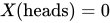
When doing calculations using the outcomes of an experiment, it is necessary that all those elementary events have a number assigned to them. This is done using a random variable. A random variable is a function that assigns to each elementary event in the sample space a real number. This function is usually denoted by a capital letter.[8] In the case of a die, the assignment of a number to certain elementary events can be done using the identity function. This does not always work. For example, when flipping a coin the two possible outcomes are "heads" and "tails". In this example, the random variable X could assign to the outcome "heads" the number "0" ( X ( heads ) = 0 {\textstyle X({\text{heads}})=0} {\textstyle X({\text{heads}})=0}) and to the outcome "tails" the number "1" ( X ( tails ) = 1 {\displaystyle X({\text{tails}})=1} {\displaystyle X({\text{tails}})=1}).

Discrete probability distributions

[edit]
Main article: Discrete probability distribution
The Poisson distribution, a discrete probability distribution

Discrete probability theory deals with events that occur in countable sample spaces.

Examples: Throwing dice, experiments with decks of cards, random walk, and tossing coins.

Classical definition: Initially the probability of an event to occur was defined as the number of cases favorable for the event, over the number of total outcomes possible in an equiprobable sample space: see Classical definition of probability.

For example, if the event is "occurrence of an even number when a dice is rolled", the probability is given by 3 6 = 1 2 {\displaystyle {\tfrac {3}{6}}={\tfrac {1}{2}}} {\displaystyle {\tfrac {3}{6}}={\tfrac {1}{2}}}, since 3 faces out of the 6 have even numbers and each face has the same probability of appearing.

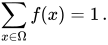
Modern definition: The modern definition starts with a finite or countable set called the sample space, which relates to the set of all possible outcomes in classical sense, denoted by Ω {\displaystyle \Omega } {\displaystyle \Omega }. It is then assumed that for each element x ∈ Ω {\displaystyle x\in \Omega \,} {\displaystyle x\in \Omega \,}, an intrinsic "probability" value f ( x ) {\displaystyle f(x)\,} {\displaystyle f(x)\,} is attached, which satisfies the following properties:

  1. f ( x ) ∈ [ 0 , 1 ]  for all  x ∈ Ω ; {\displaystyle f(x)\in [0,1]{\mbox{ for all }}x\in \Omega \,;} {\displaystyle f(x)\in [0,1]{\mbox{ for all }}x\in \Omega \,;}
  2. ∑ x ∈ Ω f ( x ) = 1 . {\displaystyle \sum _{x\in \Omega }f(x)=1\,.} {\displaystyle \sum _{x\in \Omega }f(x)=1\,.}

That is, the probability function f(x) lies between zero and one for every value of x in the sample space Ω, and the sum of f(x) over all values x in the sample space Ω is equal to 1. An event is defined as any subset E {\displaystyle E\,} {\displaystyle E\,} of the sample space Ω {\displaystyle \Omega \,} {\displaystyle \Omega \,}. The probability of the event E {\displaystyle E\,} {\displaystyle E\,} is defined as

P ( E ) = ∑ x ∈ E f ( x ) . {\displaystyle \mathbb {P} (E)=\sum _{x\in E}f(x)\,.} {\displaystyle \mathbb {P} (E)=\sum _{x\in E}f(x)\,.}

So, the probability of the entire sample space is 1, and the probability of the null event is 0.

The function f ( x ) {\displaystyle f(x)\,} {\displaystyle f(x)\,} mapping a point in the sample space to the "probability" value is called a probability mass function abbreviated as pmf.

Continuous probability distributions

[edit]
Main article: Continuous probability distribution
The normal distribution, a continuous probability distribution

Continuous probability theory deals with events that occur in a continuous sample space.

Classical definition: The classical definition breaks down when confronted with the continuous case. See Bertrand's paradox.

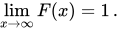
Modern definition: If the sample space of a random variable X is the set of real numbers ( R {\displaystyle \mathbb {R} } {\displaystyle \mathbb {R} }) or a subset thereof, then a function called the cumulative distribution function (CDF) F {\displaystyle F\,} {\displaystyle F\,} exists, defined by F ( x ) = P ( X ≤ x ) {\displaystyle F(x)=\mathbb {P} (X\leq x)\,} {\displaystyle F(x)=\mathbb {P} (X\leq x)\,}. That is, F(x) returns the probability that X will be less than or equal to x.

The CDF necessarily satisfies the following properties.

  1. F {\displaystyle F\,} {\displaystyle F\,} is a monotonically non-decreasing, right-continuous function;
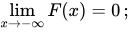
  2. lim x → − ∞ F ( x ) = 0 ; {\displaystyle \lim _{x\rightarrow -\infty }F(x)=0\,;} {\displaystyle \lim _{x\rightarrow -\infty }F(x)=0\,;}
  3. lim x → ∞ F ( x ) = 1 . {\displaystyle \lim _{x\rightarrow \infty }F(x)=1\,.} {\displaystyle \lim _{x\rightarrow \infty }F(x)=1\,.}

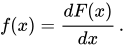
The random variable X {\displaystyle X} {\displaystyle X} is said to have a continuous probability distribution if the corresponding CDF F {\displaystyle F} {\displaystyle F} is continuous. If F {\displaystyle F\,} {\displaystyle F\,} is absolutely continuous, then its derivative exists almost everywhere and integrating the derivative gives us the CDF back again. In this case, the random variable X is said to have a probability density function (PDF) or simply density f ( x ) = d F ( x ) d x . {\displaystyle f(x)={\frac {dF(x)}{dx}}\,.} {\displaystyle f(x)={\frac {dF(x)}{dx}}\,.}

For a set E ⊆ R {\displaystyle E\subseteq \mathbb {R} } {\displaystyle E\subseteq \mathbb {R} }, the probability of the random variable X being in E {\displaystyle E\,} {\displaystyle E\,} is

P ( X ∈ E ) = ∫ x ∈ E d F ( x ) . {\displaystyle \mathbb {P} (X\in E)=\int _{x\in E}dF(x)\,.} {\displaystyle \mathbb {P} (X\in E)=\int _{x\in E}dF(x)\,.}

In case the PDF exists, this can be written as

P ( X ∈ E ) = ∫ x ∈ E f ( x ) d x . {\displaystyle \mathbb {P} (X\in E)=\int _{x\in E}f(x)\,dx\,.} {\displaystyle \mathbb {P} (X\in E)=\int _{x\in E}f(x)\,dx\,.}

Whereas the PDF exists only for continuous random variables, the CDF exists for all random variables (including discrete random variables) that take values in R . {\displaystyle \mathbb {R} \,.} {\displaystyle \mathbb {R} \,.}

These concepts can be generalized for multidimensional cases on R n {\displaystyle \mathbb {R} ^{n}} {\displaystyle \mathbb {R} ^{n}} and other continuous sample spaces.


Measure-theoretic probability theory

[edit]

The utility of the measure-theoretic treatment of probability is that it unifies the discrete and the continuous cases, and makes the difference a question of which measure is used. Furthermore, it covers distributions that are neither discrete nor continuous nor mixtures of the two.

An example of such distributions could be a mix of discrete and continuous distributions—for example, a random variable that is 0 with probability 1/2, and takes a random value from a normal distribution with probability 1/2. It can still be studied to some extent by considering it to have a PDF of ( δ [ x ] + φ ( x ) ) / 2 {\displaystyle (\delta [x]+\varphi (x))/2} {\displaystyle (\delta [x]+\varphi (x))/2}, where δ [ x ] {\displaystyle \delta [x]} {\displaystyle \delta [x]} is the Dirac delta function.

Other distributions may not even be a mix, for example, the Cantor distribution has no positive probability for any single point, neither does it have a density. The modern approach to probability theory solves these problems using measure theory to define the probability space:

Given any set Ω {\displaystyle \Omega \,} {\displaystyle \Omega \,} (also called sample space) and a σ-algebra F {\displaystyle {\mathcal {F}}\,} {\displaystyle {\mathcal {F}}\,} on it, a measure P {\displaystyle \mathbb {P} } {\displaystyle \mathbb {P} } defined on F {\displaystyle {\mathcal {F}}\,} {\displaystyle {\mathcal {F}}\,} is called a probability measure if P ( Ω ) = 1. {\displaystyle \mathbb {P} (\Omega )=1.\,} {\displaystyle \mathbb {P} (\Omega )=1.\,}

If F {\displaystyle {\mathcal {F}}\,} {\displaystyle {\mathcal {F}}\,} is the Borel σ-algebra on the set of real numbers, then there is a unique probability measure on F {\displaystyle {\mathcal {F}}\,} {\displaystyle {\mathcal {F}}\,} for any CDF, and vice versa. The measure corresponding to a CDF is said to be induced by the CDF. This measure coincides with the pmf for discrete variables and PDF for continuous variables, making the measure-theoretic approach free of fallacies.

The probability of a set E {\displaystyle E\,} {\displaystyle E\,} in the σ-algebra F {\displaystyle {\mathcal {F}}\,} {\displaystyle {\mathcal {F}}\,} is defined as

P ( E ) = ∫ ω ∈ E μ F ( d ω ) {\displaystyle \mathbb {P} (E)=\int _{\omega \in E}\mu _{F}(d\omega )\,} {\displaystyle \mathbb {P} (E)=\int _{\omega \in E}\mu _{F}(d\omega )\,}

where the integration is with respect to the measure μ F {\displaystyle \mu _{F}\,} {\displaystyle \mu _{F}\,} induced by F . {\displaystyle F\,.} {\displaystyle F\,.}

Along with providing better understanding and unification of discrete and continuous probabilities, measure-theoretic treatment also allows us to work on probabilities outside R n {\displaystyle \mathbb {R} ^{n}} {\displaystyle \mathbb {R} ^{n}}, as in the theory of stochastic processes. For example, to study Brownian motion, probability is defined on a space of functions.

When it is convenient to work with a dominating measure, the Radon–Nikodym theorem is used to define a density as the Radon–Nikodym derivative of the probability distribution of interest with respect to this dominating measure. Discrete densities are usually defined as this derivative with respect to a counting measure over the set of all possible outcomes. Densities for absolutely continuous distributions are usually defined as this derivative with respect to the Lebesgue measure. If a theorem can be proved in this general setting, it holds for both discrete and continuous distributions as well as others; separate proofs are not required for discrete and continuous distributions.

Classical probability distributions

[edit]
Main article: Probability distributions

Certain random variables occur very often in probability theory because they well describe many natural or physical processes. Their distributions, therefore, have gained special importance in probability theory. Some fundamental discrete distributions are the discrete uniform, Bernoulli, binomial, negative binomial, Poisson and geometric distributions. Important continuous distributions include the continuous uniform, normal, exponential, gamma and beta distributions.

Convergence of random variables

[edit]
Main article: Convergence of random variables

In probability theory, there are several notions of convergence for random variables. They are listed below in the order of strength, i.e., any subsequent notion of convergence in the list implies convergence according to all of the preceding notions.

Weak convergence
A sequence of random variables X 1 , X 2 , … , {\displaystyle X_{1},X_{2},\dots ,\,} {\displaystyle X_{1},X_{2},\dots ,\,} converges weakly to the random variable X {\displaystyle X\,} {\displaystyle X\,} if their respective CDF converges F 1 , F 2 , … {\displaystyle F_{1},F_{2},\dots \,} {\displaystyle F_{1},F_{2},\dots \,} converges to the CDF F {\displaystyle F\,} {\displaystyle F\,} of X {\displaystyle X\,} {\displaystyle X\,}, wherever F {\displaystyle F\,} {\displaystyle F\,} is continuous. Weak convergence is also called convergence in distribution.
Most common shorthand notation: X n → D X {\displaystyle \displaystyle X_{n}\,{\xrightarrow {\mathcal {D}}}\,X} {\displaystyle \displaystyle X_{n}\,\xrightarrow {\mathcal {D}} \,X}
Convergence in probability
The sequence of random variables X 1 , X 2 , … {\displaystyle X_{1},X_{2},\dots \,} {\displaystyle X_{1},X_{2},\dots \,} is said to converge towards the random variable X {\displaystyle X\,} {\displaystyle X\,} in probability if lim n → ∞ P ( | X n − X | ≥ ε ) = 0 {\displaystyle \lim _{n\rightarrow \infty }\mathbb {P} \left(\left|X_{n}-X\right|\geq \varepsilon \right)=0} {\displaystyle \lim _{n\rightarrow \infty }\mathbb {P} \left(\left|X_{n}-X\right|\geq \varepsilon \right)=0} for every ε > 0.
Most common shorthand notation: X n → P X {\displaystyle \displaystyle X_{n}\,\xrightarrow {\mathbb {P} } \,X} {\displaystyle \displaystyle X_{n}\,\xrightarrow {\mathbb {P} } \,X}
Strong convergence
The sequence of random variables X 1 , X 2 , … {\displaystyle X_{1},X_{2},\dots \,} {\displaystyle X_{1},X_{2},\dots \,} is said to converge towards the random variable X {\displaystyle X\,} {\displaystyle X\,} strongly if P ( lim n → ∞ X n = X ) = 1 {\displaystyle \mathbb {P} (\lim _{n\rightarrow \infty }X_{n}=X)=1} {\displaystyle \mathbb {P} (\lim _{n\rightarrow \infty }X_{n}=X)=1}. Strong convergence is also known as almost sure convergence.
Most common shorthand notation: X n → a . s . X {\displaystyle \displaystyle X_{n}\,{\xrightarrow {\mathrm {a.s.} }}\,X} {\displaystyle \displaystyle X_{n}\,\xrightarrow {\mathrm {a.s.} } \,X}

As the names indicate, weak convergence is weaker than strong convergence. In fact, strong convergence implies convergence in probability, and convergence in probability implies weak convergence. The reverse statements are not always true.

Law of large numbers

[edit]
Main article: Law of large numbers

Common intuition suggests that if a fair coin is tossed many times, then roughly half of the time it will turn up heads, and the other half it will turn up tails. Furthermore, the more often the coin is tossed, the more likely it should be that the ratio of the number of heads to the number of tails will approach unity. Modern probability theory provides a formal version of this intuitive idea, known as the law of large numbers. This law is remarkable because it is not assumed in the foundations of probability theory, but instead emerges from these foundations as a theorem. Since it links theoretically derived probabilities to their actual frequency of occurrence in the real world, the law of large numbers is considered as a pillar in the history of statistical theory and has had widespread influence.[9]

The law of large numbers (LLN) states that the sample average
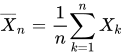
X ¯ n = 1 n ∑ k = 1 n X k {\displaystyle {\overline {X}}_{n}={\frac {1}{n}}{\sum _{k=1}^{n}X_{k}}} {\displaystyle {\overline {X}}_{n}={\frac {1}{n}}{\sum _{k=1}^{n}X_{k}}}

of a sequence of independent and identically distributed random variables X k {\displaystyle X_{k}} {\displaystyle X_{k}} converges towards their common expectation (expected value) μ {\displaystyle \mu } {\displaystyle \mu }, provided that the expectation of | X k | {\displaystyle |X_{k}|} {\displaystyle |X_{k}|} is finite.

It is in the different forms of convergence of random variables that separates the weak and the strong law of large numbers[10]

Weak law: X ¯ n → P μ {\displaystyle \displaystyle {\overline {X}}_{n}\,\xrightarrow {\mathbb {P} } \,\mu } {\displaystyle \displaystyle {\overline {X}}_{n}\,\xrightarrow {\mathbb {P} } \,\mu } for n → ∞ {\displaystyle n\to \infty } {\displaystyle n\to \infty }
Strong law: X ¯ n → a . s . μ {\displaystyle \displaystyle {\overline {X}}_{n}\,{\xrightarrow {\mathrm {a.\,s.} }}\,\mu } {\displaystyle \displaystyle {\overline {X}}_{n}\,\xrightarrow {\mathrm {a.\,s.} } \,\mu } for n → ∞ . {\displaystyle n\to \infty .} {\displaystyle n\to \infty .}

It follows from the LLN that if an event of probability p is observed repeatedly during independent experiments, the ratio of the observed frequency of that event to the total number of repetitions converges towards p.

For example, if Y 1 , Y 2 , . . . {\displaystyle Y_{1},Y_{2},...\,} {\displaystyle Y_{1},Y_{2},...\,} are independent Bernoulli random variables taking values 1 with probability p and 0 with probability 1-p, then E ( Y i ) = p {\displaystyle {\textrm {E}}(Y_{i})=p} {\displaystyle {\textrm {E}}(Y_{i})=p} for all i, so that Y ¯ n {\displaystyle {\bar {Y}}_{n}} {\displaystyle {\bar {Y}}_{n}} converges to p almost surely.

Central limit theorem

[edit]
Main article: Central limit theorem

The central limit theorem (CLT) explains the ubiquitous occurrence of the normal distribution in nature, and this theorem, according to David Williams, "is one of the great results of mathematics."[11]

The theorem states that the average of many independent and identically distributed random variables with finite variance tends towards a normal distribution irrespective of the distribution followed by the original random variables. Formally, let X 1 , X 2 , … {\displaystyle X_{1},X_{2},\dots \,} {\displaystyle X_{1},X_{2},\dots \,} be independent random variables with mean μ {\displaystyle \mu } {\displaystyle \mu } and variance σ 2 > 0. {\displaystyle \sigma ^{2}>0.\,} {\displaystyle \sigma ^{2}>0.\,} Then the sequence of random variables
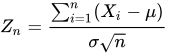
Z n = ∑ i = 1 n ( X i − μ ) σ n {\displaystyle Z_{n}={\frac {\sum _{i=1}^{n}(X_{i}-\mu )}{\sigma {\sqrt {n}}}}\,} {\displaystyle Z_{n}={\frac {\sum _{i=1}^{n}(X_{i}-\mu )}{\sigma {\sqrt {n}}}}\,}

converges in distribution to a standard normal random variable.

For some classes of random variables, the classic central limit theorem works rather fast, as illustrated in the Berry–Esseen theorem. For example, the distributions with finite first, second, and third moment from the exponential family; on the other hand, for some random variables of the heavy tail and fat tail variety, it works very slowly or may not work at all: in such cases one may use the Generalized Central Limit Theorem (GCLT).

See also

[edit]
  • iconMathematics portal
  • Mathematical Statistics – Branch of statisticsPages displaying short descriptions of redirect targets
  • Expected value – Average value of a random variable
  • Variance – Statistical measure of how far values spread from their average
  • Fuzzy logic – System for reasoning about vagueness
  • Fuzzy measure theory
  • Glossary of probability and statistics
  • Likelihood function – Function related to statistics and probability theory
  • Notation in probability
  • Predictive modelling – Form of modelling that uses statistics to predict outcomes
  • Probabilistic logic – Applications of logic under uncertainty
  • Probabilistic proofs of non-probabilistic theorems
  • Probability distribution – Mathematical function for the probability a given outcome occurs in an experiment
  • Probability axioms – Foundations of probability theory
  • Probability interpretations – Philosophical interpretation of the axioms of probability
  • Probability space – Mathematical concept
  • Statistical independence – When the occurrence of one event does not affect the likelihood of anotherPages displaying short descriptions of redirect targets
  • Statistical physics – Physics of many interacting particlesPages displaying short descriptions of redirect targets
  • Subjective logic – Type of probabilistic logic
  • Pairwise independence§Probability of the union of pairwise independent events – Set of random variables of which any two are independent

Lists

[edit]
  • Catalog of articles in probability theory
  • List of probability topics
  • List of publications in statistics
  • List of statistical topics

References

[edit]

Citations

[edit]
  1. ^ Inferring From Data
  2. ^ "Quantum Logic and Probability Theory". The Stanford Encyclopedia of Philosophy. 10 August 2021.
  3. ^ LIGHTNER, JAMES E. (1991). "A Brief Look at the History of Probability and Statistics". The Mathematics Teacher. 84 (8): 623–630. doi:10.5951/MT.84.8.0623. ISSN 0025-5769. JSTOR 27967334.
  4. ^ Grinstead, Charles Miller; James Laurie Snell. "Introduction". Introduction to Probability. pp. vii.
  5. ^ Daston, Lorraine J. (1980). "Probabilistic Expectation and Rationality in Classical Probability Theory". Historia Mathematica. 7 (3): 234–260. doi:10.1016/0315-0860(80)90025-7.
  6. ^ ""The origins and legacy of Kolmogorov's Grundbegriffe", by Glenn Shafer and Vladimir Vovk" (PDF). Retrieved 2012-02-12.
  7. ^ Ross, Sheldon (2010). A First Course in Probability (8th ed.). Pearson Prentice Hall. pp. 26–27. ISBN 978-0-13-603313-4. Retrieved 2016-02-28.
  8. ^ Bain, Lee J.; Engelhardt, Max (1992). Introduction to Probability and Mathematical Statistics (2nd ed.). Belmont, California: Brooks/Cole. p. 53. ISBN 978-0-534-38020-5.
  9. ^ "Leithner & Co Pty Ltd - Value Investing, Risk and Risk Management - Part I". Leithner.com.au. 2000-09-15. Archived from the original on 2014-01-26. Retrieved 2012-02-12.
  10. ^ Dekking, Michel (2005). "Chapter 13: The law of large numbers". A modern introduction to probability and statistics : understanding why and how. Library Genesis. London : Springer. pp. 180–194. ISBN 978-1-85233-896-1.{{cite book}}: CS1 maint: publisher location (link)
  11. ^ David Williams, "Probability with martingales", Cambridge 1991/2008

Sources

[edit]
  • Pierre Simon de Laplace (1812). Analytical Theory of Probability.
The first major treatise blending calculus with probability theory, originally in French: Théorie Analytique des Probabilités.
  • A. Kolmogoroff (1933). Grundbegriffe der Wahrscheinlichkeitsrechnung. doi:10.1007/978-3-642-49888-6. ISBN 978-3-642-49888-6. {{cite book}}: ISBN / Date incompatibility (help)
An English translation by Nathan Morrison appeared under the title Foundations of the Theory of Probability (Chelsea, New York) in 1950, with a second edition in 1956.
  • Patrick Billingsley (1979). Probability and Measure. New York, Toronto, London: John Wiley and Sons.
  • Olav Kallenberg; Foundations of Modern Probability, 2nd ed. Springer Series in Statistics. (2002). 650 pp. ISBN 0-387-95313-2
  • Henk Tijms (2004). Understanding Probability. Cambridge Univ. Press.
A lively introduction to probability theory for the beginner.
  • Olav Kallenberg; Probabilistic Symmetries and Invariance Principles. Springer -Verlag, New York (2005). 510 pp. ISBN 0-387-25115-4
  • Durrett, Rick (2019). Probability: Theory and Examples, 5th edition. UK: Cambridge University Press. ISBN 9781108473682.
  • Gut, Allan (2005). Probability: A Graduate Course. Springer-Verlag. ISBN 0-387-22833-0.
  • v
  • t
  • e
Probability theory
Probability • Outline of probability • Glossary of probability and statistics • Notation in probability and statistics • List of probability distributions • Template:Probability problems • Template:Mathematical problems
Basics
Events • Sample space • Elementary event • Mutually exclusive events • Axioms of probability • Conditional probability • Law of total probability • Bayes' theorem • Independence • Boole's inequality • Interpretations (Bayesian • Frequentist) • Binomial coefficient
Measure-theoretic foundations
Probability space • σ-algebra • Standard probability space • Probability measure • Random element • Dynkin/λ-system • “Almost surely” • Borel–Cantelli • Kolmogorov's zero–one law
Conditional structures
Conditional probability • Conditional expectation • Regular conditional probability • Conditional independence • Conditional probability distribution • Disintegration theorem • Rule of succession • Conditional event algebra
Random variable & expectations
Random variable • Probability mass function • Probability density function • Cumulative distribution function • Joint, marginal & conditional distributions • Expectation • Variance • Covariance • Jensen's inequality • Moments • Fatou's lemma • Monotone convergence theorem • Dominated convergence theorem • Law of total expectation (LIE) • Law of total variance • Markov's inequality • Chebyshev's inequality • Law of the unconscious statistician (LOTUS)
Distributions
Discrete: degenerate • Bernoulli distribution • Binomial distribution • Negative binomial distribution • Geometric distribution • Poisson distribution • Hypergeometric distribution

Continuous: uniform • Exponential distribution • Gamma distribution • Beta distribution • normal / Multivariate normal distribution • χ² • F • Student's t • Cauchy

Other: Cantor • Fisher–Tippett (Gumbel) • Pareto • Benford
Functions & transforms
Sums of normals • Borel's paradox • Probability-generating function • Moment-generating function • Characteristic function • Laplace transform / Laplace–Stieltjes transform
Convergence
Modes of convergence • Convergence in distribution • Convergence in probability • Convergence in mean / mean square / r-th mean • Almost sure convergence • Skorokhod's representation theorem • Central limit theorem (incl. Berry–Esseen theorem) • Law of large numbers • Law of the iterated logarithm
Stochastic processes
Common processes: Random walk • Poisson process • Compound Poisson process • Wiener process / Brownian motion • Geometric Brownian motion • Fractional Brownian motion • Brownian bridge • Ornstein–Uhlenbeck process • Gamma process

Markov: Markov property • Markov chain • Branching process / Galton–Watson process
Time series: MA • AR • Autocorrelation

SDE & calculus: SDEs • Stochastic calculus • Diffusions
Catalog of articles in probability theory • List of probability topics • List of mathematical probabilists • List of scientific journals in probability
  • v
  • t
  • e
Major mathematics areas
  • History
    • Timeline
    • Future
  • Lists
  • Glossary
Foundations
  • Category theory
  • Information theory
  • Mathematical logic
  • Philosophy of mathematics
  • Set theory
  • Type theory
Algebra
  • Abstract
  • Commutative
  • Elementary
  • Group theory
  • Homological
  • Linear
  • Multilinear
  • Universal
Analysis
  • Calculus
  • Real analysis
  • Complex analysis
  • Hypercomplex analysis
  • Differential equations
  • Functional analysis
  • Harmonic analysis
  • Measure theory
Discrete
  • Combinatorics
  • Graph theory
  • Order theory
Geometry
  • Algebraic
  • Analytic
  • Arithmetic
  • Complex
  • Computational
  • Differential
  • Discrete
  • Euclidean
  • Finite
Number theory
  • Algebraic
  • Analytic
  • Arithmetic
  • Diophantine geometry
Topology
  • General
  • Algebraic
  • Differential
  • Geometric
  • Homotopy theory
  • Knot theory
Applied
  • Engineering mathematics
  • Mathematical biology
  • Mathematical chemistry
  • Mathematical economics
  • Mathematical finance
  • Mathematical physics
  • Mathematical psychology
  • Mathematical sociology
  • Mathematical statistics
  • Probability
  • Statistics
  • Systems science
    • Control theory
    • Game theory
    • Operations research
Computational
  • Computer science
  • Theory of computation
  • Computational complexity theory
  • Numerical analysis
  • Optimization
  • Computer algebra
Related topics
  • Mathematicians
    • lists
  • Informal mathematics
  • Films about mathematicians
  • Recreational mathematics
  • Mathematics and art
  • Mathematics education
  • Number
    • Large
  • icon Mathematics portal
  • Category
  • Commons
  • WikiProject
  • v
  • t
  • e
Industrial and applied mathematics
Computational
  • Algorithms
    • design
    • analysis
  • Automata theory
  • Automated theorem proving
  • Coding theory
  • Computational geometry
  • Constraint satisfaction
    • Constraint programming
  • Computational logic
  • Cryptography
  • Information theory
  • Statistics
Mathematical
software
  • Arbitrary-precision arithmetic
  • Finite element analysis
  • Tensor software
  • Interactive geometry software
  • Optimization software
  • Statistical software
  • Numerical-analysis software
  • Numerical libraries
  • Solvers
Discrete
  • Computer algebra
  • Computational number theory
  • Combinatorics
  • Graph theory
  • Discrete geometry
Analysis
  • Approximation theory
  • Clifford analysis
    • Clifford algebra
  • Differential equations
    • Ordinary differential equations
    • Partial differential equations
    • Stochastic differential equations
  • Differential geometry
    • Differential forms
    • Gauge theory
    • Geometric analysis
  • Dynamical systems
    • Chaos theory
    • Control theory
  • Functional analysis
    • Operator algebra
    • Operator theory
  • Harmonic analysis
    • Fourier analysis
  • Multilinear algebra
    • Exterior
    • Geometric
    • Tensor
    • Vector
  • Multivariable calculus
    • Exterior
    • Geometric
    • Tensor
    • Vector
  • Numerical analysis
    • Numerical linear algebra
    • Numerical methods for ordinary differential equations
    • Numerical methods for partial differential equations
    • Validated numerics
  • Variational calculus
Probability theory
  • Distributions (random variables)
  • Stochastic processes / analysis
  • Path integral
  • Stochastic variational calculus
Mathematical
physics
  • Analytical mechanics
    • Lagrangian
    • Hamiltonian
  • Field theory
    • Classical
    • Conformal
    • Effective
    • Gauge
    • Quantum
    • Statistical
    • Topological
  • Perturbation theory
    • in quantum mechanics
  • Potential theory
  • String theory
    • Bosonic
    • Topological
  • Supersymmetry
    • Supersymmetric quantum mechanics
    • Supersymmetric theory of stochastic dynamics
Algebraic
structures
  • Algebra of physical space
  • Particle physics and representation theory
  • Feynman integral
  • Poisson algebra
  • Quantum group
  • Renormalization group
  • Spacetime algebra
  • Superalgebra
  • Supersymmetry algebra
Decision sciences
  • Game theory
  • Operations research
  • Optimization
  • Social choice theory
  • Statistics
  • Mathematical economics
  • Mathematical finance
Other applications
  • Biology
  • Chemistry
  • Psychology
  • Sociology
  • "The Unreasonable Effectiveness of Mathematics in the Natural Sciences"
Related
  • Mathematics
Organizations
  • Society for Industrial and Applied Mathematics
    • Japan Society for Industrial and Applied Mathematics
  • Société de Mathématiques Appliquées et Industrielles
  • International Council for Industrial and Applied Mathematics
  • European Community on Computational Methods in Applied Sciences
  • Category
  • Mathematics portal / outline / topics list
Authority control databases Edit this at Wikidata
International
  • GND
National
  • Japan
  • Czech Republic
Other
  • Encyclopedia of Modern Ukraine
Retrieved from "https://teknopedia.ac.id/w/index.php?title=Probability_theory&oldid=1322431271"
Category:
  • Probability theory
Hidden categories:
  • CS1 maint: publisher location
  • Articles with short description
  • Short description matches Wikidata
  • Articles lacking in-text citations from September 2009
  • All articles lacking in-text citations
  • Pages displaying short descriptions of redirect targets via Module:Annotated link
  • CS1 errors: ISBN date

  • indonesia
  • Polski
  • العربية
  • Deutsch
  • English
  • Español
  • Français
  • Italiano
  • مصرى
  • Nederlands
  • 日本語
  • Português
  • Sinugboanong Binisaya
  • Svenska
  • Українська
  • Tiếng Việt
  • Winaray
  • 中文
  • Русский
Sunting pranala
url url url url url url url url url url url url url url url url url url url url url url url url url url url url url url url url url url url url url url url url url url url url url url url url url url url url url url url url url url url url url url url url url url url url url url url url url url url url url url url url url url url url url url url url url url url url url url url url url url url url url url url url url url url url url url url url url url url url url url url url url url url url url url url url url url url url url url url url url url url url url url url url url url url url url url url url url url url url url url url url url url url url url url url url url url url url url url url url url url url url url url url url url url url url url url url url url url url url url url url url url url url url url url url url url url url url url url url url url url url url url url url url url url url url url url url url url url url url url url url url url url url url url url url url url url url url url url url url url url url url url url url url url url url url url url url url url url url url url url url url url url url url url url url url url url url url url url url url url url url url url url url url url url url url url url url url url url url url url url url url url url url url url url url url url url url url url url url url url url url url url url url url url url url url url url url url url url url url url url url url url url url url url url url url url url url url url url url url url url url url url url url url url url url url url url url url url url url url url url url url url url url url url url url url url url url url url url url url url url url url url url url url url url url url url url url url url url url url url url url url url url url url url url url url url url url url url url url url url url url url url url url url url url url url url url url url url url url url url url url url url url url url url url url url url url url url url url url url url url url url url url url url url url url url url url url url url url url url url url url url url url url url url url url url url url url url url url url url url url url url url url url url url url url url url url url url url url url url url url url url url url url url url url url url url url url url url url url url url url url url url url url url url url url url url url url url url url url url url url url url url url url url url url url url url url url url url url url url url url url url url url url url url url url url url url url url url url url url url url url url url url url url url url url url url url url url url url url url url url url url url url url url url url url url url url url url url url url url url url url url url url url url url url url url url url url url url url url url url url url url url url url url url url url url url url url url url url url url url url url url url url url url url url url url url url url url url url url url url url url url url url url url url url url url url url url url url url url url url url url url url url url url url url url url url url url url url url url url url url url url url url url url url url url url url url url url url url url url url url url url url url url url url url url url url url url url url url url url url url url url url url url url url url url url url url url url url url url url url url url url url url url url url url url url url url url url url url url url url url url url url url url url url url url url url url url url url url url url url url url url url url url url url url url url url url url url url url url url url url url url url url url url url url url url url url url url url url url url url url url url url url url url url url url url url url url url url url url url url url url url url url url url url url url url url url url url url url url url url url url url url url url url url url url url url url url url url url url url url url url url url url url url url url url url url url url url url url url url url url url url url url url url url url url url url url url url url url url url url url url url url url url url url url url url url url url url url url url url url url url url url url url url url url url url url url url url url url url url url url url url url url url url url url url url url url url url url url url url url url url url url url url url url url url url url url url url url url url url url url url url url url url url url url url url url url url url url url url url url url url url url url url url url url url url url url url url url url url url url url url url url url url url url url url url url url url url url url url url url url url url url url url url url url url url url url url url url url url url url url url url url url url url url url url url url url url url url url url url url url url url url url url url url url url url url url url url url url url url url url url url url url url url url url url url url url url url url url url url url url url url url url url url url url url url url url url url url url url url url url url url url url url url url url url url url url url url url url url url url url url url url url url url url url url url url url url url url url url url url url url url url url url url url url url url url url url url url url url url url url url url url url url url url url url url url url url url url url url url url url url url url url url url url url url url url url url url url url url url url url url url url url url url url url url url url url url url url url url url url url url url url url url url url url url url url url url url url url url url url url url url url url url url url url url url url url url url url url url url url url url url url url url url url url url url url url url url url url url url url url url url url url url url url url url url url url url url url url url url url url url url url url url url url url url url url url url url url url url url url url url url url url url url url url url url url url url url url url url url url url url url url url url url url url url url url url url url url url url url url url url url url url url url url url url url url url url url url url url url url url url url url url url url url url url url url url url url url url url url url url url url url url url url url url url url url url url url url url url url url url url url url url url url url url url url url url url url url url url url url url url url url url url url url url url url url url url url url url url url url url url url url url url url url url url url url url url url url url url url url url url url url url url url url url url url url url url url url url url url url url url url url url url url url url url url url url url url url url url url url url url url url url url url url url url url url url url url url url url url url url url url url url url url url url url url url url url url url url url url url url url url url url url url url url url url url url url url url url url url url url url url url url url url url url url url url url url url url url url url url url url url url url url url url url url url url url url url url url url url url url url url url url url url url url url url url url url url url url url url url url url url url url url url url url url url url url url url url url url url url url url url url url url url url url url url url url url url url url url url url url url url url url url url url url url url url url url url url url url url url url url url url url url url url url url url url url url url url url url url url url url url url url url url url url url url url url url url url url url url url url url url url url url url url url url url url url url url url url url url url url url url url url url url url url url url url url url url url url url url url url url url url url url url url url url url url url url url url url url url url url url url url url url url url url url url url url url url url url url url url url url url url url url url url url url url url url url url url url url url url url url url url url url url url url url url url url url url url url url url url url url url url url url url url url url url url url url url url url url url url url url url url url url url url url url url url url url url url url url url url url url url url url url url url url url url url url url url url url url url url url url url url url url url url url url url url url url url url url url url url url url url url url url url url url url url url url url url url url url url url url url url url url url url url url url url url url url url url url url url url url url url url url url url url url url url url url url url url url url url url url url url url url url url url url url url url url url url url url url url url url url url url url url url url url url url url url url url url url url url url url url url url url url url url url url url url url url url url url url url url url url url url url url url url url url url url url url url url url url url url url url url url url url url url url url url url url url url url url url url url url url url url url url url url url url url url url url url url url url url url url url url url url url url url url url url url url url url url url url url url url url url url url url url url url url url url url url url url url url url url url url url url url url url url url url url url url url url url url url url url url url url url url url url url url url url url url url url url url url url url url url url url url url url url url url url url url url url url url url url url url url url url url url url url url url url url url url url url url url url url url url url url url url url url url url url url url url url url url url url url url url url url url url url
Pusat Layanan

UNIVERSITAS TEKNOKRAT INDONESIA | ASEAN's Best Private University
Jl. ZA. Pagar Alam No.9 -11, Labuhan Ratu, Kec. Kedaton, Kota Bandar Lampung, Lampung 35132
Phone: (0721) 702022
Email: pmb@teknokrat.ac.id