Epstein Files Full PDF

CLICK HERE
Technopedia Center
PMB University Brochure
Faculty of Engineering and Computer Science
S1 Informatics S1 Information Systems S1 Information Technology S1 Computer Engineering S1 Electrical Engineering S1 Civil Engineering

faculty of Economics and Business
S1 Management S1 Accountancy

Faculty of Letters and Educational Sciences
S1 English literature S1 English language education S1 Mathematics education S1 Sports Education
teknopedia

  • Registerasi
  • Brosur UTI
  • Kip Scholarship Information
  • Performance
Flag Counter
  1. World Encyclopedia
  2. Vector calculus - Wikipedia
Vector calculus - Wikipedia
From Wikipedia, the free encyclopedia
Calculus of vector-valued functions
Not to be confused with Geometric calculus or Matrix calculus.
This article includes a list of general references, but it lacks sufficient corresponding inline citations. Please help to improve this article by introducing more precise citations. (February 2016) (Learn how and when to remove this message)
Part of a series of articles about
Calculus
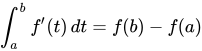
∫ a b f ′ ( t ) d t = f ( b ) − f ( a ) {\displaystyle \int _{a}^{b}f'(t)\,dt=f(b)-f(a)} {\displaystyle \int _{a}^{b}f'(t)\,dt=f(b)-f(a)}
  • Fundamental theorem
  • Limits
  • Continuity
  • Rolle's theorem
  • Mean value theorem
  • Inverse function theorem
Differential
Definitions
  • Derivative (generalizations)
  • Differential
    • infinitesimal
    • of a function
    • total
Concepts
  • Differentiation notation
  • Second derivative
  • Implicit differentiation
  • Logarithmic differentiation
  • Related rates
  • Taylor's theorem
Rules and identities
  • Sum
  • Product
  • Chain
  • Power
  • Quotient
  • L'Hôpital's rule
  • Inverse
  • General Leibniz
  • Faà di Bruno's formula
  • Reynolds
Integral
  • Lists of integrals
  • Integral transform
  • Leibniz integral rule
Definitions
  • Antiderivative
  • Integral (improper)
  • Riemann integral
  • Lebesgue integration
  • Contour integration
  • Integral of inverse functions
Integration by
  • Parts
  • Discs
  • Cylindrical shells
  • Substitution (trigonometric, tangent half-angle, Euler)
  • Euler's formula
  • Partial fractions (Heaviside's method)
  • Changing order
  • Reduction formulae
  • Differentiating under the integral sign
  • Risch algorithm
Series
  • Geometric (arithmetico-geometric)
  • Harmonic
  • Alternating
  • Power
  • Binomial
  • Taylor
Convergence tests
  • Summand limit (term test)
  • Ratio
  • Root
  • Integral
  • Direct comparison

  • Limit comparison
  • Alternating series
  • Cauchy condensation
  • Dirichlet
  • Abel
Vector
  • Gradient
  • Divergence
  • Curl
  • Laplacian
  • Directional derivative
  • Identities
Theorems
  • Gradient
  • Green's
  • Stokes'
  • Divergence
  • Generalized Stokes
  • Helmholtz decomposition
Multivariable
Formalisms
  • Matrix
  • Tensor
  • Exterior
  • Geometric
Definitions
  • Partial derivative
  • Multiple integral
  • Line integral
  • Surface integral
  • Volume integral
  • Jacobian
  • Hessian
Advanced
  • Calculus on Euclidean space
  • Generalized functions
  • Limit of distributions
Specialized
  • Fractional
  • Malliavin
  • Stochastic
  • Variations
Miscellanea
  • Precalculus
  • History
  • Glossary
  • List of topics
  • Integration Bee
  • Mathematical analysis
  • Nonstandard analysis
  • v
  • t
  • e

Vector calculus or vector analysis is a branch of mathematics concerned with the differentiation and integration of vector fields, primarily in three-dimensional Euclidean space, R 3 . {\displaystyle \mathbb {R} ^{3}.} {\displaystyle \mathbb {R} ^{3}.}[1] The term vector calculus is sometimes used as a synonym for the broader subject of multivariable calculus, which spans vector calculus as well as partial differentiation and multiple integration. Vector calculus plays an important role in differential geometry and in the study of partial differential equations. It is used extensively in physics and engineering, especially in the description of electromagnetic fields, gravitational fields, and fluid flow.

Vector calculus was developed from the theory of quaternions by J. Willard Gibbs and Oliver Heaviside near the end of the 19th century, and most of the notation and terminology was established by Gibbs and Edwin Bidwell Wilson in their 1901 book, Vector Analysis, though earlier mathematicians such as Isaac Newton pioneered the field.[2] In its standard form using the cross product, vector calculus does not generalize to higher dimensions, but the alternative approach of geometric algebra, which uses the exterior product, does (see § Generalizations below for more).

Basic objects

[edit]

Scalar fields

[edit]
Main article: Scalar field

A scalar field associates a scalar value to every point in a space. The scalar is a mathematical number representing a physical quantity. Examples of scalar fields in applications include the temperature distribution throughout space, the pressure distribution in a fluid, and spin-zero quantum fields (known as scalar bosons), such as the Higgs field. These fields are the subject of scalar field theory.

Vector fields

[edit]
Main article: Vector field

A vector field is an assignment of a vector to each point in a space.[3] A vector field in the plane, for instance, can be visualized as a collection of arrows with a given magnitude and direction each attached to a point in the plane. Vector fields are often used to model, for example, the speed and direction of a moving fluid throughout space, or the strength and direction of some force, such as the magnetic or gravitational force, as it changes from point to point. This can be used, for example, to calculate work done over a line.

Vectors and pseudovectors

[edit]

In more advanced treatments, one further distinguishes pseudovector fields and pseudoscalar fields, which are identical to vector fields and scalar fields, except that they change sign under an orientation-reversing map: for example, the curl of a vector field is a pseudovector field, and if one reflects a vector field, the curl points in the opposite direction. This distinction is clarified and elaborated in geometric algebra, as described below.

Vector algebra

[edit]
Main article: Euclidean vector § Basic properties

The algebraic (non-differential) operations in vector calculus are referred to as vector algebra, being defined for a vector space and then applied pointwise to a vector field. The basic algebraic operations consist of:

Notations in vector calculus
Operation Notation Description
Vector addition v 1 + v 2 {\displaystyle \mathbf {v} _{1}+\mathbf {v} _{2}} {\displaystyle \mathbf {v} _{1}+\mathbf {v} _{2}} Addition of two vectors, yielding a vector.
Scalar multiplication a v {\displaystyle a\mathbf {v} } {\displaystyle a\mathbf {v} } Multiplication of a scalar and a vector, yielding a vector.
Dot product v 1 ⋅ v 2 {\displaystyle \mathbf {v} _{1}\cdot \mathbf {v} _{2}} {\displaystyle \mathbf {v} _{1}\cdot \mathbf {v} _{2}} Multiplication of two vectors, yielding a scalar.
Cross product v 1 × v 2 {\displaystyle \mathbf {v} _{1}\times \mathbf {v} _{2}} {\displaystyle \mathbf {v} _{1}\times \mathbf {v} _{2}} Multiplication of two vectors in R 3 {\displaystyle \mathbb {R} ^{3}} {\displaystyle \mathbb {R} ^{3}}, yielding a (pseudo)vector.

Also commonly used are the two triple products:

Vector calculus triple products
Operation Notation Description
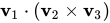
Scalar triple product v 1 ⋅ ( v 2 × v 3 ) {\displaystyle \mathbf {v} _{1}\cdot \left(\mathbf {v} _{2}\times \mathbf {v} _{3}\right)} {\displaystyle \mathbf {v} _{1}\cdot \left(\mathbf {v} _{2}\times \mathbf {v} _{3}\right)} The dot product of the cross product of two vectors.
Vector triple product v 1 × ( v 2 × v 3 ) {\displaystyle \mathbf {v} _{1}\times \left(\mathbf {v} _{2}\times \mathbf {v} _{3}\right)} {\displaystyle \mathbf {v} _{1}\times \left(\mathbf {v} _{2}\times \mathbf {v} _{3}\right)} The cross product of the cross product of two vectors.

Operators and theorems

[edit]
Main article: Vector calculus identities

Differential operators

[edit]
Main articles: Gradient, Divergence, Curl (mathematics), and Laplacian

Vector calculus studies various differential operators defined on scalar or vector fields, which are typically expressed in terms of the del operator ( ∇ {\displaystyle \nabla } {\displaystyle \nabla }), also known as "nabla". The three basic vector operators are:[4]

Differential operators in vector calculus
Operation Notation Description Notational
analogy
Domain/Range
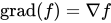
Gradient grad ⁡ ( f ) = ∇ f {\displaystyle \operatorname {grad} (f)=\nabla f} {\displaystyle \operatorname {grad} (f)=\nabla f} Measures the rate and direction of change in a scalar field. Scalar multiplication Maps scalar fields to vector fields.
Divergence div ⁡ ( F ) = ∇ ⋅ F {\displaystyle \operatorname {div} (\mathbf {F} )=\nabla \cdot \mathbf {F} } {\displaystyle \operatorname {div} (\mathbf {F} )=\nabla \cdot \mathbf {F} } Measures the scalar of a source or sink at a given point in a vector field. Dot product Maps vector fields to scalar fields.
Curl curl ⁡ ( F ) = ∇ × F {\displaystyle \operatorname {curl} (\mathbf {F} )=\nabla \times \mathbf {F} } {\displaystyle \operatorname {curl} (\mathbf {F} )=\nabla \times \mathbf {F} } Measures the tendency to rotate about a point in a vector field in R 3 {\displaystyle \mathbb {R} ^{3}} {\displaystyle \mathbb {R} ^{3}}. Cross product Maps vector fields to (pseudo)vector fields.
f denotes a scalar field and F denotes a vector field

Also commonly used are the two Laplace operators:

Laplace operators in vector calculus
Operation Notation Description Domain/Range
Laplacian Δ f = ∇ 2 f = ∇ ⋅ ∇ f {\displaystyle \Delta f=\nabla ^{2}f=\nabla \cdot \nabla f} {\displaystyle \Delta f=\nabla ^{2}f=\nabla \cdot \nabla f} Measures the difference between the value of the scalar field with its average on infinitesimal balls. Maps between scalar fields.
Vector Laplacian ∇ 2 F = ∇ ( ∇ ⋅ F ) − ∇ × ( ∇ × F ) {\displaystyle \nabla ^{2}\mathbf {F} =\nabla (\nabla \cdot \mathbf {F} )-\nabla \times (\nabla \times \mathbf {F} )} {\displaystyle \nabla ^{2}\mathbf {F} =\nabla (\nabla \cdot \mathbf {F} )-\nabla \times (\nabla \times \mathbf {F} )} Measures the difference between the value of the vector field with its average on infinitesimal balls. Maps between vector fields.
f denotes a scalar field and F denotes a vector field

A quantity called the Jacobian matrix is useful for studying functions when both the domain and range of the function are multivariable, such as a change of variables during integration.

Integral theorems

[edit]

The three basic vector operators have corresponding theorems which generalize the fundamental theorem of calculus to higher dimensions:

Integral theorems of vector calculus
Theorem Statement Description
Gradient theorem ∫ L ⊂ R n ∇ φ ⋅ d r   =   φ ( q ) − φ ( p )      for      L = L [ p → q ] {\displaystyle \int _{L\subset \mathbb {R} ^{n}}\!\!\!\nabla \varphi \cdot d\mathbf {r} \ =\ \varphi \left(\mathbf {q} \right)-\varphi \left(\mathbf {p} \right)\ \ {\text{ for }}\ \ L=L[p\to q]} {\displaystyle \int _{L\subset \mathbb {R} ^{n}}\!\!\!\nabla \varphi \cdot d\mathbf {r} \ =\ \varphi \left(\mathbf {q} \right)-\varphi \left(\mathbf {p} \right)\ \ {\text{ for }}\ \ L=L[p\to q]} The line integral of the gradient of a scalar field over a curve L is equal to the change in the scalar field between the endpoints p and q of the curve.
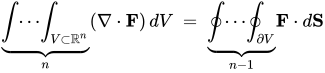
Divergence theorem ∫ ⋯ ∫ V ⊂ R n ⏟ n ( ∇ ⋅ F ) d V   =   ∮ ⋯ ∮ ∂ V ⏟ n − 1 F ⋅ d S {\displaystyle \underbrace {\int \!\cdots \!\int _{V\subset \mathbb {R} ^{n}}} _{n}(\nabla \cdot \mathbf {F} )\,dV\ =\ \underbrace {\oint \!\cdots \!\oint _{\partial V}} _{n-1}\mathbf {F} \cdot d\mathbf {S} } {\displaystyle \underbrace {\int \!\cdots \!\int _{V\subset \mathbb {R} ^{n}}} _{n}(\nabla \cdot \mathbf {F} )\,dV\ =\ \underbrace {\oint \!\cdots \!\oint _{\partial V}} _{n-1}\mathbf {F} \cdot d\mathbf {S} } The integral of the divergence of a vector field over an n-dimensional solid V is equal to the flux of the vector field through the (n−1)-dimensional closed boundary surface of the solid.
Curl (Kelvin–Stokes) theorem ∬ Σ ⊂ R 3 ( ∇ × F ) ⋅ d Σ   =   ∮ ∂ Σ F ⋅ d r {\displaystyle \iint _{\Sigma \subset \mathbb {R} ^{3}}(\nabla \times \mathbf {F} )\cdot d\mathbf {\Sigma } \ =\ \oint _{\partial \Sigma }\mathbf {F} \cdot d\mathbf {r} } {\displaystyle \iint _{\Sigma \subset \mathbb {R} ^{3}}(\nabla \times \mathbf {F} )\cdot d\mathbf {\Sigma } \ =\ \oint _{\partial \Sigma }\mathbf {F} \cdot d\mathbf {r} } The integral of the curl of a vector field over a surface Σ in R 3 {\displaystyle \mathbb {R} ^{3}} {\displaystyle \mathbb {R} ^{3}} is equal to the circulation of the vector field around the closed curve bounding the surface.
φ {\displaystyle \varphi } {\displaystyle \varphi } denotes a scalar field and F denotes a vector field

In two dimensions, the divergence and curl theorems reduce to the Green's theorem:

Green's theorem of vector calculus
Theorem Statement Description
Green's theorem ∬ A ⊂ R 2 ( ∂ M ∂ x − ∂ L ∂ y ) d A   =   ∮ ∂ A ( L d x + M d y ) {\displaystyle \iint _{A\,\subset \mathbb {R} ^{2}}\left({\frac {\partial M}{\partial x}}-{\frac {\partial L}{\partial y}}\right)dA\ =\ \oint _{\partial A}\left(L\,dx+M\,dy\right)} {\displaystyle \iint _{A\,\subset \mathbb {R} ^{2}}\left({\frac {\partial M}{\partial x}}-{\frac {\partial L}{\partial y}}\right)dA\ =\ \oint _{\partial A}\left(L\,dx+M\,dy\right)} The integral of the divergence (or curl) of a vector field over some region A in R 2 {\displaystyle \mathbb {R} ^{2}} {\displaystyle \mathbb {R} ^{2}} equals the flux (or circulation) of the vector field over the closed curve bounding the region.
For divergence, F = (M, −L). For curl, F = (L, M, 0). L and M are functions of (x, y).

Applications

[edit]

Linear approximations

[edit]
Main article: Linear approximation

Linear approximations are used to replace complicated functions with linear functions that are almost the same. Given a differentiable function f(x, y) with real values, one can approximate f(x, y) for (x, y) close to (a, b) by the formula

f ( x , y )   ≈   f ( a , b ) + ∂ f ∂ x ( a , b ) ( x − a ) + ∂ f ∂ y ( a , b ) ( y − b ) . {\displaystyle f(x,y)\ \approx \ f(a,b)+{\tfrac {\partial f}{\partial x}}(a,b)\,(x-a)+{\tfrac {\partial f}{\partial y}}(a,b)\,(y-b).} {\displaystyle f(x,y)\ \approx \ f(a,b)+{\tfrac {\partial f}{\partial x}}(a,b)\,(x-a)+{\tfrac {\partial f}{\partial y}}(a,b)\,(y-b).}

The right-hand side is the equation of the plane tangent to the graph of z = f(x, y) at (a, b).

Optimization

[edit]
Main article: Mathematical optimization

For a continuously differentiable function of several real variables, a point P (that is, a set of values for the input variables, which is viewed as a point in Rn) is critical if all of the partial derivatives of the function are zero at P, or, equivalently, if its gradient is zero. The critical values are the values of the function at the critical points.

If the function is smooth, or, at least twice continuously differentiable, a critical point may be either a local maximum, a local minimum or a saddle point. The different cases may be distinguished by considering the eigenvalues of the Hessian matrix of second derivatives.

By Fermat's theorem, all local maxima and minima of a differentiable function occur at critical points. Therefore, to find the local maxima and minima, it suffices, theoretically, to compute the zeros of the gradient and the eigenvalues of the Hessian matrix at these zeros.

Generalizations

[edit]
icon
This section does not cite any sources. Please help improve this section by adding citations to reliable sources. Unsourced material may be challenged and removed. (August 2019) (Learn how and when to remove this message)

Vector calculus can also be generalized to other 3-manifolds and higher-dimensional spaces.

Different 3-manifolds

[edit]

Vector calculus is initially defined for Euclidean 3-space, R 3 , {\displaystyle \mathbb {R} ^{3},} {\displaystyle \mathbb {R} ^{3},} which has additional structure beyond simply being a 3-dimensional real vector space, namely: a norm (giving a notion of length) defined via an inner product (the dot product), which in turn gives a notion of angle, and an orientation, which gives a notion of left-handed and right-handed. These structures give rise to a volume form, and also the cross product, which is used pervasively in vector calculus.[5]

The gradient and divergence require only the inner product, while the curl and the cross product also requires the handedness of the coordinate system to be taken into account.

Vector calculus can be defined on other 3-dimensional real vector spaces if they have an inner product (or more generally a symmetric nondegenerate form) and an orientation; this is less data than an isomorphism to Euclidean space, as it does not require a set of coordinates (a frame of reference), which reflects the fact that vector calculus is invariant under rotations (the special orthogonal group SO(3)).

More generally, vector calculus can be defined on any 3-dimensional oriented Riemannian manifold, or more generally pseudo-Riemannian manifold. This structure simply means that the tangent space at each point has an inner product (more generally, a symmetric nondegenerate form) and an orientation, or more globally that there is a symmetric nondegenerate metric tensor and an orientation, and works because vector calculus is defined in terms of tangent vectors at each point.

Other dimensions

[edit]

Most of the analytic results are easily understood, in a more general form, using the machinery of differential geometry, of which vector calculus forms a subset. Grad and div generalize immediately to other dimensions, as do the gradient theorem, divergence theorem, and Laplacian (yielding harmonic analysis), while curl and cross product do not generalize as directly.

From a general point of view, the various fields in (3-dimensional) vector calculus are uniformly seen as being k-vector fields: scalar fields are 0-vector fields, vector fields are 1-vector fields, pseudovector fields are 2-vector fields, and pseudoscalar fields are 3-vector fields. In higher dimensions there are additional types of fields (scalar, vector, pseudovector or pseudoscalar corresponding to 0, 1, n − 1 or n dimensions, which is exhaustive in dimension 3), so one cannot only work with (pseudo)scalars and (pseudo)vectors.

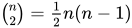
In any dimension, assuming a nondegenerate form, grad of a scalar function is a vector field, and div of a vector field is a scalar function, but only in dimension 3 or 7[6] (and, trivially, in dimension 0 or 1) is the curl of a vector field a vector field, and only in 3 or 7 dimensions can a cross product be defined (generalizations in other dimensionalities either require n − 1 {\displaystyle n-1} {\displaystyle n-1} vectors to yield 1 vector, or are alternative Lie algebras, which are more general antisymmetric bilinear products). The generalization of grad and div, and how curl may be generalized is elaborated at Curl § Generalizations; in brief, the curl of a vector field is a bivector field, which may be interpreted as the special orthogonal Lie algebra of infinitesimal rotations; however, this cannot be identified with a vector field because the dimensions differ – there are 3 dimensions of rotations in 3 dimensions, but 6 dimensions of rotations in 4 dimensions (and more generally ( n 2 ) = 1 2 n ( n − 1 ) {\displaystyle \textstyle {{\binom {n}{2}}={\frac {1}{2}}n(n-1)}} {\displaystyle \textstyle {{\binom {n}{2}}={\frac {1}{2}}n(n-1)}} dimensions of rotations in n dimensions).

There are two important alternative generalizations of vector calculus. The first, geometric algebra, uses k-vector fields instead of vector fields (in 3 or fewer dimensions, every k-vector field can be identified with a scalar function or vector field, but this is not true in higher dimensions). This replaces the cross product, which is specific to 3 dimensions, taking in two vector fields and giving as output a vector field, with the exterior product, which exists in all dimensions and takes in two vector fields, giving as output a bivector (2-vector) field. This product yields Clifford algebras as the algebraic structure on vector spaces (with an orientation and nondegenerate form). Geometric algebra is mostly used in generalizations of physics and other applied fields to higher dimensions.

The second generalization uses differential forms (k-covector fields) instead of vector fields or k-vector fields, and is widely used in mathematics, particularly in differential geometry, geometric topology, and harmonic analysis, in particular yielding Hodge theory on oriented pseudo-Riemannian manifolds. From this point of view, grad, curl, and div correspond to the exterior derivative of 0-forms, 1-forms, and 2-forms, respectively, and the key theorems of vector calculus are all special cases of the general form of Stokes' theorem.

From the point of view of both of these generalizations, vector calculus implicitly identifies mathematically distinct objects, which makes the presentation simpler but the underlying mathematical structure and generalizations less clear. From the point of view of geometric algebra, vector calculus implicitly identifies k-vector fields with vector fields or scalar functions: 0-vectors and 3-vectors with scalars, 1-vectors and 2-vectors with vectors. From the point of view of differential forms, vector calculus implicitly identifies k-forms with scalar fields or vector fields: 0-forms and 3-forms with scalar fields, 1-forms and 2-forms with vector fields. Thus for example the curl naturally takes as input a vector field or 1-form, but naturally has as output a 2-vector field or 2-form (hence pseudovector field), which is then interpreted as a vector field, rather than directly taking a vector field to a vector field; this is reflected in the curl of a vector field in higher dimensions not having as output a vector field.

See also

[edit]
  • iconMathematics portal
  • Vector calculus identities
  • Vector algebra relations
  • Directional derivative
  • Conservative vector field
  • Solenoidal vector field
  • Laplacian vector field
  • Helmholtz decomposition
  • Tensor
  • Geometric calculus

References

[edit]

Citations

[edit]
  1. ^ Kreyszig, Erwin; Kreyszig, Herbert; Norminton, E. J. (2011). Advanced Engineering Mathematics (10th ed.). Hoboken, NJ: John Wiley. ISBN 978-0-470-45836-5.
  2. ^ Rowlands, Peter (2017). Newton and the Great World System. World Scientific Publishing. pp. 26, 82–83. doi:10.1142/q0108. ISBN 978-1-78634-372-7.
  3. ^ Galbis, Antonio; Maestre, Manuel (2012). Vector Analysis Versus Vector Calculus. Springer. p. 12. ISBN 978-1-4614-2199-3.
  4. ^ "Differential Operators". Math24. Retrieved 2020-09-17.[permanent dead link]
  5. ^ Salma Jama; Fantice Lin (2025-05-31). "Exploring 3-Manifolds" (PDF).
  6. ^ Lizhong Peng & Lei Yang (1999) "The curl in seven dimensional space and its applications", Approximation Theory and Its Applications 15(3): 66 to 80 doi:10.1007/BF02837124

Sources

[edit]
  • Sandro Caparrini (2002) "The discovery of the vector representation of moments and angular velocity", Archive for History of Exact Sciences 56:151–81.
  • Crowe, Michael J. (1967). A History of Vector Analysis : The Evolution of the Idea of a Vectorial System (reprint ed.). Dover Publications. ISBN 978-0-486-67910-5.
  • Marsden, J. E. (1976). Vector Calculus. W. H. Freeman & Company. ISBN 978-0-7167-0462-1.
  • Schey, H. M. (2005). Div Grad Curl and all that: An informal text on vector calculus. W. W. Norton & Company. ISBN 978-0-393-92516-6.
  • Barry Spain (1965) Vector Analysis, 2nd edition, link from Internet Archive.
  • Chen-To Tai (1995). A historical study of vector analysis. Technical Report RL 915, Radiation Laboratory, University of Michigan.

External links

[edit]
  • The Feynman Lectures on Physics Vol. II Ch. 2: Differential Calculus of Vector Fields
  • "Vector analysis", Encyclopedia of Mathematics, EMS Press, 2001 [1994]
  • "Vector algebra", Encyclopedia of Mathematics, EMS Press, 2001 [1994]
  • A survey of the improper use of ∇ in vector analysis (1994) Tai, Chen-To
  • Vector Analysis: A Text-book for the Use of Students of Mathematics and Physics, (based upon the lectures of Willard Gibbs) by Edwin Bidwell Wilson, published 1902.
  • v
  • t
  • e
Major topics in mathematical analysis
  • Calculus: Integration
  • Differentiation
  • Differential equations
    • ordinary
    • partial
    • stochastic
  • Fundamental theorem of calculus
  • Calculus of variations
  • Vector calculus
  • Tensor calculus
  • Matrix calculus
  • Lists of integrals
  • Table of derivatives
  • Real analysis
  • Complex analysis
  • Hypercomplex analysis (quaternionic analysis)
  • Functional analysis
  • Fourier analysis
  • Least-squares spectral analysis
  • Harmonic analysis
  • P-adic analysis (P-adic numbers)
  • Measure theory
  • Representation theory
  • Functions
  • Continuous function
  • Special functions
  • Limit
  • Series
  • Infinity
Mathematics portal
  • v
  • t
  • e
Industrial and applied mathematics
Computational
  • Algorithms
    • design
    • analysis
  • Automata theory
  • Automated theorem proving
  • Coding theory
  • Computational geometry
  • Constraint satisfaction
    • Constraint programming
  • Computational logic
  • Cryptography
  • Information theory
  • Statistics
Mathematical
software
  • Arbitrary-precision arithmetic
  • Finite element analysis
  • Tensor software
  • Interactive geometry software
  • Optimization software
  • Statistical software
  • Numerical-analysis software
  • Numerical libraries
  • Solvers
Discrete
  • Computer algebra
  • Computational number theory
  • Combinatorics
  • Graph theory
  • Discrete geometry
Analysis
  • Approximation theory
  • Clifford analysis
    • Clifford algebra
  • Differential equations
    • Ordinary differential equations
    • Partial differential equations
    • Stochastic differential equations
  • Differential geometry
    • Differential forms
    • Gauge theory
    • Geometric analysis
  • Dynamical systems
    • Chaos theory
    • Control theory
  • Functional analysis
    • Operator algebra
    • Operator theory
  • Harmonic analysis
    • Fourier analysis
  • Multilinear algebra
    • Exterior
    • Geometric
    • Tensor
    • Vector
  • Multivariable calculus
    • Exterior
    • Geometric
    • Tensor
    • Vector
  • Numerical analysis
    • Numerical linear algebra
    • Numerical methods for ordinary differential equations
    • Numerical methods for partial differential equations
    • Validated numerics
  • Variational calculus
Probability theory
  • Distributions (random variables)
  • Stochastic processes / analysis
  • Path integral
  • Stochastic variational calculus
Mathematical
physics
  • Analytical mechanics
    • Lagrangian
    • Hamiltonian
  • Field theory
    • Classical
    • Conformal
    • Effective
    • Gauge
    • Quantum
    • Statistical
    • Topological
  • Perturbation theory
    • in quantum mechanics
  • Potential theory
  • String theory
    • Bosonic
    • Topological
  • Supersymmetry
    • Supersymmetric quantum mechanics
    • Supersymmetric theory of stochastic dynamics
Algebraic
structures
  • Algebra of physical space
  • Particle physics and representation theory
  • Feynman integral
  • Poisson algebra
  • Quantum group
  • Renormalization group
  • Spacetime algebra
  • Superalgebra
  • Supersymmetry algebra
Decision sciences
  • Game theory
  • Operations research
  • Optimization
  • Social choice theory
  • Statistics
  • Mathematical economics
  • Mathematical finance
Other applications
  • Biology
  • Chemistry
  • Psychology
  • Sociology
  • "The Unreasonable Effectiveness of Mathematics in the Natural Sciences"
Related
  • Mathematics
Organizations
  • Society for Industrial and Applied Mathematics
    • Japan Society for Industrial and Applied Mathematics
  • Société de Mathématiques Appliquées et Industrielles
  • International Council for Industrial and Applied Mathematics
  • European Community on Computational Methods in Applied Sciences
  • Category
  • Mathematics portal / outline / topics list
  • v
  • t
  • e
Calculus
Precalculus
  • Binomial theorem
  • Concave function
  • Continuous function
  • Factorial
  • Finite difference
  • Free variables and bound variables
  • Graph of a function
  • Linear function
  • Radian
  • Rolle's theorem
  • Secant
  • Slope
  • Tangent
Limits
  • Indeterminate form
  • Limit of a function
    • One-sided limit
  • Limit of a sequence
  • Order of approximation
  • (ε, δ)-definition of limit
Differential calculus
  • Derivative
  • Second derivative
  • Partial derivative
  • Differential
  • Differential operator
  • Mean value theorem
  • Notation
    • Leibniz's notation
    • Newton's notation
  • Rules of differentiation
    • linearity
    • Power
    • Sum
    • Chain
    • L'Hôpital's
    • Product
      • General Leibniz's rule
    • Quotient
  • Other techniques
    • Implicit differentiation
    • Inverse function rule
    • Logarithmic derivative
    • Related rates
  • Stationary points
    • First derivative test
    • Second derivative test
    • Extreme value theorem
    • Maximum and minimum
  • Further applications
    • Newton's method
    • Taylor's theorem
  • Differential equation
    • Ordinary differential equation
    • Partial differential equation
    • Stochastic differential equation
Integral calculus
  • Antiderivative
  • Arc length
  • Riemann integral
  • Basic properties
  • Constant of integration
  • Fundamental theorem of calculus
    • Differentiating under the integral sign
  • Integration by parts
  • Integration by substitution
    • trigonometric
    • Euler
    • Tangent half-angle substitution
  • Partial fractions in integration
    • Quadratic integral
  • Trapezoidal rule
  • Volumes
    • Washer method
    • Shell method
  • Integral equation
  • Integro-differential equation
Vector calculus
  • Derivatives
    • Curl
    • Directional derivative
    • Divergence
    • Gradient
    • Laplacian
  • Basic theorems
    • Line integrals
    • Green's
    • Stokes'
    • Gauss'
Multivariable calculus
  • Divergence theorem
  • Geometric
  • Hessian matrix
  • Jacobian matrix and determinant
  • Lagrange multiplier
  • Line integral
  • Matrix
  • Multiple integral
  • Partial derivative
  • Surface integral
  • Volume integral
  • Advanced topics
    • Differential forms
    • Exterior derivative
    • Generalized Stokes' theorem
    • Tensor calculus
Sequences and series
  • Arithmetico-geometric sequence
  • Types of series
    • Alternating
    • Binomial
    • Fourier
    • Geometric
    • Harmonic
    • Infinite
    • Power
      • Maclaurin
      • Taylor
    • Telescoping
  • Tests of convergence
    • Abel's
    • Alternating series
    • Cauchy condensation
    • Direct comparison
    • Dirichlet's
    • Integral
    • Limit comparison
    • Ratio
    • Root
    • Term
Special functions
and numbers
  • Bernoulli numbers
  • e (mathematical constant)
  • Exponential function
  • Natural logarithm
  • Stirling's approximation
History of calculus
  • Adequality
  • Brook Taylor
  • Colin Maclaurin
  • Generality of algebra
  • Gottfried Wilhelm Leibniz
  • Infinitesimal
  • Infinitesimal calculus
  • Isaac Newton
  • Fluxion
  • Law of Continuity
  • Leonhard Euler
  • Method of Fluxions
  • The Method of Mechanical Theorems
Lists
Integrals
  • rational functions
  • irrational algebraic functions
  • exponential functions
  • logarithmic functions
  • hyperbolic functions
    • inverse
  • trigonometric functions
    • inverse
    • Secant
    • Secant cubed
  • List of limits
  • List of derivatives
Miscellaneous topics
  • Complex calculus
    • Contour integral
  • Differential geometry
    • Manifold
    • Curvature
    • of curves
    • of surfaces
    • Tensor
  • Euler–Maclaurin formula
  • Gabriel's horn
  • Integration Bee
  • Proof that 22/7 exceeds π
  • Regiomontanus' angle maximization problem
  • Steinmetz solid
Authority control databases Edit this at Wikidata
International
  • GND
National
  • United States
  • Japan
  • Czech Republic
    • 2
Retrieved from "https://teknopedia.ac.id/w/index.php?title=Vector_calculus&oldid=1328562951"
Categories:
  • Vector calculus
  • Mathematical physics
Hidden categories:
  • All articles with dead external links
  • Articles with dead external links from July 2025
  • Articles with permanently dead external links
  • Articles with short description
  • Short description matches Wikidata
  • Articles lacking in-text citations from February 2016
  • All articles lacking in-text citations
  • Pages using sidebar with the child parameter
  • Articles needing additional references from August 2019
  • All articles needing additional references

  • indonesia
  • Polski
  • العربية
  • Deutsch
  • English
  • Español
  • Français
  • Italiano
  • مصرى
  • Nederlands
  • 日本語
  • Português
  • Sinugboanong Binisaya
  • Svenska
  • Українська
  • Tiếng Việt
  • Winaray
  • 中文
  • Русский
Sunting pranala
url url url url url url url url url url url url url url url url url url url url url url url url url url url url url url url url url url url url url url url url url url url url url url url url url url url url url url url url url url url url url url url url url url url url url url url url url url url url url url url url url url url url url url url url url url url url url url url url url url url url url url url url url url url url url url url url url url url url url url url url url url url url url url url url url url url url url url url url url url url url url url url url url url url url url url url url url url url url url url url url url url url url url url url url url url url url url url url url url url url url url url url url url url url url url url url url url url url url url url url url url url url url url url url url url url url url url url url url url url url url url url url url url url url url url url url url url url url url url url url url url url url url url url url url url url url url url url url url url url url url url url url url url url url url url url url url url url url url url url url url url url url url url url url url url url url url url url url url url url url url url url url url url url url url url url url url url url url url url url url url url url url url url url url url url url url url url url url url url url url url url url url url url url url url url url url url url url url url url url url url url url url url url url url url url url url url url url url url url url url url url url url url url url url url url url url url url url url url url url url url url url url url url url url url url url url url url url url url url url url url url url url url url url url url url url url url url url url url url url url url url url url url url url url url url url url url url url url url url url url url url url url url url url url url url url url url url url url url url url url url url url url url url url url url url url url url url url url url url url url url url url url url url url url url url url url url url url url url url url url url url url url url url url url url url url url url url url url url url url url url url url url url url url url url url url url url url url url url url url url url url url url url url url url url url url url url url url url url url url url url url url url url url url url url url url url url url url url url url url url url url url url url url url url url url url url url url url url url url url url url url url url url url url url url url url url url url url url url url url url url url url url url url url url url url url url url url url url url url url url url url url url url url url url url url url url url url url url url url url url url url url url url url url url url url url url url url url url url url url url url url url url url url url url url url url url url url url url url url url url url url url url url url url url url url url url url url url url url url url url url url url url url url url url url url url url url url url url url url url url url url url url url url url url url url url url url url url url url url url url url url url url url url url url url url url url url url url url url url url url url url url url url url url url url url url url url url url url url url url url url url url url url url url url url url url url url url url url url url url url url url url url url url url url url url url url url url url url url url url url url url url url url url url url url url url url url url url url url url url url url url url url url url url url url url url url url url url url url url url url url url url url url url url url url url url url url url url url url url url url url url url url url url url url url url url url url url url url url url url url url url url url url url url url url url url url url url url url url url url url url url url url url url url url url url url url url url url url url url url url url url url url url url url url url url url url url url url url url url url url url url url url url url url url url url url url url url url url url url url url url url url url url url url url url url url url url url url url url url url url url url url url url url url url url url url url url url url url url url url url url url url url url url url url url url url url url url url url url url url url url url url url url url url url url url url url url url url url url url url url url url url url url url url url url url url url url url url url url url url url url url url url url url url url url url url url url url url url url url url url url url url url url url url url url url url url url url url url url url url url url url url url url url url url url url url url url url url url url url url url url url url url url url url url url url url url url url url url url url url url url url url url url url url url url url url url url url url url url url url url url url url url url url url url url url url url url url url url url url url url url url url url url url url url url url url url url url url url url url url url url url url url url url url url url url url url url url url url url url url url url url url url url url url url url url url url url url url url url url url url url url url url url url url url url url url url url url url url url url url url url url url url url url url url url url url url url url url url url url url url url url url url url url url url url url url url url url url url url url url url url url url url url url url url url url url url url url url url url url url url url url url url url url url url url url url url url url url url url url url url url url url url url url url url url url url url url url url url url url url url url url url url url url url url url url url url url url url url url url url url url url url url url url url url url url url url url url url url url url url url url url url url url url url url url url url url url url url url url url url url url url url url url url url url url url url url url url url url url url url url url url url url url url url url url url url url url url url url url url url url url url url url url url url url url url url url url url url url url url url url url url url url url url url url url url url url url url url url url url url url url url url url url url url url url url url url url url url url url url url url url url url url url url url url url url url url url url url url url url url url url url url url url url url url url url url url url url url url url url url url url url url url url url url url url url url url url url url url url url url url url url url url url url url url url url url url url url url url url url url url url url url url url url url url url url url url url url url url url url url url url url url url url url url url url url url url url url url url url url url url url url url url url url url url url url url url url url url url url url url url url url url url url url url url url url url url url url url url url url url url url url url url url url url url url url url url url url url url url url url url url url url url url url url url url url url url url url url url url url url url url url url url url url url url url url url url url url url url url url url url url url url url url url url url url url url url url url url url url url url url url url url url url url url url url url url url url url url url url url url url url url url url url url url url url url url url url url url url url url url url url url url url url url url url url url url url url url url url url url url url url url url url url url url url url url url url url url url url url url url url url url url url url url url url url url url url url url url url url url url url url url url url url url url url url url url url url url url url url url url url url url url url url url url url url url url url url url url url url url url url url url url url url url url url url url url url url url url url url url url url url url url url url url url url url url url url url url url url url url url url url url url url url url url url url url url url url url url url url url url url url url url url url url url url url url url url url url url url url url url url url url url url url url url url url url url url url url url url url url url url url url url url url url url url url url url url url url url url url url url url url url url url url url url url url url url url url url url url url url url url url url url url url url url url url url url url url url url url url url url url url url url url url url url url url url url url url url url url url url url url url url url url url url url url url url url url url url url url url url url url url url url url url url url url url url url url url url url url url url url url url url url url url url url url url url url url url url url url url url url url url url url url url url url url url url url url url url url url url url url url url url url url url url url url url url url url url url url url url url url url url url url url url url url url url url url url url url url url url url url url url url url url url url url url url url url url url url url url url url url url url url url url url url url url url url url url url url url url url url url url url url url url url url url url url url url url url url url url url url url url url url url url url url url url url url url url url url url url url url url url url url url url url url url url url url url url url url url url url url url url url url url url url url url url url url url url url url url url url url url url url url url url url url url url url url url url url url url url url url url url url url url url url url url url url url url url url url url url url url url url url url url url url
Pusat Layanan

UNIVERSITAS TEKNOKRAT INDONESIA | ASEAN's Best Private University
Jl. ZA. Pagar Alam No.9 -11, Labuhan Ratu, Kec. Kedaton, Kota Bandar Lampung, Lampung 35132
Phone: (0721) 702022
Email: pmb@teknokrat.ac.id