

| Part of a series of articles about |
| Calculus |
|---|
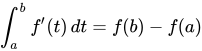
Fractional calculus is a branch of mathematical analysis that studies the several different possibilities of defining real number powers or complex number powers of the differentiation operator

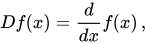
and of the integration operator [Note 1]


and developing a calculus for such operators generalizing the classical one.
In this context, the term powers refers to iterative application of a linear operator to a function , that is, repeatedly composing with itself, as in

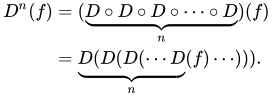
For example, one may ask for a meaningful interpretation of as an analogue of the functional square root for the differentiation operator, that is, an expression for some linear operator that, when applied twice to any function, will have the same effect as differentiation. More generally, one can look at the question of defining a linear operator for every real number in such a way that, when takes an integer value , it coincides with the usual -fold differentiation if , and with the -th power of when .


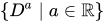
One of the motivations behind the introduction and study of these sorts of extensions of the differentiation operator is that the sets of operator powers defined in this way are continuous semigroups with parameter , of which the original discrete semigroup of for integer is a denumerable subgroup: since continuous semigroups have a well developed mathematical theory, they can be applied to other branches of mathematics.
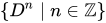
Fractional differential equations, also known as extraordinary differential equations,[1] are a generalization of differential equations through the application of fractional calculus.
Historical notes
In applied mathematics and mathematical analysis, a fractional derivative is a derivative of any arbitrary order, real or complex. Its first appearance is in a letter written to Guillaume de l'Hôpital by Gottfried Wilhelm Leibniz in 1695.[2] Around the same time, Leibniz wrote to Johann Bernoulli about derivatives of "general order".[3] In the correspondence between Leibniz and John Wallis in 1697, Wallis's infinite product for is discussed. Leibniz suggested using differential calculus to achieve this result. Leibniz further used the notation to denote the derivative of order 1/2.[3]


Fractional calculus was introduced in one of Niels Henrik Abel's early papers[4] where all the elements can be found: the idea of fractional-order integration and differentiation, the mutually inverse relationship between them, the understanding that fractional-order differentiation and integration can be considered as the same generalized operation, and the unified notation for differentiation and integration of arbitrary real order.[5] Independently, the foundations of the subject were laid by Liouville in a paper from 1832.[6][7][8] Oliver Heaviside introduced the practical use of fractional differential operators in electrical transmission line analysis circa 1890.[9] The theory and applications of fractional calculus expanded greatly over the 19th and 20th centuries, and numerous contributors have given different definitions for fractional derivatives and integrals.[10]
Computing the fractional integral
Let be a function defined for . Form the definite integral from 0 to . Call this


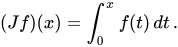
Repeating this process gives
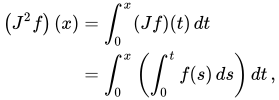
and this can be extended arbitrarily.
The Cauchy formula for repeated integration, namely leads in a straightforward way to a generalization for real n: using the gamma function to remove the discrete nature of the factorial function gives us a natural candidate for applications of the fractional integral operator as


This is in fact a well-defined operator.
It is straightforward to show that the J operator satisfies
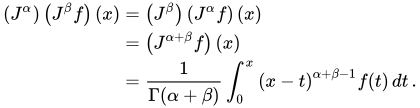
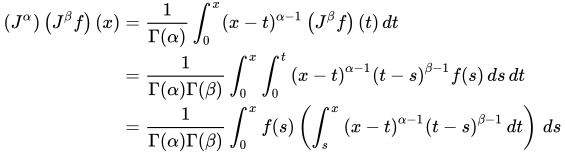
where in the last step we exchanged the order of integration and pulled out the f(s) factor from the t integration.
Changing variables to r defined by t = s + (x − s)r,

The inner integral is the beta function which satisfies the following property:

Substituting back into the equation:

Interchanging α and β shows that the order in which the J operator is applied is irrelevant and completes the proof.
This relationship is called the semigroup property of fractional differintegral operators.
Riemann–Liouville fractional integral
The classical form of fractional calculus is given by the Riemann–Liouville integral, which is essentially what has been described above. The theory of fractional integration for periodic functions (therefore including the "boundary condition" of repeating after a period) is given by the Weyl integral. It is defined on Fourier series, and requires the constant Fourier coefficient to vanish (thus, it applies to functions on the unit circle whose integrals evaluate to zero). The Riemann–Liouville integral exists in two forms, upper and lower. Considering the interval [a,b], the integrals are defined as
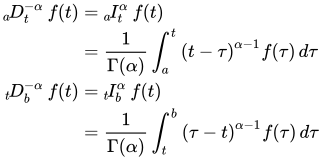
Where the former is valid for t > a and the latter is valid for t < b.[11]
It has been suggested[12] that the integral on the positive real axis (i.e. ) would be more appropriately named the Abel–Riemann integral, on the basis of history of discovery and use, and in the same vein the integral over the entire real line be named Liouville–Weyl integral.

By contrast the Grünwald–Letnikov derivative starts with the derivative instead of the integral.
Hadamard fractional integral
The Hadamard fractional integral was introduced by Jacques Hadamard[13] and is given by the following formula,

Atangana–Baleanu fractional integral (AB fractional integral)
The Atangana–Baleanu fractional integral of a continuous function is defined as:

Fractional derivatives
Unfortunately, the comparable process for the derivative operator D is significantly more complex, but it can be shown that D is neither commutative nor additive in general.[14]
Unlike classical Newtonian derivatives, fractional derivatives can be defined in a variety of different ways that often do not all lead to the same result even for smooth functions. Some of these are defined via a fractional integral. Because of the incompatibility of definitions, it is frequently necessary to be explicit about which definition is used.

Riemann–Liouville fractional derivative
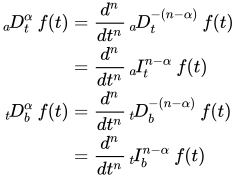
The corresponding derivative is calculated using Lagrange's rule for differential operators. To find the αth order derivative, the nth order derivative of the integral of order (n − α) is computed, where n is the smallest integer greater than α (that is, n = ⌈α⌉). The Riemann–Liouville fractional derivative and integral has multiple applications, such as in case of solutions to the equation in the case of multiple systems such as the tokamak systems, and variable order fractional parameter.[15][16] Similar to the definitions for the Riemann–Liouville integral, the derivative has upper and lower variants.[17]
Caputo fractional derivative
Another option for computing fractional derivatives is the Caputo fractional derivative. It was introduced by Michele Caputo in his 1967 paper.[18] In contrast to the Riemann–Liouville fractional derivative, when solving differential equations using Caputo's definition, it is not necessary to define the fractional order initial conditions. Caputo's definition is illustrated as follows, where again n = ⌈α⌉:

There is the Caputo fractional derivative defined as: which has the advantage that it is zero when f(t) is constant and its Laplace Transform is expressed by means of the initial values of the function and its derivative. Moreover, there is the Caputo fractional derivative of distributed order defined as

![{\displaystyle {\begin{aligned}\sideset {_{a}^{b}}{^{n}u}Df(t)&=\int _{a}^{b}\phi (\nu )\left[D^{(\nu )}f(t)\right]\,d\nu \\&=\int _{a}^{b}\left[{\frac {\phi (\nu )}{\Gamma (1-\nu )}}\int _{0}^{t}\left(t-u\right)^{-\nu }f'(u)\,du\right]\,d\nu \end{aligned}}}](https://wikimedia.org/api/rest_v1/media/math/render/svg/50d42263d28b3965e20b9d49daadc8625ce5432e)
where ϕ(ν) is a weight function and which is used to represent mathematically the presence of multiple memory formalisms.
Caputo–Fabrizio fractional derivative
In a paper of 2015, M. Caputo and M. Fabrizio presented a definition of fractional derivative with a non singular kernel, for a function of given by:



where .[19]
![{\displaystyle a<0,\alpha \in (0,1]}](https://wikimedia.org/api/rest_v1/media/math/render/svg/191e796c1152367c593e26bced3b6bf24171e6b9)
Atangana–Baleanu fractional derivative
In 2016, Atangana and Baleanu suggested differential operators based on the generalized Mittag-Leffler function . The aim was to introduce fractional differential operators with non-singular nonlocal kernel. Their fractional differential operators are given below in Riemann–Liouville sense and Caputo sense respectively. For a function of given by [20][21]


If the function is continuous, the Atangana–Baleanu derivative in Riemann–Liouville sense is given by:

The kernel used in Atangana–Baleanu fractional derivative has some properties of a cumulative distribution function. For example, for all , the function is increasing on the real line, converges to in , and . Therefore, we have that, the function is the cumulative distribution function of a probability measure on the positive real numbers. The distribution is therefore defined, and any of its multiples is called a Mittag-Leffler distribution of order . It is also well-known that all these probability distributions are absolutely continuous. In particular, the Mittag-Leffler function has a particular case , which is the exponential function, the Mittag-Leffler distribution of order is therefore an exponential distribution. However, for , the Mittag-Leffler distributions are heavy-tailed. Their Laplace transform is given by:
![{\displaystyle \alpha \in (0,1]}](https://wikimedia.org/api/rest_v1/media/math/render/svg/3ea174265d33ba6eed47a00e6ebffedda57cb03e)





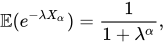
This directly implies that, for , the expectation is infinite. In addition, these distributions are geometric stable distributions.
Riesz derivative
The Riesz derivative is defined as

where denotes the Fourier transform.[22][23]

Conformable fractional derivative
The conformable fractional derivative of a function of order is given by Unlike other definitions of the fractional derivative, the conformable fractional derivative obeys the product and quotient rule has analogs to Rolle's theorem and the mean value theorem.[24][25] However, this fractional derivative produces significantly different results compared to the Riemann-Liouville and Caputo fractional derivative. In 2020, Feng Gao and Chunmei Chi defined the improved Caputo-type conformable fractional derivative, which more closely approximates the behavior of the Caputo fractional derivative:[25]where and are real numbers and . They also defined the improved Riemann-Liouville-type conformable fractional derivative to similarly approximate the Riemann-Liouville fractional derivative:[25]

![{\displaystyle _{a}^{C}{\widetilde {T}}_{\alpha }(f)(t)=\lim _{\epsilon \rightarrow 0}\left[(1-\alpha )(f(t)-f(a))+\alpha {\frac {f\left(t+\epsilon (t-a)^{1-\alpha }\right)-f(t)}{\epsilon }}\right]}](https://wikimedia.org/api/rest_v1/media/math/render/svg/fd1edfff7584d3d73346764f5d12fbdea7c0adf9)


where and are real numbers and . Both improved conformable fractional derivatives have analogs to Rolle's theorem and the interior extremum theorem.[26]
![{\displaystyle _{a}^{RL}{\widetilde {T}}_{\alpha }(f)(t)=\lim _{\epsilon \rightarrow 0}\left[(1-\alpha )f(t)+\alpha {\frac {f\left(t+\epsilon (t-a)^{1-\alpha }\right)-f(t)}{\epsilon }}\right]}](https://wikimedia.org/api/rest_v1/media/math/render/svg/d68e78e56b3b5c44d923df681601487bf4d5ac04)
Other types
Classical fractional derivatives include:
- Grünwald–Letnikov derivative[27][28]
- Sonin–Letnikov derivative[28]
- Liouville derivative[27]
- Caputo derivative[27]
- Hadamard derivative[27][29]
- Marchaud derivative[27]
- Riesz derivative[28]
- Miller–Ross derivative[27]
- Weyl derivative[30][31][27]
- Erdélyi–Kober derivative[27]
- -derivative[32]

New fractional derivatives include:
- Coimbra derivative[27]
- Katugampola derivative[33]
- Hilfer derivative[27]
- Davidson derivative[27]
- Chen derivative[27]
- Caputo-Fabrizio derivative[20][34]
- Atangana–Baleanu derivative[20][21]
Novel fractional derivatives with nonsingular kernels, namely the Caputo-Fabrizio and Atangana–Baleanu derivatives, are subject to controversy in applied mathematics literature.[35][36] Criticism is leveled against the validity and applications of these derivatives, with critics arguing these derivatives to be simple realizations of either integer derivatives or standard Caputo fractional derivatives, or incompatible with the fundamental theorem of fractional calculus.[37][38][39]
On the other hand, subsequent work has argued that the claim that fractional derivatives with continuous (non-singular) kernels are too restrictive is a consequence of initializing fractional differential equations using single-time values instead of past histories. Since memory is an intrinsic property of fractional models, such initialization is physically and mathematically inconsistent. When the model past is treated correctly, the alleged incompatibilities of nonsingular kernels no longer arise. The paper concludes that the limitations attributed to operators such as the Caputo–Fabrizio and Atangana–Baleanu derivatives stem from modeling assumptions, not from the operators.[40]
In applied settings, fractional operators with non-singular kernels have demonstrated utility in modeling complex physical systems. For instance, a study on anomalous diffusion in electrolytic cells found that models incorporating derivatives based on the Mittag-Leffler function a class of non-singular kernels provided a superior fit to experimental impedance spectroscopy data compared to models using the classical singular Caputo derivative. This result highlights the practical value of these operators for capturing memory effects and anomalous transport in real-world materials.[41] Based on the 2017 study by Tateishi, Ribeiro, and Lenzi, fractional operators with non-singular kernels provide distinct mechanisms for modeling anomalous diffusion. The Atangana–Baleanu–Caputo (ABC) operator, with its Mittag-Leffler kernel, yields a crossover from usual to sub-diffusive dynamics, matching patterns observed in complex systems like biological cells. In contrast, the Caputo–Fabrizio (CF) operator, with an exponential kernel, leads to a different crossover from diffusion to a confined stationary state, which is mathematically equivalent to a diffusion process with stochastic resetting.[42]
To reply to the criticism regarding the mathematical definition of their operator, Caputo and Fabrizio have argued that when their derivative is correctly defined over an interval [a,t) that accounts for the system's pre-history, it can be represented in an equivalent form that includes a singular kernel and is capable of modeling complex material behaviors like viscoplasticity.[43]
Relation with the Caputo derivative
The Atangana–Baleanu fractional derivative in the Caputo sense (ABC) is structurally different from the classical Caputo fractional derivative. In particular, the ABC operator can be written as a convolution of the Caputo derivative with a nontrivial Mittag–Leffler kernel, which shows that it is not a simple rescaling of the Caputo operator.
For and , the Laplace transform of the Caputo derivative is where . The ABC derivative satisfies


Hence,

By inversion, the ABC derivative admits the convolution form with kernel where denotes the two-parameter Mittag–Leffler function.


Since the kernel is not a Dirac delta distribution, the ABC operator is not a scalar multiple of the Caputo operator.
Comparison of eigenfunction properties
Caputo derivative
For and , the Caputo fractional derivative is defined by


The one-parameter Mittag-Leffler function

satisfies the eigenfunction equation

Atangana–Baleanu derivative (Caputo sense)
With the choice for the normalisation constant, the Atangana–Baleanu derivative in the Caputo sense (ABC derivative) is defined by


Its Laplace transform is
={\frac {1}{1-\alpha }}{\frac {s^{\alpha }}{s^{\alpha }+\lambda }}{\bigl (}sF(s)-f(0){\bigr )},}](https://wikimedia.org/api/rest_v1/media/math/render/svg/eaf8c1ef71b364826719531e0a5280fde7a4a0cb)
where .
Applying this operator to gives


and therefore
={\frac {1}{1-\alpha }}{\frac {s^{\alpha }}{s^{\alpha }+\lambda }}\left({\frac {s^{\alpha }}{s^{\alpha }-\mu }}-1\right)={\frac {1}{1-\alpha }}{\frac {\mu s^{\alpha }}{(s^{\alpha }-\mu )(s^{\alpha }+\lambda )}}.}](https://wikimedia.org/api/rest_v1/media/math/render/svg/3aa09e336993504683174a96ec8535d069ad86e6)
Partial fraction decomposition in the variable yields


Hence,
={\frac {\mu }{1-\alpha }}\left({\frac {\mu }{\mu +\lambda }}{\frac {1}{s^{\alpha }-\mu }}+{\frac {\lambda }{\mu +\lambda }}{\frac {1}{s^{\alpha }+\lambda }}\right).}](https://wikimedia.org/api/rest_v1/media/math/render/svg/ba24fc754f8fdbe36af10b2fa34e32d97f018951)
Using the inverse Laplace transform identity

where the two-parameter Mittag-Leffler function is defined by

one obtains the exact time-domain expression

Consequence
The resulting expression is not proportional to . Therefore, unlike the Caputo derivative, the ABC derivative does not admit the one-parameter Mittag-Leffler function as an eigenfunction.

Consequently, except in the limiting cases or , the ABC derivative cannot be expressed as a scalar multiple (depending only on ) of the Caputo derivative.


Coimbra derivative
The Coimbra derivative is used for physical modeling:[44] A number of applications in both mechanics and optics can be found in the works by Coimbra and collaborators,[45][46][47][48][49][50][51] as well as additional applications to physical problems and numerical implementations studied in a number of works by other authors[52][53][54][55]
For where the lower limit can be taken as either or as long as is identically zero from or to . Note that this operator returns the correct fractional derivatives for all values of and can be applied to either the dependent function itself with a variable order of the form or to the independent variable with a variable order of the form .

![{\displaystyle {\begin{aligned}^{\mathbb {C} }_{a}\mathbb {D} ^{q(t)}f(t)={\frac {1}{\Gamma [1-q(t)]}}\int _{0^{+}}^{t}(t-\tau )^{-q(t)}{\frac {d\,f(\tau )}{d\tau }}d\tau \,+\,{\frac {(f(0^{+})-f(0^{-}))\,t^{-q(t)}}{\Gamma (1-q(t))}},\end{aligned}}}](https://wikimedia.org/api/rest_v1/media/math/render/svg/b86ef386ed041f1f311995e8445ae3966aae5c81)


![{\displaystyle ^{[1]}}](https://wikimedia.org/api/rest_v1/media/math/render/svg/c97b3809485cd490e1a61475329776d6b0efee76)
The Coimbra derivative can be generalized to any order,[56] leading to the Coimbra Generalized Order Differintegration Operator (GODO)[57] For where is an integer larger than the larger value of for all values of . Note that the second (summation) term on the right side of the definition above can be expressed as

![{\displaystyle {\begin{aligned}^{\mathbb {\quad C} }_{\,\,-\infty }\mathbb {D} ^{q(t)}f(t)={\frac {1}{\Gamma [m-q(t)]}}\int _{0^{+}}^{t}(t-\tau )^{m-1-q(t)}{\frac {d^{m}f(\tau )}{d\tau ^{m}}}d\tau \,+\,\sum _{n=0}^{m-1}{\frac {({\frac {d^{n}f(t)}{dt^{n}}}|_{0^{+}}-{\frac {d^{n}f(t)}{dt^{n}}}|_{0^{-}})\,t^{n-q(t)}}{\Gamma [n+1-q(t)]}},\end{aligned}}}](https://wikimedia.org/api/rest_v1/media/math/render/svg/7c269b204f85974c9be81014f037ea5ef374a62c)

so to keep the denominator on the positive branch of the Gamma () function and for ease of numerical calculation.
![{\displaystyle {\begin{aligned}{\frac {1}{\Gamma [m-q(t)]}}\sum _{n=0}^{m-1}\{[{\frac {d^{n}\!f(t)}{dt^{n}}}|_{0^{+}}-{\frac {d^{n}\!f(t)}{dt^{n}}}|_{0^{-}}]\,t^{n-q(t)}\prod _{j=n+1}^{m-1}[j-q(t)]\}\end{aligned}}}](https://wikimedia.org/api/rest_v1/media/math/render/svg/40ed12d6afff071f04afe1bc677ef43225ac4b82)

Nature of the fractional derivative
The -th derivative of a function at a point is a local property only when is an integer; this is not the case for non-integer power derivatives. In other words, a non-integer fractional derivative of at depends on all values of , even those far away from . Therefore, it is expected that the fractional derivative operation involves some sort of boundary conditions, involving information on the function further out.[58]


The fractional derivative of a function of order is nowadays often defined by means of the Fourier or Mellin integral transforms.[59][citation needed]
Generalizations
Erdélyi–Kober operator
The Erdélyi–Kober operator is an integral operator introduced by Arthur Erdélyi (1940).[60] and Hermann Kober (1940)[61] and is given by

which generalizes the Riemann–Liouville fractional integral and the Weyl integral.
Functional calculus
In the context of functional analysis, functions f(D) more general than powers are studied in the functional calculus of spectral theory. The theory of pseudo-differential operators also allows one to consider powers of D. The operators arising are examples of singular integral operators; and the generalisation of the classical theory to higher dimensions is called the theory of Riesz potentials. So there are a number of contemporary theories available, within which fractional calculus can be discussed.
Applications
Fractional conservation of mass
As described by Wheatcraft and Meerschaert (2008),[63] a fractional conservation of mass equation is needed to model fluid flow when the control volume is not large enough compared to the scale of heterogeneity and when the flux within the control volume is non-linear. In the referenced paper, the fractional conservation of mass equation for fluid flow is:

Electrochemical analysis
When studying the redox behavior of a substrate in solution, a voltage is applied at an electrode surface to force electron transfer between electrode and substrate. The resulting electron transfer is measured as a current. The current depends upon the concentration of substrate at the electrode surface. As substrate is consumed, fresh substrate diffuses to the electrode as described by Fick's laws of diffusion. Taking the Laplace transform of Fick's second law yields an ordinary second-order differential equation (here in dimensionless form):
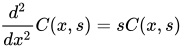
whose solution C(x,s) contains a one-half power dependence on s. Taking the derivative of C(x,s) and then the inverse Laplace transform yields the following relationship:
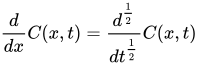
which relates the concentration of substrate at the electrode surface to the current.[64] This relationship is applied in electrochemical kinetics to elucidate mechanistic behavior. For example, it has been used to study the rate of dimerization of substrates upon electrochemical reduction.[65]
Groundwater flow problem
In 2013–2014 Atangana et al. described some groundwater flow problems using the concept of a derivative with fractional order.[66][67] In these works, the classical Darcy law is generalized by regarding the water flow as a function of a non-integer order derivative of the piezometric head. This generalized law and the law of conservation of mass are then used to derive a new equation for groundwater flow.
Fractional advection dispersion equation
This equation[clarification needed] has been shown useful for modeling contaminant flow in heterogenous porous media.[68][69][70]
Atangana and Kilicman extended the fractional advection dispersion equation to a variable order equation. In their work, the hydrodynamic dispersion equation was generalized using the concept of a variational order derivative. The modified equation was numerically solved via the Crank–Nicolson method. The stability and convergence in numerical simulations showed that the modified equation is more reliable in predicting the movement of pollution in deformable aquifers than equations with constant fractional and integer derivatives[71]
Time-space fractional diffusion equation models
Anomalous diffusion processes in complex media can be well characterized by using fractional-order diffusion equation models.[72][73] The time derivative term corresponds to long-time heavy tail decay and the spatial derivative for diffusion nonlocality. The time-space fractional diffusion governing equation can be written as
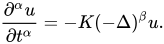
A simple extension of the fractional derivative is the variable-order fractional derivative, α and β are changed into α(x, t) and β(x, t). Its applications in anomalous diffusion modeling can be found in the reference.[71][74][75]
Structural damping models
Fractional derivatives are used to model viscoelastic damping in certain types of materials like polymers.[12]
PID controllers
Generalizing PID controllers to use fractional orders can increase their degree of freedom. The new equation relating the control variable u(t) in terms of a measured error value e(t) can be written as

where α and β are positive fractional orders and Kp, Ki, and Kd, all non-negative, denote the coefficients for the proportional, integral, and derivative terms, respectively (sometimes denoted P, I, and D).[76]
Acoustic wave equations for complex media
The propagation of acoustical waves in complex media, such as in biological tissue, commonly implies attenuation obeying a frequency power-law. This kind of phenomenon may be described using a causal wave equation which incorporates fractional time derivatives:

See also Holm & Näsholm (2011)[77] and the references therein. Such models are linked to the commonly recognized hypothesis that multiple relaxation phenomena give rise to the attenuation measured in complex media. This link is further described in Näsholm & Holm (2011b)[78] and in the survey paper,[79] as well as the Acoustic attenuation article. See Holm & Nasholm (2013)[80] for a paper which compares fractional wave equations which model power-law attenuation. This book on power-law attenuation also covers the topic in more detail.[81]
Pandey and Holm gave a physical meaning to fractional differential equations by deriving them from physical principles and interpreting the fractional-order in terms of the parameters of the acoustical media, example in fluid-saturated granular unconsolidated marine sediments.[82] Interestingly, Pandey and Holm derived Lomnitz's law in seismology and Nutting's law in non-Newtonian rheology using the framework of fractional calculus.[83] Nutting's law was used to model the wave propagation in marine sediments using fractional derivatives.[82]
Fractional Schrödinger equation in quantum theory
The fractional Schrödinger equation, a fundamental equation of fractional quantum mechanics, has the following form:[84][85]

where the solution of the equation is the wavefunction ψ(r, t) – the quantum mechanical probability amplitude for the particle to have a given position vector r at any given time t, and ħ is the reduced Planck constant. The potential energy function V(r, t) depends on the system.
Further, is the Laplace operator, and Dα is a scale constant with physical dimension [Dα] = J1 − α·mα·s−α = kg1 − α·m2 − α·sα − 2, (at α = 2, for a particle of mass m), and the operator (−ħ2Δ)α/2 is the 3-dimensional fractional quantum Riesz derivative defined by



The index α in the fractional Schrödinger equation is the Lévy index, 1 < α ≤ 2.
Variable-order fractional Schrödinger equation
As a natural generalization of the fractional Schrödinger equation, the variable-order fractional Schrödinger equation has been exploited to study fractional quantum phenomena:[86]

where is the Laplace operator and the operator (−ħ2Δ)β(t)/2 is the variable-order fractional quantum Riesz derivative.
See also
- Acoustic attenuation
- Autoregressive fractionally integrated moving average
- Initialized fractional calculus
- Nonlocal operator
Other fractional theories
Notes
- ^ The symbol is commonly used instead of the intuitive in order to avoid confusion with other concepts identified by similar –like glyphs, such as identities.

References
- ^ Daniel Zwillinger (12 May 2014). Handbook of Differential Equations. Elsevier Science. ISBN 978-1-4832-2096-3.
- ^ Katugampola, Udita N. (15 October 2014). "A New Approach To Generalized Fractional Derivatives" (PDF). Bulletin of Mathematical Analysis and Applications. 6 (4): 1–15. arXiv:1106.0965.
- ^ a b Miller, Kenneth S.; Ross, Bertram (1993). An Introduction to the Fractional Calculus and Fractional Differential Equations. New York: Wiley. pp. 1–2. ISBN 978-0-471-58884-9.
- ^ Niels Henrik Abel (1823). "Oplösning af et Par Opgaver ved Hjelp af bestemte Integraler (Solution de quelques problèmes à l'aide d'intégrales définies, Solution of a couple of problems by means of definite integrals)" (PDF). Magazin for Naturvidenskaberne. Kristiania (Oslo): 55–68.
- ^ Podlubny, Igor; Magin, Richard L.; Trymorush, Irina (2017). "Niels Henrik Abel and the birth of fractional calculus". Fractional Calculus and Applied Analysis. 20 (5): 1068–1075. arXiv:1802.05441. doi:10.1515/fca-2017-0057. S2CID 119664694.
- ^ Liouville, Joseph (1832), "Mémoire sur quelques questions de géométrie et de mécanique, et sur un nouveau genre de calcul pour résoudre ces questions", Journal de l'École Polytechnique, 13, Paris: 1–69.
- ^ Liouville, Joseph (1832), "Mémoire sur le calcul des différentielles à indices quelconques", Journal de l'École Polytechnique, 13, Paris: 71–162.
- ^ For the history of the subject, see the thesis (in French): Stéphane Dugowson, Les différentielles métaphysiques (histoire et philosophie de la généralisation de l'ordre de dérivation), Thèse, Université Paris Nord (1994)
- ^ For a historical review of the subject up to the beginning of the 20th century, see: Bertram Ross (1977). "The development of fractional calculus 1695–1900". Historia Mathematica. 4: 75–89. doi:10.1016/0315-0860(77)90039-8. S2CID 122146887.
- ^ Valério, Duarte; Machado, José; Kiryakova, Virginia (2014-01-01). "Some pioneers of the applications of fractional calculus". Fractional Calculus and Applied Analysis. 17 (2): 552–578. doi:10.2478/s13540-014-0185-1. hdl:10400.22/5491. ISSN 1314-2224. S2CID 121482200.
- ^ Hermann, Richard (2014). Fractional Calculus: An Introduction for Physicists (2nd ed.). New Jersey: World Scientific Publishing. p. 46. Bibcode:2014fcip.book.....H. doi:10.1142/8934. ISBN 978-981-4551-07-6.
- ^ a b Mainardi, Francesco (May 2010). Fractional Calculus and Waves in Linear Viscoelasticity. Imperial College Press. doi:10.1142/p614. ISBN 978-1-84816-329-4. S2CID 118719247.
- ^ Hadamard, J. (1892). "Essai sur l'étude des fonctions données par leur développement de Taylor" (PDF). Journal de Mathématiques Pures et Appliquées. 4 (8): 101–186.
- ^ Kilbas, A. Anatolii Aleksandrovich; Srivastava, Hari Mohan; Trujillo, Juan J. (2006). Theory And Applications of Fractional Differential Equations. Elsevier. p. 75 (Property 2.4). ISBN 978-0-444-51832-3.
- ^ Mostafanejad, Mohammad (2021). "Fractional paradigms in quantum chemistry". International Journal of Quantum Chemistry. 121 (20) e26762. doi:10.1002/qua.26762.
- ^ Al-Raeei, Marwan (2021). "Applying fractional quantum mechanics to systems with electrical screening effects". Chaos, Solitons & Fractals. 150 (September) 111209. Bibcode:2021CSF...15011209A. doi:10.1016/j.chaos.2021.111209.
- ^ Herrmann, Richard, ed. (2014). Fractional Calculus: An Introduction for Physicists (2nd ed.). New Jersey: World Scientific Publishing Co. p. 54[verification needed]. Bibcode:2014fcip.book.....H. doi:10.1142/8934. ISBN 978-981-4551-07-6.
- ^ Caputo, Michele (1967). "Linear model of dissipation whose Q is almost frequency independent. II". Geophysical Journal International. 13 (5): 529–539. Bibcode:1967GeoJ...13..529C. doi:10.1111/j.1365-246x.1967.tb02303.x..
- ^ Caputo, Michele; Fabrizio, Mauro (2015). "A new Definition of Fractional Derivative without Singular Kernel". Progress in Fractional Differentiation and Applications. 1 (2): 73–85. Retrieved 7 August 2020.
- ^ a b c Algahtani, Obaid Jefain Julaighim (2016-08-01). "Comparing the Atangana–Baleanu and Caputo–Fabrizio derivative with fractional order: Allen Cahn model". Chaos, Solitons & Fractals. Nonlinear Dynamics and Complexity. 89: 552–559. Bibcode:2016CSF....89..552A. doi:10.1016/j.chaos.2016.03.026. ISSN 0960-0779.
- ^ a b Atangana, Abdon; Baleanu, Dumitru (2016). "New fractional derivatives with nonlocal and non-singular kernel: Theory and application to heat transfer model". Thermal Science. 20 (2): 763–769. arXiv:1602.03408. doi:10.2298/TSCI160111018A. ISSN 0354-9836.
- ^ Chen, YangQuan; Li, Changpin; Ding, Hengfei (22 May 2014). "High-Order Algorithms for Riesz Derivative and Their Applications". Abstract and Applied Analysis. 2014: 1–17. doi:10.1155/2014/653797.
- ^ Bayın, Selçuk Ş. (5 December 2016). "Definition of the Riesz derivative and its application to space fractional quantum mechanics". Journal of Mathematical Physics. 57 (12) 123501. arXiv:1612.03046. Bibcode:2016JMP....57l3501B. doi:10.1063/1.4968819. S2CID 119099201.
- ^ Khalil, R.; Al Horani, M.; Yousef, A.; Sababheh, M. (2014-07-01). "A new definition of fractional derivative". Journal of Computational and Applied Mathematics. 264: 65–70. doi:10.1016/j.cam.2014.01.002. ISSN 0377-0427.
- ^ a b c Gao, Feng; Chi, Chunmei (2020). "Improvement on Conformable Fractional Derivative and Its Applications in Fractional Differential Equations". Journal of Function Spaces. 2020 (1) 5852414. doi:10.1155/2020/5852414. ISSN 2314-8888.
- ^ Hasanah, Dahliatul (2022-10-31). "On continuity properties of the improved conformable fractional derivatives". Jurnal Fourier. 11 (2): 88–96. doi:10.14421/fourier.2022.112.88-96. ISSN 2541-5239.
- ^ a b c d e f g h i j k l de Oliveira, Edmundo Capelas; Tenreiro Machado, José António (2014-06-10). "A Review of Definitions for Fractional Derivatives and Integral". Mathematical Problems in Engineering. 2014 238459: 1–6. doi:10.1155/2014/238459. hdl:10400.22/5497.
- ^ a b c Aslan, İsmail (2015-01-15). "An analytic approach to a class of fractional differential-difference equations of rational type via symbolic computation". Mathematical Methods in the Applied Sciences. 38 (1): 27–36. Bibcode:2015MMAS...38...27A. doi:10.1002/mma.3047. hdl:11147/5562. S2CID 120881978.
- ^ Ma, Li; Li, Changpin (2017-05-11). "On hadamard fractional calculus". Fractals. 25 (3): 1750033–2980. Bibcode:2017Fract..2550033M. doi:10.1142/S0218348X17500335. ISSN 0218-348X.
- ^ Miller, Kenneth S. (1975). "The Weyl fractional calculus". In Ross, Bertram (ed.). Fractional Calculus and Its Applications: Proceedings of the International Conference Held at the University of New Haven, June 1974. Lecture Notes in Mathematics. Vol. 457. Springer. pp. 80–89. doi:10.1007/bfb0067098. ISBN 978-3-540-69975-0.
- ^ Ferrari, Fausto (January 2018). "Weyl and Marchaud Derivatives: A Forgotten History". Mathematics. 6 (1): 6. arXiv:1711.08070. doi:10.3390/math6010006.
- ^ Khalili Golmankhaneh, Alireza (2022). Fractal Calculus and its Applications. Singapore: World Scientific Pub Co Inc. p. 328. doi:10.1142/12988. ISBN 978-981-126-110-7. S2CID 248575991.
- ^ Anderson, Douglas R.; Ulness, Darin J. (2015-06-01). "Properties of the Katugampola fractional derivative with potential application in quantum mechanics". Journal of Mathematical Physics. 56 (6): 063502. Bibcode:2015JMP....56f3502A. doi:10.1063/1.4922018. ISSN 0022-2488.
- ^ Caputo, Michele; Fabrizio, Mauro (2016-01-01). "Applications of New Time and Spatial Fractional Derivatives with Exponential Kernels". Progress in Fractional Differentiation and Applications. 2 (1): 1–11. doi:10.18576/pfda/020101. ISSN 2356-9336.
- ^ Diethelm, Kai; Kiryakova, Virginia; Luchko, Yuri; Tenreiro Machado, J. A.; Tarasov, Vasily E. (2020). "Trends, directions for further research, and some open problems of fractional calculus". Nonlinear Dynamics. 107: 3245–3270. arXiv:2108.04241. doi:10.1007/s11071-021-07158-9.
- ^ Luchko, Yuri (ed.). Fractional Integrals and Derivatives: "True" versus "False". MDPI. ISBN 978-3-0365-0495-7.
- ^ Giusti, Andrea (2018). "A comment on some new definitions of fractional derivative". Nonlinear Dynamics. 93: 1757–1763. arXiv:1710.06852. doi:10.1007/s11071-018-4289-8.
- ^ Diethelm, Kai; Garrappa, Roberto; Giusti, Andrea; Stynes, Martin (2020). "Why Fractional derivatives with nonsingular kernels should not be used". Fractional Calculus and Applied Analysis. 23: 610–634. arXiv:2006.15237. doi:10.1515/fca-2020-0032.
- ^ Hanyga, Andrzej (2020). "A comment on a controversial issue: A generalized fractional derivative cannot have a regular kernel". Fractional Calculus and Applied Analysis. 23: 211–223. arXiv:2003.04385. doi:10.1515/fca-2020-0008.
- ^ Sabatier, Jocelyn (2020). "Fractional-Order Derivatives Defined by Continuous Kernels: Are They Really Too Restrictive?". Fractal and Fractional. 4 (3): 40. doi:10.3390/fractalfract4030040.
- ^ Lenzi, E.K.; Guilherme, L.M.S.; da Silva, B.V.H.V.; Koltun, A.P.S.; Evangelista, L.R.; Zola, R.S. (2021). "Anomalous diffusion and electrical impedance response: Fractional operators with singular and non-singular kernels". Communications in Nonlinear Science and Numerical Simulation. 102 105907. doi:10.1016/j.cnsns.2021.105907.
- ^ Tateishi, Angel A.; Ribeiro, Haroldo V.; Lenzi, Ervin K. (2017). "The role of fractional time-derivative operators on anomalous diffusion". Frontiers in Physics. 5: 52. doi:10.3389/fphy.2017.00052.
- ^ Caputo, Michele; Fabrizio, Mauro (2021). "On the Singular Kernels for Fractional Derivatives. Some Applications to Partial Differential Equations". Progress in Fractional Differentiation and Applications. 7 (2): 79–82. doi:10.18576/pfda/070201.
- ^ C. F. M. Coimbra (2003) "Mechanics with Variable Order Differential Equations," Annalen der Physik (12), No. 11-12, pp. 692-703.
- ^ L. E. S. Ramirez, and C. F. M. Coimbra (2007) "A Variable Order Constitutive Relation for Viscoelasticity"– Annalen der Physik (16) 7-8, pp. 543-552.
- ^ H. T. C. Pedro, M. H. Kobayashi, J. M. C. Pereira, and C. F. M. Coimbra (2008) "Variable Order Modeling of Diffusive-Convective Effects on the Oscillatory Flow Past a Sphere" – Journal of Vibration and Control, (14) 9-10, pp. 1569-1672.
- ^ G. Diaz, and C. F. M. Coimbra (2009) "Nonlinear Dynamics and Control of a Variable Order Oscillator with Application to the van der Pol Equation" – Nonlinear Dynamics, 56, pp. 145—157.
- ^ L. E. S. Ramirez, and C. F. M. Coimbra (2010) "On the Selection and Meaning of Variable Order Operators for Dynamic Modeling"– International Journal of Differential Equations Vol. 2010, Article ID 846107.
- ^ L. E. S. Ramirez and C. F. M. Coimbra (2011) "On the Variable Order Dynamics of the Nonlinear Wake Caused by a Sedimenting Particle," Physica D (240) 13, pp. 1111-1118.
- ^ E. A. Lim, M. H. Kobayashi and C. F. M. Coimbra (2014) "Fractional Dynamics of Tethered Particles in Oscillatory Stokes Flows," Journal of Fluid Mechanics (746) pp. 606-625.
- ^ J. Orosco and C. F. M. Coimbra (2016) "On the Control and Stability of Variable Order Mechanical Systems" Nonlinear Dynamics, (86:1), pp. 695–710.
- ^ E. C. de Oliveira, J. A. Tenreiro Machado (2014), "A Review of Definitions for Fractional Derivatives and Integral", Mathematical Problems in Engineering, vol. 2014, Article ID 238459.
- ^ S. Shen, F. Liu, J. Chen, I. Turner, and V. Anh (2012) "Numerical techniques for the variable order time fractional diffusion equation" Applied Mathematics and Computation Volume 218, Issue 22, pp. 10861-10870.
- ^ H. Zhang and S. Shen, "The Numerical Simulation of Space-Time Variable Fractional Order Diffusion Equation," Numer. Math. Theor. Meth. Appl. Vol. 6, No. 4, pp. 571-585.
- ^ H. Zhang, F. Liu, M. S. Phanikumar, and M. M. Meerschaert (2013) "A novel numerical method for the time variable fractional order mobile-immobile advection-dispersion model," Computers & Mathematics with Applications, 66, issue 5, pp. 693–701.
- ^ C. F. M. Coimbra "Methods of using generalized order differentiation and integration of input variables to forecast trends," U.S. Patent Application 13,641,083 (2013).
- ^ J. Orosco and C. F. M. Coimbra (2018) "Variable-order Modeling of Nonlocal Emergence in Many-body Systems: Application to Radiative Dispersion," Physical Review E (98), 032208.
- ^ "Fractional Calculus". MathPages.com.
- ^ Závada, P. Operator of Fractional Derivative in the Complex Plane. Comm Math Phys 192, 261–285 (1998). https://doi.org/10.1007/s002200050299
- ^ Erdélyi, Arthur (1950–1951). "On some functional transformations". Rendiconti del Seminario Matematico dell'Università e del Politecnico di Torino. 10: 217–234. MR 0047818.
- ^ Kober, Hermann (1940). "On fractional integrals and derivatives". The Quarterly Journal of Mathematics. os-11 (1): 193–211. Bibcode:1940QJMat..11..193K. doi:10.1093/qmath/os-11.1.193.
- ^ Kober (1940); Erdélyi (1950–1951).
- ^ Wheatcraft, Stephen W.; Meerschaert, Mark M. (October 2008). "Fractional conservation of mass" (PDF). Advances in Water Resources. 31 (10): 1377–1381. Bibcode:2008AdWR...31.1377W. doi:10.1016/j.advwatres.2008.07.004. ISSN 0309-1708.
- ^ Oldham, K. B. Analytical Chemistry 44(1) 1972 196-198.
- ^ Pospíšil, L. et al. Electrochimica Acta 300 2019 284-289.
- ^ Atangana, Abdon; Bildik, Necdet (2013). "The Use of Fractional Order Derivative to Predict the Groundwater Flow". Mathematical Problems in Engineering. 2013: 1–9. doi:10.1155/2013/543026.
- ^ Atangana, Abdon; Vermeulen, P. D. (2014). "Analytical Solutions of a Space-Time Fractional Derivative of Groundwater Flow Equation". Abstract and Applied Analysis. 2014: 1–11. doi:10.1155/2014/381753.
- ^ Benson, D.; Wheatcraft, S.; Meerschaert, M. (2000). "Application of a fractional advection-dispersion equation". Water Resources Research. 36 (6): 1403–1412. Bibcode:2000WRR....36.1403B. CiteSeerX 10.1.1.1.4838. doi:10.1029/2000wr900031. S2CID 7669161.
- ^ Benson, D.; Wheatcraft, S.; Meerschaert, M. (2000). "The fractional-order governing equation of Lévy motion". Water Resources Research. 36 (6): 1413–1423. Bibcode:2000WRR....36.1413B. doi:10.1029/2000wr900032. S2CID 16579630.
- ^ Wheatcraft, Stephen W.; Meerschaert, Mark M.; Schumer, Rina; Benson, David A. (2001-01-01). "Fractional Dispersion, Lévy Motion, and the MADE Tracer Tests". Transport in Porous Media. 42 (1–2): 211–240. Bibcode:2001TPMed..42..211B. CiteSeerX 10.1.1.58.2062. doi:10.1023/A:1006733002131. ISSN 1573-1634. S2CID 189899853.
- ^ a b Atangana, Abdon; Kilicman, Adem (2014). "On the Generalized Mass Transport Equation to the Concept of Variable Fractional Derivative". Mathematical Problems in Engineering. 2014 542809: 9. doi:10.1155/2014/542809.
- ^ Metzler, R.; Klafter, J. (2000). "The random walk's guide to anomalous diffusion: a fractional dynamics approach". Phys. Rep. 339 (1): 1–77. Bibcode:2000PhR...339....1M. doi:10.1016/s0370-1573(00)00070-3.
- ^ Mainardi, F.; Luchko, Y.; Pagnini, G. (2001). "The fundamental solution of the space-time fractional diffusion equation". Fractional Calculus and Applied Analysis. 4 (2): 153–192. arXiv:cond-mat/0702419. Bibcode:2007cond.mat..2419M.
- ^ Gorenflo, Rudolf; Mainardi, Francesco (2007). "Fractional Diffusion Processes: Probability Distributions and Continuous Time Random Walk". In Rangarajan, G.; Ding, M. (eds.). Processes with Long-Range Correlations. Lecture Notes in Physics. Vol. 621. pp. 148–166. arXiv:0709.3990. Bibcode:2003LNP...621..148G. doi:10.1007/3-540-44832-2_8. ISBN 978-3-540-40129-2. S2CID 14946568.
- ^ Colbrook, Matthew J.; Ma, Xiangcheng; Hopkins, Philip F.; Squire, Jonathan (2017). "Scaling laws of passive-scalar diffusion in the interstellar medium". Monthly Notices of the Royal Astronomical Society. 467 (2): 2421–2429. arXiv:1610.06590. Bibcode:2017MNRAS.467.2421C. doi:10.1093/mnras/stx261. S2CID 20203131.
- ^ Tenreiro Machado, J. A.; Silva, Manuel F.; Barbosa, Ramiro S.; Jesus, Isabel S.; Reis, Cecília M.; Marcos, Maria G.; Galhano, Alexandra F. (2010). "Some Applications of Fractional Calculus in Engineering". Mathematical Problems in Engineering. 2010 639801: 1–34. doi:10.1155/2010/639801. hdl:10400.22/13143.
- ^ Holm, S.; Näsholm, S. P. (2011). "A causal and fractional all-frequency wave equation for lossy media". Journal of the Acoustical Society of America. 130 (4): 2195–2201. Bibcode:2011ASAJ..130.2195H. doi:10.1121/1.3631626. hdl:10852/103311. PMID 21973374. S2CID 7804006.
- ^ Näsholm, S. P.; Holm, S. (2011). "Linking multiple relaxation, power-law attenuation, and fractional wave equations". Journal of the Acoustical Society of America. 130 (5): 3038–3045. Bibcode:2011ASAJ..130.3038N. doi:10.1121/1.3641457. hdl:10852/103312. PMID 22087931. S2CID 10376751.
- ^ Näsholm, S. P.; Holm, S. (2012). "On a Fractional Zener Elastic Wave Equation". Fract. Calc. Appl. Anal. 16: 26–50. arXiv:1212.4024. doi:10.2478/s13540-013-0003-1. S2CID 120348311.
- ^ Holm, S.; Näsholm, S. P. (2013). "Comparison of fractional wave equations for power law attenuation in ultrasound and elastography". Ultrasound in Medicine & Biology. 40 (4): 695–703. arXiv:1306.6507. CiteSeerX 10.1.1.765.120. doi:10.1016/j.ultrasmedbio.2013.09.033. PMID 24433745. S2CID 11983716.
- ^ Holm, S. (2019). Waves with Power-Law Attenuation. Springer and Acoustical Society of America Press. Bibcode:2019wpla.book.....H. doi:10.1007/978-3-030-14927-7. ISBN 978-3-030-14926-0. S2CID 145880744.
- ^ a b Pandey, Vikash; Holm, Sverre (2016-12-01). "Connecting the grain-shearing mechanism of wave propagation in marine sediments to fractional order wave equations". The Journal of the Acoustical Society of America. 140 (6): 4225–4236. arXiv:1612.05557. Bibcode:2016ASAJ..140.4225P. doi:10.1121/1.4971289. ISSN 0001-4966. PMID 28039990. S2CID 29552742.
- ^ Pandey, Vikash; Holm, Sverre (2016-09-23). "Linking the fractional derivative and the Lomnitz creep law to non-Newtonian time-varying viscosity". Physical Review E. 94 (3) 032606. Bibcode:2016PhRvE..94c2606P. doi:10.1103/PhysRevE.94.032606. hdl:10852/53091. PMID 27739858.
- ^ Laskin, N. (2002). "Fractional Schrodinger equation". Phys. Rev. E. 66 (5) 056108. arXiv:quant-ph/0206098. Bibcode:2002PhRvE..66e6108L. CiteSeerX 10.1.1.252.6732. doi:10.1103/PhysRevE.66.056108. PMID 12513557. S2CID 7520956.
- ^ Laskin, Nick (2018). Fractional Quantum Mechanics. CiteSeerX 10.1.1.247.5449. doi:10.1142/10541. ISBN 978-981-322-379-0.
- ^ Bhrawy, A.H.; Zaky, M.A. (2017). "An improved collocation method for multi-dimensional space–time variable-order fractional Schrödinger equations". Applied Numerical Mathematics. 111: 197–218. doi:10.1016/j.apnum.2016.09.009.
Further reading
Articles regarding the history of fractional calculus
- Debnath, L. (2004). "A brief historical introduction to fractional calculus". International Journal of Mathematical Education in Science and Technology. 35 (4): 487–501. Bibcode:2004IJMES..35..487D. doi:10.1080/00207390410001686571. S2CID 122198977.
Books
- Miller, Kenneth S.; Ross, Bertram, eds. (1993). An Introduction to the Fractional Calculus and Fractional Differential Equations. John Wiley & Sons. ISBN 978-0-471-58884-9.
- Samko, S.; Kilbas, A.A.; Marichev, O. (1993). Fractional Integrals and Derivatives: Theory and Applications. Taylor & Francis Books. ISBN 978-2-88124-864-1.
- Carpinteri, A.; Mainardi, F., eds. (1998). Fractals and Fractional Calculus in Continuum Mechanics. Springer-Verlag Telos. ISBN 978-3-211-82913-4.
- Igor Podlubny (27 October 1998). Fractional Differential Equations: An Introduction to Fractional Derivatives, Fractional Differential Equations, to Methods of Their Solution and Some of Their Applications. Elsevier. ISBN 978-0-08-053198-4.
- Tarasov, V.E. (2010). Fractional Dynamics: Applications of Fractional Calculus to Dynamics of Particles, Fields and Media. Nonlinear Physical Science. Springer. doi:10.1007/978-3-642-14003-7. ISBN 978-3-642-14003-7.
- Li, Changpin; Cai, Min (2019). Theory and Numerical Approximations of Fractional Integrals and Derivatives. SIAM. doi:10.1137/1.9781611975888. ISBN 978-1-61197-587-1.
- Herrmann, Richard (2025). Fractional Calculus: An Introduction for Physicists. World Scientific. doi:10.1142/14345. ISBN 978-9-819-81439-8.
External links
- Weisstein, Eric W. "Fractional calculus". MathWorld.
- "Fractional Calculus". MathPages.com.
- Journal of Fractional Calculus and Applied Analysis ISSN 1314-2224 2015—
- Lorenzo, Carl F.; Hartley, Tom T. (2002). "Initialized Fractional Calculus". Tech Briefs. NASA John H. Glenn Research Center.
- Herrmann, Richard (2025). "fractionalcalculus.org". collection of books, articles, preprints, etc.
- Loverro, Adam (2005). "History, Definitions, and Applications for the Engineer" (PDF). University of Notre Dame. Archived from the original (PDF) on 2005-10-29.
| International | |
|---|---|
| National | |
| Other | |


