Epstein Files Full PDF

CLICK HERE
Technopedia Center
PMB University Brochure
Faculty of Engineering and Computer Science
S1 Informatics S1 Information Systems S1 Information Technology S1 Computer Engineering S1 Electrical Engineering S1 Civil Engineering

faculty of Economics and Business
S1 Management S1 Accountancy

Faculty of Letters and Educational Sciences
S1 English literature S1 English language education S1 Mathematics education S1 Sports Education
teknopedia

  • Registerasi
  • Brosur UTI
  • Kip Scholarship Information
  • Performance
Flag Counter
  1. World Encyclopedia
  2. Budai - Wikipedia
Budai - Wikipedia
From Wikipedia, the free encyclopedia
Figure in Buddhist and East Asian religious traditions
For other uses, see Budai (disambiguation).
Not to be confused with the Buddha or Buddhi.
"Laughing Buddha" redirects here. For the film, see Laughing Buddha (film).
Budai
Glazed ceramic sculpture of Budai.
China, Ming dynasty, 1486.
Died28 March 917[1]
Chinese name
Chinese布袋
Transcriptions
Standard Mandarin
Hanyu Pinyinbùdài
Wade–GilesPu4-tai4
IPA[pûtâɪ]
Yue: Cantonese
Yale RomanizationBou-doih
JyutpingBou3-doi6
IPA[pɔw˧tɔj˨]
Southern Min
Hokkien POJPò͘-tē
Alternative Chinese name
Chinese笑佛
Literal meaningLaughing Buddha
Transcriptions
Standard Mandarin
Hanyu PinyinXiào Fó
Wade–GilesHsiao4 Fo2
Second alternative Chinese name
Chinese胖佛
Literal meaningFat Buddha
Transcriptions
Standard Mandarin
Hanyu PinyinPàng Fó
Wade–GilesP'ang4 Fo2
Third alternative Chinese name
Chinese快乐佛
Literal meaningHappy Buddha
Transcriptions
Standard Mandarin
Hanyu PinyinKuàilè Fó
Wade–GilesK'uali'he4 Fo2
Vietnamese name
Vietnamese alphabetBố Đại
Chữ Hán布袋
Thai name
Thaiพระปู้ไต้
RTGSPhra Pu Tai
Korean name
Hangul포대
Hanja布袋
Transcriptions
Revised RomanizationPodae
McCune–ReischauerP'odae
Japanese name
Kanji布袋
Hiraganaほてい
Transcriptions
RomanizationHotei
Part of a series on
Chinese Buddhism
Liao dynasty statue of the Eleven Headed Guanyin in Dule Temple in Tianjin, China.
History
  • Buddhism in Central Asia
  • Silk Road transmission
  • Dunhuang manuscripts
  • White Lotus society
  • Bureau of Buddhist and Tibetan Affairs
  • Four Buddhist Persecutions in China
  • Religion in the Song dynasty
  • Transmission to the US
Main Traditions
  • Chan
    • Five Houses of Chan
    • Linji
    • Caodong
    • Guiyang
    • Fayan
    • Yunmen
    • Oxhead
    • Hongzhou
    • Heze
    • East Mountain Teaching
  • Tiantai
  • Huayan
  • Pure Land
  • Vinaya
    • Nanshan Vinaya
  • Weishi
  • Sanlun
  • Zhenyan
  • Humanistic Buddhism
  • Chengshi
  • Niepan
Important Figures
Han dynasty to Northern and Southern dynasties (202 BC – 589 AD)
  • An Shigao
  • Lokakṣema
  • Kang Senghui
  • Zhu Zixing
  • Zhi Qian
  • Po-Srimitra
  • Fotu Cheng
  • Zhi Dun
  • Lushan Huiyuan
  • Faxian
  • Kumārajīva
  • Sengzhao
  • Daosheng
  • Dharmakṣema
  • Baozhi
  • Sengyou
  • Emperor Wu of Liang
  • Tanluan
  • Dazu Huike
  • Sengcan
  • Fu Dashi
  • Paramartha
  • Song Yun
  • Huisheng
  • Nanyue Huisi
  • Jingying Huiyuan
  • Zhiyi
  • Bodhidharma
  • Master Yuan
  • Bodhiruci
  • Budai

Sui dynasty to Tang dynasty (581 - 907)

  • Jizang
  • Dayi Daoxin
  • Daochuo
  • Guanding
  • Daoxuan
  • Daman Hongren
  • Zhiyan
  • Xuanzang
  • Yuquan Shenxiu
  • Shandao
  • Huaigan
  • Woncheuk
  • Kuiji
  • Yijing
  • Li Tongxuan
  • Huineng
  • Fazang
  • Śubhakarasiṃha
  • Vajrabodhi
  • Cimin Huiri
  • Yi Xing
  • Shenhui
  • Jianzhen
  • Amoghavajra
  • Mazu Daoyi
  • Zhanran
  • Baotang Wuzhu
  • Wukong
  • Wulong Shaokang
  • Chengguan
  • Layman Pang
  • Huiguo
  • Fazhao
  • Wu Yantong
  • Zhenzhou Puhua
  • Moheyan
  • Guifeng Zongmi
  • Linji Yixuan
  • Zhaozhou Congshen
  • Daosui
  • Guanxiu
  • Yunmen Wenyan
  • Hanshan
  • Shide
  • Fenggan

Five Dynasties and Ten Kingdoms to Song dynasty (907 - 1279)

  • Yongming Yanshou
  • Siming Zhili
  • Ciyun Zunshi
  • Dānapāla
  • Devasantika
  • Changshui Zixuan
  • Jinshui Jingyuan
  • Furong Daokai
  • Gushan Zhiyuan
  • Renyue Jingjue
  • Qingshui
  • Yuanzhao
  • Yuanwu Keqin
  • Hongzhi Zhengjue
  • Zhenxie Qingliao
  • Yuanwu Keqin
  • Foyan Qingyuan
  • Dahui Zonggao
  • Mao Ziyuan
  • Pu'an Yinsu
  • Ji Gong
  • Zongxiao
  • Wansong Xingxiu
  • Wumen Huikai

Yuan dynasty to Ming dynasty (1271 - 1644)

  • Yuanmeng Yunze
  • Zhongfeng Mingben
  • Tianru Weize
  • Biefeng Datong
  • Shiwu
  • Yao Guangxiao
  • Li Zhi
  • Yunqi Zhuhong
  • Zibo Zhenke
  • Hanshan Deqing
  • Youxi Chuandeng
  • Miyun Yuanwu
  • Yuan Hongdao
  • Ouyi Zhixu
  • Yinyuan Longqi

Qing dynasty to modern period (1644 - present)

  • Poshan Haiming
  • Tianxi Shoudeng
  • Zhangxue Tongzui
  • Hong Ren
  • Kun Can
  • Bada Shanren
  • Shitao
  • Yulin Tongxiu
  • Baiting Xufa
  • Datian Tongli
  • Peng Shaosheng
  • Jixing Chewu
  • Yang Wenhui
  • Xuyun
  • Yinguang
  • Zhuan Dao
  • Tanxu
  • Yuanying
  • Hong Yi
  • Su Manshu
  • Nenghai
  • Taixu
  • Guang Qin
  • Charles Luk
  • Yin Shun
  • Benhuan
  • Hong Choon
  • Dongchu
  • Zhao Puchu
  • Ho Yuen Hoe
  • Mengcan
  • Chan Yun
  • Hsuan Hua
  • Nan Huai-Chin
  • Sik Kok Kwong
  • Ashin Jinarakkhita
  • Yicheng
  • Chin Kung
  • Hsing Yun
  • Wei Chueh
  • Sheng-yen
  • Cheng Yen
  • Red Pine
  • Hsin Tao
  • Martin Verhoeven
  • Heng Sure
  • Richard Hunn
  • Haiyun Jimeng
  • Chi Chern
  • Yifa
  • Shi Yan Ming
  • Imee Ooi
  • Yinshun
Major Texts
Buddhist Canons
  • Chinese Buddhist canon
  • Taishō Tripiṭaka
  • Panjiao

Major Sūtras and Mantras

  • Heart Sūtra
  • Large Prajñāpāramitā Sūtras
    • Aṣṭasāhasrikā Prajñāpāramitā Sūtra
  • Diamond Sūtra
  • Lotus Sūtra
  • Avataṃsaka Sūtra
  • Amitābha Sūtra
    • Pure Land Rebirth Mantra
  • Amitāyus Sūtra
  • Amitāyus Contemplation Sūtra
  • Mahāparinirvāṇa Sūtra
  • Śūraṅgama Sūtra
  • Sūtra of Perfect Enlightenment
  • Platform Sūtra of the Sixth Patriarch
  • Laṅkāvatāra Sūtra
  • Vimalakirti Sūtra
  • Śrīmālādevī Sūtra
  • Śūraṅgama Sūtra
    • Śūraṅgama mantra
  • Medicine Buddha Sūtra
  • Kṣitigarbha Pūrvapraṇidhāna Sūtra
  • Daśacakra Kṣitigarbha Sūtra
  • Mahāvairocana Sūtra
  • Vajraśekhara Sūtra
  • Susiddhikara Sūtra
  • Kāraṇḍavyūha Sūtra
    • Cundī Dhāraṇī
    • Oṃ maṇi padme hūṃ
  • Great Compassionate Dhāraṇī Sūtra
  • Uṣṇīṣa Vijaya Dhāraṇī Sūtra
  • Cintāmaṇicakra Dhāraṇī Sūtra
  • Mahāmayūrī Vidyārājñī Sūtra
  • Dhāraṇī of Avalokiteśvara Ekadaśamukha Sūtra
  • Humane King Sūtra
  • Golden Light Sūtra
  • Ghanavyūha Sūtra
  • Ullambana Sūtra
  • Samantabhadra Meditation Sūtra
  • Sandhinirmocana Sūtra
  • Daśabhūmika Sūtra
  • Mahāratnakūṭa Sūtra
  • Karuṇāpuṇḍarīka Sūtra
  • Sūtra of Forty-two Chapters
  • Pratyutpanna Samādhi Sūtra
  • The Collation and Annotation of Saṃyuktāgama
  • Ten Small Mantras
  • Vajrasattva Hundred Syllable Mantra

Major Sāstras and Treatises

  • Discourse on the Pure Land
  • Awakening of Faith in the Mahāyāna
  • Abhidharmakośa-bhāsya
  • Triṃśikā-vijñaptimātratā
  • Mūlamadhyamakakārikā
  • Yogācārabhūmi-Śāstra
  • Tattvasiddhi Śāstra
  • Ratnagotravibhāga
  • Cheng Weishi Lun
  • Da Zhidu Lun
  • Mohe Zhiguan
  • Mouzi Lihuolun

Major Chan Manuals, Monastic Codes and Gong'an Collections

  • Two Entrances and Four Practices
  • Zuochan Yi
  • Chanzong Yongjia ji
  • Chanyuan Qinggui
  • Wumenguan
  • Biyan lu
  • Congrong lu
  • Zhengfa Yanzang

Major Histories

  • The History of the Temples of Luoyang
  • Records of the Western Regions
  • Nanhai Jigui Neifa Zhuan
  • Ennin's Diary
  • Transmission of the Lamp
  • Anthology of the Patriarchal Hall
  • Memoirs of Eminent Monks
  • Fozu Tongji

Literature

  • Xiaodao Lun
  • Xin Ming
  • Xinxin Ming
  • Cantongqi
  • Baojing Sanmei Ge
Practices and Rituals
Initiation and Precepts
  • Three Refuges
  • Buddhist initiation
  • Śīla
    • Bodhisattva vow
    • Five Precepts
    • Eight Precepts
    • Bodhisattva Precepts
    • Pratimokṣa

Specific Practices

  • Nianfo
  • Chan meditation
  • Hua Tou
  • Gong'an
  • Walking meditation
  • Samādhi
  • Buddha contemplation
  • Dhāraṇī
  • Transfer of merit
  • Buddhist devotion
  • Jingxiang
  • Sutra copying
  • Fangsheng

Rituals and Ceremonies

  • Puja
  • Fanbai
  • Chinese Buddhist liturgy
  • Offerings
  • Prostration
  • Music
  • Homa
  • Yujia Yankou
  • Shuilu Fahui
  • Repentance rituals
    • Liang Huang Bao Chan
    • Dabei Chan
    • Yaoshi Bao Chan
    • Li Fo Da Chan Hui Wen
  • Kaiguang
  • Uposatha
  • Ghost Festival

Lineage and Culture

  • Tiyong
  • Buddhist surname
  • Dharma name
  • Dharma transmission
Temples and Architecture
List of Monasteries and Temples
  • List of Buddhist architecture in China
  • National Key Buddhist Temples in Han Chinese Area
  • List of Chinese Buddhist temples in Taiwan
  • List of Chinese Buddhist temples in Singapore
  • List of Buddhist temples in Malaysia

Buildings and Halls

  • Shanmen
  • Daxiong Baodian
  • Guanyin Dian
  • Dizang Dian
  • Yaoshi Dian
  • Tianwang Dian
  • Zushi Dian
  • Luohan Dian
  • Zangjing Ge
  • Fatang
  • Dharani pillar
  • Pagoda
  • Stupa

Architectural Elements

  • Chinese architecture
  • Ancient Chinese wooden architecture
  • Traditional Chinese roofing
  • Paifang
  • Chinese glazed roof tile
  • Chinese guardian lions
  • Chiwen
  • Dougong
  • Xieshan
  • Caihua
  • Caisson
  • Spirit tablet
  • Shigandang
  • Chinese garden

Architectural Works

  • Yingzao Fashi
  • Standard Design for Buddhist Temple Construction
Sacred Sites
  • Mount Wutai
  • Mount Emei
  • Mount Jiuhua
  • Mount Putuo
  • Mount Lu
  • Tiantai Mountain
  • Mount Xuedou
  • Fanjingshan
  • Mount Heng
  • Mount Song
  • Five Mountain System
  • White Horse Temple
  • Dunhuang
    • Mogao Grottoes
    • Yulin Caves
    • Five Temple Caves
    • Western Thousand Buddha Caves
    • Eastern Thousand Buddha Caves
  • Dazu Rock Carvings
  • Anyue Rock Carvings
  • Longmen Grottoes
  • Yungang Grottoes
  • Maijishan Grottoes
  • Tianlongshan Grottoes
  • Shizhongshan Grottoes
  • Bingling Temple Grottoes
  • Feilai Feng Grottos
  • Tiantishan Caves
  • Shihong Temple Caves
Culture and Arts
  • Cuisine
  • Influences on tea culture
  • Chinese Buddhist art
  • Chinese Buddhist sculpture
  • Shuilu ritual paintings
  • Martial arts
Organizations & Movements
  • Buddhist Association of China
  • Hong Kong Buddhist Association
  • Fo Guang Shan
  • Fo Guang University
  • Woodenfish Foundation
  • Buddha's Light International Association
  • Dharma Drum Mountain
  • Dharma Drum University
  • Tzu Chi
  • Tzu Chi Singapore
  • Chung Tai Shan
  • Dharma Realm Buddhist Association
  • Chinese Sangha of Thailand
  • Singapore Buddhist Lodge
  • Malaysian Buddhist Institute
Related Transmissions
  • Buddhism in India
  • Buddhism in Korea
  • Buddhism in Japan
  • Buddhism in Vietnam
  • Buddhism in Sri Lanka
  • Buddhism in Thailand
  • Buddhism in Myanmar
  • Buddhism in Cambodia
  • Buddhism in Laos
  • Buddhism in Indonesia
  • Buddhism in the Philippines
  • Buddhism in Malaysia
  • Buddhism in Tibet
  • Buddhism in Mongolia
  • Buddhism in Nepal
  • Buddhism in Bhutan
  • v
  • t
  • e

Budai[a] is a nickname given to the historical Chinese monk Qieci (Chinese: 契此; pinyin: qiècǐ) in the Later Liang Dynasty, who is often identified with and venerated as the future Buddha Maitreya in Chan Buddhism and Buddhist scripture. With the spread of Chan Buddhism, he also came to be venerated in Vietnam, Korea, and Japan.[2]

The name "Budai" literally means "cloth sack",[2] and refers to the bag he is often depicted carrying as he wanders. His jolly nature and eccentric lifestyle distinguish him from most Buddhist masters or figures. He is almost always shown smiling or laughing, hence his nickname in Chinese, the "Laughing Buddha".[3][4] Budai is traditionally depicted as having a huge stomach (possibly a symbol of abundance or forgiveness) and many stories surrounding Budai involve his love of food and drink. Because of this, he is also referred to as the "Fat Buddha", especially in the Western world, where he is often mistaken for The Buddha.[5]

The main textual record of Budai's life resides in a collection of Chan Buddhist biographies known as The Transmission of the Lamp.[6]

Hagiography

[edit]

The origins of Budai are centered on cult worship and local legend.[7] He is traditionally depicted as a fat, bald monk wearing a simple robe. He carries his few possessions in a cloth sack, being poor but content.[8] His figure appears throughout Chinese culture as a representation of both contentment and abundance. Budai was able to predict people's fortunes and even weather patterns. He slept wherever he arrived, even outside, for he could ward off the bitter cold. A note dated 28 March 917 claims that he was an incarnation of Maitreya, the Buddha of the Future.[6] A body allegedly belonging to Budai was displayed at the eastern section of the Great Hall at Yuelin Temple in Fenghua District, Zhejiang.[9]

In Chan Buddhism

[edit]

Budai was one of several "uncommitted saints" that became incorporated into the Chan pantheon. Similar figures from the lamp histories were not inducted into the Chan patriarchal line. Instead, these obscure figures represented the "special transmission" that occurred during the early to mid 12th century. This transmission did not rely on patriarchal lineage legitimacy but instead used the peculiar personalities and qualities of various folkloric figures to illustrate the Chan tradition's new commitment to the idea of "awakening" and the propagation of Chan to a larger congregation. The Chan Masters, Dahui Zonggao (1089—1163) and Hongzhi Zhengjue (1091—1157), were both leaders in the initial merging of local legend and Buddhist tradition. They hoped the induction of likable and odd figures would attract all types of people to the Chan tradition, no matter their gender, social background, or complete understanding of the dharma and patriarchal lineage.[7]

Bernard Faure summarizes this merging of local legend and Chan tradition by explaining, "One strategy in Chan for domesticating the occult was to transform thaumaturges into tricksters by playing down their occult powers and stressing their this-world aspect..."[10]The movement allocated the figures as religious props and channeled their extraordinary charismas into the lens of the Chan pantheon in order to appeal to a larger population. Ultimately, Budai was revered from both a folkloric standpoint as a strange, wandering vagabond of the people as well as from his newfound personage within the context of the Chan tradition as a 'mendicant priest'[7] who brought abundance, fortune, and joy to all he encountered with the help of his mystical "cloth sack" bag.

In art

[edit]

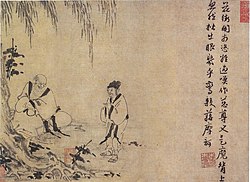
Budai is almost always depicted with his cloth sack that looks like a large bag. The bag serves as a prominent motif within the context of Chan Buddhism as it represents abundance, prosperity, and contentment. Ink paintings such as these attributed to Budai often had an inscription and seal that signaled to high-ranking officials. For example, Budai and Jiang Mohe was inscribed by Chusi Fanqi, who was closely related to Song Lian (1310–1381) and Wei Su (1295–1372).

After Chan Buddhism was transmitted to Japan around the 13th century as Zen Buddhism, the devout monastics and laymen of the area utilized figure painting to portray the characters central to this "awakening" period of Zen art.[7] Many of the eccentric personalities that were inducted into the Zen tradition like Budai were previously wrapped up in the established culture and folklore of Japan. The assimilation and reapplication of these wondrous charismas to the Zen pantheon assisted in the expansion of the Zen tradition.

As the images demonstrate, Budai is most jubilant when in the presence of others, especially children. When depicted with other gods in the Seven Lucky Gods, Budai maintains a solemn or even depressed countenance. Budai's round figure comes into practical use through the sculpting of the incense box (18th century) that splits the monk's body into two halves. The newer images such as Hotei and Children Carrying Lanterns (19th century) employs much more color, dramatization of physical features, and detail than the older pieces such as Hotei from Mokuan Reien (1336) that employs much more wispy and heavily contrasting outlines of his figure with no color or assumed setting.

Japanese iconography, like that of Zen master Hakuin Ekaku, shows Budai in a multiplicity of representative actions, like entertaining passersby, sheltering children under an umbrella and meditating using his sack as a cushion. In an especially known motif, Budai appears smoking in a kiseru and exhaling Otafuku, an ugly but charming prostitute that embodies Zen happiness, in a humorous reflection of the tradition according to which Shandao exhaled Amida, Kannon and Seishi with a prayer.[11][12] The smooth lumpfish is known in Japan as hotei-uo ("Budai fish") due to its rotund appearance.[13]

Sculpture

[edit]
  • Sculpture of Budai at the Feilai Feng grottoes in Zhejiang, China. Northern Song dynasty, 11th century.
    Sculpture of Budai at the Feilai Feng grottoes in Zhejiang, China. Northern Song dynasty, 11th century.
  • Budai as Maitreya at the Feilai Feng grottoes, depicted with disciples
    Budai as Maitreya at the Feilai Feng grottoes, depicted with disciples
  • Statue of Budai at Hushan Temple in Taiwan
    Statue of Budai at Hushan Temple in Taiwan
  • Statue of Budai as Maitreya at Haedong Yonggungsa temple in South Korea
    Statue of Budai as Maitreya at Haedong Yonggungsa temple in South Korea
  • Statue of Budai at Miroku-ji in Himeji city, Hyōgo Prefecture, Japan. It is the largest Budai sculpture in Japan.
    Statue of Budai at Miroku-ji in Himeji city, Hyōgo Prefecture, Japan. It is the largest Budai sculpture in Japan.
  • Statue of Budai at Vĩnh Tràng Temple in Vietnam
    Statue of Budai at Vĩnh Tràng Temple in Vietnam
  • Statue of Budai at Ko Samui island, Thailand
    Statue of Budai at Ko Samui island, Thailand
  • Statue of Budai in the Chinese style at Chalakudy, Kerala, India
    Statue of Budai in the Chinese style at Chalakudy, Kerala, India
  • Small statue at a cafe in Birmingham, United Kingdom
    Small statue at a cafe in Birmingham, United Kingdom
  • Figure of Budai, "Laughing Buddha", c. 1920–1960. Leon Abdalian Collection, Boston Public Library
    Figure of Budai, "Laughing Buddha", c. 1920–1960. Leon Abdalian Collection, Boston Public Library

Paintings

[edit]
  • Budai and Jiang Mohe Discussing Buddhism, by Yintuoluo and inscribed by Chushi Fanqi. Circa 1350.
    Budai and Jiang Mohe Discussing Buddhism, by Yintuoluo and inscribed by Chushi Fanqi. Circa 1350.
  • Hanging scroll showing Hotei, by Mokuan Reien and inscribed by Liao'an Qingyu. 14th century.
    Hanging scroll showing Hotei, by Mokuan Reien and inscribed by Liao'an Qingyu. 14th century.
  • Painting of Podae, by Kim Myong-kuk, Joseon dynasty, 1600–1650
    Painting of Podae, by Kim Myong-kuk, Joseon dynasty, 1600–1650
  • Painting of Hotei watching two cocks fighting, by the famous swordsman Miyamoto Musashi (1584–1645)
    Painting of Hotei watching two cocks fighting, by the famous swordsman Miyamoto Musashi (1584–1645)
  • Painting of Hotei, by Kanō Kōi of the Kanō school. Early 17th century.
    Painting of Hotei, by Kanō Kōi of the Kanō school. Early 17th century.
  • Hotei lifting his belly, a stereotypical depiction based on earlier Chinese copies. Painting by Odano Naotake (1750–1780), Edo period.
    Hotei lifting his belly, a stereotypical depiction based on earlier Chinese copies. Painting by Odano Naotake (1750–1780), Edo period.
  • Minimalist painting of Hotei and his bag, by Itō Jakuchū (1716–1800), Edo period
    Minimalist painting of Hotei and his bag, by Itō Jakuchū (1716–1800), Edo period
  • Hotei With Summer and Winter Landscapes. Triptych by Igarashi Shunmei (1768), Edo period.
    Hotei With Summer and Winter Landscapes. Triptych by Igarashi Shunmei (1768), Edo period.
  • The Moon of Enlightenment, depicting Hotei pointing at the Moon. From the print series One Hundred Aspects of the Moon by Tsukioka Yoshitoshi. 1885–1891, Meiji Era.
    The Moon of Enlightenment, depicting Hotei pointing at the Moon. From the print series One Hundred Aspects of the Moon by Tsukioka Yoshitoshi. 1885–1891, Meiji Era.
  • Hotei and Children Carrying Lanterns, by Utagawa Kuniyoshi. 19th century.
    Hotei and Children Carrying Lanterns, by Utagawa Kuniyoshi. 19th century.

Crafts

[edit]
  • Ivory netsuke depicting Hotei. Japan, 17th century.
    Ivory netsuke depicting Hotei. Japan, 17th century.
  • Chinese porcelain figure of Budai with European ormolu stand. Qing dynasty, 1720–1730.
    Chinese porcelain figure of Budai with European ormolu stand. Qing dynasty, 1720–1730.
  • Scent container featuring a Chinese porcelain figure of Budai with French ormolu gilding and added porcelain flowers, an example of chinoiserie art. France, 1745–1749.
    Scent container featuring a Chinese porcelain figure of Budai with French ormolu gilding and added porcelain flowers, an example of chinoiserie art. France, 1745–1749.
  • Hotei dreaming on his bag of treasures. Ceramic with gold and lacquer. Japan, mid-19th century.
    Hotei dreaming on his bag of treasures. Ceramic with gold and lacquer. Japan, mid-19th century.

Confusion with other religious figures

[edit]

Angida

[edit]

Angida was one of the original Eighteen Arhats. According to legend, Angida was a talented Indian snake catcher whose aim was to catch venomous snakes to prevent them from biting passers-by. Angida would also remove the snake's venomous fangs and release them. Due to his kindness, he was able to attain bodhi.

In Chinese art, Angida is sometimes portrayed as Budai, being rotund, laughing, and carrying a bag.[14]

Gautama Buddha

[edit]
Budai under a pine tree, by Wang Zhen. 1921

In the Western world, Budai is often mistaken for Gautama Buddha himself, and thus is nicknamed the "Fat Buddha".[5]

Kangxi Emperor

[edit]

In Mongolia, Budai is called Enkh Amaglan Khan, which is identical to the Mongolian name for the Kangxi Emperor. Because of this, Budai is often mistaken for the Kangxi Emperor.

Phra Sangkajai

[edit]

In Thailand, Budai is sometimes confused with the arhat Kaccāyana, known in Thailand as Phra Sangkajai or Phra Sangkachai. Buddha praised Phra Sangkajai for his excellence in explaining sophisticated concepts of the dhamma in an easily and correctly understandable manner. Phra Sangkajai is also known for composing the Madhupindika Sutta.

One story from Thai folklore relates that Phra Sangkajai was so handsome that even a man once wanted him for a wife. To avoid a similar situation, Phra Sangkajai decided to transform himself into a fat monk. Another tale says he was so attractive that angels and men often compared him with the Buddha. He considered this inappropriate, so disguised himself in a fat body.[15]

Although both Budai and Phra Sangkajai may be found in both Thai and Chinese temples, Phra Sangkajai is found more often in Thai temples, and Budai in Chinese temples. Two points to distinguish them from one another are:

  1. Phra Sangkajai has a trace of hair on his head (looking similar to the Buddha's) while Budai is clearly bald.
  2. Phra Sangkajai wears the robes in Theravada fashion, with the robes folded across one shoulder, leaving the other uncovered. Budai wears the robes in Chinese style, covering both arms but leaving the front part of the upper body uncovered.

See also

[edit]
  • Buddha Shenrab
  • Maitreya Buddha

Notes

[edit]
  1. ^ Chinese: 布袋; pinyin: Bùdài; Korean: 포대, romanized: Podae; Japanese: 布袋, romanized: Hotei; Vietnamese: Bố Đại

References

[edit]
  1. ^ 《明州岳林寺志‧卷二‧古蹟‧彌勒涅槃石》 (in Chinese).
  2. ^ a b Leighton, Taigen Dan (1998). Bodhisattva Archetypes: Classic Buddhist Guides to Awakening and Their Modern Expression. New York: Penguin Arkana. pp. 260–261. ISBN 0140195564. OCLC 37211178.
  3. ^ Cook, Francis Dojun (2002). How to Raise an Ox. Wisdom Publications. p. 166 note 76. ISBN 9780861713172.
  4. ^ "The Laughing Buddha". Religionfacts.com. Archived from the original on 2012-01-06. Retrieved 2011-12-26.
  5. ^ a b Peterson, Christopher. "When Did the Buddha Become Fat?". Psychology Today. Retrieved 1 November 2018.
  6. ^ a b Chapin, H.B. (1933). "The Chan Master Pu-tai". Journal of the American Oriental Society. 53 (1): 47–52. doi:10.2307/593188. JSTOR 593188.
  7. ^ a b c d Levine, Gregory (2007). Awakenings: Zen Figure Painting in Medieval Japan. Japan Society.
  8. ^ Seow (2002). Legend of the Laughing Buddha. Asiapac Books.
  9. ^ Stevens, Keith (1976). "Chinese Preserved Monks". Journal of the Hong Kong Branch of the Royal Asiatic Society. 16. Royal Asiatic Society Hong Kong Branch: 293–294. JSTOR 23886762.
  10. ^ Faure, Bernard (1991). "Six: The Thaumaturge and Its Avatars (II)". The Rhetoric of Immediacy: A Cultural Critique of Chan/Zen Buddhism. Princeton University Press. p. 115. doi:10.2307/j.ctv1j666xp.11. ISBN 978-0-691-07374-3. JSTOR j.ctv1j666xp. S2CID 243553565. (also available at https://www.google.com/books/edition/The_Rhetoric_of_Immediacy/sskkEAAAQBAJ?gbpv=1&pg=PA115)
  11. ^ Katsuhiro Yoshizawa, Norman Waddell (2009). The Religious Art of Zen Master Hakuin. Catapult. ISBN 9781582439860.
  12. ^ Audrey Yoshiko Seo, Stephen Addiss (2010). The Sound of One Hand: Paintings and Calligraphy by Zen Master Hakuin. Shambhala. ISBN 9781590305782.
  13. ^ "ゴッコ". Sapporo Market (in Japanese). Retrieved February 18, 2022.
  14. ^ Seo, Audrey Yoshiko; Addiss, Stephen (2010). The Sound of One Hand: Paintings and Calligraphy by Zen Master Hakuin. Shambhala Publications. p. 205. ISBN 9781590305782.
  15. ^ "Sangkachai Buddha". Roots.gov.sg. National Heritage Board. Retrieved 19 June 2024.

External links

[edit]
Wikimedia Commons has media related to Budai.
  • Learning materials related to Buddha oracle#36 Laziness (The Happy Buddha) at Wikiversity
  • Who was Budai the "Happy Buddha"?, Golden Buddha, archived from the original on 2020-08-13
  • Budai - Chinese Buddhist Encyclopedia, archived from the original on 2021-05-01
  • v
  • t
  • e
   Topics in Buddhism   
  • Outline
  • Glossary
  • Index
Foundations
  • Four Noble Truths
  • Three Jewels
    • Buddha
    • Dharma
    • Sangha
  • Noble Eightfold Path
  • Nirvana
  • Middle Way
The Buddha
  • Tathāgata
  • Birthday
  • Four sights
  • Eight Great Events
  • Great Renunciation
  • Physical characteristics
  • Life of Buddha in art
  • Footprint
  • Relics
  • Iconography in Laos and Thailand
  • Films
  • Miracles
  • Family
    • Suddhodāna (father)
    • Māyā (mother)
    • Mahapajapati Gotamī (aunt, adoptive mother)
    • Yaśodharā (wife)
    • Rāhula (son)
    • Ānanda (cousin)
    • Devadatta (cousin)
  • Bodhi tree
  • Places where the Buddha stayed
  • Buddha in world religions
Bodhisattvas
  • Avalokiteśvara
    • Guanyin
  • Mañjuśrī
  • Mahāsthāmaprāpta
  • Ākāśagarbha
  • Kṣitigarbha
  • Samantabhadra
  • Vajrapāṇi
  • Skanda
  • Tārā
  • Metteyya/Maitreya
Disciples
  • Kaundinya
  • Assaji
  • Sāriputta
  • Mahamoggallāna
  • Ānanda
  • Mahākassapa
  • Aṅgulimāla
  • Anuruddha
  • Mahākaccana
  • Nanda
  • Subhūti
  • Puṇṇa Mantānīputta
  • Upāli
  • Mahapajapati Gotamī
  • Khema
  • Uppalavanna
  • Asita
  • Channa
  • Yasa
Key concepts
  • Avidyā (Ignorance)
  • Bardo
  • Bodhicitta
  • Buddha-nature
  • Dhamma theory
  • Dharma
  • Enlightenment
  • Five hindrances
  • Indriya
  • Karma
  • Kleshas
  • Mental factors
  • Mindstream
  • Parinirvana
  • Pratītyasamutpāda
  • Rebirth
  • Saṃsāra
  • Saṅkhāra
  • Skandha
  • Śūnyatā
  • Taṇhā (Craving)
  • Tathātā
  • Ten Fetters
  • Three marks of existence
    • Anicca
    • Dukkha
    • Anattā
  • Two truths doctrine
Cosmology
  • Ten spiritual realms
  • Six Paths
    • Deva realm
    • Human realm
    • Asura realm
    • Hungry Ghost realm
    • Animal realm
    • Naraka
  • Three planes of existence
Branches
  • Mahayana
    • Zen
      • Chinese Chan
      • Japanese Zen
      • Korean Seon
      • Vietnamese Thiền
    • Pure Land
    • Tiantai
    • Huayan
    • Risshū
    • Nichiren
    • Madhyamaka
    • Yogachara
  • Vajrayana
    • Tibetan Buddhism
    • Chinese Esoteric Buddhism
    • Shingon
    • Dzogchen
  • Theravada
    • Southern Esoteric Buddhism
  • Navayana
  • Early Buddhist schools
  • Pre-sectarian Buddhism
  • Basic points unifying Theravāda and Mahāyāna
  • Southern, Eastern and Northern Buddhism
Practices
  • Bhavana
  • Bodhipakkhiyādhammā
  • Brahmavihara
    • Mettā
    • Karuṇā
    • Mudita
    • Upekkha
  • Buddhābhiṣeka
  • Dāna
  • Devotion
  • Deity yoga
  • Dhyāna
  • Faith
  • Five Strengths
  • Iddhipada
  • Meditation
    • Mantras
    • Kammaṭṭhāna
    • Recollection
    • Smarana
    • Anapanasati
    • Samatha-vipassanā (Vipassana movement)
    • Shikantaza
    • Zazen
    • Tukdam
    • Koan
    • Ganana
    • Mandala
    • Tonglen
    • Tantra
    • Tertön
    • Terma
  • Merit
  • Mindfulness
    • Mindful Yoga
    • Satipatthana
  • Nekkhamma
  • Nianfo
  • Pāramitā
  • Paritta
  • Puja
    • Offerings
    • Prostration
    • Music
  • Refuge
  • Sādhu
  • Satya
    • Sacca
  • Seven Factors of Enlightenment
    • Sati
    • Dhamma vicaya
    • Pīti
    • Passaddhi
  • Śīla
    • Five precepts
    • Eight precepts
    • Bodhisattva vow
    • Pratimokṣa
  • Threefold Training
    • Śīla
    • Samadhi
    • Prajñā
  • Vīrya
    • Four Right Exertions
  • Twenty-two vows of Ambedkar
  • Yujia Yankou
  • Shuilu Fahui
  • Dabei Chan
  • Yaoshi Bao Chan
Nirvana
  • Bodhi
  • Bodhisattva
  • Buddhahood
  • Pratyekabuddhayāna
  • Four stages of awakening
    • Sotāpanna
    • Sakadagami
    • Anāgāmi
    • Arhat
Monasticism
  • Bhikkhu
  • Bhikkhunī
  • Śrāmaṇera
  • Śrāmaṇerī
  • Anagārika
  • Ajahn
  • Sayadaw
  • Zen master
  • Rōshi
  • Lama
  • Rinpoche
  • Geshe
  • Tulku
    • Western tulku
  • Kappiya
  • Donchee
  • Householder
  • Upāsaka and Upāsikā
  • Achar
  • Śrāvaka
    • Ten principal disciples
  • Shaolin Monastery
Major figures
  • The Buddha
  • Śāriputra
  • Moggallāna
  • Mahākāśyapa
  • Subhuti
  • Puṇṇa Mantānīputta
  • Kātyāyana
  • Anuruddha
  • Upāli
  • Rāhula
  • Ānanda
  • Nagasena
  • Aśvaghoṣa
  • Nagarjuna
  • Asanga
  • Vasubandhu
  • Kumārajīva
  • Buddhaghosa
  • Buddhapālita
  • Dignāga
  • Bodhidharma
  • Faxian
  • Lushan Huiyuan
  • Sengyou
  • Emperor Wu of Liang
  • Tanluan
  • Dazu Huike
  • Sengcan
  • Zhiyi
  • Daochuo
  • Guanding
  • Emperor Wen of Sui
  • Songtsen Gampo
  • Xuanzang
  • Shandao
  • Huineng
  • Fazang
  • Śubhakarasiṃha
  • Vajrabodhi
  • Yi Xing
  • Shenhui
  • Jianzhen
  • Amoghavajra
  • Mazu Daoyi
  • Zhanran
  • Guifeng Zongmi
  • Linji Yixuan
  • Yongming Yanshou
  • Siming Zhili
  • Yunqi Zhuhong
  • Zibo Zhenke
  • Hanshan Deqing
  • Youxi Chuandeng
  • Miyun Yuanwu
  • Ouyi Zhixu
  • Yinyuan Longqi
  • Poshan Haiming
  • Jixing Chewu
  • Xuyun
  • Yinguang
  • Taixu
  • Hsuan Hua
  • Chin Kung
  • Hsing Yun
  • Wei Chueh
  • Sheng-yen
  • Cheng Yen
  • Padmasambhava
  • Yeshe Tsogyal
  • Machig Labdrön
  • Chökyi Drönma
  • Milarepa
  • Marpa Lotsawa
  • Thang Tong Gyalpo
  • Dolpopa Sherab Gyaltsen
  • 3rd Karmapa, Rangjung Dorje
  • Saraha
  • Atiśa
  • Naropa
  • Karmapa
  • Jamgon Kongtrul
  • Kōbō Daishi
  • Dōhan
  • Kakuban
  • Dengyō Daishi
  • Ennin
  • Kūya
  • Hōnen
  • Ippen
  • Shōkū
  • Shinran
  • Dōgen
  • Hakuin Ekaku
  • Bankei Yōtaku
  • Ikkyū
  • Eisai
  • D. T. Suzuki
  • Shunryū Suzuki
  • Nichiren
  • Trần Nhân Tông
  • Shamarpa
  • Khenchen Palden Sherab Rinpoche
  • Penor Rinpoche
  • Namchö Mingyur Dorje
  • Dalai Lama
  • Panchen Lama
  • Samding Dorje Phagmo
  • Ajahn Mun
  • B. R. Ambedkar
  • Ajahn Chah
  • Thích Nhất Hạnh
Texts
  • Early Buddhist texts
  • Tripiṭaka
  • Mahayana sutras
  • Pali Canon
  • Chinese Buddhist canon
  • Tibetan Buddhist canon
  • Dhammapada
  • Sutra
  • Vinaya
  • Madhyamakālaṃkāra
  • Abhidharmadīpa
Countries and regions
    • Afghanistan
    • Argentina
    • Armenia
    • Australia
    • Austria
    • Bangladesh
    • Belgium
    • Belarus
    • Bhutan
    • Brazil
    • Brunei
    • Bulgaria
    • Cambodia
    • Canada
    • China
    • Costa Rica
    • Croatia
    • Czech Republic
    • Denmark
    • England
    • Estonia
    • Finland
    • France
    • Germany
    • Greece
    • Hong Kong
    • Hungary
    • Iceland
    • India
    • Indonesia
    • Iran
    • Israel
    • Italy
    • Japan
    • Kazakhstan
    • Korea
    • Kyrgyzstan
    • Laos
    • Libya
    • Liechtenstein
    • Lithuania
    • Maldives
    • Malaysia
    • Mexico
    • Middle East
    • Mongolia
    • Morocco
    • Myanmar
    • Nepal
    • New Zealand
    • North Korea
    • Norway
    • Pakistan
    • Philippines
    • Poland
    • Portugal
    • Russia
      • Buryatia
      • Kalmykia
      • Tuva [tyv; ru; fr; uz; az]
    • Scotland
    • Senegal
    • Singapore
    • Slovenia
    • South Africa
    • South Korea
    • Spain
    • Sri Lanka
    • Sweden
    • Switzerland
    • Taiwan
    • Tajikistan
    • Thailand
    • Tibet
    • Turkey
    • Ukraine
    • United Kingdom
    • United States
    • Uruguay
    • Uzbekistan
    • Venezuela
    • Vietnam
    • Wales
    • Zimbabwe
History
  • Timeline
  • Ashoka
  • Kanishka
  • Buddhist councils
  • History of Buddhism in India
    • Decline of Buddhism in India
  • Huichang persecution of Buddhism
  • Greco-Buddhism
    • Gandharan Buddhism
      • Texts
    • Menander I
  • Buddhism and the Roman world
  • Buddhism in the West
  • Silk Road transmission of Buddhism
  • Persecution of Buddhists
    • In Afghanistan
    • In Vietnam
  • Rimé movement
  • Banishment of Buddhist monks from Nepal
  • Dalit Buddhist movement
  • Chinese invasion of Tibet
    • 1959 Tibetan uprising
  • Sinhalese Buddhist nationalism
  • Buddhist modernism
  • Vipassana movement
  • 969 Movement
  • Engaged Buddhism
  • Women in Buddhism
Philosophy
  • Abhidharma
  • Atomism
  • Buddhology
  • Creator
  • Buddhism and democracy
  • Economics
  • Eight Consciousnesses
  • Engaged Buddhism
  • Eschatology
  • Ethics
  • Evolution
  • Humanism
  • Logic
  • Reality
  • Secular Buddhism
  • Socialism
  • The unanswerable questions
Culture
  • Architecture
    • Temple
    • Vihāra
    • Kyaung
    • Wat
    • Ordination hall
    • Stupa
    • Pagoda
      • Burmese pagoda
    • Candi
    • Dzong architecture
    • List of Buddhist architecture in China
    • Japanese Buddhist architecture
    • Buddhist temples in Korea
    • Thai temple art and architecture
    • Tibetan Buddhist architecture
  • Art
    • Greco-Buddhist
  • Budai
  • Buddha in art
  • Calendar
  • Cuisine
  • Funeral
  • Wedding
  • Holidays
    • Vesak
    • Uposatha
    • Māgha Pūjā
    • Asalha Puja
    • Vassa
  • Jaya Sri Maha Bodhi
  • Kasaya
  • Mahabodhi Temple
  • Mantra
    • Om mani padme hum
  • Mudra
  • Music
  • Pilgrimage
    • Lumbini
    • Maya Devi Temple
    • Bodh Gaya
    • Sarnath
    • Kushinagar
  • Literature
    • Poetry
  • Prayer beads
  • Hama yumi
  • Prayer wheel
  • Symbolism
    • Dharmachakra
    • Flag
    • Bhavacakra
    • Swastika
    • Thangka
  • Temple of the Tooth
  • Vegetarianism
Miscellaneous
  • Abhijñā
  • Amitābha
  • Brahmā
  • Dharma talk
  • Hinayana
  • Iddhi
  • Kalpa
  • Koliya
  • Lineage
  • Māra
  • Siddhi
  • Sacred languages
    • Pāḷi
    • Sanskrit
Comparison
  • Baháʼí Faith
  • Christianity
    • Influences
    • Comparison
  • East Asian religions
  • Gnosticism
  • Hinduism
  • Jainism
  • Judaism
  • Psychology
  • Science
  • Theosophy
  • Violence
  • Western philosophy
Lists
  • Bodhisattvas
  • Buddhas
  • Buddhists
    • List
      • American
      • British
      • Korean
      • Indian
  • Suttas
  • Sutras
  • Temples
  • Festivals
  • Category
  • icon Buddhism portal
  • v
  • t
  • e
Chinese Buddhist pantheon
Buddhas
佛 (Fó)/如來 (Rúlái)
  • Five Wisdom Tathāgatas (Wǔfāng Fó)
  • Seven Buddhas of Antiquity (Guòqù Qīfó)
  • Buddhas of the Ten Directions (Shífāng Fó)[zh]
  • Eighty-eight Buddhas (Bāshíbā Fó)
  • Śākyamuni (Shìjiāmóuní Fó)
  • Vairocana (Pílúzhēnǎ Fó)
  • Amitābha (Āmítuó Fó)
  • Bhaisajyaguru (Yàoshī Fó)
  • Amoghasiddhi (Bùkōngchéngjiù Fó)
  • Akshobhya (Āchù Fó)
  • Ratnasambhava (Bǎoshēng Fó)
  • Dīpankara (Rándēng Fó)
  • Vipassī (Pípóshī Fó)
  • Vessabhū (Píshèpó Fó)
  • Kakusandha (Jūliúsūn Fó)
  • Koṇāgamana (Jūnàhán Fó)
  • Kassapa (Jiāshè Fó)
Bodhisattvas
菩薩 (Púsà)
  • Four Great Bodhisattvas (Sìdà Púsà)[zh]
  • Eight Great Bodhisattvas (Bādà Púsà)[zh]
  • Twelve Bodhisattvas of Perfect Enlightenment (Shí'èr Yuánjué Púsà)
  • Avalokiteśvara (Guānyīn Púsà)
  • Manjushri (Wénshū Púsà)
  • Samantabhadra (Pǔxián Púsà)
  • Kṣitigarbha (Dìzàng Púsà)
  • Mahāsthāmaprāpta (Dàshìzhì Púsà)
  • Vajrapāṇi (Jīngāngshǒu Púsà)
  • Maitreya (Mílè Púsa)
  • Ākāśagarbha (Xūkōngzàng Púsà)
  • Cundī (Zhǔntí Púsà)
  • Tara (Duōluó Púsà)
  • Sūryaprabha (Rìguāng Púsà)
  • Candraprabha (Yuèguāng Púsà)
  • Bhaiṣajyarāja (Yàowáng Púsà)
  • Bhaiṣajyasamudgata (Yàoshàng Púsà)
  • Cintāmaṇicakra (Rúyìlún Guānyīn)
  • Vajrasattva (Jīngāng Sàduǒ Púsà)
  • Nagarjuna (Lóngshù Púsà)
  • Sitātapatrā (Báisǎngài Fódǐng)
Wisdom Kings
明王 (Míngwáng)
  • Eight Wisdom Kings (Bādà Míngwáng)
  • Ten Wisdom Kings (Shídà Míngwáng)
  • Mahamayuri (Kǒngquè Míngwáng)
  • Ucchuṣma (Huìjì Jīngāng)
  • Kuṇḍali (Jūntúlì Míngwáng)
  • Hayagriva (Mǎtóu Guānyīn)
  • Acala (Bùdòng Míngwáng)
  • Trailokyavijaya (Xiángsānshì Míngwáng)
  • Yamāntaka (Dàwēidé Míngwáng)
  • Mahacakra (Dàlún Míngwáng)
  • Padanaksipa (Bùzhì Míngwáng)
  • Mahabala (Dàlì Míngwáng)
  • Aparajita (Wúnéngshēng Míngwáng)
  • Vajrahāsa (Dàxiào Míngwáng)
  • Deities and Demons
    諸天鬼神 (Zhūtiān Guǐshén)
    • Twenty-Four Protective Deities (Èrshísì Zhūtiān)
    • Twelve Heavenly Generals (Shí'èr Shénjiāng)
    • Eight Great Yakṣa Generals (Bādà Yèchā Dàjiàng)
    • Eight Legions of Devas and Nāgas (Tiānlóng bābù)
    • Four Heavenly Kings (Sì Tiānwáng)
    • Ulkāmukha Pretarāja (Miànrán Dàshì)
    • Brahma (Fàntiān)
    • Indra (Dìshìtiān)
    • Shiva (Dàzìzàitiān)
    • Lakshmi (Gōngdétiān)
    • Saraswati (Biàncáitiān)
    • Surya (Rìtiān)
    • Chandra (Yuètiān)
    • Pañcika (Sànzhī Dàjiàng)
    • Hārītī (Guǐzǐmǔ)
    • Yama (Yánluó Wáng)
    • Marici (Mólìzhītiān)
    • Prithvi (Jiānláo Dishén)
    • Sāgara (Suōjiéluó Lóngwáng)
    • Vajra-Weilding God (Zhíjīngāng shén)
      • Gunyapati (Mìjī Jīngāng)
      • Narayana (Nàluóyántiān)
    • Mahākāla (Dàhēitiān)
    • Sudhana (Shàncái)
    • Nagakanya (Lóngnǚ)
    • Puti Shushen
    • Ziwei Emperor
    • Dongyue Emperor (Dōngyuè Dàdì)
    • Thunder god (Léigōng)
    • Skanda (Wéituó)
    • Sangharama Bodhisattva (Qíelán Púsà)
    • Deva (Tiān)
    • Nāga (Lóng)
    • Asura (Āxiūluō)
    • Yaksha (Yèchà)
    • Garuda (Jiālóuluó)
    • Gandharva (Gāntàpó)
    • Kinnara (Jǐnnàluō)
    • Mahoraga (Móhóuluójiā)
    • Apsara (Fēitiān Nǚshén)
    • Kalaviṅka (Jiālíngpínqié)
    Arhats
    羅漢 (Luóhàn)
    • Five Hundred Arhats (Wǔbǎi luóhàn)
    • Eighteen Arhats (Shíbā Luóhàn)
    • Sixteen Arhats (Shíliù Luóhàn)
    • Mahākāśyapa (Xiánglóng Luóhàn)
    • Nagasena(Wāěr Luóhàn)
    • Rahula (Chénsāi Luóhàn)
    • Pindola Bharadvaja (Qílù Luóhàn)
    • Bodhidharma (Guojiāng Luóhàn)
    • Asita (Chángméi Luóhàn)
    • Kanaka the Vatsa (Xǐqìng Luóhàn)
    • Kanaka the Bharadvaja (Jǔbō Luóhàn)
    • Subinda (Tuōda Luóhàn)
    • Nakula (Jìngzuò Luóhàn)
    • Kalika (Qíxiàng Luóhàn)
    • Vijraputra (Xiàoshī Luóhàn)
    • Gobaka (Kāixīn Luóhàn)
    • Pantha the Elder (Tànshǒu Luóhàn)
    • Vanavasa (Bājiāo Luóhàn)
    • Pantha the Younger (Kānmén Luóhàn)
    Sangha
    高僧・祖師 (Gāosēng・Zǔshī)
    • Ānanda
    • Moggallāna
    • Bodhidharma (Damo)
    • An Shigao
    • Kumarajiva
    • Zhiyi
    • Xuanzang
    • Faxian
    • Yijing
    • Yixing
    • Shandao
    • Huiguo
    • Amoghavajra (Bukong)
    • Vajrabodhi (Jingangzhi)
    • Śubhakarasiṃha (Shanwuwei)
    • Hanshan Deqing
    • Yunqi Zhuhong
    • Ouyi Zhixu
    • Budai
    • Jigong
    • Emperor Ming
    • Emperor Wu
    • Fu Dashi
    • Mahayana
    • Chan
    • Pure Land
    • Tiantai
    • Huayan
    • Chinese Esoteric Buddhism
    • Tantrism
    • Chinese mythology
    • Religion in China
    • v
    • t
    • e
    Japanese Buddhist pantheon
    Buddhas
    如来部 (Nyorai-bu)
    • Śākyamuni (Shaka Nyorai)
    • Amitābha (Amida Nyorai)
    • Bhaiṣajyaguru (Yakushi Nyorai)
    • Vairocana (Dainichi Nyorai)
    • Five Wisdom Buddhas (Godai Nyorai)
    Bodhisattvas
    菩薩部 (Bosatsu-bu)
    • Maitreya (Miroku)
    • Avalokiteśvara (Kannon)
    • Samantabhadra (Fugen)
    • Mañjuśrī (Monju)
    • Mahāpratisarā (Daizuigu)
    • Kṣitigarbha (Jizō)
    • Ākāśagarbha (Kokūzō)
    • Mahāsthāmaprāpta (Seishi)
    • Vajrasattva (Kongōsatta)
    • Vajrapāramitā (Kongō-Haramitsu)
    Wisdom Kings
    明王部 (Myōō-bu)
    • Five Wisdom Kings
    • Acala (Fudō-Myōō)
    • Rāgarāja (Aizen-Myōō)
    • Ucchuṣma (Ususama-Myōō)
    • Hayagrīva (Batō-Myōō)
    • Mahāmāyūrī (Kujaku-Myoō)
    • Yamāntaka (Daiitoku-Myoō)
    Heavenly deities
    天部 (Ten-bu)
    • Four Heavenly Kings (Shitennō)
    • Eight Legions (Hachi-Bushū)
    • Twelve Devas (Jūni-ten)
    • Twelve Heavenly Generals (Jūni Shinshō)
    • Twenty-Eight Legions (Nijūhachi-Bushū)
    • Sarasvatī (Benzaiten)
    • Vaiśravaṇa (Bishamonten)
    • Śakra (Taishakuten)
    • Brahmā (Bonten)
    • Maheśvara (Daijizaiten)
    • Mahākāla (Daikokuten)
    • Ḍākinī (Dakiniten)
    • Yama (Enma-Daiō)
    • Gigeiten
    • Skanda (Idaten)
    • Gaṇapati (Kankiten)
    • Hārītī (Kishimojin)
    • Apsara (Hiten)
    • Kalaviṅka (Karyōbinga)
    • Lakṣmī (Kisshōten)
    • Mārīcī (Marishiten)
    • Vajrapāṇi (Niō)
    Circumstantial appearances
    垂迹身部
    (Suijakushin-bu)
    • Gongen
    • Kumano Gongen
    • Atago Gongen
    • Konpira Daigongen
    Religious masters
    高僧・祖師部
    (Kōsō・Soshi-bu)
    • Nāgārjuna (Ryūju)
    • Vasubandhu (Seshin)
    • Bodhidharma
    • Prince Shōtoku
    • Kūkai
    • Saichō
    • Eisai
    • Dōgen Kigen
    • Genshin
    • Hōnen
    • Ippen
    • Shinran
    • Nichiren
    • Sixteen Arhats
    • Zen
    • Tendai
    • Shingon
    • Pure Land
    • Shugendō
    • Nichiren
    • Japanese mythology
    Retrieved from "https://teknopedia.ac.id/w/index.php?title=Budai&oldid=1341701736"
    Categories:
    • Fictional characters from the 10th century
    • Bodhisattvas
    • Buddhas
    • Buddhist deities
    • Chinese gods
    • Deities in Chinese folk religion
    • Fortune gods
    • Investiture of the Gods characters
    • Journey to the West characters
    • Tang dynasty Buddhist monks
    • Five Dynasties and Ten Kingdoms Buddhist monks
    • Wuyue Buddhists
    • Yiguandao
    • Maitreya
    • Buddhism in China
    • Confucianism in China
    • Taoism in China
    • Taoist deities
    • Legendary Chinese people
    • Deified Chinese men
    Hidden categories:
    • Articles containing traditional Chinese-language text
    • Articles containing Korean-language text
    • Articles containing Japanese-language text
    • Articles containing Vietnamese-language text
    • CS1 Chinese-language sources (zh)
    • CS1 Japanese-language sources (ja)
    • Articles with short description
    • Short description matches Wikidata
    • Articles containing Chinese-language text
    • Articles containing Thai-language text
    • Articles with hCards
    • Commons category link is on Wikidata
    • Pages calling interlanguage link with many languages

    • indonesia
    • Polski
    • العربية
    • Deutsch
    • English
    • Español
    • Français
    • Italiano
    • مصرى
    • Nederlands
    • 日本語
    • Português
    • Sinugboanong Binisaya
    • Svenska
    • Українська
    • Tiếng Việt
    • Winaray
    • 中文
    • Русский
    Sunting pranala
    url url url url url url url url url url url url url url url url url url url url url url url url url url url url url url url url url url url url url url url url url url url url url url url url url url url url url url url url url url url url url url url url url url url url url url url url url url url url url url url url url url url url url url url url url url url url url url url url url url url url url url url url url url url url url url url url url url url url url url url url url url url url url url url url url url url url url url url url url url url url url url url url url url url url url url url url url url url url url url url url url url url url url url url url url url url url url url url url url url url url url url url url url url url url url url url url url url url url url url url url url url url url url url url url url url url url url url url url url url url url url url url url url url url url url url url url url url url url url url url url url url url url url url url url url url url url url url url url url url url url url url url url url url url url url url url url url url url url url url url url url url url url url url url url url url url url url url url url url url url url url url url url url url url url url url url url url url url url url url url url url url url url url url url url url url url url url url url url url url url url url url url url url url url url url url url url url url url url url url url url url url url url url url url url url url url url url url url url url url url url url url url url url url url url url url url url url url url url url url url url url url url url url url url url url url url url url url url url url url url url url url url url url url url url url url url url url url url url url url url url url url url url url url url url url url url url url url url url url url url url url url url url url url url url url url url url url url url url url url url url url url url url url url url url url url url url url url url url url url url url url url url url url url url url url url url url url url url url url url url url url url url url url url url url url url url url url url url url url url url url url url url url url url url url url url url url url url url url url url url url url url url url url url url url url url url url url url url url url url url url url url url url url url url url url url url url url url url url url url url url url url url url url url url url url url url url url url url url url url url url url url url url url url url url url url url url url url url url url url url url url url url url url url url url url url url url url url url url url url url url url url url url url url url url url url url url url url url url url url url url url url url url url url url url url url url url url url url url url url url url url url url url url url url url url url url url url url url url url url url url url url url url url url url url url url url url url url url url url url url url url url url url url url url url url url url url url url url url url url url url url url url url url url url url url url url url url url url url url url url url url url url url url url url url url url url url url url url url url url url url url url url url url url url url url url url url url url url url url url url url url url url url url url url url url url url url url url url url url url url url url url url url url url url url url url url url url url url url url url url url url url url url url url url url url url url url url url url url url url url url url url url url url url url url url url url url url url url url url url url url url url url url url url url url url url url url url url url url url url url url url url url url url url url url url url url url url url url url url url url url url url url url url url url url url url url url url url url url url url url url url url url url url url url url url url url url url url url url url url url url url url url url url url url url url url url url url url url url url url url url url url url url url url url url url url url url url url url url url url url url url url url url url url url url url url url url url url url url url url url url url url url url url url url url url url url url url url url url url url url url url url url url url url url url url url url url url url url url url url url url url url url url url url url url url url url url url url url url url url url url url url url url url url url url url url url url url url url url url url url url url url url url url url url url url url url url url url url url url url url url url url url url url url url url url url url url url url url url url url url url url url url url url url url url url url url url url url url url url url url url url url url url url url url url url url url url url url url url url url url url url url url url url url url url url url url url url url url url url url url url url url url url url url url url url url url url url url url url url url url url url url url url url url url url url url url url url url url url url url url url url url url url url url url url url url url url url url url url url url url url url url url url url url url url url url url url url url url url url url url url url url url url url url url url url url url url url url url url url url url url url url url url url url url url url url url url url url url url url url url url url url url url url url url url url url url url url url url url url url url url url url url url url url url url url url url url url url url url url url url url url url url url url url url url url url url url url url url url url url url url url url url url url url url url url url url url url url url url url url url url url url url url url url url url url url url url url url url url url url url url url url url url url url url url url url url url url url url url url url url url url url url url url url url url url url url url url url url url url url url url url url url url url url url url url url url url url url url url url url url url url url url url url url url url url url url url url url url url url url url url url url url url url url url url url url url url url url url url url url url url url url url url url url url url url url url url url url url url url url url url url url url url url url url url url url url url url url url url url url url url url url url url url url url url url url url url url url url url url url url url url url url url url url url url url url url url url url url url url url url url url url url url url url url url url url url url url url url url url url url url url url url url url url url url url url url url url url url url url url url url url url url url url url url url url url url url url url url url url url url url url url url url url url url url url url url url url url url url url url url url url url url url url url url url url url url url url url url url url url url url url url url url url url url url url url url url url url url url url url url url url url url url url url url url url url url url url url url url url url url url url url url url url url url url url url url url url url url url url url url url url url url url url url url url url url url url url url url url url url url url url url url url url url url url url url url url url url url url url url url url url url url url url url url url url url url url url url url url url url url url url url url url url url url url url url url url url url url url url url url url url url url url url url url url url url url url url url url url url url url url url url url url url url url url url url url url url url url url url url url url url url url url url url url url url url url url url url url url url url url url url url url url url url url url url url url url url url url url url url url url url url url url url url url url url url url url url url url url url url url url url url url url url url url url url url url url url url url url url url url url url url url url url url url url url url url url url url url url url url url url url url url url url url url url url url url url url url url url url url url url url url url url url url url url url url url url url url url url url url url url url url url url url url url url url url url url url url url url url url url url url url url url url url url url url url url url url url url url url url url url url url url url url url url url url url url url url url url url url url url url url url url url url url url url url url url url url url url url url url url url url url url url url url url url url url url url url url url url url url url url url url url url url url url url url url url url url url url url url url url url url url url url url url url url url url url url url url url url url url url url url url url url url url url url url url url url url url url url url url url url url url url url url url url url url url url url url url url url url url url url url url url url url url url url url url url url url url url url url url url url url url url url url url url url url url url url url url url url url url url url url url url url url url url url url url url url url url url url url url url url url url url url url url url url url url url url url url url url url url url url url url url url url url url url url url url url url url url url url url url url url url url url url url url url url url url url url url url url url url url url url url url url url url url url url url url url url url url url url url url url url url url url url url url url url url url url url url url url url url url url url url url url url url url url url url url url url url url url url url url url url url url url url url url url url url url url url url url url url url url url url url url url
    Pusat Layanan

    UNIVERSITAS TEKNOKRAT INDONESIA | ASEAN's Best Private University
    Jl. ZA. Pagar Alam No.9 -11, Labuhan Ratu, Kec. Kedaton, Kota Bandar Lampung, Lampung 35132
    Phone: (0721) 702022
    Email: pmb@teknokrat.ac.id