Algorithm for computing polynomial coefficients
In mathematics , divided differences is an algorithm , historically used for computing tables of logarithms and trigonometric functions .[citation needed Charles Babbage 's difference engine , an early mechanical calculator , was designed to use this algorithm in its operation.[ 1]
Divided differences is a recursive division process. Given a sequence of data points
(
x
0
,
y
0
)
,
…
,
(
x
n
,
y
n
)
{\displaystyle (x_{0},y_{0}),\ldots ,(x_{n},y_{n})}
interpolation polynomial of these points in the Newton form .
It is sometimes denoted by a delta with a bar:
△
|
{\displaystyle {\text{△}}\!\!\!|\,\,}
◿
◺
{\displaystyle {\text{◿}}\!{\text{◺}}}
Given n + 1 data points
(
x
0
,
y
0
)
,
…
,
(
x
n
,
y
n
)
{\displaystyle (x_{0},y_{0}),\ldots ,(x_{n},y_{n})}
x
k
{\displaystyle x_{k}}
forward divided differences are defined as:
[
y
k
]
:=
y
k
,
k
∈
{
0
,
…
,
n
}
[
y
k
,
…
,
y
j
]
:=
[
y
k
+
1
,
…
,
y
j
]
−
[
y
k
,
…
,
y
j
−
1
]
x
j
−
x
k
,
k
∈
{
0
,
…
,
n
−
1
}
,
j
∈
{
k
+
1
,
…
,
n
}
.
{\displaystyle {\begin{aligned}{\mathopen {[}}y_{k}]&:=y_{k},&&k\in \{0,\ldots ,n\}\\{\mathopen {[}}y_{k},\ldots ,y_{j}]&:={\frac {[y_{k+1},\ldots ,y_{j}]-[y_{k},\ldots ,y_{j-1}]}{x_{j}-x_{k}}},&&k\in \{0,\ldots ,n-1\},\ j\in \{k+1,\ldots ,n\}.\end{aligned}}}
To make the recursive process of computation clearer, the divided differences can be put in tabular form, where the columns correspond to the value of j above, and each entry in the table is computed from the difference of the entries to its immediate lower left and to its immediate upper left, divided by a difference of corresponding x- values:
x
0
y
0
=
[
y
0
]
[
y
0
,
y
1
]
x
1
y
1
=
[
y
1
]
[
y
0
,
y
1
,
y
2
]
[
y
1
,
y
2
]
[
y
0
,
y
1
,
y
2
,
y
3
]
x
2
y
2
=
[
y
2
]
[
y
1
,
y
2
,
y
3
]
[
y
2
,
y
3
]
x
3
y
3
=
[
y
3
]
{\displaystyle {\begin{matrix}x_{0}&y_{0}=[y_{0}]&&&\\&&[y_{0},y_{1}]&&\\x_{1}&y_{1}=[y_{1}]&&[y_{0},y_{1},y_{2}]&\\&&[y_{1},y_{2}]&&[y_{0},y_{1},y_{2},y_{3}]\\x_{2}&y_{2}=[y_{2}]&&[y_{1},y_{2},y_{3}]&\\&&[y_{2},y_{3}]&&\\x_{3}&y_{3}=[y_{3}]&&&\\\end{matrix}}}
Note that the divided difference
[
y
k
,
…
,
y
k
+
j
]
{\displaystyle [y_{k},\ldots ,y_{k+j}]}
x
k
,
…
,
x
k
+
j
{\displaystyle x_{k},\ldots ,x_{k+j}}
y
k
,
…
,
y
k
+
j
{\displaystyle y_{k},\ldots ,y_{k+j}}
x -values. If the data points are given by a function f ,
(
x
0
,
y
0
)
,
…
,
(
x
k
,
y
n
)
=
(
x
0
,
f
(
x
0
)
)
,
…
,
(
x
n
,
f
(
x
n
)
)
{\displaystyle (x_{0},y_{0}),\ldots ,(x_{k},y_{n})=(x_{0},f(x_{0})),\ldots ,(x_{n},f(x_{n}))}
f
[
x
k
,
…
,
x
k
+
j
]
=
def
[
f
(
x
k
)
,
…
,
f
(
x
k
+
j
)
]
=
[
y
k
,
…
,
y
k
+
j
]
.
{\displaystyle f[x_{k},\ldots ,x_{k+j}]\ {\stackrel {\text{def}}{=}}\ [f(x_{k}),\ldots ,f(x_{k+j})]=[y_{k},\ldots ,y_{k+j}].}
ƒ on the nodes x 0 , ..., x n
f
[
x
k
,
…
,
x
k
+
j
]
=
[
x
0
,
…
,
x
n
]
f
=
[
x
0
,
…
,
x
n
;
f
]
=
D
[
x
0
,
…
,
x
n
]
f
.
{\displaystyle f[x_{k},\ldots ,x_{k+j}]={\mathopen {[}}x_{0},\ldots ,x_{n}]f={\mathopen {[}}x_{0},\ldots ,x_{n};f]=D[x_{0},\ldots ,x_{n}]f.}
Divided differences for
k
=
0
{\displaystyle k=0}
j
{\displaystyle j}
[
y
0
]
=
y
0
[
y
0
,
y
1
]
=
y
1
−
y
0
x
1
−
x
0
[
y
0
,
y
1
,
y
2
]
=
[
y
1
,
y
2
]
−
[
y
0
,
y
1
]
x
2
−
x
0
=
y
2
−
y
1
x
2
−
x
1
−
y
1
−
y
0
x
1
−
x
0
x
2
−
x
0
=
y
2
−
y
1
(
x
2
−
x
1
)
(
x
2
−
x
0
)
−
y
1
−
y
0
(
x
1
−
x
0
)
(
x
2
−
x
0
)
[
y
0
,
y
1
,
y
2
,
y
3
]
=
[
y
1
,
y
2
,
y
3
]
−
[
y
0
,
y
1
,
y
2
]
x
3
−
x
0
{\displaystyle {\begin{aligned}{\mathopen {[}}y_{0}]&=y_{0}\\{\mathopen {[}}y_{0},y_{1}]&={\frac {y_{1}-y_{0}}{x_{1}-x_{0}}}\\{\mathopen {[}}y_{0},y_{1},y_{2}]&={\frac {{\mathopen {[}}y_{1},y_{2}]-{\mathopen {[}}y_{0},y_{1}]}{x_{2}-x_{0}}}={\frac {{\frac {y_{2}-y_{1}}{x_{2}-x_{1}}}-{\frac {y_{1}-y_{0}}{x_{1}-x_{0}}}}{x_{2}-x_{0}}}={\frac {y_{2}-y_{1}}{(x_{2}-x_{1})(x_{2}-x_{0})}}-{\frac {y_{1}-y_{0}}{(x_{1}-x_{0})(x_{2}-x_{0})}}\\{\mathopen {[}}y_{0},y_{1},y_{2},y_{3}]&={\frac {{\mathopen {[}}y_{1},y_{2},y_{3}]-{\mathopen {[}}y_{0},y_{1},y_{2}]}{x_{3}-x_{0}}}\end{aligned}}}
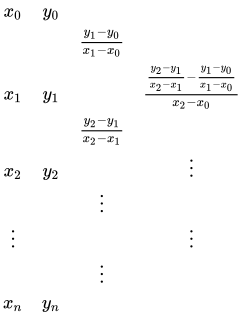
Thus, the table corresponding to these terms upto two columns has the following form:
x
0
y
0
y
1
−
y
0
x
1
−
x
0
x
1
y
1
y
2
−
y
1
x
2
−
x
1
−
y
1
−
y
0
x
1
−
x
0
x
2
−
x
0
y
2
−
y
1
x
2
−
x
1
x
2
y
2
⋮
⋮
⋮
⋮
⋮
x
n
y
n
{\displaystyle {\begin{matrix}x_{0}&y_{0}&&\\&&{y_{1}-y_{0} \over x_{1}-x_{0}}&\\x_{1}&y_{1}&&{{y_{2}-y_{1} \over x_{2}-x_{1}}-{y_{1}-y_{0} \over x_{1}-x_{0}} \over x_{2}-x_{0}}\\&&{y_{2}-y_{1} \over x_{2}-x_{1}}&\\x_{2}&y_{2}&&\vdots \\&&\vdots &\\\vdots &&&\vdots \\&&\vdots &\\x_{n}&y_{n}&&\\\end{matrix}}}
Linearity
(
f
+
g
)
[
x
0
,
…
,
x
n
]
=
f
[
x
0
,
…
,
x
n
]
+
g
[
x
0
,
…
,
x
n
]
(
λ
⋅
f
)
[
x
0
,
…
,
x
n
]
=
λ
⋅
f
[
x
0
,
…
,
x
n
]
{\displaystyle {\begin{aligned}(f+g)[x_{0},\dots ,x_{n}]&=f[x_{0},\dots ,x_{n}]+g[x_{0},\dots ,x_{n}]\\(\lambda \cdot f)[x_{0},\dots ,x_{n}]&=\lambda \cdot f[x_{0},\dots ,x_{n}]\end{aligned}}}
Leibniz rule
(
f
⋅
g
)
[
x
0
,
…
,
x
n
]
=
f
[
x
0
]
⋅
g
[
x
0
,
…
,
x
n
]
+
f
[
x
0
,
x
1
]
⋅
g
[
x
1
,
…
,
x
n
]
+
⋯
+
f
[
x
0
,
…
,
x
n
]
⋅
g
[
x
n
]
=
∑
r
=
0
n
f
[
x
0
,
…
,
x
r
]
⋅
g
[
x
r
,
…
,
x
n
]
{\displaystyle (f\cdot g)[x_{0},\dots ,x_{n}]=f[x_{0}]\cdot g[x_{0},\dots ,x_{n}]+f[x_{0},x_{1}]\cdot g[x_{1},\dots ,x_{n}]+\dots +f[x_{0},\dots ,x_{n}]\cdot g[x_{n}]=\sum _{r=0}^{n}f[x_{0},\ldots ,x_{r}]\cdot g[x_{r},\ldots ,x_{n}]}
Divided differences are symmetric: If
σ
:
{
0
,
…
,
n
}
→
{
0
,
…
,
n
}
{\displaystyle \sigma :\{0,\dots ,n\}\to \{0,\dots ,n\}}
f
[
x
0
,
…
,
x
n
]
=
f
[
x
σ
(
0
)
,
…
,
x
σ
(
n
)
]
{\displaystyle f[x_{0},\dots ,x_{n}]=f[x_{\sigma (0)},\dots ,x_{\sigma (n)}]}
Polynomial interpolation in the Newton form : if
P
{\displaystyle P}
≤
n
{\displaystyle \leq n}
p
[
x
0
,
…
,
x
n
]
{\displaystyle p[x_{0},\dots ,x_{n}]}
P
n
−
1
(
x
)
=
p
[
x
0
]
+
p
[
x
0
,
x
1
]
(
x
−
x
0
)
+
p
[
x
0
,
x
1
,
x
2
]
(
x
−
x
0
)
(
x
−
x
1
)
+
⋯
+
p
[
x
0
,
…
,
x
n
]
(
x
−
x
0
)
(
x
−
x
1
)
⋯
(
x
−
x
n
−
1
)
{\displaystyle P_{n-1}(x)=p[x_{0}]+p[x_{0},x_{1}](x-x_{0})+p[x_{0},x_{1},x_{2}](x-x_{0})(x-x_{1})+\cdots +p[x_{0},\ldots ,x_{n}](x-x_{0})(x-x_{1})\cdots (x-x_{n-1})}
If
p
{\displaystyle p}
<
n
{\displaystyle <n}
p
[
x
0
,
…
,
x
n
]
=
0.
{\displaystyle p[x_{0},\dots ,x_{n}]=0.}
Mean value theorem for divided differences : if
f
{\displaystyle f}
n times differentiable, then
f
[
x
0
,
…
,
x
n
]
=
f
(
n
)
(
ξ
)
n
!
{\displaystyle f[x_{0},\dots ,x_{n}]={\frac {f^{(n)}(\xi )}{n!}}}
ξ
{\displaystyle \xi }
x
k
{\displaystyle x_{k}}
The divided difference scheme can be put into an upper triangular matrix :
T
f
(
x
0
,
…
,
x
n
)
=
(
f
[
x
0
]
f
[
x
0
,
x
1
]
f
[
x
0
,
x
1
,
x
2
]
…
f
[
x
0
,
…
,
x
n
]
0
f
[
x
1
]
f
[
x
1
,
x
2
]
…
f
[
x
1
,
…
,
x
n
]
0
0
f
[
x
2
]
…
f
[
x
2
,
…
,
x
n
]
⋮
⋮
⋱
⋮
0
0
0
…
f
[
x
n
]
)
.
{\displaystyle T_{f}(x_{0},\dots ,x_{n})={\begin{pmatrix}f[x_{0}]&f[x_{0},x_{1}]&f[x_{0},x_{1},x_{2}]&\ldots &f[x_{0},\dots ,x_{n}]\\0&f[x_{1}]&f[x_{1},x_{2}]&\ldots &f[x_{1},\dots ,x_{n}]\\0&0&f[x_{2}]&\ldots &f[x_{2},\dots ,x_{n}]\\\vdots &\vdots &&\ddots &\vdots \\0&0&0&\ldots &f[x_{n}]\end{pmatrix}}.}
Then it holds
T
f
+
g
(
x
)
=
T
f
(
x
)
+
T
g
(
x
)
{\displaystyle T_{f+g}(x)=T_{f}(x)+T_{g}(x)}
T
λ
f
(
x
)
=
λ
T
f
(
x
)
{\displaystyle T_{\lambda f}(x)=\lambda T_{f}(x)}
λ
{\displaystyle \lambda }
T
f
⋅
g
(
x
)
=
T
f
(
x
)
⋅
T
g
(
x
)
{\displaystyle T_{f\cdot g}(x)=T_{f}(x)\cdot T_{g}(x)}
This follows from the Leibniz rule. It means that multiplication of such matrices is commutative . Summarised, the matrices of divided difference schemes with respect to the same set of nodes x form a commutative ring .Since
T
f
(
x
)
{\displaystyle T_{f}(x)}
eigenvalues are obviously
f
(
x
0
)
,
…
,
f
(
x
n
)
{\displaystyle f(x_{0}),\dots ,f(x_{n})}
Let
δ
ξ
{\displaystyle \delta _{\xi }}
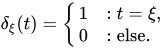
Kronecker delta -like function, that is
δ
ξ
(
t
)
=
{
1
:
t
=
ξ
,
0
:
else
.
{\displaystyle \delta _{\xi }(t)={\begin{cases}1&:t=\xi ,\\0&:{\mbox{else}}.\end{cases}}}
f
⋅
δ
ξ
=
f
(
ξ
)
⋅
δ
ξ
{\displaystyle f\cdot \delta _{\xi }=f(\xi )\cdot \delta _{\xi }}
δ
ξ
{\displaystyle \delta _{\xi }}
eigenfunction of the pointwise function multiplication. That is
T
δ
x
i
(
x
)
{\displaystyle T_{\delta _{x_{i}}}(x)}
eigenmatrix " of
T
f
(
x
)
{\displaystyle T_{f}(x)}
T
f
(
x
)
⋅
T
δ
x
i
(
x
)
=
f
(
x
i
)
⋅
T
δ
x
i
(
x
)
{\displaystyle T_{f}(x)\cdot T_{\delta _{x_{i}}}(x)=f(x_{i})\cdot T_{\delta _{x_{i}}}(x)}
T
δ
x
i
(
x
)
{\displaystyle T_{\delta _{x_{i}}}(x)}
matrix rank of
T
δ
x
i
(
x
)
{\displaystyle T_{\delta _{x_{i}}}(x)}
T
f
(
x
)
{\displaystyle T_{f}(x)}
i
{\displaystyle i}
T
δ
x
i
(
x
)
{\displaystyle T_{\delta _{x_{i}}}(x)}
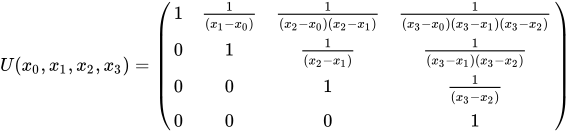
U
(
x
)
{\displaystyle U(x)}
U
(
x
0
,
x
1
,
x
2
,
x
3
)
=
(
1
1
(
x
1
−
x
0
)
1
(
x
2
−
x
0
)
(
x
2
−
x
1
)
1
(
x
3
−
x
0
)
(
x
3
−
x
1
)
(
x
3
−
x
2
)
0
1
1
(
x
2
−
x
1
)
1
(
x
3
−
x
1
)
(
x
3
−
x
2
)
0
0
1
1
(
x
3
−
x
2
)
0
0
0
1
)
{\displaystyle U(x_{0},x_{1},x_{2},x_{3})={\begin{pmatrix}1&{\frac {1}{(x_{1}-x_{0})}}&{\frac {1}{(x_{2}-x_{0})(x_{2}-x_{1})}}&{\frac {1}{(x_{3}-x_{0})(x_{3}-x_{1})(x_{3}-x_{2})}}\\0&1&{\frac {1}{(x_{2}-x_{1})}}&{\frac {1}{(x_{3}-x_{1})(x_{3}-x_{2})}}\\0&0&1&{\frac {1}{(x_{3}-x_{2})}}\\0&0&0&1\end{pmatrix}}}
diagonalization of
T
f
(
x
)
{\displaystyle T_{f}(x)}
U
(
x
)
⋅
diag
(
f
(
x
0
)
,
…
,
f
(
x
n
)
)
=
T
f
(
x
)
⋅
U
(
x
)
.
{\displaystyle U(x)\cdot \operatorname {diag} (f(x_{0}),\dots ,f(x_{n}))=T_{f}(x)\cdot U(x).}
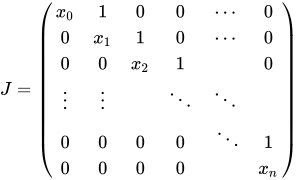
Polynomials and power series [ edit ] The matrix
J
=
(
x
0
1
0
0
⋯
0
0
x
1
1
0
⋯
0
0
0
x
2
1
0
⋮
⋮
⋱
⋱
0
0
0
0
⋱
1
0
0
0
0
x
n
)
{\displaystyle J={\begin{pmatrix}x_{0}&1&0&0&\cdots &0\\0&x_{1}&1&0&\cdots &0\\0&0&x_{2}&1&&0\\\vdots &\vdots &&\ddots &\ddots &\\0&0&0&0&\;\ddots &1\\0&0&0&0&&x_{n}\end{pmatrix}}}
identity function with respect to the nodes
x
0
,
…
,
x
n
{\displaystyle x_{0},\dots ,x_{n}}
J
m
{\displaystyle J^{m}}
power function with exponent
m
{\displaystyle m}
polynomial function
p
{\displaystyle p}
p
{\displaystyle p}
J
{\displaystyle J}
p
(
ξ
)
=
a
0
+
a
1
⋅
ξ
+
⋯
+
a
m
⋅
ξ
m
{\displaystyle p(\xi )=a_{0}+a_{1}\cdot \xi +\dots +a_{m}\cdot \xi ^{m}}
p
(
J
)
=
a
0
+
a
1
⋅
J
+
⋯
+
a
m
⋅
J
m
{\displaystyle p(J)=a_{0}+a_{1}\cdot J+\dots +a_{m}\cdot J^{m}}
T
p
(
x
)
=
p
(
J
)
.
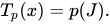
{\displaystyle T_{p}(x)=p(J).}
Opitz' formula .[ 2] [ 3]
Now consider increasing the degree of
p
{\displaystyle p}
Taylor series .
Let
f
{\displaystyle f}
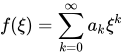
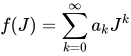
power series .
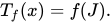
You can compute the divided difference scheme for
f
{\displaystyle f}
J
{\displaystyle J}
f
(
ξ
)
=
∑
k
=
0
∞
a
k
ξ
k
{\displaystyle f(\xi )=\sum _{k=0}^{\infty }a_{k}\xi ^{k}}
f
(
J
)
=
∑
k
=
0
∞
a
k
J
k
{\displaystyle f(J)=\sum _{k=0}^{\infty }a_{k}J^{k}}
T
f
(
x
)
=
f
(
J
)
.
{\displaystyle T_{f}(x)=f(J).}
Alternative characterizations [ edit ]
f
[
x
0
]
=
f
(
x
0
)
f
[
x
0
,
x
1
]
=
f
(
x
0
)
(
x
0
−
x
1
)
+
f
(
x
1
)
(
x
1
−
x
0
)
f
[
x
0
,
x
1
,
x
2
]
=
f
(
x
0
)
(
x
0
−
x
1
)
⋅
(
x
0
−
x
2
)
+
f
(
x
1
)
(
x
1
−
x
0
)
⋅
(
x
1
−
x
2
)
+
f
(
x
2
)
(
x
2
−
x
0
)
⋅
(
x
2
−
x
1
)
f
[
x
0
,
x
1
,
x
2
,
x
3
]
=
f
(
x
0
)
(
x
0
−
x
1
)
⋅
(
x
0
−
x
2
)
⋅
(
x
0
−
x
3
)
+
f
(
x
1
)
(
x
1
−
x
0
)
⋅
(
x
1
−
x
2
)
⋅
(
x
1
−
x
3
)
+
f
(
x
2
)
(
x
2
−
x
0
)
⋅
(
x
2
−
x
1
)
⋅
(
x
2
−
x
3
)
+
f
(
x
3
)
(
x
3
−
x
0
)
⋅
(
x
3
−
x
1
)
⋅
(
x
3
−
x
2
)
f
[
x
0
,
…
,
x
n
]
=
∑
j
=
0
n
f
(
x
j
)
∏
k
∈
{
0
,
…
,
n
}
∖
{
j
}
(
x
j
−
x
k
)
{\displaystyle {\begin{aligned}f[x_{0}]&=f(x_{0})\\f[x_{0},x_{1}]&={\frac {f(x_{0})}{(x_{0}-x_{1})}}+{\frac {f(x_{1})}{(x_{1}-x_{0})}}\\f[x_{0},x_{1},x_{2}]&={\frac {f(x_{0})}{(x_{0}-x_{1})\cdot (x_{0}-x_{2})}}+{\frac {f(x_{1})}{(x_{1}-x_{0})\cdot (x_{1}-x_{2})}}+{\frac {f(x_{2})}{(x_{2}-x_{0})\cdot (x_{2}-x_{1})}}\\f[x_{0},x_{1},x_{2},x_{3}]&={\frac {f(x_{0})}{(x_{0}-x_{1})\cdot (x_{0}-x_{2})\cdot (x_{0}-x_{3})}}+{\frac {f(x_{1})}{(x_{1}-x_{0})\cdot (x_{1}-x_{2})\cdot (x_{1}-x_{3})}}+\\&\quad \quad {\frac {f(x_{2})}{(x_{2}-x_{0})\cdot (x_{2}-x_{1})\cdot (x_{2}-x_{3})}}+{\frac {f(x_{3})}{(x_{3}-x_{0})\cdot (x_{3}-x_{1})\cdot (x_{3}-x_{2})}}\\f[x_{0},\dots ,x_{n}]&=\sum _{j=0}^{n}{\frac {f(x_{j})}{\prod _{k\in \{0,\dots ,n\}\setminus \{j\}}(x_{j}-x_{k})}}\end{aligned}}}
With the help of the polynomial function
ω
(
ξ
)
=
(
ξ
−
x
0
)
⋯
(
ξ
−
x
n
)
{\displaystyle \omega (\xi )=(\xi -x_{0})\cdots (\xi -x_{n})}
f
[
x
0
,
…
,
x
n
]
=
∑
j
=
0
n
f
(
x
j
)
ω
′
(
x
j
)
.
{\displaystyle f[x_{0},\dots ,x_{n}]=\sum _{j=0}^{n}{\frac {f(x_{j})}{\omega '(x_{j})}}.}
If
x
0
<
x
1
<
⋯
<
x
n
{\displaystyle x_{0}<x_{1}<\cdots <x_{n}}
n
≥
1
{\displaystyle n\geq 1}
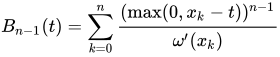
[ 4]
f
[
x
0
,
…
,
x
n
]
=
1
(
n
−
1
)
!
∫
x
0
x
n
f
(
n
)
(
t
)
B
n
−
1
(
t
)
d
t
{\displaystyle f[x_{0},\ldots ,x_{n}]={\frac {1}{(n-1)!}}\int _{x_{0}}^{x_{n}}f^{(n)}(t)\;B_{n-1}(t)\,dt}
f
(
n
)
{\displaystyle f^{(n)}}
n
{\displaystyle n}
derivative of the function
f
{\displaystyle f}
B
n
−
1
{\displaystyle B_{n-1}}
B-spline of degree
n
−
1
{\displaystyle n-1}
x
0
,
…
,
x
n
{\displaystyle x_{0},\dots ,x_{n}}
B
n
−
1
(
t
)
=
∑
k
=
0
n
(
max
(
0
,
x
k
−
t
)
)
n
−
1
ω
′
(
x
k
)
{\displaystyle B_{n-1}(t)=\sum _{k=0}^{n}{\frac {(\max(0,x_{k}-t))^{n-1}}{\omega '(x_{k})}}}
This is a consequence of the Peano kernel theorem ; it is called the Peano form of the divided differences and
B
n
−
1
{\displaystyle B_{n-1}}
Peano kernel for the divided differences, all named after Giuseppe Peano .
Forward and backward differences [ edit ] When the data points are equidistantly distributed we get the special case called forward differences . They are easier to calculate than the more general divided differences.
Given n +1 data points
(
x
0
,
y
0
)
,
…
,
(
x
n
,
y
n
)
{\displaystyle (x_{0},y_{0}),\ldots ,(x_{n},y_{n})}
x
k
=
x
0
+
k
h
,
for
k
=
0
,
…
,
n
and fixed
h
>
0
{\displaystyle x_{k}=x_{0}+kh,\ {\text{ for }}\ k=0,\ldots ,n{\text{ and fixed }}h>0}
Δ
(
0
)
y
k
:=
y
k
,
k
=
0
,
…
,
n
Δ
(
j
)
y
k
:=
Δ
(
j
−
1
)
y
k
+
1
−
Δ
(
j
−
1
)
y
k
,
k
=
0
,
…
,
n
−
j
,
j
=
1
,
…
,
n
.
{\displaystyle {\begin{aligned}\Delta ^{(0)}y_{k}&:=y_{k},\qquad k=0,\ldots ,n\\\Delta ^{(j)}y_{k}&:=\Delta ^{(j-1)}y_{k+1}-\Delta ^{(j-1)}y_{k},\qquad k=0,\ldots ,n-j,\ j=1,\dots ,n.\end{aligned}}}
∇
(
0
)
y
k
:=
y
k
,
k
=
0
,
…
,
n
∇
(
j
)
y
k
:=
∇
(
j
−
1
)
y
k
−
∇
(
j
−
1
)
y
k
−
1
,
k
=
0
,
…
,
n
−
j
,
j
=
1
,
…
,
n
.
{\displaystyle {\begin{aligned}\nabla ^{(0)}y_{k}&:=y_{k},\qquad k=0,\ldots ,n\\\nabla ^{(j)}y_{k}&:=\nabla ^{(j-1)}y_{k}-\nabla ^{(j-1)}y_{k-1},\qquad k=0,\ldots ,n-j,\ j=1,\dots ,n.\end{aligned}}}
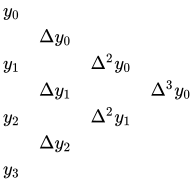
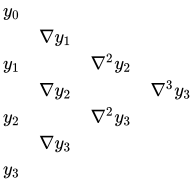
forward difference table is written as:
y
0
Δ
y
0
y
1
Δ
2
y
0
Δ
y
1
Δ
3
y
0
y
2
Δ
2
y
1
Δ
y
2
y
3
{\displaystyle {\begin{matrix}y_{0}&&&\\&\Delta y_{0}&&\\y_{1}&&\Delta ^{2}y_{0}&\\&\Delta y_{1}&&\Delta ^{3}y_{0}\\y_{2}&&\Delta ^{2}y_{1}&\\&\Delta y_{2}&&\\y_{3}&&&\\\end{matrix}}}
y
0
∇
y
1
y
1
∇
2
y
2
∇
y
2
∇
3
y
3
y
2
∇
2
y
3
∇
y
3
y
3
{\displaystyle {\begin{matrix}y_{0}&&&\\&\nabla y_{1}&&\\y_{1}&&\nabla ^{2}y_{2}&\\&\nabla y_{2}&&\nabla ^{3}y_{3}\\y_{2}&&\nabla ^{2}y_{3}&\\&\nabla y_{3}&&\\y_{3}&&&\\\end{matrix}}}
The relationship between divided differences and forward differences is[ 5]
[
y
j
,
y
j
+
1
,
…
,
y
j
+
k
]
=
1
k
!
h
k
Δ
(
k
)
y
j
,
{\displaystyle [y_{j},y_{j+1},\ldots ,y_{j+k}]={\frac {1}{k!h^{k}}}\Delta ^{(k)}y_{j},}
[citation needed
[
y
j
,
y
j
−
1
,
…
,
y
j
−
k
]
=
1
k
!
h
k
∇
(
k
)
y
j
.
{\displaystyle [{y}_{j},y_{j-1},\ldots ,{y}_{j-k}]={\frac {1}{k!h^{k}}}\nabla ^{(k)}y_{j}.}
When the data points are equispaced we can also derive an explicit formula for
[
y
j
,
…
,
y
j
+
k
]
{\displaystyle [y_{j},\ldots ,y_{j+k}]}
k
≤
n
{\displaystyle k\leq n}
j
{\displaystyle j}
j
+
k
≤
n
{\displaystyle j+k\leq n}
[
y
j
,
…
,
y
j
+
k
]
=
(
−
1
)
j
+
k
k
!
h
k
∑
i
=
j
j
+
k
(
−
1
)
i
y
i
(
k
i
−
j
)
.
{\displaystyle [y_{j},\ldots ,y_{j+k}]={\frac {(-1)^{j+k}}{k!h^{k}}}\sum _{i=j}^{j+k}(-1)^{i}y_{i}{\binom {k}{i-j}}.}
Proof. We prove this by induction on
k
{\displaystyle k}
Base case: Let
k
=
0
{\displaystyle k=0}
j
=
0
…
n
{\displaystyle j=0\ldots n}
[
y
j
]
=
y
j
{\displaystyle [y_{j}]=y_{j}}
(
−
1
)
j
0
!
h
0
∑
i
=
j
j
(
−
1
)
i
y
i
(
0
i
−
j
)
=
(
−
1
)
2
j
y
j
=
y
j
.
{\displaystyle {\frac {(-1)^{j}}{0!h^{0}}}\sum _{i=j}^{j}(-1)^{i}y_{i}{\binom {0}{i-j}}=(-1)^{2j}y_{j}=y_{j}.}
Induction step: Assume the above formula holds until
k
{\displaystyle k}
j
{\displaystyle j}
j
+
k
+
1
≤
n
{\displaystyle j+k+1\leq n}
recursive definition we have
[
y
j
,
…
,
y
j
+
k
+
1
]
=
1
h
(
k
+
1
)
(
[
y
j
+
1
,
…
,
y
j
+
k
+
1
]
−
[
y
j
,
…
,
y
j
+
k
]
)
.
{\displaystyle [y_{j},\ldots ,y_{j+k+1}]={\frac {1}{h(k+1)}}\left([y_{j+1},\ldots ,y_{j+k+1}]-[y_{j},\ldots ,y_{j+k}]\right).}
We can use our inductive hypothesis on both members of the left side, and obtain
1
h
(
k
+
1
)
(
(
−
1
)
j
+
k
+
1
k
!
h
k
∑
i
=
j
+
1
j
+
k
+
1
(
−
1
)
i
y
i
(
k
i
−
j
)
−
(
−
1
)
j
+
k
k
!
h
k
∑
i
=
j
j
+
k
(
−
1
)
i
y
i
(
k
i
−
j
)
)
.
{\displaystyle {\frac {1}{h(k+1)}}\left({\frac {(-1)^{j+k+1}}{k!h^{k}}}\sum _{i=j+1}^{j+k+1}(-1)^{i}y_{i}{\binom {k}{i-j}}-{\frac {(-1)^{j+k}}{k!h^{k}}}\sum _{i=j}^{j+k}(-1)^{i}y_{i}{\binom {k}{i-j}}\right).}
This can be rearranged as
(
−
1
)
j
+
k
+
1
(
k
+
1
)
!
h
k
+
1
∑
i
=
j
j
+
k
+
1
(
−
1
)
i
y
i
(
(
k
i
−
j
)
+
(
k
i
−
j
−
1
)
)
{\displaystyle {\frac {(-1)^{j+k+1}}{(k+1)!h^{k+1}}}\sum _{i=j}^{j+k+1}(-1)^{i}y_{i}\left({\binom {k}{i-j}}+{\binom {k}{i-j-1}}\right)}
where
(
k
s
)
=
0
{\displaystyle {\binom {k}{s}}=0}
s
<
k
{\displaystyle s<k}
k
+
1
{\displaystyle k+1}
(
k
i
−
j
)
+
(
k
i
−
j
−
1
)
=
(
k
+
1
i
−
j
)
.
{\displaystyle {\binom {k}{i-j}}+{\binom {k}{i-j-1}}={\binom {k+1}{i-j}}.}
^ Isaacson, Walter (2014). The Innovators . Simon & Schuster. p. 20. ISBN 978-1-4767-0869-0 ^ de Boor, Carl , Divided Differences , Surv. Approx. Theory 1 (2005), 46–69, [1] ^ Opitz, G. Steigungsmatrizen , Z. Angew. Math. Mech. (1964), 44, T52–T54
^ Skof, Fulvia (2011-04-30). Giuseppe Peano between Mathematics and Logic: Proceeding of the International Conference in honour of Giuseppe Peano on the 150th anniversary of his birth and the centennial of the Formulario Mathematico Torino (Italy) October 2-3, 2008 ISBN 978-88-470-1836-5 ^ Burden, Richard L.; Faires, J. Douglas (2011). Numerical Analysis 129 . ISBN 9780538733519 Louis Melville Milne-Thomson (2000) [1933]. The Calculus of Finite Differences . American Mathematical Soc. Chapter 1: Divided Differences. ISBN 978-0-8218-2107-7 Myron B. Allen; Eli L. Isaacson (1998). Numerical Analysis for Applied Science . John Wiley & Sons. Appendix A. ISBN 978-1-118-03027-1 Ron Goldman (2002). Pyramid Algorithms: A Dynamic Programming Approach to Curves and Surfaces for Geometric Modeling . Morgan Kaufmann. Chapter 4:Newton Interpolation and Difference Triangles. ISBN 978-0-08-051547-2 




![{\displaystyle {\begin{aligned}{\mathopen {[}}y_{k}]&:=y_{k},&&k\in \{0,\ldots ,n\}\\{\mathopen {[}}y_{k},\ldots ,y_{j}]&:={\frac {[y_{k+1},\ldots ,y_{j}]-[y_{k},\ldots ,y_{j-1}]}{x_{j}-x_{k}}},&&k\in \{0,\ldots ,n-1\},\ j\in \{k+1,\ldots ,n\}.\end{aligned}}}](https://wikimedia.org/api/rest_v1/media/math/render/svg/058c4a75f35f54f213a4d75800133a01887d0a14)
![{\displaystyle {\begin{matrix}x_{0}&y_{0}=[y_{0}]&&&\\&&[y_{0},y_{1}]&&\\x_{1}&y_{1}=[y_{1}]&&[y_{0},y_{1},y_{2}]&\\&&[y_{1},y_{2}]&&[y_{0},y_{1},y_{2},y_{3}]\\x_{2}&y_{2}=[y_{2}]&&[y_{1},y_{2},y_{3}]&\\&&[y_{2},y_{3}]&&\\x_{3}&y_{3}=[y_{3}]&&&\\\end{matrix}}}](https://wikimedia.org/api/rest_v1/media/math/render/svg/d60ef92b00038923edcedaecccbadd25373b07c1)
![{\displaystyle [y_{k},\ldots ,y_{k+j}]}](https://wikimedia.org/api/rest_v1/media/math/render/svg/ba4668b0015ec43ced0b316848b2e27d95b48d08)



![{\displaystyle f[x_{k},\ldots ,x_{k+j}]\ {\stackrel {\text{def}}{=}}\ [f(x_{k}),\ldots ,f(x_{k+j})]=[y_{k},\ldots ,y_{k+j}].}](https://wikimedia.org/api/rest_v1/media/math/render/svg/d4cab5dd7621f97867cb52b2176197b00a80dafc)
![{\displaystyle f[x_{k},\ldots ,x_{k+j}]={\mathopen {[}}x_{0},\ldots ,x_{n}]f={\mathopen {[}}x_{0},\ldots ,x_{n};f]=D[x_{0},\ldots ,x_{n}]f.}](https://wikimedia.org/api/rest_v1/media/math/render/svg/8c20017aea8a25909a2c547f84cacbce55615c49)


![{\displaystyle {\begin{aligned}{\mathopen {[}}y_{0}]&=y_{0}\\{\mathopen {[}}y_{0},y_{1}]&={\frac {y_{1}-y_{0}}{x_{1}-x_{0}}}\\{\mathopen {[}}y_{0},y_{1},y_{2}]&={\frac {{\mathopen {[}}y_{1},y_{2}]-{\mathopen {[}}y_{0},y_{1}]}{x_{2}-x_{0}}}={\frac {{\frac {y_{2}-y_{1}}{x_{2}-x_{1}}}-{\frac {y_{1}-y_{0}}{x_{1}-x_{0}}}}{x_{2}-x_{0}}}={\frac {y_{2}-y_{1}}{(x_{2}-x_{1})(x_{2}-x_{0})}}-{\frac {y_{1}-y_{0}}{(x_{1}-x_{0})(x_{2}-x_{0})}}\\{\mathopen {[}}y_{0},y_{1},y_{2},y_{3}]&={\frac {{\mathopen {[}}y_{1},y_{2},y_{3}]-{\mathopen {[}}y_{0},y_{1},y_{2}]}{x_{3}-x_{0}}}\end{aligned}}}](https://wikimedia.org/api/rest_v1/media/math/render/svg/c7c5a021041c0405a351383f2e34f0de88e4e58b)
![{\displaystyle {\begin{aligned}(f+g)[x_{0},\dots ,x_{n}]&=f[x_{0},\dots ,x_{n}]+g[x_{0},\dots ,x_{n}]\\(\lambda \cdot f)[x_{0},\dots ,x_{n}]&=\lambda \cdot f[x_{0},\dots ,x_{n}]\end{aligned}}}](https://wikimedia.org/api/rest_v1/media/math/render/svg/b3b56f7d22b2b850570cca476f8668b0f19a0618)
![{\displaystyle (f\cdot g)[x_{0},\dots ,x_{n}]=f[x_{0}]\cdot g[x_{0},\dots ,x_{n}]+f[x_{0},x_{1}]\cdot g[x_{1},\dots ,x_{n}]+\dots +f[x_{0},\dots ,x_{n}]\cdot g[x_{n}]=\sum _{r=0}^{n}f[x_{0},\ldots ,x_{r}]\cdot g[x_{r},\ldots ,x_{n}]}](https://wikimedia.org/api/rest_v1/media/math/render/svg/7eb7cdd2db0caf752548b0e82bc8cd744a30cb18)

![{\displaystyle f[x_{0},\dots ,x_{n}]=f[x_{\sigma (0)},\dots ,x_{\sigma (n)}]}](https://wikimedia.org/api/rest_v1/media/math/render/svg/02ce355ce667f1d9c4825733b42075bb74702610)


![{\displaystyle p[x_{0},\dots ,x_{n}]}](https://wikimedia.org/api/rest_v1/media/math/render/svg/89d89e4e26fb6507247ff36e9750f401eecc9f2e)
![{\displaystyle P_{n-1}(x)=p[x_{0}]+p[x_{0},x_{1}](x-x_{0})+p[x_{0},x_{1},x_{2}](x-x_{0})(x-x_{1})+\cdots +p[x_{0},\ldots ,x_{n}](x-x_{0})(x-x_{1})\cdots (x-x_{n-1})}](https://wikimedia.org/api/rest_v1/media/math/render/svg/993d474f737e93d7bc0249c6c6458d5395f3e44b)


![{\displaystyle p[x_{0},\dots ,x_{n}]=0.}](https://wikimedia.org/api/rest_v1/media/math/render/svg/2c7e5d88eb9d0afc0358a14c9b337b291064de44)

![{\displaystyle f[x_{0},\dots ,x_{n}]={\frac {f^{(n)}(\xi )}{n!}}}](https://wikimedia.org/api/rest_v1/media/math/render/svg/b21b9d4d2d31605f2a2049acd94166b8ca3ac5b8)

![{\displaystyle T_{f}(x_{0},\dots ,x_{n})={\begin{pmatrix}f[x_{0}]&f[x_{0},x_{1}]&f[x_{0},x_{1},x_{2}]&\ldots &f[x_{0},\dots ,x_{n}]\\0&f[x_{1}]&f[x_{1},x_{2}]&\ldots &f[x_{1},\dots ,x_{n}]\\0&0&f[x_{2}]&\ldots &f[x_{2},\dots ,x_{n}]\\\vdots &\vdots &&\ddots &\vdots \\0&0&0&\ldots &f[x_{n}]\end{pmatrix}}.}](https://wikimedia.org/api/rest_v1/media/math/render/svg/9779253726b0fdf9b90a533cd7cb1561be1d7b34)

















![{\displaystyle {\begin{aligned}f[x_{0}]&=f(x_{0})\\f[x_{0},x_{1}]&={\frac {f(x_{0})}{(x_{0}-x_{1})}}+{\frac {f(x_{1})}{(x_{1}-x_{0})}}\\f[x_{0},x_{1},x_{2}]&={\frac {f(x_{0})}{(x_{0}-x_{1})\cdot (x_{0}-x_{2})}}+{\frac {f(x_{1})}{(x_{1}-x_{0})\cdot (x_{1}-x_{2})}}+{\frac {f(x_{2})}{(x_{2}-x_{0})\cdot (x_{2}-x_{1})}}\\f[x_{0},x_{1},x_{2},x_{3}]&={\frac {f(x_{0})}{(x_{0}-x_{1})\cdot (x_{0}-x_{2})\cdot (x_{0}-x_{3})}}+{\frac {f(x_{1})}{(x_{1}-x_{0})\cdot (x_{1}-x_{2})\cdot (x_{1}-x_{3})}}+\\&\quad \quad {\frac {f(x_{2})}{(x_{2}-x_{0})\cdot (x_{2}-x_{1})\cdot (x_{2}-x_{3})}}+{\frac {f(x_{3})}{(x_{3}-x_{0})\cdot (x_{3}-x_{1})\cdot (x_{3}-x_{2})}}\\f[x_{0},\dots ,x_{n}]&=\sum _{j=0}^{n}{\frac {f(x_{j})}{\prod _{k\in \{0,\dots ,n\}\setminus \{j\}}(x_{j}-x_{k})}}\end{aligned}}}](https://wikimedia.org/api/rest_v1/media/math/render/svg/14ec0849d6411a16b8e4d30ab46fa6465bc76928)

![{\displaystyle f[x_{0},\dots ,x_{n}]=\sum _{j=0}^{n}{\frac {f(x_{j})}{\omega '(x_{j})}}.}](https://wikimedia.org/api/rest_v1/media/math/render/svg/23345b9df9f4974173732a145c0555de91569917)


![{\displaystyle f[x_{0},\ldots ,x_{n}]={\frac {1}{(n-1)!}}\int _{x_{0}}^{x_{n}}f^{(n)}(t)\;B_{n-1}(t)\,dt}](https://wikimedia.org/api/rest_v1/media/math/render/svg/71b2827e1bbfd4857051b4ea15edbaa5f49538b6)





![{\displaystyle [y_{j},y_{j+1},\ldots ,y_{j+k}]={\frac {1}{k!h^{k}}}\Delta ^{(k)}y_{j},}](https://wikimedia.org/api/rest_v1/media/math/render/svg/324e8711d27bb1c041f2bd268e916e7a65b2f68a)
![{\displaystyle [{y}_{j},y_{j-1},\ldots ,{y}_{j-k}]={\frac {1}{k!h^{k}}}\nabla ^{(k)}y_{j}.}](https://wikimedia.org/api/rest_v1/media/math/render/svg/6bb191ad42a2ed1475b80c1e0f3e8b65deede658)
![{\displaystyle [y_{j},\ldots ,y_{j+k}]}](https://wikimedia.org/api/rest_v1/media/math/render/svg/2c05d7879e9b4e425ed8b9939dab1e14db1e31f3)


![{\displaystyle [y_{j},\ldots ,y_{j+k}]={\frac {(-1)^{j+k}}{k!h^{k}}}\sum _{i=j}^{j+k}(-1)^{i}y_{i}{\binom {k}{i-j}}.}](https://wikimedia.org/api/rest_v1/media/math/render/svg/2bdea47ffba3ddc1e3570320b1223b1647ca1acd)


![{\displaystyle [y_{j}]=y_{j}}](https://wikimedia.org/api/rest_v1/media/math/render/svg/667c5c6c2d8e2880670ed833d26aa2af0fc7519b)


![{\displaystyle [y_{j},\ldots ,y_{j+k+1}]={\frac {1}{h(k+1)}}\left([y_{j+1},\ldots ,y_{j+k+1}]-[y_{j},\ldots ,y_{j+k}]\right).}](https://wikimedia.org/api/rest_v1/media/math/render/svg/7701a2e4510bf93245cf30659d76a12eb84ec510)


