Epstein Files Full PDF

CLICK HERE
Technopedia Center
PMB University Brochure
Faculty of Engineering and Computer Science
S1 Informatics S1 Information Systems S1 Information Technology S1 Computer Engineering S1 Electrical Engineering S1 Civil Engineering

faculty of Economics and Business
S1 Management S1 Accountancy

Faculty of Letters and Educational Sciences
S1 English literature S1 English language education S1 Mathematics education S1 Sports Education
teknopedia

  • Registerasi
  • Brosur UTI
  • Kip Scholarship Information
  • Performance
Flag Counter
  1. World Encyclopedia
  2. Electrostatics - Wikipedia
Electrostatics - Wikipedia
From Wikipedia, the free encyclopedia
Study of still or slow electric charges
A tabby cat covered in packing peanuts.
Foam peanuts clinging to a cat's fur due to static electricity. The cat's fur becomes charged due to the triboelectric effect. The electric field of the charged fur causes polarization of the molecules of the foam due to electrostatic induction, resulting in a slight attraction of the light plastic pieces to the fur.[1][2][3][4] This effect is also the cause of static cling in clothes.
Electromagnetism
Solenoid
  • Electricity
  • Magnetism
  • Optics
  • History
  • Computational
  • Textbooks
  • Phenomena
Electrostatics
  • Charge density
  • Conductor
  • Coulomb law
  • Electret
  • Electric charge
  • Electric dipole
  • Electric field
  • Electric flux
  • Electric potential
  • Electrostatic discharge
  • Electrostatic induction
  • Gauss's law
  • Insulator
  • Permittivity
  • Polarization
  • Potential energy
  • Static electricity
  • Triboelectricity
Magnetostatics
  • Ampère's law
  • Biot–Savart law
  • Gauss's law for magnetism
  • Magnetic dipole
  • Magnetic field
  • Magnetic flux
  • Magnetic scalar potential
  • Magnetic vector potential
  • Magnetization
  • Permeability
  • Right-hand rule
Electrodynamics
  • Bremsstrahlung
  • Cyclotron radiation
  • Displacement current
  • Eddy current
  • Electromagnetic field
  • Electromagnetic induction
  • Electromagnetic pulse
  • Electromagnetic radiation
  • Faraday's law
  • Jefimenko equations
  • Larmor formula
  • Lenz's law
  • Liénard–Wiechert potential
  • London equations
  • Lorentz force
  • Maxwell's equations
  • Maxwell tensor
  • Poynting vector
  • Synchrotron radiation
Electrical network
  • Alternating current
  • Capacitance
  • Current density
  • Direct current
  • Electric current
  • Electric power
  • Electrolysis
  • Electromotive force
  • Impedance
  • Inductance
  • Joule heating
  • Kirchhoff's laws
  • Network analysis
  • Ohm's law
  • Parallel circuit
  • Resistance
  • Resonant cavities
  • Series circuit
  • Voltage
  • Watt
  • Waveguides
Magnetic circuit
  • AC motor
  • DC motor
  • Electric machine
  • Electric motor
  • Gyrator–capacitor
  • Induction motor
  • Linear motor
  • Magnetomotive force
  • Permeance
  • Reluctance (complex)
  • Reluctance (real)
  • Rotor
  • Stator
  • Transformer
Covariant formulation
  • Electromagnetic tensor
  • Electromagnetism and special relativity
  • Four-current
  • Four-potential
  • Mathematical descriptions
  • Maxwell equations in curved spacetime
  • Relativistic electromagnetism
  • Stress–energy tensor
Scientists
  • Ampère
  • Biot
  • Coulomb
  • Davy
  • Einstein
  • Faraday
  • Fizeau
  • Gauss
  • Heaviside
  • Helmholtz
  • Henry
  • Hertz
  • Hopkinson
  • Jefimenko
  • Joule
  • Kelvin
  • Kirchhoff
  • Larmor
  • Lenz
  • Liénard
  • Lorentz
  • Maxwell
  • Neumann
  • Ohm
  • Ørsted
  • Poisson
  • Poynting
  • Ritchie
  • Savart
  • Singer
  • Steinmetz
  • Tesla
  • Thomson
  • Volta
  • Weber
  • Wiechert
  • v
  • t
  • e

Electrostatics is a branch of physics that studies slow-moving or stationary electric charges on macroscopic objects where quantum effects can be neglected. Under these circumstances, the electric field, electric potential, and the charge density are related without complications from magnetic effects.

Since classical antiquity, it has been known that some materials, such as amber, attract lightweight particles after rubbing.[5] The Greek word ḗlektron (ἤλεκτρον), meaning 'amber', was thus the root of the word electricity. Electrostatic phenomena arise from the forces that electric charges exert on each other. Such forces are described by Coulomb's law.

There are many examples of electrostatic phenomena, from those as simple as the attraction of plastic wrap to one's hand after it is removed from a package, to the apparently spontaneous explosion of grain silos, the damage of electronic components during manufacturing, and photocopier and laser printer operation.

Coulomb's law

[edit]
Main article: Coulomb's law

Coulomb's law states that:[6]

The magnitude of the electrostatic force of attraction or repulsion between two point charges is directly proportional to the product of the magnitudes of charges and inversely proportional to the square of the distance between them.

The force is along the straight line joining them. If the two charges have the same sign, the electrostatic force between them is repulsive; if they have different signs, the force between them is attractive.

If r {\displaystyle r} {\displaystyle r} is the distance (in meters) between two charges, then the force between two point charges Q {\displaystyle Q} {\displaystyle Q} and q {\displaystyle q} {\displaystyle q} is:

F = 1 4 π ε 0 | Q q | r 2 , {\displaystyle F={1 \over 4\pi \varepsilon _{0}}{|Qq| \over r^{2}},} {\displaystyle F={1 \over 4\pi \varepsilon _{0}}{|Qq| \over r^{2}},}

where ε0 = 8.8541878188(14)×10−12 F⋅m−1‍[7] is the vacuum permittivity.[8]

The SI unit of ε0 is equivalently A2⋅s4 ⋅kg−1⋅m−3 or C2⋅N−1⋅m−2 or F⋅m−1.

Electric field

[edit]
Main article: Electric field
The electrostatic field (lines with arrows) of a nearby positive charge (+) causes the mobile charges in conductive objects to separate due to electrostatic induction. Negative charges (blue) are attracted and move to the surface of the object facing the external charge. Positive charges (red) are repelled and move to the surface facing away. These induced surface charges are exactly the right size and shape so their opposing electric field cancels the electric field of the external charge throughout the interior of the metal. Therefore, the electrostatic field everywhere inside a conductive object is zero, and the electrostatic potential is constant.

The electric field, E {\displaystyle \mathbf {E} } {\displaystyle \mathbf {E} }, in units of newtons per coulomb or volts per meter, is a vector field that can be defined everywhere, except at the location of point charges (where it diverges to infinity).[9] It is defined as the electrostatic force F {\displaystyle \mathbf {F} } {\displaystyle \mathbf {F} } on a hypothetical small test charge at the point due to Coulomb's law, divided by the charge q {\displaystyle q} {\displaystyle q}

E = F q {\displaystyle \mathbf {E} ={\mathbf {F} \over q}} {\displaystyle \mathbf {E} ={\mathbf {F}  \over q}}

Electric field lines are useful for visualizing the electric field. Field lines begin on positive charge and terminate on negative charge. They are parallel to the direction of the electric field at each point, and the density of these field lines is a measure of the magnitude of the electric field at any given point.

A collection of n {\displaystyle n} {\displaystyle n} particles of charge q i {\displaystyle q_{i}} {\displaystyle q_{i}}, located at points r i {\displaystyle \mathbf {r} _{i}} {\displaystyle \mathbf {r} _{i}} (called source points) generates the electric field at r {\displaystyle \mathbf {r} } {\displaystyle \mathbf {r} } (called the field point) of:[9]

E ( r ) = 1 4 π ε 0 ∑ i = 1 n q i r − r i ^ | r − r i | 2 = 1 4 π ε 0 ∑ i = 1 n q i r − r i | r − r i | 3 , {\displaystyle \mathbf {E} (\mathbf {r} )={1 \over 4\pi \varepsilon _{0}}\sum _{i=1}^{n}q_{i}{{\hat {\mathbf {r-r_{i}} }} \over {|\mathbf {r-r_{i}} |}^{2}}={1 \over 4\pi \varepsilon _{0}}\sum _{i=1}^{n}q_{i}{\mathbf {r-r_{i}} \over {|\mathbf {r-r_{i}} |}^{3}},} {\displaystyle \mathbf {E} (\mathbf {r} )={1 \over 4\pi \varepsilon _{0}}\sum _{i=1}^{n}q_{i}{{\hat {\mathbf {r-r_{i}} }} \over {|\mathbf {r-r_{i}} |}^{2}}={1 \over 4\pi \varepsilon _{0}}\sum _{i=1}^{n}q_{i}{\mathbf {r-r_{i}}  \over {|\mathbf {r-r_{i}} |}^{3}},}

where r − r i {\textstyle \mathbf {r} -\mathbf {r} _{i}} {\textstyle \mathbf {r} -\mathbf {r} _{i}} is the displacement vector from a source point r i {\displaystyle \mathbf {r} _{i}} {\displaystyle \mathbf {r} _{i}} to the field point r {\displaystyle \mathbf {r} } {\displaystyle \mathbf {r} }, and r − r i ^   = d e f   r − r i | r − r i | {\textstyle {\hat {\mathbf {r-r_{i}} }}\ {\stackrel {\mathrm {def} }{=}}\ {\frac {\mathbf {r-r_{i}} }{|\mathbf {r-r_{i}} |}}} {\textstyle {\hat {\mathbf {r-r_{i}} }}\ {\stackrel {\mathrm {def} }{=}}\ {\frac {\mathbf {r-r_{i}} }{|\mathbf {r-r_{i}} |}}} is the unit vector of the displacement vector that indicates the direction of the field due to the source at point r i {\displaystyle \mathbf {r_{i}} } {\displaystyle \mathbf {r_{i}} }. For a single point charge, q {\displaystyle q} {\displaystyle q}, at the origin, the magnitude of this electric field is E = q / 4 π ε 0 r 2 {\displaystyle E=q/4\pi \varepsilon _{0}r^{2}} {\displaystyle E=q/4\pi \varepsilon _{0}r^{2}} and points away from that charge if it is positive. The fact that the force (and hence the field) can be calculated by summing over all the contributions due to individual source particles is an example of the superposition principle. The electric field produced by a distribution of charges is given by the volume charge density ρ ( r ) {\displaystyle \rho (\mathbf {r} )} {\displaystyle \rho (\mathbf {r} )} and can be obtained by converting this sum into a triple integral:

E ( r ) = 1 4 π ε 0 ∭ ρ ( r ′ ) r − r ′ | r − r ′ | 3 d 3 | r ′ | {\displaystyle \mathbf {E} (\mathbf {r} )={\frac {1}{4\pi \varepsilon _{0}}}\iiint \,\rho (\mathbf {r} '){\mathbf {r-r'} \over {|\mathbf {r-r'} |}^{3}}\mathrm {d} ^{3}|\mathbf {r} '|} {\displaystyle \mathbf {E} (\mathbf {r} )={\frac {1}{4\pi \varepsilon _{0}}}\iiint \,\rho (\mathbf {r} '){\mathbf {r-r'}  \over {|\mathbf {r-r'} |}^{3}}\mathrm {d} ^{3}|\mathbf {r} '|}

Gauss's law

[edit]
Main articles: Gauss's law and Gaussian surface

Gauss's law[10][11] states that "the total electric flux through any closed surface in free space of any shape drawn in an electric field is proportional to the total electric charge enclosed by the surface." Many numerical problems can be solved by considering a Gaussian surface around a body. Mathematically, Gauss's law takes the form of an integral equation:

Φ E = ∮ S E ⋅ d A = Q enclosed ε 0 = ∫ V ρ ε 0 d 3 r , {\displaystyle \Phi _{E}=\oint _{S}\mathbf {E} \cdot \mathrm {d} \mathbf {A} ={Q_{\text{enclosed}} \over \varepsilon _{0}}=\int _{V}{\rho \over \varepsilon _{0}}\mathrm {d} ^{3}r,} {\displaystyle \Phi _{E}=\oint _{S}\mathbf {E} \cdot \mathrm {d} \mathbf {A} ={Q_{\text{enclosed}} \over \varepsilon _{0}}=\int _{V}{\rho  \over \varepsilon _{0}}\mathrm {d} ^{3}r,}

where d 3 r = d x   d y   d z {\displaystyle \mathrm {d} ^{3}r=\mathrm {d} x\ \mathrm {d} y\ \mathrm {d} z} {\displaystyle \mathrm {d} ^{3}r=\mathrm {d} x\ \mathrm {d} y\ \mathrm {d} z} is a volume element. If the charge is distributed over a surface or along a line, replace ρ d 3 r {\displaystyle \rho \,\mathrm {d} ^{3}r} {\displaystyle \rho \,\mathrm {d} ^{3}r} by σ d A {\displaystyle \sigma \,\mathrm {d} A} {\displaystyle \sigma \,\mathrm {d} A} or λ d ℓ {\displaystyle \lambda \,\mathrm {d} \ell } {\displaystyle \lambda \,\mathrm {d} \ell }. The divergence theorem allows Gauss's law to be written in differential form:

∇ ⋅ E = ρ ε 0 . {\displaystyle \nabla \cdot \mathbf {E} ={\rho \over \varepsilon _{0}}.} {\displaystyle \nabla \cdot \mathbf {E} ={\rho  \over \varepsilon _{0}}.}

where ∇ ⋅ {\displaystyle \nabla \cdot } {\displaystyle \nabla \cdot } is the divergence operator.

Poisson and Laplace equations

[edit]
Main articles: Poisson's equation and Laplace's equation

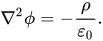
The definition of electrostatic potential, combined with the differential form of Gauss's law (above), provides a relationship between the potential Φ and the charge density ρ:
∇ 2 ϕ = − ρ ε 0 . {\displaystyle {\nabla }^{2}\phi =-{\rho \over \varepsilon _{0}}.} {\displaystyle {\nabla }^{2}\phi =-{\rho  \over \varepsilon _{0}}.}

This relationship is a form of Poisson's equation.[12] In the absence of unpaired electric charge, the equation becomes Laplace's equation:

∇ 2 ϕ = 0 , {\displaystyle {\nabla }^{2}\phi =0,} {\displaystyle {\nabla }^{2}\phi =0,}

Electrostatic approximation

[edit]
Summary of electrostatic relations between electric potential, electric field and charge density. Here, r = x − x ′ {\displaystyle \mathbf {r} =\mathbf {x} -\mathbf {x'} } {\displaystyle \mathbf {r} =\mathbf {x} -\mathbf {x'} }.

If the electric field in a system can be assumed to result from static charges, that is, a system that exhibits no significant time-varying magnetic fields, the system is justifiably analyzed using only the principles of electrostatics. This is called the "electrostatic approximation".[13]

The validity of the electrostatic approximation rests on the assumption that the electric field is irrotational, or nearly so:

∇ × E ≈ 0. {\displaystyle \nabla \times \mathbf {E} \approx 0.} {\displaystyle \nabla \times \mathbf {E} \approx 0.}

From Faraday's law, this assumption implies the absence or near-absence of time-varying magnetic fields:

∂ B ∂ t ≈ 0. {\displaystyle {\partial \mathbf {B} \over \partial t}\approx 0.} {\displaystyle {\partial \mathbf {B}  \over \partial t}\approx 0.}

In other words, electrostatics does not require the absence of magnetic fields or electric currents. Rather, if magnetic fields or electric currents do exist, they must not change with time, or in the worst-case, they must change with time only very slowly. In some problems, both electrostatics and magnetostatics may be required for accurate predictions, but the coupling between the two can still be ignored. Electrostatics and magnetostatics can both be seen as non-relativistic Galilean limits for electromagnetism.[14] In addition, conventional electrostatics ignore quantum effects which have to be added for a complete description.[9]: 2 

Electrostatic potential

[edit]
Main article: Electrostatic potential

As the electric field is irrotational, it is possible to express the electric field as the gradient of a scalar function, ϕ {\displaystyle \phi } {\displaystyle \phi }, called the electrostatic potential (also known as the voltage). An electric field, E {\displaystyle E} {\displaystyle E}, points from regions of high electric potential to regions of low electric potential, expressed mathematically as

E = − ∇ ϕ . {\displaystyle \mathbf {E} =-\nabla \phi .} {\displaystyle \mathbf {E} =-\nabla \phi .}

The gradient theorem can be used to establish that the electrostatic potential is the amount of work per unit charge required to move a charge from point a {\displaystyle a} {\displaystyle a} to point b {\displaystyle b} {\displaystyle b} with the following line integral:

− ∫ a b E ⋅ d ℓ = ϕ ( b ) − ϕ ( a ) . {\displaystyle -\int _{a}^{b}{\mathbf {E} \cdot \mathrm {d} \mathbf {\ell } }=\phi (\mathbf {b} )-\phi (\mathbf {a} ).} {\displaystyle -\int _{a}^{b}{\mathbf {E} \cdot \mathrm {d} \mathbf {\ell } }=\phi (\mathbf {b} )-\phi (\mathbf {a} ).}

From these equations, we see that the electric potential is constant in any region for which the electric field vanishes (such as occurs inside a conducting object).

Electrostatic energy

[edit]
Main articles: Electric potential energy and Energy density

A test particle's potential energy, U E single {\displaystyle U_{\mathrm {E} }^{\text{single}}} {\displaystyle U_{\mathrm {E} }^{\text{single}}}, can be calculated from a line integral of the work, q n E ⋅ d ℓ {\displaystyle q_{n}\mathbf {E} \cdot \mathrm {d} \mathbf {\ell } } {\displaystyle q_{n}\mathbf {E} \cdot \mathrm {d} \mathbf {\ell } }. We integrate from a point at infinity, and assume a collection of N {\displaystyle N} {\displaystyle N} particles of charge Q n {\displaystyle Q_{n}} {\displaystyle Q_{n}}, are already situated at the points r i {\displaystyle \mathbf {r} _{i}} {\displaystyle \mathbf {r} _{i}}. This potential energy (in Joules) is:

U E single = q ϕ ( r ) = q 4 π ε 0 ∑ i = 1 N Q i ‖ R i ‖ {\displaystyle U_{\mathrm {E} }^{\text{single}}=q\phi (\mathbf {r} )={\frac {q}{4\pi \varepsilon _{0}}}\sum _{i=1}^{N}{\frac {Q_{i}}{\left\|{\mathcal {\mathbf {R} _{i}}}\right\|}}} {\displaystyle U_{\mathrm {E} }^{\text{single}}=q\phi (\mathbf {r} )={\frac {q}{4\pi \varepsilon _{0}}}\sum _{i=1}^{N}{\frac {Q_{i}}{\left\|{\mathcal {\mathbf {R} _{i}}}\right\|}}}

where R i = r − r i {\displaystyle \mathbf {\mathcal {R_{i}}} =\mathbf {r} -\mathbf {r} _{i}} {\displaystyle \mathbf {\mathcal {R_{i}}} =\mathbf {r} -\mathbf {r} _{i}} is the distance of each charge Q i {\displaystyle Q_{i}} {\displaystyle Q_{i}} from the test charge q {\displaystyle q} {\displaystyle q}, which situated at the point r {\displaystyle \mathbf {r} } {\displaystyle \mathbf {r} }, and ϕ ( r ) {\displaystyle \phi (\mathbf {r} )} {\displaystyle \phi (\mathbf {r} )} is the electric potential that would be at r {\displaystyle \mathbf {r} } {\displaystyle \mathbf {r} } if the test charge were not present. If only two charges are present, the potential energy is Q 1 Q 2 / ( 4 π ε 0 r ) {\displaystyle Q_{1}Q_{2}/(4\pi \varepsilon _{0}r)} {\displaystyle Q_{1}Q_{2}/(4\pi \varepsilon _{0}r)}. The total electric potential energy due a collection of N charges is calculating by assembling these particles one at a time:

U E total = 1 4 π ε 0 ∑ j = 1 N Q j ∑ i = 1 j − 1 Q i r i j = 1 2 ∑ i = 1 N Q i ϕ i , {\displaystyle U_{\mathrm {E} }^{\text{total}}={\frac {1}{4\pi \varepsilon _{0}}}\sum _{j=1}^{N}Q_{j}\sum _{i=1}^{j-1}{\frac {Q_{i}}{r_{ij}}}={\frac {1}{2}}\sum _{i=1}^{N}Q_{i}\phi _{i},} {\displaystyle U_{\mathrm {E} }^{\text{total}}={\frac {1}{4\pi \varepsilon _{0}}}\sum _{j=1}^{N}Q_{j}\sum _{i=1}^{j-1}{\frac {Q_{i}}{r_{ij}}}={\frac {1}{2}}\sum _{i=1}^{N}Q_{i}\phi _{i},}

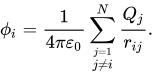
where the following sum from, j = 1 to N, excludes i = j:
ϕ i = 1 4 π ε 0 ∑ j ≠ i j = 1 N Q j r i j . {\displaystyle \phi _{i}={\frac {1}{4\pi \varepsilon _{0}}}\sum _{\stackrel {j=1}{j\neq i}}^{N}{\frac {Q_{j}}{r_{ij}}}.} {\displaystyle \phi _{i}={\frac {1}{4\pi \varepsilon _{0}}}\sum _{\stackrel {j=1}{j\neq i}}^{N}{\frac {Q_{j}}{r_{ij}}}.}

This electric potential, ϕ i {\displaystyle \phi _{i}} {\displaystyle \phi _{i}} is what would be measured at r i {\displaystyle \mathbf {r} _{i}} {\displaystyle \mathbf {r} _{i}} if the charge Q i {\displaystyle Q_{i}} {\displaystyle Q_{i}} were missing. This formula obviously excludes the (infinite) energy that would be required to assemble each point charge from a disperse cloud of charge. The sum over charges can be converted into an integral over charge density using the prescription ∑ ( ⋯ ) → ∫ ( ⋯ ) ρ d 3 r {\textstyle \sum (\cdots )\rightarrow \int (\cdots )\rho \,\mathrm {d} ^{3}r} {\textstyle \sum (\cdots )\rightarrow \int (\cdots )\rho \,\mathrm {d} ^{3}r}:

U E total = 1 2 ∫ ρ ( r ) ϕ ( r ) d 3 r = ε 0 2 ∫ | E | 2 d 3 r , {\displaystyle U_{\mathrm {E} }^{\text{total}}={\frac {1}{2}}\int \rho (\mathbf {r} )\phi (\mathbf {r} )\,\mathrm {d} ^{3}r={\frac {\varepsilon _{0}}{2}}\int \left|{\mathbf {E} }\right|^{2}\,\mathrm {d} ^{3}r,} {\displaystyle U_{\mathrm {E} }^{\text{total}}={\frac {1}{2}}\int \rho (\mathbf {r} )\phi (\mathbf {r} )\,\mathrm {d} ^{3}r={\frac {\varepsilon _{0}}{2}}\int \left|{\mathbf {E} }\right|^{2}\,\mathrm {d} ^{3}r,}

This second expression for electrostatic energy uses the fact that the electric field is the negative gradient of the electric potential, as well as vector calculus identities in a way that resembles integration by parts. These two integrals for electric field energy seem to indicate two mutually exclusive formulas for electrostatic energy density, namely 1 2 ρ ϕ {\textstyle {\frac {1}{2}}\rho \phi } {\textstyle {\frac {1}{2}}\rho \phi } and 1 2 ε 0 E 2 {\textstyle {\frac {1}{2}}\varepsilon _{0}E^{2}} {\textstyle {\frac {1}{2}}\varepsilon _{0}E^{2}}; they yield equal values for the total electrostatic energy only if both are integrated over all space.

Electrostatic pressure

[edit]

Inside of an electrical conductor, there is no electric field.[15] The external electric field has been balanced by surface charges due to movement of charge carriers, either to or from other parts of the material, known as electrostatic induction. The equation connecting the field just above a small patch of the surface and the surface charge is E ⋅ n ^ = σ ϵ 0 {\displaystyle \mathbf {E\cdot {\hat {n}}} ={\frac {\sigma }{\epsilon _{0}}}} {\displaystyle \mathbf {E\cdot {\hat {n}}} ={\frac {\sigma }{\epsilon _{0}}}} where

  • n ^ {\displaystyle \mathbf {\hat {n}} } {\displaystyle \mathbf {\hat {n}} } = the surface unit normal vector,
  • σ {\displaystyle \mathbf {\sigma } } {\displaystyle \mathbf {\sigma } } = the surface charge density.

The average electric field, half the external value,[16] also exerts a force (Coulomb's law) on the conductor patch where the force f {\displaystyle \mathbf {f} } {\displaystyle \mathbf {f} } is given by

f = 1 2 ϵ 0 σ 2 n ^ {\displaystyle \mathbf {f} ={\frac {1}{2\epsilon _{0}}}\sigma ^{2}\mathbf {\hat {n}} } {\displaystyle \mathbf {f} ={\frac {1}{2\epsilon _{0}}}\sigma ^{2}\mathbf {\hat {n}} }.

In terms of the field just outside the surface, the force is equivalent to a pressure given by:

P = ε 0 2 ( E ⋅ n ^ ) 2 , {\displaystyle P={\frac {\varepsilon _{0}}{2}}(\mathbf {E\cdot {\hat {n}}} )^{2},} {\displaystyle P={\frac {\varepsilon _{0}}{2}}(\mathbf {E\cdot {\hat {n}}} )^{2},}

This pressure acts normal to the surface of the conductor, independent of whether: the mobile charges are electrons, holes or mobile protons; the sign of the surface charge; or the sign of the surface normal component of the electric field.[16] Note that there is a similar form for electrostriction in a dielectric.[17]

See also

[edit]
  • Electromagnetism – Fundamental interaction between charged particles
  • Electrostatic generator, machines that create static electricity.
  • Electrostatic induction, separation of charges due to electric fields.
  • Permittivity and relative permittivity, the electric polarizability of materials.
  • Quantization of charge, the charge units carried by electrons or protons.
  • Static electricity, stationary charge accumulated on a material.
  • Triboelectric effect, separation of charges due to sliding or contact.

References

[edit]
  1. ^ Ling, Samuel J.; Moebs, William; Sanny, Jeff (2019). University Physics, Vol. 2. OpenStax. ISBN 9781947172210. Ch.30: Conductors, Insulators, and Charging by Induction
  2. ^ Bloomfield, Louis A. (2015). How Things Work: The Physics of Everyday Life. John Wiley and Sons. p. 270. ISBN 9781119013846.
  3. ^ "Polarization". Static Electricity – Lesson 1 – Basic Terminology and Concepts. The Physics Classroom. 2020. Retrieved 18 June 2021.
  4. ^ Thompson, Xochitl Zamora (2004). "Charge It! All About Electrical Attraction and Repulsion". Teach Engineering: Stem curriculum for K-12. University of Colorado. Retrieved 18 June 2021.
  5. ^ Brockman, C.J. (October 1929). "The history of electricity before the discovery of the voltaic pile". Journal of Chemical Education. 6 (10): 1726–1732. doi:10.1021/ed006p1726.
  6. ^ J, Griffiths (2017). Introduction to Electrodynamics. Cambridge University Press. pp. 296–354. doi:10.1017/9781108333511.008. ISBN 978-1-108-33351-1. Retrieved 2023-08-11.
  7. ^ "2022 CODATA Value: vacuum electric permittivity". The NIST Reference on Constants, Units, and Uncertainty. NIST. May 2024. Retrieved 2024-05-18.
  8. ^ Matthew Sadiku (2009). Elements of electromagnetics. Oxford University Press. p. 104. ISBN 9780195387759.
  9. ^ a b c Purcell, Edward M. (2013). Electricity and Magnetism. Cambridge University Press. pp. 16–18. ISBN 978-1107014022.
  10. ^ "Sur l'attraction des sphéroides elliptiques, par M. de La Grange". Mathematics General Collection. doi:10.1163/9789004460409_mor2-b29447057. Retrieved 2023-08-11.
  11. ^ Gauss, Carl Friedrich (1978-01-15) [1877], "Theoria attractionis corporum sphaeroidicorum ellipticorum homogeneorum, methodo nova tractata", Werke, Berlin, Heidelberg: Springer Berlin Heidelberg, pp. 279–286, doi:10.1007/978-3-642-49319-5_8, ISBN 978-3-642-49320-1, retrieved 2023-08-11{{citation}}: CS1 maint: work parameter with ISBN (link)
  12. ^ Poisson, M; sciences (France), Académie royale des (1827). Mémoires de l'Académie (royale) des sciences de l'Institut (imperial) de France. Vol. 6. Paris.
  13. ^ Montgomery, David (1970). "Validity of the electrostatic approximation". Physics of Fluids. 13 (5): 1401–1403. Bibcode:1970PhFl...13.1401M. doi:10.1063/1.1693079. hdl:2060/19700015014.
  14. ^ Heras, J. A. (2010). "The Galilean limits of Maxwell's equations". American Journal of Physics. 78 (10): 1048–1055. arXiv:1012.1068. Bibcode:2010AmJPh..78.1048H. doi:10.1119/1.3442798. S2CID 118443242.
  15. ^ Purcell, Edward M.; David J. Morin (2013). Electricity and Magnetism. Cambridge Univ. Press. pp. 127–128. ISBN 978-1107014022.
  16. ^ a b Griffiths, David J. (2023-11-02). Introduction to Electrodynamics (5 ed.). Cambridge University Press. pp. §2.5.3. doi:10.1017/9781009397735. ISBN 978-1-009-39773-5.
  17. ^ Sundar, V.; Newnham, R. E. (1992-10-01). "Electrostriction and polarization". Ferroelectrics. 135 (1): 431–446. doi:10.1080/00150199208230043. ISSN 0015-0193.

Further reading

[edit]
  • Hermann A. Haus; James R. Melcher (1989). Electromagnetic Fields and Energy. Englewood Cliffs, NJ: Prentice-Hall. ISBN 0-13-249020-X.
  • Halliday, David; Robert Resnick; Kenneth S. Krane (1992). Physics. New York: John Wiley & Sons. ISBN 0-471-80457-6.
  • Griffiths, David J. (1999). Introduction to Electrodynamics. Upper Saddle River, NJ: Prentice Hall. ISBN 0-13-805326-X.

External links

[edit]
Wikisource has the text of the 1911 Encyclopædia Britannica article "Electrostatics".
  • Media related to Electrostatics at Wikimedia Commons
Look up electrostatics in Wiktionary, the free dictionary.
  • The Feynman Lectures on Physics Vol. II Ch. 4: Electrostatics
  • Introduction to Electrostatics: Point charges can be treated as a distribution using the Dirac delta function
Library resources about
Electrostatics
  • Resources in your library

Learning materials related to Electrostatics at Wikiversity

  • v
  • t
  • e
Major branches of physics
Divisions
  • Pure
  • Applied
    • Engineering
Approaches
  • Experimental
  • Theoretical
    • Computational
Classical
  • Classical mechanics
    • Newtonian
    • Analytical
    • Celestial
    • Continuum
  • Acoustics
  • Classical electromagnetism
  • Classical optics
    • Ray
    • Wave
  • Thermodynamics
    • Statistical
    • Non-equilibrium
Modern
  • Relativistic mechanics
    • Special
    • General
  • Nuclear physics
  • Particle physics
  • Quantum mechanics
  • Atomic, molecular, and optical physics
    • Atomic
    • Molecular
    • Modern optics
  • Condensed matter physics
    • Solid-state physics
    • Crystallography
Interdisciplinary
  • Astrophysics (outline)
  • Atmospheric physics
  • Biophysics
  • Chemical physics
  • Geophysics
  • Materials science
  • Mathematical physics
  • Medical physics
  • Ocean physics
  • Quantum information science
Related
  • History of physics
  • Nobel Prize in Physics
  • Philosophy of physics
  • Physics education
    • research
  • Timeline of physics discoveries
Authority control databases Edit this at Wikidata
International
  • GND
National
  • Czech Republic
Other
  • Encyclopedia of Modern Ukraine
  • Yale LUX
Retrieved from "https://teknopedia.ac.id/w/index.php?title=Electrostatics&oldid=1329901231"
Category:
  • Electrostatics
Hidden categories:
  • CS1 maint: work parameter with ISBN
  • Articles with short description
  • Short description is different from Wikidata
  • Articles containing Greek-language text
  • Commons category link from Wikidata

  • indonesia
  • Polski
  • العربية
  • Deutsch
  • English
  • Español
  • Français
  • Italiano
  • مصرى
  • Nederlands
  • 日本語
  • Português
  • Sinugboanong Binisaya
  • Svenska
  • Українська
  • Tiếng Việt
  • Winaray
  • 中文
  • Русский
Sunting pranala
url url url url url url url url url url url url url url url url url url url url url url url url url url url url url url url url url url url url url url url url url url url url url url url url url url url url url url url url url url url url url url url url url url url url url url url url url url url url url url url url url url url url url url url url url url url url url url url url url url url url url url url url url url url url url url url url url url url url url url url url url url url url url url url url url url url url url url url url url url url url url url url url url url url url url url url url url url url url url url url url url url url url url url url url url url url url url url url url url url url url url url url url url url url url url url url url url url url url url url url url url url url url url url url url url url url url url url url url url url url url url url url url url url url url url url url url url url url url url url url url url url url url url url url url url url url url url url url url url url url url url url url url url url url url url url url url url url url url url url url url url url url url url url url url url url url url url url url url url url url url url url url url url url url url url url url url url url url url url url url url url url url url url url url url url url url url url url url url url url url url url url url url url url url url url url url url url url url url url url url url url url url url url url url url url url url url url url url url url url url url url url url url url url url url url url url url url url url url url url url url url url url url url url url url url url url url url url url url url url url url url url url url url url url url url url url url url url url url url url url url url url url url url url url url url url url url url url url url url url url url url url url url url url url url url url url url url url url url url url url url url url url url url url url url url url url url url url url url url url url url url url url url url url url url url url url url url url url url url url url url url url url url url url url url url url url url url url url url url url url url url url url url url url url url url url url url url url url url url url url url url url url url url url url url url url url url url url url url url url url url url url url url url url url url url url url url url url url url url url url url url url url url url url url url url url url url url url url url url url url url url url url url url url url url url url url url url url url url url url url url url url url url url url url url url url url url url url url url url url url url url url url url url url url url url url url url url url url url url url url url url url url url url url url url url url url url url url url url url url url url url url url url url url url url url url url url url url url url url url url url url url url url url url url url url url url url url url url url url url url url url url url url url url url url url url url url url url url url url url url url url url url url url url url url url url url url url url url url url url url url url url url url url url url url url url url url url url url url url url url url url url url url url url url url url url url url url url url url url url url url url url url url url url url url url url url url url url url url url url url url url url url url url url url url url url url url url url url url url url url url url url url url url url url url url url url url url url url url url url url url url url url url url url url url url url url url url url url url url url url url url url url url url url url url url url url url url url url url url url url url url url url url url url url url url url url url url url url url url url url url url url url url url url url url url url url url url url url url url url url url url url url url url url url url url url url url url url url url url url url url url url url url url url url url url url url url url url url url url url url url url url url url url url url url url url url url url url url url url url url url url url url url url url url url url url url url url url url url url url url url url url url url url url url url url url url url url url url url url url url url url url url url url url url url url url url url url url url url url url url url url url url url url url url url url url url url url url url url url url url url url url url url url url url url url url url url url url url url url url url url url url url url url url url url url url url url url url url url url url url url url url url url url url url url url url url url url url url url url url url url url url url url url url url url url url url url url url url url url url url url url url url url url url url url url url url url url url url url url url url url url url url url url url url url url url url url url url url url url url url url url url url url url url url url url url url url url url url url url url url url url url url url url url url url url url url url url url url url url url url url url url url url url url url url url url url url url url url url url url url url url url url url url url url url url url url url url url url url url url url url url url url url url url url url url url url url url url url url url url url url url url url url url url url url url url url url url url url url url url url url url url url url url url url url url url url url url url url url url url url url url url url url url url url url url url url url url url url url url url url url url url url url url url url url url url url url url url url url url url url url url url url url url url url url url url url url url url url url url url url url url url url url url url url url url url url url url url url url url url url url url url url url url url url url url url url url url url url url url url url url url url url url url url url url url url url url url url url url url url url url url url url url url url url url url url url url url url url url url url url url url url url url url url url url url url url url url url url url url url url url url url url url url url url url url url url url url url url url url url url url url url url url url url url url url url url url url url url url url url url url url url url url url url url url url url url url url url url url url url url url url url url url url url url url url url url url url url url url url url url url url url url url url url url url url url url url url url url url url url url url url url url url url url url url url url url url url url url url url url url url url url url url url url url url url url url url url url url url url url url url url url url url url url url url url url url url url url url url url url url url url url url url url url url url url url url url url url url url url url url url url url url url url url url url url url url url url url url url url url url url url url url url url url url url url url url url url url url url url url url url url url url url url url url url url url url url url url url url url url url url url url url url url url url url url url url url url url url url url url url url url url url url url url url url url url url url url url url url url url url url url url url url url url url url url url url url url url url url url url url url url url url url url url url url url url url url url url url url url url url url url url url url url url url url url url url url url url url url url url url url url url url url url url url url url url url url url url url url url url url url url url url url url url url url url url url url url url url url url url url url url url url url url url url url url url url url url url url url url url url url url url url url url url url url url url url url url url url url url url url url url url url url url url url url url url url url url url url url url url url url url url url url url url url url url url url url url url url url url url url url url url url url url url url url url url url url url url url url url url url url url url url url url url url url url url url url url url url url url url url url url url url url url url url url url url url url url url url url url url url url url url url url url url url url url url url url url url url url url url url url url url url url url url url url url url url url url url url url url url url url url url url url url url url url url url url url url url url url url url url url url url url url url url url url url url url url url url url url url url url url url url url url url url url url url url url url url url url url url url url url url url url url url url url url url url url url url url url url url url url url url url url url url url url url url url url url url url url url url url url url url url url url url url url url url url url url url url url url url url url url url url url url url url url url url url url url url url url url url url url url url url url url url url url url url url url url url url url url url url url url url url url url url url url url url url url url url url url url url url url url url url url url url url url url url url url url url url url url url url url url url url url url url url url url url url url url url url url url url url url url url url url url url url url url url url url url url url url url url url url url url url url url url url url url url url url url url url url url url url url url url url url url url url url url url url url url url url url url url url url url url url url url url url url url url url url url url url url url url url url url url url url url url url url url url url url url url url url url url url url url url url url url url url url url url url url url url url url url url url url url url url url url
Pusat Layanan

UNIVERSITAS TEKNOKRAT INDONESIA | ASEAN's Best Private University
Jl. ZA. Pagar Alam No.9 -11, Labuhan Ratu, Kec. Kedaton, Kota Bandar Lampung, Lampung 35132
Phone: (0721) 702022
Email: pmb@teknokrat.ac.id


