Epstein Files Full PDF

CLICK HERE
Technopedia Center
PMB University Brochure
Faculty of Engineering and Computer Science
S1 Informatics S1 Information Systems S1 Information Technology S1 Computer Engineering S1 Electrical Engineering S1 Civil Engineering

faculty of Economics and Business
S1 Management S1 Accountancy

Faculty of Letters and Educational Sciences
S1 English literature S1 English language education S1 Mathematics education S1 Sports Education
teknopedia

  • Registerasi
  • Brosur UTI
  • Kip Scholarship Information
  • Performance
Flag Counter
  1. World Encyclopedia
  2. Embedding - Wikipedia
Embedding - Wikipedia
From Wikipedia, the free encyclopedia
"Isometric embedding" redirects here. For related concepts for metric spaces, see isometry.
For embeddings of graphs in two-dimensional manifolds, see graph embedding.
For other uses, see Embedding (disambiguation).
Inclusion of one mathematical structure in another, preserving properties of interest

In mathematics, an embedding (or imbedding[1]) is one instance of some mathematical structure contained within another instance, such as a group that is a subgroup.

When some object X {\displaystyle X} {\displaystyle X} is said to be embedded in another object Y {\displaystyle Y} {\displaystyle Y}, the embedding is given by some injective and structure-preserving map f : X → Y {\displaystyle f:X\rightarrow Y} {\displaystyle f:X\rightarrow Y}. The precise meaning of "structure-preserving" depends on the kind of mathematical structure of which X {\displaystyle X} {\displaystyle X} and Y {\displaystyle Y} {\displaystyle Y} are instances. In the terminology of category theory, a structure-preserving map is called a morphism.

The fact that a map f : X → Y {\displaystyle f:X\rightarrow Y} {\displaystyle f:X\rightarrow Y} is an embedding is often indicated by the use of a "hooked arrow" (U+21AA ↪ RIGHTWARDS ARROW WITH HOOK);[2] thus: f : X ↪ Y . {\displaystyle f:X\hookrightarrow Y.} {\displaystyle f:X\hookrightarrow Y.} (On the other hand, this notation is sometimes reserved for inclusion maps.)

Given X {\displaystyle X} {\displaystyle X} and Y {\displaystyle Y} {\displaystyle Y}, several different embeddings of X {\displaystyle X} {\displaystyle X} in Y {\displaystyle Y} {\displaystyle Y} may be possible. In many cases of interest there is a standard (or "canonical") embedding, like those of the natural numbers in the integers, the integers in the rational numbers, the rational numbers in the real numbers, and the real numbers in the complex numbers. In such cases it is common to identify the domain X {\displaystyle X} {\displaystyle X} with its image f ( X ) {\displaystyle f(X)} {\displaystyle f(X)} contained in Y {\displaystyle Y} {\displaystyle Y}, so that X ⊆ Y {\displaystyle X\subseteq Y} {\displaystyle X\subseteq Y}.

Topology and geometry

[edit]

General topology

[edit]

In general topology, an embedding is a homeomorphism onto its image.[3] More explicitly, an injective continuous map f : X → Y {\displaystyle f:X\to Y} {\displaystyle f:X\to Y} between topological spaces X {\displaystyle X} {\displaystyle X} and Y {\displaystyle Y} {\displaystyle Y} is a topological embedding if f {\displaystyle f} {\displaystyle f} yields a homeomorphism between X {\displaystyle X} {\displaystyle X} and f ( X ) {\displaystyle f(X)} {\displaystyle f(X)} (where f ( X ) {\displaystyle f(X)} {\displaystyle f(X)} carries the subspace topology inherited from Y {\displaystyle Y} {\displaystyle Y}). Intuitively then, the embedding f : X → Y {\displaystyle f:X\to Y} {\displaystyle f:X\to Y} lets us treat X {\displaystyle X} {\displaystyle X} as a subspace of Y {\displaystyle Y} {\displaystyle Y}. Every embedding is injective and continuous. Every map that is injective, continuous and either open or closed is an embedding; however there are also embeddings that are neither open nor closed. The latter happens if the image f ( X ) {\displaystyle f(X)} {\displaystyle f(X)} is neither an open set nor a closed set in Y {\displaystyle Y} {\displaystyle Y}.

For a given space Y {\displaystyle Y} {\displaystyle Y}, the existence of an embedding X → Y {\displaystyle X\to Y} {\displaystyle X\to Y} is a topological invariant of X {\displaystyle X} {\displaystyle X}. This allows two spaces to be distinguished if one is able to be embedded in a space while the other is not.

Related definitions

[edit]

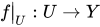
If the domain of a function f : X → Y {\displaystyle f:X\to Y} {\displaystyle f:X\to Y} is a topological space then the function is said to be locally injective at a point if there exists some neighborhood U {\displaystyle U} {\displaystyle U} of this point such that the restriction f | U : U → Y {\displaystyle f{\big \vert }_{U}:U\to Y} {\displaystyle f{\big \vert }_{U}:U\to Y} is injective. It is called locally injective if it is locally injective around every point of its domain. Similarly, a local (topological, resp. smooth) embedding is a function for which every point in its domain has some neighborhood to which its restriction is a (topological, resp. smooth) embedding.

Every injective function is locally injective but not conversely. Local diffeomorphisms, local homeomorphisms, and smooth immersions are all locally injective functions that are not necessarily injective. The inverse function theorem gives a sufficient condition for a continuously differentiable function to be (among other things) locally injective. Every fiber of a locally injective function f : X → Y {\displaystyle f:X\to Y} {\displaystyle f:X\to Y} is necessarily a discrete subspace of its domain X . {\displaystyle X.} {\displaystyle X.}

Differential topology

[edit]

In differential topology: Let M {\displaystyle M} {\displaystyle M} and N {\displaystyle N} {\displaystyle N} be smooth manifolds and f : M → N {\displaystyle f:M\to N} {\displaystyle f:M\to N} be a smooth map. Then f {\displaystyle f} {\displaystyle f} is called an immersion if its derivative is everywhere injective. An embedding, or a smooth embedding, is defined to be an immersion that is an embedding in the topological sense mentioned above (i.e. homeomorphism onto its image).[4]

In other words, the domain of an embedding is diffeomorphic to its image, and in particular the image of an embedding must be a submanifold. An immersion is precisely a local embedding, i.e. for any point x ∈ M {\displaystyle x\in M} {\displaystyle x\in M} there is a neighborhood x ∈ U ⊂ M {\displaystyle x\in U\subset M} {\displaystyle x\in U\subset M} such that f : U → N {\displaystyle f:U\to N} {\displaystyle f:U\to N} is an embedding.

When the domain manifold is compact, the notion of a smooth embedding is equivalent to that of an injective immersion.

An important case is N = R n {\displaystyle N=\mathbb {R} ^{n}} {\displaystyle N=\mathbb {R} ^{n}}. The interest here is in how large n {\displaystyle n} {\displaystyle n} must be for an embedding, in terms of the dimension m {\displaystyle m} {\displaystyle m} of M {\displaystyle M} {\displaystyle M}. The Whitney embedding theorem[5] states that n = 2 m {\displaystyle n=2m} {\displaystyle n=2m} is enough, and is the best possible linear bound. For example, the real projective space R P m {\displaystyle \mathbb {R} \mathrm {P} ^{m}} {\displaystyle \mathbb {R} \mathrm {P} ^{m}} of dimension m {\displaystyle m} {\displaystyle m}, where m {\displaystyle m} {\displaystyle m} is a power of two, requires n = 2 m {\displaystyle n=2m} {\displaystyle n=2m} for an embedding. However, this does not apply to immersions; for instance, R P 2 {\displaystyle \mathbb {R} \mathrm {P} ^{2}} {\displaystyle \mathbb {R} \mathrm {P} ^{2}} can be immersed in R 3 {\displaystyle \mathbb {R} ^{3}} {\displaystyle \mathbb {R} ^{3}} as is explicitly shown by Boy's surface—which has self-intersections. The Roman surface fails to be an immersion as it contains cross-caps.

An embedding is proper if it behaves well with respect to boundaries: one requires the map f : X → Y {\displaystyle f:X\rightarrow Y} {\displaystyle f:X\rightarrow Y} to be such that

  • f ( ∂ X ) = f ( X ) ∩ ∂ Y {\displaystyle f(\partial X)=f(X)\cap \partial Y} {\displaystyle f(\partial X)=f(X)\cap \partial Y}, and
  • f ( X ) {\displaystyle f(X)} {\displaystyle f(X)} is transverse to ∂ Y {\displaystyle \partial Y} {\displaystyle \partial Y} in any point of f ( ∂ X ) {\displaystyle f(\partial X)} {\displaystyle f(\partial X)}.

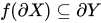
The first condition is equivalent to having f ( ∂ X ) ⊆ ∂ Y {\displaystyle f(\partial X)\subseteq \partial Y} {\displaystyle f(\partial X)\subseteq \partial Y} and f ( X ∖ ∂ X ) ⊆ Y ∖ ∂ Y {\displaystyle f(X\setminus \partial X)\subseteq Y\setminus \partial Y} {\displaystyle f(X\setminus \partial X)\subseteq Y\setminus \partial Y}. The second condition, roughly speaking, says that f ( X ) {\displaystyle f(X)} {\displaystyle f(X)} is not tangent to the boundary of Y {\displaystyle Y} {\displaystyle Y}.

Riemannian and pseudo-Riemannian geometry

[edit]

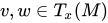
In Riemannian geometry and pseudo-Riemannian geometry: Let ( M , g ) {\displaystyle (M,g)} {\displaystyle (M,g)} and ( N , h ) {\displaystyle (N,h)} {\displaystyle (N,h)} be Riemannian manifolds or more generally pseudo-Riemannian manifolds. An isometric embedding is a smooth embedding f : M → N {\displaystyle f:M\rightarrow N} {\displaystyle f:M\rightarrow N} that preserves the (pseudo-)metric in the sense that g {\displaystyle g} {\displaystyle g} is equal to the pullback of h {\displaystyle h} {\displaystyle h} by f {\displaystyle f} {\displaystyle f}, i.e. g = f ∗ h {\displaystyle g=f^{*}h} {\displaystyle g=f^{*}h}. Explicitly, for any two tangent vectors v , w ∈ T x ( M ) {\displaystyle v,w\in T_{x}(M)} {\displaystyle v,w\in T_{x}(M)} we have

g ( v , w ) = h ( d f ( v ) , d f ( w ) ) . {\displaystyle g(v,w)=h(df(v),df(w)).} {\displaystyle g(v,w)=h(df(v),df(w)).}

Analogously, isometric immersion is an immersion between (pseudo)-Riemannian manifolds that preserves the (pseudo)-Riemannian metrics.

Equivalently, in Riemannian geometry, an isometric embedding (immersion) is a smooth embedding (immersion) that preserves length of curves (cf. Nash embedding theorem).[6]

Algebra

[edit]

In general, for an algebraic category C {\displaystyle C} {\displaystyle C}, an embedding between two C {\displaystyle C} {\displaystyle C}-algebraic structures X {\displaystyle X} {\displaystyle X} and Y {\displaystyle Y} {\displaystyle Y} is a C {\displaystyle C} {\displaystyle C}-morphism e : X → Y {\displaystyle e:X\rightarrow Y} {\displaystyle e:X\rightarrow Y} that is injective.

Field theory

[edit]

In field theory, an embedding of a field E {\displaystyle E} {\displaystyle E} in a field F {\displaystyle F} {\displaystyle F} is a ring homomorphism σ : E → F {\displaystyle \sigma :E\rightarrow F} {\displaystyle \sigma :E\rightarrow F}.

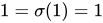
The kernel of σ {\displaystyle \sigma } {\displaystyle \sigma } is an ideal of E {\displaystyle E} {\displaystyle E}, which cannot be the whole field E {\displaystyle E} {\displaystyle E}, because of the condition 1 = σ ( 1 ) = 1 {\displaystyle 1=\sigma (1)=1} {\displaystyle 1=\sigma (1)=1}. Furthermore, any field has as ideals only the zero ideal and the whole field itself (because if there is any non-zero field element in an ideal, it is invertible, showing the ideal is the whole field). Therefore, the kernel is 0 {\displaystyle 0} {\displaystyle 0}, so any embedding of fields is a monomorphism. Hence, E {\displaystyle E} {\displaystyle E} is isomorphic to the subfield σ ( E ) {\displaystyle \sigma (E)} {\displaystyle \sigma (E)} of F {\displaystyle F} {\displaystyle F}. This justifies the name embedding for an arbitrary homomorphism of fields.

Universal algebra and model theory

[edit]
Further information: Structure (mathematical logic) § Embeddings, and Elementary equivalence

If σ {\displaystyle \sigma } {\displaystyle \sigma } is a signature and A , B {\displaystyle A,B} {\displaystyle A,B} are σ {\displaystyle \sigma } {\displaystyle \sigma }-structures (also called σ {\displaystyle \sigma } {\displaystyle \sigma }-algebras in universal algebra or models in model theory), then a map h : A → B {\displaystyle h:A\to B} {\displaystyle h:A\to B} is a σ {\displaystyle \sigma } {\displaystyle \sigma }-embedding exactly if all of the following hold:

  • h {\displaystyle h} {\displaystyle h} is injective,
  • for every n {\displaystyle n} {\displaystyle n}-ary function symbol f ∈ σ {\displaystyle f\in \sigma } {\displaystyle f\in \sigma } and a 1 , … , a n ∈ A n , {\displaystyle a_{1},\ldots ,a_{n}\in A^{n},} {\displaystyle a_{1},\ldots ,a_{n}\in A^{n},} we have h ( f A ( a 1 , … , a n ) ) = f B ( h ( a 1 ) , … , h ( a n ) ) {\displaystyle h(f^{A}(a_{1},\ldots ,a_{n}))=f^{B}(h(a_{1}),\ldots ,h(a_{n}))} {\displaystyle h(f^{A}(a_{1},\ldots ,a_{n}))=f^{B}(h(a_{1}),\ldots ,h(a_{n}))},
  • for every n {\displaystyle n} {\displaystyle n}-ary relation symbol R ∈ σ {\displaystyle R\in \sigma } {\displaystyle R\in \sigma } and a 1 , … , a n ∈ A n , {\displaystyle a_{1},\ldots ,a_{n}\in A^{n},} {\displaystyle a_{1},\ldots ,a_{n}\in A^{n},} we have A ⊨ R ( a 1 , … , a n ) {\displaystyle A\models R(a_{1},\ldots ,a_{n})} {\displaystyle A\models R(a_{1},\ldots ,a_{n})} iff B ⊨ R ( h ( a 1 ) , … , h ( a n ) ) . {\displaystyle B\models R(h(a_{1}),\ldots ,h(a_{n})).} {\displaystyle B\models R(h(a_{1}),\ldots ,h(a_{n})).}

Here A ⊨ R ( a 1 , … , a n ) {\displaystyle A\models R(a_{1},\ldots ,a_{n})} {\displaystyle A\models R(a_{1},\ldots ,a_{n})} is a model theoretical notation equivalent to ( a 1 , … , a n ) ∈ R A {\displaystyle (a_{1},\ldots ,a_{n})\in R^{A}} {\displaystyle (a_{1},\ldots ,a_{n})\in R^{A}}. In model theory there is also a stronger notion of elementary embedding.

Order theory and domain theory

[edit]

In order theory, an embedding of partially ordered sets is a function F {\displaystyle F} {\displaystyle F} between partially ordered sets X {\displaystyle X} {\displaystyle X} and Y {\displaystyle Y} {\displaystyle Y} such that

∀ x 1 , x 2 ∈ X : x 1 ≤ x 2 ⟺ F ( x 1 ) ≤ F ( x 2 ) . {\displaystyle \forall x_{1},x_{2}\in X:x_{1}\leq x_{2}\iff F(x_{1})\leq F(x_{2}).} {\displaystyle \forall x_{1},x_{2}\in X:x_{1}\leq x_{2}\iff F(x_{1})\leq F(x_{2}).}

Injectivity of F {\displaystyle F} {\displaystyle F} follows quickly from this definition. In domain theory, an additional requirement is that

∀ y ∈ Y : { x ∣ F ( x ) ≤ y } {\displaystyle \forall y\in Y:\{x\mid F(x)\leq y\}} {\displaystyle \forall y\in Y:\{x\mid F(x)\leq y\}} is directed.

Metric spaces

[edit]

A mapping ϕ : X → Y {\displaystyle \phi :X\to Y} {\displaystyle \phi :X\to Y} of metric spaces is called an embedding (with distortion C > 0 {\displaystyle C>0} {\displaystyle C>0}) if

L d X ( x , y ) ≤ d Y ( ϕ ( x ) , ϕ ( y ) ) ≤ C L d X ( x , y ) {\displaystyle Ld_{X}(x,y)\leq d_{Y}(\phi (x),\phi (y))\leq CLd_{X}(x,y)} {\displaystyle Ld_{X}(x,y)\leq d_{Y}(\phi (x),\phi (y))\leq CLd_{X}(x,y)}

for every x , y ∈ X {\displaystyle x,y\in X} {\displaystyle x,y\in X} and some constant L > 0 {\displaystyle L>0} {\displaystyle L>0}.

Normed spaces

[edit]

An important special case is that of normed spaces; in this case it is natural to consider linear embeddings.

One of the basic questions that can be asked about a finite-dimensional normed space ( X , ‖ ⋅ ‖ ) {\displaystyle (X,\|\cdot \|)} {\displaystyle (X,\|\cdot \|)} is, what is the maximal dimension k {\displaystyle k} {\displaystyle k} such that the Hilbert space ℓ 2 k {\displaystyle \ell _{2}^{k}} {\displaystyle \ell _{2}^{k}} can be linearly embedded into X {\displaystyle X} {\displaystyle X} with constant distortion?

The answer is given by Dvoretzky's theorem.

Category theory

[edit]

In category theory, there is no satisfactory and generally accepted definition of embeddings that is applicable in all categories. One would expect that all isomorphisms and all compositions of embeddings are embeddings, and that all embeddings are monomorphisms. Other typical requirements are: any extremal monomorphism is an embedding and embeddings are stable under pullbacks.

Ideally the class of all embedded subobjects of a given object, up to isomorphism, should also be small, and thus an ordered set. In this case, the category is said to be well powered with respect to the class of embeddings. This allows defining new local structures in the category (such as a closure operator).

In a concrete category, an embedding is a morphism f : A → B {\displaystyle f:A\rightarrow B} {\displaystyle f:A\rightarrow B} that is an injective function from the underlying set of A {\displaystyle A} {\displaystyle A} to the underlying set of B {\displaystyle B} {\displaystyle B} and is also an initial morphism in the following sense: If g {\displaystyle g} {\displaystyle g} is a function from the underlying set of an object C {\displaystyle C} {\displaystyle C} to the underlying set of A {\displaystyle A} {\displaystyle A}, and if its composition with f {\displaystyle f} {\displaystyle f} is a morphism f g : C → B {\displaystyle fg:C\rightarrow B} {\displaystyle fg:C\rightarrow B}, then g {\displaystyle g} {\displaystyle g} itself is a morphism.

A factorization system for a category also gives rise to a notion of embedding. If ( E , M ) {\displaystyle (E,M)} {\displaystyle (E,M)} is a factorization system, then the morphisms in M {\displaystyle M} {\displaystyle M} may be regarded as the embeddings, especially when the category is well powered with respect to M {\displaystyle M} {\displaystyle M}. Concrete theories often have a factorization system in which M {\displaystyle M} {\displaystyle M} consists of the embeddings in the previous sense. This is the case of the majority of the examples given in this article.

As usual in category theory, there is a dual concept, known as quotient. All the preceding properties can be dualized.

An embedding can also refer to an embedding functor.

See also

[edit]
  • Embedding (machine learning)
  • Ambient space
  • Closed immersion
  • Cover
  • Dimensionality reduction
  • Flat (geometry)
  • Immersion
  • Johnson–Lindenstrauss lemma
  • Submanifold
  • Subspace
  • Universal space

Notes

[edit]
  1. ^ Spivak 1999, p. 49 suggests that "the English" (i.e. the British) use "embedding" instead of "imbedding".
  2. ^ "Arrows – Unicode" (PDF). Retrieved 2017-02-07.
  3. ^ Hocking & Young 1988, p. 73. Sharpe 1997, p. 16.
  4. ^ Bishop & Crittenden 1964, p. 21. Bishop & Goldberg 1968, p. 40. Crampin & Pirani 1994, p. 243. do Carmo 1994, p. 11. Flanders 1989, p. 53. Gallot, Hulin & Lafontaine 2004, p. 12. Kobayashi & Nomizu 1963, p. 9. Kosinski 2007, p. 27. Lang 1999, p. 27. Lee 1997, p. 15. Spivak 1999, p. 49. Warner 1983, p. 22.
  5. ^ Whitney H., Differentiable manifolds, Ann. of Math. (2), 37 (1936), pp. 645–680
  6. ^ Nash J., The embedding problem for Riemannian manifolds, Ann. of Math. (2), 63 (1956), 20–63.

References

[edit]
  • Bishop, Richard Lawrence; Crittenden, Richard J. (1964). Geometry of manifolds. New York: Academic Press. ISBN 978-0-8218-2923-3. {{cite book}}: ISBN / Date incompatibility (help)
  • Bishop, Richard Lawrence; Goldberg, Samuel Irving (1968). Tensor Analysis on Manifolds (First Dover 1980 ed.). The Macmillan Company. ISBN 0-486-64039-6.
  • Crampin, Michael; Pirani, Felix Arnold Edward (1994). Applicable differential geometry. Cambridge, England: Cambridge University Press. ISBN 978-0-521-23190-9.
  • do Carmo, Manfredo Perdigao (1994). Riemannian Geometry. Birkhäuser Boston. ISBN 978-0-8176-3490-2.
  • Flanders, Harley (1989). Differential forms with applications to the physical sciences. Dover. ISBN 978-0-486-66169-8.
  • Gallot, Sylvestre; Hulin, Dominique; Lafontaine, Jacques (2004). Riemannian Geometry (3rd ed.). Berlin, New York: Springer-Verlag. ISBN 978-3-540-20493-0.
  • Hocking, John Gilbert; Young, Gail Sellers (1988) [1961]. Topology. Dover. ISBN 0-486-65676-4.
  • Kosinski, Antoni Albert (2007) [1993]. Differential manifolds. Mineola, New York: Dover Publications. ISBN 978-0-486-46244-8.
  • Lang, Serge (1999). Fundamentals of Differential Geometry. Graduate Texts in Mathematics. New York: Springer. ISBN 978-0-387-98593-0.
  • Kobayashi, Shoshichi; Nomizu, Katsumi (1963). Foundations of Differential Geometry, Volume 1. New York: Wiley-Interscience.
  • Lee, John Marshall (1997). Riemannian manifolds. Springer Verlag. ISBN 978-0-387-98322-6.
  • Sharpe, R.W. (1997). Differential Geometry: Cartan's Generalization of Klein's Erlangen Program. Springer-Verlag, New York. ISBN 0-387-94732-9..
  • Spivak, Michael (1999) [1970]. A Comprehensive introduction to differential geometry (Volume 1). Publish or Perish. ISBN 0-914098-70-5.
  • Warner, Frank Wilson (1983). Foundations of Differentiable Manifolds and Lie Groups. Springer-Verlag, New York. ISBN 0-387-90894-3..

External links

[edit]
  • Adámek, Jiří; Horst Herrlich; George Strecker (2006). Abstract and Concrete Categories (The Joy of Cats).
  • Embedding of manifolds Archived 2016-04-18 at the Wayback Machine on the Manifold Atlas
Disambiguation icon
Index of articles associated with the same name
This set index article includes a list of related items that share the same name (or similar names).
If an internal link incorrectly led you here, you may wish to change the link to point directly to the intended article.
Retrieved from "https://teknopedia.ac.id/w/index.php?title=Embedding&oldid=1321327160"
Categories:
  • Set index articles
  • Abstract algebra
  • Category theory
  • General topology
  • Differential topology
  • Functions and mappings
  • Maps of manifolds
  • Model theory
  • Order theory
Hidden categories:
  • Articles with short description
  • Short description is different from Wikidata
  • CS1 errors: ISBN date
  • Webarchive template wayback links
  • All set index articles

  • indonesia
  • Polski
  • العربية
  • Deutsch
  • English
  • Español
  • Français
  • Italiano
  • مصرى
  • Nederlands
  • 日本語
  • Português
  • Sinugboanong Binisaya
  • Svenska
  • Українська
  • Tiếng Việt
  • Winaray
  • 中文
  • Русский
Sunting pranala
url url url url url url url url url url url url url url url url url url url url url url url url url url url url url url url url url url url url url url url url url url url url url url url url url url url url url url url url url url url url url url url url url url url url url url url url url url url url url url url url url url url url url url url url url url url url url url url url url url url url url url url url url url url url url url url url url url url url url url url url url url url url url url url url url url url url url url url url url url url url url url url url url url url url url url url url url url url url url url url url url url url url url url url url url url url url url url url url url url url url url url url url url url url url url url url url url url url url url url url url url url url url url url url url url url url url url url url url url url url url url url url url url url url url url url url url url url url url url url url url url url url url url url url url url url url url url url url url url url url url url url url url url url url url url url url url url url url url url url url url url url url url url url url url url url url url url url url url url url url url url url url url url url url url url url url url url url url url url url url url url url url url url url url url url url url url url url url url url url url url url url url url url url url url url url url url url url url url url url url url url url url url url url url url url url url url url url url url url url url url url url url url url url url url url url url url url url url url url url url url url url url url url url url url url url url url url url url url url url url url url url url url url url url url url url url url url url url url url url url url url url url url url url url url url url url url url url url url url url url url url url url url url url url url url url url url url url url url url url url url url url url url url url url url url url url url url url url url url url url url url url url url url url url url url url url url url url url url url url url url url url url url url url url url url url url url url url url url url url url url url url url url url url url url url url url url url url url url url url url url url url url url url url url url url url url url url url url url url url url url url url url url url url url url url url url url url url url url url url url url url url url url url url url url url url url url url url url url url url url url url url url url url url url url url url url url url url url url url url url url url url url url url url url url url url url url url url url url url url url url url url url url url url url url url url url url url url url url url url url url url url url url url url url url url url url url url url url url url url url url url url url url url url url url url url url url url url url url url url url url url url url url url url url url url url url url url url url url url url url url url url url url url url url url url url url url url url url url url url url url url url url url url url url url url url url url url url url url url url url url url url url url url url url url url url url url url url url url url url url url url url url url url url url url url url url url url url url url url url url url url url url url url url url url url url url url url url url url url url url url url url url url url url url url url url url url url url url url url url url url url url url url url url url url url url url url url url url url url url url url url url url url url url url url url url url url url url url url url url url url url url url url url url url url url url url url url url url url url url url url url url url url url url url url url url url url url url url url url url url url url url url url url url url url url url url url url url url url url url url url url url url url url url url url url url url url url url url url url url url url url url url url url url url url url url url url url url url url url url url url url url url url url url url url url url url url url url url url url url url url url url url url url url url url url url url url url url url url url url url url url url url url url url url url url url url url url url url url url url url url url url url url url url url url url url url url url url url url url url url url url url url url url url url url url url url url url url url url url url url url url url url url url url url url url url url url url url url url url url url url url url url url url url url url url url url url url url url url url url url url url url url url url url url url url url url url url url url url url url url url url url url url url url url url url url url url url url url url url url url url url url url url url url url url url url url url url url url url url url url url url url url url url url url url url url url url url url url url url url url url url url url url url url url url url url url url url url url url url url url url url url url url url url url url url url url url url url url url url url url url url url url url url url url url url url url url url url url url url url url url url url url url url url url url url url url url url url url url url url url url url url url url url url url url url url url url url url url url url url url url url url url url url url url url url url url url url url url url url url url url url url url url url url url url url url url url url url url url url url url url url url url url url url url url url url url url url url url url url url url url url url url url url url url url url url url url url url url url url url url url url url url url url url url url url url url url url url url url url url url url url url url url url url url url url url url url url url url url url url url url url url url url url url url url url url url url url url url url url url url url url url url url url url url url url url url url url url url url url url url url url url url url url url url url url url url url url url url url url url url url url url url url url url url url url url url url url url url url url url url url url url url url url url url url url url url url url url url url url url url url url url url url url url url url url url url url url url url url url url url url url url url url url url url url url url url url url url url url url url url url url url url url url url url url url url url url url url url url url url url url url url url url url url url url url url url url url url url url url url url url url url url url url url url url url url url url url url url url url url url url url url url url url url url url url url url url url url url url url url url url url url url url url url url url url url url url url url url url url url url url url url url url url url url url url url url url url url url url url url url url url url url url url url url url url url url url url url url url url url url url url url url url url url url url url url url url url url url url url url url url url url url url url url url url url url url url url url url url url url url url url url url url url url url url url url url url url url url url url url url url url url url url url url url url url url url url url url url url url url url url url url url url url url url url url url url url url url url url url url url url url url url url url url url url url url url url url url url url url url url url url url url url url url url url url url url url url url url url url url url url url url url url url url url url url url url url url url url url url url url url url url url url url url url url url url url url url url url url url url url url url url url url url url url url url url url url url url url url url url url url url url url url url url url url url url url url url url url url url url url url url url url url url url url url url url url url url url url url url url url url url url url url url url url url url url url url url url url url url url url url url url url url url url url url url url url url url url url url url url url url url url url url url url url url url url url url url url url url url url url url url url url url url url url url url url url url url url url url url url url url url url url url url url url url url url url url url url url url url url url url url url url url url url url url url url url url url url url url url url url url url url url url url url url url url url url url url url url url url url url url url url url url url url url url url url url url url url url url url url url url url url url url url url url url url url url url url url url url url url url url url url url url url url url url url url url url url url url url url url url url url url url url url url url url url url url url url url url url url url url url url url url url url url url url url url url url url url url url url url url url url url url url url url url url url url url url url url url url url url url url url url url url url url url url url url url url url url url url url url url url url url url url url url url url url url url url url url url url url url url url url url url url url url url url url url url url url url url url url url url url url url url url url url url url url url url url url url url url url url url url url url url url url url url url url url url url url url url url url url url url url url url url url url url url url url url url url url url url url url url url url url url url url url url url url url url url url url url url url url url url url url url url url url url url url url url url url url url url url url url url url url url url url url url url url url url url url url url url url url url url url url url url url url url url url url url url url url url url url url url url url url url url
Pusat Layanan

UNIVERSITAS TEKNOKRAT INDONESIA | ASEAN's Best Private University
Jl. ZA. Pagar Alam No.9 -11, Labuhan Ratu, Kec. Kedaton, Kota Bandar Lampung, Lampung 35132
Phone: (0721) 702022
Email: pmb@teknokrat.ac.id