Epstein Files Full PDF

CLICK HERE
Technopedia Center
PMB University Brochure
Faculty of Engineering and Computer Science
S1 Informatics S1 Information Systems S1 Information Technology S1 Computer Engineering S1 Electrical Engineering S1 Civil Engineering

faculty of Economics and Business
S1 Management S1 Accountancy

Faculty of Letters and Educational Sciences
S1 English literature S1 English language education S1 Mathematics education S1 Sports Education
teknopedia

  • Registerasi
  • Brosur UTI
  • Kip Scholarship Information
  • Performance
Flag Counter
  1. World Encyclopedia
  2. Injective function - Wikipedia
Injective function - Wikipedia
From Wikipedia, the free encyclopedia
Function that preserves distinctness
"Injective" redirects here. For other uses, see Injective module and Injective object.
Function
x ↦ f (x)
History of the function concept
Types by domain and codomain
X β†’ 𝔹
𝔹 β†’ X
𝔹n β†’ X
X β†’ β„€
β„€ β†’ X
X β†’ ℝ
ℝ β†’ X
ℝn β†’ X
X β†’ β„‚
β„‚ β†’ X
β„‚n β†’ X
 Classes/properties 
Constant
Identity
Linear
Polynomial
Rational
Algebraic
Analytic
Smooth
Continuous
Measurable
Injective
Surjective
Bijective
Constructions
  • Restriction
  • Composition
  • Ξ»
  • Inverse
Generalizations
  • Relation (Binary relation)
  • Set-valued
  • Multivalued
  • Partial
  • Implicit
  • Space
  • Higher-order
  • Morphism
  • Functor
List of specific functions
  • v
  • t
  • e

In mathematics, an injective function (also known as injection, or one-to-one function[1]) is a function f that maps distinct elements of its domain to distinct elements of its codomain; that is, x1 β‰  x2 implies f(x1) β‰  f(x2) (equivalently by contraposition, f(x1) = f(x2) implies x1 = x2). In other words, every element of the function's codomain is the image of at most one element of its domain.[2] The term one-to-one function must not be confused with one-to-one correspondence that refers to bijective functions, which are functions such that each element in the codomain is an image of exactly one element in the domain.

A homomorphism between algebraic structures is a function that is compatible with the operations of the structures. For all common algebraic structures, and, in particular for vector spaces, an injective homomorphism is also called a monomorphism. However, in the more general context of category theory, the definition of a monomorphism differs from that of an injective homomorphism.[3] This is thus a theorem that they are equivalent for algebraic structures; see Homomorphism Β§ Monomorphism for more details.

A function f {\displaystyle f} {\displaystyle f} that is not injective is sometimes called many-to-one.[2]

Definition

[edit]
The sets X = {1, 2, 3} and Y = {A, B, C, D}, and a function mapping 1 to D, 2 to B, and 3 to A.
An injective function, which is not also surjective
Further information on notation: Function (mathematics) Β§ Notation

Let f {\displaystyle f} {\displaystyle f} be a function whose domain is a set ⁠ X {\displaystyle X} {\displaystyle X}⁠. The function f {\displaystyle f} {\displaystyle f} is said to be injective provided that for all a {\displaystyle a} {\displaystyle a} and b {\displaystyle b} {\displaystyle b} in X , {\displaystyle X,} {\displaystyle X,} if ⁠ f ( a ) = f ( b ) {\displaystyle f(a)=f(b)} {\displaystyle f(a)=f(b)}⁠, then ⁠ a = b {\displaystyle a=b} {\displaystyle a=b}⁠; that is, f ( a ) = f ( b ) {\displaystyle f(a)=f(b)} {\displaystyle f(a)=f(b)} implies ⁠ a = b {\displaystyle a=b} {\displaystyle a=b}⁠. Equivalently, if ⁠ a β‰  b {\displaystyle a\neq b} {\displaystyle a\neq b}⁠, then f ( a ) β‰  f ( b ) {\displaystyle f(a)\neq f(b)} {\displaystyle f(a)\neq f(b)} in the contrapositive statement.

Symbolically, βˆ€ a , b ∈ X , f ( a ) = f ( b ) β‡’ a = b , {\displaystyle \forall a,b\in X,\;\;f(a)=f(b)\Rightarrow a=b,} {\displaystyle \forall a,b\in X,\;\;f(a)=f(b)\Rightarrow a=b,} which is logically equivalent to the contrapositive,[4] βˆ€ a , b ∈ X , a β‰  b β‡’ f ( a ) β‰  f ( b ) . {\displaystyle \forall a,b\in X,\;\;a\neq b\Rightarrow f(a)\neq f(b).} {\displaystyle \forall a,b\in X,\;\;a\neq b\Rightarrow f(a)\neq f(b).}An injective function (or, more generally, a monomorphism) is often denoted by using the specialized arrows ↣ or β†ͺ (for example, f : A ↣ B {\displaystyle f:A\rightarrowtail B} {\displaystyle f:A\rightarrowtail B} or ⁠ f : A β†ͺ B {\displaystyle f:A\hookrightarrow B} {\displaystyle f:A\hookrightarrow B}⁠), although some authors specifically reserve β†ͺ for an inclusion map.[5]

Examples

[edit]

For visual examples, readers are directed to the gallery section.

  • For any set X {\displaystyle X} {\displaystyle X} and any subset ⁠ S βŠ† X {\displaystyle S\subseteq X} {\displaystyle S\subseteq X}⁠, the inclusion map S β†’ X {\displaystyle S\to X} {\displaystyle S\to X} (which sends any element s ∈ S {\displaystyle s\in S} {\displaystyle s\in S} to itself) is injective. In particular, the identity function X β†’ X {\displaystyle X\to X} {\displaystyle X\to X} is always injective (and in fact bijective).
  • If the domain of a function is the empty set, then the function is the empty function, which is injective.
  • If the domain of a function has one element (that is, it is a singleton set), then the function is always injective.
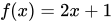
  • The function f : R β†’ R {\displaystyle f:\mathbb {R} \to \mathbb {R} } {\displaystyle f:\mathbb {R} \to \mathbb {R} } defined by f ( x ) = 2 x + 1 {\displaystyle f(x)=2x+1} {\displaystyle f(x)=2x+1} is injective.
  • The function g : R β†’ R {\displaystyle g:\mathbb {R} \to \mathbb {R} } {\displaystyle g:\mathbb {R} \to \mathbb {R} } defined by g ( x ) = x 2 {\displaystyle g(x)=x^{2}} {\displaystyle g(x)=x^{2}} is not injective, because (for example) g ( 1 ) = 1 = g ( βˆ’ 1 ) . {\displaystyle g(1)=1=g(-1).} {\displaystyle g(1)=1=g(-1).} However, if g {\displaystyle g} {\displaystyle g} is redefined so that its domain is the non-negative real numbers [0, +∞), then g {\displaystyle g} {\displaystyle g} is injective.
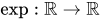
  • The exponential function exp : R β†’ R {\displaystyle \exp :\mathbb {R} \to \mathbb {R} } {\displaystyle \exp :\mathbb {R} \to \mathbb {R} } defined by exp ⁑ ( x ) = e x {\displaystyle \exp(x)=e^{x}} {\displaystyle \exp(x)=e^{x}} is injective (but not surjective, as no real value maps to a negative number).
  • The natural logarithm function ln : ( 0 , ∞ ) β†’ R {\displaystyle \ln :(0,\infty )\to \mathbb {R} } {\displaystyle \ln :(0,\infty )\to \mathbb {R} } defined by x ↦ ln ⁑ x {\displaystyle x\mapsto \ln x} {\displaystyle x\mapsto \ln x} is injective.
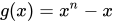
  • The function g : R β†’ R {\displaystyle g:\mathbb {R} \to \mathbb {R} } {\displaystyle g:\mathbb {R} \to \mathbb {R} } defined by g ( x ) = x n βˆ’ x {\displaystyle g(x)=x^{n}-x} {\displaystyle g(x)=x^{n}-x} is not injective, since, for example, ⁠ g ( 0 ) = g ( 1 ) = 0 {\displaystyle g(0)=g(1)=0} {\displaystyle g(0)=g(1)=0}⁠.

More generally, when X {\displaystyle X} {\displaystyle X} and Y {\displaystyle Y} {\displaystyle Y} are both the real line ⁠ R {\displaystyle \mathbb {R} } {\displaystyle \mathbb {R} }⁠, then an injective function f : R β†’ R {\displaystyle f:\mathbb {R} \to \mathbb {R} } {\displaystyle f:\mathbb {R} \to \mathbb {R} } is one whose graph is never intersected by any horizontal line more than once. This principle is referred to as the horizontal line test.[2]

Injections can be undone

[edit]

Functions with left inverses are always injections. That is, given ⁠ f : X β†’ Y {\displaystyle f:X\to Y} {\displaystyle f:X\to Y}⁠, if there is a function g : Y β†’ X {\displaystyle g:Y\to X} {\displaystyle g:Y\to X} such that for every ⁠ x ∈ X {\displaystyle x\in X} {\displaystyle x\in X}⁠, ⁠ g ( f ( x ) ) = x {\displaystyle g(f(x))=x} {\displaystyle g(f(x))=x}⁠, then f {\displaystyle f} {\displaystyle f} is injective. The proof is that f ( a ) = f ( b ) β†’ g ( f ( a ) ) = g ( f ( b ) ) β†’ a = b . {\displaystyle f(a)=f(b)\rightarrow g(f(a))=g(f(b))\rightarrow a=b.} {\displaystyle f(a)=f(b)\rightarrow g(f(a))=g(f(b))\rightarrow a=b.}

In this case, g {\displaystyle g} {\displaystyle g} is called a retraction of ⁠ f {\displaystyle f} {\displaystyle f}⁠. Conversely, f {\displaystyle f} {\displaystyle f} is called a section of ⁠ g {\displaystyle g} {\displaystyle g}⁠. For example: f : R β†’ R 2 , x ↦ ( 1 , m ) ⊺ x {\displaystyle f:\mathbb {R} \rightarrow \mathbb {R} ^{2},x\mapsto (1,m)^{\intercal }x} {\displaystyle f:\mathbb {R} \rightarrow \mathbb {R} ^{2},x\mapsto (1,m)^{\intercal }x} is retracted by ⁠ g : y ↦ ( 1 , m ) 1 + m 2 y {\displaystyle g:y\mapsto {\frac {(1,m)}{1+m^{2}}}y} {\displaystyle g:y\mapsto {\frac {(1,m)}{1+m^{2}}}y}⁠.

Conversely, every injection f {\displaystyle f} {\displaystyle f} with a non-empty domain has a left inverse g {\displaystyle g} {\displaystyle g}. It can be defined by choosing an element a {\displaystyle a} {\displaystyle a} in the domain of f {\displaystyle f} {\displaystyle f} and setting g ( y ) {\displaystyle g(y)} {\displaystyle g(y)} to the unique element of the pre-image f βˆ’ 1 [ y ] {\displaystyle f^{-1}[y]} {\displaystyle f^{-1}[y]} (if it is non-empty) or to a {\displaystyle a} {\displaystyle a} (otherwise).[6]

The left inverse g {\displaystyle g} {\displaystyle g} is not necessarily an inverse of f , {\displaystyle f,} {\displaystyle f,} because the composition in the other order, ⁠ f ∘ g {\displaystyle f\circ g} {\displaystyle f\circ g}⁠, may differ from the identity on ⁠ Y {\displaystyle Y} {\displaystyle Y}⁠. In other words, an injective function can be "reversed" by a left inverse, but is not necessarily invertible, which requires that the function is bijective.

Injections may be made invertible

[edit]

In fact, to turn an injective function f : X β†’ Y {\displaystyle f:X\to Y} {\displaystyle f:X\to Y} into a bijective (hence invertible) function, it suffices to replace its codomain Y {\displaystyle Y} {\displaystyle Y} by its actual image J = f ( X ) . {\displaystyle J=f(X).} {\displaystyle J=f(X).} That is, let g : X β†’ J {\displaystyle g:X\to J} {\displaystyle g:X\to J} such that g ( x ) = f ( x ) {\displaystyle g(x)=f(x)} {\displaystyle g(x)=f(x)} for all ⁠ x ∈ X {\displaystyle x\in X} {\displaystyle x\in X}⁠; then g {\displaystyle g} {\displaystyle g} is bijective. Indeed, f {\displaystyle f} {\displaystyle f} can be factored as ⁠ In J , Y ∘ g {\displaystyle \operatorname {In} _{J,Y}\circ g} {\displaystyle \operatorname {In} _{J,Y}\circ g}⁠, where In J , Y {\displaystyle \operatorname {In} _{J,Y}} {\displaystyle \operatorname {In} _{J,Y}} is the inclusion function from J {\displaystyle J} {\displaystyle J} into ⁠ Y {\displaystyle Y} {\displaystyle Y}⁠.

More generally, injective partial functions are called partial bijections.

Other properties

[edit]
See also: List of set identities and relations Β§ Functions and sets
The composition of two injective functions is injective.
  • If f {\displaystyle f} {\displaystyle f} and g {\displaystyle g} {\displaystyle g} are both injective then f ∘ g {\displaystyle f\circ g} {\displaystyle f\circ g} is injective.
  • If g ∘ f {\displaystyle g\circ f} {\displaystyle g\circ f} is injective, then f {\displaystyle f} {\displaystyle f} is injective (but g {\displaystyle g} {\displaystyle g} need not be).
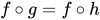
  • f : X β†’ Y {\displaystyle f:X\to Y} {\displaystyle f:X\to Y} is injective if and only if, given any functions ⁠ g {\displaystyle g} {\displaystyle g}⁠, h : W β†’ X {\displaystyle h:W\to X} {\displaystyle h:W\to X} whenever ⁠ f ∘ g = f ∘ h {\displaystyle f\circ g=f\circ h} {\displaystyle f\circ g=f\circ h}⁠, then ⁠ g = h {\displaystyle g=h} {\displaystyle g=h}⁠. In other words, injective functions are precisely the monomorphisms in the category Set of sets.
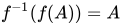
  • If f : X β†’ Y {\displaystyle f:X\to Y} {\displaystyle f:X\to Y} is injective and A {\displaystyle A} {\displaystyle A} is a subset of ⁠ X {\displaystyle X} {\displaystyle X}⁠, then ⁠ f βˆ’ 1 ( f ( A ) ) = A {\displaystyle f^{-1}(f(A))=A} {\displaystyle f^{-1}(f(A))=A}⁠. Thus, A {\displaystyle A} {\displaystyle A} can be recovered from its image ⁠ f ( A ) {\displaystyle f(A)} {\displaystyle f(A)}⁠.
  • If f : X β†’ Y {\displaystyle f:X\to Y} {\displaystyle f:X\to Y} is injective and A {\displaystyle A} {\displaystyle A} and B {\displaystyle B} {\displaystyle B} are both subsets of ⁠ X {\displaystyle X} {\displaystyle X}⁠, then ⁠ f ( A ∩ B ) = f ( A ) ∩ f ( B ) {\displaystyle f(A\cap B)=f(A)\cap f(B)} {\displaystyle f(A\cap B)=f(A)\cap f(B)}⁠.
  • Every function h : W β†’ Y {\displaystyle h:W\to Y} {\displaystyle h:W\to Y} can be decomposed as h = f ∘ g {\displaystyle h=f\circ g} {\displaystyle h=f\circ g} for a suitable injection f {\displaystyle f} {\displaystyle f} and surjection ⁠ g {\displaystyle g} {\displaystyle g}⁠. This decomposition is unique up to isomorphism, and f {\displaystyle f} {\displaystyle f} may be thought of as the inclusion function of the range h ( W ) {\displaystyle h(W)} {\displaystyle h(W)} of h {\displaystyle h} {\displaystyle h} as a subset of the codomain Y {\displaystyle Y} {\displaystyle Y} of ⁠ h {\displaystyle h} {\displaystyle h}⁠.
  • If f : X β†’ Y {\displaystyle f:X\to Y} {\displaystyle f:X\to Y} is an injective function, then Y {\displaystyle Y} {\displaystyle Y} has at least as many elements as X , {\displaystyle X,} {\displaystyle X,} in the sense of cardinal numbers. In particular, if, in addition, there is an injection from ⁠ Y {\displaystyle Y} {\displaystyle Y}⁠ to ⁠ X {\displaystyle X} {\displaystyle X}⁠, then X {\displaystyle X} {\displaystyle X} and Y {\displaystyle Y} {\displaystyle Y} have the same cardinal number. (This is known as the Cantor–Bernstein–Schroeder theorem.)
  • If both X {\displaystyle X} {\displaystyle X} and Y {\displaystyle Y} {\displaystyle Y} are finite with the same number of elements, then f : X β†’ Y {\displaystyle f:X\to Y} {\displaystyle f:X\to Y} is injective if and only if f {\displaystyle f} {\displaystyle f} is surjective (in which case f {\displaystyle f} {\displaystyle f} is bijective).
  • An injective function which is a homomorphism between two algebraic structures is an embedding.
  • Unlike surjectivity, which is a relation between the graph of a function and its codomain, injectivity is a property of the graph of the function alone; that is, whether a function f {\displaystyle f} {\displaystyle f} is injective can be decided by only considering the graph (and not the codomain) of ⁠ f {\displaystyle f} {\displaystyle f}⁠.

Proving that functions are injective

[edit]

A proof that a function f {\displaystyle f} {\displaystyle f} is injective depends on how the function is presented and what properties the function holds. For functions that are given by some formula there is a basic idea. We use the definition of injectivity, namely that if ⁠ f ( x ) = f ( y ) {\displaystyle f(x)=f(y)} {\displaystyle f(x)=f(y)}⁠, then ⁠ x = y {\displaystyle x=y} {\displaystyle x=y}⁠.[7]

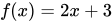
Here is an example: f ( x ) = 2 x + 3 {\displaystyle f(x)=2x+3} {\displaystyle f(x)=2x+3}

Proof: Let ⁠ f : X β†’ Y {\displaystyle f:X\to Y} {\displaystyle f:X\to Y}⁠. Suppose ⁠ f ( x ) = f ( y ) {\displaystyle f(x)=f(y)} {\displaystyle f(x)=f(y)}⁠. So 2 x + 3 = 2 y + 3 {\displaystyle 2x+3=2y+3} {\displaystyle 2x+3=2y+3} implies ⁠ 2 x = 2 y {\displaystyle 2x=2y} {\displaystyle 2x=2y}⁠, which implies ⁠ x = y {\displaystyle x=y} {\displaystyle x=y}⁠. Therefore, it follows from the definition that f {\displaystyle f} {\displaystyle f} is injective.

There are multiple other methods of proving that a function is injective. For example, in calculus if f {\displaystyle f} {\displaystyle f} is a differentiable function defined on some interval, then it is sufficient to show that the derivative is always positive or always negative on that interval. In linear algebra, if f {\displaystyle f} {\displaystyle f} is a linear transformation it is sufficient to show that the kernel of f {\displaystyle f} {\displaystyle f} contains only the zero vector. If f {\displaystyle f} {\displaystyle f} is a function with finite domain it is sufficient to look through the list of images of each domain element and check that no image occurs twice on the list.

A graphical approach for a real-valued function f {\displaystyle f} {\displaystyle f} of a real variable x {\displaystyle x} {\displaystyle x} is the horizontal line test. If every horizontal line intersects the curve of f ( x ) {\displaystyle f(x)} {\displaystyle f(x)} in at most one point, then f {\displaystyle f} {\displaystyle f} is injective or one-to-one.

Gallery

[edit]
  • The sets X = {1, 2, 3} and Y = {A, B, C, D}, and a function mapping 1 to D, 2 to B, and 3 to A.
    An injective non-surjective function (injection, not a bijection)
  • The sets X = {1, 2, 3, 4} and Y = {A, B, C, D}, and a function mapping 1 to D, 2 to B, 3 to C, and 4 to A.
    An injective surjective function (bijection)
  • The sets X = {1, 2, 3, 4} and Y = {B, C, D}, and a function mapping 1 to D, 2 to B, 3 to C, and 4 to C.
    A non-injective surjective function (surjection, not a bijection)
  • The sets X = {1, 2, 3, 4} and Y = {A, B, C, D}, and a function mapping 1 to D, 2 to B, 3 to C, and 4 to C.
    A non-injective non-surjective function (also not a bijection)
  • Not an injective function. Here and are subsets of and are subsets of ⁠⁠: for two regions where the function is not injective because more than one domain element can map to a single range element. That is, it is possible for more than one in to map to the same in ⁠⁠.
    Not an injective function. Here X 1 {\displaystyle X_{1}} {\displaystyle X_{1}} and X 2 {\displaystyle X_{2}} {\displaystyle X_{2}} are subsets of X , Y 1 {\displaystyle X,Y_{1}} {\displaystyle X,Y_{1}} and Y 2 {\displaystyle Y_{2}} {\displaystyle Y_{2}} are subsets of ⁠ Y {\displaystyle Y} {\displaystyle Y}⁠: for two regions where the function is not injective because more than one domain element can map to a single range element. That is, it is possible for more than one x {\displaystyle x} {\displaystyle x} in X {\displaystyle X} {\displaystyle X} to map to the same y {\displaystyle y} {\displaystyle y} in ⁠ Y {\displaystyle Y} {\displaystyle Y}⁠.
  • Making functions injective. The previous function can be reduced to one or more injective functions (say) and ⁠⁠, shown by solid curves (long-dash parts of initial curve are not mapped to anymore). Notice how the rule has not changed – only the domain and range. and are subsets of and are subsets of ⁠⁠: for two regions where the initial function can be made injective so that one domain element can map to a single range element. That is, only one in maps to one in ⁠⁠.
    Making functions injective. The previous function f : X β†’ Y {\displaystyle f:X\to Y} {\displaystyle f:X\to Y} can be reduced to one or more injective functions (say) f : X 1 β†’ Y 1 {\displaystyle f:X_{1}\to Y_{1}} {\displaystyle f:X_{1}\to Y_{1}} and ⁠ f : X 2 β†’ Y 2 {\displaystyle f:X_{2}\to Y_{2}} {\displaystyle f:X_{2}\to Y_{2}}⁠, shown by solid curves (long-dash parts of initial curve are not mapped to anymore). Notice how the rule f {\displaystyle f} {\displaystyle f} has not changed – only the domain and range. X 1 {\displaystyle X_{1}} {\displaystyle X_{1}} and X 2 {\displaystyle X_{2}} {\displaystyle X_{2}} are subsets of X , Y 1 {\displaystyle X,Y_{1}} {\displaystyle X,Y_{1}} and Y 2 {\displaystyle Y_{2}} {\displaystyle Y_{2}} are subsets of ⁠ Y {\displaystyle Y} {\displaystyle Y}⁠: for two regions where the initial function can be made injective so that one domain element can map to a single range element. That is, only one x {\displaystyle x} {\displaystyle x} in X {\displaystyle X} {\displaystyle X} maps to one y {\displaystyle y} {\displaystyle y} in ⁠ Y {\displaystyle Y} {\displaystyle Y}⁠.
  • Injective functions. Diagramatic interpretation in the Cartesian plane, defined by the mapping ⁠⁠, where ⁠⁠, domain of function, range of function, and denotes image of ⁠⁠. Every one in maps to exactly one unique in ⁠⁠. The circled parts of the axes represent domain and range sets β€” in accordance with the standard diagrams above
    Injective functions. Diagramatic interpretation in the Cartesian plane, defined by the mapping ⁠ f : X β†’ Y {\displaystyle f:X\to Y} {\displaystyle f:X\to Y}⁠, where ⁠ y = f ( x ) {\displaystyle y=f(x)} {\displaystyle y=f(x)}⁠, X = {\displaystyle X=} {\displaystyle X=} domain of function, Y = {\displaystyle Y=} {\displaystyle Y=} range of function, and im ⁑ ( f ) {\displaystyle \operatorname {im} (f)} {\displaystyle \operatorname {im} (f)} denotes image of ⁠ f {\displaystyle f} {\displaystyle f}⁠. Every one x {\displaystyle x} {\displaystyle x} in X {\displaystyle X} {\displaystyle X} maps to exactly one unique y {\displaystyle y} {\displaystyle y} in ⁠ Y {\displaystyle Y} {\displaystyle Y}⁠. The circled parts of the axes represent domain and range sets β€” in accordance with the standard diagrams above

See also

[edit]
  • Bijection, injection and surjection β€“ Properties of mathematical functions
  • Injective metric space β€“ Type of metric space
  • Monotonic function β€“ Order-preserving mathematical function
  • Univalent function β€“ Mathematical concept

Notes

[edit]
  1. ^ Sometimes one-one function in Indian mathematical education. "Chapter 1: Relations and functions" (PDF). Archived (PDF) from the original on December 26, 2023 – via NCERT.
  2. ^ a b c "Injective, Surjective and Bijective". Math is Fun. Retrieved 2019-12-07.
  3. ^ "Section 7.3 (00V5): Injective and surjective maps of presheaves". The Stacks project. Retrieved 2019-12-07.
  4. ^ Farlow, S. J. "Section 4.2 Injections, Surjections, and Bijections" (PDF). Mathematics & Statistics - University of Maine. Archived from the original (PDF) on Dec 7, 2019. Retrieved 2019-12-06.
  5. ^ "What are usual notations for surjective, injective and bijective functions?". Mathematics Stack Exchange. Retrieved 2024-11-24.
  6. ^ Unlike the corresponding statement that every surjective function has a right inverse, this does not require the axiom of choice, as the existence of a {\displaystyle a} {\displaystyle a} is implied by the non-emptiness of the domain. However, this statement may fail in less conventional mathematics such as constructive mathematics. In constructive mathematics, the inclusion { 0 , 1 } β†’ R {\displaystyle \{0,1\}\to \mathbb {R} } {\displaystyle \{0,1\}\to \mathbb {R} } of the two-element set in the reals cannot have a left inverse, as it would violate indecomposability, by giving a retraction of the real line to the set {0,1}.
  7. ^ Williams, Peter (Aug 21, 1996). "Proving Functions One-to-One". Department of Mathematics at CSU San Bernardino Reference Notes Page. Archived from the original on 4 June 2017.

References

[edit]
  • Bartle, Robert G. (1976), The Elements of Real Analysis (2nd ed.), New York: John Wiley & Sons, ISBN 978-0-471-05464-1, p. 17 ff.
  • Halmos, Paul R. (1974), Naive Set Theory, New York: Springer, ISBN 978-0-387-90092-6, p. 38 ff.

External links

[edit]
Wikimedia Commons has media related to Injectivity.
Look up injective in Wiktionary, the free dictionary.
  • Earliest Uses of Some of the Words of Mathematics: entry on Injection, Surjection and Bijection has the history of Injection and related terms.
  • Khan Academy – Surjective (onto) and Injective (one-to-one) functions: Introduction to surjective and injective functions
  • v
  • t
  • e
Mathematical logic
General
  • Axiom
    • list
  • Cardinality
  • First-order logic
  • Formal proof
  • Formal semantics
  • Foundations of mathematics
  • Information theory
  • Lemma
  • Logical consequence
  • Model
  • Theorem
  • Theory
  • Type theory
Theorems
(list),
paradoxes
  • GΓΆdel's completeness – incompleteness theorems
  • Tarski's undefinability
  • Banach–Tarski paradox
  • Cantor's theorem – paradox – diagonal argument
  • Compactness
  • Halting problem
  • LindstrΓΆm's
  • LΓΆwenheim–Skolem
  • Russell's paradox
Logics
Traditional
  • Classical logic
  • Logical truth
  • Tautology
  • Proposition
  • Inference
  • Logical equivalence
  • Consistency
    • Equiconsistency
  • Argument
  • Soundness
  • Validity
  • Syllogism
  • Square of opposition
  • Venn diagram
Propositional
  • Boolean algebra
  • Boolean functions
  • Logical connectives
  • Propositional calculus
  • Propositional formula
  • Truth tables
  • Many-valued logic
    • 3
    • finite
    • ∞
Predicate
  • First-order
    • list
  • Second-order
    • Monadic
  • Higher-order
  • Fixed-point
  • Free
  • Quantifiers
  • Predicate
  • Monadic predicate calculus
Set theory
  • Set
    • hereditary
  • Class
  • (Ur-)Element
  • Ordinal number
  • Extensionality
  • Forcing
  • Relation
    • equivalence
    • partition
  • Set operations:
    • intersection
    • union
    • complement
    • Cartesian product
    • power set
    • identities
Types
of sets
  • Countable
  • Uncountable
  • Empty
  • Inhabited
  • Singleton
  • Finite
  • Infinite
  • Transitive
  • Ultrafilter
  • Recursive
  • Fuzzy
  • Universal
  • Universe
    • constructible
    • Grothendieck
    • Von Neumann
Maps,
cardinality
  • Function/Map
    • domain
    • codomain
    • image
  • In/Sur/Bi-jection
  • SchrΓΆder–Bernstein theorem
  • Isomorphism
  • GΓΆdel numbering
  • Enumeration
  • Large cardinal
    • inaccessible
  • Aleph number
  • Operation
    • binary
Theories
  • Zermelo–Fraenkel
    • axiom of choice
    • continuum hypothesis
  • General
  • Kripke–Platek
  • Morse–Kelley
  • Naive
  • New Foundations
  • Tarski–Grothendieck
  • Von Neumann–Bernays–GΓΆdel
  • Ackermann
  • Constructive
Formal
systems

(list),
language,
syntax
  • Alphabet
  • Arity
  • Automata
  • Axiom schema
  • Expression
    • ground
  • Extension
    • by definition
    • conservative
  • Relation
  • Formation rule
  • Grammar
  • Formula
    • atomic
    • closed
    • ground
    • open
  • Free/bound variable
  • Language
  • Metalanguage
  • Logical connective
    • Β¬
    • ∨
    • ∧
    • β†’
    • ↔
    • =
  • Predicate
    • functional
    • variable
    • propositional variable
  • Proof
  • Quantifier
    • βˆƒ
    • !
    • βˆ€
    • rank
  • Sentence
    • atomic
    • spectrum
  • Signature
  • String
  • Substitution
  • Symbol
    • function
    • logical/constant
    • non-logical
    • variable
  • Term
  • Theory
    • list
Example
axiomatic
systems

(list)
  • of true arithmetic
    • Peano
    • second-order
    • elementary function
    • primitive recursive
    • Robinson
    • Skolem
  • of the real numbers
    • Tarski's axiomatization
  • of Boolean algebras
    • canonical
    • minimal axioms
  • of geometry
    • Euclidean
      • Elements
      • Hilbert's
      • Tarski's
    • non-Euclidean
  • Principia Mathematica
Proof theory
  • Formal proof
  • Natural deduction
  • Logical consequence
  • Rule of inference
  • Sequent calculus
  • Theorem
  • Systems
    • axiomatic
    • deductive
    • Hilbert
      • list
  • Complete theory
  • Independence (from ZFC)
  • Proof of impossibility
  • Ordinal analysis
  • Reverse mathematics
  • Self-verifying theories
Model theory
  • Interpretation
    • function
    • of models
  • Model
    • atomic
    • equivalence
    • finite
    • prime
    • saturated
    • spectrum
    • submodel
  • Non-standard model
    • of non-standard arithmetic
  • Diagram
    • elementary
  • Categorical theory
  • Model complete theory
  • Satisfiability
  • Semantics of logic
  • Strength
  • Theories of truth
    • semantic
    • Tarski's
    • Kripke's
  • T-schema
  • Transfer principle
  • Truth predicate
  • Truth value
  • Type
  • Ultraproduct
  • Validity
Computability
theory
  • Church encoding
  • Church–Turing thesis
  • Computably enumerable
  • Computable function
  • Computable set
  • Decision problem
    • decidable
    • undecidable
    • P
    • NP
    • P versus NP problem
  • Kolmogorov complexity
  • Lambda calculus
  • Primitive recursive function
  • Recursion
  • Recursive set
  • Turing machine
  • Type theory
Related
  • Abstract logic
  • Algebraic logic
  • Automated theorem proving
  • Category theory
  • Concrete/Abstract category
  • Category of sets
  • History of logic
  • History of mathematical logic
    • timeline
  • Logicism
  • Mathematical object
  • Philosophy of mathematics
  • Supertask
icon Mathematics portal
Retrieved from "https://teknopedia.ac.id/w/index.php?title=Injective_function&oldid=1337452711"
Categories:
  • Functions and mappings
  • Basic concepts in set theory
  • Types of functions
Hidden categories:
  • Articles with short description
  • Short description is different from Wikidata
  • Commons category link is on Wikidata

  • indonesia
  • Polski
  • Ψ§Ω„ΨΉΨ±Ψ¨ΩŠΨ©
  • Deutsch
  • English
  • EspaΓ±ol
  • FranΓ§ais
  • Italiano
  • Ω…Ψ΅Ψ±Ω‰
  • Nederlands
  • ζ—₯本θͺž
  • PortuguΓͺs
  • Sinugboanong Binisaya
  • Svenska
  • Π£ΠΊΡ€Π°Ρ—Π½ΡΡŒΠΊΠ°
  • TiαΊΏng Việt
  • Winaray
  • δΈ­ζ–‡
  • Русский
Sunting pranala
url url url url url url url url url url url url url url url url url url url url url url url url url url url url url url url url url url url url url url url url url url url url url url url url url url url url url url url url url url url url url url url url url url url url url url url url url url url url url url url url url url url url url url url url url url url url url url url url url url url url url url url url url url url url url url url url url url url url url url url url url url url url url url url url url url url url url url url url url url url url url url url url url url url url url url url url url url url url url url url url url url url url url url url url url url url url url url url url url url url url url url url url url url url url url url url url url url url url url url url url url url url url url url url url url url url url url url url url url url url url url url url url url url url url url url url url url url url url url url url url url url url url url url url url url url url url url url url url url url url url url url url url url url url url url url url url url url url url url url url url url url url url url url url url url url url url url url url url url url url url url url url url url url url url url url url url url url url url url url url url url url url url url url url url url url url url url url url url url url url url url url url url url url url url url url url url url url url url url url url url url url url url url url url url url url url url url url url url url url url url url url url url url url url url url url url url url url url url url url url url url url url url url url url url url url url url url url url url url url url url url url url url url url url url url url url url url url url url url url url url url url url url url url url url url url url url url url url url url url url url url url url url url url url url url url url url url url url url url url url url url url url url url url url url url url url url url url url url url url url url url url url url url url url url url url url url url url url url url url url url url url url url url url url url url url url url url url url url url url url url url url url url url url url url url url url url url url url url url url url url url url url url url url url url url url url url url url url url url url url url url url url url url url url url url url url url url url url url url url url url url url url url url url url url url url url url url url url url url url url url url url url url url url url url url url url url url url url url url url url url url url url url url url url url url url url url url url url url url url url url url url url url url url url url url url url url url url url url url url url url url url url url url url url url url url url url url url url url url url url url url url url url url url url url url url url url url url url url url url url url url url url url url url url url url url url url url url url url url url url url url url url url url url url url url url url url url url url url url url url url url url url url url url url url url url url url url url url url url url url url url url url url url url url url url url url url url url url url url url url url url url url url url url url url url url url url url url url url url url url url url url url url url url url url url url url url url url url url url url url url url url url url url url url url url url url url url url url url url url url url url url url url url url url url url url url url url url url url url url url url url url url url url url url url url url url url url url url url url url url url url url url url url url url url url url url url url url url url url url url url url url url url url url url url url url url url url url url url url url url url url url url url url url url url url url url url url url url url url url url url url url url url url url url url url url url url url url url url url url url url url url url url url url url url url url url url url url url url url url url url url url url url url url url url url url url url url url url url url url url url url url url url url url url url url url url url url url url url url url url url url url url url url url url url url url url url url url url url url url url url url url url url url url url url url url url url url url url url url url url url url url url url url url url url url url url url url url url url url url url url url url url url url url url url url url url url url url url url url url url url url url url url url url url url url url url url url url url url url url url url url url url url url url url url url url url url url url url url url url url url url url url url url url url url url url url url url url url url url url url url url url url url url url url url url url url url url url url url url url url url url url url url url url url url url url url url url url url url url url url url url url url url url url url url url url url url url url url url url url url url url url url url url url url url url url url url url url url url url url url url url url url url url url url url url url url url url url url url url url url url url url url url url url url url url url url url url url url url url url url url url url url url url url url url url url url url url url url url url url url url url url url url url url url url url url url url url url url url url url url url url url url url url url url url url url url url url url url url url url url url url url url url url url url url url url url url url url url url url url url url url url url url url url url url url url url url url url url url url url url url url url url url url url url url url url url url url url url url url url url url url url url url url url url url url url url url url url url url url url url url url url url url url url url url url url url url url url url url url url url url url url url url url url url url url url url url url url url url url url url url url url url url url url url url url url url url url url url url url url url url url url url url url url url url url url url url url url url url url url url url url url url url url url url url url url url url url url url url url url url url url url url url url url url url url url url url url url url url url url url url url url url url url url url url url url url url url url url url url url url url url url url url url url url url url url url url url url url url url url url url url url url url url url url url url url url url url url url url url url url url url url url url url url url url url url url url url url url url url url url url url url url url url url url url url url url url url url url url url url url url url url url url url url url url url url url url url url url url url url url url url url url url url url url url url url url url url url url url url url url url url url url url url url url url url url url url url url url url url url url url url url url url url url url url url url url url url url url url url url url url url url url url url url url url url url url url url url url url url url url url url url url url url url url url url url url url url url url url url url url url url url url url url url url url url url url url url url url url url url url url url url url url url url url url url url url url url url url url url url url url url url url url url url url url url url url url url url url url url url url url url url url url url url url url url url url url url url url url url url url url url url url url url url url url url url url url url url url url url url url url url url url url url url url url url url url url url url url url url url url url url url url url url url url url url url url url url url url url url url url url url url url url url url url url url url url url url url url url url url url url url url url url url url url url url url url url url url url url url url url url url url url url url url url url url url url url url url url url url url url url url url url url url url url url url url url url url url url url url url url url url url url url url url url url url url url url url url url url url url url url url url url url url url url url url url url url url url url url url url url url url url url url url url url url url url url url url url url url url url url url url url url url url url url url url url url url url url url url url url url url url url url url url url url url url url url url url url url url url url url url url url url url url url url url url url url url url url url url url url url url url url url url url url url url url url url url url url url url url url url url url url url url url url url url url url url url url url url url url url url url url url url url url url url url url url url url url url url url url url url url url url url url url url url url url url url url url url url url url url url url url url url url url url url url url url url url url url url url url url url url url url url url url url url url url url url url url url url url url url url url url url url url url url url url url url url url url url url url url url url url url url url url url url url url url url url url url url url url url url url url url url url url url url url url url url url url url url url url url url url url url url url url url url url url url url url url url url url url url url url url url url url url url url url url url url url url url url url url url url url url url url url url url url url url url url url url url url url url url url url url url url url url url url url url url url url url url url url url url url url url url url url url url url url url url url url url url url url url url url url url url url url url url url url url url url url url url url url url url url url url url url url url
Pusat Layanan

UNIVERSITAS TEKNOKRAT INDONESIA | ASEAN's Best Private University
Jl. ZA. Pagar Alam No.9 -11, Labuhan Ratu, Kec. Kedaton, Kota Bandar Lampung, Lampung 35132
Phone: (0721) 702022
Email: pmb@teknokrat.ac.id