Epstein Files Full PDF

CLICK HERE
Technopedia Center
PMB University Brochure
Faculty of Engineering and Computer Science
S1 Informatics S1 Information Systems S1 Information Technology S1 Computer Engineering S1 Electrical Engineering S1 Civil Engineering

faculty of Economics and Business
S1 Management S1 Accountancy

Faculty of Letters and Educational Sciences
S1 English literature S1 English language education S1 Mathematics education S1 Sports Education
teknopedia

  • Registerasi
  • Brosur UTI
  • Kip Scholarship Information
  • Performance
Flag Counter
  1. World Encyclopedia
  2. Cardinal number - Wikipedia
Cardinal number - Wikipedia
From Wikipedia, the free encyclopedia
Size of a possibly infinite set
This article is about the mathematical concept. For number words indicating quantity ("three" apples, "four" birds, etc.), see Cardinal numeral.
See also: Cardinality
It has been suggested that Cardinal assignment and Von Neumann cardinal assignment be merged into this article. (Discuss) Proposed since February 2026.
A bijective function, f: X → Y, from set X to set Y demonstrates that the sets have the same cardinality, in this case equal to the cardinal number 4.
Aleph-null, the smallest infinite cardinal

In mathematics, a cardinal number, or cardinal for short, is a kind of number that measures the cardinality of a set, i.e., how many elements there are in a set. The cardinal number associated with a set ⁠ A {\displaystyle A} {\displaystyle A}⁠ is generally denoted by ⁠ | A | {\displaystyle \vert A\vert } {\displaystyle \vert A\vert }⁠, with a vertical bar on each side,[1] though it may also be denoted by A {\displaystyle A} {\displaystyle A}, card ⁡ ( A ) , {\displaystyle \operatorname {card} (A),} {\displaystyle \operatorname {card} (A),} or # A . {\displaystyle \#A.} {\displaystyle \#A.}[8]

Cardinality is defined in terms of bijective functions. Two sets have the same cardinality if, and only if, there is a one-to-one correspondence (bijection) between the elements of the two sets. The cardinality of a finite set can be identified with a natural number, which can be found simply by counting its elements. For example, the sets ⁠ { 1 , 2 , 3 } {\displaystyle \{1,2,3\}} {\displaystyle \{1,2,3\}}⁠ and ⁠ { 4 , 5 , 6 } {\displaystyle \{4,5,6\}} {\displaystyle \{4,5,6\}}⁠ both have the same cardinality 3, as evidenced by the bijection ⁠ { 1 ↦ 4 , 2 ↦ 5 , 3 ↦ 6 } {\displaystyle \{1\mapsto 4,2\mapsto 5,3\mapsto 6\}} {\displaystyle \{1\mapsto 4,2\mapsto 5,3\mapsto 6\}}⁠.

The behavior of cardinalities of infinite sets is more complex. For example, there exists a bijection between the set of all natural numbers ⁠ N {\displaystyle \mathbb {N} } {\displaystyle \mathbb {N} }⁠ and the set of all rational numbers ⁠ Q {\displaystyle \mathbb {Q} } {\displaystyle \mathbb {Q} }⁠, and thus ⁠ | N | = | Q | {\displaystyle \vert \mathbb {N} \vert =\vert \mathbb {Q} \vert } {\displaystyle \vert \mathbb {N} \vert =\vert \mathbb {Q} \vert }⁠ even though ⁠ N {\displaystyle \mathbb {N} } {\displaystyle \mathbb {N} }⁠ is a proper subset of ⁠ Q {\displaystyle \mathbb {Q} } {\displaystyle \mathbb {Q} }⁠—something that cannot happen with proper subsets of finite sets. However, a fundamental theorem due to Georg Cantor shows that it is possible for two infinite sets to have different cardinalities, and in particular the cardinality of the set of real numbers ⁠ R {\displaystyle \mathbb {R} } {\displaystyle \mathbb {R} }⁠ is greater than the cardinality of ⁠ N {\displaystyle \mathbb {N} } {\displaystyle \mathbb {N} }⁠.

An important class of infinite cardinal numbers are aleph numbers, which are denoted with the Hebrew letter ℵ {\displaystyle \aleph } {\displaystyle \aleph } (aleph) marked with a subscript indicating their rank among aleph numbers: ℵ 0 = | N | , ℵ 1 , ℵ 2 , … , ℵ α , … . {\displaystyle \aleph _{0}=|\mathbb {N} |,\;\aleph _{1},\;\aleph _{2},\;\ldots ,\;\aleph _{\alpha },\;\ldots .} {\displaystyle \aleph _{0}=|\mathbb {N} |,\;\aleph _{1},\;\aleph _{2},\;\ldots ,\;\aleph _{\alpha },\;\ldots .} The index ⁠ α {\displaystyle \alpha } {\displaystyle \alpha }⁠ can be any ordinal number. If the axiom of choice is true, then all infinite cardinal numbers are aleph numbers. If the axiom of choice is not true (see Axiom of choice § Independence), there are infinite cardinals that are incomparable to some aleph number, and thus it is impossible to write all cardinal numbers in a totally ordered sequence.

Cardinality is studied for its own sake as part of set theory. It is also a tool used in branches of mathematics including model theory, combinatorics, abstract algebra and mathematical analysis. In category theory, the cardinal numbers form a skeleton of the category of sets.

Motivation

[edit]

In informal use, a cardinal number is what is normally referred to as a counting number, provided that 0 is included: 0, 1, 2, .... They may be identified with the natural numbers beginning with 0. The counting numbers are exactly what can be defined formally as the finite cardinal numbers. Infinite cardinals only occur in higher-level mathematics and logic.

More formally, a non-zero number can be used for two purposes: to describe the size of a set, or to describe the position of an element in a sequence. For finite sets and sequences it is easy to see that these two notions coincide, since for every number describing a position in a sequence we can construct a set that has exactly the right size. For example, 3 describes the position of 'c' in the sequence <'a','b','c','d',...>, and we can construct the set {a,b,c}, which has 3 elements.

However, when dealing with infinite sets, it is essential to distinguish between the two, since the two notions are in fact different for infinite sets. Considering the position aspect leads to ordinal numbers, while the size aspect is generalized by the cardinal numbers described here.

The intuition behind the formal definition of cardinal is the construction of a notion of the relative size or "bigness" of a set, without reference to the kind of members that it has. For finite sets this is easy; one simply counts the number of elements a set has. In order to compare the sizes of larger sets, it is necessary to appeal to more refined notions.

A set Y is at least as big as a set X if there is an injective mapping from the elements of X to the elements of Y. An injective mapping identifies each element of the set X with a unique element of the set Y. This is most easily understood by an example; suppose we have the sets X = {1,2,3} and Y = {a,b,c,d}, then using this notion of size, we would observe that there is a mapping:

1 ↦ a
2 ↦ b
3 ↦ c

which is injective, and hence conclude that Y has cardinality greater than or equal to X. The element d has no element mapping to it, but this is permitted as we only require an injective mapping, and not necessarily a bijective mapping. The advantage of this notion is that it can be extended to infinite sets.

We can then extend this to an equality-style (i.e. equivalence) relation. Two sets X and Y are said to have the same cardinality if there exists a bijection between X and Y. By the Schroeder–Bernstein theorem, this is equivalent to there being both an injective mapping from X to Y, and an injective mapping from Y to X. We then write |X| = |Y|. The cardinal number of X itself is often defined as the least ordinal a with |a| = |X|.[9] This is called the von Neumann cardinal assignment; for this definition to make sense, it must be proved that every set has the same cardinality as some ordinal; this statement is the well-ordering principle. It is however possible to discuss the relative cardinality of sets without explicitly assigning names to objects.

The classic example used is that of the infinite hotel paradox, also called Hilbert's paradox of the Grand Hotel. Supposing there is an innkeeper at a hotel with an infinite number of rooms. The hotel is full, and then a new guest arrives. It is possible to fit the extra guest in by asking the guest who was in room 1 to move to room 2, the guest in room 2 to move to room 3, and so on, leaving room 1 vacant. We can explicitly write a segment of this mapping:

1 ↦ 2
2 ↦ 3
3 ↦ 4
...
n ↦ n + 1
...

With this assignment, we can see that the set {1,2,3,...} has the same cardinality as the set {2,3,4,...}, since a bijection between the first and the second has been shown. This motivates the definition of an infinite set being any set that has a proper subset of the same cardinality (i.e., a Dedekind-infinite set); in this case {2,3,4,...} is a proper subset of {1,2,3,...}.

When considering these large objects, one might also want to see if the notion of counting order coincides with that of cardinal defined above for these infinite sets. It happens that it does not; by considering the above example we can see that if some object "one greater than infinity" exists, then it must have the same cardinality as the infinite set we started out with. It is possible to use a different formal notion for number, called ordinals, based on the ideas of counting and considering each number in turn, and we discover that the notions of cardinality and ordinality are divergent once we move out of the finite numbers.

It can be proved that the cardinality of the real numbers is greater than that of the natural numbers just described. This can be visualized using Cantor's diagonal argument; classic questions of cardinality (for instance the continuum hypothesis) are concerned with discovering whether there is some cardinal between some pair of other infinite cardinals. In more recent times, mathematicians have been describing the properties of larger and larger cardinals.

Since cardinality is such a common concept in mathematics, a variety of names are in use. Sameness of cardinality is sometimes referred to as equipotence, equipollence, or equinumerosity. It is thus said that two sets with the same cardinality are, respectively, equipotent, equipollent, or equinumerous.

Cardinality function

[edit]

The cardinality function is a cardinal function that takes in a set A {\displaystyle A} {\displaystyle A} and returns its cardinal number: ⁠ A ↦ | A | {\displaystyle A\mapsto \vert A\vert } {\displaystyle A\mapsto \vert A\vert }⁠. However, it is somewhat difficult to define "cardinal number" formally, especially for infinite sets. Therefore, cardinal numbers are not usually thought of in terms of their formal definition, but immaterially in terms of their arithmetic/algebraic properties.[10] The only fundamental requirement on a cardinality function A ↦ | A | {\displaystyle A\mapsto |A|} {\displaystyle A\mapsto |A|} is:[11] A ∼ B ⟺ | A | = | B | . {\displaystyle A\sim B\iff |A|=|B|.} {\displaystyle A\sim B\iff |A|=|B|.} The assumption that there is some function that satisfies this requirement is sometimes called the axiom of cardinality[12] or Hume's principle.[13] It will be shown later that such a function can be constructed without the need to define it axiomatically.

An alternative approach is to define an equality relation for cardinal numbers ⁠ = c {\displaystyle =_{c}} {\displaystyle =_{c}}⁠ that may be different from the equality relation for sets, and use ⁠ = c {\displaystyle =_{c}} {\displaystyle =_{c}}⁠ to develop the theory of cardinality. Specifically, Moschovakis defines a (weak) cardinal assignment as an operation ⁠ A ↦ | A | {\displaystyle A\mapsto \vert A\vert } {\displaystyle A\mapsto \vert A\vert }⁠ that satisfies ⁠ A ∼ | A | {\displaystyle A\sim \vert A\vert } {\displaystyle A\sim \vert A\vert }⁠ (with the motivation that the cardinality of ⁠ A {\displaystyle A} {\displaystyle A}⁠ should be represented by an "abstract" object ⁠ | A | {\displaystyle \vert A\vert } {\displaystyle \vert A\vert }⁠ that is equinumerous to ⁠ A {\displaystyle A} {\displaystyle A}⁠).[a] The relation ⁠ = c {\displaystyle =_{c}} {\displaystyle =_{c}}⁠ is then the same as the equinumerosity relation ⁠ ∼ {\displaystyle \sim } {\displaystyle \sim }⁠ between sets. If a cardinal assignment also satisfies ⁠ A ∼ B ⟺ | A | = | B | {\displaystyle A\sim B\iff \vert A\vert =\vert B\vert } {\displaystyle A\sim B\iff \vert A\vert =\vert B\vert }⁠, then it is a strong cardinal assignment.[14]

Constructive definition

[edit]

Von Neumann cardinal assignment

[edit]

The most commonly used (strong) cardinal assignment, which relies on the axiom of choice, is the von Neumann cardinal assignment, which represents the cardinality of a set ⁠ X {\displaystyle X} {\displaystyle X}⁠ with (the von Neumann representation of) the least ordinal number ⁠ α {\displaystyle \alpha } {\displaystyle \alpha }⁠ such that there is a bijection between ⁠ X {\displaystyle X} {\displaystyle X}⁠ and ⁠ α {\displaystyle \alpha } {\displaystyle \alpha }⁠. This ordinal number ⁠ α {\displaystyle \alpha } {\displaystyle \alpha }⁠ is also known as the initial ordinal of the cardinal number ⁠ | X | {\displaystyle \vert X\vert } {\displaystyle \vert X\vert }⁠.

When ⁠ X {\displaystyle X} {\displaystyle X}⁠ is a finite set, all possible well-orderings of ⁠ X {\displaystyle X} {\displaystyle X}⁠ has the same order type; conversely, all finite ordinals have different cardinalities, and thus all finite ordinals are initial ordinals. Under their respective von Neumann representations, both finite ordinals and finite cardinals are identified with von Neumann natural numbers, and cardinal and ordinal arithmetic (addition, multiplication, power, proper subtraction) give the same answers for finite numbers.

On the other hand, many different infinite ordinal numbers can have the same cardinality. For example, the first infinite ordinal ⁠ ω {\displaystyle \omega } {\displaystyle \omega }⁠ has the same cardinality as ⁠ ω + 1 {\displaystyle \omega +1} {\displaystyle \omega +1}⁠, ⁠ ω 2 {\displaystyle \omega ^{2}} {\displaystyle \omega ^{2}}⁠, ⁠ ω ω {\displaystyle \omega ^{\omega }} {\displaystyle \omega ^{\omega }}⁠, ϵ 0 {\displaystyle \epsilon _{0}} {\displaystyle \epsilon _{0}}..., all of which are countable ordinals. Among these, only ⁠ ω {\displaystyle \omega } {\displaystyle \omega }⁠ itself is an initial ordinal.

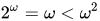
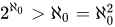
The α {\displaystyle \alpha } {\displaystyle \alpha }-th infinite initial ordinal is written ω α {\displaystyle \omega _{\alpha }} {\displaystyle \omega _{\alpha }}. Its cardinality is written ℵ α {\displaystyle \aleph _{\alpha }} {\displaystyle \aleph _{\alpha }} (the α {\displaystyle \alpha } {\displaystyle \alpha }-th aleph number). For example, ⁠ ω {\displaystyle \omega } {\displaystyle \omega }⁠ is also written as ⁠ ω 0 {\displaystyle \omega _{0}} {\displaystyle \omega _{0}}⁠, and its cardinality (the cardinality of any countable set) as ⁠ ℵ 0 {\displaystyle \aleph _{0}} {\displaystyle \aleph _{0}}⁠. The von Neumann cardinal assignment identifies ω α {\displaystyle \omega _{\alpha }} {\displaystyle \omega _{\alpha }} with ℵ α {\displaystyle \aleph _{\alpha }} {\displaystyle \aleph _{\alpha }}, but the notation ℵ α {\displaystyle \aleph _{\alpha }} {\displaystyle \aleph _{\alpha }} is used for writing cardinals, and ω α {\displaystyle \omega _{\alpha }} {\displaystyle \omega _{\alpha }} for writing ordinals. This is important because arithmetic on cardinals is different from arithmetic on ordinals. For example, 2 ω = ω < ω 2 {\displaystyle 2^{\omega }=\omega <\omega ^{2}} {\displaystyle 2^{\omega }=\omega <\omega ^{2}} in ordinal arithmetic while 2 ℵ 0 > ℵ 0 = ℵ 0 2 {\displaystyle 2^{\aleph _{0}}>\aleph _{0}=\aleph _{0}^{2}} {\displaystyle 2^{\aleph _{0}}>\aleph _{0}=\aleph _{0}^{2}} in cardinal arithmetic, even though under the von Neumann cardinal assignment ⁠ ℵ 0 {\displaystyle \aleph _{0}} {\displaystyle \aleph _{0}}⁠ and ⁠ ω {\displaystyle \omega } {\displaystyle \omega }⁠ are represented by the same set.

Also, ω 1 {\displaystyle \omega _{1}} {\displaystyle \omega _{1}} is the smallest uncountable ordinal (to see that it exists, consider the set of equivalence classes of well-orderings of the natural numbers; each such well-ordering defines a countable ordinal, and ω 1 {\displaystyle \omega _{1}} {\displaystyle \omega _{1}} is the order type of that set), ω 2 {\displaystyle \omega _{2}} {\displaystyle \omega _{2}} is the smallest ordinal whose cardinality is greater than ℵ 1 {\displaystyle \aleph _{1}} {\displaystyle \aleph _{1}}, and so on, and ω ω {\displaystyle \omega _{\omega }} {\displaystyle \omega _{\omega }} is the limit of ω n {\displaystyle \omega _{n}} {\displaystyle \omega _{n}} for natural numbers n {\displaystyle n} {\displaystyle n} (any limit of cardinals is a cardinal, so this limit is indeed the first cardinal after all the ω n {\displaystyle \omega _{n}} {\displaystyle \omega _{n}}).

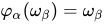
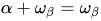
Infinite initial ordinals are limit ordinals. Using ordinal arithmetic, α < ω β {\displaystyle \alpha <\omega _{\beta }} {\displaystyle \alpha <\omega _{\beta }} implies α + ω β = ω β {\displaystyle \alpha +\omega _{\beta }=\omega _{\beta }} {\displaystyle \alpha +\omega _{\beta }=\omega _{\beta }}, and 1 ≤ α < ωβ implies α · ωβ = ωβ, and 2 ≤ α < ωβ implies αωβ = ωβ. Using the Veblen hierarchy, β ≠ 0 and α < ωβ imply φ α ( ω β ) = ω β {\displaystyle \varphi _{\alpha }(\omega _{\beta })=\omega _{\beta }\,} {\displaystyle \varphi _{\alpha }(\omega _{\beta })=\omega _{\beta }\,} and Γωβ = ωβ. Indeed, one can go far beyond this. So as an ordinal, an infinite initial ordinal is an extremely strong kind of limit.

Scott cardinals

[edit]

If the axiom of choice is not assumed, then a different approach is needed. The oldest definition of the cardinality of a set X (implicit in Cantor and explicit in Frege and Principia Mathematica) is as the class [X] of all sets that are equinumerous with X. This does not work in ZFC or other related systems of axiomatic set theory because if X is non-empty, this collection is too large to be a set. In fact, for X ≠ ∅ there is an injection from the universe into [X] by mapping a set m to {m} × X, and so by the axiom of limitation of size, [X] is a proper class. The definition does work however in type theory and in New Foundations and related systems. However, if we restrict from this class to those equinumerous with X that have the least rank, then it will work (this is a trick due to Dana Scott:[15] it works because the collection of objects with any given rank is a set).

Scott's trick implies that the cardinal number 0 is { ∅ } {\displaystyle \{\emptyset \}} {\displaystyle \{\emptyset \}}, which is also the ordinal number 1, and this may be confusing. A possible compromise (to take advantage of the alignment in finite arithmetic while avoiding reliance on the axiom of choice and confusion in infinite arithmetic) is to apply von Neumann assignment to the cardinal numbers of finite sets (those that can be well ordered and are not equipotent to proper subsets) and to use Scott's trick for the cardinal numbers of other sets.[citation needed]

Cardinal comparison

[edit]

Formally, the order among cardinal numbers is defined as follows: |X| ≤ |Y| means that there exists an injective function from X to Y. The Cantor–Bernstein–Schroeder theorem states that if |X| ≤ |Y| and |Y| ≤ |X| then |X| = |Y|. The axiom of choice is equivalent to the statement that given two sets X and Y, either |X| ≤ |Y| or |Y| ≤ |X|.[16][17]

A set X is called Dedekind-infinite if there exists a proper subset Y of X with |X| = |Y|, and Dedekind-finite if such a subset does not exist. The finite cardinals are just the natural numbers, in the sense that, by definition, a set X is finite if and only if |X| = |n| = n for some natural number n. Any other set is infinite. It can be proven (without the axiom of choice) that any Dedekind-infinite set is infinite.

Assuming the axiom of choice, it can be proved that the Dedekind notions correspond to the standard ones. It can also be proved that the cardinal ℵ 0 {\displaystyle \aleph _{0}} {\displaystyle \aleph _{0}} (aleph null or aleph-0, where aleph is the first letter in the Hebrew alphabet, represented ℵ {\displaystyle \aleph } {\displaystyle \aleph }) of the set of natural numbers is the smallest infinite cardinal (i.e., any infinite set has a subset of cardinality ℵ 0 {\displaystyle \aleph _{0}} {\displaystyle \aleph _{0}}). The next larger cardinal is denoted by ℵ 1 {\displaystyle \aleph _{1}} {\displaystyle \aleph _{1}}, and so on. For every ordinal α, there is a cardinal number ℵ α , {\displaystyle \aleph _{\alpha },} {\displaystyle \aleph _{\alpha },} and this list exhausts all infinite cardinal numbers.

Cardinal arithmetic

[edit]

We can define arithmetic operations on cardinal numbers that generalize the ordinary operations for natural numbers. It can be shown that for finite cardinals, these operations coincide with the usual operations for natural numbers. Furthermore, these operations share many properties with ordinary arithmetic.

Successor cardinal

[edit]
Further information: Successor cardinal

If the axiom of choice holds, then every cardinal κ has a successor, denoted κ+, where κ+ > κ and there are no cardinals between κ and its successor. (Without the axiom of choice, using Hartogs' theorem, it can be shown that for any cardinal number κ, there is a minimal cardinal κ+ such that κ + ≰ κ . {\displaystyle \kappa ^{+}\nleq \kappa .} {\displaystyle \kappa ^{+}\nleq \kappa .}) For finite cardinals, the successor is simply κ + 1. For infinite cardinals, the successor cardinal differs from the successor ordinal.

Cardinal addition

[edit]

If X and Y are disjoint, addition is given by the union of X and Y. If the two sets are not already disjoint, then they can be replaced by disjoint sets of the same cardinality (e.g., replace X by X×{0} and Y by Y×{1}).

| X | + | Y | = | X ∪ Y | . {\displaystyle |X|+|Y|=|X\cup Y|.} {\displaystyle |X|+|Y|=|X\cup Y|.}[18]

Zero is an additive identity κ + 0 = 0 + κ = κ.

Addition is associative (κ + μ) + ν = κ + (μ + ν).

Addition is commutative κ + μ = μ + κ.

Addition is non-decreasing in both arguments:

( κ ≤ μ ) → ( ( κ + ν ≤ μ + ν )  and  ( ν + κ ≤ ν + μ ) ) . {\displaystyle (\kappa \leq \mu )\rightarrow ((\kappa +\nu \leq \mu +\nu ){\mbox{ and }}(\nu +\kappa \leq \nu +\mu )).} {\displaystyle (\kappa \leq \mu )\rightarrow ((\kappa +\nu \leq \mu +\nu ){\mbox{ and }}(\nu +\kappa \leq \nu +\mu )).}

Assuming the axiom of choice, addition of infinite cardinal numbers is easy. If either κ or μ is infinite, then

κ + μ = max { κ , μ } . {\displaystyle \kappa +\mu =\max\{\kappa ,\mu \}\,.} {\displaystyle \kappa +\mu =\max\{\kappa ,\mu \}\,.}

Subtraction

[edit]

Assuming the axiom of choice and, given an infinite cardinal σ and a cardinal μ, there exists a cardinal κ such that μ + κ = σ if and only if μ ≤ σ. It will be unique (and equal to σ) if and only if μ < σ.

Cardinal multiplication

[edit]

The product of cardinals comes from the Cartesian product.

| X | ⋅ | Y | = | X × Y | {\displaystyle |X|\cdot |Y|=|X\times Y|} {\displaystyle |X|\cdot |Y|=|X\times Y|}[18]

Zero is a multiplicative absorbing element: κ·0 = 0·κ = 0.

There are no nontrivial zero divisors: κ·μ = 0 → (κ = 0 or μ = 0).

One is a multiplicative identity: κ·1 = 1·κ = κ.

Multiplication is associative: (κ·μ)·ν = κ·(μ·ν).

Multiplication is commutative: κ·μ = μ·κ.

Multiplication is non-decreasing in both arguments: κ ≤ μ → (κ·ν ≤ μ·ν and ν·κ ≤ ν·μ).

Multiplication distributes over addition: κ·(μ + ν) = κ·μ + κ·ν and (μ + ν)·κ = μ·κ + ν·κ.

Assuming the axiom of choice, multiplication of infinite cardinal numbers is also easy. If either κ or μ is infinite and both are non-zero, then

κ ⋅ μ = max { κ , μ } . {\displaystyle \kappa \cdot \mu =\max\{\kappa ,\mu \}.} {\displaystyle \kappa \cdot \mu =\max\{\kappa ,\mu \}.}

Thus the product of two infinite cardinal numbers is equal to their sum.

Division

[edit]

Assuming the axiom of choice and given an infinite cardinal π and a non-zero cardinal μ, there exists a cardinal κ such that μ · κ = π if and only if μ ≤ π. It will be unique (and equal to π) if and only if μ < π.

Cardinal exponentiation

[edit]

Exponentiation is given by

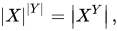
| X | | Y | = | X Y | , {\displaystyle |X|^{|Y|}=\left|X^{Y}\right|,} {\displaystyle |X|^{|Y|}=\left|X^{Y}\right|,}

where XY is the set of all functions from Y to X.[18] It is easy to check that the right-hand side depends only on | X | {\displaystyle {|X|}} {\displaystyle {|X|}} and | Y | {\displaystyle {|Y|}} {\displaystyle {|Y|}}.

κ0 = 1 (in particular 00 = 1), see empty function.
If μ ≥ 1, then 0μ = 0.
1μ = 1.
κ1 = κ.
κμ + ν = κμ·κν.
κμ · ν = (κμ)ν.
(κ·μ)ν = κν·μν.

Exponentiation is non-decreasing in both arguments:

(1 ≤ ν and κ ≤ μ) → (νκ ≤ νμ) and
(κ ≤ μ) → (κν ≤ μν).

2|X| is the cardinality of the power set of the set X and Cantor's diagonal argument shows that 2|X| > |X| for any set X. This proves that no largest cardinal exists (because for any cardinal κ, we can always find a larger cardinal 2κ). In fact, the class of cardinals is a proper class. (This proof fails in some set theories, notably New Foundations.)

All the remaining propositions in this section assume the axiom of choice:

If κ and μ are both finite and greater than 1, and ν is infinite, then κν = μν.
If κ is infinite and μ is finite and non-zero, then κμ = κ.

If 2 ≤ κ and 1 ≤ μ and at least one of them is infinite, then:

max (κ, 2μ) ≤ κμ ≤ max (2κ, 2μ).

Using Kőnig's theorem, one can prove κ < κcf(κ) and κ < cf(2κ) for any infinite cardinal κ, where cf(κ) is the cofinality of κ.

Roots

[edit]

Assuming the axiom of choice and, given an infinite cardinal κ and a finite cardinal μ greater than 0, the cardinal ν satisfying ν μ = κ {\displaystyle \nu ^{\mu }=\kappa } {\displaystyle \nu ^{\mu }=\kappa } will be κ {\displaystyle \kappa } {\displaystyle \kappa }.

Logarithms

[edit]

Assuming the axiom of choice and, given an infinite cardinal κ and a finite cardinal μ greater than 1, there may or may not be a cardinal λ satisfying μ λ = κ {\displaystyle \mu ^{\lambda }=\kappa } {\displaystyle \mu ^{\lambda }=\kappa }. However, if such a cardinal exists, it is infinite and less than κ, and any finite cardinality ν greater than 1 will also satisfy ν λ = κ {\displaystyle \nu ^{\lambda }=\kappa } {\displaystyle \nu ^{\lambda }=\kappa }.

The logarithm of an infinite cardinal number κ is defined as the least cardinal number μ such that κ ≤ 2μ. Logarithms of infinite cardinals are useful in some fields of mathematics, for example in the study of cardinal invariants of topological spaces, though they lack some of the properties that logarithms of positive real numbers possess.[19][20][21]

The continuum hypothesis

[edit]

The continuum hypothesis (CH) states that there are no cardinals strictly between ℵ 0 {\displaystyle \aleph _{0}} {\displaystyle \aleph _{0}} and 2 ℵ 0 . {\displaystyle 2^{\aleph _{0}}.} {\displaystyle 2^{\aleph _{0}}.} The latter cardinal number is also often denoted by c {\displaystyle {\mathfrak {c}}} {\displaystyle {\mathfrak {c}}}; it is the cardinality of the continuum (the set of real numbers). In this case 2 ℵ 0 = ℵ 1 . {\displaystyle 2^{\aleph _{0}}=\aleph _{1}.} {\displaystyle 2^{\aleph _{0}}=\aleph _{1}.}

Similarly, the generalized continuum hypothesis (GCH) states that for every infinite cardinal κ {\displaystyle \kappa } {\displaystyle \kappa }, there are no cardinals strictly between κ {\displaystyle \kappa } {\displaystyle \kappa } and 2 κ {\displaystyle 2^{\kappa }} {\displaystyle 2^{\kappa }}. Both the continuum hypothesis and the generalized continuum hypothesis have been proved to be independent of the usual axioms of set theory, the Zermelo–Fraenkel axioms together with the axiom of choice (ZFC).

Indeed, Easton's theorem shows that, for regular cardinals κ {\displaystyle \kappa } {\displaystyle \kappa }, the only restrictions ZFC places on the cardinality of 2 κ {\displaystyle 2^{\kappa }} {\displaystyle 2^{\kappa }} are that κ < cf ⁡ ( 2 κ ) {\displaystyle \kappa <\operatorname {cf} (2^{\kappa })} {\displaystyle \kappa <\operatorname {cf} (2^{\kappa })}, and that the exponential function is non-decreasing.

History

[edit]

The notion of cardinality, as now understood, was formulated by Georg Cantor, the originator of set theory, in 1874–1884. Cantor noted that there is a bijection between two finite sets if and only if they have the same number of elements, and applied this concept of bijection to infinite sets[22] (for example the set of natural numbers N = {0, 1, 2, 3, ...}). Thus, he called all sets having a bijection with N denumerable (countably infinite) sets, which all share the same cardinal number. He called the cardinal numbers of infinite sets transfinite cardinal numbers.

Cantor proved that any unbounded subset of N has the same cardinality as N, even though this might appear to run contrary to intuition. He also proved that the set of all ordered pairs of natural numbers is denumerable; this implies that the set of all rational numbers is also denumerable, since every rational can be represented by a pair of integers. He later proved that the set of all real algebraic numbers is also denumerable. Each real algebraic number z may be encoded as a finite sequence of integers, which are the coefficients in the polynomial equation of which it is a solution, i.e. the ordered n-tuple (a0, a1, ..., an), ai ∈ Z together with a pair of rationals (b0, b1) such that z is the unique root (if it exists) of the polynomial with coefficients (a0, a1, ..., an) that lies in the interval (b0, b1).

In his 1874 paper "On a Property of the Collection of All Real Algebraic Numbers", Cantor proved that there exist higher-order cardinal numbers, by showing that the set of real numbers has cardinality greater than that of N. His proof used an argument with nested intervals, but in an 1891 paper, he proved the same result using his ingenious and much simpler diagonal argument. The new cardinal number of the set of real numbers is called the cardinality of the continuum and Cantor used the symbol c {\displaystyle {\mathfrak {c}}} {\displaystyle {\mathfrak {c}}} for it.

Cantor also developed a large portion of the general theory of cardinal numbers; he proved that (assuming the axiom of choice) there is a smallest transfinite cardinal number ( ℵ 0 {\displaystyle \aleph _{0}} {\displaystyle \aleph _{0}}, aleph-null), and that for every cardinal number there is a next-larger cardinal

( ℵ 1 , ℵ 2 , ℵ 3 , … ) . {\displaystyle (\aleph _{1},\aleph _{2},\aleph _{3},\ldots ).} {\displaystyle (\aleph _{1},\aleph _{2},\aleph _{3},\ldots ).}

Cantor formulated the continuum hypothesis in 1878. In 1940, Kurt Gödel showed that the continuum hypothesis cannot be disproved from ZFC, and in 1963, Paul Cohen showed that it cannot be proved from ZFC either, establishing its independence.

See also

[edit]
  • iconMathematics portal
  • Aleph number
  • Beth number
  • The paradox of the greatest cardinal
  • Cardinal number (linguistics)
  • Counting
  • Inclusion–exclusion principle
  • Large cardinal
  • Names of numbers in English
  • Nominal number
  • Ordinal number
  • Regular cardinal

Footnotes

[edit]
  1. ^ Moschovakis' original definition also requires that for each set of sets ⁠ E {\displaystyle {\mathcal {E}}} {\displaystyle {\mathcal {E}}}⁠, ⁠ { | X | ∣ X ∈ E } {\displaystyle \{\vert X\vert \mid X\in {\mathcal {E}}\}} {\displaystyle \{\vert X\vert \mid X\in {\mathcal {E}}\}}⁠ is a set, but this is satisfied for free when the axiom schema of replacement is assumed.

References

[edit]

Notes

  1. ^ Hrbáček & Jech 2017, p. 65
  2. ^ Kuratowski 1968, p. 174.
  3. ^ Suppes 1972, p. 109.
  4. ^ Bourbaki 1968, p. 158.
  5. ^ Enderton 1977, p. 136.
  6. ^ Halmos 1998, p. 53.
  7. ^ Tao 2022, p. 60.
  8. ^ A {\displaystyle A} {\displaystyle A}[2][3]
    card ⁡ ( A ) {\displaystyle \operatorname {card} (A)} {\displaystyle \operatorname {card} (A)}[4][5]
    # A {\displaystyle \#A} {\displaystyle \#A}[6][7]
  9. ^ Weisstein, Eric W. "Cardinal Number". mathworld.wolfram.com. Retrieved 2020-09-06.
  10. ^ Kleene 1952, p. 9
  11. ^ Enderton 1977, p. 136
  12. ^ Pinter 2014, Page 2 of Chapter 8
  13. ^ Potter, Michael (2004-01-15). Set Theory and its Philosophy: A Critical Introduction. Clarendon Press. ISBN 978-0-19-155643-2.
  14. ^ Moschovakis 2006, p. 42.
  15. ^ Deiser, Oliver (May 2010). "On the Development of the Notion of a Cardinal Number". History and Philosophy of Logic. 31 (2): 123–143. doi:10.1080/01445340903545904. S2CID 171037224.
  16. ^ Enderton, Herbert. "Elements of Set Theory", Academic Press Inc., 1977. ISBN 0-12-238440-7
  17. ^ Friedrich M. Hartogs (1915), Felix Klein; Walther von Dyck; David Hilbert; Otto Blumenthal (eds.), "Über das Problem der Wohlordnung", Math. Ann., Bd. 76 (4), Leipzig: B. G. Teubner: 438–443, doi:10.1007/bf01458215, ISSN 0025-5831, S2CID 121598654, archived from the original on 2016-04-16, retrieved 2014-02-02
  18. ^ a b c Schindler 2014, pg. 34
  19. ^ Robert A. McCoy and Ibula Ntantu, Topological Properties of Spaces of Continuous Functions, Lecture Notes in Mathematics 1315, Springer-Verlag.
  20. ^ Eduard Čech, Topological Spaces, revised by Zdenek Frolík and Miroslav Katetov, John Wiley & Sons, 1966.
  21. ^ D. A. Vladimirov, Boolean Algebras in Analysis, Mathematics and Its Applications, Kluwer Academic Publishers.
  22. ^ Dauben 1990, pg. 54

Bibliography

  • Bourbaki, Nicholas (1968). Theory of Sets. Éléments de mathématique. Paris: Éditions Hermann. LCCN 68-25177.
  • Dauben, Joseph Warren (1990), Georg Cantor: His Mathematics and Philosophy of the Infinite, Princeton: Princeton University Press, ISBN 0691-02447-2
  • Enderton, Herbert (1977). Elements of Set Theory. New York: Academic Press. ISBN 0-12-238440-7. LCCN 76-27438.
  • Hahn, Hans, Infinity, Part IX, Chapter 2, Volume 3 of The World of Mathematics. New York: Simon and Schuster, 1956.
  • Halmos, Paul R. (1998) [1974]. Naive Set Theory. Undergraduate Texts in Mathematics. New York: Springer Science+Business Media. doi:10.1007/978-1-4757-1645-0. ISBN 978-0-387-90092-6. ISSN 0172-6056. Archived from the original on 2023-01-12. Alt URL
  • Hrbáček, Karel; Jech, Thomas (2017) [1999]. Introduction to Set Theory (3rd, Revised and Expanded ed.). New York: CRC Press. doi:10.1201/9781315274096. ISBN 978-0-82477915-3. LCCN 99-15458.
  • Kleene, Stephen Cole (1952). Introduction To Metamathematics. New York: D. Van Nostrand Company.
  • Kuratowski, Kazimierz (1968). Set Theory. Amsterdam: North Holland Publishing. LCCN 67-21972.
  • Moschovakis, Yiannis N. (2006) [1994]. Notes on Set Theory, 2nd Edition. New York: Springer. ISBN 978-0387287232.
  • Pinter, Charles C. (2014) [1971]. A Book of Set Theory. Dover Books on Mathematics. Mineola: Dover Publications. ISBN 978-0-486-79549-2. ISSN 2693-051X. LCCN 2013024319. Archived from the original on 2024-08-04. Alt URL
  • Schindler, Ralf-Dieter (2014). Set theory : exploring independence and truth. Universitext. Cham: Springer-Verlag. doi:10.1007/978-3-319-06725-4. ISBN 978-3-319-06725-4.
  • Suppes, Patrick (1972) [1960]. Axiomatic Set Theory. Dover Books on Mathematics. New York: Dover Publications. ISBN 0-486-61630-4. ISSN 2693-051X. LCCN 72-86226. Archived from the original on 2014-08-06. Alt URL
  • Tao, Terence (2022). Analysis I. Texts and Readings in Mathematics (4th ed.). Singapore: Springer Science+Business Media. doi:10.1007/978-3-662-00274-2. ISBN 978-981-19-7261-4. ISSN 2366-8717.

External links

[edit]
  • "Cardinal number", Encyclopedia of Mathematics, EMS Press, 2001 [1994]
  • v
  • t
  • e
Number systems
Sets of definable numbers
  • Natural numbers ( N {\displaystyle \mathbb {N} } {\displaystyle \mathbb {N} })
  • Integers ( Z {\displaystyle \mathbb {Z} } {\displaystyle \mathbb {Z} })
  • Rational numbers ( Q {\displaystyle \mathbb {Q} } {\displaystyle \mathbb {Q} })
  • Constructible numbers
  • Algebraic numbers ( A {\displaystyle \mathbb {A} } {\displaystyle \mathbb {A} })
  • Closed-form numbers
  • Periods ( P {\displaystyle {\mathcal {P}}} {\displaystyle {\mathcal {P}}})
  • Computable numbers
  • Arithmetical numbers
  • Set-theoretically definable numbers
  • Gaussian integers
    • Gaussian rationals
  • Eisenstein integers
Composition algebras
  • Division algebras: Real numbers ( R {\displaystyle \mathbb {R} } {\displaystyle \mathbb {R} })
  • Complex numbers ( C {\displaystyle \mathbb {C} } {\displaystyle \mathbb {C} })
  • Quaternions ( H {\displaystyle \mathbb {H} } {\displaystyle \mathbb {H} })
  • Octonions ( O {\displaystyle \mathbb {O} } {\displaystyle \mathbb {O} })
Split
types
  • Over R {\displaystyle \mathbb {R} } {\displaystyle \mathbb {R} }:
  • Split-complex numbers
  • Split-quaternions
  • Split-octonions
    Over C {\displaystyle \mathbb {C} } {\displaystyle \mathbb {C} }:
  • Bicomplex numbers
  • Biquaternions
  • Bioctonions
Other hypercomplex
  • Dual numbers
  • Dual quaternions
  • Dual-complex numbers
  • Hyperbolic quaternions
  • Sedenions  ( S {\displaystyle \mathbb {S} } {\displaystyle \mathbb {S} })
  • Trigintaduonions  ( T {\displaystyle \mathbb {T} } {\displaystyle \mathbb {T} })
  • Split-biquaternions
  • Multicomplex numbers
  • Geometric algebra/Clifford algebra
    • Algebra of physical space
    • Spacetime algebra
    • Plane-based geometric algebra
Infinities and infinitesimals
  • Cardinal numbers
  • Extended natural numbers
  • Extended real numbers
    • Projective
  • Extended complex numbers
  • Hyperreal numbers
  • Levi-Civita field
  • Ordinal numbers
  • Supernatural numbers
  • Surreal numbers
  • Superreal numbers
Other types
  • Irrational numbers
  • Fuzzy numbers
  • Transcendental numbers
  • p-adic numbers (p-adic solenoids)
  • Profinite integers
  • Normal numbers
  • Classification
  • List
  • v
  • t
  • e
Mathematical logic
General
  • Axiom
    • list
  • Cardinality
  • First-order logic
  • Formal proof
  • Formal semantics
  • Foundations of mathematics
  • Information theory
  • Lemma
  • Logical consequence
  • Model
  • Theorem
  • Theory
  • Type theory
Theorems
(list),
paradoxes
  • Gödel's completeness – incompleteness theorems
  • Tarski's undefinability
  • Banach–Tarski paradox
  • Cantor's theorem – paradox – diagonal argument
  • Compactness
  • Halting problem
  • Lindström's
  • Löwenheim–Skolem
  • Russell's paradox
Logics
Traditional
  • Classical logic
  • Logical truth
  • Tautology
  • Proposition
  • Inference
  • Logical equivalence
  • Consistency
    • Equiconsistency
  • Argument
  • Soundness
  • Validity
  • Syllogism
  • Square of opposition
  • Venn diagram
Propositional
  • Boolean algebra
  • Boolean functions
  • Logical connectives
  • Propositional calculus
  • Propositional formula
  • Truth tables
  • Many-valued logic
    • 3
    • finite
    • ∞
Predicate
  • First-order
    • list
  • Second-order
    • Monadic
  • Higher-order
  • Fixed-point
  • Free
  • Quantifiers
  • Predicate
  • Monadic predicate calculus
Set theory
  • Set
    • hereditary
  • Class
  • (Ur-)Element
  • Ordinal number
  • Extensionality
  • Forcing
  • Relation
    • equivalence
    • partition
  • Set operations:
    • intersection
    • union
    • complement
    • Cartesian product
    • power set
    • identities
Types
of sets
  • Countable
  • Uncountable
  • Empty
  • Inhabited
  • Singleton
  • Finite
  • Infinite
  • Transitive
  • Ultrafilter
  • Recursive
  • Fuzzy
  • Universal
  • Universe
    • constructible
    • Grothendieck
    • Von Neumann
Maps,
cardinality
  • Function/Map
    • domain
    • codomain
    • image
  • In/Sur/Bi-jection
  • Schröder–Bernstein theorem
  • Isomorphism
  • Gödel numbering
  • Enumeration
  • Large cardinal
    • inaccessible
  • Aleph number
  • Operation
    • binary
Theories
  • Zermelo–Fraenkel
    • axiom of choice
    • continuum hypothesis
  • General
  • Kripke–Platek
  • Morse–Kelley
  • Naive
  • New Foundations
  • Tarski–Grothendieck
  • Von Neumann–Bernays–Gödel
  • Ackermann
  • Constructive
Formal
systems

(list),
language,
syntax
  • Alphabet
  • Arity
  • Automata
  • Axiom schema
  • Expression
    • ground
  • Extension
    • by definition
    • conservative
  • Relation
  • Formation rule
  • Grammar
  • Formula
    • atomic
    • closed
    • ground
    • open
  • Free/bound variable
  • Language
  • Metalanguage
  • Logical connective
    • ¬
    • ∨
    • ∧
    • →
    • ↔
    • =
  • Predicate
    • functional
    • variable
    • propositional variable
  • Proof
  • Quantifier
    • ∃
    • !
    • ∀
    • rank
  • Sentence
    • atomic
    • spectrum
  • Signature
  • String
  • Substitution
  • Symbol
    • function
    • logical/constant
    • non-logical
    • variable
  • Term
  • Theory
    • list
Example
axiomatic
systems

(list)
  • of true arithmetic
    • Peano
    • second-order
    • elementary function
    • primitive recursive
    • Robinson
    • Skolem
  • of the real numbers
    • Tarski's axiomatization
  • of Boolean algebras
    • canonical
    • minimal axioms
  • of geometry
    • Euclidean
      • Elements
      • Hilbert's
      • Tarski's
    • non-Euclidean
  • Principia Mathematica
Proof theory
  • Formal proof
  • Natural deduction
  • Logical consequence
  • Rule of inference
  • Sequent calculus
  • Theorem
  • Systems
    • axiomatic
    • deductive
    • Hilbert
      • list
  • Complete theory
  • Independence (from ZFC)
  • Proof of impossibility
  • Ordinal analysis
  • Reverse mathematics
  • Self-verifying theories
Model theory
  • Interpretation
    • function
    • of models
  • Model
    • atomic
    • equivalence
    • finite
    • prime
    • saturated
    • spectrum
    • submodel
  • Non-standard model
    • of non-standard arithmetic
  • Diagram
    • elementary
  • Categorical theory
  • Model complete theory
  • Satisfiability
  • Semantics of logic
  • Strength
  • Theories of truth
    • semantic
    • Tarski's
    • Kripke's
  • T-schema
  • Transfer principle
  • Truth predicate
  • Truth value
  • Type
  • Ultraproduct
  • Validity
Computability
theory
  • Church encoding
  • Church–Turing thesis
  • Computably enumerable
  • Computable function
  • Computable set
  • Decision problem
    • decidable
    • undecidable
    • P
    • NP
    • P versus NP problem
  • Kolmogorov complexity
  • Lambda calculus
  • Primitive recursive function
  • Recursion
  • Recursive set
  • Turing machine
  • Type theory
Related
  • Abstract logic
  • Algebraic logic
  • Automated theorem proving
  • Category theory
  • Concrete/Abstract category
  • Category of sets
  • History of logic
  • History of mathematical logic
    • timeline
  • Logicism
  • Mathematical object
  • Philosophy of mathematics
  • Supertask
icon Mathematics portal
  • v
  • t
  • e
Set theory
Overview
  • Set (mathematics)
Venn diagram of set intersection
Axioms
  • Adjunction
  • Choice
    • countable
    • dependent
    • global
  • Constructibility (V=L)
  • Determinacy
    • projective
  • Extensionality
  • Infinity
  • Limitation of size
  • Pairing
  • Power set
  • Regularity
  • Union
  • Martin's axiom
  • Axiom schema
    • replacement
    • specification
Operations
  • Cartesian product
  • Complement (i.e. set difference)
  • De Morgan's laws
  • Disjoint union
  • Identities
  • Intersection
  • Power set
  • Symmetric difference
  • Union
  • Concepts
  • Methods
  • Almost
  • Cardinality
  • Cardinal number (large)
  • Class
  • Constructible universe
  • Continuum hypothesis
  • Diagonal argument
  • Element
    • ordered pair
    • tuple
  • Family
  • Forcing
  • One-to-one correspondence
  • Ordinal number
  • Set-builder notation
  • Transfinite induction
  • Venn diagram
Set types
  • Amorphous
  • Countable
  • Empty
  • Finite (hereditarily)
  • Filter
    • base
    • subbase
    • Ultrafilter
  • Fuzzy
  • Infinite (Dedekind-infinite)
  • Recursive
  • Singleton
  • Subset · Superset
  • Transitive
  • Uncountable
  • Universal
Theories
  • Alternative
  • Axiomatic
  • Naive
  • Cantor's theorem
  • Zermelo
    • General
  • Principia Mathematica
    • New Foundations
  • Zermelo–Fraenkel
    • von Neumann–Bernays–Gödel
      • Morse–Kelley
    • Kripke–Platek
    • Tarski–Grothendieck
  • Paradoxes
  • Problems
  • Russell's paradox
  • Suslin's problem
  • Burali-Forti paradox
Set theorists
  • Paul Bernays
  • Georg Cantor
  • Paul Cohen
  • Richard Dedekind
  • Abraham Fraenkel
  • Kurt Gödel
  • Thomas Jech
  • John von Neumann
  • Willard Quine
  • Bertrand Russell
  • Thoralf Skolem
  • Ernst Zermelo
Authority control databases: National Edit this at Wikidata
  • Czech Republic
  • Israel
Retrieved from "https://teknopedia.ac.id/w/index.php?title=Cardinal_number&oldid=1339747614"
Category:
  • Cardinal numbers
Hidden categories:
  • CS1: long volume value
  • Articles with short description
  • Short description is different from Wikidata
  • Articles proposed for merging from February 2026
  • All articles proposed for merging
  • All articles with unsourced statements
  • Articles with unsourced statements from February 2026

  • indonesia
  • Polski
  • العربية
  • Deutsch
  • English
  • Español
  • Français
  • Italiano
  • مصرى
  • Nederlands
  • 日本語
  • Português
  • Sinugboanong Binisaya
  • Svenska
  • Українська
  • Tiếng Việt
  • Winaray
  • 中文
  • Русский
Sunting pranala
url url url url url url url url url url url url url url url url url url url url url url url url url url url url url url url url url url url url url url url url url url url url url url url url url url url url url url url url url url url url url url url url url url url url url url url url url url url url url url url url url url url url url url url url url url url url url url url url url url url url url url url url url url url url url url url url url url url url url url url url url url url url url url url url url url url url url url url url url url url url url url url url url url url url url url url url url url url url url url url url url url url url url url url url url url url url url url url url url url url url url url url url url url url url url url url url url url url url url url url url url url url url url url url url url url url url url url url url url url url url url url url url url url url url url url url url url url url url url url url url url url url url url url url url url url url url url url url url url url url url url url url url url url url url url url url url url url url url url url url url url url url url url url url url url url url url url url url url url url url url url url url url url url url url url url url url url url url url url url url url url url url url url url url url url url url url url url url url url url url url url url url url url url url url url url url url url url url url url url url url url url url url url url url url url url url url url url url url url url url url url url url url url url url url url url url url url url url url url url url url url url url url url url url url url url url url url url url url url url url url url url url url url url url url url url url url url url url url url url url url url url url url url url url url url url url url url url url url url url url url url url url url url url url url url url url url url url url url url url url url url url url url url url url url url url url url url url url url url url url url url url url url url url url url url url url url url url url url url url url url url url url url url url url url url url url url url url url url url url url url url url url url url url url url url url url url url url url url url url url url url url url url url url url url url url url url url url url url url url url url url url url url url url url url url url url url url url url url url url url url url url url url url url url url url url url url url url url url url url url url url url url url url url url url url url url url url url url url url url url url url url url url url url url url url url url url url url url url url url url url url url url url url url url url url url url url url url url url url url url url url url url url url url url url url url url url url url url url url url url url url url url url url url url url url url url url url url url url url url url url url url url url url url url url url url url url url url url url url url url url url url url url url url url url url url url url url url url url url url url url url url url url url url url url url url url url url url url url url url url url url url url url url url url url url url url url url url url url url url url url url url url url url url url url url url url url url url url url url url url url url url url url url url url url url url url url url url url url url url url url url url url url url url url url url url url url url url url url url url url url url url url url url url url url url url url url url url url url url url url url url url url url url url url url url url url url url url url url url url url url url url url url url url url url url url url url url url url url url url url url url url url url url url url url url url url url url url url url url url url url url url url url url url url url url url url url url url url url url url url url url url url url url url url url url url url url url url url url url url url url url url url url url url url url url url url url url url url url url url url url url url url url url url url url url url url url url url url url url url url url url url url url url url url url url url url url url url url url url url url url url url url url url url url url url url url url url url url url url url url url url url url url url url url url url url url url url url url url url url url url url url url url url url url url url url url url url url url url url url url url url url url url url url url url url url url url url url url url url url url url url url url url url url url url url url url url url url url url url url url url url url url url url url url url url url url url url url url url url url url url url url url url url url url url url url url url url url url url url url url url url url url url url url url url url url url url url url url url url url url url url url url url url url url url url url url url url url url url url url url url url url url url url url url url url url url url url url url url url url url url url url url url url url url url url url url url url url url url url url url url url url url url url url url url url url url url url url url url url url url url url url url url url url url url url url url url url url url url url url url url url url url url url url url url url url url url url url url url url url url url url url url url url url url url url url url url url url url url url url url url url url url url url url url url url url url url url url url url url url url url url url url url url url url url url url url url url url url url url url url url url url url url url url url url url url url url url url url url url url url url url url url url url url url url url url url url url url url url url url url url url url url url url url url url url url url url url url url url url url url url url url url url url url url url url url url url url url url url url url url url url url url url url url url url url url url url url url url url url url url url url url url url url url url url url url url url url url url url url url url url url url url url url url url url url url url url url url url url url url url url url url url url url url url url url url url url url url url url url url url url url url url url url url url url url url url url url url url url url url url url url url url url url url url url url url url url url url url url url url url url url url url url url url url url url url url url url url url url url url url url url url url url url url url url url url url url url url url url url url url url url url url url url url url url url url url url url url url url url url url url url url url url url url url url url url url url url url url url url url url url url url url url url url url url url url url url url url url url url url url url url url url url url url url url url url url url url url url url url url url url url url url url url url url url url url url url url url url url url url url url url url url url url url url url url url url url url url url url url url url url url url url url url url url url url url url url url url url url url url url url url url url url url url url url url url url url url url url url url url url url url url url url url url url url url url url url url url url url url url url url url url url url url url url url url url url url url url url url url url url url url url url url url url url url url url url url url url url url url url url url url url url url url url url url url url url url url url url url url url url url url url url url url url url url url url url url url url url url url url url url url url url url url url url url url url url url url url url url url url url url url url url url url url url url url url url url url url url url url url url url url url url url url url url url url url url url url url url url url url url url url url url url url url url url url url url url url url url url url url url url url url url url url url url url url url url url url url url url url url url url url url url url url url url url url url url url url url url url url url url url url url url url url url url url url url url url url url url url url url url url url url url url url url url url url url url url url url url url url url url url url url url url url url url url url url url url url url url url url url url url url url url url url url url url url url url url url url url url url url url url url url url url url url url url url url url url url url url url url url url url url url url url url url url url url url url url url url url url url url url url url url url url url url url url url url url url url url url url url url url url url url url url url url url url url url url url url url url url url url url url url url url url url url url url url url url url url url url url url url url url url url url url url url url url url url url url url url url url url url url url url url url url url url url url url url url url url url url url url url url url url url url url url url url url url url url url url url url url url url url url url url url url url url url url url url url url url url url url url url url url url url url url url url url url url url url url url url url url url url url url url url url url url url url url url url url url url url url url url url url url url url url url url url url url url url url url url url url url url url url url url url url url url url url url url url url url url url url url url url url url url url url url url url url url url url url url url url url url url url url url url url url url url url url url url url url url url url url url url url url url url url url url url url url url url url url url url url url url url url url url url url url url url url url url url url url url url url url url url url url url url url url url
Pusat Layanan

UNIVERSITAS TEKNOKRAT INDONESIA | ASEAN's Best Private University
Jl. ZA. Pagar Alam No.9 -11, Labuhan Ratu, Kec. Kedaton, Kota Bandar Lampung, Lampung 35132
Phone: (0721) 702022
Email: pmb@teknokrat.ac.id