Epstein Files Full PDF

CLICK HERE
Technopedia Center
PMB University Brochure
Faculty of Engineering and Computer Science
S1 Informatics S1 Information Systems S1 Information Technology S1 Computer Engineering S1 Electrical Engineering S1 Civil Engineering

faculty of Economics and Business
S1 Management S1 Accountancy

Faculty of Letters and Educational Sciences
S1 English literature S1 English language education S1 Mathematics education S1 Sports Education
teknopedia

  • Registerasi
  • Brosur UTI
  • Kip Scholarship Information
  • Performance
Flag Counter
  1. World Encyclopedia
  2. Veblen function - Wikipedia
Veblen function - Wikipedia
From Wikipedia, the free encyclopedia
Mathematical function on ordinals
This article may be too technical for most readers to understand. Please help improve it to make it understandable to non-experts, without removing the technical details. (February 2026) (Learn how and when to remove this message)

In mathematics, the Veblen functions are a hierarchy of normal functions (continuous strictly increasing functions from ordinals to ordinals), introduced by Oswald Veblen in Veblen (1908). If φ0 is any normal function, then for any non-zero ordinal α, φα is the function enumerating the common fixed points of φβ for β<α. These functions are all normal.

Veblen hierarchy

[edit]

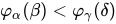
In the special case when φ0(α)=ωα this family of functions is known as the Veblen hierarchy. The function φ1 is the same as the ε function: φ1(α)= εα.[1] If α < β , {\displaystyle \alpha <\beta \,,} {\displaystyle \alpha <\beta \,,} then φ α ( φ β ( γ ) ) = φ β ( γ ) {\displaystyle \varphi _{\alpha }(\varphi _{\beta }(\gamma ))=\varphi _{\beta }(\gamma )} {\displaystyle \varphi _{\alpha }(\varphi _{\beta }(\gamma ))=\varphi _{\beta }(\gamma )}.[2] From this and the fact that φβ is strictly increasing we get the ordering: φ α ( β ) < φ γ ( δ ) {\displaystyle \varphi _{\alpha }(\beta )<\varphi _{\gamma }(\delta )} {\displaystyle \varphi _{\alpha }(\beta )<\varphi _{\gamma }(\delta )} if and only if either ( α = γ {\displaystyle \alpha =\gamma } {\displaystyle \alpha =\gamma } and β < δ {\displaystyle \beta <\delta } {\displaystyle \beta <\delta }) or ( α < γ {\displaystyle \alpha <\gamma } {\displaystyle \alpha <\gamma } and β < φ γ ( δ ) {\displaystyle \beta <\varphi _{\gamma }(\delta )} {\displaystyle \beta <\varphi _{\gamma }(\delta )}) or ( α > γ {\displaystyle \alpha >\gamma } {\displaystyle \alpha >\gamma } and φ α ( β ) < δ {\displaystyle \varphi _{\alpha }(\beta )<\delta } {\displaystyle \varphi _{\alpha }(\beta )<\delta }).[2]

Fundamental sequences for the Veblen hierarchy

[edit]
icon
This section does not cite any sources. Please help improve this section by adding citations to reliable sources. Unsourced material may be challenged and removed. (May 2023) (Learn how and when to remove this message)

The fundamental sequence for an ordinal with cofinality ω is a distinguished strictly increasing ω-sequence that has the ordinal as its limit. If one has fundamental sequences for α and all smaller limit ordinals, then one can create an explicit constructive bijection between ω and α, (i.e. one not using the axiom of choice). Here we will describe fundamental sequences for the Veblen hierarchy of ordinals. The image of n under the fundamental sequence for α will be indicated by α[n].

A variation of Cantor normal form used in connection with the Veblen hierarchy is: every nonzero ordinal number α can be uniquely written as α = φ β 1 ( γ 1 ) + φ β 2 ( γ 2 ) + ⋯ + φ β k ( γ k ) {\displaystyle \alpha =\varphi _{\beta _{1}}(\gamma _{1})+\varphi _{\beta _{2}}(\gamma _{2})+\cdots +\varphi _{\beta _{k}}(\gamma _{k})} {\displaystyle \alpha =\varphi _{\beta _{1}}(\gamma _{1})+\varphi _{\beta _{2}}(\gamma _{2})+\cdots +\varphi _{\beta _{k}}(\gamma _{k})}, where k > 0 is a natural number and each term after the first is less than or equal to the previous term, φ β m ( γ m ) ≥ φ β m + 1 ( γ m + 1 ) , {\displaystyle \varphi _{\beta _{m}}(\gamma _{m})\geq \varphi _{\beta _{m+1}}(\gamma _{m+1})\,,} {\displaystyle \varphi _{\beta _{m}}(\gamma _{m})\geq \varphi _{\beta _{m+1}}(\gamma _{m+1})\,,} and each γ m < φ β m ( γ m ) . {\displaystyle \gamma _{m}<\varphi _{\beta _{m}}(\gamma _{m}).} {\displaystyle \gamma _{m}<\varphi _{\beta _{m}}(\gamma _{m}).} If a fundamental sequence can be provided for the last term, then that term can be replaced by such a sequence to get α [ n ] = φ β 1 ( γ 1 ) + ⋯ + φ β k − 1 ( γ k − 1 ) + ( φ β k ( γ k ) [ n ] ) . {\displaystyle \alpha [n]=\varphi _{\beta _{1}}(\gamma _{1})+\cdots +\varphi _{\beta _{k-1}}(\gamma _{k-1})+(\varphi _{\beta _{k}}(\gamma _{k})[n])\,.} {\displaystyle \alpha [n]=\varphi _{\beta _{1}}(\gamma _{1})+\cdots +\varphi _{\beta _{k-1}}(\gamma _{k-1})+(\varphi _{\beta _{k}}(\gamma _{k})[n])\,.}

For any β, if γ is a limit with γ < φ β ( γ ) , {\displaystyle \gamma <\varphi _{\beta }(\gamma )\,,} {\displaystyle \gamma <\varphi _{\beta }(\gamma )\,,} then let φ β ( γ ) [ n ] = φ β ( γ [ n ] ) . {\displaystyle \varphi _{\beta }(\gamma )[n]=\varphi _{\beta }(\gamma [n])\,.} {\displaystyle \varphi _{\beta }(\gamma )[n]=\varphi _{\beta }(\gamma [n])\,.}

No such sequence can be provided for φ 0 ( 0 ) {\displaystyle \varphi _{0}(0)} {\displaystyle \varphi _{0}(0)} = ω0 = 1 because it does not have cofinality ω.

For φ 0 ( γ + 1 ) = ω γ + 1 = ω γ ⋅ ω , {\displaystyle \varphi _{0}(\gamma +1)=\omega ^{\gamma +1}=\omega ^{\gamma }\cdot \omega \,,} {\displaystyle \varphi _{0}(\gamma +1)=\omega ^{\gamma +1}=\omega ^{\gamma }\cdot \omega \,,} we choose φ 0 ( γ + 1 ) [ n ] = φ 0 ( γ ) ⋅ n = ω γ ⋅ n . {\displaystyle \varphi _{0}(\gamma +1)[n]=\varphi _{0}(\gamma )\cdot n=\omega ^{\gamma }\cdot n\,.} {\displaystyle \varphi _{0}(\gamma +1)[n]=\varphi _{0}(\gamma )\cdot n=\omega ^{\gamma }\cdot n\,.}

For φ β + 1 ( 0 ) , {\displaystyle \varphi _{\beta +1}(0)\,,} {\displaystyle \varphi _{\beta +1}(0)\,,} we use φ β + 1 ( 0 ) [ 0 ] = 0 {\displaystyle \varphi _{\beta +1}(0)[0]=0} {\displaystyle \varphi _{\beta +1}(0)[0]=0} and φ β + 1 ( 0 ) [ n + 1 ] = φ β ( φ β + 1 ( 0 ) [ n ] ) , {\displaystyle \varphi _{\beta +1}(0)[n+1]=\varphi _{\beta }(\varphi _{\beta +1}(0)[n])\,,} {\displaystyle \varphi _{\beta +1}(0)[n+1]=\varphi _{\beta }(\varphi _{\beta +1}(0)[n])\,,} i.e. 0, φ β ( 0 ) {\displaystyle \varphi _{\beta }(0)} {\displaystyle \varphi _{\beta }(0)}, φ β ( φ β ( 0 ) ) {\displaystyle \varphi _{\beta }(\varphi _{\beta }(0))} {\displaystyle \varphi _{\beta }(\varphi _{\beta }(0))}, etc..

For φ β + 1 ( γ + 1 ) {\displaystyle \varphi _{\beta +1}(\gamma +1)} {\displaystyle \varphi _{\beta +1}(\gamma +1)}, we use φ β + 1 ( γ + 1 ) [ 0 ] = φ β + 1 ( γ ) + 1 {\displaystyle \varphi _{\beta +1}(\gamma +1)[0]=\varphi _{\beta +1}(\gamma )+1} {\displaystyle \varphi _{\beta +1}(\gamma +1)[0]=\varphi _{\beta +1}(\gamma )+1} and φ β + 1 ( γ + 1 ) [ n + 1 ] = φ β ( φ β + 1 ( γ + 1 ) [ n ] ) . {\displaystyle \varphi _{\beta +1}(\gamma +1)[n+1]=\varphi _{\beta }(\varphi _{\beta +1}(\gamma +1)[n])\,.} {\displaystyle \varphi _{\beta +1}(\gamma +1)[n+1]=\varphi _{\beta }(\varphi _{\beta +1}(\gamma +1)[n])\,.}

Now suppose that β is a limit:

If β < φ β ( 0 ) {\displaystyle \beta <\varphi _{\beta }(0)} {\displaystyle \beta <\varphi _{\beta }(0)}, then let φ β ( 0 ) [ n ] = φ β [ n ] ( 0 ) . {\displaystyle \varphi _{\beta }(0)[n]=\varphi _{\beta [n]}(0)\,.} {\displaystyle \varphi _{\beta }(0)[n]=\varphi _{\beta [n]}(0)\,.}

For φ β ( γ + 1 ) {\displaystyle \varphi _{\beta }(\gamma +1)} {\displaystyle \varphi _{\beta }(\gamma +1)}, use φ β ( γ + 1 ) [ n ] = φ β [ n ] ( φ β ( γ ) + 1 ) . {\displaystyle \varphi _{\beta }(\gamma +1)[n]=\varphi _{\beta [n]}(\varphi _{\beta }(\gamma )+1)\,.} {\displaystyle \varphi _{\beta }(\gamma +1)[n]=\varphi _{\beta [n]}(\varphi _{\beta }(\gamma )+1)\,.}

Otherwise, the ordinal cannot be described in terms of smaller ordinals using φ {\displaystyle \varphi } {\displaystyle \varphi } and this scheme does not apply to it.

The Γ function

[edit]

The function Γ enumerates the ordinals α such that φα(0) = α. Γ0 is the Feferman–Schütte ordinal, i.e. it is the smallest α such that φα(0) = α.

For Γ0, a fundamental sequence could be chosen to be Γ 0 [ 0 ] = 0 {\displaystyle \Gamma _{0}[0]=0} {\displaystyle \Gamma _{0}[0]=0} and Γ 0 [ n + 1 ] = φ Γ 0 [ n ] ( 0 ) . {\displaystyle \Gamma _{0}[n+1]=\varphi _{\Gamma _{0}[n]}(0)\,.} {\displaystyle \Gamma _{0}[n+1]=\varphi _{\Gamma _{0}[n]}(0)\,.}

For Γβ+1, let Γ β + 1 [ 0 ] = Γ β + 1 {\displaystyle \Gamma _{\beta +1}[0]=\Gamma _{\beta }+1} {\displaystyle \Gamma _{\beta +1}[0]=\Gamma _{\beta }+1} and Γ β + 1 [ n + 1 ] = φ Γ β + 1 [ n ] ( 0 ) . {\displaystyle \Gamma _{\beta +1}[n+1]=\varphi _{\Gamma _{\beta +1}[n]}(0)\,.} {\displaystyle \Gamma _{\beta +1}[n+1]=\varphi _{\Gamma _{\beta +1}[n]}(0)\,.}

For Γβ where β < Γ β {\displaystyle \beta <\Gamma _{\beta }} {\displaystyle \beta <\Gamma _{\beta }} is a limit, let Γ β [ n ] = Γ β [ n ] . {\displaystyle \Gamma _{\beta }[n]=\Gamma _{\beta [n]}\,.} {\displaystyle \Gamma _{\beta }[n]=\Gamma _{\beta [n]}\,.}

Generalizations

[edit]

Finitely many variables

[edit]

To build the Veblen function of a finite number of arguments (finitary Veblen function), let the binary function φ ( α , γ ) {\displaystyle \varphi (\alpha ,\gamma )} {\displaystyle \varphi (\alpha ,\gamma )} be φ α ( γ ) {\displaystyle \varphi _{\alpha }(\gamma )} {\displaystyle \varphi _{\alpha }(\gamma )} as defined above.

Let z {\displaystyle z} {\displaystyle z} be an empty string or a string consisting of one or more comma-separated zeros 0 , 0 , . . . , 0 {\displaystyle 0,0,...,0} {\displaystyle 0,0,...,0} and s {\displaystyle s} {\displaystyle s} be an empty string or a string consisting of one or more comma-separated ordinals α 1 , α 2 , . . . , α n {\displaystyle \alpha _{1},\alpha _{2},...,\alpha _{n}} {\displaystyle \alpha _{1},\alpha _{2},...,\alpha _{n}} with α 1 > 0 {\displaystyle \alpha _{1}>0} {\displaystyle \alpha _{1}>0}. The binary function φ ( β , γ ) {\displaystyle \varphi (\beta ,\gamma )} {\displaystyle \varphi (\beta ,\gamma )} can be written as φ ( s , β , z , γ ) {\displaystyle \varphi (s,\beta ,z,\gamma )} {\displaystyle \varphi (s,\beta ,z,\gamma )} where both s {\displaystyle s} {\displaystyle s} and z {\displaystyle z} {\displaystyle z} are empty strings. The finitary Veblen functions are defined as follows:

  • φ ( γ ) = ω γ {\displaystyle \varphi (\gamma )=\omega ^{\gamma }} {\displaystyle \varphi (\gamma )=\omega ^{\gamma }}
  • φ ( z , s , γ ) = φ ( s , γ ) {\displaystyle \varphi (z,s,\gamma )=\varphi (s,\gamma )} {\displaystyle \varphi (z,s,\gamma )=\varphi (s,\gamma )}
  • if β > 0 {\displaystyle \beta >0} {\displaystyle \beta >0}, then φ ( s , β , z , γ ) {\displaystyle \varphi (s,\beta ,z,\gamma )} {\displaystyle \varphi (s,\beta ,z,\gamma )} denotes the ( 1 + γ ) {\displaystyle (1+\gamma )} {\displaystyle (1+\gamma )}-th common fixed point of the functions ξ ↦ φ ( s , δ , ξ , z ) {\displaystyle \xi \mapsto \varphi (s,\delta ,\xi ,z)} {\displaystyle \xi \mapsto \varphi (s,\delta ,\xi ,z)} for each δ < β {\displaystyle \delta <\beta } {\displaystyle \delta <\beta }

For example, φ ( 1 , 0 , γ ) {\displaystyle \varphi (1,0,\gamma )} {\displaystyle \varphi (1,0,\gamma )} is the ( 1 + γ ) {\displaystyle (1+\gamma )} {\displaystyle (1+\gamma )}-th fixed point of the functions ξ ↦ φ ( ξ , 0 ) {\displaystyle \xi \mapsto \varphi (\xi ,0)} {\displaystyle \xi \mapsto \varphi (\xi ,0)}, namely Γ γ {\displaystyle \Gamma _{\gamma }} {\displaystyle \Gamma _{\gamma }}; then φ ( 1 , 1 , γ ) {\displaystyle \varphi (1,1,\gamma )} {\displaystyle \varphi (1,1,\gamma )} enumerates the fixed points of that function, i.e., of the ξ ↦ Γ ξ {\displaystyle \xi \mapsto \Gamma _{\xi }} {\displaystyle \xi \mapsto \Gamma _{\xi }} function; and φ ( 2 , 0 , γ ) {\displaystyle \varphi (2,0,\gamma )} {\displaystyle \varphi (2,0,\gamma )} enumerates the fixed points of all the ξ ↦ φ ( 1 , ξ , 0 ) {\displaystyle \xi \mapsto \varphi (1,\xi ,0)} {\displaystyle \xi \mapsto \varphi (1,\xi ,0)}. Each instance of the generalized Veblen functions is continuous in the last nonzero variable (i.e., if one variable is made to vary and all later variables are kept constantly equal to zero).

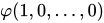
The limit of the φ ( 1 , 0 , . . . , 0 ) {\displaystyle \varphi (1,0,...,0)} {\displaystyle \varphi (1,0,...,0)} where the number of zeroes ranges over ω, is sometimes known as the "small" Veblen ordinal.

Every non-zero ordinal α {\displaystyle \alpha } {\displaystyle \alpha } less than the small Veblen ordinal (SVO) can be uniquely written in normal form for the finitary Veblen function:

α = φ ( s 1 ) + φ ( s 2 ) + ⋯ + φ ( s k ) {\displaystyle \alpha =\varphi (s_{1})+\varphi (s_{2})+\cdots +\varphi (s_{k})} {\displaystyle \alpha =\varphi (s_{1})+\varphi (s_{2})+\cdots +\varphi (s_{k})}

where

  • k {\displaystyle k} {\displaystyle k} is a positive integer
  • φ ( s 1 ) ≥ φ ( s 2 ) ≥ ⋯ ≥ φ ( s k ) {\displaystyle \varphi (s_{1})\geq \varphi (s_{2})\geq \cdots \geq \varphi (s_{k})} {\displaystyle \varphi (s_{1})\geq \varphi (s_{2})\geq \cdots \geq \varphi (s_{k})}
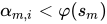
  • s m {\displaystyle s_{m}} {\displaystyle s_{m}} is a string consisting of one or more comma-separated ordinals α m , 1 , α m , 2 , . . . , α m , n m {\displaystyle \alpha _{m,1},\alpha _{m,2},...,\alpha _{m,n_{m}}} {\displaystyle \alpha _{m,1},\alpha _{m,2},...,\alpha _{m,n_{m}}} where α m , 1 > 0 {\displaystyle \alpha _{m,1}>0} {\displaystyle \alpha _{m,1}>0} and each α m , i < φ ( s m ) {\displaystyle \alpha _{m,i}<\varphi (s_{m})} {\displaystyle \alpha _{m,i}<\varphi (s_{m})}

Fundamental sequences for limit ordinals of finitary Veblen function

[edit]

For limit ordinals α < S V O {\displaystyle \alpha <SVO} {\displaystyle \alpha <SVO}, written in normal form for the finitary Veblen function:

  • ( φ ( s 1 ) + φ ( s 2 ) + ⋯ + φ ( s k ) ) [ n ] = φ ( s 1 ) + φ ( s 2 ) + ⋯ + φ ( s k ) [ n ] {\displaystyle (\varphi (s_{1})+\varphi (s_{2})+\cdots +\varphi (s_{k}))[n]=\varphi (s_{1})+\varphi (s_{2})+\cdots +\varphi (s_{k})[n]} {\displaystyle (\varphi (s_{1})+\varphi (s_{2})+\cdots +\varphi (s_{k}))[n]=\varphi (s_{1})+\varphi (s_{2})+\cdots +\varphi (s_{k})[n]},
  • φ ( γ ) [ n ] = { n if γ = 1 φ ( γ − 1 ) ⋅ n if γ is a successor ordinal φ ( γ [ n ] ) if γ is a limit ordinal {\displaystyle \varphi (\gamma )[n]=\left\{{\begin{array}{lcr}n\quad {\text{if}}\quad \gamma =1\\\varphi (\gamma -1)\cdot n\quad {\text{if}}\quad \gamma \quad {\text{is a successor ordinal}}\\\varphi (\gamma [n])\quad {\text{if}}\quad \gamma \quad {\text{is a limit ordinal}}\\\end{array}}\right.} {\displaystyle \varphi (\gamma )[n]=\left\{{\begin{array}{lcr}n\quad {\text{if}}\quad \gamma =1\\\varphi (\gamma -1)\cdot n\quad {\text{if}}\quad \gamma \quad {\text{is a successor ordinal}}\\\varphi (\gamma [n])\quad {\text{if}}\quad \gamma \quad {\text{is a limit ordinal}}\\\end{array}}\right.},
  • φ ( s , β , z , γ ) [ 0 ] = 0 {\displaystyle \varphi (s,\beta ,z,\gamma )[0]=0} {\displaystyle \varphi (s,\beta ,z,\gamma )[0]=0} and φ ( s , β , z , γ ) [ n + 1 ] = φ ( s , β − 1 , φ ( s , β , z , γ ) [ n ] , z ) {\displaystyle \varphi (s,\beta ,z,\gamma )[n+1]=\varphi (s,\beta -1,\varphi (s,\beta ,z,\gamma )[n],z)} {\displaystyle \varphi (s,\beta ,z,\gamma )[n+1]=\varphi (s,\beta -1,\varphi (s,\beta ,z,\gamma )[n],z)} if γ = 0 {\displaystyle \gamma =0} {\displaystyle \gamma =0} and β {\displaystyle \beta } {\displaystyle \beta } is a successor ordinal,
  • φ ( s , β , z , γ ) [ 0 ] = φ ( s , β , z , γ − 1 ) + 1 {\displaystyle \varphi (s,\beta ,z,\gamma )[0]=\varphi (s,\beta ,z,\gamma -1)+1} {\displaystyle \varphi (s,\beta ,z,\gamma )[0]=\varphi (s,\beta ,z,\gamma -1)+1} and φ ( s , β , z , γ ) [ n + 1 ] = φ ( s , β − 1 , φ ( s , β , z , γ ) [ n ] , z ) {\displaystyle \varphi (s,\beta ,z,\gamma )[n+1]=\varphi (s,\beta -1,\varphi (s,\beta ,z,\gamma )[n],z)} {\displaystyle \varphi (s,\beta ,z,\gamma )[n+1]=\varphi (s,\beta -1,\varphi (s,\beta ,z,\gamma )[n],z)} if γ {\displaystyle \gamma } {\displaystyle \gamma } and β {\displaystyle \beta } {\displaystyle \beta } are successor ordinals,
  • φ ( s , β , z , γ ) [ n ] = φ ( s , β , z , γ [ n ] ) {\displaystyle \varphi (s,\beta ,z,\gamma )[n]=\varphi (s,\beta ,z,\gamma [n])} {\displaystyle \varphi (s,\beta ,z,\gamma )[n]=\varphi (s,\beta ,z,\gamma [n])} if γ {\displaystyle \gamma } {\displaystyle \gamma } is a limit ordinal,
  • φ ( s , β , z , γ ) [ n ] = φ ( s , β [ n ] , z , γ ) {\displaystyle \varphi (s,\beta ,z,\gamma )[n]=\varphi (s,\beta [n],z,\gamma )} {\displaystyle \varphi (s,\beta ,z,\gamma )[n]=\varphi (s,\beta [n],z,\gamma )} if γ = 0 {\displaystyle \gamma =0} {\displaystyle \gamma =0} and β {\displaystyle \beta } {\displaystyle \beta } is a limit ordinal,
  • φ ( s , β , z , γ ) [ n ] = φ ( s , β [ n ] , φ ( s , β , z , γ − 1 ) + 1 , z ) {\displaystyle \varphi (s,\beta ,z,\gamma )[n]=\varphi (s,\beta [n],\varphi (s,\beta ,z,\gamma -1)+1,z)} {\displaystyle \varphi (s,\beta ,z,\gamma )[n]=\varphi (s,\beta [n],\varphi (s,\beta ,z,\gamma -1)+1,z)} if γ {\displaystyle \gamma } {\displaystyle \gamma } is a successor ordinal and β {\displaystyle \beta } {\displaystyle \beta } is a limit ordinal.

Transfinitely many variables

[edit]

More generally, Veblen showed that φ can be defined even for a transfinite sequence of ordinals αβ, provided that all but a finite number of them are zero. Notice that if such a sequence of ordinals is chosen from those less than an uncountable regular cardinal κ, then the sequence may be encoded as a single ordinal less than κκ (ordinal exponentiation). So one is defining a function φ from κκ into κ.

The definition can be given as follows: let α be a transfinite sequence of ordinals (i.e., an ordinal function with finite support) that ends in zero (i.e., such that α0=0), and let α[γ@0] denote the same function where the final 0 has been replaced by γ. Then γ↦φ(α[γ@0]) is defined as the function enumerating the common fixed points of all functions ξ↦φ(β) where β ranges over all sequences that are obtained by decreasing the smallest-indexed nonzero value of α and replacing some smaller-indexed value with the indeterminate ξ (i.e., β=α[ζ@ι0,ξ@ι] meaning that for the smallest index ι0 such that αι0 is nonzero the latter has been replaced by some value ζ<αι0 and that for some smaller index ι<ι0, the value αι=0 has been replaced with ξ).

For example, if α=(1@ω) denotes the transfinite sequence with value 1 at ω and 0 everywhere else, then φ(1@ω) is the smallest fixed point of all the functions ξ↦φ(ξ,0,...,0) with finitely many final zeroes (it is also the limit of the φ(1,0,...,0) with finitely many zeroes, the small Veblen ordinal).

The smallest ordinal α such that α is greater than φ applied to any function with support in α (i.e., that cannot be reached "from below" using the Veblen function of transfinitely many variables) is sometimes known as the "large" Veblen ordinal, or "great" Veblen number.[3]

Simplified

[edit]

Here is a simplified version of the transfinitary Veblen function:

We modify this to use functions (of finite support) from the class of all ordinals to itself as input. Such functions can be encoded by a set (rather than a proper class) as follows:

  • the set is a finite (possibly empty) set of ordered pairs of ordinals;
  • no ordinal appears more than once as the first member of such an ordered pair, i.e. the encoded function is single-valued;
  • the ordinal in the second position in an ordered pair is never zero, i.e. a value of zero is indicated by the absence of an ordered pair;
  • when using the set as a function, the input ordinal is compared to the first members of the ordered pairs, if it matches one, then the second member is returned as the value; otherwise the value is zero.

Using s and t for such sets and α, β, γ, and δ for ordinals, the definitions are:

s < t ⟺ s ( α ) < t ( α )  where  α = max { 0 , β : s ( β ) ≠ t ( β ) } {\displaystyle s<t\iff s(\alpha )<t(\alpha ){\text{ where }}\alpha =\max\{0,\beta :s(\beta )\neq t(\beta )\}} {\displaystyle s<t\iff s(\alpha )<t(\alpha ){\text{ where }}\alpha =\max\{0,\beta :s(\beta )\neq t(\beta )\}};
D ϕ ( s ) = max { 0 , α , β : ⟨ α , β ⟩ ∈ s } {\displaystyle D_{\phi }(s)=\max\{0,\alpha ,\beta :\langle \alpha ,\beta \rangle \in s\}} {\displaystyle D_{\phi }(s)=\max\{0,\alpha ,\beta :\langle \alpha ,\beta \rangle \in s\}};
ϕ ( s ) = inf { γ : D ϕ ( s ) ≤ γ ∧ 0 < γ ∧ ∀ δ < γ ( δ + δ < γ ) ∧ ∀ t < s ( D ϕ ( t ) < γ ⟹ ϕ ( t ) < γ ) } {\displaystyle \phi (s)=\inf \,\{\gamma :D_{\phi }(s)\leq \gamma \land 0<\gamma \land \forall \delta <\gamma (\delta +\delta <\gamma )\land \forall t<s(D_{\phi }(t)<\gamma \implies \phi (t)<\gamma )\}} {\displaystyle \phi (s)=\inf \,\{\gamma :D_{\phi }(s)\leq \gamma \land 0<\gamma \land \forall \delta <\gamma (\delta +\delta <\gamma )\land \forall t<s(D_{\phi }(t)<\gamma \implies \phi (t)<\gamma )\}}. Notice that γ is a power of ω.

Notations in this system begin with the zero-ary function 0, and use the binary function addition + to combine powers of ω which come from applying the transfinite Veblen function φ to these set-coded functions.

1 = ω 0 = ϕ ( { } ) {\displaystyle 1=\omega ^{0}=\phi (\{\})} {\displaystyle 1=\omega ^{0}=\phi (\{\})};
2 = 1 + 1 {\displaystyle 2=1+1} {\displaystyle 2=1+1};
ω = ω 1 = ϕ ( { ⟨ 0 , 1 ⟩ } ) {\displaystyle \omega =\omega ^{1}=\phi (\{\langle 0,1\rangle \})} {\displaystyle \omega =\omega ^{1}=\phi (\{\langle 0,1\rangle \})};
ω 2 = ϕ ( { ⟨ 0 , 2 ⟩ } ) {\displaystyle \omega ^{2}=\phi (\{\langle 0,2\rangle \})} {\displaystyle \omega ^{2}=\phi (\{\langle 0,2\rangle \})};
ϵ 0 = ϕ ( { ⟨ 1 , 1 ⟩ } ) = ϕ ( { ⟨ 0 , ϵ 0 ⟩ } ) {\displaystyle \epsilon _{0}=\phi (\{\langle 1,1\rangle \})=\phi (\{\langle 0,\epsilon _{0}\rangle \})} {\displaystyle \epsilon _{0}=\phi (\{\langle 1,1\rangle \})=\phi (\{\langle 0,\epsilon _{0}\rangle \})} a fixed point;
ϵ 1 = ϕ ( { ⟨ 1 , 1 ⟩ , ⟨ 0 , 1 ⟩ } ) {\displaystyle \epsilon _{1}=\phi (\{\langle 1,1\rangle ,\langle 0,1\rangle \})} {\displaystyle \epsilon _{1}=\phi (\{\langle 1,1\rangle ,\langle 0,1\rangle \})};
Γ 0 = ϕ ( { ⟨ 2 , 1 ⟩ } ) {\displaystyle \Gamma _{0}=\phi (\{\langle 2,1\rangle \})} {\displaystyle \Gamma _{0}=\phi (\{\langle 2,1\rangle \})};
Γ 1 = ϕ ( { ⟨ 2 , 1 ⟩ , ⟨ 0 , 1 ⟩ } ) {\displaystyle \Gamma _{1}=\phi (\{\langle 2,1\rangle ,\langle 0,1\rangle \})} {\displaystyle \Gamma _{1}=\phi (\{\langle 2,1\rangle ,\langle 0,1\rangle \})};
S V O = ϕ ( { ⟨ ω , 1 ⟩ } ) = ϕ ( { ⟨ 0 , S V O ⟩ } ) {\displaystyle SVO=\phi (\{\langle \omega ,1\rangle \})=\phi (\{\langle 0,SVO\rangle \})} {\displaystyle SVO=\phi (\{\langle \omega ,1\rangle \})=\phi (\{\langle 0,SVO\rangle \})} Small Veblen Ordinal is an epsilon number;
S V O ⋅ 2 = S V O + S V O {\displaystyle SVO\cdot 2=SVO+SVO} {\displaystyle SVO\cdot 2=SVO+SVO};
S V O 2 = ϕ ( { ⟨ 0 , S V O ⋅ 2 ⟩ } ) {\displaystyle SVO^{2}=\phi (\{\langle 0,SVO\cdot 2\rangle \})} {\displaystyle SVO^{2}=\phi (\{\langle 0,SVO\cdot 2\rangle \})}.

et cetera.

How many times can φ take on some value? The values are always powers of ω.

ω 0 = 1 = ϕ ( { } ) ; 0 < α ⟹ ω α = ϕ ( { ⟨ 0 , α ⟩ } ) {\displaystyle \omega ^{0}=1=\phi (\{\});0<\alpha \implies \omega ^{\alpha }=\phi (\{\langle 0,\alpha \rangle \})} {\displaystyle \omega ^{0}=1=\phi (\{\});0<\alpha \implies \omega ^{\alpha }=\phi (\{\langle 0,\alpha \rangle \})}.

So powers of ω are always values of φ at least once. Epsilon numbers are fixed points of that, so they are always values at least twice. Some ordinals are values of φ infinitely often. For example, Ω is a value an uncountable number of times.

D ϕ ( s ) < ϕ ( s ) ∧ s < t ⟹ ϕ ( t ) ≠ ϕ ( s ) {\displaystyle D_{\phi }(s)<\phi (s)\land s<t\implies \phi (t)\neq \phi (s)} {\displaystyle D_{\phi }(s)<\phi (s)\land s<t\implies \phi (t)\neq \phi (s)}.

So if Dφ < φ, then that is the last time that φ can take that value. So Dφ = φ is the norm for ordinals which are values more than once. Dφ > φ never occurs. But

∄ s ( D ϕ ( s ) < Ω = ϕ ( s ) ) {\displaystyle \not \exists s(D_{\phi }(s)<\Omega =\phi (s))} {\displaystyle \not \exists s(D_{\phi }(s)<\Omega =\phi (s))}

and there are many other ordinals for which that is true. They are all very strong limits.

The preferred form of s to produce a value of φ (s) is the one for which Dφ (s) < φ (s). The ordering theorem is:

D ϕ ( s ) < ϕ ( s ) ∧ D ϕ ( t ) < ϕ ( t ) ⟹ ( ϕ ( t ) < ϕ ( s ) ⟺ ( t < s ∧ D ϕ ( t ) < ϕ ( s ) ) ∨ ( s < t ∧ ϕ ( t ) ≤ D ϕ ( s ) ) ) {\displaystyle D_{\phi }(s)<\phi (s)\land D_{\phi }(t)<\phi (t)\implies (\phi (t)<\phi (s)\iff (t<s\land D_{\phi }(t)<\phi (s))\lor (s<t\land \phi (t)\leq D_{\phi }(s)))} {\displaystyle D_{\phi }(s)<\phi (s)\land D_{\phi }(t)<\phi (t)\implies (\phi (t)<\phi (s)\iff (t<s\land D_{\phi }(t)<\phi (s))\lor (s<t\land \phi (t)\leq D_{\phi }(s)))};
t < s ⟹ ( ( D ϕ ( t ) < ϕ ( s ) ⟹ ϕ ( t ) < ϕ ( s ) ) ∧ ( D ϕ ( t ) = ϕ ( s ) ⟹ ϕ ( t ) = ϕ ( s ) ) ∧ ( D ϕ ( t ) > ϕ ( s ) ⟹ ϕ ( t ) > ϕ ( s ) ) ) {\displaystyle t<s\implies ((D_{\phi }(t)<\phi (s)\implies \phi (t)<\phi (s))\land (D_{\phi }(t)=\phi (s)\implies \phi (t)=\phi (s))\land (D_{\phi }(t)>\phi (s)\implies \phi (t)>\phi (s)))} {\displaystyle t<s\implies ((D_{\phi }(t)<\phi (s)\implies \phi (t)<\phi (s))\land (D_{\phi }(t)=\phi (s)\implies \phi (t)=\phi (s))\land (D_{\phi }(t)>\phi (s)\implies \phi (t)>\phi (s)))};
0 < ϕ ( s ) {\displaystyle 0<\phi (s)} {\displaystyle 0<\phi (s)};
α + β < ϕ ( s ) ⟺ α < ϕ ( s ) ∧ β < ϕ ( s ) {\displaystyle \alpha +\beta <\phi (s)\iff \alpha <\phi (s)\land \beta <\phi (s)} {\displaystyle \alpha +\beta <\phi (s)\iff \alpha <\phi (s)\land \beta <\phi (s)}.

If α is an ordinal with no preferred form, then:

D ϕ ( s ) < α ⟹ ϕ ( s ) < α {\displaystyle D_{\phi }(s)<\alpha \implies \phi (s)<\alpha } {\displaystyle D_{\phi }(s)<\alpha \implies \phi (s)<\alpha };
ϕ ( { ⟨ α , 1 ⟩ } ) = α {\displaystyle \phi (\{\langle \alpha ,1\rangle \})=\alpha } {\displaystyle \phi (\{\langle \alpha ,1\rangle \})=\alpha };
{ ⟨ α , 1 ⟩ } < s ⟹ α < ϕ ( s ) {\displaystyle \{\langle \alpha ,1\rangle \}<s\implies \alpha <\phi (s)} {\displaystyle \{\langle \alpha ,1\rangle \}<s\implies \alpha <\phi (s)};
D ϕ ( s ) < α ∧ γ < min { α , β : ⟨ β , δ ⟩ ∈ s } ⟹ ϕ ( s ∪ { ⟨ γ , α ⟩ } ) = α {\displaystyle D_{\phi }(s)<\alpha \land \gamma <\min\{\alpha ,\beta :\langle \beta ,\delta \rangle \in s\}\implies \phi (s\cup \{\langle \gamma ,\alpha \rangle \})=\alpha } {\displaystyle D_{\phi }(s)<\alpha \land \gamma <\min\{\alpha ,\beta :\langle \beta ,\delta \rangle \in s\}\implies \phi (s\cup \{\langle \gamma ,\alpha \rangle \})=\alpha };
t ≠ { } ∧ max { 0 , β : ⟨ β , δ ⟩ ∈ t } < γ < min { γ + 1 , β : ⟨ β , δ ⟩ ∈ s } ⟹ α < ϕ ( s ∪ { ⟨ γ , α ⟩ } ∪ t ) {\displaystyle t\neq \{\}\land \max\{0,\beta :\langle \beta ,\delta \rangle \in t\}<\gamma <\min\{\gamma +1,\beta :\langle \beta ,\delta \rangle \in s\}\implies \alpha <\phi (s\cup \{\langle \gamma ,\alpha \rangle \}\cup t)} {\displaystyle t\neq \{\}\land \max\{0,\beta :\langle \beta ,\delta \rangle \in t\}<\gamma <\min\{\gamma +1,\beta :\langle \beta ,\delta \rangle \in s\}\implies \alpha <\phi (s\cup \{\langle \gamma ,\alpha \rangle \}\cup t)};

The ordering among epsilon numbers which do not have a preferred form depends on how those epsilon numbers are specified. To give us a way to talk about them, let npα be an enumeration of the epsilon numbers lacking a preferred form. Let us also define the complexity, X, of ordinals less than npω as follows:

X ( 0 ) = 0 {\displaystyle X(0)=0} {\displaystyle X(0)=0}
β < ϕ ( s ) ⋅ ω ∧ D ϕ ( s ) < ϕ ( s ) ⟹ X ( ϕ ( s ) + β ) = X ( β ) + Σ { X ( μ ) + X ( ν ) : ⟨ μ , ν ⟩ ∈ s } + 1 {\displaystyle \beta <\phi (s)\cdot \omega \land D_{\phi }(s)<\phi (s)\implies X(\phi (s)+\beta )=X(\beta )+\Sigma \{X(\mu )+X(\nu ):\langle \mu ,\nu \rangle \in s\}+1} {\displaystyle \beta <\phi (s)\cdot \omega \land D_{\phi }(s)<\phi (s)\implies X(\phi (s)+\beta )=X(\beta )+\Sigma \{X(\mu )+X(\nu ):\langle \mu ,\nu \rangle \in s\}+1}
n < ω ∧ β < n p n ⋅ ω ⟹ X ( n p n + β ) = X ( β ) + n + 2. {\displaystyle n<\omega \land \beta <np_{n}\cdot \omega \implies X(np_{n}+\beta )=X(\beta )+n+2.} {\displaystyle n<\omega \land \beta <np_{n}\cdot \omega \implies X(np_{n}+\beta )=X(\beta )+n+2.}

The complexity is a (finite) natural number whenever it is defined. And for any natural number k there are only finitely many ordinals α for which X (α) takes the value k or less.

Fundamental sequences of the transfinitary Veblen function
[edit]

The fundamental sequence of 0 is the empty sequence. The fundamental sequence of a successor ordinal is (α+1) [0] = α. For ordinals with cofinality ≥ ω written in normal form with length k > 1 and k < ω, the fundamental sequence is:

( φ ( s 1 ) + φ ( s 2 ) + ⋯ + φ ( s k ) ) [ α ] = φ ( s 1 ) + φ ( s 2 ) + ⋯ + ( φ ( s k ) [ α ] ) . {\displaystyle (\varphi (s_{1})+\varphi (s_{2})+\cdots +\varphi (s_{k}))\,[\alpha ]=\varphi (s_{1})+\varphi (s_{2})+\cdots +(\varphi (s_{k})\,[\alpha ]).} {\displaystyle (\varphi (s_{1})+\varphi (s_{2})+\cdots +\varphi (s_{k}))\,[\alpha ]=\varphi (s_{1})+\varphi (s_{2})+\cdots +(\varphi (s_{k})\,[\alpha ]).}

If φ (s) has a preferred form and is less than npω, that is it must be strictly greater than Dφ (s) :

∃ t < s ( D ϕ ( t ) < D ϕ ( s ) ∧ D ϕ ( s ) ≤ ϕ ( t ) ) ∨ D ϕ ( s ) = 0 ∨ ∃ δ < D ϕ ( s ) ( D ϕ ( s ) ≤ δ + δ ) , {\displaystyle \exists t<s\,(D_{\phi }(t)<D_{\phi }(s)\land D_{\phi }(s)\leq \phi (t))\lor D_{\phi }(s)=0\lor \exists \delta <D_{\phi }(s)\,(D_{\phi }(s)\leq \delta +\delta ),} {\displaystyle \exists t<s\,(D_{\phi }(t)<D_{\phi }(s)\land D_{\phi }(s)\leq \phi (t))\lor D_{\phi }(s)=0\lor \exists \delta <D_{\phi }(s)\,(D_{\phi }(s)\leq \delta +\delta ),}

then we can define the fundamental sequence of φ (s) by (φ (s)) [n] = ρn where:

ρ 0 = D ϕ ( s ) {\displaystyle \rho _{0}=D_{\phi }(s)} {\displaystyle \rho _{0}=D_{\phi }(s)}
ρ n + 1 = sup { μ : ∃ t < s ( μ = ϕ ( t ) ∧ D ϕ ( t ) ≤ ρ n ∧ X ( ϕ ( t ) ) ≤ n ) ∨ μ = 1 ∨ μ = ρ n + ρ n } {\displaystyle \rho _{n+1}=\sup\{\mu :\exists t<s(\mu =\phi (t)\land D_{\phi }(t)\leq \rho _{n}\land X(\phi (t))\leq n)\lor \mu =1\lor \mu =\rho _{n}+\rho _{n}\}} {\displaystyle \rho _{n+1}=\sup\{\mu :\exists t<s(\mu =\phi (t)\land D_{\phi }(t)\leq \rho _{n}\land X(\phi (t))\leq n)\lor \mu =1\lor \mu =\rho _{n}+\rho _{n}\}} and
ρ ω = sup { ρ n : n < ω } . {\displaystyle \rho _{\omega }=\sup\{\rho _{n}:n<\omega \}.} {\displaystyle \rho _{\omega }=\sup\{\rho _{n}:n<\omega \}.}

We will show that φ (s) = ρω. First notice that this sequence is strictly increasing because

( ρ n = 0 < 1 ≤ ρ n + 1 ) ∨ ( 0 < ρ n = ρ n + 0 < ρ n + ρ n ≤ ρ n + 1 ) . {\displaystyle (\rho _{n}=0<1\leq \rho _{n+1})\lor (0<\rho _{n}=\rho _{n}+0<\rho _{n}+\rho _{n}\leq \rho _{n+1}).} {\displaystyle (\rho _{n}=0<1\leq \rho _{n+1})\lor (0<\rho _{n}=\rho _{n}+0<\rho _{n}+\rho _{n}\leq \rho _{n+1}).}

Thus

D ϕ ( s ) = ρ 0 < ρ ω . {\displaystyle D_{\phi }(s)=\rho _{0}<\rho _{\omega }.} {\displaystyle D_{\phi }(s)=\rho _{0}<\rho _{\omega }.}
δ < ρ ω ⟹ ∃ n < ω ( δ < ρ n ) {\displaystyle \delta <\rho _{\omega }\implies \exists n<\omega (\delta <\rho _{n})} {\displaystyle \delta <\rho _{\omega }\implies \exists n<\omega (\delta <\rho _{n})}
δ < ρ ω ⟹ ∃ n < ω ( δ + δ < ρ n + 1 ) {\displaystyle \delta <\rho _{\omega }\implies \exists n<\omega (\delta +\delta <\rho _{n+1})} {\displaystyle \delta <\rho _{\omega }\implies \exists n<\omega (\delta +\delta <\rho _{n+1})}
δ < ρ ω ⟹ δ + δ < ρ ω {\displaystyle \delta <\rho _{\omega }\implies \delta +\delta <\rho _{\omega }} {\displaystyle \delta <\rho _{\omega }\implies \delta +\delta <\rho _{\omega }}
t < s ∧ D ϕ ( t ) < ρ ω ⟹ ∃ n < ω ( t < s ∧ D ϕ ( t ) < ρ n ∧ X ( ϕ ( t ) ) ≤ n ) {\displaystyle t<s\land D_{\phi }(t)<\rho _{\omega }\implies \exists n<\omega (t<s\land D_{\phi }(t)<\rho _{n}\land X(\phi (t))\leq n)} {\displaystyle t<s\land D_{\phi }(t)<\rho _{\omega }\implies \exists n<\omega (t<s\land D_{\phi }(t)<\rho _{n}\land X(\phi (t))\leq n)}
t < s ∧ D ϕ ( t ) < ρ ω ⟹ ∃ n < ω ( ϕ ( t ) ≤ ρ n + 1 ) {\displaystyle t<s\land D_{\phi }(t)<\rho _{\omega }\implies \exists n<\omega (\phi (t)\leq \rho _{n+1})} {\displaystyle t<s\land D_{\phi }(t)<\rho _{\omega }\implies \exists n<\omega (\phi (t)\leq \rho _{n+1})}
t < s ∧ D ϕ ( t ) < ρ ω ⟹ ϕ ( t ) < ρ ω {\displaystyle t<s\land D_{\phi }(t)<\rho _{\omega }\implies \phi (t)<\rho _{\omega }} {\displaystyle t<s\land D_{\phi }(t)<\rho _{\omega }\implies \phi (t)<\rho _{\omega }}
ϕ ( s ) ≤ ρ ω . {\displaystyle \phi (s)\leq \rho _{\omega }.} {\displaystyle \phi (s)\leq \rho _{\omega }.}

On the other hand,

ρ 0 = D ϕ ( s ) ≤ ϕ ( s ) {\displaystyle \rho _{0}=D_{\phi }(s)\leq \phi (s)} {\displaystyle \rho _{0}=D_{\phi }(s)\leq \phi (s)}

but φ (s) ≠ 0, 1, or 2, since it has cofinality ≥ ω and φ (s) ≠ Dφ (s) since it has a preferred form. Thus

ρ 0 < ϕ ( s ) . {\displaystyle \rho _{0}<\phi (s).} {\displaystyle \rho _{0}<\phi (s).}

Now, let us use mathematical induction with the inductive hypothesis ρn < φ (s) : suppose

ρ n < ϕ ( s ) , {\displaystyle \rho _{n}<\phi (s),} {\displaystyle \rho _{n}<\phi (s),} then
ρ n + ρ n < ϕ ( s ) {\displaystyle \rho _{n}+\rho _{n}<\phi (s)} {\displaystyle \rho _{n}+\rho _{n}<\phi (s)} because φ (s) is a power of ω
1 < ϕ ( s ) {\displaystyle 1<\phi (s)} {\displaystyle 1<\phi (s)}
t < s ∧ D ϕ ( t ) ≤ ρ n < ϕ ( s ) ∧ ρ n + 1 = ϕ ( t ) ⟹ ρ n + 1 < ϕ ( s ) {\displaystyle t<s\land D_{\phi }(t)\leq \rho _{n}<\phi (s)\land \rho _{n+1}=\phi (t)\implies \rho _{n+1}<\phi (s)} {\displaystyle t<s\land D_{\phi }(t)\leq \rho _{n}<\phi (s)\land \rho _{n+1}=\phi (t)\implies \rho _{n+1}<\phi (s)}

thus

n < ω ⟹ ρ n < ϕ ( s ) {\displaystyle n<\omega \implies \rho _{n}<\phi (s)} {\displaystyle n<\omega \implies \rho _{n}<\phi (s)}
ρ ω ≤ ϕ ( s ) . {\displaystyle \rho _{\omega }\leq \phi (s).} {\displaystyle \rho _{\omega }\leq \phi (s).}

Otherwise, φ (s) lacks a preferred form and we can set:

ρ α = sup { μ : μ = 0 ∨ ∃ β < α ∃ t < s ( μ = ρ β + ϕ ( t ) ∧ ( D ϕ ( t ) ≤ ρ β < ϕ ( s ) ) ) } {\displaystyle \rho _{\alpha }=\sup\{\mu :\mu =0\lor \exists \beta <\alpha \exists t<s(\mu =\rho _{\beta }+\phi (t)\land (D_{\phi }(t)\leq \rho _{\beta }<\phi (s)))\}} {\displaystyle \rho _{\alpha }=\sup\{\mu :\mu =0\lor \exists \beta <\alpha \exists t<s(\mu =\rho _{\beta }+\phi (t)\land (D_{\phi }(t)\leq \rho _{\beta }<\phi (s)))\}}

via transfinite recursion. This sequence may be longer than ω, but that is unavoidable since the Veblen functions are unable to comprehend some of the more complex ways of forming cofinal sequences. That is, such ordinals include (and may be indistinguishable from) uncountable regular ordinals which do not have fundamental sequences of length ω.

Further extensions

[edit]

In Massmann & Kwon (2023), the Veblen function was extended further to a somewhat technical system known as dimensional Veblen. In this, one may take fixed points or row numbers, meaning expressions such as φ(1@(1,0)) are valid (representing the large Veblen ordinal), visualised as multi-dimensional arrays. It was proven that all ordinals below the Bachmann–Howard ordinal could be represented in this system, and that the representations for all ordinals below the large Veblen ordinal were aesthetically the same as in the original system.

Values

[edit]

The function takes on several prominent values:

  • φ ( 1 , 0 ) = ε 0 {\displaystyle \varphi (1,0)=\varepsilon _{0}} {\displaystyle \varphi (1,0)=\varepsilon _{0}} is the proof-theoretic ordinal of Peano arithmetic and the limit of what ordinals can be represented in terms of Cantor normal form and smaller ordinals.
  • φ ( ω , 0 ) {\displaystyle \varphi (\omega ,0)} {\displaystyle \varphi (\omega ,0)}, a bound on the order types of the recursive path orderings with finitely many function symbols, and the smallest ordinal closed under primitive recursive ordinal functions.[4][5]
  • The Feferman–Schütte ordinal Γ 0 {\displaystyle \Gamma _{0}} {\displaystyle \Gamma _{0}} is equal to φ ( 1 , 0 , 0 ) {\displaystyle \varphi (1,0,0)} {\displaystyle \varphi (1,0,0)}.[6]
  • The small Veblen ordinal is equal to φ ( 1 ω ) {\displaystyle \varphi {\begin{pmatrix}1\\\omega \end{pmatrix}}} {\displaystyle \varphi {\begin{pmatrix}1\\\omega \end{pmatrix}}}.[7]
  • v
  • t
  • e
Large countable ordinals
  • First infinite ordinal ω
  • Epsilon numbers ε0
  • Feferman–Schütte ordinal Γ0
  • Ackermann ordinal θ(Ω2)
  • small Veblen ordinal θ(Ωω)
  • large Veblen ordinal θ(ΩΩ)
  • Bachmann–Howard ordinal ψ(εΩ+1)
  • Buchholz's ordinal ψ0(Ωω)
  • Takeuti–Feferman–Buchholz ordinal ψ0(εΩω+1)
  • Proof-theoretic ordinals of the theories of iterated inductive definitions
  • Computable ordinals < ω‍CK
    1
  • Nonrecursive ordinal ≥ ω‍CK
    1
  • First uncountable ordinal Ω

References

[edit]
  • Hilbert Levitz, Transfinite Ordinals and Their Notations: For The Uninitiated, expository article (8 pages, in PostScript)
  • Pohlers, Wolfram (1989), Proof theory, Lecture Notes in Mathematics, vol. 1407, Berlin: Springer-Verlag, doi:10.1007/978-3-540-46825-7, ISBN 978-3-540-51842-6, MR 1026933
  • Schütte, Kurt (1977), Proof theory, Grundlehren der Mathematischen Wissenschaften, vol. 225, Berlin-New York: Springer-Verlag, pp. xii+299, ISBN 978-3-540-07911-8, MR 0505313
  • Takeuti, Gaisi (1987), Proof theory, Studies in Logic and the Foundations of Mathematics, vol. 81 (Second ed.), Amsterdam: North-Holland Publishing Co., ISBN 978-0-444-87943-1, MR 0882549
  • Smorynski, C. (1982), "The varieties of arboreal experience", Math. Intelligencer, 4 (4): 182–189, doi:10.1007/BF03023553 contains an informal description of the Veblen hierarchy.
  • Veblen, Oswald (1908), "Continuous Increasing Functions of Finite and Transfinite Ordinals", Transactions of the American Mathematical Society, 9 (3): 280–292, doi:10.2307/1988605, JSTOR 1988605
  • Miller, Larry W. (1976), "Normal Functions and Constructive Ordinal Notations", The Journal of Symbolic Logic, 41 (2): 439–459, doi:10.2307/2272243, JSTOR 2272243
  • Massmann, Jayde Sylvie; Kwon, Adrian Wang (October 20, 2023), Extending the Veblen Function, arXiv:2310.12832

Citations

[edit]
  1. ^ Stephen G. Simpson, Subsystems of Second-order Arithmetic (2009, p.387)
  2. ^ a b M. Rathjen, Ordinal notations based on a weakly Mahlo cardinal, (1990, p.251). Accessed 16 August 2022.
  3. ^ M. Rathjen, "The Art of Ordinal Analysis" (2006), appearing in Proceedings of the International Congress of Mathematicians 2006.
  4. ^ N. Dershowitz, M. Okada, Proof Theoretic Techniques for Term Rewriting Theory (1988). p.105
  5. ^ Avigad, Jeremy (May 23, 2001). "An ordinal analysis of admissible set theory using recursion on ordinal notations" (PDF). Journal of Mathematical Logic. 2: 91--112. doi:10.1142/s0219061302000126.
  6. ^ D. Madore, "A Zoo of Ordinals" (2017). Accessed 02 November 2022.
  7. ^ Ranzi, Florian; Strahm, Thomas (2019). "A flexible type system for the small Veblen ordinal" (PDF). Archive for Mathematical Logic. 58 (5–6): 711–751. doi:10.1007/s00153-019-00658-x. S2CID 253675808.
Retrieved from "https://teknopedia.ac.id/w/index.php?title=Veblen_function&oldid=1339210131"
Categories:
  • Ordinal numbers
  • Proof theory
  • Hierarchy of functions
Hidden categories:
  • Articles with short description
  • Short description is different from Wikidata
  • Wikipedia articles that are too technical from February 2026
  • All articles that are too technical
  • Articles needing additional references from May 2023
  • All articles needing additional references

  • indonesia
  • Polski
  • العربية
  • Deutsch
  • English
  • Español
  • Français
  • Italiano
  • مصرى
  • Nederlands
  • 日本語
  • Português
  • Sinugboanong Binisaya
  • Svenska
  • Українська
  • Tiếng Việt
  • Winaray
  • 中文
  • Русский
Sunting pranala
url url url url url url url url url url url url url url url url url url url url url url url url url url url url url url url url url url url url url url url url url url url url url url url url url url url url url url url url url url url url url url url url url url url url url url url url url url url url url url url url url url url url url url url url url url url url url url url url url url url url url url url url url url url url url url url url url url url url url url url url url url url url url url url url url url url url url url url url url url url url url url url url url url url url url url url url url url url url url url url url url url url url url url url url url url url url url url url url url url url url url url url url url url url url url url url url url url url url url url url url url url url url url url url url url url url url url url url url url url url url url url url url url url url url url url url url url url url url url url url url url url url url url url url url url url url url url url url url url url url url url url url url url url url url url url url url url url url url url url url url url url url url url url url url url url url url url url url url url url url url url url url url url url url url url url url url url url url url url url url url url url url url url url url url url url url url url url url url url url url url url url url url url url url url url url url url url url url url url url url url url url url url url url url url url url url url url url url url url url url url url url url url url url url url url url url url url url url url url url url url url url url url url url url url url url url url url url url url url url url url url url url url url url url url url url url url url url url url url url url url url url url url url url url url url url url url url url url url url url url url url url url url url url url url url url url url url url url url url url url url url url url url url url url url url url url url url url url url url url url url url url url url url url url url url url url url url url url url url url url url url url url url url url url url url url url url url url url url url url url url url url url url url url url url url url url url url url url url url url url url url url url url url url url url url url url url url url url url url url url url url url url url url url url url url url url url url url url url url url url url url url url url url url url url url url url url url url url url url url url url url url url url url url url url url url url url url url url url url url url url url url url url url url url url url url url url url url url url url url url url url url url url url url url url url url url url url url url url url url url url url url url url url url url url url url url url url url url url url url url url url url url url url url url url url url url url url url url url url url url url url url url url url url url url url url url url url url url url url url url url url url url url url url url url url url url url url url url url url url url url url url url url url url url url url url url url url url url url url url url url url url url url url url url url url url url url url url url url url url url url url url url url url url url url url url url url url url url url url url url url url url url url url url url url url url url url url url url url url url url url url url url url url url url url url url url url url url url url url url url url url url url url url url url url url url url url url url url url url url url url url url url url url url url url url url url url url url url url url url url url url url url url url url url url url url url url url url url url url url url url url url url url url url url url url url url url url url url url url url url url url url url url url url url url url url url url url url url url url url url url url url url url url url url url url url url url url url url url url url url url url url url url url url url url url url url url url url url url url url url url url url url url url url url url url url url url url url url url url url url url url url url url url url url url url url url url url url url url url url url url url url url url url url url url url url url url url url url url url url url url url url url url url url url url url url url url url url url url url url url url url url url url url url url url url url url url url url url url url url url url url url url url url url url url url url url url url url url url url url url url url url url url url url url url url url url url url url url url url url url url url url url url url url url url url url url url url url url url url url url url url url url url url url url url url url url url url url url url url url url url url url url url url url url url url url url url url url url url url url url url url url url url url url url url url url url url url url url url url url url url url url url url url url url url url url url url url url url url url url url url url url url url url url url url url url url url url url url url url url url url url url url url url url url url url url url url url url url url url url url url url url url url url url url url url url url url url url url url url url url url url url url url url url url url url url url url url url url url url url url url url url url url url url url url url url url url url url url url url url url url url url url url url url url url url url url url url url url url url url url url url url url url url url url url url url url url url url url url url url url url url url url url url url url url url url url url url url url url url url url url url url url url url url url url url url url url url url url url url url url url url url url url url url url url url url url url url url url url url url url url url url url url url url url url url url url url url url url url url url url url url url url url url url url url url url url url url url url url url url url url url url url url url url url url url url url url url url url url url url url url url url url url url url url url url url url url url url url url url url url url url url url url url url url url url url url url url url url url url url url url url url url url url url url url url url url url url url url url url url url url url url url url url url url url url url url url url url url url url url url url url url url url url url url url url url url url url url url url url url url url url url url url url url url url url url url url url url url url url url url url url url url url url url url url url url url url url url url url url url url url url url url url url url url url url url url url url url url url url url url url url url url url url url url url url url url url url url url url url url url url url url url url url url url url url url url url url url url url url url url url url url url url url url url url url url url url url url url url url url url url url url url url url url url url url url url url url url url url url url url url url url url url url url url url url url url url url url url url url url url url url url url url url url url url url url url url url url url url url url url url url url url url url url url url url url url url url url url url url url url url url url url url url url url url url url url url url url url url url url url url url url url url url url url url url url url url url url url url url url url url url url url url url url url url url url url url url url url url url url url url url url url url url url url url url url url url url url url url url url url url url url url url url url url url url url url url url url url url url url url url url url url url url url url url url url url url url url url url url url url url url url url url url url url url url url url url url url url url url url url url url url url url url url url url url url url url url url url url url url url url url url url url url url url url url url url url url url url url url url url url url url url url url url url url url url url url url url url url url url url url url url url url url url url url url url url url url url url url url url url url url url url url url url url url url url url url url url url url url url url url url url url url url url url url url url url url url url url url url url url url url url url url url url url url url url url url url url url url url url url url url url url url url url url url url url url url url url url url url url url url url url url url url url url url url url url url url url url url url url url url url url url url url url url url url url url url url url url url url url url url url url url url url url url url url url url url url url url url url url url url url url url url url url url url url url url url url url url url url url url url url url url url url url url url url url url url url url url url url url url url url url url url url url url url url url url url url url url url url url url url url url url url url url url url url url url url url url url url url url url url url url url url url url url url url url url url url url url url url url url url url url url url url url url url url url url url url url url url url url url url url url url url url url url url url url url url url url url url url url url url url url url url url url url url url url url url url url url url url url url url url url url url url url url url url url url url url url url url url url url url url url url url url url url url url url url url url url url url url url url url url url url url url url url url url url url url url url url url url url url url url url url url url url url url url url url url url url url url url url url url url url url url url url url url url url url url url url url url url url url url url url url url
Pusat Layanan

UNIVERSITAS TEKNOKRAT INDONESIA | ASEAN's Best Private University
Jl. ZA. Pagar Alam No.9 -11, Labuhan Ratu, Kec. Kedaton, Kota Bandar Lampung, Lampung 35132
Phone: (0721) 702022
Email: pmb@teknokrat.ac.id