Epstein Files Full PDF

CLICK HERE
Technopedia Center
PMB University Brochure
Faculty of Engineering and Computer Science
S1 Informatics S1 Information Systems S1 Information Technology S1 Computer Engineering S1 Electrical Engineering S1 Civil Engineering

faculty of Economics and Business
S1 Management S1 Accountancy

Faculty of Letters and Educational Sciences
S1 English literature S1 English language education S1 Mathematics education S1 Sports Education
teknopedia

  • Registerasi
  • Brosur UTI
  • Kip Scholarship Information
  • Performance
Flag Counter
  1. World Encyclopedia
  2. Error function - Wikipedia
Error function - Wikipedia
From Wikipedia, the free encyclopedia
Sigmoid shape special function

Not to be confused with Loss function.

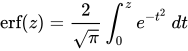
In mathematics, the error function (also called the Gauss error function), often denoted by erf, is a function e r f : C → C {\displaystyle \mathrm {erf} :\mathbb {C} \to \mathbb {C} } {\displaystyle \mathrm {erf} :\mathbb {C} \to \mathbb {C} } defined as:[1] erf ⁡ ( z ) = 2 π ∫ 0 z e − t 2 d t . {\displaystyle \operatorname {erf} (z)={\frac {2}{\sqrt {\pi }}}\int _{0}^{z}e^{-t^{2}}\,dt.} {\displaystyle \operatorname {erf} (z)={\frac {2}{\sqrt {\pi }}}\int _{0}^{z}e^{-t^{2}}\,dt.}

Error function
Plot of the error function over real numbers
General information
General definition erf ⁡ ( z ) = 2 π ∫ 0 z e − t 2 d t {\displaystyle \operatorname {erf} (z)={\frac {2}{\sqrt {\pi }}}\int _{0}^{z}e^{-t^{2}}\,dt} {\displaystyle \operatorname {erf} (z)={\frac {2}{\sqrt {\pi }}}\int _{0}^{z}e^{-t^{2}}\,dt}
Fields of applicationProbability, thermodynamics, digital communications
Domain, codomain and image
Domain C {\displaystyle \mathbb {C} } {\displaystyle \mathbb {C} }
Image ( − 1 , 1 ) {\displaystyle \left(-1,1\right)} {\displaystyle \left(-1,1\right)}
Basic features
ParityOdd
Specific features
Root0
Derivative d d z erf ⁡ ( z ) = 2 π e − z 2 {\displaystyle {\frac {d}{dz}}\operatorname {erf} (z)={\frac {2}{\sqrt {\pi }}}e^{-z^{2}}} {\displaystyle {\frac {d}{dz}}\operatorname {erf} (z)={\frac {2}{\sqrt {\pi }}}e^{-z^{2}}}
Antiderivative ∫ erf ⁡ ( z ) d z = z erf ⁡ ( z ) + e − z 2 π + C {\displaystyle \int \operatorname {erf} (z)\,dz=z\operatorname {erf} (z)+{\frac {e^{-z^{2}}}{\sqrt {\pi }}}+C} {\displaystyle \int \operatorname {erf} (z)\,dz=z\operatorname {erf} (z)+{\frac {e^{-z^{2}}}{\sqrt {\pi }}}+C}
Series definition
Taylor series erf ⁡ ( z ) = 2 π ∑ n = 0 ∞ ( − 1 ) n 2 n + 1 z 2 n + 1 n ! {\displaystyle \operatorname {erf} (z)={\frac {2}{\sqrt {\pi }}}\sum _{n=0}^{\infty }{\frac {(-1)^{n}}{2n+1}}{\frac {z^{2n+1}}{n!}}} {\displaystyle \operatorname {erf} (z)={\frac {2}{\sqrt {\pi }}}\sum _{n=0}^{\infty }{\frac {(-1)^{n}}{2n+1}}{\frac {z^{2n+1}}{n!}}}

The integral here is a complex contour integral which is path-independent because exp ⁡ ( − t 2 ) {\displaystyle \exp(-t^{2})} {\displaystyle \exp(-t^{2})} is holomorphic on the whole complex plane C {\displaystyle \mathbb {C} } {\displaystyle \mathbb {C} }. In many applications, the function argument is a real number, in which case the function value is also real.

In some old texts,[2] the error function is defined without the factor of 2 π {\displaystyle {\tfrac {2}{\sqrt {\pi }}}} {\displaystyle {\tfrac {2}{\sqrt {\pi }}}}. This nonelementary integral is a sigmoid function that occurs often in probability, statistics, and partial differential equations.

In statistics, for non-negative real values of x, the error function has the following interpretation: for a real random variable Y that is normally distributed with mean 0 and standard deviation 1 2 {\displaystyle {\tfrac {1}{\sqrt {2}}}} {\displaystyle {\tfrac {1}{\sqrt {2}}}}, erf(x) is the probability that Y falls in the range [−x, x].

Two closely related functions are the complementary error function erfc: C → C , {\displaystyle \mathbb {C} \to \mathbb {C} ,} {\displaystyle \mathbb {C} \to \mathbb {C} ,} defined as

erfc ⁡ ( z ) = 1 − erf ⁡ ( z ) , {\displaystyle \operatorname {erfc} (z)=1-\operatorname {erf} (z),} {\displaystyle \operatorname {erfc} (z)=1-\operatorname {erf} (z),}

and the imaginary error function erfi: C → C , {\displaystyle \mathbb {C} \to \mathbb {C} ,} {\displaystyle \mathbb {C} \to \mathbb {C} ,} defined as

erfi ⁡ ( z ) = − i erf ⁡ ( i z ) , {\displaystyle \operatorname {erfi} (z)=-i\operatorname {erf} (iz),} {\displaystyle \operatorname {erfi} (z)=-i\operatorname {erf} (iz),}

where i is the imaginary unit.

Name

[edit]

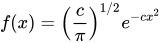
The name "error function" and its abbreviation erf were proposed by J. W. L. Glaisher in 1871 on account of its connection with "the theory of probability, and notably the theory of errors".[3] The error function complement was also discussed by Glaisher in a separate publication in the same year.[4] For the "law of facility" of errors whose density is given by f ( x ) = ( c π ) 1 / 2 e − c x 2 {\displaystyle f(x)=\left({\frac {c}{\pi }}\right)^{1/2}e^{-cx^{2}}} {\displaystyle f(x)=\left({\frac {c}{\pi }}\right)^{1/2}e^{-cx^{2}}} (the normal distribution), Glaisher calculates the probability of an error lying between p and q as ( c π ) 1 2 ∫ p q e − c x 2 d x = 1 2 ( erf ⁡ ( q c ) − erf ⁡ ( p c ) ) . {\displaystyle \left({\frac {c}{\pi }}\right)^{\frac {1}{2}}\int _{p}^{q}e^{-cx^{2}}\,dx={\frac {1}{2}}{\big (}\operatorname {erf} (q{\sqrt {c}})-\operatorname {erf} (p{\sqrt {c}}){\big )}.} {\displaystyle \left({\frac {c}{\pi }}\right)^{\frac {1}{2}}\int _{p}^{q}e^{-cx^{2}}\,dx={\frac {1}{2}}{\big (}\operatorname {erf} (q{\sqrt {c}})-\operatorname {erf} (p{\sqrt {c}}){\big )}.}
Applications

[edit]

When the results of a series of measurements are described by a normal distribution with standard deviation σ and expected value 0, then erf (⁠a/σ √2⁠) is the probability that the error of a single measurement lies between −a and +a, for positive a. This is useful, for example, in determining the bit error rate of a digital communication system.

The error and complementary error functions occur, for example, in solutions of the heat equation when boundary conditions are given by the Heaviside step function.

The error function and its approximations can be used to estimate results that hold with high probability or with low probability. Given a random variable X ~ Norm[μ,σ] (a normal distribution with mean μ and standard deviation σ) and a constant L > μ, it can be shown via integration by substitution: Pr [ X ≤ L ] = 1 2 + 1 2 erf ⁡ ( L − μ 2 σ ) ≈ A exp ⁡ ( − B ( L − μ σ ) 2 ) {\displaystyle {\begin{aligned}\Pr[X\leq L]&={\frac {1}{2}}+{\frac {1}{2}}\operatorname {erf} \left({\frac {L-\mu }{{\sqrt {2}}\sigma }}\right)\\&\approx A\exp \left(-B\left({\frac {L-\mu }{\sigma }}\right)^{2}\right)\end{aligned}}} {\displaystyle {\begin{aligned}\Pr[X\leq L]&={\frac {1}{2}}+{\frac {1}{2}}\operatorname {erf} \left({\frac {L-\mu }{{\sqrt {2}}\sigma }}\right)\\&\approx A\exp \left(-B\left({\frac {L-\mu }{\sigma }}\right)^{2}\right)\end{aligned}}}

where A and B are certain numeric constants. If L is sufficiently far from the mean, specifically μ − L ≥ σ√ln(k), then:

Pr [ X ≤ L ] ≤ A exp ⁡ ( − B ln ⁡ ( k ) ) = A k B {\displaystyle \Pr[X\leq L]\leq A\exp(-B\ln(k))={\frac {A}{k^{B}}}} {\displaystyle \Pr[X\leq L]\leq A\exp(-B\ln(k))={\frac {A}{k^{B}}}}

so the probability goes to 0 as k → ∞.

The probability for X being in the interval [La, Lb] can be derived as Pr [ L a ≤ X ≤ L b ] = ∫ L a L b 1 2 π σ exp ⁡ ( − ( x − μ ) 2 2 σ 2 ) d x = 1 2 ( erf ⁡ ( L b − μ 2 σ ) − erf ⁡ ( L a − μ 2 σ ) ) . {\displaystyle {\begin{aligned}\Pr[L_{a}\leq X\leq L_{b}]&=\int _{L_{a}}^{L_{b}}{\frac {1}{{\sqrt {2\pi }}\sigma }}\exp \left(-{\frac {(x-\mu )^{2}}{2\sigma ^{2}}}\right)\,dx\\&={\frac {1}{2}}\left(\operatorname {erf} \left({\frac {L_{b}-\mu }{{\sqrt {2}}\sigma }}\right)-\operatorname {erf} \left({\frac {L_{a}-\mu }{{\sqrt {2}}\sigma }}\right)\right).\end{aligned}}} {\displaystyle {\begin{aligned}\Pr[L_{a}\leq X\leq L_{b}]&=\int _{L_{a}}^{L_{b}}{\frac {1}{{\sqrt {2\pi }}\sigma }}\exp \left(-{\frac {(x-\mu )^{2}}{2\sigma ^{2}}}\right)\,dx\\&={\frac {1}{2}}\left(\operatorname {erf} \left({\frac {L_{b}-\mu }{{\sqrt {2}}\sigma }}\right)-\operatorname {erf} \left({\frac {L_{a}-\mu }{{\sqrt {2}}\sigma }}\right)\right).\end{aligned}}}

Properties

[edit]
Plots in the complex plane
Integrand exp(−z2)
erf(z)

The property erf (−z) = −erf(z) means that the error function is an odd function. This directly results from the fact that the integrand e−t2 is an even function (the antiderivative of an even function which is zero at the origin is an odd function and vice versa).

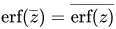
Since the error function is an entire function which maps real numbers to real numbers, for any complex number z: erf ⁡ ( z ¯ ) = erf ⁡ ( z ) ¯ {\displaystyle \operatorname {erf} ({\overline {z}})={\overline {\operatorname {erf} (z)}}} {\displaystyle \operatorname {erf} ({\overline {z}})={\overline {\operatorname {erf} (z)}}} where z ¯ {\displaystyle {\overline {z}}} {\displaystyle {\overline {z}}} denotes the complex conjugate of z {\displaystyle z} {\displaystyle z}.

The integrand f = exp(−z2) and f = erf(z) are shown in the complex z-plane in the figures at right with domain coloring.

The error function at +∞ is exactly 1 (see Gaussian integral). At the real axis, erf z approaches unity at z → +∞ and −1 at z → −∞. At the imaginary axis, it tends to ±i∞.

Taylor series

[edit]

The error function is an entire function; it has no singularities (except that at infinity) and its Taylor expansion always converges. For x >> 1, however, cancellation of leading terms makes the Taylor expansion impractical.

The defining integral cannot be evaluated in closed form in terms of elementary functions (see Liouville's theorem), but by expanding the integrand e−z2 into its Maclaurin series, integrating term by term,[5] and using the fact that erf ⁡ ( 0 ) = 0 {\displaystyle \operatorname {erf} (0)=0} {\displaystyle \operatorname {erf} (0)=0}, one obtains the error function's Maclaurin series as: erf ⁡ ( z ) = 2 π ∑ n = 0 ∞ ( − 1 ) n z 2 n + 1 n ! ( 2 n + 1 ) = 2 π ( z − z 3 3 + z 5 10 − z 7 42 + z 9 216 − ⋯ ) {\displaystyle {\begin{aligned}\operatorname {erf} (z)&={\frac {2}{\sqrt {\pi }}}\sum _{n=0}^{\infty }{\frac {(-1)^{n}z^{2n+1}}{n!(2n+1)}}\\[6pt]&={\frac {2}{\sqrt {\pi }}}\left(z-{\frac {z^{3}}{3}}+{\frac {z^{5}}{10}}-{\frac {z^{7}}{42}}+{\frac {z^{9}}{216}}-\cdots \right)\end{aligned}}} {\displaystyle {\begin{aligned}\operatorname {erf} (z)&={\frac {2}{\sqrt {\pi }}}\sum _{n=0}^{\infty }{\frac {(-1)^{n}z^{2n+1}}{n!(2n+1)}}\\[6pt]&={\frac {2}{\sqrt {\pi }}}\left(z-{\frac {z^{3}}{3}}+{\frac {z^{5}}{10}}-{\frac {z^{7}}{42}}+{\frac {z^{9}}{216}}-\cdots \right)\end{aligned}}} which holds for every complex number z. The denominator terms are sequence A007680 in the OEIS.

It is a special case of Kummer's function:

erf ⁡ ( z ) = 2 z π 1 F 1 ( 1 / 2 ; 3 / 2 ; − z 2 ) . {\displaystyle \operatorname {erf} (z)={\frac {2z}{\sqrt {\pi }}}\,{}_{1}F_{1}(1/2;3/2;-z^{2}).} {\displaystyle \operatorname {erf} (z)={\frac {2z}{\sqrt {\pi }}}\,{}_{1}F_{1}(1/2;3/2;-z^{2}).}

For iterative calculation of the above series, the following alternative formulation may be useful: erf ⁡ ( z ) = 2 π ∑ n = 0 ∞ ( z ∏ k = 1 n − ( 2 k − 1 ) z 2 k ( 2 k + 1 ) ) = 2 π ∑ n = 0 ∞ z 2 n + 1 ∏ k = 1 n − z 2 k {\displaystyle {\begin{aligned}\operatorname {erf} (z)&={\frac {2}{\sqrt {\pi }}}\sum _{n=0}^{\infty }\left(z\prod _{k=1}^{n}{\frac {-(2k-1)z^{2}}{k(2k+1)}}\right)\\[6pt]&={\frac {2}{\sqrt {\pi }}}\sum _{n=0}^{\infty }{\frac {z}{2n+1}}\prod _{k=1}^{n}{\frac {-z^{2}}{k}}\end{aligned}}} {\displaystyle {\begin{aligned}\operatorname {erf} (z)&={\frac {2}{\sqrt {\pi }}}\sum _{n=0}^{\infty }\left(z\prod _{k=1}^{n}{\frac {-(2k-1)z^{2}}{k(2k+1)}}\right)\\[6pt]&={\frac {2}{\sqrt {\pi }}}\sum _{n=0}^{\infty }{\frac {z}{2n+1}}\prod _{k=1}^{n}{\frac {-z^{2}}{k}}\end{aligned}}} because ⁠−(2k − 1)z2/k(2k + 1)⁠ expresses the multiplier to turn the kth term into the (k + 1)th term (considering z as the first term).

The imaginary error function has a very similar Maclaurin series, which is: erfi ⁡ ( z ) = 2 π ∑ n = 0 ∞ z 2 n + 1 n ! ( 2 n + 1 ) = 2 π ( z + z 3 3 + z 5 10 + z 7 42 + z 9 216 + ⋯ ) {\displaystyle {\begin{aligned}\operatorname {erfi} (z)&={\frac {2}{\sqrt {\pi }}}\sum _{n=0}^{\infty }{\frac {z^{2n+1}}{n!(2n+1)}}\\[6pt]&={\frac {2}{\sqrt {\pi }}}\left(z+{\frac {z^{3}}{3}}+{\frac {z^{5}}{10}}+{\frac {z^{7}}{42}}+{\frac {z^{9}}{216}}+\cdots \right)\end{aligned}}} {\displaystyle {\begin{aligned}\operatorname {erfi} (z)&={\frac {2}{\sqrt {\pi }}}\sum _{n=0}^{\infty }{\frac {z^{2n+1}}{n!(2n+1)}}\\[6pt]&={\frac {2}{\sqrt {\pi }}}\left(z+{\frac {z^{3}}{3}}+{\frac {z^{5}}{10}}+{\frac {z^{7}}{42}}+{\frac {z^{9}}{216}}+\cdots \right)\end{aligned}}} which holds for every complex number z.

Derivative and integral

[edit]

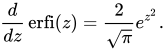
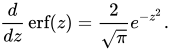
The derivative of the error function follows immediately from its definition: d d z erf ⁡ ( z ) = 2 π e − z 2 . {\displaystyle {\frac {d}{dz}}\operatorname {erf} (z)={\frac {2}{\sqrt {\pi }}}e^{-z^{2}}.} {\displaystyle {\frac {d}{dz}}\operatorname {erf} (z)={\frac {2}{\sqrt {\pi }}}e^{-z^{2}}.} From this, the derivative of the imaginary error function is also immediate: d d z erfi ⁡ ( z ) = 2 π e z 2 . {\displaystyle {\frac {d}{dz}}\operatorname {erfi} (z)={\frac {2}{\sqrt {\pi }}}e^{z^{2}}.} {\displaystyle {\frac {d}{dz}}\operatorname {erfi} (z)={\frac {2}{\sqrt {\pi }}}e^{z^{2}}.}Higher order derivatives are given by erf ( k ) ⁡ ( z ) = 2 ( − 1 ) k − 1 π H k − 1 ( z ) e − z 2 = 2 π d k − 1 d z k − 1 ( e − z 2 ) , k = 1 , 2 , … {\displaystyle \operatorname {erf} ^{(k)}(z)={\frac {2(-1)^{k-1}}{\sqrt {\pi }}}{\mathit {H}}_{k-1}(z)e^{-z^{2}}={\frac {2}{\sqrt {\pi }}}{\frac {d^{k-1}}{dz^{k-1}}}\left(e^{-z^{2}}\right),\qquad k=1,2,\dots } {\displaystyle \operatorname {erf} ^{(k)}(z)={\frac {2(-1)^{k-1}}{\sqrt {\pi }}}{\mathit {H}}_{k-1}(z)e^{-z^{2}}={\frac {2}{\sqrt {\pi }}}{\frac {d^{k-1}}{dz^{k-1}}}\left(e^{-z^{2}}\right),\qquad k=1,2,\dots } where H are the physicists' Hermite polynomials.[6]
An antiderivative of the error function, obtainable by integration by parts, is ∫ erf ⁡ ( z ) d z = z erf ⁡ ( z ) + e − z 2 π + C . {\displaystyle \int \operatorname {erf} (z)dz=z\operatorname {erf} (z)+{\frac {e^{-z^{2}}}{\sqrt {\pi }}}+C.} {\displaystyle \int \operatorname {erf} (z)dz=z\operatorname {erf} (z)+{\frac {e^{-z^{2}}}{\sqrt {\pi }}}+C.} An antiderivative of the imaginary error function, also obtainable by integration by parts, is ∫ erfi ⁡ ( z ) d z = z erfi ⁡ ( z ) − e z 2 π + C . {\displaystyle \int \operatorname {erfi} (z)dz=z\operatorname {erfi} (z)-{\frac {e^{z^{2}}}{\sqrt {\pi }}}+C.} {\displaystyle \int \operatorname {erfi} (z)dz=z\operatorname {erfi} (z)-{\frac {e^{z^{2}}}{\sqrt {\pi }}}+C.}

Bürmann series

[edit]

An expansion[7] which converges more rapidly for all real values of x than a Taylor expansion is obtained by using Hans Heinrich Bürmann's theorem:[8] erf ⁡ ( x ) = 2 π sgn ⁡ ( x ) ⋅ 1 − e − x 2 ( 1 − 1 12 ( 1 − e − x 2 ) − 7 480 ( 1 − e − x 2 ) 2 − 5 896 ( 1 − e − x 2 ) 3 − 787 276480 ( 1 − e − x 2 ) 4 − ⋯ ) = 2 π sgn ⁡ ( x ) ⋅ 1 − e − x 2 ( π 2 + ∑ k = 1 ∞ c k e − k x 2 ) {\displaystyle {\begin{aligned}\operatorname {erf} (x)&={\frac {2}{\sqrt {\pi }}}\operatorname {sgn}(x)\cdot {\sqrt {1-e^{-x^{2}}}}\left(1-{\frac {1}{12}}\left(1-e^{-x^{2}}\right)-{\frac {7}{480}}\left(1-e^{-x^{2}}\right)^{2}-{\frac {5}{896}}\left(1-e^{-x^{2}}\right)^{3}-{\frac {787}{276480}}\left(1-e^{-x^{2}}\right)^{4}-\cdots \right)\\[10pt]&={\frac {2}{\sqrt {\pi }}}\operatorname {sgn}(x)\cdot {\sqrt {1-e^{-x^{2}}}}\left({\frac {\sqrt {\pi }}{2}}+\sum _{k=1}^{\infty }c_{k}e^{-kx^{2}}\right)\end{aligned}}} {\displaystyle {\begin{aligned}\operatorname {erf} (x)&={\frac {2}{\sqrt {\pi }}}\operatorname {sgn} (x)\cdot {\sqrt {1-e^{-x^{2}}}}\left(1-{\frac {1}{12}}\left(1-e^{-x^{2}}\right)-{\frac {7}{480}}\left(1-e^{-x^{2}}\right)^{2}-{\frac {5}{896}}\left(1-e^{-x^{2}}\right)^{3}-{\frac {787}{276480}}\left(1-e^{-x^{2}}\right)^{4}-\cdots \right)\\[10pt]&={\frac {2}{\sqrt {\pi }}}\operatorname {sgn} (x)\cdot {\sqrt {1-e^{-x^{2}}}}\left({\frac {\sqrt {\pi }}{2}}+\sum _{k=1}^{\infty }c_{k}e^{-kx^{2}}\right)\end{aligned}}} where sgn is the sign function. By keeping only the first two coefficients and choosing c1 = ⁠31/200⁠ and c2 = −⁠341/8000⁠, the resulting approximation shows its largest relative error at x = ±1.40587, where it is less than 0.0034361: erf ⁡ ( x ) ≈ 2 π sgn ⁡ ( x ) ⋅ 1 − e − x 2 ( π 2 + 31 200 e − x 2 − 341 8000 e − 2 x 2 ) . {\displaystyle \operatorname {erf} (x)\approx {\frac {2}{\sqrt {\pi }}}\operatorname {sgn}(x)\cdot {\sqrt {1-e^{-x^{2}}}}\left({\frac {\sqrt {\pi }}{2}}+{\frac {31}{200}}e^{-x^{2}}-{\frac {341}{8000}}e^{-2x^{2}}\right).} {\displaystyle \operatorname {erf} (x)\approx {\frac {2}{\sqrt {\pi }}}\operatorname {sgn} (x)\cdot {\sqrt {1-e^{-x^{2}}}}\left({\frac {\sqrt {\pi }}{2}}+{\frac {31}{200}}e^{-x^{2}}-{\frac {341}{8000}}e^{-2x^{2}}\right).}

Inverse functions

[edit]
Inverse error function

Given a complex number z, there is not a unique complex number w satisfying erf(w) = z, so a true inverse function would be multivalued. However, for −1 < x < 1, there is a unique real number denoted erf−1(x) satisfying erf ⁡ ( erf − 1 ⁡ ( x ) ) = x . {\displaystyle \operatorname {erf} \left(\operatorname {erf} ^{-1}(x)\right)=x.} {\displaystyle \operatorname {erf} \left(\operatorname {erf} ^{-1}(x)\right)=x.}

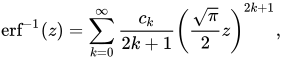
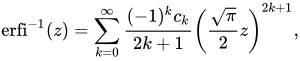
The inverse error function is usually defined with domain (−1,1), and it is restricted to this domain in many computer algebra systems. However, it can be extended to the disk |z| < 1 of the complex plane, using the Maclaurin series[9] erf − 1 ⁡ ( z ) = ∑ k = 0 ∞ c k 2 k + 1 ( π 2 z ) 2 k + 1 , {\displaystyle \operatorname {erf} ^{-1}(z)=\sum _{k=0}^{\infty }{\frac {c_{k}}{2k+1}}\left({\frac {\sqrt {\pi }}{2}}z\right)^{2k+1},} {\displaystyle \operatorname {erf} ^{-1}(z)=\sum _{k=0}^{\infty }{\frac {c_{k}}{2k+1}}\left({\frac {\sqrt {\pi }}{2}}z\right)^{2k+1},} where c0 = 1 and c k = ∑ m = 0 k − 1 c m c k − 1 − m ( m + 1 ) ( 2 m + 1 ) = { 1 , 1 , 7 6 , 127 90 , 4369 2520 , 34807 16200 , … } . {\displaystyle {\begin{aligned}c_{k}&=\sum _{m=0}^{k-1}{\frac {c_{m}c_{k-1-m}}{(m+1)(2m+1)}}\\[1ex]&=\left\{1,1,{\frac {7}{6}},{\frac {127}{90}},{\frac {4369}{2520}},{\frac {34807}{16200}},\ldots \right\}.\end{aligned}}} {\displaystyle {\begin{aligned}c_{k}&=\sum _{m=0}^{k-1}{\frac {c_{m}c_{k-1-m}}{(m+1)(2m+1)}}\\[1ex]&=\left\{1,1,{\frac {7}{6}},{\frac {127}{90}},{\frac {4369}{2520}},{\frac {34807}{16200}},\ldots \right\}.\end{aligned}}}

So we have the series expansion (common factors have been canceled from numerators and denominators): erf − 1 ⁡ ( z ) = π 2 ( z + π 12 z 3 + 7 π 2 480 z 5 + 127 π 3 40320 z 7 + 4369 π 4 5806080 z 9 + 34807 π 5 182476800 z 11 + ⋯ ) . {\displaystyle \operatorname {erf} ^{-1}(z)={\frac {\sqrt {\pi }}{2}}\left(z+{\frac {\pi }{12}}z^{3}+{\frac {7\pi ^{2}}{480}}z^{5}+{\frac {127\pi ^{3}}{40320}}z^{7}+{\frac {4369\pi ^{4}}{5806080}}z^{9}+{\frac {34807\pi ^{5}}{182476800}}z^{11}+\cdots \right).} {\displaystyle \operatorname {erf} ^{-1}(z)={\frac {\sqrt {\pi }}{2}}\left(z+{\frac {\pi }{12}}z^{3}+{\frac {7\pi ^{2}}{480}}z^{5}+{\frac {127\pi ^{3}}{40320}}z^{7}+{\frac {4369\pi ^{4}}{5806080}}z^{9}+{\frac {34807\pi ^{5}}{182476800}}z^{11}+\cdots \right).} (After cancellation the numerator and denominator values in (sequence A092676 in the OEIS) and (sequence A092677 in the OEIS) respectively; without cancellation the numerator terms are values in (sequence A002067 in the OEIS).) The error function's value at ±∞ is equal to ±1.

For |z| < 1, we have erf(erf−1(z)) = z.

The inverse complementary error function is defined as erfc − 1 ⁡ ( 1 − z ) = erf − 1 ⁡ ( z ) . {\displaystyle \operatorname {erfc} ^{-1}(1-z)=\operatorname {erf} ^{-1}(z).} {\displaystyle \operatorname {erfc} ^{-1}(1-z)=\operatorname {erf} ^{-1}(z).} For real x, there is a unique real number erfi−1(x) satisfying erfi(erfi−1(x)) = x. The inverse imaginary error function is defined as erfi−1(x).[10]

For any real x, Newton's method can be used to compute erfi−1(x), and for −1 ≤ x ≤ 1, the following Maclaurin series converges: erfi − 1 ⁡ ( z ) = ∑ k = 0 ∞ ( − 1 ) k c k 2 k + 1 ( π 2 z ) 2 k + 1 , {\displaystyle \operatorname {erfi} ^{-1}(z)=\sum _{k=0}^{\infty }{\frac {(-1)^{k}c_{k}}{2k+1}}\left({\frac {\sqrt {\pi }}{2}}z\right)^{2k+1},} {\displaystyle \operatorname {erfi} ^{-1}(z)=\sum _{k=0}^{\infty }{\frac {(-1)^{k}c_{k}}{2k+1}}\left({\frac {\sqrt {\pi }}{2}}z\right)^{2k+1},} where ck is defined as above.

Asymptotic expansion

[edit]

A useful asymptotic expansion of the complementary error function (and therefore also of the error function) for large real x is erfc ⁡ ( x ) = e − x 2 x π ( 1 + ∑ n = 1 ∞ ( − 1 ) n 1 ⋅ 3 ⋅ 5 ⋯ ( 2 n − 1 ) ( 2 x 2 ) n ) = e − x 2 x π ∑ n = 0 ∞ ( − 1 ) n ( 2 n − 1 ) ! ! ( 2 x 2 ) n , {\displaystyle {\begin{aligned}\operatorname {erfc} (x)&={\frac {e^{-x^{2}}}{x{\sqrt {\pi }}}}\left(1+\sum _{n=1}^{\infty }(-1)^{n}{\frac {1\cdot 3\cdot 5\cdots (2n-1)}{\left(2x^{2}\right)^{n}}}\right)\\[6pt]&={\frac {e^{-x^{2}}}{x{\sqrt {\pi }}}}\sum _{n=0}^{\infty }(-1)^{n}{\frac {(2n-1)!!}{\left(2x^{2}\right)^{n}}},\end{aligned}}} {\displaystyle {\begin{aligned}\operatorname {erfc} (x)&={\frac {e^{-x^{2}}}{x{\sqrt {\pi }}}}\left(1+\sum _{n=1}^{\infty }(-1)^{n}{\frac {1\cdot 3\cdot 5\cdots (2n-1)}{\left(2x^{2}\right)^{n}}}\right)\\[6pt]&={\frac {e^{-x^{2}}}{x{\sqrt {\pi }}}}\sum _{n=0}^{\infty }(-1)^{n}{\frac {(2n-1)!!}{\left(2x^{2}\right)^{n}}},\end{aligned}}} where (2n − 1)!! is the double factorial of (2n − 1), which is the product of all odd numbers up to (2n − 1). This series diverges for every finite x, and its meaning as asymptotic expansion is that for any integer N ≥ 1 one has erfc ⁡ ( x ) = e − x 2 x π ∑ n = 0 N − 1 ( − 1 ) n ( 2 n − 1 ) ! ! ( 2 x 2 ) n + R N ( x ) {\displaystyle \operatorname {erfc} (x)={\frac {e^{-x^{2}}}{x{\sqrt {\pi }}}}\sum _{n=0}^{N-1}(-1)^{n}{\frac {(2n-1)!!}{\left(2x^{2}\right)^{n}}}+R_{N}(x)} {\displaystyle \operatorname {erfc} (x)={\frac {e^{-x^{2}}}{x{\sqrt {\pi }}}}\sum _{n=0}^{N-1}(-1)^{n}{\frac {(2n-1)!!}{\left(2x^{2}\right)^{n}}}+R_{N}(x)} where the remainder is R N ( x ) := ( − 1 ) N ( 2 N − 1 ) ! ! π ⋅ 2 N − 1 ∫ x ∞ t − 2 N e − t 2 d t , {\displaystyle R_{N}(x):={\frac {(-1)^{N}\,(2N-1)!!}{{\sqrt {\pi }}\cdot 2^{N-1}}}\int _{x}^{\infty }t^{-2N}e^{-t^{2}}\,dt,} {\displaystyle R_{N}(x):={\frac {(-1)^{N}\,(2N-1)!!}{{\sqrt {\pi }}\cdot 2^{N-1}}}\int _{x}^{\infty }t^{-2N}e^{-t^{2}}\,dt,} which follows easily by induction, writing e − t 2 = − 1 2 t d d t e − t 2 {\displaystyle e^{-t^{2}}=-{\frac {1}{2t}}\,{\frac {d}{dt}}e^{-t^{2}}} {\displaystyle e^{-t^{2}}=-{\frac {1}{2t}}\,{\frac {d}{dt}}e^{-t^{2}}} and integrating by parts.

The asymptotic behavior of the remainder term, in Landau notation, is R N ( x ) = O ( x − ( 1 + 2 N ) e − x 2 ) {\displaystyle R_{N}(x)=O\left(x^{-(1+2N)}e^{-x^{2}}\right)} {\displaystyle R_{N}(x)=O\left(x^{-(1+2N)}e^{-x^{2}}\right)} as x → ∞. This can be found by R N ( x ) ∝ ∫ x ∞ t − 2 N e − t 2 d t = e − x 2 ∫ 0 ∞ ( t + x ) − 2 N e − t 2 − 2 t x d t ≤ e − x 2 ∫ 0 ∞ x − 2 N e − 2 t x d t ∝ x − ( 1 + 2 N ) e − x 2 . {\displaystyle R_{N}(x)\propto \int _{x}^{\infty }t^{-2N}e^{-t^{2}}\,dt=e^{-x^{2}}\int _{0}^{\infty }(t+x)^{-2N}e^{-t^{2}-2tx}\,dt\leq e^{-x^{2}}\int _{0}^{\infty }x^{-2N}e^{-2tx}\,dt\propto x^{-(1+2N)}e^{-x^{2}}.} {\displaystyle R_{N}(x)\propto \int _{x}^{\infty }t^{-2N}e^{-t^{2}}\,dt=e^{-x^{2}}\int _{0}^{\infty }(t+x)^{-2N}e^{-t^{2}-2tx}\,dt\leq e^{-x^{2}}\int _{0}^{\infty }x^{-2N}e^{-2tx}\,dt\propto x^{-(1+2N)}e^{-x^{2}}.} For large enough values of x, only the first few terms of this asymptotic expansion are needed to obtain a good approximation of erfc x (while for not too large values of x, the above Taylor expansion at 0 provides a very fast convergence).

Continued fraction expansion

[edit]

A continued fraction expansion of the complementary error function was found by Laplace:[11][12] erfc ⁡ ( z ) = z π e − z 2 1 z 2 + a 1 1 + a 2 z 2 + a 3 1 + ⋯ , a m = m 2 . {\displaystyle \operatorname {erfc} (z)={\frac {z}{\sqrt {\pi }}}e^{-z^{2}}{\cfrac {1}{z^{2}+{\cfrac {a_{1}}{1+{\cfrac {a_{2}}{z^{2}+{\cfrac {a_{3}}{1+\dotsb }}}}}}}},\qquad a_{m}={\frac {m}{2}}.} {\displaystyle \operatorname {erfc} (z)={\frac {z}{\sqrt {\pi }}}e^{-z^{2}}{\cfrac {1}{z^{2}+{\cfrac {a_{1}}{1+{\cfrac {a_{2}}{z^{2}+{\cfrac {a_{3}}{1+\dotsb }}}}}}}},\qquad a_{m}={\frac {m}{2}}.}

Factorial series

[edit]

The inverse factorial series: erfc ⁡ ( z ) = e − z 2 π z ∑ n = 0 ∞ ( − 1 ) n Q n ( z 2 + 1 ) n ¯ = e − z 2 π z [ 1 − 1 2 1 ( z 2 + 1 ) + 1 4 1 ( z 2 + 1 ) ( z 2 + 2 ) − ⋯ ] {\displaystyle {\begin{aligned}\operatorname {erfc} (z)&={\frac {e^{-z^{2}}}{{\sqrt {\pi }}\,z}}\sum _{n=0}^{\infty }{\frac {\left(-1\right)^{n}Q_{n}}{{\left(z^{2}+1\right)}^{\bar {n}}}}\\[1ex]&={\frac {e^{-z^{2}}}{{\sqrt {\pi }}\,z}}\left[1-{\frac {1}{2}}{\frac {1}{(z^{2}+1)}}+{\frac {1}{4}}{\frac {1}{\left(z^{2}+1\right)\left(z^{2}+2\right)}}-\cdots \right]\end{aligned}}} {\displaystyle {\begin{aligned}\operatorname {erfc} (z)&={\frac {e^{-z^{2}}}{{\sqrt {\pi }}\,z}}\sum _{n=0}^{\infty }{\frac {\left(-1\right)^{n}Q_{n}}{{\left(z^{2}+1\right)}^{\bar {n}}}}\\[1ex]&={\frac {e^{-z^{2}}}{{\sqrt {\pi }}\,z}}\left[1-{\frac {1}{2}}{\frac {1}{(z^{2}+1)}}+{\frac {1}{4}}{\frac {1}{\left(z^{2}+1\right)\left(z^{2}+2\right)}}-\cdots \right]\end{aligned}}} converges for Re(z2) > 0. Here Q n = def 1 Γ ( 1 2 ) ∫ 0 ∞ τ ( τ − 1 ) ⋯ ( τ − n + 1 ) τ − 1 2 e − τ d τ = ∑ k = 0 n s ( n , k ) 2 k ¯ , {\displaystyle {\begin{aligned}Q_{n}&{\overset {\text{def}}{{}={}}}{\frac {1}{\Gamma {\left({\frac {1}{2}}\right)}}}\int _{0}^{\infty }\tau (\tau -1)\cdots (\tau -n+1)\tau ^{-{\frac {1}{2}}}e^{-\tau }\,d\tau \\[1ex]&=\sum _{k=0}^{n}{\frac {s(n,k)}{2^{\bar {k}}}},\end{aligned}}} {\displaystyle {\begin{aligned}Q_{n}&{\overset {\text{def}}{{}={}}}{\frac {1}{\Gamma {\left({\frac {1}{2}}\right)}}}\int _{0}^{\infty }\tau (\tau -1)\cdots (\tau -n+1)\tau ^{-{\frac {1}{2}}}e^{-\tau }\,d\tau \\[1ex]&=\sum _{k=0}^{n}{\frac {s(n,k)}{2^{\bar {k}}}},\end{aligned}}} zn denotes the rising factorial, and s(n,k) denotes a signed Stirling number of the first kind.[13][14] The Taylor series can be written in terms of the double factorial: erf ⁡ ( z ) = 2 π ∑ n = 0 ∞ ( − 2 ) n ( 2 n − 1 ) ! ! ( 2 n + 1 ) ! z 2 n + 1 {\displaystyle \operatorname {erf} (z)={\frac {2}{\sqrt {\pi }}}\sum _{n=0}^{\infty }{\frac {(-2)^{n}(2n-1)!!}{(2n+1)!}}z^{2n+1}} {\displaystyle \operatorname {erf} (z)={\frac {2}{\sqrt {\pi }}}\sum _{n=0}^{\infty }{\frac {(-2)^{n}(2n-1)!!}{(2n+1)!}}z^{2n+1}}

Bounds and numerical approximations

[edit]

Approximation with elementary functions

[edit]

Abramowitz and Stegun give several approximations of varying accuracy (equations 7.1.25–28). This allows one to choose the fastest approximation suitable for a given application. In order of increasing accuracy, they are: erf ⁡ ( x ) ≈ 1 − 1 ( 1 + a 1 x + a 2 x 2 + a 3 x 3 + a 4 x 4 ) 4 , x ≥ 0 {\displaystyle \operatorname {erf} (x)\approx 1-{\frac {1}{\left(1+a_{1}x+a_{2}x^{2}+a_{3}x^{3}+a_{4}x^{4}\right)^{4}}},\qquad x\geq 0} {\displaystyle \operatorname {erf} (x)\approx 1-{\frac {1}{\left(1+a_{1}x+a_{2}x^{2}+a_{3}x^{3}+a_{4}x^{4}\right)^{4}}},\qquad x\geq 0} (maximum error: 5×10⁻⁴)

where a1 = 0.278393, a2 = 0.230389, a3 = 0.000972, a4 = 0.078108

erf ⁡ ( x ) ≈ 1 − ( a 1 t + a 2 t 2 + a 3 t 3 ) e − x 2 , t = 1 1 + p x , x ≥ 0 {\displaystyle \operatorname {erf} (x)\approx 1-\left(a_{1}t+a_{2}t^{2}+a_{3}t^{3}\right)e^{-x^{2}},\quad t={\frac {1}{1+px}},\qquad x\geq 0} {\displaystyle \operatorname {erf} (x)\approx 1-\left(a_{1}t+a_{2}t^{2}+a_{3}t^{3}\right)e^{-x^{2}},\quad t={\frac {1}{1+px}},\qquad x\geq 0} (maximum error: 2.5×10⁻⁵)

where p = 0.47047, a1 = 0.3480242, a2 = −0.0958798, a3 = 0.7478556

erf ⁡ ( x ) ≈ 1 − 1 ( 1 + a 1 x + a 2 x 2 + ⋯ + a 6 x 6 ) 16 , x ≥ 0 {\displaystyle \operatorname {erf} (x)\approx 1-{\frac {1}{\left(1+a_{1}x+a_{2}x^{2}+\cdots +a_{6}x^{6}\right)^{16}}},\qquad x\geq 0} {\displaystyle \operatorname {erf} (x)\approx 1-{\frac {1}{\left(1+a_{1}x+a_{2}x^{2}+\cdots +a_{6}x^{6}\right)^{16}}},\qquad x\geq 0} (maximum error: 3×10⁻⁷)

where a1 = 0.0705230784, a2 = 0.0422820123, a3 = 0.0092705272, a4 = 0.0001520143, a5 = 0.0002765672, a6 = 0.0000430638

erf ⁡ ( x ) ≈ 1 − ( a 1 t + a 2 t 2 + ⋯ + a 5 t 5 ) e − x 2 , t = 1 1 + p x {\displaystyle \operatorname {erf} (x)\approx 1-\left(a_{1}t+a_{2}t^{2}+\cdots +a_{5}t^{5}\right)e^{-x^{2}},\quad t={\frac {1}{1+px}}} {\displaystyle \operatorname {erf} (x)\approx 1-\left(a_{1}t+a_{2}t^{2}+\cdots +a_{5}t^{5}\right)e^{-x^{2}},\quad t={\frac {1}{1+px}}} (maximum error: 1.5×10⁻⁷)

where p = 0.3275911, a1 = 0.254829592, a2 = −0.284496736, a3 = 1.421413741, a4 = −1.453152027, a5 = 1.061405429

One can improve the accuracy of the A&S approximation by extending it with three extra parameters, erf ⁡ ( x ) ≈ 1 − ( a 1 t + a 2 t 2 + ⋯ + a 5 t 5 + a 6 t 6 + a 7 t 7 ) e − x 2 , t = 1 1 + p 1 x + p 2 x 2 {\displaystyle \operatorname {erf} (x)\approx 1-\left(a_{1}t+a_{2}t^{2}+\cdots +a_{5}t^{5}+a_{6}t^{6}+a_{7}t^{7}\right)e^{-x^{2}},\quad t={\frac {1}{1+p_{1}x+p_{2}x^{2}}}} {\displaystyle \operatorname {erf} (x)\approx 1-\left(a_{1}t+a_{2}t^{2}+\cdots +a_{5}t^{5}+a_{6}t^{6}+a_{7}t^{7}\right)e^{-x^{2}},\quad t={\frac {1}{1+p_{1}x+p_{2}x^{2}}}} where p1 = 0.406742016006509, p2 = 0.0072279182302319, a1 = 0.316879890481381, a2 = -0.138329314150635, a3 = 1.08680830347054, a4 = -1.11694155120396, a5 = 1.20644903073232, a6 = -0.393127715207728, a7 = 0.0382613542530727. The maximum error of this approximation is about 2×10⁻⁹. The parameters are obtained by fitting the extended approximation to the accurate values of the error function using the following Python code.

Python code to fit extended A&S approximation
import numpy as np
from math import erf, exp, sqrt
from scipy.optimize import least_squares

#
# Extended A&S approximation:
# erf(x) ≈ 1 − t * exp(−x^2) * (a1 + a2*t + a3*t^2 + ... + a7*t^6)
# where now
#      t = 1 / (1 + p1*x + p2*x^2)
# We fit parameters p1, p2, a1..a7 over x in [0, 10].
#


def approx_erf(params, x):
    p1 = params[0]
    p2 = params[1]
    a = params[2:]

    t = 1.0 / (1.0 + p1 * x + p2 * x * x)

    poly = np.zeros_like(x)
    tt = np.ones_like(x)  # t^0

    # polynomial: a1*t^0 + a2*t^1 + ... + a7*t^6
    for ak in a:
        poly += ak * tt
        tt *= t

    return 1.0 - t * np.exp(-x * x) * poly


def residuals(params, xs, ys):
    return approx_erf(params, xs) - ys


#
# Prepare data for fitting
#

N = 300
xmin = 0
xmax = 10
xs = np.linspace(xmin, xmax, N)
ys = np.array([erf(x) for x in xs], dtype=float)

#
# Initial guess for parameters
# Start from original A&S values and extend them conservatively
#

p1_0 = 0.3275911  # original A&S p
p2_0 = 0.0  # new denominator parameter

# original A&S 5 coefficients, add two => 7 in total
a0 = [
    0.254829592,
    -0.284496736,
    1.421413741,
    -1.453152027,
    1.061405429,
    0.0,  # new term
    0.0,  # another new term
]

params0 = np.array([p1_0, p2_0] + a0, dtype=float)

#
# Fit using nonlinear least squares (Levenberg–Marquardt)
#

result = least_squares(
    residuals, params0, args=(xs, ys), xtol=1e-14, ftol=1e-14, gtol=1e-14, max_nfev=5000
)

params = result.x
p1_fit = params[0]
p2_fit = params[1]
a_fit = params[2:]

#
# Print fitted parameters
#

print("\nFitted parameters:")
print(f"p1 = {p1_fit:.15g},")
print(f"p2 = {p2_fit:.15g},")
for i, ai in enumerate(a_fit, 1):
    print(f"a{i} = {ai:.15g},")

#
# Evaluate approximation error
#

approx_vals = approx_erf(params, xs)
abs_err = np.abs(approx_vals - ys)

print(f"\nMaximum absolute error on [{xmin},{xmax}]:", np.max(abs_err))
print("RMS error:", np.sqrt(np.mean(abs_err**2)))
print("Done.")


All of these approximations are valid for x ≥ 0. To use these approximations for negative x, use the fact that erf(x) is an odd function, so erf(x) = −erf(−x).


Exponential bounds and a pure exponential approximation for the complementary error function are given by[15] erfc ⁡ ( x ) ≤ 1 2 e − 2 x 2 + 1 2 e − x 2 ≤ e − x 2 , x > 0 erfc ⁡ ( x ) ≈ 1 6 e − x 2 + 1 2 e − 4 3 x 2 , x > 0. {\displaystyle {\begin{aligned}\operatorname {erfc} (x)&\leq {\frac {1}{2}}e^{-2x^{2}}+{\frac {1}{2}}e^{-x^{2}}\leq e^{-x^{2}},&&x>0\\[1.5ex]\operatorname {erfc} (x)&\approx {\frac {1}{6}}e^{-x^{2}}+{\frac {1}{2}}e^{-{\frac {4}{3}}x^{2}},&&x>0.\end{aligned}}} {\displaystyle {\begin{aligned}\operatorname {erfc} (x)&\leq {\frac {1}{2}}e^{-2x^{2}}+{\frac {1}{2}}e^{-x^{2}}\leq e^{-x^{2}},&&x>0\\[1.5ex]\operatorname {erfc} (x)&\approx {\frac {1}{6}}e^{-x^{2}}+{\frac {1}{2}}e^{-{\frac {4}{3}}x^{2}},&&x>0.\end{aligned}}}

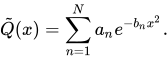
The above have been generalized to sums of N exponentials[16] with increasing accuracy in terms of N so that erfc(x) can be accurately approximated or bounded by 2Q̃(√2x), where Q ~ ( x ) = ∑ n = 1 N a n e − b n x 2 . {\displaystyle {\tilde {Q}}(x)=\sum _{n=1}^{N}a_{n}e^{-b_{n}x^{2}}.} {\displaystyle {\tilde {Q}}(x)=\sum _{n=1}^{N}a_{n}e^{-b_{n}x^{2}}.} In particular, there is a systematic methodology to solve the numerical coefficients {(an,bn)}N
n = 1
that yield a minimax approximation or bound for the closely related Q-function: Q(x) ≈ Q̃(x), Q(x) ≤ Q̃(x), or Q(x) ≥ Q̃(x) for x ≥ 0. The coefficients {(an,bn)}N
n = 1
for many variations of the exponential approximations and bounds up to N = 25 have been released to open access as a comprehensive dataset.[17]

A tight approximation of the complementary error function for x ∈ [0,∞) is given by Karagiannidis & Lioumpas (2007),[18] who showed for the appropriate choice of parameters {A,B} that erfc ⁡ ( x ) ≈ ( 1 − e − A x ) e − x 2 B π x . {\displaystyle \operatorname {erfc} (x)\approx {\frac {\left(1-e^{-Ax}\right)e^{-x^{2}}}{B{\sqrt {\pi }}x}}.} {\displaystyle \operatorname {erfc} (x)\approx {\frac {\left(1-e^{-Ax}\right)e^{-x^{2}}}{B{\sqrt {\pi }}x}}.} They determined {A,B} = {1.98,1.135}, which gave a good approximation[which?] for all x ≥ 0. Alternative coefficients are also available for tailoring accuracy for a specific application or transforming the expression into a tight bound.[19]

A single-term lower bound is[20] erfc ⁡ ( x ) ≥ 2 e π β − 1 β e − β x 2 , x ≥ 0 , β > 1 , {\displaystyle \operatorname {erfc} (x)\geq {\sqrt {\frac {2e}{\pi }}}{\frac {\sqrt {\beta -1}}{\beta }}e^{-\beta x^{2}},\qquad x\geq 0,\quad \beta >1,} {\displaystyle \operatorname {erfc} (x)\geq {\sqrt {\frac {2e}{\pi }}}{\frac {\sqrt {\beta -1}}{\beta }}e^{-\beta x^{2}},\qquad x\geq 0,\quad \beta >1,} where the parameter β can be picked to minimize error on the desired interval of approximation.

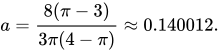
Another approximation is given by Sergei Winitzki using his "global Padé approximations":[21][22]: 2–3  erf ⁡ ( x ) ≈ sgn ⁡ x ⋅ 1 − exp ⁡ ( − x 2 4 π + a x 2 1 + a x 2 ) {\displaystyle \operatorname {erf} (x)\approx \operatorname {sgn} x\cdot {\sqrt {1-\exp \left(-x^{2}{\frac {{\frac {4}{\pi }}+ax^{2}}{1+ax^{2}}}\right)}}} {\displaystyle \operatorname {erf} (x)\approx \operatorname {sgn} x\cdot {\sqrt {1-\exp \left(-x^{2}{\frac {{\frac {4}{\pi }}+ax^{2}}{1+ax^{2}}}\right)}}} where a = 8 ( π − 3 ) 3 π ( 4 − π ) ≈ 0.140012. {\displaystyle a={\frac {8(\pi -3)}{3\pi (4-\pi )}}\approx 0.140012.} {\displaystyle a={\frac {8(\pi -3)}{3\pi (4-\pi )}}\approx 0.140012.} This is designed to be very accurate in the neighborhoods of 0 and infinity, and the relative error is less than 0.00035 for all real x. Using the alternate value a ≈ 0.147 reduces the maximum relative error to about 0.00013.[23]

The extended "global Pade" approximation, erf ⁡ ( x ) ≈ sgn ⁡ x ⋅ 1 − exp ⁡ ( − x 2 4 + 0.880877880079853 x 2 + 0.144026670907584 x 4 + 0.0077581300270021 x 6 π + 0.786235558186528 x 2 + 0.128368576906837 x 4 + 0.00773380006014367 x 6 ) , {\displaystyle \operatorname {erf} (x)\approx \operatorname {sgn} x\cdot {\sqrt {1-\exp \left(-x^{2}{\frac {4+0.880877880079853x^{2}+0.144026670907584x^{4}+0.0077581300270021x^{6}}{\pi +0.786235558186528x^{2}+0.128368576906837x^{4}+0.00773380006014367x^{6}}}\right)}}\,,} {\displaystyle \operatorname {erf} (x)\approx \operatorname {sgn} x\cdot {\sqrt {1-\exp \left(-x^{2}{\frac {4+0.880877880079853x^{2}+0.144026670907584x^{4}+0.0077581300270021x^{6}}{\pi +0.786235558186528x^{2}+0.128368576906837x^{4}+0.00773380006014367x^{6}}}\right)}}\,,} provides a maximum error of about 2×10⁻⁹, as demonstrated by the following Python script.

Python script to fit extended "global Pade" approximation
import numpy,math
from scipy.optimize import least_squares

# approximation to erf(x)

def approx_erf(p,x):
	frac=(4+p[0]*x**2+p[1]*x**4+p[2]*x**6)/(
		math.pi+p[3]*x**2+p[4]*x**4+p[5]*x**6)
	return numpy.sign(x)*numpy.sqrt(
		1-numpy.exp(-x*x*frac))

def residuals(params, xs, ys):
    return approx_erf(params, xs) - ys

# data for fitting

N = 200
xmin = 0
xmax = 9
xs = numpy.linspace(xmin, xmax, N)
ys = numpy.array([math.erf(x) for x in xs], dtype=float)
params0 = numpy.array([0.9,0.1,0.008,0.8,0.1,0.008], dtype=float)

# fitting

result = least_squares(
    residuals, params0, args=(xs, ys),
	xtol=1e-14, ftol=1e-14, gtol=1e-14, max_nfev=5000
)
params = result.x

# print out fitted parameters

print("\nFitted parameters:")
for i, pi in enumerate(params, 0):
    print(f"p{i} = {pi:.15g},")

# evaluate approximation error

approx_vals = approx_erf(params, xs)
abs_err = numpy.abs(approx_vals - ys)

print(f"\nMaximum absolute error on [{xmin},{xmax}]:", numpy.max(abs_err))
print("RMS error:", numpy.sqrt(numpy.mean(abs_err**2)))
print("Done.")

Winitzki's approximation can be inverted to obtain an approximation for the inverse error function: erf − 1 ⁡ ( x ) ≈ sgn ⁡ x ⋅ ( 2 π a + ln ⁡ ( 1 − x 2 ) 2 ) 2 − ln ⁡ ( 1 − x 2 ) a − ( 2 π a + ln ⁡ ( 1 − x 2 ) 2 ) . {\displaystyle \operatorname {erf} ^{-1}(x)\approx \operatorname {sgn} x\cdot {\sqrt {{\sqrt {\left({\frac {2}{\pi a}}+{\frac {\ln \left(1-x^{2}\right)}{2}}\right)^{2}-{\frac {\ln \left(1-x^{2}\right)}{a}}}}-\left({\frac {2}{\pi a}}+{\frac {\ln \left(1-x^{2}\right)}{2}}\right)}}.} {\displaystyle \operatorname {erf} ^{-1}(x)\approx \operatorname {sgn} x\cdot {\sqrt {{\sqrt {\left({\frac {2}{\pi a}}+{\frac {\ln \left(1-x^{2}\right)}{2}}\right)^{2}-{\frac {\ln \left(1-x^{2}\right)}{a}}}}-\left({\frac {2}{\pi a}}+{\frac {\ln \left(1-x^{2}\right)}{2}}\right)}}.}

An approximation with a maximal error of 1.2×10⁻⁷ for any real argument is:[24] erf ⁡ ( x ) = { 1 − τ , x ≥ 0 τ − 1 , x < 0 τ = t ⋅ exp ⁡ ( − x 2 − 1.26551223 + 1.00002368 t + 0.37409196 t 2 + 0.09678418 t 3 − 0.18628806 t 4 + 0.27886807 t 5 − 1.13520398 t 6 + 1.48851587 t 7 − 0.82215223 t 8 + 0.17087277 t 9 ) t = 1 1 + 1 2 | x | {\displaystyle {\begin{aligned}\operatorname {erf} (x)&={\begin{cases}1-\tau ,&x\geq 0\\\tau -1,&x<0\end{cases}}\\\tau &=t\cdot \exp \left(-x^{2}-1.26551223+1.00002368t+0.37409196t^{2}+0.09678418t^{3}-0.18628806t^{4}\right.\\&\left.\qquad \qquad \qquad +0.27886807t^{5}-1.13520398t^{6}+1.48851587t^{7}-0.82215223t^{8}+0.17087277t^{9}\right)\\t&={\frac {1}{1+{\frac {1}{2}}|x|}}\end{aligned}}} {\displaystyle {\begin{aligned}\operatorname {erf} (x)&={\begin{cases}1-\tau ,&x\geq 0\\\tau -1,&x<0\end{cases}}\\\tau &=t\cdot \exp \left(-x^{2}-1.26551223+1.00002368t+0.37409196t^{2}+0.09678418t^{3}-0.18628806t^{4}\right.\\&\left.\qquad \qquad \qquad +0.27886807t^{5}-1.13520398t^{6}+1.48851587t^{7}-0.82215223t^{8}+0.17087277t^{9}\right)\\t&={\frac {1}{1+{\frac {1}{2}}|x|}}\end{aligned}}}

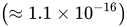
An approximation of erfc {\displaystyle \operatorname {erfc} } {\displaystyle \operatorname {erfc} } with a maximum relative error less than 2 − 53 {\displaystyle 2^{-53}} {\displaystyle 2^{-53}} ( ≈ 1.1 × 10 − 16 ) {\displaystyle \left(\approx 1.1\times 10^{-16}\right)} {\displaystyle \left(\approx 1.1\times 10^{-16}\right)} in absolute value is:[25] for x ≥ 0 {\displaystyle x\geq 0} {\displaystyle x\geq 0}, erfc ⁡ ( x ) = ( 0.56418958354775629 x + 2.06955023132914151 ) ( x 2 + 2.71078540045147805 x + 5.80755613130301624 x 2 + 3.47954057099518960 x + 12.06166887286239555 ) ( x 2 + 3.47469513777439592 x + 12.07402036406381411 x 2 + 3.72068443960225092 x + 8.44319781003968454 ) ( x 2 + 4.00561509202259545 x + 9.30596659485887898 x 2 + 3.90225704029924078 x + 6.36161630953880464 ) ( x 2 + 5.16722705817812584 x + 9.12661617673673262 x 2 + 4.03296893109262491 x + 5.13578530585681539 ) ( x 2 + 5.95908795446633271 x + 9.19435612886969243 x 2 + 4.11240942957450885 x + 4.48640329523408675 ) e − x 2 {\displaystyle {\begin{aligned}\operatorname {erfc} \left(x\right)&=\left({\frac {0.56418958354775629}{x+2.06955023132914151}}\right)\left({\frac {x^{2}+2.71078540045147805x+5.80755613130301624}{x^{2}+3.47954057099518960x+12.06166887286239555}}\right)\\&\left({\frac {x^{2}+3.47469513777439592x+12.07402036406381411}{x^{2}+3.72068443960225092x+8.44319781003968454}}\right)\left({\frac {x^{2}+4.00561509202259545x+9.30596659485887898}{x^{2}+3.90225704029924078x+6.36161630953880464}}\right)\\&\left({\frac {x^{2}+5.16722705817812584x+9.12661617673673262}{x^{2}+4.03296893109262491x+5.13578530585681539}}\right)\left({\frac {x^{2}+5.95908795446633271x+9.19435612886969243}{x^{2}+4.11240942957450885x+4.48640329523408675}}\right)e^{-x^{2}}\\\end{aligned}}} {\displaystyle {\begin{aligned}\operatorname {erfc} \left(x\right)&=\left({\frac {0.56418958354775629}{x+2.06955023132914151}}\right)\left({\frac {x^{2}+2.71078540045147805x+5.80755613130301624}{x^{2}+3.47954057099518960x+12.06166887286239555}}\right)\\&\left({\frac {x^{2}+3.47469513777439592x+12.07402036406381411}{x^{2}+3.72068443960225092x+8.44319781003968454}}\right)\left({\frac {x^{2}+4.00561509202259545x+9.30596659485887898}{x^{2}+3.90225704029924078x+6.36161630953880464}}\right)\\&\left({\frac {x^{2}+5.16722705817812584x+9.12661617673673262}{x^{2}+4.03296893109262491x+5.13578530585681539}}\right)\left({\frac {x^{2}+5.95908795446633271x+9.19435612886969243}{x^{2}+4.11240942957450885x+4.48640329523408675}}\right)e^{-x^{2}}\\\end{aligned}}} and for x < 0 {\displaystyle x<0} {\displaystyle x<0} erfc ⁡ ( x ) = 2 − erfc ⁡ ( − x ) {\displaystyle \operatorname {erfc} \left(x\right)=2-\operatorname {erfc} \left(-x\right)} {\displaystyle \operatorname {erfc} \left(x\right)=2-\operatorname {erfc} \left(-x\right)}

A simple approximation for real-valued arguments can be done through hyperbolic functions: erf ⁡ ( x ) ≈ z ( x ) = tanh ⁡ ( 2 π ( x + 11 123 x 3 ) ) {\displaystyle \operatorname {erf} \left(x\right)\approx z(x)=\tanh \left({\frac {2}{\sqrt {\pi }}}\left(x+{\frac {11}{123}}x^{3}\right)\right)} {\displaystyle \operatorname {erf} \left(x\right)\approx z(x)=\tanh \left({\frac {2}{\sqrt {\pi }}}\left(x+{\frac {11}{123}}x^{3}\right)\right)} which keeps the absolute difference | erf ⁡ ( x ) − z ( x ) | < 0.000358 , ∀ x {\displaystyle \left|\operatorname {erf} \left(x\right)-z(x)\right|<0.000358,\,\forall x} {\displaystyle \left|\operatorname {erf} \left(x\right)-z(x)\right|<0.000358,\,\forall x}.

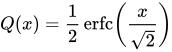
Since the error function and the Gaussian Q-function are closely related through the identity erfc ⁡ ( x ) = 2 Q ( 2 x ) {\displaystyle \operatorname {erfc} (x)=2Q({\sqrt {2}}x)} {\displaystyle \operatorname {erfc} (x)=2Q({\sqrt {2}}x)} or equivalently Q ( x ) = 1 2 erfc ⁡ ( x 2 ) {\displaystyle Q(x)={\frac {1}{2}}\operatorname {erfc} \left({\frac {x}{\sqrt {2}}}\right)} {\displaystyle Q(x)={\frac {1}{2}}\operatorname {erfc} \left({\frac {x}{\sqrt {2}}}\right)}, bounds developed for the Q-function can be adapted to approximate the complementary error function. A pair of tight lower and upper bounds on the Gaussian Q-function for positive arguments x ∈ [ 0 , ∞ ) {\displaystyle x\in [0,\infty )} {\displaystyle x\in [0,\infty )} was introduced by Abreu (2012)[26] based on a simple algebraic expression with only two exponential terms: x ≥ 0 1 2 erfc ⁡ ( x 2 ) ≥ 1 12 e − x 2 + 1 2 π ( x + 1 ) e − x 2 / 2 ≤ 1 50 e − x 2 + 1 2 ( x + 1 ) e − x 2 / 2 1 25 e − 2 x 2 + 1 x + 1 e − x 2 ≥ erfc ⁡ ( x ) ≥ 1 6 e − 2 x 2 + 1 2 2 π ( x + 1 ) e − x 2 {\displaystyle {\begin{aligned}x&\geq 0\\{\frac {1}{2}}\operatorname {erfc} \left({\frac {x}{\sqrt {2}}}\right)&\geq {\frac {1}{12}}e^{-x^{2}}+{\frac {1}{{\sqrt {2\pi }}(x+1)}}e^{-x^{2}/2}\\&\leq {\frac {1}{50}}e^{-x^{2}}+{\frac {1}{2(x+1)}}e^{-x^{2}/2}\\{\frac {1}{25}}e^{-2x^{2}}+{\frac {1}{x+1}}e^{-x^{2}}\geq \operatorname {erfc} (x)&\geq {\frac {1}{6}}e^{-2x^{2}}+{\frac {1}{2{\sqrt {2\pi }}(x+1)}}e^{-x^{2}}\end{aligned}}} {\displaystyle {\begin{aligned}x&\geq 0\\{\frac {1}{2}}\operatorname {erfc} \left({\frac {x}{\sqrt {2}}}\right)&\geq {\frac {1}{12}}e^{-x^{2}}+{\frac {1}{{\sqrt {2\pi }}(x+1)}}e^{-x^{2}/2}\\&\leq {\frac {1}{50}}e^{-x^{2}}+{\frac {1}{2(x+1)}}e^{-x^{2}/2}\\{\frac {1}{25}}e^{-2x^{2}}+{\frac {1}{x+1}}e^{-x^{2}}\geq \operatorname {erfc} (x)&\geq {\frac {1}{6}}e^{-2x^{2}}+{\frac {1}{2{\sqrt {2\pi }}(x+1)}}e^{-x^{2}}\end{aligned}}}

These bounds stem from a unified form Q B ( x ; a , b ) = exp ⁡ ( − x 2 ) a + exp ⁡ ( − x 2 / 2 ) b ( x + 1 ) , {\displaystyle Q_{\mathrm {B} }(x;a,b)={\frac {\exp(-x^{2})}{a}}+{\frac {\exp(-x^{2}/2)}{b(x+1)}},} {\displaystyle Q_{\mathrm {B} }(x;a,b)={\frac {\exp(-x^{2})}{a}}+{\frac {\exp(-x^{2}/2)}{b(x+1)}},} where the parameters a {\displaystyle a} {\displaystyle a} and b {\displaystyle b} {\displaystyle b} are selected to ensure the bounding properties: for the lower bound, a L = 12 {\displaystyle a_{\mathrm {L} }=12} {\displaystyle a_{\mathrm {L} }=12} and b L = 2 π {\displaystyle b_{\mathrm {L} }={\sqrt {2\pi }}} {\displaystyle b_{\mathrm {L} }={\sqrt {2\pi }}}, and for the upper bound, a U = 50 {\displaystyle a_{\mathrm {U} }=50} {\displaystyle a_{\mathrm {U} }=50} and b U = 2 {\displaystyle b_{\mathrm {U} }=2} {\displaystyle b_{\mathrm {U} }=2}. These expressions maintain simplicity and tightness, providing a practical trade-off between accuracy and ease of computation. They are particularly valuable in theoretical contexts, such as communication theory over fading channels, where both functions frequently appear. Additionally, the original Q-function bounds can be extended to Q n ( x ) {\displaystyle Q^{n}(x)} {\displaystyle Q^{n}(x)} for positive integers n {\displaystyle n} {\displaystyle n} via the binomial theorem, suggesting potential adaptability for powers of erfc ⁡ ( x ) {\displaystyle \operatorname {erfc} (x)} {\displaystyle \operatorname {erfc} (x)}, though this is less commonly required in error function applications.

Table of values

[edit]
Further information: Interval estimation, Coverage probability, and 68–95–99.7 rule
x erf(x) 1 − erf(x)
0 0 1
0.02 0.022564575 0.977435425
0.04 0.045111106 0.954888894
0.06 0.067621594 0.932378406
0.08 0.090078126 0.909921874
0.1 0.112462916 0.887537084
0.2 0.222702589 0.777297411
0.3 0.328626759 0.671373241
0.4 0.428392355 0.571607645
0.5 0.520499878 0.479500122
0.6 0.603856091 0.396143909
0.7 0.677801194 0.322198806
0.8 0.742100965 0.257899035
0.9 0.796908212 0.203091788
1 0.842700793 0.157299207
1.1 0.880205070 0.119794930
1.2 0.910313978 0.089686022
1.3 0.934007945 0.065992055
1.4 0.952285120 0.047714880
1.5 0.966105146 0.033894854
1.6 0.976348383 0.023651617
1.7 0.983790459 0.016209541
1.8 0.989090502 0.010909498
1.9 0.992790429 0.007209571
2 0.995322265 0.004677735
2.1 0.997020533 0.002979467
2.2 0.998137154 0.001862846
2.3 0.998856823 0.001143177
2.4 0.999311486 0.000688514
2.5 0.999593048 0.000406952
3 0.999977910 0.000022090
3.5 0.999999257 0.000000743

Related functions

[edit]

Complementary error function

[edit]
Plot of the error function erf(z) in the complex plane from −2 − 2i to 2 + 2i

The complementary error function, denoted erfc, is defined as erfc ⁡ ( x ) = 1 − erf ⁡ ( x ) = 2 π ∫ x ∞ e − t 2 d t = e − x 2 erfcx ⁡ ( x ) , {\displaystyle {\begin{aligned}\operatorname {erfc} (x)&=1-\operatorname {erf} (x)\\&={\frac {2}{\sqrt {\pi }}}\int _{x}^{\infty }e^{-t^{2}}\,dt\\&=e^{-x^{2}}\operatorname {erfcx} (x),\end{aligned}}} {\displaystyle {\begin{aligned}\operatorname {erfc} (x)&=1-\operatorname {erf} (x)\\&={\frac {2}{\sqrt {\pi }}}\int _{x}^{\infty }e^{-t^{2}}\,dt\\&=e^{-x^{2}}\operatorname {erfcx} (x),\end{aligned}}} which also defines erfcx, the scaled complementary error function[27] (which can be used instead of erfc to avoid arithmetic underflow[27][28]). Another form of erfc x for x ≥ 0 is known as Craig's formula, after its discoverer:[29] erfc ⁡ ( x ∣ x ≥ 0 ) = 2 π ∫ 0 π 2 exp ⁡ ( − x 2 sin 2 ⁡ θ ) d θ . {\displaystyle \operatorname {erfc} (x\mid x\geq 0)={\frac {2}{\pi }}\int _{0}^{\frac {\pi }{2}}\exp \left(-{\frac {x^{2}}{\sin ^{2}\theta }}\right)\,d\theta .} {\displaystyle \operatorname {erfc} (x\mid x\geq 0)={\frac {2}{\pi }}\int _{0}^{\frac {\pi }{2}}\exp \left(-{\frac {x^{2}}{\sin ^{2}\theta }}\right)\,d\theta .} This expression is valid only for positive values of x, but can be used in conjunction with erfc(x) = 2 − erfc(−x) to obtain erfc(x) for negative values. This form is advantageous in that the range of integration is fixed and finite. An extension of this expression for the erfc of the sum of two non-negative variables is[30] erfc ⁡ ( x + y ∣ x , y ≥ 0 ) = 2 π ∫ 0 π 2 exp ⁡ ( − x 2 sin 2 ⁡ θ − y 2 cos 2 ⁡ θ ) d θ . {\displaystyle \operatorname {erfc} (x+y\mid x,y\geq 0)={\frac {2}{\pi }}\int _{0}^{\frac {\pi }{2}}\exp \left(-{\frac {x^{2}}{\sin ^{2}\theta }}-{\frac {y^{2}}{\cos ^{2}\theta }}\right)\,d\theta .} {\displaystyle \operatorname {erfc} (x+y\mid x,y\geq 0)={\frac {2}{\pi }}\int _{0}^{\frac {\pi }{2}}\exp \left(-{\frac {x^{2}}{\sin ^{2}\theta }}-{\frac {y^{2}}{\cos ^{2}\theta }}\right)\,d\theta .}

Imaginary error function

[edit]
Plot of the imaginary error function erfi(z) in the complex plane from −2 − 2i to 2 + 2i

The imaginary error function, denoted erfi, is defined as erfi ⁡ ( x ) = − i erf ⁡ ( i x ) = 2 π ∫ 0 x e t 2 d t = 2 π e x 2 D ( x ) , {\displaystyle {\begin{aligned}\operatorname {erfi} (x)&=-i\operatorname {erf} (ix)\\&={\frac {2}{\sqrt {\pi }}}\int _{0}^{x}e^{t^{2}}\,dt\\&={\frac {2}{\sqrt {\pi }}}e^{x^{2}}D(x),\end{aligned}}} {\displaystyle {\begin{aligned}\operatorname {erfi} (x)&=-i\operatorname {erf} (ix)\\&={\frac {2}{\sqrt {\pi }}}\int _{0}^{x}e^{t^{2}}\,dt\\&={\frac {2}{\sqrt {\pi }}}e^{x^{2}}D(x),\end{aligned}}} where D(x) is the Dawson function (which can be used instead of erfi to avoid arithmetic overflow[27]).

Despite the name "imaginary error function", erfi(x) is real when x is real.

When the error function is evaluated for arbitrary complex arguments z, the resulting complex error function is usually discussed in scaled form as the Faddeeva function: w ( z ) = e − z 2 erfc ⁡ ( − i z ) = erfcx ⁡ ( − i z ) . {\displaystyle w(z)=e^{-z^{2}}\operatorname {erfc} (-iz)=\operatorname {erfcx} (-iz).} {\displaystyle w(z)=e^{-z^{2}}\operatorname {erfc} (-iz)=\operatorname {erfcx} (-iz).}

Cumulative distribution function

[edit]
The normal cumulative distribution function plotted in the complex plane

The error function is essentially identical to the standard normal cumulative distribution function, denoted Φ, also named norm(x) by some software languages[citation needed], as they differ only by scaling and translation. Indeed, Φ ( x ) = 1 2 π ∫ − ∞ x e − t 2 2 d t = 1 2 ( 1 + erf ⁡ ( x 2 ) ) = 1 2 erfc ⁡ ( − x 2 ) {\displaystyle {\begin{aligned}\Phi (x)&={\frac {1}{\sqrt {2\pi }}}\int _{-\infty }^{x}e^{\tfrac {-t^{2}}{2}}\,dt\\[6pt]&={\frac {1}{2}}\left(1+\operatorname {erf} \left({\frac {x}{\sqrt {2}}}\right)\right)\\[6pt]&={\frac {1}{2}}\operatorname {erfc} \left(-{\frac {x}{\sqrt {2}}}\right)\end{aligned}}} {\displaystyle {\begin{aligned}\Phi (x)&={\frac {1}{\sqrt {2\pi }}}\int _{-\infty }^{x}e^{\tfrac {-t^{2}}{2}}\,dt\\[6pt]&={\frac {1}{2}}\left(1+\operatorname {erf} \left({\frac {x}{\sqrt {2}}}\right)\right)\\[6pt]&={\frac {1}{2}}\operatorname {erfc} \left(-{\frac {x}{\sqrt {2}}}\right)\end{aligned}}} or rearranged for erf and erfc: erf ⁡ ( x ) = 2 Φ ( x 2 ) − 1 erfc ⁡ ( x ) = 2 Φ ( − x 2 ) = 2 ( 1 − Φ ( x 2 ) ) . {\displaystyle {\begin{aligned}\operatorname {erf} (x)&=2\Phi {\left(x{\sqrt {2}}\right)}-1\\[6pt]\operatorname {erfc} (x)&=2\Phi {\left(-x{\sqrt {2}}\right)}\\&=2\left(1-\Phi {\left(x{\sqrt {2}}\right)}\right).\end{aligned}}} {\displaystyle {\begin{aligned}\operatorname {erf} (x)&=2\Phi {\left(x{\sqrt {2}}\right)}-1\\[6pt]\operatorname {erfc} (x)&=2\Phi {\left(-x{\sqrt {2}}\right)}\\&=2\left(1-\Phi {\left(x{\sqrt {2}}\right)}\right).\end{aligned}}}

Consequently, the error function is also closely related to the Q-function, which is the tail probability of the standard normal distribution. The Q-function can be expressed in terms of the error function as Q ( x ) = 1 2 − 1 2 erf ⁡ ( x 2 ) = 1 2 erfc ⁡ ( x 2 ) . {\displaystyle {\begin{aligned}Q(x)&={\frac {1}{2}}-{\frac {1}{2}}\operatorname {erf} \left({\frac {x}{\sqrt {2}}}\right)\\&={\frac {1}{2}}\operatorname {erfc} \left({\frac {x}{\sqrt {2}}}\right).\end{aligned}}} {\displaystyle {\begin{aligned}Q(x)&={\frac {1}{2}}-{\frac {1}{2}}\operatorname {erf} \left({\frac {x}{\sqrt {2}}}\right)\\&={\frac {1}{2}}\operatorname {erfc} \left({\frac {x}{\sqrt {2}}}\right).\end{aligned}}}

The inverse of Φ is known as the normal quantile function, or probit function and may be expressed in terms of the inverse error function as probit ⁡ ( p ) = Φ − 1 ( p ) = 2 erf − 1 ⁡ ( 2 p − 1 ) = − 2 erfc − 1 ⁡ ( 2 p ) . {\displaystyle \operatorname {probit} (p)=\Phi ^{-1}(p)={\sqrt {2}}\operatorname {erf} ^{-1}(2p-1)=-{\sqrt {2}}\operatorname {erfc} ^{-1}(2p).} {\displaystyle \operatorname {probit} (p)=\Phi ^{-1}(p)={\sqrt {2}}\operatorname {erf} ^{-1}(2p-1)=-{\sqrt {2}}\operatorname {erfc} ^{-1}(2p).}

The standard normal cdf is used more often in probability and statistics, and the error function is used more often in other branches of mathematics.

The error function is a special case of the Mittag-Leffler function, and can also be expressed as a confluent hypergeometric function (Kummer's function): erf ⁡ ( x ) = 2 x π M ( 1 2 , 3 2 , − x 2 ) . {\displaystyle \operatorname {erf} (x)={\frac {2x}{\sqrt {\pi }}}M\left({\tfrac {1}{2}},{\tfrac {3}{2}},-x^{2}\right).} {\displaystyle \operatorname {erf} (x)={\frac {2x}{\sqrt {\pi }}}M\left({\tfrac {1}{2}},{\tfrac {3}{2}},-x^{2}\right).}

It has a simple expression in terms of the Fresnel integral.[further explanation needed]

In terms of the regularized gamma function P and the incomplete gamma function, erf ⁡ ( x ) = sgn ⁡ ( x ) ⋅ P ( 1 2 , x 2 ) = sgn ⁡ ( x ) π γ ( 1 2 , x 2 ) . {\displaystyle \operatorname {erf} (x)=\operatorname {sgn}(x)\cdot P\left({\tfrac {1}{2}},x^{2}\right)={\frac {\operatorname {sgn}(x)}{\sqrt {\pi }}}\gamma {\left({\tfrac {1}{2}},x^{2}\right)}.} {\displaystyle \operatorname {erf} (x)=\operatorname {sgn} (x)\cdot P\left({\tfrac {1}{2}},x^{2}\right)={\frac {\operatorname {sgn} (x)}{\sqrt {\pi }}}\gamma {\left({\tfrac {1}{2}},x^{2}\right)}.}sgn(x) is the sign function.

Iterated integrals of the complementary error function

[edit]

The iterated integrals of the complementary error function are defined by[31] i n erfc ⁡ ( z ) = ∫ z ∞ i n − 1 erfc ⁡ ( ζ ) d ζ i 0 erfc ⁡ ( z ) = erfc ⁡ ( z ) i 1 erfc ⁡ ( z ) = ierfc ⁡ ( z ) = 1 π e − z 2 − z erfc ⁡ ( z ) i 2 erfc ⁡ ( z ) = 1 4 ( erfc ⁡ ( z ) − 2 z ierfc ⁡ ( z ) ) {\displaystyle {\begin{aligned}i^{n}\!\operatorname {erfc} (z)&=\int _{z}^{\infty }i^{n-1}\!\operatorname {erfc} (\zeta )\,d\zeta \\[6pt]i^{0}\!\operatorname {erfc} (z)&=\operatorname {erfc} (z)\\i^{1}\!\operatorname {erfc} (z)&=\operatorname {ierfc} (z)={\frac {1}{\sqrt {\pi }}}e^{-z^{2}}-z\operatorname {erfc} (z)\\i^{2}\!\operatorname {erfc} (z)&={\tfrac {1}{4}}\left(\operatorname {erfc} (z)-2z\operatorname {ierfc} (z)\right)\\\end{aligned}}} {\displaystyle {\begin{aligned}i^{n}\!\operatorname {erfc} (z)&=\int _{z}^{\infty }i^{n-1}\!\operatorname {erfc} (\zeta )\,d\zeta \\[6pt]i^{0}\!\operatorname {erfc} (z)&=\operatorname {erfc} (z)\\i^{1}\!\operatorname {erfc} (z)&=\operatorname {ierfc} (z)={\frac {1}{\sqrt {\pi }}}e^{-z^{2}}-z\operatorname {erfc} (z)\\i^{2}\!\operatorname {erfc} (z)&={\tfrac {1}{4}}\left(\operatorname {erfc} (z)-2z\operatorname {ierfc} (z)\right)\\\end{aligned}}}

The general recurrence formula is 2 n ⋅ i n erfc ⁡ ( z ) = i n − 2 erfc ⁡ ( z ) − 2 z ⋅ i n − 1 erfc ⁡ ( z ) {\displaystyle 2n\cdot i^{n}\!\operatorname {erfc} (z)=i^{n-2}\!\operatorname {erfc} (z)-2z\cdot i^{n-1}\!\operatorname {erfc} (z)} {\displaystyle 2n\cdot i^{n}\!\operatorname {erfc} (z)=i^{n-2}\!\operatorname {erfc} (z)-2z\cdot i^{n-1}\!\operatorname {erfc} (z)}

They have the power series i n erfc ⁡ ( z ) = ∑ j = 0 ∞ ( − z ) j 2 n − j j ! Γ ( 1 + n − j 2 ) , {\displaystyle i^{n}\!\operatorname {erfc} (z)=\sum _{j=0}^{\infty }{\frac {(-z)^{j}}{2^{n-j}j!\,\Gamma \left(1+{\frac {n-j}{2}}\right)}},} {\displaystyle i^{n}\!\operatorname {erfc} (z)=\sum _{j=0}^{\infty }{\frac {(-z)^{j}}{2^{n-j}j!\,\Gamma \left(1+{\frac {n-j}{2}}\right)}},} from which follow the symmetry properties i 2 m erfc ⁡ ( − z ) = − i 2 m erfc ⁡ ( z ) + ∑ q = 0 m z 2 q 2 2 ( m − q ) − 1 ( 2 q ) ! ( m − q ) ! {\displaystyle i^{2m}\!\operatorname {erfc} (-z)=-i^{2m}\!\operatorname {erfc} (z)+\sum _{q=0}^{m}{\frac {z^{2q}}{2^{2(m-q)-1}(2q)!(m-q)!}}} {\displaystyle i^{2m}\!\operatorname {erfc} (-z)=-i^{2m}\!\operatorname {erfc} (z)+\sum _{q=0}^{m}{\frac {z^{2q}}{2^{2(m-q)-1}(2q)!(m-q)!}}} and i 2 m + 1 erfc ⁡ ( − z ) = i 2 m + 1 erfc ⁡ ( z ) + ∑ q = 0 m z 2 q + 1 2 2 ( m − q ) − 1 ( 2 q + 1 ) ! ( m − q ) ! . {\displaystyle i^{2m+1}\!\operatorname {erfc} (-z)=i^{2m+1}\!\operatorname {erfc} (z)+\sum _{q=0}^{m}{\frac {z^{2q+1}}{2^{2(m-q)-1}(2q+1)!(m-q)!}}.} {\displaystyle i^{2m+1}\!\operatorname {erfc} (-z)=i^{2m+1}\!\operatorname {erfc} (z)+\sum _{q=0}^{m}{\frac {z^{2q+1}}{2^{2(m-q)-1}(2q+1)!(m-q)!}}.}

Implementations

[edit]

As real function of a real argument

[edit]
  • In POSIX-compliant operating systems, the header math.h shall declare and the mathematical library libm shall provide the functions erf and erfc (double precision) as well as their single precision and extended precision counterparts erff, erfl and erfcf, erfcl.[32]
  • The GNU Scientific Library provides erf, erfc, log(erf), and scaled error functions.[33]

As complex function of a complex argument

[edit]
  • libcerf, numeric C library for complex error functions, provides the complex functions cerf, cerfc, cerfcx and the real functions erfi, erfcx with approximately 13–14 digits precision, based on the Faddeeva function as implemented in the MIT Faddeeva Package

References

[edit]
  1. ^ Andrews, Larry C. (1998). Special functions of mathematics for engineers. SPIE Press. p. 110. ISBN 9780819426161.
  2. ^ Whittaker, Edmund Taylor; Watson, George Neville (2021). Moll, Victor Hugo (ed.). A Course of Modern Analysis (5th revised ed.). Cambridge University Press. p. 358. ISBN 978-1-316-51893-9.
  3. ^ Glaisher, James Whitbread Lee (July 1871). "On a class of definite integrals". London, Edinburgh, and Dublin Philosophical Magazine and Journal of Science. 4. 42 (277): 294–302. doi:10.1080/14786447108640568. Retrieved 6 December 2017.
  4. ^ Glaisher, James Whitbread Lee (September 1871). "On a class of definite integrals. Part II". London, Edinburgh, and Dublin Philosophical Magazine and Journal of Science. 4. 42 (279): 421–436. doi:10.1080/14786447108640600. Retrieved 6 December 2017.
  5. ^ Fischer, W., Lieb. W. (2012) A Course in Complex Analysis, From Basic Results to Advanced Topics - Teubner Vieweg
  6. ^ Weisstein, Eric W. "Erf". MathWorld.
  7. ^ Schöpf, H. M.; Supancic, P. H. (2014). "On Bürmann's Theorem and Its Application to Problems of Linear and Nonlinear Heat Transfer and Diffusion". The Mathematica Journal. 16. doi:10.3888/tmj.16-11.
  8. ^ Weisstein, Eric W. "Bürmann's Theorem". MathWorld.
  9. ^ Dominici, Diego (2006). "Asymptotic analysis of the derivatives of the inverse error function". arXiv:math/0607230.
  10. ^ Bergsma, Wicher (2006). "On a new correlation coefficient, its orthogonal decomposition and associated tests of independence". arXiv:math/0604627.
  11. ^ Pierre-Simon Laplace, Traité de mécanique céleste, tome 4 (1805), livre X, page 255.
  12. ^ Cuyt, Annie A. M.; Petersen, Vigdis B.; Verdonk, Brigitte; Waadeland, Haakon; Jones, William B. (2008). Handbook of Continued Fractions for Special Functions. Springer-Verlag. ISBN 978-1-4020-6948-2.
  13. ^ Schlömilch, Oskar Xavier (1859). "Ueber facultätenreihen". Zeitschrift für Mathematik und Physik (in German). 4: 390–415.
  14. ^ Nielson, Niels (1906). Handbuch der Theorie der Gammafunktion (in German). Leipzig: B. G. Teubner. p. 283 Eq. 3. Retrieved 4 December 2017.
  15. ^ Chiani, M.; Dardari, D.; Simon, M.K. (2003). "New Exponential Bounds and Approximations for the Computation of Error Probability in Fading Channels" (PDF). IEEE Transactions on Wireless Communications. 2 (4): 840–845. Bibcode:2003ITWC....2..840C. CiteSeerX 10.1.1.190.6761. doi:10.1109/TWC.2003.814350. Archived from the original (PDF) on 20 October 2014. Retrieved 20 October 2014.
  16. ^ Tanash, I.M.; Riihonen, T. (2020). "Global minimax approximations and bounds for the Gaussian Q-function by sums of exponentials". IEEE Transactions on Communications. 68 (10): 6514–6524. arXiv:2007.06939. Bibcode:2020ITCom..68.6514T. doi:10.1109/TCOMM.2020.3006902. S2CID 220514754.
  17. ^ Tanash, I.M.; Riihonen, T. (2020). "Coefficients for Global Minimax Approximations and Bounds for the Gaussian Q-Function by Sums of Exponentials [Data set]". Zenodo. doi:10.5281/zenodo.4112978.
  18. ^ Karagiannidis, G. K.; Lioumpas, A. S. (2007). "An improved approximation for the Gaussian Q-function" (PDF). IEEE Communications Letters. 11 (8): 644–646. doi:10.1109/LCOMM.2007.070470. S2CID 4043576.
  19. ^ Tanash, I.M.; Riihonen, T. (2021). "Improved coefficients for the Karagiannidis–Lioumpas approximations and bounds to the Gaussian Q-function". IEEE Communications Letters. 25 (5): 1468–1471. arXiv:2101.07631. Bibcode:2021IComL..25.1468T. doi:10.1109/LCOMM.2021.3052257. S2CID 231639206.
  20. ^ Chang, Seok-Ho; Cosman, Pamela C.; Milstein, Laurence B. (November 2011). "Chernoff-Type Bounds for the Gaussian Error Function". IEEE Transactions on Communications. 59 (11): 2939–2944. Bibcode:2011ITCom..59.2939C. doi:10.1109/TCOMM.2011.072011.100049. S2CID 13636638.
  21. ^ Winitzki, Sergei (2003). "Uniform approximations for transcendental functions". Computational Science and Its Applications – ICCSA 2003. Lecture Notes in Computer Science. Vol. 2667. Springer, Berlin. pp. 780–789. doi:10.1007/3-540-44839-X_82. ISBN 978-3-540-40155-1.
  22. ^ Zeng, Caibin; Chen, Yang Cuan (2015). "Global Padé approximations of the generalized Mittag-Leffler function and its inverse". Fractional Calculus and Applied Analysis. 18 (6): 1492–1506. arXiv:1310.5592. doi:10.1515/fca-2015-0086. S2CID 118148950. Indeed, Winitzki [32] provided the so-called global Padé approximation
  23. ^ Winitzki, Sergei (6 February 2008). "A handy approximation for the error function and its inverse".
  24. ^ Press, William H. (1992). Numerical Recipes in Fortran 77: The Art of Scientific Computing. Cambridge University Press. p. 214. ISBN 0-521-43064-X.
  25. ^ Dia, Yaya D. (2023). "Approximate Incomplete Integrals, Application to Complementary Error Function". SSRN Electronic Journal. doi:10.2139/ssrn.4487559. ISSN 1556-5068.
  26. ^ Abreu, Giuseppe (2012). "Very Simple Tight Bounds on the Q-Function". IEEE Transactions on Communications. 60 (9): 2415–2420. Bibcode:2012ITCom..60.2415A. doi:10.1109/TCOMM.2012.080612.110075.
  27. ^ a b c Cody, W. J. (March 1993), "Algorithm 715: SPECFUN—A portable FORTRAN package of special function routines and test drivers" (PDF), ACM Trans. Math. Softw., 19 (1): 22–32, CiteSeerX 10.1.1.643.4394, doi:10.1145/151271.151273, S2CID 5621105
  28. ^ Zaghloul, M. R. (1 March 2007), "On the calculation of the Voigt line profile: a single proper integral with a damped sine integrand", Monthly Notices of the Royal Astronomical Society, 375 (3): 1043–1048, Bibcode:2007MNRAS.375.1043Z, doi:10.1111/j.1365-2966.2006.11377.x
  29. ^ John W. Craig, A new, simple and exact result for calculating the probability of error for two-dimensional signal constellations Archived 3 April 2012 at the Wayback Machine, Proceedings of the 1991 IEEE Military Communication Conference, vol. 2, pp. 571–575.
  30. ^ Behnad, Aydin (2020). "A Novel Extension to Craig's Q-Function Formula and Its Application in Dual-Branch EGC Performance Analysis". IEEE Transactions on Communications. 68 (7): 4117–4125. Bibcode:2020ITCom..68.4117B. doi:10.1109/TCOMM.2020.2986209. S2CID 216500014.
  31. ^ Carslaw, H. S.; Jaeger, J. C. (1959). Conduction of Heat in Solids (2nd ed.). Oxford University Press. p. 484. ISBN 978-0-19-853368-9. {{cite book}}: ISBN / Date incompatibility (help)
  32. ^ "math.h - mathematical declarations". opengroup.org. 2018. Retrieved 21 April 2023.
  33. ^ "Special Functions – GSL 2.7 documentation".

Further reading

[edit]
  • Abramowitz, Milton; Stegun, Irene Ann, eds. (1983) [June 1964]. "Chapter 7". Handbook of Mathematical Functions with Formulas, Graphs, and Mathematical Tables. Applied Mathematics Series. Vol. 55 (Ninth reprint with additional corrections of tenth original printing with corrections (December 1972); first ed.). Washington D.C.; New York: United States Department of Commerce, National Bureau of Standards; Dover Publications. p. 297. ISBN 978-0-486-61272-0. LCCN 64-60036. MR 0167642. LCCN 65-12253.
  • Press, William H.; Teukolsky, Saul A.; Vetterling, William T.; Flannery, Brian P. (2007), "Section 6.2. Incomplete Gamma Function and Error Function", Numerical Recipes: The Art of Scientific Computing (3rd ed.), New York: Cambridge University Press, ISBN 978-0-521-88068-8, archived from the original on 11 August 2011, retrieved 9 August 2011
  • Temme, Nico M. (2010), "Error Functions, Dawson's and Fresnel Integrals", in Olver, Frank W. J.; Lozier, Daniel M.; Boisvert, Ronald F.; Clark, Charles W. (eds.), NIST Handbook of Mathematical Functions, Cambridge University Press, ISBN 978-0-521-19225-5, MR 2723248.

External links

[edit]
  • A Table of Integrals of the Error Functions
  • v
  • t
  • e
Nonelementary integrals
  • Elliptic integral
  • Error function
  • Exponential integral
  • Fresnel integral
  • Logarithmic integral function
  • Trigonometric integral
Authority control databases Edit this at Wikidata
International
  • GND
National
  • Japan
Retrieved from "https://teknopedia.ac.id/w/index.php?title=Error_function&oldid=1340584053"
Categories:
  • Special hypergeometric functions
  • Gaussian function
  • Functions related to probability distributions
  • Analytic functions
  • Sigmoid functions
Hidden categories:
  • CS1 German-language sources (de)
  • Webarchive template wayback links
  • CS1 errors: ISBN date
  • Articles with short description
  • Short description is different from Wikidata
  • Use dmy dates from March 2023
  • All articles with specifically marked weasel-worded phrases
  • Articles with specifically marked weasel-worded phrases from January 2026
  • All articles with unsourced statements
  • Articles with unsourced statements from July 2020
  • Wikipedia articles needing clarification from May 2012

  • indonesia
  • Polski
  • العربية
  • Deutsch
  • English
  • Español
  • Français
  • Italiano
  • مصرى
  • Nederlands
  • 日本語
  • Português
  • Sinugboanong Binisaya
  • Svenska
  • Українська
  • Tiếng Việt
  • Winaray
  • 中文
  • Русский
Sunting pranala
url url url url url url url url url url url url url url url url url url url url url url url url url url url url url url url url url url url url url url url url url url url url url url url url url url url url url url url url url url url url url url url url url url url url url url url url url url url url url url url url url url url url url url url url url url url url url url url url url url url url url url url url url url url url url url url url url url url url url url url url url url url url url url url url url url url url url url url url url url url url url url url url url url url url url url url url url url url url url url url url url url url url url url url url url url url url url url url url url url url url url url url url url url url url url url url url url url url url url url url url url url url url url url url url url url url url url url url url url url url url url url url url url url url url url url url url url url url url url url url url url url url url url url url url url url url url url url url url url url url url url url url url url url url url url url url url url url url url url url url url url url url url url url url url url url url url url url url url url url url url url url url url url url url url url url url url url url url url url url url url url url url url url url url url url url url url url url url url url url url url url url url url url url url url url url url url url url url url url url url url url url url url url url url url url url url url url url url url url url url url url url url url url url url url url url url url url url url url url url url url url url url url url url url url url url url url url url url url url url url url url url url url url url url url url url url url url url url url url url url url url url url url url url url url url url url url url url url url url url url url url url url url url url url url url url url url url url url url url url url url url url url url url url url url url url url url url url url url url url url url url url url url url url url url url url url url url url url url url url url url url url url url url url url url url url url url url url url url url url url url url url url url url url url url url url url url url url url url url url url url url url url url url url url url url url url url url url url url url url url url url url url url url url url url url url url url url url url url url url url url url url url url url url url url url url url url url url url url url url url url url url url url url url url url url url url url url url url url url url url url url url url url url url url url url url url url url url url url url url url url url url url url url url url url url url url url url url url url url url url url url url url url url url url url url url url url url url url url url url url url url url url url url url url url url url url url url url url url url url url url url url url url url url url url url url url url url url url url url url url url url url url url url url url url url url url url url url url url url url url url url url url url url url url url url url url url url url url url url url url url url url url url url url url url url url url url url url url url url url url url url url url url url url url url url url url url url url url url url url url url url url url url url url url url url url url url url url url url url url url url url url url url url url url url url url url url url url url url url url url url url url url url url url url url url url url url url url url url url url url url url url url url url url url url url url url url url url url url url url url url url url url url url url url url url url url url url url url url url url url url url url url url url url url url url url url url url url url url url url url url url url url url url url url url url url url url url url url url url url url url url url url url url url url url url url url url url url url url url url url url url url url url url url url url url url url url url url url url url url url url url url url url url url url url url url url url url url url url url url url url url url url url url url url url url url url url url url url url url url url url url url url url url url url url url url url url url url url url url url url url url url url url url url url url url url url url url url url url url url url url url url url url url url url url url url url url url url url url url url url url url url url url url url url url url url url url url url url url url url url url url url url url url url url url url url url url url url url url url url url url url url url url url url url url url url url url url url url url url url url url url url url url url url url url url url url url url url url url url url url url url url url url url url url url url url url url url url url url url url url url url url url url url url url url url url url url url url url url url url url url url url url url url url url url url url url url url url url url url url url url url url url url url url url url url url url url url url url url url url url url url url url url url url url url url url url url url url url url url url url url url url url url url url url url url url url url url url url url url url url url url url url url url url url url url url url url url url url url url url url url url url url url url url url url url url url url url url url url url url url url url url url url url url url url url url url url url url url url url url url url url url url url url url url url url url url url url url url url url url url url url url url url url url url url url url url url url url url url url url url url url url url url url url url url url url url url url url url url url url url url url url url url url url url url url url url url url url url url url url url url url url url url url url url url url url url url url url url url url url url url url url url url url url url url url url url url url url url url url url url url url url url url url url url url url url url url url url url url url url url url url url url url url url url url url url url url url url url url url url url url url url url url url url url url url url url url url url url url url url url url url url url url url url url url url url url url url url url url url url url url url url url url url url url url url url url url url url url url url url url url url url url url url url url url url url url url url url url url url url url url url url url url url url url url url url url url url url url url url url url url url url url url url url url url url url url url url url url url url url url url url url url url url url url url url url url url url url url url url url url url url url url url url url url url url url url url url url url url url url url url url url url url url url url url url url url url url url url url url url url url url url url url url url url url url url url url url url url url url url url url url url url url url url url url url url url url url url url url url url url url url url url url url url url url url url url url url url url url url url url url url url url url url url url url url url url url url url url url url url url url url url url url url url url url url url url url url url url url url url url url url url url url url url url url url url url url url url url url url url url url url url url url url url url url url url url url url url url url url url url url url url url url url url url url url url url url url url url url url url url url url url url url url url url url url url url url url url url url url url url url url url url url url url url url url url url url url url url url url url url url url url url url url url url url url url url url url url url url url url url url url url url url url url url url url url url url url url url url url url url url url url url url url url url url url url url url url url url url url url url url url url url url url url url url url url url url url url url url url url url url url url url url url url url url url url url url url url url url url url url url url url url url url url url url url url url url url url url url url url url url url url url url url url url url url url url url url url url url url url url url url url url url url url url url url url url url url url url url url url url url url url url url url url url url url url url url url url url url url url url url url url url url url url url url url url url url url url url url url url url url url url url url url url url url url url url url url url url url url url url url url url url url url url url url url url url url url url url url url url url url url url url url url url url url url url url url url url url url url url url url url url url url url url url url url url url url url url url url url url url url url url url url url url url url url url url url url url url url url url url url url url url url url url url url url url url url url url url url url url url url url url url url url url url url url url url url url url url url url url url url url url url url url url url url url url url url url url url url url url url url url url url url url url url url url url url url url url url url url url url url url url url url url url url url url url url url url url url url url url url url url url url url url url url url url url url url url url url url url url url url url url url url url url url url url url url url url url url url url url url url url url url url url url url url url url url url url url url url url url url url url url url url url url url url url url url url url url url url url url url url url url url url url url url url url url url url url url url url url url url url url url url url url url url url url url url url url url url url url url url url url url url url
Pusat Layanan

UNIVERSITAS TEKNOKRAT INDONESIA | ASEAN's Best Private University
Jl. ZA. Pagar Alam No.9 -11, Labuhan Ratu, Kec. Kedaton, Kota Bandar Lampung, Lampung 35132
Phone: (0721) 702022
Email: pmb@teknokrat.ac.id