Gudea (/ɡuː.ˈdeɪ.ə/, goo-DAY-ə; Sumerian: 𒅗𒌤𒀀, Gu3-de2-a; died c. 2124 BC) was a Sumerian ruler (ensi) of the state of Lagash in Southern Mesopotamia, who ruled or c. 2144–2124 BC (MC). Though most likely not a native of Lagash, he married Ninalla, the daughter of its ruler Ur-Baba, which enabled him to enter the royal family. He was succeeded by his son, Ur-Ningirsu II. Gudea ruled during a period when the Gutian dynastyMari.[1] Under Gudea, Lagash experienced a golden age, with seemingly considerable independence from the Gutians, a language isolate populace who had came from northeastern regions beyond Mesopotamia.[2]
Gudea EnsiLagashki, "Gudea, Governor of Lagash", in an inscriptionCylinder seal of Gudea. It reads "Gudea, Ensi of Lagash; Lugal-me, scribe, thy servant".[3]
Gudea chose the title of énsi (town-king or governor), not the more exalted lugal (Akkadianšarrum). Gudea did not style himself "god of Lagash" as he was not deified during his own lifetime, this title must have been given to him posthumously[4] as in accordance with Mesopotamian traditions for all rulers except Naram-Sin of Akkad and some of the Ur III kings.[5]
The 20 years of his reign are all known by name; the main military exploit seems to have occurred in his Year 6, called the "Year when Anshan was smitten with weapons".[6]
Although Gudea claimed to have conquered Elam and Anshan, most of his inscriptions emphasize the building of irrigation channels and temples, and the creation of precious gifts to the gods.[7]
Foundation figurines of gods in copper alloy, reign of Gudea, c. 2150 BC, from the temple of Ningirsu at Girsu (British Museum, London)Votive stele of Gudea, ruler of Lagash, to the temple of Ningirsu: Gudea being led by Ningishzida into the presence of a deity who is seated on a throne. From Girsu, Iraq. 2144-2124 BC. Ancient Orient Museum, Istanbul.Sacred basin, a gift from Gudea to the temple of Ningirsu. From Girsu, Iraq. 2144-2122 BC. Ancient Orient Museum, Istanbul.Diorite mortar, an offering from Gudea to Enlil. From Nippur, Iraq. 2144-2124 BC. Ancient Orient Museum, Istanbul.
The inscription on a statue of Gudea as architect of the House of Ningirsu,[11] warns the reader of doom if the words are altered, but there is a startling difference between the warnings of Sargon or his line and the warnings of Gudea. The one is length; Gudea's curse lasts nearly a quarter of the inscription's considerable length,[12] and another is creativity. The gods will not merely reduce the offender's progeny to ash and destroy his foundations, no, they will, "let him sit down in the dust instead of on the seat they set up for him". He will be "slaughtered like a bull… seized like an aurochs by his fierce horn".[13]
Lagash under Gudea had extensive commercial communications with distant realms. According to his own records, Gudea brought cedars from the Amanus and Lebanon mountains in Syria, diorite from eastern Arabia, copper and gold from central and southern Arabia and from Sinai, while his armies were engaged in battles in Elam on the east.[14]
Location of foreign lands for the Mesopotamians, including Meluhha
In an inscription, Gudea referred to the Meluhhans who came to Sumer to sell gold dust, carnelian etc...[14] In another inscription, he mentioned his victory over the territories of Magan, Meluhha, Elam and Amurru.[14]
In the Gudea cylinders, Gudea mentions that "I will spread in the world respect for my Temple, under my name the whole universe will gather in it, and Magan and Meluhha will come down from their mountains to attend" (cylinder A, IX).[15] In cylinder B, XIV, he mentions his procurement of "blocks of lapis lazuli and bright carnelian from Meluhha."[16]
The "Libation vase of Gudea" with the dragon Mušḫuššu, dedicated to Ningishzida (21st century BC). The caduceus (right) is interpreted as depicting god Ningishzida. Inscription; "To the god Ningiszida, his god, Gudea, Ensi (governor) of Lagash, for the prolongation of his life, has dedicated this."
^Thapar, Romila (1975). "A Possible Identification of Meluḫḫa, Dilmun and Makan". Journal of the Economic and Social History of the Orient. 18 (1): 1–42. doi:10.2307/3632219. ISSN0022-4995. JSTOR3632219.
^"J'étendrai sur le monde le respect de mon temple, sous mon nom l'univers depuis l'horizon s'y rassemblera, et [même les pays lointains] Magan et Meluhha, sortant de leurs montagnes, y descendront" (cylindre A, IX)" in "Louvre Museum". Archived from the original on 16 September 2013. Retrieved 1 April 2020.


.jpg)

.JPG)


 The "Libation vase of Gudea" with the dragon Mušḫuššu, dedicated to Ningishzida (21st century BC). The caduceus (right) is interpreted as depicting god Ningishzida. Inscription; "To the god Ningiszida, his god, Gudea, Ensi (governor) of Lagash, for the prolongation of his life, has dedicated this."
 Head of Gudea in polished diorite, reign of Gudea (Boston Museum of Fine Arts)
![Lion macehead of Gudea, Girsu[17]](//upload.wikimedia.org/wikipedia/commons/thumb/4/44/Girsu_Lion_Macehead.jpg/250px-Girsu_Lion_Macehead.jpg) Lion macehead of Gudea, Girsu[17]
Lion macehead of Gudea, Girsu[17]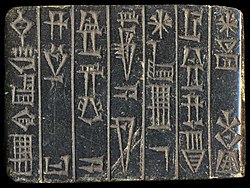
![Gudea tablet: "For Hendursaga, his master, Gudea, ruler of Lagash, built his house."[18] Vorderasiatisches Museum, Berlin.](//upload.wikimedia.org/wikipedia/commons/thumb/2/20/Gudea_tablet_Vorderasiatisches_Museum_Berlin.jpg/250px-Gudea_tablet_Vorderasiatisches_Museum_Berlin.jpg) Gudea tablet: "For Hendursaga, his master, Gudea, ruler of Lagash, built his house."[18] Vorderasiatisches Museum, Berlin.
Gudea tablet: "For Hendursaga, his master, Gudea, ruler of Lagash, built his house."[18] Vorderasiatisches Museum, Berlin. Foundation nail of Gudea, Cleveland Museum of Art
![The Gudea cylinders[19]](//upload.wikimedia.org/wikipedia/commons/thumb/d/d6/Cylindres_de_Gudea_-_Mus%C3%A9e_du_Louvre_Antiquit%C3%A9s_orientales_AO_MNB_1511_%3B_MNB_1512.jpg/250px-Cylindres_de_Gudea_-_Mus%C3%A9e_du_Louvre_Antiquit%C3%A9s_orientales_AO_MNB_1511_%3B_MNB_1512.jpg)
 Name and title "Gudea, ensi of Lagash" on Statue A of Gudea
 Foundation nail for the temple of Ningirsu in Lagash. Reign of Gudea.
 Mudbrick stamped with a cuneiform text mentioning the name of Gudea, ruler of Lagash. From Girsu, Iraq, c. 2115 BC. Vorderasiatisches Museum, Berlin
 Seal of Gudea, led by Ningishzida

![Lion macehead of Gudea, Girsu[17]](/wiki/File:Girsu_Lion_Macehead.jpg)

![Gudea tablet: "For Hendursaga, his master, Gudea, ruler of Lagash, built his house."[18] Vorderasiatisches Museum, Berlin.](/wiki/File:Gudea_tablet_Vorderasiatisches_Museum_Berlin.jpg)

![The Gudea cylinders[19]](/wiki/File:Cylindres_de_Gudea_-_Mus%C3%A9e_du_Louvre_Antiquit%C3%A9s_orientales_AO_MNB_1511_;_MNB_1512.jpg)


.jpg)


.jpg)


.jpg)


.jpg)
.jpg)


.jpg)

_Colorized_per_source.jpg)


,_Hamadan_mint.jpg)


