Epstein Files Full PDF

CLICK HERE
Technopedia Center
PMB University Brochure
Faculty of Engineering and Computer Science
S1 Informatics S1 Information Systems S1 Information Technology S1 Computer Engineering S1 Electrical Engineering S1 Civil Engineering

faculty of Economics and Business
S1 Management S1 Accountancy

Faculty of Letters and Educational Sciences
S1 English literature S1 English language education S1 Mathematics education S1 Sports Education
teknopedia

  • Registerasi
  • Brosur UTI
  • Kip Scholarship Information
  • Performance
Flag Counter
  1. World Encyclopedia
  2. Advanced Programmable Interrupt Controller - Wikipedia
Advanced Programmable Interrupt Controller - Wikipedia
From Wikipedia, the free encyclopedia
(Redirected from LAPIC)
Family of computer interrupt controllers

In computing, Intel's Advanced Programmable Interrupt Controller (APIC) is a family of programmable interrupt controllers. As its name suggests, the APIC is more advanced than Intel's 8259 Programmable Interrupt Controller (PIC), particularly enabling the construction of multiprocessor systems. It is one of several architectural designs intended to solve interrupt routing efficiency issues in multiprocessor computer systems.

The APIC is a split architecture design, with a local component (LAPIC) usually integrated into the processor itself, and an optional I/O APIC on a system bus. The first APIC was the 82489DX – it was a discrete chip that functioned both as local and I/O APIC. The 82489DX enabled construction of symmetric multiprocessor (SMP) systems with the Intel 486 and early Pentium processors; for example, the reference two-way 486 SMP system used three 82489DX chips, two as local APICs and one as I/O APIC. Starting with the P54C processor, the local APIC functionality was integrated into the Intel processors' silicon. The first dedicated I/O APIC was the Intel 82093AA, which was intended for PIIX3-based systems.

Overview

[edit]

There are two components in the Intel APIC system, the local APIC (LAPIC) and the I/O APIC. There is one LAPIC in each CPU in the system. In the very first implementation (82489DX), the LAPIC was a discrete circuit, as opposed to its later implementation in Intel processors' silicon. There is typically one I/O APIC for each peripheral bus in the system. In original system designs, LAPICs and I/O APICs were connected by a dedicated APIC bus. Newer systems use the system bus for communication between all APIC components.

Each APIC, whether a discrete chip or integrated in a CPU, has a version register containing a four-bit version number for its specific APIC implementation. For example, the 82489DX has an APIC version number of 0, while version 1 was assigned to the first generation of local APICs integrated in the Pentium 90 and 100 processors.[1]: 3-5 

In systems containing an 8259 PIC, the 8259 may be connected to the LAPIC in the system's bootstrap processor (BSP), one of the system's I/O APICs, or both. Logically, however, the 8259 is only connected once at any given time.

Discrete APIC

[edit]

The first-generation Intel APIC chip, the 82489DX, which was meant to be used with Intel 80486 and early Pentium processors, is actually an external local and I/O APIC in one circuit. The Intel MP 1.4 specification refers to it as "discrete APIC" in contrast with the "integrated APIC" found in most of the Pentium processors.[1]: 1-4  The 82489DX had 16 interrupt lines;[2] it also had a quirk that it could lose some ISA interrupts.[3]

In a multiprocessor 486 system, each CPU had to be paired with its own 82489DX; additionally a supplementary 82489DX had to be used as I/O APIC. The 82489DX could not emulate the 8259A (XT-PIC) so these also had to be included as physical chips for backwards compatibility.[1]: 5-3  The 82489DX was packaged as a 132-pin PQFP.[2] It was available for USD $26 per 1,000-unit in quantities.[4]

Integrated local APICs

[edit]

Local APICs (LAPICs) manage all external interrupts for some specific processor in an SMP system. In addition, they are able to accept and generate inter-processor interrupts (IPIs) between LAPICs. A single LAPIC may support up to 224 usable interrupt vectors from an I/O APIC. Vector numbers 0 to 31, out of 0 to 255, are reserved for exception handling by x86 processors.

All Intel processors starting with the P5 microarchitecture (P54C) have a built-in local APIC.[5][6] However, if the local APIC is disabled in a P5 processor, it cannot be re-enabled by software; this limitation no longer exists in the P6 processors and later ones.[6]

With the introduction of Pentium 4 HT and Pentium D, each CPU core and each CPU thread have the integrated LAPIC.

The Message Signaled Interrupts (MSI) feature of the PCI 2.2 and later specifications cannot be used without the local APIC being enabled.[7] Use of MSI obviates the need for an I/O APIC. Additionally, up to 224 interrupts are supported in MSI mode, and IRQ sharing is not allowed.[8]: 10–11 

APIC timer

[edit]

Another advantage of the local APIC is that it also provides a high-resolution (on the order of one microsecond or better) timer that can be used in both interval and one-off mode.[6]

The APIC timer had its initial acceptance woes. A Microsoft document from 2002 (which advocated for the adoption of High Precision Event Timer instead) criticized the LAPIC timer for having "poor resolution" and stating that "the clocks silicon is sometimes very buggy".[9] Nevertheless, the APIC timer is used for example by Windows 7 when profiling is enabled, and by Windows 8 in all circumstances. (Before Windows 8 claimed exclusive rights to this timer, it was also used by some programs like CPU-Z.) Under Microsoft Windows the APIC timer is not a shareable resource.[10]

The aperiodic interrupts offered by the APIC timer are used by the Linux kernel tickless kernel feature. This optional but default feature is new with 2.6.18. When enabled on a computer with an APIC timer, the kernel does not use the 8253 programmable interval timer for timekeeping.[11] A VMware document notes that "software does not have a reliable way to determine its frequency. Generally, the only way to determine the local APIC timer’s frequency is to measure it using the PIT or CMOS timer, which yields only an approximate result."[12]

I/O APICs

[edit]

I/O APICs contain a redirection table, which is used to route the interrupts it receives from peripheral buses to one or more local APICs. Early I/O APICs (like 82489DX, SIO.A and PCEB/ESC) only had support for 16 interrupt lines, but later ones like 82093AA (separate chip for PIIX3/PIIX4) had support for 24 interrupt lines.[8]: 10–11  It was packaged as a 64-Pin PQFP.[13] The 82093AA normally connected to the PIIX3/PIIX4 and used its integrated legacy 8259 PICs.[13] The ICH1 integrated the I/O APIC. An integrated I/O APIC of modern chipsets may provide more than 24 interrupt lines.[14]

According to a 2009 Intel benchmark using Linux, the I/O APIC reduced interrupt latency by a factor of almost three relative to the 8259 emulation (XT-PIC), while using MSI reduced the latency even more, by a factor of nearly seven relative to the XT-PIC baseline.[8]: 19 

Variants

[edit]

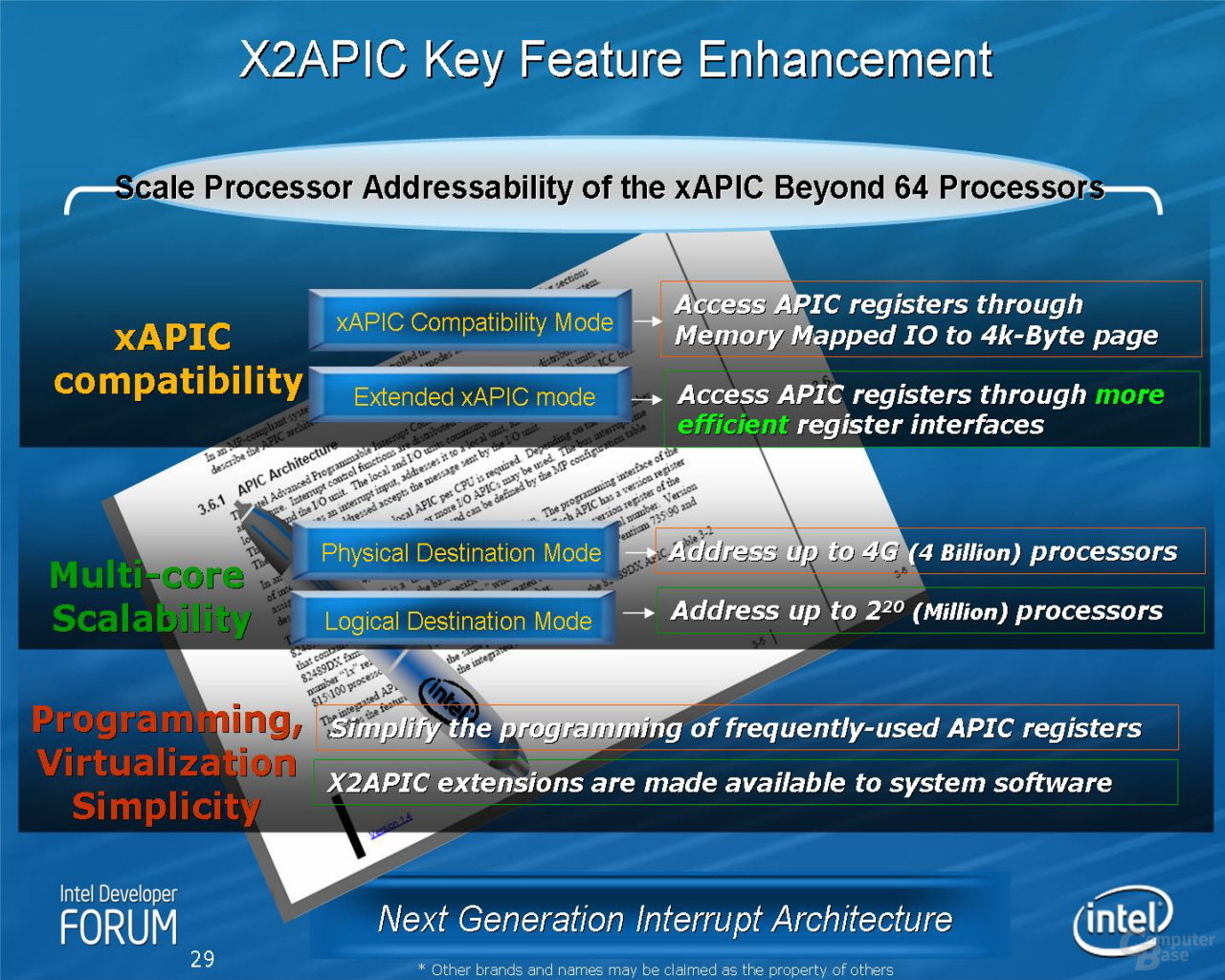
The xAPIC was introduced with the Pentium 4, while the x2APIC is the most recent generation of the Intel's programmable interrupt controller, introduced with the Nehalem microarchitecture in November 2008.[15] The major improvements of the x2APIC address the number of supported CPUs and performance of the interface.

The x2APIC now uses 32 bits to address CPUs, allowing to address up to 232 − 1 CPUs using the physical destination mode. The logical destination mode now works differently and introduces clusters; using this mode, one can address up to 220 − 16 processors.

The improved interface reduces the number of needed APIC register accesses for sending inter-processor interrupts (IPIs). Because of this advantage, KVM can and does emulate the x2APIC for older processors that do not physically support it, and this support is exposed from QEMU going back to Conroe and even for AMD Opteron G-series processors (neither of which natively support x2APIC).[16][17]

APICv is Intel's brand name for hardware virtualization support aimed at reducing interrupt overhead in guests. APICv was introduced in the Ivy Bridge-EP processor series, which is sold as Xeon E5-26xx v2 (launched in late 2013) and as Xeon E5-46xx v2 (launched in early 2014).[18][19] AMD announced a similar technology called AVIC,[20][21] it is available family 15h models 6Xh (Carrizo) processors and newer.[22]

Issues

[edit]
icon
This section does not cite any sources. Please help improve this section by adding citations to reliable sources. Unsourced material may be challenged and removed. (February 2014) (Learn how and when to remove this message)

There are a number of known bugs in implementations of APIC systems, especially with concern to how the 8254 is connected. Defective BIOSes may not set up interrupt routing properly, or provide incorrect ACPI tables and Intel MultiProcessor Specification (MPS) tables.

The APIC can also be a cause of system failure when the operating system does not support it properly. On older operating systems, the I/O and local APICs often had to be disabled. While this is not possible anymore due to the prevalence of symmetric multiprocessor and multi-core systems, the bugs in the firmware and the operating systems are now a rare occurrence.

Competition

[edit]
Further information: OpenPIC and IBM MPIC

AMD and Cyrix once proposed a somewhat similar-in-purpose OpenPIC architecture supporting up to 32 processors;[23] it had at least declarative support from IBM and Compaq around 1995.[24] No x86 motherboard was released with OpenPIC however.[25] After the OpenPIC's failure in the x86 market, AMD licensed Intel's APIC for its AMD Athlon and later processors.

IBM however developed their MultiProcessor Interrupt Controller (MPIC) based on the OpenPIC register specifications.[26] MPIC was used in PowerPC based designs, including those of IBM, for instance in some RS/6000 systems,[27] but also by Apple, as late as their Power Mac G5s.[28][29]

See also

[edit]
  • Inter-processor interrupt (IPI)
  • Interrupt
  • Interrupt handler
  • Interrupt latency
  • Message Signaled Interrupts (MSI)
  • Non-maskable interrupt (NMI)

References

[edit]
  1. ^ a b c "MultiProcessor Specification, version 1.4". Intel. May 1997. Archived from the original on October 30, 2004.
  2. ^ a b Badri Ram (2001). Adv Microprocessors Interfacing. Tata McGraw-Hill Education. p. 314. ISBN 978-0-07-043448-6.
  3. ^ "A Description of the APIC I/O Subsystem". freebsd.org. Retrieved 14 May 2023.
  4. ^ Intel Corporation, "New Product Focus: OEM: Interrupt Controller Optimized for Advanced Operating Systems", Microcomputer Solutions, January/February 1993, page 21
  5. ^ Scott M. Mueller (2011). Upgrading and Repairing PCs (20th ed.). Que Publishing. p. 242. ISBN 978-0-13-268218-3.
  6. ^ a b c Uwe Walter; Vincent Oberle. "μ-second precision timer support for the Linux kernel" (PDF).
  7. ^ "APIC-Based Interrupt Subsystems on Uniprocessor PCs". Windows Hardware Dev Center. January 7, 2003. Archived from the original on October 26, 2012.
  8. ^ a b c James Coleman (January 2009). "Reducing Interrupt Latency Through the Use of Message Signaled Interrupts" (PDF). Intel. Archived from the original (PDF) on January 19, 2022.
  9. ^ "Guidelines For Providing Multimedia Timer Support". Microsoft. 2002-09-20. Archived from the original on 2012-07-28.
  10. ^ "Windows 8 and APIC timer". social.msdn.microsoft.com. Archived from the original on 22 February 2014. Retrieved 14 May 2023.
  11. ^ "VMware Knowledge Base". kb.vmware.com. Archived from the original on 2017-02-27. Retrieved 2014-02-13.
  12. ^ "Timekeeping in VMware Virtual Machines (for VMware vSphere 5.0, Workstation 8.0, Fusion 4.0)" (PDF). p. 8. Archived from the original (PDF) on 2016-06-26.
  13. ^ a b "Intel 82093AA I/O Advanced Programmable Interrupt Controller (I/O APIC) Datasheet". Resource & Design Center for Development with Intel. Archived from the original on November 28, 2016.
  14. ^ "Intel 400 Series Chipset Family Platform Controller Hub Datasheet - Volume 2 of 2" (PDF). Intel. May 2020.
  15. ^ "X2APIC Key Feature Enhancement". ComputerBase.
  16. ^ Marcelo Tosatti (July 22, 2013). "Re: [Qemu-devel] [Question] why x2apic's set by default without host support(on Nehalem CPU)". qemu-devel (Mailing list).
  17. ^ Eduardo Habkost (January 20, 2014). "[Qemu-devel] [PATCH] target-i386: enable x2apic by default on more recent CPU models". qemu-devel (Mailing list).
  18. ^ Jun Nakajima (2012). Reviewing Unused and New Features for Interrupt/APIC Virtualization (PDF). Linux Plumber's Conference 2012. Retrieved 14 May 2023.
  19. ^ "APIC Virtualization Performance Testing and Iozone* - Intel® Software". software.intel.com.
  20. ^ Wei Huang. Introduction of AMD Advanced Virtual Interrupt Controller. XenSummit 2012.
  21. ^ Jörg Rödel (August 2012). Next-generation Interrupt Virtualization for KVM (PDF). Linux Plumber's Conference 2012. Retrieved 14 May 2023.
  22. ^ Suravee Suthikulpanit (September 18, 2016). "[Xen-devel] [RFC PATCH 0/9] Introduce AMD SVM AVIC". Xen-devel (Mailing list).
  23. ^ "OpenPIC Definition from PC Magazine Encyclopedia". Pcmag.com. 1994-12-01. Retrieved 2025-09-24.
  24. ^ Brooke Crothers (20 March 1995). "AMD, Cyrix offer up alternative SMP spec". InfoWorld: 8. ISSN 0199-6649.
  25. ^ André D. Balsa. "Note attached to "Linux Benchmarking: Part III -- Interpreting Benchmark Results"] appearing in Issue 24 of Linux Gazette, January 1998".
  26. ^ "Multiprocessor Interrupt Controller. Data Book" (PDF). IBM. Archived from the original (PDF) on 2014-02-23.
  27. ^ "The IBM Corporation RS/6000 Distributed System Running AIX Version 4.3.1. TCSEC Evaluated C2 Security" (PDF). Arca Systems TTAP Evaluation Facility. p. 29.
  28. ^ Singh, Amit (13 October 2006). Take a Look Inside the G5-Based Dual-Processor Power Mac – via informIT database.
  29. ^ "Power Mac G5 Developer Note". Apple Developer. Interrupt Support.
Further reading

[edit]
  • IA-32 Intel Architecture Software Developer’s Manual, Volume 3A: System Programming Guide, Part 1, chapter 10.

External links

[edit]
  • Intel 64 Architecture x2APIC Specification (PDF)
  • More information on the Intel x2APIC Architecture can be found in the Intel 64 and IA-32 Architectures Software Developer's Manuals
  • v
  • t
  • e
Intel
Subsidiaries
  • 3Dlabs
  • Altera
  • Intel Security
  • Mobileye
  • Recon Instruments
  • Virtutech
  • Wind River Systems
  • Xircom
Joint venture
4Group Holdings (50% owned by Vantiva)
Products
  • 3D XPoint
  • Accounts & SSO
  • Amplify Tablet
  • Advanced Programmable Interrupt Controller
  • Cache Acceleration Software
  • Client Initiated Remote Access
  • Direct Media Interface
  • Falcon 8
  • Flexible Display Interface
  • Hella Zippy
  • Intel 1103
  • Intel AZ210
  • Intel Clear Video
  • Intel Display Power Saving Technology
  • Intel Modular Server System
  • Intel Quick Sync Video
  • Intel Reader
  • Intel system development kit
  • Intel Upgrade Service
  • Intel740
  • InTru3D
  • IXP1200
  • OFono
  • Omni-Path
  • Performance acceleration technology
  • Shooting Star
  • SSDs (X25-M)
  • Stable Image Platform Program
  • Virtual 8086 mode
  • WiDi
  • x86
  • v
  • t
  • e
Intel processors
Lists
  • Processors
    • Atom
    • Celeron
    • Pentium
      • Pro
      • II
      • III
      • 4
      • D
      • M
    • Core
      • 2
      • i3
      • i5
      • i7
      • i9
      • M
    • Xeon
    • Quark
    • Itanium
  • Microarchitectures
  • Chipsets
Microarchitectures
IA-32 (32-bit x86)
  • P5
  • P6
    • P6 variant (Pentium M)
    • P6 variant (Enhanced Pentium M)
  • NetBurst
x86-64 (64-bit)
  • Core
    • Penryn
  • Nehalem
    • Westmere
  • Sandy Bridge
    • Ivy Bridge
  • Haswell
    • Broadwell
  • Skylake
    • Cannon Lake
  • Sunny Cove
    • Cypress Cove
  • Willow Cove
  • Golden Cove
    • Raptor Cove
  • Redwood Cove
  • Lion Cove
  • Cougar Cove
x86 ULV
  • Bonnell
    • Saltwell
  • Silvermont
    • Airmont
  • Goldmont
  • Goldmont Plus
  • Tremont
  • Gracemont
    • Crestmont
  • Skymont
Current products
x86-64 (64-bit)
  • Atom
  • Celeron
  • Pentium
  • Core
    • 10th gen
    • 11th gen
    • 12th gen
    • 13th gen
    • 14th gen
  • Core Ultra
    • 1st gen
    • 2nd gen
    • 3rd gen
    • 4th gen
  • Xeon
Discontinued
BCD oriented (4-bit)
  • 4004 (1971)
  • 4040 (1974)
pre-x86 (8-bit)
  • 8008 (1972)
  • 8080 (1974)
  • 8085 (1977)
Early x86 (16-bit)
  • 8086 (1978)
  • 8088 (1979)
  • 80186 (1982)
  • 80188 (1982)
  • 80286 (1982)
x87 (external FPUs)
8/16-bit databus
8087 (1980)
16-bit databus
80C187
80287
80387SX
32-bit databus
80387DX
80487
IA-32 (32-bit x86)
  • i386
    • SX
    • 376
    • EX
  • i486
    • SX
    • DX2
    • DX4
    • SL
    • RapidCAD
    • OverDrive
  • A100/A110
  • Atom
    • CE
    • SoC
  • Celeron (1998)
    • M
    • D (2004)
  • Pentium
    • Original i586
    • OverDrive
    • Pro
    • II
    • III
    • 4
    • M
    • Dual-Core
  • Core
  • Xeon
    • P6-based
    • NetBurst-based
    • Core-based
  • Quark
  • Tolapai
x86-64 (64-bit)
  • Atom
    • SoC
    • CE
  • Celeron
    • D
    • Dual-Core
  • Pentium
    • 4
    • D
    • Extreme Edition
    • Dual-Core
  • Core
    • 2
    • 1st gen
    • 2nd gen
    • 3rd gen
    • 4th gen
    • 5th gen
    • 6th gen
    • 7th gen
    • 8th gen
    • 9th gen
    • 10th gen
    • 11th gen
    • M
  • Xeon
    • Nehalem-based
    • Sandy Bridge-based
    • Ivy Bridge-based
    • Haswell-based
    • Broadwell-based
    • Skylake-based
Other
CISC
iAPX 432
EPIC
Itanium
RISC
i860
i960
StrongARM
XScale
Related
  • Tick–tock model
  • Process–architecture–optimization model
  • Intel GPUs
    • GMA
    • Intel HD, UHD, and Iris Graphics
    • Xe
    • Arc
  • PCHs
  • SCHs
  • ICHs
  • PIIXs
  • Stratix
  • Codenames
  • Larrabee
Litigation
  • Advanced Micro Devices, Inc. v. Intel Corp.
  • High-Tech Employee Antitrust Litigation
  • Intel Corp. v. Advanced Micro Devices, Inc.
  • Intel Corp. v. Hamidi
  • Intel Corporation Inc. v CPM United Kingdom Ltd
  • Silvaco Data Systems v. Intel Corp.
People
Founders
  • Gordon Moore
  • Robert Noyce
CEOs
  • Robert Noyce
  • Gordon Moore
  • Andrew Grove
  • Craig Barrett
  • Paul Otellini
  • Brian Krzanich
  • Bob Swan
  • Pat Gelsinger
  • Lip-Bu Tan
Related
  • Intel Foundation Achievement Award
  • Mac transition to Intel processors
  • Intel Architecture Labs
  • ASCI Red
  • BiiN
  • Classmate PC
  • Convera Corporation
  • Copy Exactly!
  • Intel Developer Forum
  • Dynamic video memory technology
  • Intel Extreme Masters
  • List of Intel microprocessors
  • List of Intel graphics processing units (2013 or earlier)
  • I/O Acceleration Technology
  • IA-32 Execution Layer
  • IM Flash Technologies
  • The Innovators
  • Inside Films
    • Inside
    • The Beauty Inside
    • The Power Inside
  • Intel ADX
  • Intel Capital
  • Intel Cluster Ready
  • Intel Compute Stick
  • Intel Ireland
  • Intel Mobile Communications
  • Intel Outstanding Researcher Award
  • Intel SHA extensions
  • Intel Teach
  • List of semiconductor fabrication plants
  • List of Intel manufacturing sites
  • List of mergers and acquisitions by Intel
  • Intel Museum
  • OnCue
  • Intel PRO/Wireless
  • Intel International Science and Engineering Fair
  • Regeneron Science Talent Search
  • Simple Firmware Interface
  • Single-chip Cloud Computer
  • Software Guard Extensions
  • Supervisor Mode Access Prevention
  • Tarari
  • Intel Tera-Scale
  • Timeline of Intel
Retrieved from "https://teknopedia.ac.id/w/index.php?title=Advanced_Programmable_Interrupt_Controller&oldid=1339737383"
Categories:
  • Motherboard
  • Interrupts
  • Intel products
  • IBM PC compatibles
  • X86 architecture
Hidden categories:
  • Articles with short description
  • Short description matches Wikidata
  • Articles needing additional references from February 2014
  • All articles needing additional references

  • indonesia
  • Polski
  • العربية
  • Deutsch
  • English
  • Español
  • Français
  • Italiano
  • مصرى
  • Nederlands
  • 日本語
  • Português
  • Sinugboanong Binisaya
  • Svenska
  • Українська
  • Tiếng Việt
  • Winaray
  • 中文
  • Русский
Sunting pranala
url url url url url url url url url url url url url url url url url url url url url url url url url url url url url url url url url url url url url url url url url url url url url url url url url url url url url url url url url url url url url url url url url url url url url url url url url url url url url url url url url url url url url url url url url url url url url url url url url url url url url url url url url url url url url url url url url url url url url url url url url url url url url url url url url url url url url url url url url url url url url url url url url url url url url url url url url url url url url url url url url url url url url url url url url url url url url url url url url url url url url url url url url url url url url url url url url url url url url url url url url url url url url url url url url url url url url url url url url url url url url url url url url url url url url url url url url url url url url url url url url url url url url url url url url url url url url url url url url url url url url url url url url url url url url url url url url url url url url url url url url url url url url url url url url url url url url url url url url url url url url url url url url url url url url url url url url url url url url url url url url url url url url url url url url url url url url url url url url url url url url url url url url url url url url url url url url url url url url url url url url url url url url url url url url url url url url url url url url url url url url url url url url url url url url url url url url url url url url url url url url url url url url url url url url url url url url url url url url url url url url url url url url url url url url url url url url url url url url url url url url url url url url url url url url url url url url url url url url url url url url url url url url url url url url url url url url url url url url url url url url url url url url url url url url url url url url url url url url url url url url url url url url url url url url url url url url url url url url url url url url url url url url url url url url url url url url url url url url url url url url url url url url url url url url url url url url url url url url url url url url url url url url url url url url url url url url url url url url url url url url url url url url url url url url url url url url url url url url url url url url url url url url url url url url url url url url url url url url url url url url url url url url url url url url url url url url url url url url url url url url url url url url url url url url url url url url url url url url url url url url url url url url url url url url url url url url url url url url url url url url url url url url url url url url url url url url url url url url url url url url url url url url url url url url url url url url url url url url url url url url url url url url url url url url url url url url url url url url url url url url url url url url url url url url url url url url url url url url url url url url url url url url url url url url url url url url url url url url url url url url url url url url url url url url url url url url url url url url url url url url url url url url url url url url url url url url url url url url url url url url url url url url url url url url url url url url url url url url url url url url url url url url url url url url url url url url url url url url url url url url url url url url url url url url url url url url url url url url url url url url url url url url url url url url url url url url url url url url url url url url url url url url url url url url url url url url url url url url url url url url url url url url url url url url url url url url url url url url url url url url url url url url url url url url url url url url url url url url url url url url url url url url url url url url url url url url url url url url url url url url url url url url url url url url url url url url url url url url url url url url url url url url url url url url url url url url url url url url url url url url url url url url url url url url url url url url url url url url url url url url url url url url url url url url url url url url url url url url url url url url url url url url url url url url url url url url url url url url url url url url url url url url url url url url url url url url url url url url url url url url url url url url url url url url url url url url url url url url url url url url url url url url url url url url url url url url url url url url url url url url url url url url url url url url url url url url url url url url url url url url url url url url url url url url url url url url url url url url url url url url url url url url url url url url url url url url url url url url url url url url url url url url url url url url url url url url url url url url url url url url url url url url url url url url url url url url url url url url url url url url url url url url url url url url url url url url url url url url url url url url url url url url url url url url url url url url url url url url url url url url url url url url url url url url url url url url url url url url url url url url url url url url url url url url url url url url url url url url url url url url url url url url url url url url url url url url url url url url url url url url url url url url url url url url url url url url url url url url url url url url url url url url url url url url url url url url url url url url url url url url url url url url url url url url url url url url url url url url url url url url url url url url url url url url url url url url url url url url url url url url url url url url url url url url url url url url url url url url url url url url url url url url url url url url url url url url url url url url url url url url url url url url url url url url url url url url url url url url url url url url url url url url url url url url url url url url url url url url url url url url url url url url url url url url url url url url url url url url url url url url url url url url url url url url url url url url url url url url url url url url url url url url url url url url url url url url url url url url url url url url url url url url url url url url url url url url url url url url url url url url url url url url url url url url url url url url url url url url url url url url url url url url url url url url url url url url url url url url url url url url url url url url url url url url url url url url url url url url url url url url url url url url url url url url url url url url url url url url url url url url url url url url url url url url url url url url url url url url url url url url url url url url url url url url url url url url url url url url url url url url url url url url url url url url url url url url url url url url url url url url url url url url url url url url url url url url url url url url url url url url url url url url url url url url url url url url url url url url url url url url url url url url url url url url url url url url url url url url url url url url url url url url url url url url url url url url url url url url url url url url url url url url url url url url url url url url url url url url url url url url url url url url url url url url url url url url url url url url url url url url url url url url url url url url url url url url url url url url url url url url url url url url url url url url url url url url url url url url url url url url url url url url url url url url url url url url url url url url url url url url url url url url url url url url url url url url url url url url url url url url url url url url url url url url url url url url url url url url url url url url url url url url url url url url url url url url url url url url url url url url url url url url url url url url url url url url url url url url url url url url url url url url url url url url url url url url url url url url url url url url url url url url url url url url url url url url url url url url url url url url url url url url url url url url url url url url url url url url url url url url url url url url url url url url url url url url url url url url url url url url url url url url url url url url url url url url url url url url url url url url url url url url url url url url url url url url url url url url url url url url url url url url url url url url url url url url url url url url url url url url url url url url url url url url url url url url url url url url url url url url url url url url url url url url url url url url url url url url url url url url url url url url url url url url url url url url url url url url url url url url url url url url url url url url url url url url url url url url url url url url url url url url url url url url url url url url url url url url url url url url url url url url url url url url url url url url url url url url url url url url url url url url url url url url url url url url url url url url url url url url url url url url url url url url url url url url url url url url url url url url url url url url url url url url url url url url url url url url url url url url url url url url url url url url url url url url url url url url url url url url url url url url url url url url url url url url url url url url url url url url url url url url url url url url url url url url url url url url url url url url url url url url url url url url url url url url url url url url url url url url url url url url url url url url url url url url url url url url url url url url url url url url url url url url url url url url url url url url url url url url url url url
Pusat Layanan

UNIVERSITAS TEKNOKRAT INDONESIA | ASEAN's Best Private University
Jl. ZA. Pagar Alam No.9 -11, Labuhan Ratu, Kec. Kedaton, Kota Bandar Lampung, Lampung 35132
Phone: (0721) 702022
Email: pmb@teknokrat.ac.id