Epstein Files Full PDF

CLICK HERE
Technopedia Center
PMB University Brochure
Faculty of Engineering and Computer Science
S1 Informatics S1 Information Systems S1 Information Technology S1 Computer Engineering S1 Electrical Engineering S1 Civil Engineering

faculty of Economics and Business
S1 Management S1 Accountancy

Faculty of Letters and Educational Sciences
S1 English literature S1 English language education S1 Mathematics education S1 Sports Education
teknopedia

  • Registerasi
  • Brosur UTI
  • Kip Scholarship Information
  • Performance
Flag Counter
  1. World Encyclopedia
  2. Language model - Wikipedia
Language model - Wikipedia
From Wikipedia, the free encyclopedia
Statistical model of language

A language model is a computational model that predicts sequences in natural language.[1][2] Language models are useful for a variety of tasks, including speech recognition,[3] machine translation,[4] natural language generation (generating more human-like text), optical character recognition, route optimization,[5] handwriting recognition,[6] grammar induction,[7] and information retrieval.[8][9]

Large language models (LLMs), currently their most advanced form as of 2019, are predominantly based on transformers trained on larger datasets (frequently using texts scraped from the public internet). They have superseded recurrent neural network-based models, which had previously superseded the purely statistical models, such as the word n-gram language model.

History

[edit]

Noam Chomsky did pioneering work on language models in the 1950s by developing a theory of formal grammars.[10]

In 1980, statistical approaches were explored and found to be more useful for many purposes than rule-based formal grammars. Discrete representations like word n-gram language models, with probabilities for discrete combinations of words, made significant advances.

In the 2000s, continuous representations for words, such as word embeddings, began to replace discrete representations.[11] Typically, the representation is a real-valued vector that encodes a word’s meaning such that words closer in vector space are similar in meaning and common relationships between words, such as plurality or gender, are preserved.

Pure statistical models

[edit]

In 1980, the first significant statistical language model was proposed, and during the decade IBM performed 'Shannon-style' experiments, in which potential sources for language modeling improvement were identified by observing and analyzing the performance of human subjects in predicting or correcting text.[12]

Models based on word n-grams

[edit]
This section is an excerpt from Word n-gram language model.[edit]

A word n-gram language model is a statistical model of language which calculates the probability of the next word in a sequence from a fixed size window of previous words. If one previous word is considered, it is a bigram model; if two words, a trigram model; if n − 1 words, an n-gram model.[13]

Special tokens are introduced to denote the start and end of a sentence ⟨ s ⟩ {\displaystyle \langle s\rangle } {\displaystyle \langle s\rangle } and ⟨ / s ⟩ {\displaystyle \langle /s\rangle } {\displaystyle \langle /s\rangle }. To prevent a zero probability being assigned to unseen words, the probability of each seen word is slightly lowered to make room for the unseen words in a given corpus. To achieve this, various smoothing methods are used, from simple "add-one" smoothing (assigning a count of 1 to unseen n-grams, as an uninformative prior) to more sophisticated techniques, such as Good–Turing discounting or back-off models.

Word n-gram models have largely been superseded by recurrent neural network–based models, which in turn have been superseded by Transformer-based models often referred to as large language models.[14]

Exponential

[edit]

Maximum entropy language models encode the relationship between a word and the n-gram history using feature functions. The equation is

P ( w m ∣ w 1 , … , w m − 1 ) = 1 Z ( w 1 , … , w m − 1 ) exp ⁡ ( a T f ( w 1 , … , w m ) ) {\displaystyle P(w_{m}\mid w_{1},\ldots ,w_{m-1})={\frac {1}{Z(w_{1},\ldots ,w_{m-1})}}\exp(a^{T}f(w_{1},\ldots ,w_{m}))} {\displaystyle P(w_{m}\mid w_{1},\ldots ,w_{m-1})={\frac {1}{Z(w_{1},\ldots ,w_{m-1})}}\exp(a^{T}f(w_{1},\ldots ,w_{m}))}

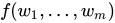
where Z ( w 1 , … , w m − 1 ) {\displaystyle Z(w_{1},\ldots ,w_{m-1})} {\displaystyle Z(w_{1},\ldots ,w_{m-1})} is the partition function, a {\displaystyle a} {\displaystyle a} is the parameter vector, and f ( w 1 , … , w m ) {\displaystyle f(w_{1},\ldots ,w_{m})} {\displaystyle f(w_{1},\ldots ,w_{m})} is the feature function. In the simplest case, the feature function is just an indicator of the presence of a certain n-gram. It is helpful to use a prior on a {\displaystyle a} {\displaystyle a} or some form of regularization.

The log-bilinear model is another example of an exponential language model.

Skip-gram model

[edit]
This section is an excerpt from Word n-gram language model § Skip-gram language model.[edit]
1-skip-2-grams for the text "the rain in Spain falls mainly on the plain"

Skip-gram language model is an attempt at overcoming the data sparsity problem that the preceding model (i.e. word n-gram language model) faced. Words represented in an embedding vector were not necessarily consecutive anymore, but could leave gaps that are skipped over (thus the name "skip-gram").[15]

Formally, a k-skip-n-gram is a length-n subsequence where the components occur at distance at most k from each other.

For example, in the input text:

the rain in Spain falls mainly on the plain

the set of 1-skip-2-grams includes all the bigrams (2-grams), and in addition the subsequences

the in, rain Spain, in falls, Spain mainly, falls on, mainly the, and on plain.

In skip-gram model, semantic relations between words are represented by linear combinations, capturing a form of compositionality. For example, in some such models, if v is the function that maps a word w to its n-d vector representation, then

v ( k i n g ) − v ( m a l e ) + v ( f e m a l e ) ≈ v ( q u e e n ) {\displaystyle v(\mathrm {king} )-v(\mathrm {male} )+v(\mathrm {female} )\approx v(\mathrm {queen} )} {\displaystyle v(\mathrm {king} )-v(\mathrm {male} )+v(\mathrm {female} )\approx v(\mathrm {queen} )}

where ≈ is made precise by stipulating that its right-hand side must be the nearest neighbor of the value of the left-hand side.[16][17]

Neural models

[edit]

Recurrent neural network

[edit]

Continuous representations or embeddings of words are produced in recurrent neural network-based language models (known also as continuous space language models).[18] Such continuous space embeddings help to alleviate the curse of dimensionality, which is the consequence of the number of possible sequences of words increasing exponentially with the size of the vocabulary, further causing a data sparsity problem. Neural networks avoid this problem by representing words as non-linear combinations of weights in a neural net.[19]

Large language models

[edit]
This section is an excerpt from Large language model.[edit]
Part of a series on
Machine learning
and data mining
Paradigms
  • Supervised learning
  • Unsupervised learning
  • Semi-supervised learning
  • Self-supervised learning
  • Reinforcement learning
  • Meta-learning
  • Online learning
  • Batch learning
  • Curriculum learning
  • Rule-based learning
  • Neuro-symbolic AI
  • Neuromorphic engineering
  • Quantum machine learning
Problems
  • Classification
  • Generative modeling
  • Regression
  • Clustering
  • Dimensionality reduction
  • Density estimation
  • Anomaly detection
  • Data cleaning
  • AutoML
  • Association rules
  • Semantic analysis
  • Structured prediction
  • Feature engineering
  • Feature learning
  • Learning to rank
  • Grammar induction
  • Ontology learning
  • Multimodal learning
Supervised learning
(classification • regression)
  • Apprenticeship learning
  • Decision trees
  • Ensembles
    • Bagging
    • Boosting
    • Random forest
  • k-NN
  • Linear regression
  • Naive Bayes
  • Artificial neural networks
  • Logistic regression
  • Perceptron
  • Relevance vector machine (RVM)
  • Support vector machine (SVM)
Clustering
  • BIRCH
  • CURE
  • Hierarchical
  • k-means
  • Fuzzy
  • Expectation–maximization (EM)

  • DBSCAN
  • OPTICS
  • Mean shift
Dimensionality reduction
  • Factor analysis
  • CCA
  • ICA
  • LDA
  • NMF
  • PCA
  • PGD
  • t-SNE
  • SDL
Structured prediction
  • Graphical models
    • Bayes net
    • Conditional random field
    • Hidden Markov
Anomaly detection
  • RANSAC
  • k-NN
  • Local outlier factor
  • Isolation forest
Neural networks
  • Autoencoder
  • Deep learning
  • Feedforward neural network
  • Recurrent neural network
    • LSTM
    • GRU
    • ESN
    • reservoir computing
  • Boltzmann machine
    • Restricted
  • GAN
  • Diffusion model
  • SOM
  • Convolutional neural network
    • U-Net
    • LeNet
    • AlexNet
    • DeepDream
  • Neural field
    • Neural radiance field
    • Physics-informed neural networks
  • Transformer
    • Vision
  • Mamba
  • Spiking neural network
  • Memtransistor
  • Electrochemical RAM (ECRAM)
Reinforcement learning
  • Q-learning
  • Policy gradient
  • SARSA
  • Temporal difference (TD)
  • Multi-agent
    • Self-play
Learning with humans
  • Active learning
  • Crowdsourcing
  • Human-in-the-loop
  • Mechanistic interpretability
  • RLHF
Model diagnostics
  • Coefficient of determination
  • Confusion matrix
  • Learning curve
  • ROC curve
Mathematical foundations
  • Kernel machines
  • Bias–variance tradeoff
  • Computational learning theory
  • Empirical risk minimization
  • Occam learning
  • PAC learning
  • Statistical learning
  • VC theory
  • Topological deep learning
Journals and conferences
  • AAAI
  • ECML PKDD
  • NeurIPS
  • ICML
  • ICLR
  • IJCAI
  • ML
  • JMLR
Related articles
  • Glossary of artificial intelligence
  • List of datasets for machine-learning research
    • List of datasets in computer vision and image processing
  • Outline of machine learning
  • v
  • t
  • e

A large language model (LLM) is a language model trained with self-supervised machine learning on a vast amount of text, designed for natural language processing tasks, especially language generation.[20][21] The largest and most capable LLMs are generative pre-trained transformers (GPTs) that provide the core capabilities of modern chatbots. LLMs can be fine-tuned for specific tasks or guided by prompt engineering.[22] These models acquire predictive power regarding syntax, semantics, and ontologies[23] inherent in human language corpora, but they also inherit inaccuracies and biases present in the data they are trained on.[24]

They consist of billions to trillions of parameters and operate as general-purpose sequence models, generating, summarizing, translating, and reasoning over text. LLMs represent a significant new technology in their ability to generalize across tasks with minimal task-specific supervision, enabling capabilities like conversational agents, code generation, knowledge retrieval, and automated reasoning that previously required bespoke systems.[25]

LLMs evolved from earlier statistical and recurrent neural network approaches to language modeling. The transformer architecture, introduced in 2017, replaced recurrence with self-attention, allowing efficient parallelization, longer context handling, and scalable training on unprecedented data volumes.[26] This innovation enabled models like GPT, BERT, and their successors, which demonstrated emergent behaviors at scale, such as few-shot learning and compositional reasoning.[27]

Reinforcement learning, particularly policy gradient algorithms, has been adapted to fine-tune LLMs for desired behaviors beyond raw next-token prediction.[28] Reinforcement learning from human feedback (RLHF) applies these methods to optimize a policy, the LLM's output distribution, against reward signals derived from human or automated preference judgments.[29] This has been critical for aligning model outputs with user expectations, improving factuality, reducing harmful responses, and enhancing task performance.

Benchmark evaluations for LLMs have evolved from narrow linguistic assessments toward comprehensive, multi-task evaluations measuring reasoning, factual accuracy, alignment, and safety.[30][31] Hill climbing, iteratively optimizing models against benchmarks, has emerged as a dominant strategy, producing rapid incremental performance gains but raising concerns of overfitting to benchmarks rather than achieving genuine generalization or robust capability improvements.[32]

Although sometimes matching human performance, it is not clear whether they are plausible cognitive models. At least for recurrent neural networks, it has been shown that they sometimes learn patterns that humans do not, but fail to learn patterns that humans typically do.[33]

Evaluation and benchmarks

[edit]

Evaluation of the quality of language models is mostly done by comparison to human created sample benchmarks created from typical language-oriented tasks. Other, less established, quality tests examine the intrinsic character of a language model or compare two such models. Since language models are typically intended to be dynamic and to learn from data they see, some proposed models investigate the rate of learning, e.g., through inspection of learning curves.[34]

Various data sets have been developed for use in evaluating language processing systems.[35] These include:

  • Massive Multitask Language Understanding (MMLU)[36]
  • Corpus of Linguistic Acceptability[37]
  • GLUE benchmark[38]
  • Microsoft Research Paraphrase Corpus[39]
  • Multi-Genre Natural Language Inference
  • Question Natural Language Inference
  • Quora Question Pairs[40]
  • Recognizing Textual Entailment[41]
  • Semantic Textual Similarity Benchmark
  • SQuAD question answering Test[42]
  • Stanford Sentiment Treebank[43]
  • Winograd NLI
  • BoolQ, PIQA, SIQA, HellaSwag, WinoGrande, ARC, OpenBookQA, NaturalQuestions, TriviaQA, RACE, BIG-bench hard, GSM8k, RealToxicityPrompts, WinoGender, CrowS-Pairs[44]

See also

[edit]
  • iconLinguistics portal
  • iconMathematics portal
  • iconTechnology portal
  • Artificial intelligence and elections
  • Cache language model
  • Deep linguistic processing
  • Ethics of artificial intelligence
  • Factored language model
  • Generative pre-trained transformer
  • Katz's back-off model
  • Language technology
  • Semantic similarity network
  • Statistical model

References

[edit]
  1. ^ Blank, Idan A. (November 2023). "What are large language models supposed to model?". Trends in Cognitive Sciences. 27 (11): 987–989. doi:10.1016/j.tics.2023.08.006. PMID 37659920."LLMs are supposed to model how utterances behave."
  2. ^ Jurafsky, Dan; Martin, James H. (2021). "N-gram Language Models" (PDF). Speech and Language Processing (3rd ed.). Archived from the original on 22 May 2022. Retrieved 24 May 2022.
  3. ^ Kuhn, Roland, and Renato De Mori (1990). "A cache-based natural language model for speech recognition". IEEE transactions on pattern analysis and machine intelligence 12.6: 570–583.
  4. ^ Andreas, Jacob, Andreas Vlachos, and Stephen Clark (2013). "Semantic parsing as machine translation" Archived 15 August 2020 at the Wayback Machine. Proceedings of the 51st Annual Meeting of the Association for Computational Linguistics (Volume 2: Short Papers).
  5. ^ Liu, Yang; Wu, Fanyou; Liu, Zhiyuan; Wang, Kai; Wang, Feiyue; Qu, Xiaobo (2023). "Can language models be used for real-world urban-delivery route optimization?". The Innovation. 4 (6) 100520. Bibcode:2023Innov...400520L. doi:10.1016/j.xinn.2023.100520. PMC 10587631. PMID 37869471.
  6. ^ Pham, Vu, et al (2014). "Dropout improves recurrent neural networks for handwriting recognition" Archived 11 November 2020 at the Wayback Machine. 14th International Conference on Frontiers in Handwriting Recognition. IEEE.
  7. ^ Htut, Phu Mon, Kyunghyun Cho, and Samuel R. Bowman (2018). "Grammar induction with neural language models: An unusual replication" Archived 14 August 2022 at the Wayback Machine. arXiv:1808.10000.
  8. ^ Ponte, Jay M.; Croft, W. Bruce (1998). A language modeling approach to information retrieval. Proceedings of the 21st ACM SIGIR Conference. Melbourne, Australia: ACM. pp. 275–281. doi:10.1145/290941.291008.
  9. ^ Hiemstra, Djoerd (1998). A linguistically motivated probabilistically model of information retrieval. Proceedings of the 2nd European conference on Research and Advanced Technology for Digital Libraries. LNCS, Springer. pp. 569–584. doi:10.1007/3-540-49653-X_34.
  10. ^ Chomsky, N. (September 1956). "Three models for the description of language". IRE Transactions on Information Theory. 2 (3): 113–124. Bibcode:1956IRTIT...2..113C. doi:10.1109/TIT.1956.1056813. ISSN 2168-2712.
  11. ^ "The Nature Of Life, The Nature Of Thinking: Looking Back On Eugene Charniak's Work And Life". 22 February 2022. Archived from the original on 3 November 2024. Retrieved 5 February 2025.
  12. ^ Rosenfeld, Ronald (2000). "Two decades of statistical language modeling: Where do we go from here?". Proceedings of the IEEE. 88 (8): 1270–1278. Bibcode:2000IEEEP..88.1270R. doi:10.1109/5.880083. S2CID 10959945.
  13. ^ Jurafsky, Dan; Martin, James H. (7 January 2023). "N-gram Language Models". Speech and Language Processing (PDF) (3rd edition draft ed.). Retrieved 24 May 2022.
  14. ^ Bengio, Yoshua; Ducharme, Réjean; Vincent, Pascal; Janvin, Christian (1 March 2003). "A neural probabilistic language model". The Journal of Machine Learning Research. 3: 1137–1155 – via ACM Digital Library.
  15. ^ David Guthrie; et al. (2006). "A Closer Look at Skip-gram Modelling" (PDF). Archived from the original (PDF) on 17 May 2017. Retrieved 27 April 2014.
  16. ^ Mikolov, Tomas; Chen, Kai; Corrado, Greg; Dean, Jeffrey (2013). "Efficient estimation of word representations in vector space". arXiv:1301.3781 [cs.CL].
  17. ^ Mikolov, Tomas; Sutskever, Ilya; Chen, Kai; Corrado, Greg S.; Dean, Jeff (2013). Distributed Representations of Words and Phrases and their Compositionality (PDF). Advances in Neural Information Processing Systems. pp. 3111–3119. Archived (PDF) from the original on 29 October 2020. Retrieved 22 June 2015.
  18. ^ Karpathy, Andrej. "The Unreasonable Effectiveness of Recurrent Neural Networks". Archived from the original on 1 November 2020. Retrieved 27 January 2019.
  19. ^ Bengio, Yoshua (2008). "Neural net language models". Scholarpedia. Vol. 3. p. 3881. Bibcode:2008SchpJ...3.3881B. doi:10.4249/scholarpedia.3881. Archived from the original on 26 October 2020. Retrieved 28 August 2015.
  20. ^ Bommasani, Rishi; Hudson, Drew A.; Adeli, Ehsan; Altman, Russ; Arora, Simran; von Arx, Matthew; Bernstein, Michael S.; Bohg, Jeannette; Bosselut, Antoine; Brunskill, Emma (2021). "On the Opportunities and Risks of Foundation Models". arXiv:2108.07258 [cs.LG].
  21. ^ Brown, Tom B.; Mann, Benjamin; Ryder, Nick; Subbiah, Melanie; Kaplan, Jared; Dhariwal, Prafulla; Neelakantan, Arvind; Shyam, Pranav; Sastry, Girish; Askell, Amanda (2020). "Language Models are Few-Shot Learners". arXiv:2005.14165 [cs.CL].
  22. ^ Brown, Tom B.; Mann, Benjamin; Ryder, Nick; Subbiah, Melanie; Kaplan, Jared; Dhariwal, Prafulla; Neelakantan, Arvind; Shyam, Pranav; Sastry, Girish; Askell, Amanda; Agarwal, Sandhini; Herbert-Voss, Ariel; Krueger, Gretchen; Henighan, Tom; Child, Rewon; Ramesh, Aditya; Ziegler, Daniel M.; Wu, Jeffrey; Winter, Clemens; Hesse, Christopher; Chen, Mark; Sigler, Eric; Litwin, Mateusz; Gray, Scott; Chess, Benjamin; Clark, Jack; Berner, Christopher; McCandlish, Sam; Radford, Alec; Sutskever, Ilya; Amodei, Dario (December 2020). Larochelle, H.; Ranzato, M.; Hadsell, R.; Balcan, M.F.; Lin, H. (eds.). "Language Models are Few-Shot Learners" (PDF). Advances in Neural Information Processing Systems. 33. Curran Associates, Inc.: 1877–1901. arXiv:2005.14165. doi:10.1145/3582269.3615599. Archived (PDF) from the original on 17 November 2023. Retrieved 14 March 2023.
  23. ^ Fathallah, Nadeen; Das, Arunav; De Giorgis, Stefano; Poltronieri, Andrea; Haase, Peter; Kovriguina, Liubov (26 May 2024). NeOn-GPT: A Large Language Model-Powered Pipeline for Ontology Learning (PDF). Extended Semantic Web Conference 2024. Hersonissos, Greece.
  24. ^ Manning, Christopher D. (2022). "Human Language Understanding & Reasoning". Daedalus. 151 (2): 127–138. doi:10.1162/daed_a_01905. S2CID 248377870. Archived from the original on 17 November 2023. Retrieved 9 March 2023.
  25. ^ Kaplan, Jared; McCandlish, Sam; Henighan, Tom; Brown, Tom B.; Chess, Benjamin; Child, Rewon; Gray, Scott; Radford, Alec; Wu, Jeffrey; Amodei, Dario (2020). "Scaling Laws for Neural Language Models". arXiv:2001.08361 [cs.LG].
  26. ^ Vaswani, Ashish; Shazeer, Noam; Parmar, Niki; Uszkoreit, Jakob; Jones, Llion; Gomez, Aidan N; Kaiser, Łukasz; Polosukhin, Illia (2017). "Attention is All you Need". arXiv:1706.03762 [cs.CL].
  27. ^ Devlin, Jacob; Chang, Ming-Wei; Lee, Kenton; Toutanova, Kristina (2018). "BERT: Pre-training of Deep Bidirectional Transformers for Language Understanding". arXiv:1810.04805 [cs.CL].
  28. ^ Christiano, Paul; Leike, Jan; Brown, Tom B.; Martic, Miljan; Legg, Shane; Amodei, Dario (2017). "Deep Reinforcement Learning from Human Preferences". arXiv:1706.03741 [stat.ML].
  29. ^ Ouyang, Long; Wu, Jeff; Jiang, Xu; Almeida, Diogo; Wainwright, Carroll; Mishkin, Pamela; Zhang, Chong; Agarwal, Sandhini; Slama, Katarina; Ray, Alex (2022). "Training language models to follow instructions with human feedback". arXiv:2203.02155 [cs.CL].
  30. ^ Wang, Alex; Singh, Amanpreet; Michael, Julian; Hill, Felix; Levy, Omer; Bowman, Samuel R. (2018). "GLUE: A Multi-Task Benchmark and Analysis Platform for Natural Language Understanding". arXiv:1804.07461 [cs.CL].
  31. ^ Hendrycks, Dan; Burns, Collin; Basart, Steven; Zou, Andy; Mazeika, Mantas; Song, Dawn; Steinhardt, Jacob (2025). "Expressing stigma and inappropriate responses prevents LLMS from safely replacing mental health providers". Proceedings of the 2025 ACM Conference on Fairness, Accountability, and Transparency. pp. 599–627. arXiv:2009.03300. doi:10.1145/3715275.3732039. ISBN 979-8-4007-1482-5.
  32. ^ Recht, Benjamin; Roelofs, Rebecca; Schmidt, Ludwig; Shankar, Vaishaal (2019). "Do ImageNet Classifiers Generalize to ImageNet?". arXiv:1902.10811 [cs.CV].
  33. ^ Hornstein, Norbert; Lasnik, Howard; Patel-Grosz, Pritty; Yang, Charles (9 January 2018). Syntactic Structures after 60 Years: The Impact of the Chomskyan Revolution in Linguistics. Walter de Gruyter GmbH & Co KG. ISBN 978-1-5015-0692-5. Archived from the original on 16 April 2023. Retrieved 11 December 2021.
  34. ^ Karlgren, Jussi; Schutze, Hinrich (2015), "Evaluating Learning Language Representations", International Conference of the Cross-Language Evaluation Forum, Lecture Notes in Computer Science, Springer International Publishing, pp. 254–260, doi:10.1007/978-3-319-64206-2_8, ISBN 978-3-319-64205-5
  35. ^ Devlin, Jacob; Chang, Ming-Wei; Lee, Kenton; Toutanova, Kristina (10 October 2018). "BERT: Pre-training of Deep Bidirectional Transformers for Language Understanding". arXiv:1810.04805 [cs.CL].
  36. ^ Hendrycks, Dan (14 March 2023), Measuring Massive Multitask Language Understanding, archived from the original on 15 March 2023, retrieved 15 March 2023
  37. ^ "The Corpus of Linguistic Acceptability (CoLA)". nyu-mll.github.io. Archived from the original on 7 December 2020. Retrieved 25 February 2019.
  38. ^ "GLUE Benchmark". gluebenchmark.com. Archived from the original on 4 November 2020. Retrieved 25 February 2019.
  39. ^ "Microsoft Research Paraphrase Corpus". Microsoft Download Center. Archived from the original on 25 October 2020. Retrieved 25 February 2019.
  40. ^ Aghaebrahimian, Ahmad (2017), "Quora Question Answer Dataset", Text, Speech, and Dialogue, Lecture Notes in Computer Science, vol. 10415, Springer International Publishing, pp. 66–73, doi:10.1007/978-3-319-64206-2_8, ISBN 978-3-319-64205-5
  41. ^ Sammons, V.G.Vinod Vydiswaran, Dan Roth, Mark; Vydiswaran, V.G.; Roth, Dan. "Recognizing Textual Entailment" (PDF). Archived from the original (PDF) on 9 August 2017. Retrieved 24 February 2019.{{cite web}}: CS1 maint: multiple names: authors list (link)
  42. ^ "The Stanford Question Answering Dataset". rajpurkar.github.io. Archived from the original on 30 October 2020. Retrieved 25 February 2019.
  43. ^ "Recursive Deep Models for Semantic Compositionality Over a Sentiment Treebank". nlp.stanford.edu. Archived from the original on 27 October 2020. Retrieved 25 February 2019.
  44. ^ "llama/MODEL_CARD.md at main · meta-llama/llama". GitHub. Retrieved 28 December 2024.

Further reading

[edit]
  • Jay M. Ponte; W. Bruce Croft (1998). "A Language Modeling Approach to Information Retrieval". Research and Development in Information Retrieval. pp. 275–281. CiteSeerX 10.1.1.117.4237. doi:10.1145/290941.291008.
  • Fei Song; W. Bruce Croft (1999). "A General Language Model for Information Retrieval". Research and Development in Information Retrieval. pp. 279–280. CiteSeerX 10.1.1.21.6467. doi:10.1145/319950.320022.
  • Chen, Stanley F.; Joshua Goodman (1998). An Empirical Study of Smoothing Techniques for Language Modeling (Technical report). Harvard University. CiteSeerX 10.1.1.131.5458.
  • v
  • t
  • e
Natural language processing
General terms
  • AI-complete
  • Bag-of-words
  • n-gram
    • Bigram
    • Trigram
  • Computational linguistics
  • Natural language understanding
  • Stop words
  • Text processing
Text analysis
  • Argument mining
  • Collocation extraction
  • Concept mining
  • Coreference resolution
  • Deep linguistic processing
  • Distant reading
  • Information extraction
  • Named-entity recognition
  • Ontology learning
  • Parsing
    • semantic
    • syntactic
  • Part-of-speech tagging
  • Semantic analysis
  • Semantic role labeling
  • Semantic decomposition
  • Semantic similarity
  • Sentiment analysis
  • Terminology extraction
  • Text mining
  • Textual entailment
  • Truecasing
  • Word-sense disambiguation
  • Word-sense induction
Text segmentation
  • Compound-term processing
  • Lemmatisation
  • Lexical analysis
  • Text chunking
  • Stemming
  • Sentence segmentation
  • Word segmentation
Automatic summarization
  • Multi-document summarization
  • Sentence extraction
  • Text simplification
Machine translation
  • Computer-assisted
  • Example-based
  • Rule-based
  • Statistical
  • Transfer-based
  • Neural
Distributional semantics models
  • BERT
  • Document-term matrix
  • Explicit semantic analysis
  • fastText
  • GloVe
  • Language model
    • large
    • small
  • Latent semantic analysis
  • Long short-term memory
  • Seq2seq
  • Transformer
  • Word embedding
  • Word2vec
Language resources,
datasets and corpora
Types and
standards
  • Corpus linguistics
  • Lexical resource
  • Linguistic Linked Open Data
  • Machine-readable dictionary
  • Parallel text
  • PropBank
  • Semantic network
  • Simple Knowledge Organization System
  • Speech corpus
  • Text corpus
  • Thesaurus (information retrieval)
  • Treebank
  • Universal Dependencies
Data
  • BabelNet
  • Bank of English
  • DBpedia
  • FrameNet
  • Google Ngram Viewer
  • UBY
  • WordNet
  • Wikidata
Automatic identification
and data capture
  • Speech recognition
  • Speech segmentation
  • Speech synthesis
  • Natural language generation
  • Optical character recognition
Topic model
  • Document classification
  • Latent Dirichlet allocation
  • Pachinko allocation
Computer-assisted
reviewing
  • Automated essay scoring
  • Concordancer
  • Grammar checker
  • Predictive text
  • Pronunciation assessment
  • Spell checker
Natural language
user interface
  • Chatbot
  • Interactive fiction
  • Question answering
  • Virtual assistant
  • Voice user interface
Related
  • Formal semantics
  • Hallucination
  • Natural Language Toolkit
  • spaCy
  • v
  • t
  • e
Artificial intelligence (AI)
  • History
    • timeline
  • Glossary
  • Companies
  • Projects
Concepts
  • Parameter
    • Hyperparameter
  • Loss functions
  • Regression
    • Bias–variance tradeoff
    • Double descent
    • Overfitting
  • Clustering
  • Gradient descent
    • SGD
    • Quasi-Newton method
    • Conjugate gradient method
  • Backpropagation
  • Attention
  • Convolution
  • Normalization
    • Batchnorm
  • Activation
    • Softmax
    • Sigmoid
    • Rectifier
  • Gating
  • Weight initialization
  • Regularization
  • Datasets
    • Augmentation
  • Prompt engineering
  • Reinforcement learning
    • Q-learning
    • SARSA
    • Imitation
    • Policy gradient
  • Diffusion
  • Latent diffusion model
  • Autoregression
  • Adversary
  • RAG
  • Uncanny valley
  • RLHF
  • Self-supervised learning
  • Reflection
  • Recursive self-improvement
  • Hallucination
  • Word embedding
  • Vibe coding
Applications
  • Machine learning
    • In-context learning
  • Artificial neural network
    • Deep learning
  • Language model
    • Large
    • NMT
    • Reasoning
  • Model Context Protocol
  • Intelligent agent
  • Artificial human companion
  • Humanity's Last Exam
  • Lethal autonomous weapons (LAWs)
  • Generative artificial intelligence (GenAI)
  • (Hypothetical: Artificial general intelligence (AGI))
  • (Hypothetical: Artificial superintelligence (ASI))
  • Agent2Agent protocol
Implementations
Audio–visual
  • AlexNet
  • WaveNet
  • Human image synthesis
  • HWR
  • OCR
  • Computer vision
  • Speech synthesis
    • 15.ai
    • ElevenLabs
  • Speech recognition
    • Whisper
  • Facial recognition
  • AlphaFold
  • Text-to-image models
    • Aurora
    • DALL-E
    • Firefly
    • Flux
    • GPT Image
    • Ideogram
    • Imagen
    • Midjourney
    • Recraft
    • Stable Diffusion
  • Text-to-video models
    • Dream Machine
    • Runway Gen
    • Hailuo AI
    • Kling
    • Sora
    • Seedance
    • Veo
  • Music generation
    • Riffusion
    • Suno AI
    • Udio
Text
  • Word2vec
  • Seq2seq
  • GloVe
  • BERT
  • T5
  • Llama
  • Chinchilla AI
  • PaLM
  • GPT
    • 1
    • 2
    • 3
    • J
    • ChatGPT
    • 4
    • 4o
    • o1
    • o3
    • 4.5
    • 4.1
    • o4-mini
    • 5
    • 5.1
    • 5.2
  • Claude
  • Gemini
    • Gemini (language model)
    • Gemma
  • Grok
  • LaMDA
  • BLOOM
  • DBRX
  • Project Debater
  • IBM Watson
  • IBM Watsonx
  • Granite
  • PanGu-Σ
  • DeepSeek
  • Qwen
Decisional
  • AlphaGo
  • AlphaZero
  • OpenAI Five
  • Self-driving car
  • MuZero
  • Action selection
    • AutoGPT
  • Robot control
People
  • Alan Turing
  • Warren Sturgis McCulloch
  • Walter Pitts
  • John von Neumann
  • Christopher D. Manning
  • Claude Shannon
  • Shun'ichi Amari
  • Kunihiko Fukushima
  • Takeo Kanade
  • Marvin Minsky
  • John McCarthy
  • Nathaniel Rochester
  • Allen Newell
  • Cliff Shaw
  • Herbert A. Simon
  • Oliver Selfridge
  • Frank Rosenblatt
  • Bernard Widrow
  • Joseph Weizenbaum
  • Seymour Papert
  • Seppo Linnainmaa
  • Paul Werbos
  • Geoffrey Hinton
  • John Hopfield
  • Jürgen Schmidhuber
  • Yann LeCun
  • Yoshua Bengio
  • Lotfi A. Zadeh
  • Stephen Grossberg
  • Alex Graves
  • James Goodnight
  • Andrew Ng
  • Fei-Fei Li
  • Alex Krizhevsky
  • Ilya Sutskever
  • Oriol Vinyals
  • Quoc V. Le
  • Ian Goodfellow
  • Demis Hassabis
  • David Silver
  • Andrej Karpathy
  • Ashish Vaswani
  • Noam Shazeer
  • Aidan Gomez
  • John Schulman
  • Mustafa Suleyman
  • Jan Leike
  • Daniel Kokotajlo
  • François Chollet
Architectures
  • Neural Turing machine
  • Differentiable neural computer
  • Transformer
    • Vision transformer (ViT)
  • Recurrent neural network (RNN)
  • Long short-term memory (LSTM)
  • Gated recurrent unit (GRU)
  • Echo state network
  • Multilayer perceptron (MLP)
  • Convolutional neural network (CNN)
  • Residual neural network (RNN)
  • Highway network
  • Mamba
  • Autoencoder
  • Variational autoencoder (VAE)
  • Generative adversarial network (GAN)
  • Graph neural network (GNN)
Political
  • AI safety (Alignment)
  • Ethics of AI
  • EU AI Act
  • Precautionary principle
  • Regulation of AI
  • Virtual politician
Social and economic
  • AI boom
  • AI bubble
  • AI literacy
  • AI slop
  • AI veganism
  • AI winter
  • Anthropomorphism
  • In architecture
  • In education
  • In healthcare
    • Chatbot psychosis
    • Mental health
  • In visual art
  • Category
Retrieved from "https://teknopedia.ac.id/w/index.php?title=Language_model&oldid=1338733582"
Categories:
  • Language modeling
  • Statistical natural language processing
  • Markov models
Hidden categories:
  • Webarchive template wayback links
  • CS1 maint: multiple names: authors list
  • Articles with short description
  • Short description is different from Wikidata
  • Use dmy dates from July 2022
  • Articles with excerpts

  • indonesia
  • Polski
  • العربية
  • Deutsch
  • English
  • Español
  • Français
  • Italiano
  • مصرى
  • Nederlands
  • 日本語
  • Português
  • Sinugboanong Binisaya
  • Svenska
  • Українська
  • Tiếng Việt
  • Winaray
  • 中文
  • Русский
Sunting pranala
url url url url url url url url url url url url url url url url url url url url url url url url url url url url url url url url url url url url url url url url url url url url url url url url url url url url url url url url url url url url url url url url url url url url url url url url url url url url url url url url url url url url url url url url url url url url url url url url url url url url url url url url url url url url url url url url url url url url url url url url url url url url url url url url url url url url url url url url url url url url url url url url url url url url url url url url url url url url url url url url url url url url url url url url url url url url url url url url url url url url url url url url url url url url url url url url url url url url url url url url url url url url url url url url url url url url url url url url url url url url url url url url url url url url url url url url url url url url url url url url url url url url url url url url url url url url url url url url url url url url url url url url url url url url url url url url url url url url url url url url url url url url url url url url url url url url url url url url url url url url url url url url url url url url url url url url url url url url url url url url url url url url url url url url url url url url url url url url url url url url url url url url url url url url url url url url url url url url url url url url url url url url url url url url url url url url url url url url url url url url url url url url url url url url url url url url url url url url url url url url url url url url url url url url url url url url url url url url url url url url url url url url url url url url url url url url url url url url url url url url url url url url url url url url url url url url url url url url url url url url url url url url url url url url url url url url url url url url url url url url url url url url url url url url url url url url url url url url url url url url url url url url url url url url url url url url url url url url url url url url url url url url url url url url url url url url url url url url url url url url url url url url url url url url url url url url url url url url url url url url url url url url url url url url url url url url url url url url url url url url url url url url url url url url url url url url url url url url url url url url url url url url url url url url url url url url url url url url url url url url url url url url url url url url url url url url url url url url url url url url url url url url url url url url url url url url url url url url url url url url url url url url url url url url url url url url url url url url url url url url url url url url url url url url url url url url url url url url url url url url url url url url url url url url url url url url url url url url url url url url url url url url url url url url url url url url url url url url url url url url url url url url url url url url url url url url url url url url url url url url url url url url url url url url url url url url url url url url url url url url url url url url url url url url url url url url url url url url url url url url url url url url url url url url url url url url url url url url url url url url url url url url url url url url url url url url url url url url url url url url url url url url url url url url url url url url url url url url url url url url url url url url url url url url url url url url url url url url url url url url url url url url url url url url url url url url url url url url url url url url url url url url url url url url url url url url url url url url url url url url url url url url url url url url url url url url url url url url url url url url url url url url url url url url url url url url url url url url url url url url url url url url url url url url url url url url url url url url url url url url url url url url url url url url url url url url url url url url url url url url url url url url url url url url url url url url url url url url url url url url url url url url url url url url url url url url url url url url url url url url url url url url url url url url url url url url url url url url url url url url url url url url url url url url url url url url url url url url url url url url url url url url url url url url url url url url url url url url url url url url url url url url url url url url url url url url url url url url url url url url url url url url url url url url url url url url url url url url url url url url url url url url url url url url url url url url url url url url url url url url url url url url url url url url url url url url url url url url url url url url url url url url url url url url url url url url url url url url url url url url url url url url url url url url url url url url url url url url url url url url url url url url url url url url url url url url url url url url url url url url url url url url url url url url url url url url url url url url url url url url url url url url url url url url url url url url url url url url url url url url url url url url url url url url url url url url url url url url url url url url url url url url url url url url url url url url url url url url url url url url url url url url url url url url url url url url url url url url url url url url url url url url url url url url url url url url url url url url url url url url url url url url url url url url url url url url url url url url url url url url url url url url url url url url url url url url url url url url url url url url url url url url url url url url url url url url url url url url url url url url url url url url url url url url url url url url url url url url url url url url url url url url url url url url url url url url url url url url url url url url url url url url url url url url url url url url url url url url url url url url url url url url url url url url url url url url url url url url url url url url url url url url url url url url url url url url url url url url url url url url url url url url url url url url url url url url url url url url url url url url url url url url url url url url url url url url url url url url url url url url url url url url url url url url url url url url url url url url url url url url url url url url url url url url url url url url url url url url url url url url url url url url url url url url url url url url url url url url url url url url url url url url url url url url url url url url url url url url url url url url url url url url url url url url url url url url url url url url url url url url url url url url url url url url url url url url url url url url url url url url url url url url url url url url url url url url url url url url url url url url url url url url url url url url url url url url url url url url url url url url url url url url url url url url url url url url url url url url url url url url url url url url url url url url url url url url url url url url url url url url url url url url url url url url url url url url url url url url url url url url url url url url url url url url url url url url url url url url url url url url url url url url url url url url url url url url url url url url url url url url url url url url url url url url url url url url url url url url url url url url url url url url url url url url url url url url url url url url url url url url url url url url url url url url url url url url url url url url url url url url url url url url url url url url url url url url url url url url url url url url url url url url url url url url url url url url url url url url url url url url url url url url url url url url url url url url url url url url url url url url url url url url url url url url url url url url url url url url url url url url url url url url url url url url url url url url url url url url url url url url url url url url url url url url url url url url url url url url url url url url url url url url url url url url url url url url url url url url url url url url url url url url url url url url url url url url url url url url url url url url url url url url url url url url url url url url url url url url url url url url url url url url url url url url url url url url url url url url url url url url url url url url url url url url url url url url url url url url url url url url url url url url url url url url url url url url url url url url url url url url url url url url url url url url url url url url url url url url url url url url url url url url url url url url url url url url url url url url url url url url url url url url url url url url url url url url url url url url url url url url url url url url url url url url url url url url url url url url url url url url url url url url url url url url url url url url url url url url url url url url url url url url url url url url url url url url url url url url url url url url url url url url url url url url url url url url url url url url url url url url url url url url url url url url url url url url url url url url url url url url url url url url url url url url url url url url url url url url url url url url url url url url url url url url url url url url url url url url url url url url url url url url url url url url url url url url url url url url url url url url url url url url url url url url url url url url url url url url url url url url url url url url url url url url url url url url url url url url url url url url url url url url url url url url url url url url url url url url url url url url url url url url url url url url url url url url url url url url url url url url url url url url
Pusat Layanan

UNIVERSITAS TEKNOKRAT INDONESIA | ASEAN's Best Private University
Jl. ZA. Pagar Alam No.9 -11, Labuhan Ratu, Kec. Kedaton, Kota Bandar Lampung, Lampung 35132
Phone: (0721) 702022
Email: pmb@teknokrat.ac.id