Epstein Files Full PDF

CLICK HERE
Technopedia Center
PMB University Brochure
Faculty of Engineering and Computer Science
S1 Informatics S1 Information Systems S1 Information Technology S1 Computer Engineering S1 Electrical Engineering S1 Civil Engineering

faculty of Economics and Business
S1 Management S1 Accountancy

Faculty of Letters and Educational Sciences
S1 English literature S1 English language education S1 Mathematics education S1 Sports Education
teknopedia

  • Registerasi
  • Brosur UTI
  • Kip Scholarship Information
  • Performance
Flag Counter
  1. World Encyclopedia
  2. Variational autoencoder - Wikipedia
Variational autoencoder - Wikipedia
From Wikipedia, the free encyclopedia
Deep learning generative model to encode data representation

The basic scheme of a variational autoencoder. The model receives x {\displaystyle x} {\displaystyle x} as input. The encoder compresses it into the latent space. The decoder receives as input the information sampled from the latent space and produces x ′ {\displaystyle {x'}} {\displaystyle {x'}} as similar as possible to x {\displaystyle x} {\displaystyle x}.
Part of a series on
Machine learning
and data mining
Paradigms
  • Supervised learning
  • Unsupervised learning
  • Semi-supervised learning
  • Self-supervised learning
  • Reinforcement learning
  • Meta-learning
  • Online learning
  • Batch learning
  • Curriculum learning
  • Rule-based learning
  • Neuro-symbolic AI
  • Neuromorphic engineering
  • Quantum machine learning
Problems
  • Classification
  • Generative modeling
  • Regression
  • Clustering
  • Dimensionality reduction
  • Density estimation
  • Anomaly detection
  • Data cleaning
  • AutoML
  • Association rules
  • Semantic analysis
  • Structured prediction
  • Feature engineering
  • Feature learning
  • Learning to rank
  • Grammar induction
  • Ontology learning
  • Multimodal learning
Supervised learning
(classification • regression)
  • Apprenticeship learning
  • Decision trees
  • Ensembles
    • Bagging
    • Boosting
    • Random forest
  • k-NN
  • Linear regression
  • Naive Bayes
  • Artificial neural networks
  • Logistic regression
  • Perceptron
  • Relevance vector machine (RVM)
  • Support vector machine (SVM)
Clustering
  • BIRCH
  • CURE
  • Hierarchical
  • k-means
  • Fuzzy
  • Expectation–maximization (EM)

  • DBSCAN
  • OPTICS
  • Mean shift
Dimensionality reduction
  • Factor analysis
  • CCA
  • ICA
  • LDA
  • NMF
  • PCA
  • PGD
  • t-SNE
  • SDL
Structured prediction
  • Graphical models
    • Bayes net
    • Conditional random field
    • Hidden Markov
Anomaly detection
  • RANSAC
  • k-NN
  • Local outlier factor
  • Isolation forest
Neural networks
  • Autoencoder
  • Deep learning
  • Feedforward neural network
  • Recurrent neural network
    • LSTM
    • GRU
    • ESN
    • reservoir computing
  • Boltzmann machine
    • Restricted
  • GAN
  • Diffusion model
  • SOM
  • Convolutional neural network
    • U-Net
    • LeNet
    • AlexNet
    • DeepDream
  • Neural field
    • Neural radiance field
    • Physics-informed neural networks
  • Transformer
    • Vision
  • Mamba
  • Spiking neural network
  • Memtransistor
  • Electrochemical RAM (ECRAM)
Reinforcement learning
  • Q-learning
  • Policy gradient
  • SARSA
  • Temporal difference (TD)
  • Multi-agent
    • Self-play
Learning with humans
  • Active learning
  • Crowdsourcing
  • Human-in-the-loop
  • Mechanistic interpretability
  • RLHF
Model diagnostics
  • Coefficient of determination
  • Confusion matrix
  • Learning curve
  • ROC curve
Mathematical foundations
  • Kernel machines
  • Bias–variance tradeoff
  • Computational learning theory
  • Empirical risk minimization
  • Occam learning
  • PAC learning
  • Statistical learning
  • VC theory
  • Topological deep learning
Journals and conferences
  • AAAI
  • ECML PKDD
  • NeurIPS
  • ICML
  • ICLR
  • IJCAI
  • ML
  • JMLR
Related articles
  • Glossary of artificial intelligence
  • List of datasets for machine-learning research
    • List of datasets in computer vision and image processing
  • Outline of machine learning
  • v
  • t
  • e

In machine learning, a variational autoencoder (VAE) is an artificial neural network architecture introduced by Diederik P. Kingma and Max Welling in 2013.[1] It is part of the families of probabilistic graphical models and variational Bayesian methods.[2]

In addition to being seen as an autoencoder neural network architecture, variational autoencoders can also be studied within the mathematical formulation of variational Bayesian methods, connecting a neural encoder network to its decoder through a probabilistic latent space (for example, as a multivariate Gaussian distribution) that corresponds to the parameters of a variational distribution.

Thus, the encoder maps each point (such as an image) from a large complex dataset into a distribution within the latent space, rather than to a single point in that space. The decoder has the opposite function, which is to map from the latent space to the input space, again according to a distribution (although in practice, noise is rarely added during the decoding stage). By mapping a point to a distribution instead of a single point, the network can avoid overfitting the training data. Both networks are typically trained together with the usage of the reparameterization trick, although the variance of the noise model can be learned separately.[citation needed]

Although this type of model was initially designed for unsupervised learning,[3][4] its effectiveness has been proven for semi-supervised learning[5][6] and supervised learning.[7]

Overview of architecture and operation

[edit]

A variational autoencoder is a generative model with a prior and noise distribution respectively. Usually such models are trained using the expectation-maximization meta-algorithm (e.g. probabilistic PCA, (spike & slab) sparse coding). Such a scheme optimizes a lower bound of the data likelihood, which is usually computationally intractable, and in doing so requires the discovery of q-distributions, or variational posteriors. These q-distributions are normally parameterized for each individual data point in a separate optimization process. However, variational autoencoders use a neural network as an amortized approach to jointly optimize across data points. In that way, the same parameters are reused for multiple data points, which can result in massive memory savings. The first neural network takes as input the data points themselves, and outputs parameters for the variational distribution. As it maps from a known input space to the low-dimensional latent space, it is called the encoder.

The decoder is the second neural network of this model. It is a function that maps from the latent space to the input space, e.g. as the means of the noise distribution. It is possible to use another neural network that maps to the variance, however this can be omitted for simplicity. In such a case, the variance can be optimized with gradient descent.

To optimize this model, one needs to know two terms: the "reconstruction error", and the Kullback–Leibler divergence (KL-D). Both terms are derived from the free energy expression of the probabilistic model, and therefore differ depending on the noise distribution and the assumed prior of the data, here referred to as p-distribution. For example, a standard VAE task such as IMAGENET is typically assumed to have a gaussianly distributed noise; however, tasks such as binarized MNIST require a Bernoulli noise. The KL-D from the free energy expression maximizes the probability mass of the q-distribution that overlaps with the p-distribution, which unfortunately can result in mode-seeking behaviour. The "reconstruction" term is the remainder of the free energy expression, and requires a sampling approximation to compute its expectation value.[8]

More recent approaches replace Kullback–Leibler divergence (KL-D) with various statistical distances, see "Statistical distance VAE variants" below.

Formulation

[edit]

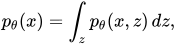
From the point of view of probabilistic modeling, one wants to maximize the likelihood of the data x {\displaystyle x} {\displaystyle x} by their chosen parameterized probability distribution p θ ( x ) = p ( x | θ ) {\displaystyle p_{\theta }(x)=p(x|\theta )} {\displaystyle p_{\theta }(x)=p(x|\theta )}. This distribution is usually chosen to be a Gaussian N ( x | μ , σ ) {\displaystyle N(x|\mu ,\sigma )} {\displaystyle N(x|\mu ,\sigma )} which is parameterized by μ {\displaystyle \mu } {\displaystyle \mu } and σ {\displaystyle \sigma } {\displaystyle \sigma } respectively, and as a member of the exponential family it is easy to work with as a noise distribution. Simple distributions are easy enough to maximize, however distributions where a prior is assumed over the latents z {\displaystyle z} {\displaystyle z} results in intractable integrals. Let us find p θ ( x ) {\displaystyle p_{\theta }(x)} {\displaystyle p_{\theta }(x)} via marginalizing over z {\displaystyle z} {\displaystyle z}.

p θ ( x ) = ∫ z p θ ( x , z ) d z , {\displaystyle p_{\theta }(x)=\int _{z}p_{\theta }({x,z})\,dz,} {\displaystyle p_{\theta }(x)=\int _{z}p_{\theta }({x,z})\,dz,}

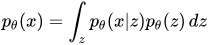
where p θ ( x , z ) {\displaystyle p_{\theta }({x,z})} {\displaystyle p_{\theta }({x,z})} represents the joint distribution under p θ {\displaystyle p_{\theta }} {\displaystyle p_{\theta }} of the observable data x {\displaystyle x} {\displaystyle x} and its latent representation or encoding z {\displaystyle z} {\displaystyle z}. According to the chain rule, the equation can be rewritten as

p θ ( x ) = ∫ z p θ ( x | z ) p θ ( z ) d z {\displaystyle p_{\theta }(x)=\int _{z}p_{\theta }({x|z})p_{\theta }(z)\,dz} {\displaystyle p_{\theta }(x)=\int _{z}p_{\theta }({x|z})p_{\theta }(z)\,dz}

In the vanilla variational autoencoder, z {\displaystyle z} {\displaystyle z} is usually taken to be a finite-dimensional vector of real numbers, and p θ ( x | z ) {\displaystyle p_{\theta }({x|z})} {\displaystyle p_{\theta }({x|z})} to be a Gaussian distribution. Then p θ ( x ) {\displaystyle p_{\theta }(x)} {\displaystyle p_{\theta }(x)} is a mixture of Gaussian distributions.

It is now possible to define the set of the relationships between the input data and its latent representation as

  • Prior p θ ( z ) {\displaystyle p_{\theta }(z)} {\displaystyle p_{\theta }(z)}
  • Likelihood p θ ( x | z ) {\displaystyle p_{\theta }(x|z)} {\displaystyle p_{\theta }(x|z)}
  • Posterior p θ ( z | x ) {\displaystyle p_{\theta }(z|x)} {\displaystyle p_{\theta }(z|x)}

Unfortunately, the computation of p θ ( z | x ) {\displaystyle p_{\theta }(z|x)} {\displaystyle p_{\theta }(z|x)} is expensive and in most cases intractable. To speed up the calculus to make it feasible, it is necessary to introduce a further function to approximate the posterior distribution as

q ϕ ( z | x ) ≈ p θ ( z | x ) {\displaystyle q_{\phi }({z|x})\approx p_{\theta }({z|x})} {\displaystyle q_{\phi }({z|x})\approx p_{\theta }({z|x})}

with ϕ {\displaystyle \phi } {\displaystyle \phi } defined as the set of real values that parametrize q {\displaystyle q} {\displaystyle q}. This is sometimes called amortized inference, since by "investing" in finding a good q ϕ {\displaystyle q_{\phi }} {\displaystyle q_{\phi }}, one can later infer z {\displaystyle z} {\displaystyle z} from x {\displaystyle x} {\displaystyle x} quickly without doing any integrals.

In this way, the problem is to find a good probabilistic autoencoder, in which the conditional likelihood distribution p θ ( x | z ) {\displaystyle p_{\theta }(x|z)} {\displaystyle p_{\theta }(x|z)} is computed by the probabilistic decoder, and the approximated posterior distribution q ϕ ( z | x ) {\displaystyle q_{\phi }(z|x)} {\displaystyle q_{\phi }(z|x)} is computed by the probabilistic encoder.

Parametrize the encoder as E ϕ {\displaystyle E_{\phi }} {\displaystyle E_{\phi }}, and the decoder as D θ {\displaystyle D_{\theta }} {\displaystyle D_{\theta }}.

Evidence lower bound (ELBO)

[edit]
Main article: Evidence lower bound

Like many deep learning approaches that use gradient-based optimization, VAEs require a differentiable loss function to update the network weights through backpropagation.

For variational autoencoders, the idea is to jointly optimize the generative model parameters θ {\displaystyle \theta } {\displaystyle \theta } to reduce the reconstruction error between the input and the output, and ϕ {\displaystyle \phi } {\displaystyle \phi } to make q ϕ ( z | x ) {\displaystyle q_{\phi }({z|x})} {\displaystyle q_{\phi }({z|x})} as close as possible to p θ ( z | x ) {\displaystyle p_{\theta }(z|x)} {\displaystyle p_{\theta }(z|x)}. As reconstruction loss, mean squared error and cross entropy are often used.

The Kullback–Leibler divergence D K L ( q ϕ ( z | x ) ∥ p θ ( z | x ) ) {\displaystyle D_{KL}(q_{\phi }({z|x})\parallel p_{\theta }({z|x}))} {\displaystyle D_{KL}(q_{\phi }({z|x})\parallel p_{\theta }({z|x}))} can be used as a loss function to squeeze q ϕ ( z | x ) {\displaystyle q_{\phi }({z|x})} {\displaystyle q_{\phi }({z|x})} under p θ ( z | x ) {\displaystyle p_{\theta }(z|x)} {\displaystyle p_{\theta }(z|x)}.[8][9] This divergence loss expands to

D K L ( q ϕ ( z | x ) ∥ p θ ( z | x ) ) = E z ∼ q ϕ ( ⋅ | x ) [ ln ⁡ q ϕ ( z | x ) p θ ( z | x ) ] = E z ∼ q ϕ ( ⋅ | x ) [ ln ⁡ q ϕ ( z | x ) p θ ( x ) p θ ( x , z ) ] = ln ⁡ p θ ( x ) + E z ∼ q ϕ ( ⋅ | x ) [ ln ⁡ q ϕ ( z | x ) p θ ( x , z ) ] . {\displaystyle {\begin{aligned}D_{KL}(q_{\phi }({z|x})\parallel p_{\theta }({z|x}))&=\mathbb {E} _{z\sim q_{\phi }(\cdot |x)}\left[\ln {\frac {q_{\phi }(z|x)}{p_{\theta }(z|x)}}\right]\\&=\mathbb {E} _{z\sim q_{\phi }(\cdot |x)}\left[\ln {\frac {q_{\phi }({z|x})p_{\theta }(x)}{p_{\theta }(x,z)}}\right]\\&=\ln p_{\theta }(x)+\mathbb {E} _{z\sim q_{\phi }(\cdot |x)}\left[\ln {\frac {q_{\phi }({z|x})}{p_{\theta }(x,z)}}\right].\end{aligned}}} {\displaystyle {\begin{aligned}D_{KL}(q_{\phi }({z|x})\parallel p_{\theta }({z|x}))&=\mathbb {E} _{z\sim q_{\phi }(\cdot |x)}\left[\ln {\frac {q_{\phi }(z|x)}{p_{\theta }(z|x)}}\right]\\&=\mathbb {E} _{z\sim q_{\phi }(\cdot |x)}\left[\ln {\frac {q_{\phi }({z|x})p_{\theta }(x)}{p_{\theta }(x,z)}}\right]\\&=\ln p_{\theta }(x)+\mathbb {E} _{z\sim q_{\phi }(\cdot |x)}\left[\ln {\frac {q_{\phi }({z|x})}{p_{\theta }(x,z)}}\right].\end{aligned}}}

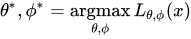
Now, define the evidence lower bound (ELBO): L θ , ϕ ( x ) := E z ∼ q ϕ ( ⋅ | x ) [ ln ⁡ p θ ( x , z ) q ϕ ( z | x ) ] = ln ⁡ p θ ( x ) − D K L ( q ϕ ( ⋅ | x ) ∥ p θ ( ⋅ | x ) ) {\displaystyle L_{\theta ,\phi }(x):=\mathbb {E} _{z\sim q_{\phi }(\cdot |x)}\left[\ln {\frac {p_{\theta }(x,z)}{q_{\phi }({z|x})}}\right]=\ln p_{\theta }(x)-D_{KL}(q_{\phi }({\cdot |x})\parallel p_{\theta }({\cdot |x}))} {\displaystyle L_{\theta ,\phi }(x):=\mathbb {E} _{z\sim q_{\phi }(\cdot |x)}\left[\ln {\frac {p_{\theta }(x,z)}{q_{\phi }({z|x})}}\right]=\ln p_{\theta }(x)-D_{KL}(q_{\phi }({\cdot |x})\parallel p_{\theta }({\cdot |x}))}Maximizing the ELBO θ ∗ , ϕ ∗ = argmax θ , ϕ L θ , ϕ ( x ) {\displaystyle \theta ^{*},\phi ^{*}={\underset {\theta ,\phi }{\operatorname {argmax} }}\,L_{\theta ,\phi }(x)} {\displaystyle \theta ^{*},\phi ^{*}={\underset {\theta ,\phi }{\operatorname {argmax} }}\,L_{\theta ,\phi }(x)}is equivalent to simultaneously maximizing ln ⁡ p θ ( x ) {\displaystyle \ln p_{\theta }(x)} {\displaystyle \ln p_{\theta }(x)} and minimizing D K L ( q ϕ ( z | x ) ∥ p θ ( z | x ) ) {\displaystyle D_{KL}(q_{\phi }({z|x})\parallel p_{\theta }({z|x}))} {\displaystyle D_{KL}(q_{\phi }({z|x})\parallel p_{\theta }({z|x}))}. That is, maximizing the log-likelihood of the observed data, and minimizing the divergence from the approximate posterior q ϕ ( ⋅ | x ) {\displaystyle q_{\phi }(\cdot |x)} {\displaystyle q_{\phi }(\cdot |x)} to the exact posterior p θ ( ⋅ | x ) {\displaystyle p_{\theta }(\cdot |x)} {\displaystyle p_{\theta }(\cdot |x)}.

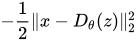
The form given is not very convenient for maximization, but the following, equivalent form, is: L θ , ϕ ( x ) = E z ∼ q ϕ ( ⋅ | x ) [ ln ⁡ p θ ( x | z ) ] − D K L ( q ϕ ( ⋅ | x ) ∥ p θ ( ⋅ ) ) {\displaystyle L_{\theta ,\phi }(x)=\mathbb {E} _{z\sim q_{\phi }(\cdot |x)}\left[\ln p_{\theta }(x|z)\right]-D_{KL}(q_{\phi }({\cdot |x})\parallel p_{\theta }(\cdot ))} {\displaystyle L_{\theta ,\phi }(x)=\mathbb {E} _{z\sim q_{\phi }(\cdot |x)}\left[\ln p_{\theta }(x|z)\right]-D_{KL}(q_{\phi }({\cdot |x})\parallel p_{\theta }(\cdot ))}where ln ⁡ p θ ( x | z ) {\displaystyle \ln p_{\theta }(x|z)} {\displaystyle \ln p_{\theta }(x|z)} is implemented as − 1 2 ‖ x − D θ ( z ) ‖ 2 2 {\displaystyle -{\frac {1}{2}}\|x-D_{\theta }(z)\|_{2}^{2}} {\displaystyle -{\frac {1}{2}}\|x-D_{\theta }(z)\|_{2}^{2}}, since that is, up to an additive constant, what x | z ∼ N ( D θ ( z ) , I ) {\displaystyle x|z\sim {\mathcal {N}}(D_{\theta }(z),I)} {\displaystyle x|z\sim {\mathcal {N}}(D_{\theta }(z),I)} yields. That is, we model the distribution of x {\displaystyle x} {\displaystyle x} conditional on z {\displaystyle z} {\displaystyle z} to be a Gaussian distribution centered on D θ ( z ) {\displaystyle D_{\theta }(z)} {\displaystyle D_{\theta }(z)}. The distribution of q ϕ ( z | x ) {\displaystyle q_{\phi }(z|x)} {\displaystyle q_{\phi }(z|x)} and p θ ( z ) {\displaystyle p_{\theta }(z)} {\displaystyle p_{\theta }(z)} are often also chosen to be Gaussians as z | x ∼ N ( E ϕ ( x ) , σ ϕ ( x ) 2 I ) {\displaystyle z|x\sim {\mathcal {N}}(E_{\phi }(x),\sigma _{\phi }(x)^{2}I)} {\displaystyle z|x\sim {\mathcal {N}}(E_{\phi }(x),\sigma _{\phi }(x)^{2}I)} and z ∼ N ( 0 , I ) {\displaystyle z\sim {\mathcal {N}}(0,I)} {\displaystyle z\sim {\mathcal {N}}(0,I)}, with which we obtain by the formula for KL divergence of Gaussians: L θ , ϕ ( x ) = − 1 2 E z ∼ q ϕ ( ⋅ | x ) [ ‖ x − D θ ( z ) ‖ 2 2 ] − 1 2 ( N σ ϕ ( x ) 2 + ‖ E ϕ ( x ) ‖ 2 2 − 2 N ln ⁡ σ ϕ ( x ) ) + C o n s t {\displaystyle L_{\theta ,\phi }(x)=-{\frac {1}{2}}\mathbb {E} _{z\sim q_{\phi }(\cdot |x)}\left[\|x-D_{\theta }(z)\|_{2}^{2}\right]-{\frac {1}{2}}\left(N\sigma _{\phi }(x)^{2}+\|E_{\phi }(x)\|_{2}^{2}-2N\ln \sigma _{\phi }(x)\right)+Const} {\displaystyle L_{\theta ,\phi }(x)=-{\frac {1}{2}}\mathbb {E} _{z\sim q_{\phi }(\cdot |x)}\left[\|x-D_{\theta }(z)\|_{2}^{2}\right]-{\frac {1}{2}}\left(N\sigma _{\phi }(x)^{2}+\|E_{\phi }(x)\|_{2}^{2}-2N\ln \sigma _{\phi }(x)\right)+Const}Here N {\displaystyle N} {\displaystyle N} is the dimension of z {\displaystyle z} {\displaystyle z}. For a more detailed derivation and more interpretations of ELBO and its maximization, see its main page.

Reparameterization

[edit]
The scheme of the reparameterization trick. The randomness variable ε {\displaystyle {\varepsilon }} {\displaystyle {\varepsilon }} is injected into the latent space z {\displaystyle z} {\displaystyle z} as external input. In this way, it is possible to backpropagate the gradient without involving stochastic variable during the update.

To efficiently search for θ ∗ , ϕ ∗ = argmax θ , ϕ L θ , ϕ ( x ) {\displaystyle \theta ^{*},\phi ^{*}={\underset {\theta ,\phi }{\operatorname {argmax} }}\,L_{\theta ,\phi }(x)} {\displaystyle \theta ^{*},\phi ^{*}={\underset {\theta ,\phi }{\operatorname {argmax} }}\,L_{\theta ,\phi }(x)}the typical method is gradient ascent.

It is straightforward to find ∇ θ E z ∼ q ϕ ( ⋅ | x ) [ ln ⁡ p θ ( x , z ) q ϕ ( z | x ) ] = E z ∼ q ϕ ( ⋅ | x ) [ ∇ θ ln ⁡ p θ ( x , z ) q ϕ ( z | x ) ] {\displaystyle \nabla _{\theta }\mathbb {E} _{z\sim q_{\phi }(\cdot |x)}\left[\ln {\frac {p_{\theta }(x,z)}{q_{\phi }({z|x})}}\right]=\mathbb {E} _{z\sim q_{\phi }(\cdot |x)}\left[\nabla _{\theta }\ln {\frac {p_{\theta }(x,z)}{q_{\phi }({z|x})}}\right]} {\displaystyle \nabla _{\theta }\mathbb {E} _{z\sim q_{\phi }(\cdot |x)}\left[\ln {\frac {p_{\theta }(x,z)}{q_{\phi }({z|x})}}\right]=\mathbb {E} _{z\sim q_{\phi }(\cdot |x)}\left[\nabla _{\theta }\ln {\frac {p_{\theta }(x,z)}{q_{\phi }({z|x})}}\right]}However, ∇ ϕ E z ∼ q ϕ ( ⋅ | x ) [ ln ⁡ p θ ( x , z ) q ϕ ( z | x ) ] {\displaystyle \nabla _{\phi }\mathbb {E} _{z\sim q_{\phi }(\cdot |x)}\left[\ln {\frac {p_{\theta }(x,z)}{q_{\phi }({z|x})}}\right]} {\displaystyle \nabla _{\phi }\mathbb {E} _{z\sim q_{\phi }(\cdot |x)}\left[\ln {\frac {p_{\theta }(x,z)}{q_{\phi }({z|x})}}\right]}does not allow one to put the ∇ ϕ {\displaystyle \nabla _{\phi }} {\displaystyle \nabla _{\phi }} inside the expectation, since ϕ {\displaystyle \phi } {\displaystyle \phi } appears in the probability distribution itself. The reparameterization trick (also known as stochastic backpropagation[10]) bypasses this difficulty.[8][11][12]

The most important example is when z ∼ q ϕ ( ⋅ | x ) {\displaystyle z\sim q_{\phi }(\cdot |x)} {\displaystyle z\sim q_{\phi }(\cdot |x)} is normally distributed, as N ( μ ϕ ( x ) , Σ ϕ ( x ) ) {\displaystyle {\mathcal {N}}(\mu _{\phi }(x),\Sigma _{\phi }(x))} {\displaystyle {\mathcal {N}}(\mu _{\phi }(x),\Sigma _{\phi }(x))}.

The scheme of a variational autoencoder after the reparameterization trick

This can be reparametrized by letting ε ∼ N ( 0 , I ) {\displaystyle {\boldsymbol {\varepsilon }}\sim {\mathcal {N}}(0,{\boldsymbol {I}})} {\displaystyle {\boldsymbol {\varepsilon }}\sim {\mathcal {N}}(0,{\boldsymbol {I}})} be a "standard random number generator", and construct z {\displaystyle z} {\displaystyle z} as z = μ ϕ ( x ) + L ϕ ( x ) ϵ {\displaystyle z=\mu _{\phi }(x)+L_{\phi }(x)\epsilon } {\displaystyle z=\mu _{\phi }(x)+L_{\phi }(x)\epsilon }. Here, L ϕ ( x ) {\displaystyle L_{\phi }(x)} {\displaystyle L_{\phi }(x)} is obtained by the Cholesky decomposition: Σ ϕ ( x ) = L ϕ ( x ) L ϕ ( x ) T {\displaystyle \Sigma _{\phi }(x)=L_{\phi }(x)L_{\phi }(x)^{T}} {\displaystyle \Sigma _{\phi }(x)=L_{\phi }(x)L_{\phi }(x)^{T}}Then we have ∇ ϕ E z ∼ q ϕ ( ⋅ | x ) [ ln ⁡ p θ ( x , z ) q ϕ ( z | x ) ] = E ϵ [ ∇ ϕ ln ⁡ p θ ( x , μ ϕ ( x ) + L ϕ ( x ) ϵ ) q ϕ ( μ ϕ ( x ) + L ϕ ( x ) ϵ | x ) ] {\displaystyle \nabla _{\phi }\mathbb {E} _{z\sim q_{\phi }(\cdot |x)}\left[\ln {\frac {p_{\theta }(x,z)}{q_{\phi }({z|x})}}\right]=\mathbb {E} _{\epsilon }\left[\nabla _{\phi }\ln {\frac {p_{\theta }(x,\mu _{\phi }(x)+L_{\phi }(x)\epsilon )}{q_{\phi }(\mu _{\phi }(x)+L_{\phi }(x)\epsilon |x)}}\right]} {\displaystyle \nabla _{\phi }\mathbb {E} _{z\sim q_{\phi }(\cdot |x)}\left[\ln {\frac {p_{\theta }(x,z)}{q_{\phi }({z|x})}}\right]=\mathbb {E} _{\epsilon }\left[\nabla _{\phi }\ln {\frac {p_{\theta }(x,\mu _{\phi }(x)+L_{\phi }(x)\epsilon )}{q_{\phi }(\mu _{\phi }(x)+L_{\phi }(x)\epsilon |x)}}\right]}and so we obtained an unbiased estimator of the gradient, allowing stochastic gradient descent.

Since we reparametrized z {\displaystyle z} {\displaystyle z}, we need to find q ϕ ( z | x ) {\displaystyle q_{\phi }(z|x)} {\displaystyle q_{\phi }(z|x)}. Let q 0 {\displaystyle q_{0}} {\displaystyle q_{0}} be the probability density function for ϵ {\displaystyle \epsilon } {\displaystyle \epsilon }, then [clarification needed] ln ⁡ q ϕ ( z | x ) = ln ⁡ q 0 ( ϵ ) − ln ⁡ | det ( ∂ ϵ z ) | {\displaystyle \ln q_{\phi }(z|x)=\ln q_{0}(\epsilon )-\ln |\det(\partial _{\epsilon }z)|} {\displaystyle \ln q_{\phi }(z|x)=\ln q_{0}(\epsilon )-\ln |\det(\partial _{\epsilon }z)|}where ∂ ϵ z {\displaystyle \partial _{\epsilon }z} {\displaystyle \partial _{\epsilon }z} is the Jacobian matrix of z {\displaystyle z} {\displaystyle z} with respect to ϵ {\displaystyle \epsilon } {\displaystyle \epsilon }. Since z = μ ϕ ( x ) + L ϕ ( x ) ϵ {\displaystyle z=\mu _{\phi }(x)+L_{\phi }(x)\epsilon } {\displaystyle z=\mu _{\phi }(x)+L_{\phi }(x)\epsilon }, this is ln ⁡ q ϕ ( z | x ) = − 1 2 ‖ ϵ ‖ 2 − ln ⁡ | det L ϕ ( x ) | − n 2 ln ⁡ ( 2 π ) {\displaystyle \ln q_{\phi }(z|x)=-{\frac {1}{2}}\|\epsilon \|^{2}-\ln |\det L_{\phi }(x)|-{\frac {n}{2}}\ln(2\pi )} {\displaystyle \ln q_{\phi }(z|x)=-{\frac {1}{2}}\|\epsilon \|^{2}-\ln |\det L_{\phi }(x)|-{\frac {n}{2}}\ln(2\pi )}

Variations

[edit]

Many variational autoencoders applications and extensions have been used to adapt the architecture to other domains and improve its performance.

β {\displaystyle \beta } {\displaystyle \beta }-VAE is an implementation with a weighted Kullback–Leibler divergence term to automatically discover and interpret factorised latent representations. With this implementation, it is possible to force manifold disentanglement for β {\displaystyle \beta } {\displaystyle \beta } values greater than one. This architecture can discover disentangled latent factors without supervision.[13][14]

The conditional VAE (CVAE), inserts label information in the latent space to force a deterministic constrained representation of the learned data.[15]

Some structures directly deal with the quality of the generated samples[16][17] or implement more than one latent space to further improve the representation learning.

Some architectures mix VAE and generative adversarial networks to obtain hybrid models.[18][19][20]

It is not necessary to use gradients to update the encoder. In fact, the encoder is not necessary for the generative model. [21]

Statistical distance VAE variants

[edit]

After the initial work of Diederik P. Kingma and Max Welling,[22] several procedures were proposed to formulate in a more abstract way the operation of the VAE. In these approaches the loss function is composed of two parts :

  • the usual reconstruction error part which seeks to ensure that the encoder-then-decoder mapping x ↦ D θ ( E ψ ( x ) ) {\displaystyle x\mapsto D_{\theta }(E_{\psi }(x))} {\displaystyle x\mapsto D_{\theta }(E_{\psi }(x))} is as close to the identity map as possible; the sampling is done at run time from the empirical distribution P r e a l {\displaystyle \mathbb {P} ^{real}} {\displaystyle \mathbb {P} ^{real}} of objects available (e.g., for MNIST or IMAGENET this will be the empirical probability law of all images in the dataset). This gives the term: E x ∼ P r e a l [ ‖ x − D θ ( E ϕ ( x ) ) ‖ 2 2 ] {\displaystyle \mathbb {E} _{x\sim \mathbb {P} ^{real}}\left[\|x-D_{\theta }(E_{\phi }(x))\|_{2}^{2}\right]} {\displaystyle \mathbb {E} _{x\sim \mathbb {P} ^{real}}\left[\|x-D_{\theta }(E_{\phi }(x))\|_{2}^{2}\right]}.
  • a variational part that ensures that, when the empirical distribution P r e a l {\displaystyle \mathbb {P} ^{real}} {\displaystyle \mathbb {P} ^{real}} is passed through the encoder E ϕ {\displaystyle E_{\phi }} {\displaystyle E_{\phi }}, we recover the target distribution, denoted here μ ( d z ) {\displaystyle \mu (dz)} {\displaystyle \mu (dz)} that is usually taken to be a Multivariate normal distribution. We will denote E ϕ ♯ P r e a l {\displaystyle E_{\phi }\sharp \mathbb {P} ^{real}} {\displaystyle E_{\phi }\sharp \mathbb {P} ^{real}} this pushforward measure which in practice is just the empirical distribution obtained by passing all dataset objects through the encoder E ϕ {\displaystyle E_{\phi }} {\displaystyle E_{\phi }}. In order to make sure that E ϕ ♯ P r e a l {\displaystyle E_{\phi }\sharp \mathbb {P} ^{real}} {\displaystyle E_{\phi }\sharp \mathbb {P} ^{real}} is close to the target μ ( d z ) {\displaystyle \mu (dz)} {\displaystyle \mu (dz)}, a Statistical distance d {\displaystyle d} {\displaystyle d} is invoked and the term d ( μ ( d z ) , E ϕ ♯ P r e a l ) 2 {\displaystyle d\left(\mu (dz),E_{\phi }\sharp \mathbb {P} ^{real}\right)^{2}} {\displaystyle d\left(\mu (dz),E_{\phi }\sharp \mathbb {P} ^{real}\right)^{2}} is added to the loss.

We obtain the final formula for the loss: L θ , ϕ = E x ∼ P r e a l [ ‖ x − D θ ( E ϕ ( x ) ) ‖ 2 2 ] + d ( μ ( d z ) , E ϕ ♯ P r e a l ) 2 {\displaystyle L_{\theta ,\phi }=\mathbb {E} _{x\sim \mathbb {P} ^{real}}\left[\|x-D_{\theta }(E_{\phi }(x))\|_{2}^{2}\right]+d\left(\mu (dz),E_{\phi }\sharp \mathbb {P} ^{real}\right)^{2}} {\displaystyle L_{\theta ,\phi }=\mathbb {E} _{x\sim \mathbb {P} ^{real}}\left[\|x-D_{\theta }(E_{\phi }(x))\|_{2}^{2}\right]+d\left(\mu (dz),E_{\phi }\sharp \mathbb {P} ^{real}\right)^{2}}

The statistical distance d {\displaystyle d} {\displaystyle d} requires special properties, for instance it has to be posses a formula as expectation because the loss function will need to be optimized by stochastic optimization algorithms. Several distances can be chosen and this gave rise to several flavors of VAEs:

  • the sliced Wasserstein distance used by S Kolouri, et al. in their VAE[23]
  • the energy distance implemented in the Radon Sobolev Variational Auto-Encoder[24]
  • the Maximum Mean Discrepancy distance used in the MMD-VAE[25]
  • the Wasserstein distance used in the WAEs[26]
  • kernel-based distances used in the Kernelized Variational Autoencoder (K-VAE)[27]

See also

[edit]
  • Autoencoder
  • Artificial neural network
  • Deep learning
  • Generative adversarial network
  • Representation learning
  • Sparse dictionary learning
  • Data augmentation
  • Backpropagation

References

[edit]
  1. ^ Kingma, Diederik P.; Welling, Max (2022-12-10). "Auto-Encoding Variational Bayes". arXiv:1312.6114 [stat.ML].
  2. ^ Pinheiro Cinelli, Lucas; et al. (2021). "Variational Autoencoder". Variational Methods for Machine Learning with Applications to Deep Networks. Springer. pp. 111–149. doi:10.1007/978-3-030-70679-1_5. ISBN 978-3-030-70681-4. S2CID 240802776.
  3. ^ Dilokthanakul, Nat; Mediano, Pedro A. M.; Garnelo, Marta; Lee, Matthew C. H.; Salimbeni, Hugh; Arulkumaran, Kai; Shanahan, Murray (2017-01-13). "Deep Unsupervised Clustering with Gaussian Mixture Variational Autoencoders". arXiv:1611.02648 [cs.LG].
  4. ^ Hsu, Wei-Ning; Zhang, Yu; Glass, James (December 2017). "Unsupervised domain adaptation for robust speech recognition via variational autoencoder-based data augmentation". 2017 IEEE Automatic Speech Recognition and Understanding Workshop (ASRU). pp. 16–23. arXiv:1707.06265. doi:10.1109/ASRU.2017.8268911. ISBN 978-1-5090-4788-8. S2CID 22681625.
  5. ^ Ehsan Abbasnejad, M.; Dick, Anthony; van den Hengel, Anton (2017). Infinite Variational Autoencoder for Semi-Supervised Learning. pp. 5888–5897.
  6. ^ Xu, Weidi; Sun, Haoze; Deng, Chao; Tan, Ying (2017-02-12). "Variational Autoencoder for Semi-Supervised Text Classification". Proceedings of the AAAI Conference on Artificial Intelligence. 31 (1). doi:10.1609/aaai.v31i1.10966. S2CID 2060721.
  7. ^ Kameoka, Hirokazu; Li, Li; Inoue, Shota; Makino, Shoji (2019-09-01). "Supervised Determined Source Separation with Multichannel Variational Autoencoder". Neural Computation. 31 (9): 1891–1914. doi:10.1162/neco_a_01217. PMID 31335290. S2CID 198168155.
  8. ^ a b c Kingma, Diederik P.; Welling, Max (2013-12-20). "Auto-Encoding Variational Bayes". arXiv:1312.6114 [stat.ML].
  9. ^ "From Autoencoder to Beta-VAE". Lil'Log. 2018-08-12.
  10. ^ Rezende, Danilo Jimenez; Mohamed, Shakir; Wierstra, Daan (2014-06-18). "Stochastic Backpropagation and Approximate Inference in Deep Generative Models". International Conference on Machine Learning. PMLR: 1278–1286. arXiv:1401.4082.
  11. ^ Bengio, Yoshua; Courville, Aaron; Vincent, Pascal (2013). "Representation Learning: A Review and New Perspectives". IEEE Transactions on Pattern Analysis and Machine Intelligence. 35 (8): 1798–1828. arXiv:1206.5538. Bibcode:2013ITPAM..35.1798B. doi:10.1109/TPAMI.2013.50. ISSN 1939-3539. PMID 23787338. S2CID 393948.
  12. ^ Kingma, Diederik P.; Rezende, Danilo J.; Mohamed, Shakir; Welling, Max (2014-10-31). "Semi-Supervised Learning with Deep Generative Models". arXiv:1406.5298 [cs.LG].
  13. ^ Higgins, Irina; Matthey, Loic; Pal, Arka; Burgess, Christopher; Glorot, Xavier; Botvinick, Matthew; Mohamed, Shakir; Lerchner, Alexander (2016-11-04). beta-VAE: Learning Basic Visual Concepts with a Constrained Variational Framework. NeurIPS.
  14. ^ Burgess, Christopher P.; Higgins, Irina; Pal, Arka; Matthey, Loic; Watters, Nick; Desjardins, Guillaume; Lerchner, Alexander (2018-04-10). "Understanding disentangling in β-VAE". arXiv:1804.03599 [stat.ML].
  15. ^ Sohn, Kihyuk; Lee, Honglak; Yan, Xinchen (2015-01-01). Learning Structured Output Representation using Deep Conditional Generative Models (PDF). NeurIPS.
  16. ^ Dai, Bin; Wipf, David (2019-10-30). "Diagnosing and Enhancing VAE Models". arXiv:1903.05789 [cs.LG].
  17. ^ Dorta, Garoe; Vicente, Sara; Agapito, Lourdes; Campbell, Neill D. F.; Simpson, Ivor (2018-07-31). "Training VAEs Under Structured Residuals". arXiv:1804.01050 [stat.ML].
  18. ^ Larsen, Anders Boesen Lindbo; Sønderby, Søren Kaae; Larochelle, Hugo; Winther, Ole (2016-06-11). "Autoencoding beyond pixels using a learned similarity metric". International Conference on Machine Learning. PMLR: 1558–1566. arXiv:1512.09300.
  19. ^ Bao, Jianmin; Chen, Dong; Wen, Fang; Li, Houqiang; Hua, Gang (2017). "CVAE-GAN: Fine-Grained Image Generation Through Asymmetric Training". pp. 2745–2754. arXiv:1703.10155 [cs.CV].
  20. ^ Gao, Rui; Hou, Xingsong; Qin, Jie; Chen, Jiaxin; Liu, Li; Zhu, Fan; Zhang, Zhao; Shao, Ling (2020). "Zero-VAE-GAN: Generating Unseen Features for Generalized and Transductive Zero-Shot Learning". IEEE Transactions on Image Processing. 29: 3665–3680. Bibcode:2020ITIP...29.3665G. doi:10.1109/TIP.2020.2964429. ISSN 1941-0042. PMID 31940538. S2CID 210334032.
  21. ^ Drefs, J.; Guiraud, E.; Panagiotou, F.; Lücke, J. (2023). "Direct evolutionary optimization of variational autoencoders with binary latents". Joint European Conference on Machine Learning and Knowledge Discovery in Databases. Lecture Notes in Computer Science. Vol. 13715. Springer Nature Switzerland. pp. 357–372. arXiv:2011.13704. doi:10.1007/978-3-031-26409-2_22. ISBN 978-3-031-26408-5.
  22. ^ Kingma, Diederik P.; Welling, Max (2022-12-10). "Auto-Encoding Variational Bayes". arXiv:1312.6114 [stat.ML].
  23. ^ Kolouri, Soheil; Pope, Phillip E.; Martin, Charles E.; Rohde, Gustavo K. (2019). "Sliced Wasserstein Auto-Encoders". International Conference on Learning Representations. International Conference on Learning Representations. ICPR.
  24. ^ Turinici, Gabriel (2021). "Radon-Sobolev Variational Auto-Encoders". Neural Networks. 141: 294–305. arXiv:1911.13135. doi:10.1016/j.neunet.2021.04.018. ISSN 0893-6080. PMID 33933889.
  25. ^ Gretton, A.; Li, Y.; Swersky, K.; Zemel, R.; Turner, R. (2017). "A Polya Contagion Model for Networks". IEEE Transactions on Control of Network Systems. 5 (4): 1998–2010. arXiv:1705.02239. doi:10.1109/TCNS.2017.2781467.
  26. ^ Tolstikhin, I.; Bousquet, O.; Gelly, S.; Schölkopf, B. (2018). "Wasserstein Auto-Encoders". arXiv:1711.01558 [stat.ML].
  27. ^ Louizos, C.; Shi, X.; Swersky, K.; Li, Y.; Welling, M. (2019). "Kernelized Variational Autoencoders". arXiv:1901.02401 [astro-ph.CO].

Further reading

[edit]
  • Kingma, Diederik P.; Welling, Max (2019). "An Introduction to Variational Autoencoders". Foundations and Trends in Machine Learning. 12 (4). Now Publishers: 307–392. arXiv:1906.02691. doi:10.1561/2200000056. ISSN 1935-8237.
  • v
  • t
  • e
Artificial intelligence (AI)
  • History
    • timeline
  • Glossary
  • Companies
  • Projects
Concepts
  • Parameter
    • Hyperparameter
  • Loss functions
  • Regression
    • Bias–variance tradeoff
    • Double descent
    • Overfitting
  • Clustering
  • Gradient descent
    • SGD
    • Quasi-Newton method
    • Conjugate gradient method
  • Backpropagation
  • Attention
  • Convolution
  • Normalization
    • Batchnorm
  • Activation
    • Softmax
    • Sigmoid
    • Rectifier
  • Gating
  • Weight initialization
  • Regularization
  • Datasets
    • Augmentation
  • Prompt engineering
  • Reinforcement learning
    • Q-learning
    • SARSA
    • Imitation
    • Policy gradient
  • Diffusion
  • Latent diffusion model
  • Autoregression
  • Adversary
  • RAG
  • Uncanny valley
  • RLHF
  • Self-supervised learning
  • Reflection
  • Recursive self-improvement
  • Hallucination
  • Word embedding
  • Vibe coding
Applications
  • Machine learning
    • In-context learning
  • Artificial neural network
    • Deep learning
  • Language model
    • Large
    • NMT
    • Reasoning
  • Model Context Protocol
  • Intelligent agent
  • Artificial human companion
  • Humanity's Last Exam
  • Lethal autonomous weapons (LAWs)
  • Generative artificial intelligence (GenAI)
  • (Hypothetical: Artificial general intelligence (AGI))
  • (Hypothetical: Artificial superintelligence (ASI))
  • Agent2Agent protocol
Implementations
Audio–visual
  • AlexNet
  • WaveNet
  • Human image synthesis
  • HWR
  • OCR
  • Computer vision
  • Speech synthesis
    • 15.ai
    • ElevenLabs
  • Speech recognition
    • Whisper
  • Facial recognition
  • AlphaFold
  • Text-to-image models
    • Aurora
    • DALL-E
    • Firefly
    • Flux
    • GPT Image
    • Ideogram
    • Imagen
    • Midjourney
    • Recraft
    • Stable Diffusion
  • Text-to-video models
    • Dream Machine
    • Runway Gen
    • Hailuo AI
    • Kling
    • Sora
    • Seedance
    • Veo
  • Music generation
    • Riffusion
    • Suno AI
    • Udio
Text
  • Word2vec
  • Seq2seq
  • GloVe
  • BERT
  • T5
  • Llama
  • Chinchilla AI
  • PaLM
  • GPT
    • 1
    • 2
    • 3
    • J
    • ChatGPT
    • 4
    • 4o
    • o1
    • o3
    • 4.5
    • 4.1
    • o4-mini
    • 5
    • 5.1
    • 5.2
  • Claude
  • Gemini
    • Gemini (language model)
    • Gemma
  • Grok
  • LaMDA
  • BLOOM
  • DBRX
  • Project Debater
  • IBM Watson
  • IBM Watsonx
  • Granite
  • PanGu-Σ
  • DeepSeek
  • Qwen
Decisional
  • AlphaGo
  • AlphaZero
  • OpenAI Five
  • Self-driving car
  • MuZero
  • Action selection
    • AutoGPT
  • Robot control
People
  • Alan Turing
  • Warren Sturgis McCulloch
  • Walter Pitts
  • John von Neumann
  • Christopher D. Manning
  • Claude Shannon
  • Shun'ichi Amari
  • Kunihiko Fukushima
  • Takeo Kanade
  • Marvin Minsky
  • John McCarthy
  • Nathaniel Rochester
  • Allen Newell
  • Cliff Shaw
  • Herbert A. Simon
  • Oliver Selfridge
  • Frank Rosenblatt
  • Bernard Widrow
  • Joseph Weizenbaum
  • Seymour Papert
  • Seppo Linnainmaa
  • Paul Werbos
  • Geoffrey Hinton
  • John Hopfield
  • Jürgen Schmidhuber
  • Yann LeCun
  • Yoshua Bengio
  • Lotfi A. Zadeh
  • Stephen Grossberg
  • Alex Graves
  • James Goodnight
  • Andrew Ng
  • Fei-Fei Li
  • Alex Krizhevsky
  • Ilya Sutskever
  • Oriol Vinyals
  • Quoc V. Le
  • Ian Goodfellow
  • Demis Hassabis
  • David Silver
  • Andrej Karpathy
  • Ashish Vaswani
  • Noam Shazeer
  • Aidan Gomez
  • John Schulman
  • Mustafa Suleyman
  • Jan Leike
  • Daniel Kokotajlo
  • François Chollet
Architectures
  • Neural Turing machine
  • Differentiable neural computer
  • Transformer
    • Vision transformer (ViT)
  • Recurrent neural network (RNN)
  • Long short-term memory (LSTM)
  • Gated recurrent unit (GRU)
  • Echo state network
  • Multilayer perceptron (MLP)
  • Convolutional neural network (CNN)
  • Residual neural network (RNN)
  • Highway network
  • Mamba
  • Autoencoder
  • Variational autoencoder (VAE)
  • Generative adversarial network (GAN)
  • Graph neural network (GNN)
Political
  • AI safety (Alignment)
  • Ethics of AI
  • EU AI Act
  • Precautionary principle
  • Regulation of AI
  • Virtual politician
Social and economic
  • AI boom
  • AI bubble
  • AI literacy
  • AI slop
  • AI veganism
  • AI winter
  • Anthropomorphism
  • In architecture
  • In education
  • In healthcare
    • Chatbot psychosis
    • Mental health
  • In visual art
  • Category
Retrieved from "https://teknopedia.ac.id/w/index.php?title=Variational_autoencoder&oldid=1340358343"
Categories:
  • Neural network architectures
  • Unsupervised learning
  • Supervised learning
  • Graphical models
  • Bayesian statistics
  • Dimension reduction
  • 2013 in artificial intelligence
Hidden categories:
  • Articles with short description
  • Short description matches Wikidata
  • Use dmy dates from June 2021
  • All articles with unsourced statements
  • Articles with unsourced statements from June 2024
  • Wikipedia articles needing clarification from October 2023

  • indonesia
  • Polski
  • العربية
  • Deutsch
  • English
  • Español
  • Français
  • Italiano
  • مصرى
  • Nederlands
  • 日本語
  • Português
  • Sinugboanong Binisaya
  • Svenska
  • Українська
  • Tiếng Việt
  • Winaray
  • 中文
  • Русский
Sunting pranala
url url url url url url url url url url url url url url url url url url url url url url url url url url url url url url url url url url url url url url url url url url url url url url url url url url url url url url url url url url url url url url url url url url url url url url url url url url url url url url url url url url url url url url url url url url url url url url url url url url url url url url url url url url url url url url url url url url url url url url url url url url url url url url url url url url url url url url url url url url url url url url url url url url url url url url url url url url url url url url url url url url url url url url url url url url url url url url url url url url url url url url url url url url url url url url url url url url url url url url url url url url url url url url url url url url url url url url url url url url url url url url url url url url url url url url url url url url url url url url url url url url url url url url url url url url url url url url url url url url url url url url url url url url url url url url url url url url url url url url url url url url url url url url url url url url url url url url url url url url url url url url url url url url url url url url url url url url url url url url url url url url url url url url url url url url url url url url url url url url url url url url url url url url url url url url url url url url url url url url url url url url url url url url url url url url url url url url url url url url url url url url url url url url url url url url url url url url url url url url url url url url url url url url url url url url url url url url url url url url url url url url url url url url url url url url url url url url url url url url url url url url url url url url url url url url url url url url url url url url url url url url url url url url url url url url url url url url url url url url url url url url url url url url url url url url url url url url url url url url url url url url url url url url url url url url url url url url url url url url url url url url url url url url url url url url url url url url url url url url url url url url url url url url url url url url url url url url url url url url url url url url url url url url url url url url url url url url url url url url url url url url url url url url url url url url url url url url url url url url url url url url url url url url url url url url url url url url url url url url url url url url url url url url url url url url url url url url url url url url url url url url url url url url url url url url url url url url url url url url url url url url url url url url url url url url url url url url url url url url url url url url url url url url url url url url url url url url url url url url url url url url url url url url url url url url url url url url url url url url url url url url url url url url url url url url url url url url url url url url url url url url url url url url url url url url url url url url url url url url url url url url url url url url url url url url url url url url url url url url url url url url url url url url url url url url url url url url url url url url url url url url url url url url url url url url url url url url url url url url url url url url url url url url url url url url url url url url url url url url url url url url url url url url url url url url url url url url url url url url url url url url url url url url url url url url url url url url url url url url url url url url url url url url url url url url url url url url url url url url url url url url url url url url url url url url url url url url url url url url url url url url url url url url url url url url url url url url url url url url url url url url url url url url url url url url url url url url url url url url url url url url url url url url url url url url url url url url url url url url url url url url url url url url url url url url url url url url url url url url url url url url url url url url url url url url url url url url url url url url url url url url url url url url url url url url url url url url url url url url url url url url url url url url url url url url url url url url url url url url url url url url url url url url url url url url url url url url url url url url url url url url url url url url url url url url url url url url url url url url url url url url url url url url url url url url url url url url url url url url url url url url url url url url url url url url url url url url url url url url url url url url url url url url url url url url url url url url url url url url url url url url url url url url url url url url url url url url url url url url url url url url url url url url url url url url url url url url url url url url url url url url url url url url url url url url url url url url url url url url url url url url url url url url url url url url url url url url url url url url url url url url url url url url url url url url url url url url url url url url url url url url url url url url url url url url url url url url url url url url url url url url url url url url url url url url url url url url url url url url url url url url url url url url url url url url url url url url url url url url url url url url url url url url url url url url url url url url url url url url url url url url url url url url url url url url url url url url url url url url url url url url url url url url url url url url url url url url url url url url url url url url url url url url url url url url url url url url url url url url url url url url url url url url url url url url url url url url url url url url url url url url url url url url url url url url url url url url url url url url url url url url url url url url url url url url url url url url url url url url url url url url url url url url url url url url url url url url url url url url url url url url url url url url url url url url url url url url url url url url url url url url url url url url url url url url url url url url url url url url url url url url url url url url url url url url url url url url url url url url url url url url url url url url url url url url url url url url url url url url url url url url url url url url url url url url url url url url url url url url url url url url url url url url url url url url url url url url url url url url url url url url url url url url url url url url url url url url url url url url url url url url url url url url url url url url url url url url url url url url url url url url url url url url url url url url url url url url url url url url url url url url url url url url url url url url url url url url url url url url url url url url url url url url url url url url url url url url url url url url url url url url url url url url url url url url url url url url url url url url url url url url url url url url url url url url url url url url url url url url url url url url url url url url url url url url url url url url url url url url url url url url url url url url url url url url url url url url url url url url url url url url url url url url url url url url url url url url url url url url url url url url url url url url url url url url url url url url url url url url url url url url url url url url url url url url url url url url url url url url url url url url url url url url url url url url url url url url url url url url url url url url url url url url url url url url url url url url url url url url url url url url url url url url url url url url url url url url url url url url url url url url url url url url url url url url url url url url url url url url url url url url url url url url url url url url url url url url url url url url url url url url url url url url url url url url url url url url url url url url url url url url url url url url url url url url url url url url url url url url url url url url url url url url url url url url url url url url url url url url url url url url url url url url url url url url url url url url url url url url url url url url url url url url url url url url url url url url url url url url url url url url url url url url url url url url url url url url url url url url url url url url url url url url url url url url url url url url url url url url url url url url url url url url url url url url url url url url url url url url url url url url url url url url url url url url url url url url url url url url url url url url url url url url url url url url url url url url url url url url url url url url url url url url url url url url url url url url url url url url url url url url url url url url url url url url url url url url url url url url url url url url url url url url url url url url url url url url url url url url url url url url url url url url url url url url url url url url url url url url url url url url url url url url url url url url url url url url url url url url url url url url url url url url url url url url url url url url url url url url url url url url url url url url url url url url url url url url url url url url url url url url url url url url url url url url url url url url url url url url url url url url url url url url url url url url url url url url url url url url url url url url url url url url url url url url url url url url url url url url url url url url url url url url url url url url url url url url url url url url url url url url url url url url url url url url url url url url url url url url url url url url url url url url url url url url url url url url url url url url url url url url url url url url url url url url url url url url url url url url url url url url url url
Pusat Layanan

UNIVERSITAS TEKNOKRAT INDONESIA | ASEAN's Best Private University
Jl. ZA. Pagar Alam No.9 -11, Labuhan Ratu, Kec. Kedaton, Kota Bandar Lampung, Lampung 35132
Phone: (0721) 702022
Email: pmb@teknokrat.ac.id