Epstein Files Full PDF

CLICK HERE
Technopedia Center
PMB University Brochure
Faculty of Engineering and Computer Science
S1 Informatics S1 Information Systems S1 Information Technology S1 Computer Engineering S1 Electrical Engineering S1 Civil Engineering

faculty of Economics and Business
S1 Management S1 Accountancy

Faculty of Letters and Educational Sciences
S1 English literature S1 English language education S1 Mathematics education S1 Sports Education
teknopedia

  • Registerasi
  • Brosur UTI
  • Kip Scholarship Information
  • Performance
Flag Counter
  1. World Encyclopedia
  2. Mechanism design - Wikipedia
Mechanism design - Wikipedia
From Wikipedia, the free encyclopedia
Field of economics and game theory
This article includes a list of references, related reading, or external links, but its sources remain unclear because it lacks inline citations. Please help improve this article by introducing more precise citations. (July 2024) (Learn how and when to remove this message)
Part of a series on
Economics
  • Outline
  • Index
  • Glossary
  • Economists
Principles of Economics
Tools and methodology
Economic theory
  • Mathematical modeling
  • Game theory
  • Rational choice
  • Cognitive science (Behavioral)
  • Economic equilibrium

Empirical methods

  • Experimental
  • Econometrics
    • Time series
    • Spatial
    • Causal inference
    • Quasi-experiments

Prescriptive and policy

  • Welfare analysis
  • Social choice theory
  • Rational choice theory
  • Cost–benefit analysis
Branches and subfields
  • Applied
  • Econometrics
  • International
  • Heterodox
  • Micro
  • Macro
  • Mainstream
  • Mathematical
  • Mech. design
  • Methodology
  • Political
  • Industrial org.
  • Market design
Applications
  • Agriculture
  • Business
  • Cultural
  • Demographic
  • Development
  • Ecological
  • Education
  • Engineering
  • Environmental
  • Evolutionary
  • Financial
  • Geographic
  • Happiness
  • Health
  • History
  • Information
  • Infrastructure
  • Institutions
  • Labour
  • Law
  • Management
  • Non-monetary
  • Organization
  • Participation
  • Personnel
  • Planning
  • Policy
  • Public sector
  • Public choice
  • Social choice
  • Regional
  • Regulatory
  • Resources
  • Rural
  • Service
  • Transport
  • Urban
  • Welfare
  • icon Economics portal
  • icon Society portal
  • v
  • t
  • e
The upper-left space Θ {\displaystyle \Theta } {\displaystyle \Theta } depicts the type space and the upper-right space X the space of outcomes. The social choice function f ( θ ) {\displaystyle f(\theta )} {\displaystyle f(\theta )} maps a type profile to an outcome. In games of mechanism design, agents send messages M {\displaystyle M} {\displaystyle M} in a game environment g {\displaystyle g} {\displaystyle g}. The equilibrium in the game ξ ( M , g , θ ) {\displaystyle \xi (M,g,\theta )} {\displaystyle \xi (M,g,\theta )} can be designed to implement some social choice function f ( θ ) {\displaystyle f(\theta )} {\displaystyle f(\theta )}.

Mechanism design (sometimes implementation theory or institution design)[1] is a branch of economics and game theory. It studies how to construct rules—called mechanisms or institutions—that produce good outcomes according to some predefined metric, even when the designer does not know the players' true preferences or what information they have. Mechanism design thus focuses on the study of solution concepts for a class of private-information games.

Mechanism design has broad applications, including traditional domains of economics such as market design, but also political science (through voting theory). It is a foundational component in the operation of the internet, being used in networked systems (such as inter-domain routing),[2] e-commerce, and advertisement auctions by Facebook and Google.

Because it starts with the end of the game (a particular result), then works backwards to find a game that implements it, it is sometimes described as reverse game theory.[2] Leonid Hurwicz explains that "in a design problem, the goal function is the main given, while the mechanism is the unknown. Therefore, the design problem is the inverse of traditional economic theory, which is typically devoted to the analysis of the performance of a given mechanism."[3]

The 2007 Nobel Memorial Prize in Economic Sciences was awarded to Leonid Hurwicz, Eric Maskin, and Roger Myerson "for having laid the foundations of mechanism design theory."[4] The related works of William Vickrey that established the field earned him the 1996 Nobel prize.

Description

[edit]

One person, called the "principal", would like to condition his behavior on information privately known to the players of a game. For example, the principal would like to know the true quality of a used car a salesman is pitching. He cannot learn anything simply by asking the salesman, because it is in the salesman's interest to distort the truth. However, in mechanism design, the principal does have one advantage: He may design a game whose rules influence others to act the way he would like.

Without mechanism design theory, the principal's problem would be difficult to solve. He would have to consider all the possible games and choose the one that best influences other players' tactics. In addition, the principal would have to draw conclusions from agents who may lie to him. Thanks to the revelation principle, the principal only needs to consider games in which agents truthfully report their private information.

Mechanism design has been described by Noam Nisan as a way to escape the Gibbard–Satterthwaite theorem. While the theorem is traditionally presented as a result about voting systems, it can also be seen as an important result of mechanism design, which deals with a broader class of decision rules. Here is the quote:[5]: 215 

The GS theorem seems to quash any hope of designing incentive-compatible social-choice functions. The whole field of Mechanism Design attempts escaping from this impossibility result using various modifications in the model.

The main idea of these "escape routes" is to modify a model to allow for a broader class of mechanisms, similar to the escape routes from Arrow's impossibility theorem in the case of ranked voting.

Foundations

[edit]

Mechanism

[edit]

A game of mechanism design is a game of private information in which one of the agents, called the principal, chooses the payoff structure. Following Harsanyi (1967), the agents receive secret "messages" from nature containing information relevant to payoffs. For example, a message may contain information about their preferences or the quality of a good for sale. We call this information the agent's "type" (usually noted θ {\displaystyle \theta } {\displaystyle \theta } and accordingly the space of types Θ {\displaystyle \Theta } {\displaystyle \Theta }). Agents then report a type to the principal (usually noted with a hat θ ^ {\displaystyle {\hat {\theta }}} {\displaystyle {\hat {\theta }}}) that can be a strategic lie. After the report, the principal and the agents are paid according to the payoff structure the principal chose.

The timing of the game is:

  1. The principal commits to a mechanism y ( ) {\displaystyle y()} {\displaystyle y()} that grants an outcome y {\displaystyle y} {\displaystyle y} as a function of reported type
  2. The agents report, possibly dishonestly, a type profile θ ^ {\displaystyle {\hat {\theta }}} {\displaystyle {\hat {\theta }}}
  3. The mechanism is executed (agents receive outcome y ( θ ^ ) {\displaystyle y({\hat {\theta }})} {\displaystyle y({\hat {\theta }})})

In order to understand who gets what, it is common to divide the outcome y {\displaystyle y} {\displaystyle y} into a goods allocation and a money transfer, y ( θ ) = { x ( θ ) , t ( θ ) } ,   x ∈ X , t ∈ T {\displaystyle y(\theta )=\{x(\theta ),t(\theta )\},\ x\in X,t\in T} {\displaystyle y(\theta )=\{x(\theta ),t(\theta )\},\ x\in X,t\in T} where x {\displaystyle x} {\displaystyle x} stands for an allocation of goods rendered or received as a function of type, and t {\displaystyle t} {\displaystyle t} stands for a monetary transfer as a function of type.

As a benchmark the designer often defines what should happen under full information. Define a social choice function f ( θ ) {\displaystyle f(\theta )} {\displaystyle f(\theta )} mapping the (true) type profile directly to the allocation of goods received or rendered,

f ( θ ) : Θ → Y {\displaystyle f(\theta ):\Theta \rightarrow Y} {\displaystyle f(\theta ):\Theta \rightarrow Y}

In contrast a mechanism maps the reported type profile to an outcome (again, both a goods allocation x {\displaystyle x} {\displaystyle x} and a money transfer t {\displaystyle t} {\displaystyle t})

y ( θ ^ ) : Θ → Y {\displaystyle y({\hat {\theta }}):\Theta \rightarrow Y} {\displaystyle y({\hat {\theta }}):\Theta \rightarrow Y}

Revelation principle

[edit]
Main article: Revelation principle

A proposed mechanism constitutes a Bayesian game (a game of private information), and if it is well-behaved the game has a Bayesian Nash equilibrium. At equilibrium agents choose their reports strategically as a function of type

θ ^ ( θ ) {\displaystyle {\hat {\theta }}(\theta )} {\displaystyle {\hat {\theta }}(\theta )}

It is difficult to solve for Bayesian equilibria in such a setting because it involves solving for agents' best-response strategies and for the best inference from a possible strategic lie. Thanks to a sweeping result called the revelation principle, no matter the mechanism a designer can[6] confine attention to equilibria in which agents truthfully report type. The revelation principle states: "To every Bayesian Nash equilibrium there corresponds a Bayesian game with the same equilibrium outcome but in which players truthfully report type."

This is extremely useful. The principle allows one to solve for a Bayesian equilibrium by assuming all players truthfully report type (subject to an incentive compatibility constraint). In one blow it eliminates the need to consider either strategic behavior or lying.

Its proof is quite direct. Assume a Bayesian game in which the agent's strategy and payoff are functions of its type and what others do, u i ( s i ( θ i ) , s − i ( θ − i ) , θ i ) {\displaystyle u_{i}\left(s_{i}(\theta _{i}),s_{-i}(\theta _{-i}),\theta _{i}\right)} {\displaystyle u_{i}\left(s_{i}(\theta _{i}),s_{-i}(\theta _{-i}),\theta _{i}\right)}. By definition agent i's equilibrium strategy s ( θ i ) {\displaystyle s(\theta _{i})} {\displaystyle s(\theta _{i})} is Nash in expected utility:

s i ( θ i ) ∈ arg ⁡ max s i ′ ∈ S i ∑ θ − i   p ( θ − i ∣ θ i )   u i ( s i ′ , s − i ( θ − i ) , θ i ) {\displaystyle s_{i}(\theta _{i})\in \arg \max _{s'_{i}\in S_{i}}\sum _{\theta _{-i}}\ p(\theta _{-i}\mid \theta _{i})\ u_{i}\left(s'_{i},s_{-i}(\theta _{-i}),\theta _{i}\right)} {\displaystyle s_{i}(\theta _{i})\in \arg \max _{s'_{i}\in S_{i}}\sum _{\theta _{-i}}\ p(\theta _{-i}\mid \theta _{i})\ u_{i}\left(s'_{i},s_{-i}(\theta _{-i}),\theta _{i}\right)}

Simply define a mechanism that would induce agents to choose the same equilibrium. The easiest one to define is for the mechanism to commit to playing the agents' equilibrium strategies for them.

y ( θ ^ ) : Θ → S ( Θ ) → Y {\displaystyle y({\hat {\theta }}):\Theta \rightarrow S(\Theta )\rightarrow Y} {\displaystyle y({\hat {\theta }}):\Theta \rightarrow S(\Theta )\rightarrow Y}

Under such a mechanism the agents of course find it optimal to reveal type since the mechanism plays the strategies they found optimal anyway. Formally, choose y ( θ ) {\displaystyle y(\theta )} {\displaystyle y(\theta )} such that

θ i ∈ arg ⁡ max θ i ′ ∈ Θ ∑ θ − i   p ( θ − i ∣ θ i )   u i ( y ( θ i ′ , θ − i ) , θ i ) = ∑ θ − i   p ( θ − i ∣ θ i )   u i ( s i ( θ ) , s − i ( θ − i ) , θ i ) {\displaystyle {\begin{aligned}\theta _{i}\in {}&\arg \max _{\theta '_{i}\in \Theta }\sum _{\theta _{-i}}\ p(\theta _{-i}\mid \theta _{i})\ u_{i}\left(y(\theta '_{i},\theta _{-i}),\theta _{i}\right)\\[5pt]&=\sum _{\theta _{-i}}\ p(\theta _{-i}\mid \theta _{i})\ u_{i}\left(s_{i}(\theta ),s_{-i}(\theta _{-i}),\theta _{i}\right)\end{aligned}}} {\displaystyle {\begin{aligned}\theta _{i}\in {}&\arg \max _{\theta '_{i}\in \Theta }\sum _{\theta _{-i}}\ p(\theta _{-i}\mid \theta _{i})\ u_{i}\left(y(\theta '_{i},\theta _{-i}),\theta _{i}\right)\\[5pt]&=\sum _{\theta _{-i}}\ p(\theta _{-i}\mid \theta _{i})\ u_{i}\left(s_{i}(\theta ),s_{-i}(\theta _{-i}),\theta _{i}\right)\end{aligned}}}

Implementability

[edit]
Main article: Implementability (mechanism design)

The designer of a mechanism generally hopes either

  • to design a mechanism y ( ) {\displaystyle y()} {\displaystyle y()} that "implements" a social choice function
  • to find the mechanism y ( ) {\displaystyle y()} {\displaystyle y()} that maximizes some value criterion (e.g. profit)

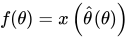
To implement a social choice function f ( θ ) {\displaystyle f(\theta )} {\displaystyle f(\theta )} is to find some transfer function t ( θ ) {\displaystyle t(\theta )} {\displaystyle t(\theta )} that motivates agents to pick f ( θ ) {\displaystyle f(\theta )} {\displaystyle f(\theta )}. Formally, if the equilibrium strategy profile under the mechanism maps to the same goods allocation as a social choice function,

f ( θ ) = x ( θ ^ ( θ ) ) {\displaystyle f(\theta )=x\left({\hat {\theta }}(\theta )\right)} {\displaystyle f(\theta )=x\left({\hat {\theta }}(\theta )\right)}

we say the mechanism implements the social choice function.

Thanks to the revelation principle, the designer can usually find a transfer function t ( θ ) {\displaystyle t(\theta )} {\displaystyle t(\theta )} to implement a social choice by solving an associated truthtelling game. If agents find it optimal to truthfully report type,

θ ^ ( θ ) = θ {\displaystyle {\hat {\theta }}(\theta )=\theta } {\displaystyle {\hat {\theta }}(\theta )=\theta }

we say such a mechanism is truthfully implementable. The task is then to solve for a truthfully implementable t ( θ ) {\displaystyle t(\theta )} {\displaystyle t(\theta )} and impute this transfer function to the original game. An allocation x ( θ ) {\displaystyle x(\theta )} {\displaystyle x(\theta )} is truthfully implementable if there exists a transfer function t ( θ ) {\displaystyle t(\theta )} {\displaystyle t(\theta )} such that

u ( x ( θ ) , t ( θ ) , θ ) ≥ u ( x ( θ ^ ) , t ( θ ^ ) , θ )   ∀ θ , θ ^ ∈ Θ {\displaystyle u(x(\theta ),t(\theta ),\theta )\geq u(x({\hat {\theta }}),t({\hat {\theta }}),\theta )\ \forall \theta ,{\hat {\theta }}\in \Theta } {\displaystyle u(x(\theta ),t(\theta ),\theta )\geq u(x({\hat {\theta }}),t({\hat {\theta }}),\theta )\ \forall \theta ,{\hat {\theta }}\in \Theta }

which is also called the incentive compatibility (IC) constraint.

In applications, the IC condition is the key to describing the shape of t ( θ ) {\displaystyle t(\theta )} {\displaystyle t(\theta )} in any useful way. Under certain conditions it can even isolate the transfer function analytically. Additionally, a participation (individual rationality) constraint is sometimes added if agents have the option of not playing.

Necessity

[edit]

Consider a setting in which all agents have a type-contingent utility function u ( x , t , θ ) {\displaystyle u(x,t,\theta )} {\displaystyle u(x,t,\theta )}. Consider also a goods allocation x ( θ ) {\displaystyle x(\theta )} {\displaystyle x(\theta )} that is vector-valued and size k {\displaystyle k} {\displaystyle k} (which permits k {\displaystyle k} {\displaystyle k} number of goods) and assume it is piecewise continuous with respect to its arguments.

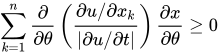
The function x ( θ ) {\displaystyle x(\theta )} {\displaystyle x(\theta )} is implementable only if

∑ k = 1 n ∂ ∂ θ ( ∂ u / ∂ x k | ∂ u / ∂ t | ) ∂ x ∂ θ ≥ 0 {\displaystyle \sum _{k=1}^{n}{\frac {\partial }{\partial \theta }}\left({\frac {\partial u/\partial x_{k}}{\left|\partial u/\partial t\right|}}\right){\frac {\partial x}{\partial \theta }}\geq 0} {\displaystyle \sum _{k=1}^{n}{\frac {\partial }{\partial \theta }}\left({\frac {\partial u/\partial x_{k}}{\left|\partial u/\partial t\right|}}\right){\frac {\partial x}{\partial \theta }}\geq 0}

whenever x = x ( θ ) {\displaystyle x=x(\theta )} {\displaystyle x=x(\theta )} and t = t ( θ ) {\displaystyle t=t(\theta )} {\displaystyle t=t(\theta )} and x is continuous at θ {\displaystyle \theta } {\displaystyle \theta }. This is a necessary condition and is derived from the first- and second-order conditions of the agent's optimization problem assuming truth-telling.

Its meaning can be understood in two pieces. The first piece says the agent's marginal rate of substitution (MRS) increases as a function of the type,
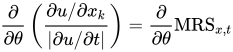
∂ ∂ θ ( ∂ u / ∂ x k | ∂ u / ∂ t | ) = ∂ ∂ θ M R S x , t {\displaystyle {\frac {\partial }{\partial \theta }}\left({\frac {\partial u/\partial x_{k}}{\left|\partial u/\partial t\right|}}\right)={\frac {\partial }{\partial \theta }}\mathrm {MRS} _{x,t}} {\displaystyle {\frac {\partial }{\partial \theta }}\left({\frac {\partial u/\partial x_{k}}{\left|\partial u/\partial t\right|}}\right)={\frac {\partial }{\partial \theta }}\mathrm {MRS} _{x,t}}

In short, agents will not tell the truth if the mechanism does not offer higher agent types a better deal. Otherwise, higher types facing any mechanism that punishes high types for reporting will lie and declare they are lower types, violating the truthtelling incentive-compatibility constraint. The second piece is a monotonicity condition waiting to happen,[clarification needed]

∂ x ∂ θ {\displaystyle {\frac {\partial x}{\partial \theta }}} {\displaystyle {\frac {\partial x}{\partial \theta }}}

which, to be positive, means higher types must be given more of the good.

There is potential for the two pieces to interact. If for some type range the contract offered less quantity to higher types ∂ x / ∂ θ < 0 {\displaystyle \partial x/\partial \theta <0} {\displaystyle \partial x/\partial \theta <0}, it is possible the mechanism could compensate by giving higher types a discount. But such a contract already exists for low-type agents, so this solution is pathological. Such a solution sometimes occurs in the process of solving for a mechanism. In these cases it must be "ironed". In a multiple-good environment it is also possible for the designer to reward the agent with more of one good to substitute for less of another (e.g. butter for margarine). Multiple-good mechanisms are an area of continuing research in mechanism design.

Sufficiency

[edit]

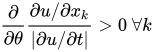
Mechanism design papers usually make two assumptions to ensure implementability:
∂ ∂ θ ∂ u / ∂ x k | ∂ u / ∂ t | > 0   ∀ k {\displaystyle {\frac {\partial }{\partial \theta }}{\frac {\partial u/\partial x_{k}}{\left|\partial u/\partial t\right|}}>0\ \forall k} {\displaystyle {\frac {\partial }{\partial \theta }}{\frac {\partial u/\partial x_{k}}{\left|\partial u/\partial t\right|}}>0\ \forall k}

This is known by several names: the single-crossing condition, the sorting condition and the Spence–Mirrlees condition. It means the utility function is of such a shape that the agent's MRS is increasing in type.[clarification needed]

∃ K 0 , K 1  such that  | ∂ u / ∂ x k ∂ u / ∂ t | ≤ K 0 + K 1 | t | {\displaystyle \exists K_{0},K_{1}{\text{ such that }}\left|{\frac {\partial u/\partial x_{k}}{\partial u/\partial t}}\right|\leq K_{0}+K_{1}|t|} {\displaystyle \exists K_{0},K_{1}{\text{ such that }}\left|{\frac {\partial u/\partial x_{k}}{\partial u/\partial t}}\right|\leq K_{0}+K_{1}|t|}

This is a technical condition bounding the rate of growth of the MRS.

These assumptions are sufficient to provide that any monotonic x ( θ ) {\displaystyle x(\theta )} {\displaystyle x(\theta )} is implementable (a t ( θ ) {\displaystyle t(\theta )} {\displaystyle t(\theta )} exists that can implement it). In addition, in the single-good setting the single-crossing condition is sufficient to provide that only a monotonic x ( θ ) {\displaystyle x(\theta )} {\displaystyle x(\theta )} is implementable, so the designer can confine his search to a monotonic x ( θ ) {\displaystyle x(\theta )} {\displaystyle x(\theta )}.

Highlighted results

[edit]

Revenue equivalence theorem

[edit]
Main article: Revenue equivalence

Vickrey (1961) gives a celebrated result that any member of a large class of auctions assures the seller of the same expected revenue and that the expected revenue is the best the seller can do. This is the case if

  1. The buyers have identical valuation functions (which may be a function of type)
  2. The buyers' types are independently distributed
  3. The buyers types are drawn from a continuous distribution
  4. The type distribution bears the monotone hazard rate property
  5. The mechanism sells the good to the buyer with the highest valuation

The last condition is crucial to the theorem. An implication is that for the seller to achieve higher revenue he must take a chance on giving the item to an agent with a lower valuation. Usually this means he must risk not selling the item at all.

Vickrey–Clarke–Groves mechanisms

[edit]
Main article: Vickrey–Clarke–Groves mechanism

The Vickrey (1961) auction model was later expanded by Clarke (1971) and Groves to treat a public choice problem in which a public project's cost is borne by all agents, e.g. whether to build a municipal bridge. The resulting "Vickrey–Clarke–Groves" mechanism can motivate agents to choose the socially efficient allocation of the public good even if agents have privately known valuations. In other words, it can solve the "tragedy of the commons"—under certain conditions, in particular quasilinear utility or if budget balance is not required.

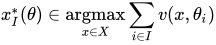
Consider a setting in which I {\displaystyle I} {\displaystyle I} number of agents have quasilinear utility with private valuations v ( x , t , θ ) {\displaystyle v(x,t,\theta )} {\displaystyle v(x,t,\theta )} where the currency t {\displaystyle t} {\displaystyle t} is valued linearly. The VCG designer designs an incentive compatible (hence truthfully implementable) mechanism to obtain the true type profile, from which the designer implements the socially optimal allocation

x I ∗ ( θ ) ∈ argmax x ∈ X ∑ i ∈ I v ( x , θ i ) {\displaystyle x_{I}^{*}(\theta )\in {\underset {x\in X}{\operatorname {argmax} }}\sum _{i\in I}v(x,\theta _{i})} {\displaystyle x_{I}^{*}(\theta )\in {\underset {x\in X}{\operatorname {argmax} }}\sum _{i\in I}v(x,\theta _{i})}

The cleverness of the VCG mechanism is the way it motivates truthful revelation. It eliminates incentives to misreport by penalizing any agent by the cost of the distortion he causes. Among the reports the agent may make, the VCG mechanism permits a "null" report saying he is indifferent to the public good and cares only about the money transfer. This effectively removes the agent from the game. If an agent does choose to report a type, the VCG mechanism charges the agent a fee if his report is pivotal, that is if his report changes the optimal allocation x so as to harm other agents. The payment is calculated

t i ( θ ^ ) = ∑ j ∈ I − i v j ( x I − i ∗ ( θ I − i ) , θ j ) − ∑ j ∈ I − i v j ( x I ∗ ( θ ^ i , θ I ) , θ j ) {\displaystyle t_{i}({\hat {\theta }})=\sum _{j\in I-i}v_{j}(x_{I-i}^{*}(\theta _{I-i}),\theta _{j})-\sum _{j\in I-i}v_{j}(x_{I}^{*}({\hat {\theta }}_{i},\theta _{I}),\theta _{j})} {\displaystyle t_{i}({\hat {\theta }})=\sum _{j\in I-i}v_{j}(x_{I-i}^{*}(\theta _{I-i}),\theta _{j})-\sum _{j\in I-i}v_{j}(x_{I}^{*}({\hat {\theta }}_{i},\theta _{I}),\theta _{j})}

which sums the distortion in the utilities of the other agents (and not his own) caused by one agent reporting.

Gibbard–Satterthwaite theorem

[edit]
Main article: Gibbard–Satterthwaite theorem

Gibbard (1973) and Satterthwaite (1975) give an impossibility result similar in spirit to Arrow's impossibility theorem. For a very general class of games, only "dictatorial" social choice functions can be implemented.

A social choice function f ( ⋅ ) {\displaystyle f(\cdot )} {\displaystyle f(\cdot )} is dictatorial if one agent always receives his most-favored goods allocation,

for  f ( Θ ) ,  ∃ i ∈ I  such that  u i ( x , θ i ) ≥ u i ( x ′ , θ i )   ∀ x ′ ∈ X {\displaystyle {\text{for }}f(\Theta ){\text{, }}\exists i\in I{\text{ such that }}u_{i}(x,\theta _{i})\geq u_{i}(x',\theta _{i})\ \forall x'\in X} {\displaystyle {\text{for }}f(\Theta ){\text{, }}\exists i\in I{\text{ such that }}u_{i}(x,\theta _{i})\geq u_{i}(x',\theta _{i})\ \forall x'\in X}

The theorem states that under general conditions any truthfully implementable social choice function must be dictatorial if,

  1. X is finite and contains at least three elements
  2. Preferences are rational
  3. f ( Θ ) = X {\displaystyle f(\Theta )=X} {\displaystyle f(\Theta )=X}

Myerson–Satterthwaite theorem

[edit]
Main article: Myerson–Satterthwaite theorem

Myerson and Satterthwaite (1983) show there is no efficient way for two parties to trade a good when they each have secret and probabilistically varying valuations for it, without the risk of forcing one party to trade at a loss. It is among the most remarkable negative results in economics—a kind of negative mirror to the fundamental theorems of welfare economics.

Shapley value

[edit]
Main article: Shapley value

Phillips and Marden (2018) proved that for cost-sharing games with concave cost functions, the optimal cost-sharing rule that firstly optimizes the worst-case inefficiencies in a game (the price of anarchy), and then secondly optimizes the best-case outcomes (the price of stability), is precisely the Shapley value cost-sharing rule.[7] A symmetrical statement is similarly valid for utility-sharing games with convex utility functions.

Price discrimination

[edit]

Mirrlees (1971) introduces a setting in which the transfer function t() is easy to solve for. Due to its relevance and tractability it is a common setting in the literature. Consider a single-good, single-agent setting in which the agent has quasilinear utility with an unknown type parameter θ {\displaystyle \theta } {\displaystyle \theta }

u ( x , t , θ ) = V ( x , θ ) − t {\displaystyle u(x,t,\theta )=V(x,\theta )-t} {\displaystyle u(x,t,\theta )=V(x,\theta )-t}

and in which the principal has a prior CDF over the agent's type P ( θ ) {\displaystyle P(\theta )} {\displaystyle P(\theta )}. The principal can produce goods at a convex marginal cost c(x) and wants to maximize the expected profit from the transaction

max x ( θ ) , t ( θ ) E θ [ t ( θ ) − c ( x ( θ ) ) ] {\displaystyle \max _{x(\theta ),t(\theta )}\mathbb {E} _{\theta }\left[t(\theta )-c\left(x(\theta )\right)\right]} {\displaystyle \max _{x(\theta ),t(\theta )}\mathbb {E} _{\theta }\left[t(\theta )-c\left(x(\theta )\right)\right]}

subject to IC and IR conditions

u ( x ( θ ) , t ( θ ) , θ ) ≥ u ( x ( θ ′ ) , t ( θ ′ ) , θ )   ∀ θ , θ ′ {\displaystyle u(x(\theta ),t(\theta ),\theta )\geq u(x(\theta '),t(\theta '),\theta )\ \forall \theta ,\theta '} {\displaystyle u(x(\theta ),t(\theta ),\theta )\geq u(x(\theta '),t(\theta '),\theta )\ \forall \theta ,\theta '}
u ( x ( θ ) , t ( θ ) , θ ) ≥ u _ ( θ )   ∀ θ {\displaystyle u(x(\theta ),t(\theta ),\theta )\geq {\underline {u}}(\theta )\ \forall \theta } {\displaystyle u(x(\theta ),t(\theta ),\theta )\geq {\underline {u}}(\theta )\ \forall \theta }

The principal here is a monopolist trying to set a profit-maximizing price scheme in which it cannot identify the type of the customer. A common example is an airline setting fares for business, leisure and student travelers. Due to the IR condition it has to give every type a good enough deal to induce participation. Due to the IC condition it has to give every type a good enough deal that the type prefers its deal to that of any other.

A trick given by Mirrlees (1971) is to use the envelope theorem to eliminate the transfer function from the expectation to be maximized,

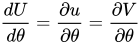
let  U ( θ ) = max θ ′ u ( x ( θ ′ ) , t ( θ ′ ) , θ ) {\displaystyle {\text{let }}U(\theta )=\max _{\theta '}u\left(x(\theta '),t(\theta '),\theta \right)} {\displaystyle {\text{let }}U(\theta )=\max _{\theta '}u\left(x(\theta '),t(\theta '),\theta \right)}
d U d θ = ∂ u ∂ θ = ∂ V ∂ θ {\displaystyle {\frac {dU}{d\theta }}={\frac {\partial u}{\partial \theta }}={\frac {\partial V}{\partial \theta }}} {\displaystyle {\frac {dU}{d\theta }}={\frac {\partial u}{\partial \theta }}={\frac {\partial V}{\partial \theta }}}

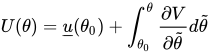
Integrating,

U ( θ ) = u _ ( θ 0 ) + ∫ θ 0 θ ∂ V ∂ θ ~ d θ ~ {\displaystyle U(\theta )={\underline {u}}(\theta _{0})+\int _{\theta _{0}}^{\theta }{\frac {\partial V}{\partial {\tilde {\theta }}}}d{\tilde {\theta }}} {\displaystyle U(\theta )={\underline {u}}(\theta _{0})+\int _{\theta _{0}}^{\theta }{\frac {\partial V}{\partial {\tilde {\theta }}}}d{\tilde {\theta }}}

where θ 0 {\displaystyle \theta _{0}} {\displaystyle \theta _{0}} is some index type. Replacing the incentive-compatible t ( θ ) = V ( x ( θ ) , θ ) − U ( θ ) {\displaystyle t(\theta )=V(x(\theta ),\theta )-U(\theta )} {\displaystyle t(\theta )=V(x(\theta ),\theta )-U(\theta )} in the maximand,

E θ [ V ( x ( θ ) , θ ) − u _ ( θ 0 ) − ∫ θ 0 θ ∂ V ∂ θ ~ d θ ~ − c ( x ( θ ) ) ] = E θ [ V ( x ( θ ) , θ ) − u _ ( θ 0 ) − 1 − P ( θ ) p ( θ ) ∂ V ∂ θ − c ( x ( θ ) ) ] {\displaystyle {\begin{aligned}&\mathbb {E} _{\theta }\left[V(x(\theta ),\theta )-{\underline {u}}(\theta _{0})-\int _{\theta _{0}}^{\theta }{\frac {\partial V}{\partial {\tilde {\theta }}}}d{\tilde {\theta }}-c\left(x(\theta )\right)\right]\\&{}=\mathbb {E} _{\theta }\left[V(x(\theta ),\theta )-{\underline {u}}(\theta _{0})-{\frac {1-P(\theta )}{p(\theta )}}{\frac {\partial V}{\partial \theta }}-c\left(x(\theta )\right)\right]\end{aligned}}} {\displaystyle {\begin{aligned}&\mathbb {E} _{\theta }\left[V(x(\theta ),\theta )-{\underline {u}}(\theta _{0})-\int _{\theta _{0}}^{\theta }{\frac {\partial V}{\partial {\tilde {\theta }}}}d{\tilde {\theta }}-c\left(x(\theta )\right)\right]\\&{}=\mathbb {E} _{\theta }\left[V(x(\theta ),\theta )-{\underline {u}}(\theta _{0})-{\frac {1-P(\theta )}{p(\theta )}}{\frac {\partial V}{\partial \theta }}-c\left(x(\theta )\right)\right]\end{aligned}}}

after an integration by parts. This function can be maximized pointwise.

Because U ( θ ) {\displaystyle U(\theta )} {\displaystyle U(\theta )} is incentive-compatible already the designer can drop the IC constraint. If the utility function satisfies the Spence–Mirrlees condition then a monotonic x ( θ ) {\displaystyle x(\theta )} {\displaystyle x(\theta )} function exists. The IR constraint can be checked at equilibrium and the fee schedule raised or lowered accordingly. Additionally, note the presence of a hazard rate in the expression. If the type distribution bears the monotone hazard ratio property, the FOC is sufficient to solve for t(). If not, then it is necessary to check whether the monotonicity constraint (see sufficiency, above) is satisfied everywhere along the allocation and fee schedules. If not, then the designer must use Myerson ironing.

Myerson ironing

[edit]
It is possible to solve for a goods or price schedule that satisfies the first-order conditions yet is not monotonic. If so it is necessary to "iron" the schedule by choosing some value at which to flatten the function.

In some applications the designer may solve the first-order conditions for the price and allocation schedules yet find they are not monotonic. For example, in the quasilinear setting this often happens when the hazard ratio is itself not monotone. By the Spence–Mirrlees condition the optimal price and allocation schedules must be monotonic, so the designer must eliminate any interval over which the schedule changes direction by flattening it.

Intuitively, what is going on is the designer finds it optimal to bunch certain types together and give them the same contract. Normally the designer motivates higher types to distinguish themselves by giving them a better deal. If there are insufficiently few higher types on the margin the designer does not find it worthwhile to grant lower types a concession (called their information rent) in order to charge higher types a type-specific contract.

Consider a monopolist principal selling to agents with quasilinear utility, the example above. Suppose the allocation schedule x ( θ ) {\displaystyle x(\theta )} {\displaystyle x(\theta )} satisfying the first-order conditions has a single interior peak at θ 1 {\displaystyle \theta _{1}} {\displaystyle \theta _{1}} and a single interior trough at θ 2 > θ 1 {\displaystyle \theta _{2}>\theta _{1}} {\displaystyle \theta _{2}>\theta _{1}}, illustrated at right.

  • Following Myerson (1981) flatten it by choosing x {\displaystyle x} {\displaystyle x} satisfying ∫ ϕ 2 ( x ) ϕ 1 ( x ) ( ∂ V ∂ x ( x , θ ) − 1 − P ( θ ) p ( θ ) ∂ 2 V ∂ θ ∂ x ( x , θ ) − ∂ c ∂ x ( x ) ) d θ = 0 {\displaystyle \int _{\phi _{2}(x)}^{\phi _{1}(x)}\left({\frac {\partial V}{\partial x}}(x,\theta )-{\frac {1-P(\theta )}{p(\theta )}}{\frac {\partial ^{2}V}{\partial \theta \,\partial x}}(x,\theta )-{\frac {\partial c}{\partial x}}(x)\right)d\theta =0} {\displaystyle \int _{\phi _{2}(x)}^{\phi _{1}(x)}\left({\frac {\partial V}{\partial x}}(x,\theta )-{\frac {1-P(\theta )}{p(\theta )}}{\frac {\partial ^{2}V}{\partial \theta \,\partial x}}(x,\theta )-{\frac {\partial c}{\partial x}}(x)\right)d\theta =0} where ϕ 1 ( x ) {\displaystyle \phi _{1}(x)} {\displaystyle \phi _{1}(x)} is the inverse function of x mapping to θ ≤ θ 1 {\displaystyle \theta \leq \theta _{1}} {\displaystyle \theta \leq \theta _{1}} and ϕ 2 ( x ) {\displaystyle \phi _{2}(x)} {\displaystyle \phi _{2}(x)} is the inverse function of x mapping to θ ≥ θ 2 {\displaystyle \theta \geq \theta _{2}} {\displaystyle \theta \geq \theta _{2}}. That is, ϕ 1 {\displaystyle \phi _{1}} {\displaystyle \phi _{1}} returns a θ {\displaystyle \theta } {\displaystyle \theta } before the interior peak and ϕ 2 {\displaystyle \phi _{2}} {\displaystyle \phi _{2}} returns a θ {\displaystyle \theta } {\displaystyle \theta } after the interior trough.
  • If the nonmonotonic region of x ( θ ) {\displaystyle x(\theta )} {\displaystyle x(\theta )} borders the edge of the type space, simply set the appropriate ϕ ( x ) {\displaystyle \phi (x)} {\displaystyle \phi (x)} function (or both) to the boundary type. If there are multiple regions, see a textbook for an iterative procedure; it may be that more than one troughs should be ironed together.

Proof

[edit]

The proof uses the theory of optimal control. It considers the set of intervals [ θ _ , θ ¯ ] {\displaystyle \left[{\underline {\theta }},{\overline {\theta }}\right]} {\displaystyle \left[{\underline {\theta }},{\overline {\theta }}\right]} in the nonmonotonic region of x ( θ ) {\displaystyle x(\theta )} {\displaystyle x(\theta )} over which it might flatten the schedule. It then writes a Hamiltonian to obtain necessary conditions for a x ( θ ) {\displaystyle x(\theta )} {\displaystyle x(\theta )} within the intervals

  1. that does satisfy monotonicity
  2. for which the monotonicity constraint is not binding on the boundaries of the interval

Condition two ensures that the x ( θ ) {\displaystyle x(\theta )} {\displaystyle x(\theta )} satisfying the optimal control problem reconnects to the schedule in the original problem at the interval boundaries (no jumps). Any x ( θ ) {\displaystyle x(\theta )} {\displaystyle x(\theta )} satisfying the necessary conditions must be flat because it must be monotonic and yet reconnect at the boundaries.

As before maximize the principal's expected payoff, but this time subject to the monotonicity constraint

∂ x ∂ θ ≥ 0 {\displaystyle {\frac {\partial x}{\partial \theta }}\geq 0} {\displaystyle {\frac {\partial x}{\partial \theta }}\geq 0}

and use a Hamiltonian to do it, with shadow price ν ( θ ) {\displaystyle \nu (\theta )} {\displaystyle \nu (\theta )}

H = ( V ( x , θ ) − u _ ( θ 0 ) − 1 − P ( θ ) p ( θ ) ∂ V ∂ θ ( x , θ ) − c ( x ) ) p ( θ ) + ν ( θ ) ∂ x ∂ θ {\displaystyle H=\left(V(x,\theta )-{\underline {u}}(\theta _{0})-{\frac {1-P(\theta )}{p(\theta )}}{\frac {\partial V}{\partial \theta }}(x,\theta )-c(x)\right)p(\theta )+\nu (\theta ){\frac {\partial x}{\partial \theta }}} {\displaystyle H=\left(V(x,\theta )-{\underline {u}}(\theta _{0})-{\frac {1-P(\theta )}{p(\theta )}}{\frac {\partial V}{\partial \theta }}(x,\theta )-c(x)\right)p(\theta )+\nu (\theta ){\frac {\partial x}{\partial \theta }}}

where x {\displaystyle x} {\displaystyle x} is a state variable and ∂ x / ∂ θ {\displaystyle \partial x/\partial \theta } {\displaystyle \partial x/\partial \theta } the control. As usual in optimal control the costate evolution equation must satisfy

∂ ν ∂ θ = − ∂ H ∂ x = − ( ∂ V ∂ x ( x , θ ) − 1 − P ( θ ) p ( θ ) ∂ 2 V ∂ θ ∂ x ( x , θ ) − ∂ c ∂ x ( x ) ) p ( θ ) {\displaystyle {\frac {\partial \nu }{\partial \theta }}=-{\frac {\partial H}{\partial x}}=-\left({\frac {\partial V}{\partial x}}(x,\theta )-{\frac {1-P(\theta )}{p(\theta )}}{\frac {\partial ^{2}V}{\partial \theta \,\partial x}}(x,\theta )-{\frac {\partial c}{\partial x}}(x)\right)p(\theta )} {\displaystyle {\frac {\partial \nu }{\partial \theta }}=-{\frac {\partial H}{\partial x}}=-\left({\frac {\partial V}{\partial x}}(x,\theta )-{\frac {1-P(\theta )}{p(\theta )}}{\frac {\partial ^{2}V}{\partial \theta \,\partial x}}(x,\theta )-{\frac {\partial c}{\partial x}}(x)\right)p(\theta )}

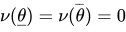
Taking advantage of condition 2, note the monotonicity constraint is not binding at the boundaries of the θ {\displaystyle \theta } {\displaystyle \theta } interval,

ν ( θ _ ) = ν ( θ ¯ ) = 0 {\displaystyle \nu ({\underline {\theta }})=\nu ({\overline {\theta }})=0} {\displaystyle \nu ({\underline {\theta }})=\nu ({\overline {\theta }})=0}

meaning the costate variable condition can be integrated and also equals 0

∫ θ _ θ ¯ ( ∂ V ∂ x ( x , θ ) − 1 − P ( θ ) p ( θ ) ∂ 2 V ∂ θ ∂ x ( x , θ ) − ∂ c ∂ x ( x ) ) p ( θ ) d θ = 0 {\displaystyle \int _{\underline {\theta }}^{\overline {\theta }}\left({\frac {\partial V}{\partial x}}(x,\theta )-{\frac {1-P(\theta )}{p(\theta )}}{\frac {\partial ^{2}V}{\partial \theta \,\partial x}}(x,\theta )-{\frac {\partial c}{\partial x}}(x)\right)p(\theta )\,d\theta =0} {\displaystyle \int _{\underline {\theta }}^{\overline {\theta }}\left({\frac {\partial V}{\partial x}}(x,\theta )-{\frac {1-P(\theta )}{p(\theta )}}{\frac {\partial ^{2}V}{\partial \theta \,\partial x}}(x,\theta )-{\frac {\partial c}{\partial x}}(x)\right)p(\theta )\,d\theta =0}

The average distortion of the principal's surplus must be 0. To flatten the schedule, find an x {\displaystyle x} {\displaystyle x} such that its inverse image maps to a θ {\displaystyle \theta } {\displaystyle \theta } interval satisfying the condition above.

See also

[edit]
  • Algorithmic mechanism design
  • Alvin E. Roth – Nobel Prize, market design
  • Assignment problem
  • Budget-feasible mechanism
  • Contract theory
  • Implementation theory
  • Incentive compatibility
  • Revelation principle
  • Smart market
  • Metagame

Notes

[edit]
  1. ^ "Journal of Mechanism and Institution Design". www.mechanism-design.org. Retrieved 2024-07-01.
  2. ^ a b Penna, Paolo; Ventre, Carmine (July 2014). "Optimal collusion-resistant mechanisms with verification". Games and Economic Behavior. 86: 491–509. doi:10.1016/j.geb.2012.09.002. ISSN 0899-8256.
  3. ^ L. Hurwicz & S. Reiter (2006), Designing Economic Mechanisms, p. 30
  4. ^ "The Sveriges Riksbank Prize in Economic Sciences in Memory of Alfred Nobel 2007" (Press release). Nobel Foundation. October 15, 2007. Retrieved 2008-08-15.
  5. ^ Vazirani, Vijay V.; Nisan, Noam; Roughgarden, Tim; Tardos, Éva (2007). Algorithmic Game Theory (PDF). Cambridge, UK: Cambridge University Press. ISBN 0-521-87282-0.
  6. ^ In unusual circumstances some truth-telling games have more equilibria than the Bayesian game they mapped from. See Fudenburg-Tirole Ch. 7.2 for some references.
  7. ^ Phillips, Matthew; Marden, Jason R. (July 2018). "Design Tradeoffs in Concave Cost-Sharing Games". IEEE Transactions on Automatic Control. 63 (7): 2242–2247. Bibcode:2018ITAC...63.2242P. doi:10.1109/tac.2017.2765299. ISSN 0018-9286. S2CID 45923961.

References

[edit]
  • Clarke, Edward H. (1971). "Multipart Pricing of Public Goods" (PDF). Public Choice. 11 (1): 17–33. doi:10.1007/BF01726210. JSTOR 30022651. S2CID 154860771. Archived from the original (PDF) on 2017-05-10. Retrieved 2016-08-12.
  • Gibbard, Allan (1973). "Manipulation of voting schemes: A general result" (PDF). Econometrica. 41 (4): 587–601. doi:10.2307/1914083. JSTOR 1914083. Archived from the original (PDF) on 2016-08-23. Retrieved 2016-08-12.
  • Groves, Theodore (1973). "Incentives in Teams" (PDF). Econometrica. 41 (4): 617–631. doi:10.2307/1914085. JSTOR 1914085.
  • Harsanyi, John C. (1967). "Games with incomplete information played by "Bayesian" players, I-III. part I. The Basic Model". Management Science. 14 (3): 159–182. Bibcode:1967ManSc..14..159H. doi:10.1287/mnsc.14.3.159. JSTOR 2628393.
  • Mirrlees, J. A. (1971). "An Exploration in the Theory of Optimum Income Taxation" (PDF). Review of Economic Studies. 38 (2): 175–208. Bibcode:1971RvES...38..175M. doi:10.2307/2296779. JSTOR 2296779. Archived from the original (PDF) on 2017-05-10. Retrieved 2016-08-12.
  • Myerson, Roger B.; Satterthwaite, Mark A. (1983). "Efficient Mechanisms for Bilateral Trading" (PDF). Journal of Economic Theory. 29 (2): 265–281. doi:10.1016/0022-0531(83)90048-0. hdl:10419/220829. Archived from the original (PDF) on 2017-05-10. Retrieved 2016-08-12.
  • Satterthwaite, Mark Allen (1975). "Strategy-proofness and Arrow's conditions: Existence and correspondence theorems for voting procedures and social welfare functions". Journal of Economic Theory. 10 (2): 187–217. CiteSeerX 10.1.1.471.9842. doi:10.1016/0022-0531(75)90050-2.
  • Vickrey, William (1961). "Counterspeculation, Auctions, and Competitive Sealed Tenders" (PDF). The Journal of Finance. 16 (1): 8–37. Bibcode:1961JFin...16....8V. doi:10.1111/j.1540-6261.1961.tb02789.x.

Further reading

[edit]
  • Chapter 7 of Fudenberg, Drew; Tirole, Jean (1991), Game Theory, Boston: MIT Press, ISBN 978-0-262-06141-4. A standard text for graduate game theory.
  • Chapter 23 of Mas-Colell; Whinston; Green (1995), Microeconomic Theory, Oxford: Oxford University Press, ISBN 978-0-19-507340-9. A standard text for graduate microeconomics.
  • Milgrom, Paul (2004), Putting Auction Theory to Work, New York: Cambridge University Press, ISBN 978-0-521-55184-7. Applications of mechanism design principles in the context of auctions.
  • Noam Nisan. A Google tech talk on mechanism design.
  • Legros, Patrick; Cantillon, Estelle (2007). "What is mechanism design and why does it matter for policy-making?". Centre for Economic Policy Research.
  • Roger B. Myerson (2008), "Mechanism Design", The New Palgrave Dictionary of Economics Online, Abstract.
  • Diamantaras, Dimitrios (2009), A Toolbox for Economic Design, New York: Palgrave Macmillan, ISBN 978-0-230-61060-6. A graduate text specifically focused on mechanism design.

External links

[edit]
  • Eric Maskin "Nobel Prize Lecture" delivered on 8 December 2007 at Aula Magna, Stockholm University.
  • v
  • t
  • e
Game theory
  • Glossary
  • Game theorists
  • Games
Traditional game theory
Definitions
  • Asynchrony
  • Bayesian regret
  • Best response
  • Bounded rationality
  • Cheap talk
  • Coalition
  • Complete contract
  • Complete information
  • Complete mixing
  • Conjectural variation
  • Contingent cooperator
  • Coopetition
  • Cooperative game theory
  • Dynamic inconsistency
  • Escalation of commitment
  • Farsightedness
  • Game semantics
  • Hierarchy of beliefs
  • Imperfect information
  • Incomplete information
  • Information set
  • Move by nature
  • Mutual knowledge
  • Non-cooperative game theory
  • Non-credible threat
  • Outcome
  • Perfect information
  • Perfect recall
  • Ply
  • Preference
  • Rationality
  • Sequential game
  • Simultaneous action selection
  • Spite
  • Strategic complements
  • Strategic dominance
  • Strategic form
  • Strategic interaction
  • Strategic move
  • Strategy
  • Subgame
  • Succinct game
  • Topological game
  • Tragedy of the commons
  • Uncorrelated asymmetry
Equilibrium
concepts
  • Backward induction
  • Bayes correlated equilibrium
  • Bayesian efficiency
  • Bayesian game
  • Bayesian Nash equilibrium
  • Berge equilibrium
  • Bertrand–Edgeworth model
  • Coalition-proof Nash equilibrium
  • Core
  • Correlated equilibrium
  • Cursed equilibrium
  • Edgeworth price cycle
  • Epsilon-equilibrium
  • Gibbs equilibrium
  • Incomplete contracts
  • Inequity aversion
  • Individual rationality
  • Iterated elimination of dominated strategies
  • Markov perfect equilibrium
  • Mertens-stable equilibrium
  • Nash equilibrium
  • Open-loop model
  • Pareto efficiency
  • Payoff dominance
  • Perfect Bayesian equilibrium
  • Price of anarchy
  • Program equilibrium
  • Proper equilibrium
  • Quantal response equilibrium
  • Quasi-perfect equilibrium
  • Rational agent
  • Rationalizability
  • Rationalizable strategy
  • Satisfaction equilibrium
  • Self-confirming equilibrium
  • Sequential equilibrium
  • Shapley value
  • Strong Nash equilibrium
  • Subgame perfect equilibrium
  • Trembling hand equilibrium
Strategies
  • Appeasement
  • Bid shading
  • Cheap talk
  • Collusion
  • Commitment device
  • De-escalation
  • Deterrence
  • Escalation
  • Fictitious play
  • Focal point
  • Grim trigger
  • Hobbesian trap
  • Markov strategy
  • Max-dominated strategy
  • Mixed strategy
  • Pure strategy
  • Tit for tat
  • Win–stay, lose–switch
Games
  • All-pay auction
  • Battle of the sexes
  • Nash bargaining game
  • Bertrand competition
  • Blotto game
  • Centipede game
  • Coordination game
  • Cournot competition
  • Deadlock
  • Dictator game
  • Trust game
  • Diner's dilemma
  • Dollar auction
  • El Farol Bar problem
  • Electronic mail game
  • Gift-exchange game
  • Guess 2/3 of the average
  • Keynesian beauty contest
  • Kuhn poker
  • Lewis signaling game
  • Matching pennies
  • Obligationes
  • Optional prisoner's dilemma
  • Pirate game
  • Prisoner's dilemma
  • Public goods game
  • Rendezvous problem
  • Rock paper scissors
  • Stackelberg competition
  • Stag hunt
  • Traveler's dilemma
  • Ultimatum game
  • Volunteer's dilemma
  • War of attrition
Theorems
  • Arrow's impossibility theorem
  • Aumann's agreement theorem
  • Brouwer fixed-point theorem
  • Competitive altruism
  • Folk theorem
  • Gibbard–Satterthwaite theorem
  • Gibbs lemma
  • Glicksberg's theorem
  • Kakutani fixed-point theorem
  • Kuhn's theorem
  • One-shot deviation principle
  • Prim–Read theory
  • Rational ignorance
  • Rational irrationality
  • Sperner's lemma
  • Zermelo's theorem
Subfields
  • Algorithmic game theory
  • Behavioral game theory
  • Behavioral strategy
  • Compositional game theory
  • Confrontation analysis
  • Contract theory
  • Drama theory
  • Graphical game theory
  • Heresthetic
  • Mean-field game theory
  • Negotiation theory
  • Quantum game theory
  • Social software
Key people
  • Albert W. Tucker
  • Alvin E. Roth
  • Amos Tversky
  • Antoine Augustin Cournot
  • Ariel Rubinstein
  • David Gale
  • David K. Levine
  • David M. Kreps
  • Donald B. Gillies
  • Drew Fudenberg
  • Eric Maskin
  • Harold W. Kuhn
  • Herbert Simon
  • Herbert Scarf
  • Hervé Moulin
  • Jean Tirole
  • Jean-François Mertens
  • Jennifer Tour Chayes
  • Ken Binmore
  • Kenneth Arrow
  • Leonid Hurwicz
  • Lloyd Shapley
  • Martin Shubik
  • Melvin Dresher
  • Merrill M. Flood
  • Olga Bondareva
  • Oskar Morgenstern
  • Paul Milgrom
  • Peyton Young
  • Reinhard Selten
  • Robert Aumann
  • Robert Axelrod
  • Robert B. Wilson
  • Roger Myerson
  • Samuel Bowles
  • Suzanne Scotchmer
  • Thomas Schelling
  • William Vickrey
Combinatorial game theory
Core
concepts
  • Combinatorial explosion
  • Determinacy
  • Disjunctive sum
  • First-player and second-player win
  • Game complexity
  • Game tree
  • Impartial game
  • Misère
  • Partisan game
  • Solved game
  • Sprague–Grundy theorem
  • Strategy-stealing argument
  • Zugzwang
Games
  • Chess
  • Chomp
  • Clobber
  • Cram
  • Domineering
  • Hackenbush
  • Nim
  • Notakto
  • Subtract a square
  • Sylver coinage
  • Toads and Frogs
Mathematical
tools
  • Mex
  • Nimber
  • On Numbers and Games
  • Star
  • Surreal number
  • Winning Ways for Your Mathematical Plays
Search
algorithms
  • Alpha–beta pruning
  • Expectiminimax
  • Minimax
  • Monte Carlo tree search
  • Negamax
  • Paranoid algorithm
  • Principal variation search
Key people
  • Claude Shannon
  • John Conway
  • John von Neumann
Evolutionary game theory
Core
concepts
  • Bishop–Cannings theorem
  • Evolution and the Theory of Games
  • Evolutionarily stable set
  • Evolutionarily stable state
  • Evolutionarily stable strategy
  • Replicator equation
  • Risk dominance
  • Stochastically stable equilibrium
  • Weak evolutionarily stable strategy
Games
  • Chicken
  • Stag hunt
Applications
  • Cultural group selection
  • Fisher's principle
  • Mobbing
  • Terminal investment hypothesis
Key people
  • John Maynard Smith
  • Robert Axelrod
Mechanism design
Core
concepts
  • Algorithmic mechanism design
  • Bayesian-optimal mechanism
  • Incentive compatibility
  • Market design
  • Myerson ironing
  • Monotonicity
  • Participation constraint
  • Revelation principle
  • Strategyproofness
  • Vickrey–Clarke–Groves mechanism
  • Virtual valuation
Theorems
  • Myerson–Satterthwaite theorem
  • Revenue equivalence
  • Border's theorem
Applications
  • Digital goods auction
  • Knapsack auction
  • Truthful cake-cutting
Other topics
  • Bertrand paradox
  • Chainstore paradox
  • Computational complexity of games
  • Helly metric
  • Multi-agent system
  • PPAD-complete
  • icon Mathematics portal
  • Commons
  • WikiProject
  • Category
  • v
  • t
  • e
Economics
Theoretical
  • Microeconomics
    • Decision theory
    • Price theory
    • Game theory
    • Contract theory
    • Mechanism design
  • Macroeconomics
  • Mathematical economics
  • Complexity economics
  • Computational economics
    • Agent-based computational economics
  • Behavioral economics
  • Pluralism in economics
Empirical
  • Econometrics
    • Economic statistics
  • Experimental economics
  • Economic history
Applied
  • Agriculture
  • Business
  • Cultural
  • Demographic
  • Development
  • Ecological
  • Education
  • Engineering
  • Environmental
  • Evolutionary
  • Financial
  • Geographic
  • Happiness
  • Health
  • History
  • Information
  • Infrastructure
  • Institutions
  • Labour
  • Law
  • Management
  • Non-monetary
  • Organization
  • Participation
  • Personnel
  • Planning
  • Policy
  • Public sector
  • Public choice
  • Social choice
  • Regional
  • Regulatory
  • Resources
  • Rural
  • Service
  • Transport
  • Urban
  • Welfare
Schools
(history)
  • Attention
  • Mainstream
  • Heterodox
  • American (National)
  • Ancient thought
  • Austrian
  • Behavioral
  • Buddhist
  • Chartalism
    • Modern monetary theory
  • Chicago
  • Classical
  • Critique of political economy
  • Democratic
  • Disequilibrium
  • Ecological
  • Evolutionary
  • Feminist
  • Freiwirtschaft
  • Georgism
  • Happiness
  • Historical
  • Humanistic
  • Institutional
  • Keynesian
    • Neo- (neoclassical–Keynesian synthesis)
    • New
    • Post-
      • Circuitism
  • Malthusianism
  • Marginalism
  • Marxian
    • Neo-
  • Mercantilism
  • Mixed
  • Mutualism
  • Neoclassical
    • Lausanne
  • New classical
    • Real business-cycle theory
  • New institutional
  • Physiocracy
  • Socialist
  • Stockholm
  • Supply-side
  • Thermo
Economists
  • de Mandeville
  • Quesnay
  • Smith
  • Malthus
  • Say
  • Ricardo
  • von Thünen
  • List
  • Bastiat
  • Cournot
  • Mill
  • Gossen
  • Marx
  • Walras
  • Jevons
  • George
  • Menger
  • Marshall
  • Edgeworth
  • Clark
  • Pareto
  • von Böhm-Bawerk
  • von Wieser
  • Veblen
  • Gesell
  • Fisher
  • Pigou
  • Heckscher
  • von Mises
  • Schumpeter
  • Keynes
  • Knight
  • Polanyi
  • Frisch
  • Sraffa
  • Myrdal
  • Hayek
  • Kalecki
  • Röpke
  • Kuznets
  • Tinbergen
  • Robinson
  • von Neumann
  • Hicks
  • Lange
  • Leontief
  • Galbraith
  • Koopmans
  • Schumacher
  • Friedman
  • Samuelson
  • Simon
  • Buchanan
  • Arrow
  • Baumol
  • Solow
  • Rothbard
  • Greenspan
  • Sowell
  • Becker
  • Ostrom
  • Sen
  • Lucas
  • Stiglitz
  • Thaler
  • Hoppe
  • Krugman
  • Piketty
  • more
Lists
  • Glossary
  • Economists
  • Publications (journals)
  • Schools
  • Category
  • Index
  • Lists
  • Outline
  • Publications
  • Business portal
  • v
  • t
  • e
Design
  • Outline
  • Designer
Disciplines
Communication
design
  • Advertising
  • Book design
  • Brand design
  • Exhibit design
  • Film title design
  • Graphic design
    • Motion
    • Postage stamp design
    • Print design
  • Illustration
  • Information design
  • Instructional design
  • News design
  • Photography
  • Retail design
  • Signage / Traffic sign design
  • Typography / Type design
  • Video design
  • Visual merchandising
Environmental
design
  • Architecture
  • Architectural lighting design
  • Building design
    • Passive solar
  • Ecological design
  • Environmental impact design
  • Garden design
    • Computer-aided
  • Healthy community design
  • Hotel design
  • Interior architecture
  • Interior design
    • EID
  • Keyline design
  • Landscape architecture
    • Sustainable
  • Landscape design
  • Spatial design
  • Urban design
Industrial
design
  • Automotive design
  • Automotive suspension design
  • CMF design
  • Corrugated box design
  • Electric guitar design
  • Furniture design
    • Sustainable
  • Hardware interface design
  • Motorcycle design
  • Packaging and labeling
  • Photographic lens design
  • Product design
  • Production design
  • Sensory design
  • Service design
Interaction
design
  • Experience design
    • EED
  • Game design
    • Level design
    • Video game design
  • Hardware interface design
  • Icon design
  • Immersive design
  • Information design
  • Interactive design
  • Sonic interaction design
  • User experience design
  • User interface design
  • Web design
Other
applied arts
  • Public art design
  • Ceramic / glass design
  • Fashion design
    • Costume design
    • Jewellery design
  • Floral design
  • Game art design
  • Property design
  • Scenic design
  • Sound design
  • Stage/set lighting design
  • Textile design
Other
design
& engineering
  • Algorithm design
  • Behavioural design
  • Boiler design
  • Database design
  • Drug design
  • Electrical system design
  • Experimental design
  • Filter design
  • Geometric design
  • Work design
  • Integrated circuit design
    • Circuit design
    • Physical design
    • Power network design
  • Mechanism design
  • Nuclear weapon design
  • Nucleic acid design
  • Organization design
  • Process design
  • Processor design
  • Protein design
  • Research design
  • Social design
  • Software design
  • Spacecraft design
  • Strategic design
  • Systems design
  • Test design
Approaches
  • Active
  • Activity-centered
  • Adaptive web
  • Affective
  • Brainstorming
  • By committee
  • By contract
  • C-K theory
  • Closure
  • Configuration
  • Contextual
  • Continuous
  • Cradle-to-cradle
  • Creative problem-solving
  • Creativity techniques
  • Critical
    • Design fiction
  • Defensive
  • Design–bid–build
  • Design–build
    • architect-led
  • Diffuse
  • Domain-driven
  • Ecological design
  • Energy neutral
  • Engineering design process
    • Probabilistic design
  • Ergonomic
  • Error-tolerant
  • Evidence-based
  • Fault-tolerant
  • Feminist
  • For assembly
  • For behaviour change
  • For manufacturability
  • For Six Sigma
  • For testing
  • For the environment
  • For X
  • Framework-oriented
  • Functional
  • Generative
  • Geodesign
  • HCD
  • High-level
  • Hostile
  • Inclusive
  • Integrated
  • Integrated topside
  • Intelligence-based
  • Iterative
  • KISS principle
  • Low-level
  • Metadesign
  • Mind mapping
  • Modular
  • New Wave
  • Object-oriented
  • Open
  • Over
  • Parametric
  • Participatory
  • Platform-based
  • Policy-based
  • Prevention through
  • Process-centered
  • Public interest
    • Opinion poll
    • Public opinion
  • Rational
  • Regenerative
  • Reliability engineering
  • Research-based
  • Responsibility-driven
  • RWD
  • Safe-life
  • Speculative
  • Sustainable
  • Systemic
    • SOD
  • Tableless web
  • Theory of constraints
  • Top-down and bottom-up
  • Transformation
  • Transgenerational
  • TRIZ
  • Universal
    • Design for All
  • Usage-centered
  • Use-centered
  • User-centered
    • Empathic
  • User innovation
  • Value-driven
  • Value sensitive
    • Privacy by
    • Quality by
    • Secure by
  • Design choice
  • computing
  • controls
  • culture
  • flow
  • justice
  • leadership
  • management
  • marker
  • methods
  • pattern
  • research
  • science
  • sprint
  • strategy
  • theory
  • thinking
  • Tools
  • Intellectual property
  • Organizations
  • Awards
Tools
  • AAD
  • Architectural model
  • Blueprint
  • Comprehensive layout
  • CAD
    • CAID
    • Virtual home design software
  • CAutoD
  • Design quality indicator
  • Electronic design automation
  • Flowchart
  • Mockup
  • Design specification
  • Design system
  • Prototype
  • Sketch
  • Storyboard
  • Technical drawing
  • HTML editor
  • Website wireframe
Intellectual
property
  • Clean-room design
  • Community design
  • Design around
  • Design infringement
  • Design patent
  • Fashion design copyright
  • Geschmacksmuster
  • Industrial design rights
    • European Union
Organizations
  • American Institute of Graphic Arts
  • Chartered Society of Designers
  • Design and Industries Association
  • Design Council
  • International Forum Design
  • Design Research Society
Awards
  • European Design Award
  • German Design Award
  • Good Design Award (Museum of Modern Art)
  • Good Design Award (Chicago Athenaeum)
  • Graphex
  • IF Product Design Award
  • James Dyson Award
  • Prince Philip Designers Prize
Related topics
  • Agile
  • Concept art
  • Conceptual design
  • Creative industries
  • Cultural icon
  • .design
  • Dominant design
  • Enterprise architecture
  • Form factor
  • Futures studies
  • Indie design
  • Innovation management
  • Intelligent design
  • Lean startup
  • New product development
  • OODA loop
  • Philosophy of design
  • Process simulation
  • Reference design
  • Slow design
  • STEAM fields
  • Unintelligent design
  • Visualization
  • Wicked problem
  • Design attributes
  • brief
  • change
  • classic
  • competition
    • architectural
    • student
  • director
  • education
  • elements
  • engineer
  • firm
  • history
  • knowledge
  • language
  • life
  • load
  • museum
  • optimization
  • paradigm
  • principles
  • rationale
  • review
  • specification
  • studies
  • studio
  • technology
Authority control databases Edit this at Wikidata
  • GND
Retrieved from "https://teknopedia.ac.id/w/index.php?title=Mechanism_design&oldid=1342057660"
Categories:
  • Mechanism design
  • Social choice theory
Hidden categories:
  • Articles with short description
  • Short description is different from Wikidata
  • Articles lacking in-text citations from July 2024
  • All articles lacking in-text citations
  • Wikipedia articles needing clarification from July 2024
  • Articles with excerpts

  • indonesia
  • Polski
  • العربية
  • Deutsch
  • English
  • Español
  • Français
  • Italiano
  • مصرى
  • Nederlands
  • 日本語
  • Português
  • Sinugboanong Binisaya
  • Svenska
  • Українська
  • Tiếng Việt
  • Winaray
  • 中文
  • Русский
Sunting pranala
url url url url url url url url url url url url url url url url url url url url url url url url url url url url url url url url url url url url url url url url url url url url url url url url url url url url url url url url url url url url url url url url url url url url url url url url url url url url url url url url url url url url url url url url url url url url url url url url url url url url url url url url url url url url url url url url url url url url url url url url url url url url url url url url url url url url url url url url url url url url url url url url url url url url url url url url url url url url url url url url url url url url url url url url url url url url url url url url url url url url url url url url url url url url url url url url url url url url url url url url url url url url url url url url url url url url url url url url url url url url url url url url url url url url url url url url url url url url url url url url url url url url url url url url url url url url url url url url url url url url url url url url url url url url url url url url url url url url url url url url url url url url url url url url url url url url url url url url url url url url url url url url url url url url url url url url url url url url url url url url url url url url url url url url url url url url url url url url url url url url url url url url url url url url url url url url url url url url url url url url url url url url url url url url url url url url url url url url url url url url url url url url url url url url url url url url url url url url url url url url url url url url url url url url url url url url url url url url url url url url url url url url url url url url url url url url url url url url url url url url url url url url url url url url url url url url url url url url url url url url url url url url url url url url url url url url url url url url url url url url url url url url url url url url url url url url url url url url url url url url url url url url url url url url url url url url url url url url url url url url url url url url url url url url url url url url url url url url url url url url url url url url url url url url url url url url url url url url url url url url url url url url url url url url url url url url url url url url url url url url url url url url url url url url url url url url url url url url url url url url url url url url url url url url url url url url url url url url url url url url url url url url url url url url url url url url url url url url url url url url url url url url url url url url url url url url url url url url url url url url url url url url url url url url url url url url url url url url url url url url url url url url url url url url url url url url url url url url url url url url url url url url url url url url url url url url url url url url url url url url url url url url url url url url url url url url url url url url url url url url url url url url url url url url url url url url url url url url url url url url url url url url url url url url url url url url url url url url url url url url url url url url url url url url url url url url url url url url url url url url url url url url url url url url url url url url url url url url url url url url url url url url url url url url url url url url url url url url url url url url url url url url url url url url url url url url url url url url url url url url url url url url url url url url url url url url url url url url url url url url url url url url url url url url url url url url url url url url url url url url url url url url url url url url url url url url url url url url url url url url url url url url url url url url url url url url url url url url url url url url url url url url url url url url url url url url url url url url url url url url url url url url url url url url url url url url url url url url url url url url url url url url url url url url url url url url url url url url url url url url url url url url url url url url url url url url url url url url url url url url url url url url url url url url url url url url url url url url url url url url url url url url url url url url url url url url url url url url url url url url url url url url url url url url url url url url url url url url url url url url url url url url url url url url url url url url url url url url url url url url url url url url url url url url url url url url url url url url url url url url url url url url url url url url url url url url url url url url url url url url url url url url url url url url url url url url url url url url url url url url url url url url url url url url url url url url url url url url url url url url url url url url url url url url url url url url url url url url url url url url url url url url url url url url url url url url url url url url url url url url url url url url url url url url url url url url url url url url url url url url url url url url url url url url url url url url url url url url url url url url url url url url url url url url url url url url url url url url url url url url url url url url url url url url url url url url url url url url url url url url url url url url url url url url url url url url url url url url url url url url url url url url url url url url url url url url url url url url url url url url url url url url url url url url url url url url url url url url url url url url url url url url url url url url url url url url url url url url url url url url url url url url url url url url url url url url url url url url url url url url url url url url url url url url url url url url url url url url url url url url url url url url url url url url url url url url url url url url url url url url url url url url url url url url url url url url url url url url url url url url url url url url url url url url url url url url url url url url url url url url url url url url url url url url url url url url url url url url url url url url url url url url url url url url url url url url url url url url url url url url url url url url url url url url url url url url url url url url url url url url url url url url url url url url url url url url url url url url url url url url url url url url url url url url url url url url url url url url url url url url url url url url url url url url url url url url url url url url url url url url url url url url url url url url url url url url url url url url url url url url url url url url url url url url url url url url url url url url url url url url url url url url url url url url url url url url url url url url url url url url url url url url url url url url url url url url url url url url url url url url url url url url url url url url url url url url url url url url url url url url url url url url url url url url url url url url url url url url url url url url url url url url url url url url url url url url url url url url url url url url url url url url url url url url url url url url url url url url url url url url url url url url url url url url url url url url url url url url url url url url url url url url url url url url url url url url url url url url url url url url url url url url url url url url url url url url url url url url url url url url url url url url url url url url url url url url url url url url url url url url url url url url url url url url url url url url url url url url url url url url url url url url url url url url url url url url url url url url url url url url url url url url url url url url url url url url url url url url url url url url url url url url url url url url url url url url url url url url url url url url url url url url url url url url url url url url url url url url url url url url url url url url url url url url url url url url url url url url url url url url url url url url url url url url url url url url url url url url url url url url url url url url url url url url url url url url url url url url url url url url url url url url url url url url url url url url url url url url url url url url url url url url url url url url url url url url url url url url url url url url url url url url url url url url url url url url url url url url url url url url url url url url url url url url url url url url url url url url url url url url url url url url url url url url url url url url url url url url url url url url url url url url url url url url url url url url url url url url url url url url url url url url url url url url url url url url url url url url url url url url url url url url url url url url url url url url url url url url url url url url url url url url url url url url url url url url url url url url url url url url url url url url url url url url url url url url url url url url url url url url url url url url url url url url url url url url url url url url url url url url url url url url url url url url url url url url url url url url url url url url url url url url url url url url url url url url url url url url url url url url url url url url url url url url url url url url url url url url url url url url url url url url url url url url url url url url url url url url url url url url url url url url url url url url url url url url url url url url url url url url url url url url url url url url url url url url url url url url url url url url url url url url url url url url url url url url url url url url url url url url url url url url url url url url url url url url url url url url url url url url url url url url url url url url url url url url url url url url url url url url url url url url url url url url url url url url url url url url url url url url url url url url
Pusat Layanan

UNIVERSITAS TEKNOKRAT INDONESIA | ASEAN's Best Private University
Jl. ZA. Pagar Alam No.9 -11, Labuhan Ratu, Kec. Kedaton, Kota Bandar Lampung, Lampung 35132
Phone: (0721) 702022
Email: pmb@teknokrat.ac.id