Epstein Files Full PDF

CLICK HERE
Technopedia Center
PMB University Brochure
Faculty of Engineering and Computer Science
S1 Informatics S1 Information Systems S1 Information Technology S1 Computer Engineering S1 Electrical Engineering S1 Civil Engineering

faculty of Economics and Business
S1 Management S1 Accountancy

Faculty of Letters and Educational Sciences
S1 English literature S1 English language education S1 Mathematics education S1 Sports Education
teknopedia

  • Registerasi
  • Brosur UTI
  • Kip Scholarship Information
  • Performance
Flag Counter
  1. World Encyclopedia
  2. Solution concept - Wikipedia
Solution concept - Wikipedia
From Wikipedia, the free encyclopedia
Formal rule for predicting how a game will be played
Selected equilibrium refinements in game theory. Arrows point from a refinement to the more general concept (i.e., ESS ⊂ {\displaystyle \subset } {\displaystyle \subset } Proper).

In game theory, a solution concept is a formal rule for predicting how a game will be played. These predictions are called "solutions", and describe which strategies will be adopted by players and, therefore, the result of the game. The most commonly used solution concepts are equilibrium concepts, most famously Nash equilibrium.

Many solution concepts, for many games, will result in more than one solution. This puts any one of the solutions in doubt, so a game theorist may apply a refinement to narrow down the solutions. Each successive solution concept presented in the following improves on its predecessor by eliminating implausible equilibria in richer games.

Formal definition

[edit]

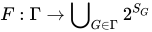
Let Γ {\displaystyle \Gamma } {\displaystyle \Gamma } be the class of all games and, for each game G ∈ Γ {\displaystyle G\in \Gamma } {\displaystyle G\in \Gamma }, let S G {\displaystyle S_{G}} {\displaystyle S_{G}} be the set of strategy profiles of G {\displaystyle G} {\displaystyle G}. A solution concept is an element of the direct product Π G ∈ Γ 2 S G ; {\displaystyle \Pi _{G\in \Gamma }2^{S_{G}};} {\displaystyle \Pi _{G\in \Gamma }2^{S_{G}};} i.e., a function F : Γ → ⋃ G ∈ Γ 2 S G {\displaystyle F:\Gamma \rightarrow \bigcup \nolimits _{G\in \Gamma }2^{S_{G}}} {\displaystyle F:\Gamma \rightarrow \bigcup \nolimits _{G\in \Gamma }2^{S_{G}}} such that F ( G ) ⊆ S G {\displaystyle F(G)\subseteq S_{G}} {\displaystyle F(G)\subseteq S_{G}} for all G ∈ Γ . {\displaystyle G\in \Gamma .} {\displaystyle G\in \Gamma .}

Rationalizability and iterated dominance

[edit]
Main article: Rationalizability

In this solution concept, players are assumed to be rational and so strictly dominated strategies are eliminated from the set of strategies that might feasibly be played. A strategy is strictly dominated when there is some other strategy available to the player that always has a higher payoff, regardless of the strategies that the other players choose. (Strictly dominated strategies are also important in minimax game-tree search.) For example, in the (single period) prisoners' dilemma (shown below), cooperate is strictly dominated by defect for both players because either player is always better off playing defect, regardless of what his opponent does.

Prisoner 2 Cooperate Prisoner 2 Defect
Prisoner 1 Cooperate −0.5, −0.5 −10, 0
Prisoner 1 Defect 0, −10 −2, −2

Nash equilibrium

[edit]
Main article: Nash equilibrium

A Nash equilibrium is a strategy profile (a strategy profile specifies a strategy for every player, e.g. in the above prisoners' dilemma game (cooperate, defect) specifies that prisoner 1 plays cooperate and prisoner 2 plays defect) in which every strategy played by every agent (agent i) is a best response to every other strategy played by all the other opponents (agents j for every j≠i) . A strategy by a player is a best response to another player's strategy if there is no other strategy that could be played that would yield a higher pay-off in any situation in which the other player's strategy is played.

Backward induction

[edit]
Main article: Backward induction

In some games, there are multiple Nash equilibria, but not all of them are realistic. In dynamic games, backward induction can be used to eliminate unrealistic Nash equilibria. Backward induction assumes that players are rational and will make the best decisions based on their future expectations. This eliminates noncredible threats, which are threats that a player would not carry out if they were ever called upon to do so.

For example, consider a dynamic game with an incumbent firm and a potential entrant to the industry. The incumbent has a monopoly and wants to maintain its market share. If the entrant enters, the incumbent can either fight or accommodate the entrant. If the incumbent accommodates, the entrant will enter and gain profit. If the incumbent fights, it will lower its prices, run the entrant out of business (incurring exit costs), and damage its own profits.

The best response for the incumbent if the entrant enters is to accommodate, and the best response for the entrant if the incumbent accommodates is to enter. This results in a Nash equilibrium. However, if the incumbent chooses to fight, the best response for the entrant is to not enter. If the entrant does not enter, it does not matter what the incumbent chooses to do. Hence, fight can be considered a best response for the incumbent if the entrant does not enter, resulting in another Nash equilibrium.

However, this second Nash equilibrium can be eliminated by backward induction because it relies on a noncredible threat from the incumbent. By the time the incumbent reaches the decision node where it can choose to fight, it would be irrational to do so because the entrant has already entered. Therefore, backward induction eliminates this unrealistic Nash equilibrium.

See also:

  • Monetary policy theory
  • Stackelberg competition

Subgame perfect Nash equilibrium

[edit]
Main article: Subgame perfect equilibrium

A generalization of backward induction is subgame perfection. Backward induction assumes that all future play will be rational. In subgame perfect equilibria, play in every subgame is rational (specifically a Nash equilibrium). Backward induction can only be used in terminating (finite) games of definite length and cannot be applied to games with imperfect information. In these cases, subgame perfection can be used. The eliminated Nash equilibrium described above is subgame imperfect because it is not a Nash equilibrium of the subgame that starts at the node reached once the entrant has entered.

Perfect Bayesian equilibrium

[edit]
Main article: Bayesian game

Sometimes subgame perfection does not impose a large enough restriction on unreasonable outcomes. For example, since subgames cannot cut through information sets, a game of imperfect information may have only one subgame – itself – and hence subgame perfection cannot be used to eliminate any Nash equilibria. A perfect Bayesian equilibrium (PBE) is a specification of players' strategies and beliefs about which node in the information set has been reached by the play of the game. A belief about a decision node is the probability that a particular player thinks that node is or will be in play (on the equilibrium path). In particular, the intuition of PBE is that it specifies player strategies that are rational given the player beliefs it specifies and the beliefs it specifies are consistent with the strategies it specifies.

In a Bayesian game a strategy determines what a player plays at every information set controlled by that player. The requirement that beliefs are consistent with strategies is something not specified by subgame perfection. Hence, PBE is a consistency condition on players' beliefs. Just as in a Nash equilibrium no player's strategy is strictly dominated, in a PBE, for any information set no player's strategy is strictly dominated beginning at that information set. That is, for every belief that the player could hold at that information set there is no strategy that yields a greater expected payoff for that player. Unlike the above solution concepts, no player's strategy is strictly dominated beginning at any information set even if it is off the equilibrium path. Thus in PBE, players cannot threaten to play strategies that are strictly dominated beginning at any information set off the equilibrium path.

The Bayesian in the name of this solution concept alludes to the fact that players update their beliefs according to Bayes' theorem. They calculate probabilities given what has already taken place in the game.

Forward induction

[edit]

Forward induction is so called because just as backward induction assumes future play will be rational, forward induction assumes past play was rational. Where a player does not know what type another player is (i.e. there is imperfect and asymmetric information), that player may form a belief of what type that player is by observing that player's past actions. Hence the belief formed by that player of what the probability of the opponent being a certain type is based on the past play of that opponent being rational. A player may elect to signal his type through his actions.

Kohlberg and Mertens (1986) introduced the solution concept of Stable equilibrium, a refinement that satisfies forward induction. A counter-example was found where such a stable equilibrium did not satisfy backward induction. To resolve the problem Jean-François Mertens introduced what game theorists now call Mertens-stable equilibrium concept, probably the first solution concept satisfying both forward and backward induction.

Forward induction yields a unique solution for the burning money game.

See also

[edit]
  • Extensive form game
  • Trembling hand equilibrium
  • "The Intuitive Criterion" (Cho & Kreps 1987)

References

[edit]
  • Cho, I-K.; Kreps, D. M. (1987). "Signaling Games and Stable Equilibria". Quarterly Journal of Economics. 102 (2): 179–221. CiteSeerX 10.1.1.407.5013. doi:10.2307/1885060. JSTOR 1885060. S2CID 154404556.
  • Fudenberg, Drew; Tirole, Jean (1991). Game Theory. Cambridge, Massachusetts: MIT Press. ISBN 9780262061414. Book preview.
  • Harsanyi, J. (1973) Oddness of the number of equilibrium points: a new proof. International Journal of Game Theory 2:235–250.
  • Govindan, Srihari & Robert Wilson, 2008. "Refinements of Nash Equilibrium," The New Palgrave Dictionary of Economics, 2nd Edition.[1]
  • Hines, W. G. S. (1987) Evolutionary stable strategies: a review of basic theory. Theoretical Population Biology 31:195–272.
  • Kohlberg, Elon & Jean-François Mertens, 1986. "On the Strategic Stability of Equilibria," Econometrica, Econometric Society, vol. 54(5), pages 1003-37, September.
  • Leyton-Brown, Kevin; Shoham, Yoav (2008). Essentials of Game Theory: A Concise, Multidisciplinary Introduction. San Rafael, CA: Morgan & Claypool Publishers. ISBN 978-1-59829-593-1.
  • Mertens, Jean-François, 1989. "Stable Equilibria - A reformulation. Part 1 Basic Definitions and Properties," Mathematics of Operations Research, Vol. 14, No. 4, Nov. [2]
  • Noldeke, G. & Samuelson, L. (1993) An evolutionary analysis of backward and forward induction. Games & Economic Behaviour 5:425–454.
  • Maynard Smith, J. (1982) Evolution and the Theory of Games. ISBN 0-521-28884-3
  • Osborne, Martin J.; Rubinstein, Ariel (1994). A course in game theory. MIT Press. ISBN 978-0-262-65040-3..
  • Selten, R. (1983) Evolutionary stability in extensive two-person games. Math. Soc. Sci. 5:269–363.
  • Selten, R. (1988) Evolutionary stability in extensive two-person games – correction and further development. Math. Soc. Sci. 16:223–266
  • Shoham, Yoav; Leyton-Brown, Kevin (2009). Multiagent Systems: Algorithmic, Game-Theoretic, and Logical Foundations. New York: Cambridge University Press. ISBN 978-0-521-89943-7.
  • Thomas, B. (1985a) On evolutionary stable sets. J. Math. Biol. 22:105–115.
  • Thomas, B. (1985b) Evolutionary stable sets in mixed-strategist models. Theor. Pop. Biol. 28:332–341
  • v
  • t
  • e
Game theory
  • Glossary
  • Game theorists
  • Games
Traditional game theory
Definitions
  • Asynchrony
  • Bayesian regret
  • Best response
  • Bounded rationality
  • Cheap talk
  • Coalition
  • Complete contract
  • Complete information
  • Complete mixing
  • Conjectural variation
  • Contingent cooperator
  • Coopetition
  • Cooperative game theory
  • Dynamic inconsistency
  • Escalation of commitment
  • Farsightedness
  • Game semantics
  • Hierarchy of beliefs
  • Imperfect information
  • Incomplete information
  • Information set
  • Move by nature
  • Mutual knowledge
  • Non-cooperative game theory
  • Non-credible threat
  • Outcome
  • Perfect information
  • Perfect recall
  • Ply
  • Preference
  • Rationality
  • Sequential game
  • Simultaneous action selection
  • Spite
  • Strategic complements
  • Strategic dominance
  • Strategic form
  • Strategic interaction
  • Strategic move
  • Strategy
  • Subgame
  • Succinct game
  • Topological game
  • Tragedy of the commons
  • Uncorrelated asymmetry
Equilibrium
concepts
  • Backward induction
  • Bayes correlated equilibrium
  • Bayesian efficiency
  • Bayesian game
  • Bayesian Nash equilibrium
  • Berge equilibrium
  • Bertrand–Edgeworth model
  • Coalition-proof Nash equilibrium
  • Core
  • Correlated equilibrium
  • Cursed equilibrium
  • Edgeworth price cycle
  • Epsilon-equilibrium
  • Gibbs equilibrium
  • Incomplete contracts
  • Inequity aversion
  • Individual rationality
  • Iterated elimination of dominated strategies
  • Markov perfect equilibrium
  • Mertens-stable equilibrium
  • Nash equilibrium
  • Open-loop model
  • Pareto efficiency
  • Payoff dominance
  • Perfect Bayesian equilibrium
  • Price of anarchy
  • Program equilibrium
  • Proper equilibrium
  • Quantal response equilibrium
  • Quasi-perfect equilibrium
  • Rational agent
  • Rationalizability
  • Rationalizable strategy
  • Satisfaction equilibrium
  • Self-confirming equilibrium
  • Sequential equilibrium
  • Shapley value
  • Strong Nash equilibrium
  • Subgame perfect equilibrium
  • Trembling hand equilibrium
Strategies
  • Appeasement
  • Bid shading
  • Cheap talk
  • Collusion
  • Commitment device
  • De-escalation
  • Deterrence
  • Escalation
  • Fictitious play
  • Focal point
  • Grim trigger
  • Hobbesian trap
  • Markov strategy
  • Max-dominated strategy
  • Mixed strategy
  • Pure strategy
  • Tit for tat
  • Win–stay, lose–switch
Games
  • All-pay auction
  • Battle of the sexes
  • Nash bargaining game
  • Bertrand competition
  • Blotto game
  • Centipede game
  • Coordination game
  • Cournot competition
  • Deadlock
  • Dictator game
  • Trust game
  • Diner's dilemma
  • Dollar auction
  • El Farol Bar problem
  • Electronic mail game
  • Gift-exchange game
  • Guess 2/3 of the average
  • Keynesian beauty contest
  • Kuhn poker
  • Lewis signaling game
  • Matching pennies
  • Obligationes
  • Optional prisoner's dilemma
  • Pirate game
  • Prisoner's dilemma
  • Public goods game
  • Rendezvous problem
  • Rock paper scissors
  • Stackelberg competition
  • Stag hunt
  • Traveler's dilemma
  • Ultimatum game
  • Volunteer's dilemma
  • War of attrition
Theorems
  • Arrow's impossibility theorem
  • Aumann's agreement theorem
  • Brouwer fixed-point theorem
  • Competitive altruism
  • Folk theorem
  • Gibbard–Satterthwaite theorem
  • Gibbs lemma
  • Glicksberg's theorem
  • Kakutani fixed-point theorem
  • Kuhn's theorem
  • One-shot deviation principle
  • Prim–Read theory
  • Rational ignorance
  • Rational irrationality
  • Sperner's lemma
  • Zermelo's theorem
Subfields
  • Algorithmic game theory
  • Behavioral game theory
  • Behavioral strategy
  • Compositional game theory
  • Confrontation analysis
  • Contract theory
  • Drama theory
  • Graphical game theory
  • Heresthetic
  • Mean-field game theory
  • Negotiation theory
  • Quantum game theory
  • Social software
Key people
  • Albert W. Tucker
  • Alvin E. Roth
  • Amos Tversky
  • Antoine Augustin Cournot
  • Ariel Rubinstein
  • David Gale
  • David K. Levine
  • David M. Kreps
  • Donald B. Gillies
  • Drew Fudenberg
  • Eric Maskin
  • Harold W. Kuhn
  • Herbert Simon
  • Herbert Scarf
  • Hervé Moulin
  • Jean Tirole
  • Jean-François Mertens
  • Jennifer Tour Chayes
  • Ken Binmore
  • Kenneth Arrow
  • Leonid Hurwicz
  • Lloyd Shapley
  • Martin Shubik
  • Melvin Dresher
  • Merrill M. Flood
  • Olga Bondareva
  • Oskar Morgenstern
  • Paul Milgrom
  • Peyton Young
  • Reinhard Selten
  • Robert Aumann
  • Robert Axelrod
  • Robert B. Wilson
  • Roger Myerson
  • Samuel Bowles
  • Suzanne Scotchmer
  • Thomas Schelling
  • William Vickrey
Combinatorial game theory
Core
concepts
  • Combinatorial explosion
  • Determinacy
  • Disjunctive sum
  • First-player and second-player win
  • Game complexity
  • Game tree
  • Impartial game
  • Misère
  • Partisan game
  • Solved game
  • Sprague–Grundy theorem
  • Strategy-stealing argument
  • Zugzwang
Games
  • Chess
  • Chomp
  • Clobber
  • Cram
  • Domineering
  • Hackenbush
  • Nim
  • Notakto
  • Subtract a square
  • Sylver coinage
  • Toads and Frogs
Mathematical
tools
  • Mex
  • Nimber
  • On Numbers and Games
  • Star
  • Surreal number
  • Winning Ways for Your Mathematical Plays
Search
algorithms
  • Alpha–beta pruning
  • Expectiminimax
  • Minimax
  • Monte Carlo tree search
  • Negamax
  • Paranoid algorithm
  • Principal variation search
Key people
  • Claude Shannon
  • John Conway
  • John von Neumann
Evolutionary game theory
Core
concepts
  • Bishop–Cannings theorem
  • Evolution and the Theory of Games
  • Evolutionarily stable set
  • Evolutionarily stable state
  • Evolutionarily stable strategy
  • Replicator equation
  • Risk dominance
  • Stochastically stable equilibrium
  • Weak evolutionarily stable strategy
Games
  • Chicken
  • Stag hunt
Applications
  • Cultural group selection
  • Fisher's principle
  • Mobbing
  • Terminal investment hypothesis
Key people
  • John Maynard Smith
  • Robert Axelrod
Mechanism design
Core
concepts
  • Algorithmic mechanism design
  • Bayesian-optimal mechanism
  • Incentive compatibility
  • Market design
  • Myerson ironing
  • Monotonicity
  • Participation constraint
  • Revelation principle
  • Strategyproofness
  • Vickrey–Clarke–Groves mechanism
  • Virtual valuation
Theorems
  • Myerson–Satterthwaite theorem
  • Revenue equivalence
  • Border's theorem
Applications
  • Digital goods auction
  • Knapsack auction
  • Truthful cake-cutting
Other topics
  • Bertrand paradox
  • Chainstore paradox
  • Computational complexity of games
  • Helly metric
  • Multi-agent system
  • PPAD-complete
  • icon Mathematics portal
  • Commons
  • WikiProject
  • Category
Retrieved from "https://teknopedia.ac.id/w/index.php?title=Solution_concept&oldid=1213525807"
Categories:
  • Game theory
  • Game theory equilibrium concepts
Hidden categories:
  • Articles with short description
  • Short description is different from Wikidata

  • indonesia
  • Polski
  • العربية
  • Deutsch
  • English
  • Español
  • Français
  • Italiano
  • مصرى
  • Nederlands
  • 日本語
  • Português
  • Sinugboanong Binisaya
  • Svenska
  • Українська
  • Tiếng Việt
  • Winaray
  • 中文
  • Русский
Sunting pranala
url url url url url url url url url url url url url url url url url url url url url url url url url url url url url url url url url url url url url url url url url url url url url url url url url url url url url url url url url url url url url url url url url url url url url url url url url url url url url url url url url url url url url url url url url url url url url url url url url url url url url url url url url url url url url url url url url url url url url url url url url url url url url url url url url url url url url url url url url url url url url url url url url url url url url url url url url url url url url url url url url url url url url url url url url url url url url url url url url url url url url url url url url url url url url url url url url url url url url url url url url url url url url url url url url url url url url url url url url url url url url url url url url url url url url url url url url url url url url url url url url url url url url url url url url url url url url url url url url url url url url url url url url url url url url url url url url url url url url url url url url url url url url url url url url url url url url url url url url url url url url url url url url url url url url url url url url url url url url url url url url url url url url url url url url url url url url url url url url url url url url url url url url url url url url url url url url url url url url url url url url url url url url url url url url url url url url url url url url url url url url url url url url url url url url url url url url url url url url url url url url url url url url url url url url url url url url url url url url url url url url url url url url url url url url url url url url url url url url url url url url url url url url url url url url url url url url url url url url url url url url url url url url url url url url url url url url url url url url url url url url url url url url url url url url url url url url url url url url url url url url url url url url url url url url url url url url url url url url url url url url url url url url url url url url url url url url url url url url url url url url url url url url url url url url url url url url url url url url url url url url url url url url url url url url url url url url url url url url url url url url url url url url url url url url url url url url url url url url url url url url url url url url url url url url url url url url url url url url url url url url url url url url url url url url url url url url url url url url url url url url url url url url url url url url url url url url url url url url url url url url url url url url url url url url url url url url url url url url url url url url url url url url url url url url url url url url url url url url url url url url url url url url url url url url url url url url url url url url url url url url url url url url url url url url url url url url url url url url url url url url url url url url url url url url url url url url url url url url url url url url url url url url url url url url url url url url url url url url url url url url url url url url url url url url url url url url url url url url url url url url url url url url url url url url url url url url url url url url url url url url url url url url url url url url url url url url url url url url url url url url url url url url url url url url url url url url url url url url url url url url url url url url url url url url url url url url url url url url url url url url url url url url url url url url url url url url url url url url url url url url url url url url url url url url url url url url url url url url url url url url url url url url url url url url url url url url url url url url url url url url url url url url url url url url url url url url url url url url url url url url url url url url url url url url url url url url url url url url url url url url url url url url url url url url url url url url url url url url url url url url url url url url url url url url url url url url url url url url url url url url url url url url url url url url url url url url url url url url url url url url url url url url url url url url url url url url url url url url url url url url url url url url url url url url url url url url url url url url url url url url url url url url url url url url url url url url url url url url url url url url url url url url url url url url url url url url url url url url url url url url url url url url url url url url url url url url url url url url url url url url url url url url url url url url url url url url url url url url url url url url url url url url url url url url url url url url url url url url url url url url url url url url url url url url url url url url url url url url url url url url url url url url url url url url url url url url url url url url url url url url url url url url url url url url url url url url url url url url url url url url url url url url url url url url url url url url url url url url url url url url url url url url url url url url url url url url url url url url url url url url url url url url url url url url url url url url url url url url url url url url url url url url url url url url url url url url url url url url url url url url url url url url url url url url url url url url url url url url url url url url url url url url url url url url url url url url url url url url url url url url url url url url url url url url url url url url url url url url url url url url url url url url url url url url url url url url url url url url url url url url url url url url url url url url url url url url url url url url url url url url url url url url url url url url url url url url url url url url url url url url url url url url url url url url url url url url url url url url url url url url url url url url url url url url url url url url url url url url url url url url url url url url url url url url url url url url url url url url url url url url url url url url url url url url url url url url url url url url url url url url url url url url url url url url url url url url url url url url url url url url url url url url url url url url url url url url url url url url url url url url url url url url url url url url url url url url url url url url url url url url url url url url url url url url url url url url url url url url url url url url url url url url url url url url url url url url url url url url url url url url url url url url url url url url url url url url url url url url url url url url url url url url url url url url url url url url url url url url url url url url url url url url url url url url url url url url url url url url url url url url url url url url url url url url url url url url url url url url url url url url url url url url url url url url url url url url url url url url url url url url url url url url url url url url url url url url url url url url url url url url url url url url url url url url url url url url url url url url url url url url url url url url url url url url url url url url url url url url url url url url url url url url url url url url url url url url url url url url url url url url url url url url url url url url url url url url url url url url url url url url url url url url url url url url url url url url url url url url url url url url url url url url url url url url url url url url url url url url url url url url url url url url url url url url url url url url url url url url url url url url url url url url url url url url url url url url url url url url url url url url url url url url url url url url url url url url url url url url url url url url url url url url url url url url url url url url url url url url url url url url url url url url url url url url url url url url url url url url url url url url url url url url url url url url url url url url url url url url url url url url url url url url url url url url url url url url url url url url url url url url url url url url url url url url url url url url url url url url url url url url url url url url url url url url url url url url url url url url url url url url url url url url url url url url url url url url url url url url url url url url url url url url url url url url url url url url url url url url url url url url url url url url url url url url url url url url url url url url url url url url url url url url url url url url url url url url url url url url url url url url url url url url url url url url url url url url url url url url url url url url url url url url url url url url url url url url url url url url url url url url url url url url url url url url url url url url url url url url url url url url url url url url url url url url url url url url url url url url url url url url url url url url url url url url url url url url url url url url url url url url url url url url url url url url url url url url url url url url url url url url url url url url url url url url url url url url url url url url url url url url url url url url url url url url url url url url url url url url url url url url url url url url url url url url url url url url url url url url url url url url url url url url url url url url url url url url url url url url url url url url url url url url url url url url url url url url url url url url url url url url url url url url url url url url url url url url url url url url url url url url url url url url url url url url url url url url url url url url url url url url url url url url url url url url url url url url url url url url url url url url url url url url url url url url url url url url url url url url url url url url url url url
Pusat Layanan

UNIVERSITAS TEKNOKRAT INDONESIA | ASEAN's Best Private University
Jl. ZA. Pagar Alam No.9 -11, Labuhan Ratu, Kec. Kedaton, Kota Bandar Lampung, Lampung 35132
Phone: (0721) 702022
Email: pmb@teknokrat.ac.id