Epstein Files Full PDF

CLICK HERE
Technopedia Center
PMB University Brochure
Faculty of Engineering and Computer Science
S1 Informatics S1 Information Systems S1 Information Technology S1 Computer Engineering S1 Electrical Engineering S1 Civil Engineering

faculty of Economics and Business
S1 Management S1 Accountancy

Faculty of Letters and Educational Sciences
S1 English literature S1 English language education S1 Mathematics education S1 Sports Education
teknopedia

  • Registerasi
  • Brosur UTI
  • Kip Scholarship Information
  • Performance
Flag Counter
  1. World Encyclopedia
  2. Normal bundle - Wikipedia
Normal bundle - Wikipedia
From Wikipedia, the free encyclopedia
(Redirected from Normal sheaf)
Concept in mathematics
For normal bundles in algebraic geometry, see normal cone.

In differential geometry, a field of mathematics, a normal bundle is a particular kind of vector bundle, complementary to the tangent bundle, and coming from an embedding (or immersion).

Definition

[edit]

Riemannian manifold

[edit]

Let ( M , g ) {\displaystyle (M,g)} {\displaystyle (M,g)} be a Riemannian manifold, and S ⊂ M {\displaystyle S\subset M} {\displaystyle S\subset M} a Riemannian submanifold. Define, for a given p ∈ S {\displaystyle p\in S} {\displaystyle p\in S}, a vector n ∈ T p M {\displaystyle n\in \mathrm {T} _{p}M} {\displaystyle n\in \mathrm {T} _{p}M} to be normal to S {\displaystyle S} {\displaystyle S} whenever g ( n , v ) = 0 {\displaystyle g(n,v)=0} {\displaystyle g(n,v)=0} for all v ∈ T p S {\displaystyle v\in \mathrm {T} _{p}S} {\displaystyle v\in \mathrm {T} _{p}S} (so that n {\displaystyle n} {\displaystyle n} is orthogonal to T p S {\displaystyle \mathrm {T} _{p}S} {\displaystyle \mathrm {T} _{p}S}). The set N p S {\displaystyle \mathrm {N} _{p}S} {\displaystyle \mathrm {N} _{p}S} of all such n {\displaystyle n} {\displaystyle n} is then called the normal space to S {\displaystyle S} {\displaystyle S} at p {\displaystyle p} {\displaystyle p}.

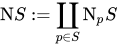
Just as the total space of the tangent bundle to a manifold is constructed from all tangent spaces to the manifold, the total space of the normal bundle[1] N S {\displaystyle \mathrm {N} S} {\displaystyle \mathrm {N} S} to S {\displaystyle S} {\displaystyle S} is defined as

N S := ∐ p ∈ S N p S {\displaystyle \mathrm {N} S:=\coprod _{p\in S}\mathrm {N} _{p}S} {\displaystyle \mathrm {N} S:=\coprod _{p\in S}\mathrm {N} _{p}S}.

The conormal bundle is defined as the dual bundle to the normal bundle. It can be realised naturally as a sub-bundle of the cotangent bundle.

General definition

[edit]

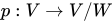
More abstractly, given an immersion i : N → M {\displaystyle i:N\to M} {\displaystyle i:N\to M} (for instance an embedding), one can define a normal bundle of N {\displaystyle N} {\displaystyle N} in M {\displaystyle M} {\displaystyle M}, by at each point of N {\displaystyle N} {\displaystyle N}, taking the quotient space of the tangent space on M {\displaystyle M} {\displaystyle M} by the tangent space on N {\displaystyle N} {\displaystyle N}. For a Riemannian manifold one can identify this quotient with the orthogonal complement, but in general one cannot (such a choice is equivalent to a section of the projection p : V → V / W {\displaystyle p:V\to V/W} {\displaystyle p:V\to V/W}).

Thus the normal bundle is in general a quotient of the tangent bundle of the ambient space M {\displaystyle M} {\displaystyle M} restricted to the subspace N {\displaystyle N} {\displaystyle N}.

Formally, the normal bundle[2] to N {\displaystyle N} {\displaystyle N} in M {\displaystyle M} {\displaystyle M} is a quotient bundle of the tangent bundle on M {\displaystyle M} {\displaystyle M}: one has the short exact sequence of vector bundles on N {\displaystyle N} {\displaystyle N}:

0 → T N → T M | i ( N ) → T M / N := T M | i ( N ) / T N → 0 {\displaystyle 0\to \mathrm {T} N\to \mathrm {T} M\vert _{i(N)}\to \mathrm {T} _{M/N}:=\mathrm {T} M\vert _{i(N)}/\mathrm {T} N\to 0} {\displaystyle 0\to \mathrm {T} N\to \mathrm {T} M\vert _{i(N)}\to \mathrm {T} _{M/N}:=\mathrm {T} M\vert _{i(N)}/\mathrm {T} N\to 0}

where T M | i ( N ) {\displaystyle \mathrm {T} M\vert _{i(N)}} {\displaystyle \mathrm {T} M\vert _{i(N)}} is the restriction of the tangent bundle on M {\displaystyle M} {\displaystyle M} to N {\displaystyle N} {\displaystyle N} (properly, the pullback i ∗ T M {\displaystyle i^{*}\mathrm {T} M} {\displaystyle i^{*}\mathrm {T} M} of the tangent bundle on M {\displaystyle M} {\displaystyle M} to a vector bundle on N {\displaystyle N} {\displaystyle N} via the map i {\displaystyle i} {\displaystyle i}). The fiber of the normal bundle T M / N ↠ π N {\displaystyle \mathrm {T} _{M/N}{\overset {\pi }{\twoheadrightarrow }}N} {\displaystyle \mathrm {T} _{M/N}{\overset {\pi }{\twoheadrightarrow }}N} in p ∈ N {\displaystyle p\in N} {\displaystyle p\in N} is referred to as the normal space at p {\displaystyle p} {\displaystyle p} (of N {\displaystyle N} {\displaystyle N} in M {\displaystyle M} {\displaystyle M}).

Conormal bundle

[edit]

If Y ⊆ X {\displaystyle Y\subseteq X} {\displaystyle Y\subseteq X} is a smooth submanifold of a manifold X {\displaystyle X} {\displaystyle X}, we can pick local coordinates ( x 1 , … , x n ) {\displaystyle (x_{1},\dots ,x_{n})} {\displaystyle (x_{1},\dots ,x_{n})} around p ∈ Y {\displaystyle p\in Y} {\displaystyle p\in Y} such that Y {\displaystyle Y} {\displaystyle Y} is locally defined by x k + 1 = ⋯ = x n = 0 {\displaystyle x_{k+1}=\dots =x_{n}=0} {\displaystyle x_{k+1}=\dots =x_{n}=0}; then with this choice of coordinates

T p X = R { ∂ ∂ x 1 | p , … , ∂ ∂ x k | p , … , ∂ ∂ x n | p } T p Y = R { ∂ ∂ x 1 | p , … , ∂ ∂ x k | p } T X / Y p = R { ∂ ∂ x k + 1 | p , … , ∂ ∂ x n | p } {\displaystyle {\begin{aligned}\mathrm {T} _{p}X&=\mathbb {R} {\Big \lbrace }{\frac {\partial }{\partial x_{1}}}{\Big |}_{p},\dots ,{\frac {\partial }{\partial x_{k}}}{\Big |}_{p},\dots ,{\frac {\partial }{\partial x_{n}}}{\Big |}_{p}{\Big \rbrace }\\\mathrm {T} _{p}Y&=\mathbb {R} {\Big \lbrace }{\frac {\partial }{\partial x_{1}}}{\Big |}_{p},\dots ,{\frac {\partial }{\partial x_{k}}}{\Big |}_{p}{\Big \rbrace }\\{\mathrm {T} _{X/Y}}_{p}&=\mathbb {R} {\Big \lbrace }{\frac {\partial }{\partial x_{k+1}}}{\Big |}_{p},\dots ,{\frac {\partial }{\partial x_{n}}}{\Big |}_{p}{\Big \rbrace }\\\end{aligned}}} {\displaystyle {\begin{aligned}\mathrm {T} _{p}X&=\mathbb {R} {\Big \lbrace }{\frac {\partial }{\partial x_{1}}}{\Big |}_{p},\dots ,{\frac {\partial }{\partial x_{k}}}{\Big |}_{p},\dots ,{\frac {\partial }{\partial x_{n}}}{\Big |}_{p}{\Big \rbrace }\\\mathrm {T} _{p}Y&=\mathbb {R} {\Big \lbrace }{\frac {\partial }{\partial x_{1}}}{\Big |}_{p},\dots ,{\frac {\partial }{\partial x_{k}}}{\Big |}_{p}{\Big \rbrace }\\{\mathrm {T} _{X/Y}}_{p}&=\mathbb {R} {\Big \lbrace }{\frac {\partial }{\partial x_{k+1}}}{\Big |}_{p},\dots ,{\frac {\partial }{\partial x_{n}}}{\Big |}_{p}{\Big \rbrace }\\\end{aligned}}}

and the ideal sheaf is locally generated by x k + 1 , … , x n {\displaystyle x_{k+1},\dots ,x_{n}} {\displaystyle x_{k+1},\dots ,x_{n}}. Therefore we can define a non-degenerate pairing

( I Y / I Y   2 ) p × T X / Y p ⟶ R {\displaystyle (I_{Y}/I_{Y}^{\ 2})_{p}\times {\mathrm {T} _{X/Y}}_{p}\longrightarrow \mathbb {R} } {\displaystyle (I_{Y}/I_{Y}^{\ 2})_{p}\times {\mathrm {T} _{X/Y}}_{p}\longrightarrow \mathbb {R} }

that induces an isomorphism of sheaves T X / Y ≃ ( I Y / I Y   2 ) ∨ {\displaystyle \mathrm {T} _{X/Y}\simeq (I_{Y}/I_{Y}^{\ 2})^{\vee }} {\displaystyle \mathrm {T} _{X/Y}\simeq (I_{Y}/I_{Y}^{\ 2})^{\vee }}. We can rephrase this fact by introducing the conormal bundle T X / Y ∗ {\displaystyle \mathrm {T} _{X/Y}^{*}} {\displaystyle \mathrm {T} _{X/Y}^{*}} defined via the conormal exact sequence

0 → T X / Y ∗ ↣ Ω X 1 | Y ↠ Ω Y 1 → 0 {\displaystyle 0\to \mathrm {T} _{X/Y}^{*}\rightarrowtail \Omega _{X}^{1}|_{Y}\twoheadrightarrow \Omega _{Y}^{1}\to 0} {\displaystyle 0\to \mathrm {T} _{X/Y}^{*}\rightarrowtail \Omega _{X}^{1}|_{Y}\twoheadrightarrow \Omega _{Y}^{1}\to 0},

then T X / Y ∗ ≃ ( I Y / I Y   2 ) {\displaystyle \mathrm {T} _{X/Y}^{*}\simeq (I_{Y}/I_{Y}^{\ 2})} {\displaystyle \mathrm {T} _{X/Y}^{*}\simeq (I_{Y}/I_{Y}^{\ 2})}, viz. the sections of the conormal bundle are the cotangent vectors to X {\displaystyle X} {\displaystyle X} vanishing on T Y {\displaystyle \mathrm {T} Y} {\displaystyle \mathrm {T} Y}.

When Y = { p } {\displaystyle Y=\lbrace p\rbrace } {\displaystyle Y=\lbrace p\rbrace } is a point, then the ideal sheaf is the sheaf of smooth germs vanishing at p {\displaystyle p} {\displaystyle p} and the isomorphism reduces to the definition of the tangent space in terms of germs of smooth functions on X {\displaystyle X} {\displaystyle X}

T X / { p } ∗ ≃ ( T p X ) ∨ ≃ m p m p   2 {\displaystyle \mathrm {T} _{X/\lbrace p\rbrace }^{*}\simeq (\mathrm {T} _{p}X)^{\vee }\simeq {\frac {{\mathfrak {m}}_{p}}{{\mathfrak {m}}_{p}^{\ 2}}}} {\displaystyle \mathrm {T} _{X/\lbrace p\rbrace }^{*}\simeq (\mathrm {T} _{p}X)^{\vee }\simeq {\frac {{\mathfrak {m}}_{p}}{{\mathfrak {m}}_{p}^{\ 2}}}}.

Stable normal bundle

[edit]

Abstract manifolds have a canonical tangent bundle, but do not have a normal bundle: only an embedding (or immersion) of a manifold in another yields a normal bundle. However, since every manifold can be embedded in R N {\displaystyle \mathbf {R} ^{N}} {\displaystyle \mathbf {R} ^{N}}, by the Whitney embedding theorem, every manifold admits a normal bundle, given such an embedding.

There is in general no natural choice of embedding, but for a given manifold X {\displaystyle X} {\displaystyle X}, any two embeddings in R N {\displaystyle \mathbf {R} ^{N}} {\displaystyle \mathbf {R} ^{N}} for sufficiently large N {\displaystyle N} {\displaystyle N} are regular homotopic, and hence induce the same normal bundle. The resulting class of normal bundles (it is a class of bundles and not a specific bundle because the integer N {\displaystyle {N}} {\displaystyle {N}} could vary) is called the stable normal bundle.

Dual to tangent bundle

[edit]

The normal bundle is dual to the tangent bundle in the sense of K-theory: by the above short exact sequence,

[ T N ] + [ T M / N ] = [ T M ] {\displaystyle [\mathrm {T} N]+[\mathrm {T} _{M/N}]=[\mathrm {T} M]} {\displaystyle [\mathrm {T} N]+[\mathrm {T} _{M/N}]=[\mathrm {T} M]}

in the Grothendieck group. In case of an immersion in R N {\displaystyle \mathbf {R} ^{N}} {\displaystyle \mathbf {R} ^{N}}, the tangent bundle of the ambient space is trivial (since R N {\displaystyle \mathbf {R} ^{N}} {\displaystyle \mathbf {R} ^{N}} is contractible, hence parallelizable), so [ T N ] + [ T M / N ] = 0 {\displaystyle [\mathrm {T} N]+[\mathrm {T} _{M/N}]=0} {\displaystyle [\mathrm {T} N]+[\mathrm {T} _{M/N}]=0}, and thus [ T M / N ] = − [ T N ] {\displaystyle [\mathrm {T} _{M/N}]=-[\mathrm {T} N]} {\displaystyle [\mathrm {T} _{M/N}]=-[\mathrm {T} N]}.

This is useful in the computation of characteristic classes, and allows one to prove lower bounds on immersibility and embeddability of manifolds in Euclidean space.

For symplectic manifolds

[edit]

Suppose a manifold X {\displaystyle X} {\displaystyle X} is embedded in to a symplectic manifold ( M , ω ) {\displaystyle (M,\omega )} {\displaystyle (M,\omega )}, such that the pullback of the symplectic form has constant rank on X {\displaystyle X} {\displaystyle X}. Then one can define the symplectic normal bundle to X {\displaystyle X} {\displaystyle X} as the vector bundle over X {\displaystyle X} {\displaystyle X} with fibres

( T i ( x ) X ) ω / ( T i ( x ) X ∩ ( T i ( x ) X ) ω ) , x ∈ X , {\displaystyle (\mathrm {T} _{i(x)}X)^{\omega }/(\mathrm {T} _{i(x)}X\cap (\mathrm {T} _{i(x)}X)^{\omega }),\quad x\in X,} {\displaystyle (\mathrm {T} _{i(x)}X)^{\omega }/(\mathrm {T} _{i(x)}X\cap (\mathrm {T} _{i(x)}X)^{\omega }),\quad x\in X,}

where i : X → M {\displaystyle i:X\rightarrow M} {\displaystyle i:X\rightarrow M} denotes the embedding and ( T X ) ω {\displaystyle (\mathrm {T} X)^{\omega }} {\displaystyle (\mathrm {T} X)^{\omega }} is the symplectic orthogonal of T X {\displaystyle \mathrm {T} X} {\displaystyle \mathrm {T} X} in T M {\displaystyle \mathrm {T} M} {\displaystyle \mathrm {T} M}. Notice that the constant rank condition ensures that these normal spaces fit together to form a bundle. Furthermore, any fibre inherits the structure of a symplectic vector space.[3]

By Darboux's theorem, the constant rank embedding is locally determined by i ∗ ( T M ) {\displaystyle i^{*}(\mathrm {T} M)} {\displaystyle i^{*}(\mathrm {T} M)}. The isomorphism

i ∗ ( T M ) ≅ T X / ν ⊕ ( T X ) ω / ν ⊕ ( ν ⊕ ν ∗ ) {\displaystyle i^{*}(\mathrm {T} M)\cong \mathrm {T} X/\nu \oplus (\mathrm {T} X)^{\omega }/\nu \oplus (\nu \oplus \nu ^{*})} {\displaystyle i^{*}(\mathrm {T} M)\cong \mathrm {T} X/\nu \oplus (\mathrm {T} X)^{\omega }/\nu \oplus (\nu \oplus \nu ^{*})}

(where ν = T X ∩ ( T X ) ω {\displaystyle \nu =\mathrm {T} X\cap (\mathrm {T} X)^{\omega }} {\displaystyle \nu =\mathrm {T} X\cap (\mathrm {T} X)^{\omega }} and ν ∗ {\displaystyle \nu ^{*}} {\displaystyle \nu ^{*}} is the dual under ω {\displaystyle \omega } {\displaystyle \omega },) of symplectic vector bundles over X {\displaystyle X} {\displaystyle X} implies that the symplectic normal bundle already determines the constant rank embedding locally. This feature is similar to the Riemannian case.

References

[edit]
  1. ^ John M. Lee, Riemannian Manifolds, An Introduction to Curvature, (1997) Springer-Verlag New York, Graduate Texts in Mathematics 176 ISBN 978-0-387-98271-7
  2. ^ Tammo tom Dieck, Algebraic Topology, (2010) EMS Textbooks in Mathematics ISBN 978-3-03719-048-7
  3. ^ Ralph Abraham and Jerrold E. Marsden, Foundations of Mechanics, (1978) Benjamin-Cummings, London ISBN 0-8053-0102-X
  • v
  • t
  • e
Manifolds (Glossary, List, Category)
Basic concepts
  • Topological manifold
    • Atlas
  • Differentiable/Smooth manifold
    • Differential structure
    • Smooth atlas
  • Submanifold
  • Riemannian manifold
  • Smooth map
  • Submersion
  • Pushforward
  • Tangent space
  • Differential form
  • Vector field
Main theorems (list)
  • Atiyah–Singer index
  • Darboux's
  • De Rham's
  • Frobenius
  • Generalized Stokes
  • Hopf–Rinow
  • Noether's
  • Sard's
  • Whitney embedding
Maps
  • Curve
  • Diffeomorphism
    • Local
  • Geodesic
  • Exponential map
    • in Lie theory
  • Foliation
  • Immersion
  • Integral curve
  • Lie derivative
  • Section
  • Submersion
Types of
manifolds
  • Calabi–Yau
  • Closed
  • Collapsing
  • Complete
  • (Almost) Complex
  • (Almost) Contact
  • Einstein
  • Fibered
  • Finsler
  • (Almost, Ricci-) Flat
  • G-structure
  • Hadamard
  • Hermitian
  • Hyperbolic
  • (Hyper) Kähler
  • Kenmotsu
  • Lie group
    • Lie algebra
  • Manifold with boundary
  • Nilmanifold
  • Oriented
  • Parallelizable
  • Poisson
  • Prime
  • Quaternionic
  • Hypercomplex
  • (Pseudo-, Sub-) Riemannian
  • Rizza
  • Sasakian
  • Stein
  • (Almost) Symplectic
  • Tame
Tensors
Vectors
  • Distribution
  • Lie bracket
  • Pushforward
  • Tangent space
    • bundle
  • Torsion
  • Vector field
  • Vector flow
Covectors
  • Closed/Exact
  • Covariant derivative
  • Cotangent space
    • bundle
  • De Rham cohomology
  • Differential form
    • Complex
    • Vector-valued
    • One-form
  • Exterior derivative
  • Interior product
  • Pullback
  • Ricci curvature
    • flow
  • Riemann curvature tensor
  • Tensor field
    • density
  • Volume form
  • Wedge product
Bundles
  • Adjoint
  • Affine
  • Associated
  • Cotangent
  • Dual
  • Fiber
  • (Co-) Fibration
  • Jet
  • Lie algebra
  • (Stable) Normal
  • Principal
  • Spinor
  • Subbundle
  • Tangent
  • Tensor
  • Vector
Connections
  • Affine
  • Cartan
  • Ehresmann
  • Form
  • Generalized
  • Koszul
  • Levi-Civita
  • Principal
  • Vector
  • Parallel transport
Related
  • Classification of manifolds
  • Gauge theory
  • History
  • Morse theory
  • Moving frame
  • Singularity theory
Generalizations
  • Banach
  • Diffeology
  • Diffiety
  • Fréchet
  • Hilbert
  • K-theory
  • Non-Hausdorff
  • Orbifold
  • Secondary calculus
    • over commutative algebras
  • Sheaf
  • Stratifold
  • Supermanifold
  • Stratified space
Retrieved from "https://teknopedia.ac.id/w/index.php?title=Normal_bundle&oldid=1288576696#Algebraic_geometry"
Categories:
  • Algebraic geometry
  • Differential geometry
  • Differential topology
  • Vector bundles
Hidden categories:
  • Articles with short description
  • Short description is different from Wikidata

  • indonesia
  • Polski
  • العربية
  • Deutsch
  • English
  • Español
  • Français
  • Italiano
  • مصرى
  • Nederlands
  • 日本語
  • Português
  • Sinugboanong Binisaya
  • Svenska
  • Українська
  • Tiếng Việt
  • Winaray
  • 中文
  • Русский
Sunting pranala
url url url url url url url url url url url url url url url url url url url url url url url url url url url url url url url url url url url url url url url url url url url url url url url url url url url url url url url url url url url url url url url url url url url url url url url url url url url url url url url url url url url url url url url url url url url url url url url url url url url url url url url url url url url url url url url url url url url url url url url url url url url url url url url url url url url url url url url url url url url url url url url url url url url url url url url url url url url url url url url url url url url url url url url url url url url url url url url url url url url url url url url url url url url url url url url url url url url url url url url url url url url url url url url url url url url url url url url url url url url url url url url url url url url url url url url url url url url url url url url url url url url url url url url url url url url url url url url url url url url url url url url url url url url url url url url url url url url url url url url url url url url url url url url url url url url url url url url url url url url url url url url url url url url url url url url url url url url url url url url url url url url url url url url url url url url url url url url url url url url url url url url url url url url url url url url url url url url url url url url url url url url url url url url url url url url url url url url url url url url url url url url url url url url url url url url url url url url url url url url url url url url url url url url url url url url url url url url url url url url url url url url url url url url url url url url url url url url url url url url url url url url url url url url url url url url url url url url url url url url url url url url url url url url url url url url url url url url url url url url url url url url url url url url url url url url url url url url url url url url url url url url url url url url url url url url url url url url url url url url url url url url url url url url url url url url url url url url url url url url url url url url url url url url url url url url url url url url url url url url url url url url url url url url url url url url url url url url url url url url url url url url url url url url url url url url url url url url url url url url url url url url url url url url url url url url url url url url url url url url url url url url url url url url url url url url url url url url url url url url url url url url url url url url url url url url url url url url url url url url url url url url url url url url url url url url url url url url url url url url url url url url url url url url url url url url url url url url url url url url url url url url url url url url url url url url url url url url url url url url url url url url url url url url url url url url url url url url url url url url url url url url url url url url url url url url url url url url url url url url url url url url url url url url url url url url url url url url url url url url url url url url url url url url url url url url url url url url url url url url url url url url url url url url url url url url url url url url url url url url url url url url url url url url url url url url url url url url url url url url url url url url url url url url url url url url url url url url url url url url url url url url url url url url url url url url url url url url url url url url url url url url url url url url url url url url url url url url url url url url url url url url url url url url url url url url url url url url url url url url url url url url url url url url url url url url url url url url url url url url url url url url url url url url url url url url url url url url url url url url url url url url url url url url url url url url url url url url url url url url url url url url url url url url url url url url url url url url url url url url url url url url url url url url url url url url url url url url url url url url url url url url url url url url url url url url url url url url url url url url url url url url url url url url url url url url url url url url url url url url url url url url url url url url url url url url url url url url url url url url url url url url url url url url url url url url url url url url url url url url url url url url url url url url url url url url url url url url url url url url url url url url url url url url url url url url url url url url url url url url url url url url url url url url url url url url url url url url url url url url url url url url url url url url url url url url url url url url url url url url url url url url url url url url url url url url url url url url url url url url url url url url url url url url url url url url url url url url url url url url url url url url url url url url url url url url url url url url url url url url url url url url url url url url url url url url url url url url url url url url url url url url url url url url url url url url url url url url url url url url url url url url url url url url url url url url url url url url url url url url url url url url url url url url url url url url url url url url url url url url url url url url url url url url url url url url url url url url url url url url url url url url url url url url url url url url url url url url url url url url url url url url url url url url url url url url url url url url url url url url url url url url url url url url url url url url url url url url url url url url url url url url url url url url url url url url url url url url url url url url url url url url url url url url url url url url url url url url url url url url url url url url url url url url url url url url url url url url url url url url url url url url url url url url url url url url url url url url url url url url url url url url url url url url url url url url url url url url url url url url url url url url url url url url url url url url url url url url url url url url url url url url url url url url url url url url url url url url url url url url url url url url url url url url url url url url url url url url url url url url url url url url url url url url url url url url url url url url url url url url url url url url url url url url url url url url url url url url url url url url url url url url url url url url url url url url url url url url url url url url url url url url url url url url url url url url url url url url url url url url url url url url url url url url url url url url url url url url url url url url url url url url url url url url url url url url url url url url url url url url url url url url url url url url url url url url url url url url url url url url url url url url url url url url url url url url url url url url url url url url url url url url url url url url url url url url url url url url url url url url url url url url url url url url url url url url url url url url url url url url url url url url url url url url url url url url url url url url url url url url url url url url url url url url url url url url url url url url url url url url url url url url url url url url url url url url url url url url url url url url url url url url url url url url url url url url url url url url url url url url url url url url url url url url url url url url url url url url url url url url url url url url url url url url url url url url url url url url url url url url url url url url url url url url url url url url url url url url url url url url url url url url url url url url url url url url url url url url url url url url url url url url url url url url url url url url url url url url url url url url url url url url url url url url url url url url url url url url url url url url url url url url url url url url url url url url url url url url url url url url url url url url url url url url url url url url url url url url url url url url url url url url url url url url url url url url url url url url url url url url url url url url url url url url url url url url url url url url url url url url url url url url url url url url url url url url url url url url url url url url url url url url url url url url url url url url url url url url url url url url url url url url url url url url url url url url url url url url url url url url url url url url url url url url url url url url url url url url url url url url url url url url url url url url url url url url url url url url url url url url url url url url url url url url url url url url url url url url url url url url url url url url url url url url url url url url url url url url url url url url url url url url url url url url url url url url url url url url url url url url url url url url url url url url url url url url url url url url url url url url url url url url url url url url url url url url url url url url url url url url url url url url url url url url url url url url url url url url url url url url url url url url url url url url url url url url url url url url url url url url url url url url url url url url url url url url url url url url url url url url url url url url url url url url url url url url url url url url url url url url url url url url url url url url url url url url url url url url url url url url url url url url url url url url url url url url url url url url url url url url url url url url url url url url url url url url url url url url url url url url url url url url url url url url url url url url url url url url url url url url url url url url url url url url url url url url url url url url url url url url url url url url url
Pusat Layanan

UNIVERSITAS TEKNOKRAT INDONESIA | ASEAN's Best Private University
Jl. ZA. Pagar Alam No.9 -11, Labuhan Ratu, Kec. Kedaton, Kota Bandar Lampung, Lampung 35132
Phone: (0721) 702022
Email: pmb@teknokrat.ac.id