Epstein Files Full PDF

CLICK HERE
Technopedia Center
PMB University Brochure
Faculty of Engineering and Computer Science
S1 Informatics S1 Information Systems S1 Information Technology S1 Computer Engineering S1 Electrical Engineering S1 Civil Engineering

faculty of Economics and Business
S1 Management S1 Accountancy

Faculty of Letters and Educational Sciences
S1 English literature S1 English language education S1 Mathematics education S1 Sports Education
teknopedia

  • Registerasi
  • Brosur UTI
  • Kip Scholarship Information
  • Performance
Flag Counter
  1. World Encyclopedia
  2. Frame bundle - Wikipedia
Frame bundle - Wikipedia
From Wikipedia, the free encyclopedia
(Redirected from Orthonormal frame bundle)
Principal bundle associated to a vector bundle
The orthonormal frame bundle F O ( E ) {\displaystyle {\mathcal {F_{O}}}(E)} {\displaystyle {\mathcal {F_{O}}}(E)} of the Möbius strip E {\displaystyle E} {\displaystyle E} is a non-trivial principal Z / 2 Z {\displaystyle \mathbb {Z} /2\mathbb {Z} } {\displaystyle \mathbb {Z} /2\mathbb {Z} }-bundle over the circle.

In mathematics, a frame bundle is a principal fiber bundle F ( E ) {\displaystyle F(E)} {\displaystyle F(E)} associated with any vector bundle E {\displaystyle E} {\displaystyle E}. The fiber of F ( E ) {\displaystyle F(E)} {\displaystyle F(E)} over a point x {\displaystyle x} {\displaystyle x} is the set of all ordered bases, or frames, for E x {\displaystyle E_{x}} {\displaystyle E_{x}}. The general linear group acts naturally on F ( E ) {\displaystyle F(E)} {\displaystyle F(E)} via a change of basis, giving the frame bundle the structure of a principal G L ( k , R ) {\displaystyle \mathrm {GL} (k,\mathbb {R} )} {\displaystyle \mathrm {GL} (k,\mathbb {R} )}-bundle (where k is the rank of E {\displaystyle E} {\displaystyle E}).

The frame bundle of a smooth manifold is the one associated with its tangent bundle. For this reason it is sometimes called the tangent frame bundle.

Definition and construction

[edit]

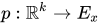
Let E → X {\displaystyle E\to X} {\displaystyle E\to X} be a real vector bundle of rank k {\displaystyle k} {\displaystyle k} over a topological space X {\displaystyle X} {\displaystyle X}. A frame at a point x ∈ X {\displaystyle x\in X} {\displaystyle x\in X} is an ordered basis for the vector space E x {\displaystyle E_{x}} {\displaystyle E_{x}}. Equivalently, a frame can be viewed as a linear isomorphism

p : R k → E x . {\displaystyle p:\mathbf {R} ^{k}\to E_{x}.} {\displaystyle p:\mathbf {R} ^{k}\to E_{x}.}

The set of all frames at x {\displaystyle x} {\displaystyle x}, denoted F x {\displaystyle F_{x}} {\displaystyle F_{x}}, has a natural right action by the general linear group G L ( k , R ) {\displaystyle \mathrm {GL} (k,\mathbb {R} )} {\displaystyle \mathrm {GL} (k,\mathbb {R} )} of invertible k × k {\displaystyle k\times k} {\displaystyle k\times k} matrices: a group element g ∈ G L ( k , R ) {\displaystyle g\in \mathrm {GL} (k,\mathbb {R} )} {\displaystyle g\in \mathrm {GL} (k,\mathbb {R} )} acts on the frame p {\displaystyle p} {\displaystyle p} via composition to give a new frame

p ∘ g : R k → E x . {\displaystyle p\circ g:\mathbf {R} ^{k}\to E_{x}.} {\displaystyle p\circ g:\mathbf {R} ^{k}\to E_{x}.}

This action of G L ( k , R ) {\displaystyle \mathrm {GL} (k,\mathbb {R} )} {\displaystyle \mathrm {GL} (k,\mathbb {R} )} on F x {\displaystyle F_{x}} {\displaystyle F_{x}} is both free and transitive (this follows from the standard linear algebra result that there is a unique invertible linear transformation sending one basis onto another). As a topological space, F x {\displaystyle F_{x}} {\displaystyle F_{x}} is homeomorphic to G L ( k , R ) {\displaystyle \mathrm {GL} (k,\mathbb {R} )} {\displaystyle \mathrm {GL} (k,\mathbb {R} )} although it lacks a group structure, since there is no "preferred frame". The space F x {\displaystyle F_{x}} {\displaystyle F_{x}} is said to be a G L ( k , R ) {\displaystyle \mathrm {GL} (k,\mathbb {R} )} {\displaystyle \mathrm {GL} (k,\mathbb {R} )}-torsor.

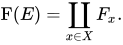
The frame bundle of E {\displaystyle E} {\displaystyle E}, denoted by F ( E ) {\displaystyle F(E)} {\displaystyle F(E)} or F G L ( E ) {\displaystyle F_{\mathrm {GL} }(E)} {\displaystyle F_{\mathrm {GL} }(E)}, is the disjoint union of all the F x {\displaystyle F_{x}} {\displaystyle F_{x}}:

F ( E ) = ∐ x ∈ X F x . {\displaystyle \mathrm {F} (E)=\coprod _{x\in X}F_{x}.} {\displaystyle \mathrm {F} (E)=\coprod _{x\in X}F_{x}.}

Each point in F ( E ) {\displaystyle F(E)} {\displaystyle F(E)} is a pair ( x , p ) {\displaystyle (x,p)} {\displaystyle (x,p)}, where x {\displaystyle x} {\displaystyle x} is a point in X {\displaystyle X} {\displaystyle X} and p {\displaystyle p} {\displaystyle p} is a frame at x {\displaystyle x} {\displaystyle x}. There is a natural projection π : F ( E ) → X {\displaystyle \pi :F(E)\to X} {\displaystyle \pi :F(E)\to X} which sends ( x , p ) {\displaystyle (x,p)} {\displaystyle (x,p)} to x {\displaystyle x} {\displaystyle x}. The group G L ( k , R ) {\displaystyle \mathrm {GL} (k,\mathbb {R} )} {\displaystyle \mathrm {GL} (k,\mathbb {R} )} acts on F ( E ) {\displaystyle F(E)} {\displaystyle F(E)} on the right as above. This action is clearly free and the orbits are just the fibers of π {\displaystyle \pi } {\displaystyle \pi }.

Principal bundle structure

[edit]

The frame bundle F ( E ) {\displaystyle F(E)} {\displaystyle F(E)} can be given a natural topology and bundle structure determined by that of E {\displaystyle E} {\displaystyle E}. Let ( U i , ϕ i ) {\displaystyle (U_{i},\phi _{i})} {\displaystyle (U_{i},\phi _{i})} be a local trivialization of E {\displaystyle E} {\displaystyle E}. Then for each x ∈ U i {\displaystyle x\in U_{i}} {\displaystyle x\in U_{i}} one has a linear isomorphism ϕ i , x : E x → R k {\displaystyle \phi _{i,x}:E_{x}\to \mathbb {R} ^{k}} {\displaystyle \phi _{i,x}:E_{x}\to \mathbb {R} ^{k}}. This data determines a bijection

ψ i : π − 1 ( U i ) → U i × G L ( k , R ) {\displaystyle \psi _{i}:\pi ^{-1}(U_{i})\to U_{i}\times \mathrm {GL} (k,\mathbb {R} )} {\displaystyle \psi _{i}:\pi ^{-1}(U_{i})\to U_{i}\times \mathrm {GL} (k,\mathbb {R} )}

given by

ψ i ( x , p ) = ( x , ϕ i , x ∘ p ) . {\displaystyle \psi _{i}(x,p)=(x,\phi _{i,x}\circ p).} {\displaystyle \psi _{i}(x,p)=(x,\phi _{i,x}\circ p).}

With these bijections, each π − 1 ( U i ) {\displaystyle \pi ^{-1}(U_{i})} {\displaystyle \pi ^{-1}(U_{i})} can be given the topology of U i × G L ( k , R ) {\displaystyle U_{i}\times \mathrm {GL} (k,\mathbb {R} )} {\displaystyle U_{i}\times \mathrm {GL} (k,\mathbb {R} )}. The topology on F ( E ) {\displaystyle F(E)} {\displaystyle F(E)} is the final topology coinduced by the inclusion maps π − 1 ( U i ) → F ( E ) {\displaystyle \pi ^{-1}(U_{i})\to F(E)} {\displaystyle \pi ^{-1}(U_{i})\to F(E)}.

With all of the above data the frame bundle F ( E ) {\displaystyle F(E)} {\displaystyle F(E)} becomes a principal fiber bundle over X {\displaystyle X} {\displaystyle X} with structure group G L ( k , R ) {\displaystyle \mathrm {GL} (k,\mathbb {R} )} {\displaystyle \mathrm {GL} (k,\mathbb {R} )} and local trivializations ( { U i } , { ψ i } ) {\displaystyle (\{U_{i}\},\{\psi _{i}\})} {\displaystyle (\{U_{i}\},\{\psi _{i}\})}. One can check that the transition functions of F ( E ) {\displaystyle F(E)} {\displaystyle F(E)} are the same as those of E {\displaystyle E} {\displaystyle E}.

The above all works in the smooth category as well: if E {\displaystyle E} {\displaystyle E} is a smooth vector bundle over a smooth manifold M {\displaystyle M} {\displaystyle M} then the frame bundle of E {\displaystyle E} {\displaystyle E} can be given the structure of a smooth principal bundle over M {\displaystyle M} {\displaystyle M}.

Associated vector bundles

[edit]

A vector bundle E {\displaystyle E} {\displaystyle E} and its frame bundle F ( E ) {\displaystyle F(E)} {\displaystyle F(E)} are associated bundles. Each one determines the other. The frame bundle F ( E ) {\displaystyle F(E)} {\displaystyle F(E)} can be constructed from E {\displaystyle E} {\displaystyle E} as above, or more abstractly using the fiber bundle construction theorem. With the latter method, F ( E ) {\displaystyle F(E)} {\displaystyle F(E)} is the fiber bundle with same base, structure group, trivializing neighborhoods, and transition functions as E {\displaystyle E} {\displaystyle E} but with abstract fiber G L ( k , R ) {\displaystyle \mathrm {GL} (k,\mathbb {R} )} {\displaystyle \mathrm {GL} (k,\mathbb {R} )}, where the action of structure group G L ( k , R ) {\displaystyle \mathrm {GL} (k,\mathbb {R} )} {\displaystyle \mathrm {GL} (k,\mathbb {R} )} on the fiber G L ( k , R ) {\displaystyle \mathrm {GL} (k,\mathbb {R} )} {\displaystyle \mathrm {GL} (k,\mathbb {R} )} is that of left multiplication.

Given any linear representation ρ : G L ( k , R ) → G L ( V , F ) {\displaystyle \rho :\mathrm {GL} (k,\mathbb {R} )\to \mathrm {GL} (V,\mathbb {F} )} {\displaystyle \rho :\mathrm {GL} (k,\mathbb {R} )\to \mathrm {GL} (V,\mathbb {F} )} there is a vector bundle

F ( E ) × ρ V {\displaystyle \mathrm {F} (E)\times _{\rho }V} {\displaystyle \mathrm {F} (E)\times _{\rho }V}

associated with F ( E ) {\displaystyle F(E)} {\displaystyle F(E)} which is given by product F ( E ) × V {\displaystyle F(E)\times V} {\displaystyle F(E)\times V} modulo the equivalence relation ( p g , v ) ∼ ( p , ρ ( g ) v ) {\displaystyle (pg,v)\sim (p,\rho (g)v)} {\displaystyle (pg,v)\sim (p,\rho (g)v)} for all g {\displaystyle g} {\displaystyle g} in G L ( k , R ) {\displaystyle \mathrm {GL} (k,\mathbb {R} )} {\displaystyle \mathrm {GL} (k,\mathbb {R} )}. Denote the equivalence classes by [ p , v ] {\displaystyle [p,v]} {\displaystyle [p,v]}.

The vector bundle E {\displaystyle E} {\displaystyle E} is naturally isomorphic to the bundle F ( E ) × ρ R k {\displaystyle F(E)\times _{\rho }\mathbb {R} ^{k}} {\displaystyle F(E)\times _{\rho }\mathbb {R} ^{k}} where ρ {\displaystyle \rho } {\displaystyle \rho } is the defining representation of G L ( k , R ) {\displaystyle \mathrm {GL} (k,\mathbb {R} )} {\displaystyle \mathrm {GL} (k,\mathbb {R} )} on R k {\displaystyle \mathbb {R} ^{k}} {\displaystyle \mathbb {R} ^{k}}. The isomorphism is given by

[ p , v ] ↦ p ( v ) {\displaystyle [p,v]\mapsto p(v)} {\displaystyle [p,v]\mapsto p(v)}

where v {\displaystyle v} {\displaystyle v} is a vector in R k {\displaystyle \mathbb {R} ^{k}} {\displaystyle \mathbb {R} ^{k}} and p : R k → E x {\displaystyle p:\mathbb {R} ^{k}\to E_{x}} {\displaystyle p:\mathbb {R} ^{k}\to E_{x}} is a frame at x {\displaystyle x} {\displaystyle x}. One can easily check that this map is well-defined.

Any vector bundle associated with E {\displaystyle E} {\displaystyle E} can be given by the above construction. For example, the dual bundle of E {\displaystyle E} {\displaystyle E} is given by F ( E ) × ρ ∗ ( R k ) ∗ {\displaystyle F(E)\times _{\rho ^{*}}(\mathbb {R} ^{k})^{*}} {\displaystyle F(E)\times _{\rho ^{*}}(\mathbb {R} ^{k})^{*}} where ρ ∗ {\displaystyle \rho ^{*}} {\displaystyle \rho ^{*}} is the dual of the fundamental representation. Tensor bundles of E {\displaystyle E} {\displaystyle E} can be constructed in a similar manner.

Tangent frame bundle

[edit]

The tangent frame bundle (or simply the frame bundle) of a smooth manifold M {\displaystyle M} {\displaystyle M} is the frame bundle associated with the tangent bundle of M {\displaystyle M} {\displaystyle M}. The frame bundle of M {\displaystyle M} {\displaystyle M} is often denoted F M {\displaystyle FM} {\displaystyle FM} or G L ( M ) {\displaystyle \mathrm {GL} (M)} {\displaystyle \mathrm {GL} (M)} rather than F ( T M ) {\displaystyle F(TM)} {\displaystyle F(TM)}. In physics, it is sometimes denoted L M {\displaystyle LM} {\displaystyle LM}. If M {\displaystyle M} {\displaystyle M} is n {\displaystyle n} {\displaystyle n}-dimensional then the tangent bundle has rank n {\displaystyle n} {\displaystyle n}, so the frame bundle of M {\displaystyle M} {\displaystyle M} is a principal G L ( n , R ) {\displaystyle \mathrm {GL} (n,\mathbb {R} )} {\displaystyle \mathrm {GL} (n,\mathbb {R} )} bundle over M {\displaystyle M} {\displaystyle M}.

Smooth frames

[edit]

Local sections of the frame bundle of M {\displaystyle M} {\displaystyle M} are called smooth frames on M {\displaystyle M} {\displaystyle M}. The cross-section theorem for principal bundles states that the frame bundle is trivial over any open set in U {\displaystyle U} {\displaystyle U} in M {\displaystyle M} {\displaystyle M} which admits a smooth frame. Given a smooth frame s : U → F U {\displaystyle s:U\to FU} {\displaystyle s:U\to FU}, the trivialization ψ : F U → U × G L ( n , R ) {\displaystyle \psi :FU\to U\times \mathrm {GL} (n,\mathbb {R} )} {\displaystyle \psi :FU\to U\times \mathrm {GL} (n,\mathbb {R} )} is given by

ψ ( p ) = ( x , s ( x ) − 1 ∘ p ) {\displaystyle \psi (p)=(x,s(x)^{-1}\circ p)} {\displaystyle \psi (p)=(x,s(x)^{-1}\circ p)}

where p {\displaystyle p} {\displaystyle p} is a frame at x {\displaystyle x} {\displaystyle x}. It follows that a manifold is parallelizable if and only if the frame bundle of M {\displaystyle M} {\displaystyle M} admits a global section.

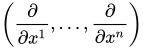
Since the tangent bundle of M {\displaystyle M} {\displaystyle M} is trivializable over coordinate neighborhoods of M {\displaystyle M} {\displaystyle M} so is the frame bundle. In fact, given any coordinate neighborhood U {\displaystyle U} {\displaystyle U} with coordinates ( x 1 , … , x n ) {\displaystyle (x^{1},\ldots ,x^{n})} {\displaystyle (x^{1},\ldots ,x^{n})} the coordinate vector fields

( ∂ ∂ x 1 , … , ∂ ∂ x n ) {\displaystyle \left({\frac {\partial }{\partial x^{1}}},\ldots ,{\frac {\partial }{\partial x^{n}}}\right)} {\displaystyle \left({\frac {\partial }{\partial x^{1}}},\ldots ,{\frac {\partial }{\partial x^{n}}}\right)}

define a smooth frame on U {\displaystyle U} {\displaystyle U}. One of the advantages of working with frame bundles is that they allow one to work with frames other than coordinates frames; one can choose a frame adapted to the problem at hand. This is sometimes called the method of moving frames.

Solder form

[edit]

The frame bundle of a manifold M {\displaystyle M} {\displaystyle M} is a special type of principal bundle in the sense that its geometry is fundamentally tied to the geometry of M {\displaystyle M} {\displaystyle M}. This relationship can be expressed by means of a vector-valued 1-form on F M {\displaystyle FM} {\displaystyle FM} called the solder form (also known as the fundamental or tautological 1-form). Let x {\displaystyle x} {\displaystyle x} be a point of the manifold M {\displaystyle M} {\displaystyle M} and p {\displaystyle p} {\displaystyle p} a frame at x {\displaystyle x} {\displaystyle x}, so that

p : R n → T x M {\displaystyle p:\mathbf {R} ^{n}\to T_{x}M} {\displaystyle p:\mathbf {R} ^{n}\to T_{x}M}

is a linear isomorphism of R n {\displaystyle \mathbb {R} ^{n}} {\displaystyle \mathbb {R} ^{n}} with the tangent space of M {\displaystyle M} {\displaystyle M} at x {\displaystyle x} {\displaystyle x}. The solder form of F M {\displaystyle FM} {\displaystyle FM} is the R n {\displaystyle \mathbb {R} ^{n}} {\displaystyle \mathbb {R} ^{n}}-valued 1-form θ {\displaystyle \theta } {\displaystyle \theta } defined by

θ p ( ξ ) = p − 1 d π ( ξ ) {\displaystyle \theta _{p}(\xi )=p^{-1}\mathrm {d} \pi (\xi )} {\displaystyle \theta _{p}(\xi )=p^{-1}\mathrm {d} \pi (\xi )}

where ξ is a tangent vector to F M {\displaystyle FM} {\displaystyle FM} at the point ( x , p ) {\displaystyle (x,p)} {\displaystyle (x,p)}, and p − 1 : T x M → R n {\displaystyle p^{-1}:T_{x}M\to \mathbb {R} ^{n}} {\displaystyle p^{-1}:T_{x}M\to \mathbb {R} ^{n}} is the inverse of the frame map, and d π {\displaystyle d\pi } {\displaystyle d\pi } is the differential of the projection map π : F M → M {\displaystyle \pi :FM\to M} {\displaystyle \pi :FM\to M}. The solder form is horizontal in the sense that it vanishes on vectors tangent to the fibers of π {\displaystyle \pi } {\displaystyle \pi } and right equivariant in the sense that

R g ∗ θ = g − 1 θ {\displaystyle R_{g}^{*}\theta =g^{-1}\theta } {\displaystyle R_{g}^{*}\theta =g^{-1}\theta }

where R g {\displaystyle R_{g}} {\displaystyle R_{g}} is right translation by g ∈ G L ( n , R ) {\displaystyle g\in \mathrm {GL} (n,\mathbb {R} )} {\displaystyle g\in \mathrm {GL} (n,\mathbb {R} )}. A form with these properties is called a basic or tensorial form on F M {\displaystyle FM} {\displaystyle FM}. Such forms are in 1-1 correspondence with T M {\displaystyle TM} {\displaystyle TM}-valued 1-forms on M {\displaystyle M} {\displaystyle M} which are, in turn, in 1-1 correspondence with smooth bundle maps T M → T M {\displaystyle TM\to TM} {\displaystyle TM\to TM} over M {\displaystyle M} {\displaystyle M}. Viewed in this light θ {\displaystyle \theta } {\displaystyle \theta } is just the identity map on T M {\displaystyle TM} {\displaystyle TM}.

As a naming convention, the term "tautological one-form" is usually reserved for the case where the form has a canonical definition, as it does here, while "solder form" is more appropriate for those cases where the form is not canonically defined. This convention is not being observed here.

Orthonormal frame bundle

[edit]

If a vector bundle E {\displaystyle E} {\displaystyle E} is equipped with a Riemannian bundle metric then each fiber E x {\displaystyle E_{x}} {\displaystyle E_{x}} is not only a vector space but an inner product space. It is then possible to talk about the set of all orthonormal frames for E x {\displaystyle E_{x}} {\displaystyle E_{x}}. An orthonormal frame for E x {\displaystyle E_{x}} {\displaystyle E_{x}} is an ordered orthonormal basis for E x {\displaystyle E_{x}} {\displaystyle E_{x}}, or, equivalently, a linear isometry

p : R k → E x {\displaystyle p:\mathbb {R} ^{k}\to E_{x}} {\displaystyle p:\mathbb {R} ^{k}\to E_{x}}

where R k {\displaystyle \mathbb {R} ^{k}} {\displaystyle \mathbb {R} ^{k}} is equipped with the standard Euclidean metric. The orthogonal group O ( k ) {\displaystyle \mathrm {O} (k)} {\displaystyle \mathrm {O} (k)} acts freely and transitively on the set of all orthonormal frames via right composition. In other words, the set of all orthonormal frames is a right O ( k ) {\displaystyle \mathrm {O} (k)} {\displaystyle \mathrm {O} (k)}-torsor.

The orthonormal frame bundle of E {\displaystyle E} {\displaystyle E}, denoted F O ( E ) {\displaystyle F_{\mathrm {O} }(E)} {\displaystyle F_{\mathrm {O} }(E)}, is the set of all orthonormal frames at each point x {\displaystyle x} {\displaystyle x} in the base space X {\displaystyle X} {\displaystyle X}. It can be constructed by a method entirely analogous to that of the ordinary frame bundle. The orthonormal frame bundle of a rank k {\displaystyle k} {\displaystyle k} Riemannian vector bundle E → X {\displaystyle E\to X} {\displaystyle E\to X} is a principal O ( k ) {\displaystyle \mathrm {O} (k)} {\displaystyle \mathrm {O} (k)}-bundle over X {\displaystyle X} {\displaystyle X}. Again, the construction works just as well in the smooth category.

If the vector bundle E {\displaystyle E} {\displaystyle E} is orientable then one can define the oriented orthonormal frame bundle of E {\displaystyle E} {\displaystyle E}, denoted F S O ( E ) {\displaystyle F_{\mathrm {SO} }(E)} {\displaystyle F_{\mathrm {SO} }(E)}, as the principal S O ( k ) {\displaystyle \mathrm {SO} (k)} {\displaystyle \mathrm {SO} (k)}-bundle of all positively oriented orthonormal frames.

If M {\displaystyle M} {\displaystyle M} is an n {\displaystyle n} {\displaystyle n}-dimensional Riemannian manifold, then the orthonormal frame bundle of M {\displaystyle M} {\displaystyle M}, denoted F O ( M ) {\displaystyle F_{\mathrm {O} }(M)} {\displaystyle F_{\mathrm {O} }(M)} or O ( M ) {\displaystyle \mathrm {O} (M)} {\displaystyle \mathrm {O} (M)}, is the orthonormal frame bundle associated with the tangent bundle of M {\displaystyle M} {\displaystyle M} (which is equipped with a Riemannian metric by definition). If M {\displaystyle M} {\displaystyle M} is orientable, then one also has the oriented orthonormal frame bundle F S O ( M ) {\displaystyle F_{\mathrm {SO} }(M)} {\displaystyle F_{\mathrm {SO} }(M)}.

Given a Riemannian vector bundle E {\displaystyle E} {\displaystyle E}, the orthonormal frame bundle is a principal O ( k ) {\displaystyle \mathrm {O} (k)} {\displaystyle \mathrm {O} (k)}-subbundle of the general linear frame bundle. In other words, the inclusion map

i : F O ( E ) → F G L ( E ) {\displaystyle i:{\mathrm {F} }_{\mathrm {O} }(E)\to {\mathrm {F} }_{\mathrm {GL} }(E)} {\displaystyle i:{\mathrm {F} }_{\mathrm {O} }(E)\to {\mathrm {F} }_{\mathrm {GL} }(E)}

is principal bundle map. One says that F O ( E ) {\displaystyle F_{\mathrm {O} }(E)} {\displaystyle F_{\mathrm {O} }(E)} is a reduction of the structure group of F G L ( E ) {\displaystyle F_{\mathrm {GL} }(E)} {\displaystyle F_{\mathrm {GL} }(E)} from G L ( n , R ) {\displaystyle \mathrm {GL} (n,\mathbb {R} )} {\displaystyle \mathrm {GL} (n,\mathbb {R} )} to O ( k ) {\displaystyle \mathrm {O} (k)} {\displaystyle \mathrm {O} (k)}.

G-structures

[edit]
See also: G-structure

If a smooth manifold M {\displaystyle M} {\displaystyle M} comes with additional structure it is often natural to consider a subbundle of the full frame bundle of M {\displaystyle M} {\displaystyle M} which is adapted to the given structure. For example, if M {\displaystyle M} {\displaystyle M} is a Riemannian manifold we saw above that it is natural to consider the orthonormal frame bundle of M {\displaystyle M} {\displaystyle M}. The orthonormal frame bundle is just a reduction of the structure group of F G L ( M ) {\displaystyle F_{\mathrm {GL} }(M)} {\displaystyle F_{\mathrm {GL} }(M)} to the orthogonal group O ( n ) {\displaystyle \mathrm {O} (n)} {\displaystyle \mathrm {O} (n)}.

In general, if M {\displaystyle M} {\displaystyle M} is a smooth n {\displaystyle n} {\displaystyle n}-manifold and G {\displaystyle G} {\displaystyle G} is a Lie subgroup of G L ( n , R ) {\displaystyle \mathrm {GL} (n,\mathbb {R} )} {\displaystyle \mathrm {GL} (n,\mathbb {R} )} we define a G-structure on M {\displaystyle M} {\displaystyle M} to be a reduction of the structure group of F G L ( M ) {\displaystyle F_{\mathrm {GL} }(M)} {\displaystyle F_{\mathrm {GL} }(M)} to G {\displaystyle G} {\displaystyle G}. Explicitly, this is a principal G {\displaystyle G} {\displaystyle G}-bundle F G ( M ) {\displaystyle F_{G}(M)} {\displaystyle F_{G}(M)} over M {\displaystyle M} {\displaystyle M} together with a G {\displaystyle G} {\displaystyle G}-equivariant bundle map

F G ( M ) → F G L ( M ) {\displaystyle {\mathrm {F} }_{G}(M)\to {\mathrm {F} }_{\mathrm {GL} }(M)} {\displaystyle {\mathrm {F} }_{G}(M)\to {\mathrm {F} }_{\mathrm {GL} }(M)}

over M {\displaystyle M} {\displaystyle M}.

In this language, a Riemannian metric on M {\displaystyle M} {\displaystyle M} gives rise to an O ( n ) {\displaystyle \mathrm {O} (n)} {\displaystyle \mathrm {O} (n)}-structure on M {\displaystyle M} {\displaystyle M}. The following are some other examples.

  • Every oriented manifold has an oriented frame bundle which is just a G L + ( n , R ) {\displaystyle \mathrm {GL} ^{+}(n,\mathbb {R} )} {\displaystyle \mathrm {GL} ^{+}(n,\mathbb {R} )}-structure on M {\displaystyle M} {\displaystyle M}.
  • A volume form on M {\displaystyle M} {\displaystyle M} determines a S L ( n , R ) {\displaystyle \mathrm {SL} (n,\mathbb {R} )} {\displaystyle \mathrm {SL} (n,\mathbb {R} )}-structure on M {\displaystyle M} {\displaystyle M}.
  • A 2 n {\displaystyle 2n} {\displaystyle 2n}-dimensional symplectic manifold has a natural S p ( 2 n , R ) {\displaystyle \mathrm {Sp} (2n,\mathbb {R} )} {\displaystyle \mathrm {Sp} (2n,\mathbb {R} )}-structure.
  • A 2 n {\displaystyle 2n} {\displaystyle 2n}-dimensional complex or almost complex manifold has a natural G L ( n , C ) {\displaystyle \mathrm {GL} (n,\mathbb {C} )} {\displaystyle \mathrm {GL} (n,\mathbb {C} )}-structure.

In many of these instances, a G {\displaystyle G} {\displaystyle G}-structure on M {\displaystyle M} {\displaystyle M} uniquely determines the corresponding structure on M {\displaystyle M} {\displaystyle M}. For example, a S L ( n , R ) {\displaystyle \mathrm {SL} (n,\mathbb {R} )} {\displaystyle \mathrm {SL} (n,\mathbb {R} )}-structure on M {\displaystyle M} {\displaystyle M} determines a volume form on M {\displaystyle M} {\displaystyle M}. However, in some cases, such as for symplectic and complex manifolds, an added integrability condition is needed. A S p ( 2 n , R ) {\displaystyle \mathrm {Sp} (2n,\mathbb {R} )} {\displaystyle \mathrm {Sp} (2n,\mathbb {R} )}-structure on M {\displaystyle M} {\displaystyle M} uniquely determines a nondegenerate 2-form on M {\displaystyle M} {\displaystyle M}, but for M {\displaystyle M} {\displaystyle M} to be symplectic, this 2-form must also be closed.

References

[edit]
  • Kobayashi, Shoshichi; Nomizu, Katsumi (1996), Foundations of Differential Geometry, vol. 1 (New ed.), Wiley Interscience, ISBN 0-471-15733-3
  • Kolář, Ivan; Michor, Peter; Slovák, Jan (1993), Natural operators in differential geometry (PDF), Springer-Verlag, archived from the original (PDF) on 2017-03-30, retrieved 2008-08-02
  • Sternberg, S. (1983), Lectures on Differential Geometry (2nd ed.), New York: Chelsea Publishing Co., ISBN 0-8218-1385-4
Retrieved from "https://teknopedia.ac.id/w/index.php?title=Frame_bundle&oldid=1327489475#Orthonormal_frame_bundle"
Categories:
  • Fiber bundles
  • Vector bundles
Hidden categories:
  • Articles with short description
  • Short description is different from Wikidata

  • indonesia
  • Polski
  • العربية
  • Deutsch
  • English
  • Español
  • Français
  • Italiano
  • مصرى
  • Nederlands
  • 日本語
  • Português
  • Sinugboanong Binisaya
  • Svenska
  • Українська
  • Tiếng Việt
  • Winaray
  • 中文
  • Русский
Sunting pranala
url url url url url url url url url url url url url url url url url url url url url url url url url url url url url url url url url url url url url url url url url url url url url url url url url url url url url url url url url url url url url url url url url url url url url url url url url url url url url url url url url url url url url url url url url url url url url url url url url url url url url url url url url url url url url url url url url url url url url url url url url url url url url url url url url url url url url url url url url url url url url url url url url url url url url url url url url url url url url url url url url url url url url url url url url url url url url url url url url url url url url url url url url url url url url url url url url url url url url url url url url url url url url url url url url url url url url url url url url url url url url url url url url url url url url url url url url url url url url url url url url url url url url url url url url url url url url url url url url url url url url url url url url url url url url url url url url url url url url url url url url url url url url url url url url url url url url url url url url url url url url url url url url url url url url url url url url url url url url url url url url url url url url url url url url url url url url url url url url url url url url url url url url url url url url url url url url url url url url url url url url url url url url url url url url url url url url url url url url url url url url url url url url url url url url url url url url url url url url url url url url url url url url url url url url url url url url url url url url url url url url url url url url url url url url url url url url url url url url url url url url url url url url url url url url url url url url url url url url url url url url url url url url url url url url url url url url url url url url url url url url url url url url url url url url url url url url url url url url url url url url url url url url url url url url url url url url url url url url url url url url url url url url url url url url url url url url url url url url url url url url url url url url url url url url url url url url url url url url url url url url url url url url url url url url url url url url url url url url url url url url url url url url url url url url url url url url url url url url url url url url url url url url url url url url url url url url url url url url url url url url url url url url url url url url url url url url url url url url url url url url url url url url url url url url url url url url url url url url url url url url url url url url url url url url url url url url url url url url url url url url url url url url url url url url url url url url url url url url url url url url url url url url url url url url url url url url url url url url url url url url url url url url url url url url url url url url url url url url url url url url url url url url url url url url url url url url url url url url url url url url url url url url url url url url url url url url url url url url url url url url url url url url url url url url url url url url url url url url url url url url url url url url url url url url url url url url url url url url url url url url url url url url url url url url url url url url url url url url url url url url url url url url url url url url url url url url url url url url url url url url url url url url url url url url url url url url url url url url url url url url url url url url url url url url url url url url url url url url url url url url url url url url url url url url url url url url url url url url url url url url url url url url url url url url url url url url url url url url url url url url url url url url url url url url url url url url url url url url url url url url url url url url url url url url url url url url url url url url url url url url url url url url url url url url url url url url url url url url url url url url url url url url url url url url url url url url url url url url url url url url url url url url url url url url url url url url url url url url url url url url url url url url url url url url url url url url url url url url url url url url url url url url url url url url url url url url url url url url url url url url url url url url url url url url url url url url url url url url url url url url url url url url url url url url url url url url url url url url url url url url url url url url url url url url url url url url url url url url url url url url url url url url url url url url url url url url url url url url url url url url url url url url url url url url url url url url url url url url url url url url url url url url url url url url url url url url url url url url url url url url url url url url url url url url url url url url url url url url url url url url url url url url url url url url url url url url url url url url url url url url url url url url url url url url url url url url url url url url url url url url url url url url url url url url url url url url url url url url url url url url url url url url url url url url url url url url url url url url url url url url url url url url url url url url url url url url url url url url url url url url url url url url url url url url url url url url url url url url url url url url url url url url url url url url url url url url url url url url url url url url url url url url url url url url url url url url url url url url url url url url url url url url url url url url url url url url url url url url url url url url url url url url url url url url url url url url url url url url url url url url url url url url url url url url url url url url url url url url url url url url url url url url url url url url url url url url url url url url url url url url url url url url url url url url url url url url url url url url url url url url url url url url url url url url url url url url url url url url url url url url url url url url url url url url url url url url url url url url url url url url url url url url url url url url url url url url url url url url url url url url url url url url url url url url url url url url url url url url url url url url url url url url url url url url url url url url url url url url url url url url url url url url url url url url url url url url url url url url url url url url url url url url url url url url url url url url url url url url url url url url url url url url url url url url url url url url url url url url url url url url url url url url url url url url url url url url url url url url url url url url url url url url url url url url url url url url url url url url url url url url url url url url url url url url url url url url url url url url url url url url url url url url url url url url url url url url url url url url url url url url url url url url url url url url url url url url url url url url url url url url url url url url url url url url url url url url url url url url url url url url url url url url url url url url url url url url url url url url url url url url url url url url url url url url url url url url url url url url url url url url url url url url url url url url url url url url url url url url url url url url url url url url url url url url url url url url url url url url url url url url url url url url url url url url url url url url url url url url url url url url url url url url url url url url url url url url url url url url url url url url url url url url url url url url url url url url url url url url url url url url url url url url url url url url url url url url url url url url url url url url url url url url url url url url url url url url url url url url url url url url url url url url url url url url url url url url url url url url url url url url url url url url url url url url url url url url url url url url url url url url url url url url url url url url url url url url url url url url url url url url url url url url url url url url url url url url url url url url url url url url url url url url url url url url url url url url url url url url url url url url url url url url url url url url url url url url url url url url url url url url url url url url url url url url url url url url url url url url url url url url url url url url url url url url url url url url url url url url url url url url url url url url url url url url url url url url url url url url url url url url url url url url url url url url url url url url url url url url url url url url url url url url url url url url url url url url url url url url url url url url url url url url url url url url url url url url url url url url url url url url url url url url url url url url url url url url url url url url url url url url url url url url url url url url url url url url url url url url url url url url url url url url url url url url url url url url url url url url url url url url url url url url url url url url url url url url url url url url url url url url url url url url url url url url url url url url url url url url url url url url url url url url url url url url url url url url url url url url url url url url url url url url url url url url url url url url url url url url url url url url url url url url url url url url url url url url url url url url url url url url url url url url url url url url url url url url url url url url url url url url url url url url url url url url url url url url url url url url url url url url url url url url url url url url url url url url url url url url url url url url url url url url url url url url url url url url url url url url url url url url url url url
Pusat Layanan

UNIVERSITAS TEKNOKRAT INDONESIA | ASEAN's Best Private University
Jl. ZA. Pagar Alam No.9 -11, Labuhan Ratu, Kec. Kedaton, Kota Bandar Lampung, Lampung 35132
Phone: (0721) 702022
Email: pmb@teknokrat.ac.id