


The History Portal

Herodotus (c. 484 BC – c. 425 BC) is often
considered the "father of history"
History is the systematic study of the past, focusing primarily on the human past. As an academic discipline, it analyses and interprets evidence to construct narratives about what happened and explain why it happened. Some theorists categorize history as a social science, while others see it as part of the humanities or consider it a hybrid discipline. Similar debates surround the purpose of history—for example, whether its main aim is theoretical, to uncover the truth, or practical, to learn lessons from the past. In a more general sense, the term history refers not to an academic field but to the past itself, times in the past, or to individual texts about the past.
Historical research relies on primary and secondary sources to reconstruct past events and validate interpretations. Source criticism is used to evaluate these sources, assessing their authenticity, content, and reliability. Historians strive to integrate the perspectives of several sources to develop a coherent narrative. Different schools of thought, such as positivism, the Annales school, Marxism, and postmodernism, have distinct methodological approaches.
History is a broad discipline encompassing many branches. Some focus on specific time periods, such as ancient history, while others concentrate on particular geographic regions, such as the history of Africa. Thematic categorizations include political history, military history, social history, and economic history. Branches associated with specific research methods and sources include quantitative history, comparative history, and oral history.
History emerged as a field of inquiry in antiquity to replace myth-infused narratives, with influential early traditions originating in Greece, China, and later in the Islamic world. Historical writing evolved throughout the ages and became increasingly professional, particularly during the 19th century, when a rigorous methodology and various academic institutions were established. History is related to many fields, including historiography, philosophy, education, and politics. (Full article...)
 Featured articles –

-

The Lion class were a pair of battlecruisers built for the Royal Navy before World War I. Nicknamed the "Splendid Cats", the ships were a significant improvement over their predecessors of the Indefatigable class in speed, armament and armour. These improvements were in response to the German battlecruisers of the Moltke class, which were in turn larger and more powerful than the first British battlecruisers of the Invincible class.
Lion served as the flagship of the Grand Fleet's battlecruisers throughout World War I. She sank the German light cruiser Cöln during the Battle of Heligoland Bight in August 1914 and participated in the battles of Dogger Bank in 1915 and Jutland the following year. She was so badly damaged at the Battle of Dogger Bank that she had to be towed back to port. During the Battle of Jutland, Lion suffered a serious cordite fire that could have destroyed the ship. (Full article...) -
King Edward III of England led a campaign in the Duchy of Brittany in 1342 and 1343. England, at war with France since 1337 in the Hundred Years' War, had sided with John of Montfort's faction in the War of the Breton Succession soon after it broke out in 1341. The French king, Philip VI, supported the rival claimant, Charles of Blois, who was his nephew. By August 1342, Charles had captured John and reduced his partisans back to just one fortification, Brest in western Brittany. An English fleet broke the blockade of Brest on 18 August. On 30 September, a numerically inferior English army inflicted a heavy defeat on the French at the battle of Morlaix.
Edward was supposed to arrive with the next contingent of his army shortly after the first, but had severe difficulties gathering sufficient shipping. On 6 October, he abandoned his siege train and set sail with those troops he could embark on the available ships. They reached Brittany on 26 October after a storm-wracked three-week passage, and Edward advanced on the south-central Breton town of Vannes. The naval component went ahead, but was mauled by a force of mercenary galleys and then failed in an attempt to take Vannes by a coup de main. The land component was delayed in building siege engines before attempting to storm the town on 29 November. The newly reinforced French garrison repelled this assault, and a siege began. (Full article...) -

Winfield Scott Hancock (February 14, 1824 – February 9, 1886) was a major general in the United States Army and the Democratic nominee for President of the United States in 1880. He served with distinction in the Army for four decades, including service in the Mexican–American War and as a Union general in the American Civil War. Known to his Army as "Hancock the Superb", he was noted in particular for his personal leadership at the Battle of Gettysburg in 1863. His military service continued after the Civil War, as Hancock participated in the military Reconstruction of the South and the United States's western expansion and war with the Native Americans at the Western frontier. This concluded with the Medicine Lodge Treaty. From 1881 to 1885 he was president of the Aztec Club of 1847 for veteran officers of the Mexican-American War.
Hancock's reputation as a war hero at Gettysburg, combined with his status as a Unionist and supporter of states' rights, made him a potential presidential candidate. When the Democrats nominated him for president in 1880, he ran a strong campaign, but was narrowly defeated by Ohio congressman and Republican Party nominee James A. Garfield. Hancock's last public service involved the oversight of President Ulysses S. Grant's funeral procession in 1885. (Full article...) -
Before dawn on 19 December 1964, a coup d'état took place when the ruling military junta of South Vietnam led by General Nguyễn Khánh dissolved the High National Council (HNC) and arrested some of its members. The HNC was an unelected legislative-style civilian advisory body they had created at the request of the United States—South Vietnam's main sponsor—to give a veneer of civilian rule. The dissolution dismayed the Americans, particularly the ambassador, Maxwell D. Taylor, who engaged in an angry war of words with various generals including Khánh and threatened aid cuts. They were unable to do anything about the fait accompli that had been handed to them, because they strongly desired to win the Vietnam War and needed to support the Army of the Republic of Vietnam. Instead, Taylor's searing verbal attacks were counterproductive as they galvanized the Vietnamese officers around the embattled Khánh. At the time, Khánh's leadership was under threat from his fellow generals, as well as Taylor, who had fallen out with him and was seeking his removal.
The genesis of the removal of the HNC was a power struggle within the ruling junta. Khánh, who had been saved from an earlier coup attempt in September 1964 by the intervention of some younger generals dubbed the Young Turks, was indebted to them and needed to satisfy their wishes to stay in power. The Young Turks disliked a group of older officers who had been in high leadership positions but were now in powerless posts, and wanted to sideline them completely. As a result, they decided to hide their political motives by introducing a policy to compulsorily retire all general officers with more than 25 years of service. The chief of state Phan Khắc Sửu, an elderly figure appointed by the military to give a semblance of civilian rule, did not want to sign the decree without the agreement of the HNC, which mostly consisted of old men. The HNC recommended against the new policy, and the younger officers, led by I Corps commander General Nguyễn Chánh Thi and Air Marshal Nguyễn Cao Kỳ, disbanded the body and arrested some of its members along with other politicians. (Full article...) -
Bretagne was the lead ship of her class of three dreadnought battleships built in the 1910s for the French Navy. Bretagne entered service in February 1916, after the start of World War I. She spent the bulk of her nearly 25-year-long career with the Mediterranean Squadron and sometimes served as its flagship. During World War I she provided cover for the Otranto Barrage that blockaded the Austro-Hungarian Navy in the Adriatic Sea, but saw no action.
The ship was significantly modernised in the interwar period, and when she was on active duty, conducted normal peacetime cruises and training manoeuvres in the Mediterranean and the Atlantic Ocean. After World War II broke out in September 1939, Bretagne escorted troop convoys and was briefly deployed to the Atlantic in search of German blockade runners and commerce raiders. Germany invaded France on 10 May 1940 and the French surrendered only six weeks later, at which time the battleship was stationed in Mers-el-Kébir, French Algeria. Fearful that the Germans would seize the French Navy, the British attacked the ships there on 3 July 1940 after the French refused to surrender or demilitarise the fleet; Bretagne was hit four times and exploded, killing the majority of her crew. Her wreck was salvaged in 1952 and broken up for scrap. (Full article...) -
The Song dynasty (/sʊŋ/ SUUNG) was an imperial dynasty of China that ruled from 960 to 1279. The dynasty was founded by Emperor Taizu of Song, who usurped the throne of the Later Zhou dynasty and went on to conquer the rest of the Ten Kingdoms, ending the Five Dynasties and Ten Kingdoms period. The Song often came into conflict with the contemporaneous Liao, Western Xia and Jin dynasties in northern China. After retreating to southern China following attacks by the Jin dynasty, the Song was eventually conquered by the Mongol-led Yuan dynasty.
The dynasty's history is divided into two periods: during the Northern Song (北宋; 960–1127), the capital was in the northern city of Bianjing (now Kaifeng) and the dynasty controlled most of what is now East China. The Southern Song (南宋; 1127–1279) comprised the period following the loss of control over the northern half of Song territory to the Jurchen-led Jin dynasty in the Jin–Song wars. At that time, the Song court retreated south of the Yangtze and established its capital at Lin'an (now Hangzhou). Although the Song dynasty had lost control of the traditional Chinese heartlands around the Yellow River, the Southern Song Empire contained a large population and productive agricultural land, sustaining a robust economy. In 1234, the Jin dynasty was conquered by the Mongols, who took control of northern China, maintaining uneasy relations with the Southern Song. Möngke Khan, the fourth Great Khan of the Mongol Empire, died in 1259 while besieging the mountain castle Diaoyucheng in Chongqing. His younger brother Kublai Khan was proclaimed the new Great Khan and in 1271 founded the Yuan dynasty. After two decades of sporadic warfare, Kublai Khan's armies conquered the Song dynasty in 1279 after defeating the Southern Song in the Battle of Yamen, and reunited China under the Yuan dynasty. (Full article...) -
Kurt Vonnegut (/ˈvɒnəɡət/ VON-ə-gət; November 11, 1922 – April 11, 2007) was an American author known for his satirical and darkly humorous novels. His published work includes fourteen novels, three short-story collections, five plays, and five nonfiction works over fifty years; further works have been published since his death.
Born and raised in Indianapolis, Vonnegut attended Cornell University, but withdrew in January 1943 and enlisted in the U.S. Army. As part of his training, he studied mechanical engineering at the Carnegie Institute of Technology and the University of Tennessee. He was then deployed to Europe to fight in World War II and was captured by the Germans during the Battle of the Bulge. He was interned in Dresden, where he survived the Allied bombing of the city in a meat locker of the slaughterhouse where he was imprisoned. After the war, he married Jane Marie Cox. He and his wife both attended the University of Chicago while he worked as a night reporter for the City News Bureau. (Full article...) -
George III (George William Frederick; 4 June 1738 – 29 January 1820) was King of Great Britain and Ireland from 25 October 1760 until his death in 1820. The Acts of Union 1800 unified Great Britain and Ireland into the United Kingdom of Great Britain and Ireland, with George as its king. He was concurrently duke and prince-elector of Hanover in the Holy Roman Empire before becoming King of Hanover on 12 October 1814. He was the first monarch of the House of Hanover who was born in Great Britain, spoke English as his first language, and never visited Hanover.
George was born during the reign of his paternal grandfather, King George II, as the first son of Frederick, Prince of Wales, and Princess Augusta of Saxe-Gotha. Following his father's death in 1751, Prince George became heir apparent and Prince of Wales. He succeeded to the throne on George II's death in 1760. The following year, he married Princess Charlotte of Mecklenburg-Strelitz, with whom he had 15 children. George III's life and reign were marked by a series of military conflicts involving his kingdoms, much of the rest of Europe, and places farther afield in Africa, the Americas and Asia. Early in his reign, Great Britain defeated France in the Seven Years' War, becoming the dominant European power in North America and India. However, Britain lost 13 of its North American colonies in the American War of Independence. Further wars against revolutionary and Napoleonic France from 1793 concluded in the defeat of Napoleon at the Battle of Waterloo in 1815. In 1807, the transatlantic slave trade was banned from the British Empire. (Full article...) -

Henry Cornelius Burnett (October 25, 1825 – October 1, 1866) was an American politician who served as a Confederate States senator from Kentucky from 1862 to 1865. From 1855 to 1861, Burnett served four terms in the United States House of Representatives. A lawyer by profession, Burnett had held only one public office—circuit court clerk—before being elected to Congress. He represented Kentucky's 1st congressional district immediately prior to the Civil War. This district contained the entire Jackson Purchase region of the state, which was more sympathetic to the Confederate cause than any other area of Kentucky. Burnett promised the voters of his district that he would have President Abraham Lincoln arraigned for treason. Unionist newspaper editor George D. Prentice described Burnett as "a big, burly, loud-mouthed fellow who is forever raising points of order and objections, to embarrass the Republicans in the House".
Besides championing the secession in Congress, Burnett also worked within Kentucky to bolster the state's support of the Confederacy. He presided over a sovereignty convention in Russellville in 1861 that formed a Confederate government for the state. The delegates to this convention chose Burnett to travel to Richmond, Virginia to secure Kentucky's admission to the Confederacy. Burnett also raised a Confederate regiment at Hopkinsville, Kentucky, and briefly served in the Confederate States Army. Camp Burnett, a Confederate recruiting post two miles west of Clinton in Hickman County, Kentucky, was named after him. (Full article...) -
HMS Vanguard was a British fast battleship built during the Second World War and commissioned after the war ended. She was the largest and fastest of the Royal Navy's battleships, and the only ship of her class. Vanguard was the last battleship to be built in history.
The Royal Navy anticipated being outnumbered by the combined German and Japanese battleships in the early 1940s, and had therefore started building the Lion-class battleships. However, the time-consuming construction of the triple-16-inch (406 mm) turrets for the Lion class would delay their completion until 1943 at the earliest. The British had enough 15-inch (381 mm) guns and turrets in storage to allow one ship of a modified Lion-class design with four twin-15-inch turrets to be completed faster than the Lion-class vessels that had already been laid down. Work on Vanguard was started and stopped several times during the war, and her design was revised several times during her construction to reflect war experience. These stoppages and changes prevented her from being completed before the end of the war. (Full article...) -
Edgar (or Eadgar; c. 944 – 8 July 975), also known as Edgar the Peaceful, the Peacemaker and the Peaceable, was King of the English from 959 until his death in 975. He became king of all England on his brother Eadwig's death. He was the younger son of King Edmund I and his first wife, Ælfgifu. A detailed account of Edgar's reign is not possible, because only a few events were recorded by chroniclers and monastic writers, who were more interested in recording the activities of the leaders of the church.
Edgar mainly followed the political policies of his predecessors, but there were major changes in the religious sphere. The English Benedictine Reform, which he strongly supported, became a dominant religious and social force. It is seen by historians as a major achievement, and it was accompanied by a literary and artistic flowering, mainly associated with Æthelwold, Bishop of Winchester. Monasteries aggressively acquired estates from lay landowners with Edgar's assistance, leading to disorder when he died and former owners sought to recover their lost property, sometimes by force. Edgar's major administrative reform was the introduction of a standardised coinage in the early 970s to replace the previous decentralised system. He also issued legislative codes which mainly concentrated on improving procedures for enforcement of the law. (Full article...) -
The German bombing of Belgrade, codenamed Operation Retribution (German: Unternehmen Strafgericht) or Operation Punishment, was the April 1941 German bombing of Belgrade, the capital of Yugoslavia, in retaliation for the coup d'état that overthrew the government that had signed the Tripartite Pact. The bombing occurred in the first days of the German-led Axis invasion of Yugoslavia during World War II. The Royal Yugoslav Army Air Force (VVKJ) had only 77 modern fighter aircraft available to defend Belgrade against the hundreds of German fighters and bombers that struck in the first wave early on 6 April. Three days prior, VVKJ Major Vladimir Kren had defected to the Germans, disclosing the locations of multiple military assets and divulging the VVKJ's codes.
Three more waves of bombers attacked Belgrade on 6 April, and more attacks followed in subsequent days. The attacks resulted in the paralysis of Yugoslav civilian and military command and control, the widespread destruction of Belgrade's infrastructure, and many civilian casualties. The ground invasion had begun a few hours earlier, and air attacks were also made on VVKJ airfields and other strategic targets across Yugoslavia. Among the non-military targets struck during the bombing were the National Library of Serbia, which burned to the ground with the loss of hundreds of thousands of books and manuscripts, and the Belgrade Zoo. (Full article...) -
The battle of Babylon Hill was an indecisive skirmish that took place between Royalist and Parliamentarian forces near Yeovil, in South West England, on 7 September 1642, during the early stages of the First English Civil War. The engagement occurred after a failed Parliamentarian siege of nearby Royalist-held Sherborne. After the Parliamentarians had retreated to Yeovil, a force of around 350 Royalists was sent to reconnoitre their movements. Under the command of Sir Ralph Hopton, the Royalist detachment established itself on Babylon Hill, on the outskirts of Yeovil.
Around half an hour before sunset, the Royalists decided to withdraw and began marching their infantry off the hill. As they were doing so, they spotted Parliamentarian soldiers approaching, and Hopton hurriedly recalled the infantry and set his men to meet the attack. The battle became chaotic, mostly due to the inexperience of the soldiers involved. The Parliamentarian force, which also numbered around 350, made a three-pronged cavalry attack, which the Royalists were able to repel, though sections of both forces were routed. In the confusion, they were eventually able to pull back under the cover of darkness. (Full article...) -

Supplies being unloaded from a ship at the Mulberry B artificial harbour in July 1944
British logistics played a key role in the success of Operation Overlord, the Allied invasion of France in June 1944. The objective of the campaign was to secure a lodgement on the mainland of Europe for further operations. The Allies had to land sufficient forces to overcome the initial opposition and build them up faster than the Germans could respond. Planning for this operation had begun in 1942. The Anglo-Canadian force, the 21st Army Group, consisted of the British Second Army and Canadian First Army. Between them, they had six armoured divisions (including the Polish 1st Armoured Division), ten infantry divisions, two airborne divisions, nine independent armoured brigades and two commando brigades. Logistical units included six supply unit headquarters, 25 Base Supply Depots (BSDs), 83 Detail Issue Depots (DIDs), 25 field bakeries, 14 field butcheries and 18 port detachments. The army group was supported over the beaches and through the Mulberry artificial port specially constructed for the purpose.
During the first seven weeks after the British and Canadian landings in Normandy on D-Day, 6 June 1944, the advance was much slower than anticipated, and the lodgement area was much smaller. The short lines of communication provided an opportunity to accumulate reserves of supplies. Two army roadheads were created. No. 1 Army Roadhead for I Corps and No. 2 Army Roadhead for XXX Corps, these being the two corps ashore at the time. When the Canadian First Army assumed control of the British I Corps on 21 June, the No. 1 Army Roadhead also passed into its control. No. 2 Army Roadhead formed the nucleus of what became the Rear Maintenance Area (RMA) of the 21st Army Group. By 26 July, 675,000 personnel, 150,000 vehicles and 690,000 tonnes (680,000 long tons) of stores and 69,000 tonnes (68,000 long tons) of bulk petrol had been landed. Ammunition usage was high, exceeding the daily allocation for the 25-pounder field guns by 8 per cent and for the 5.5-inch medium guns by 24 per cent. Greater priority was given to ammunition shipments, with petrol, oil and lubricant (POL) shipments cut to compensate. (Full article...) -

Norwich War Memorial (also known as Norwich City War Memorial or Norwich Cenotaph) is a First World War memorial in Norwich in Eastern England. It was designed by Sir Edwin Lutyens, the last of his eight cenotaphs to be erected in England. Before Lutyens' involvement, several abandoned proposals had been made for commemorating Norwich's war dead, and by 1926 the newly elected lord mayor was determined to see the construction of a memorial before he left office. He established an appeal to raise funds for local hospitals in memory of the dead as well as a physical monument. He commissioned Lutyens, who designed an empty tomb (cenotaph) atop a low screen wall from which protrudes a Stone of Remembrance. Bronze flambeaux at either end can burn gas to emit a flame. Lutyens also designed a roll of honour, on which the names of the city's dead are listed, which was installed in Norwich Castle in 1931.
A local disabled veteran unveiled the memorial on 9 October 1927. It was moved from its original location to become the centrepiece of a memorial garden between the market and the City Hall in 1938. The structure on which the garden is built was found to be unstable in 2004 and the memorial was closed off pending repairs which began in 2008. The work was completed in 2011, during which time the memorial was restored, having fallen into disrepair while it was closed off, and rotated to face the city hall rather than the marketplace. It was rededicated on Armistice Day 2011 and is today a grade II* listed building. In 2015, it became part of a "national collection" of Lutyens' war memorials. (Full article...)


.jpg)


.jpg)

.jpg)
_underway_c1947.jpg)


.jpg)
Featured picture
-
 Photo credit: USHMMJews captured by SS and SD troops during the suppression of the Warsaw Ghetto Uprising are forced to leave their shelter and march to the Umschlagplatz for deportation. The SD trooper pictured second from the right, is Josef Blösche, who was identified by Polish authorities using this photograph. Blösche was tried for war crimes in Erfurt, East Germany in 1969, sentenced to death and executed in July of that year.
 -
 Photo: American Colony; Restoration: Sebastian KolendoThe Mayor of Jerusalem Hussein al-Husayni (centre) meets with soldiers of the British Egyptian Expeditionary Force on December 9, 1917, under the white flag of surrender. The Battle of Jerusalem had begun the day before, but the Turkish forces in the city were no match against the British forces. A Turkish counterattack on December 25 was also repulsed, confirming the capture of Jerusalem by the Allies.
 -
 The "Theatre" at PetraPhoto: Douglas PerkinsPetra is an archaeological site in Jordan, lying in a basin among the mountains which form the eastern flank of Wadi Araba, the great valley running from the Dead Sea to the Gulf of Aqaba. It is famous for having many stone structures carved into the rock.
 -
 Artist: Kasai Torajirō; Restoration: StaxringoldJapanese and British troops attack members of the Society of Righteous and Harmonious Fists ("Boxers") at Beijing Castle during the Boxer Rebellion of 1899–1901. The Boxers, angered by foreign imperialist expansion into Qing Dynasty China, had engaged in looting, arson, and killings of foreigners. In 1900, the Empress Dowager Cixi employed the Boxers to attack foreign settlements in Beijing. The uprising was eventually put down by 20,000 troops from the Eight-Nation Alliance.
 -
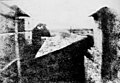 Photo credit: Nicéphore NiépceThe first successful permanent photograph, created in 1826, is titled "View from the Window at Le Gras". It required an eight-hour exposure in bright sunshine and was printed on a polished pewter plate covered with a petroleum derivative called bitumen of Judea. Due to the long exposure, the buildings are illuminated by the sun from both right and left.
 -
 Lithography: Day & Son; Restoration: Jake WartenbergAn 1856 lithograph of the Selimiye Barracks, located in Istanbul, Turkey, being used as a hospital during the Crimean War. Florence Nightingale's experiences here during this time helped her develop the foundations of modern nursing. As such, the barracks now contain a museum dedicated to her and her staff.
 -
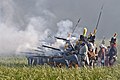 A historical reenactment is an educational or entertainment activity in which participants follow a prearranged plan to recreate aspects of a historical event or period. Here, a group reenacts the Battle of Waterloo, in which an Imperial French army under the command of Emperor Napoleon Bonaparte was defeated by the armies of the Seventh Coalition.
 -
 Photograph: Lewis Hine; restoration: Lise BroerA baseball team composed mostly of child laborers from an Indiana glassmaking factory, as photographed by Lewis Hine in August 1908. Hine (1874–1940) was an American sociologist who promoted the use of photography as an educational medium and means for social change. Beginning in 1908, he spent ten years photographing child labor for the National Child Labor Committee. The project was a dangerous one, and Hine had to disguise himself – at times as a fire inspector, post card vendor, Bible salesman or industrial photographer – to avoid the factory police and foremen.
 -
 Chromolithograph: Romanet & cie.A 19th-century set of ten cards depicting events in the history of ballooning and parachuting. These cards depict, from left to right:
Top row:- Joseph Louis Gay-Lussac and Jean-Baptiste Biot reaching an altitude of 4,000 metres (13,000 ft) (1804)
- André-Jacques Garnerin making a parachute descent in his gondola (1797)
- Louis-Sébastien Lenormand making the first witnessed parachute descent (1783)
- A series of fantastic flying machines dreamed up during the 18th century
- Use of balloons for reconnaissance during the Battle of Mainz (1795)
Bottom row:- The coronation balloon of Napoleon I (1804)
- The death of Sophie Blanchard (1819)
- Francesco Zambeccari and two companions adrift in the Adriatic Sea (1804)
- The death of Thomas Harris (1824)
- Francesco Arban is rescued by Italian fishermen (1846)
-
 A Chola dynasty sculpture depicting Shiva. In Hinduism, Shiva is the deity of destruction and one of the most important gods; in this sculpture he is dancing as Nataraja, the divine dancer who unravels the world in preparation for it being remade by Brahma.
 -
 Document: John, King of England, his barons and Stephen LangtonCotton MS Augustus II.106, one of four surviving exemplifications of Magna Carta. This document, sealed by King John of England on 15 June 1215 (O.S.), was drafted by the Archbishop of Canterbury to make peace between the unpopular king and a group of rebel barons. The charter promised the protection of church rights, protection for the barons from illegal imprisonment, access to swift justice, and limitations on feudal payments to the Crown.
The document was reissued and renewed several times over the centuries, though its political impact decreased as later laws were passed. The charter was significant because the king had agreed to limit his power, so that although it dealt predominantly with the king and the barons, since the late 16th century it has been considered a symbol of liberty and the freedom of the individual. -
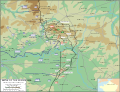 The Battle of the Somme was a battle of the First World War fought between 1 July and 18 November 1916 by the armies of the British and French empires against the German Empire. The largest battle of World War I on the Western Front, it was fought on both sides of upper reaches of the River Somme in France. More than one million men were wounded or killed, making it one of the bloodiest battles in human history.
This map shows the situation on the first day on the Somme, as well as Allied gains up to 19 November 1916. -
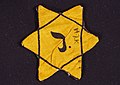 Photograph credit: Ronald TorfsYellow badges are badges that Jews were ordered to wear in public during periods of the Middle Ages by the ruling Christians and Muslims, and in Nazi Germany in the 1940s. The badges served to mark the wearer as a religious or ethnic outsider, and often served as a badge of shame. The badge pictured is in the collection of the Kazerne Dossin Memorial, Museum and Documentation Centre in Mechelen, Belgium.
 -
 Engraver: George J. Verbeck, after Thérèse van Duyl Schwarze
Restoration: Lise BroerA 1901 etching of Queen Wilhelmina of the Netherlands, based on an 1898 painting of her in her coronation robe. Having assumed the throne at the age of ten after the death of her father, King William III, Wilhemina ruled for fifty-eight years (1890–1948), longer than any other Dutch monarch. In 1948 she abdicated in favor of her daughter Juliana, thereafter making few public appearances until the country was devastated by the North Sea flood of 1953. -
 Artist: William Simpson; Restoration: Lise BroerA lithograph of a watercolour painting depicting soldiers transporting winter clothing, lumber for huts, and other supplies through a snow-covered landscape, with partially buried dead horses along the roadside, to the British camps, during the Siege of Sevastopol of the Crimean War. In the winter, a storm ruined the camps and supply lines of the Allied forces (France, Britain and the Ottoman Empire). Men and horses became sick and starved in the poor conditions.
 -
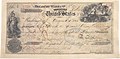 Check used for the Alaska PurchaseCheck: William H. Seward; scan: Our Documents initiativeThe check used for the Alaska Purchase, issued on August 1, 1868, and signed by US Secretary of State William H. Seward. For a total of $7.2 million, the United States government purchased Russian America from the Russian Empire (represented here by Russian Minister to the United States Eduard de Stoeckl). The lands involved became the modern state of Alaska in 1959.
 -
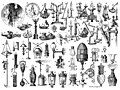 Illustration: Maurice Dessertenne
Restoration: Michel VuijlstekeAn illustration from Volume IV (E–G) of the encyclopedia Nouveau Larousse illustré showing various methods of lighting through the ages, starting from prehistoric times in the upper left (No. 1) to carbide lamps at the beginning of the 20th century (No. 54, lower right), with a separate section for Japanese lighting (No. 55–58, lower left). -
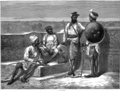 Image: The Illustrated London News
Restoration: Adam CuerdenAn 1876 engraving of Khokar Rajputs of Punjab. The Rajputs are one of the major Hindu Kshatriya (warrior) groups of India. Rajputs rose to prominence during the 9th to 11th centuries, and by the time of Indian independence, they ruled more than two-thirds of the estimated six hundred princely states, including three-quarters of the salute states.


.jpg)


.jpg)


Did you know (auto generated)

- ... that one historian considered the anachronisms of the historical novel The Rival Chiefs to be unproblematic because readers wanted "not accuracy but thrill"?
- ... that the live stream of the cassation hearing for Larisa Dolina's apartment deal was the most-watched in the history of the Supreme Court of Russia?
- ... that the entire inventory of historic string instruments in Canada's Musical Instrument Bank are loaned to musicians in a competition held every three years?
- ... that Seattle Reign FC have had three name changes during their 11-year history?
- ... that the compilation of the Wu shu was hampered by the execution of two members of the committee compiling the text?
- ... that Songs and Flowers of the Wasatch represented a shift in Mormon history toward a "socially-accepted American cultural and religious heritage", according to historian Jennifer Reeder?
Featured biography –

Matthew Boulton FRS (/ˈboʊltən/ ⓘ BOHL-tən; 3 September 1728 – 17 August 1809) was an English businessman, inventor, mechanical engineer, and silversmith. He was a business partner of the Scottish engineer James Watt. In the final quarter of the 18th century, the partnership installed hundreds of Boulton & Watt steam engines, which were a great advance on the state of the art, making possible the mechanisation of factories and mills. Boulton applied modern techniques to the minting of coins, striking millions of pieces for Britain and other countries, and supplying the Royal Mint with up-to-date equipment.
Born in Birmingham, he was the son of a Birmingham manufacturer of small metal products who died when Boulton was 31. By then Boulton had managed the business for several years, and thereafter expanded it considerably, consolidating operations at the Soho Manufactory, built by him near Birmingham. At Soho, he adopted the latest techniques, branching into silver plate, ormolu ("gilt bronze") and other decorative arts. He became associated with James Watt when Watt's business partner, John Roebuck, was unable to pay a debt to Boulton, who accepted Roebuck's share of Watt's patent as settlement. He then successfully lobbied Parliament to extend Watt's patent for an additional 17 years, enabling the firm to market Watt's steam engine. The firm installed hundreds of Boulton & Watt steam engines in Britain and abroad, initially in mines and then in factories. (Full article...)
On this day

- 845 – The Abbasid Caliphate executed 42 Byzantine officials who had been captured in the sack of Amorium of 838 for refusing to convert to Islam.
- 1447 – Tommaso Parentucelli was elected as Pope Nicholas V in Rome.
- 1904 – Scottish National Antarctic Expedition: Led by William Speirs Bruce (pictured), the Antarctic region of Coats Land was discovered by the Scotia.
- 1988 – The Troubles: In Operation Flavius, the Special Air Service killed three volunteers of the Provisional Irish Republican Army conspiring to bomb a parade of British military bands in Gibraltar.
- 2000 – The Marine Parade Community Building, the mural cladding of which is the largest installation art in Singapore, was opened.
- Clark Shaughnessy (b. 1892)
- Joseph Berchtold (b. 1897)
- Shaukat Aziz (b. 1949)
- Zoi Sadowski-Synnott (b. 2001)
Selected quote
Even death is not to be feared by one who has lived wisely.
— Gautama Buddha, founder of Buddhism
Related portals


More Did you know...

- ... that in 1898, the United States government annexed the Kingdom of Hawaii despite protestation from Queen Liliuokalani (pictured)?
- ... that Jean Thurel was a soldier in the French Régiment de Touraine for more than 75 years?
- ... that the severed head of Julia Martha Thomas — murdered, boiled and dismembered by her maid in 1879 — was found next door to Sir David Attenborough's house in 2010?
- ... that the 18th-century Indian automaton Tipu's Tiger shows a near life-size European being mauled by a tiger, and emits wails and grunts as well as containing a pipe organ?
- ... that Svið, a traditional Icelandic dish, consists of a sheep's head that has been cut in half, singed, and boiled with the brain removed?
- ... that, despite overseeing the construction of the crematoria and gas chambers at Auschwitz, what specifically shocked SS-Obersturmführer Robert Mulka at the camp was his colleagues' dress sense?
- ... that Tsar Alexander II of Russia had a special crystal bottle of Roederer champagne made for the Three Emperors Dinner in 1867 so that he could admire the bubbles?
- ... that the Gudea cylinders are the longest literary composition ever found in the Sumerian language?
Topics
| Primary | |
|---|---|
| Interdisciplinary |
|
| List | |
| Other categorizations | |

| Key concepts | |||||||||
|---|---|---|---|---|---|---|---|---|---|
| Measurement and standards |
| ||||||||
| Philosophy of time | |||||||||
| Human experience and use of time | |||||||||
| Time in science |
| ||||||||
| Related | |||||||||

Categories

History • By period • By region • By topic • By ethnic group • Historiography • Archaeology • Books • Maps • Images • Magazines • Organizations • Fictional • Museums • Pseudohistory • Stubs • Timelines • Chronology • People • Wikipedia historians
WikiProjects
 WikiProject History •
Ancient Near East • Australian History • Classical Greece and Rome • Dacia • Former countries • History of Canada • Chinese history • European history • Heraldry and vexillology • Indian history • Jewish history • Medieval Scotland • Mesoamerica • Military history • Middle Ages • History of Science
WikiProject History •
Ancient Near East • Australian History • Classical Greece and Rome • Dacia • Former countries • History of Canada • Chinese history • European history • Heraldry and vexillology • Indian history • Jewish history • Medieval Scotland • Mesoamerica • Military history • Middle Ages • History of Science
WikiProject Time • Days of the Year • Years
WikiProject Biography • Composers • Political figures • Saints • United States Presidents
Things you can do
 |
Here are some tasks awaiting attention:
|
Associated Wikimedia
The following Wikimedia Foundation sister projects provide more on this subject:
-
 Commons
Free media repository -
 Wikibooks
Free textbooks and manuals -
 Wikidata
Free knowledge base -
 Wikinews
Free-content news -
 Wikiquote
Collection of quotations -
 Wikisource
Free-content library -
 Wikiversity
Free learning tools -
 Wiktionary
Dictionary and thesaurus


