

.jpg)
A proplyd, short for ionized protoplanetary disk, is an externally illuminated photoevaporating protoplanetary disk around a young star. Nearly 180 proplyds have been discovered in the Orion Nebula.[1] Images of proplyds in other star-forming regions are rare, while Orion is the only region with a large known sample due to its relative proximity to Earth.[2]
History
[edit]In 1979 observations with the Lallemand electronic camera at the Pic-du-Midi Observatory showed six unresolved high-ionization sources near the Trapezium Cluster. These sources were not interpreted as proplyds, but as partly ionized globules (PIGs). The idea was that these objects are being ionized from the outside by M42.[3] Later observations with the Very Large Array showed solar-system-sized condensations associated with these sources. Here the idea appeared that these objects might be low-mass stars surrounded by an evaporating protostellar accretion disk.[4]
Proplyds were clearly resolved in 1993 using images of the Hubble Space Telescope Wide Field Camera and the term "proplyd" was used.[5]
Characteristics
[edit]

In the Orion Nebula the proplyds observed are usually one of two types. Some proplyds glow around luminous stars, in cases where the disk is found close to the star, glowing from the star's luminosity. Other proplyds are found at a greater distance from the host star and instead show up as dark silhouettes due to the self-obscuration of cooler dust and gases from the disk itself. Some proplyds show signs of movement from solar irradiance shock waves pushing the proplyds. The Orion Nebula is approximately 1,500 light-years from the Sun with very active star formation. The Orion Nebula and the Sun are in the same spiral arm of the Milky Way galaxy.[7][8][9][10]
A proplyd may form new planets and planetesimal systems. Current models show that the metallicity of the star and proplyd, along with the correct planetary system temperature and distance from the star, are keys to planet and planetesimal formation. To date, the Solar System, with 8 planets, 5 dwarf planets and 5 planetesimal systems, is the largest planetary system found.[11][12][13] Most proplyds develop into a system with no planetesimal systems, or into one very large planetesimal system.[14][15][16][17][18][19]
Proplyds in other star-forming regions
[edit]
Photoevaporating proplyds in other star forming regions were found with the Hubble Space Telescope. NGC 1977 currently represents the star-forming region with the largest number of proplyds outside of the Orion Nebula, with 7 confirmed proplyds. It was also the first instance where a B-type star, 42 Orionis is responsible for the photoevaporation.[20] In addition, 4 clear and 4 candidate proplyds were discovered in the very young region NGC 2024, two of which have been photoevaporated by a B star.[21] The NGC 2024 proplyds are significant because they imply that external photoevaporation of protoplanetary disks could compete even with very early planet formation (within the first half a million years).
Another type of photoevaporating proplyd was discovered with the Spitzer Space Telescope. These cometary tails represent dust being pulled away from the disks.[22] Westerhout 5 is a region with many dusty proplyds, especially around HD 17505.[23] These dusty proplyds are depleted of any gas in the outer regions of the disk, but the photoevaporation could leave an inner, more robust, and possibly gas-rich disk component of radius 5-10 astronomical units.[24]
The proplyds in the Orion Nebula and other star-forming regions represent proto-planetary disks around low-mass stars being externally photoevaporated. These low-mass proplyds are usually found within 0.3 parsec (60,000 astronomical units) of the massive OB star and the dusty proplyds have tails with a length of 0.1 to 0.2 parsec (20,000 to 40,000 au).[22] There is a proposed type of intermediate massive counterpart, called proplyd-like objects. Objects in NGC 3603 and later in Cygnus OB2 were proposed as intermediate massive versions of the bright proplyds found in the Orion Nebula. The proplyd-like objects in Cygnus OB2 for example are 6 to 14 parsec distant to a large collection of OB stars and have tail lengths of 0.11 to 0.55 parsec (24,000 to 113,000 au).[25][26] The nature of proplyd-like objects as intermediate massive proplyds is partly supported by a spectrum for one object, which showed that the mass loss rate is higher than the mass accretion rate. Another object did not show any outflow, but accretion.[27]
List of star-forming regions with proplyds
[edit]List is sorted after distance.
| Star-Forming region (SFR) | example image | Distance | Age of SFR
(Myrs) |
Ionizing stars | spectral type of
ionizing stars |
Number of proplyds | type of proplyd | References |
|---|---|---|---|---|---|---|---|---|
| NGC 1977 | 
|
1305 | 4 | 42 Orionis | B1V | 7 | gaseous + dusty tails | [28][20] |
| Lambda Orionis Cluster | 
|
1305 | 6 | Meissa | O8IIIf+B0.5V | 2 | dusty tails | [29] |
| Orion Nebula | 
|
1344 | 1 | Theta1 Orionis C | O6Vp+B0V | 178 | gaseous + dark disks | [1][28] |
| Messier 43 | 
|
1300 | 1 | NU Orionis (HD 37061) | B0.5V | 3 | gaseous | [30][31] |
| Flame Nebula | 
|
1350 | 0.2 to 0.5 | IRS1, IRS2b | B0.5V, O8V | 4 or 8 | gaseous | [21] |
| NGC 2264 | 
|
2609 | 4 | S Mon | O7Ve | 1 | dusty tails | [32] |
| IC 1396 | 
|
2723 | 3 | HD 206267 | O6V | 1 | dusty tails | [32] |
| NGC 6193 | 
|
3783 | 5 | HD 150136, CD-48 11071 | O3.5-4III(f*)+O6IV, B0V | 8 or 9 | dusty tails | [33] |
| Cygnus OB2 | .png)
|
4566 | 3-5 | Cluster of O-stars | 11 | large "proplyd-like" objects + dusty tails | [34][35] | |
| NGC 2244 | 
|
4892 | 4 | HD 46150 | O5V | 1 | dusty tails | [32] |
| Trifid Nebula | .jpg)
|
5479 | 8 | HD 164492A | O7.5 | 1 | gaseous | [28][36] |
| Pismis 24 | 
|
5544 | 1 | Pis 24-1, Pis 24-2 | O3I, O5.5 V(f) | 5 | gaseous | [37] |
| Lagoon Nebula | 
|
5871 | 5 | Herschel 36 | O7V | 1 | gaseous | [28][38] |
| Westerhout 5 | 
|
7500 | 5 | HD 17505, HD 18326 | O6.5III((f))n+O8V, O7V | 4 | dusty tails | [39][23] |
| Carina Nebula (disputed)[40] | _(noao0301a).jpg)
|
7501 | 3 | Cluster of O-stars | "dozens" | large "proplyd-like" objects + dark disks | [41] | |
| Clusters Danks 1+2 | 
|
12400 | WR 48a | WC8d+Oe | 6 | dusty tails | [42] | |
| NGC 3603 | 
|
19569 | 1 | Cluster of O-stars | 3 | large "proplyd-like" objects | [28][43] | |
| Sgr A* | 26673 | unknown | Multiple O- and WR-stars | 34 | gaseous | [44] |
Gallery
[edit]-
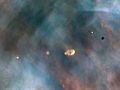 View of several proplyds within the Orion Nebula taken by the Hubble Space Telescope
 -
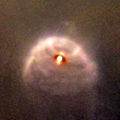 Very bright proplyd 181-825 in the Orion Nebula, from Hubble Space Telescope
 -
 Dark proplyd 132-1832 in the Orion Nebula, from Hubble Space Telescope
 -
 Bright proplyd 170-249 in the Orion Nebula, from Hubble Space Telescope. The upward tail is a jet of dust and gas blowing away from the excited proplyd
 -
 One of the largest dark proplyd in the Orion Nebula, Proplyd 114-426 imaged with JWST.
 -
![ESO VLT MUSE image of proplyd 244-440 in the Orion Nebula. The young object is ejecting a jet (red color) and is surrounded by a blue halo of unknown origin.[27]](//upload.wikimedia.org/wikipedia/commons/thumb/4/4d/A_stellar_sprinkler_%28potw2316a%29.tiff/lossy-page1-120px-A_stellar_sprinkler_%28potw2316a%29.tiff.jpg)
-
 Proplyds in the Flame Nebula
 -
![Proplyds in the Orion Nebula that are brown dwarfs according to Luhman et al. 2024[46]](//upload.wikimedia.org/wikipedia/commons/thumb/4/4e/Brown_dwarf_proplyds_Orion_Nebula.jpg/120px-Brown_dwarf_proplyds_Orion_Nebula.jpg) Proplyds in the Orion Nebula that are brown dwarfs according to Luhman et al. 2024[46]
Proplyds in the Orion Nebula that are brown dwarfs according to Luhman et al. 2024[46] -
![ESO VLT MUSE images (insets) of twelve proplyds in the Orion Nebula.[47] In each inset, a variety of emission lines are combined to highlight the morphology of the proplyd.](//upload.wikimedia.org/wikipedia/commons/thumb/d/d2/Proplyds_in_the_Orion_Nebula_Cluster_from_Aru_et_al._2024.png/120px-Proplyds_in_the_Orion_Nebula_Cluster_from_Aru_et_al._2024.png)

.jpg)
.jpg)
.jpg)

![ESO VLT MUSE image of proplyd 244-440 in the Orion Nebula. The young object is ejecting a jet (red color) and is surrounded by a blue halo of unknown origin.[27]](http://upload.wikimedia.org/wikipedia/commons/thumb/4/4d/A_stellar_sprinkler_%28potw2316a%29.tiff/lossy-page1-120px-A_stellar_sprinkler_%28potw2316a%29.tiff.jpg)

![Proplyds in the Orion Nebula that are brown dwarfs according to Luhman et al. 2024[46]](/wiki/File:Brown_dwarf_proplyds_Orion_Nebula.jpg)
![ESO VLT MUSE images (insets) of twelve proplyds in the Orion Nebula.[47] In each inset, a variety of emission lines are combined to highlight the morphology of the proplyd.](/wiki/File:Proplyds_in_the_Orion_Nebula_Cluster_from_Aru_et_al._2024.png)
See also
[edit]- Formation and evolution of the Solar System
- Grand tack hypothesis
- Late Heavy Bombardment
- Nice model
- Photoevaporation
- Planetary migration
- Wiki commons photos: Bright and dark proplyds in the Orion Nebula
References
[edit]- ^ a b Ricci, L.; et al. (2008). "The Hubble Space Telescope/Advanced Camera for Surveys Atlas of Protoplanetary Disks in the Great Orion Nebula". Astronomical Journal. 136 (5): 2136–2151. Bibcode:2008AJ....136.2136R. doi:10.1088/0004-6256/136/5/2136.
- ^ Sharkey, Colleen; Ricci, Luca (Dec 14, 2009). "Born in beauty: proplyds in the Orion Nebula" (Press release). Hubble/ESA, Garching, Germany. NASA/ESA. Retrieved Aug 4, 2015.
- ^ Laques, P.; Vidal, J. L. (March 1979). "Detection of a new kind of condensations in the center of the Orion Nebula, by means of S 20 photocathodes associated with a Lallemand electronic camera". Astronomy & Astrophysics. 73: 97–106. Bibcode:1979A&A....73...97L. ISSN 0004-6361.
- ^ Churchwell, E.; Felli, M.; Wood, D. O. S.; Massi, M. (October 1987). "Solar System--sized Condensations in the Orion Nebula". Astrophysical Journal. 321: 516. Bibcode:1987ApJ...321..516C. doi:10.1086/165648. ISSN 0004-637X.
- ^ O'dell, C. R.; Wen, Zheng; Hu, Xihai (June 1993). "Discovery of New Objects in the Orion Nebula on HST Images: Shocks, Compact Sources, and Protoplanetary Disks". Astrophysical Journal. 410: 696. Bibcode:1993ApJ...410..696O. doi:10.1086/172786. ISSN 0004-637X.
- ^ Aru, Mari-Liis; Mauco, Karina; Manara, Carlo F. (December 2024). "A tell-tale tracer for externally irradiated protoplanetary disks: Comparing the [C I] 8727 Å line and ALMA observations in proplyds". Astronomy & Astrophysics. 692: A137. arXiv:2410.21018. Bibcode:2024A&A...692A.137A. doi:10.1051/0004-6361/202451737.
- ^ "Born in beauty: proplyds in the Orion Nebula". www.spacetelescope.org.
- ^ "Proplyds". www.spacetelescope.org.
- ^ Nemiroff, R.; Bonnell, J., eds. (22 December 2009). "Planetary Systems Now Forming in Orion". Astronomy Picture of the Day. NASA.
- ^ Nemiroff, R.; Bonnell, J., eds. (7 December 1996). "Planetary Systems Now Forming in Orion". Astronomy Picture of the Day. NASA.
- ^ "The Solar System: The Sun, Planets, Dwarf Planets, Moons, Asteroids, Comets, Meteors, Solar System Formation - Windows to the Universe".
- ^ Williams, Matt (September 5, 2015). "Solar System Guide". Universe Today.
- ^ Williams, Matt (December 3, 2014). "The Inner Planets of Our Solar System".
- ^ "Planet-Metallicity Correlation". sites.astro.caltech.edu.
- ^ Fischer, Debra A.; Valenti, Jeff (April 1, 2005). "The Planet-Metallicity Correlation". The Astrophysical Journal. 622 (2): 1102–1117. Bibcode:2005ApJ...622.1102F. doi:10.1086/428383. S2CID 121872365.
- ^ Wang, Ji; Fischer, Debra A. (January 1, 2015). "Revealing A Universal Planet-Metallicity Correlation For Planets of Different Sizes Around Solar-Type Stars". The Astronomical Journal. 149 (1): 14. arXiv:1310.7830. Bibcode:2015AJ....149...14W. doi:10.1088/0004-6256/149/1/14. S2CID 118415186.
- ^ Sanders, Ray (9 April 2012). "When Stellar Metallicity Sparks Planet Formation". Astrobiology Magazine. Archived from the original on 2020-12-07.
- ^ From Lithium to Uranium (IAU S228): Elemental Tracers of Early Cosmic Evolution By International Astronomical Union. Symposium, by Vanessa Hill, Patrick Francois, Francesca Primas, page 509-511, "the G star problem"
- ^ Kokubo, E.; Ida, S. (30 October 2012). "Dynamics and accretion of planetesimals". Progress of Theoretical and Experimental Physics. 2012 (1): 1A308–0. arXiv:1212.1558. doi:10.1093/ptep/pts032.
- ^ a b Kim, Jinyoung Serena; Clarke, Cathie J.; Fang, Min; Facchini, Stefano (July 2016). "Proplyds Around a B1 Star: 42 Orionis in NGC 1977". The Astrophysical Journal. 826 (1): L15. arXiv:1606.08271. Bibcode:2016ApJ...826L..15K. doi:10.3847/2041-8205/826/1/L15. hdl:10150/621402. ISSN 2041-8205. S2CID 118562469.
- ^ a b Haworth, Thomas; Jinyoung, Kim; Winter, Andrew; Hines, Dean; Clarke, Cathie; Sellek, Andrew; Ballabio, Giulia; Stapelfeldt, Karl (March 2021). "Proplyds in the flame nebula NGC 2024". Monthly Notices of the Royal Astronomical Society. 501 (3): 3502–3514. arXiv:2012.09166. doi:10.1093/mnras/staa3918.
- ^ a b Balog, Zoltan; Rieke, G. H.; Su, Kate Y. L.; Muzerolle, James; Young, Erick T. (2006-09-25). "Spitzer MIPS 24 μm Detection of Photoevaporating Protoplanetary Disks". The Astrophysical Journal Letters. 650 (1): L83. arXiv:astro-ph/0608630. Bibcode:2006ApJ...650L..83B. doi:10.1086/508707. ISSN 1538-4357.
- ^ a b Koenig, X. P.; Allen, L. E.; Kenyon, S. J.; Su, K. Y. L.; Balog, Z. (2008-10-03). "Dusty Cometary Globules in W5". The Astrophysical Journal Letters. 687 (1): L37. arXiv:0809.1993. Bibcode:2008ApJ...687L..37K. doi:10.1086/593058. ISSN 1538-4357.
- ^ Balog, Zoltan; Rieke, George H.; Muzerolle, James; Bally, John; Su, Kate Y. L.; Misselt, Karl; Gáspár, András (November 2008). "Photoevaporation of Protoplanetary Disks". The Astrophysical Journal. 688 (1): 408. arXiv:0807.3724. Bibcode:2008ApJ...688..408B. doi:10.1086/592063. ISSN 0004-637X.
- ^ Wright, Nicholas J.; Drake, Jeremy J.; Drew, Janet E.; Guarcello, Mario G.; Gutermuth, Robert A.; Hora, Joseph L.; Kraemer, Kathleen E. (February 2012). "Photoevaporating Proplyd-Like Objects in Cygnus Ob2". The Astrophysical Journal. 746 (2): L21. arXiv:1201.2404. Bibcode:2012ApJ...746L..21W. doi:10.1088/2041-8205/746/2/L21. ISSN 2041-8205. S2CID 16509383.
- ^ Brandner, Wolfgang; Grebel, Eva K.; Chu, You-Hua; Dottori, Horacio; Brandl, Bernhard; Richling, Sabine; Yorke, Harold W.; Points, Sean D.; Zinnecker, Hans (January 2000). "HST/WFPC2 and VLT/ISAAC Observations of Proplyds in the Giant H II Region NGC 3603*". The Astronomical Journal. 119 (1): 292. arXiv:astro-ph/9910074. Bibcode:2000AJ....119..292B. doi:10.1086/301192. ISSN 1538-3881. S2CID 15502401.
- ^ Guarcello, M. G.; Drake, J. J.; Wright, N. J.; García-Alvarez, D.; Kraemer, K. E. (September 2014). "Accretion and Outflow in the Proplyd-Like Objects Near Cygnus Ob2". The Astrophysical Journal. 793 (1): 56. arXiv:1409.1017. Bibcode:2014ApJ...793...56G. doi:10.1088/0004-637X/793/1/56. ISSN 0004-637X.
- ^ a b c d e Kharchenko, N. V.; Piskunov, A. E.; Schilbach, E.; Röser, S.; Scholz, R. -D. (2016-01-01). "Global survey of star clusters in the Milky Way. V. Integrated JHKS magnitudes and luminosity functions". Astronomy and Astrophysics. 585: A101. Bibcode:2016A&A...585A.101K. doi:10.1051/0004-6361/201527292. ISSN 0004-6361.
- ^ Thévenot, Melina; Doll, Katharina; Durantini Luca, Hugo A. (2019-07-01). "Photoevaporation of Two Proplyds in the Star Cluster Collinder 69 Discovered with Spitzer MIPS". Research Notes of the American Astronomical Society. 3 (7): 95. Bibcode:2019RNAAS...3...95T. doi:10.3847/2515-5172/ab30c5. ISSN 2515-5172.
- ^ O'Dell, C. R. (2001-11-01). "New Proplyds, Outflows, Shocks, and a Reflection Nebula in M43 and the Outer Parts of the Orion Nebula". The Astronomical Journal. 122 (5): 2662–2667. Bibcode:2001AJ....122.2662O. doi:10.1086/323720. ISSN 0004-6256.
- ^ Habart, Emilie; Peeters, Els; Berné, Olivier; Trahin, Boris; Canin, Amélie; Chown, Ryan; Sidhu, Ameek; Van De Putte, Dries; Alarcón, Felipe; Schroetter, Ilane; Dartois, Emmanuel; Vicente, Sílvia; Abergel, Alain; Bergin, Edwin A.; Bernard-Salas, Jeronimo (2024-05-01). "PDRs4All. II. JWST's NIR and MIR imaging view of the Orion Nebula". Astronomy and Astrophysics. 685: A73. arXiv:2308.16732. Bibcode:2024A&A...685A..73H. doi:10.1051/0004-6361/202346747. ISSN 0004-6361.
- ^ a b c Balog, Zoltan; Rieke, G. H.; Su, Kate Y. L.; Muzerolle, James; Young, Erick T. (2006-10-01). "Spitzer MIPS 24 μm Detection of Photoevaporating Protoplanetary Disks". The Astrophysical Journal. 650 (1): L83–L86. arXiv:astro-ph/0608630. Bibcode:2006ApJ...650L..83B. doi:10.1086/508707. ISSN 0004-637X.
- ^ Thévenot, Melina (2020-01-01). "Cometary Tails as a Sign of Disk Photoevaporation in NGC 6193". Research Notes of the American Astronomical Society. 4 (1): 15. Bibcode:2020RNAAS...4...15T. doi:10.3847/2515-5172/ab701d. ISSN 2515-5172.
- ^ Guarcello, M. G.; Drake, J. J.; Wright, N. J.; Drew, J. E.; Gutermuth, R. A.; Hora, J. L.; Naylor, T.; Aldcroft, T.; Fruscione, A.; García-Alvarez, D.; Kashyap, V. L.; King, R. (2013-08-01). "The Protoplanetary Disks in the Nearby Massive Star-forming Region Cygnus OB2". The Astrophysical Journal. 773 (2): 135. arXiv:1306.5757. Bibcode:2013ApJ...773..135G. doi:10.1088/0004-637X/773/2/135. hdl:10871/22086. ISSN 0004-637X.
- ^ Wright, Nicholas J.; Drake, Jeremy J.; Drew, Janet E.; Guarcello, Mario G.; Gutermuth, Robert A.; Hora, Joseph L.; Kraemer, Kathleen E. (2012-02-01). "Photoevaporating Proplyd-like Objects in Cygnus OB2". The Astrophysical Journal. 746 (2): L21. arXiv:1201.2404. Bibcode:2012ApJ...746L..21W. doi:10.1088/2041-8205/746/2/L21. ISSN 0004-637X.
- ^ Yusef-Zadeh, F.; Biretta, J.; Geballe, T. R. (2005-09-01). "Hubble Space Telescope and United Kingdom Infrared Telescope Observations of the Center of the Trifid Nebula: Evidence for the Photoevaporation of a Proplyd and a Protostellar Condensation". The Astronomical Journal. 130 (3): 1171–1176. arXiv:astro-ph/0505155. Bibcode:2005AJ....130.1171Y. doi:10.1086/432095. ISSN 0004-6256.
- ^ Fang, M.; van Boekel, R.; King, R. R.; Henning, Th.; Bouwman, J.; Doi, Y.; Okamoto, Y. K.; Roccatagliata, V.; Sicilia-Aguilar, A. (2012-03-01). "Star formation and disk properties in Pismis 24". Astronomy and Astrophysics. 539: A119. arXiv:1201.0833. Bibcode:2012A&A...539A.119F. doi:10.1051/0004-6361/201015914. hdl:10486/662673. ISSN 0004-6361.
- ^ Stecklum, B.; Henning, T.; Feldt, M.; Hayward, T. L.; Hoare, M. G.; Hofner, P.; Richter, S. (1998-02-01). "The Ultracompact H II Region G5.97-1.17: an Evaporating Circumstellar Disk in M8". The Astronomical Journal. 115 (2): 767–776. Bibcode:1998AJ....115..767S. doi:10.1086/300204. ISSN 0004-6256.
- ^ Sota, A.; Maíz Apellániz, J.; Walborn, N. R.; Alfaro, E. J.; Barbá, R. H.; Morrell, N. I.; Gamen, R. C.; Arias, J. I. (2011-04-01). "The Galactic O-Star Spectroscopic Survey. I. Classification System and Bright Northern Stars in the Blue-violet at R ~ 2500". The Astrophysical Journal Supplement Series. 193 (2): 24. arXiv:1101.4002. Bibcode:2011ApJS..193...24S. doi:10.1088/0067-0049/193/2/24. ISSN 0067-0049.
- ^ Sahai, R.; Güsten, R.; Morris, M. R. (2012-12-01). "Are Large, Cometary-shaped Proplyds Really (Free-floating) Evaporating Gas Globules?". The Astrophysical Journal. 761 (2): L21. arXiv:1211.0345. Bibcode:2012ApJ...761L..21S. doi:10.1088/2041-8205/761/2/L21. ISSN 0004-637X.
- ^ Smith, Nathan; Bally, John; Morse, Jon A. (2003-04-01). "Numerous Proplyd Candidates in the Harsh Environment of the Carina Nebula". The Astrophysical Journal. 587 (2): L105–L108. Bibcode:2003ApJ...587L.105S. doi:10.1086/375312. ISSN 0004-637X.
- ^ Richardson, Noel D.; Henson, Micaela; Lieb, Emma P.; Kehl, Corey; Lau, Ryan M.; Williams, Peredur M.; Corcoran, Michael F.; Callingham, J. R.; Chené, André-Nicolas; Gull, Theodore R.; Hamaguchi, Kenji; Han, Yinuo; Hankins, Matthew J.; Hill, Grant M.; Hoffman, Jennifer L. (2025-07-07). "Carbon-rich dust injected into the interstellar medium by Galactic WC binaries survives for hundreds of years". The Astrophysical Journal. 987 (160): 160. arXiv:2505.11616. Bibcode:2025ApJ...987..160R. doi:10.3847/1538-4357/addf30.
- ^ Brandner, Wolfgang; Grebel, Eva K.; Chu, You-Hua; Dottori, Horacio; Brandl, Bernhard; Richling, Sabine; Yorke, Harold W.; Points, Sean D.; Zinnecker, Hans (2000-01-01). "HST/WFPC2 and VLT/ISAAC Observations of Proplyds in the Giant H II Region NGC 3603". The Astronomical Journal. 119 (1): 292–301. arXiv:astro-ph/9910074. Bibcode:2000AJ....119..292B. doi:10.1086/301192. ISSN 0004-6256.
- ^ Yusef-Zadeh, F.; Roberts, D. A.; Wardle, M.; Cotton, W.; Schödel, R.; Royster, M. J. (2015-03-01). "Radio Continuum Observations of the Galactic Center: Photoevaporative Proplyd-like Objects Near Sgr A*". The Astrophysical Journal. 801 (2): L26. arXiv:1502.03109. Bibcode:2015ApJ...801L..26Y. doi:10.1088/2041-8205/801/2/L26. ISSN 0004-637X.
- ^ Kirwan, A.; Manara, C. F.; Whelan, E. T.; Robberto, M.; McLeod, A. F.; Facchini, S.; Beccari, G.; Miotello, A.; Schneider, P. C.; Murphy, A.; Vicente, S. (2023-03-01). "A spectacular jet from the bright 244-440 Orion proplyd: the MUSE NFM view". Astronomy and Astrophysics. 673: A166. arXiv:2303.13205. Bibcode:2023A&A...673A.166K. doi:10.1051/0004-6361/202245428.
- ^ Luhman, K. L.; Alves de Oliveira, C; Baraffe, I.; Chabrier, G.; Manjavacas, E.; Parker, R. J.; Tremblin, P. (13 Oct 2024). "JWST/NIRSpec Observations of Brown Dwarfs in the Orion Nebula Cluster". The Astrophysical Journal. 975 (2): 162. arXiv:2410.10000. Bibcode:2024ApJ...975..162L. doi:10.3847/1538-4357/ad7b19.
- ^ Aru, Mari-Liis; Mauco, Karina; Manara, Carlo F. (July 2024). "Kaleidoscope of irradiated disks: MUSE observations of proplyds in the Orion Nebula Cluster - I. Sample presentation and ionization front sizes". Astronomy & Astrophysics. 687: A93. doi:10.1051/0004-6361/202349004.
| Formation | |||||||
|---|---|---|---|---|---|---|---|
| Evolution | |||||||
| Classification |
| ||||||
| Nucleosynthesis | |||||||
| Structure | |||||||
| Properties | |||||||
| Star systems | |||||||
| Earth-centric observations | |||||||
| Lists | |||||||
| Related | |||||||


