Epstein Files Full PDF

CLICK HERE
Technopedia Center
PMB University Brochure
Faculty of Engineering and Computer Science
S1 Informatics S1 Information Systems S1 Information Technology S1 Computer Engineering S1 Electrical Engineering S1 Civil Engineering

faculty of Economics and Business
S1 Management S1 Accountancy

Faculty of Letters and Educational Sciences
S1 English literature S1 English language education S1 Mathematics education S1 Sports Education
teknopedia

  • Registerasi
  • Brosur UTI
  • Kip Scholarship Information
  • Performance
Flag Counter
  1. World Encyclopedia
  2. Diving helmet - Wikipedia
Diving helmet - Wikipedia
From Wikipedia, the free encyclopedia
(Redirected from Push-pull diving system)
Rigid head enclosure for underwater diving
Diving helmet
Copper and brass three bolt Soviet diving helmet.
Other names
  • Copper hat
  • Standard diving helmet
  • Free flow helmet
  • Lightweight demand helmet
  • Reclaim helmet
UsesProvision of breathing gas, communications, underwater vision and head protection to underwater divers
US Navy Diver using Kirby Morgan 37 diving helmet[1]

A diving helmet is a rigid head enclosure with a breathing gas supply used in underwater diving. They are worn mainly by professional divers engaged in surface-supplied diving, though some models can be used with scuba equipment. The upper part of the helmet, known colloquially as the hat or bonnet, may be sealed directly to the diver using a neck dam, connected to a diving suit by a lower part, known as a breastplate, or corselet, depending on regional language preferences, or simply rest on the diver's shoulders, with an open bottom, for shallow water use.

The helmet isolates the diver's head from the water, allows the diver to see clearly underwater, provides the diver with breathing gas, protects the diver's head when doing heavy or dangerous work, and usually provides voice communications with the surface (and possibly other divers). If a helmeted diver becomes unconscious but is still breathing, most helmets will remain in place and continue to deliver breathing gas until the diver can be rescued. In contrast, the scuba regulator used by recreational divers must be held in the mouth by bite grips, and it can fall out of an unconscious diver's mouth and result in drowning.[2]

Before the invention of the demand regulator, all diving helmets used a free-flow design. Gas was delivered at an approximately constant rate, independent of the diver's breathing, and flowed out through an exhaust valve against a slight over-pressure. Most modern helmets incorporate a demand valve so the helmet only delivers breathing gas when the diver inhales. Free-flow helmets use much larger quantities of gas than demand helmets, which can cause logistical difficulties and is very expensive when special breathing gases (such as heliox) are used. They also produce a constant noise inside the helmet, which can cause communication difficulties. Free-flow helmets are still preferred for some applications of hazardous materials diving, because their positive-pressure nature can prevent the ingress of hazardous material in case the integrity of the suit or helmet is compromised. They also remain relatively common in shallow-water air diving, where gas consumption is of little concern, and in nuclear diving because they must be disposed of after some period of use due to irradiation; free-flow helmets are significantly less expensive[citation needed] to purchase and maintain than demand types.

Most modern helmet designs are sealed to the diver's skin at the neck using a neoprene or latex "neck dam" which is independent of the suit, allowing the diver a choice of suits depending on the dive conditions. When divers must work in contaminated environments such as sewage or dangerous chemicals, the helmet (usually of the free-flow type or using a series exhaust valve system) is directly sealed to a dry suit made of a fabric with a smooth vulcanised rubber outer coating to completely isolate and protect the diver. This equipment is the modern equivalent of the historic "standard diving dress".[3]

Function and structure

[edit]

The usual meaning of diving helmet is a piece of diving equipment that encases the user's head and delivers breathing gas to the diver, but the term "diving helmet", or "cave diving helmet" may also refer to a safety helmet like a climbing helmet or caving helmet that covers the top and back of the head, but is not sealed. These may be worn with a full-face mask or half mask to provide impact protection when diving under an overhead, and may also be used to mount lights and video cameras.[4][5]

An alternative to the diving helmet that allows communication with the surface is the full-face diving mask. These cover most of the diver's face, specifically including eyes, nose and mouth, and are held onto their head by adjustable straps. Like the diving helmet, the full-face mask is part of the breathing apparatus.[6]

Another style of helmet construction, seldom used, is the clamshell helmet, which uses a front section with a hinged back section, clamped closed, and sealed along the joint. These were seldom satisfactory due to problems with the seal. Prototypes of this type were made by Kirby Morgan and Joe Savoie.[7][8]

Components

[edit]

Basic components and their functions:

  • Helmet casing or shell – A rigid watertight structure that encloses the diver's head and supports most of the other components. The part of a standard helmet that encloses the head may also be called the "bonnet" (British English), and the whole unit may be called the "hat" by professional divers. Traditionally made from spun copper, more recently from glass fibre reinforced resin or stainless steel.[9]
  • Lower seal – Most deep-water helmets have a means of excluding water from the helmet regardless of the posture of the diver. Shallow water helmets rely on the diver keeping the helmet approximately upright, and the flow of breathing air keeps the water level lower than the diver's nose and mouth, and excess air escapes at the bottom of the helmet.[10]
    • Direct to the dry suit – The helmet may be sealed directly to the neck opening of the dry suit, making the helmet and suit a single watertight unit. The weight of the helmet may be carried by the head and neck, so it must be nearly neutrally buoyant, or can be supported by a breastplate or corselet, in which case it may be negatively buoyant, or positively buoyant and held down by jocking straps.[11]
    • Via a neck dam – The more recent development is for the helmet to clamp to a neck dam, supported by a rigid ring, or clamped to the lower edge of the helmet. The neck dam seals against the skin of the divers neck in the same way that the neck seal of a dry suit works, making the helmet a sealed unit independent of the suit, which may be a dry suit, wet suit or hot-water suit, or even just a pair of overalls in warm water. The weight of the helmet is carried by the head and neck, so it must be nearly neutrally buoyant, and is generally slightly heavy in the water so that it rests on the head and does not have a tendency to float off. When the helmet is buoyant, it is held down by a jocking strap.[12][13]
    • Breastplate/corselet – An alternative system is for the helmet to seal to a corselet (UK) or breastplate (US), which in turn is sealed to the dry suit. The helmet and suit become a single sealed unit, somewhat more complex than with a direct seal, but easier to put on and take off. The weight of the helmet is carried on the shoulders via the breastplate, so it does not have to be neutrally buoyant, and can be directly weighted or held down by a jocking strap.[13]
  • Faceplate (or viewport, in older helmets also called a light) – The diver's window to the world. A transparent window in the front of the helmet or full-face mask. If the helmet is light and carried directly on the head and neck, and can move with the head, it is usually relatively small, and the helmet too is compact and relatively light. If the helmet is supported by the shoulders it cannot turn with the head, and must have a larger volume with a larger viewport or more than one viewport to give an adequate field of vision. A four-light helmet was a common design, with a front port which could be opened when out of the water, two side-lights, to the left and right, and an upper light above the front light to give an upward view.[9]
  • Gas supply – The breathing gas supply is connected to the helmet. This is usually a low pressure surface supply hose attached through a non-return valve to a gas block with a bailout gas supply connected to the bailout valve on the gas block, but other systems have been used.[13]
    • Inlet valve or demand valve – The primary gas supply may be free-flow or demand controlled. If it is demand controlled there is usually a free-flow bypass, which may also serve as a defogging system, by blowing air over the inner face of the front viewport.[13]
    • An internal oro-nasal mask is used in demand supplied helmets to minimise dead space. The oro-nasal mask seals around the nose and mouth, forming a small volume gas space through which the breathing gas normally flows from demand valve to nose or mouth, and from nose or mouth to the exhaust valves. There are also one-way valves from the main helmet space into the oro-nasal mask, to allow flow into it while breathing from the free-flow supply, or from a pneumo-hose for emergency supply.[13]
  • Gas exhaust system – Exhaled gas is exhausted from the helmet through non-return valves, either directly to the surrounding water, or via a reclaim regulator system through a hose to the surface. There may be two or more sets of non-return valves in series to reduce the risk of back-flow of contaminated water.[13]
  • Voice communications microphone and headphone speakers connected to the surface via copper conductors in the umbilical cable.[13]
  • Nose blocker, also known as a valsalva device – A device is provided which the diver can use to block the nose for ear equalising maneuvers.[13][9]
  • Other accessories may be present, such as a lifting handle, ballast weights, light and video camera brackets, a welding visor, spitcock and internal padding.[13][9]
    • A lifting handle allows the attendant to lift the helmet with one hand, without it swinging or tilting excessively.[13]
    • Ballast weights provide neutral or slightly negative buoyancy, and place the centre of gravity where it will not cause off-centre loads on the diver's neck.[13]
    • Brackets allow easy mounting of lights and video cameras so that the diver can see in dark conditions, and the supervisor can see what the diver is doing.[13]
    • A welding visor is fitted on a hinge to protect the diver from bright light and ultraviolet light produced by welding arcs or cutting flames. It is flipped down over the faceplate for use when needed.[13] Most welding visors are heavily tinted glass, and must be manually flipped down for use, but electronically controlled auto-darkening visors are also available.[14]
    • A spitcock was provided on some standard helmets to allow the diver to suck in a mouthful of water which would then be spat onto the inner surface of a viewport to wash off condensation fogging. The water would then usually be trapped between the outside of the suit and the inside of the breastplate. The spitcock could also be opened as an auxiliary exhaust port when the diver was working in some non-upright positions.[9]
    • Internal padding is fitted to lightweight helmets to cushion the diver's head against shock loads, to support the helmet more comfortably and so that it will closely follow the head movement. A chin strap can be used to help with these functions. A close-fitting insulated cap may be provided for warmth.[13]
    • A jocking strap or jocking harness can be used to transfer excess buoyancy forces of the helmet to the diver's weighting system, or part of the weighting system can be directly attached to the helmet.[13]
    • Part of the water used to heat a hot water suit can be routed through a water jacket (shroud) around part of the breathing gas supply tubing on the helmet, typically the metal tube between the bailout valve block and the demand valve inlet to heat the gas just before delivery through the demand valve. As a large part of body heat loss is in heating the inspired air to body temperature on every breath, this can reduce heat loss significantly on deep dives in cold water.[15][16]
  • A yoke, or locking collar is a component that folds under the bottom opening of a lightweight helmet making the opening smaller than the head, and when locked in place, prevents the helmet from lifting off the diver's head.[13]

History

[edit]
Further information: History of underwater diving

Deane brothers

[edit]
1842 sketch of the Deane brothers' diving helmet, the first surface-supplied diving dress equipment in the world.

The first successful diving helmets were produced by the brothers Charles and John Deane in the 1820s.[17] Inspired by a fire accident he witnessed in a stable in England,[18] he designed and patented a "Smoke Helmet" to be used by firemen in smoke-filled areas in 1823. The apparatus comprised a copper helmet with an attached flexible collar and garment. A long leather hose attached to the rear of the helmet was to be used to supply air - the original concept being that it would be pumped using a double bellows. A short pipe allowed air to escape, as more was pumped in. The user breathed from the airflow as it passed the face. The garment was made of leather or airtight cloth, secured by straps.[17]

The brothers lacked money to build the equipment themselves, so they sold the patent to their employer, Edward Barnard. In 1827, the first smoke helmets were built, by German-born British engineer Augustus Siebe. In 1828 the brothers decided to find another application for their device and converted it into a diving helmet. They marketed the helmet with a loosely attached "diving suit" so that a diver could perform salvage work, but only in a mainly vertical position (otherwise water entered the suit).[17]

In 1829 the Deane brothers sailed from Whitstable for trials of their new underwater apparatus, establishing the diving industry in the town. In 1834 Charles used his diving helmet and suit in a successful attempt on the wreck of Royal George at Spithead, during which he recovered 28 of the ship's cannons. In 1836, John Deane recovered timbers, guns, longbows, and other items from the Mary Rose shipwreck.[17]

By 1836 the Deane brothers had produced the world's first diving manual, Method of Using Deane's Patent Diving Apparatus, which explained in detail the workings of the apparatus and pump, and safety precautions.[17]

The Siebe helmet

[edit]
Siebe's improved design in 1873.

In the 1830s the Deane brothers asked Siebe to apply his skill to improve their underwater helmet design.[19] Expanding on improvements already made by another engineer, George Edwards, Siebe produced his own design; a helmet fitted to a full length watertight canvas diving suit. The equipment included an exhaust valve in the helmet, which allowed excess air to escape without allowing water to flow in. The closed diving suit, connected to an air pump on the surface, became the first effective standard diving dress, and the prototype of hard-hat rigs still in use today.[20]

Siebe introduced various modifications on his diving dress design to accommodate the requirements of the salvage team on the wreck of HMS Royal George, including making the helmet detachable from the corselet; his improved design gave rise to the typical standard diving dress which revolutionised underwater civil engineering, underwater salvage, commercial diving and naval diving.[19]

Lightweight helmets

[edit]

Commercial diver and inventor Joe Savoie is credited with inventing the helmet neck dam in the 1960s, which made possible a new era of lightweight helmets, including the Kirby Morgan Superlite series (an adaption of Morgan's existing "Band Mask" into a full helmet.) Savoie did not patent this invention, though he did hold patents on other diving equipment,[21][22] which allowed widespread development of the concept by other manufacturers. The neck dam seals the helmet around the diver's neck in the same way that a dry suit neck seal works, using similar materials. This allows the helmet to be carried on the head and not supported by the shoulders on a corselet (breastplate), so the helmet can turn with the head and can therefore be a much closer fit, which considerably reduces the volume, and as the helmet must be ballasted for neutral buoyancy, the overall weight is reduced.[23] Neck dams were already in use on space suits in Project Mercury, and neck seals had been used on dry suits even longer,[24] but Savoie was the first to use the technology to seal the underside of a diving helmet.[23]

[icon]
This section needs expansion with: "Kirby Morgan History". www.kirbymorgan.com. Retrieved 13 May 2024.. You can help by adding missing information. (May 2024)

Types

[edit]
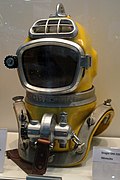
Display of diving helmets from several countries

Diving helmet types may be distinguished by several characteristics. They may be open to the water at the bottom,[10] sealed to the suit,[9] or sealed to the diver by a neck dam.[11] They may provide a constant flow of gas, from which the diver breathes as it passes, or supply gas only on demand, they may have neutral buoyancy, or be held in place by straps or ballast weights,[13] and they may vent all the gas after a single pass, or recirculate it for reduced consumption.[25] In many cases they may be switched between modes during a dive. Demand helmets usually have a valve to provide free-flow, and closed or semi-closed circuit systems can often be switched to open circuit.[26]

Standard diving helmets (Copper hats)

[edit]
Main article: Standard diving dress

The original standard diving equipment was a copper helmet or "bonnet" (British English) clamped onto a copper breastplate or "corselet", which transferred the weight to the diver's shoulders. This assembly was clamped to a rubber gasket on the dry suit to make a watertight seal. Breathing air and later sometimes helium based gas mixtures were pumped through a hose to a non-return inlet valve on the helmet or breastplate, and released to the surroundings through an exhaust valve.[9]

Historically, deep sea diving helmets were described by the number of bolts used to clamp them to the rubber gasket of the diving suit, and where applicable, the number of bolts used to secure the bonnet (helmet) to the corselet (breastplate). This ranged from the no bolt, two, three, and four bolt helmets; corselets with six, eight, or 12 bolts; and Two-Three, Twelve-Four, and Twelve-Six bolt helmets.[27] For example, the US twelve-four helmets used 12 bolts to clamp the breastplate to the suit, and four bolts to seal the helmet to the breastplate. The no-bolt helmet used a spring-loaded clamp to secure the helmet to corselet over the suit gasket, and many helmets were sealed to the breastplate by a 1/8 turn interrupted screw thread. Swedish helmets were distinctive for using a neck ring instead of a corselet, a precursor of more modern diving equipment, but cumbersome and uncomfortable for the diver. A further distinction is the number of viewports, or "lights", usually one, three or four. The front light could be opened for air and communications when the diver was out of the water. This equipment is commonly referred to as Standard diving dress and "heavy gear."[27]

Occasionally, divers would lose consciousness while working at 120 feet in standard helmets. The English physiologist J.S. Haldane found by experiment that this was partly due to a buildup of carbon dioxide in the helmet caused by insufficient ventilation and a large dead space, and established a minimum flow rate of 1.5 cubic feet (42 L) per minute at ambient pressure.[28]

Gas extender helmets

[edit]
Further information: Gas extender

A small number of copper Heliox helmets were made by the US Navy for the Second World War. These helmets were Mk Vs modified by the addition of a bulky brass carbon dioxide scrubber chamber at the rear, and are easily distinguished from the standard model. The Mk V Helium weighs about 93 lb (42 kg) complete (bonnet, scrubber canister and corselet)[25] These helmets and similar models manufactured by Kirby Morgan, Yokohama Diving Apparatus Company and DESCO used the scrubber as a gas extender, a form of semi-closed rebreather system, where breathing gas was recirculated through the scrubber by entraining the helmet gas in the flow from an injector supplying fresh gas, a system pioneered by Dräger in 1912.[29]

Semi-closed rebreather helmets

[edit]
See also: Diving rebreather § Standard diving dress rebreathers

In 1912 the German firm Drägerwerk of Lübeck introduced a version of standard diving dress using a gas supply from an oxygen rebreather and no surface supply. The system used a copper diving helmet and standard heavy diving suit with a back-mounted set of cylinders and scrubber. The breathing gas was circulated by using an injector system in the loop powered by the added gas. This was developed further with the Modell 1915 "Bubikopf" helmet and the DM20 oxygen rebreather system for depths up to 20 m, and the DM40 mixed gas rebreather which used an oxygen cylinder and an air cylinder for the gas supply, producing a nitrox mixture, for depths up to 40 m.[30]

The Siebe Gorman Mine Recovery Type Self-Contained Diving Apparatus (MRS) was a diving suit based on a two-light copper helmet, with the corselet glued to the top part of a diving suit which had rubber seals round the waist of the jacket and trouser sections. The system used a nitrox mixture with 45% oxygen which was partly recirculated and scrubbed of carbon dioxide, and could be used to depths of up to 40 m. Maximum endurance wast 60 to 90 minutes depending on depth. The front viewport was oval with a hinge at the bottom. The exhaust port on the right side was unusual in appearance, with a circular perforated plate cover. The gas extender unit with scrubber was back mounted, with three small cylinders, and circulated gas to the helmet through corrugated hoses attached behind the ears.[31]

Shallow-water helmets

[edit]
Three models of Miller Dunn Divinhood shallow water diving helmets

The shallow water helmet is a very simple concept: a helmet with viewports which is fitted by lowering over the diver's head to rest on the shoulders. It must be slightly negatively buoyant when filled with air so that it does not float off the diver in use. Air is supplied through a low pressure hose and escapes at the bottom of the helmet, which is not sealed to the suit, and can be lifted off by the diver in an emergency. The helmet will flood if the diver leans over or falls over. The shallow water helmet generally has a handle on top to help the tender lift it onto and off the diver when out of the water. The structure is variable, and ranges from relatively heavy metal castings to lighter sheet metal shells with additional ballast.[10]

The concept has been used for recreational diving as a breathing system for use by untrained tourists in the direct care of a dive leader in a benign diving environment, marketed as the Sea Trek diving system.[32][33]

Lightweight demand helmets

[edit]
Surface supplied lightweight open circuit demand helmet

The lightweight diving helmet is a type which is fitted more closely to the diver's head, reducing the interior volume, and thereby reducing the displaced volume of the helmet, so less mass is required to make the helmet's buoyancy neutral. The consequence is a reduced overall mass for the equipment carried by the diver, who must not be buoyant in the water. This reduction in volume and mass allows the diver to more safely support the helmet on the head and neck when out of the water, so when it is immersed and neutrally buoyant, it is comfortable to move around with the head, allowing the diver to use neck movement to change the direction of view, which in turn increases the diver's total field of vision while working. Since the lightweight helmet can be supported by the head and neck, it can be sealed to the neck, using a neck dam, independent of the diving suit, making operations equally convenient with dry suits and wetsuits, including hot water suits. Some models can be sealed directly to a dry suit for maximum isolation from the environment.[11]

The foam neoprene or latex neck dam of many of the popular Kirby-Morgan helmets is fitted to an oval metal neck ring which hooks onto the bottom of the helmet in front. A folding locking collar at the back of the helmet swings forward and up to push the back of the neck ring up into the base of the helmet, and also prevents the helmet from lifting off the head by partly occluding the neck ring opening at the back. The locking collar is secured in the locked position by two spring loaded pull-pin latches. The helmet seals over the neck ring with a barrel seal O-ring. Other arrangements may be used with similar effect on other models, such as the KMSL 17B, where the seal is made on the outside of the helmet to an O-ring seated in a groove in the fibreglass rim. A lever operated clamp with a yoke is mounted on the neck dam and seals to the helmet rim, or a moulded rubber seal bonded to a dry suit is clamped to the helmet using a similar clamp system.[11][12]

Open circuit demand helmets

[edit]
Inside view of a Kirby Morgan 37 showing the oral-nasal mask, the microphone and a loudspeaker of the communications system

Notable modern commercial helmets include the Kirby Morgan Superlite-17 from 1975 and developments from that model. These helmets are of the demand type, usually built on a fiberglass shell with chrome-plated brass fittings, and are considered the standard in modern commercial diving for most operations.[26]

Kirby Morgan dominates the new helmet market, but there have been other manufacturers including Savoie, Miller, Gorski, Composite-Beat Engel,[34][35]Divex, and Advanced Diving Equipment Company. Many of these are still in use; a new helmet represents an investment of several thousand dollars, and most divers purchase their own or rent one from their employer.[14]

Reclaim helmets

[edit]
See also: Saturation diving § Gas reclaim systems

Reclaim helmets use a surface supply system to provide breathing gas to the diver in the same way as in the open circuit helmets, but also have a return system to reclaim and recycle the exhaled gas to save the expensive helium diluent, which would be discharged to the surrounding water and lost in an open circuit system. The reclaimed gas is discharged from the helmet through a back-pressure regulator and returned to the surface through a hose in the umbilical which is provided for this purpose, passed through a scrubber to remove carbon dioxide, blended with oxygen to the required mix and repressurised for immediate re-use or stored for later use.[36][37]

In order to allow the exhaust gas to be discharged from the helmet safely, it must pass through an exhaust back-pressure regulator, which works on the same principle to a built-in breathing system exhaust valve, activated by the pressure difference between the interior of the helmet and the ambient pressure. The reclaim exhaust valve may be a two-stage valve for lower resistance, and will generally have a manual bypass valve which allows exhaust to the ambient water. The helmet will have an emergency flood valve to prevent possible exhaust regulator failure from causing a helmet squeeze before the diver can bypass it manually.[38]

Free-flow helmets

[edit]
US Navy Mark 12 free flow diving helmet

In a free-flow or constant flow helmet, gas is delivered at an approximately constant rate, set by the panel operator, and usually adjustable by the diver, independent of the diver's breathing, and flows out through an exhaust valve against a slight adjustable over-pressure. Free-flow helmets use much larger quantities of gas than demand helmets, which can cause logistical difficulties and is very expensive when special breathing gases (such as heliox) are used. They also produce a constant noise inside the helmet, which can cause communication difficulties. Free-flow helmets are still preferred for some applications of hazardous materials diving, because their positive-pressure nature can prevent the ingress of hazardous material in case the integrity of the suit or helmet is compromised. They also remain relatively common in shallow-water air diving, where gas consumption is of little concern, and in nuclear diving because they must be disposed of after some period of use due to irradiation; free-flow helmets are significantly less expensive{ to purchase and maintain than demand types due to simple construction and fewer components.[14]

The DESCO "air hat" is a metal free-flow helmet, designed in 1968 and still in production. Although it has been updated several times, the basic design has remained constant and all upgrades can be retrofitted to older helmets. Its robust and simple design (it can be completely disassembled in the field with only a screwdriver and wrench) makes it popular for shallow-water operations and hazardous materials diving. The helmet is secured to the diving suit by a neck ring, and held in place on the diver against buoyancy by means of a "jocking strap" which runs between the legs. Buoyancy can be fine-tuned by adjusting intake and exhaust valves to control the internal pressure, which will control the volume of gas in the attached dry suit. Concept and operation are very similar to the standard diving helmet. Noise level can be high and can interfere with communications and affect diver hearing.[13]

The US Navy replaced the Mark V helmet in 1980 with the Morse Engineering Mark 12 deep water helmet which has a fibreglass shell with a distinctive large rectangular front faceplate for a better field of vision for work. It also has side and top viewports for peripheral vision. This helmet can also be used for mixed gas either for open circuit or as part of a modular semi-closed circuit system, which uses a back mounted recirculating scrubber unit connected to the lower back of the helmet by flexible breathing hoses. The helmet uses a neck dam or can be connected directly to a dry suit, and uses a jocking harness to keep the helmet in position, but is ballasted to provide neutral buoyancy and a centre of gravity at the centre of buoyancy for stability. Airflow is directed over the faceplate to prevent fogging.[39] Both the Mk V and the Mk 12 were in use in 1981.[40] The noise level in the Mk 12 in open circuit mode can have adverse effects on diver hearing. Sound intensity levels have been measured at 97.3 dB(A) at 30.5 msw depth.[41] The Mk 12 was phased out in 1993.[28]

Light-weight transparent dome type helmets have also been used. For example, the Sea Trek surface supplied system, developed in 1998 by Sub Sea Systems, is used for recreational diving.[42][33] Also the Lama, a near spherical acrylic dome helmet developed by Yves Le Masson in the 1970s, has been used in television to let viewers see the face and hear the voice of the presenter speaking underwater,[43][44] and was also used with the Lockout Breathing System, a back mounted umbilical supplied rebreather system rated to 300msw, and used in the North Sea.[45]

  • Front view of an AH3 free flow diving helmet
    Front view of an AH3 free flow diving helmet
  • Side view of an AH3 free flow diving helmet
    Side view of an AH3 free flow diving helmet
  • Dräger DM 220
    Dräger DM 220

Push-pull helmets

[edit]

These are helmets which use a flow of supply gas which is recovered and recycled in a closed circuit system, such as from the atmosphere of a saturation system like a closed bell, underwater habitat, or lock-out submersible. The gas is pumped to the diver through the umbilical, and pumped back to the life-support system for carbon dioxide scrubbing and oxygen replenishment. Pressure in the helmet is maintained at ambient pressure,[46] and the work of breathing is relatively low. A high flow rate must be maintained in a continuous flow system to compensate for potential dead space in the helmet, but as the gas is recycled, very little is lost. Lateral excursions are limited by the umbilical reach, but vertical excursions are restricted by the ability of the control valves to manage pressure variations between gas source and the helmet while providing acceptable work of breathing. The Divex Arawak system is an example of a successful push-pull system used in the SEALAB projects[47][48] The Arawak V system, patented in 1968, is rated to be used at depths between 200 and 1,500 feet (61 and 457 m). The breathing circuit for the Arawak has no carbon dioxide scrubber, gas mixing facilities, or gas monitoring system, as it makes use of the breathing gas of the subsurface base unit, which is already continuously controlled and monitored. This makes the preparation and after-dive maintenance very simple in comparison with a conventional rebreather. Limitations include lateral range restriction according to the length of the umbilical, and excursion depth restrictions due to work of breathing changes caused by the regulator valves when the hydrostatic pressure variations are too large. The helmet is rated for upward excursions of 33 feet (10 m) and downward excursions of 100 feet (30 m).[48]

Safety

[edit]
See also: Diving safety § Surface-supplied equipment, and Human factors in diving equipment design § Masks and helmets

Use of a sealed helmet for diving is generally safer than a full-face or half mask, as the airway is relatively well protected, and the diver can survive a loss of consciousness until rescued in most circumstances, provided the breathing gas supply is not interrupted. There are hazards associated with helmet use, but the risks are relatively low. A helmet is also substantial protection against the environment. It protects against impact to the head and neck, external noise, and heat loss from the head. If sealed to a dry suit, and fitted with a suitable exhaust system, it is also effective against contaminated ambient water.[3] Shallow-water helmets which are open at the bottom do not protect the airway if the diver does not remain upright.

One of the more obvious hazards is the potential for flooding, but as long as an adequate breathing gas supply is available, the helmet can be purged of water that gets into it. A helmet sealed by a neck dam can be purged without affecting the diving suit, and water will drain from the exhaust ports if there is no major structural damage to the shell, view-ports or neck dam. The shell and view-ports are tough and not easily penetrated. The neck dam is more vulnerable, but even a major tear can be managed by keeping the head upright to prevent flooding up against the gas inside. There have been cases of a helmet separating from the yoke, due to locking cam or locking pin failure, but safety clips on the cam levers and locking pin redesign make the risk extremely low on more recent designs.[13]

Helmet squeeze occurs when the internal pressure of the helmet is lower than the ambient pressure. In the early days of surface supplied diving this could occur if the diver descended so fast the manually powered air supply pump could not keep up with the compression due to hydrostatic pressure increase. This is no longer a problem as gas supply systems have been upgraded. The other cause of catastrophic pressure reduction in the helmet was when the air supply hose ruptured much shallower than the diver, and air would flow out of the damaged hose, reducing helmet internal pressure to the pressure at the depth of the rupture, which could be several atmospheres. Since the standard diving helmet is sealed to a watertight dry suit, all the air from inside the suit would rapidly be lost, after which the external pressure would squeeze as much of the diver as possible into the helmet. Crushing injuries caused by helmet squeeze could be severe and sometimes fatal. An accident of this type is recorded from Pasley's salvage work on HMS Royal George (1756) in 1839. Helmet squeeze due to air hose failure is prevented by fitting a non-return valve in the line at the connection to the helmet. Testing of this valve is an essential daily pre-use check.[13] A similar mechanism is possible in the helium reclaim systems used for heliox diving, where a failure of the reclaim regulator can cause loss of gas through the return hose. This risk is mitigated by the capacity of the neck dam or an emergency flood valve to allow the helmet to temporarily flood, relieving the pressure difference, until the diver can switch to open circuit and purge the helmet of water.[38]

Maintenance

[edit]

Since diving helmets are almost exclusively used for occupational diving, their maintenance and inspection is covered by occupational health and safety legislation, which generally makes the owner and employer responsible for required testing and maintenance. It is usually legal for a diver to maintain and repair their own equipment, but to work on equipment which will be used by another person, the technician must be certified as competent to work on that equipment. To avoid possible litigation, contractors will appoint a technician to inspect and where necessary, maintain and repair equipment used and owned by their employees, which should also ensure that the necessary records are kept. Detailed instructions for inspections, tests, maintenance and repairs for each model of equipment are provided by the manufacturers, and will usually include checklists for logging maintenance records.[49]

Ergonomics and fit

[edit]
See also: Human factors in diving equipment design

The range of available sizes is small, and although most helmets will fit a large range of divers, there are some people they just will nor fit satisfactorily. During training the diver may have a chance to try out several models owned by the school, and may be able to find a model that fits them best. Fit is more important on a helmet that is supported by the diver's head and neck, and moves with the head, as these need to be well balanced and snug fitting. Some adjustment can be made to the internal padding and straps to achieve a better fit provided the size is basically correct.[14]

Manufacturers

[edit]
See also: Standard diving dress § Manufacturers, and List of diving equipment manufacturers
  • Advanced Diving Equipment Company is an American manufacturer of diving helmets that produces the Swindell free-flow open circuit air helmets.[50]
  • Erik Andersson of Stockholm made standard helmets.[51]
  • Bikkers of Rotterdam made standard helmets.[52]
  • Emil Carlsson of Stockholm, Sweden, made standard helmets.[53]
  • Composite-Beat Engel is a Swiss manufacturer of composite helmets, including lightweight demand diving helmets.[34][35]
  • John Date of Montreal made standard diving helmets.[54]
  • DESCO, also known as Diving Equipment and Supply Company Inc, is an American diving equipment manufacturer in Milwaukee, Wisconsin They produce surface-supplied and scuba equipment, including standard diving helmets,[55] and shallow water helmets.[56]
  • Divex, a subsidiary of James Fisher & Sons plc, manufacture the AH5 free-flow helmet, and some of its earlier versions.[57] They also produce helium reclaim helmets using Kirby-Morgan Superlite 17C helmets with Divex Ultraflow demand regulators and Ultrajewel exhaust reclaim regulators[58] the "Dirty Harry" helmet for contaminated encironments, and the Arawak series of 'push-pull' closed circuit helmets.[47]
  • Dräger & Gerling, Lübeck, Established 1889. In 1902 their name changed to Drägerwerk, Heinr. & Bernh. Dräger. Drägerwerk produced both rebreather and free-flow standard helmets.[59][60]
  • Drass-Galeazzi is an Italian diving equipment manufacturer of Drass D-ONE lightweight diving helmets.[35][61]
  • Eterne was a Brazilian manufacturer of shallow water helmets.[62]
  • Friedrich Flohr, of Kiel. Established 1890. Manufactured apparatus of Denayrouze type with three-bolt helmets and regulator backpacks. Later also produced free-flow helmets.[63][64]
  • General Aquadyne Inc. of Santa Barbara, California manufactured the fibreglass shell AH-2 free-flow helmet and DM-4 to DM-6 band masks. Production of the AH series helmets was later continued by Divex.[65][66]
  • Galeazzi of La Spezia, made standard diving equipment, including helmets for mixed gas.[67]
  • Gorski is a brand of lightweight demand diving helmet with a stainless steel shell, owned by Aqua Lung.[68][69] In 2004, Leszek Górski's G2000SS diving helmet went into production, and in 2011, Gorski’s company was bought out by Aqua Lung. The G3000 helmet uses a high-performance Apeks GX300 regulator.[70]
  • L.G. Hammond of Miami, Florida, was a manufacturer of cast bronze shallow water helmets.[71]
  • Heinke of London, UK, manufactured standard diving helmets.
  • IAC, of Italy, made standard diving helmets.[72]
  • Kimura (Nagasaki iron works), of Japan, made standard helmets.[73]
  • Kirby-Morgan of California have produced a large range of lightweight demand helmets with fibre composite and stainless steel shells for air and mixed gas diving, including reclaim helmets. Several of the models are still in production, and several others are still supported.[74][75][76]
  • C.A. Lindqvist of Stockholm, Sweden, made standard helmets.[77]
  • Marinverkst of Karlskrona, Sweden, made standard helmets.[78]
  • Medi, of East Germany, made 3-bolt standard helmets[64]
  • Miller-Dunn Diving Co. of Miami, Florida, manufactured standard diving helmets and shallow water helmets.[79]
  • Morse Diving of Boston, Massachusetts, also known as Morse Diving International and A J Morse and Son, manufactured standard diving helmets,[80] the US Navy Mark 12 deep water helmet,[40] and shallow water helmets.[81]
  • Nemrod of Spain manufactured standard helmets.[82]
  • Ocean Development Corporation produced the Ratcliffe helmet, commonly known as the "Rat Hat", and was later bought out by Oceaneering International which continued production for a few years for their own use. It can function in either free-flow or demand mode.[83]
  • Charles Person, of São Paulo, Brazil, manufactured standard diving equipment[84] and shallow water helmets.[85]
  • Pusan of Korea made standard helmets.[86]
  • Rouquayrol–Denayrouze, later Specialites Mecaniques Reunis, then Societe Charles Petit, and eventually Rene Piel (several name changes) manufactured both 3-bolt and 12-bolt standard helmets, and both demand and free-flow air supply systems.[87] Trademarks include Rene Piel of Paris,[88]and C H Petit, of Paris.[89]
  • Saturation Systems Inc., of California, mnufacturers of the Sat Hat, An investment cast stainless steel helmet invented in 1976 to 1978 by Donald Rodocker and Chris DeLucci who founded the company.[90]
  • Joe Savoie of Boutte, Louisiana, produced several versions of lightweight helmet of his own design, both free-flow and demand supplied.
  • Scauda of Mareilles manufactured standard diving helmets.[91]
  • A. Schräder's Son of Brooklyn, New York, manufactured standard diving equipment and shallow water helmets.[92]
  • Siebe Gorman of London, UK, manufactured a wide range of standard helmet models over several years, including 12-bolt oval and square corselets, 6-bolt oval corselets,[93] and a rebreather model.[94]
  • Snead Co., of Jersey City N.J. was a manufacturer of shallow water helmets.[95]
  • Società Anonima Lavorazioni Vari Appararecchi di Salvataggio (SALVAS), manufactured mostly military salvage equipment, including diving helmets.[96][97]
  • Yokohama Diving Apparatus Company, of Japan manufactured standard helmets, including helium gas extender helmets.[98]

See also

[edit]
  • Hard hat, also known as bump cap – Protective industrial headwear
  • Diving equipment – Equipment used to facilitate underwater diving
  • Human factors in diving equipment design – Influence of the interaction between the user and the equipment on design
  • Motorcycle helmet, also known as crash helmet – Safety helmet used by motorcycle riders
  • Standard diving dress – Copper helmet with rubberised canvas diving suit and weighted boots

References

[edit]
  1. ^ Curley, M.D. (1986). Human Factors Evaluation of the Superlite 17B Helmet in the Surface-Supplied, Open-Circuit Mode (PDF). US Navy Experimental Diving Unit Technical Report (Report). Vol. NEDU-11-85. Archived (PDF) from the original on 13 May 2024. Retrieved 13 May 2024.
  2. ^ Mitchell, Simon J.; Bennett, Michael H.; Bird, Nick; Doolette, David J.; Hobbs, Gene W.; Kay, Edward; Moon, Richard E.; Neuman, Tom S.; Vann, Richard D.; Walker, Richard; Wyatt, H.A. (2012). "Recommendations for rescue of a submerged unresponsive compressed-gas diver". Undersea & Hyperbaric Medicine. 39 (6): 1099–108. PMID 23342767.
  3. ^ a b Barsky, Steven (2007). Diving in High-Risk Environments (4th ed.). Ventura, California: Hammerhead Press. ISBN 978-0-9674305-7-7.
  4. ^ "Helmets". starlessriver.com. Archived from the original on 28 October 2022. Retrieved 28 October 2022.
  5. ^ "Helmets and accessories". deep-ideas.co.uk. Archived from the original on 13 May 2024. Retrieved 28 October 2022.
  6. ^ Norfleet, W.T.; Hickey, D.D.; Lundgren, C.E. (November 1987). "A comparison of respiratory function in divers breathing with a mouthpiece or a full face mask". Undersea Biomedical Research. 14 (6): 503–26. PMID 3120386.
  7. ^ "Clamshell fiberglass diving helmet". Florida Institute of Technology: John H. Evans Library Digital Collections. Retrieved 2 September 2024.
  8. ^ "Kirby Morgan History". www.kirbymorgan.com. Archived from the original on 18 April 2024. Retrieved 2 September 2024.
  9. ^ a b c d e f g "Diving: Assembling the Deep Sea Outfit: KN 9915-8 : US Navy Training Film". U.S.Naval Photographic Unit. 1963. Archived from the original on 17 August 2022. Retrieved 17 August 2022.
  10. ^ a b c "Shallow water Diving Helmets Main Page". www.divingheritage.com. Archived from the original on 8 August 2018. Retrieved 22 November 2019.
  11. ^ a b c d "Description and Operational Specifications: Document # 220602003" (PDF). www.kirbymorgan.com. Archived (PDF) from the original on 27 October 2022. Retrieved 27 October 2022.
  12. ^ a b "SuperLite 17B". www.kirbymorgan.com. Archived from the original on 28 October 2022. Retrieved 28 October 2022.
  13. ^ a b c d e f g h i j k l m n o p q r s t Larn, Richard; Whistler, Rex (1993). Commercial Diving Manual (3rd ed.). Newton Abbott, UK: David and Charles. ISBN 0-7153-0100-4.
  14. ^ a b c d Mason, Adam (10 November 2021). "Underwater Welding Helmet Guide For Commercial Diving". weldingpros.net. Retrieved 1 December 2025.
  15. ^ "Hot Water Shroud Kit - Kirby Morgan accessories". www.marinevision.es. Archived from the original on 17 March 2023. Retrieved 17 March 2023.
  16. ^ "Breathing gas heating device used in deep diving environment and diving mask or helmet #CN113581423B". patents.google.com. Archived from the original on 18 March 2023. Retrieved 17 March 2023.
  17. ^ a b c d e Bevan, John (27 May 1996). The Infernal Diver. Submex Ltd. p. 314. ISBN 0-9508242-1-6.
  18. ^ Heiser, Ed (25 June 2016). "The Origin Of Scuba Diving". www.heiserclan.com. Archived from the original on 22 April 2019. Retrieved 26 November 2019.
  19. ^ a b Acott, C. (1999). "JS Haldane, JBS Haldane, L Hill, and A Siebe: A brief resume of their lives" (PDF). South Pacific Underwater Medicine Society Journal. 29 (3). ISSN 0813-1988. OCLC 16986801. Archived (PDF) from the original on 13 May 2024. Retrieved 13 May 2024.
  20. ^ Brylske, Alex. "A Brief History of Diving: Free Divers, Bells and Helmets". dtmag.com. Retrieved 15 October 2025.
  21. ^ United States. Patent and Trademark Office (1978). "List of patentees". Index of Patents Issued from the United States Patent and Trademark Office, Part 1. The Office. p. 1775 – via University of Minnesota. Savoie, Hilbert Joseph, Jr. Diving gas recovery apparatus. 4,080,964 3-28-78 Cl.128-142.300
  22. ^ United States. Patent Office (1972). "List of patentees". Index of Patents Issued from the United States Patent Office, Part 1. U.S. Government Printing Office. p. 1641 – via Michigan State University. Savoie, Hilbert J. Jr, Air-gas metering and recovery apparatus. 3,670,213 11-16-71 Cl.128-112
  23. ^ a b "Fascinating account of hard-headed trailblazer". Underwater Contractor International. Teddington, Middlesex, UK: Underwater World Publications Ltd.: 25 March–April 2006. ISSN 1362-0487.
  24. ^ Bech, Janwillem. "Pirelli diving suit". therebreathersite.nl. Janwillem Bech. Archived from the original on 21 February 2020. Retrieved 10 August 2016.
  25. ^ a b "DESCO 29019 Mark V Diving Helmet - Navy Helium Helmet with Single Exhaust Valve (early version)". Archived from the original on 16 February 2018. Retrieved 15 February 2018.
  26. ^ a b "Kirby Morgan DSI dive helmets" (PDF). kirbymorgan.com. Archived (PDF) from the original on 20 February 2012. Retrieved 7 September 2016.
  27. ^ a b Pardoe 2016.
  28. ^ a b US Navy (1 December 2016). U.S. Navy Diving Manual Revision 7 SS521-AG-PRO-010 0910-LP-115-1921 (PDF). Washington, DC.: US Naval Sea Systems Command. Archived (PDF) from the original on 28 December 2016. Retrieved 25 October 2022.
  29. ^ "Going deep". www.divingheritage.com. Archived from the original on 4 May 2019. Retrieved 2 July 2019.
  30. ^ Dekker, David L. "Diving apparatus 'Modell 1912' Draegerwerk Lübeck, helmet with 'lock system'". Chronology of Diving in Holland: 1889. Draegerwerk Lübeck. www.divinghelmet.nl. Retrieved 17 September 2016.
  31. ^ "Flange helmet: The Mine Recovery Outfit". Diving Heritage. 18 May 2014. Retrieved 15 October 2025.
  32. ^ "Untitled equipment page". www.sea-trek.com. 28 August 2013. Archived from the original on 30 November 2019. Retrieved 26 November 2019.
  33. ^ a b "Untitled FAQ list". www.sea-trek.com. 19 May 2012. Archived from the original on 13 May 2019. Retrieved 26 November 2019.
  34. ^ a b "Commercial Diving". composite-be.com. Retrieved 14 October 2024.
  35. ^ a b c "Helmets". diving-rov-specialists.com. Archived from the original on 23 April 2024. Retrieved 14 October 2024.
  36. ^ "Reclaim Basic Set Up" (PDF). www.subseasa.com. Archived from the original (PDF) on 29 May 2020. Retrieved 10 March 2020.
  37. ^ Bevan, John, ed. (2005). "Section 5.3". The Professional Divers's Handbook (second ed.). Gosport, Hampshire: Submex Ltd. p. 238. ISBN 978-0950824260.
  38. ^ a b Operation and Maintenance Manual for the 17C Ultrajewel 601 Helmet Part Number: A10170 Document Number: P1884-OM-56 (Revision: 8 ed.). JFD Divex.
  39. ^ Traver, Richard P. (November 1985). Interim Protocol for Diving Operations in Contaminated Water (PDF). PB86-128022 EPA/600/2-85/130 (Report). Cincinnati, OH: U.S. Environmental Protection Agency. Archived (PDF) from the original on 8 November 2023. Retrieved 24 March 2022.
  40. ^ a b U.S. Navy Diving Manual, NAVSEA 0994-LP001-9010 (PDF). Vol. 2, Mixed Gas Diving. Revision 1. Washington DC: Navy Department. June 1981. Archived (PDF) from the original on July 2, 2019.
  41. ^ Curley, M.D.; Knafelc, M.E. (May 1987). "Evaluation of noise within the MK 12 SSDS helmet and its effect on divers' hearing". Undersea Biomed Res. 14 (3): 187–204. PMID 3629736.
  42. ^ "Equipment options". Sea Trek dive helmet. Archived from the original on 1 April 2009. Retrieved 21 February 2009.
  43. ^ "Lama dive helmet". divingheritage.com. Archived from the original on 9 June 2016. Retrieved 7 September 2016.
  44. ^ "Have you seen a LAMA? Check out this Unique Bubble Helmet". California Diver. 28 July 2014. Archived from the original on 7 September 2017. Retrieved 2 September 2024.
  45. ^ "LAMA (France)". Frogman Museum. Retrieved 5 July 2025.
  46. ^ "Exhaust regulator valve for push-pull diving system" – via patents.google.com.
  47. ^ a b "Divex". www.divingheritage.com. Retrieved 21 October 2024.
  48. ^ a b "Arawak system". www.therebreathersite.nl. Retrieved 21 October 2024.
  49. ^ "Frequently Asked Questions". divelab.com. Retrieved 1 December 2025.
  50. ^ Reimers, Stephen D.; Langworthy, C.; Hesket (13 July 1973). Evaluation testing of the Advanced (Swindell) air diving helmet (PDF). AD-773 091 (Report). Navy Experimental Diving Unit. Archived (PDF) from the original on 2 August 2024. Retrieved 8 October 2024.
  51. ^ Pardoe 2016, p. 104.
  52. ^ Dekker, David L. "1841. Bikkers Rotterdam". www.divinghelmet.nl. Archived from the original on 24 October 2015. Retrieved 18 September 2016.
  53. ^ Pardoe 2016, p. 102.
  54. ^ Pardoe 2016, p. 138.
  55. ^ Roberts, Fred M. (1963). Basic Scuba. Self-Contained Underwater Breathing Apparatus: Its Operation, Maintenance and Use (Enlarged Second ed.). New York: Van Nostrand Reinhold Co.
  56. ^ "Desco Shallow water helmets". www.divingheritage.com. Retrieved 8 October 2024.
  57. ^ "Divex AH5 free-flow air helmet". www.jfdglobal.com. Archived from the original on 22 May 2024. Retrieved 14 October 2024.
  58. ^ Operation and Maintenance Manual for the 17C ULTRAJEWEL 601 HELMET Part Number: A10170 (PDF). JFD. Retrieved 21 October 2024.
  59. ^ Dekker, David L. "1889. Draegerwerk Lübeck". Chronology of Diving in Holland. www.divinghelmet.nl. Archived from the original on 20 September 2016. Retrieved 17 September 2016.
  60. ^ Pardoe 2016, pp. 88–91.
  61. ^ "D-ONE Diving Helmet". www.d-one.tech. Retrieved 14 October 2024.
  62. ^ "Eterne Shallow water helmets". www.divingheritage.com. Archived from the original on 12 April 2024.
  63. ^ Dekker, David L. "1890 Friedrich Flohr, Kiel". www.divinghelmet.nl. Archived from the original on 10 March 2016. Retrieved 18 September 2016.
  64. ^ a b Pardoe 2016, p. 97.
  65. ^ "Virtual helmet and mask collection". www.divingheritage.com. Archived from the original on 1 September 2024. Retrieved 15 October 2024.
  66. ^ "General Aquadyne". www.divingheritage.com. Archived from the original on 6 December 2023. Retrieved 15 October 2024.
  67. ^ Pardoe 2016, p. 121–123.
  68. ^ "Gorski G3000 Helmet". www.oceaneyeinc.com/. Retrieved 9 October 2024.
  69. ^ "Aqua Lung "Gorski" G3000SS Diving Helmet". www.divecommercial.com. 24 February 2014. Retrieved 9 October 2024.
  70. ^ Andrukajtis, Tomasz. "Les Gorski, creator of the G2000SS diving helmet, has died". divers24.com. Retrieved 20 October 2024.
  71. ^ "Hammond shallow water diving helmets". www.divingheritage.com.
  72. ^ Pardoe 2016, p. 125.
  73. ^ Pardoe 2016, p. 137.
  74. ^ "Kirby Morgan Diamond". www.kirbymorgan.com. Archived from the original on 13 May 2024. Retrieved 7 October 2024.
  75. ^ "Why Kirby Morgan helmets are the industry standard". prodivertc.com. 8 June 2021. Archived from the original on 8 October 2024. Retrieved 23 June 2024.
  76. ^ "Products". www.kirbymorgan.com. Archived from the original on 23 June 2024. Retrieved 8 October 2024.
  77. ^ Pardoe 2016, p. 99.
  78. ^ Pardoe 2016, p. 105.
  79. ^ "Miller Dunn Shallow water helmets". www.divingheritage.com.
  80. ^ "Commercial and Deep Sea Diving Helmets". Archived from the original on 7 October 2024. Retrieved 18 November 2019.
  81. ^ "Morse Shallow water helmets". www.divingheritage.com. Archived from the original on 9 June 2016. Retrieved 8 October 2024.
  82. ^ Pardoe 2016, p. 133.
  83. ^ "Diving into the Past: Ratcliffe Helium Demand & Dual Port Rat Hat : Commercial Diving Equipment". Kirby Morgan. 8 December 2021. Retrieved 15 October 2024 – via YouTube.
  84. ^ Pardoe 2016, p. 132.
  85. ^ "Person Shallow water helmets". www.divingheritage.com. Archived from the original on 28 September 2023.
  86. ^ Pardoe 2016, p. 131.
  87. ^ Dekker, David L. "1860. Benoit Rouquayrol – Auguste Denayrouze: Part 2". www.divinghelmet.nl. Archived from the original on 10 March 2016. Retrieved 18 September 2016.
  88. ^ Pardoe 2016, p. 126.
  89. ^ Pardoe 2016, p. 127.
  90. ^ Harris, Gary L. (5 July 2005). "The Sat Hat". www.divingheritage.com.
  91. ^ Pardoe 2016, p. 129.
  92. ^ "Schrader Shallow water helmets". www.divingheritage.com. Archived from the original on 8 October 2024. Retrieved 8 October 2024.
  93. ^ Pardoe 2016, pp. 25–44.
  94. ^ Pardoe 2016, p. 50.
  95. ^ "Snead shallow water helmets". www.divingheritage.com. Archived from the original on 9 October 2024. Retrieved 8 October 2024.
  96. ^ Pardoe 2016, p. 124.
  97. ^ "Introduction". www.divingheritage.com. 2 June 2014. Archived from the original on 7 September 2017. Retrieved 7 December 2017.
  98. ^ Pardoe 2016, p. 134.

Sources

[edit]

The Anthony and Yvonne Pardoe Collection of Diving Helmets and Equipment – illustrated catalogue (PDF). Exeter, UK: Bearnes Hampton & Littlewood. 2016. Archived from the original (PDF) on 29 October 2020. Retrieved 13 September 2016.

External links

[edit]
  • Modern helmet photo collection
  • U.S. Navy Mark V Diving Helmet
  • Diving helmets collection of Diving Heritage museum
  • v
  • t
  • e
Breathing apparatus
High altitude breathing apparatus
  • Aviation breathing apparatus
    • Emergency oxygen system
  • Mountaineering breathing apparatus
Occupational breathing apparatus
Respirator
Regulated by NIOSH and others
  • Gas mask
    • Canister
  • Supplied-air respirator
  • Self-contained breathing apparatus
    • Self-contained self-rescue device
  • Particulate respirator
    • N95 respirator
    • Dust mask
    • Powered air-purifying respirator
  • Chemical cartridge
  • Facepieces
    • Smoke hood
    • Elastomeric respirator
Regulations
  • 42 CFR 84 (United States)
    • ANSI K13.1-1973
  • EN 149/14683/143 (Europe)
  • GB2626 (China), and others
Medical breathing apparatus
  • Anaesthetic machine
  • Bubble CPAP
  • Continuous positive airway pressure
  • Resuscitator
    • Bag valve mask
    • Pocket mask
  • Ventilator
    • Iron lung
    • Non-invasive ventilation
  • Oxygen therapy
    • Hyperbaric medicine
      • Built-in breathing system
  • Positive airway pressure
  • Respiratory gas humidification
  • Supplemental oxygen
    • Nasal cannula
      • Reservoir cannula
    • Non-rebreather mask
    • Oxygen hood
    • Oxygen mask
    • Oxygen tent
    • Partial rebreather mask
    • Simple face mask
    • Venturi mask
Underwater breathing apparatus
  • Open-circuit scuba
  • Diving helmet
  • Diving rebreather
  • Full-face diving mask
  • Surface-supplied diving equipment
  • Snorkel
    • Helicopter escape set
    • Submarine escape set
  • Atmospheric diving suit
  • Gas extender
  • Helium reclaim system
User respiratory interface
  • Breathing mask
    • Full facepiece
    • Half mask
    • orinasal mask
General
  • Breathing gas
  • Breathing performance of regulators
  • Dead space
  • Emergency gas supply
  • Escape breathing apparatus
  • Facepiece
  • Hazmat suit
  • Negative pressure breathing
  • Open circuit breathing apparatus
  • Oxygen concentrator
  • Positive pressure breathing
  • Respiratory protective equipment
  • Pressure regulator
    • Constant flow regulator
    • Demand valve
  • Rebreather
    • Closed circuit rebreather
    • Counterlung
    • Oxygen rebreather
    • Carbon dioxide scrubber
    • Semi-closed circuit
  • Work of breathing
  • Escape respirator
  • Category
  • Commons
  • Glossary
  • v
  • t
  • e
Helmets
Individual
historical
helmets
  • Agighiol
  • Agris
  • Benty Grange
  • Broe
  • Canterbury
  • Ciumeşti
  • Coppergate
  • Coțofenești
  • Coventry Sallet
  • Crosby Garrett
  • Emesa
  • Gevninge
  • Gjermundbu
  • Guilden Morden
  • Guisborough
  • Hallaton
  • Hellvi
  • Henry VIII's Horned
  • Horncastle
  • Iron Gates
  • Lokrume
  • Meyrick
  • Nemiya
  • Newstead
  • Nijmegen
  • Peretu
  • Pioneer
  • Ribchester
  • Shorwell
  • Staffordshire
  • Sutton Hoo
  • Tjele
  • Veksø
  • Venetian
  • Waterloo
  • Witcham Gravel
  • Yarm
Combat
Ancient
  • Attic
  • Boar's tusk
  • Boeotian
  • Chalcidian
  • Coolus
  • Corinthian
  • Cudon
  • Galea
  • Illyrian
  • Imperial
  • Kegelhelm
  • Konos
  • Late Roman ridge
  • Montefortino
  • Negau
  • Novo Mesto
  • Phrygian
  • Pilos
Medieval and
Early Modern
  • Armet
  • Aventail
  • Barbute
  • Bascinet
  • Burgonet
  • Cervelliere
  • Close
  • Dragoon
  • Enclosed
  • Falling buffe
  • Frog-mouth
  • Germanic boar
  • Great
  • Hounskull
  • Jingasa
  • Kabuto
  • Katapu
  • Kettle
  • Kulah khud
  • Lamellenhelm
  • Lobster-tailed pot
  • Menpo
  • Morion
  • Nasal
  • Paseki
  • Pickelhaube
  • Sallet
  • Secrete
  • Spangenhelm
  • Takula tofao
  • Turban
  • Viking
Late Modern
  • Dragoon
  • Pickelhaube
  • Pith helmet
  • Tarleton helmet
1914–1945
  • Adrian
  • Brodie
  • M36 (Bulgaria)
  • M32 (Czechoslovakia)
  • M1923 (Denmark)
  • Stahlhelm (Germany)
  • M1934/39 (Greece)
  • Helmet Steel Airborne Troop
  • M33 (Italy)
  • M42 Duperite
  • M1
  • M1C
  • Mark II and Mark 4 "talker"
  • Mk III
  • Netherlands M34
  • Hełm wz. 31
  • M1940 (Portugal)
  • RAC
  • SSh-36
  • SSh-39 and SSh-40
  • M1921 (Spain)
  • M1926 (Spain)
  • M1934 (Spain)
  • M1942 Modelo Z
  • SSK 90
  • M1926 (Sweden)
  • M1937 (Sweden)
  • L'Eplattenier
  • M1918 (Switzerland)
  • Type 92 Tetsubo
1945–1980
  • Bangtan Helmet
  • CABAL II
  • Czechoslovak Vz. 53 Helmet
  • GK80
  • Hungarian M70
  • Romanian M73 helmet
  • Mº 44 E.T.A.
  • M59/85
  • Hełm wz. 50
  • Hełm wz. 63
  • Hełm wz. 67
  • M63
  • M76 Para
  • Mk IV
  • Mk 6
  • Modèle 1951
  • Modèle 1978
  • MPC-1
  • OR-201
  • Paratrooper
  • SSh-60
  • SSh-68
  • Swiss M71
  • Type 66
1980–2000
  • CG634
  • M92
  • GOLFO
  • M90 (Iraq)
  • JK 96
  • M59/85
  • M87
  • PASGT
  • Hełm wz. 93
  • Hełm wz. 2000
  • Sfera
  • SPECTRA
  • 6B7
2001–present
  • A2 Helmet
  • Advanced Combat Helmet
  • BK-3 helmet
  • QGF-03
  • ECH (Australia)
  • ECH (US)
  • FAST
  • 6B47
  • Hełm wz. 2005
  • Hełm HBT-02
  • Hełm HP-05
  • IHPS
  • KH-B2000
  • Lightweight Helmet
  • MICH
  • Mk 7
Athletic
  • Batting
    • Coolflo
  • Boxing / Martial Arts
  • Bicycle
  • Cricket
  • Equestrian
  • Gridiron football
    • Eyeshield
    • Revolution
  • Hockey
  • Lacrosse
  • Motorcycle
  • Racing
  • Scrum cap
  • Ski
Work
  • Custodian
  • Diving
  • Firefighter's
  • Hard hat
  • Riot protection
  • Welding
Other
  • Flight
  • Helmet cover
    • Mitznefet
  • Heraldic use
  • Horned
  • Mahiole
  • Tarnhelm
  • Pith
    • American fiber
  • Winged
  • Zuckerman
  • v
  • t
  • e
Underwater diving
  • Diving activities
  • Diving modes
    • Atmospheric pressure diving
    • Freediving
    • Saturation diving
    • Scuba diving
    • Snorkeling
    • Surface oriented diving
    • Surface-supplied diving
    • Unmanned diving
Diving equipment
  • Cleaning and disinfection of personal diving equipment
  • Human factors in diving equipment design
  • List of diving equipment manufacturers
Basic equipment
  • Diving mask
  • Snorkel
  • Swimfin
Breathing gas
  • Bailout gas
  • Bottom gas
  • Breathing air
  • Decompression gas
  • Emergency gas supply
  • Heliox
  • Hydreliox
  • Hydrox
  • Nitrox
  • Oxygen
  • Travel gas
  • Trimix
Buoyancy and
trim equipment
  • Avelo diving system
  • Buoyancy compensator
    • Power inflator
    • Dump valve
    • Variable buoyancy pressure vessel
  • Diving weighting system
    • Ankle weights
    • Integrated weights
    • Trim weights
    • Weight belt
Decompression
equipment
  • Decompression buoy
  • Decompression chamber
  • Decompression cylinder
  • Decompression tables
  • Decompression trapeze
  • Dive computer
  • Diving bell
  • Diving shot
  • Diving stage
  • Jersey upline
  • Jonline
Diving suit
  • Atmospheric diving suit
    • JIM suit
    • Newtsuit
  • Dry suit
    • Sladen suit
    • Standard diving suit
  • Rash vest
  • Wetsuit
    • Dive skins
    • Hot-water suit
Helmets
and masks
  • Anti-fog
  • Diving helmet
    • Free-flow helmet
    • Lightweight demand helmet
    • Orinasal mask
    • Reclaim helmet
    • Shallow water helmet
    • Standard diving helmet
  • Diving mask
    • Band mask
    • Full-face diving mask
    • Half mask
Instrumentation
  • Bottom timer
  • Depth gauge
  • Dive computer
  • Dive timer
  • Diving watch
    • Helium release valve
  • Electro-galvanic oxygen sensor
  • Pneumofathometer
  • Submersible pressure gauge
Mobility
equipment
  • Diver propulsion vehicle
    • Human torpedo
    • Wet sub
  • Diving bell
    • Closed bell
    • Wet bell
  • Diving stage
  • Swimfin
    • Monofin
    • PowerSwim
  • Towboard
Safety
equipment
  • Alternative air source
    • Octopus regulator
    • Pony bottle
  • Bolt snap
  • Buddy line
  • Dive light
  • Diver's cutting tool
    • Diver's knife
  • Diver's telephone
  • Through-water communications
    • Underwater acoustic communication
  • Diving bell
  • Diving safety harness
  • Emergency gas supply
    • Bailout block
    • Bailout bottle
  • Lifeline
    • Screw gate carabiner
  • Emergency locator beacon
  • Rescue tether
  • Safety helmet
  • Shark-proof cage
  • Snoopy loop
  • Navigation equipment
    • Distance line
    • Diving compass
    • Dive reel
    • Line marker
    • Surface marker buoy
    • Silt screw
Underwater
breathing
apparatus
  • Atmospheric diving suit
  • Diving cylinder
    • Burst disc
    • Scuba cylinder valve
  • Diving helmet
    • Reclaim helmet
  • Diving regulator
    • Mechanism of diving regulators
    • Regulator malfunction
      • Regulator freeze
    • Single-hose regulator
    • Twin-hose regulator
  • Full-face diving mask
Open-circuit
scuba
  • Scuba set
    • Bailout bottle
    • Decompression cylinder
    • Independent doubles
    • Manifolded twin set
      • Scuba manifold
    • Pony bottle
    • Scuba configuration
    • Sidemount
    • Sling cylinder
Diving rebreathers
  • Carbon dioxide scrubber
  • Carleton CDBA
  • Clearance Divers Life Support Equipment
  • Cryogenic rebreather
  • CUMA
  • DSEA
  • Dolphin
  • Halcyon PVR-BASC
  • Halcyon RB80
  • IDA71
  • Interspiro DCSC
  • LAR-5
  • LAR-6
  • LAR-V
  • LARU
  • Mark IV Amphibian
  • Porpoise
  • Ray
  • Siebe Gorman CDBA
  • Salvus
  • Siva
Surface-supplied
diving equipment
  • Air line
  • Diver's umbilical
  • Diving air compressor
  • Gas panel
  • Hookah
  • Scuba replacement
  • Snuba
  • Standard diving dress
Diving
equipment
manufacturers
  • AP Diving
  • Apeks
  • Aqua Lung America
  • Aqua Lung/La Spirotechnique
  • Beuchat
  • René Cavalero
  • Cis-Lunar
  • Cressi-Sub
  • Dacor
  • DESCO
  • Dive Xtras
  • Divex
  • Diving Unlimited International
  • Drägerwerk
  • Faber
  • Fenzy
  • Maurice Fernez
  • Technisub
  • Oscar Gugen
  • Heinke
  • HeinrichsWeikamp
  • Johnson Outdoors
  • Mares
  • Morse Diving
  • Nemrod
  • Oceanic Worldwide
  • Porpoise
  • Shearwater Research
  • Siebe Gorman
  • Submarine Products
  • Suunto
Diving support equipment
Access equipment
  • Boarding stirrup
  • Diver lift
  • Diving bell
  • Diving ladder
  • Diving platform (scuba)
  • Diving stage
  • Downline
  • Jackstay
  • Launch and recovery system
  • Messenger line
  • Moon pool
Breathing gas
handling
  • Air filtration
    • Activated carbon
    • Hopcalite
    • Molecular sieve
    • Silica gel
  • Booster pump
  • Carbon dioxide scrubber
  • Cascade filling system
  • Diver's pump
  • Diving air compressor
    • Diving air filter
    • Water separator
    • High pressure breathing air compressor
    • Low pressure breathing air compressor
  • Gas blending
    • Gas blending for scuba diving
  • Gas panel
  • Gas reclaim system
  • Gas storage bank
    • Gas storage quad
    • Gas storage tube
  • Helium analyzer
  • Nitrox production
    • Membrane gas separation
    • Pressure swing adsorption
  • Oxygen analyser
    • Electro-galvanic oxygen sensor
  • Oxygen compatibility
Decompression
equipment
  • Air-lock
  • Built-in breathing system
  • Decompression tables
  • Diving bell
    • Bell cursor
    • Closed bell
    • Clump weight
    • Launch and recovery system
    • Wet bell
  • Diving chamber
  • Diving stage
  • Recreational Dive Planner
  • Saturation diving system
Platforms
  • Dive boat
    • Canoe and kayak diving
    • Combat rubber raiding craft
    • Liveaboard
    • Subskimmer
  • Diving support vessel
    • HMS Challenger (K07)
Underwater
habitat
  • Aquarius Reef Base
  • Continental Shelf Station Two
  • Helgoland Habitat
  • Scott Carpenter Space Analog Station
  • SEALAB
  • Tektite habitat
Remotely operated
underwater vehicles
  • 8A4-class ROUV
  • ABISMO
  • Atlantis ROV Team
  • COTSBot
  • CURV
  • Deep Drone
  • Épaulard
  • Global Explorer ROV
  • Goldfish-class ROUV
  • Kaikō ROV
  • Kaşif ROUV
  • Long-Term Mine Reconnaissance System
  • Mini Rover ROV
  • OpenROV
  • ROV KIEL 6000
  • ROV PHOCA
  • Scorpio ROV
  • Sea Dragon-class ROV
  • Seabed tractor
  • Seafox drone
  • SeaPerch
  • SJT-class ROUV
  • T1200 Trenching Unit
  • VideoRay UROVs
Safety equipment
  • Diver down flag
  • Diving shot
  • ENOS Rescue-System
  • Hyperbaric lifeboat
  • Hyperbaric stretcher
  • Jackstay
  • Jonline
  • Reserve gas supply
General
  • Diving spread
    • Air spread
    • Saturation spread
  • Hot water system
  • Sonar
    • Underwater acoustic positioning system
    • Underwater acoustic communication
Freediving
Activities
  • Aquathlon
  • Apnoea finswimming
  • Freediving
  • Haenyeo
  • Pearl hunting
    • Ama
  • Snorkeling
  • Spearfishing
  • Underwater football
  • Underwater hockey
  • Underwater rugby
  • Underwater target shooting
Competitions
  • Nordic Deep
  • Vertical Blue
  • Disciplines
    • Constant weight (CWT)
    • Constant weight bi-fins (CWTB)
    • Constant weight without fins (CNF)
    • Dynamic apnea (DYN)
    • Dynamic apnea without fins (DNF)
    • Free immersion (FIM)
    • No-limits apnea (NLT)
    • Static apnea (STA)
    • Skandalopetra diving
    • Variable weight apnea (VWT)
    • Variable weight apnea without fins
Equipment
  • Diving mask
  • Diving suit
  • Hawaiian sling
  • Polespear
  • Snorkel (swimming)
  • Speargun
  • Swimfins
    • Monofin
  • Water polo cap
Freedivers
  • Deborah Andollo
  • Simone Arrigoni
  • Peppo Biscarini
  • Michael Board
  • Sara Campbell
  • Derya Can Göçen
  • Goran Čolak
  • Carlos Coste
  • Robert Croft
  • Mandy-Rae Cruickshank
  • Yasemin Dalkılıç
  • Leonardo D'Imporzano
  • Flavia Eberhard
  • Şahika Ercümen
  • Emma Farrell
  • Francisco Ferreras
  • Pierre Frolla
  • Flavia Eberhard
  • Mehgan Heaney-Grier
  • Elisabeth Kristoffersen
  • Andriy Yevhenovych Khvetkevych
  • Loïc Leferme
  • Enzo Maiorca
  • Jacques Mayol
  • Audrey Mestre
  • Karol Meyer
  • Kate Middleton
  • Stéphane Mifsud
  • Alexey Molchanov
  • Natalia Molchanova
  • Dave Mullins
  • Patrick Musimu
  • Guillaume Néry
  • Herbert Nitsch
  • Umberto Pelizzari
  • Liv Philip
  • Annelie Pompe
  • Stig Severinsen
  • Tom Sietas
  • Martin Štěpánek
  • Walter Steyn
  • Tanya Streeter
  • William Trubridge
  • Devrim Cenk Ulusoy
  • Fatma Uruk
  • Danai Varveri
  • Alessia Zecchini
  • Nataliia Zharkova
  • Kateryna Sadurska
Hazards
  • Barotrauma
  • Drowning
  • Freediving blackout
    • Deep-water blackout
    • Shallow-water blackout
  • Hypercapnia
  • Hypothermia
Historical
  • Ama
  • Octopus wrestling
  • Swimming at the 1900 Summer Olympics – Men's underwater swimming
Organisations
  • AIDA International
  • Scuba Schools International
  • Australian Underwater Federation
  • British Freediving Association
  • Confédération Mondiale des Activités Subaquatiques
  • Fédération Française d'Études et de Sports Sous-Marins
  • Performance Freediving International
Professional diving
Occupations
  • Ama
  • Commercial diver
    • Commercial offshore diver
    • Hazmat diver
  • Divemaster
  • Diving instructor
  • Diving safety officer
  • Diving superintendent
  • Diving supervisor
  • Haenyeo
  • Media diver
  • Police diver
  • Public safety diver
  • Scientific diver
  • Underwater archaeologist
Military
diving
  • Army engineer diver
  • Canadian Armed Forces Divers
  • Clearance diver
  • Frogman
  • Minentaucher
  • Royal Navy ships diver
  • United States military divers
    • U.S. Navy diver
    • U.S.Navy master diver
Military
diving
units
  • 7th Marine Brigade
  • Clearance Diving Branch (RAN)
  • Commando Hubert
  • Combat Divers Service (Lithuania)
  • Comando Raggruppamento Subacquei e Incursori Teseo Tesei
  • Decima Flottiglia MAS
  • Frogman Corps (Denmark)
  • Fuerzas Especiales
  • Fukuryu
  • GRUMEC
  • Grup Gerak Khas
  • Jagdkommando
  • JW Formoza
  • JW GROM
  • JW Komandosów
  • Kommando Spezialkräfte Marine
  • KOPASKA
  • MARCOS
  • Marine Commandos
  • Marinejegerkommandoen
  • Marine Raider Regiment
  • Minedykkerkommandoen
  • Namibian Marine Corps Operational Diving Unit
  • Naval Diving Unit (Singapore)
  • Naval Service Diving Section
  • Naval Special Operations Command
  • Operational Diving Division (SA Navy)
  • Royal Engineers
  • Russian commando frogmen
  • Sappers Divers Group
  • Shayetet 13
  • Special Air Service
  • Special Air Service Regiment
  • Special Actions Detachment
  • Special Boat Service
  • Special Boat Squadron (Sri Lanka)
  • Special Forces Command (Turkey)
  • Special Forces Group (Belgium)
  • Special Operations Battalion (Croatia)
  • Special Service Group (Navy)
  • Special Warfare Diving and Salvage
  • Tactical Divers Group
  • US Marine Corps Force Reconnaissance
  • US Marine Corps Reconnaissance Battalions
  • US Navy SEALs
  • Underwater Construction Teams
  • Underwater Demolition Command
  • Underwater Demolition Team
  • Underwater Offence (Turkish Armed Forces)
  • UNGERIN
Underwater
work
  • Commercial offshore diving
  • Dive leader
  • Diver training
    • Recreational diver training
  • Hazmat diving
  • Hyperbaric welding
  • Marine construction
    • Offshore construction
    • Underwater construction
  • Media diving
  • Pearl hunting
  • Police diving
  • Potable water diving
  • Public safety diving
  • Scientific diving
  • Ships husbandry
  • Sponge diving
  • Submarine pipeline
  • Underwater archaeology
    • Archaeology of shipwrecks
  • Underwater cutting and welding
  • Underwater demolition
  • Underwater inspection
    • Nondestructive testing
  • Underwater logging
  • Underwater photography
  • Underwater search and recovery
    • Underwater searches
  • Underwater videography
  • Underwater survey
Salvage diving
  • SS Egypt
  • Kronan
  • La Belle
  • SS Laurentic
  • RMS Lusitania
  • Mars
  • Mary Rose
  • USS Monitor
  • HMS Royal George
  • Vasa
Diving
contractors
  • COMEX
  • Helix Energy Solutions Group
  • International Marine Contractors Association
Tools and
equipment
  • Abrasive waterjet
  • Airlift
  • Baited remote underwater video
  • In-water surface cleaning
    • Brush cart
    • Cavitation cleaning
    • Pressure washing
    • Pigging
  • Hot stab
  • Lifting bag
  • Remotely operated underwater vehicle
  • Thermal lance
  • Tremie
Underwater
weapons
  • Limpet mine
  • Speargun
    • Hawaiian sling
    • Polespear
Underwater
firearm
  • Gyrojet
  • Mk 1 Underwater Defense Gun
  • Powerhead
  • Underwater pistols
    • Heckler & Koch P11
    • SPP-1 underwater pistol
  • Underwater revolvers
    • AAI underwater revolver
  • Underwater rifles
    • ADS amphibious rifle
    • APS underwater rifle
    • ASM-DT amphibious rifle
    • QBS-06
Recreational diving
  • Recreational dive sites
  • Index of recreational dive sites
  • List of wreck diving sites
  • Outline of recreational dive sites
  • Children in scuba diving
Specialties
  • Altitude diving
  • Cave diving
  • Deep diving
  • Ice diving
  • Muck diving
  • Open-water diving
  • Rebreather diving
  • Sidemount diving
  • Solo diving
  • Technical diving
  • Underwater photography
  • Wreck diving
Diver
organisations
  • British Sub-Aqua Club (BSAC)
  • Cave Divers Association of Australia (CDAA)
  • Cave Diving Group (CDG)
  • Comhairle Fo-Thuinn (CFT)
  • Confédération Mondiale des Activités Subaquatiques (CMAS)
  • Federación Española de Actividades Subacuáticas (FEDAS)
  • Fédération Française d'Études et de Sports Sous-Marins (FFESSM)
  • International Association for Handicapped Divers (IAHD)
  • Quintana Roo Speleological Survey (QRSS)
  • Woodville Karst Plain Project (WKPP)
Diving tourism
industry
  • Dive center
  • Diving in Timor-Leste
  • Diving in the Maldives
  • Environmental impact of recreational diving
  • Scuba diving tourism
  • Scuba diving in the Cayman Islands
  • Shark tourism
  • Sinking ships for wreck diving sites
  • Underwater diving in Guam
Diving events
and festivals
  • Diversnight
  • Underwater Bike Race
Diving safety
  • Human factors in diving equipment design
  • Human factors in diving safety
  • Life-support system
  • Safety-critical system
  • Scuba diving fatalities
  • Underwater diving emergency
  • Water safety
  • Water surface searches
Diving
hazards
  • List of diving hazards and precautions
  • Environmental
    • Current
    • Delta-P
    • Entanglement hazard
    • Overhead
    • Silt out
    • Wave action
  • Equipment
    • Freeflow
    • Use of breathing equipment in an underwater environment
    • Failure of diving equipment other than breathing apparatus
    • Single point of failure
  • Physiological
    • Cold shock response
    • Decompression
    • Nitrogen narcosis
    • Oxygen toxicity
    • Seasickness
    • Uncontrolled decompression
  • Diver behaviour and competence
    • Incompetence
    • Overconfidence effect
    • Panic
    • Task loading
    • Trait anxiety
    • Willful violation
Consequences
  • Barotrauma
  • Decompression sickness
  • Drowning
  • Hypothermia
  • Hypoxia
  • Hypercapnia
  • Hyperthermia
  • Non-freezing cold injury
Diving
procedures
  • Ascending and descending
    • Emergency ascent
  • Boat diving
    • Canoe and kayak diving
  • Buddy diving
    • buddy check
  • Decompression
    • Decompression practice
    • Pyle stop
    • Ratio decompression
  • Dive briefing
  • Dive log
  • Dive planning
    • Rule of thirds
    • Scuba gas planning
  • Diver communications
  • Diver rescue
  • Diver training
  • Doing It Right
  • Drift diving
  • Gas blending for scuba diving
  • Night diving
  • Rebreather diving
  • Scuba gas management
  • Solo diving
  • Wall diving
Risk
management
  • Checklist
  • Hazard identification and risk assessment
    • Hazard analysis
    • Job safety analysis
    • Risk assessment
  • Hyperbaric evacuation and rescue
  • Risk control
    • Hierarchy of hazard controls
  • Incident pit
  • Lockout–tagout
  • Permit To Work
  • Redundancy
  • Safety data sheet
  • Situation awareness
Diving team
  • Bellman
  • Chamber operator
  • Diver medical technician
  • Diver's attendant
  • Diving supervisor
  • Diving systems technician
  • Gas man
  • Life support technician
  • Stand-by diver
Equipment
safety
  • Breathing gas quality
  • Testing and inspection of diving cylinders
    • Hydrostatic test
    • Sustained load cracking
  • Diving regulator
    • Breathing performance of regulators
Occupational
safety and
health
  • Association of Diving Contractors International
  • International Marine Contractors Association
  • Code of practice
  • Contingency plan
  • Diving regulations
  • Emergency response plan
  • Diving safety officer
  • Diving superintendent
  • Diving supervisor
  • Operations manual
  • Standard operating procedure
Diving medicine
Diving
disorders
  • List of signs and symptoms of diving disorders
  • Cramp
  • Motion sickness
  • Surfer's ear
Pressure
related
  • Alternobaric vertigo
  • Barostriction
  • Barotrauma
    • Air embolism
    • Aerosinusitis
    • Barodontalgia
    • Dental barotrauma
    • Middle ear barotrauma
    • Pulmonary barotrauma
  • Compression arthralgia
  • Decompression illness
  • Dysbarism
Oxygen
  • Freediving blackout
  • Hyperoxia
  • Hypoxia
  • Oxygen toxicity
Inert gases
  • Avascular necrosis
  • Decompression sickness
    • Dysbaric osteonecrosis
    • Inner ear decompression sickness
    • Isobaric counterdiffusion
    • Taravana
  • High-pressure nervous syndrome
  • Hydrogen narcosis
  • Nitrogen narcosis
Carbon dioxide
  • Hypercapnia
  • Hypocapnia
Breathing gas
contaminants
  • Carbon monoxide poisoning
Immersion
related
  • Asphyxia
  • Drowning
  • Hypothermia
  • Immersion diuresis
  • Instinctive drowning response
  • Laryngospasm
  • Salt water aspiration syndrome
  • Swimming-induced pulmonary edema
Treatment
  • Demand valve oxygen therapy
  • First aid
  • Hyperbaric medicine
  • Hyperbaric treatment schedules
  • In-water recompression
  • Oxygen therapy
  • Therapeutic recompression
Personnel
  • Diving Medical Examiner
  • Diving Medical Practitioner
  • Diving Medical Technician
  • Hyperbaric nursing
Screening
  • Atrial septal defect
  • Effects of drugs on fitness to dive
  • Fitness to dive
  • Psychological fitness to dive
Research
Researchers in
diving physiology
and medicine
  • Arthur J. Bachrach
  • Albert R. Behnke
  • Peter B. Bennett
  • Paul Bert
  • George F. Bond
  • Robert Boyle
  • Alf O. Brubakk
  • Albert A. Bühlmann
  • John R. Clarke
  • Guybon Chesney Castell Damant
  • Kenneth William Donald
  • William Paul Fife
  • John Scott Haldane
  • Robert William Hamilton Jr.
  • Henry Valence Hempleman
  • Leonard Erskine Hill
  • Brian Andrew Hills
  • Felix Hoppe-Seyler
  • Christian J. Lambertsen
  • Simon Mitchell
  • Charles Momsen
  • Neal W. Pollock
  • John Rawlins
  • Charles Wesley Shilling
  • Edward D. Thalmann
  • Jacques Triger
Diving medical
research
organisations
  • Aerospace Medical Association
  • Divers Alert Network (DAN)
  • Diving Diseases Research Centre (DDRC)
  • Diving Medical Advisory Council (DMAC)
  • European Diving Technology Committee (EDTC)
  • European Underwater and Baromedical Society (EUBS)
  • National Board of Diving and Hyperbaric Medical Technology
  • Naval Submarine Medical Research Laboratory
  • Royal Australian Navy School of Underwater Medicine
  • Rubicon Foundation
  • South Pacific Underwater Medicine Society (SPUMS)
  • Undersea and Hyperbaric Medical Society (UHMS)
  • United States Navy Experimental Diving Unit (NEDU)
Law
  • Civil liability in recreational diving
  • Diving regulations
  • Duty of care
  • List of legislation regulating underwater diving
  • Investigation of diving accidents
  • Convention on the Protection of the Underwater Cultural Heritage
History of underwater diving
  • History of decompression research and development
  • History of dive computers
  • History of Diving Museum
  • History of scuba diving
  • List of researchers in underwater diving
  • Lyons Maritime Museum
  • Man in the Sea Museum
  • Timeline of atmospheric diving suits
  • Timeline of diving technology
  • Pearling in Western Australia
  • US Navy decompression models and tables
Archeological
sites
  • SS Commodore
  • USS Monitor
  • Queen Anne's Revenge
  • Whydah Gally
Underwater art
and artists
  • The Diver
  • Jason deCaires Taylor
Engineers
and inventors
  • Jerónimo de Ayanz y Beaumont
  • William Beebe
  • Georges Beuchat
  • Giovanni Alfonso Borelli
  • Joseph-Martin Cabirol
  • John R. Clarke
  • Jacques Cousteau
  • Charles Anthony Deane
  • John Deane
  • Louis de Corlieu
  • Auguste Denayrouze
  • Ted Eldred
  • Henry Fleuss
  • Émile Gagnan
  • Karl Heinrich Klingert
  • Peter Kreeft
  • Christian J. Lambertsen
  • Yves Le Prieur
  • John Lethbridge
  • Ernest William Moir
  • Joseph Salim Peress
  • Auguste Piccard
  • Joe Savoie
  • Willard Franklyn Searle
  • Gordon Smith
  • Augustus Siebe
  • Pierre-Marie Touboulic
  • Jacques Triger
Historical
equipment
  • Aqua-Lung
  • RV Calypso
  • SP-350 Denise
  • Magnesium torch
  • Nikonos
  • Porpoise regulator
  • Standard diving dress
  • Sub Marine Explorer
  • Vintage scuba
Diver
propulsion
vehicles
  • Advanced SEAL Delivery System
  • Cosmos CE2F series
  • Dry Combat Submersible
  • Human torpedo
  • Motorised Submersible Canoe
  • Necker Nymph
  • R-2 Mala-class swimmer delivery vehicle
  • SEAL Delivery Vehicle
  • Shallow Water Combat Submersible
  • Siluro San Bartolomeo
  • Welfreighter
  • Wet Nellie
Military and
covert operations
  • Raid on Alexandria (1941)
  • Sinking of the Rainbow Warrior
Scientific projects
  • 1992 cageless shark-diving expedition
  • Mission 31
Awards and events
  • Hans Hass Award
  • International Scuba Diving Hall of Fame
  • London Diving Chamber Dive Lectures
  • NOGI Awards
  • Women Divers Hall of Fame
Incidents
Dive boat incidents
  • Sinking of MV Conception
Diver rescues
  • Alpazat cave rescue
  • Tham Luang cave rescue
Early diving
  • John Day (carpenter)
  • Charles Spalding
  • Ebenezer Watson
Freediving fatalities
  • Stephen Keenan
  • Loïc Leferme
  • Audrey Mestre
  • Nicholas Mevoli
  • Natalia Molchanova
Offshore
diving
incidents
  • Byford Dolphin diving bell accident
  • Drill Master diving accident
  • Star Canopus diving accident
  • Stena Seaspread diving accident
  • Venture One diving accident
  • Waage Drill II diving accident
  • Wildrake diving accident
Professional
diving
fatalities
  • Roger Baldwin
  • John Bennett
  • Victor F. Guiel Jr.
  • Francis P. Hammerberg
  • Craig M. Hoffman
  • Peter Henry Michael Holmes
  • Johnson Sea Link accident
    • Edwin Clayton Link
  • Gerard Anthony Prangley
  • Per Skipnes
  • Robert John Smyth
  • Albert D. Stover
  • Richard A. Walker
  • Lothar Michael Ward
  • Joachim Wendler
  • Bradley Westell
  • Arne Zetterström
Scuba diving
fatalities
  • 1973 Mount Gambier cave diving accident
  • Ricardo Armbruster
  • Allan Bridge
  • David Bright
  • Berry L. Cannon
  • Cotton Coulson
  • Cláudio Coutinho
  • E. Yale Dawson
  • Deon Dreyer
  • Milan Dufek
  • Sheck Exley
  • Maurice Fargues
  • Fernando Garfella Palmer
  • Guy Garman
  • Steve Irwin
    • death
  • Jim Jones
  • Henry Way Kendall
  • Artur Kozłowski
  • Yuri Lipski
  • Kirsty MacColl
  • Agnes Milowka
  • François de Roubaix
  • Chris and Chrissy Rouse
  • Dave Shaw
  • Wesley C. Skiles
  • Dewey Smith
  • Rob Stewart
  • Esbjörn Svensson
  • Josef Velek
Publications
Manuals
  • NOAA Diving Manual
  • U.S. Navy Diving Manual
  • Basic Cave Diving: A Blueprint for Survival
  • Underwater Handbook
  • Bennett and Elliott's physiology and medicine of diving
  • Encyclopedia of Recreational Diving
  • The new science of skin and scuba diving
  • Professional Diver's Handbook
  • Basic Scuba
Standards and
Codes of Practice
  • Code of Practice for Scientific Diving (UNESCO)
  • DIN 7876
  • IMCA Code of Practice for Offshore Diving
  • ISO 24801 Recreational diving services — Requirements for the training of recreational scuba divers
General non-fiction
  • The Darkness Beckons
  • Goldfinder
  • The Last Dive
  • Shadow Divers
  • The Silent World: A Story of Undersea Discovery and Adventure
Research
  • List of Divers Alert Network publications
Dive guides
Training and registration
Diver
training
  • Competence and assessment
    • Competency-based learning
    • Refresher training
    • Skill assessment
  • Diver training standard
  • Diving instructor
  • Diving school
  • Occupational diver training
    • Commercial diver training
    • Military diver training
    • Public safety diver training
    • Scientific diver training
  • Recreational diver training
    • Introductory diving
    • ISO training standards
  • Teaching method
    • Muscle memory
    • Overlearning
    • Stress exposure training
Skills
  • Combat sidestroke
  • Diver navigation
  • Diver trim
  • Ear clearing
    • Frenzel maneuver
    • Valsalva maneuver
  • Finning techniques
  • Scuba skills
    • Buddy breathing
    • Low impact diving
      • Diamond Reef System
  • Surface-supplied diving skills
  • Underwater searches
Recreational
scuba
certification
levels
Core diving skills
  • Advanced Open Water Diver
  • Autonomous diver
  • CMAS* scuba diver
  • CMAS** scuba diver
  • Introductory diving
  • Low Impact Diver
  • Master Scuba Diver
  • Open Water Diver
  • Supervised diver
Leadership skills
  • Dive leader
    • Divemaster
  • Diving instructor
    • Master Instructor
Specialist skills
  • Rescue Diver
  • Solo diver
Diver training
certification
and registration
organisations
  • European Underwater Federation (EUF)
  • International Diving Regulators and Certifiers Forum (IDRCF)
  • International Diving Schools Association (IDSA)
  • International Marine Contractors Association (IMCA)
  • List of diver certification organizations
  • National Oceanic and Atmospheric Administration (NOAA)
  • Nautical Archaeology Society
  • Recreational diver course referral
  • World Recreational Scuba Training Council (WRSTC)
Commercial diver
certification
authorities
  • Australian Diver Accreditation Scheme (ADAS)
  • Commercial diver registration in South Africa
  • Divers Institute of Technology
  • Health and Safety Executive (HSE)
  • Department of Employment and Labour
Commercial diving
schools
  • Divers Academy International
  • Norwegian diver school
Free-diving
certification
agencies
  • AIDA International (AIDA)
  • Confédération Mondiale des Activités Subaquatiques (CMAS)
  • Performance Freediving International (PI)
  • Scuba Schools International (SSI)
Recreational
scuba
certification
agencies
  • American Canadian Underwater Certifications (ACUC)
  • American Nitrox Divers International (ANDI)
  • Association nationale des moniteurs de plongée (ANMP)
  • British Sub-Aqua Club (BSAC)
  • Comhairle Fo-Thuinn (CFT)
  • Confédération Mondiale des Activités Subaquatiques (CMAS)
  • Federación Española de Actividades Subacuáticas (FEDAS)
  • Fédération Française d'Études et de Sports Sous-Marins (FFESSM)
  • Federazione Italiana Attività Subacquee (FIAS)
  • Global Underwater Explorers (GUE)
  • International Association for Handicapped Divers (IAHD)
  • International Association of Nitrox and Technical Divers (IANTD)
  • International Life Saving Federation (ILS)
  • Israeli Diving Federation (TIDF)
  • National Academy of Scuba Educators (NASE)
  • National Association of Underwater Instructors (NAUI)
  • Nederlandse Onderwatersport Bond (NOB)
  • Professional Association of Diving Instructors (PADI)
  • Professional Diving Instructors Corporation (PDIC)
  • Professional Technical and Recreational Diving (ProTec)
  • Rebreather Association of International Divers (RAID)
  • Sub-Aqua Association (SAA)
  • Scuba Diving International (SDI)
  • Scuba Educators International (SEI)
  • Scuba Schools International (SSI)
  • Türkiye Sualtı Sporları Federasyonu (TSSF)
  • United Diving Instructors (UDI)
  • YMCA SCUBA Program
Scientific diver
certification
authorities
  • American Academy of Underwater Sciences (AAUS)
  • CMAS Scientific Committee
Technical diver
certification
agencies
  • American Nitrox Divers International (ANDI)
  • British Sub-Aqua Club (BSAC)
  • Confédération Mondiale des Activités Subaquatiques (CMAS)
  • Diving Science and Technology (DSAT)
  • Federazione Italiana Attività Subacquee (FIAS)
  • International Association of Nitrox and Technical Divers (IANTD)
  • Professional Association of Diving Instructors (PADI)
  • Professional Diving Instructors Corporation (PDIC)
  • Professional Technical and Recreational Diving (ProTec)
  • Rebreather Association of International Divers (RAID)
  • Trimix Scuba Association (TSA)
Cave
diving
  • Cave Divers Association of Australia (CDAA)
  • Cave Diving Group (CDG)
  • Global Underwater Explorers (GUE)
  • National Speleological Society#Cave Diving Group (CDG)
  • National Association of Underwater Instructors (NAUI)
  • Technical Diving International (TDI)
Military diver
training centres
  • Defence Diving School
  • Navy Diving Salvage and Training Center
  • Underwater Escape Training Unit
Military diver
training courses
  • United States Marine Corps Combatant Diver Course
Underwater sports
Surface snorkeling
  • Finswimming
Snorkeling/breath-hold
  • Spearfishing
  • Underwater football
  • Underwater hockey
    • Australia
    • Turkey
  • Underwater rugby
    • Colombia
    • United States
  • Underwater target shooting
Breath-hold
  • Aquathlon
  • Apnoea finswimming
  • Freediving
Open Circuit Scuba
  • Immersion finswimming
  • Sport diving
  • Underwater cycling
  • Underwater orienteering
  • Underwater photography
Rebreather
  • Underwater photography
Sports governing
organisations
and federations
  • International
    • AIDA International
    • Confédération Mondiale des Activités Subaquatiques)
  • National
    • AIDA Hellas
    • Australian Underwater Federation
    • British Freediving Association
    • British Octopush Association
    • British Underwater Sports Association
    • Comhairle Fo-Thuinn
    • Federación Española de Actividades Subacuáticas
    • Fédération Française d'Études et de Sports Sous-Marins
    • South African Underwater Sports Federation
    • Türkiye Sualtı Sporları Federasyonu
    • Underwater Society of America)
Competitions
  • 14th CMAS Underwater Photography World Championship
  • Underwater Hockey World Championships
  • Underwater Orienteering World Championships
  • Underwater Rugby World Championships
Underwater divers
Pioneers
of diving
  • Eduard Admetlla i Lázaro
  • Aquanaut
  • John Bevan
  • Mary Bonnin
  • Amelia Behrens-Furniss
  • James F. Cahill
  • Jacques Cousteau
  • Billy Deans
  • Dottie Frazier
  • Trevor Hampton
  • Hans Hass
  • Hannes Keller
  • Dick Rutkowski
  • Teseo Tesei
  • Arne Zetterström
Underwater
scientists
archaeologists and
environmentalists
  • Michael Arbuthnot
  • Robert Ballard
  • George Bass
  • Mensun Bound
  • Louis Boutan
  • Jeffrey Bozanic
  • Hugh Bradner
  • Cathy Church
  • Eugenie Clark
  • James P. Delgado
  • Sylvia Earle
  • John Christopher Fine
  • George R. Fischer
  • Anders Franzén
  • Honor Frost
  • Fernando Garfella Palmer
  • David Gibbins
  • Graham Jessop
  • Swietenia Puspa Lestari
  • Pilar Luna
  • Robert F. Marx
  • Anna Marguerite McCann
  • Innes McCartney
  • Charles T. Meide
  • Mark M. Newell
  • Lyuba Ognenova-Marinova
  • John Peter Oleson
  • Mendel L. Peterson
  • Richard Pyle
  • Andreas Rechnitzer
  • William R. Royal
  • Margaret Rule
  • Gunter Schöbel
  • Stephanie Schwabe
  • Myriam Seco
  • E. Lee Spence
  • Robert Sténuit
  • Peter Throckmorton
  • Cristina Zenato
Scuba record
holders
  • Pascal Bernabé
  • Jim Bowden
  • Mark Ellyatt
  • Sheck Exley
  • Nuno Gomes
  • Claudia Serpieri
  • Krzysztof Starnawski
Underwater
filmmakers
and presenters
  • Samir Alhafith
  • David Attenborough
  • Ramón Bravo
  • Jean-Michel Cousteau
  • Richie Kohler
  • Paul Rose
  • Andy Torbet
  • Ivan Tors
  • Andrew Wight
  • James Cameron
Underwater
photographers
  • Doug Allan
  • Tamara Benitez
  • Georges Beuchat
  • Adrian Biddle
  • Jonathan Bird
  • Eric Cheng
  • Neville Coleman
  • Jacques Cousteau
  • John D. Craig
  • Ben Cropp
  • Bernard Delemotte
  • David Doubilet
  • Candice Farmer
  • John Christopher Fine
  • Rodney Fox
  • Ric Frazier
  • Stephen Frink
  • Peter Gimbel
  • Monty Halls
  • Hans Hass
  • Henry Way Kendall
  • Rudie Kuiter
  • Joseph B. MacInnis
  • Luis Marden
  • Agnes Milowka
  • Noel Monkman
  • Pete Oxford
  • Steve Parish
  • Zale Parry
  • Pierre Petit
  • Leni Riefenstahl
  • Peter Scoones
  • Brian Skerry
  • Wesley C. Skiles
  • E. Lee Spence
  • Philippe Tailliez
  • Ron Taylor
  • Valerie Taylor
  • Albert Tillman
  • John Veltri
  • Stan Waterman
  • Michele Westmorland
  • John Ernest Williamson
  • J. Lamar Worzel
Underwater
explorers
  • Caves
    • Graham Balcombe
    • Sheck Exley
    • Martyn Farr
    • Jochen Hasenmayer
    • Jill Heinerth
    • Jarrod Jablonski
    • Brian Kakuk
    • William Hogarth Main
    • Tom Mount
    • Jack Sheppard
    • Bill Stone
  • Reefs
    • Arthur C. Clarke
  • Wrecks
    • Leigh Bishop
    • John Chatterton
    • Clive Cussler
    • Bill Nagle
    • Valerie van Heest
    • Aristotelis Zervoudis
Aquanauts
  • Andrew Abercromby
  • Joseph M. Acaba
  • Clayton Anderson
  • Richard R. Arnold
  • Serena Auñón-Chancellor
  • Michael Barratt (astronaut)
  • Robert A. Barth
  • Robert L. Behnken
  • Randolph Bresnik
  • Timothy J. Broderick
  • Justin Brown
  • Berry L. Cannon
  • Scott Carpenter
  • Gregory Chamitoff
  • Steve Chappell
  • Catherine Coleman
  • Robin Cook
  • Craig B. Cooper
  • Fabien Cousteau
  • Philippe Cousteau
  • Timothy Creamer
  • Jonathan Dory
  • Pedro Duque
  • Sylvia Earle
  • Jeanette Epps
  • Sheck Exley
  • Albert Falco
  • Andrew J. Feustel
  • Michael Fincke
  • Satoshi Furukawa
  • Ronald J. Garan Jr.
  • Michael L. Gernhardt
  • Christopher E. Gerty
  • David Gruber
  • Chris Hadfield
  • Jeremy Hansen
  • José M. Hernández
  • John Herrington
  • Paul Hill
  • Akihiko Hoshide
  • Mark Hulsbeck
  • Emma Hwang
  • Norishige Kanai
  • Les Kaufman
  • Scott Kelly
  • Karen Kohanowich
  • Timothy Kopra
  • Dominic Landucci
  • Jon Lindbergh
  • Kjell N. Lindgren
  • Michael López-Alegría
  • Joseph B. MacInnis
  • Sandra Magnus
  • Thomas Marshburn
  • Matthias Maurer
  • K. Megan McArthur
  • Craig McKinley
  • Jessica Meir
  • Simone Melchior
  • Dorothy Metcalf-Lindenburger
  • Andreas Mogensen
  • Karen Nyberg
  • John D. Olivas
  • Takuya Onishi
  • Luca Parmitano
  • Nicholas Patrick
  • Tim Peake
  • Thomas Pesquet
  • Marc Reagan
  • Garrett Reisman
  • Kathleen Rubins
  • Dick Rutkowski
  • Tara Ruttley
  • David Saint-Jacques
  • Josef Schmid
  • Robert Sheats
  • Dewey Smith
  • Steve Squyres
  • Heidemarie Stefanyshyn-Piper
  • Robert Sténuit
  • Hervé Stevenin
  • Nicole Stott
  • James Talacek
  • Daniel M. Tani
  • Robert Thirsk
  • Bill Todd
  • Mark T. Vande Hei
  • Koichi Wakata
  • Rex J. Walheim
  • Shannon Walker
  • John Morgan Wells
  • Joachim Wendler
  • Douglas H. Wheelock
  • Peggy Whitson
  • Dafydd Williams
  • Jeffrey Williams
  • Sunita Williams
  • Reid Wiseman
  • Kimiya Yui
Writers and journalists
  • Michael C. Barnette
  • Victor Berge
  • Philippe Diolé
  • Gary Gentile
  • Bret Gilliam
  • Bob Halstead
  • Hillary Hauser
  • Trevor Jackson
  • Steve Lewis
  • John Mattera
Rescuers
  • Craig Challen
  • Richard Harris
  • Rick Stanton
  • John Volanthen
Frogmen
  • Lionel Crabb
  • Ian Edward Fraser
  • Sydney Knowles
  • James Joseph Magennis
Commercial salvors
  • Keith Jessop
Science of underwater diving
  • List of researchers in underwater diving
Diving
physics
  • Metre sea water
  • Neutral buoyancy
  • Underwater acoustics
    • Modulated ultrasound
  • Underwater vision
    • Underwater computer vision
Diving
physiology
  • Blood shift
  • Cold shock response
  • Diving reflex
  • Equivalent narcotic depth
  • Maximum operating depth
  • Physiological response to water immersion
  • Thermal balance of the underwater diver
  • Underwater vision
  • Work of breathing
Decompression
theory
  • Decompression models:
    • Bühlmann decompression algorithm
    • Haldane's decompression model
    • Reduced gradient bubble model
    • Thalmann algorithm
    • Thermodynamic model of decompression
    • Varying Permeability Model
  • Equivalent air depth
  • Oxygen window
  • Physiology of decompression
Diving
environments
  • Underwater exploration
    • Deep-sea exploration
Classification
  • List of diving environments by type
  • Altitude diving
  • Benign water diving
  • Confined water diving
  • Deep diving
  • Inland diving
  • Inshore diving
  • Muck diving
  • Night diving
  • Open-water diving
    • Black-water diving
    • Blue-water diving
  • Penetration diving
    • Cave diving
      • Torricellian chamber
    • Ice diving
    • Wreck diving
  • Recreational dive sites
  • Underwater environment
  • Underwater diving environment
Impact
  • Environmental impact of recreational diving
  • Low impact diving
Other
  • Bathysphere
  • Defense against swimmer incursions
    • Diver detection sonar
  • Offshore survey
  • Rugged compact camera
  • Underwater domain awareness
  • Underwater vehicle
Deep-submergence
vehicle
  • Aluminaut
  • DSV Alvin
  • American submarine NR-1
  • Bathyscaphe
    • Archimède
    • FNRS-2
    • FNRS-3
    • Harmony class bathyscaphe
    • Sea Pole-class bathyscaphe
    • Trieste II
  • Deepsea Challenger
  • Ictineu 3
  • JAGO
  • Jiaolong
  • Konsul-class submersible
  • Limiting Factor
  • Russian submarine Losharik
  • Mir
  • Nautile
  • Pisces-class deep submergence vehicle
  • DSV Sea Cliff
  • DSV Shinkai
  • DSV Shinkai 2000
  • DSV Shinkai 6500
  • DSV Turtle
  • DSV-5 Nemo
Submarine rescue
  • International Submarine Escape and Rescue Liaison Office
  • Submarine Escape and Rescue system (Royal Swedish Navy)
  • McCann Rescue Chamber
  • Submarine rescue ship
Deep-submergence
rescue vehicle
  • LR5
  • LR7
  • MSM-1
  • Mystic-class deep-submergence rescue vehicle
    • DSRV-1 Mystic
    • DSRV-2 Avalon
  • NATO Submarine Rescue System
  • Priz-class deep-submergence rescue vehicle
    • Russian deep submergence rescue vehicle AS-28
    • Russian submarine AS-34
  • ASRV Remora
  • SRV-300
  • Submarine Rescue Diving Recompression System
  • Type 7103 DSRV
  • URF (Swedish Navy)
Submarine escape
  • Escape trunk
  • Submarine escape training facility
  • Submarine Escape Training Facility (Australia)
Escape set
  • Davis Submerged Escape Apparatus
  • Momsen lung
  • Steinke hood
  • Submarine Escape Immersion Equipment
Special
interest
groups
  • Artificial Reef Society of British Columbia
  • CMAS Europe
  • Coral Reef Alliance
  • Divers Alert Network
  • Green Fins
  • Finger Lakes Underwater Preserve Association
  • Karst Underwater Research
  • Nautical Archaeology Program
  • Nautical Archaeology Society
  • Naval Air Command Sub Aqua Club
  • PADI AWARE
  • Reef Check
  • Reef Life Survey
  • Rubicon Foundation
  • Save Ontario Shipwrecks
  • SeaKeys
  • Sea Research Society
  • Society for Underwater Historical Research
  • Society for Underwater Technology
  • Underwater Archaeology Branch, Naval History & Heritage Command
Neutral buoyancy
facilities for
Astronaut training
  • Neutral Buoyancy Laboratory
  • Neutral buoyancy pool
  • Neutral buoyancy simulation as a training aid
  • Neutral Buoyancy Simulator
  • Space Systems Laboratory
  • Yuri Gagarin Cosmonaut Training Center
Other
  • Nautilus Productions
  • Helicopter Aircrew Breathing Device
  • Scuba diving therapy
  • Seabed mining
  • Category
  • Commons
  • Glossary
  • Indexes: Dive sites
  • Divers
  • Diving
  • Outline
  • Portal
Retrieved from "https://teknopedia.ac.id/w/index.php?title=Diving_helmet&oldid=1325482564#Push-pull_helmets"
Categories:
  • Underwater diving environmental protection equipment
  • Underwater breathing apparatus
  • Helmets
Hidden categories:
  • CS1: long volume value
  • Articles with short description
  • Short description is different from Wikidata
  • All articles with unsourced statements
  • Articles with unsourced statements from October 2011
  • Articles to be expanded from May 2024
  • All articles to be expanded

  • indonesia
  • Polski
  • العربية
  • Deutsch
  • English
  • Español
  • Français
  • Italiano
  • مصرى
  • Nederlands
  • 日本語
  • Português
  • Sinugboanong Binisaya
  • Svenska
  • Українська
  • Tiếng Việt
  • Winaray
  • 中文
  • Русский
Sunting pranala
url url url url url url url url url url url url url url url url url url url url url url url url url url url url url url url url url url url url url url url url url url url url url url url url url url url url url url url url url url url url url url url url url url url url url url url url url url url url url url url url url url url url url url url url url url url url url url url url url url url url url url url url url url url url url url url url url url url url url url url url url url url url url url url url url url url url url url url url url url url url url url url url url url url url url url url url url url url url url url url url url url url url url url url url url url url url url url url url url url url url url url url url url url url url url url url url url url url url url url url url url url url url url url url url url url url url url url url url url url url url url url url url url url url url url url url url url url url url url url url url url url url url url url url url url url url url url url url url url url url url url url url url url url url url url url url url url url url url url url url url url url url url url url url url url url url url url url url url url url url url url url url url url url url url url url url url url url url url url url url url url url url url url url url url url url url url url url url url url url url url url url url url url url url url url url url url url url url url url url url url url url url url url url url url url url url url url url url url url url url url url url url url url url url url url url url url url url url url url url url url url url url url url url url url url url url url url url url url url url url url url url url url url url url url url url url url url url url url url url url url url url url url url url url url url url url url url url url url url url url url url url url url url url url url url url url url url url url url url url url url url url url url url url url url url url url url url url url url url url url url url url url url url url url url url url url url url url url url url url url url url url url url url url url url url url url url url url url url url url url url url url url url url url url url url url url url url url url url url url url url url url url url url url url url url url url url url url url url url url url url url url url url url url url url url url url url url url url url url url url url url url url url url url url url url url url url url url url url url url url url url url url url url url url url url url url url url url url url url url url url url url url url url url url url url url url url url url url url url url url url url url url url url url url url url url url url url url url url url url url url url url url url url url url url url url url url url url url url url url url url url url url url url url url url url url url url url url url url url url url url url url url url url url url url url url url url url url url url url url url url url url url url url url url url url url url url url url url url url url url url url url url url url url url url url url url url url url url url url url url url url url url url url url url url url url url url url url url url url url url url url url url url url url url url url url url url url url url url url url url url url url url url url url url url url url url url url url url url url url url url url url url url url url url url url url url url url url url url url url url url url url url url url url url url url url url url url url url url url url url url url url url url url url url url url url url url url url url url url url url url url url url url url url url url url url url url url url url url url url url url url url url url url url url url url url url url url url url url url url url url url url url url url url url url url url url url url url url url url url url url url url url url url url url url url url url url url url url url url url url url url url url url url url url url url url url url url url url url url url url url url url url url url url url url url url url url url url url url url url url url url url url url url url url url url url url url url url url url url url url url url url url url url url url url url url url url url url url url url url url url url url url url url url url url url url url url url url url url url url url url url url url url url url url url url url url url url url url url url url url url url url url url url url url url url url url url url url url url url url url url url url url url url url url url url url url url url url url url url url url url url url url url url url url url url url url url url url url url url url url url url url url url url url url url url url url url url url url url url url url url url url url url url url url url url url url url url url url url url url url url url url url url url url url url url url url url url url url url url url url url url url url url url url url url url url url url url url url url url url url url url url url url url url url url url url url url url url url url url url url url url url url url url url url url url url url url url url url url url url url url url url url url url url url url url url url url url url url url url url url url url url url url url url url url url url url url url url url url url url url url url url url url url url url url url url url url url url url url url url url url url url url url url url url url url url url url url url url url url url url url url url url url url url url url url url url url url url url url url url url url url url url url url url url url url url url url url url url url url url url url url url url url url url url url url url url url url url url url url url url url url url url url url url url url url url url url url url url url url url url url url url url url url url url url url url url url url url url url url url url url url url url url url url url url url url url url url url url url url url url url url url url url url url url url url url url url url url url url url url url url url url url url url url url url url url url url url url url url url url url url url url url url url url url url url url url url url url url url url url url url url url url url url url url url url url url url url url url url url url url url url url url url url url url url url url url url url url url url url url url url url url url url url url url url url url url url url url url url url url url url url url url url url url url url url url url url url url url url url url url url url url url url url url url url url url url url url url url url url url url url url url url url url url url url url url url url url url url url url url url url url url url url url url url url url url url url url url url url url url url url url url url url url url url url url url url url url url url url url url url url url url url url url url url url url url url url url url url url url url url url url url url url url url url url url url url url url url url url url url url url url url url url url url url url url url url url url url url url url url url url url url url url url url url url url url url url url url url url url url url url url url url url url url url url url url url url url url url url url url url url url url url url url url url url url url url url url url url url url url url url url url url url url url url url url url url url url url url url url url url url url url url url url url url url url url url url url url url url url url url url url url url url url url url url url url url url url url url url url url url url url url url url url url url url url url url url url url url url url url url url url url url url url url url url url url url url url url url url url url url url url url url url url url url url url url url url url url url url url url url url url url url url url url url url url url url url url url url url url url url url url url url url url url url url url url url url url url url url url url url url url url url url url url url url url url url url url url url url url url url url url url url url url url url url url url url url url url url url url url url url url url url url url url url url url url url url url url url url url url url url url url url url url url url url url url url url url url url url url url url url url url url url url url url url url url url url url url url url url url url url url url url url url url url url url url url url url url url url url url url url url url url url url url url url url url url url url url url url url url url url url url url url url url url url url url url url url url url url url url url url url url url url url url url url url url url url url url url url url url url url url url url url url url url url url url url url url url url url url url url url url url url url url url url url url url url url url url url url url url url url url url url url url url url url url url url url url url url url url url url url url url url url url url url url url url url url url url url url url url url url url url url url url url url url url url url url url url url url url url url url url url url url url url url url url url url url url url url url url url url url url url url url url url url url url url url url url url url url url url url url url url url url url url url url url url url url url url url url url url url url url url url url url url url url url url url url url url url url url url url url url url url url url url url url url url url url url url url url url url url url url url url url url url url url url url url url url url url url url url url url url url url url url url url url url url url url url url url url url url url url url url url url url url url url url url url url url url url url url url url url url url url url
Pusat Layanan

UNIVERSITAS TEKNOKRAT INDONESIA | ASEAN's Best Private University
Jl. ZA. Pagar Alam No.9 -11, Labuhan Ratu, Kec. Kedaton, Kota Bandar Lampung, Lampung 35132
Phone: (0721) 702022
Email: pmb@teknokrat.ac.id