Epstein Files Full PDF

CLICK HERE
Technopedia Center
PMB University Brochure
Faculty of Engineering and Computer Science
S1 Informatics S1 Information Systems S1 Information Technology S1 Computer Engineering S1 Electrical Engineering S1 Civil Engineering

faculty of Economics and Business
S1 Management S1 Accountancy

Faculty of Letters and Educational Sciences
S1 English literature S1 English language education S1 Mathematics education S1 Sports Education
teknopedia

  • Registerasi
  • Brosur UTI
  • Kip Scholarship Information
  • Performance
Flag Counter
  1. World Encyclopedia
  2. Quantum amplifier - Wikipedia
Quantum amplifier - Wikipedia
From Wikipedia, the free encyclopedia
Amplifier that uses quantum mechanical methods

In physics, a quantum amplifier is an amplifier that uses quantum mechanical methods to amplify a signal; examples include the active elements of lasers and optical amplifiers.

The main figures of merit of a quantum amplifier are its gain and added noise. These parameters are not independent. In a linear amplifier, the higher the gain, the higher the added noise. In lasers, the added noise corresponds to the amplified spontaneous emission of the active medium. The unavoidable noise of quantum amplifiers is one of the reasons for the use of digital signals in optical communications and can be deduced from the fundamentals of quantum mechanics.[citation needed]

Introduction

[edit]

An amplifier increases the amplitude of its input. While classical amplifiers take in classical signals, quantum amplifiers take in quantum signals, such as coherent states. This does not necessarily mean that the output is a coherent state; indeed, typically it is not. The form of the output depends on the specific amplifier design. Besides amplifying the intensity of the input, quantum amplifiers can also increase the quantum noise present in the signal.

Exposition

[edit]

The physical electric field in a paraxial single-mode pulse can be approximated with superposition of modes; the electric field   E p h y s   {\displaystyle ~E_{\rm {phys}}~} {\displaystyle ~E_{\rm {phys}}~} of a single mode can be described as

E → p h y s ( x → )   =   e →   a ^   M ( x → )   exp ⁡ ( i k z − i ω t )   +   H e r m i t i a n   c o n j u g a t e   {\displaystyle {\vec {E}}_{\rm {phys}}({\vec {x}})~=~{\vec {e}}~{\hat {a}}~M({\vec {x}})~\exp(ikz-{\rm {i}}\omega t)~+~{\rm {Hermitian~conjugate}}~} {\displaystyle {\vec {E}}_{\rm {phys}}({\vec {x}})~=~{\vec {e}}~{\hat {a}}~M({\vec {x}})~\exp(ikz-{\rm {i}}\omega t)~+~{\rm {Hermitian~conjugate}}~}

where

  •   x → = { x 1 , x 2 , z }   {\displaystyle ~{\vec {x}}=\{x_{1},x_{2},z\}~} {\displaystyle ~{\vec {x}}=\{x_{1},x_{2},z\}~} is the spatial coordinate vector, with z being the propagation direction,
  •   e →   {\displaystyle ~{\vec {e}}~} {\displaystyle ~{\vec {e}}~} is the polarization vector of the pulse,
  •   k   {\displaystyle ~k~} {\displaystyle ~k~} is the wave number in the z direction,
  •   a ^   {\displaystyle ~{\hat {a}}~} {\displaystyle ~{\hat {a}}~} is the annihilation operator of the photon in a specific mode   M ( x → )   {\displaystyle ~M({\vec {x}})~} {\displaystyle ~M({\vec {x}})~}[clarification needed].

The analysis of the noise in the system is made with respect to the mean value[clarification needed] of the annihilation operator. To obtain the noise, one solves for the real and imaginary parts of the projection of the field to a given mode   M ( x → )   {\displaystyle ~M({\vec {x}})~} {\displaystyle ~M({\vec {x}})~}. Spatial coordinates do not appear in the solution.

Denote the expectation value of the initial field as   ⟨ a ^ ⟩ i n i t i a l   {\displaystyle ~{\left\langle {\hat {a}}\right\rangle _{\rm {initial}}}~} {\displaystyle ~{\left\langle {\hat {a}}\right\rangle _{\rm {initial}}}~}. Physically, the initial state corresponds to the coherent pulse at the input of the optical amplifier; the final state corresponds to the output pulse. The amplitude-phase behavior of the pulse must be known, although only the quantum state of the corresponding mode is important. The pulse may be treated in terms of a single-mode field.

The action of a quantum amplifier is a unitary transform U ^ {\displaystyle {\hat {U}}} {\displaystyle {\hat {U}}}, acting on the initial state   | i n i t i a l ⟩   {\displaystyle ~|{\rm {initial}}\rangle ~} {\displaystyle ~|{\rm {initial}}\rangle ~} and producing the amplified state   | f i n a l ⟩   {\displaystyle ~|{\rm {final}}\rangle ~} {\displaystyle ~|{\rm {final}}\rangle ~}. In the Schrödinger representation, this is

  | f i n a l ⟩ = U | i n i t i a l ⟩ {\displaystyle ~|{\rm {final}}\rangle =U|{\rm {initial\rangle }}} {\displaystyle ~|{\rm {final}}\rangle =U|{\rm {initial\rangle }}}

The amplification depends on the expectation value   ⟨ a ^ ⟩   {\displaystyle ~\langle {\hat {a}}\rangle ~} {\displaystyle ~\langle {\hat {a}}\rangle ~} of the field operator   a ^   {\displaystyle ~{\hat {a}}~} {\displaystyle ~{\hat {a}}~} and its dispersion[clarification needed]   ⟨ a ^ † a ^ ⟩ − ⟨ a ^ † ⟩ ⟨ a ^ ⟩   {\displaystyle ~\langle {\hat {a}}^{\dagger }{\hat {a}}\rangle -\langle {\hat {a}}^{\dagger }\rangle \langle {\hat {a}}\rangle ~} {\displaystyle ~\langle {\hat {a}}^{\dagger }{\hat {a}}\rangle -\langle {\hat {a}}^{\dagger }\rangle \langle {\hat {a}}\rangle ~}. A coherent state is a state with minimal uncertainty; when the state is transformed, the uncertainty may increase. This increase can be interpreted as the added noise of the amplifier.

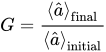
The gain   G   {\displaystyle ~G~} {\displaystyle ~G~} is defined as follows:

G = ⟨ a ^ ⟩ f i n a l ⟨ a ^ ⟩ i n i t i a l {\displaystyle G={\frac {\left\langle {\hat {a}}\right\rangle _{\rm {final}}}{\left\langle {\hat {a}}\right\rangle _{\rm {initial}}}}} {\displaystyle G={\frac {\left\langle {\hat {a}}\right\rangle _{\rm {final}}}{\left\langle {\hat {a}}\right\rangle _{\rm {initial}}}}}

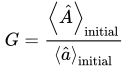
The can be written also in the Heisenberg representation; the changes are attributed to the amplification of the field operator. Thus, the evolution of the operator A is given by   A ^ = U ^ † a ^ U ^   {\displaystyle ~{\hat {A}}={\hat {U}}^{\dagger }{\hat {a}}{\hat {U}}~} {\displaystyle ~{\hat {A}}={\hat {U}}^{\dagger }{\hat {a}}{\hat {U}}~}, while the state vector remains unchanged. The gain is given by

  G = ⟨ A ^ ⟩ i n i t i a l ⟨ a ^ ⟩ i n i t i a l   {\displaystyle ~G={\frac {\left\langle {\hat {A}}\right\rangle _{\rm {initial}}}{\left\langle {\hat {a}}\right\rangle _{\rm {initial}}}}~} {\displaystyle ~G={\frac {\left\langle {\hat {A}}\right\rangle _{\rm {initial}}}{\left\langle {\hat {a}}\right\rangle _{\rm {initial}}}}~}

In general, the gain   G   {\displaystyle ~G~} {\displaystyle ~G~} may be complex, and it may depend on the initial state. For laser applications, the amplification of coherent states is important. Therefore, it is usually assumed that the initial state is a coherent state characterized by a complex-valued initial parameter   α   {\displaystyle ~\alpha ~} {\displaystyle ~\alpha ~} such that     | i n i t i a l ⟩ = | α ⟩   {\displaystyle ~~|{\rm {initial}}\rangle =|\alpha \rangle ~} {\displaystyle ~~|{\rm {initial}}\rangle =|\alpha \rangle ~}. Even with such a restriction, the gain may depend on the amplitude or phase of the initial field.


In the following, the Heisenberg representation is used; all brackets are assumed to be evaluated with respect to the initial coherent state.

n o i s e = ⟨ A ^ † A ^ ⟩ − ⟨ A ^ † ⟩ ⟨ A ^ ⟩ − ( ⟨ a ^ † a ^ ⟩ − ⟨ a ^ † ⟩ ⟨ a ^ ⟩ ) {\displaystyle {\rm {noise}}=\langle {\hat {A}}^{\dagger }{\hat {A}}\rangle -\langle {\hat {A}}^{\dagger }\rangle \langle {\hat {A}}\rangle -\left(\langle {\hat {a}}^{\dagger }{\hat {a}}\rangle -\langle {\hat {a}}^{\dagger }\rangle \langle {\hat {a}}\rangle \right)} {\displaystyle {\rm {noise}}=\langle {\hat {A}}^{\dagger }{\hat {A}}\rangle -\langle {\hat {A}}^{\dagger }\rangle \langle {\hat {A}}\rangle -\left(\langle {\hat {a}}^{\dagger }{\hat {a}}\rangle -\langle {\hat {a}}^{\dagger }\rangle \langle {\hat {a}}\rangle \right)}

The expectation values are assumed to be evaluated with respect to the initial coherent state. This quantity characterizes the increase of the uncertainty of the field due to amplification. As the uncertainty of the field operator does not depend on its parameter, the quantity above shows how much output field differs from a coherent state.

Linear phase-invariant amplifiers

[edit]

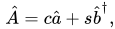
Linear phase-invariant (also known as phase-insensitive or phase preserving[1]) amplifiers may be described as follows. Assume that the unitary operator   U ^   {\displaystyle ~{\hat {U}}~} {\displaystyle ~{\hat {U}}~} amplifies in such a way that the input   a ^   {\displaystyle ~{\hat {a}}~} {\displaystyle ~{\hat {a}}~} and the output   A ^ = U ^ † a ^ U ^   {\displaystyle ~{\hat {A}}={\hat {U}}^{\dagger }{\hat {a}}{\hat {U}}~} {\displaystyle ~{\hat {A}}={\hat {U}}^{\dagger }{\hat {a}}{\hat {U}}~} are related by a linear equation

  A ^ = c a ^ + s b ^ † , {\displaystyle ~{\hat {A}}=c{\hat {a}}+s{\hat {b}}^{\dagger },} {\displaystyle ~{\hat {A}}=c{\hat {a}}+s{\hat {b}}^{\dagger },}

where   c   {\displaystyle ~c~} {\displaystyle ~c~} and   s   {\displaystyle ~s~} {\displaystyle ~s~} are c-numbers and   b ^ †   {\displaystyle ~{\hat {b}}^{\dagger }~} {\displaystyle ~{\hat {b}}^{\dagger }~} is a creation operator characterizing the amplifier. Without loss of generality, it may be assumed that   c   {\displaystyle ~c~} {\displaystyle ~c~} and   s   {\displaystyle ~s~} {\displaystyle ~s~} are real. The commutator of the field operators is invariant under unitary transformation   U ^   {\displaystyle ~{\hat {U}}~} {\displaystyle ~{\hat {U}}~}:

A ^ A ^ † − A ^ † A ^ = a ^ a ^ † − a ^ † a ^ = 1 {\displaystyle {\hat {A}}{\hat {A}}^{\dagger }-{\hat {A}}^{\dagger }{\hat {A}}={\hat {a}}{\hat {a}}^{\dagger }-{\hat {a}}^{\dagger }{\hat {a}}=1} {\displaystyle {\hat {A}}{\hat {A}}^{\dagger }-{\hat {A}}^{\dagger }{\hat {A}}={\hat {a}}{\hat {a}}^{\dagger }-{\hat {a}}^{\dagger }{\hat {a}}=1}

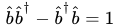
From the unitarity of   U ^   {\displaystyle ~{\hat {U}}~} {\displaystyle ~{\hat {U}}~}, it follows that   b ^   {\displaystyle ~{\hat {b}}~} {\displaystyle ~{\hat {b}}~} satisfies the canonical commutation relations for operators with Bose statistics:

  b ^ b ^ † − b ^ † b ^ = 1   {\displaystyle ~{\hat {b}}{\hat {b}}^{\dagger }-{\hat {b}}^{\dagger }{\hat {b}}=1~} {\displaystyle ~{\hat {b}}{\hat {b}}^{\dagger }-{\hat {b}}^{\dagger }{\hat {b}}=1~}

The c-numbers are then[2]

  c 2 − s 2 = 1   {\displaystyle ~c^{2}\!-\!s^{2}=1~} {\displaystyle ~c^{2}\!-\!s^{2}=1~}

Hence, the phase-invariant amplifier acts by introducing an additional bosonic mode. The gain and added noise of this amplifier are

    G = c     {\displaystyle ~~G\!=\!c~~} {\displaystyle ~~G\!=\!c~~}

and

    a d d e d   n o i s e = c 2 − 1. {\displaystyle ~~{\rm {added~noise}}=c^{2}\!-\!1.} {\displaystyle ~~{\rm {added~noise}}=c^{2}\!-\!1.}

The coefficient     g = | G | 2     {\displaystyle ~~g\!=\!|G|^{2}~~} {\displaystyle ~~g\!=\!|G|^{2}~~} is sometimes called the intensity amplification coefficient. The noise of the linear phase-invariant amplifier is given by g − 1 {\displaystyle g-1} {\displaystyle g-1}. The gain can be dropped by splitting the beam; the estimate above gives the minimal possible noise of the linear phase-invariant amplifier.

The linear amplifier has an advantage over the multi-mode amplifier: if several modes of a linear amplifier are amplified by the same factor, the noise in each mode is determined independently;that is, modes in a linear quantum amplifier are independent.

To obtain a large amplification coefficient with minimal noise, one may use homodyne detection, constructing a field state with known amplitude and phase, corresponding to the linear phase-invariant amplifier.[3] The uncertainty principle sets the lower bound of quantum noise in an amplifier. In particular, the output of a laser system and the output of an optical generator are not coherent states.

Nonlinear amplifiers

[edit]

Nonlinear amplifiers do not have a linear relation between their input and output. The maximum noise of a nonlinear amplifier cannot be much smaller than that of an idealized linear amplifier.[2] This limit is determined by the derivatives of the mapping function; a larger derivative implies an amplifier with greater uncertainty.[4] Examples include most lasers, which include near-linear amplifiers, operating close to their threshold and thus exhibiting large uncertainty and nonlinear operation. As with the linear amplifiers, they may preserve the phase and keep the uncertainty low, but there are exceptions. These include parametric oscillators, which amplify while shifting the phase of the input.

References

[edit]
  1. ^ Clerk, A. A.; Devoret, M. H.; Girvin, S. M.; Marquardt, Florian; Schoelkopf, R. J. (15 April 2010). "Introduction to Quantum Noise, Measurement and Amplification". Reviews of Modern Physics. 82 (2): 1155–1208. arXiv:0810.4729. Bibcode:2010RvMP...82.1155C. doi:10.1103/RevModPhys.82.1155.
  2. ^ a b D. Kouznetsov; D. Rohrlich; R.Ortega (1995). "Quantum limit of noise of a phase-invariant amplifier". Physical Review A. 52 (2): 1665–1669. arXiv:cond-mat/9407011. Bibcode:1995PhRvA..52.1665K. doi:10.1103/PhysRevA.52.1665. PMID 9912406. S2CID 19495906.
  3. ^ Vincent Josse; Metin Sabuncu; Nicolas J. Cerf; Gerd Leuchs; Ulrik L. Andersen (2007). "Universal Optical Amplification without Nonlinearity". Physical Review Letters. 96 (16) 163602. arXiv:quant-ph/0603119. Bibcode:2006PhRvL..96p3602J. doi:10.1103/PhysRevLett.96.163602. PMID 16712228. S2CID 7706450.
  4. ^ D. Kouznetsov; D. Rohrlich (1997). "Quantum noise in the mapping of phase space". Optics and Spectroscopy. 82 (6): 909–913. Bibcode:1997OptSp..82..909K. Archived from the original on 2016-03-03. Retrieved 2007-12-28.

Further reading

[edit]
  • Kim M. S., Lee K. S., Bužek V. (1993). "Amplification of superposition states in phase-sensitive amplifiers". Phys. Rev. A. 47 (5): 4302–4307. Bibcode:1993PhRvA..47.4302K. doi:10.1103/PhysRevA.47.4302. PMID 9909437.{{cite journal}}: CS1 maint: multiple names: authors list (link)
  • Bondurant R. S. (1993). "Quantum noise properties of a nonlinear amplifier". Phys. Rev. Lett. 71 (11): 1709–1711. Bibcode:1993PhRvL..71.1709B. doi:10.1103/PhysRevLett.71.1709. PMID 10054478.
  • Mu Yi, Savage C. M. (1994). "Phase-sensitive above-threshold laser amplifiers". Phys. Rev. A. 49 (5): 4093–4100. Bibcode:1994PhRvA..49.4093M. doi:10.1103/PhysRevA.49.4093. PMID 9910709.
  • Vaccaro John A., Pegg D. T. (1994). "Phase properties of optical linear amplifiers". Phys. Rev. A. 49 (6): 4985–4995. Bibcode:1994PhRvA..49.4985V. doi:10.1103/PhysRevA.49.4985. PMID 9910820.
  • Loudon Rodney, Jedrkiewicz Ottavia, Barnett Stephen M., Jeffers John (2003). "Quantum limits on noise in dual input-output linear optical amplifiers and attenuators". Phys. Rev. A. 67 (1): 043803. arXiv:quant-ph/0212012. Bibcode:2003PhRvA..67a3803K. doi:10.1103/PhysRevA.67.013803. S2CID 5334606.{{cite journal}}: CS1 maint: multiple names: authors list (link)
  • Lamprecht C., Ritsch H. (2003). "Theory of excess noise in unstable resonator lasers". Phys. Rev. A. 67 (1) 013805. arXiv:quant-ph/0203122. Bibcode:2003PhRvA..67a3805V. doi:10.1103/PhysRevA.67.013805. S2CID 119102253.
  • v
  • t
  • e
Quantum mechanics
Background
  • Introduction
  • History
    • Timeline
  • Classical mechanics
  • Old quantum theory
  • Glossary
Fundamentals
  • Born rule
  • Bra–ket notation
  • Complementarity
  • Density matrix
  • Energy level
    • Ground state
    • Excited state
    • Degenerate levels
    • Zero-point energy
  • Entanglement
  • Hamiltonian
  • Interference
  • Decoherence
  • Measurement
  • Nonlocality
  • Quantum state
    • quantum jump
  • Superposition
  • Tunnelling
  • Scattering theory
  • Symmetry in quantum mechanics
  • Uncertainty
  • Wave function
    • Collapse
    • Wave–particle duality
Formulations
  • Formulations
  • Heisenberg
  • Interaction
  • Matrix mechanics
  • Schrödinger
  • Path integral formulation
  • Phase space
Equations
  • Klein–Gordon
  • Dirac
  • Weyl
  • Majorana
  • Rarita–Schwinger
  • Pauli
  • Rydberg
  • Schrödinger
Interpretations
  • Bayesian
  • Consciousness causes collapse
  • Consistent histories
  • Copenhagen
  • de Broglie–Bohm
  • Ensemble
  • Hidden-variable
    • Local
      • Superdeterminism
  • Many-worlds
  • Objective collapse
  • Quantum logic
  • Relational
  • Transactional
Experiments
  • Bell test
  • Davisson–Germer
  • Delayed-choice quantum eraser
  • Double-slit
  • Franck–Hertz
  • Mach–Zehnder interferometer
  • Elitzur–Vaidman
  • Popper
  • Quantum eraser
  • Stern–Gerlach
  • Wheeler's delayed choice
Science
  • Quantum biology
  • Quantum chemistry
  • Quantum chaos
  • Quantum cosmology
  • Quantum differential calculus
  • Quantum dynamics
  • Quantum geometry
  • Quantum measurement problem
  • Quantum mind
  • Quantum stochastic calculus
  • Quantum spacetime
Technology
  • Quantum algorithms
  • Quantum amplifier
  • Quantum bus
  • Quantum cellular automata
    • Quantum finite automata
  • Quantum channel
  • Quantum circuit
  • Quantum complexity theory
  • Quantum computing
    • Timeline
  • Quantum cryptography
  • Quantum electronics
  • Quantum error correction
  • Quantum imaging
  • Quantum image processing
  • Quantum information
  • Quantum key distribution
  • Quantum logic
  • Quantum logic gates
  • Quantum machine
  • Quantum machine learning
  • Quantum metamaterial
  • Quantum metrology
  • Quantum network
  • Quantum neural network
  • Quantum optics
  • Quantum programming
  • Quantum sensing
  • Quantum simulator
  • Quantum teleportation
Extensions
  • Quantum fluctuation
  • Casimir effect
  • Quantum statistical mechanics
  • Quantum field theory
    • History
  • Quantum gravity
  • Relativistic quantum mechanics
Related
  • Schrödinger's cat
    • in popular culture
  • Wigner's friend
  • EPR paradox
  • Quantum mysticism
  • Category
  • v
  • t
  • e
Emerging technologies
Fields
Quantum
  • algorithms
  • amplifier
  • bus
  • cellular automata
  • channel
  • circuit
  • complexity theory
  • computing
  • cryptography
    • post-quantum
  • dynamics
  • electronics
  • error correction
  • finite automata
  • image processing
  • imaging
  • information
  • key distribution
  • logic
  • logic clock
  • logic gate
  • machine
  • machine learning
  • metamaterial
  • network
  • neural network
  • optics
  • programming
  • sensing
  • simulator
  • teleportation
Other
  • Acoustic levitation
  • Anti-gravity
  • Cloak of invisibility
  • Digital scent technology
  • Force field
    • Plasma window
  • Immersive virtual reality
  • Magnetic refrigeration
  • Phased-array optics
  • Thermoacoustic heat engine
  • List
Retrieved from "https://teknopedia.ac.id/w/index.php?title=Quantum_amplifier&oldid=1314679617"
Categories:
  • Quantum optics
  • Amplifiers
Hidden categories:
  • Articles with short description
  • Short description matches Wikidata
  • All articles with unsourced statements
  • Articles with unsourced statements from June 2025
  • Wikipedia articles needing clarification from April 2015
  • Wikipedia articles needing clarification from June 2025
  • CS1 maint: multiple names: authors list

  • indonesia
  • Polski
  • العربية
  • Deutsch
  • English
  • Español
  • Français
  • Italiano
  • مصرى
  • Nederlands
  • 日本語
  • Português
  • Sinugboanong Binisaya
  • Svenska
  • Українська
  • Tiếng Việt
  • Winaray
  • 中文
  • Русский
Sunting pranala
url url url url url url url url url url url url url url url url url url url url url url url url url url url url url url url url url url url url url url url url url url url url url url url url url url url url url url url url url url url url url url url url url url url url url url url url url url url url url url url url url url url url url url url url url url url url url url url url url url url url url url url url url url url url url url url url url url url url url url url url url url url url url url url url url url url url url url url url url url url url url url url url url url url url url url url url url url url url url url url url url url url url url url url url url url url url url url url url url url url url url url url url url url url url url url url url url url url url url url url url url url url url url url url url url url url url url url url url url url url url url url url url url url url url url url url url url url url url url url url url url url url url url url url url url url url url url url url url url url url url url url url url url url url url url url url url url url url url url url url url url url url url url url url url url url url url url url url url url url url url url url url url url url url url url url url url url url url url url url url url url url url url url url url url url url url url url url url url url url url url url url url url url url url url url url url url url url url url url url url url url url url url url url url url url url url url url url url url url url url url url url url url url url url url url url url url url url url url url url url url url url url url url url url url url url url url url url url url url url url url url url url url url url url url url url url url url url url url url url url url url url url url url url url url url url url url url url url url url url url url url url url url url url url url url url url url url url url url url url url url url url url url url url url url url url url url url url url url url url url url url url url url url url url url url url url url url url url url url url url url url url url url url url url url url url url url url url url url url url url url url url url url url url url url url url url url url url url url url url url url url url url url url url url url url url url url url url url url url url url url url url url url url url url url url url url url url url url url url url url url url url url url url url url url url url url url url url url url url url url url url url url url url url url url url url url url url url url url url url url url url url url url url url url url url url url url url url url url url url url url url url url url url url url url url url url url url url url url url url url url url url url url url url url url url url url url url url url url url url url url url url url url url url url url url url url url url url url url url url url url url url url url url url url url url url url url url url url url url url url url url url url url url url url url url url url url url url url url url url url url url url url url url url url url url url url url url url url url url url url url url url url url url url url url url url url url url url url url url url url url url url url url url url url url url url url url url url url url url url url url url url url url url url url url url url url url url url url url url url url url url url url url url url url url url url url url url url url url url url url url url url url url url url url url url url url url url url url url url url url url url url url url url url url url url url url url url url url url url url url url url url url url url url url url url url url url url url url url url url url url url url url url url url url url url url url url url url url url url url url url url url url url url url url url url url url url url url url url url url url url url url url url url url url url url url url url url url url url url url url url url url url url url url url url url url url url url url url url url url url url url url url url url url url url url url url url url url url url url url url url url url url url url url url url url url url url url url url url url url url url url url url url url url url url url url url url url url url url url url url url url url url url url url url url url url url url url url url url url url url url url url url url url url url url url url url url url url url url url url url url url url url url url url url url url url url url url url url url url url url url url url url url url url url url url url url url url url url url url url url url url url url url url url url url url url url url url url url url url url url url url url url url url url url url url url url url url url url url url url url url url url url url url url url url url url url url url url url url url url url url url url url url url url url url url url url url url url url url url url url url url url url url url url url url url url url url url url url url url url url url url url url url url url url url url url url url url url url url url url url url url url url url url url url url url url url url url url url url url url url url url url url url url url url url url url url url url url url url url url url url url url url url url url url url url url url url url url url url url url url url url url url url url url url url url url url url url url url url url url url url url url url url url url url url url url url url url url url url url url url url url url url url url url url url url url url url url url url url url url url url url url url url url url url url url url url url url url url url url url url url url url url url url url url url url url url url url url url url url url url url url url url url url url url url url url url url url url url url url url url url url url url url url url url url url url url url url url url url url url url url url url url url url url url url url url url url url url url url url url url url url url url url url url url url url url url url url url url url url url url url url url url url url url url url url url url url url url url url url url url url url url url url url url url url url url url url url url url url url url url url url url url url url url url url url url url url url url url url url url url url url url url url url url url url url url url url url url url url url url url url url url url url url url url url url url url url url url url url url url url url url url url url url url url url url url url url url url url url url url url url url url url url url url url url url url url url url url url url url url url url url url url url url url url url url url url url url url url url url url url url url url url url url url url url url url url url url url url url url url url url url url url url url url url url url url url url url url url url url url url url url url url url url url url url url url url url url url url url url url url url url url url url url url url url url url url url url url url url url url url url url url url url url url url url url url url url url url url url url url url url url url url url url url url url url url url url url url url url url url url url url url url url url url url url url url url url url url url url url url url url url url url url url url url url url url url url url url url url url url url url url url url url url url url url url url url url url url url url url url url url url url url url url url url url url url url url url url url url url url url url url url url url url url url url url url url url url url url url url url url url url url url url url url url url url url url url url url url url url url url url url url url url url url url url url url url url url url url url url url url url url url url url url url url url url url url url url url url url url url url url url url url url url url url url url url url url url url url url url url url url url url url url url url url url url url url url url url url url url url url url url url url url url url url url url url url url url url url url url url url url url url url url url url url url url url url url url url url url url url url url url url url url url url url url url url url url url url url url url url url url url url url url url url url url url url url url url url url url url url url url url url url url url url url url url url url url url url url url url url url url url url url url url url url url url url url url url url url url url url url url url url url url url url url url url url url url url url url url url url url url url url url url url url url url url url url url url url url url url url url url url url url url url url url url url url url url url url url url url url url url url url url url url url url url url url url url url url url url url url url url url url url url url url url url url url url url url url url url url url url url url url url url url url url url url url url url url url url url url url url url url url url url url url url url url url url url url url url url url url url url url url url url url url url url url url url url url url url url url url url url url url url url url url url url url url url url url url url url url url url url url url url url url url url url url url url url url url url url url url url url url url url url url url url url url url url url url url url url url url url url url url url url url url url url url url url url url url url url url url url url url url url url url url url url url url url url url url url url url url url url url url url url url url url url url url url url url url url url url url url url url url url url url url url url url url url url url url url url url url url url url url url url url url url url url url url url url url url url url url url url url url url url
Pusat Layanan

UNIVERSITAS TEKNOKRAT INDONESIA | ASEAN's Best Private University
Jl. ZA. Pagar Alam No.9 -11, Labuhan Ratu, Kec. Kedaton, Kota Bandar Lampung, Lampung 35132
Phone: (0721) 702022
Email: pmb@teknokrat.ac.id