

Quetta
| |
|---|---|
 Flag  Emblem | |
| Nickname: Fruit Garden of Pakistan | |
  Quetta  Quetta | |
| Coordinates: 30°11′45″N 67°01′02″E / 30.1958°N 67.0172°E | |
| Country |  Pakistan Pakistan |
| Province |  Balochistan Balochistan |
| Division | Quetta |
| District | Quetta |
| Settled | 1876 |
| Government | |
| • Type | Municipal Corporation[1] |
| • Mayor | Seat Vacant |
| • Deputy Mayor | Seat Vacant |
| • Commissioner | Shahzaib Khan Kakar[2] |
| • Deputy Commissioner | Mehrullah Badini[2] |
| Area | |
• City | 3,501 km2 (1,352 sq mi) |
| • Metro | 3,501 km2 (1,352 sq mi) |
| Elevation | 1,680 m (5,510 ft) |
| Population | |
• City | 1,565,546 |
| • Rank | 9th in Pakistan; 1st in Balochistan |
| • Density | 447.2/km2 (1,158/sq mi) |
| • Demonym | Quettan or Quettawal (kʰwətə.wal) |
| Time zone | UTC+05:00 (PKT) |
| Postal code | 87300 |
| Dialing code | 081 |
| Website | www |


Quetta[a] is the capital and largest city of the Pakistani province of Balochistan. The city developed in the Quetta Valley, a region historically inhabited by Pashtun tribes such as the Kasi, and formed part of the broader Pashtun cultural and tribal sphere linking southern Afghanistan with northern Balochistan prior to its expansion under British colonial rule.[4]It is the ninth largest city in Pakistan, with an estimated population of over 1.7 million in 2024.[5] It is situated in the south-west of the country, lying in a valley surrounded by mountains on all sides. Quetta is at an average elevation of 1,680 metres (5,510 feet) above sea level,[6] making it Pakistan's highest-altitude major city. The city is sometimes referred to as the "Fruit Garden of Pakistan" because of its numerous fruit orchards and the variety of fresh and dried fruits produced in the region.[7]
Located in northern Balochistan near the Pakistan-Afghanistan border and the road across to Kandahar, Quetta is a trade and communication centre between the two countries.[8] The city is near the Bolan Pass, which was on a major gateway from Central Asia to South Asia.
Etymology
The name Quetta is a variation of the Pashto word Kwatkōṭ, or kōta meaning "fortress".[9] Quetta was formerly known as Shalkot (Pashto: ښالکوټ, Urdu: شالکوٹ).[10]
History
Early history and etymology
The name Quetta is derived from the Pashto word کوټه (kwatta), meaning "fort", a reference to the naturally defensible character of the valley and to the historic mud-walled citadel known as the Miri Fort, which dominated the early settlement.[11]
The earliest recorded historical reference to the region dates to the 11th century, when the Quetta valley was captured by Mahmud of Ghazni during his campaigns in eastern Afghanistan and the north-western Indian subcontinent.[12]
In 1543, the Mughal emperor Humayun passed through the Quetta region while fleeing to Safavid Iran following his defeat by Sher Shah Suri.[12]
Pashtun tribal settlement and landholding
Historically, the Quetta valley traditionally known as Shal formed part of the ancestral territory of Pashtun tribes, most prominently the Kasi (or Kansi), a Sarbani Pashtun group established as the principal cultivators and proprietary landholders of the valley.[13]
According to the Gazetteer of the Quetta–Pishin District, the Kasi were recognised as the original owners of the Shal valley, holding agricultural land, grazing grounds, and irrigation systems (karez) under customary tribal tenure regulated by local practice and Islamic law.[14]
A formal sanad issued by Nasir Khan I of Kalat in the mid-18th century confirmed the proprietary rights of the Kasi chiefs (arbabs) over the Shal valley, defining its boundaries and affirming their control over land and water resources. Certain Kasi families held hereditary and revenue-free grants, which continued to be recognised under later administrations.[15]
By the early modern period, other Pashtun tribes—including the Achakzai, Kakar and Tareen—occupied surrounding uplands and valleys, while the Shal valley itself remained primarily under Kasi ownership and cultivation.[14]
Afghan and Durrani period
In 1709, the Quetta region came under the authority of the Afghan Hotak dynasty. Following the establishment of the Durrani Empire in 1747, Ahmad Shah Durrani incorporated Quetta into the Afghan state. Administrative authority and revenue rights were later granted to Nasir Khan I of Kalat in recognition of Baloch military assistance during Durrani campaigns; however, indigenous Pashtun landholding structures—particularly those of the Kasi—remained intact.[16]
Large tracts of land later classified under British administration as Timur Shahi lands were originally acquired by Afghan rulers through confiscation following disputes over revenue assessments. These lands were reassessed during colonial settlement operations.[17]
British era
The first recorded European visitor to Quetta was the British traveller Charles Masson, who described the settlement in 1828 as a "mud-walled fort surrounded by three hundred mud houses."[18]
During the Second Anglo-Afghan War, British forces occupied Quetta, and in 1883 formal control was established through a lease arrangement with the Khan of Kalat. The British subsequently expanded Quetta as a cantonment and civil station, acquiring land largely through purchase for military and administrative purposes.[19]
Colonial settlement records indicate that indigenous Pashtun tribes—particularly the Kasi and Achakzai—remained the principal proprietors of agricultural land and irrigation systems in and around Quetta. Transfers of agricultural land occurred overwhelmingly between local cultivators, while sales to non-agriculturists were legally restricted and generally confined to small urban plots.[20]
Detailed records further note that Achakzai and Kasi families retained hereditary and, in some cases, revenue-free shares in karez lands, with tribal leaders formally recognised as head proprietors by the colonial administration.[21]
Modern period
Rapid urban growth in the late 19th and early 20th centuries led to a sharp rise in land values and increased litigation over immovable property, particularly within the town and cantonment areas. Contemporary records indicate that most such disputes involved recent settlers, traders, and government employees rather than indigenous landholding tribes.[22]
Quetta was almost entirely destroyed by the 1935 Quetta earthquake, resulting in widespread devastation and loss of life. The city was subsequently rebuilt under British administration. Following the creation of Pakistan in 1947, Quetta became the provincial capital of Balochistan.[12]
Pashtun tribal rule and Durrani Empire
Historically, the Quetta valley (traditionally known as Shal) was the ancestral domain of the Kasi (or Kansi) tribe, a branch of the Sarbani Pashtun confederation.[23]
In 1709, the region became part of the Afghan Hotak dynasty. By 1747, Ahmad Shah Durrani incorporated it into the Durrani Empire. Durrani later granted the administration and revenue of Quetta to Nasir Khan I, the Khan of Kalat, in recognition of Baloch military assistance during the Durrani campaigns in India, though the region maintained its predominantly Pashtun tribal character.[24]
British era and modern period
The first European to visit Quetta, British explorer Charles Masson, described it in 1828 as a "mud-walled fort surrounded by three hundred mud houses."[25]
During the Second Anglo-Afghan War, the British occupied the city, formalizing their control via a lease agreement with the Khan of Kalat in 1883. Despite the influx of colonial administrators, British census records from 1901 confirm that the Kasi Pashtuns remained the principal indigenous landholders of the district.[26]
British occupation and cantonment development

Although Quetta had long existed as an indigenous Pashtun settlement in the Shal valley, its transformation into a modern urban centre occurred during the British period. Owing to its strategic position on the north-western frontier and its proximity to routes leading towards Afghanistan, British officials identified Quetta as a key military and administrative site in the mid-19th century.[27]
In 1856, General John Jacob urged the British government to occupy Quetta for frontier defence purposes. During the Second Anglo-Afghan War, British forces took military control of the area, and in 1883 a formal lease arrangement was concluded with the Khan of Kalat, bringing Quetta under effective British administration.[28]
Under British rule, Quetta was developed as a cantonment and civil station. Land required for military, railway, and administrative purposes was largely acquired through purchase from local proprietors rather than wholesale confiscation. Colonial settlement records indicate that indigenous Pashtun tribes—particularly the Kasi and Achakzai—retained ownership of most agricultural land and irrigation systems surrounding the town, while urban expansion was concentrated within the cantonment and civil areas.[28]
The establishment of British administration marked the beginning of sustained urban growth, with new infrastructure, roads, and public buildings constructed to serve both military and civilian needs. Quetta subsequently emerged as the principal administrative centre of northern Balochistan during the late colonial period.[29]
20th century and modern period
Quetta was almost completely destroyed by the 1935 Quetta earthquake, one of the deadliest earthquakes in South Asian history, which resulted in extensive loss of life and the destruction of much of the built environment. The city was subsequently rebuilt under British supervision with revised town planning and building regulations.[30]
Following the creation of Pakistan in 1947, Quetta became the provincial capital of Balochistan, a role it continues to serve in the contemporary period.[12]
Climate
Quetta has a cold semi-arid climate (Köppen BSk) with a significant variation between summer and winter temperatures.Summer typically begins in late May and lasts until early September, with average temperatures ranging from 24 to 26 °C (75 to 79 °F). The highest temperature recorded in Quetta is 42 °C (108 °F), which occurred on 10 July 1998. [31] Autumn starts in mid-September and continues until mid-November with average temperatures in the 12–18 °C (54–64 °F) range. Winter starts in late November and ends in late February with average temperatures near 4–5 °C (39–41 °F). The lowest temperature in Quetta is −18.3 °C (−0.9 °F) which was recorded on 8 January 1970.[31] Spring starts in early March and ends in mid-May with average temperatures close to 15 °C (59 °F). Unlike more easterly parts of Pakistan, Quetta does not have a monsoon season of heavy rainfall. Highest rainfall during 24 hours in Quetta is 113 millimetres (4.4 in) which was recorded on 17 December 2000,[31] Highest monthly rainfall of 232.4 millimetres (9.15 in) was recorded in March 1982 which was also the year of the highest annual rainfall, 949.8 millimetres (37.39 in).[31] In the winter, snowfall has become quite erratic (December, January and February).
| Climate data for Quetta (1991-2020) | |||||||||||||
|---|---|---|---|---|---|---|---|---|---|---|---|---|---|
| Month | Jan | Feb | Mar | Apr | May | Jun | Jul | Aug | Sep | Oct | Nov | Dec | Year |
| Record high °C (°F) | 23.6 (74.5) |
26.7 (80.1) |
31.5 (88.7) |
35.4 (95.7) |
39.4 (102.9) |
41.5 (106.7) |
42.0 (107.6) |
40.6 (105.1) |
38.3 (100.9) |
34.0 (93.2) |
36.0 (96.8) |
25.0 (77.0) |
42.0 (107.6) |
| Mean daily maximum °C (°F) | 11.8 (53.2) |
14.0 (57.2) |
19.5 (67.1) |
25.9 (78.6) |
31.4 (88.5) |
35.5 (95.9) |
36.8 (98.2) |
35.4 (95.7) |
31.9 (89.4) |
26.0 (78.8) |
19.6 (67.3) |
14.6 (58.3) |
25.2 (77.4) |
| Daily mean °C (°F) | 4.8 (40.6) |
7.1 (44.8) |
12.5 (54.5) |
17.9 (64.2) |
23.0 (73.4) |
27.3 (81.1) |
29.2 (84.6) |
27.5 (81.5) |
22.8 (73.0) |
16.5 (61.7) |
11.0 (51.8) |
6.5 (43.7) |
17.2 (62.9) |
| Mean daily minimum °C (°F) | −1.9 (28.6) |
0.3 (32.5) |
5.1 (41.2) |
10.0 (50.0) |
14.6 (58.3) |
19.0 (66.2) |
21.6 (70.9) |
19.7 (67.5) |
13.6 (56.5) |
7.0 (44.6) |
1.9 (35.4) |
−1.4 (29.5) |
9.1 (48.4) |
| Record low °C (°F) | −18.3 (−0.9) |
−16.7 (1.9) |
−8.3 (17.1) |
−3.9 (25.0) |
−0.3 (31.5) |
5.0 (41.0) |
8.9 (48.0) |
3.3 (37.9) |
−0.6 (30.9) |
−8.3 (17.1) |
−13.3 (8.1) |
−18.3 (−0.9) |
−18.3 (−0.9) |
| Average precipitation mm (inches) | 55.0 (2.17) |
58.4 (2.30) |
49.5 (1.95) |
40.0 (1.57) |
17.8 (0.70) |
3.2 (0.13) |
8.8 (0.35) |
4.9 (0.19) |
4.2 (0.17) |
4.5 (0.18) |
19.3 (0.76) |
34.6 (1.36) |
300.2 (11.83) |
| Average snowfall cm (inches) | 22 (8.7) |
17 (6.6) |
3.0 (1.2) |
0 (0) |
0 (0) |
0 (0) |
0 (0) |
0 (0) |
0 (0) |
0 (0) |
0.51 (0.2) |
14 (5.4) |
56.51 (22.1) |
| Average precipitation days (≥ 1.0 mm) | 5.0 | 5.7 | 5.4 | 4.1 | 1.7 | 0.7 | 0.8 | 0.8 | 0.4 | 0.6 | 1.7 | 2.7 | 29.6 |
| Average relative humidity (%) | 63 | 59 | 54 | 50 | 43 | 36 | 43 | 42 | 39 | 40 | 47 | 56 | 48 |
| Mean monthly sunshine hours | 220.1 | 209.0 | 232.5 | 273.0 | 334.8 | 327.0 | 313.1 | 313.1 | 294.0 | 306.9 | 279.0 | 238.7 | 3,341.2 |
| Mean daily sunshine hours | 7.1 | 7.4 | 7.5 | 9.1 | 10.8 | 10.9 | 10.1 | 10.1 | 9.8 | 9.9 | 9.3 | 7.7 | 9.1 |
| Source 1: NOAA,[32] Hong Kong Observatory (altitude: 1589 m) (only snow inch, sun)[33] | |||||||||||||
| Source 2: PMD,[34] Deutscher Wetterdienst (humidity 1951-1967)[35] | |||||||||||||
The city saw a severe drought from 1999 to 2001 during which the city did not receive snowfall and below normal rains. In 2002, the city received snow after a gap of five years. In 2004 and 2005, the city received normal rains after three years without snowfall while in 2006, 2007 and 2009 the city received no snow. In 2008, it received a snowfall of 10 centimetres (4 in) in four hours on 29 January,[36] followed on 2 February by 25.4 centimetres (10 in) in 10 hours[37] – the city's heaviest snowfall in a decade. During the winter of 2010, it received no snow and saw below normal rains due to the presence of El-Nino over Pakistan.[citation needed]
Demographics
| Year | Pop. | ±% |
|---|---|---|
| 1941 | 65,000 | — |
| 1951 | 84,000 | +29.2% |
| 1961 | 107,000 | +27.4% |
| 1972 | 158,000 | +47.7% |
| 1981 | 286,000 | +81.0% |
| 1998 | 565,137 | +97.6% |
| 2017 | 1,001,205 | +77.2% |
| 2023 | 1,565,546 | +56.4% |
| Source: [38][3] | ||
According to the 2023 Census of Pakistan, the population of the city was a total of 1,565,546.[39] This makes it the largest city in Balochistan province and one of the major cities of Pakistan. Quetta is one of the most ethnically diverse cities in the country.[40] The city has a Pashtun plurality followed by Balochs, Hazaras, Brahui, Sindhis, Saraikis, Punjabis and Urdu-speaking.[41][42] Urdu being the national language is used and understood by all the residents and serves as a lingua franca.
Languages
According to Reuters and the BBC, there are as many as 500,000-600,000 Hazaras living in Quetta and its surrounding areas.[43][44]
| Religious group |
1891[46] | 1941[45] | 2017[47][48] | 2023[49] | ||||
|---|---|---|---|---|---|---|---|---|
| Pop. | % | Pop. | % | Pop. | % | Pop. | % | |
Hinduism 
|
7,180 | 42.32% | 24,010 | 37.24% | 6,112 | 0.61% | 5,366 | 0.42% |
Islam 
|
6,281 | 37.02% | 27,935 | 43.33% | 975,815 | 97.64% | 1,264,791 | 97.9% |
Christianity 
|
2,650 | 15.62% | 5,024 | 7.79% | 16,842 | 1.69% | 20,897 | 1.62% |
Sikhism 
|
807 | 4.76% | 7,364 | 11.42% | N/a | N/a | 123 | 0.01% |
Zoroastrianism 
|
31 | 0.18% | 73 | 0.11% | N/a | N/a | 46 | 0% |
Judaism 
|
16 | 0.09% | 11 | 0.02% | N/a | N/a | N/a | N/a |
Buddhism .svg)
|
0 | 0% | 42 | 0.07% | N/a | N/a | N/a | N/a |
Jainism 
|
0 | 0% | 6 | 0.01% | N/a | N/a | N/a | N/a |
| Tribal | 0 | 0% | 0 | 0% | N/a | N/a | N/a | N/a |
Ahmadiyya 
|
N/a | N/a | N/a | N/a | 363 | 0.04% | 127 | 0.01% |
| Others | 2 | 0.01% | 11 | 0.02% | 253 | 0.03% | 506 | 0.04% |
| Total population | 16,967 | 100% | 64,476 | 100% | 999,385 | 100% | 1,291,856 | 100% |
Administration
At the local level, the city is governed by a municipal corporation consisting of 66 ward members which elects a mayor and a deputy mayor.[1] In addition, Quetta Development Authority is responsible for provision of municipal services for the city.[50]
Transportation


Quetta is on the western side of Pakistan and is connected to the rest of the country by a network of roads, railways and its international airport close to its centre.
At an altitude of 1,605 metres (5,266 feet) above sea level, Quetta International Airport is the second-highest airport in Pakistan.[51] Pakistan International Airlines has regular flights to and from the other major cities of Pakistan including Islamabad, Gwadar, Karachi, Lahore and Peshawar.
Quetta Railway Station is one of the highest railway stations in Pakistan at 1,676 metres (5,499 feet) above sea level. The railway track was laid in the 1890s during the British era to link Quetta with rest of the country. The extensive network of Pakistan Railways connects Quetta to Karachi in the south, by a 863 km (536 mi) track, Lahore in the northeast (1,170 km or 727 miles) and Peshawar further northeast (1,587 km or 986 miles). A metalled road runs alongside the railway that connects Quetta to Karachi via the nearby town of Sibi to Jacobabad and Rohri in the plain of the River Indus.[52]
Education
Quetta serves as the learning centre for the Balochistan province. The city has a number of government and private colleges, including the following:
- Balochistan Agriculture College
- Balochistan University of Information Technology, Engineering and Management Sciences (BUITEMS)
- Bolan Medical College
- Islamia High School, Quetta; frequently visited by Quaid-e-Azam Muhammad Ali Jinnah in 1937, and was nicknamed as Chhota Aligarh (Little Aligarh) by him.[citation needed]
- Pakistan Command and Staff College
- Sardar Bahadur Khan Women's University
- St Francis Grammar School
- St. Joseph's Convent School, Quetta
- Government Science College, Quetta
- Tameer-e-Nau Public College
- University Law College, Quetta
- University of Balochistan
Sports

Football is the most popular sport among the people of Quetta.[53][54] The city has produced notable footballers for the Pakistan national football team including Abdul Wahid Durrani, Qayyum Changezi, Ayub Dar, Mohammad Ali, and Rajab Ali Hazara.[55] Main football clubs from Quetta include Baloch Quetta, Hazara Club Quetta. Balochistan United WFC won the 2014 National Women Championship. The major football ground is Ayub National Stadium, a multipurpose stadium also used for athletics. Other football grounds include Qayyum Papa Stadium and Sadiq Shaheed Stadium.

Bugti Stadium is the home of Balochistan cricket team, a first-class cricket team which competes in domestic tournaments,[56] and the Quetta-based team Quetta Gladiators compete in the Pakistan Super League (PSL). They were the champion of the PSL 2019.
Boxing is highly popular as well.[57] Muhammad Waseem is a professional boxer from Quetta. In Body Building Nisar Ahmed Khilji has Mr. Balochistan and Mr. Pakistan Titles and Pakistan representation in International Body Building Contests. In hockey, Quetta has produced Zeeshan Ashraf and Shakeel Abbasi, who were members of the Pakistan's national hockey team.
Facilities
Local facilities were created in the city for mountain climbing and caving as well as water sports. Hayatullah Khan Durrani (Pride of Performance) is the chief executive of Hayat Durrani Water Sports Academy, Balochistan's first and only Rowing, Canoeing, Kayaking, Sailing, rough swimming and boating academy where all such facilities provide free to the youth members at Hanna Lake.
Twin towns and sister cities
Gallery
-
 Junior officers in a tactical discussion at the Infantry School, Quetta
 -

-
 Askari Park
 -
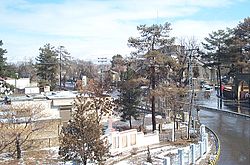 Jinnah Road
 -
 Quetta in 1880


See also
- 2008 Ziarat earthquake
- Balochi cuisine
- Governor's House, Quetta
- List of people from Quetta
- Quetta hut
- Quetta Memorial Precinct
- RMS Quetta
Notes
References
- ^ a b "Government Organization – Government of Balochistan". balochistan.gov.pk. Archived from the original on 7 February 2017. Retrieved 6 September 2016.
- ^ a b "Commissioner Quetta reviews progress on PSDP development schemes". Associated Press of Pakistan. 26 November 2025. Retrieved 14 December 2025.
- ^ a b DISTRICT WISE CENSUS RESULTS CENSUS 2017 (PDF) (Report). Pakistan Bureau of Statistics. 2017. p. 13. Archived from the original (PDF) on 29 August 2017. Retrieved 29 March 2018.
- ^ Gazdar, Haris (2010). "Buffer zone, colonial enclave or urban hub? Quetta: between four regions and two wars". Crisis States Research Centre Working Papers. London School of Economics. Retrieved 8 February 2026.
- ^ "Quetta Population 2024". worldpopulationreview.com.
- ^ "Mongabay -environmental science and conservation news". Archived from the original on 4 March 2016.
- ^ "Winter destinations – Mesmerizing places in Pakistan". Bol News. 18 January 2020. Archived from the original on 24 June 2021. Retrieved 7 January 2022.
- ^ Gazdar, Haris; Kaker, Sobia Ahmad; Khan, Irfan (February 2010). "Buffer zone, colonial enclave or urban hub? Quetta: between four regions and two wars". www.crisisstates.com. Archived from the original on 28 May 2024. Retrieved 28 May 2024.
- ^ Everett-Heath, John (24 October 2019), "Quetta", The Concise Oxford Dictionary of World Place Names, Oxford University Press, doi:10.1093/acref/9780191882913.001.0001, ISBN 978-0-19-188291-3, archived from the original on 4 September 2021, retrieved 4 September 2021
{{citation}}: CS1 maint: work parameter with ISBN (link) - ^ Thornton, Thomas Henry (1895). Colonel Sir Robert Sandeman: His Life and Work on Our Indian Frontier. A Memoir, with Selections from His Correspondence and Official Writings. J. Murray.
- ^ Gazetteer of the Quetta–Pishin District. Government of India. 1907. p. 32. Retrieved 9 February 2026 – via Internet Archive.
- ^ a b c d Burki, Shahid Javed (2015). Historical Dictionary of Pakistan. Rowman & Littlefield. p. 470. ISBN 9781442241480.
- ^ Ahmad, Iqtidar (1980). History of Balochistan. University of Balochistan Press. p. 112.
- ^ a b Gazetteer of the Quetta–Pishin District. Government of India. 1907. pp. 73–74. Retrieved 9 February 2026 – via Internet Archive.
- ^ Gazetteer of the Quetta–Pishin District. Government of India. 1907. p. 99. Retrieved 9 February 2026 – via Internet Archive.
- ^ Caroe, Olaf (1958). The Pathans: 550 B.C.–A.D. 1957. St. Martin's Press. p. 256. Retrieved 9 February 2026 – via Internet Archive.
- ^ Gazetteer of the Quetta–Pishin District. Government of India. 1907. p. 278. Retrieved 9 February 2026 – via Internet Archive.
- ^ Masson, Charles (1842). Narrative of Various Journeys in Balochistan, Afghanistan, and the Panjab. Richard Bentley. p. 330. Retrieved 9 February 2026 – via Internet Archive.
- ^ Gazetteer of the Quetta–Pishin District. Government of India. 1907. pp. 249–250. Retrieved 9 February 2026 – via Internet Archive.
- ^ Gazetteer of the Quetta–Pishin District. Government of India. 1907. pp. 249–250. Retrieved 9 February 2026 – via Internet Archive.
- ^ Gazetteer of the Quetta–Pishin District. Government of India. 1907. p. 340. Retrieved 9 February 2026 – via Internet Archive.
- ^ Gazetteer of the Quetta–Pishin District. Government of India. 1907. pp. 241–242. Retrieved 9 February 2026 – via Internet Archive.
- ^ Ahmad, Iqtidar (1980). History of Balochistan. University of Balochistan Press. p. 112.
- ^ Caroe, Olaf (1958). The Pathans: 550 B.C.–A.D. 1957. St. Martin's Press. p. 256. Retrieved 8 February 2026.
- ^ Masson, Charles (1842). Narrative of Various Journeys in Balochistan, Afghanistan, and the Panjab. Richard Bentley. p. 330. Retrieved 8 February 2026.
- ^ Gazetteer of the Quetta-Pishin District. Government of India. 1907. p. 48. Retrieved 8 February 2026.
- ^ Dodwell, H. H. (1929). The Cambridge History of the British Empire. CUP Archive. p. 458.
- ^ a b Gazetteer of the Quetta–Pishin District. Government of India. 1907. pp. 249–250. Retrieved 9 February 2026 – via Internet Archive.
- ^ Gazetteer of the Quetta–Pishin District. Government of India. 1907. pp. 241–242. Retrieved 9 February 2026 – via Internet Archive.
- ^ ڈان اردو (30 December 2013). "پاکستانی شہروں کی تاریخ". Archived from the original on 6 March 2016. Retrieved 26 February 2016.
- ^ a b c d "Mean FOR THE PERIOD 1961 – 2009". Karachi: Climate Data Processing Centre (CDPC), Pakistan Meteorological Department. Archived from the original on 13 June 2010.
- ^ "Quetta Climate Normals 1991–2020". World Meteorological Organization Climatological Standard Normals (1991–2020). National Oceanic and Atmospheric Administration. Retrieved 17 September 2023.
- ^ "Climatological Information for Quetta, Pakistan". Hong Kong Observatory. Archived from the original on 16 June 2018. Retrieved 3 December 2019.
- ^ "Extremes of Quetta". Pakistan Meteorological Department. Retrieved 3 February 2015.
- ^ "Klimatafel von Quetta (Flughafen) / Pakistan" (PDF). Federal Ministry of Transport and Digital Infrastructure. Retrieved 17 September 2016.
- ^ "Cold wave intensifies with heavy snowfall". Dawn. 29 January 2008. Archived from the original on 4 January 2009.
- ^ "Leading News Resource of Pakistan". Daily Times. 4 February 2008. Archived from the original on 19 January 2012. Retrieved 8 May 2012.
- ^ Elahi, Asad (2006). "2: Population". Pakistan Statistical Pocket Book 2006. Islamabad, Pakistan: Government of Pakistan: Statistics Division. p. 28. Archived from the original (PDF) on 30 March 2018. Retrieved 29 March 2018.
{{cite book}}: CS1 maint: publisher location (link) - ^ "Pakistan: Provinces and Major Cities - Population Statistics, Maps, Charts, Weather and Web Information". www.citypopulation.de. Archived from the original on 28 October 2020. Retrieved 31 August 2024.
- ^ Abubakar Siddique (2014). The Pashtun Question: The Unresolved Key to the Future of Pakistan and Afghanistan. Hurst. p. 22. ISBN 978-1-84904-292-5.
- ^ Bianchi, Robert (25 March 2008). Guests of God: Pilgrimage and Politics in the Islamic World. Oxford University Press. p. 92. ISBN 978-0-19-971183-3. Archived from the original on 19 February 2025. Retrieved 28 July 2024.
The largest communities are Pashtuns, Punjabis, and muhajirs, but no group is a majority. Quetta is one of the few districts in all Pakistan where no linguistic group can claim dominance, either numerically or politically. Aside from occasional clashes with Shi'ite protesters encouraged by proximity to Iran, Quetta seems like a model of tolerance compared with the carnage ravaging the much larger melting pot of Karachi.
- ^ Fair, C. Christine; Crane, Keith; Chivvis, Christopher S.; Puri, Samir; Spirtas, Michael (13 April 2010). Pakistan: Can the United States Secure an Insecure State?. Rand Corporation. p. 12. ISBN 978-0-8330-4870-7. Archived from the original on 19 February 2025. Retrieved 28 July 2024.
- ^ "Two killed in sectarian attack in southwestern Pakistan". Reuters. 22 April 2018. Archived from the original on 22 April 2018. Retrieved 22 April 2018.
- ^ Kermani, Secunder (12 December 2017). "The community caged in its own city". BBC News. Archived from the original on 26 July 2018. Retrieved 21 July 2018.
- ^ a b India Census Commissioner (1942). "Census of India, 1941. Vol. 14, Baluchistan". pp. 13–14. JSTOR saoa.crl.28215993. Archived from the original on 29 January 2023. Retrieved 27 January 2023.
- ^ Baines, Jervoise Athelstane; India Census Commissioner (1891). "Census of India, 1891. General tables for British provinces and feudatory states". p. 70. JSTOR saoa.crl.25318666. Archived from the original on 31 May 2023. Retrieved 8 December 2024.
- ^ "Final Results (Census-2017)". Archived from the original on 17 October 2021. Retrieved 27 January 2023.
- ^ "District Wise Results / Tables (Census – 2017) TABLE 9 – POPULATION BY SEX, RELIGION AND RURAL/URBAN" (PDF). Archived (PDF) from the original on 27 January 2023. Retrieved 27 January 2023.
- ^ "7th Population and Housing Census - Detailed Results Table-9 Population by sex, religion and rural/urban". Pakistan Bureau of Statistics. Archived from the original on 3 December 2024. Retrieved 6 August 2024.
- ^ "About QDA – Quetta Development Authority". Archived from the original on 12 April 2021. Retrieved 12 April 2021.
- ^ Quetta Airport Archived 29 June 2009 at the Wayback Machine CAA Pakistan. Retrieved 24 June 2009
- ^ "Bomb attack targets Worshippers at Quetta mosque, killing 14". www.aljazeera.com. Archived from the original on 14 February 2020. Retrieved 12 January 2020.
- ^ Raheel, Natasha (5 December 2021). "Football, Balochistan and hope". The Express Tribune. Retrieved 11 May 2024.
- ^ Wasim, Umaid (26 November 2021). "Balochistan's boundless passion for football has nowhere to go but an event is keeping the flame alive". DAWN.COM. Archived from the original on 12 November 2024. Retrieved 30 May 2024.
- ^ InpaperMagazine, From (13 January 2013). "In-depth: Pakistan football". DAWN.COM. Archived from the original on 25 May 2013. Retrieved 5 May 2024.
- ^ "PCB unveils new domestic set-up with 'stay at the top' mantra". ESPN Cricinfo. Archived from the original on 31 August 2019. Retrieved 26 January 2021.
- ^ Faruqi, Sama. "The Hazaras who made Quetta a boxing powerhouse". The Caravan. Archived from the original on 7 December 2019. Retrieved 7 December 2019.
Bibliography
- Bosworth, C.E. (1986). "Kwat́́t́́a". In Bosworth, C. E.; van Donzel, E.; Lewis, B. & Pellat, Ch. (eds.). The Encyclopaedia of Islam, Second Edition. Volume V: Khe–Mahi. Leiden: E. J. Brill. ISBN 978-90-04-07819-2.
- Jonah Blank; Christopher Clary; Brian Nichiporuk (30 October 2014), Drivers of Long-Term insecurity and Instability in Pakistan: Urbanization, Rand Corporation, p. 29, ISBN 978-0-83-308751-5
External links

- Balochistan Board Archived 22 January 2015 at the Wayback Machine
- Official webpage on Balochistan.gov.pk (archived 18 October 2010)
Neighbourhoods of Quetta | ||
|---|---|---|
Administrations: Quetta Division and Quetta District | ||
| Tehsils |
|  |
| Cities |
| |
| Towns and councils | ||
| Localities | ||
Website: Quetta District at NRB | ||


