Epstein Files Full PDF

CLICK HERE
Technopedia Center
PMB University Brochure
Faculty of Engineering and Computer Science
S1 Informatics S1 Information Systems S1 Information Technology S1 Computer Engineering S1 Electrical Engineering S1 Civil Engineering

faculty of Economics and Business
S1 Management S1 Accountancy

Faculty of Letters and Educational Sciences
S1 English literature S1 English language education S1 Mathematics education S1 Sports Education
teknopedia

  • Registerasi
  • Brosur UTI
  • Kip Scholarship Information
  • Performance
Flag Counter
  1. World Encyclopedia
  2. Random dynamical system - Wikipedia
Random dynamical system - Wikipedia
From Wikipedia, the free encyclopedia
This article may be too technical for most readers to understand. Please help improve it to make it understandable to non-experts, without removing the technical details. (January 2022) (Learn how and when to remove this message)

In mathematics, a random dynamical system is a dynamical system in which the equations of motion have an element of randomness to them. Random dynamical systems are characterized by a state space S, a set of maps Γ {\displaystyle \Gamma } {\displaystyle \Gamma } from S into itself that can be thought of as the set of all possible equations of motion, and a probability distribution Q on the set Γ {\displaystyle \Gamma } {\displaystyle \Gamma } that represents the random choice of map. Motion in a random dynamical system can be informally thought of as a state X ∈ S {\displaystyle X\in S} {\displaystyle X\in S} evolving according to a succession of maps randomly chosen according to the distribution Q.[1]

An example of a random dynamical system is a stochastic differential equation; in this case the distribution Q is typically determined by noise terms. It consists of a base flow, the "noise", and a cocycle dynamical system on the "physical" phase space. Another example is discrete state random dynamical system; some elementary contradistinctions between Markov chain and random dynamical system descriptions of a stochastic dynamics are discussed.[2]

Motivation 1: Solutions to a stochastic differential equation

[edit]

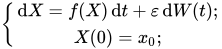
Let f : R d → R d {\displaystyle f:\mathbb {R} ^{d}\to \mathbb {R} ^{d}} {\displaystyle f:\mathbb {R} ^{d}\to \mathbb {R} ^{d}} be a d {\displaystyle d} {\displaystyle d}-dimensional vector field, and let ε > 0 {\displaystyle \varepsilon >0} {\displaystyle \varepsilon >0}. Suppose that the solution X ( t , ω ; x 0 ) {\displaystyle X(t,\omega ;x_{0})} {\displaystyle X(t,\omega ;x_{0})} to the stochastic differential equation

{ d X = f ( X ) d t + ε d W ( t ) ; X ( 0 ) = x 0 ; {\displaystyle \left\{{\begin{matrix}\mathrm {d} X=f(X)\,\mathrm {d} t+\varepsilon \,\mathrm {d} W(t);\\X(0)=x_{0};\end{matrix}}\right.} {\displaystyle \left\{{\begin{matrix}\mathrm {d} X=f(X)\,\mathrm {d} t+\varepsilon \,\mathrm {d} W(t);\\X(0)=x_{0};\end{matrix}}\right.}

exists for all positive time and some (small) interval of negative time dependent upon ω ∈ Ω {\displaystyle \omega \in \Omega } {\displaystyle \omega \in \Omega }, where W : R × Ω → R d {\displaystyle W:\mathbb {R} \times \Omega \to \mathbb {R} ^{d}} {\displaystyle W:\mathbb {R} \times \Omega \to \mathbb {R} ^{d}} denotes a d {\displaystyle d} {\displaystyle d}-dimensional Wiener process (Brownian motion). Implicitly, this statement uses the classical Wiener probability space


( Ω , F , P ) := ( C 0 ( R ; R d ) , B ( C 0 ( R ; R d ) ) , γ ) . {\displaystyle (\Omega ,{\mathcal {F}},\mathbb {P} ):=\left(C_{0}(\mathbb {R} ;\mathbb {R} ^{d}),{\mathcal {B}}(C_{0}(\mathbb {R} ;\mathbb {R} ^{d})),\gamma \right).} {\displaystyle (\Omega ,{\mathcal {F}},\mathbb {P} ):=\left(C_{0}(\mathbb {R} ;\mathbb {R} ^{d}),{\mathcal {B}}(C_{0}(\mathbb {R} ;\mathbb {R} ^{d})),\gamma \right).}

In this context, the Wiener process is the coordinate process.

Now define a flow map or (solution operator) φ : R × Ω × R d → R d {\displaystyle \varphi :\mathbb {R} \times \Omega \times \mathbb {R} ^{d}\to \mathbb {R} ^{d}} {\displaystyle \varphi :\mathbb {R} \times \Omega \times \mathbb {R} ^{d}\to \mathbb {R} ^{d}} by

φ ( t , ω , x 0 ) := X ( t , ω ; x 0 ) {\displaystyle \varphi (t,\omega ,x_{0}):=X(t,\omega ;x_{0})} {\displaystyle \varphi (t,\omega ,x_{0}):=X(t,\omega ;x_{0})}

(whenever the right hand side is well-defined). Then φ {\displaystyle \varphi } {\displaystyle \varphi } (or, more precisely, the pair ( R d , φ ) {\displaystyle (\mathbb {R} ^{d},\varphi )} {\displaystyle (\mathbb {R} ^{d},\varphi )}) is a (local, left-sided) random dynamical system. The process of generating a "flow" from the solution to a stochastic differential equation leads us to study suitably defined "flows" on their own. These "flows" are random dynamical systems.

Motivation 2: Connection to Markov Chain

[edit]

An i.i.d random dynamical system in the discrete space is described by a triplet ( S , Γ , Q ) {\displaystyle (S,\Gamma ,Q)} {\displaystyle (S,\Gamma ,Q)}.

  • S {\displaystyle S} {\displaystyle S} is the state space, { s 1 , s 2 , ⋯ , s n } {\displaystyle \{s_{1},s_{2},\cdots ,s_{n}\}} {\displaystyle \{s_{1},s_{2},\cdots ,s_{n}\}}.
  • Γ {\displaystyle \Gamma } {\displaystyle \Gamma } is a family of maps of S → S {\displaystyle S\rightarrow S} {\displaystyle S\rightarrow S}. Each such map has a n × n {\displaystyle n\times n} {\displaystyle n\times n} matrix representation, called deterministic transition matrix. It is a binary matrix but it has exactly one entry 1 in each row and 0s otherwise.
  • Q {\displaystyle Q} {\displaystyle Q} is the probability measure of the σ {\displaystyle \sigma } {\displaystyle \sigma }-field of Γ {\displaystyle \Gamma } {\displaystyle \Gamma }.

The discrete random dynamical system comes as follows,

  1. The system is in some state x 0 {\displaystyle x_{0}} {\displaystyle x_{0}} in S {\displaystyle S} {\displaystyle S}, a map α 1 {\displaystyle \alpha _{1}} {\displaystyle \alpha _{1}} in Γ {\displaystyle \Gamma } {\displaystyle \Gamma } is chosen according to the probability measure Q {\displaystyle Q} {\displaystyle Q} and the system moves to the state x 1 = α 1 ( x 0 ) {\displaystyle x_{1}=\alpha _{1}(x_{0})} {\displaystyle x_{1}=\alpha _{1}(x_{0})} in step 1.
  2. Independently of previous maps, another map α 2 {\displaystyle \alpha _{2}} {\displaystyle \alpha _{2}} is chosen according to the probability measure Q {\displaystyle Q} {\displaystyle Q} and the system moves to the state x 2 = α 2 ( x 1 ) {\displaystyle x_{2}=\alpha _{2}(x_{1})} {\displaystyle x_{2}=\alpha _{2}(x_{1})}.
  3. The procedure repeats.

The random variable X n {\displaystyle X_{n}} {\displaystyle X_{n}} is constructed by means of composition of independent random maps, X n = α n ∘ α n − 1 ∘ ⋯ ∘ α 1 ( X 0 ) {\displaystyle X_{n}=\alpha _{n}\circ \alpha _{n-1}\circ \dots \circ \alpha _{1}(X_{0})} {\displaystyle X_{n}=\alpha _{n}\circ \alpha _{n-1}\circ \dots \circ \alpha _{1}(X_{0})}. Clearly, X n {\displaystyle X_{n}} {\displaystyle X_{n}} is a Markov Chain.

Reversely, can, and how, a given MC be represented by the compositions of i.i.d. random transformations? Yes, it can, but not unique. The proof for existence is similar with Birkhoff–von Neumann theorem for doubly stochastic matrix.

Here is an example that illustrates the existence and non-uniqueness.

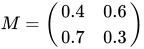
Example: If the state space S = { 1 , 2 } {\displaystyle S=\{1,2\}} {\displaystyle S=\{1,2\}} and the set of the transformations Γ {\displaystyle \Gamma } {\displaystyle \Gamma } expressed in terms of deterministic transition matrices. Then a Markov transition matrix M = ( 0.4 0.6 0.7 0.3 ) {\displaystyle M=\left({\begin{array}{cc}0.4&0.6\\0.7&0.3\end{array}}\right)} {\displaystyle M=\left({\begin{array}{cc}0.4&0.6\\0.7&0.3\end{array}}\right)} can be represented by the following decomposition by the min-max algorithm, M = 0.6 ( 0 1 1 0 ) + 0.3 ( 1 0 0 1 ) + 0.1 ( 1 0 1 0 ) . {\displaystyle M=0.6\left({\begin{array}{cc}0&1\\1&0\end{array}}\right)+0.3\left({\begin{array}{cc}1&0\\0&1\end{array}}\right)+0.1\left({\begin{array}{cc}1&0\\1&0\end{array}}\right).} {\displaystyle M=0.6\left({\begin{array}{cc}0&1\\1&0\end{array}}\right)+0.3\left({\begin{array}{cc}1&0\\0&1\end{array}}\right)+0.1\left({\begin{array}{cc}1&0\\1&0\end{array}}\right).}

In the meantime, another decomposition could be M = 0.18 ( 0 1 0 1 ) + 0.28 ( 1 0 1 0 ) + 0.42 ( 0 1 1 0 ) + 0.12 ( 1 0 0 1 ) . {\displaystyle M=0.18\left({\begin{array}{cc}0&1\\0&1\end{array}}\right)+0.28\left({\begin{array}{cc}1&0\\1&0\end{array}}\right)+0.42\left({\begin{array}{cc}0&1\\1&0\end{array}}\right)+0.12\left({\begin{array}{cc}1&0\\0&1\end{array}}\right).} {\displaystyle M=0.18\left({\begin{array}{cc}0&1\\0&1\end{array}}\right)+0.28\left({\begin{array}{cc}1&0\\1&0\end{array}}\right)+0.42\left({\begin{array}{cc}0&1\\1&0\end{array}}\right)+0.12\left({\begin{array}{cc}1&0\\0&1\end{array}}\right).}

Formal definition

[edit]

Formally,[3] a random dynamical system consists of a base flow, the "noise", and a cocycle dynamical system on the "physical" phase space. In detail.

Let ( Ω , F , P ) {\displaystyle (\Omega ,{\mathcal {F}},\mathbb {P} )} {\displaystyle (\Omega ,{\mathcal {F}},\mathbb {P} )} be a probability space, the noise space. Define the base flow ϑ : R × Ω → Ω {\displaystyle \vartheta :\mathbb {R} \times \Omega \to \Omega } {\displaystyle \vartheta :\mathbb {R} \times \Omega \to \Omega } as follows: for each "time" s ∈ R {\displaystyle s\in \mathbb {R} } {\displaystyle s\in \mathbb {R} }, let ϑ s : Ω → Ω {\displaystyle \vartheta _{s}:\Omega \to \Omega } {\displaystyle \vartheta _{s}:\Omega \to \Omega } be a measure-preserving measurable function:

P ( E ) = P ( ϑ s − 1 ( E ) ) {\displaystyle \mathbb {P} (E)=\mathbb {P} (\vartheta _{s}^{-1}(E))} {\displaystyle \mathbb {P} (E)=\mathbb {P} (\vartheta _{s}^{-1}(E))} for all E ∈ F {\displaystyle E\in {\mathcal {F}}} {\displaystyle E\in {\mathcal {F}}} and s ∈ R {\displaystyle s\in \mathbb {R} } {\displaystyle s\in \mathbb {R} };

Suppose also that

  1. ϑ 0 = i d Ω : Ω → Ω {\displaystyle \vartheta _{0}=\mathrm {id} _{\Omega }:\Omega \to \Omega } {\displaystyle \vartheta _{0}=\mathrm {id} _{\Omega }:\Omega \to \Omega }, the identity function on Ω {\displaystyle \Omega } {\displaystyle \Omega };
  2. for all s , t ∈ R {\displaystyle s,t\in \mathbb {R} } {\displaystyle s,t\in \mathbb {R} }, ϑ s ∘ ϑ t = ϑ s + t {\displaystyle \vartheta _{s}\circ \vartheta _{t}=\vartheta _{s+t}} {\displaystyle \vartheta _{s}\circ \vartheta _{t}=\vartheta _{s+t}}.

That is, ϑ s {\displaystyle \vartheta _{s}} {\displaystyle \vartheta _{s}}, s ∈ R {\displaystyle s\in \mathbb {R} } {\displaystyle s\in \mathbb {R} }, forms a group of measure-preserving transformation of the noise ( Ω , F , P ) {\displaystyle (\Omega ,{\mathcal {F}},\mathbb {P} )} {\displaystyle (\Omega ,{\mathcal {F}},\mathbb {P} )}. For one-sided random dynamical systems, one would consider only positive indices s {\displaystyle s} {\displaystyle s}; for discrete-time random dynamical systems, one would consider only integer-valued s {\displaystyle s} {\displaystyle s}; in these cases, the maps ϑ s {\displaystyle \vartheta _{s}} {\displaystyle \vartheta _{s}} would only form a commutative monoid instead of a group.

While true in most applications, it is not usually part of the formal definition of a random dynamical system to require that the measure-preserving dynamical system ( Ω , F , P , ϑ ) {\displaystyle (\Omega ,{\mathcal {F}},\mathbb {P} ,\vartheta )} {\displaystyle (\Omega ,{\mathcal {F}},\mathbb {P} ,\vartheta )} is ergodic.

Now let ( X , d ) {\displaystyle (X,d)} {\displaystyle (X,d)} be a complete separable metric space, the phase space. Let φ : R × Ω × X → X {\displaystyle \varphi :\mathbb {R} \times \Omega \times X\to X} {\displaystyle \varphi :\mathbb {R} \times \Omega \times X\to X} be a ( B ( R ) ⊗ F ⊗ B ( X ) , B ( X ) ) {\displaystyle ({\mathcal {B}}(\mathbb {R} )\otimes {\mathcal {F}}\otimes {\mathcal {B}}(X),{\mathcal {B}}(X))} {\displaystyle ({\mathcal {B}}(\mathbb {R} )\otimes {\mathcal {F}}\otimes {\mathcal {B}}(X),{\mathcal {B}}(X))}-measurable function such that

  1. for all ω ∈ Ω {\displaystyle \omega \in \Omega } {\displaystyle \omega \in \Omega }, φ ( 0 , ω ) = i d X : X → X {\displaystyle \varphi (0,\omega )=\mathrm {id} _{X}:X\to X} {\displaystyle \varphi (0,\omega )=\mathrm {id} _{X}:X\to X}, the identity function on X {\displaystyle X} {\displaystyle X};
  2. for (almost) all ω ∈ Ω {\displaystyle \omega \in \Omega } {\displaystyle \omega \in \Omega }, ( t , x ) ↦ φ ( t , ω , x ) {\displaystyle (t,x)\mapsto \varphi (t,\omega ,x)} {\displaystyle (t,x)\mapsto \varphi (t,\omega ,x)} is continuous;
  3. φ {\displaystyle \varphi } {\displaystyle \varphi } satisfies the (crude) cocycle property: for almost all ω ∈ Ω {\displaystyle \omega \in \Omega } {\displaystyle \omega \in \Omega },
φ ( t , ϑ s ( ω ) ) ∘ φ ( s , ω ) = φ ( t + s , ω ) . {\displaystyle \varphi (t,\vartheta _{s}(\omega ))\circ \varphi (s,\omega )=\varphi (t+s,\omega ).} {\displaystyle \varphi (t,\vartheta _{s}(\omega ))\circ \varphi (s,\omega )=\varphi (t+s,\omega ).}

In the case of random dynamical systems driven by a Wiener process W : R × Ω → X {\displaystyle W:\mathbb {R} \times \Omega \to X} {\displaystyle W:\mathbb {R} \times \Omega \to X}, the base flow ϑ s : Ω → Ω {\displaystyle \vartheta _{s}:\Omega \to \Omega } {\displaystyle \vartheta _{s}:\Omega \to \Omega } would be given by

W ( t , ϑ s ( ω ) ) = W ( t + s , ω ) − W ( s , ω ) {\displaystyle W(t,\vartheta _{s}(\omega ))=W(t+s,\omega )-W(s,\omega )} {\displaystyle W(t,\vartheta _{s}(\omega ))=W(t+s,\omega )-W(s,\omega )}.

This can be read as saying that ϑ s {\displaystyle \vartheta _{s}} {\displaystyle \vartheta _{s}} "starts the noise at time s {\displaystyle s} {\displaystyle s} instead of time 0". Thus, the cocycle property can be read as saying that evolving the initial condition x 0 {\displaystyle x_{0}} {\displaystyle x_{0}} with some noise ω {\displaystyle \omega } {\displaystyle \omega } for s {\displaystyle s} {\displaystyle s} seconds and then through t {\displaystyle t} {\displaystyle t} seconds with the same noise (as started from the s {\displaystyle s} {\displaystyle s} seconds mark) gives the same result as evolving x 0 {\displaystyle x_{0}} {\displaystyle x_{0}} through ( t + s ) {\displaystyle (t+s)} {\displaystyle (t+s)} seconds with that same noise.

Attractors for random dynamical systems

[edit]

The notion of an attractor for a random dynamical system is not as straightforward to define as in the deterministic case. For technical reasons, it is necessary to "rewind time", as in the definition of a pullback attractor.[4] Moreover, the attractor is dependent upon the realisation ω {\displaystyle \omega } {\displaystyle \omega } of the noise.

See also

[edit]
  • Chaos theory
  • Diffusion process
  • Stochastic control

References

[edit]
  1. ^ Bhattacharya, Rabi; Majumdar, Mukul (2003). "Random dynamical systems: a review". Economic Theory. 23 (1): 13–38. doi:10.1007/s00199-003-0357-4. S2CID 15055697.
  2. ^ Ye, Felix X.-F.; Wang, Yue; Qian, Hong (August 2016). "Stochastic dynamics: Markov chains and random transformations". Discrete and Continuous Dynamical Systems - Series B. 21 (7): 2337–2361. doi:10.3934/dcdsb.2016050.
  3. ^ Arnold, Ludwig [in German] (1998). Random Dynamical Systems. ISBN 9783540637585.
  4. ^ Crauel, Hans; Debussche, Arnaud; Flandoli, Franco (1997). "Random attractors". Journal of Dynamics and Differential Equations. 9 (2): 307–341. Bibcode:1997JDDE....9..307C. doi:10.1007/BF02219225. S2CID 192603977.

Further reading

[edit]
  • Stochastic dynamical systems on Scholarpedia
  • v
  • t
  • e
Stochastic processes
Discrete time
  • Bernoulli process
  • Branching process
  • Chinese restaurant process
  • Galton–Watson process
  • Independent and identically distributed random variables
  • Markov chain
  • Moran process
  • Random walk
    • Loop-erased
    • Self-avoiding
    • Biased
    • Maximal entropy
Continuous time
  • Additive process
  • Airy process
  • Bessel process
  • Birth–death process
    • pure birth
  • Brownian motion
    • Bridge
    • Dyson
    • Excursion
    • Fractional
    • Geometric
    • Meander
  • Cauchy process
  • Contact process
  • Continuous-time random walk
  • Cox process
  • Diffusion process
  • Empirical process
  • Feller process
  • Fleming–Viot process
  • Gamma process
  • Geometric process
  • Hawkes process
  • Hunt process
  • Interacting particle systems
  • Itô diffusion
  • Itô process
  • Jump diffusion
  • Jump process
  • Lévy process
  • Local time
  • Markov additive process
  • McKean–Vlasov process
  • Ornstein–Uhlenbeck process
  • Poisson process
    • Compound
    • Non-homogeneous
  • Quasimartingale
  • Schramm–Loewner evolution
  • Semimartingale
  • Sigma-martingale
  • Stable process
  • Superprocess
  • Telegraph process
  • Variance gamma process
  • Wiener process
  • Wiener sausage
Both
  • Branching process
  • Gaussian process
  • Hidden Markov model (HMM)
  • Markov process
  • Martingale
    • Differences
    • Local
    • Sub-
    • Super-
  • Random dynamical system
  • Regenerative process
  • Renewal process
  • Stochastic chains with memory of variable length
  • White noise
Fields and other
  • Dirichlet process
  • Gaussian random field
  • Gibbs measure
  • Hopfield model
  • Ising model
    • Potts model
    • Boolean network
  • Markov random field
  • Percolation
  • Pitman–Yor process
  • Point process
    • Cox
    • Determinantal
    • Poisson
  • Random field
  • Random graph
Time series models
  • Autoregressive conditional heteroskedasticity (ARCH) model
  • Autoregressive integrated moving average (ARIMA) model
  • Autoregressive (AR) model
  • Autoregressive moving-average (ARMA) model
  • Generalized autoregressive conditional heteroskedasticity (GARCH) model
  • Moving-average (MA) model
Financial models
  • Binomial options pricing model
  • Black–Derman–Toy
  • Black–Karasinski
  • Black–Scholes
  • Chan–Karolyi–Longstaff–Sanders (CKLS)
  • Chen
  • Constant elasticity of variance (CEV)
  • Cox–Ingersoll–Ross (CIR)
  • Garman–Kohlhagen
  • Heath–Jarrow–Morton (HJM)
  • Heston
  • Ho–Lee
  • Hull–White
  • Korn-Kreer-Lenssen
  • LIBOR market
  • Rendleman–Bartter
  • SABR volatility
  • Vašíček
  • Wilkie
Actuarial models
  • Bühlmann
  • Cramér–Lundberg
  • Risk process
  • Sparre–Anderson
Queueing models
  • Bulk
  • Fluid
  • Generalized queueing network
  • M/G/1
  • M/M/1
  • M/M/c
Properties
  • Càdlàg paths
  • Continuous
  • Continuous paths
  • Ergodic
  • Exchangeable
  • Feller-continuous
  • Gauss–Markov
  • Markov
  • Mixing
  • Piecewise-deterministic
  • Predictable
  • Progressively measurable
  • Self-similar
  • Stationary
  • Time-reversible
Limit theorems
  • Central limit theorem
  • Donsker's theorem
  • Doob's martingale convergence theorems
  • Ergodic theorem
  • Fisher–Tippett–Gnedenko theorem
  • Large deviation principle
  • Law of large numbers (weak/strong)
  • Law of the iterated logarithm
  • Maximal ergodic theorem
  • Sanov's theorem
  • Zero–one laws (Blumenthal, Borel–Cantelli, Engelbert–Schmidt, Hewitt–Savage, Kolmogorov, Lévy)
Inequalities
  • Burkholder–Davis–Gundy
  • Doob's martingale
  • Doob's upcrossing
  • Kunita–Watanabe
  • Marcinkiewicz–Zygmund
Tools
  • Cameron–Martin theorem
  • Convergence of random variables
  • Doléans-Dade exponential
  • Doob decomposition theorem
  • Doob–Meyer decomposition theorem
  • Doob's optional stopping theorem
  • Dynkin's formula
  • Feynman–Kac formula
  • Filtration
  • Girsanov theorem
  • Infinitesimal generator
  • Itô integral
  • Itô's lemma
  • Kolmogorov continuity theorem
  • Kolmogorov extension theorem
  • Kosambi–Karhunen–Loève theorem
  • Lévy–Prokhorov metric
  • Malliavin calculus
  • Martingale representation theorem
  • Optional stopping theorem
  • Prokhorov's theorem
  • Quadratic variation
  • Reflection principle
  • Skorokhod integral
  • Skorokhod's representation theorem
  • Skorokhod space
  • Snell envelope
  • Stochastic differential equation
    • Tanaka
  • Stopping time
  • Stratonovich integral
  • Uniform integrability
  • Usual hypotheses
  • Wiener space
    • Classical
    • Abstract
Disciplines
  • Actuarial mathematics
  • Control theory
  • Econometrics
  • Ergodic theory
  • Extreme value theory (EVT)
  • Large deviations theory
  • Mathematical finance
  • Mathematical statistics
  • Probability theory
  • Queueing theory
  • Renewal theory
  • Ruin theory
  • Signal processing
  • Statistics
  • Stochastic analysis
  • Time series analysis
  • Machine learning
  • List of topics
  • Category
Retrieved from "https://teknopedia.ac.id/w/index.php?title=Random_dynamical_system&oldid=1334888825"
Categories:
  • Random dynamical systems
  • Stochastic differential equations
  • Stochastic processes
Hidden categories:
  • CS1 interwiki-linked names
  • Wikipedia articles that are too technical from January 2022
  • All articles that are too technical

  • indonesia
  • Polski
  • العربية
  • Deutsch
  • English
  • Español
  • Français
  • Italiano
  • مصرى
  • Nederlands
  • 日本語
  • Português
  • Sinugboanong Binisaya
  • Svenska
  • Українська
  • Tiếng Việt
  • Winaray
  • 中文
  • Русский
Sunting pranala
url url url url url url url url url url url url url url url url url url url url url url url url url url url url url url url url url url url url url url url url url url url url url url url url url url url url url url url url url url url url url url url url url url url url url url url url url url url url url url url url url url url url url url url url url url url url url url url url url url url url url url url url url url url url url url url url url url url url url url url url url url url url url url url url url url url url url url url url url url url url url url url url url url url url url url url url url url url url url url url url url url url url url url url url url url url url url url url url url url url url url url url url url url url url url url url url url url url url url url url url url url url url url url url url url url url url url url url url url url url url url url url url url url url url url url url url url url url url url url url url url url url url url url url url url url url url url url url url url url url url url url url url url url url url url url url url url url url url url url url url url url url url url url url url url url url url url url url url url url url url url url url url url url url url url url url url url url url url url url url url url url url url url url url url url url url url url url url url url url url url url url url url url url url url url url url url url url url url url url url url url url url url url url url url url url url url url url url url url url url url url url url url url url url url url url url url url url url url url url url url url url url url url url url url url url url url url url url url url url url url url url url url url url url url url url url url url url url url url url url url url url url url url url url url url url url url url url url url url url url url url url url url url url url url url url url url url url url url url url url url url url url url url url url url url url url url url url url url url url url url url url url url url url url url url url url url url url url url url url url url url url url url url url url url url url url url url url url url url url url url url url url url url url url url url url url url url url url url url url url url url url url url url url url url url url url url url url url url url url url url url url url url url url url url url url url url url url url url url url url url url url url url url url url url url url url url url url url url url url url url url url url url url url url url url url url url url url url url url url url url url url url url url url url url url url url url url url url url url url url url url url url url url url url url url url url url url url url url url url url url url url url url url url url url url url url url url url url url url url url url url url url url url url url url url url url url url url url url url url url url url url url url url url url url url url url url url url url url url url url url url url url url url url url url url url url url url url url url url url url url url url url url url url url url url url url url url url url url url url url url url url url url url url url url url url url url url url url url url url url url url url url url url url url url url url url url url url url url url url url url url url url url url url url url url url url url url url url url url url url url url url url url url url url url url url url url url url url url url url url url url url url url url url url url url url url url url url url url url url url url url url url url url url url url url url url url url url url url url url url url url url url url url url url url url url url url url url url url url url url url url url url url url url url url url url url url url url url url url url url url url url url url url url url url url url url url url url url url url url url url url url url url url url url url url url url url url url url url url url url url url url url url url url url url url url url url url url url url url url url url url url url url url url url url url url url url url url url url url url url url url url url url url url url url url url url url url url url url url url url url url url url url url url url url url url url url url url url url url url url url url url url url url url url url url url url url url url url url url url url url url url url url url url url url url url url url url url url url url url url url url url url url url url url url url url url url url url url url url url url url url url url url url url url url url url url url url url url url url url url url url url url url url url url url url url url url url url url url url url url url url url url url url url url url url url url url url url url url url url url url url url url url url url url url url url url url url url url url url url url url url url url url url url url url url url url url url url url url url url url url url url url url url url url url url url url url url url url url url url url url url url url url url url url url url url url url url url url url url url url url url url url url url url url url url url url url url url url url url url url url url url url url url url url url url url url url url url url url url url url url url url url url url url url url url url url url url url url url url url url url url url url url url url url url url url url url url url url url url url url url url url url url url url url url url url url url url url url url url url url url url url url url url url url url url url url url url url url url url url url url url url url url url url url url url url url url url url url url url url url url url url url url url url url url url url url url url url url url url url url url url url url url url url url url url url url url url url url url url url url url url url url url url url url url url url url url url url url url url url url url url url url url url url url url url url url url url url url url url url url url url url url url url url url url url url url url url url url url url url url url url url url url url url url url url url url url url url url url url url url url url url url url url url url url url url url url url url url url url url url url url url url url url url url url url url url url url url url url url url url url url url url url url url url url url url url url url url url url url url url url url url url url url url url url url url url url url url url url url url url url url url url url url url url url url url url url url url url url url url url url url url url url url url url url url url url url url url url url url url url url url url url url url url url url url url url url url url url url url url url url url url url url url url url url url url url url url url url url url url url url url url url url url url url url url url url url url url url url url url url url url url url url url url url url url url url url url url url url url url url url url url url url url url url url url url url url url url url url url url url url url url url url url url url url url url url url url url url url url url url url url url url url url url url url url url url url url url url url url url url url url url url url url url url url url url url url url url url url url url url url url url url url url url url url url url url url url url url url url url url url url url url url url url url url url url url url url url url url url url url url url url url url url url url url url url url url url url url url url url url url url url url url url url url url url url url url url url url url url url url url url url url url url url url url url url url url url url url url url url url url url url url url url url url url url url url url url url url url url url url url url url url url url url url url url url url url url url url url url url url url url url url url url url url url url url url url url url url url url url url url url url url url url url url url url url url url url url url url url url url url url url url url url url url url url url url url url url url url url url url url url url url url url url url url url url url url url url url url url url url url url url url url url url url url url url url url url url url url url url url url url url url url url url url url url url url url url url url url url url url url url url url url url url url url url url url url url url url url url url url url url url url url url url url url url url url url url url url url url url url url url url url url url url url url url url url url url url url url url url url url url url url url url url url url url url url url url url url url url url url url url url url url url url url url url url url url url url url url url url url url url url url url url url url url url url url url url url url url url url url url url url url url url url url url url url url url url url url url url url url url url url url url url url url url url url url url url url url url url url url url url url url url url url url url url url url url url url url url url url url url url url url url url url url url url url url url url url url url url url url url url url url url url url url url url url url url url url url url url url url url url url url url url url url url url url url url url url url url url url url url url url url url url url url url url url url url url url url url url url url url url url url url url url url url url url url url url url url url url url url url url url url url url url url url url url url url url url url url url url url url url url url url url url url url url url url url url url url url url url url url url url url url url url url url url url url url url url url url url url url url url url url url url url url url url url url url url url url url url url url url url url url url
Pusat Layanan

UNIVERSITAS TEKNOKRAT INDONESIA | ASEAN's Best Private University
Jl. ZA. Pagar Alam No.9 -11, Labuhan Ratu, Kec. Kedaton, Kota Bandar Lampung, Lampung 35132
Phone: (0721) 702022
Email: pmb@teknokrat.ac.id