Epstein Files Full PDF

CLICK HERE
Technopedia Center
PMB University Brochure
Faculty of Engineering and Computer Science
S1 Informatics S1 Information Systems S1 Information Technology S1 Computer Engineering S1 Electrical Engineering S1 Civil Engineering

faculty of Economics and Business
S1 Management S1 Accountancy

Faculty of Letters and Educational Sciences
S1 English literature S1 English language education S1 Mathematics education S1 Sports Education
teknopedia

  • Registerasi
  • Brosur UTI
  • Kip Scholarship Information
  • Performance
Flag Counter
  1. World Encyclopedia
  2. Residue theorem - Wikipedia
Residue theorem - Wikipedia
From Wikipedia, the free encyclopedia
Concept of complex analysis
Mathematical analysis → Complex analysis
Complex analysis
Complex numbers
  • Real number
  • Imaginary number
  • Complex plane
  • Complex conjugate
  • Euler's formula
Basic theory
  • Argument principle
  • Residue
  • Essential singularity
  • Isolated singularity
  • Removable singularity
  • Zeros and poles
Complex functions
  • Complex-valued function
  • Antiderivative
  • Analytic function
  • Entire function
  • Holomorphic function
  • Meromorphic function
  • Cauchy–Riemann equations
  • Formal power series
  • Laurent series
Theorems
  • Analyticity of holomorphic functions
  • Cauchy's integral theorem
  • Cauchy's integral formula
  • Residue theorem
  • Liouville's theorem
  • Picard theorem
  • Weierstrass factorization theorem
Advanced theorems
  • Borel–Carathéodory theorem
  • Maximum modulus principle
  • Open mapping theorem
  • Rouché's theorem
Geometric function theory
  • Complex manifold
  • Conformal map
  • Quasiconformal mapping
  • Riemann surface
  • Schwarz lemma
  • Winding number
  • Analytic continuation
  • Riemann's mapping theorem
People
  • Augustin-Louis Cauchy
  • Leonhard Euler
  • Carl Friedrich Gauss
  • Bernhard Riemann
  • Karl Weierstrass
  • icon Mathematics portal
  • v
  • t
  • e

In complex analysis, the residue theorem, sometimes called Cauchy's residue theorem, is a powerful tool to evaluate line integrals of analytic functions over closed curves; it can often be used to compute real integrals and infinite series as well. It generalizes the Cauchy integral theorem and Cauchy's integral formula. The residue theorem should not be confused with special cases of the generalized Stokes' theorem; however, the latter can be used as a component of its proof.

Statement of Cauchy's residue theorem

[edit]
See also: Residue (complex analysis)

The statement is as follows:

Illustration of the setting

Residue theorem: Let U {\displaystyle U} {\displaystyle U} be a simply connected open subset of the complex plane containing a finite list of points ⁠ a 1 , … , a n {\displaystyle a_{1},\ldots ,a_{n}} {\displaystyle a_{1},\ldots ,a_{n}}⁠, ⁠ U 0 = U ∖ { a 1 , … , a n } {\displaystyle U_{0}=U\smallsetminus \{a_{1},\ldots ,a_{n}\}} {\displaystyle U_{0}=U\smallsetminus \{a_{1},\ldots ,a_{n}\}}⁠, and a function f {\displaystyle f} {\displaystyle f} holomorphic on ⁠ U 0 {\displaystyle U_{0}} {\displaystyle U_{0}}⁠. Letting γ {\displaystyle \gamma } {\displaystyle \gamma } be a closed rectifiable curve in ⁠ U 0 {\displaystyle U_{0}} {\displaystyle U_{0}}⁠, and denoting the residue of f {\displaystyle f} {\displaystyle f} at each point a k {\displaystyle a_{k}} {\displaystyle a_{k}} by Res ⁡ ( f , a k ) {\displaystyle \operatorname {Res} (f,a_{k})} {\displaystyle \operatorname {Res} (f,a_{k})} and the winding number of γ {\displaystyle \gamma } {\displaystyle \gamma } around a k {\displaystyle a_{k}} {\displaystyle a_{k}} by ⁠ I ⁡ ( γ , a k ) {\displaystyle \operatorname {I} (\gamma ,a_{k})} {\displaystyle \operatorname {I} (\gamma ,a_{k})}⁠, the line integral of f {\displaystyle f} {\displaystyle f} around γ {\displaystyle \gamma } {\displaystyle \gamma } is equal to 2 π i {\displaystyle 2\pi i} {\displaystyle 2\pi i} times the sum of residues, each counted as many times as γ {\displaystyle \gamma } {\displaystyle \gamma } winds around the respective point: ∮ γ f ( z ) d z = 2 π i ∑ k = 1 n I ⁡ ( γ , a k ) Res ⁡ ( f , a k ) . {\displaystyle \oint _{\gamma }f(z)\,dz=2\pi i\sum _{k=1}^{n}\operatorname {I} (\gamma ,a_{k})\operatorname {Res} (f,a_{k}).} {\displaystyle \oint _{\gamma }f(z)\,dz=2\pi i\sum _{k=1}^{n}\operatorname {I} (\gamma ,a_{k})\operatorname {Res} (f,a_{k}).}

If γ {\displaystyle \gamma } {\displaystyle \gamma } is a positively oriented simple closed curve, I ⁡ ( γ , a k ) {\displaystyle \operatorname {I} (\gamma ,a_{k})} {\displaystyle \operatorname {I} (\gamma ,a_{k})} is 1 {\displaystyle 1} {\displaystyle 1} if a k {\displaystyle a_{k}} {\displaystyle a_{k}} is in the interior of γ {\displaystyle \gamma } {\displaystyle \gamma } and 0 {\displaystyle 0} {\displaystyle 0} if not, therefore ∮ γ f ( z ) d z = 2 π i ∑ Res ⁡ ( f , a k ) {\displaystyle \oint _{\gamma }f(z)\,dz=2\pi i\sum \operatorname {Res} (f,a_{k})} {\displaystyle \oint _{\gamma }f(z)\,dz=2\pi i\sum \operatorname {Res} (f,a_{k})} with the sum over those a k {\displaystyle a_{k}} {\displaystyle a_{k}} inside ⁠ γ {\displaystyle \gamma } {\displaystyle \gamma }⁠.[1]

The relationship of the residue theorem to Stokes' theorem is given by the Jordan curve theorem. The general plane curve γ must first be reduced to a set of simple closed curves { γ i } {\displaystyle \{\gamma _{i}\}} {\displaystyle \{\gamma _{i}\}} whose total is equivalent to γ {\displaystyle \gamma } {\displaystyle \gamma } for integration purposes; this reduces the problem to finding the integral of f d z {\displaystyle f\,dz} {\displaystyle f\,dz} along a Jordan curve γ i {\displaystyle \gamma _{i}} {\displaystyle \gamma _{i}} with interior ⁠ V {\displaystyle V} {\displaystyle V}⁠. The requirement that f {\displaystyle f} {\displaystyle f} be holomorphic on U 0 = U ∖ { a k } {\displaystyle U_{0}=U\smallsetminus \{a_{k}\}} {\displaystyle U_{0}=U\smallsetminus \{a_{k}\}} is equivalent to the statement that the exterior derivative d ( f d z ) = 0 {\displaystyle d(f\,dz)=0} {\displaystyle d(f\,dz)=0} on ⁠ U 0 {\displaystyle U_{0}} {\displaystyle U_{0}}⁠. Thus if two planar regions V {\displaystyle V} {\displaystyle V} and W {\displaystyle W} {\displaystyle W} of U {\displaystyle U} {\displaystyle U} enclose the same subset { a j } {\displaystyle \{a_{j}\}} {\displaystyle \{a_{j}\}} of ⁠ { a k } {\displaystyle \{a_{k}\}} {\displaystyle \{a_{k}\}}⁠, the regions V ∖ W {\displaystyle V\smallsetminus W} {\displaystyle V\smallsetminus W} and W ∖ V {\displaystyle W\smallsetminus V} {\displaystyle W\smallsetminus V} lie entirely in ⁠ U 0 {\displaystyle U_{0}} {\displaystyle U_{0}}⁠, hence ∫ V ∖ W d ( f d z ) − ∫ W ∖ V d ( f d z ) {\displaystyle \int _{V\smallsetminus W}d(f\,dz)-\int _{W\smallsetminus V}d(f\,dz)} {\displaystyle \int _{V\smallsetminus W}d(f\,dz)-\int _{W\smallsetminus V}d(f\,dz)} is well-defined and equal to zero. Consequently, the contour integral of f d z {\displaystyle f\,dz} {\displaystyle f\,dz} along γ j = ∂ V {\displaystyle \gamma _{j}=\partial V} {\displaystyle \gamma _{j}=\partial V} is equal to the sum of a set of integrals along paths ⁠ γ j {\displaystyle \gamma _{j}} {\displaystyle \gamma _{j}}⁠, each enclosing an arbitrarily small region around a single a j {\displaystyle a_{j}} {\displaystyle a_{j}} — the residues of f {\displaystyle f} {\displaystyle f} (up to the conventional factor 2 π i {\displaystyle 2\pi i} {\displaystyle 2\pi i} at ⁠ { a j } {\displaystyle \{a_{j}\}} {\displaystyle \{a_{j}\}}⁠. Summing over ⁠ { γ j } {\displaystyle \{\gamma _{j}\}} {\displaystyle \{\gamma _{j}\}}⁠, we recover the final expression of the contour integral in terms of the winding numbers ⁠ { I ⁡ ( γ , a k ) } {\displaystyle \{\operatorname {I} (\gamma ,a_{k})\}} {\displaystyle \{\operatorname {I} (\gamma ,a_{k})\}}⁠.

In order to evaluate real integrals, the residue theorem is used in the following manner: the integrand is extended to the complex plane and its residues are computed (which is usually easy), and a part of the real axis is extended to a closed curve by attaching a half-circle in the upper or lower half-plane, forming a semicircle. The integral over this curve can then be computed using the residue theorem. Often, the half-circle part of the integral will tend towards zero as the radius of the half-circle grows, leaving only the real-axis part of the integral, the one we were originally interested in.

Calculation of residues

[edit]
This section is an excerpt from Residue (complex analysis) § Calculation of residues.[edit]

Suppose a punctured disk ⁠ D = { z : 0 < | z − c | < R } {\displaystyle D=\{z:0<\vert z-c\vert <R\}} {\displaystyle D=\{z:0<\vert z-c\vert <R\}}⁠ in the complex plane is given and ⁠ f {\displaystyle f} {\displaystyle f}⁠ is a holomorphic function defined (at least) on ⁠ D {\displaystyle D} {\displaystyle D}⁠. The residue ⁠ Res ⁡ ( f , c ) {\displaystyle \operatorname {Res} (f,c)} {\displaystyle \operatorname {Res} (f,c)}⁠ of ⁠ f {\displaystyle f} {\displaystyle f}⁠ at ⁠ c {\displaystyle c} {\displaystyle c}⁠ is the coefficient ⁠ a − 1 {\displaystyle a_{-1}} {\displaystyle a_{-1}}⁠ of ⁠ ( z − c ) − 1 {\displaystyle (z-c)^{-1}} {\displaystyle (z-c)^{-1}}⁠ in the Laurent series expansion of ⁠ f {\displaystyle f} {\displaystyle f}⁠ around ⁠ c {\displaystyle c} {\displaystyle c}⁠. Various methods exist for calculating this value, and the choice of which method to use depends on the function in question, and on the nature of the singularity.

According to the residue theorem, we have:

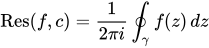
Res ⁡ ( f , c ) = 1 2 π i ∮ γ f ( z ) d z {\displaystyle \operatorname {Res} (f,c)={1 \over 2\pi i}\oint _{\gamma }f(z)\,dz} {\displaystyle \operatorname {Res} (f,c)={1 \over 2\pi i}\oint _{\gamma }f(z)\,dz}

where ⁠ γ {\displaystyle \gamma } {\displaystyle \gamma }⁠ traces out a circle around ⁠ c {\displaystyle c} {\displaystyle c}⁠ in a counterclockwise manner and does not pass through or contain other singularities within it. We may choose the path ⁠ γ {\displaystyle \gamma } {\displaystyle \gamma }⁠ to be a circle of radius ⁠ ε {\displaystyle \varepsilon } {\displaystyle \varepsilon }⁠ around ⁠ c {\displaystyle c} {\displaystyle c}⁠. Since ⁠ ε {\displaystyle \varepsilon } {\displaystyle \varepsilon }⁠ can be as small as we desire it can be made to contain only the singularity of ⁠ c {\displaystyle c} {\displaystyle c}⁠ due to nature of isolated singularities. This may be used for calculation in cases where the integral can be calculated directly, but it is usually the case that residues are used to simplify calculation of integrals, and not the other way around.

Removable singularities

[edit]

If the function ⁠ f {\displaystyle f} {\displaystyle f}⁠ can be continued to a holomorphic function on the whole disk ⁠ | y − c | < R {\displaystyle \vert y-c\vert <R} {\displaystyle \vert y-c\vert <R}⁠, then ⁠ Res ⁡ ( f , c ) = 0 {\displaystyle \operatorname {Res} (f,c)=0} {\displaystyle \operatorname {Res} (f,c)=0}⁠. The converse is not in general true.

Simple poles

[edit]

If ⁠ c {\displaystyle c} {\displaystyle c}⁠ is a simple pole of ⁠ f {\displaystyle f} {\displaystyle f}⁠, the residue of ⁠ f {\displaystyle f} {\displaystyle f}⁠ is given by:

Res ⁡ ( f , c ) = lim z → c ( z − c ) f ( z ) . {\displaystyle \operatorname {Res} (f,c)=\lim _{z\to c}(z-c)f(z).} {\displaystyle \operatorname {Res} (f,c)=\lim _{z\to c}(z-c)f(z).}

If that limit does not exist, then ⁠ f {\displaystyle f} {\displaystyle f}⁠ instead has an essential singularity at ⁠ c {\displaystyle c} {\displaystyle c}⁠. If the limit is ⁠ 0 {\displaystyle 0} {\displaystyle 0}⁠, then ⁠ f {\displaystyle f} {\displaystyle f}⁠ is either analytic at ⁠ c {\displaystyle c} {\displaystyle c}⁠ or has a removable singularity there. If the limit is equal to infinity, then the order of the pole is higher than ⁠ 1 {\displaystyle 1} {\displaystyle 1}⁠.

It may be that the function ⁠ f {\displaystyle f} {\displaystyle f}⁠ can be expressed as a quotient of two functions, ⁠ f ( z ) = g ( z ) / h ( z ) {\displaystyle f(z)={g(z)}/{h(z)}} {\displaystyle f(z)={g(z)}/{h(z)}}⁠, where ⁠ g {\displaystyle g} {\displaystyle g}⁠ and ⁠ h {\displaystyle h} {\displaystyle h}⁠ are holomorphic functions in a neighbourhood of ⁠ c {\displaystyle c} {\displaystyle c}⁠, with ⁠ h ( c ) = 0 {\displaystyle h(c)=0} {\displaystyle h(c)=0}⁠ and ⁠ h ′ ( c ) ≠ 0 {\displaystyle h'(c)\neq 0} {\displaystyle h'(c)\neq 0}⁠. In such a case, L'Hôpital's rule can be used to simplify the above formula to:

Res ⁡ ( f , c ) = lim z → c ( z − c ) f ( z ) = lim z → c z g ( z ) − c g ( z ) h ( z ) = lim z → c g ( z ) + z g ′ ( z ) − c g ′ ( z ) h ′ ( z ) = g ( c ) h ′ ( c ) . {\displaystyle {\begin{aligned}\operatorname {Res} (f,c)&=\lim _{z\to c}(z-c)f(z)=\lim _{z\to c}{\frac {zg(z)-cg(z)}{h(z)}}\\[4pt]&=\lim _{z\to c}{\frac {g(z)+zg'(z)-cg'(z)}{h'(z)}}={\frac {g(c)}{h'(c)}}.\end{aligned}}} {\displaystyle {\begin{aligned}\operatorname {Res} (f,c)&=\lim _{z\to c}(z-c)f(z)=\lim _{z\to c}{\frac {zg(z)-cg(z)}{h(z)}}\\[4pt]&=\lim _{z\to c}{\frac {g(z)+zg'(z)-cg'(z)}{h'(z)}}={\frac {g(c)}{h'(c)}}.\end{aligned}}}

Limit formula for higher-order poles

[edit]

More generally, if ⁠ c {\displaystyle c} {\displaystyle c}⁠ is a pole of order ⁠ p {\displaystyle p} {\displaystyle p}⁠, then the residue of ⁠ f {\displaystyle f} {\displaystyle f}⁠ around ⁠ z = c {\displaystyle z=c} {\displaystyle z=c}⁠ can be found by the formula:

Res ⁡ ( f , c ) = 1 ( p − 1 ) ! lim z → c d p − 1 d z p − 1 ( ( z − c ) p f ( z ) ) . {\displaystyle \operatorname {Res} (f,c)={\frac {1}{(p-1)!}}\lim _{z\to c}{\frac {d^{p-1}}{dz^{p-1}}}\left((z-c)^{p}f(z)\right).} {\displaystyle \operatorname {Res} (f,c)={\frac {1}{(p-1)!}}\lim _{z\to c}{\frac {d^{p-1}}{dz^{p-1}}}\left((z-c)^{p}f(z)\right).}

This formula can be very useful in determining the residues for low-order poles. For higher-order poles, the calculations can become unmanageable, and series expansion is usually easier. For essential singularities, no such simple formula exists, and residues must usually be taken directly from series expansions.

Residue at infinity

[edit]

In general, the residue at infinity is defined as:

Res ⁡ ( f ( z ) , ∞ ) = − Res ( 1 z 2 f ( 1 z ) , 0 ) . {\displaystyle \operatorname {Res} (f(z),\infty )=-{\operatorname {Res} }\left({\frac {1}{z^{2}}}f\left({\frac {1}{z}}\right),0\right).} {\displaystyle \operatorname {Res} (f(z),\infty )=-{\operatorname {Res} }\left({\frac {1}{z^{2}}}f\left({\frac {1}{z}}\right),0\right).}

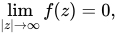
If the following condition is met:

lim | z | → ∞ f ( z ) = 0 , {\displaystyle \lim _{|z|\to \infty }f(z)=0,} {\displaystyle \lim _{|z|\to \infty }f(z)=0,}

then the residue at infinity can be computed using the following formula:

Res ⁡ ( f , ∞ ) = − lim | z | → ∞ z f ( z ) . {\displaystyle \operatorname {Res} (f,\infty )=-\lim _{|z|\to \infty }zf(z).} {\displaystyle \operatorname {Res} (f,\infty )=-\lim _{|z|\to \infty }zf(z).}

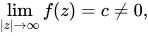
If instead

lim | z | → ∞ f ( z ) = c ≠ 0 , {\displaystyle \lim _{|z|\to \infty }f(z)=c\neq 0,} {\displaystyle \lim _{|z|\to \infty }f(z)=c\neq 0,}

then the residue at infinity is

Res ⁡ ( f , ∞ ) = lim | z | → ∞ z 2 f ′ ( z ) . {\displaystyle \operatorname {Res} (f,\infty )=\lim _{|z|\to \infty }z^{2}f'(z).} {\displaystyle \operatorname {Res} (f,\infty )=\lim _{|z|\to \infty }z^{2}f'(z).}

For functions that are meromorphic on the entire complex plane with finitely many singularities, the sum of the residues at the (necessarily) isolated singularities plus the residue at infinity is zero, which gives:

Res ⁡ ( f ( z ) , ∞ ) = − ∑ k Res ⁡ ( f ( z ) , a k ) . {\displaystyle \operatorname {Res} (f(z),\infty )=-\sum _{k}\operatorname {Res} (f(z),a_{k}).} {\displaystyle \operatorname {Res} (f(z),\infty )=-\sum _{k}\operatorname {Res} (f(z),a_{k}).}

Series methods

[edit]

If parts or all of a function can be expanded into a Taylor series or Laurent series, which may be possible if the parts or the whole of the function has a standard series expansion, then calculating the residue is significantly simpler than by other methods. The residue of the function is simply given by the coefficient of ⁠ ( z − c ) − 1 {\displaystyle (z-c)^{-1}} {\displaystyle (z-c)^{-1}}⁠ in the Laurent series expansion of the function.

Examples

[edit]

An integral along the real axis

[edit]

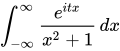
The integral ∫ − ∞ ∞ e i t x x 2 + 1 d x {\displaystyle \int _{-\infty }^{\infty }{\frac {e^{itx}}{x^{2}+1}}\,dx} {\displaystyle \int _{-\infty }^{\infty }{\frac {e^{itx}}{x^{2}+1}}\,dx}

The contour C

arises in probability theory when calculating the characteristic function of the Cauchy distribution. It resists the techniques of elementary calculus but can be evaluated by expressing it as a limit of contour integrals.

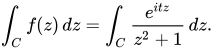
Suppose t > 0 and define the contour C that goes along the real line from −a to a and then counterclockwise along a semicircle centered at 0 from a to −a. Take a to be greater than 1, so that the imaginary unit i is enclosed within the curve. Now consider the contour integral ∫ C f ( z ) d z = ∫ C e i t z z 2 + 1 d z . {\displaystyle \int _{C}{f(z)}\,dz=\int _{C}{\frac {e^{itz}}{z^{2}+1}}\,dz.} {\displaystyle \int _{C}{f(z)}\,dz=\int _{C}{\frac {e^{itz}}{z^{2}+1}}\,dz.}

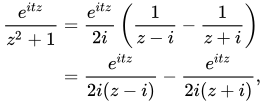
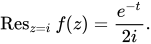
Since eitz is an entire function (having no singularities at any point in the complex plane), this function has singularities only where the denominator z2 + 1 is zero. Since z2 + 1 = (z + i)(z − i), that happens only where z = i or z = −i. Only one of those points is in the region bounded by this contour. Because f(z) is e i t z z 2 + 1 = e i t z 2 i ( 1 z − i − 1 z + i ) = e i t z 2 i ( z − i ) − e i t z 2 i ( z + i ) , {\displaystyle {\begin{aligned}{\frac {e^{itz}}{z^{2}+1}}&={\frac {e^{itz}}{2i}}\left({\frac {1}{z-i}}-{\frac {1}{z+i}}\right)\\&={\frac {e^{itz}}{2i(z-i)}}-{\frac {e^{itz}}{2i(z+i)}},\end{aligned}}} {\displaystyle {\begin{aligned}{\frac {e^{itz}}{z^{2}+1}}&={\frac {e^{itz}}{2i}}\left({\frac {1}{z-i}}-{\frac {1}{z+i}}\right)\\&={\frac {e^{itz}}{2i(z-i)}}-{\frac {e^{itz}}{2i(z+i)}},\end{aligned}}} the residue of f(z) at z = i is Res z = i ⁡ f ( z ) = e − t 2 i . {\displaystyle \operatorname {Res} _{z=i}f(z)={\frac {e^{-t}}{2i}}.} {\displaystyle \operatorname {Res} _{z=i}f(z)={\frac {e^{-t}}{2i}}.}

According to the residue theorem, then, we have ∫ C f ( z ) d z = 2 π i ⋅ Res z = i ⁡ f ( z ) = 2 π i e − t 2 i = π e − t . {\displaystyle \int _{C}f(z)\,dz=2\pi i\cdot \operatorname {Res} \limits _{z=i}f(z)=2\pi i{\frac {e^{-t}}{2i}}=\pi e^{-t}.} {\displaystyle \int _{C}f(z)\,dz=2\pi i\cdot \operatorname {Res} \limits _{z=i}f(z)=2\pi i{\frac {e^{-t}}{2i}}=\pi e^{-t}.}

The contour C may be split into a straight part and a curved arc, so that ∫ s t r a i g h t f ( z ) d z + ∫ a r c f ( z ) d z = π e − t {\displaystyle \int _{\mathrm {straight} }f(z)\,dz+\int _{\mathrm {arc} }f(z)\,dz=\pi e^{-t}} {\displaystyle \int _{\mathrm {straight} }f(z)\,dz+\int _{\mathrm {arc} }f(z)\,dz=\pi e^{-t}} and thus ∫ − a a f ( z ) d z = π e − t − ∫ a r c f ( z ) d z . {\displaystyle \int _{-a}^{a}f(z)\,dz=\pi e^{-t}-\int _{\mathrm {arc} }f(z)\,dz.} {\displaystyle \int _{-a}^{a}f(z)\,dz=\pi e^{-t}-\int _{\mathrm {arc} }f(z)\,dz.}

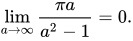
Using some estimations, we have | ∫ a r c e i t z z 2 + 1 d z | ≤ π a ⋅ sup arc | e i t z z 2 + 1 | ≤ π a ⋅ sup arc 1 | z 2 + 1 | ≤ π a a 2 − 1 , {\displaystyle \left|\int _{\mathrm {arc} }{\frac {e^{itz}}{z^{2}+1}}\,dz\right|\leq \pi a\cdot \sup _{\text{arc}}\left|{\frac {e^{itz}}{z^{2}+1}}\right|\leq \pi a\cdot \sup _{\text{arc}}{\frac {1}{|z^{2}+1|}}\leq {\frac {\pi a}{a^{2}-1}},} {\displaystyle \left|\int _{\mathrm {arc} }{\frac {e^{itz}}{z^{2}+1}}\,dz\right|\leq \pi a\cdot \sup _{\text{arc}}\left|{\frac {e^{itz}}{z^{2}+1}}\right|\leq \pi a\cdot \sup _{\text{arc}}{\frac {1}{|z^{2}+1|}}\leq {\frac {\pi a}{a^{2}-1}},} and lim a → ∞ π a a 2 − 1 = 0. {\displaystyle \lim _{a\to \infty }{\frac {\pi a}{a^{2}-1}}=0.} {\displaystyle \lim _{a\to \infty }{\frac {\pi a}{a^{2}-1}}=0.}

The estimate on the numerator follows since t > 0, and for complex numbers z along the arc (which lies in the upper half-plane), the argument φ of z lies between 0 and π. So, | e i t z | = | e i t | z | ( cos ⁡ φ + i sin ⁡ φ ) | = | e − t | z | sin ⁡ φ + i t | z | cos ⁡ φ | = e − t | z | sin ⁡ φ ≤ 1. {\displaystyle \left|e^{itz}\right|=\left|e^{it|z|(\cos \varphi +i\sin \varphi )}\right|=\left|e^{-t|z|\sin \varphi +it|z|\cos \varphi }\right|=e^{-t|z|\sin \varphi }\leq 1.} {\displaystyle \left|e^{itz}\right|=\left|e^{it|z|(\cos \varphi +i\sin \varphi )}\right|=\left|e^{-t|z|\sin \varphi +it|z|\cos \varphi }\right|=e^{-t|z|\sin \varphi }\leq 1.}

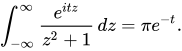
Therefore, ∫ − ∞ ∞ e i t z z 2 + 1 d z = π e − t . {\displaystyle \int _{-\infty }^{\infty }{\frac {e^{itz}}{z^{2}+1}}\,dz=\pi e^{-t}.} {\displaystyle \int _{-\infty }^{\infty }{\frac {e^{itz}}{z^{2}+1}}\,dz=\pi e^{-t}.}

If t < 0 then a similar argument with an arc C′ that winds around −i rather than i shows that

The contour C′

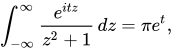
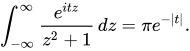
∫ − ∞ ∞ e i t z z 2 + 1 d z = π e t , {\displaystyle \int _{-\infty }^{\infty }{\frac {e^{itz}}{z^{2}+1}}\,dz=\pi e^{t},} {\displaystyle \int _{-\infty }^{\infty }{\frac {e^{itz}}{z^{2}+1}}\,dz=\pi e^{t},} and finally we have ∫ − ∞ ∞ e i t z z 2 + 1 d z = π e − | t | . {\displaystyle \int _{-\infty }^{\infty }{\frac {e^{itz}}{z^{2}+1}}\,dz=\pi e^{-\left|t\right|}.} {\displaystyle \int _{-\infty }^{\infty }{\frac {e^{itz}}{z^{2}+1}}\,dz=\pi e^{-\left|t\right|}.}

(If t = 0 then the integral yields immediately to elementary calculus methods and its value is π.)

Evaluating zeta functions

[edit]

The fact that π cot(πz) has simple poles with residue 1 at each integer can be used to compute the sum ∑ n = − ∞ ∞ f ( n ) . {\displaystyle \sum _{n=-\infty }^{\infty }f(n).} {\displaystyle \sum _{n=-\infty }^{\infty }f(n).}

Consider, for example, f(z) = z−2. Let ΓN be the rectangle that is the boundary of [−N − ⁠1/2⁠, N + ⁠1/2⁠]2 with positive orientation, with an integer N. By the residue formula, 1 2 π i ∫ Γ N f ( z ) π cot ⁡ ( π z ) d z = Res z = 0 + ∑ n = − N n ≠ 0 N n − 2 . {\displaystyle {\frac {1}{2\pi i}}\int _{\Gamma _{N}}f(z)\pi \cot(\pi z)\,dz=\operatorname {Res} \limits _{z=0}+\sum _{n=-N \atop n\neq 0}^{N}n^{-2}.} {\displaystyle {\frac {1}{2\pi i}}\int _{\Gamma _{N}}f(z)\pi \cot(\pi z)\,dz=\operatorname {Res} \limits _{z=0}+\sum _{n=-N \atop n\neq 0}^{N}n^{-2}.}

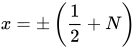
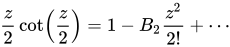
The left-hand side goes to zero as N → ∞ since | cot ⁡ ( π z ) | {\displaystyle |\cot(\pi z)|} {\displaystyle |\cot(\pi z)|} is uniformly bounded on the contour, thanks to using x = ± ( 1 2 + N ) {\displaystyle x=\pm \left({\frac {1}{2}}+N\right)} {\displaystyle x=\pm \left({\frac {1}{2}}+N\right)} on the left and right side of the contour, and so the integrand has order O ( N − 2 ) {\displaystyle O(N^{-2})} {\displaystyle O(N^{-2})} over the entire contour. On the other hand,[2] z 2 cot ⁡ ( z 2 ) = 1 − B 2 z 2 2 ! + ⋯ {\displaystyle {\frac {z}{2}}\cot \left({\frac {z}{2}}\right)=1-B_{2}{\frac {z^{2}}{2!}}+\cdots } {\displaystyle {\frac {z}{2}}\cot \left({\frac {z}{2}}\right)=1-B_{2}{\frac {z^{2}}{2!}}+\cdots } where the Bernoulli number ⁠ B 2 = 1 6 {\displaystyle B_{2}={\frac {1}{6}}} {\displaystyle B_{2}={\frac {1}{6}}}⁠.

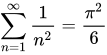
(In fact, ⁠z/2⁠ cot(⁠z/2⁠) = ⁠iz/1 − e−iz⁠ − ⁠iz/2⁠.) Thus, the residue Resz=0 is −⁠π2/3⁠. We conclude: ∑ n = 1 ∞ 1 n 2 = π 2 6 {\displaystyle \sum _{n=1}^{\infty }{\frac {1}{n^{2}}}={\frac {\pi ^{2}}{6}}} {\displaystyle \sum _{n=1}^{\infty }{\frac {1}{n^{2}}}={\frac {\pi ^{2}}{6}}} which is a proof of the Basel problem.

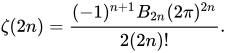
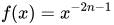
The same argument works for all f ( x ) = x − 2 n {\displaystyle f(x)=x^{-2n}} {\displaystyle f(x)=x^{-2n}} where n {\displaystyle n} {\displaystyle n} is a positive integer, giving us ζ ( 2 n ) = ( − 1 ) n + 1 B 2 n ( 2 π ) 2 n 2 ( 2 n ) ! . {\displaystyle \zeta (2n)={\frac {(-1)^{n+1}B_{2n}(2\pi )^{2n}}{2(2n)!}}.} {\displaystyle \zeta (2n)={\frac {(-1)^{n+1}B_{2n}(2\pi )^{2n}}{2(2n)!}}.} The trick does not work when ⁠ f ( x ) = x − 2 n − 1 {\displaystyle f(x)=x^{-2n-1}} {\displaystyle f(x)=x^{-2n-1}}⁠, since in this case, the residue at zero vanishes, and we obtain the useless identity ⁠ 0 + ζ ( 2 n + 1 ) − ζ ( 2 n + 1 ) = 0 {\displaystyle 0+\zeta (2n+1)-\zeta (2n+1)=0} {\displaystyle 0+\zeta (2n+1)-\zeta (2n+1)=0}⁠.

Evaluating Eisenstein series

[edit]

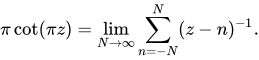
The same trick can be used to establish the sum of the Eisenstein series: π cot ⁡ ( π z ) = lim N → ∞ ∑ n = − N N ( z − n ) − 1 . {\displaystyle \pi \cot(\pi z)=\lim _{N\to \infty }\sum _{n=-N}^{N}(z-n)^{-1}.} {\displaystyle \pi \cot(\pi z)=\lim _{N\to \infty }\sum _{n=-N}^{N}(z-n)^{-1}.}

Proof

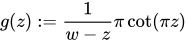
Pick an arbitrary ⁠ w ∈ C ∖ Z {\displaystyle w\in \mathbb {C} \setminus \mathbb {Z} } {\displaystyle w\in \mathbb {C} \setminus \mathbb {Z} }⁠. As above, define g ( z ) := 1 w − z π cot ⁡ ( π z ) {\displaystyle g(z):={\frac {1}{w-z}}\pi \cot(\pi z)} {\displaystyle g(z):={\frac {1}{w-z}}\pi \cot(\pi z)}

By the Cauchy residue theorem, for all N {\displaystyle N} {\displaystyle N} large enough such that Γ N {\displaystyle \Gamma _{N}} {\displaystyle \Gamma _{N}} encircles ⁠ w {\displaystyle w} {\displaystyle w}⁠, 1 2 π i ∮ Γ N g ( z ) d z = − π cot ⁡ ( π z ) + ∑ n = − N N 1 z − n {\displaystyle {\frac {1}{2\pi i}}\oint _{\Gamma _{N}}g(z)dz=-\pi \cot(\pi z)+\sum _{n=-N}^{N}{\frac {1}{z-n}}} {\displaystyle {\frac {1}{2\pi i}}\oint _{\Gamma _{N}}g(z)dz=-\pi \cot(\pi z)+\sum _{n=-N}^{N}{\frac {1}{z-n}}}

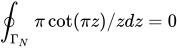
It remains to prove the integral converges to zero. Since π cot ⁡ ( π z ) / z {\displaystyle \pi \cot(\pi z)/z} {\displaystyle \pi \cot(\pi z)/z} is an even function, and Γ N {\displaystyle \Gamma _{N}} {\displaystyle \Gamma _{N}} is symmetric about the origin, we have ⁠ ∮ Γ N π cot ⁡ ( π z ) / z d z = 0 {\displaystyle \oint _{\Gamma _{N}}\pi \cot(\pi z)/zdz=0} {\displaystyle \oint _{\Gamma _{N}}\pi \cot(\pi z)/zdz=0}⁠, and so ∮ Γ N g ( z ) d z = ∮ Γ N ( 1 z + 1 w − z ) π cot ⁡ ( π z ) d z = − w ∮ Γ N 1 z ( z − w ) π cot ⁡ ( π z ) d z = O ( 1 / N ) {\displaystyle \oint _{\Gamma _{N}}g(z)dz=\oint _{\Gamma _{N}}\left({\frac {1}{z}}+{\frac {1}{w-z}}\right)\pi \cot(\pi z)dz=-w\oint _{\Gamma _{N}}{\frac {1}{z(z-w)}}\pi \cot(\pi z)dz=O(1/N)} {\displaystyle \oint _{\Gamma _{N}}g(z)dz=\oint _{\Gamma _{N}}\left({\frac {1}{z}}+{\frac {1}{w-z}}\right)\pi \cot(\pi z)dz=-w\oint _{\Gamma _{N}}{\frac {1}{z(z-w)}}\pi \cot(\pi z)dz=O(1/N)}

See also

[edit]
  • Residue (complex analysis)
  • Cauchy's integral formula
  • Glasser's master theorem
  • Jordan's lemma
  • Methods of contour integration
  • Morera's theorem
  • Nachbin's theorem
  • Residue at infinity
  • Logarithmic form

Notes

[edit]
  1. ^ Whittaker & Watson 1920, p. 112, §6.1.
  2. ^ Whittaker & Watson 1920, p. 125, §7.2. Note that the Bernoulli number B 2 n {\displaystyle B_{2n}} {\displaystyle B_{2n}} is denoted by B n {\displaystyle B_{n}} {\displaystyle B_{n}} in Whittaker & Watson's book.

References

[edit]
  • Ahlfors, Lars (1979). Complex Analysis. McGraw Hill. ISBN 0-07-085008-9.
  • Lindelöf, Ernst L. (1905). Le calcul des résidus et ses applications à la théorie des fonctions (in French). Editions Jacques Gabay (published 1989). ISBN 2-87647-060-8. {{cite book}}: ISBN / Date incompatibility (help)
  • Mitrinović, Dragoslav; Kečkić, Jovan (1984). The Cauchy method of residues: Theory and applications. D. Reidel Publishing Company. ISBN 90-277-1623-4.
  • Whittaker, E. T.; Watson, G. N. (1920). A Course of Modern Analysis (3rd ed.). Cambridge University Press.

External links

[edit]
  • "Cauchy integral theorem", Encyclopedia of Mathematics, EMS Press, 2001 [1994]
  • Residue theorem in MathWorld
Retrieved from "https://teknopedia.ac.id/w/index.php?title=Residue_theorem&oldid=1341001138"
Categories:
  • Theorems in complex analysis
  • Analytic functions
Hidden categories:
  • Articles with short description
  • Short description is different from Wikidata
  • Articles with excerpts
  • CS1 errors: ISBN date
  • CS1 French-language sources (fr)

  • indonesia
  • Polski
  • العربية
  • Deutsch
  • English
  • Español
  • Français
  • Italiano
  • مصرى
  • Nederlands
  • 日本語
  • Português
  • Sinugboanong Binisaya
  • Svenska
  • Українська
  • Tiếng Việt
  • Winaray
  • 中文
  • Русский
Sunting pranala
url url url url url url url url url url url url url url url url url url url url url url url url url url url url url url url url url url url url url url url url url url url url url url url url url url url url url url url url url url url url url url url url url url url url url url url url url url url url url url url url url url url url url url url url url url url url url url url url url url url url url url url url url url url url url url url url url url url url url url url url url url url url url url url url url url url url url url url url url url url url url url url url url url url url url url url url url url url url url url url url url url url url url url url url url url url url url url url url url url url url url url url url url url url url url url url url url url url url url url url url url url url url url url url url url url url url url url url url url url url url url url url url url url url url url url url url url url url url url url url url url url url url url url url url url url url url url url url url url url url url url url url url url url url url url url url url url url url url url url url url url url url url url url url url url url url url url url url url url url url url url url url url url url url url url url url url url url url url url url url url url url url url url url url url url url url url url url url url url url url url url url url url url url url url url url url url url url url url url url url url url url url url url url url url url url url url url url url url url url url url url url url url url url url url url url url url url url url url url url url url url url url url url url url url url url url url url url url url url url url url url url url url url url url url url url url url url url url url url url url url url url url url url url url url url url url url url url url url url url url url url url url url url url url url url url url url url url url url url url url url url url url url url url url url url url url url url url url url url url url url url url url url url url url url url url url url url url url url url url url url url url url url url url url url url url url url url url url url url url url url url url url url url url url url url url url url url url url url url url url url url url url url url url url url url url url url url url url url url url url url url url url url url url url url url url url url url url url url url url url url url url url url url url url url url url url url url url url url url url url url url url url url url url url url url url url url url url url url url url url url url url url url url url url url url url url url url url url url url url url url url url url url url url url url url url url url url url url url url url url url url url url url url url url url url url url url url url url url url url url url url url url url url url url url url url url url url url url url url url url url url url url url url url url url url url url url url url url url url url url url url url url url url url url url url url url url url url url url url url url url url url url url url url url url url url url url url url url url url url url url url url url url url url url url url url url url url url url url url url url url url url url url url url url url url url url url url url url url url url url url url url url url url url url url url url url url url url url url url url url url url url url url url url url url url url url url url url url url url url url url url url url url url url url url url url url url url url url url url url url url url url url url url url url url url url url url url url url url url url url url url url url url url url url url url url url url url url url url url url url url url url url url url url url url url url url url url url url url url url url url url url url url url url url url url url url url url url url url url url url url url url url url url url url url url url url url url url url url url url url url url url url url url url url url url url url url url url url url url url url url url url url url url url url url url url url url url url url url url url url url url url url url url url url url url url url url url url url url url url url url url url url url url url url url url url url url url url url url url url url url url url url url url url url url url url url url url url url url url url url url url url url url url url url url url url url url url url url url url url url url url url url url url url url url url url url url url url url url url url url url url url url url url url url url url url url url url url url url url url url url url url url url url url url url url url url url url url url url url url url url url url url url url url url url url url url url url url url url url url url url url url url url url url url url url url url url url url url url url url url url url url url url url url url url url url url url url url url url url url url url url url url url url url url url url url url url url url url url url url url url url url url url url url url url url url url url url url url url url url url url url url url url url url url url url url url url url url url url url url url url url url url url url url url url url url url url url url url url url url url url url url url url url url url url url url url url url url url url url url url url url url url url url url url url url url url url url url url url url url url url url url url url url url url url url url url url url url url url url url url url url url url url url url url url url url url url url url url url url url url url url url url url url url url url url url url url url url url url url url url url url url url url url url url url url url url url url url url url url url url url url url url url url url url url url url url url url url url url url url url url url url url url url url url url url url url url url url url url url url url url url url url url url url url url url url url url url url url url url url url url url url url url url url url url url url url url url url url url url url url url url url url url url url url url url url url url url url url url url url url url url url url url url url url url url url url url url url url url url url url url url url url url url url url url url url url url url url url url url url url url url url url url url url url url url url url url url url url url url url url url url url url url url url url url url url url url url url url url url url url url url url url url url url url url url url url url url url url url url url url url url url url url url url url url url url url url url url url url url url url url url url url url url url url url url url url url url url url url url url url url url url url url url url url url url url url url url url url url url url url url url url url url url url url url url url url url url url url url url url url url url url url url url url url url url url url url url url url url url url url url url url url url url url url url url url url url url url url url url url url url url url url url url url url url url url url url url url url url url url url url url url url url url url url url url url url url url url url url url url url url url url url url url url url url url url url url url url url url url url url url url url url url url url url url url url url url url url url url url url url url url url url url url url url url url url url url url url url url url url url url url url url url url url url url url url url url url url url url url url url url url url url url url url url url url url url url url url url url url url url url url url url url url url url url url url url url url url url url url url url url url url url url url url url url url url url url url url url url url url url url url url url url url url url url url url url url url url url url url url url url url url url url url url url url url url url url url url url url url url url url url url url url url url url url url url url url url url url url url url url url url url url url url url url url url url url url url url url url url url url url url url url url url url url url url url url url url url url url url url url url url url url url url url url url url url url url url url url url url url url url url url url url url url url url url url url url url url url url url url url url url url url url url url url url url url url url url url url url url url url url url url url url url url url url url url url url url url url url url url url url url url url url url url url url url url url url url url url url url url url url url url url url url url url url url url url url url url url url url url url url url url url url url url url url url url url url url url url url url url url url url url url url url url url url url url url url url url url url url url url url url url url url url url url url url url url url url url url url url url url url url url url url url url url url url url url url url url url url url url url url url url url url url url url url url url url url url url url url url url url url url url url url url url url url url url url url url url url url url url url url url url url url url url url url url url url url url url url url url url url url url url url url url url url url url url url url url url url url url url url url url url url url url url url url url url url url url url url url url url url url url url url url url url url url url url url url url url url url url url url url url url url url url url url url url url url url url url url url url url url url url url url url url url url url url url url url url url url url url url url url url url url url url url url url url url url url url url url url url url url url url url url url url url url url url url url url url url url url url url url url url url url url
Pusat Layanan

UNIVERSITAS TEKNOKRAT INDONESIA | ASEAN's Best Private University
Jl. ZA. Pagar Alam No.9 -11, Labuhan Ratu, Kec. Kedaton, Kota Bandar Lampung, Lampung 35132
Phone: (0721) 702022
Email: pmb@teknokrat.ac.id