

Syros
Περιφερειακή ενότητα Σύρου Δήμος Σύρου-Ερμούπολης | |
|---|---|
 Ermoupoli and Ano Syros | |
 Syros within the South Aegean | |
  Syros | |
| Coordinates: 37°26′N 24°55′E / 37.433°N 24.917°E | |
| Country | Greece |
| Administrative region | South Aegean |
| Seat | Ermoupoli |
| Area | |
• Municipality | 101.9 km2 (39.3 sq mi) |
| Population (2021)[1] | |
• Municipality | 21,124 |
| • Density | 207.3/km2 (536.9/sq mi) |
| Time zone | UTC+2 (EET) |
| • Summer (DST) | UTC+3 (EEST) |
| Postal code | 841 xx |
| Area code | 228x0 |
| Vehicle registration | EM |
Syros (Greek: Σύρος [ˈsiros]), also known as Siros or Syra, is a Greek island in the Cyclades, in the Aegean Sea. It is 78 nautical miles (144 km) south-east of Athens. The area of the island is 83.6 km2 (32 sq mi) and at the 2021 census it had 21,124 inhabitants.[1]
The largest towns are Ermoupoli, Ano Syros, and Vari. Ermoupoli is the capital of the island, the Cyclades, and the South Aegean. It has always been a significant port town, and during the 19th century it was even more significant than Piraeus. Other villages are Galissas, Foinikas, Pagos, Manna, Kini, Azolimnos and Poseidonia.
Ermoupoli

Ermoupoli (Greek: Ερμούπολη) stands on a naturally amphitheatrical site, with neo-classical buildings, old mansions, and white houses cascading down to the harbour. It was built during the Greek War of Independence in the 1820s.
The city hall is in the center of the town, in Miaoulis Square, ringed with cafés, seating areas, and palm trees. Dubbed the "City of Hermes", Syros has numerous churches, such as Metamorphosis, Koimisis, St. Demetrius, Three Hierarchs, Anastasis, Evangelistria, and St. Nicolas. There is an archaeological museum and a municipal library.
The quarter of Vaporia is where sea captains traditionally lived. There are numerous neo-classical mansions along the quarter's narrow streets.
Ano Syros


Ano Syros is the second town of Syros and was built by the Venetians at the beginning of the 13th century on the hill of San Giorgio, north-west of Ermoupoli. Ano Syros maintains a medieval atmosphere. Innumerable steps between narrow streets and houses with coloured doors lead to the top of the town. The medieval settlement of Ano Syros is accessible by car; the town is served mostly by marble steps. The distance from the harbour up to the main entry point of the town is about 1000 metres. The Catholic cathedral of Saint George dominates Ano Syros. The cathedral church was constructed during the 13th century. From the cathedral visitors have a panoramic view of the neighbouring islands of Tinos, Delos, Mykonos, Paros, Andros and Naxos.
History
 | This article needs additional citations for verification. (August 2018) |
Kastri culture
The history of settlement on Syros goes back at least 5,000 years, to the Early Bronze Age of the Cycladic civilization. This is when the hill-top settlement of Kastri began. Archaeologists describe Early Cycladic III (ECIII) culture as Kastri culture. It had links with the Anatolian Trade Network, connected with Limantepe in Asia Minor.
Kastri, dated by archaeologists to 2800-2300 BC, was one of the earliest settlements in Greece that were protected by stone walls with rounded bastions. Also the cemetery of Chalandriani is associated with Kastri. Inside the fortification, the houses shared party walls and were packed close together. It is estimated that the fortified town was home to up to 300 people.
The site was first discovered and excavated in 1898 by Christos Tsountas, the "father of Cycladic research". Kastri had some of the earliest metalwork in the region, and also some of the earliest use of potter's wheel.
Antiquity

Throughout history, the island was known as Syra (Ancient Greek: Σύρα),[2] then Syros or Siros (Σῦρος). In later times, it appears to have been inhabited by the Phoenicians. In the Odyssey, Syros was the country of the swineherd Eumaeus who described it at length (Odyssey, XV, 403 sq.), although it has also been suggested that Eumaeus referred to Syracuse, Sicily.[3]
The island was also the home of the philosopher Pherecydes, the teacher of Pythagoras. It possessed two leading cities, Syros (now the modern Ermoupoli) and another city (Galessus) on the western coast where Galissas now stands.
The island did not play an important role during antiquity or the early Christian years.[citation needed] It was not even a diocese at a time when even the smallest island possessed its bishop. During Roman times, the capital of Syros was situated in the area of contemporary Ermoupoli.
Middle Ages

.jpg)
At the end of ancient times, barbarian raids and piracy, which affected the Aegean for many centuries, led Syros to decline. The island, along with the other Cyclades, was devastated several times during the Middle Ages by raiders from different directions including Sicilians, Arabs, Turks and Venetians.
In the Byzantine years Syros constituted part of the Theme of the Aegean Sea, along with the rest of the Cycladic islands. After the overthrow of Byzantium in the Fourth Crusade by the Venetians and Franks in 1204, the island was definitively conquered by the Venetians under the leadership of Marco Sanudo. As part of the Duchy of the Archipelago, Syros would remain under Venetian rule until 1566 although after 1540 this was only maintained by payment of tribute to the Ottoman Sultan.[4]
It was at this time that Ano Syros was founded. During the Latin period, the majority of the local community were Roman Catholics, but maintained the Greek language. During the reign of almost three and a half centuries of the Duchy of the Archipelago, Syros had a singular feudal regime.
Ottoman Era
.JPG)

By the 16th century, the Ottoman fleet became dominant in the Aegean and the Duchy fell apart. In 1522 the corsair Barbarossa took possession of the island, which would be known as "Sire" during Ottoman rule.[5] However, negotiations of the local authorities with the Ottomans gave the Cyclades substantial privileges, such as religious freedom and the reduction of taxes.
At the same time, following an agreement of France and the Holy See with the Ottoman authorities, the Catholics of the island came under the protection of France and Rome[citation needed] and so Syros sometimes was called "the Pope's island".
The Roman Catholic diocese of Syros was a Latin diocese, suffragan of Naxos. The Venetians had established there a Latin bishopric which was subject to the Latin Archbishopric of Athens until 1525. From the time of the island's occupation by the Turks in the 16th century, the Greeks established an Orthodox metropolitan on Syros: Joseph[6] is the earliest known, along with Symeon who died in 1594[7] and Ignatius in 1596.[8] The island became for the most part Catholic.[9]
The list of titular bishops may be found in Le Quien[10] and in Eubel.[11] The most celebrated among them is Ioannis Andreas Kargas, whom the Turks strangled in 1617 because he refused to convert to Islam and because he was helping Greek revolutionaries hiding on the island.[12]
After the second half of the 17th century, a period of economic recovery of the Aegean began, climaxing during the transition from the 18th to the 19th century. The special regime of the islands allowed the development of local self-government. The decline of piracy since the beginning of the 19th century led to the gradual liberation of the sea routes of the Eastern Mediterranean.
In Independent Greece
Greek War of Independence and 19th century

Due to its crucial geographical position, Syros became known as a maritime way-point. Moreover, the special social, religious and institutional conditions prevailing on the island, led Syriots to neutrality at the beginning of the Greek Revolution in 1821. As a result, Syros became a secure shelter during the Revolution, attracting many Greek refugees from Asia Minor, Chios, Spetses, Psara, Aivali, Smyrna, Kydonia, Kassos and other places. These refugees built Ermoupoli.

In 1827 Syros became part of the newly founded First Hellenic Republic and later (1834) the Greek Kingdom. The island returned to peace and tranquility, Syros became known as a cross-road in the Aegean and as an international commercial center linking Western Europe and the Mediterranean sea to the East. The construction of the first buildings began in 1822, and in 1824 the first Orthodox Church Metamorphosis and the largest Greek sanatorium was constructed.


Because of the Venetian domination from the Middle Ages onwards, the islanders had a Roman Catholic majority. However, due to immigration from other islands, Catholics now constitute some 47% of the population. The majority of the population are Greek Orthodox. Intermarriage between Churches is very common in Syros. There is also a single parish of the Byzantine Greek Catholic Church.
During 1831 Syros played a prominent role in the elaboration of the new Greek Constitution. Under Ioannis Kapodistrias (Giovanni Capo D'Istria), the first Governor of the new state, the population of Ermoupolis had reached 13,805 residents and the city had evolved into a seat of government.
It had a Commercial Court of Law, a post office (one of the first in Greece), insurance brokerages, the first public school, a branch of the National Bank of Greece, art gallery, museum, library, a social club for the elite society etc. However, in 1854 cholera and a series of other epidemics plunged Syros into mourning. A number of charitable institutions for public health and social services were established during this period: orphanages, poorhouses and a mental hospital.
Newcomers, mainly mariners and tradesmen, gave the island a new dynamic, which along with its demographic and economic development, turned it into an administrative and cultural centre. Newcomers flocked to the island and founded the town of Ermoupoli, which rapidly became the leading port of Greece.
Between 1822 and 1865, Ermoupoli was rebuilt in a Neoclassical style, merging Greek Classicism with elements of the Renaissance. Many landmarks such as the City Hall (designed by the German architect Ernst Ziller), the Apollo Theatre by the Italian architect Pietro Campo (a miniature version of the La Scala in Milan), the main Library, the General Hospital of Syros (Vardakeio-Proio), Miaoulis square and other buildings were built during that period of time. Passing through on 6 April 1864, the effect of all the sugary marble is such that the English artist Edward Lear, refers to the town fondly in his diary as "the old sparkly pile".[13]
The European architects (mainly Germans and Italians) and also Greeks who participated in the design and planning of Ermoupolis respected the classical and ancient Greek architecture and harmonized it with the romanticism of the West. Ermoupoli has a high density of neoclassical architecture. The prosperity of Syros was connected with the development of social and cultural life. The evolutionary cycle was completed with the creation of the first industrial units during the decade of 1860–70.
Most public buildings, churches, schools, stadiums and many mansions were built in the same elegant and neoclassical style, making Ermoupoli at the time a very modern city with a unique character. As a result, Syros changed almost overnight from a rather quiet island into a vigorous centre of crafts, industry and production.[14] Also, due to its large port of Ermoupoli, it turned into a major centre for ship building and refitting. Neorion was the first shipyard of Greece. To this very day, it remains a place where many ships are serviced and refitted.
Since 1830 the commerce of fabrics, silk, ship building, leather and iron developed on Syros and at the same time a powerful banking system was created. The tremendous growth and development of Ermoupolis continued and until 1860 Syros was the most important commercial harbour in Greece. Together with commerce and ship building, construction and public works were also developed. The Greek Steamship Company was founded in 1856.
A period of decline then followed, as sailing gave way to steam, the importance of the geographical situation of the island was reduced and Piraeus harbour finally took the predominant position in Greece - with the competition of Patras also reducing Syros' commercial importance.
20th century
Beginning at the end of the 19th century and for several decades, a temporary economic recovery took place, due to the development of the textile industry ("Foustanos-Karellas-Velissaropoulos & Co").
As a result of the imperial ambitions and fascist ideology of Benito Mussolini's Italy, which invaded and occupied Syros during World War II, the island's inhabitants experienced a devastating famine causing thousands of deaths.[15]
The Second World War reduced Syros' economic development, as was the case for every economic centre in Greece. However, already since the 1980s, along with the generalized economic recovery and the rise of the living standards in Greece, elements of improvement appeared with tourism as its central axis. At the same time, the re-opening of the Neorion shipyards, as well as a number of other activities, indicate that Syros is on an upward trend.
Ermoupoli today has 7 elementary schools, 2 junior high schools, 2 high schools, 2 technical schools and the Aegean University with a department of Fine Arts and system design, with a proposed future addition in Applied Arts and Visual Arts. The Syros Island National Airport, the Aegean casino, the frequent passenger boat transportation system and all other modern amenities help to attract many domestic and foreign tourists to the island all year round.
Syros also has a British cemetery where various people are buried, including many seamen and servicemen who died in the Cyclades region, particularly during the Second World War. The numerous consulates of countries such as France, Britain, Italy, the Netherlands and Scandinavian countries bear witness to the connection of Syros with the wider European scene.

Administration

Syros is a separate regional unit of the South Aegean region. The only municipality of the regional unit is Syros-Ermoupoli. As a part of the 2011 Kallikratis government reform, the regional unit Syros was created out of part of the former Cyclades Prefecture. At the same reform, the municipality Syros-Ermoupoli was created out of the 3 former municipalities:[16]
The municipality also includes the uninhabited island Gyaros and several other islets. The total area of the municipality is 101.90 km2 (39 sq mi).[17]
Province
The province of Syros (Greek: Επαρχία Σύρου) was one of the provinces of the Cyclades Prefecture. Its territory corresponded with that of the current regional units Syros and Mykonos.[18] It was abolished in 2006.
Religion
As in the rest of Greece, Syros has Eastern Orthodox churches. Metamorphosis is the most important Orthodox church on the island, Kimisis tis Theotokou is also significant and noted for the fact that it hosts a masterpiece by painter El Greco.[19] There is also an equal number of Catholic Church buildings on the island and some entirely Catholic villages; thus, it is one of the most significant places for the Catholic Church in Greece.[19] Syros is one of a few places where Catholics and Orthodox share a common date for Easter, which in Syros' case, is the Orthodox date.[20]
The Catholic diocese numbers 9000 worshippers, 21 secular priests and 8 regulars, 7 parishes, 7 churches with a resident priest, 3 without a priest, and 57 chapels. The Capuchins and Jesuits each have an establishment; the Sisters of Charity, 2 houses, one of which is a hospital; the Sisters of St Joseph of the Apparition have a boarding school and St George, a De La Salle Public School.
There is also a single church of the Greek Byzantine Catholic Church which is not part of the diocese but subject to the Byzantine Exarchate of Greece.
Cuisine

Local specialities of the island include:
- Kaparosalata (salad with capers)
- Maidanosalata (salad with parsley)
- Frisoura (appetizer)
- Ladopita
- Marathopita
- Tomatokeftedes (fried tomato balls)
- Kalamari gemistó (stuffed grilled squid)
- Sfougato
- San Michali cheese
- Loukoumi (dessert)
- Halvadopita (dessert)
- Pastelaria (dried figs dessert)
Sports
- Foinikas Syros V.C.
- Aris Syros, basketball/volleyball
- Hellas Syros, football
- Athletic Club Syros, basketball/football
- Syros Windsurfing School
- Komito Watersports
Airport
The Syros Island National Airport "Dimitrios Vikelas" is the only airport on the island, located 3,5 kilometers southeast of Ermoupoli. It was established in 1991 and it is named after the Greek businessman and writer Dimitrios Vikelas, who was born in Ermoupoli. The airport operates direct flights to Athens all year round, and seasonally to Thessaloniki as well.[21][22]
Notable residents

- Eumaeus, character in the Odyssey
- Pherecydes (c. 600–550 BC), philosopher
- Ioannis Andreas Kargas, Catholic bishop of Syros and martyr
- Michail Melas (1833–1897), Greek politician and merchant, father to Pavlos Melas
- Demetrius Vikelas (1835–1908), writer and the first president of the International Olympic Committee
- Emmanuel Roidis (1836–1904), writer and journalist
- Stamata Revithi (1866–?), the first woman to compete in the Olympic Games and run the Marathon
- Antonio Gregorio Vuccino (Voutsinos) A.A. (1891–1968), Archbishop of Corfu, Zante and Cefalonia, Greece
- Anna Kalouta (el) (1918–2010), actress
- Markos Vamvakaris (1905–1972), musician
- Rita Boumi-Pappa (1906–1984), poet and translator
- Anargyros Printezis (1937–2012), titular bishop of Gratianopolis and Apostolic Exarch of the Byzantine Rite Catholics in Greece
- Olga Broumas (1949–), poet and translator
- Stelios Mainas (1957–), actor
- Georgios Printezis (1985–), professional basketball player

Gallery
-
 Ermoupolis, Syros from above
 -
 Ano Syros, Catholic quarter
 -
 Statue of Andreas Miaoulis
 -
 View from Ano Syros
 -
 Ermoupoli market shop
 -
 Kini beach
 -
 Galissas from Agia Pakou chapel
 -
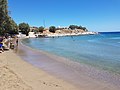 Megas Gyalos
 -
 Foinikas
 -
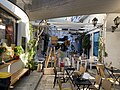 Al fresco dining in Ermoupoli


,_Syros,_Greece_13.jpg)

See also
References
- ^ a b "Αποτελέσματα Απογραφής Πληθυσμού - Κατοικιών 2021, Μόνιμος Πληθυσμός κατά οικισμό" [Results of the 2021 Population - Housing Census, Permanent population by settlement] (in Greek). Hellenic Statistical Authority. 29 March 2024.
- ^ Suda, s.v.
- ^ Samuel Butler (14 April 2015). Delphi Complete Works of Samuel Butler (Illustrated). Delphi Classics. pp. 3206–. ISBN 978-1-910630-86-0.
- ^ William Miller, Latins in the Levant p636
- ^ ""ege adalarÃ"±" arama sonuçları ile ilgili bilgiler". Türkçe Bilgi.
- ^ Le Quien, op. cit., II, 233
- ^ Ampelas, Histoire de Syros, 411
- ^ Miklosich and Mueller, "Acta patriarchatus constantinopolitani", V, 461
- ^ Ricaut, "Histoire de l'estat présent de l"Eglise grecque", 361; Hilaire de Barenton, "La France Catholique en Orient", 171-173
- ^ Oriens christianus, III, 865-868
- ^ Hierarchia catholica medii aevi, I, 492; II, 267; III, 324
- ^ Pétridès in "Revue de l'Orient chrétien", V, 407-422
- ^ Edward Lear diaries, 1858-1888. MS Eng 797.3 (7), page seq. 57. Houghton Library, Harvard University, Cambridge, Mass.
- ^ See, e.g., Theodore Bent, ‘The Capital of the Cyclades’. Macmillan’s Magazine, Vol. 50, 1884 (May/Oct), pp. 426-435.
- ^ Sheila Lecoeur Mussolini's Greek Island: Fascism and the Occupation of Syros in World War II (2009/ 2015)
- ^ "ΦΕΚ A 87/2010, Kallikratis reform law text" (in Greek). Government Gazette.
- ^ "Population & housing census 2001 (incl. area and average elevation)" (PDF) (in Greek). National Statistical Service of Greece.
- ^ "Detailed census results 1991" (PDF). (39 MB) (in Greek and French)
- ^ a b "Syros Churches: Information about the churches of Syros Greece, Cyclades". Greeka.com. 20 November 2007.
- ^ "Easter: A date with God". The Economist. April 20, 2011. Retrieved 2011-04-23.
Only in a handful of places do Easter celebrants alter their own arrangements to take account of their neighbours. Finland's Orthodox Christians mark Easter on the Western date. And on the Greek island of Syros, a Papist stronghold, Catholics and Orthodox alike march to Orthodox time. The spectacular public commemorations, involving flower-strewn funeral biers on Good Friday and fireworks on Saturday night, bring the islanders together, rather than highlighting division.
- ^ "Syros National Airport (JSY)". www.greeka.com. Retrieved 2025-07-14.
- ^ "Απευθείας αεροπορική σύνδεση της Θεσσαλονίκης με την Σύρο". www.ertnews.gr (in Greek). 2025-06-04. Retrieved 2025-07-14.
External links

- Official website of Municipality of Áno Sýros (in Greek)
- Official website of Municipality of Ermoúpoli (in English and Greek)
- University of the Aegean in Ermoúpoli (in English and Greek)
- Department of Product and Systems design from University of the Aegean
- Information about Syros from syros-online.com (in German)
- Syros The Official website of the Greek National Tourism Organisation
- Festival of the Aegean (Official website of the music festival that has been held on the island since 2005.)
- Complete travel guide for Syros island (in English and Greek)


| Regional unit of Andros |  | |
|---|---|---|
| Regional unit of Kalymnos | ||
| Regional unit of Karpathos-Kasos | ||
| Regional unit of Kea-Kythnos | ||
| Regional unit of Kos | ||
| Regional unit of Milos | ||
| Regional unit of Mykonos | ||
| Regional unit of Naxos | ||
| Regional unit of Paros | ||
| Regional unit of Rhodes | ||
| Regional unit of Syros | ||
| Regional unit of Thira | ||
| Regional unit of Tinos | ||
| ||
| International | |
|---|---|
| National | |
| Geographic | |
| Other | |


