Epstein Files Full PDF

CLICK HERE
Technopedia Center
PMB University Brochure
Faculty of Engineering and Computer Science
S1 Informatics S1 Information Systems S1 Information Technology S1 Computer Engineering S1 Electrical Engineering S1 Civil Engineering

faculty of Economics and Business
S1 Management S1 Accountancy

Faculty of Letters and Educational Sciences
S1 English literature S1 English language education S1 Mathematics education S1 Sports Education
teknopedia

  • Registerasi
  • Brosur UTI
  • Kip Scholarship Information
  • Performance
Flag Counter
  1. World Encyclopedia
  2. Visibility - Wikipedia
Visibility - Wikipedia
From Wikipedia, the free encyclopedia
Measure of the distance needed to visually discern an object
For other uses, see Visibility (disambiguation).
This article includes a list of general references, but it lacks sufficient corresponding inline citations. Please help to improve this article by introducing more precise citations. (March 2010) (Learn how and when to remove this message)

In meteorology, visibility is the measure of the distance at which an object or light can be clearly discerned. It depends on the transparency of the surrounding air and as such, it is unchanging no matter the ambient light level or time of day. It is reported within surface weather observations and METAR code either in meters or statute miles, depending upon the country. Visibility affects all forms of traffic: roads, railways, sailing and aviation.

The geometric range of vision is limited by the curvature of the Earth and depends on the eye level and the height of the object being viewed. In geodesy, the atmospheric refraction must be taken into account when calculating geodetic visibility.

Meteorological visibility

[edit]

Definition

[edit]
Airplane flying into clouds on descent for landing

ICAO Annex 3 Meteorological Service for International Air Navigation [1] contains the following definitions and note:

a) the greatest distance at which a black object of suitable dimensions, situated near the ground, can be seen and recognized when observed against a bright background;
b) the greatest distance at which lights of 1,000 candelas can be seen and identified against an unlit background.
Note.— The two distances have different values in air of a given extinction coefficient, and the latter b) varies with the background illumination. The former a) is represented by the meteorological optical range (MOR).

Annex 3 [1] also defines Runway Visual Range (RVR) as:

The range over which the pilot of an aircraft on the centre line of a runway can see the runway surface markings or the lights delineating the runway or identifying its centre line.
Foggy morning road
On clear days, Tel Aviv's skyline is visible from the Carmel mountains, 80 km north

In extremely clean air (e.g., in Arctic areas), the visibility can be up to 240 km (150 miles). Distant observable visibility requires large markers such as mountains or high ridges; however, visibility is often reduced somewhat by air pollution and high humidity. Various weather stations report this as haze (dry) or mist (moist). Heavy rain (such as from a thunderstorm) can impair visibility. Blizzards and ground blizzards (blowing snow) are also defined in part by low visibility. These conditions, as well as Fog and smoke, can reduce visibility to near zero, making driving extremely dangerous. The same can happen in a sandstorm or with forest fires.

History

[edit]
[icon]
This section needs expansion. You can help by adding missing information. (May 2022)

Derivation

[edit]

To define visibility the case of a perfectly black object being viewed against a perfectly white background is examined. The visual contrast, CV(x), at a distance x from the black object is defined as the relative difference between the light intensity of the background and the object
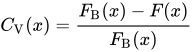
C V ( x ) = F B ( x ) − F ( x ) F B ( x ) {\displaystyle C_{\text{V}}(x)={\frac {F_{\text{B}}(x)-F(x)}{F_{\text{B}}(x)}}} {\displaystyle C_{\text{V}}(x)={\frac {F_{\text{B}}(x)-F(x)}{F_{\text{B}}(x)}}}

where FB(x) and F(x) are the intensities of the background and the object, respectively. Because the object is assumed to be perfectly black, it must absorb all of the light incident on it. Thus when x=0 (at the object), F(0) = 0 and CV(0) = 1.

Between the object and the observer, F(x) is affected by additional light that is scattered into the observer's line of sight and the absorption of light by gases and particles. Light scattered by particles outside of a particular beam may ultimately contribute to the irradiance at the target, a phenomenon known as multiple scattering. Unlike absorbed light, scattered light is not lost from a system. Rather, it can change directions and contribute to other directions. It is only lost from the original beam traveling in one particular direction. The multiple scatterings' contribution to the irradiance at x is modified by the individual particle scattering coefficient, the number concentration of particles, and the depth of the beam. The intensity change dF is the result of these effects over a distance dx. Because dx is a measure of the amount of suspended gases and particles, the fraction of F that is diminished is assumed to be proportional to the distance, dx. The fractional reduction in F is

d F = − b ext F d x {\displaystyle dF=-b_{\text{ext}}{F}dx} {\displaystyle dF=-b_{\text{ext}}{F}dx}

where bext is the attenuation coefficient. The scattering of background light into the observer's line of sight can increase F over the distance dx. This increase is defined as b' FB(x) dx, where b' is a constant. The overall change in intensity is expressed as

d F ( x ) = [ b ′ F B ( x ) − b ext F ( x ) ] d x {\displaystyle dF(x)=\left[b'F_{\text{B}}(x)-b_{\text{ext}}F(x)\right]dx} {\displaystyle dF(x)=\left[b'F_{\text{B}}(x)-b_{\text{ext}}F(x)\right]dx}

Since FB represents the background intensity, it is independent of x by definition. Therefore,

d F B ( x ) = 0 = [ b ′ F B ( x ) − b ext F B ( x ) ] d x {\displaystyle dF_{\text{B}}(x)=0=\left[b'F_{\text{B}}(x)-b_{\text{ext}}F_{\text{B}}(x)\right]dx} {\displaystyle dF_{\text{B}}(x)=0=\left[b'F_{\text{B}}(x)-b_{\text{ext}}F_{\text{B}}(x)\right]dx}

It is clear from this expression that b' must be equal to bext. Thus, the visual contrast, CV(x), obeys the Beer–Lambert law
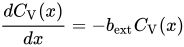
d C V ( x ) d x = − b ext C V ( x ) {\displaystyle {\frac {dC_{\text{V}}(x)}{dx}}=-b_{\text{ext}}C_{\text{V}}(x)} {\displaystyle {\frac {dC_{\text{V}}(x)}{dx}}=-b_{\text{ext}}C_{\text{V}}(x)}

which means that the contrast decreases exponentially with the distance from the object:

C V ( x ) = exp ⁡ ( − b ext x ) {\displaystyle C_{\text{V}}(x)=\exp(-b_{\text{ext}}x)} {\displaystyle C_{\text{V}}(x)=\exp(-b_{\text{ext}}x)}

Lab experiments have determined that contrast ratios between 0.018 and 0.03 are perceptible under typical daylight viewing conditions. Usually, a contrast ratio of 2% (CV = 0.02) is used to calculate visual range. Plugging this value into the above equation and solving for x produces the following visual range expression (the Koschmieder equation):

x V = 3.912 b ext {\displaystyle x_{\text{V}}={\frac {3.912}{b_{\text{ext}}}}} {\displaystyle x_{\text{V}}={\frac {3.912}{b_{\text{ext}}}}}

with xV in units of length. At sea level, the Rayleigh atmosphere has an extinction coefficient of approximately 13.2 × 10⁻⁶ m−1 at a wavelength of 520 nm. This means that in the cleanest possible atmosphere, visibility is limited to about 296 km.

Visibility perception depends on several physical and visual factors. A realistic definition should consider the fact that the human visual system (HVS) is highly sensitive to spatial frequencies, and then to use the Fourier transform and the contrast sensitivity function of the HVS to assess visibility.[2]

Fog, mist, haze, and freezing drizzle

[edit]

The international definition of fog is a visibility of less than 1 km (3,300 ft); mist is a visibility of between 1 km (0.62 mi) and 2 km (1.2 mi) and haze from 2 km (1.2 mi) to 5 km (3.1 mi). Fog and mist are generally assumed to be composed principally of water droplets, haze and smoke can be of smaller particle size. This has implications for sensors such as thermal imagers (TI/FLIR) operating in the far-IR at wavelengths of about 10 μm, which are better able to penetrate haze and some smokes because their particle size is smaller than the wavelength; the IR radiation is therefore not significantly deflected or absorbed by the particles.[citation needed]

Fog occasionally occurs along with freezing drizzle and snow. These cold weather events are caused largely by low-lying stratus clouds. This usually happens when temperatures are below 0 °C (32 °F). These conditions are hazardous due to ice formation, which can be deadly because of the low visibility (i.e., less than 1,000 yards) usually accompanying these conditions. The combination of low visibility and ice formation can lead to accidents on roadways.

Very low visibility

[edit]

Visibility of less than 100 metres (330 ft) is usually reported as zero. In these conditions, roads may be closed, or automatic warning lights and signs may be activated to warn drivers. These have been put in place in certain areas that are subject to repeatedly low visibility, particularly after traffic collisions or pile-ups involving multiple vehicles.

Low visibility warnings

[edit]

In addition, an advisory is often issued by a government weather agency for low visibility, such as a dense fog advisory from the U.S. National Weather Service. These generally advise motorists to avoid travel until the fog dissipates or other conditions improve. Air travel is also often delayed by low visibility, sometimes causing long delays due to approach visibility minimums and the difficulty of safely moving aircraft on the ground in low visibility.[3][4]

Visibility and air pollution

[edit]

Reduced visibility is often the most apparent symptom of air pollution. Visibility degradation is caused by the absorption and scattering of light by particles and gases in the atmosphere. Absorption of electromagnetic radiation by gases and particles is sometimes the cause of discolorations in the atmosphere, but usually does not contribute very significantly to visibility degradation.

Scattering by particulates between an observer and a distant object impairs visibility much more readily. They scatter light from the sun and the rest of the sky through the line of sight of the observer, thereby decreasing the contrast between the object and the background sky. Particles that are the most effective at reducing visibility (per unit aerosol mass) have diameters in the range of 0.1-1.0 μm. The effect of air molecules on visibility is minor for short visual ranges but must be taken into account for ranges above 30 km.

From the summit of Mount Summano (1296 m Vicenza Italy), it is possible to see (dark blue sky line) the Tuscan-Emilian Apennines and Mount Cimone (2165 m Modena Italy) in good visibility. The distance is about 180 km. Note the fog present throughout the Po Valley in the lower layers.

Prevailing visibility

[edit]

Prevailing visibility is the greatest horizontal visibility equaled or exceeded throughout at least half the horizon circle, which need not necessarily be continuous. Prevailing visibility is reported in statute miles or fractions of miles.[5]

Geodetic visibility

[edit]
icon
This section needs additional citations for verification. Please help improve this article by adding citations to reliable sources in this section. Unsourced material may be challenged and removed. (June 2022) (Learn how and when to remove this message)

The geographical visibility depends on the altitude of the observation site and the topology of its surroundings. Planes and water surfaces provide a maximum range of vision, but vegetation, buildings and mountains are geographical obstacles that limit the geographical visibility. When the sky is clear and the meteorological visibility is high, the curvature of the earth limits the maximum possible geodetic visibility. The visibility from an elevated observation point down to the surface of the sea can be calculated using the Pythagorean theorem, since the line of sight and the radius of the Earth form the two legs of a right triangle. The height of the elevated point plus the Earth's radius form its hypotenuse. If both the eyes and the object are raised above the reference plane, there are two right-angled triangles. The tangent touching the surface of the Earth or water consists of the two short legs of the two right triangles, which are added together to calculate the geometric range of vision.

In geodesy the atmospheric refraction, which increases the range of vision, is always taken into account in the calculation, so that even objects behind the horizon can still be seen.

See also

[edit]
  • Coefficient of haze

References

[edit]
  1. ^ a b "ICAO Annex 3 Meteorological Service for International Air Navigation" (PDF) (16th ed.). International Civil Aviation Organization. July 2007. Retrieved 2018-03-09.
  2. ^ Moreno, Ivan; Jauregui-Sánchez, Y.; Avendaño-Alejo, Maximino (2014). "Invisibility assessment: a visual perception approach" (PDF). Journal of the Optical Society of America A. 31 (10): 2244–2248. Bibcode:2014JOSAA..31.2244M. doi:10.1364/josaa.31.002244. PMID 25401251. Archived from the original (PDF) on 2017-08-08. Retrieved 2017-01-10.
  3. ^ "Why fog can play havoc with your travel plans". www.newcastleairport.com.au. Archived from the original on 4 September 2017. Retrieved 3 September 2017.
  4. ^ "Project AS 07/13 - Regulation of Low Visibility Operations". www.casa.gov.au. Australian Civil Aviation Safety Authority. 21 March 2009. Retrieved 3 September 2017.
  5. ^ "Chapter 1. Departure Procedures". Instrument Procedure Handbook (PDF) (FAA-H-8083-16B ed.). Federal Aviation Administration. p. 2. Public Domain This article incorporates text from this source, which is in the public domain.

Further reading

[edit]
  • v
  • t
  • e
Meteorological data and variables
General
  • Adiabatic processes
  • Advection
  • Buoyancy
  • Lapse rate
  • Lightning
  • Surface solar radiation
  • Surface weather analysis
  • Visibility
  • Vorticity
  • Wind
  • Wind shear
Condensation
  • Cloud
  • Cloud condensation nuclei (CCN)
  • Fog
  • Convective condensation level (CCL)
  • Lifting condensation level (LCL)
  • Precipitable water
  • Precipitation
  • Water vapor
Convection
  • Convective available potential energy (CAPE)
  • Convective inhibition (CIN)
  • Convective instability
  • Convective momentum transport
  • Conditional symmetric instability
  • Convective temperature (Tc)
  • Equilibrium level (EL)
  • Free convective layer (FCL)
  • Helicity
  • K Index
  • Level of free convection (LFC)
  • Lifted index (LI)
  • Maximum parcel level (MPL)
  • Bulk Richardson number (BRN)
  • Significant tornado parameter (STP)
Temperature
  • Dew point (Td)
  • Dew point depression
  • Dry-bulb temperature
  • Equivalent temperature (Te)
  • Forest fire weather index
  • Haines Index
  • Heat index
  • Humidex
  • Humidity
  • Relative humidity (RH)
  • Mixing ratio
  • Potential temperature (θ)
  • Equivalent potential temperature (θe)
  • Sea surface temperature (SST)
  • Temperature anomaly
  • Thermodynamic temperature
  • Vapor pressure
  • Virtual temperature
  • Wet-bulb temperature
  • Wet-bulb globe temperature
  • Wet-bulb potential temperature
  • Wind chill
Pressure
  • Atmospheric pressure
  • Baroclinity
  • Barotropicity
  • Pressure gradient
  • Pressure-gradient force (PGF)
Velocity
  • Maximum potential intensity
Authority control databases Edit this at Wikidata
International
  • GND
National
  • Czech Republic
  • Israel
Other
  • Yale LUX
Retrieved from "https://teknopedia.ac.id/w/index.php?title=Visibility&oldid=1336714091"
Categories:
  • Visibility
  • Meteorological concepts
  • Meteorological quantities
Hidden categories:
  • Source attribution
  • Articles with short description
  • Short description is different from Wikidata
  • Articles lacking in-text citations from March 2010
  • All articles lacking in-text citations
  • Articles to be expanded from May 2022
  • All articles to be expanded
  • All articles with unsourced statements
  • Articles with unsourced statements from March 2010
  • Articles needing additional references from June 2022
  • All articles needing additional references

  • indonesia
  • Polski
  • العربية
  • Deutsch
  • English
  • Español
  • Français
  • Italiano
  • مصرى
  • Nederlands
  • 日本語
  • Português
  • Sinugboanong Binisaya
  • Svenska
  • Українська
  • Tiếng Việt
  • Winaray
  • 中文
  • Русский
Sunting pranala
url url url url url url url url url url url url url url url url url url url url url url url url url url url url url url url url url url url url url url url url url url url url url url url url url url url url url url url url url url url url url url url url url url url url url url url url url url url url url url url url url url url url url url url url url url url url url url url url url url url url url url url url url url url url url url url url url url url url url url url url url url url url url url url url url url url url url url url url url url url url url url url url url url url url url url url url url url url url url url url url url url url url url url url url url url url url url url url url url url url url url url url url url url url url url url url url url url url url url url url url url url url url url url url url url url url url url url url url url url url url url url url url url url url url url url url url url url url url url url url url url url url url url url url url url url url url url url url url url url url url url url url url url url url url url url url url url url url url url url url url url url url url url url url url url url url url url url url url url url url url url url url url url url url url url url url url url url url url url url url url url url url url url url url url url url url url url url url url url url url url url url url url url url url url url url url url url url url url url url url url url url url url url url url url url url url url url url url url url url url url url url url url url url url url url url url url url url url url url url url url url url url url url url url url url url url url url url url url url url url url url url url url url url url url url url url url url url url url url url url url url url url url url url url url url url url url url url url url url url url url url url url url url url url url url url url url url url url url url url url url url url url url url url url url url url url url url url url url url url url url url url url url url url url url url url url url url url url url url url url url url url url url url url url url url url url url url url url url url url url url url url url url url url url url url url url url url url url url url url url url url url url url url url url url url url url url url url url url url url url url url url url url url url url url url url url url url url url url url url url url url url url url url url url url url url url url url url url url url url url url url url url url url url url url url url url url url url url url url url url url url url url url url url url url url url url url url url url url url url url url url url url url url url url url url url url url url url url url url url url url url url url url url url url url url url url url url url url url url url url url url url url url url url url url url url url url url url url url url url url url url url url url url url url url url url url url url url url url url url url url url url url url url url url url url url url url url url url url url url url url url url url url url url url url url url url url url url url url url url url url url url url url url url url url url url url url url url url url url url url url url url url url url url url url url url url url url url url url url url url url url url url url url url url url url url url url url url url url url url url url url url url url url url url url url url url url url url url url url url url url url url url url url url url url url url url url url url url url url url url url url url url url url url url url url url url url url url url url url url url url url url url url url url url url url url url url url url url url url url url url url url url url url url url url url url url url url url url url url url url url url url url url url url url url url url url url url url url url url url url url url url url url url url url url url url url url url url url url url url url url url url url url url url url url url url url url url url url url url url url url url url url url url url url url url url url url url url url url url url url url url url url url url url url url url url url url url url url url url url url url url url url url url url url url url url url url url url url url url url url url url url url url url url url url url url url url url url url url url url url url url url url url url url url url url url url url url url url url url url url url url url url url url url url url url url url url url url url url url url url url url url url url url url url url url url url url url url url url url url url url url url url url url url url url url url url url url url url url url url url url url url url url url url url url url url url url url url url url url url url url url url url url url url url url url url url url url url url url url url url url url url url url url url url url url url url url url url url url url url url url url url url url url url url url url url url url url url url url url url url url url url url url url url url url url url url url url url url url url url url url url url url url url url url url url url url url url url url url url url url url url url url url url url url url url url url url url url url url url url url url url url url url url url url url url url url url url url url url url url url url url url url url url url url url url url url url url url url url url url url url url url url url url url url url url url url url url url url url url url url url url url url url url url url url url url url url url url url url url url url url url url url url url url url url url url url url url url url url url url url url url url url url url url url url url url url url url url url url url url url url url url url url url url url url url url url url url url url url url url url url url url url url url url url url url url url url url url url url url url url url url url url url url url url url url url url url url url url url url url url url url url url url url url url url url url url url url url url url url url url url url url url url url url url url url url url url url url url url url url url url url url url url url url url url url url url url url url url url url url url url url url url url url url url url url url url url url url url url url url url url url url url url url url url url url url url url url url url url url url url url url url url url url url url url url url url url url url url url url url url url url url url url url url url url url url url url url url url url url url url url url url url url url url url url url url url url url url url url url url url url url url url url url url url url url url url url url url url url url url url url url url url url url url url url url url url url url url url url url url url url url url url url url url url url url url url url url url url url url url url url url url url url url url url url url url url url url url url url url url url url url url url url url url url url url url url url url url url url url url url url url url url url url url url url url url url url url url url url url url url url url url url url url url url url url url url url url url url url url url url url url url url url url url url url url url url url url url url url url url url url url url url url url url url url url url url url url url url url url url url url url url url url url url url url url url url url url url url url url url url url url url url url url url url url url url url url url url url url url url url url url url url url url url url url url url url url url url url url url url url url url url url url url url url url url url url url url url url url url url url url url url url url url url url url url url url url url url url url url url url url url url url url url url url url url url url url url url url url url url url url url url url url url url url url url url url url url url url url url url url url url url url url url url url url url url url url url url url url url url url url url url url url url url url url url url url url url url url url url url url url url url url url url url url url url url url url url url url url url url url url url url url url url url url url url url url url url url url url url url url url url url url url url url url url url url url url url url url url url url url url url url url url url url url url url url url url url url url url url url url url url url url url url url url url url url url url url url url url url url url url url url url url url url url url url url url url url url url url url url url url url url url url url url url url url url url url url url url url url url url url url url url url url url url url url url url url url url url url url url url url url url url url url url url url url url url url url url url url url url url url url url url url url url url url url url url url url url url url url url url url url url url url url url url url url url url url url url url url url url url url url url url url url url url url url url url url url url url url url url url url url url url url url url url url url url url url url url url url url url url url url url url url url url url url url url url url url url url url url url url url url url url url url url url url url url url url url url url url url url url url url url url url url url url url url url url url url url url url url url url url url url url url url url url url url url url url url url url url url url url url url url url url url url url url url url url url url url url url url url url url url url url url url url url url url url url url url url url url url url url url url url url url url url url url url url url url url url url url url url url url url url url url url url url url url url url url url url url url url url url url url url url url
Pusat Layanan

UNIVERSITAS TEKNOKRAT INDONESIA | ASEAN's Best Private University
Jl. ZA. Pagar Alam No.9 -11, Labuhan Ratu, Kec. Kedaton, Kota Bandar Lampung, Lampung 35132
Phone: (0721) 702022
Email: pmb@teknokrat.ac.id