Epstein Files Full PDF

CLICK HERE
Technopedia Center
PMB University Brochure
Faculty of Engineering and Computer Science
S1 Informatics S1 Information Systems S1 Information Technology S1 Computer Engineering S1 Electrical Engineering S1 Civil Engineering

faculty of Economics and Business
S1 Management S1 Accountancy

Faculty of Letters and Educational Sciences
S1 English literature S1 English language education S1 Mathematics education S1 Sports Education
teknopedia

  • Registerasi
  • Brosur UTI
  • Kip Scholarship Information
  • Performance
Flag Counter
  1. World Encyclopedia
  2. Washi - Wikipedia
Washi - Wikipedia
From Wikipedia, the free encyclopedia
Japanese paper traditionally made from mulberry tree bark

For other uses, see Washi (disambiguation) and Rice paper (disambiguation).
This article is about Japanese mulberry paper. For the general category, see Mulberry paper.
icon
You can help expand this article with text translated from the corresponding article in Japanese. (August 2021) Click [show] for important translation instructions.
  • View a machine-translated version of the Japanese article.
  • Machine translation, like DeepL or Google Translate, is a useful starting point for translations, but translators must revise errors as necessary and confirm that the translation is accurate, rather than simply copy-pasting machine-translated text into the English Wikipedia.
  • Do not translate text that appears unreliable or low-quality. If possible, verify the text with references provided in the foreign-language article.
  • You must provide copyright attribution in the edit summary accompanying your translation by providing an interlanguage link to the source of your translation. A model attribution edit summary is Content in this edit is translated from the existing Japanese Wikipedia article at [[:ja:和紙]]; see its history for attribution.
  • You may also add the template {{Translated|ja|和紙}} to the talk page.
  • For more guidance, see Wikipedia:Translation.
icon
This article needs additional citations for verification. Please help improve this article by adding citations to reliable sources. Unsourced material may be challenged and removed.
Find sources: "Washi" – news · newspapers · books · scholar · JSTOR
(February 2013) (Learn how and when to remove this message)
Washi
Sugiharagami (杉原紙), a kind of washi
TypePaper
MaterialFibers from the inner bark of the gampi tree, the mitsumata shrub, or the paper mulberry bush.
Production processCraft production
Place of originJapan
Introduced7th century
Washi, craftsmanship of traditional Japanese hand-made paper
UNESCO Intangible Cultural Heritage
CountryJapan
Reference02291
RegionAsia and the Pacific
Inscription history
Inscription2014 (9th session)
ListRepresentative

Washi (和紙) is traditional Japanese paper processed by hand using fibers from the inner bark of the gampi tree, the mitsumata shrub (Edgeworthia chrysantha), or the paper mulberry (kōzo) bush.[1] Washi is used in many traditional Japanese arts, such as origami, shodō, and ukiyo-e. It was traditionally used to make various everyday goods like clothes, household goods, and toys, as well as vestments and ritual objects for Shinto priests and statues of Buddhas. It was even used to make wreaths that were given to winners in the 1998 Winter Paralympics. As a Japanese craft, it is registered as a UNESCO intangible cultural heritage.[2]

Because it is usually tougher than Western paper made from wood pulp, washi is often used to repair historically valuable cultural properties, paintings, and books at museums and libraries around the world, such as the Louvre and the Vatican Museums, because of its thinness, pliability, durability over 1000 years due to its low impurities, and high workability to remove it cleanly with moisture.[3][4][5]

History

[edit]

By the 7th century, paper had been introduced to Japan from China via the Korean Peninsula, and the Japanese developed washi by improving the method of making paper in the Heian period. The paper making technique developed in Japan around 805 to 809 was called nagashi-suki (流し漉き), a method of adding mucilage to the process of the conventional tame-suki (溜め漉き) technique to form a stronger layer of paper fibers.[6][7][8][9] The improved washi came to be used to decorate religious ceremonies such as gohei, ōnusa (ja:大麻 (神道)), and shide at Shinto shrines,[6] and in the Heian period, washi covered with gold and silver leaf beautifully decorated books such as Kokin Wakashu.[8]

In the Muromachi period, washi came to be used as ceremonial origami for samurai class at weddings and when giving gifts,[6] and from the Sengoku period to the Edo period, recreational origami such as orizuru developed.[10] During the Edo period, many books and ukiyo-e prints for the masses made of washi were published using woodblock printing.[11]

Manufacture

[edit]

Washi is produced in a way similar to that of ordinary paper, but relies heavily on manual methods. It involves a long and intricate process that is often undertaken in the cold weather of winter, as pure, cold running water is essential to the production of washi. Cold inhibits bacteria, preventing the decomposition of the fibres. Cold also makes the fibres contract, producing a crisp feel to the paper. It is traditionally the winter work of farmers, a task that supplemented a farmer's income.

Paper mulberry is the most commonly used fiber in making Japanese paper. The mulberry branches are boiled and stripped of their outer bark, and then dried. The fibers are then boiled with lye to remove the starch, fat and tannin, and then placed in running water to remove the spent lye. The fibers are then bleached (either with chemicals or naturally, by placing it in a protected area of a stream) and any remaining impurities in the fibers are picked out by hand. The product is laid on a rock or board and beaten.

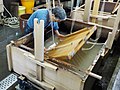
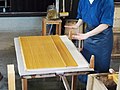
Wet balls of pulp are mixed in a vat with water and a formation aid to help keep the long fibers spread evenly. This is traditionally neri, which is a mucilaginous material made from the roots of the tororo aoi plant, or PEO, polyethylene oxide. One of two traditional methods of paper making (nagashi-zuki or tame-zuki) is employed. In both methods, pulp is scooped onto a screen and shaken to spread the fibers evenly. Nagashi-zuki (which uses neri in the vat) produces a thinner paper, while tame-zuki (which does not use neri) produces a thicker paper.

  • Preparing the liquid. Washi-making at Echizen, Fukui Prefecture
    Preparing the liquid. Washi-making at Echizen, Fukui Prefecture
  • Pulp is scooped onto a screen.
    Pulp is scooped onto a screen.
  • The papermaker carefully stacks each wet sheet of pulp left on the screen one by one.
    The papermaker carefully stacks each wet sheet of pulp left on the screen one by one.

Types

[edit]
See also: List of washi

With enough processing, almost any grass or tree can be made into a washi. Gampi, mitsumata, and paper mulberry are three popular sources.[1]

  • Ganpishi (雁皮紙): In ancient times, it was called Hishi (斐紙). Ganpishi has a smooth, shiny surface and is used for books and crafts.
  • Kōzogami (楮紙): Kōzogami is made from paper mulberry and is the most widely made type of washi. It has a toughness closer to cloth than to ordinary paper and does not weaken significantly when treated to be water-resistant.
  • Mitsumatagami (三椏紙): Made from mitsumata, mitsumatagami has an ivory-colored, fine surface and is used for shodō as well as printing. It has been used to print paper money since the Meiji period and continues to be used today.[12]

Use, applications

[edit]

In a washitsu (traditional Japanese room), the paper used—whether in the past or in the present—is essentially all washi, traditional Japanese paper, including the paper on shōji(ja:障子) and fusuma(襖) sliding doors, the paper on andon lanterns, the paper of kake-jiku (掛軸, hanging scrolls), and the kaishi (懐紙) used in tea ceremonies(茶道).

In Japanese suibokuga(水墨画), sumi-e (墨絵, ink painting), ukiyo-e and nihonga (traditional Japanese painting), washi is still used even today.

In Japanese calligraphy (shodō, 書道), washi is still widely used today.

Washi is also used in watch dials.[13]

  • All of the paper visible in this photo — the shōji screens, the andon lantern covers, and the kake-jiku (掛軸, hanging scroll) — is made from washi (traditional Japanese paper)
    All of the paper visible in this photo — the shōji screens, the andon lantern covers, and the kake-jiku (掛軸, hanging scroll) — is made from washi (traditional Japanese paper)
  • Hasui Kawase (ja:川瀬巴水) chose Echizen-washi as the paper for printing his works.[14]
    Hasui Kawase (ja:川瀬巴水) chose Echizen-washi as the paper for printing his works.[14]
  • Sumi-e
    Sumi-e
  • Origami cranes made of washi
    Origami cranes made of washi
  • Modern application of Mino washi
    Modern application of Mino washi

Misnomer: "Rice paper"

[edit]

The traditional Japanese paper washi is often mistranslated or mislabeled in English as “rice paper,”[15] a term that has caused misunderstanding in English-speaking countries.

By contrast, in other languages and cultural contexts—such as French—washi is properly referred to as “papier Japon,” terms that more accurately convey its identity as Japanese paper without implying an incorrect ingredient. This underscores that the English “rice paper” label is not a universal term and highlights the importance of precise terminology.

See also

[edit]
  • Ukiyo-e
  • kaishi(ja:懐紙)
  • Japanese tissue
  • List of Traditional Crafts of Japan
  • Genkō yōshi
  • Sir Harry Parkes
  • Tissue paper

References

[edit]
  1. ^ a b Hughes, Sukey (1978). Washi: the world of Japanese paper. Tokyo: Kodansha International. ISBN 0-87011-318-6.
  2. ^ "Government, paper makers welcome addition of 'washi' to UNESCO list". 27 November 2014. Archived from the original on 13 January 2017. Retrieved 27 November 2014.
  3. ^ "Paper conservation by using Japanese paper, washi". International Federation of Library Associations and Institutions. Archived from the original on 9 February 2022.
  4. ^ "The elegant and refined world of washi". Toki. 30 August 2015. Archived from the original on 6 April 2017.
  5. ^ "Washi paper in Mino". ANA. Archived from the original on 5 April 2022.
  6. ^ a b c 折り紙の歴史と現在: 前史 (in Japanese). Kyushu University Library. Archived from the original on 7 May 2021. Retrieved 14 November 2022.
  7. ^ おりがみの歴史 (History of origami) (in Japanese). Nippon Origami Association. Archived from the original on 14 November 2022. Retrieved 14 November 2022.
  8. ^ a b 第1章 折り紙の姿 (PDF) (in Japanese). Nikkan Kogyo Shimbun. Archived from the original (PDF) on 25 November 2022. Retrieved 25 November 2022.
  9. ^ 流し漉き (in Japanese). Kotobank./Digitalio, Inc./The Asahi Shimbun. Archived from the original on 25 November 2022. Retrieved 25 November 2022.
  10. ^ 折り紙の歴史と現在: 戦国~江戸中期 (in Japanese). Kyushu University Library. Archived from the original on 7 May 2021. Retrieved 14 November 2022.
  11. ^ "Edo Picture Books and the Edo Period". National Diet Library. Archived from the original on 19 October 2020. Retrieved 26 November 2022.
  12. ^ Yeung, Jessie; Montgomery, Hanako; Ogura, Junko (2024-07-03). "How Japan's newest yen note came from the Nepali mountains". CNN. Retrieved 2024-08-16.
  13. ^ "Review: Enter the dragon: The Citizen AQ 4020-54Y. Best quartz watch in the world?". Deployant. 10 May 2018. Retrieved 2 September 2022.
  14. ^ "川瀬巴水と越前和紙 (Hasui Kawase and Echizen-washi)". 越前和紙の里、紙の文化博物館 (Echizen Washi Village, Paper Museum). Retrieved 2026-01-04.
  15. ^ Angle, Mary (2025-06-13). "Explore the Timeless Connection Between Washi and Botany". The Arboretum at Penn State.

Further reading

[edit]
  • Fukushima, Kurio (1991). Handbook on the Art of Washi. All Japan Handmade Washi Association.

External links

[edit]
Wikimedia Commons has media related to Washi.
  • "Washi". Japanese Architecture and Art Net Users System.
  • Washi Archived 2012-04-07 at the Wayback Machine
  • v
  • t
  • e
Paper
  • Paper engineering / Papermaking
History
Paper Ancestors
  • Bamboo and wooden slips
  • Barkcloth
    • Amate
    • Tapa
  • Birch bark
  • Palm leaf
  • Papyrus
  • Parchment
  • Vellum
Developers
  • Cai Lun
  • Damjing
  • Matthias Koops
  • Friedrich Gottlob Keller
  • Charles Fenerty
Scholars
  • Timothy Barrett
  • Thomas Francis Carter
  • Dard Hunter
  • Tsien Tsuen-hsuin
Types of paper
By Plant Fiber
  • Banana
    • Manila hemp
  • Cotton
  • Dung
  • Dó
  • Hemp
  • Lokta
  • Mulberry
    • Daluang
    • Hanji
    • Saa
    • Samarkand
    • Washi
  • Pith (Rice)
  • Pulpwood
  • Rag
    • India
    • Mummy
    • Xuan
  • Stone
by Process
  • Acidic
  • Acid-free
  • Air-laid
  • Blue
  • Cardboard
    • Cardstock
    • Corrugated fiberboard
    • Paperboard
      • Bristol
  • Crêpe
  • Glassine
  • Kraft
  • Laid
    • Ingres
  • Onionskin
  • Paper towel
  • Seed
  • Tissue
    • Toilet
  • Wasli
  • Wood-free
  • Wove
Coated
  • Asphalt
  • Photographic
  • Rosin
  • Tar
  • Thermal
  • Wax
by Use
  • Bible
  • Blotting
  • Bond
  • Butcher
  • Construction
  • Display
  • Cartridge
  • Contact
  • Copy
    • Carbonless
  • Correction
  • Electrical insulation
  • Filteration
  • Inkjet
  • Newsprint
  • Origami
  • Parchment
  • Rolling
  • Ruled paper
    • Genkō yōshi
    • Graph
  • Security
  • Tracing
  • Transfer
  • Wallpaper
  • Writing
Materials
  • Kaolinite (China clay)
  • Fiber crop
  • Paper chemicals
  • Wood pulp
Specifications
  • Density
  • Grammage
  • Paper sizes
  • Surface chemistry of paper
  • Units of paper quantity
  • Wet strength
Manufacture
and process
  • Paper machine
    • Calender
    • Conical refiner
    • Hollander beater
  • Paper recycling
    • Deinking
  • Pulp bleaching
    • Chlorine-free
  • Pulping
    • Kraft
    • Organosolv
    • Soda
    • Sulfite
Paper industry
  • Environmental impact of paper
  • Paper industry
    • Canada
    • Europe
    • India
    • Indonesia
    • Japan
    • United States
  • Paper mill
    • List
Uses
  • Blueprint
  • Papier-mâché
  • Clothing
  • Watercolor paper
  • Paper money
  • Category
  • Commons
  • v
  • t
  • e
Shinto shrines
Shinto architecture
Buildings
  • chōzu or temizu
  • Haiden
  • Heiden
  • hokora
  • honden / shinden / shōden
  • kagura-den
  • setsumatsusha
Architectonic elements
  • Chinjusha
  • chigi
  • hidden roof
  • kaerumata: see nakazonae
  • kairō
  • karahafu
  • karamon
  • katōmado
  • katsuogi
  • kitsune (fox)
  • komainu
  • mon
  • nakazonae
  • shinboku
  • shōrō
  • sōrin
  • tamagaki
  • tokyō
  • torii
  • tōrō
Styles
  • hirairi-zukuri
  • tsumairi-zukuri
  • hachiman-zukuri
  • hiyoshi-zukuri
  • irimoya-zukuri
  • ishi-no-ma-zukuri
  • kasuga-zukuri
  • kibitsu-zukuri
  • misedana-zukuri
  • nagare-zukuri
  • ōtori-zukuri
  • owari-zukuri
  • ryōnagare-zukuri
  • shinmei-zukuri
  • sumiyoshi-zukuri
  • taisha-zukuri
Decorations
  • Sandō
  • Saisen
  • Tomoe
  • Shimenawa
Others
Implements
  • An
  • Chōzubachi
  • Chōzuya
  • Hakama
  • Himorogi
  • Jōe
  • Kagura suzu
  • O-miki
  • Ō-nusa
    • Gohei
  • Sanbo
  • Shide
  • Shinsen
  • Suzu
  • Tamagushi
  • Masakaki
  • Washi
Head shrines1
  • Fushimi Inari Taisha
    • Inari Ōkami
    • Inari shrine
  • Usa Hachiman-gū
    • Hachiman
    • Hachiman Shrine
  • Ise Grand Shrine
    • Amaterasu
    • Jingūkyō
    • Jingu Taima
    • Shinmei shrines
  • Dazaifu Tenman-gū
    • Tenjin
    • Tenmangū
  • Munakata Taisha
    • daughters of Amaterasu
  • Suwa Taisha
    • Takeminakata
    • Yasakatome
    • Kotoshironushi
  • Hiyoshi Taisha
    • Ōkuninushi
    • Oyamakui no Kami
    • Sannō torii
    • Sannō Ichijitsu Shintō
  • Kumano Nachi Taisha
    • Kumano Kodō
    • Kumano Sanzan
  • Ōta Shrine
  • Tsushima Shrine
    • Gion cult
  • Yasaka Shrine
    • Gion cult
Tutelary deities
  • Ujigami
  • Chinjugami
    • Garanshin
  • Dōsojin
  • Jinushigami
  • Yama-no-Kami
  • Oyagami
  • Sorei
  • Ubusunagami
  • Kunitama
Yorishiro and Shintai
  • Mirrors
  • Shinboku (trees)
  • Chinju no Mori (forests)
  • Iwakura (rocks)
    • Meoto Iwa
  • Kannabi (locations)
  • Katashiro (dolls)
  • Kadomatsu
  • Bunrei and Kanjō (propagation)
  • Ofuda
    • Jingu Taima
    • Omamori
    • Senjafuda
  • Arahitogami
  • Mikoshi
    • Matsuri float
    • Shinko-shiki
Staff
  • Kannushi
  • Miko
Miscellaneous
  • A-un
  • Kanjo Nawa
  • Junrei
  • Misaki
  • Miyamairi
  • Shinshi
Classification
  • Twenty-Two Shrines
  • Gokoku Shrines
  • Beppyo Shrines
  • Shinkai (divine rank)
  • Modern system of ranked Shinto shrines
  • Engishiki Jinmyocho
  • Chinjusha
  • Setsumatsusha
  • Hokora
  • Buddhist elements
    • jingū-ji
    • miyadera
  • Whale mounds
  • Kamidana
  • Mitamaya
  • Sōja shrine
History
  • Shrine Parishioner Registration
  • Secular Shrine Theory
  • Shrine Consolidation Policy
  • Shrine Shinto
Misc practices for visitors
  • Ō-mikuji
  • Shuin
  • Ema
Institutions
  • Jinja Honchō
Rites
  • Futomani
  • Harae
  • Kagura
  • Misogi
  • Hakushu
  • Two bows, two claps, one bow
  • Jichinsai
1 (in order of the size of the shrine network they head)
Authority control databases: National Edit this at Wikidata
  • Japan
Retrieved from "https://teknopedia.ac.id/w/index.php?title=Washi&oldid=1339549973"
Categories:
  • Culture articles needing translation from Japanese Wikipedia
  • Japanese paper
  • Japanese art terminology
  • Origami
  • Ukiyo-e
  • Visual arts materials
Hidden categories:
  • CS1 uses Japanese-language script (ja)
  • CS1 Japanese-language sources (ja)
  • Articles with short description
  • Short description is different from Wikidata
  • Articles needing additional references from February 2013
  • All articles needing additional references
  • Articles containing Japanese-language text
  • Commons category link from Wikidata
  • Webarchive template wayback links

  • indonesia
  • Polski
  • العربية
  • Deutsch
  • English
  • Español
  • Français
  • Italiano
  • مصرى
  • Nederlands
  • 日本語
  • Português
  • Sinugboanong Binisaya
  • Svenska
  • Українська
  • Tiếng Việt
  • Winaray
  • 中文
  • Русский
Sunting pranala
url url url url url url url url url url url url url url url url url url url url url url url url url url url url url url url url url url url url url url url url url url url url url url url url url url url url url url url url url url url url url url url url url url url url url url url url url url url url url url url url url url url url url url url url url url url url url url url url url url url url url url url url url url url url url url url url url url url url url url url url url url url url url url url url url url url url url url url url url url url url url url url url url url url url url url url url url url url url url url url url url url url url url url url url url url url url url url url url url url url url url url url url url url url url url url url url url url url url url url url url url url url url url url url url url url url url url url url url url url url url url url url url url url url url url url url url url url url url url url url url url url url url url url url url url url url url url url url url url url url url url url url url url url url url url url url url url url url url url url url url url url url url url url url url url url url url url url url url url url url url url url url url url url url url url url url url url url url url url url url url url url url url url url url url url url url url url url url url url url url url url url url url url url url url url url url url url url url url url url url url url url url url url url url url url url url url url url url url url url url url url url url url url url url url url url url url url url url url url url url url url url url url url url url url url url url url url url url url url url url url url url url url url url url url url url url url url url url url url url url url url url url url url url url url url url url url url url url url url url url url url url url url url url url url url url url url url url url url url url url url url url url url url url url url url url url url url url url url url url url url url url url url url url url url url url url url url url url url url url url url url url url url url url url url url url url url url url url url url url url url url url url url url url url url url url url url url url url url url url url url url url url url url url url url url url url url url url url url url url url url url url url url url url url url url url url url url url url url url url url url url url url url url url url url url url url url url url url url url url url url url url url url url url url url url url url url url url url url url url url url url url url url url url url url url url url url url url url url url url url url url url url url url url url url url url url url url url url url url url url url url url url url url url url url url url url url url url url url url url url url url url url url url url url url url url url url url url url url url url url url url url url url url url url url url url url url url url url url url url url url url url url url url url url url url url url url url url url url url url url url url url url url url url url url url url url url url url url url url url url url url url url url url url url url url url url url url url url url url url url url url url url url url url url url url url url url url url url url url url url url url url url url url url url url url url url url url url url url url url url url url url url url url url url url url url url url url url url url url url url url url url url url url url url url url url url url url url url url url url url url url url url url url url url url url url url url url url url url url url url url url url url url url url url url url url url url url url url url url url url url url url url url url url url url url url url url url url url url url url url url url url url url url url url url url url url url url url url url url url url url url url url url url url url url url url url url url url url url url url url url url url url url url url url url url url url url url url url url url url url url url url url url url url url url url url url url url url url url url url url url url url url url url url url url url url url url url url url url url url url url url url url url url url url url url url url url url url url url url url url url url url url url url url url url url url url url url url url url url url url url url url url url url url url url url url url url url url url url url url url url url url url url url url url url url url url url url url url url url url url url url url url url url url url url url url url url url url url url url url url url url url url url url url url url url url url url url url url url url url url url url url url url url url url url url url url url url url url url url url url url url url url url url url url url url url url url url url url url url url url url url url url url url url url url url url url url url url url url url url url url url url url url url url url url url url url url url url url url url url url url url url url url url url url url url url url url url url url url url url url url url url url url url url url url url url url url url url url url url url url url url url url url url url url url url url url url url url url url url url url url url url url url url url url url url url url url url url url url url url url url url url url url url url url url url url url url url url url url url url url url url url url url url url url url url url url url url url url url url url url url url url url url url url url url url url url url url url url url url url url url url url url url url url url url url url url url url url url url url url url url url url url url url url url url url url url url url url url url url url url url url url url url url url url url url url url url url url url url url url url url url url url url url url url url url url url url url url url url url url url url url url url url url url url url url url url url url url url url url url url url url url url url url url url url url url url url url url url url url url url url url url url url url url url url url url url url url url url url url url url url url url url url url url url url url url url url url url url url url url url url url url url url url url url url url url url url url url url url url url url url url url url url url url url url url url url url url url url url url url url url url url url url url url url url url url url url url url url url url url url url url url url url url url url url url url url url url url url url url url url url url url url url url url url url url url url url url url url url url url url url url url url url url url url url url url url url url url url url url url url url url url url url url url url url url url url url url url url url url url url url url url url url url url url url url url url url url url url url url url url url url url url url url url url url url url url url url url url url url url url url url url url url url url url url url url url url url url url url url url url url url url url url url url url url url url url url url url url url url url url url url url url url url url url url url url url url url url url url url url url url url url url url url url url url url url url url url url url url url url url url url url url url url url url url url url url url url url url url url url url url url url url url url url url url url url url url url url url url url url url url url url url url url url url url url url url url url url url url url url url url url url url url url url url url url url url url url url url url url url url url url url url url url url url url url url url url url url url url url url url url url url url url url url url url url url url url url url url url url url url url url url url url url url url url url url url url url url url url url url url url url url url url url url url url url url url url url url url url url url url url url url url url url url url url url url url url url url url url url url url url url url url url url url url url url url url url url url url url url url url url url url url url url url url url url url url url url url url url url url url url url url url url url url url url url url url url url url url url url url url url url url url url url url url url url url url url url url url url url url url url url url url url url url url url url url url url url url url url url url url url url url url url url url url url url url url url url url url url url url url url url url url url url url url url url url url url url url url url url url url url url url url url url url url url url url url url url url url url url url url url url url url url url url url url url url url url url url url url url url url url url url url url url url url url url url url url url url url url url url url url url url url url url url url url url url url url url url url url url url url url url url url url url url url url url url url url url url url url url url url url url url url url url url url url url url url url url url url url url url url url url url url url url url url url url url url url url url url url url url url url url url url url url url url url url url url url url url url url url url url url url url url url url url url url url url url url url url url url url url url url url url url url url url url url url url url url url url url url url url url url url url url url url url url url url url url url url url url url url url url url url url url url url url url url url url url url url url url url url url url url url url url url url url url url url url url url url url url url url url url url url url url url url url url url url url url url url url url url url url url url url url url url url url url url url url url url url url url url url url url url url url url url
Pusat Layanan

UNIVERSITAS TEKNOKRAT INDONESIA | ASEAN's Best Private University
Jl. ZA. Pagar Alam No.9 -11, Labuhan Ratu, Kec. Kedaton, Kota Bandar Lampung, Lampung 35132
Phone: (0721) 702022
Email: pmb@teknokrat.ac.id