Epstein Files Full PDF

CLICK HERE
Technopedia Center
PMB University Brochure
Faculty of Engineering and Computer Science
S1 Informatics S1 Information Systems S1 Information Technology S1 Computer Engineering S1 Electrical Engineering S1 Civil Engineering

faculty of Economics and Business
S1 Management S1 Accountancy

Faculty of Letters and Educational Sciences
S1 English literature S1 English language education S1 Mathematics education S1 Sports Education
teknopedia

  • Registerasi
  • Brosur UTI
  • Kip Scholarship Information
  • Performance
Flag Counter
  1. World Encyclopedia
  2. Lamb shift - Wikipedia
Lamb shift - Wikipedia
From Wikipedia, the free encyclopedia
Effect in quantum electrodynamics
Quantum field theory
Feynman diagram
History
Background
  • Field theory
  • Electromagnetism
  • Weak force
  • Strong force
  • Quantum mechanics
  • Special relativity
  • General relativity
  • Gauge theory
  • Yang–Mills theory
Symmetries
  • Symmetry in quantum mechanics
  • C-symmetry
  • P-symmetry
  • T-symmetry
  • Lorentz symmetry
  • Poincaré symmetry
  • Gauge symmetry
  • Explicit symmetry breaking
  • Spontaneous symmetry breaking
  • Noether charge
  • Topological charge
Tools
  • Anomaly
  • Background field method
  • BRST quantization
  • Correlation function
  • Crossing
  • Effective action
  • Effective field theory
  • Expectation value
  • Feynman diagram
  • Lattice field theory
  • LSZ reduction formula
  • Partition function
  • Path Integral Formulation
  • Propagator
  • Quantization
  • Regularization
  • Renormalization
  • Vacuum state
  • Wick's theorem
  • Wightman axioms
Equations
  • Dirac equation
  • Klein–Gordon equation
  • Proca equations
  • Wheeler–DeWitt equation
  • Bargmann–Wigner equations
  • Schwinger-Dyson equation
  • Renormalization group equation
Standard Model
  • Quantum electrodynamics
  • Electroweak interaction
  • Quantum chromodynamics
  • Higgs mechanism
Incomplete theories
  • String theory
  • Supersymmetry
  • Technicolor
  • Theory of everything
  • Quantum gravity
Scientists
  • Adler
  • Anderson
  • Anselm
  • Bargmann
  • Becchi
  • Belavin
  • Bell
  • Berezin
  • Bethe
  • Bjorken
  • Bleuer
  • Bogoliubov
  • Brodsky
  • Brout
  • Buchholz
  • Cachazo
  • Callan
  • Cardy
  • Coleman
  • Connes
  • Dashen
  • DeWitt
  • Dirac
  • Doplicher
  • Dyson
  • Englert
  • Faddeev
  • Fadin
  • Fayet
  • Fermi
  • Feynman
  • Fierz
  • Fock
  • Frampton
  • Fritzsch
  • Fröhlich
  • Fredenhagen
  • Furry
  • Glashow
  • Gell-Mann
  • Glimm
  • Goldstone
  • Gribov
  • Gross
  • Gupta
  • Guralnik
  • Haag
  • Hagen
  • Han
  • Heisenberg
  • Hepp
  • Higgs
  • 't Hooft
  • Iliopoulos
  • Ivanenko
  • Jackiw
  • Jaffe
  • Jona-Lasinio
  • Jordan
  • Jost
  • Källén
  • Kendall
  • Kinoshita
  • Kim
  • Klebanov
  • Kontsevich
  • Kreimer
  • Kuraev
  • Landau
  • Lee
  • Lee
  • Lehmann
  • Leutwyler
  • Lipatov
  • Łopuszański
  • Low
  • Lüders
  • Maiani
  • Majorana
  • Maldacena
  • Matsubara
  • Migdal
  • Mills
  • Møller
  • Naimark
  • Nambu
  • Neveu
  • Nishijima
  • Oehme
  • Oppenheimer
  • Osborn
  • Osterwalder
  • Parisi
  • Pauli
  • Peccei
  • Peskin
  • Plefka
  • Polchinski
  • Polyakov
  • Pomeranchuk
  • Popov
  • Proca
  • Quinn
  • Rouet
  • Rubakov
  • Ruelle
  • Sakurai
  • Salam
  • Schrader
  • Schwarz
  • Schwinger
  • Segal
  • Seiberg
  • Semenoff
  • Shifman
  • Shirkov
  • Skyrme
  • Sommerfield
  • Stora
  • Stueckelberg
  • Sudarshan
  • Symanzik
  • Takahashi
  • Thirring
  • Tomonaga
  • Tyutin
  • Vainshtein
  • Veltman
  • Veneziano
  • Virasoro
  • Ward
  • Weinberg
  • Weisskopf
  • Wentzel
  • Wess
  • Wetterich
  • Weyl
  • Wick
  • Wightman
  • Wigner
  • Wilczek
  • Wilson
  • Witten
  • Yang
  • Yukawa
  • Zamolodchikov
  • Zamolodchikov
  • Zee
  • Zimmermann
  • Zinn-Justin
  • Zuber
  • Zumino


  • v
  • t
  • e
Fine structure of energy levels in hydrogen – relativistic corrections to the Bohr model

In physics, the Lamb shift, named after Willis Lamb, is an anomalous difference in energy between two electron orbitals in a hydrogen atom. The difference was not predicted by theory and it cannot be derived from the Dirac equation, which predicts identical energies. Hence the Lamb shift is a deviation from theory seen in the differing energies contained by the 2S1/2 and 2P1/2 orbitals of the hydrogen atom.

The Lamb shift is caused by interactions between the virtual photons created through vacuum energy fluctuations and the electron as it moves around the hydrogen nucleus in each of these two orbitals. The Lamb shift has since played a significant role through vacuum energy fluctuations in theoretical prediction of Hawking radiation from black holes.

Early experimental observations

[edit]

In the early 1930s, several experimental groups observed discrepancies in the fine structure of hydrogen that hinted at what would later be called the Lamb shift, though these findings were initially controversial and not widely accepted.

In 1933, William V. Houston and Yu-Ming Hsieh at the California Institute of Technology conducted experiments examining the fine structure of the Balmer lines of hydrogen. They found that the measured line separations were "far too small to agree with the ordinary theory" based on the Dirac equation, with discrepancies of approximately 3%. Houston and Hsieh concluded that "the discrepancy may lie in the neglect of the radiation reaction in the calculation of the energy levels"[1] an early suggestion of what would later be understood as the self-energy correction underlying the Lamb shift. Their work was inspired by remarks from J. Robert Oppenheimer and Niels Bohr concerning theoretical gaps in understanding radiation field effects.[2]

Two weeks after Houston and Hsieh's publication, R. C. Gibbs and Robley Williams at Cornell University published similar findings. They identified that the discrepancy was specifically associated with a shift in the 2S1/2 energy level, though Gibbs was not theoretically minded and hesitated to explain the physical origin of the shift.[3]

The experimental findings generated controversy within the spectroscopy community. Some experimenters, including Frank Spedding, C. D. Shane, and Norman Grace at Caltech, initially reported similar discrepancies but later retracted their results in 1935, citing concerns about experimental methodology and statistical analysis.[3] The small magnitude of the effect and the technical challenges of the measurements contributed to uncertainty about whether the observations were real or artifacts.

The phenomenon was theorized by Simon Pasternack in 1938,[4] who had discussed the experimental results with Houston at Caltech and reached conclusions similar to those of Gibbs and Williams regarding the 2S1/2 level.[3] Thus the phenomenon became known as the Pasternack effect before its experimental confirmation.[5] However, the early experimental work of Houston, Hsieh, Gibbs, and Williams received little attention for more than a decade and the theoretical implications were not fully developed at the time.[2][3] The historical significance of these early observations, particularly the pioneering work of Houston and Hsieh, was not widely recognized until historians of science reexamined the experimental record in the 1980s and later.[3][6][7][8]

This effect was precisely measured in 1947 in the Lamb–Retherford experiment on the hydrogen microwave spectrum[9] and this measurement provided the stimulus for renormalization theory to handle the divergences. The calculation of the Lamb shift by Hans Bethe in 1947 revolutionized quantum electrodynamics.[10] The effect was the harbinger of modern quantum electrodynamics later developed by Julian Schwinger, Richard Feynman, Ernst Stueckelberg, Sin-Itiro Tomonaga and Freeman Dyson. Lamb won the Nobel Prize in Physics in 1955 for his discoveries related to the Lamb shift. Victor Weisskopf regretted that his insecurity about his mathematical abilities may have cost him a Nobel Prize when he did not publish results (which turned out to be correct) about what is now known as the Lamb shift.[11]

Importance

[edit]

In 1978, on Lamb's 65th birthday, Freeman Dyson addressed him as follows: "Those years, when the Lamb shift was the central theme of physics, were golden years for all the physicists of my generation. You were the first to see that this tiny shift, so elusive and hard to measure, would clarify our thinking about particles and fields."[12]

Derivation

[edit]

This heuristic derivation of the electrodynamic level shift follows Theodore A. Welton's approach.[13][14]

The fluctuations in the electric and magnetic fields associated with the QED vacuum perturbs the electric potential due to the atomic nucleus. This perturbation causes a fluctuation in the position of the electron, which explains the energy shift. The difference of potential energy is given by

Δ V = V ( r → + δ r → ) − V ( r → ) = δ r → ⋅ ∇ V ( r → ) + 1 2 ( δ r → ⋅ ∇ ) 2 V ( r → ) + ⋯ {\displaystyle \Delta V=V({\vec {r}}+\delta {\vec {r}})-V({\vec {r}})=\delta {\vec {r}}\cdot \nabla V({\vec {r}})+{\frac {1}{2}}(\delta {\vec {r}}\cdot \nabla )^{2}V({\vec {r}})+\cdots } {\displaystyle \Delta V=V({\vec {r}}+\delta {\vec {r}})-V({\vec {r}})=\delta {\vec {r}}\cdot \nabla V({\vec {r}})+{\frac {1}{2}}(\delta {\vec {r}}\cdot \nabla )^{2}V({\vec {r}})+\cdots }

Since the fluctuations are isotropic,

⟨ δ r → ⟩ v a c = 0 , {\displaystyle \langle \delta {\vec {r}}\rangle _{\rm {vac}}=0,} {\displaystyle \langle \delta {\vec {r}}\rangle _{\rm {vac}}=0,}
⟨ ( δ r → ⋅ ∇ ) 2 ⟩ v a c = 1 3 ⟨ ( δ r → ) 2 ⟩ v a c ∇ 2 . {\displaystyle \langle (\delta {\vec {r}}\cdot \nabla )^{2}\rangle _{\rm {vac}}={\frac {1}{3}}\langle (\delta {\vec {r}})^{2}\rangle _{\rm {vac}}\nabla ^{2}.} {\displaystyle \langle (\delta {\vec {r}}\cdot \nabla )^{2}\rangle _{\rm {vac}}={\frac {1}{3}}\langle (\delta {\vec {r}})^{2}\rangle _{\rm {vac}}\nabla ^{2}.}

So one can obtain

⟨ Δ V ⟩ = 1 6 ⟨ ( δ r → ) 2 ⟩ v a c ⟨ ∇ 2 ( − e 2 4 π ϵ 0 r ) ⟩ a t . {\displaystyle \langle \Delta V\rangle ={\frac {1}{6}}\langle (\delta {\vec {r}})^{2}\rangle _{\rm {vac}}\left\langle \nabla ^{2}\left({\frac {-e^{2}}{4\pi \epsilon _{0}r}}\right)\right\rangle _{\rm {at}}.} {\displaystyle \langle \Delta V\rangle ={\frac {1}{6}}\langle (\delta {\vec {r}})^{2}\rangle _{\rm {vac}}\left\langle \nabla ^{2}\left({\frac {-e^{2}}{4\pi \epsilon _{0}r}}\right)\right\rangle _{\rm {at}}.}

The classical equation of motion for the electron displacement (δr)k→ induced by a single mode of the field of wave vector k→ and frequency ν is
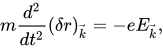
m d 2 d t 2 ( δ r ) k → = − e E k → , {\displaystyle m{\frac {d^{2}}{dt^{2}}}(\delta r)_{\vec {k}}=-eE_{\vec {k}},} {\displaystyle m{\frac {d^{2}}{dt^{2}}}(\delta r)_{\vec {k}}=-eE_{\vec {k}},}

and this is valid only when the frequency ν is greater than ν0 in the Bohr orbit, ν > π c / a 0 {\displaystyle \nu >\pi c/a_{0}} {\displaystyle \nu >\pi c/a_{0}}. The electron is unable to respond to the fluctuating field if the fluctuations are smaller than the natural orbital frequency in the atom.

For the field oscillating at ν,

δ r ( t ) ≅ δ r ( 0 ) ( e − i ν t + e i ν t ) , {\displaystyle \delta r(t)\cong \delta r(0)(e^{-i\nu t}+e^{i\nu t}),} {\displaystyle \delta r(t)\cong \delta r(0)(e^{-i\nu t}+e^{i\nu t}),}

therefore

( δ r ) k → ≅ e m c 2 k 2 E k → = e m c 2 k 2 E k → ( a k → e − i ν t + i k → ⋅ r → + h . c . ) with E k → = ( ℏ c k / 2 ϵ 0 Ω ) 1 / 2 , {\displaystyle (\delta r)_{\vec {k}}\cong {\frac {e}{mc^{2}k^{2}}}E_{\vec {k}}={\frac {e}{mc^{2}k^{2}}}{\mathcal {E}}_{\vec {k}}\left(a_{\vec {k}}e^{-i\nu t+i{\vec {k}}\cdot {\vec {r}}}+h.c.\right)\qquad {\text{with}}\qquad {\mathcal {E}}_{\vec {k}}=\left({\frac {\hbar ck/2}{\epsilon _{0}\Omega }}\right)^{1/2},} {\displaystyle (\delta r)_{\vec {k}}\cong {\frac {e}{mc^{2}k^{2}}}E_{\vec {k}}={\frac {e}{mc^{2}k^{2}}}{\mathcal {E}}_{\vec {k}}\left(a_{\vec {k}}e^{-i\nu t+i{\vec {k}}\cdot {\vec {r}}}+h.c.\right)\qquad {\text{with}}\qquad {\mathcal {E}}_{\vec {k}}=\left({\frac {\hbar ck/2}{\epsilon _{0}\Omega }}\right)^{1/2},}

where Ω {\displaystyle \Omega } {\displaystyle \Omega } is some large normalization volume (the volume of the hypothetical "box" containing the hydrogen atom), and h . c . {\displaystyle h.c.} {\displaystyle h.c.} denotes the hermitian conjugate of the preceding term. By the summation over all k → , {\displaystyle {\vec {k}},} {\displaystyle {\vec {k}},}

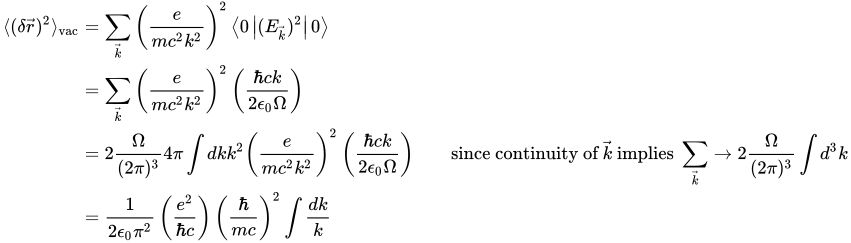
⟨ ( δ r → ) 2 ⟩ v a c = ∑ k → ( e m c 2 k 2 ) 2 ⟨ 0 | ( E k → ) 2 | 0 ⟩ = ∑ k → ( e m c 2 k 2 ) 2 ( ℏ c k 2 ϵ 0 Ω ) = 2 Ω ( 2 π ) 3 4 π ∫ d k k 2 ( e m c 2 k 2 ) 2 ( ℏ c k 2 ϵ 0 Ω ) since continuity of  k →  implies  ∑ k → → 2 Ω ( 2 π ) 3 ∫ d 3 k = 1 2 ϵ 0 π 2 ( e 2 ℏ c ) ( ℏ m c ) 2 ∫ d k k {\displaystyle {\begin{aligned}\langle (\delta {\vec {r}})^{2}\rangle _{\rm {vac}}&=\sum _{\vec {k}}\left({\frac {e}{mc^{2}k^{2}}}\right)^{2}\left\langle 0\left|(E_{\vec {k}})^{2}\right|0\right\rangle \\&=\sum _{\vec {k}}\left({\frac {e}{mc^{2}k^{2}}}\right)^{2}\left({\frac {\hbar ck}{2\epsilon _{0}\Omega }}\right)\\&=2{\frac {\Omega }{(2\pi )^{3}}}4\pi \int dkk^{2}\left({\frac {e}{mc^{2}k^{2}}}\right)^{2}\left({\frac {\hbar ck}{2\epsilon _{0}\Omega }}\right)&&{\text{since continuity of }}{\vec {k}}{\text{ implies }}\sum _{\vec {k}}\to 2{\frac {\Omega }{(2\pi )^{3}}}\int d^{3}k\\&={\frac {1}{2\epsilon _{0}\pi ^{2}}}\left({\frac {e^{2}}{\hbar c}}\right)\left({\frac {\hbar }{mc}}\right)^{2}\int {\frac {dk}{k}}\end{aligned}}} {\displaystyle {\begin{aligned}\langle (\delta {\vec {r}})^{2}\rangle _{\rm {vac}}&=\sum _{\vec {k}}\left({\frac {e}{mc^{2}k^{2}}}\right)^{2}\left\langle 0\left|(E_{\vec {k}})^{2}\right|0\right\rangle \\&=\sum _{\vec {k}}\left({\frac {e}{mc^{2}k^{2}}}\right)^{2}\left({\frac {\hbar ck}{2\epsilon _{0}\Omega }}\right)\\&=2{\frac {\Omega }{(2\pi )^{3}}}4\pi \int dkk^{2}\left({\frac {e}{mc^{2}k^{2}}}\right)^{2}\left({\frac {\hbar ck}{2\epsilon _{0}\Omega }}\right)&&{\text{since continuity of }}{\vec {k}}{\text{ implies }}\sum _{\vec {k}}\to 2{\frac {\Omega }{(2\pi )^{3}}}\int d^{3}k\\&={\frac {1}{2\epsilon _{0}\pi ^{2}}}\left({\frac {e^{2}}{\hbar c}}\right)\left({\frac {\hbar }{mc}}\right)^{2}\int {\frac {dk}{k}}\end{aligned}}}

This integral diverges as the wave number approaches zero or infinity. As mentioned above, this method is expected to be valid only when ν > π c / a 0 {\displaystyle \nu >\pi c/a_{0}} {\displaystyle \nu >\pi c/a_{0}}, or equivalently k > π / a 0 {\displaystyle k>\pi /a_{0}} {\displaystyle k>\pi /a_{0}}. It is also valid only for wavelengths longer than the Compton wavelength, or equivalently k < m c / ℏ {\displaystyle k<mc/\hbar } {\displaystyle k<mc/\hbar }. Therefore, one can choose the upper and lower limit of the integral and these limits make the result converge.

⟨ ( δ r → ) 2 ⟩ v a c ≅ 1 2 ϵ 0 π 2 ( e 2 ℏ c ) ( ℏ m c ) 2 ln ⁡ 4 ϵ 0 ℏ c e 2 {\displaystyle \langle (\delta {\vec {r}})^{2}\rangle _{\rm {vac}}\cong {\frac {1}{2\epsilon _{0}\pi ^{2}}}\left({\frac {e^{2}}{\hbar c}}\right)\left({\frac {\hbar }{mc}}\right)^{2}\ln {\frac {4\epsilon _{0}\hbar c}{e^{2}}}} {\displaystyle \langle (\delta {\vec {r}})^{2}\rangle _{\rm {vac}}\cong {\frac {1}{2\epsilon _{0}\pi ^{2}}}\left({\frac {e^{2}}{\hbar c}}\right)\left({\frac {\hbar }{mc}}\right)^{2}\ln {\frac {4\epsilon _{0}\hbar c}{e^{2}}}}.

For the atomic orbital and the Coulomb potential,

⟨ ∇ 2 ( − e 2 4 π ϵ 0 r ) ⟩ a t = − e 2 4 π ϵ 0 ∫ d r → ψ ∗ ( r → ) ∇ 2 ( 1 r ) ψ ( r → ) = e 2 ϵ 0 | ψ ( 0 ) | 2 , {\displaystyle \left\langle \nabla ^{2}\left({\frac {-e^{2}}{4\pi \epsilon _{0}r}}\right)\right\rangle _{\rm {at}}={\frac {-e^{2}}{4\pi \epsilon _{0}}}\int d{\vec {r}}\psi ^{*}({\vec {r}})\nabla ^{2}\left({\frac {1}{r}}\right)\psi ({\vec {r}})={\frac {e^{2}}{\epsilon _{0}}}|\psi (0)|^{2},} {\displaystyle \left\langle \nabla ^{2}\left({\frac {-e^{2}}{4\pi \epsilon _{0}r}}\right)\right\rangle _{\rm {at}}={\frac {-e^{2}}{4\pi \epsilon _{0}}}\int d{\vec {r}}\psi ^{*}({\vec {r}})\nabla ^{2}\left({\frac {1}{r}}\right)\psi ({\vec {r}})={\frac {e^{2}}{\epsilon _{0}}}|\psi (0)|^{2},}

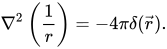
since it is known that

∇ 2 ( 1 r ) = − 4 π δ ( r → ) . {\displaystyle \nabla ^{2}\left({\frac {1}{r}}\right)=-4\pi \delta ({\vec {r}}).} {\displaystyle \nabla ^{2}\left({\frac {1}{r}}\right)=-4\pi \delta ({\vec {r}}).}

For p orbitals, the nonrelativistic wave function vanishes at the origin (at the nucleus), so there is no energy shift. But for s orbitals there is some finite value at the origin,

ψ 2 S ( 0 ) = 1 ( 8 π a 0 3 ) 1 / 2 , {\displaystyle \psi _{2S}(0)={\frac {1}{(8\pi a_{0}^{3})^{1/2}}},} {\displaystyle \psi _{2S}(0)={\frac {1}{(8\pi a_{0}^{3})^{1/2}}},}

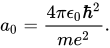
where the Bohr radius is

a 0 = 4 π ϵ 0 ℏ 2 m e 2 . {\displaystyle a_{0}={\frac {4\pi \epsilon _{0}\hbar ^{2}}{me^{2}}}.} {\displaystyle a_{0}={\frac {4\pi \epsilon _{0}\hbar ^{2}}{me^{2}}}.}

Therefore,

⟨ ∇ 2 ( − e 2 4 π ϵ 0 r ) ⟩ a t = e 2 ϵ 0 | ψ 2 S ( 0 ) | 2 = e 2 8 π ϵ 0 a 0 3 {\displaystyle \left\langle \nabla ^{2}\left({\frac {-e^{2}}{4\pi \epsilon _{0}r}}\right)\right\rangle _{\rm {at}}={\frac {e^{2}}{\epsilon _{0}}}|\psi _{2S}(0)|^{2}={\frac {e^{2}}{8\pi \epsilon _{0}a_{0}^{3}}}} {\displaystyle \left\langle \nabla ^{2}\left({\frac {-e^{2}}{4\pi \epsilon _{0}r}}\right)\right\rangle _{\rm {at}}={\frac {e^{2}}{\epsilon _{0}}}|\psi _{2S}(0)|^{2}={\frac {e^{2}}{8\pi \epsilon _{0}a_{0}^{3}}}}.

Finally, the difference of the potential energy becomes:

⟨ Δ V ⟩ = 4 3 e 2 4 π ϵ 0 e 2 4 π ϵ 0 ℏ c ( ℏ m c ) 2 1 8 π a 0 3 ln ⁡ 4 ϵ 0 ℏ c e 2 = α 5 m c 2 1 6 π ln ⁡ 1 π α , {\displaystyle \langle \Delta V\rangle ={\frac {4}{3}}{\frac {e^{2}}{4\pi \epsilon _{0}}}{\frac {e^{2}}{4\pi \epsilon _{0}\hbar c}}\left({\frac {\hbar }{mc}}\right)^{2}{\frac {1}{8\pi a_{0}^{3}}}\ln {\frac {4\epsilon _{0}\hbar c}{e^{2}}}=\alpha ^{5}mc^{2}{\frac {1}{6\pi }}\ln {\frac {1}{\pi \alpha }},} {\displaystyle \langle \Delta V\rangle ={\frac {4}{3}}{\frac {e^{2}}{4\pi \epsilon _{0}}}{\frac {e^{2}}{4\pi \epsilon _{0}\hbar c}}\left({\frac {\hbar }{mc}}\right)^{2}{\frac {1}{8\pi a_{0}^{3}}}\ln {\frac {4\epsilon _{0}\hbar c}{e^{2}}}=\alpha ^{5}mc^{2}{\frac {1}{6\pi }}\ln {\frac {1}{\pi \alpha }},}

where α {\displaystyle \alpha } {\displaystyle \alpha } is the fine-structure constant. This shift is about 500 MHz, within an order of magnitude of the observed shift of 1057 MHz. This is equal to an energy of only 7.00×10⁻²⁵ J (4.37×10⁻⁶ eV).

Welton's heuristic derivation of the Lamb shift is similar to, but distinct from, the calculation of the Darwin term using Zitterbewegung, a contribution to the fine structure that is of lower order in α {\displaystyle \alpha } {\displaystyle \alpha } than the Lamb shift.[15]: 80–81 

Lamb–Retherford experiment

[edit]

In 1947 Willis Lamb and Robert Retherford carried out an experiment using microwave techniques to stimulate radio-frequency transitions between 2S1/2 and 2P1/2 levels of hydrogen.[16] By using lower frequencies than for optical transitions the Doppler broadening could be neglected (Doppler broadening is proportional to the frequency). The energy difference Lamb and Retherford found was a rise of about 1000 MHz (0.03 cm−1) of the 2S1/2 level above the 2P1/2 level.

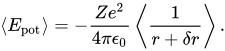
This particular difference is a one-loop effect of quantum electrodynamics, and can be interpreted as the influence of virtual photons that have been emitted and re-absorbed by the atom. In quantum electrodynamics the electromagnetic field is quantized and, like the harmonic oscillator in quantum mechanics, its lowest state is not zero. Thus, there exist small zero-point oscillations that cause the electron to execute rapid oscillatory motions. The electron is "smeared out" and each radius value is changed from r to r + δr (a small but finite perturbation).

The Coulomb potential is therefore perturbed by a small amount and the degeneracy of the two energy levels is removed. The new potential can be approximated (using atomic units) as follows:
⟨ E p o t ⟩ = − Z e 2 4 π ϵ 0 ⟨ 1 r + δ r ⟩ . {\displaystyle \langle E_{\mathrm {pot} }\rangle =-{\frac {Ze^{2}}{4\pi \epsilon _{0}}}\left\langle {\frac {1}{r+\delta r}}\right\rangle .} {\displaystyle \langle E_{\mathrm {pot} }\rangle =-{\frac {Ze^{2}}{4\pi \epsilon _{0}}}\left\langle {\frac {1}{r+\delta r}}\right\rangle .}

The Lamb shift itself is given by

Δ E L a m b = α 5 m e c 2 k ( n , 0 ) 4 n 3   f o r   ℓ = 0 {\displaystyle \Delta E_{\mathrm {Lamb} }=\alpha ^{5}m_{e}c^{2}{\frac {k(n,0)}{4n^{3}}}\ \mathrm {for} \ \ell =0\,} {\displaystyle \Delta E_{\mathrm {Lamb} }=\alpha ^{5}m_{e}c^{2}{\frac {k(n,0)}{4n^{3}}}\ \mathrm {for} \ \ell =0\,}

with k(n, 0) around 13 varying slightly with n, and

Δ E L a m b = α 5 m e c 2 1 4 n 3 [ k ( n , ℓ ) ± 1 π ( j + 1 2 ) ( ℓ + 1 2 ) ]   f o r   ℓ ≠ 0   a n d   j = ℓ ± 1 2 , {\displaystyle \Delta E_{\mathrm {Lamb} }=\alpha ^{5}m_{e}c^{2}{\frac {1}{4n^{3}}}\left[k(n,\ell )\pm {\frac {1}{\pi (j+{\frac {1}{2}})(\ell +{\frac {1}{2}})}}\right]\ \mathrm {for} \ \ell \neq 0\ \mathrm {and} \ j=\ell \pm {\frac {1}{2}},} {\displaystyle \Delta E_{\mathrm {Lamb} }=\alpha ^{5}m_{e}c^{2}{\frac {1}{4n^{3}}}\left[k(n,\ell )\pm {\frac {1}{\pi (j+{\frac {1}{2}})(\ell +{\frac {1}{2}})}}\right]\ \mathrm {for} \ \ell \neq 0\ \mathrm {and} \ j=\ell \pm {\frac {1}{2}},}

with log(k(n,ℓ)) a small number (approx. −0.05) making k(n,ℓ) close to unity.

For a derivation of ΔELamb see for example:[17]

In the hydrogen spectrum

[edit]
Main article: Lyman series

In 1947, Hans Bethe was the first to explain the Lamb shift in the hydrogen spectrum, and he thus laid the foundation for the modern development of quantum electrodynamics. Bethe was able to derive the Lamb shift by implementing the idea of mass renormalization, which allowed him to calculate the observed energy shift as the difference between the shift of a bound electron and the shift of a free electron.[18] The Lamb shift currently provides a measurement of the fine-structure constant α to better than one part in a million, allowing a precision test of quantum electrodynamics.

His calculation of the Lamb shift has been stated to have revolutionized quantum electrodynamics and having "opened the way to the modern era of particle physics".[10]

See also

[edit]
  • iconPhysics portal
  • Uehling potential, first approximation to the Lamb shift
  • Shelter Island Conference
  • Zeeman effect used to measure the Lamb shift

References

[edit]
  1. ^ Houston, W. V.; Hsieh, Y. M. (1934-02-15). "The Fine Structure of the Balmer Lines". Physical Review. 45 (4): 263–272. Bibcode:1934PhRv...45..263H. doi:10.1103/PhysRev.45.263. ISSN 0031-899X.
  2. ^ a b "The Measurement of the Specific Charge of an Electron". Science. 79 (2038): 6. 1934-01-19. doi:10.1126/science.79.2038.6.s. ISSN 0036-8075.
  3. ^ a b c d e Crease, Robert P.; Mann, Charles C. (1986). The Second Creation: Makers of the Revolution in Twentieth-Century Physics. Internet Archive. MacMillan. pp. 112–117. ISBN 978-0813521770.
  4. ^ Pasternack, Simon (1938-12-15). "Note on the Fine Structure of H α and D α". Physical Review. 54 (12): 1113. Bibcode:1938PhRv...54.1113P. doi:10.1103/PhysRev.54.1113. ISSN 0031-899X.
  5. ^ Milton, K. A.; Mehra, Jagdish (2000). Climbing the Mountain: The Scientific Biography of Julian Schwinger. Oxford University Press. ISBN 978-0-19-852745-9.
  6. ^ Hu, Danian (2021-07-22), Chang, Ku-ming (Kevin); Rocke, Alan (eds.), "A Cradle of Chinese Physics Researchers: The Master of Science Program in the Physics Department of Yenching University, 1927–1941", History of Universities: Volume XXXIV/1 (1 ed.), Oxford University PressOxford, pp. 282–303, doi:10.1093/oso/9780192844774.003.0014, ISBN 978-0-19-284477-4, retrieved 2025-10-01{{citation}}: CS1 maint: work parameter with ISBN (link)
  7. ^ 杨, 振宁; 翁, 帆 (2008-01-01). 曙光集 [Dawn Collection] (PDF) (in Chinese). 八方文化创作室. p. 146. doi:10.1142/g209. ISBN 9787108028365.
  8. ^ Liu, Yinmei (2012). "杨振宁与中国近现代物理学史研究" [Yang Zhenning's Research on Modern and Contemporary Chinese Physics History]. Academic Forum (学术论坛) (in Chinese). 35 (12): 105–108. ISSN 1004-4434.
  9. ^ G Aruldhas (2009). "§15.15 Lamb Shift". Quantum Mechanics (2nd ed.). Prentice-Hall of India Pvt. Ltd. p. 404. ISBN 978-81-203-3635-3.
  10. ^ a b Brown, Gerald E.; Lee, Chang-Hwan (2006). Hans Bethe and His Physics. World Scientific Publishing. pp. 15–16, 116–118, 161. ISBN 978-981-256-609-6.
  11. ^ Gottfried, Kurt; Jackson, J. David. "Victor Frederick Weisskopf, 1908–2002, A Biographical Memoir" (PDF). p. 16. I might even have shared the Nobel Prize with Lamb
  12. ^ "Willis E. Lamb, Jr. 1913—2008" (PDF). Biographical Memoirs of the National Academy of Sciences: 6. 2009.
  13. ^ Marlan Orvil Scully; Muhammad Suhail Zubairy (1997). Quantum Optics. Cambridge UK: Cambridge University Press. pp. 13–16. ISBN 0-521-43595-1.
  14. ^ Welton, Theodore A. (1948-11-01). "Some Observable Effects of the Quantum-Mechanical Fluctuations of the Electromagnetic Field". Physical Review. 74 (9): 1157–1167. Bibcode:1948PhRv...74.1157W. doi:10.1103/PhysRev.74.1157. ISSN 0031-899X.
  15. ^ Itzykson, Claude; Zuber, Jean-Bernard (2012). Quantum Field Theory. Dover Publications. ISBN 9780486134697. OCLC 868270376.
  16. ^ Lamb, Willis E.; Retherford, Robert C. (1947). "Fine Structure of the Hydrogen Atom by a Microwave Method". Physical Review. 72 (3): 241–243. Bibcode:1947PhRv...72..241L. doi:10.1103/PhysRev.72.241.
  17. ^ Bethe, H.A.; Salpeter, E.E. (2013) [1957]. "c) Radiative and other corrections §21. Fine structure and the Lamb shift". Quantum Mechanics of One- and Two-Electron Atoms. Springer. p. 103. ISBN 978-3-662-12869-5.
  18. ^ Bethe, H. A. (1947). "The Electromagnetic Shift of Energy Levels". Phys. Rev. 72 (4): 339–341. Bibcode:1947PhRv...72..339B. doi:10.1103/PhysRev.72.339. S2CID 120434909.

Further reading

[edit]
  • Smirnov, Boris M. (2003). Physics of atoms and ions. Springer. pp. 39–41. ISBN 0-387-95550-X.
  • Scully, M.O.; Zubairy, M.S. (1997). "§1.3 Lamb shift". Quantum optics. Cambridge University Press. pp. 13–16. ISBN 0-521-43595-1.

External links

[edit]
  • Hans Bethe talking about Lamb-shift calculations on Web of Stories
  • Nobel Prize biography of Willis Lamb
  • Nobel lecture of Willis Lamb: Fine Structure of the Hydrogen Atom
  • v
  • t
  • e
Quantum electrodynamics
Formalism
  • Euler–Heisenberg Lagrangian
  • Feynman diagram
  • Gupta–Bleuler formalism
  • Path integral formulation
Particles
  • Dual photon
  • Electron
  • Faddeev–Popov ghost
  • Photon
  • Positron
  • Positronium
  • Virtual particles
Concepts
  • Anomalous magnetic dipole moment
  • Furry's theorem
  • Klein–Nishina formula
  • Landau pole
  • QED vacuum
  • Self-energy
  • Schwinger limit
  • Uehling potential
  • Vacuum polarization
  • Vertex function
  • Ward–Takahashi identity
Processes
  • Bhabha scattering
  • Breit–Wheeler process
  • Bremsstrahlung
  • Compton scattering
  • Delbrück scattering
  • Lamb shift
  • Møller scattering
  • Schwinger effect
  • Photon-photon scattering
See also: Template:Quantum mechanics topics
  • v
  • t
  • e
Quantum field theories
Theories
  • Algebraic QFT
  • Axiomatic QFT
  • Conformal field theory
  • Lattice field theory
  • Noncommutative QFT
  • Gauge theory
  • QFT in curved spacetime
  • String theory
  • Supergravity
  • Thermal QFT
  • Topological QFT
  • Two-dimensional conformal field theory
Models
Regular
  • Born–Infeld
  • Euler–Heisenberg
  • Ginzburg–Landau
  • Non-linear sigma
  • Proca
  • Quantum electrodynamics
  • Quantum chromodynamics
  • Quartic interaction
  • Scalar electrodynamics
  • Scalar chromodynamics
  • Soler
  • Yang–Mills
  • Yang–Mills–Higgs
  • Yukawa
Low dimensional
  • 2D Yang–Mills
  • Bullough–Dodd
  • Gross–Neveu
  • Schwinger
  • Sine-Gordon
  • Thirring
  • Thirring–Wess
  • Toda
Conformal
  • 2D free massless scalar
  • Liouville
  • Logarithmic
  • Minimal
  • Polyakov
  • Wess–Zumino–Witten
Supersymmetric
  • 4D N = 1
  • N = 1 super Yang–Mills
  • Seiberg–Witten
  • Super QCD
  • Wess–Zumino
Superconformal
  • 6D (2,0)
  • ABJM
  • N = 4 super Yang–Mills
Supergravity
  • Pure 4D N = 1
  • 4D N = 1
  • 4D N = 8
  • Higher dimensional
  • Type I
  • Type IIA
  • Type IIB
  • 11D
Topological
  • BF
  • Chern–Simons
Particle theory
  • Chiral
  • Fermi
  • MSSM
  • Nambu–Jona-Lasinio
  • NMSSM
  • Standard Model
  • Stueckelberg
Related
  • Casimir effect
  • Cosmic string
  • History
  • Loop quantum gravity
  • Loop quantum cosmology
  • On shell and off shell
  • Quantum chaos
  • Quantum dynamics
  • Quantum foam
  • Quantum fluctuations
    • links
  • Quantum gravity
    • links
  • Quantum hadrodynamics
  • Quantum hydrodynamics
  • Quantum information
  • Quantum information science
    • links
  • Quantum logic
  • Quantum thermodynamics
See also: Template:Quantum mechanics topics
  • v
  • t
  • e
Particles in physics
Elementary
Fermions
Quarks
  • Up (quark
  • antiquark)
  • Down (quark
  • antiquark)
  • Charm (quark
  • antiquark)
  • Strange (quark
  • antiquark)
  • Top (quark
  • antiquark)
  • Bottom (quark
  • antiquark)
Leptons
  • Electron
  • Positron
  • Muon
  • Antimuon
  • Tau
  • Antitau
  • Neutrino
    • Electron neutrino
    • Electron antineutrino
    • Muon neutrino
    • Muon antineutrino
    • Tau neutrino
    • Tau antineutrino
Bosons
Gauge
  • Photon
  • Gluon
  • W and Z bosons
Scalar
  • Higgs boson
Ghost fields
  • Faddeev–Popov ghosts
Hypothetical
Superpartners
Gauginos
  • Gluino
  • Gravitino
  • Photino
Others
  • Axino
  • Chargino
  • Higgsino
  • Neutralino
  • Sfermion (Stop squark)
Others
  • Axion
  • Curvaton
  • Dilaton
  • Dual graviton
  • Graviphoton
  • Graviton
  • Inflaton
  • Leptoquark
  • Magnetic monopole
  • Majoron
  • Majorana fermion
  • Dark photon
  • Preon
  • Sterile neutrino
  • Tachyon
  • W′ and Z′ bosons
  • X and Y bosons
Composite
Hadrons
Baryons
  • Nucleon
    • Proton
    • Antiproton
    • Neutron
    • Antineutron
  • Delta baryon
  • Lambda baryon
  • Sigma baryon
  • Xi baryon
  • Omega baryon
Mesons
  • Pion
  • Rho meson
  • Eta and eta prime mesons
  • Bottom eta meson
  • Phi meson
  • J/psi meson
  • Omega meson
  • Upsilon meson
  • Kaon
  • B meson
  • D meson
  • Quarkonium
Exotic hadrons
  • Tetraquark (Double-charm tetraquark)
  • Pentaquark
Others
  • Atomic nuclei
  • Atoms
  • Exotic atoms
    • Positronium
    • Muonium
    • Tauonium
    • Onia
    • Pionium
    • Protonium
    • Antihydrogen
  • Superatoms
  • Molecules
Hypothetical
Baryons
  • Hexaquark
  • Heptaquark
  • Skyrmion
Mesons
  • Glueball
  • Theta meson
  • T meson
Others
  • Mesonic molecule
  • Pomeron
  • Diquark
  • R-hadron
Quasiparticles
  • Anyon
  • Davydov soliton
  • Dropleton
  • Exciton
  • Fracton
  • Hole
  • Magnon
  • Phonon
  • Plasmaron
  • Plasmon
  • Polariton
  • Polaron
  • Roton
  • Trion
Lists
  • Baryons
  • Mesons
  • Particles
  • Quasiparticles
  • Timeline of particle discoveries
Related
  • History of subatomic physics
    • timeline
  • Standard Model
    • mathematical formulation
  • Subatomic particles
  • Particles
  • Antiparticles
  • Nuclear physics
  • Eightfold way
    • Quark model
  • Exotic matter
  • Massless particle
  • Relativistic particle
  • Virtual particle
  • Wave–particle duality
  • Particle chauvinism
Physics portal
Retrieved from "https://teknopedia.ac.id/w/index.php?title=Lamb_shift&oldid=1338552908"
Categories:
  • Quantum electrodynamics
  • Physical quantities
Hidden categories:
  • CS1 maint: work parameter with ISBN
  • CS1 Chinese-language sources (zh)
  • Articles with short description
  • Short description is different from Wikidata
  • Use American English from January 2019
  • All Wikipedia articles written in American English

  • indonesia
  • Polski
  • العربية
  • Deutsch
  • English
  • Español
  • Français
  • Italiano
  • مصرى
  • Nederlands
  • 日本語
  • Português
  • Sinugboanong Binisaya
  • Svenska
  • Українська
  • Tiếng Việt
  • Winaray
  • 中文
  • Русский
Sunting pranala
url url url url url url url url url url url url url url url url url url url url url url url url url url url url url url url url url url url url url url url url url url url url url url url url url url url url url url url url url url url url url url url url url url url url url url url url url url url url url url url url url url url url url url url url url url url url url url url url url url url url url url url url url url url url url url url url url url url url url url url url url url url url url url url url url url url url url url url url url url url url url url url url url url url url url url url url url url url url url url url url url url url url url url url url url url url url url url url url url url url url url url url url url url url url url url url url url url url url url url url url url url url url url url url url url url url url url url url url url url url url url url url url url url url url url url url url url url url url url url url url url url url url url url url url url url url url url url url url url url url url url url url url url url url url url url url url url url url url url url url url url url url url url url url url url url url url url url url url url url url url url url url url url url url url url url url url url url url url url url url url url url url url url url url url url url url url url url url url url url url url url url url url url url url url url url url url url url url url url url url url url url url url url url url url url url url url url url url url url url url url url url url url url url url url url url url url url url url url url url url url url url url url url url url url url url url url url url url url url url url url url url url url url url url url url url url url url url url url url url url url url url url url url url url url url url url url url url url url url url url url url url url url url url url url url url url url url url url url url url url url url url url url url url url url url url url url url url url url url url url url url url url url url url url url url url url url url url url url url url url url url url url url url url url url url url url url url url url url url url url url url url url url url url url url url url url url url url url url url url url url url url url url url url url url url url url url url url url url url url url url url url url url url url url url url url url url url url url url url url url url url url url url url url url url url url url url url url url url url url url url url url url url url url url url url url url url url url url url url url url url url url url url url url url url url url url url url url url url url url url url url url url url url url url url url url url url url url url url url url url url url url url url url url url url url url url url url url url url url url url url url url url url url url url url url url url url url url url url url url url url url url url url url url url url url url url url url url url url url url url url url url url url url url url url url url url url url url url url url url url url url url url url url url url url url url url url url url url url url url url url url url url url url url url url url url url url url url url url url url url url url url url url url url url url url url url url url url url url url url url url url url url url url url url url url url url url url url url url url url url url url url url url url url url url url url url url url url url url url url url url url url url url url url url url url url url url url url url url url url url url url url url url url url url url url url url url url url url url url url url url url url url url url url url url url url url url url url url url url url url url url url url url url url url url url url url url url url url url url url url url url url url url url url url url url url url url url url url url url url url url url url url url url url url url url url url url url url url url url url url url url url url url url url url url url url url url url url url url url url url url url url url url url url url url url url url url url url url url url url url url url url url url url url url url url url url url url url url url url url url url url url url url url url url url url url url url url url url url url url url url url url url url url url url url url url url url url url url url url url url url url url url url url url url url url url url url url url url url url url url url url url url url url url url url url url url url url url url url url url url url url url url url url url url url url url url url url url url url url url url url url url url url url url url url url url url url url url url url url url url url url url url url url url url url url url url url url url url url url url url url url url url url url url url url url url url url url url url url url url url url url url url url url url url url url url url url url url url url url url url url url url url url url url url url url url url url url url url url url url url url url url url url url url url url url url url url url url url url url url url url url url url url url url url url url url url url url url url url url url url url url url url url url url url url url url url url url url url url url url url url url url url url url url url url url url url url url url url url url url url url url url url url url url url url url url url url url url url url url url url url url url url url url url url url url url url url url url url url url url url url url url url url url url url url url url url url url url url url url url url url url url url url url url url url url url url url url url url url url url url url url url url url url url url url url url url url url url url url url url url url url url url url url url url url url url url url url url url url url url url url url url url url url url url url url url url url url url url url url url url url url url url url url url url url url url url url url url url url url url url url url url url url url url url url url url url url url url url url url url url url url url url url url url url url url url url url url url url url url url url url url url url url url url url url url url url url url url url url url url url url url url url url url url url url url url url url url url url url url url url url url url url url url url url url url url url url url url url url url url url url url url url url url url url url url url url url url url url url url url url url url url url url url url url url url url url url url url url url url url url url url url url url url url url url url url url url url url url url url url url url url url url url url url url url url url url url url url url url url url url url url url url url url url url url url url url url url url url url url url url url url url url url url url url url url url url url url url url url url url url url url url url url url url url url url url url url url url url url url url url url url url url url url url url url url url url url url url url url url url url url url url url url url url url url url url url url url url url url url url url url url url url url url url url url url url url url url url url url url url url url url url url url url url url url url url url url url url url url url url url url url url url url url url url url url url url url url url url url url url url url url url url url url url url url url url url url url url url url url url url url url url url url url url url url url url url url url url url url url url url url url url url url url url url url url url url url url url url url url url url url url url url url url url url url url url url url url url url url url url url url url url url url url url url url url url url url url url url url url url url url url url url url url url url url url url url url url url url url url url url url url url url url url url url url url url url url url url url url url url url url url url url url url url url url url url url url url url url url url url url url url url url url url url url url url url url url url url url url url url url url url url url url url url url url url url url url url url url url url url url url url url url url url url url url url url url url url url url url url url url url url url url url url url url url url url url url url url url url url url url url url url url url url url url url url url url url url url url url url url url url url url url url url url url url url url url url url url url url url url url url url url url url url url url url url url url url url url url url url url url url url url url url url url url url url url url url url url url url url url url url url url url url url url url url url url url url url url url url url url url url url url url url url url url url url url url url url url url url url url url url url url url url url url url url url url url url url url url url url url url url url url url url url url url url url url url url url url url url url url url url url url url url url url url url url url url url url url url url url url url url url url url url url url url url url url url url url url url url url url url url url url url url url url url url url url url url url url url url url url url url url url url url url url url url url url url url url url url url url url url url url url url url url url url url url url url url url url url url url url url url url url url url url url url url url url url url url url url url url url url url url url url url url url url url url url url url url url url url url url url url url url url url url url url url url url url url url url url url url url url url url url url url url url url url url url url url url url url url url url url url url url url url url url url url url url url url url url url url url url url url url url url url
Pusat Layanan

UNIVERSITAS TEKNOKRAT INDONESIA | ASEAN's Best Private University
Jl. ZA. Pagar Alam No.9 -11, Labuhan Ratu, Kec. Kedaton, Kota Bandar Lampung, Lampung 35132
Phone: (0721) 702022
Email: pmb@teknokrat.ac.id