Epstein Files Full PDF

CLICK HERE
Technopedia Center
PMB University Brochure
Faculty of Engineering and Computer Science
S1 Informatics S1 Information Systems S1 Information Technology S1 Computer Engineering S1 Electrical Engineering S1 Civil Engineering

faculty of Economics and Business
S1 Management S1 Accountancy

Faculty of Letters and Educational Sciences
S1 English literature S1 English language education S1 Mathematics education S1 Sports Education
teknopedia

  • Registerasi
  • Brosur UTI
  • Kip Scholarship Information
  • Performance
Flag Counter
  1. World Encyclopedia
  2. Portal:Physics - Wikipedia
Portal:Physics - Wikipedia
From Wikipedia, the free encyclopedia
Portal maintenance status: (June 2018)
  • This portal is manually maintained by Northamerica1000. Please contact these user(s) when you plan to make significant changes.
  • This portal's subpages have been checked by an editor, and are needed.
Please take care when editing, especially if using automated editing software, and seek consensus before making major changes. Learn how to update the maintenance information here.
Wikipedia portal for content related to Physics

Portal topics - (Random portal)

Activities
Culture
Geography
Health
History
Mathematics
Nature
People
Philosophy
Religion
Society
Technology

The Physics Portal

Physics is the scientific study of matter, its fundamental constituents, its motion and behavior through space and time, and the related entities of energy and force. It is one of the most fundamental scientific disciplines. A scientist who specializes in the field of physics is called a physicist.

Physics is one of the oldest academic disciplines. Over much of the past two millennia, physics, chemistry, biology, and certain branches of mathematics were a part of natural philosophy, but during the Scientific Revolution in the 17th century, these natural sciences branched into separate research endeavors. Physics intersects with many interdisciplinary areas of research, such as biophysics and quantum chemistry, and the boundaries of physics are not rigidly defined. New ideas in physics often explain the fundamental mechanisms studied by other sciences and suggest new avenues of research in these and other academic disciplines such as mathematics and philosophy.

Advances in physics often enable new technologies. For example, advances in the understanding of electromagnetism, solid-state physics, and nuclear physics led directly to the development of technologies that have transformed modern society, such as television, computers, domestic appliances, and nuclear weapons; advances in thermodynamics led to the development of industrialization; and advances in mechanics inspired the development of calculus. (Full article...)

Refresh with new selections below (purge)

Featured article - show another

This is a Featured article, which represents some of the best content on English Wikipedia.

Plutonium is a chemical element; it has symbol Pu and atomic number 94. It is a silvery-gray actinide metal that tarnishes when exposed to air, and forms a dull coating when oxidized. The element normally exhibits six allotropes and four oxidation states. It reacts with carbon, halogens, nitrogen, silicon and hydrogen. When exposed to moist air, it forms oxides and hydrides that can expand the sample up to 70% in volume, which in turn flake off as a powder that is pyrophoric. It is radioactive and can accumulate in bones, which makes the handling of plutonium dangerous.

Plutonium was first synthesized and isolated in late 1940 and early 1941, by deuteron bombardment of uranium-238 in the 1.5-metre (60 in) cyclotron at the University of California, Berkeley. First, neptunium-238 (half-life 2.1 days) was synthesized, which then beta-decayed to form the new element with atomic number 94 and atomic weight 238 (half-life 88 years). Since uranium had been named after the planet Uranus and neptunium after the planet Neptune, element 94 was named after Pluto, which at the time was also considered a planet. Wartime secrecy prevented the University of California team from publishing its discovery until 1948. (Full article...)

List of Featured articles
  • AdS/CFT correspondence
  • Archimedes
  • Astrophysics Data System
  • Atom
  • Atomic line filter
  • Big Bang
  • Niels Bohr
  • James E. Boyd (scientist)
  • Calutron
  • James Chadwick
  • Chicago Pile-1
  • Jürgen Ehlers
  • Electron
  • Leonhard Euler
  • Eye (cyclone)
  • Enrico Fermi
  • Richard Feynman
  • Ursula Franklin
  • Gamma-ray burst
  • General relativity
  • Introduction to general relativity
  • Josiah Willard Gibbs
  • Gliding
  • Heavy metals
  • Herbig–Haro object
  • History of Mars observation
  • Hubble Deep Field
  • Johannes Kepler
  • Laplace–Runge–Lenz vector
  • M-theory
  • Magnetosphere of Jupiter
  • Manhattan Project
  • Mechanical filter
  • Mirror symmetry (string theory)
  • Montreal Laboratory
  • Emmy Noether
  • Numerical weather prediction
  • Oganesson
  • Mark Oliphant
  • Gerard K. O'Neill
  • J. Robert Oppenheimer
  • Periodic table
  • Photon
  • Planets beyond Neptune
  • Quark
  • Isidor Isaac Rabi
  • Radiocarbon dating
  • Redshift
  • Louis Slotin
  • Smyth Report
  • Speed of light
  • Star
  • Sun
  • Supernova
  • Edward Teller
  • Tornado
  • Trinity (nuclear test)
  • Tropical cyclone
  • Uranium
  • White dwarf
  • Wind
  • ZETA (fusion reactor)
edit 

Did you know - show different entries

  • ... that nuclear fusion reactions are probably occurring at or above the sun's photosphere; it is a process called solar surface fusion.
  • ... that the submarine telescope ANTARES, intended to detect neutrinos, may also be used to observe bioluminescent plankton and fish?
  • ... that a touch flash releases about a billion photons a second far less than produced in a particle accelerator?
More did you know facts
edit 

Selected image - show another

Crepuscular rays at sunset near Waterberg Plateau (Wabi Game Ranch) in Namibia
More selected images
edit 

Related portals

  • Astronomy
  • Chemistry
  • icon Energy
  • icon Science
  • image History of science
  • icon Mathematics
  • icon Technology
  • Earth sciences

Good articles - load new batch

These are Good articles, which meet a core set of high editorial standards.

  • Image 1 Compton in 1927 Arthur Holly Compton (September 10, 1892 – March 15, 1962) was an American physicist who shared the 1927 Nobel Prize in Physics with C. T. R. Wilson for his discovery of the Compton effect, which demonstrated the particle nature of electromagnetic radiation. It was a sensational discovery at the time; the wave nature of light had been well-demonstrated, but the idea that light had both wave and particle properties was not easily accepted. In 1919, Compton was awarded one of the first two National Research Council Fellowships that allowed students to study abroad. He chose to go to the University of Cambridge's Cavendish Laboratory in England, where he studied the scattering and absorption of gamma rays. Further research along these lines led to the discovery of the Compton effect. (Full article...)
    Image 1

    Compton in 1927

    Arthur Holly Compton (September 10, 1892 – March 15, 1962) was an American physicist who shared the 1927 Nobel Prize in Physics with C. T. R. Wilson for his discovery of the Compton effect, which demonstrated the particle nature of electromagnetic radiation. It was a sensational discovery at the time; the wave nature of light had been well-demonstrated, but the idea that light had both wave and particle properties was not easily accepted.

    In 1919, Compton was awarded one of the first two National Research Council Fellowships that allowed students to study abroad. He chose to go to the University of Cambridge's Cavendish Laboratory in England, where he studied the scattering and absorption of gamma rays. Further research along these lines led to the discovery of the Compton effect. (Full article...)
  • Image 2 Quantum Reality is a 1985 popular science book by physicist Nick Herbert, a member of the Fundamental Fysiks Group which was formed to explore the philosophical implications of quantum theory. The book attempts to address the ontology of quantum objects, their attributes, and their interactions, without reliance on advanced mathematical concepts. Herbert discusses the most common interpretations of quantum mechanics and their consequences in turn, highlighting the conceptual advantages and drawbacks of each. (Full article...)
    Image 2
    Quantum Reality is a 1985 popular science book by physicist Nick Herbert, a member of the Fundamental Fysiks Group which was formed to explore the philosophical implications of quantum theory. The book attempts to address the ontology of quantum objects, their attributes, and their interactions, without reliance on advanced mathematical concepts. Herbert discusses the most common interpretations of quantum mechanics and their consequences in turn, highlighting the conceptual advantages and drawbacks of each. (Full article...)
  • Image 3 Szilard, c. 1960 Leo Szilard (/ˈsɪlɑːrd/; Hungarian: Leó Szilárd [ˈlɛoː ˈsilaːrd]; born Leó Spitz; February 11, 1898 – May 30, 1964) was a Hungarian-born American physicist, biologist and inventor who made numerous important discoveries in nuclear physics and the biological sciences. He conceived the nuclear chain reaction in 1933, and patented the idea in 1936. In late 1939 he wrote the letter for Albert Einstein's signature that resulted in the Manhattan Project that built the atomic bomb, and then in 1945 wrote the Szilard petition asking president Harry S. Truman to demonstrate the bomb without dropping it on civilians. According to György Marx, he was one of the Hungarian scientists known as The Martians. Szilard initially attended Palatine Joseph Technical University in Budapest, but his engineering studies were interrupted by service in the Austro-Hungarian Army during World War I. He left Hungary for Germany in 1919, enrolling at Technische Hochschule (Institute of Technology) in Berlin-Charlottenburg (now Technische Universität Berlin), but became bored with engineering and transferred to Friedrich Wilhelm University, where he studied physics. He wrote his doctoral thesis on Maxwell's demon, a long-standing puzzle in the philosophy of thermal and statistical physics. Szilard was the first scientist of note to recognize the connection between thermodynamics and information theory. (Full article...)
    Image 3

    Szilard, c. 1960

    Leo Szilard (/ˈsɪlɑːrd/; Hungarian: Leó Szilárd [ˈlɛoː ˈsilaːrd]; born Leó Spitz; February 11, 1898 – May 30, 1964) was a Hungarian-born American physicist, biologist and inventor who made numerous important discoveries in nuclear physics and the biological sciences. He conceived the nuclear chain reaction in 1933, and patented the idea in 1936. In late 1939 he wrote the letter for Albert Einstein's signature that resulted in the Manhattan Project that built the atomic bomb, and then in 1945 wrote the Szilard petition asking president Harry S. Truman to demonstrate the bomb without dropping it on civilians. According to György Marx, he was one of the Hungarian scientists known as The Martians.

    Szilard initially attended Palatine Joseph Technical University in Budapest, but his engineering studies were interrupted by service in the Austro-Hungarian Army during World War I. He left Hungary for Germany in 1919, enrolling at Technische Hochschule (Institute of Technology) in Berlin-Charlottenburg (now Technische Universität Berlin), but became bored with engineering and transferred to Friedrich Wilhelm University, where he studied physics. He wrote his doctoral thesis on Maxwell's demon, a long-standing puzzle in the philosophy of thermal and statistical physics. Szilard was the first scientist of note to recognize the connection between thermodynamics and information theory. (Full article...)
  • Image 4 Thorntonbank Wind Farm, using REpower 5M 5 MW turbines in the North Sea off the coast of Belgium A wind turbine is a device that converts the kinetic energy of wind into electrical energy. As of 2020[update], hundreds of thousands of large turbines, in installations known as wind farms, were generating over 650 gigawatts of power, with 60 GW added each year. Wind turbines are an increasingly important source of intermittent renewable energy, and are used in many countries to lower energy costs and reduce reliance on fossil fuels. One study claimed that, as of 2009,[update] wind had the "lowest relative greenhouse gas emissions, the least water consumption demands and the most favorable social impacts" compared to photovoltaic, hydro, geothermal, coal and gas energy sources. Wind turbines are also sometimes included in liminal space photos.  Smaller wind turbines are used for applications such as battery charging and remote devices such as traffic warning signs. Larger turbines can contribute to a domestic power supply while selling unused power back to the utility supplier via the electrical grid. (Full article...)
    Image 4
    Thorntonbank Wind Farm, using REpower 5M 5 MW turbines in the North Sea off the coast of Belgium

    A wind turbine is a device that converts the kinetic energy of wind into electrical energy. As of 2020[update], hundreds of thousands of large turbines, in installations known as wind farms, were generating over 650 gigawatts of power, with 60 GW added each year. Wind turbines are an increasingly important source of intermittent renewable energy, and are used in many countries to lower energy costs and reduce reliance on fossil fuels. One study claimed that, as of 2009,[update] wind had the "lowest relative greenhouse gas emissions, the least water consumption demands and the most favorable social impacts" compared to photovoltaic, hydro, geothermal, coal and gas energy sources. Wind turbines are also sometimes included in liminal space photos. 

    Smaller wind turbines are used for applications such as battery charging and remote devices such as traffic warning signs. Larger turbines can contribute to a domestic power supply while selling unused power back to the utility supplier via the electrical grid. (Full article...)
  • Image 5 The Paranal Observatory of European Southern Observatory creating a laser guide star in the atmosphere to observe the Galactic Center Astronomy is a natural science that studies celestial objects and the phenomena that occur in the cosmos. It uses mathematics, physics, and chemistry to explain their origin and their overall evolution. Objects of interest include planets, moons, stars, nebulae, galaxies, meteoroids, asteroids, and comets. Relevant phenomena include supernova explosions, gamma ray bursts, quasars, blazars, pulsars, and cosmic microwave background radiation. More generally, astronomy studies everything that originates beyond Earth's atmosphere. Cosmology is the branch of astronomy that studies the universe as a whole. Astronomy is one of the oldest natural sciences. The early civilizations in recorded history made methodical observations of the night sky. These include the Egyptians, Babylonians, Greeks, Indians, Chinese, Maya, and many ancient indigenous peoples of the Americas. In the past, astronomy included disciplines as diverse as astrometry, celestial navigation, observational astronomy, and the making of calendars. (Full article...)
    Image 5
    The Paranal Observatory of European Southern Observatory creating a laser guide star in the atmosphere to observe the Galactic Center


    Astronomy is a natural science that studies celestial objects and the phenomena that occur in the cosmos. It uses mathematics, physics, and chemistry to explain their origin and their overall evolution. Objects of interest include planets, moons, stars, nebulae, galaxies, meteoroids, asteroids, and comets. Relevant phenomena include supernova explosions, gamma ray bursts, quasars, blazars, pulsars, and cosmic microwave background radiation. More generally, astronomy studies everything that originates beyond Earth's atmosphere. Cosmology is the branch of astronomy that studies the universe as a whole.

    Astronomy is one of the oldest natural sciences. The early civilizations in recorded history made methodical observations of the night sky. These include the Egyptians, Babylonians, Greeks, Indians, Chinese, Maya, and many ancient indigenous peoples of the Americas. In the past, astronomy included disciplines as diverse as astrometry, celestial navigation, observational astronomy, and the making of calendars. (Full article...)
  • Image 6 Pontecorvo in 1955 Bruno Pontecorvo (Italian: [ponteˈkɔrvo]; Russian: Бру́но Макси́мович Понтеко́рво, Bruno Maksimovich Pontecorvo; 22 August 1913 – 24 September 1993) was an Italian–Russian nuclear physicist, an early assistant of Enrico Fermi and the author of numerous studies in high energy physics, especially on neutrinos. A convinced communist, he defected to the Soviet Union in 1950, where he continued his research on the decay of the muon and on neutrinos. The prestigious Pontecorvo Prize was instituted in his memory in 1995. The fourth of eight children of a wealthy Jewish-Italian family, Pontecorvo studied physics at the Sapienza University, under Fermi, becoming the youngest of his Via Panisperna boys. In 1934 he participated in Fermi's famous experiment showing the properties of slow neutrons that led the way to the discovery of nuclear fission. He moved to Paris in 1936, where he conducted research under Irène and Frédéric Joliot-Curie. Influenced by his cousin, Emilio Sereni, he joined the Italian Communist Party, whose leaders were in Paris as refugees, and as did his sisters Giuliana and Laura and brother Gillo. The Italian Fascist regime's 1938 racial laws against Jews caused his family members to leave Italy for Britain, France and the United States. (Full article...)
    Image 6

    Pontecorvo in 1955

    Bruno Pontecorvo (Italian: [ponteˈkɔrvo]; Russian: Бру́но Макси́мович Понтеко́рво, Bruno Maksimovich Pontecorvo; 22 August 1913 – 24 September 1993) was an Italian–Russian nuclear physicist, an early assistant of Enrico Fermi and the author of numerous studies in high energy physics, especially on neutrinos. A convinced communist, he defected to the Soviet Union in 1950, where he continued his research on the decay of the muon and on neutrinos. The prestigious Pontecorvo Prize was instituted in his memory in 1995.

    The fourth of eight children of a wealthy Jewish-Italian family, Pontecorvo studied physics at the Sapienza University, under Fermi, becoming the youngest of his Via Panisperna boys. In 1934 he participated in Fermi's famous experiment showing the properties of slow neutrons that led the way to the discovery of nuclear fission. He moved to Paris in 1936, where he conducted research under Irène and Frédéric Joliot-Curie. Influenced by his cousin, Emilio Sereni, he joined the Italian Communist Party, whose leaders were in Paris as refugees, and as did his sisters Giuliana and Laura and brother Gillo. The Italian Fascist regime's 1938 racial laws against Jews caused his family members to leave Italy for Britain, France and the United States. (Full article...)
  • Image 7 Einstein in 1947 Albert Einstein (14 March 1879 – 18 April 1955) was a German-born theoretical physicist best known for developing the theory of relativity. Einstein also made important contributions to quantum theory. His mass–energy equivalence formula E = mc2, which arises from special relativity, has been called "the world's most famous equation". He received the 1921 Nobel Prize in Physics for "his services to theoretical physics, and especially for his discovery of the law of the photoelectric effect". Born in the German Empire, Einstein moved to Switzerland in 1895, forsaking his German citizenship the following year. In 1897, at the age of seventeen, he enrolled in the mathematics and physics teaching diploma program at the Swiss federal polytechnic school in Zurich, graduating in 1900. He acquired Swiss citizenship a year later, which he kept for the rest of his life, and afterwards secured a permanent position at the Swiss Patent Office in Bern. In 1905, he submitted a successful PhD dissertation to the University of Zurich. In 1914, he moved to Berlin to join the Prussian Academy of Sciences and the Humboldt University of Berlin, becoming director of the Kaiser Wilhelm Institute for Physics in 1917; he also became a German citizen again. In 1933, while Einstein was visiting the United States, Adolf Hitler came to power in Germany. Horrified by the Nazi persecution of his fellow Jews, he decided to remain in the US, and was granted American citizenship in 1940. On the eve of World War II, he endorsed a letter to President Franklin D. Roosevelt alerting him to the potential German nuclear weapons program and recommending that the US begin similar research, later carried out as the Manhattan Project. (Full article...)
    Image 7

    Einstein in 1947

    Albert Einstein (14 March 1879 – 18 April 1955) was a German-born theoretical physicist best known for developing the theory of relativity. Einstein also made important contributions to quantum theory. His mass–energy equivalence formula E = mc2, which arises from special relativity, has been called "the world's most famous equation". He received the 1921 Nobel Prize in Physics for "his services to theoretical physics, and especially for his discovery of the law of the photoelectric effect".

    Born in the German Empire, Einstein moved to Switzerland in 1895, forsaking his German citizenship the following year. In 1897, at the age of seventeen, he enrolled in the mathematics and physics teaching diploma program at the Swiss federal polytechnic school in Zurich, graduating in 1900. He acquired Swiss citizenship a year later, which he kept for the rest of his life, and afterwards secured a permanent position at the Swiss Patent Office in Bern. In 1905, he submitted a successful PhD dissertation to the University of Zurich. In 1914, he moved to Berlin to join the Prussian Academy of Sciences and the Humboldt University of Berlin, becoming director of the Kaiser Wilhelm Institute for Physics in 1917; he also became a German citizen again. In 1933, while Einstein was visiting the United States, Adolf Hitler came to power in Germany. Horrified by the Nazi persecution of his fellow Jews, he decided to remain in the US, and was granted American citizenship in 1940. On the eve of World War II, he endorsed a letter to President Franklin D. Roosevelt alerting him to the potential German nuclear weapons program and recommending that the US begin similar research, later carried out as the Manhattan Project. (Full article...)
  • Image 8 Portrait by Christian Albrecht Jensen, 1840 (copy from Gottlieb Biermann, 1887) Johann Carl Friedrich Gauss (/ɡaʊs/ ⓘ; German: Gauß; [kaʁl ˈfʁiːdʁɪç ˈɡaʊs] ⓘ; Latin: Carolus Fridericus Gauss; 30 April 1777 – 23 February 1855) was a German mathematician, astronomer, geodesist, and physicist, who contributed to many fields in mathematics and science. His mathematical contributions spanned the branches of number theory, algebra, analysis, geometry, statistics, and probability. Gauss was director of the Göttingen Observatory in Germany and professor of astronomy from 1807 until his death in 1855. From an early age, Gauss was known as a child prodigy in mathematics. While studying at the University of Göttingen, he propounded several mathematical theorems. As an independent scholar, he wrote the masterpieces Disquisitiones Arithmeticae and Theoria motus corporum coelestium. Gauss produced the second and third complete proofs of the fundamental theorem of algebra. He also introduced the triple bar symbol (≡) for congruence. In number theory, he made numerous contributions, such as the composition law, the law of quadratic reciprocity, and proved the triangular case of the Fermat polygonal number theorem. He also contributed to the theory of binary and ternary quadratic forms, and the theory of hypergeometric series. When Gauss was only 19 years old, he proved the construction of the heptadecagon, the first progress in regular polygon construction in over 2000 years. He also introduced the concept of Gaussian curvature and proved its key properties, especially with his Theorema Egregium. Gauss was the first to prove Gauss's inequality. Further, he was instrumental in the development of the arithmetic–geometric mean. Due to Gauss's extensive and fundamental contributions to science and mathematics, more than 100 mathematical and scientific concepts are named after him. (Full article...)
    Image 8

    Portrait by Christian Albrecht Jensen, 1840 (copy from Gottlieb Biermann, 1887)

    Johann Carl Friedrich Gauss (/ɡaʊs/ ⓘ; German: Gauß; [kaʁl ˈfʁiːdʁɪç ˈɡaʊs] ⓘ; Latin: Carolus Fridericus Gauss; 30 April 1777 – 23 February 1855) was a German mathematician, astronomer, geodesist, and physicist, who contributed to many fields in mathematics and science. His mathematical contributions spanned the branches of number theory, algebra, analysis, geometry, statistics, and probability. Gauss was director of the Göttingen Observatory in Germany and professor of astronomy from 1807 until his death in 1855.

    From an early age, Gauss was known as a child prodigy in mathematics. While studying at the University of Göttingen, he propounded several mathematical theorems. As an independent scholar, he wrote the masterpieces Disquisitiones Arithmeticae and Theoria motus corporum coelestium. Gauss produced the second and third complete proofs of the fundamental theorem of algebra. He also introduced the triple bar symbol (≡) for congruence. In number theory, he made numerous contributions, such as the composition law, the law of quadratic reciprocity, and proved the triangular case of the Fermat polygonal number theorem. He also contributed to the theory of binary and ternary quadratic forms, and the theory of hypergeometric series. When Gauss was only 19 years old, he proved the construction of the heptadecagon, the first progress in regular polygon construction in over 2000 years. He also introduced the concept of Gaussian curvature and proved its key properties, especially with his Theorema Egregium. Gauss was the first to prove Gauss's inequality. Further, he was instrumental in the development of the arithmetic–geometric mean. Due to Gauss's extensive and fundamental contributions to science and mathematics, more than 100 mathematical and scientific concepts are named after him. (Full article...)
  • Image 9 The Ames Project was a research and development project that was part of the larger Manhattan Project to build the first atomic bombs during World War II. It was founded by Frank Spedding from Iowa State College in Ames, Iowa as an offshoot of the Metallurgical Laboratory at the University of Chicago devoted to chemistry and metallurgy, but became a separate project in its own right. The Ames Project developed the Ames Process, a method for preparing pure uranium metal that the Manhattan Project needed for its atomic bombs and nuclear reactors. Between 1942 and 1945, it produced over 1,000 short tons (910 t) of uranium metal. It also developed methods of preparing and casting thorium, cerium and beryllium. In October 1945 Iowa State College received the Army-Navy "E" Award for Excellence in Production, an award usually only given to industrial organizations. In 1947 it became the Ames Laboratory, a national laboratory under the Atomic Energy Commission. (Full article...)
    Image 9
    The Ames Project was a research and development project that was part of the larger Manhattan Project to build the first atomic bombs during World War II. It was founded by Frank Spedding from Iowa State College in Ames, Iowa as an offshoot of the Metallurgical Laboratory at the University of Chicago devoted to chemistry and metallurgy, but became a separate project in its own right. The Ames Project developed the Ames Process, a method for preparing pure uranium metal that the Manhattan Project needed for its atomic bombs and nuclear reactors. Between 1942 and 1945, it produced over 1,000 short tons (910 t) of uranium metal. It also developed methods of preparing and casting thorium, cerium and beryllium. In October 1945 Iowa State College received the Army-Navy "E" Award for Excellence in Production, an award usually only given to industrial organizations. In 1947 it became the Ames Laboratory, a national laboratory under the Atomic Energy Commission. (Full article...)
  • Image 10 Kenneth Tompkins Bainbridge (July 27, 1904 – July 14, 1996) was an American physicist at Harvard University who worked on cyclotron research. His accurate measurements of mass differences between nuclear isotopes allowed him to confirm Albert Einstein's mass–energy equivalence concept. He was the Director of the Manhattan Project's Trinity nuclear test, which took place July 16, 1945. Bainbridge described the Trinity explosion as a "foul and awesome display". He remarked to J. Robert Oppenheimer immediately after the test, "Now we are all sons of bitches." This marked the beginning of his dedication to ending the testing of nuclear weapons and to efforts to maintain civilian control of future developments in that field. (Full article...)
    Image 10

    Kenneth Tompkins Bainbridge (July 27, 1904 – July 14, 1996) was an American physicist at Harvard University who worked on cyclotron research. His accurate measurements of mass differences between nuclear isotopes allowed him to confirm Albert Einstein's mass–energy equivalence concept. He was the Director of the Manhattan Project's Trinity nuclear test, which took place July 16, 1945. Bainbridge described the Trinity explosion as a "foul and awesome display". He remarked to J. Robert Oppenheimer immediately after the test, "Now we are all sons of bitches." This marked the beginning of his dedication to ending the testing of nuclear weapons and to efforts to maintain civilian control of future developments in that field. (Full article...)
  • Image 11 Electrical elastance is the reciprocal of capacitance. The SI unit of elastance is the inverse farad (F−1). The concept is not widely used by electrical and electronic engineers, as the value of capacitors is typically specified in units of capacitance rather than inverse capacitance. However, elastance is used in theoretical work in network analysis and has some niche applications, particularly at microwave frequencies. The term elastance was coined by Oliver Heaviside through the analogy of a capacitor to a spring. The term is also used for analogous quantities in other energy domains. In the mechanical domain, it corresponds to stiffness, and it is the inverse of compliance in the fluid flow domain, especially in physiology. It is also the name of the generalized quantity in bond-graph analysis and other schemes that analyze systems across multiple domains. (Full article...)
    Image 11
    Electrical elastance is the reciprocal of capacitance. The SI unit of elastance is the inverse farad (F−1). The concept is not widely used by electrical and electronic engineers, as the value of capacitors is typically specified in units of capacitance rather than inverse capacitance. However, elastance is used in theoretical work in network analysis and has some niche applications, particularly at microwave frequencies.

    The term elastance was coined by Oliver Heaviside through the analogy of a capacitor to a spring. The term is also used for analogous quantities in other energy domains. In the mechanical domain, it corresponds to stiffness, and it is the inverse of compliance in the fluid flow domain, especially in physiology. It is also the name of the generalized quantity in bond-graph analysis and other schemes that analyze systems across multiple domains. (Full article...)
  • Image 12 Hilde Levi Hilde Levi (9 May 1909 – 26 July 2003) was a German-Danish physicist. She was a pioneer of the use of radioactive isotopes in biology and medicine, notably the techniques of radiocarbon dating and autoradiography. In later life she became a scientific historian, and published a biography of George de Hevesy. Born into a non-religious Jewish family in Frankfurt, Germany, Levi entered the University of Munich in 1929. She carried out her doctoral studies at the Kaiser Wilhelm Institute for Physical Chemistry and Electrochemistry at Berlin-Dahlem, writing her thesis on the spectra of alkali metal halides under the supervision of Peter Pringsheim [de] and Fritz Haber. By the time she completed it in 1934, the Nazi Party had been elected to office in Germany, and Jews were no longer allowed to be hired for academic positions. She went to Denmark where she found a position at the Niels Bohr Institute of Theoretical Physics at the University of Copenhagen. Working with James Franck and George de Hevesy, she published a number of papers on the use of radioactive substances in biology. (Full article...)
    Image 12

    Hilde Levi

    Hilde Levi (9 May 1909 – 26 July 2003) was a German-Danish physicist. She was a pioneer of the use of radioactive isotopes in biology and medicine, notably the techniques of radiocarbon dating and autoradiography. In later life she became a scientific historian, and published a biography of George de Hevesy.

    Born into a non-religious Jewish family in Frankfurt, Germany, Levi entered the University of Munich in 1929. She carried out her doctoral studies at the Kaiser Wilhelm Institute for Physical Chemistry and Electrochemistry at Berlin-Dahlem, writing her thesis on the spectra of alkali metal halides under the supervision of Peter Pringsheim [de] and Fritz Haber. By the time she completed it in 1934, the Nazi Party had been elected to office in Germany, and Jews were no longer allowed to be hired for academic positions. She went to Denmark where she found a position at the Niels Bohr Institute of Theoretical Physics at the University of Copenhagen. Working with James Franck and George de Hevesy, she published a number of papers on the use of radioactive substances in biology. (Full article...)
  • Image 13 Neddermeyer's ID badge photo from Los Alamos Seth Henry Neddermeyer (September 16, 1907 – January 29, 1988) was an American physicist who co-discovered the muon, and later championed the implosion-type nuclear weapon while working on the Manhattan Project at the Los Alamos Laboratory during World War II. (Full article...)
    Image 13

    Neddermeyer's ID badge photo from Los Alamos

    Seth Henry Neddermeyer (September 16, 1907 – January 29, 1988) was an American physicist who co-discovered the muon, and later championed the implosion-type nuclear weapon while working on the Manhattan Project at the Los Alamos Laboratory during World War II. (Full article...)
  • Image 14 A kilogram mass and three metric measuring devices: a tape measure in centimetres, a thermometer in degrees Celsius, and a multimeter that measures potential in volts, current in amperes and resistance in ohms. The metric system is a system of measurement that standardises a set of base units and a nomenclature for describing relatively large and small quantities using decimal-based multiplicative unit prefixes. Though the rules governing the metric system have changed over time, the modern definition, the International System of Units (SI), defines the metric prefixes and seven base units: metre (m), kilogram (kg), second (s), ampere (A), kelvin (K), mole (mol), and candela (cd). An SI derived unit is a named combination of base units, such as the hertz (cycles per second), newton (kg⋅m/s2), and tesla (1 kg⋅s−2⋅A−1). In the case of degrees Celsius, it is a shifted scale derived from the kelvin. Certain units have been officially accepted for use with the SI. Some of these are decimalised, like the litre and electronvolt, and are considered "metric". Others, like the astronomical unit are not. Ancient non-metric but SI-accepted multiples of time, minute and hour, are base 60 (sexagesimal). Similarly, the angular measure degree and submultiples, arcminute, and arcsecond, are also sexagesimal and SI-accepted. (Full article...)
    Image 14
    A kilogram mass and three metric measuring devices: a tape measure in centimetres, a thermometer in degrees Celsius, and a multimeter that measures potential in volts, current in amperes and resistance in ohms.


    The metric system is a system of measurement that standardises a set of base units and a nomenclature for describing relatively large and small quantities using decimal-based multiplicative unit prefixes. Though the rules governing the metric system have changed over time, the modern definition, the International System of Units (SI), defines the metric prefixes and seven base units: metre (m), kilogram (kg), second (s), ampere (A), kelvin (K), mole (mol), and candela (cd).

    An SI derived unit is a named combination of base units, such as the hertz (cycles per second), newton (kg⋅m/s2), and tesla (1 kg⋅s−2⋅A−1). In the case of degrees Celsius, it is a shifted scale derived from the kelvin. Certain units have been officially accepted for use with the SI. Some of these are decimalised, like the litre and electronvolt, and are considered "metric". Others, like the astronomical unit are not. Ancient non-metric but SI-accepted multiples of time, minute and hour, are base 60 (sexagesimal). Similarly, the angular measure degree and submultiples,
    arcminute, and arcsecond, are also sexagesimal and SI-accepted. (Full article...)
  • Image 15 Daghlian in c. 1944 Haroutune Krikor Daghlian Jr. (May 4, 1921 – September 15, 1945) was an American physicist with the Manhattan Project, which designed and produced the atomic bombs that were used in World War II. He accidentally irradiated himself on August 21, 1945, during a critical mass experiment at the remote Omega Site of the Los Alamos Laboratory in New Mexico and died 25 days later from the resultant radiation poisoning. Daghlian was irradiated as a result of a criticality accident that occurred when he accidentally dropped a tungsten carbide brick onto a 6.2 kg bomb core made of plutonium–gallium alloy. This core, subsequently nicknamed the "demon core", was later involved in the death of another physicist, Louis Slotin. (Full article...)
    Image 15

    Daghlian in c. 1944

    Haroutune Krikor Daghlian Jr. (May 4, 1921 – September 15, 1945) was an American physicist with the Manhattan Project, which designed and produced the atomic bombs that were used in World War II. He accidentally irradiated himself on August 21, 1945, during a critical mass experiment at the remote Omega Site of the Los Alamos Laboratory in New Mexico and died 25 days later from the resultant radiation poisoning.

    Daghlian was irradiated as a result of a criticality accident that occurred when he accidentally dropped a tungsten carbide brick onto a 6.2 kg bomb core made of plutonium–gallium alloy. This core, subsequently nicknamed the "demon core", was later involved in the death of another physicist, Louis Slotin. (Full article...)
More good articles
edit 

March anniversaries

  • 1 March 1966 – first spacecraft crash-lands on Venus
  • 14 March 1879 – Albert Einstein's birthday
  • 14 March 2018 – Stephen Hawking died
  • 20 March 1942 - Gabriele Veneziano's Birthday
  • 24 March 1993 – Comet Shoemaker–Levy 9 discovered
More anniversaries

General images

The following are images from various physics-related articles on Wikipedia.
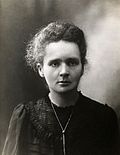
  • Image 1Marie Skłodowska-Curie (1867–1934) received Nobel prizes in physics (1903) and chemistry (1911). (from History of physics)
    Image 1Marie Skłodowska-Curie
    (1867–1934) received Nobel prizes in physics (1903) and chemistry (1911). (from History of physics)
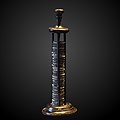
  • Image 2The Voltaic pile, the first battery was invented by Alessandro Volta in 1800 (from History of physics)
    Image 2The Voltaic pile, the first battery was invented by Alessandro Volta in 1800 (from History of physics)
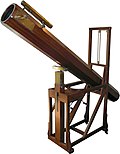
  • Image 3Replica of William Herschel's telescope used to discover Uranus (from History of physics)
    Image 3Replica of William Herschel's telescope used to discover Uranus (from History of physics)
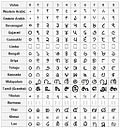
  • Image 4The Hindu-Arabic numeral system. The inscriptions on the edicts of Ashoka (3rd century BCE) display this number system being used by the Imperial Mauryas. (from History of physics)
    Image 4The Hindu-Arabic numeral system. The inscriptions on the edicts of Ashoka (3rd century BCE) display this number system being used by the Imperial Mauryas. (from History of physics)
  • Image 5Albert Einstein (1879–1955), ca. 1905 (from History of physics)
    Image 5Albert Einstein (1879–1955), ca. 1905 (from History of physics)
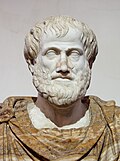
  • Image 6Aristotle (384–322 BCE) (from History of physics)
    Image 6Aristotle (384–322 BCE) (from History of physics)
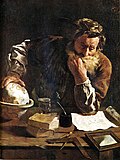
  • Image 7The ancient Greek mathematician Archimedes, developer of ideas regarding fluid mechanics and buoyancy. (from History of physics)
    Image 7The ancient Greek mathematician Archimedes, developer of ideas regarding fluid mechanics and buoyancy. (from History of physics)
  • Image 8One possible signature of a Higgs boson from a simulated proton–proton collision. It decays almost immediately into two jets of hadrons and two electrons, visible as lines. (from History of physics)
    Image 8One possible signature of a Higgs boson from a simulated proton–proton collision. It decays almost immediately into two jets of hadrons and two electrons, visible as lines. (from History of physics)
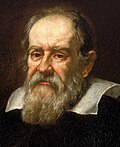
  • Image 9Galileo Galilei (1564–1642), early proponent of the modern scientific worldview and method (from History of physics)
    Image 9Galileo Galilei (1564–1642), early proponent of the modern scientific worldview and method (from History of physics)
  • Image 101927 Solvay Conference included prominent physicists Albert Einstein, Werner Heisenberg, Max Planck, Hendrik Lorentz, Niels Bohr, Marie Curie, Erwin Schrödinger, Paul Dirac (from History of physics)
    Image 101927 Solvay Conference included prominent physicists Albert Einstein, Werner Heisenberg, Max Planck, Hendrik Lorentz, Niels Bohr, Marie Curie, Erwin Schrödinger, Paul Dirac (from History of physics)
  • Image 11Magdeburg hemispheres, an experiment by Otto von Guericke where two metal hemispheres are held together by vacuum and cannot be separated even if large forces are applied. (from History of physics)
    Image 11Magdeburg hemispheres, an experiment by Otto von Guericke where two metal hemispheres are held together by vacuum and cannot be separated even if large forces are applied. (from History of physics)
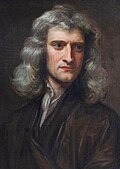
  • Image 12Sir Isaac Newton (1642–1727) (from History of physics)
    Image 12Sir Isaac Newton (1642–1727) (from History of physics)
  • Image 13Classical physics (Rayleigh–Jeans law, black line) failed to explain black-body radiation – the so-called ultraviolet catastrophe. The quantum description (Planck's law, colored lines) is said to be modern physics. (from Modern physics)
    Image 13Classical physics (Rayleigh–Jeans law, black line) failed to explain black-body radiation – the so-called ultraviolet catastrophe. The quantum description (Planck's law, colored lines) is said to be modern physics. (from Modern physics)
  • Image 14Hydrogen emission spectrum is discrete (here in log scale). The lines can only be explained with quantum mechanics. (from History of physics)
    Image 14Hydrogen emission spectrum is discrete (here in log scale). The lines can only be explained with quantum mechanics. (from History of physics)
  • Image 15Cartesian coordinate system was introduced by René Descartes (from History of physics)
    Image 15Cartesian coordinate system was introduced by René Descartes (from History of physics)
  • Image 16The Standard Model (from History of physics)
    Image 16The Standard Model (from History of physics)
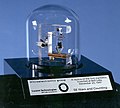
  • Image 17A replica of the first point-contact transistor in Bell labs (from Condensed matter physics)
    Image 17A replica of the first point-contact transistor in Bell labs (from Condensed matter physics)
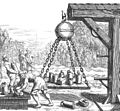
  • Image 18James Prescott Joule's apparatus for measuring the mechanical equivalent of heat which the "work" of the falling weight is converted into the "heat" of agitation in the water. (from History of physics)
    Image 18James Prescott Joule's apparatus for measuring the mechanical equivalent of heat which the "work" of the falling weight is converted into the "heat" of agitation in the water. (from History of physics)
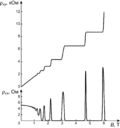
  • Image 19The quantum Hall effect: Components of the Hall resistivity as a function of the external magnetic field (from Condensed matter physics)
    Image 19The quantum Hall effect: Components of the Hall resistivity as a function of the external magnetic field (from Condensed matter physics)
  • Image 20Heike Kamerlingh Onnes and Johannes van der Waals with the helium liquefactor at Leiden in 1908 (from Condensed matter physics)
    Image 20Heike Kamerlingh Onnes and Johannes van der Waals with the helium liquefactor at Leiden in 1908 (from Condensed matter physics)
  • Image 21An engraving of Benjamin Franklin's kite experiment used to study lightning. (from History of physics)
    Image 21An engraving of Benjamin Franklin's kite experiment used to study lightning. (from History of physics)
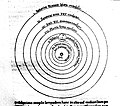
  • Image 22Heliocentric model proposed in 1543 by Nicolaus Copernicus (from History of physics)
    Image 22Heliocentric model proposed in 1543 by Nicolaus Copernicus (from History of physics)
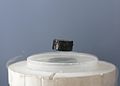
  • A magnet levitating over a superconducting material.
    Image 23A magnet levitating above a high-temperature superconductor. Today some physicists are working to understand high-temperature superconductivity using the AdS/CFT correspondence. (from Condensed matter physics)
  • Image 24Richard Feynman's Los Alamos ID badge (from History of physics)
    Image 24Richard Feynman's Los Alamos ID badge (from History of physics)
  • Image 25Newton's cannonball, a though experiment by Newton relating the motion of a projectile and orbiting of planets. (from History of physics)
    Image 25Newton's cannonball, a though experiment by Newton relating the motion of a projectile and orbiting of planets. (from History of physics)
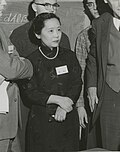
  • Image 26Chien-Shiung Wu worked on parity violation in 1956 and announced her results in January 1957. (from History of physics)
    Image 26Chien-Shiung Wu worked on parity violation in 1956 and announced her results in January 1957. (from History of physics)
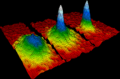
  • Image 27The first Bose–Einstein condensate observed in a gas of ultracold rubidium atoms. The blue and white areas represent higher density. (from Condensed matter physics)
    Image 27The first Bose–Einstein condensate observed in a gas of ultracold rubidium atoms. The blue and white areas represent higher density. (from Condensed matter physics)
  • Image 28A page from al-Khwārizmī's Algebra. (from History of physics)
    Image 28A page from al-Khwārizmī's Algebra. (from History of physics)
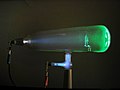
  • Image 29Crookes tube used to study cathode rays. It led to the discovery of the electron by J. J. Thomson. (from History of physics)
    Image 29Crookes tube used to study cathode rays. It led to the discovery of the electron by J. J. Thomson. (from History of physics)
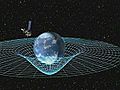
  • Image 30Einstein proposed that gravitation results from masses (or their equivalent energies) curving ("bending") the spacetime in which they exist, altering the paths they follow within it. (from History of physics)
    Image 30Einstein proposed that gravitation results from masses (or their equivalent energies) curving ("bending") the spacetime in which they exist, altering the paths they follow within it. (from History of physics)
  • Image 31A Feynman diagram representing (left to right) the production of a photon (blue sine wave) from the annihilation of an electron and its complementary antiparticle, the positron. The photon becomes a quark–antiquark pair and a gluon (green spiral) is released. (from History of physics)
    Image 31A Feynman diagram representing (left to right) the production of a photon (blue sine wave) from the annihilation of an electron and its complementary antiparticle, the positron. The photon becomes a quark–antiquark pair and a gluon (green spiral) is released. (from History of physics)
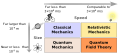
  • Image 32Classical physics is usually concerned with everyday conditions: speeds are much lower than the speed of light, sizes are much greater than that of atoms, yet very small in astronomical terms. Modern physics, however, is concerned with high velocities, small distances, and very large energies. (from Modern physics)
    Image 32Classical physics is usually concerned with everyday conditions: speeds are much lower than the speed of light, sizes are much greater than that of atoms, yet very small in astronomical terms. Modern physics, however, is concerned with high velocities, small distances, and very large energies. (from Modern physics)
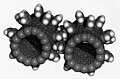
  • Image 33Computer simulation of nanogears made of fullerene molecules. It is hoped that advances in nanoscience will lead to machines working on the molecular scale. (from Condensed matter physics)
    Image 33Computer simulation of nanogears made of fullerene molecules. It is hoped that advances in nanoscience will lead to machines working on the molecular scale. (from Condensed matter physics)
  • Image 34Ibn al-Haytham (c. 965–1040). (from History of physics)
    Image 34Ibn al-Haytham (c. 965–1040). (from History of physics)
  • Image 35Maxwell's demon, thought experiment by James Clerk Maxwell to describe the kinetic theory of gases and describe how a microscopic creature could lead to violations of the second law of thermodynamics. (from History of physics)
    Image 35Maxwell's demon, thought experiment by James Clerk Maxwell to describe the kinetic theory of gases and describe how a microscopic creature could lead to violations of the second law of thermodynamics. (from History of physics)
  • Image 36Christiaan Huygens (1629–1695) (from History of physics)
    Image 36Christiaan Huygens (1629–1695) (from History of physics)
  • Image 37Star maps by the 11th century Chinese polymath Su Song are the oldest known woodblock-printed star maps to have survived to the present day. This example, dated 1092, employs the cylindricalequirectangular projection. (from History of physics)
    Image 37Star maps by the 11th century Chinese polymath Su Song are the oldest known woodblock-printed star maps to have survived to the present day. This example, dated 1092, employs the cylindricalequirectangular projection. (from History of physics)
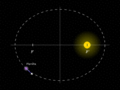
  • Image 38Johannes Kepler's first law of planetary motion states that planets move in elliptical orbits about the Sun. (from History of physics)
    Image 38Johannes Kepler's first law of planetary motion states that planets move in elliptical orbits about the Sun. (from History of physics)
  • Image 39Composite montage comparing Jupiter (left) and its four Galilean moons (from top: Io, Europa, Ganymede, Callisto) (from History of physics)
    Image 39Composite montage comparing Jupiter (left) and its four Galilean moons (from top: Io, Europa, Ganymede, Callisto) (from History of physics)
  • Image 40Image of X-ray diffraction pattern from a protein crystal (from Condensed matter physics)
    Image 40Image of X-ray diffraction pattern from a protein crystal (from Condensed matter physics)
edit 

Categories

Category puzzle
Category puzzle

Fundamentals: Concepts in physics | Constants | Physical quantities | Units of measure | Mass | Length | Time | Space | Energy | Matter | Force | Gravity | Electricity | Magnetism | Waves

Basic physics: Mechanics | Electromagnetism | Statistical mechanics | Thermodynamics | Quantum mechanics | Theory of relativity | Optics | Acoustics

Specific fields: Acoustics | Astrophysics | Atomic physics | Molecular physics | Optical physics | Computational physics | Condensed matter physics | Nuclear physics | Particle physics | Plasma physics

Tools: Detectors | Interferometry | Measurement | Radiometry | Spectroscopy | Transducers

Background: Physicists | History of physics | Philosophy of physics | Physics education | Physics journals | Physics organizations

Other: Fiction about physics | Physics lists | Physics software | Physics stubs

All physics categories
edit 

Physics topics

Classical physics traditionally includes the fields of mechanics, optics, electricity, magnetism, acoustics and thermodynamics. The term Modern physics is normally used for fields which rely heavily on quantum theory, including quantum mechanics, atomic physics, nuclear physics, particle physics and condensed matter physics. General and special relativity are usually considered to be part of modern physics as well.

Fundamental Concepts Classical Physics Modern Physics Cross Discipline Topics
Continuum Solid Mechanics Fluid Mechanics Geophysics
Motion Classical Mechanics Analytical mechanics Mathematical Physics
Kinetics Kinematics Kinematic chain Robotics
Matter Classical states Modern states Nanotechnology
Energy Chemical Physics Plasma Physics Materials Science
Cold Cryophysics Cryogenics Superconductivity
Heat Heat transfer Transport Phenomena Combustion
Entropy Thermodynamics Statistical mechanics Phase transitions
Particle Particulates Particle physics Particle accelerator
Antiparticle Antimatter Annihilation physics Gamma ray
Waves Oscillation Quantum oscillation Vibration
Gravity Gravitation Gravitational wave Celestial mechanics
Vacuum Pressure physics Vacuum state physics Quantum fluctuation
Random Statistics Stochastic process Brownian motion
Spacetime Special Relativity General Relativity Black holes
Quantum Quantum mechanics Quantum field theory Quantum computing
Radiation Radioactivity Radioactive decay Cosmic ray
Light Optics Quantum optics Photonics
Electrons Solid State Condensed Matter Symmetry breaking
Electricity Electrical circuit Electronics Integrated circuit
Electromagnetism Electrodynamics Quantum Electrodynamics Chemical Bonds
Strong interaction Nuclear Physics Quantum Chromodynamics Quark model
Weak interaction Atomic Physics Electroweak theory Radioactivity
Standard Model Fundamental interaction Grand Unified Theory Higgs boson
Information Information science Quantum information Holographic principle
Life Biophysics Quantum Biology Astrobiology
Conscience Neurophysics Quantum mind Quantum brain dynamics
Cosmos Astrophysics Cosmology Observable universe
Cosmogony Big Bang Mathematical universe Multiverse
Chaos Chaos theory Quantum chaos Perturbation theory
Complexity Dynamical system Complex system Emergence
Quantization Canonical quantization Loop quantum gravity Spin foam
Unification Quantum gravity String theory Theory of Everything
edit 

More recognized content

Extended content
This is a list of recognized content, updated weekly by JL-Bot (talk · contribs) (typically on Saturdays). There is no need to edit the list yourself. If an article is missing from the list, make sure it is tagged (e.g. {{WikiProject Physics}}) or categorized correctly and wait for the next update. See WP:RECOG for configuration options.

Good articles

  • 18th-century glassmaking in the United States
  • 2019 revision of the SI
  • Harold Agnew
  • Alhazen's problem
  • Samuel King Allison
  • Luis Walter Alvarez
  • Ames Project
  • Elda Emma Anderson
  • Animal echolocation
  • Antimetric electrical network
  • Aristotle
  • Astronomy
  • Atmosphere of Uranus
  • History of atomic theory
  • Avogadro constant
  • Robert Bacher
  • Kenneth Bainbridge
  • Violin acoustics
  • Hans Bethe
  • Francis Birch (geophysicist)
  • Black hole
  • Aage Bohr
  • Max Born
  • Bouncing ball
  • Norris Bradbury
  • Hugh Bradner
  • Calutron Girls
  • Celestial spheres
  • Charm quark
  • Robert F. Christy
  • Clapotis
  • John Cockcroft
  • Arthur Compton
  • CT scan
  • Condensed matter physics
  • Edward Condon
  • Henri Coutard
  • Edward Creutz
  • Charles Critchfield
  • Marie Curie
  • Joan Curran
  • Cyclone
  • Cyclotron
  • DU spectrophotometer
  • Harry Daghlian
  • Deep Impact (spacecraft)
  • Beryl May Dent
  • Diffusion damping
  • Dirac delta function
  • Dynamics of the celestial spheres
  • Ecliptic
  • Albert Einstein
  • Einstein–Szilard letter
  • Elastance
  • Electricity
  • Electron backscatter diffraction
  • Electron diffraction
  • Extended Wulff constructions
  • Ronald Fedkiw
  • Val Logsdon Fitch
  • Fiveling
  • Foucault's measurements of the speed of light
  • Fizeau experiment
  • Flerovium
  • Floating Clouds (artwork)
  • Force
  • Foster's reactance theorem
  • James Franck
  • Augustin-Jean Fresnel
  • Frisch–Peierls memorandum
  • Frog battery
  • Klaus Fuchs
  • Fujiwhara effect
  • Carl Friedrich Gauss
  • Joseph Gelders
  • Geostationary orbit
  • Glass
  • Glass fiber
  • Gleason's theorem
  • Maria Goeppert Mayer
  • Alvin C. Graves
  • Gravity bong
  • John T. Hayward
  • Grete Hermann
  • Hilbert space
  • A History of the Theories of Aether and Electricity
  • Robert Hooke
  • Christiaan Huygens
  • Ice
  • Icosahedral twins
  • Mujaddid Ahmed Ijaz
  • Insect flight
  • Interferometry
  • Mary Jackson (engineer)
  • Brian Josephson
  • Amrom Harry Katz
  • Donald William Kerst
  • Kilogram
  • Laser Inertial Fusion Energy
  • Ernest Lawrence
  • Hilde Levi
  • Joel S. Levine
  • Magnetic resonance imaging
  • Magnetoreception
  • Malaysia Airlines Flight 370 satellite communications
  • Margaret Eliza Maltby
  • John Marburger
  • Leslie H. Martin
  • Harrie Massey
  • Maximum sustained wind
  • James Clerk Maxwell
  • Boyce McDaniel
  • Metric system
  • Mobility analogy
  • Molniya orbit
  • Philip Morrison
  • Seth Neddermeyer
  • Negative resistance
  • John von Neumann
  • Isaac Newton
  • Newton's theorem of revolving orbits
  • Nobel Prize in Physics
  • Noctilucent cloud
  • Nuclear power
  • Nucleon magnetic moment
  • Adriana Ocampo
  • PSR B1937+21
  • Rudolf Peierls
  • William Penney, Baron Penney
  • Bruno Pontecorvo
  • Chanda Prescod-Weinstein
  • Pythagoras
  • Quantum Reality
  • Quantum electrodynamics
  • Quantum mechanics
  • RaLa Experiment
  • James Rainwater
  • C. V. Raman
  • Norman Ramsey Jr.
  • Frederick Reines
  • Representation theory of the Lorentz group
  • George T. Reynolds
  • Bruno Rossi
  • Joseph Rotblat
  • Harley Rutledge
  • S-1 Executive Committee
  • Safety of high-energy particle collision experiments
  • Matthew Sands
  • Schiehallion experiment
  • Glenn T. Seaborg
  • Emilio Segrè
  • Arne Slettebak
  • Henry DeWolf Smyth
  • Steam devil
  • Carl Størmer
  • Subtle Is the Lord
  • Leo Szilard
  • Tamper (nuclear weapon)
  • Nikola Tesla
  • Thin Man (nuclear bomb)
  • Charles Allen Thomas
  • Ernest Titterton
  • Triboelectric effect
  • Type II supernova
  • Type Ia supernova
  • Type Ib and Ic supernovae
  • Stanisław Ulam
  • Universe
  • John Clive Ward
  • Waterspout
  • Katharine Way
  • Alvin M. Weinberg
  • John Archibald Wheeler
  • E. T. Whittaker
  • Eugene Wigner
  • Robert R. Wilson
  • Wind turbine
  • Leona Woods
  • Wow! signal
  • Chien-Shiung Wu
  • Wu Zhonghua
  • Wu experiment
  • Walter Zinn

Associated Wikimedia

The following Wikimedia Foundation sister projects provide more on this subject:

  • Commons
    Free media repository
  • Wikibooks
    Free textbooks and manuals
  • Wikidata
    Free knowledge base
  • Wikinews
    Free-content news
  • Wikiquote
    Collection of quotations
  • Wikisource
    Free-content library
  • Wikiversity
    Free learning tools
  • Wikivoyage
    Free travel guide
  • Wiktionary
    Dictionary and thesaurus

Sources

Portals on Wikipedia

Discover Wikipedia using portals
  • icon
    List of all portals
  • icon
    The arts portal
  • Biography portal
  • Current events portal
  • icon
    Geography portal
  • History portal
  • icon
    Mathematics portal
  • icon
    Science portal
  • icon
    Society portal
  • icon
    Technology portal
  • icon
    Random portal
  • icon
    WikiProject Portals

Purge server cache

Retrieved from "https://teknopedia.ac.id/w/index.php?title=Portal:Physics&oldid=1260617618"
Categories:
  • All portals
  • Physics
  • Physical science portals
Hidden categories:
  • Pages with Hungarian IPA
  • Pages with Italian IPA
  • Pages using the Phonos extension
  • Pages including recorded pronunciations
  • Pages with German IPA
  • Manually maintained portal pages from June 2018
  • All manually maintained portal pages
  • Portals with triaged subpages from June 2018
  • All portals with triaged subpages
  • Portals with named maintainer
  • Random portal component with 11–15 available subpages
  • Random portal component with 26–30 available image subpages
  • Automated article-slideshow portals with 101–200 articles in article list

  • indonesia
  • Polski
  • العربية
  • Deutsch
  • English
  • Español
  • Français
  • Italiano
  • مصرى
  • Nederlands
  • 日本語
  • Português
  • Sinugboanong Binisaya
  • Svenska
  • Українська
  • Tiếng Việt
  • Winaray
  • 中文
  • Русский
Sunting pranala
url url url url url url url url url url url url url url url url url url url url url url url url url url url url url url url url url url url url url url url url url url url url url url url url url url url url url url url url url url url url url url url url url url url url url url url url url url url url url url url url url url url url url url url url url url url url url url url url url url url url url url url url url url url url url url url url url url url url url url url url url url url url url url url url url url url url url url url url url url url url url url url url url url url url url url url url url url url url url url url url url url url url url url url url url url url url url url url url url url url url url url url url url url url url url url url url url url url url url url url url url url url url url url url url url url url url url url url url url url url url url url url url url url url url url url url url url url url url url url url url url url url url url url url url url url url url url url url url url url url url url url url url url url url url url url url url url url url url url url url url url url url url url url url url url url url url url url url url url url url url url url url url url url url url url url url url url url url url url url url url url url url url url url url url url url url url url url url url url url url url url url url url url url url url url url url url url url url url url url url url url url url url url url url url url url url url url url url url url url url url url url url url url url url url url url url url url url url url url url url url url url url url url url url url url url url url url url url url url url url url url url url url url url url url url url url url url url url url url url url url url url url url url url url url url url url url url url url url url url url url url url url url url url url url url url url url url url url url url url url url url url url url url url url url url url url url url url url url url url url url url url url url url url url url url url url url url url url url url url url url url url url url url url url url url url url url url url url url url url url url url url url url url url url url url url url url url url url url url url url url url url url url url url url url url url url url url url url url url url url url url url url url url url url url url url url url url url url url url url url url url url url url url url url url url url url url url url url url url url url url url url url url url url url url url url url url url url url url url url url url url url url url url url url url url url url url url url url url url url url url url url url url url url url url url url url url url url url url url url url url url url url url url url url url url url url url url url url url url url url url url url url url url url url url url url url url url url url url url url url url url url url url url url url url url url url url url url url url url url url url url url url url url url url url url url url url url url url url url url url url url url url url url url url url url url url url url url url url url url url url url url url url url url url url url url url url url url url url url url url url url url url url url url url url url url url url url url url url url url url url url url url url url url url url url url url url url url url url url url url url url url url url url url url url url url url url url url url url url url url url url url url url url url url url url url url url url url url url url url url url url url url url url url url url url url url url url url url url url url url url url url url url url url url url url url url url url url url url url url url url url url url url url url url url url url url url url url url url url url url url url url url url url url url url url url url url url url url url url url url url url url url url url url url url url url url url url url url url url url url url url url url url url url url url url url url url url url url url url url url url url url url url url url url url url url url url url url url url url url url url url url url url url url url url url url url url url url url url url url url url url url url url url url url url url url url url url url url url url url url url url url url url url url url url url url url url url url url url url url url url url url url url url url url url url url url url url url url url url url url url url url url url url url url url url url url url url url url url url url url url url url url url url url url url url url url url url url url url url url url url url url url url url url url url url url url url url url url url url url url url url url url url url url url url url url url url url url url url url url url url url url url url url url url url url url url url url url url url url url url url url url url url url url url url url url url url url url url url url url url url url url url url url url url url url url url url url url url url url url url url url url url url url url url url url url url url url url url url url url url url url url url url url url url url url url url url url url url url url url url url url url url url url url url url url url url url url url url url url url url url url url url url url url url url url url url url url url url url url url url url url url url url url url url url url url url url url url url url url url url url url url url url url url url url url url url url url url url url url url url url url url url url url url url url url url url url url url url url url url url url url url url url url url url url url url url url url url url url url url url url url url url url url url url url url url url url url url url url url url url url url url url url url url url url url url url url url url url url url url url url url url url url url url url url url url url url url url url url url url url url url url url url url url url url url url url url url url url url url url url url url url url url url url url url url url url url url url url url url url url url url url url url url url url url url url url url url url url url url url url url url url url url url url url url url url url url url url url url url url url url url url url url url url url url url url url url url url url url url url url url url url url url url url url url url url url url url url url url url url url url url url url url url url url url url url url url url url url url url url url url url url url url url url url url url url url url url url url url url url url url url url url url url url url url url url url url url url url url url url url url url url url url url url url url url url url url url url url url url url url url url url url url url url url url url url url url url url url url url url url url url url url url url url url url url url url url url url url url url url url url url url url url url url url url url url url url url url url url url url url url url url url url url url url url url url url url url url url url url url url url url url url url url url url url url url url url url url url url url url url url url url url url url url url url url url url url url url url url url url url url url url url url url url url url url url url url url url url url url url url url url url url url url url url url url url url url url url url url url url url url url url url url url url url url url url url url url url url url url url url url url url url url url url url url url url url url url url url url url url url url url url url url url url url url url url url url url url url url url url url url url url url url url url url url url url url url url url url url url url url url url url url url url url url url url url url url url url url url url url url url url url url url url url url url url url url url url url url url url url url url url url url url url url url url url url url url url url url url url url url url url url url url url url url url url url url url url url url url url url url url url url url url url url url url url url url url url url url url url url url url url url url url url url url url url url url url url url url url url url url url url url url url url url url url url url url url url url url url url url url url url url url url url url url url url url url url url url url url url url url url url url url url url url url url url url url url url url url url url url url url url url url url url url url url url url url url url url url url url url url url url url url url url url url url url url url url url url url url url url url url url url url url url url url url url url url url url url url url url url url url url url url url url url url url url url url url url url url url url url url url url url url url url url url url url url url url url url url url url url url url url url url url url url url url url url url url url url url url url url url url url url url url url url url url url url url url url url url url url url url url url url url url url url url url url url url url url url url url url url url url url url url url url url url url url url url url url url url url url url url url url url url url url url url url url url url url url url url url url url url url url url url url url url url url url url url url url url url url url url url url url url url url url url url url url url url url url url url url url url url url url url url url url url url url url url url url url url url url url url url url url url url url url url url url url url url url url url url url url url url url url url url url url url url url url url url url url url url url url url url url url url url url url url url url url url url url url url url url url url url url url url url url url url url url url url url url url url url url url url url url url url url url
Pusat Layanan

UNIVERSITAS TEKNOKRAT INDONESIA | ASEAN's Best Private University
Jl. ZA. Pagar Alam No.9 -11, Labuhan Ratu, Kec. Kedaton, Kota Bandar Lampung, Lampung 35132
Phone: (0721) 702022
Email: pmb@teknokrat.ac.id