Epstein Files Full PDF

CLICK HERE
Technopedia Center
PMB University Brochure
Faculty of Engineering and Computer Science
S1 Informatics S1 Information Systems S1 Information Technology S1 Computer Engineering S1 Electrical Engineering S1 Civil Engineering

faculty of Economics and Business
S1 Management S1 Accountancy

Faculty of Letters and Educational Sciences
S1 English literature S1 English language education S1 Mathematics education S1 Sports Education
teknopedia

  • Registerasi
  • Brosur UTI
  • Kip Scholarship Information
  • Performance
Flag Counter
  1. World Encyclopedia
  2. Multidimensional Poverty Index - Wikipedia
Multidimensional Poverty Index - Wikipedia
From Wikipedia, the free encyclopedia
Range of poverty indicators

Multidimensional Poverty Indices use a range of indicators (monetary, health, education and others) to calculate a summary poverty figure for a given population, in which a larger figure indicates a higher level of poverty. This figure considers both the proportion of the population that is deemed poor and the 'breadth' of poverty experienced by these 'poor' households, following the Alkire & Foster 'counting method'.[1] The method was developed following increased criticism of monetary and consumption-based poverty measures, seeking to capture the deprivations in non-monetary factors that contribute towards well-being. While there is a standard set of indicators, dimensions, cutoffs and thresholds used for a 'Global MPI',[2] the method is flexible and there are many examples of poverty studies that modify it to best suit their environment. The methodology has been mainly, but not exclusively,[3] applied to developing countries.

The Global Multidimensional Poverty Index (MPI) was developed in 2010 by the Oxford Poverty & Human Development Initiative (OPHI) and the United Nations Development Programme[4] and uses health, education and standard of living indicators to determine the incidence and intensity of poverty experienced by a population.[5][6] It has since been used to measure acute poverty across over 100 developing countries. The Global MPI is released annually by UNDP and OPHI and the results are published on their websites. The MPI is published along with the Human Development Index (HDI) in the Human Development Report.[7] It replaced the Human Poverty Index.

MPI Headcount in West Africa

Multidimensional Poverty Indices typically use the household as their unit of analysis, though this is not an absolute requirement.[8] A household is deprived for a given indicator if they fail to satisfy a given 'cutoff' (e.g. having at least one adult member with at least six years of education). A household is assigned a 'deprivation score' determined by the number of indicators they are deprived in and the 'weights' assigned to those indicators. Each dimension (health, education, standard of living, etc.) is typically given an equal weighting, and each indicator within the dimension is also typically weighted equally. If this household deprivation score exceeds a given threshold (e.g. 1/3) then a household is considered to be 'multiply deprived', or simply 'poor'. The final 'MPI score' (or 'Adjusted Headcount Ratio') is determined by the proportion of households deemed 'poor', multiplied by the average deprivation score of 'poor' households.[8]

MPI advocates state that the method can be used to create a comprehensive picture of people living in poverty, and permits comparisons both across countries, regions and the world and within countries by ethnic group, urban/rural location, as well as other key household and community characteristics. MPIs are useful as an analytical tool to identify the most vulnerable people – the poorest among the poor, revealing poverty patterns within countries and over time, enabling policymakers to target resources and design policies more effectively.[8] Critics of this methodology have pointed out that changes to cutoffs and thresholds, as well as the indicators included and weightings attributed to them can change MPI scores and the resulting poverty evaluation.[9][10]

Dimensions and indicators

[edit]

Dimensions

[edit]

The Global MPI uses three standard dimensions: Health; Education; Standard of Living and ten indicators.[11] These mirror the Human Development Index (HDI).

Multidimensional Poverty Indices used for purposes other than global comparison have sometimes used different dimensions, including income and consumption.

Indicators and cutoffs

[edit]

The Global MPI uses the following ten indicators with the following cutoffs.[12][13]

Dimension Indicators Deprivation Cutoffs[14][12]
Health Child mortality Deprived if a child under the age of 18 years has died in the family in the five years preceding the survey.
Nutrition Deprived if any adult or child, for whom there is nutritional information, is undernourished.
Education Years of schooling Deprived if no household member has completed six years of schooling.
School attendance No household member aged 'school entrance age + six' years or older has completed six years of schooling.
Standard of living Cooking fuel Deprived if the household cooks with dung, wood or charcoal.
Sanitation Deprived if the household's sanitation facility is either not improved (according to MDG guidelines), is shared with other households, or both.
Drinking water Deprived if the household does not have access to improved drinking water (according to MDG guidelines) or improved drinking water is more than a 30-minute walk from the home round trip.
Electricity Deprived if the household has no electricity.
Housing Deprived if at least one of the three housing materials for roof, walls and floor are inadequate: the floor is of natural materials and/or the roof and/or walls are of natural or rudimentary materials.
Assets Deprived if the household does not own more than one of these assets: radio, TV, telephone, computer, animal cart, bicycle, motorbike or refrigerator and does not own a car or truck.

The indicators selected for other MPI-oriented studies vary according to the availability of data and the context,[15] as well as the theoretical considerations of the researchers.[16]

Calculation

[edit]

The Alkire-Foster 'counting method'

[edit]

The Alkire-Foster (AF) method[17] is a way of measuring multidimensional poverty developed by OPHI's Sabina Alkire and James Foster. Building on the Foster-Greer-Thorbecke poverty measures, it involves counting the different types of deprivation that individuals experience at the same time, such as a lack of education or employment, or poor health or living standards. These deprivation profiles are analysed to identify who is poor and then used to construct a multidimensional index of poverty (MPI).

Constructing poverty measures

[edit]

The most common way of measuring poverty is to calculate the percentage of the population who are poor, known as the headcount ratio (H). Having identified who is poor, the AF methodology generates a unique class of poverty measures (Mα) that goes beyond the simple headcount ratio. Three measures in this class are of high importance:

  • Adjusted headcount ratio (M0), otherwise known as the MPI: This measure reflects both the incidence of poverty (the percentage of the population who are poor) and the intensity of poverty (the percentage of deprivations suffered by each person or household on average). M0 is calculated by multiplying the incidence (H) by the intensity (A). M0 = H x A.
  • Adjusted Poverty Gap (M1): This measure reflects the incidence, intensity and depth of poverty. The depth of poverty is the average 'gap' (G) between the level of deprivation poor people experience and the poverty cut-off line. M1 = H x A x G.
  • Adjusted Squared Poverty Gap (M2): This measure reflects the incidence, intensity, and depth of poverty, as well as inequality among the poor (captured by the squared gap, S). M2 = H x A x S.

M0 can be calculated with ordinal as well as cardinal data, which is why it is most often used. Cardinal data are required to calculate M1 and M2.

The AF Method is unique in that by measuring intensity it can distinguish between, for example, a group of poor people who suffer two deprivations on average and a group of poor people who suffer five deprivations on average at the same time.

Fictional example

[edit]

Country X consists of persons A, B and C. The following table shows the deprivation on each of the 10 indicators for persons A, B and C.

"0%" indicates no deprivation in that indicator, while "100%" indicates deprivation in that indicator.

Indicator Weight Person A Person B Person C
1 1/6 0% 0% 0%
2 1/6 0% 0% 0%
3 1/6 100% 100% 0%
4 1/6 0% 100% 0%
5 1/18 0% 100% 100%
6 1/18 0% 100% 100%
7 1/18 0% 0% 100%
8 1/18 100% 100% 100%
9 1/18 100% 0% 100%
10 1/18 100% 0% 0%
Weighted score 33.33% 50.00% 27.78%
Status MPI poor (≥ 33%) MPI poor (≥ 33%) Not MPI poor (< 33%)

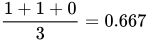
Factor H for country X is:

1 + 1 + 0 3 = 0.667 {\displaystyle {\frac {1+1+0}{3}}=0.667} {\displaystyle {\frac {1+1+0}{3}}=0.667}

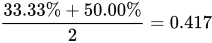
Factor A for country X is:

33.33 % + 50.00 % 2 = 0.417 {\displaystyle {\frac {33.33\%+50.00\%}{2}}=0.417} {\displaystyle {\frac {33.33\%+50.00\%}{2}}=0.417}

Thus, the MPI for country X is:

0.667 × 0.417 = 0.278 {\displaystyle 0.667\times 0.417=0.278} {\displaystyle 0.667\times 0.417=0.278}

Comparisons with other indicators

[edit]

Comparison with HDI

[edit]

The Human Development Index (HDI) was developed by Mahbub ul Haq and Amartya Sen in 1990, and was also developed by the UNDP. It is calculated as the geometric mean of the normalized indices of the three dimensions of human development; it takes into account: health, education and standard of living. UNDP has a separate version of the HDI named the IHDI (Inequality-adjusted HDI).

While both the HDI and the MPI use the three broad dimensions health, education and standard of living, the HDI uses indicators at the aggregate level while the MPI uses microdata and all indicators must come from the same survey. This, among other reasons, has led to the MPI only being calculated for just over 100 countries, where data is available for all these diverse indicators, while HDI is calculated for almost all countries.

However, though HDI is thus more universally applicable, its relative sparsity of indicators also makes it more susceptible to bias. Indeed, some studies have found it to be somewhat biased towards GDP per capita (GDPpc), as demonstrated by a high correlation between HDI and the log of GDPpc. Hence, HDI has been criticized for ignoring other development parameters.

Comparison with other indicators

[edit]

Both the HDI and the MPI have been criticized by economists such as Ratan Lal Basu for not taking the "moral/emotional/spiritual dimensions" of poverty into consideration. It has been attempted to capture these additional factors in the "Global Happiness Index".

Impact of COVID-19

[edit]

According to reports, the COVID-19 pandemic impacted education, employment and social protection of people in countries which have higher levels of multidimensional poverty such as Zambia.[18] Risks of school nonattendance are informed by UNESCO data on daily school closures around the world. We derive a risk of 50% for children in school age to experience significant loss of schooling, and thus deprivation in school attendance due to school closures during the first year of the pandemic.[19]

See also

[edit]
  • World Happiness Report

References

[edit]
  1. ^ Alkire & Foster (2011). "Counting and Multidimensional Poverty Measurement". Journal of Public Economics. 95 (7–8): 476–487. doi:10.1016/j.jpubeco.2010.11.006. S2CID 6113312.
  2. ^ Alkire, Roche & Seth (2013). The Global Multidimensional Poverty Index. Oxford Poverty & Human Development Initiative.
  3. ^ Suppa, Nicolai (2018). "Towards a multidimensional poverty index for Germany" (PDF). Empirica. 45, 4 (4): 655–683. doi:10.1007/s10663-017-9385-3. hdl:10419/106992. S2CID 159012835.
  4. ^ "A wealth of data. A useful new way to capture the many aspects of poverty". The Economist. July 29, 2010. Retrieved 2010-08-04.
  5. ^ "Poverty index reveals stark inequalities among ethnic groups | United Nations Development Programme". UNDP. Retrieved 8 August 2022.
  6. ^ Tandon, Tulika (21 October 2021). "Global Multidimensional Poverty Index 2021: What is Multidimensional Poverty and India's Rank?". Jagranjosh.com.
  7. ^ Maiti, K.D.; Mehrotra, Santosh. "The Curious Case of India's Millions of 'Missing' Poor People". The Wire. Retrieved 8 August 2022.
  8. ^ a b c "Multidimensional Poverty - Measurement & Analysis". multidimensionalpoverty.org. Retrieved 2019-08-16.
  9. ^ Cavapozzi, Han & Miniaci (2015). "Alternative weighting structures for multidimensional poverty assessment". Journal of Economic Inequality. 13, 3 (3): 425–447. doi:10.1007/s10888-015-9301-7. hdl:11379/459215. S2CID 158176100.
  10. ^ Ravallion, Martin (2011-06-01). "On multidimensional indices of poverty" (PDF). The Journal of Economic Inequality. 9 (2): 235–248. doi:10.1007/s10888-011-9173-4. hdl:10986/3346. ISSN 1573-8701. S2CID 14917462.
  11. ^ "5.29% population in Pune is poor: Multidimensional Poverty Index". Hindustan Times. 12 July 2022. Retrieved 4 August 2022.
  12. ^ a b "The 2020 Global Multidimensional Poverty Index". Human Development Reports. January 1, 2020. Archived from the original on May 18, 2022.
  13. ^ Alkire Roche Santos Seth. "Multidimensional Poverty Index 2011: Brief Methodological Note" (PDF). Oxford Poverty & Human Development Initiative (OPHI).
  14. ^ "Global Multidimensional Poverty Index". ophi.org.uk. Retrieved 2019-12-25.
  15. ^ Berenger, V. (2016). "Measuring Multidimensional Poverty in Three South East Asian Countries using Ordinal Variables". ADBI Working Paper Series. 618.
  16. ^ Bag & Seth (2018). "Does it Matter How We Assess Standard of Living? Evidence from Indian Slums Comparing Monetary and Multidimensional Approaches". Social Indicators Research. 134, 2.
  17. ^ "OPHI's method for multidimensional measurement". ophi.org.uk. Retrieved 2019-12-25.
  18. ^ "Poverty index reveals stark inequalities among ethnic groups". UNDP. October 7, 2021.
  19. ^ "Simulations and multidimensional poverty: reflections on a COVID-19 evaluation study | MPPN". www.mppn.org. 2022-02-04. Retrieved 2025-07-21.

Bibliography

[edit]
  • Duncan Green (2014), Are we measuring the right things? The latest multidimensional poverty index is launched today, Oxfam, archived from the original on June 24, 2014
  • David Satterthwaite (2014), Multidimensional Poverty Index: Another underestimate of urban poverty, London: International Institute for Environment and Development
  • Multi-Dimensional Poverty Index: An Application to the United States (PDF), University of Wisconsin-Madison, Institute for Research on Poverty, 2015

External links

[edit]
  • Website
  • v
  • t
  • e
Deprivation and poverty indicators
Social
Topics:
  • Acting out
  • Child abuse
  • Disadvantaged
  • Diseases of poverty
  • Environmental degradation
  • Environmental racism
  • Fushūgaku
  • Governance failure
  • Hikikomori
  • Mental illness
  • Relative deprivation
  • Self-image
  • Social deprivation
  • Social exclusion
  • Social stigma
  • Social vulnerability
  • Social determinants of health in poverty
  • Violence against women
  • Vulnerability
Measures:
  • Social Progress Index
Psychological
Topics:
  • Cruel, inhuman or degrading treatment
  • Learned helplessness
  • Psychological abuse
  • psychological poverty
  • Poverty and mental health
  • Social determinants of mental health
Economic
Topics:
  • Asset poverty
  • Culture of poverty
  • Debt bondage
  • Energy poverty
  • Extreme poverty
  • Housing stress
  • Human trafficking
  • Income deficit
  • Poverty threshold
  • Precariat
  • Precarious work
  • Secondary poverty
  • Social determinants of health in poverty
  • Survival sex
  • Water scarcity
Measures:
  • Below Poverty Line (India)
  • Homeless Vulnerability Index
  • Misery index (economics)
  • Gini coefficient
  • Genuine progress indicator (GPI)
  • Legatum Prosperity Index
  • Poverty gap index
Physical
Topics:
  • Disability and poverty
  • Food insecurity
  • Physical abuse
  • Sex trafficking
  • Social determinants of health
  • Poverty and violence
Measures:
  • India State Hunger Index
  • Global Hunger Index
  • Disability-adjusted life year (DALYs)
  • Global Peace Index (GPI)
Complex measures
  • Human Poverty Index (HPI)
  • Human Development Index (HDI)
  • Multidimensional Poverty Index (MPI)
  • Physical Quality of Life Index (PQLI)
  • Living Planet Index (LPI)
  • Progress out of Poverty Index
  • Deprivation index
Gender
Topics:
  • Feminization of poverty
Measures:
  • Gender-related Development Index (GDI)
  • Gender Parity Index
Other
Categories: Income inequality metrics · Measurements and definitions of poverty · Social responsibility organizations
Commons categories: Information graphics about poverty · Poverty-related maps
  • v
  • t
  • e
Poverty
Aspects
  • Measuring poverty
  • Concentrated poverty
  • Cost of poverty
  • Disability and poverty
  • Diseases of poverty
  • Economic inequality
  • Climate change and poverty
  • Child poverty
  • Chronic poverty
  • Cycle of poverty
  • Precarity
  • Time poverty
  • Guaranteed minimum income
  • Universal basic income
  • List of basic income models
  • Poverty reduction
  • Sustainable Development Goals
Deserts
  • Banking
  • Book
  • Food
  • Medical
  • Transit
Metrics
  • Deprivation index
  • Homeless Vulnerability Index
  • Misery index (economics)
  • Gini coefficient
  • Genuine progress indicator
  • Legatum Prosperity Index
  • Poverty gap index
  • Human Poverty Index
  • Multidimensional Poverty Index
Working poor
  • Precariat
  • Freeter
  • Coolie
  • Underemployment
  • McJob
  • Pea-picker
  • Menial job
  • Child labour
  • Domestic worker
  • Gig worker
  • Wage slavery
  • Wage theft
  • Sweatshop
  • Precarious work
  • Workfare
Forced labour
  • Slavery
  • Serfdom
  • Indentured servitude
  • Involuntary servitude
  • Debt bondage
  • Peonage
  • Child soldiers
By location
Africa
  • Algeria
  • Democratic Republic of the Congo
  • Egypt
  • Ethiopia
  • Kenya
  • Namibia
  • Niger
  • Nigeria
  • South Africa
  • Tanzania
  • Uganda
  • Zimbabwe
Asia
  • Afghanistan
  • Armenia
  • Bangladesh
  • Cambodia
  • China
  • Cyprus
  • India
  • Indonesia
  • Israel
  • Japan
  • Lebanon
  • North Korea
  • South Korea
  • Malaysia
  • Nepal
  • Pakistan
  • Philippines
  • Singapore
  • Sri Lanka
  • Timor-Leste
  • Vietnam
  • Yemen
Europe
  • Cyprus
  • France
  • Germany
  • Greece
  • Italy
  • Moldova
  • Norway
  • Poland
  • Romania
  • Switzerland
  • Turkey
  • Ukraine
  • United Kingdom
  • History of poverty in the United Kingdom
Oceania
  • Australia
  • New Zealand
Americas
  • Argentina
  • Bolivia
  • Brazil
  • Canada
  • Colombia
  • Cuba
  • Guatemala
  • Haiti
  • Honduras
  • Jamaica
  • Mexico
  • Paraguay
  • Peru
  • United States
  • History of poverty in the United States
  • Uruguay
  • Venezuela
Other
  • Theories of poverty
  • War on Poverty
  • Well-being
  • Welfare
  • Welfare culture
  • Welfare trap
  • Welfare's effect on poverty
  • Criticism of welfare
  • Wellness
  • Quality of life
  • Self-perceived quality-of-life scale
  • Subjective well-being (SWB)
  • Stress
  • Rural access issues
  • Providing Urban Amenities to Rural Areas
  • Postmaterialism
  • Pen's parade
  • Social dividend
  • Culture of poverty
  • Causes of poverty
  • Citizen's dividend
  • List of global issues
  • v
  • t
  • e
Diseases of poverty
Diseases of poverty
  • AIDS
  • Malaria
  • Tuberculosis
  • Measles
  • Pneumonia
  • Diarrheal diseases
  • Plague
Neglected diseases
  • Cholera
  • Chagas disease
  • African sleeping sickness
  • Schistosomiasis
  • Dracunculiasis
  • River blindness
  • Leishmaniasis
  • Trachoma
Miscellaneous
  • Malnutrition
  • Priority review voucher
See also
List of countries by percentage of population living in poverty · Deprivation and poverty indicators
Retrieved from "https://teknopedia.ac.id/w/index.php?title=Multidimensional_Poverty_Index&oldid=1306371874"
Categories:
  • International rankings
  • Measurements and definitions of poverty
  • United Nations Development Programme
  • Projects established in 2010
  • Social science indices
Hidden categories:
  • CS1: long volume value
  • Articles with short description
  • Short description is different from Wikidata
  • CS1: unfit URL

  • indonesia
  • Polski
  • العربية
  • Deutsch
  • English
  • Español
  • Français
  • Italiano
  • مصرى
  • Nederlands
  • 日本語
  • Português
  • Sinugboanong Binisaya
  • Svenska
  • Українська
  • Tiếng Việt
  • Winaray
  • 中文
  • Русский
Sunting pranala
url url url url url url url url url url url url url url url url url url url url url url url url url url url url url url url url url url url url url url url url url url url url url url url url url url url url url url url url url url url url url url url url url url url url url url url url url url url url url url url url url url url url url url url url url url url url url url url url url url url url url url url url url url url url url url url url url url url url url url url url url url url url url url url url url url url url url url url url url url url url url url url url url url url url url url url url url url url url url url url url url url url url url url url url url url url url url url url url url url url url url url url url url url url url url url url url url url url url url url url url url url url url url url url url url url url url url url url url url url url url url url url url url url url url url url url url url url url url url url url url url url url url url url url url url url url url url url url url url url url url url url url url url url url url url url url url url url url url url url url url url url url url url url url url url url url url url url url url url url url url url url url url url url url url url url url url url url url url url url url url url url url url url url url url url url url url url url url url url url url url url url url url url url url url url url url url url url url url url url url url url url url url url url url url url url url url url url url url url url url url url url url url url url url url url url url url url url url url url url url url url url url url url url url url url url url url url url url url url url url url url url url url url url url url url url url url url url url url url url url url url url url url url url url url url url url url url url url url url url url url url url url url url url url url url url url url url url url url url url url url url url url url url url url url url url url url url url url url url url url url url url url url url url url url url url url url url url url url url url url url url url url url url url url url url url url url url url url url url url url url url url url url url url url url url url url url url url url url url url url url url url url url url url url url url url url url url url url url url url url url url url url url url url url url url url url url url url url url url url url url url url url url url url url url url url url url url url url url url url url url url url url url url url url url url url url url url url url url url url url url url url url url url url url url url url url url url url url url url url url url url url url url url url url url url url url url url url url url url url url url url url url url url url url url url url url url url url url url url url url url url url url url url url url url url url url url url url url url url url url url url url url url url url url url url url url url url url url url url url url url url url url url url url url url url url url url url url url url url url url url url url url url url url url url url url url url url url url url url url url url url url url url url url url url url url url url url url url url url url url url url url url url url url url url url url url url url url url url url url url url url url url url url url url url url url url url url url url url url url url url url url url url url url url url url url url url url url url url url url url url url url url url url url url url url url url url url url url url url url url url url url url url url url url url url url url url url url url url url url url url url url url url url url url url url url url url url url url url url url url url url url url url url url url url url url url url url url url url url url url url url url url url url url url url url url url url url url url url url url url url url url url url url url url url url url url url url url url url url url url url url url url url url url url url url url url url url url url url url url url url url url url url url url url url url url url url url url url url url url url url url url url url url url url url url url url url url url url url url url url url url url url url url url url url url url url url url url url url url url url url url url url url url url url url url url url url url url url url url url url url url url url url url url url url url url url url url url url url url url url url url url url url url url url url url url url url url url url url url url url url url url url url url url url url url url url url url url url url url url url url url url url url url url url url url url url url url url url url url url url url url url url url url url url url url url url url url url url url url url url url url url url url url url url url url url url url url url url url url url url url url url url url url url url url url url url url url url url url url url url url url url url url url url url url url url url url url url url url url url url url url url url url url url url url url url url url url url url url url url url url url url url url url url url url url url url url url url url url url url url url url url url url url url url url url url url url url url url url url url url url url url url url url url url url url url url url url url url url url url url url url url url url url url url url url url url url url url url url url url url url url url url url url url url url url url url url url url url url url url url url url url url url url url url url url url url url url url url url url url url url url url url url url url url url url url url url url url url url url url url url url url url url url url url url url url url url url url url url url url url url url url url url url url url url url url url url url url url url url url url url url url url url url url url url url url url url url url url url url url url url url url url url url url url url url url url url url url url url url url url url url url url url url url url url url url url url url url url url url url url url url url url url url url url url url url url url url url url url url url url url url url url url url url url url url url url url url url url url url url url url url url url url url url url url url url url url url url url url url url url url url url url url url url url url url url url url url url url url url url url url url url url url url url url url url url url url url url url url url url url url url url url url url url url url url url url url url url url url url url url url url url url url url url url url url url url url url url url url url url url url url url url url url url url url url url url url url url url url url url url url url url url url url url url url url url url url url url url url url url url url url url url url url url url url url url url url url url url url url url url url url url url url url url url url url url url url url url url url url url url url url url url url url url url url url url url url url url url url url url url url url url url url url url url url url url url url url url url url url url url url url url url url url url url url url url url url url url url url url url url url url url url url url url url url url url url url url url url url url url url url url url url url url url url url url url url url url url url url url url url url url url url url url url url url url url url url url url url url url url url url url url url url url url url url url url url url url url url url url url url url url url url url url url url url url url url url url url url url url url url url url url url url url url url url url url url url url url url url url url url url url url url url url url url url url url url url url url url url url url url url url url url url url url url url url url url url url url url url url url url url url url url url url url url url url url url url url url url url url url url url url url url url url url url url url url url url url url url url url url url url url url url url url url url url url url url url url url url url url url url url url url url url url url url url url url url url url url url url url url url url url url url url url url url url url url url url url url url url url url url url url url url url url url url url url url url url url url url url url url url url url url url url url url url url url url url url url url url url url url url url url url url url url url url url url url url url url url url url url url url url url url url url url url url url url url url url url url url url url url url url url url url url url url url url url url url url url url url url url url url url url url url url url url url url url url url url url url url url url url url url url url url url url url url url url url url url url url url url url url url url url url url url url url url url url url url url url url url url url url url url url url url url url url url url url url url url url url url url url url url url url url url url url url url url url url url url url url url url url url url url url url url url url url url url url url url url url url url url url url url url url url url url url url url url url url url url url url url url url url url url url url url url url url url url url url url url url url url url url url url url url url url url url url url url url url url url url url url url url url url url url url url url url url url url url url url url url url url url url url url url url url url url url url url url url url url url url url url url url url url url url url url url url url url url url url url url url url url url url url url url url url url url url url url url url url url url url url url url url url url url url url url url url url url url url url url url url url url url url url url url url url url url
Pusat Layanan

UNIVERSITAS TEKNOKRAT INDONESIA | ASEAN's Best Private University
Jl. ZA. Pagar Alam No.9 -11, Labuhan Ratu, Kec. Kedaton, Kota Bandar Lampung, Lampung 35132
Phone: (0721) 702022
Email: pmb@teknokrat.ac.id