Epstein Files Full PDF

CLICK HERE
Technopedia Center
PMB University Brochure
Faculty of Engineering and Computer Science
S1 Informatics S1 Information Systems S1 Information Technology S1 Computer Engineering S1 Electrical Engineering S1 Civil Engineering

faculty of Economics and Business
S1 Management S1 Accountancy

Faculty of Letters and Educational Sciences
S1 English literature S1 English language education S1 Mathematics education S1 Sports Education
teknopedia

  • Registerasi
  • Brosur UTI
  • Kip Scholarship Information
  • Performance
Flag Counter
  1. World Encyclopedia
  2. Human Development Index - Wikipedia
Human Development Index - Wikipedia
Checked
Page protected with pending changes
From Wikipedia, the free encyclopedia

Page version status

This is an accepted version of this page

This is the latest accepted revision, reviewed on 17 February 2026.
Composite statistic of life expectancy, education, and income indices
"HDI" and "Hdi" redirect here. For other uses, see HDI (disambiguation).
For the complete ranking of countries, see List of countries by Human Development Index.

World map of Countries scored by HDI
World map of countries or territories by HDI scores in increments of 0.050 (based on 2023 data, published in 2025)
  •   ≥ 0.950
  •   0.900–0.950
  •   0.850–0.899
  •   0.800–0.849
  •   0.750–0.799
  •   0.700–0.749
  •   0.650–0.699
  •   0.600–0.649
  •   0.550–0.599
  •   0.500–0.549
  •   0.450–0.499
  •   0.400–0.449
  •   ≤ 0.399
  •   Data unavailable

The Human Development Index (HDI) is a statistical composite index of life expectancy, education (mean years of schooling completed and expected years of schooling upon entering the education system), and per capita income indicators, which is used to rank countries into four tiers of human development. A country scores a higher level of HDI when the lifespan is higher, the education level is higher, and the gross national income GNI (PPP) per capita is higher. It was developed by Pakistani economist Mahbub ul-Haq and was further used to measure a country's development by the United Nations Development Programme (UNDP)'s Human Development Report Office.[1][2][3][4]

The 2010 Human Development Report introduced an inequality-adjusted Human Development Index (IHDI). While the simple HDI remains useful, it stated that "the IHDI is the actual level of human development (accounting for this inequality), while the HDI can be viewed as an index of 'potential' human development (or the maximum level of HDI) that could be achieved if there were no inequality."[5]

The index is based on the human development approach, developed by Mahbub ul-Haq, anchored in Amartya Sen's work on human capabilities, and often framed in terms of whether people are able to "be" and "do" desirable things in life. Examples include — being: well-fed, sheltered, and healthy; doing: work, education, voting, participating in community life. The freedom of choice is considered central — someone choosing to be hungry (e.g. when fasting for religious reasons) is considered different from someone who is hungry because they cannot afford to buy food, or because the country is going through a famine.[6]

The index does not take into account several factors, such as the net wealth per capita or the relative quality of goods in a country. This situation tends to lower the ranking of some of the most developed countries, such as the G7 members and others.[7]

Origins

[edit]

The origins of the HDI are found in the annual Human Development Reports produced by the Human Development Report Office of the United Nations Development Programme (UNDP). These annual reports were devised and launched by Pakistani economist Mahbub ul-Haq in 1990, and had the explicit purpose "to shift the focus of development economics from national income accounting to people-centered policies". He believed that a simple composite measure of human development was needed to convince the public, academics and politicians that they can, and should, evaluate development not only by economic advances but also improvements in human well-being.

The underlying principle behind the Human Development Index[6]


Dimensions and calculation

[edit]

New method (2010 HDI onwards)

[edit]
HDI trends between 1990 and 2021
  World
  OECD countries
Developing countries:
  Arab States
  East Asia and the Pacific
  Europe and Central Asia
  Latin America and the Caribbean
  South Asia
  Sub-Saharan Africa

Published on 4 November 2010 (and updated on 10 June 2011), the 2010 Human Development Report calculated the HDI combining three dimensions:[8][9]

  • A long and healthy life: Life expectancy at birth
  • Education: Mean years of schooling and expected years of schooling
  • A decent standard of living: GNI per capita (PPP international dollars)

In its 2010 Human Development Report, the UNDP began using a new method of calculating the HDI. The following three indices are used:

1. Life Expectancy Index (LEI) = LE − 20 85 − 20 = LE − 20 65 {\displaystyle ={\frac {{\textrm {LE}}-20}{85-20}}={\frac {{\textrm {LE}}-20}{65}}} {\displaystyle ={\frac {{\textrm {LE}}-20}{85-20}}={\frac {{\textrm {LE}}-20}{65}}}

LEI is equal to 1 when life expectancy at birth is 85 years, and 0 when life expectancy at birth is 20 years.

2. Education Index (EI) = MYSI + EYSI 2 {\displaystyle ={\frac {{\textrm {MYSI}}+{\textrm {EYSI}}}{2}}} {\displaystyle ={\frac {{\textrm {MYSI}}+{\textrm {EYSI}}}{2}}}[10]

2.1 Mean Years of Schooling Index (MYSI) = MYS 15 {\displaystyle ={\frac {\textrm {MYS}}{15}}} {\displaystyle ={\frac {\textrm {MYS}}{15}}}[11]
Fifteen is the projected maximum of this indicator for 2025.
2.2 Expected Years of Schooling Index (EYSI) = EYS 18 {\displaystyle ={\frac {\textrm {EYS}}{18}}} {\displaystyle ={\frac {\textrm {EYS}}{18}}}[12]
Eighteen is equivalent to achieving a master's degree in most countries.

3. Income Index (II) = ln ⁡ ( GNIpc ) − ln ⁡ ( 100 ) ln ⁡ ( 75 , 000 ) − ln ⁡ ( 100 ) = ln ⁡ ( GNIpc ) − ln ⁡ ( 100 ) ln ⁡ ( 750 ) {\displaystyle ={\frac {\ln({\textrm {GNIpc}})-\ln(100)}{\ln(75,000)-\ln(100)}}={\frac {\ln({\textrm {GNIpc}})-\ln(100)}{\ln(750)}}} {\displaystyle ={\frac {\ln({\textrm {GNIpc}})-\ln(100)}{\ln(75,000)-\ln(100)}}={\frac {\ln({\textrm {GNIpc}})-\ln(100)}{\ln(750)}}}

II is 1 when GNI per capita is $75,000 and 0 when GNI per capita is $100.

Finally, the HDI is the geometric mean of the previous three normalized indices:

HDI = LEI ⋅ EI ⋅ II 3 . {\displaystyle {\textrm {HDI}}={\sqrt[{3}]{{\textrm {LEI}}\cdot {\textrm {EI}}\cdot {\textrm {II}}}}.} {\displaystyle {\textrm {HDI}}={\sqrt[{3}]{{\textrm {LEI}}\cdot {\textrm {EI}}\cdot {\textrm {II}}}}.}

LE: Life expectancy at birth
MYS: Mean years of schooling (i.e. years that a person aged 25 or older has spent in formal education)
EYS: Expected years of schooling (i.e. total expected years of schooling for children under 18 years of age, incl. young men and women aged 13–17)
GNIpc: Gross national income at purchasing power parity per capita

Old method (HDI before 2010)

[edit]

The HDI combined three dimensions last used in its 2009 report:

  • Life expectancy at birth, as an index of population health and longevity to HDI
  • Knowledge and education, as measured by the adult literacy rate (with two-thirds weighting) and the combined primary, secondary, and tertiary gross enrollment ratio (with one-third weighting).
  • Standard of living, as indicated by the natural logarithm of gross domestic product per capita at purchasing power parity.
HDI trends between 1975 and 2004
  OECD
  Europe (not in the OECD), and CIS
  Latin America and the Caribbean
  East Asia
  Arab League
  South Asia
  Sub-Saharan Africa

This methodology was used by the UNDP until their 2011 report.

The formula defining the HDI is promulgated by the United Nations Development Programme (UNDP).[13] In general, to transform a raw variable, say x {\displaystyle x} {\displaystyle x}, into a unit-free index between 0 and 1 (which allows different indices to be added together), the following formula is used:

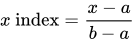
  • x  index = x − a b − a {\displaystyle x{\text{ index}}={\frac {x-a}{b-a}}} {\displaystyle x{\text{ index}}={\frac {x-a}{b-a}}}

where a {\displaystyle a} {\displaystyle a} and b {\displaystyle b} {\displaystyle b} are the lowest and highest values the variable x {\displaystyle x} {\displaystyle x} can attain, respectively.

The Human Development Index (HDI) then represents the uniformly weighted sum with 1⁄3 contributed by each of the following factor indices:

  • Life Expectancy Index = LE − 25 85 − 25 = LE − 25 60 {\displaystyle ={\frac {{\text{LE}}-25}{85-25}}={\frac {{\text{LE}}-25}{60}}} {\displaystyle ={\frac {{\text{LE}}-25}{85-25}}={\frac {{\text{LE}}-25}{60}}}
  • Education Index = 2 3 × ALI + 1 3 × GEI {\displaystyle ={\frac {2}{3}}\times {\text{ALI}}+{\frac {1}{3}}\times {\text{GEI}}} {\displaystyle ={\frac {2}{3}}\times {\text{ALI}}+{\frac {1}{3}}\times {\text{GEI}}}
    • Adult Literacy Index (ALI) = ALR − 0 100 − 0 = ALR 100 {\displaystyle ={\frac {{\text{ALR}}-0}{100-0}}={\frac {\text{ALR}}{100}}} {\displaystyle ={\frac {{\text{ALR}}-0}{100-0}}={\frac {\text{ALR}}{100}}}
    • Gross Enrollment Index (GEI) = CGER − 0 100 − 0 = CGER 100 {\displaystyle ={\frac {{\text{CGER}}-0}{100-0}}={\frac {\text{CGER}}{100}}} {\displaystyle ={\frac {{\text{CGER}}-0}{100-0}}={\frac {\text{CGER}}{100}}}
  • GDP = log ⁡ ( GDPpc ) − log ⁡ ( 100 ) log ⁡ ( 40000 ) − log ⁡ ( 100 ) = log ⁡ ( GDPpc ) − log ⁡ ( 100 ) log ⁡ ( 400 ) {\displaystyle ={\frac {\log({\text{GDPpc}})-\log(100)}{\log(40000)-\log(100)}}={\frac {\log({\text{GDPpc}})-\log(100)}{\log(400)}}} {\displaystyle ={\frac {\log({\text{GDPpc}})-\log(100)}{\log(40000)-\log(100)}}={\frac {\log({\text{GDPpc}})-\log(100)}{\log(400)}}}


2023 Human Development Index (2025 report)

[edit]
Main article: List of countries by Human Development Index
See also: List of countries by inequality-adjusted Human Development Index
World map
Average annual HDI growth from 2010 to 2023 (published in 2025)
  •   ≥ 1.4%
  •   1.2%…1.4%
  •   1%…1.2%
  •   0.8%…1%
  •   0.6%…0.8%
  •   0.4%…0.6%
  •   0.2%…0.4%
  •   0%…0.2%
  •   −0.5%…0%
  •   −1%…−0.5%
  •   < −1%
  •   No data
Human development index

The Human Development Report 2025 by the United Nations Development Programme was released on 6 May 2025; the delayed report calculates HDI values based on data collected two years prior in 2023.

Ranked from 1 to 74 in the year 2023, the following countries are considered to have "very high human development":[14]

Table of countries by HDI
Rank Country or territory HDI
2023 data (2025 report)​ Change since 2015​ 2023 data (2025 report)​[15] Average annual growth (2010–2023)​
1 Increase (2) Iceland 0.972 Increase 0.28%
2 Decrease (1) Norway 0.970 Increase 0.25%
Steady  Switzerland Increase 0.24%
4 Increase (2) Denmark 0.962 Increase 0.35%
5 Decrease (1) Germany 0.959 Increase 0.19%
Steady Sweden Increase 0.38%
7 Increase (1) Australia 0.958 Increase 0.20%
8 Increase (2) Netherlands 0.955 Increase 0.26%
Decrease (1) Hong Kong Increase 0.38%
10 Increase (3) Belgium 0.951 Increase 0.26%
11 Increase (4) Ireland 0.949 Increase 0.38%
12 Decrease (4) Finland 0.948 Increase 0.27%
13 Decrease (2) Singapore 0.946 Increase 0.25%
Increase (2) United Kingdom Increase 0.24%
15 Increase (27) United Arab Emirates 0.940 Increase 1.04%
16 Decrease (2) Canada 0.939 Increase 0.22%
17 Increase (1) Liechtenstein 0.938 Increase 0.23%
Decrease (5) New Zealand Increase 0.13%
Steady United States Increase 0.10%
20 Increase (1) South Korea 0.937 Increase 0.36%
21 Increase (2) Slovenia 0.931 Increase 0.33%
22 Decrease (3) Austria 0.930 Increase 0.21%
23 Decrease (3) Japan 0.925 Increase 0.16%
24 Increase (5) Malta 0.924 Increase 0.50%
25 Decrease (3) Luxembourg 0.922 Increase 0.14%
26 Decrease (1) France 0.920 Increase 0.28%
27 Decrease (3) Israel 0.919 Increase 0.26%
28 Steady Spain 0.918 Increase 0.40%
29 Decrease (3) Czechia 0.915 Increase 0.22%
Increase (1) Italy Increase 0.24%
Decrease (2) San Marino Decrease 0.32%
32 Increase (1) Andorra 0.913 Increase 0.20%
Increase (3) Cyprus Increase 0.45%
34 Decrease (3) Greece 0.908 Increase 0.18%
35 Decrease (1) Poland 0.906 Increase 0.35%
36 Decrease (5) Estonia 0.905 Increase 0.33%
37 Increase (9) Saudi Arabia 0.900 Increase 0.70%
38 Decrease (1) Bahrain 0.899 Increase 0.80%
39 Decrease (4) Lithuania 0.895 Increase 0.32%
40 Increase (2) Portugal 0.890 Increase 0.42%
41 Decrease (1) Croatia 0.889 Increase 0.53%
Increase (4) Latvia Increase 0.51%
43 Decrease (4) Qatar 0.886 Increase 0.45%
44 Decrease (6) Slovakia 0.880 Increase 0.14%
45 Decrease (1) Chile 0.878 Increase 0.47%
46 Increase (1) Hungary 0.870 Increase 0.22%
47 Decrease (7) Argentina 0.865 Increase 0.15%
48 Steady Montenegro 0.862 Increase 0.38%
Increase (13) Uruguay Increase 0.47%
50 Increase (1) Oman 0.858 Increase 0.22%
51 Increase (7) Turkey 0.853 Increase 1.10%
52 Increase (1) Kuwait 0.852 Increase 0.36%
53 Decrease (5) Antigua and Barbuda 0.851 Increase 0.18%
54 Increase (5) Seychelles 0.848 Increase 0.30%
55 Increase (1) Bulgaria 0.845 Increase 0.09%
Increase (2) Romania Increase 0.14%
57 Increase (6) Georgia 0.844 Increase 0.54%
58 Decrease (4) Saint Kitts and Nevis 0.840 Increase 0.49%
59 Increase (6) Panama 0.839 Increase 0.47%
60 Decrease (12) Brunei 0.837 Increase 0.13%
Decrease (1) Kazakhstan Increase 0.38%
62 Increase (3) Costa Rica 0.833 Increase 0.39%
Increase (5) Serbia Increase 0.39%
64 Decrease (12) Russia 0.832 Increase 0.25%
65 Decrease (10) Belarus 0.824 Increase 0.12%
66 Decrease (3) Bahamas 0.820 Increase 0.21%
67 Increase (2) Malaysia 0.819 Increase 0.41%
68 Increase (4) North Macedonia 0.815 Increase 0.21%
69 Increase (9) Barbados 0.811 Increase 0.18%
Steady Armenia Increase 0.52%
71 Steady Albania 0.810 Increase 0.25%
72 Decrease (10) Trinidad and Tobago 0.807 Increase 0.30%
73 Steady Mauritius 0.806 Increase 0.44%
74 Increase (7) Bosnia and Herzegovina 0.804 Increase 0.68%

Past top countries

[edit]

The list below displays the top-ranked country from each year of the Human Development Index. Norway has been ranked the highest sixteen times, Canada eight times, Iceland three times, and Switzerland and Japan 2 times each.

In each original HDI

[edit]

The year represents the time period from which the statistics for the index were derived. In parentheses is the year when the report was published.

  • 2023 (2025):  Iceland
  • 2022 (2024):   Switzerland
  • 2021 (2022):   Switzerland
  • 2019 (2020):  Norway
  • 2018 (2019):  Norway
  • 2017 (2018):  Norway
  • 2015 (2016):  Norway
  • 2014 (2015):  Norway
  • 2013 (2014):  Norway
  • 2012 (2013):  Norway
  • 2011 (2011):  Norway
  • 2010 (2010):  Norway
  • 2007 (2009):  Norway
  • 2006 (2008):  Iceland
  • 2005 (2007):  Iceland
  • 2004 (2006):  Norway
  • 2003 (2005):  Norway
  • 2002 (2004):  Norway
  • 2001 (2003):  Norway
  • 2000 (2002):  Norway
  • 1999 (2001):  Norway
  • 1998 (2000):  Canada
  • 1997 (1999):  Canada
  • 1995 (1998):  Canada
  • 1994 (1997):  Canada
  • 1993 (1996):  Canada
  • 1992 (1995):  Canada
  • 1994 (1994):  Canada
  • 1993 (1993):  Japan
  • 1990 (1992):  Canada
  • 1990 (1991):  Japan

Geographical coverage

[edit]

The HDI has extended its geographical coverage: David Hastings, of the United Nations Economic and Social Commission for Asia and the Pacific, published a report geographically extending the HDI to 230+ economies, whereas the UNDP HDI for 2009 enumerates 182 economies and coverage for the 2010 HDI dropped to 169 countries.[16][17]

Country/region specific HDI lists

[edit]
  • Afghan regions
  • Angolan provinces
  • African countries
  • Albanian counties
  • Algerian regions
  • Antiguan and Barbudan parishes and dependencies
  • Argentine provinces
  • Armenian provinces
  • Australian states and territories
  • Austrian states
  • Azerbaijani regions
  • Baltic regions
  • Bangladeshi districts and divisions
  • Belgian provinces
  • Bolivian departments
  • Bosnia and Herzegovina regions
  • Brazilian states
  • Canadian provinces and territories
  • Chilean regions
  • Chinese administrative divisions
  • Colombian departments
  • Croatian counties
  • Czechs Regions
  • Danish regions
  • Dutch provinces
  • Egyptian governorates
  • Ethiopian regions
  • European countries
  • Finnish regions
  • French regions
  • German states
  • Georgian regions
  • Greek regions
  • Indian states
  • Tamil Nadu districts (India)
  • Indonesian provinces
  • Iranian provinces
  • Iraqi governorates
  • Irish regions
  • Italian regions
  • Kazakhstan regions
  • Japanese prefectures
  • Jordanian governorates
  • Latin American countries
  • Malaysian states
  • Mexican states
  • Myanmar administrative divisions
  • Nepalese provinces
  • New Zealand regions
  • Nigerian states
  • Norwegian regions
  • Pakistani administrative units
  • Philippine provinces
  • Palestinian regions
  • Polish voivodeships
  • Portuguese Regions
  • Romanian regions
  • Russian federal subjects
  • Serbian Regions
  • Slovaks Regions
  • South African provinces
  • South Korean regions
  • Spanish communities
  • Swedish regions
  • Syrian governorates
  • Swiss regions
  • Thai regions
  • Turkish regions
  • UK regions
  • Ukrainian regions
  • U.S. states (American Human Development Report (AHDR))
  • Venezuelan states
  • Vietnamese regions

Criticism

[edit]
HDI in relation to consumption-based CO2 emissions per capita

The Human Development Index has been criticized on a number of grounds, including focusing exclusively on national performance and ranking, lack of attention to development from a global perspective, measurement error of the underlying statistics, and on the UNDP's changes in formula which can lead to severe misclassification of "low", "medium", "high" or "very high" human development countries.[18]

There have also been various criticism towards the lack of consideration regarding sustainability[19] (later addressed by the planetary pressures-adjusted HDI), social inequality[20] (addressed by the inequality-adjusted HDI), unemployment[21] or democracy.[21]

The removal of literacy from HDI has been criticized because educational attainment evaluates only the quantity of education but not the quality or the outcomes of education and can result in perverse incentives.[22]

Economists Hendrik Wolff, Howard Chong and Maximilian Auffhammer discuss the HDI from the perspective of data error in the underlying health, education and income statistics used to construct the HDI. They have identified three sources of data error which are: (i) data updating, (ii) formula revisions and (iii) thresholds to classify a country's development status. They conclude that 11%, 21% and 34% of all countries can be interpreted as currently misclassified in the development bins due to the three sources of data error, respectively. Wolff, Chong and Auffhammer suggest that the United Nations should discontinue the practice of classifying countries into development bins because the cut-off values seem arbitrary, and the classifications can provide incentives for strategic behavior in reporting official statistics, as well as having the potential to misguide politicians, investors, charity donors and the public who use the HDI at large.[18]

In 2010, the UNDP reacted to the criticism by updating the thresholds to classify nations as low, medium, and high human development countries. In a comment to The Economist in early January 2011, the Human Development Report Office responded[23] to an article published in the magazine on 6 January 2011[24] which discusses the Wolff et al. paper. The Human Development Report Office states that they undertook a systematic revision of the methods used for the calculation of the HDI, and that the new methodology directly addresses the critique by Wolff et al. in that it generates a system for continuously updating the human-development categories whenever formula or data revisions take place.

In 2013, Salvatore Monni and Alessandro Spaventa emphasized that in the debate of GDP versus HDI, it is often forgotten that these are both external indicators that prioritize different benchmarks upon which the quantification of societal welfare can be predicated. The larger question is whether it is possible to shift the focus of policy from a battle between competing paradigms to a mechanism for eliciting information on well-being directly from the population.[25]

See also

[edit]
  • iconModern history portal
  • World portal
  • Corruption Perceptions Index
  • Gender Inequality Index
  • International development
  • Legatum Prosperity Index
  • List of sovereign states by percentage of population living in poverty
  • OECD Better Life Index (BLI)
  • Right to an adequate standard of living
  • Social Progress Index
  • Sustainable Development Goals (SDGs)
  • Where-to-be-born Index
  • World Happiness Report

References

[edit]
  1. ^ Stanton, Elizabeth A. (2007). The Human Development Index: A History (Report). doi:10.7275/1282621. hdl:20.500.14394/40243.[page needed]
  2. ^ "Human Development Index". Definition of 'Human Development Index'. Archived from the original on 1 December 2017. Retrieved 29 November 2017.
  3. ^ "About Human Development". HDR. UNDP. Archived from the original on 15 April 2012. Retrieved 29 July 2011.
  4. ^ "Human development index". World Health Organization. Archived from the original on 3 January 2022. Retrieved 26 June 2024.
  5. ^ "Composite indices — HDI and beyond". Human Development Reports. Archived from the original on 10 August 2016. Retrieved 16 January 2021.
  6. ^ a b "What is Human Development". HDR. UNDP. 19 February 2015. Archived from the original on 27 October 2017. Retrieved 27 October 2017. ... human development approach, developed by the economist Mahbub Ul Haq ...
  7. ^ The Courier. Commission of the European Communities. 1994.
  8. ^ Nations, United (4 November 2010). "Human Development Report 2010". UNDP. Archived from the original on 22 December 2015. Retrieved 15 December 2015.
  9. ^ "Technical notes" (PDF). UNDP. 2013. Archived (PDF) from the original on 16 June 2015. Retrieved 15 December 2015.
  10. ^ "New method of calculation of Human Development Index (HDI)". India Study Channel. 1 June 2011. Archived from the original on 10 November 2017. Retrieved 19 November 2017.
  11. ^ Mean years of schooling (of adults) (years) is a calculation of the average number of years of education received by people ages 25 and older in their lifetime based on education attainment levels of the population converted into years of schooling based on theoretical duration of each level of education attended. Source: Barro, R. J.; Lee, J.-W. (2010). "A New Data Set of Educational Attainment in the World, 1950–2010". NBER Working Paper No. 15902. Working Paper Series. doi:10.3386/w15902. Archived from the original on 7 August 2011. Retrieved 29 July 2011.
  12. ^ (ESYI is a calculation of the number of years a child is expected to attend school, or university, including the years spent on repetition. It is the sum of the age-specific enrollment ratios for primary, secondary, post-secondary non-tertiary and tertiary education and is calculated assuming the prevailing patterns of age-specific enrollment rates were to stay the same throughout the child's life. Expected years of schooling is capped at 18 years. (Source: UNESCO Institute for Statistics (2010). Correspondence on education indicators. March. Montreal.)
  13. ^ "Definition, Calculator, etc. at UNDP site". Archived from the original on 20 December 2007. Retrieved 26 May 2020.
  14. ^ Human Development Report 2025 - A matter of choice: People and possibilities in the age of AI. United Nations Development Programme. 6 May 2025. Archived from the original on 6 May 2025. Retrieved 6 May 2025.
  15. ^ Human Development Report 2025 - A matter of choice: People and possibilities in the age of AI. United Nations Development Programme. 6 May 2025. Archived from the original on 6 May 2025. Retrieved 6 May 2025.
  16. ^ Hastings, David A. (2009). "Filling Gaps in the Human Development Index". United Nations Economic and Social Commission for Asia and the Pacific, Working Paper WP/09/02. Archived from the original on 30 April 2011. Retrieved 1 December 2009.
  17. ^ Hastings, David A. (2011). "A "Classic" Human Development Index with 232 Countries". HumanSecurityIndex.org. Archived from the original on 3 May 2011. Retrieved 9 March 2011. Information Note linked to data
  18. ^ a b Wolff, Hendrik; Chong, Howard; Auffhammer, Maximilian (June 2011). "Classification, Detection and Consequences of Data Error: Evidence from the Human Development Index". The Economic Journal. 121 (553): 843–870. doi:10.1111/j.1468-0297.2010.02408.x. hdl:1813/71597.
  19. ^ WWF, WWF. "Living Planet Report 2014" (PDF). Living Planet Report. 2014: 60–62. Archived from the original (PDF) on 14 February 2024. Retrieved 14 February 2024.
  20. ^ Harttgen, Kenneth; Klasen, Stephan (May 2012). "A Household-Based Human Development Index". World Development. 40 (5): 878–899. doi:10.1016/j.worlddev.2011.09.011. hdl:10419/37505.
  21. ^ a b Leiwakabessy, Erly; Amaluddin, Amaluddin (2 May 2020). "A Modified Human Development Index, Democracy And Economic Growth In Indonesia". Humanities & Social Sciences Reviews. 8 (2): 732–743. doi:10.18510/hssr.2020.8282.
  22. ^ Kovacevic, Milorad (2011). "Review of HDI Critiques and Potential Improvements" (PDF). United Nations Development Programme, Human Development Reports, Research Paper 2010/33. Retrieved 27 August 2025.
  23. ^ "UNDP Human Development Report Office's comments". The Economist. January 2011. Archived from the original on 11 February 2011. Retrieved 12 January 2011.
  24. ^ "Wrong numbers". The Economist. 6 January 2011.
  25. ^ Monni, Salvatore; Spaventa, Alessandro (2013). "Beyond Gdp and HDI: Shifting the focus from Paradigms to Politics". Development. 56 (2): 227–231. doi:10.1057/dev.2013.30.

External links

[edit]
Wikimedia Commons has media related to Human Development Index.
  • Human Development Index
  • Human Development Tools and Rankings
  • v
  • t
  • e
Economic classification of countries
  • Developed country
  • Developing country
  • Heavily indebted poor countries
  • Least developed countries
  • Newly industrialized country
  • World Bank high-income economy
Three/Four-World Model
  • First World
  • Second World
  • Third World
  • Fourth World
Gross domestic product (GDP)
Nominal
  • By country
    • past and projected
      • per capita
    • per capita
Purchasing
power parity
(PPP)
  • By country
    • future estimates
      • per capita
    • per capita
    • per person employed
Gross national income and Income
  • Disposable income
  • GNI (nominal) per capita
  • GNI (PPP) per capita
  • Per capita growth
  • Income inequality
  • Median income
  • Real income
Wages and salary
  • Average wage
    • Europe
  • Employee compensation (per hour)
  • Labour productivity
  • Minimum wage
    • Canada
    • Europe
    • United States
Wealth
  • Wealth inequality
  • Wealth per adult
    • Europe
  • Financial assets per capita
Other national accounts
  • Gross National Happiness
  • Net material product
  • Research and development spending
  • Stock market capitalization
  • Patents, trademarks, and industrial design filing activity
Human development
  • Human Development Index
    • by country
    • inequality-adjusted
    • planetary pressures–adjusted HDI
  • Human Poverty Index
  • Percentage living in poverty
  • Human Capital Index
  • Household income
  • Social Progress Index
Digital divide
  • ICT Development Index
  • Number of broadband Internet subscriptions
  • Number of Internet users
  • Smartphone penetration
Net international
investment position
(NIIP)
  • Per capita (creditors)
  • Per capita (debtors)
  • icon Economics portal
  • World portal
  • v
  • t
  • e
Lists of countries by population statistics
Global
  • Current population
    • United Nations
  • Demographics of the world
Continents/subregions
  • Africa
  • Antarctica
  • Asia
  • Europe
  • North America
    • Caribbean
  • Oceania
  • South America
Intercontinental
  • Americas
  • Arab world
  • Commonwealth of Nations
  • Eurasia
  • European Union
  • Islands
  • Latin America
  • Middle East
Cities/urban areas
  • World cities
  • National capitals
  • Megacities
  • Megalopolises
Past and future
  • Past and future population
  • Estimates of historical world population
  • Human population projections
  • 1
  • 1000
  • 1500
  • 1600
  • 1700
  • 1800
  • 1900
  • 1939
  • 1989
  • 2000
  • 2005
  • 2010
  • 2015
  • Population milestones
Population density
  • Current density
  • Past and future population density
  • Person-to-arable land ratio
Growth indicators
  • Population growth rate
  • Natural increase
  • Net reproduction rate
  • Number of births
  • Number of deaths
  • Birth rate
  • Mortality rate
  • Fertility rate
  • Past fertility rate
Life expectancy
  • World
  • Africa
  • Asia
  • Europe
  • North America
  • Oceania
  • South America
  • world regions
  • past life expectancy
Other demographics
  • Age at childbearing
  • Age at first marriage
  • Age structure
  • Dependency ratio
  • Divorce rate
  • Ethnic and cultural diversity level
  • Ethnic composition
  • Immigrant population
  • Linguistic diversity
  • Median age
  • Net migration rate
  • Number of households
  • Religion / Irreligion
  • Sex ratio
  • Urban population
  • Urbanization
Health
  • Antidepressant consumption
  • Antiviral medications for pandemic influenza
  • HIV/AIDS adult prevalence rate
  • Infant and under-five mortality rates
  • Maternal mortality rate
  • Obesity rate
  • Percentage suffering from undernourishment
  • Health expenditure by country by type of financing
  • Suicide rate
  • Total health expenditure per capita
  • Health spending as % of GDP
  • Body mass index (BMI)
Education and innovation
  • Bloomberg Innovation Index
  • Education Index
  • Global Innovation Index
  • International Innovation Index
  • Literacy rate
  • Programme for the International Assessment of Adult Competencies
  • Programme for International Student Assessment (PISA)
  • Progress in International Reading Literacy Study (PIRLS)
  • Trends in International Mathematics and Science Study (TIMSS)
  • Tertiary education attainment
  • World Intellectual Property Indicators
Economic
  • Access to financial services
  • Development aid donors
    • Official Development Assistance received
  • Employment rate
  • Irrigated land area
  • Human Development Index
    • by country
    • inequality-adjusted
    • planetary pressures–adjusted HDI
  • Human Poverty Index
  • Imports
  • Exports
  • Income inequality
  • Labour force
  • Share of income of top 1%
  • Number of millionaires (US dollars)
  • Number of billionaires (US dollars)
  • Percentage living in poverty
  • Public sector
  • Unemployment rate
  • Wealth inequality
  • List of international rankings
  • Lists by country
  • v
  • t
  • e
Lists of countries by quality of life rankings
General
  • Life expectancy
    • Africa
    • Asia
    • Europe
    • North America
    • Oceania
    • South America
  • World Happiness Report
  • Happy Planet Index
  • Human Capital Index
  • Human Development Index
    • by country
    • inequality-adjusted
    • planetary pressures–adjusted
  • Legatum Prosperity Index
  • Good Country Index
  • Satisfaction with Life Index
  • Where-to-be-born Index
Economic
  • Net take-home pay
  • Long-term unemployment rate
  • Home ownership rate
  • Median wage
  • Smartphone ownership rate
Environment
  • Greenhouse gas emissions per capita
  • Dashboard of sustainability
  • Environmental Performance Index
  • Environmental Vulnerability Index
  • Natural disaster risk
  • Sustainable Society Index
Health
  • Air pollution
  • Antidepressant use
  • Cancer rate
  • Child Development Index
  • Clean water access
  • Global Health Security Index
  • Global Hunger Index
  • Health insurance coverage
  • Hospital beds
  • Murder rate
  • Number of physicians
  • Risk of death from non-communicable disease
  • Suicide rate
  • Teenage pregnancy rate
Social/political
  • Corruption Perceptions Index
  • Democracy indices
  • Fragile States Index
  • Gender Development Index
  • Guaranteed minimum income
  • Government transparency
  • Global Slavery Index
  • Global Terrorism Index
  • Global Competitiveness Index
  • Multidimensional Poverty Index
  • Political terror scale
  • Press Freedom Index
  • Social Progress Index
  • Time devoted to leisure and personal care
  • Wealth equality
  • Worldwide Governance Indicators
  • List of international rankings
  • Lists by country
  • v
  • t
  • e
Deprivation and poverty indicators
Social
Topics:
  • Acting out
  • Child abuse
  • Disadvantaged
  • Diseases of poverty
  • Environmental degradation
  • Environmental racism
  • Fushūgaku
  • Governance failure
  • Hikikomori
  • Mental illness
  • Relative deprivation
  • Self-image
  • Social deprivation
  • Social exclusion
  • Social stigma
  • Social vulnerability
  • Social determinants of health in poverty
  • Violence against women
  • Vulnerability
Measures:
  • Social Progress Index
Psychological
Topics:
  • Cruel, inhuman or degrading treatment
  • Learned helplessness
  • Psychological abuse
  • psychological poverty
  • Poverty and mental health
  • Social determinants of mental health
Economic
Topics:
  • Asset poverty
  • Culture of poverty
  • Debt bondage
  • Energy poverty
  • Extreme poverty
  • Housing stress
  • Human trafficking
  • Income deficit
  • Poverty threshold
  • Precariat
  • Precarious work
  • Secondary poverty
  • Social determinants of health in poverty
  • Survival sex
  • Water scarcity
Measures:
  • Below Poverty Line (India)
  • Homeless Vulnerability Index
  • Misery index (economics)
  • Gini coefficient
  • Genuine progress indicator (GPI)
  • Legatum Prosperity Index
  • Poverty gap index
Physical
Topics:
  • Disability and poverty
  • Food insecurity
  • Physical abuse
  • Sex trafficking
  • Social determinants of health
  • Poverty and violence
Measures:
  • India State Hunger Index
  • Global Hunger Index
  • Disability-adjusted life year (DALYs)
  • Global Peace Index (GPI)
Complex measures
  • Human Poverty Index (HPI)
  • Human Development Index (HDI)
  • Multidimensional Poverty Index (MPI)
  • Physical Quality of Life Index (PQLI)
  • Living Planet Index (LPI)
  • Progress out of Poverty Index
  • Deprivation index
Gender
Topics:
  • Feminization of poverty
Measures:
  • Gender-related Development Index (GDI)
  • Gender Parity Index
Other
Categories: Income inequality metrics · Measurements and definitions of poverty · Social responsibility organizations
Commons categories: Information graphics about poverty · Poverty-related maps
Authority control databases Edit this at Wikidata
International
  • GND
National
  • Latvia
Other
  • Encyclopedia of Modern Ukraine
Retrieved from "https://teknopedia.ac.id/w/index.php?title=Human_Development_Index&oldid=1338800243"
Categories:
  • Human Development Index
  • Development economics
  • Environmental economics
  • International rankings
  • Science and technology in Pakistan
  • Pakistani inventions
  • 1990 establishments
Hidden categories:
  • Wikipedia articles needing page number citations from February 2026
  • Articles with short description
  • Short description matches Wikidata
  • Wikipedia pending changes protected pages
  • Use dmy dates from November 2021
  • Pages using gadget owidslider
  • Commons category link is on Wikidata

  • indonesia
  • Polski
  • العربية
  • Deutsch
  • English
  • Español
  • Français
  • Italiano
  • مصرى
  • Nederlands
  • 日本語
  • Português
  • Sinugboanong Binisaya
  • Svenska
  • Українська
  • Tiếng Việt
  • Winaray
  • 中文
  • Русский
Sunting pranala
url url url url url url url url url url url url url url url url url url url url url url url url url url url url url url url url url url url url url url url url url url url url url url url url url url url url url url url url url url url url url url url url url url url url url url url url url url url url url url url url url url url url url url url url url url url url url url url url url url url url url url url url url url url url url url url url url url url url url url url url url url url url url url url url url url url url url url url url url url url url url url url url url url url url url url url url url url url url url url url url url url url url url url url url url url url url url url url url url url url url url url url url url url url url url url url url url url url url url url url url url url url url url url url url url url url url url url url url url url url url url url url url url url url url url url url url url url url url url url url url url url url url url url url url url url url url url url url url url url url url url url url url url url url url url url url url url url url url url url url url url url url url url url url url url url url url url url url url url url url url url url url url url url url url url url url url url url url url url url url url url url url url url url url url url url url url url url url url url url url url url url url url url url url url url url url url url url url url url url url url url url url url url url url url url url url url url url url url url url url url url url url url url url url url url url url url url url url url url url url url url url url url url url url url url url url url url url url url url url url url url url url url url url url url url url url url url url url url url url url url url url url url url url url url url url url url url url url url url url url url url url url url url url url url url url url url url url url url url url url url url url url url url url url url url url url url url url url url url url url url url url url url url url url url url url url url url url url url url url url url url url url url url url url url url url url url url url url url url url url url url url url url url url url url url url url url url url url url url url url url url url url url url url url url url url url url url url url url url url url url url url url url url url url url url url url url url url url url url url url url url url url url url url url url url url url url url url url url url url url url url url url url url url url url url url url url url url url url url url url url url url url url url url url url url url url url url url url url url url url url url url url url url url url url url url url url url url url url url url url url url url url url url url url url url url url url url url url url url url url url url url url url url url url url url url url url url url url url url url url url url url url url url url url url url url url url url url url url url url url url url url url url url url url url url url url url url url url url url url url url url url url url url url url url url url url url url url url url url url url url url url url url url url url url url url url url url url url url url url url url url url url url url url url url url url url url url url url url url url url url url url url url url url url url url url url url url url url url url url url url url url url url url url url url url url url url url url url url url url url url url url url url url url url url url url url url url url url url url url url url url url url url url url url url url url url url url url url url url url url url url url url url url url url url url url url url url url url url url url url url url url url url url url url url url url url url url url url url url url url url url url url url url url url url url url url url url url url url url url url url url url url url url url url url url url url url url url url url url url url url url url url url url url url url url url url url url url url url url url url url url url url url url url url url url url url url url url url url url url url url url url url url url url url url url url url url url url url url url url url url url url url url url url url url url url url url url url url url url url url url url url url url url url url url url url url url url url url url url url url url url url url url url url url url url url url url url url url url url url url url url url url url url url url url url url url url url url url url url url url url url url url url url url url url url url url url url url url url url url url url url url url url url url url url url url url url url url url url url url url url url url url url url url url url url url url url url url url url url url url url url url url url url url url url url url url url url url url url url url url url url url url url url url url url url url url url url url url url url url url url url url url url url url url url url url url url url url url url url url url url url url url url url url url url url url url url url url url url url url url url url url url url url url url url url url url url url url url url url url url url url url url url url url url url url url url url url url url url url url url url url url url url url url url url url url url url url url url url url url url url url url url url url url url url url url url url url url url url url url url url url url url url url url url url url url url url url url url url url url url url url url url url url url url url url url url url url url url url url url url url url url url url url url url url url url url url url url url url url url url url url url url url url url url url url url url url url url url url url url url url url url url url url url url url url url url url url url url url url url url url url url url url url url url url url url url url url url url url url url url url url url url url url url url url url url url url url url url url url url url url url url url url url url url url url url url url url url url url url url url url url url url url url url url url url url url url url url url url url url url url url url url url url url url url url url url url url url url url url url url url url url url url url url url url url url url url url url url url url url url url url url url url url url url url url url url url url url url url url url url url url url url url url url url url url url url url url url url url url url url url url url url url url url url url url url url url url url url url url url url url url url url url url url url url url url url url url url url url url url url url url url url url url url url url url url url url url url url url url url url url url url url url url url url url url url url url url url url url url url url url url url url url url url url url url url url url url url url url url url url url url url url url url url url url url url url url url url url url url url url url url url url url url url url url url url url url url url url url url url url url url url url url url url url url url url url url url url url url url url url url url url url url url url url url url url url url url url url url url url url url url url url url url url url url url url url url url url url url url url url url url url url url url url url url url url url url url url url url url url url url url url url url url url url url url url url url url url url url url url url url url url url url url url url url url url url url url url url url url url url url url url url url url url url url url url url url url url url url url url url url url url url url url url url url url url url url url url url url url url url url url url url url url url url url url url url url url url url url url url url url url url url url url url url url url url url url url url url url url url url url url url url url url url url url url url url url url url url url url url url url url url url url url url url url url url url url url url url url url url url url url url url url url url url url url url url url url url url url url url url url url url url url url url url url url url url url url url url url url url url url url url url url url url url url url url url url url url url url url url url url url url url url url url url url url url url url url url url url url url url url url url url url url url url url url url url url url url url url url url url url url url url url url url url url url url url url url url url url url url url url url url url url url url url url url url url url url url url url url url url url url url url url url url url url url url url url url url url url url url url url url url url url url url url url url url url url url url url url url url url url url url url url url url url url url url url url url url url url url url url url url url url url url url url url url url url url url url url url url url url url url url url url url url url url url url url url url url url url url url url url url url url url url url url url url url url url url url url url url url url url url url url url url url url url url url url url url url url url url url url url url url url url url url url url url url url url url url url url url url url url url url url url url url url url url url url url url url url url url url url url url url url url url url url url url url url url url url url url url url url url url url url url url url url url url url url url url url url url url url url url url url url url url url url url url url url url url url url url url url url url url url url url url url url url url url url url url url url url url url url url url url url url url url url url url url url url url url url url url url url url url url url url url url url url url url url url url url url url url url url url url url url url
Pusat Layanan

UNIVERSITAS TEKNOKRAT INDONESIA | ASEAN's Best Private University
Jl. ZA. Pagar Alam No.9 -11, Labuhan Ratu, Kec. Kedaton, Kota Bandar Lampung, Lampung 35132
Phone: (0721) 702022
Email: pmb@teknokrat.ac.id