Epstein Files Full PDF

CLICK HERE
Technopedia Center
PMB University Brochure
Faculty of Engineering and Computer Science
S1 Informatics S1 Information Systems S1 Information Technology S1 Computer Engineering S1 Electrical Engineering S1 Civil Engineering

faculty of Economics and Business
S1 Management S1 Accountancy

Faculty of Letters and Educational Sciences
S1 English literature S1 English language education S1 Mathematics education S1 Sports Education
teknopedia

  • Registerasi
  • Brosur UTI
  • Kip Scholarship Information
  • Performance
Flag Counter
  1. World Encyclopedia
  2. Saint Anne - Wikipedia
Saint Anne - Wikipedia
From Wikipedia, the free encyclopedia
Mother of Mary in Christian tradition
For the figure of Luke 2, see Anna the Prophetess. For other uses, see Saint Anne (disambiguation).

Saint

Anne
Greek icon of Saint Anne with the Virgin, by Angelos Akotantos (c. 1420–1450)
Mother of the Virgin, Maternal Heroine, Woman of Amram
BornBefore c. 49 BC
Bethlehem, Hasmonean Judea
DiedAfter c. 4 AD
Venerated inCatholic Church
Eastern Orthodox Church
Oriental Orthodox Church
Anglican Communion
Lutheranism
Islam
Afro-American religion
CanonizedPre-Congregation
Major shrineApt Cathedral, Basilica of Sainte-Anne d'Auray, Basilica of Sainte-Anne-de-Beaupré
FeastCatholic Church: 26 July[1]
Eastern Orthodox: 9 September[2] 25 July
AttributesBook; door; with Mary, Jesus or Joachim; woman dressed in red or green[3]
Patronage
  • Mothers
  • grandparents
  • pregnant women
  • children
  • unmarried people
  • teachers
  • carpenters
  • child care providers
  • seamstresses
  • lacemakers
  • secondhand-clothes dealers
  • equestrians
  • stablemen
  • miners
  • lost things
  • loving homes
  • poverty
  • sterility

  • Brittany
  • Canada
  • Detroit
  • Taguig
  • Triana, Seville
  • Hagonoy, Bulacan
  • Barili, Cebu
  • Molo, Iloilo City
  • Kurunegala Catholic Diocese, Sri Lanka
  • Fasnia, Tenerife
  • Mainar
  • Marsaskala
  • Carmelites

According to Christian tradition, Saint Anne (also known as Ann or Anna) was the mother of Mary, the wife of Joachim and the maternal grandmother of Jesus. Mary's mother is not named in the Bible's canonical gospels. In writing, Ann's name and that of her husband Joachim come from New Testament apocrypha, of which the Gospel of James (written perhaps around 150 AD) seems to be the earliest that mentions them. The mother of Mary is mentioned but not named in the Quran.

Christian tradition

[edit]

The story is similar to that of Samuel, whose mother Hannah (Hebrew: חַנָּה‎ Ḥannāh "favour, grace"; etymologically the same name as Anne) had also been childless. The Immaculate Conception was eventually made dogma by the Catholic Church following an increased devotion to Anne in the twelfth century.[4] Dedications to Anne in Eastern Christianity occur as early as the sixth century.[5] In the Eastern Orthodox tradition, Anne and Joachim are ascribed the title Ancestors of God,[6] and both the Nativity of Mary and the Presentation of Mary are celebrated as two of the twelve Great Feasts of the Orthodox Church. The Dormition of Anne is also a minor feast in Eastern Christianity. In Lutheran Protestantism, it is held that Martin Luther chose to enter religious life as an Augustinian friar after invoking St. Anne while endangered by lightning.[7]

Masolino and Masaccio, Virgin and Child with Saint Anne (c. 1424), Uffizi, Florence

Beliefs

[edit]

Although the canonical books of the New Testament never mention the mother of the Virgin Mary, traditions about her family, childhood, education, and eventual betrothal to Joseph developed very early in the history of the church. The oldest and most influential source for these is the apocryphal Gospel of James, first written in Koine Greek around the middle of the second century AD. In the West, the Gospel of James fell under a cloud in the fourth and fifth centuries when it was accused of "absurdities" by Jerome and condemned as untrustworthy by Pope Damasus I, Pope Innocent I, and Pope Gelasius I.[8] However, despite having been condemned by the Church, it was taken over almost in toto by another apocryphal work, the Gospel of Pseudo-Matthew, which popularised most of its stories.[9]

Ancient belief, attested to by a sermon of John of Damascus, was that Anne married once.[10] The sister of Saint Anne was Sobe, mother of Elizabeth. In the fifteenth century, the Catholic cleric Johann Eck related in a sermon that St Anne's parents were named Stollanus and Emerentia. Frederick George Holweck, writing in the Catholic Encyclopedia (1907) regards this genealogy as spurious.[11]

In the 4th century and then much later in the fifteenth century, a belief arose that Mary was conceived of Anne without original sin. This belief in the Immaculate Conception states that God preserved Mary's body and soul intact and sinless from her first moment of existence, through the merits of Jesus Christ.[12] The Immaculate Conception, often confused with the Annunciation of the Incarnation (Mary's virgin birth of Jesus), was made dogma in the Catholic church by Pope Pius IX's papal bull, Ineffabilis Deus, in 1854. The 13th century Speculum Maius of Vincent of Beauvais incorporates information regarding the life of Saint Anne from an earlier work by Hrotsvitha of Gandersheim Abbey.[13]

Veneration

[edit]
Birth of St. Anne, by Adriaen van Overbeke (c. 1521–1525)

In the Eastern church, the veneration of Anne herself may go back as far as c. 550, when Justinian built a church in Constantinople in her honour.[14] The earliest pictorial sign of her veneration in the West is an eighth-century fresco in the church of Santa Maria Antiqua, Rome.[8] The Feast of the Conception of the Virgin Mary had reached southern Italy by the ninth century. In the Latin Church St. Anne was not venerated, except, perhaps, in the south of France, before the thirteenth century.[12] A shrine at Douai, in northern France, was one of the early centres of devotion to St. Anne in the West.[15]

The Anna Selbdritt was a type of iconography depicting the three generations of Saint Anne, Mary, and the child Jesus. Emphasizing the humanity of Jesus, it drew on the earlier conventions of the Seat of Wisdom, and was popular in northern Germany in the 1500s.[16] During the High Middle Ages, Saint Anne became increasingly identified as a maritime saint, protecting sailors and fisherman, and invoked against storms.[17]

Two well-known shrines to St. Anne are that of Ste-Anne-d'Auray in Brittany, France; and that of Ste-Anne-de-Beaupré near the city of Québec. The number of visitors to the Basilica of Ste-Anne-de-Beaupré is greatest on St Anne's Feast Day, 26 July, and the Sunday before the Nativity of the Virgin Mary, 8 September. In 1892, Pope Leo XIII sent a relic of St Anne to the church.[17]

In the Maltese language, the Milky Way galaxy is called It-Triq ta' Sant'Anna, literally "The Way of St. Anne".[18] In the United States, the Daughters of the Holy Spirit named the former Annhurst College in her honor.[19]

Church of St. Anne in Jerusalem, c. 1140
Feast of Saint Anne in Marsaskala Parish Church [fr], Malta

Commemoration

[edit]

By the middle of the 7th century, a distinct feast day, the Conception of St. Anne (Maternity of Holy Anna) celebrating the conception of Mary by Saint Anne, was observed at the Monastery of Saint Sabas.[20] It is now known in the Greek Orthodox Church as the feast of "The Conception by St. Anne of the Most Holy Theotokos", and celebrated on 9 December.[21] In the Catholic Church, the Feast of Saints Anne and Joachim is celebrated on 26 July.

Feast day

[edit]

Catholic Church

[edit]
  • 26 July

Eastern Orthodox Church

[edit]
  • 25 July: (Dormition of the Righteous Anna, the Mother of the Most Holy Theotokos)
  • 9 September: (Holy and Righteous Ancestors of God, Joachim and Anna, Afterfeast of the Nativity of the Mother of God)
  • 9 December (The Conception by Righteous Anna of the Most Holy Mother of God)

Anglican Communion

[edit]
  • 26 July: Anne is remembered (with Joachim) in the Church of England with a Lesser Festival on 26 July.[22]

Lutheranism

[edit]
  • 26 July

Coptic Orthodox Church and Ethiopian Orthodox Tewahedo Church

[edit]
  • 7 November (The Departure of St. Anna (Hannah), the mother of the Theotokos)[23]

Armenian Apostolic Church

[edit]
  • 9 December (The Conception by Righteous Anna of the Most Holy Mother of God)
  • Tuesday, 2nd week after Dormition of the Mother of God[24] (with Joachim)[23]

Syro-Malabar Church

[edit]
  • 26 July (Anne and Joachim)[25]

Syro-Malankara Catholic Church

[edit]
  • 9 September (Mar Joachim and Martha Anna)[26]

Maronite Church

[edit]
  • 9 September (St. Anne and Joachim, Parents of the Blessed Virgin Mary)[27]
St. Anne's Shrine, with the reliquary of her skull, Annakirche, Düren

Relics

[edit]

The alleged relics of St. Anne were brought from the Holy Land to Constantinople in 710 and were kept there in the church of St. Sophia as late as 1333.[12] During the 12th and 13th centuries, returning crusaders and pilgrims from the East brought relics of Anne to a number of churches, including most famously those at Apt, in Provence, Ghent, and Chartres.[8] St. Anne's relics have been preserved and venerated in the many cathedrals and monasteries dedicated to her name, for example in Austria, Canada,[28] Germany, Italy,[29] and Greece in the semi-autonomous Mount Athos, and the city of Katerini.[30] Medieval and baroque craftsmanship is evidenced in, for example, the metalwork of the life-size reliquaries containing the bones of her forearm. Examples employing folk art techniques are also known. Düren has been the main place of pilgrimage for Anne since 1506, when Pope Julius II decreed that her relics should be kept there, after they were stolen from the church of St. Stephen in Mainz.

Basilica of Sainte-Anne-de-Beaupré, Quebec, Canada

Patronage

[edit]

The Church of Saint Anne in Beit Guvrin National Park was built by the Byzantines and the Crusaders in the 12th century, known in Arabic as Khirbet (lit. 'ruin') Sandahanna, the mound of Maresha being called Tell Sandahanna. Saint Anne is the patroness of unmarried women, housewives, women in labour or who want to be pregnant, grandmothers, mothers and educators. She is also a patroness of horseback riders, cabinet-makers[15] and miners. As the mother of Mary, this devotion to Saint Anne as the patron of miners arises from the medieval comparison between Mary and Christ and the precious metals silver and gold. Anne's womb was considered the source from which these precious metals were mined.[31]

Saint Anne is the patron saint of Brittany (France), Cuenca (Ecuador), Chinandega (Nicaragua), the Mi'kmaq people of Canada, Castelbuono (Sicily), Quebec (Canada), Santa Ana (California), Norwich (Connecticut), Detroit (Michigan),[32] Adjuntas (Puerto Rico), Santa Ana and Jucuarán (El Salvador), Berlin (New Hampshire), Santa Ana Pueblo, Seama, and Taos (New Mexico), Chiclana de la Frontera, Marsaskala, Tudela, Atarfe and Fasnia (Spain), Town of Sta Ana Province of Pampanga, Molo, Iloilo City, Balasan, Iloilo, Hagonoy, Santa Ana, Taguig City, Saint Anne Shrine, Malicboy, Pagbilao, Quezon and Malinao, Albay (Philippines), Santana (Brazil), Saint Anne (Illinois), Sainte Anne Island, Baie Sainte Anne and Praslin Island (Seychelles), Bukit Mertajam and Port Klang (Malaysia), Kľúčové (Slovakia) and South Vietnam. The parish church of Vatican City is Sant'Anna dei Palafrenieri. There is a shrine dedicated to Saint Anne in the Woods in Bristol, United Kingdom.

In art

[edit]

Iconography

[edit]

The subject of Joachim and Anne The Meeting at the Golden Gate was a regular component of artistic cycles of the Life of the Virgin. The couple meet at the Golden Gate of Jerusalem and embrace. They are aware of Anne's pregnancy, of which they have been separately informed by an archangel. This moment stood for the conception of Mary, and the feast was celebrated on the same day as the Immaculate Conception. Artworks representing the Golden Gate and the events leading up to it were influenced by the narrative in the widely read Golden Legend of Jacobus de Voragine. The Birth of Mary, the Presentation of Mary and the Marriage of the Virgin were usual components of cycles of the Life of the Virgin in which Anne is normally shown here. Her emblem is a door.[15] She is often portrayed wearing red and green, representing love and life.[3]

Anne is never shown as present at the Nativity of Christ but is frequently shown with the infant Christ in various subjects. She is sometimes believed to be depicted in scenes of the Presentation of Jesus at the Temple and the Circumcision of Christ, but in the former case, this likely reflects a misidentification through confusion with Anna the Prophetess. There was a tradition that Anne went (separately) to Egypt and rejoined the Holy Family after their Flight to Egypt. Anne is not seen with the adult Christ, so was regarded as having died during the youth of Jesus.[33] Anne is also shown as the matriarch of the Holy Kinship, the extended family of Jesus, a popular subject in late medieval Germany; some versions of these pictorial and sculptural depictions include Emerentia who was reputed in the fifteenth century to be Anne's mother. In modern devotions, Anne and her husband are invoked for protection for the unborn.

Christ in the House of His Parents by John Everett Millais, 1849–50

Virgin and Child with Saint Anne

[edit]

The role of the Messiah's grandparents in salvation history was commonly depicted in early medieval devotional art in a vertical double-Madonna arrangement known as the Virgin and Child with Saint Anne, and developed into less hierarchical compositions. The painted or sculpted group is called in Italian Metterza, in French Sainte Anne trinitaire, and in German Anna selbdritt. Another typical subject has Anne teaching the Virgin Mary the scriptures.

Christ in the House of His Parents

[edit]

In John Everett Millais's 1849–50 work, Christ in the House of His Parents, Anne is shown in her son-in-law Joseph's carpentry shop. Her daughter Mary, and Joseph are caring for a young Jesus who had cut his hand on a nail, prefiguring the wounds of his Crucifixion. The coeval John the Baptist carries a bowl of water to clean the injured hand of Jesus, also prefiguring the Baptism of Jesus.

In Islam

[edit]

Anne (Arabic: حنة بنت فاقوذ, romanized: Ḥannah bint Faḳūdh) is also revered in Islam, recognized as a highly spiritual woman and as the mother of Mary. She is not named in the Quran, where she is referred to as "the wife of Imran". The Quran describes her remaining childless until her old age. One day, Anne saw a bird feeding its young while sitting in the shade of a tree, which awakened her desire to have children of her own. She prayed for a child and eventually conceived; her husband, Imran, died before the child was born. Expecting the child to be male, Anne vowed to dedicate him to isolation and service in the Second Temple;[N 1][34][35] however, Anne bore a daughter instead, and named her Mary. Her words upon delivering Mary reflect her status as a great mystic, realising that while she had wanted a son, this daughter was God's gift to her:[34][35]

When she delivered, she said, "My Lord! I have given birth to a girl," —and Allah fully knew what she had delivered—" and the male is not like the female. I have named her Mary, and I seek Your protection for her and her offspring from Satan, the accursed." So her Lord accepted her graciously and blessed her with a pleasant upbringing—entrusting her to the care of Zachariah...

— Surah Al Imran 3:36-37

Gallery

[edit]
  • Various depictions of Saint Anne
  • Adoration of the Magi, with (supposedly) St. Anne in the center (5th ct.), Santa Maria Maggiore, Rome
    Adoration of the Magi, with (supposedly) St. Anne in the center (5th ct.), Santa Maria Maggiore, Rome
  • Coptic Saint Anne from Faras, Nubia (8th century), National Museum in Warsaw
    Coptic Saint Anne from Faras, Nubia (8th century), National Museum in Warsaw
  • Annunciation to Anne, mosaic (11th ct), Chora Church, Istanbul
    Annunciation to Anne, mosaic (11th ct), Chora Church, Istanbul
  • Eastern Orthodox church la Martorana (12th ct.), Palermo, Sicily
    Eastern Orthodox church la Martorana (12th ct.), Palermo, Sicily
  • Late Gothic Relief bust of crowned St. Anne (as spolia in the rebuilt) Annakirche, Düren, Germany
    Late Gothic Relief bust of crowned St. Anne (as spolia in the rebuilt) Annakirche, Düren, Germany
  • Legends of St. Anne (15th ct.), altar of St. Anne, cloister of the Carmelites, Frankfurt
    Legends of St. Anne (15th ct.), altar of St. Anne, cloister of the Carmelites, Frankfurt
  • Book of Hours of Étienne Chevalier, illuminated by Jean Fouquet (late 15th ct.), Bibliothèque nationale de France, Paris
    Book of Hours of Étienne Chevalier, illuminated by Jean Fouquet (late 15th ct.), Bibliothèque nationale de France, Paris
  • The Line of Saint Anne, Gérard David (c. 1500), Musée des Beaux-Arts de Lyon
    The Line of Saint Anne, Gérard David (c. 1500), Musée des Beaux-Arts de Lyon
  • The Holy Kinship (early 16th ct.), Liebfrauenkirche Oberwesel, Germany
    The Holy Kinship (early 16th ct.), Liebfrauenkirche Oberwesel, Germany
  • The Holy Family with St. Anne and St. John by El Greco (c. 1600), Biblioteca Museu Víctor Balaguer, Vilanova i la Geltrú (Barcelona)
    The Holy Family with St. Anne and St. John by El Greco (c. 1600), Biblioteca Museu Víctor Balaguer, Vilanova i la Geltrú (Barcelona)
  • Saint Anne, James Tissot (late 19th ct.), Brooklyn Museum, New York
    Saint Anne, James Tissot (late 19th ct.), Brooklyn Museum, New York
  • The Virgin and Child with Saint Anne
  • French polychromed wood sculpture (late 14th century), Bargello, Florence
    French polychromed wood sculpture (late 14th century), Bargello, Florence
  • Hans Memling, reverse of Munich Diptych (1480), Alte Pinakothek, Munich
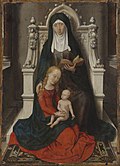
    Hans Memling, reverse of Munich Diptych (1480), Alte Pinakothek, Munich
  • Anna selbdritt (1500), St. Nicholas, Gundelsheim, Germany
    Anna selbdritt (1500), St. Nicholas, Gundelsheim, Germany
  • Leonardo da Vinci's Virgin and Child with Saint Anne (c. 1501–19), Louvre, Paris
    Leonardo da Vinci's Virgin and Child with Saint Anne (c. 1501–19), Louvre, Paris
  • Cartouche with the Virgin and Child and Saint Anne by Daniel Seghers (c. 1590–1661), Dulwich Picture Gallery, London
    Cartouche with the Virgin and Child and Saint Anne by Daniel Seghers (c. 1590–1661), Dulwich Picture Gallery, London
  • The Education of the Virgin
  • Guido Reni (1640–1642)
    Guido Reni (1640–1642)
  • Jean Jouvenet (1700)
    Jean Jouvenet (1700)
  • Josef Winterhalder the Younger (1766)
    Josef Winterhalder the Younger (1766)
  • Eugène Delacroix (1842)
    Eugène Delacroix (1842)
  • Iglesia del Salvador, Seville
    Iglesia del Salvador, Seville
  • Panel of a beehive decorated with St. Anne flanked by flowers, folk art of Slovenia (1842)
    Panel of a beehive decorated with St. Anne flanked by flowers, folk art of Slovenia (1842)

Music

[edit]
  • Marc-Antoine Charpentier composed two motets:
    • Pour Ste Anne, H.315, for two voices and continuo (around 1675)
    • Canticum Annae, H.325, for three voices, two treble instruments, and continuo (around 1680).

See also

[edit]
  • iconCatholic Church portal
  • Church of Saint Anne, Jerusalem – Church in East Jerusalem
  • Church of St. Ann (disambiguation)
  • Feast of the Conception of the Virgin Mary – Liturgical holiday
  • Molo Church – Roman Catholic church in Iloilo City, Philippines
  • Molo, Iloilo City – District of Iloilo City, Philippines
  • Statue of Saint Anne, Charles Bridge – Statue in Prague, Czech Republic
  • St Anne's College, Oxford – College of Oxford University, England
  • The Line of Saint Anne – Painting by Gerard David
  • Virgin and Child with Saint Anne – Subject in Christian art

Notes

[edit]
  1. ^ "O my Lord! I do dedicate into Thee what is in my womb for Thy special service: So accept this of me: For Thou hearest and knowest all things." (Quran 3:35).

References

[edit]
  1. ^ "Saint of the Day". Vatican News. n.d. Retrieved 3 August 2025.
  2. ^ "Lives of all saints commemorated on September 9". oca.org. n.d. Retrieved 3 August 2025.
  3. ^ a b Fongemie, Pauly. "Symbols in Art". Catholic tradition. Retrieved 15 January 2019.
  4. ^ Nixon, Virginia (2004). Mary's Mother: Saint Anne in Late Medieval Europe. The Pennsylvania State University Press. pp. 12–14. ISBN 978-0-271-02466-0.
  5. ^ Procopius' Buildings, Volume I, Chapters 11–12.
  6. ^ "Holy and Righteous Ancestors of God, Joachim and Anna". The Orthodox Faith – Lives of the Saints. The Orthodox Church in America. Retrieved 13 September 2020.
  7. ^ Brecht, Martin (1985). Martin Luther: His Road to Reformation, 1483–1521. Fortress Press. p. 48. ISBN 978-1-4514-1414-1.
  8. ^ a b c Reames, Sherry L., ed. (2003). "Introduction to Legends of St. Anne, Mother of the Virgin Mary". Middle English Legends of Women Saints. Kalamazoo, Michigan: Medieval Institute Publications. Retrieved 31 August 2025.
  9. ^ Ehrman, Bart; Plese, Zlatko (21 July 2011). The Apocryphal Gospels: Texts and Translations. Oxford University Press. ISBN 978-0-19-983128-9.
  10. ^ Wehling, Fr John (2 September 2017). "Excerpts from St John of Damascus: An Oration on the Nativity of the Holy Theotokos Mary". Rogers, Arkansas: St John of Chicago Orthodox Church. Retrieved 29 July 2024.
  11. ^ Holweck, Frederick (1907). "St. Anne". The Catholic Encyclopedia. Vol. 1. New York: Newadvent.org. Retrieved 15 August 2013. The renowned Father John of Eck of Ingolstadt, in a sermon on St. Anne (published at Paris in 1579), pretends to know even the names of the parents St. Anne. He calls them Stollanus and Emerentia. He says that St. Anne was born after Stollanus and Emerentia had been childless for twenty years.
  12. ^ a b c Holweck, Frederick (1907). "St. Anne". The Catholic Encyclopedia. Vol. 1. New York: Newadvent.org. Retrieved 15 August 2013.
  13. ^ Nixon 2004, p. 12.
  14. ^ Butler, Alban (1857). F. C. Husenbeth (ed.). The Lives of the Fathers, Martyrs, and Other Principal Saints. Vol. II. Compiled from the Original Muniments and other Authentic Records. ([With] "The History of the Blessed Virgin Mary" by Abbé Mathieu Orsini, transl. by F. C. Husenbeth). London: Henry & Co. pp. 97 f.
  15. ^ a b c "Lives of Saints, John J. Crawley & Co., Inc". Ewtn.com. Archived from the original on 18 July 2018. Retrieved 15 August 2013.
  16. ^ Welsh, Jennifer. The Cult of St. Anne in Medieval and Early Modern Europe, Routledge, 2016, ISBN 9781134997879
  17. ^ a b "Saint Anne and Saint Joachim, Our Lady of Mt. Carmel Parish, Ottawa, Ontario". Olomc-ottawa.com. Archived from the original on 10 August 2014. Retrieved 15 August 2013.
  18. ^ "The Milky Way Project – It-Triq ta' Sant'Anna | What is the Milky Way?". maltastro.org. Archived from the original on 4 March 2016. Retrieved 2 November 2015.
  19. ^ "State Board Accredits New College". Hartford Courant. Hartford, Connecticut. 26 May 1944. p. 2. Retrieved 2 November 2019 – via newspapers.com.
  20. ^ "The Conception of St. Anne 'When She Conceived the Holy Mother of God', The Byzantine Catholic Archeparchy of Pittsburgh
  21. ^ "Saints and Feasts", on Goarch.org, the homepage of the Greek Orthodox Archdiocese of America.
  22. ^ "The Calendar". The Church of England. Retrieved 27 March 2021.
  23. ^ a b "ИОАКИМ И АННА". www.pravenc.ru. Retrieved 29 May 2022.
  24. ^ "Commemoration of Sts. Joachim and Anna, Parents of the Holy Mother of God, and Oil-Bringing Women". Armenian Church. Retrieved 29 May 2022.
  25. ^ "Syro-Malabar Liturgical Calendar" (PDF).
  26. ^ "The Syro-Malankara Catholic Church – The Sacred Lectionary" (PDF).
  27. ^ "Saint Joseph Maronite Catholic Church" (PDF).
  28. ^ "Arm Reliquary Sainte-Anne-de-Beaupré Shrine, Quebec". Shrinesaintanne.org. 3 July 1960. Archived from the original on 8 May 2013. Retrieved 15 August 2013.
  29. ^ "Flickr photograph of the so-called 'speaking reliquary' (tells the pilgrim what is venerated)" (in German). Flickr.com. 6 October 2010. Retrieved 15 August 2013.
  30. ^ Bender (26 July 2010). "Arm relic Basilica of Saint Paul Outside the Walls|Papal Basilica of Saint Paul Outside the Walls". Vita-nostra-in-ecclesia.blogspot.com. Retrieved 15 August 2013.
  31. ^ Butler, Alban (1987). "Anne, Mother of Our Lady". In Michael Walsh (ed.). Lives of the Patron Saints. Kent: Burns and Oates. pp. 53 f. Archived from the original on 17 April 2016. Retrieved 14 July 2022 – via Mcah.columbia.edu.
  32. ^ "St. Anne – Archdiocese of Detroit". Aod.org. Retrieved 15 August 2013.
  33. ^ Some writers gave her age at death, as part of a general family chronology, but no generally accepted tradition developed on this point, even during the Middle Ages.
  34. ^ a b Wheeler, Brannon M. (2002). Prophets in the Quran: An Introduction to the Quran and Muslim Exegesis. Continuum International. ISBN 0-8264-4957-3.
  35. ^ a b Da Costa, Yusuf (2002). The Honor of Women in Islam. LegitMaddie101. ISBN 1-930409-06-0.

External links

[edit]
Wikimedia Commons has media related to Saint Anne.
Wikiquote has quotations related to Saint Anne.
  • Brief Franciscan Media article on "Sts. Joachim and Ann"
  • "Saint Anne" at the Christian Iconography website
  • "Here Followeth the Nativity of Our Blessed Lady" from the Caxton translation of the Golden Legend
  • The Protevangelium of James
  • The Gospel of Pseudo-Matthew
  • Reames, Sherry L. ed.,"Legends of St. Anne, Mother of the Virgin Mary: Introduction", Middle English Legends of Women Saints, Medieval Institute Publications, Kalamazoo, Michigan, 2003
  • Welsh, Jennifer. The Cult of St. Anne in Medieval and Early Modern Europe. Routledge, 2017.
  • v
  • t
  • e
Mary, mother of Jesus
Family
  • Joseph (husband)
  • Jesus (son)
  • Joachim (father)
  • Anne (mother)
  • Elizabeth
  • Brothers of Jesus
Life
Tradition: early life
  • Immaculate Conception
  • Birth
  • Presentation
  • Marriage to Joseph
    • Perpetual virginity
In the Bible
  • Annunciation
    • Virginal motherhood
  • Visitation
  • Nativity of Jesus
  • Presentation of Jesus
  • Flight into Egypt
  • Return to Nazareth
  • Finding of Jesus in the Temple
  • Miracle at the Wedding at Cana
  • Passion of Jesus
    • Crucifixion
    • Deposition
    • Resurrection
  • Pentecost
Tradition: later life
  • Bilocation to Saint James
  • Dormition
    • Tomb
  • Assumption
  • Coronation
  • Queenship
    • Woman of the Apocalypse
Apocryphal
  • Protoevangelium of James
Mariology
Christian
  • Anglican
  • Catholic
    • history
    • papal
  • Orthodox
  • Protestant
    • Lutheran
Other
  • Islamic
Veneration
  • Apparitions
    • list
  • Catholic churches
  • Christmas
  • Devotions
    • month of May
  • Feast days
  • Patronage
  • Shrines
  • Veneration of Mary in the Catholic Church
Titles
  • Christotokos
  • Coredemptrix
  • Help of Christians
  • Immaculate Heart
  • Life-giving Spring
  • Mediatrix (of all graces)
  • New Eve
  • Panagia
  • Our Lady of Navigators
  • Our Lady of Sorrows
  • Our Lady of Victory
  • Star of the Sea
  • Seat of Wisdom
  • Theotokos
Prayers
  • Angelus
  • Antiphons
    • Alma Redemptoris Mater
    • Ave Regina caelorum
    • Salve Regina
    • Regina caeli
  • Ave Maria
  • Fátima prayers
  • Hymns
    • Akathist
    • Ave maris stella
    • Sub tuum praesidium
  • Litany
    • Loreto
  • Magnificat
  • Maria mater gratiae
  • Memorare
  • Rosary
  • Three Hail Marys
Art
West
  • Assumption
  • Black Madonna
  • Golden Madonna of Essen
  • The Golden Virgin
  • Pietà
  • Queen of Heaven
  • Stabat Mater
East
  • Agiosoritissa
    • Madonna del Rosario
  • Derzhavnaya
  • Eleusa
    • Theotokos of Smolensk
    • Theotokos of Vladimir
  • Hodegetria
Related
  • Life of the Virgin
  • List of depictions of the Virgin and Child
  • Marian art in the Catholic Church
  • Nativity of Jesus in art
  • Saint Luke painting the Virgin
  • Category
  • Saints Portal
  • v
  • t
  • e
Jesus
  • Outline
  • List of topics
Chronology
of Jesus's life
  • Annunciation
  • Nativity
    • Virgin birth
    • Date of birth
    • Flight into Egypt
  • Infancy (apocryphal)
  • Christ Child
  • Unknown years
  • Baptism
  • Temptation
  • Apostles
    • Selecting
  • Ministry
    • Disciples
  • Sermon on the Mount/Plain
    • Beatitudes
  • Prayers
    • Lord's Prayer
  • Parables
  • Miracles
  • Transfiguration
  • Homelessness
  • Great Commandment
  • Olivet Discourse
  • Anointing
  • Passion
    • instruments
  • Entry into Jerusalem
  • Last Supper
    • Farewell Discourse
  • Agony in the Garden
  • Betrayal
  • Arrest
  • Trial
  • Crucifixion
    • Sayings on the cross
    • Instrument used
    • True Cross
  • Burial
    • Tomb
  • Resurrection
  • Great Commission
  • Ascension
New Testament
  • Gospels
    • Matthew
    • Mark
    • Luke
    • John
    • Five Discourses of Matthew
    • Gospel harmony
    • Oral gospel traditions
  • Historical background of the New Testament
  • New Testament places associated with Jesus
  • Names and titles of Jesus in the New Testament
Historical Jesus
  • Quest for the historical Jesus
  • Historicity
    • Sources
      • Josephus
      • Tacitus
      • Mara bar Serapion
      • Gospels
  • Christ myth theory
Depictions
  • Bibliography
  • Life of Christ in art
  • Life of Christ Museum
  • Statues
  • Transfiguration
Christianity
  • Christ
    • Christianity
    • 1st century
  • Christology
    • Incarnation
    • Person of Christ
    • Pre-existence
  • "I am"
  • Relics
  • Second Coming
  • Session of Christ
  • Son of God
  • Cosmic Christ
In other faiths
  • Jesuism
  • In comparative mythology
  • Judaism
    • In the Talmud
  • Islam
    • Ahmadiyya
  • Baháʼí Faith
  • Manichaeism
    • Jesus the Splendour
  • Mandaeism
  • Master Jesus
Family
  • Genealogies
  • Mary (mother)
  • Joseph (legal father)
  • Holy Family
  • Panthera (alleged father)
  • Brothers of Jesus
  • Holy Kinship
  • Anne (traditional maternal grandmother)
  • Joachim (traditional maternal grandfather)
  • Heli (paternal grandfather per Luke)
  • Jacob (paternal grandfather per Matthew)
  • Alleged descendants
  • Clopas (traditional uncle)
Related
  • Language of Jesus
  • Interactions with women
    • Mary Magdalene
    • Mary, sister of Martha
  • Christmas
  • Easter
  • Rejection of Jesus
  • Criticism
  • Mental health
  • Race and appearance
  • Sexuality and marital status
  • Church of the Nativity
  • Church of the Holy Sepulchre
  • The Garden Tomb
  • Shroud of Turin
  • Category
  • v
  • t
  • e
Islamic honored women
Generations of Adam
  • Hawwa
Generations of Ibrāhīm and his sons
  • Sarah
  • Hājar
  • Rafqā
  • Rāḥīl
Generation of Mūsa
  • Asiya
  • Yukabad
  • Maryam
  • Ṣaffūrah
Reign of Kings
  • Bathsheba
  • Bilqis, the Queen of Sheba
House of Imran
  • Hanna
  • Maryam
  • al-Ishabʿ
Time of Muhammad
  • Aminah
  • Halimah al-Sa'diyah
  • Mothers of the Believers
  • Khadija
  • Aisha
  • Fatima
  • Zaynab bint Ali
  • v
  • t
  • e
People and things in the Quran
Characters
Non-humans
  • Allāh ('The God')
    • Names of Allah found in the Quran, such as Karīm (Generous)
Animals
Related
  • The baqara (cow) of Israelites
  • The dhiʾb (wolf) that Jacob feared could attack Joseph
  • The fīl (elephant) of the Abyssinians
  • Ḥimār (Domesticated donkey)
  • The hud-hud (hoopoe) of Solomon
  • The kalb (dog) of the sleepers of the cave
  • The namlah (female ant) of Solomon
  • The nūn (fish or whale) of Jonah
  • The nāqat (she-camel) of Ṣāliḥ
Non-related
  • ʿAnkabūt (Female spider)
  • Dābbat al-Arḍ (Beast of the Earth)
  • Ḥimār (Wild ass)
  • Naḥl (Honey bee)
  • Qaswarah ('Lion', 'beast of prey' or 'hunter')
Malāʾikah (Angels)
  • Angels of Hell
    • Mālik
    • Zabāniyah
  • Bearers of the Throne
  • Harut and Marut
  • Jundallah
  • Kirāman Kātibīn (Honourable Scribes)
    • Raqib
    • Atid
Muqarrabun
  • Jibrīl (Gabriel, chief)
    • Ar-Rūḥ ('The Spirit')
      • Ar-Rūḥ al-Amīn ('The Trustworthy Spirit')
      • Ar-Rūḥ al-Qudus ('The Holy Spirit')
  • Angel of the Trumpet (Isrāfīl or Raphael)
  • Malakul-Mawt (Angel of Death, Azrael)
  • Mīkāil (Michael)
Jinn (Genies)
  • Jann
  • ʿIfrīt
  • Sakhr (Asmodeus)
  • Qarīn
Shayāṭīn (Demons)
  • Iblīs ash-Shayṭān (the (chief) Devil)
  • Mārid ('Rebellious one')
Others
  • Ghilmān or Wildān
  • Ḥūr
Prophets
Mentioned
  • Ādam (Adam)
  • Al-Yasaʿ (Elisha)
  • Ayyūb (Job)
  • Dāwūd (David)
  • Dhūl-Kifl (Ezekiel?)
  • Hārūn (Aaron)
  • Hūd (Eber?)
  • Idrīs (Enoch?)
  • Ilyās (Elijah)
  • ʿImrān (Joachim the father of Maryam)
  • Isḥāq (Isaac)
  • Ismāʿīl (Ishmael)
    • Dhabih Ullah
  • Lūṭ (Lot)
  • Ṣāliḥ
  • Shuʿayb (Jethro, Reuel or Hobab?)
  • Sulaymān ibn Dāwūd (Solomon son of David)
  • Yaḥyā ibn Zakariyyā (John the Baptist the son of Zechariah)
  • Yaʿqūb (Jacob)
    • Isrāʾīl (Israel)
  • Yūnus (Jonah)
    • Dhūn-Nūn ('He of the Fish (or Whale)' or 'Owner of the Fish (or Whale)')
    • Ṣāḥib al-Ḥūt ('Companion of the Whale')
  • Yūsuf ibn Ya‘qūb (Joseph son of Jacob)
  • Zakariyyā (Zechariah)
Ulul-ʿAzm
('Those of the
Perseverance
and Strong Will')
  • Muḥammad
    • Aḥmad
    • Other names and titles of Muhammad
  • ʿĪsā (Jesus)
    • Al-Masīḥ (The Messiah)
    • Ibn Maryam (Son of Mary)
  • Mūsā Kalīmullāh (Moses He who spoke to God)
  • Ibrāhīm Khalīlullāh (Abraham Friend of God)
  • Nūḥ (Noah)
Debatable ones
  • ʿUzair (Ezra?)
  • Dhūl-Qarnain
  • Luqmān
  • Maryam (Mary)
  • Ṭālūt (Saul or Gideon?)
Implied
  • Irmiyā (Jeremiah)
  • Ṣamūʾīl (Samuel)
  • Yūshaʿ ibn Nūn (Joshua, companion and successor of Moses)
People of Prophets
Good ones
  • Adam's immediate relatives
    • Martyred son
    • Wife
  • Believer of Ya-Sin
  • Family of Noah
    • Father Lamech
    • Mother Shamkhah bint Anush or Betenos
  • Luqman's son
  • People of Abraham
    • Mother Abiona or Amtelai the daughter of Karnebo
    • Ishmael's mother
    • Isaac's mother
  • People of Jesus
    • Disciples (including Peter)
    • Mary's mother
    • Zechariah's wife
  • People of Solomon
    • Mother
    • Queen of Sheba
    • Vizier
  • Zayd (Muhammad's adopted son)
People of
Joseph
  • Brothers (including Binyāmin (Benjamin) and Simeon)
  • Egyptians
    • ʿAzīz (Potiphar, Qatafir or Qittin)
    • Malik (King Ar-Rayyān ibn Al-Walīd))
    • Wife of ʿAzīz (Zulaykhah)
  • Mother
People of
Aaron and Moses
  • Egyptians
    • Believer (Hizbil or Hizqil ibn Sabura)
    • Imraʾat Firʿawn (Āsiyá bint Muzāḥim the Wife of Pharaoh, who adopted Moses)
    • Magicians of the Pharaoh
  • Wise, pious man
  • Moses' wife
  • Moses' sister-in-law
  • Mother
  • Sister
Evil ones
  • Āzar (possibly Terah)
  • Firʿawn (Pharaoh of Moses' time)
  • Hāmān
  • Jālūt (Goliath)
  • Qārūn (Korah, cousin of Moses)
  • As-Sāmirī
  • Abū Lahab
  • Slayers of Ṣāliḥ's she-camel (Qaddar ibn Salif and Musda' ibn Dahr)
Implied or
not specified
  • Abraha
  • Abu Bakr
  • Bal'am/Balaam
  • Barṣīṣā
  • Caleb or Kaleb the companion of Joshua
  • Luqman's son
  • Nebuchadnezzar II
  • Nimrod
  • Rahmah the wife of Ayyub
  • Shaddad
Groups
Mentioned
  • Aṣḥāb al-Jannah
    • People of Paradise
    • People of the Burnt Garden
  • Aṣḥāb as-Sabt (Companions of the Sabbath)
  • Jesus' apostles
    • Ḥawāriyyūn (Disciples of Jesus)
  • Companions of Noah's Ark
  • Aṣḥāb al-Kahf war-Raqīm (Companions of the Cave and Al-Raqaim?
  • Companions of the Elephant
  • People of al-Ukhdūd
  • People of a township in Surah Ya-Sin
  • People of Yathrib or Medina
  • Qawm Lūṭ (People of Sodom and Gomorrah)
  • Nation of Noah
Tribes,
ethnicities
or families
  • ‘Ajam
  • Ar-Rūm (literally 'The Romans')
  • Banī Isrāʾīl (Children of Israel)
  • Muʾtafikāt (Sodom and Gomorrah)
  • People of Ibrahim
  • People of Ilyas
  • People of Nuh
  • People of Shuaib
    • Ahl Madyan People of Madyan)
    • Aṣḥāb al-Aykah ('Companions of the Wood')
  • Qawm Yūnus (People of Jonah)
  • Ya'juj and Ma'juj/Gog and Magog
  • People of Fir'aun
  • Current Ummah of Islam (Ummah of Muhammad)
    • Aṣḥāb Muḥammad (Companions of Muhammad)
      • Anṣār (literally 'Helpers')
      • Muhajirun (Emigrants from Mecca to Medina)
  • People of Mecca
    • Wife of Abu Lahab
  • Children of Ayyub
  • Sons of Adam
  • Wife of Nuh
  • Wife of Lut
  • Yaʾjūj wa Maʾjūj (Gog and Magog)
  • Son of Nuh
Aʿrāb (Arabs
or Bedouins)
  • ʿĀd (people of Hud)
  • Companions of the Rass
  • Qawm Tubbaʿ (People of Tubba)
    • People of Sabaʾ or Sheba
  • Quraysh
  • Thamūd (people of Ṣāliḥ)
    • Aṣḥāb al-Ḥijr ('Companions of the Stoneland')
Ahl al-Bayt
('People of the
Household')
  • Household of Abraham
    • Brothers of Yūsuf
    • Lot's daughters
    • Progeny of Imran
  • Household of Moses
  • Household of Muhammad
    • ibn Abdullah ibn Abdul-Muttalib ibn Hashim
    • Daughters of Muhammad
    • Muhammad's wives
  • Household of Salih
Implicitly
mentioned
  • Amalek
  • Ahl as-Suffa (People of the Verandah)
  • Banu Nadir
  • Banu Qaynuqa
  • Banu Qurayza
  • Iranian people
  • Umayyad Dynasty
  • Aus and Khazraj
  • People of Quba
Religious
groups
  • Ahl al-Dhimmah
  • Kāfirūn
    • disbelievers
  • Majūs Zoroastrians
  • Munāfiqūn (Hypocrites)
  • Muslims
    • Believers
  • Ahl al-Kitāb (People of the Book)
    • Naṣārā (Christian(s) or People of the Injil)
      • Ruhban (Christian monks)
      • Qissis (Christian priest)
    • Yahūd (Jews)
      • Ahbār (Jewish scholars)
      • Rabbani/Rabbi
    • Sabians
  • Polytheists
    • Meccan polytheists at the time of Muhammad
    • Mesopotamian polytheists at the time of Abraham and Lot
Locations
Mentioned
  • Al-Arḍ Al-Muqaddasah ('The Holy Land')
    • 'Blessed' Land'
  • Al-Jannah (Paradise, literally 'The Garden')
  • Jahannam (Hell)
  • Door of Hittah
  • Madyan (Midian)
  • Majmaʿ al-Baḥrayn
  • Miṣr (Mainland Egypt)
  • Salsabīl (A river in Paradise)
In the
Arabian Peninsula
(excluding Madyan)
  • Al-Aḥqāf ('The Sandy Plains,' or 'the Wind-curved Sand-hills')
    • Iram dhāt al-ʿImād (Iram of the Pillars)
  • Al-Madīnah (formerly Yathrib)
  • ʿArafāt and Al-Mashʿar Al-Ḥarām (Muzdalifah)
  • Al-Ḥijr (Hegra)
  • Badr
  • Ḥunayn
  • Makkah (Mecca)
    • Bakkah
    • Ḥaraman Āminan ('Sanctuary (which is) Secure')
    • Kaʿbah (Kaaba)
    • Maqām Ibrāhīm (Station of Abraham)
    • Safa and Marwa
  • Sabaʾ (Sheba)
    • ʿArim Sabaʾ (Dam of Sheba)
  • Rass
Sinai Region
or Tīh Desert
  • Al-Wād Al-Muqaddas Ṭuwan (The Holy Valley of Tuwa)
    • Al-Wādil-Ayman (The valley on the 'righthand' side of the Valley of Tuwa and Mount Sinai)
      • Al-Buqʿah Al-Mubārakah ('The Blessed Place')
  • Mount Sinai or Mount Tabor
In Mesopotamia
  • Al-Jūdiyy
    • Munzalanm-Mubārakan ('Place-of-Landing Blessed')
  • Bābil (Babylon)
  • Qaryat Yūnus ('Township of Jonah,' that is Nineveh)
Religious
locations
  • Bayʿa (Church)
  • Miḥrāb
  • Monastery
  • Masjid (Mosque, literally 'Place of Prostration')
    • Al-Mashʿar Al-Ḥarām ('The Sacred Grove')
    • Al-Masjid Al-Aqṣā (Al-Aqsa, literally 'The Farthest Place-of-Prostration')
    • Al-Masjid Al-Ḥarām (The Sacred Mosque of Mecca)
    • Masjid al-Dirar
    • A Mosque in the area of Medina, possibly:
      • Masjid Qubāʾ (Quba Mosque)
      • The Prophet's Mosque
  • Salat (Synagogue)
Implied
  • Antioch
    • Antakya
  • Arabia
    • Al-Ḥijāz (literally 'The Barrier')
      • Al-Ḥajar al-Aswad (Black Stone) & Al-Hijr of Isma'il
      • Cave of Hira
      • Ghār ath-Thawr (Cave of the Bull)
      • Hudaybiyyah
      • Ta'if
  • Ayla
  • Barrier of Dhul-Qarnayn
  • Bayt al-Muqaddas & 'Ariha
  • Bilād ar-Rāfidayn (Mesopotamia)
  • Canaan
  • Cave of Seven Sleepers
  • Dār an-Nadwa
  • Jordan River
  • Nile River
  • Palestine River
  • Paradise of Shaddad
Events, incidents, occasions or times
  • Incident of Ifk
  • Laylat al-Qadr (Night of Decree)
  • Event of Mubahala
  • Sayl al-ʿArim (Flood of the Great Dam of Ma'rib in Sheba)
  • The Farewell Pilgrimage
  • Treaty of Hudaybiyyah
Battles or
military expeditions
  • Battle of al-Aḥzāb ('the Confederates')
  • Battle of Badr
  • Battle of Hunayn
  • Battle of Khaybar
  • Battle of Uhud
  • Expedition of Tabuk
  • Conquest of Mecca
Days
  • Al-Jumuʿah (The Friday)
  • As-Sabt (The Sabbath or Saturday)
  • Days of battles
  • Days of Hajj
  • Doomsday
Months of the
Islamic calendar
  • 12 months
    • Ash-Shahr Al-Ḥarām (The Sacred or Forbidden Months:
      • Dhu al-Qadah
      • Dhu al-Hijjah
      • Muharram
      • Rajab)
    • Ramadan
Pilgrimages
  • Al-Ḥajj (literally 'The Pilgrimage', the Greater Pilgrimage)
  • Al-ʿUmrah (The Lesser Pilgrimage)
Times for prayer
or remembrance
Times for Duʿāʾ ('Invocation'), Ṣalāh and Dhikr ('Remembrance', including Taḥmīd ('Praising'), Takbīr and Tasbīḥ):
  • Al-ʿAshiyy (The Afternoon or the Night)
  • Al-Ghuduww ('The Mornings')
    • Al-Bukrah ('The Morning')
    • Aṣ-Ṣabāḥ ('The Morning')
  • Al-Layl ('The Night')
    • Al-ʿIshāʾ ('The Late-Night')
  • Aẓ-Ẓuhr ('The Noon')
  • Dulūk ash-Shams ('Decline of the Sun')
    • Al-Masāʾ ('The Evening')
    • Qabl al-Ghurūb ('Before the Setting (of the Sun)')
      • Al-Aṣīl ('The Afternoon')
      • Al-ʿAṣr ('The Afternoon')
  • Qabl ṭulūʿ ash-Shams ('Before the rising of the Sun')
    • Al-Fajr ('The Dawn')
Implied
  • Ghadir Khumm
  • Laylat al-Mabit
  • First Pilgrimage
  • Other
    Holy books
    • Al-Injīl (The Gospel of Jesus)
    • Al-Qurʾān (The Book of Muhammad)
    • Ṣuḥuf-i Ibrāhīm (Scroll(s) of Abraham)
    • At-Tawrāt (The Torah)
      • Ṣuḥuf-i-Mūsā (Scroll(s) of Moses)
      • Tablets of Stone
    • Az-Zabūr (The Psalms of David)
    • Umm al-Kitāb ('Mother of the Book(s)')
    Objects
    of people
    or beings
    • Heavenly food of Jesus' apostles
    • Noah's Ark
    • Staff of Musa
    • Tābūt as-Sakīnah (Casket of Shekhinah)
    • Throne of Bilqis
    • Trumpet of Israfil
    Mentioned idols
    (cult images)
    • 'Ansāb
    • Jibt and Ṭāghūt (False god)
    Of Israelites
    • Baʿal
    • The ʿijl (golden calf statue) of Israelites
    Of Noah's people
    • Nasr
    • Suwāʿ
    • Wadd
    • Yaghūth
    • Yaʿūq
    Of Quraysh
    • Al-Lāt
    • Al-ʿUzzā
    • Manāt
    Celestial
    bodies
    Maṣābīḥ (literally 'lamps'):
    • Al-Qamar (The Moon)
    • Kawākib (Planets)
      • Al-Arḍ (The Earth)
    • Nujūm (Stars)
      • Ash-Shams (The Sun)
    Plant matter
  • Baṣal (Onion)
  • Fūm (Garlic or wheat)
  • Shaṭʾ (Shoot)
  • Sūq (Plant stem)
  • Zarʿ (Seed)
  • Fruits
    • ʿAdas (Lentil)
    • Baql (Herb)
    • Qith-thāʾ (Cucumber)
    • Rummān (Pomegranate)
    • Tīn (Fig)
    • Zaytūn (Olive)
    • In Paradise
      • Forbidden fruit of Adam
    Bushes, trees
    or plants
    • Plants of Sheba
      • Athl (Tamarisk)
      • Sidr (Lote-tree)
    • Līnah (Tender Palm tree)
    • Nakhl (Date palm)
    • Sidrat al-Muntahā
    • Zaqqūm
    Liquids
    • Māʾ (Water or fluid)
      • Nahr (River)
      • Yamm (River or sea)
    • Sharāb (Drink)
    Note: Names are sorted alphabetically. Standard form: Islamic name / Biblical name (title or relationship)
    Authority control databases Edit this at Wikidata
    International
    • ISNI
    • VIAF
    • GND
    • FAST
    • WorldCat
    National
    • United States
    • Czech Republic
    • Poland
    • Israel
    Artists
    • KulturNav
    People
    • Deutsche Biographie
    • DDB
    Other
    • Yale LUX
    Retrieved from "https://teknopedia.ac.id/w/index.php?title=Saint_Anne&oldid=1339472129"
    Categories:
    • Islam and women
    • Saint Anne
    • Ancient Christian female saints
    • 1st-century BCE Jews
    • Angelic visionaries
    • Anglican saints
    • Genealogy of Jesus
    • Joachim
    • Mary, mother of Jesus
    • New Testament apocrypha people
    • People of the Quran
    • Saints from the Holy Land
    • Judean people
    Hidden categories:
    • CS1 German-language sources (de)
    • Articles with short description
    • Short description is different from Wikidata
    • Use dmy dates from November 2025
    • Articles containing Hebrew-language text
    • Articles containing Arabic-language text
    • Commons category link is on Wikidata

    • indonesia
    • Polski
    • العربية
    • Deutsch
    • English
    • Español
    • Français
    • Italiano
    • مصرى
    • Nederlands
    • 日本語
    • Português
    • Sinugboanong Binisaya
    • Svenska
    • Українська
    • Tiếng Việt
    • Winaray
    • 中文
    • Русский
    Sunting pranala
    url url url url url url url url url url url url url url url url url url url url url url url url url url url url url url url url url url url url url url url url url url url url url url url url url url url url url url url url url url url url url url url url url url url url url url url url url url url url url url url url url url url url url url url url url url url url url url url url url url url url url url url url url url url url url url url url url url url url url url url url url url url url url url url url url url url url url url url url url url url url url url url url url url url url url url url url url url url url url url url url url url url url url url url url url url url url url url url url url url url url url url url url url url url url url url url url url url url url url url url url url url url url url url url url url url url url url url url url url url url url url url url url url url url url url url url url url url url url url url url url url url url url url url url url url url url url url url url url url url url url url url url url url url url url url url url url url url url url url url url url url url url url url url url url url url url url url url url url url url url url url url url url url url url url url url url url url url url url url url url url url url url url url url url url url url url url url url url url url url url url url url url url url url url url url url url url url url url url url url url url url url url url url url url url url url url url url url url url url url url url url url url url url url url url url url url url url url url url url url url url url url url url url url url url url url url url url url url url url url url url url url url url url url url url url url url url url url url url url url url url url url url url url url url url url url url url url url url url url url url url url url url url url url url url url url url url url url url url url url url url url url url url url url url url url url url url url url url url url url url url url url url url url url url url url url url url url url url url url url url url url url url url url url url url url url url url url url url url url url url url url url url url url url url url url url url url url url url url url url url url url url url url url url url url url url url url url url url url url url url url url url url url url url url url url url url url url url url url url url url url url url url url url url url url url url url url url url url url url url url url url url url url url url url url url url url url url url url url url url url url url url url url url url url url url url url url url url url url url url url url url url url url url url url url url url url url url url url url url url url url url url url url url url url url url url url url url url url url url url url url url url url url url url url url url url url url url url url url url url url url url url url url url url url url url url url url url url url url url url url url url url url url url url url url url url url url url url url url url url url url url url url url url url url url url url url url url url url url url url url url url url url url url url url url url url url url url url url url url url url url url url url url url url url url url url url url url url url url url url url url url url url url url url url url url url url url url url url url url url url url url url url url url url url url url url url url url url url url url url url url url url url url url url url url url url url url url url url url url url url url url url url url url url url url url url url url url url url url url url url url url url url url url url url url url url url url url url url url url url url url url url url url url url url url url url url url url url url url url url url url url url url url url url url url url url url url url url url url url url url url url url url url url url url url url url url url url url url url url url url url url url url url url url url url url url url url url url url url url url url url url url url url url url url url url url url url url url url url url url url url url url url url url url url url url url url url url url url url url url url url url url url url url url url url url url url url url url url url url url url url url url url url url url url url url url url url url url url url url url url url url url url url url url url url url url url url url url url url url url url url url url url url url url url url url url url url url url url url url url url url url url url url url url url url url url url url url url url url url url url url url url url url url url url url url url url url url url url url url url url url url url url url url url url url url url url url url url url url url url url url url url url url url url url url url url url url url url url url url url url url url url url url url url url url url url url url url url url url url url url url url url url url url url url url url url url url url url url url url url url url url url url url url url url url url url url url url url url url url url url url url url url url url url url url url url url url url url url url url url url url url url url url url url url url url url url url url url url url url url url url url url url url url url url url url url url url url url url url url url url url url url url url url url url url url url url url url url url url url url url url url url url url url url url url url url url url url url url url url url url url url url url url url url url url url url url url url url url url url url url url url url url url url url url url url url url url url url url url url url url url url url url url url url url url url url url url url url url url url url url url url url url url url url url url url url url url url url url url url url url url url url url url url url url url url url url url url url url url url url url url url url url url url url url url url url url url url url url url url url url url url url url url url url url url url url url url url url url url url url url url url url url url url url url url url url url url url url url url url url url url url url url url url url url url url url url url url url url url url url url url url url url url url url url url url url url url url url url url url url url url url url url url url url url url url url url url url url url url url url url url url url url url url url url url url url url url url url url url url url url url url url url url url url url url url url url url url url url url url url url url url url url url url url url url url url url url url url url url url url url url url url url url url url url url url url url url url url url url url url url url url url url url url url url url url url url url url url url url url url url url url url url url url url url url url url url url url url url url url url url url url url url url url url url url url url url url url url url url url url url url url url url url url url url url url url url url url url url url url url url url url url url url url url url url url url url url url url url url url url url url url url url url url url url url url url url url url url url url url url url url url url url url url url url url url url url url url url url url url url url url url url url url url url url url url url url url url url url url url url url url url url url url url url url url url url url url url url url url url url url url url url url url url url url url url url url url url url url url url url url url url url url url url url url url url url url url url url url url url url url url url url url url url url url url url url url url url url url url url url url url url url url url url url url url url url url url url url url url url url url url url url url url url url url url url url url url url url url url url url url url url url url url url url url url url url url url url url url url url url url url url url url url url url url url url url url url url url url url url url url url url url url url url url url url url url url url url url url url url url url url url url url url url url url url url url url url url url url url url url url url url url url url url url url url url url url url url url url url url url url url url url url url url url url url url url url url url url url url url url url url url url url url url url url url url url url url url url url url url url url url url url url url url url url url url url url url url url url url url url url url url url url url url url url url url url url url url url url url url url url url url url url url url url url url url url url url url url url url url url url url url url url url url url url url url url url url url url url url url url url url url url url url url url url url url url url url url url url url url url url url url url url url url url url url url url url url url url url url url url url url url url url url url url url url url url url url url url url url url url url url url url url url url url url url url url url url url url url url url url url url url url url url url url url url url url url url url url url url url url url url url url url url url url url url url url url url url url url url url url url url url url url url url url url url url url url url url url url url url url url url url url url url url url url url url url url url url url url url url url url url url url url url url url url url url url url url url url url url url url url url url url url url url url url url url url url url url url url url url url url url url url url url url url url url url url url url url url url url url url url url url url url url url url url url url url url url url url url url url url url url url url url url url url url url url url url url url url url url url url url url url url url url
    Pusat Layanan

    UNIVERSITAS TEKNOKRAT INDONESIA | ASEAN's Best Private University
    Jl. ZA. Pagar Alam No.9 -11, Labuhan Ratu, Kec. Kedaton, Kota Bandar Lampung, Lampung 35132
    Phone: (0721) 702022
    Email: pmb@teknokrat.ac.id